
What does it take to achieve entrepreneurial success? Is it sheer hard work, or a specific set of characteristics that define great entrepreneurs? These questions are not abstract for small business owners and fearless entrepreneurs — they are essential to anyone who dreams of building, scaling, or leading a successful business. This article Essential Entrepreneur Traits for Fearless Business Growth Now! has been written from personal experience.
Peter Drucker once said, “The best way to predict the future is to create it.” That line captures the essence of the entrepreneurial spirit. The traits of successful entrepreneurs — resilience, innovation, strategic thinking, and adaptability — are the tools that allow ordinary people to build extraordinary ventures.
In my own entrepreneurial journey, I’ve started many businesses. I learned early that business success is about more than luck; it requires clear vision, strong work ethic, and constant problem-solving. Over time, I discovered that mastering these entrepreneurial traits determines whether your great idea becomes a successful venture or just another dream. Check out our entire series on starting a business here.
- Take our personality quiz below
- Quiz: Do You Have the Entrepreneurial Personality?
- 1) I enjoy exploring new ideas and creative solutions.
- 2) I’m comfortable making decisions when outcomes are uncertain.
- 3) I believe I can reach my goals despite setbacks.
- 4) I take initiative without waiting for permission or direction.
- 5) I bounce back quickly after failures or disappointments.
- 6) I adapt quickly when circumstances change unexpectedly.
- 7) I enjoy networking and confidently sharing my ideas.
- 8) I’m willing to invest time or money without guaranteed results.
- 9) I stay persistent and motivated even when progress is slow.
- 10) I actively look for opportunities to improve or grow a venture.
- Your Score: 0 / 50
- 1. Vision and Purpose
- 2. Self-Motivation and Discipline
- 3. Risk Tolerance and the Power of Plan B
- 4. Creativity and Innovation
- 5. Adaptability
- 6. Persistence
- 7. Customer Empathy
- Take our Reflection Quiz below:
- 📊 Reflection Quiz: Where Do You Stand Now?
- 8. Financial Awareness — You Are Not a Charity
- 9. Systems Thinking and Delegation
- 10. Emotional Resilience
- 11. Networking and Relationship Building
- 12. Confidence and Optimism
- 13. Lifelong Learning
- The Bottom Line
- Continue Your Entrepreneurial Journey
- Frequently Asked Questions About Entrepreneurial Traits and Success
- Frequently Asked Questions About Entrepreneurial Traits and Success
- 1. What are the most important traits of successful entrepreneurs?
- 2. Is having a great idea enough to build a successful business?
- 3. How important is hard work in the entrepreneurial journey?
- 4. Why do so many small businesses fail in the first five years?
- 5. What is meant by “entrepreneurial spirit”?
- 6. How does emotional intelligence help entrepreneurs?
- 7. Do all entrepreneurs need to be natural risk-takers?
- 8. Why is having a Plan B so important for entrepreneurs?
- 9. What does “you are not a charity” mean in a business context?
- 10. How can delegation help a business grow faster?
- 11. Are there different types of entrepreneurs?
- 12. Can entrepreneurial traits be learned, or are they inborn?
- 13. How important is networking for business success?
- 14. Do I need a detailed business plan to start a new venture?
- 15. What is the single most important trait for long-term entrepreneurial success?
Take our personality quiz below
Quiz: Do You Have the Entrepreneurial Personality?
Rate each statement from 1 (Strongly Disagree) to 5 (Strongly Agree). When you’re done, click See My Results.
Your Score: 0 / 50
1. Vision and Purpose
Every good entrepreneur starts with visionary thinking. Vision gives you direction when everything else feels uncertain. It’s your “why” — the reason you get up early, stay up late, and push through long hours.
A strong vision should go beyond profit. It’s about solving customer needs, creating new opportunities, and making a lasting impact on your community or industry.
Successful business owners with a clear vision make better business decisions. They align their business plan and long-term goals with a strong purpose, giving team members motivation to perform their best.
Entrepreneurs who embody this essential trait attract potential investors and employees who share their enthusiasm. Visionary leaders don’t wait for business opportunities — they create them. Check out this article on the best business you can start.
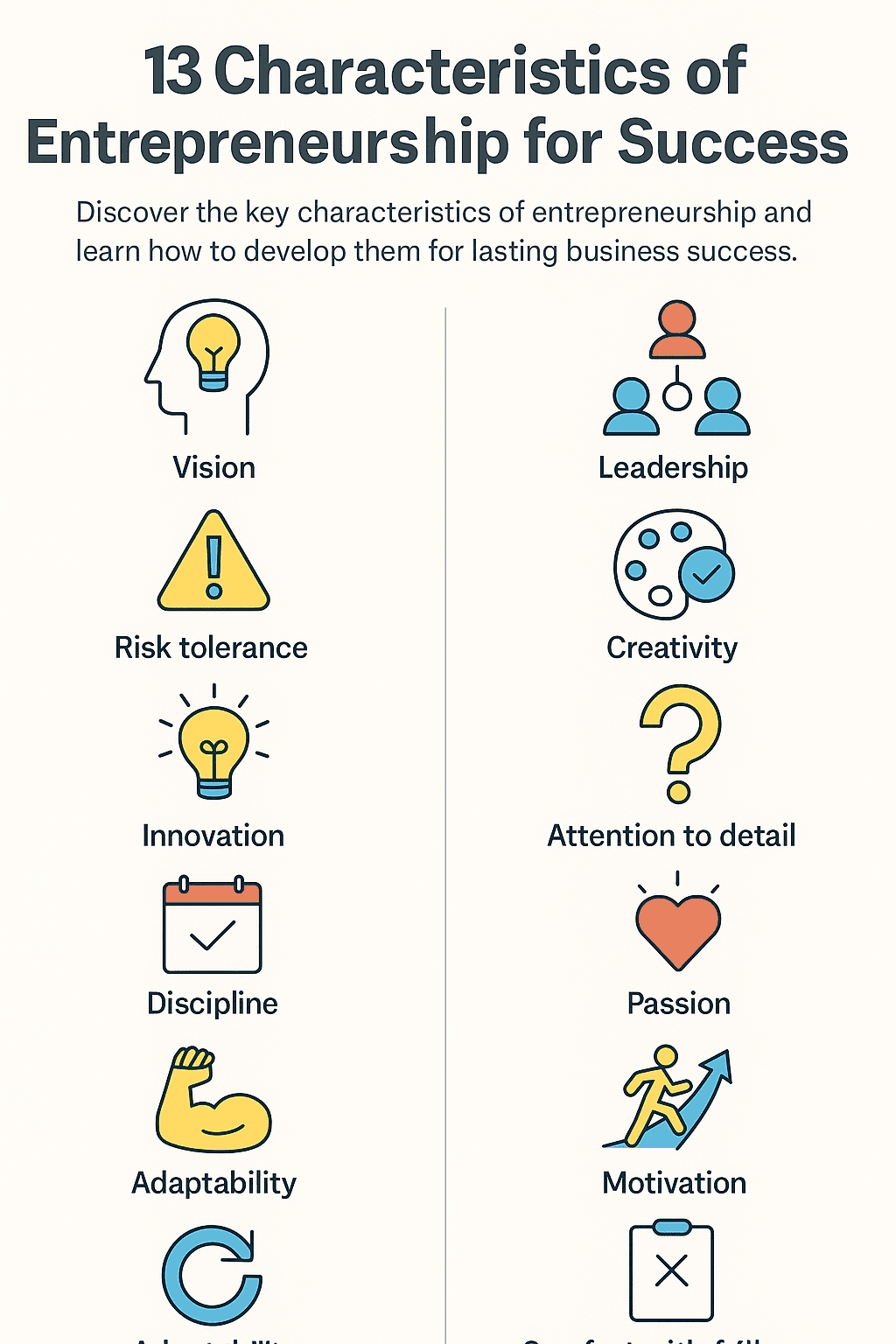
2. Self-Motivation and Discipline
No one can motivate you except yourself. That’s one of the most important characteristics of successful entrepreneurs.
Discipline and a strong work ethic turn new ideas into real businesses. Entrepreneurs with this personality trait don’t rely on inspiration — they rely on consistency. They plan their days, track progress, and stay focused even when results take time.
When I launched my own ventures, I learned that self-motivation separates those who talk from those who build. Entrepreneurship rewards perseverance and clear daily habits.
It’s not always easy — long hours, uncertainty, and financial strain are real. But consistent effort compounds over time. That’s how great entrepreneurs turn vision into reality.
3. Risk Tolerance and the Power of Plan B
Entrepreneurs take calculated risks. Risk tolerance is one of the most essential traits in any successful business owner. It’s not about gambling; it’s about confidence in your research, instincts, and preparation.
Smart entrepreneurs balance courage with caution through strong business models and sound strategic planning. They use market research, critical thinking, and cash flow forecasting to manage uncertainty.
Plan B
I learned early that every entrepreneur must have a Plan B. What if your customer fails to pay and your capital is stretched thin? What if a high-value contract is delayed and your cash flow dries up? Successful entrepreneurs think like gymnasts — flexible and ready to pivot before problems grow. The ability to maneuver quickly and fix issues before they escalate is the mark of a resilient business leader.
Adaptable entrepreneurs understand that setbacks are part of the game. Having a Plan B ensures your new business venture can survive tough times and emerge stronger.

4. Creativity and Innovation
Innovation and creative thinking drive business success. Great entrepreneurs challenge the status quo, turning bold ideas into innovative solutions that serve customer needs.
Creativity isn’t just about inventing new products — it’s about improving existing business practices. Entrepreneurs who stay curious and push boundaries often find simple ways to make complex problems disappear.
Steve Jobs, for example, embodied this entrepreneurial skill. He saw what didn’t exist yet and had the courage to create it. From personal computers to smartphones, his creativity reshaped the business world.
Cultivate creativity by exploring beyond your comfort zone. Read widely, talk to other business leaders, and expose yourself to new ideas. Innovation flourishes when you stay open-minded and inspired.
5. Adaptability
Markets shift fast. Technology evolves, customer expectations change, and new competitors appear overnight. Adaptable entrepreneurs are those who pivot quickly and see disruption as opportunity.
Every successful venture, from small businesses to social entrepreneurs, relies on flexibility. When one business strategy stops working, agile leaders adjust and find a better model.
Those who cling to old ways risk being left behind. Business success demands continuous learning, experimentation, and a positive attitude toward change.

6. Persistence
Persistence is the invisible force behind every successful business owner. Starting your own business means facing failure, fatigue, and fear — but persistence transforms those challenges into growth.
Thomas Edison once said, “I have not failed. I’ve just found 10,000 ways that won’t work.” That quote embodies entrepreneurial spirit.
I’ve had business ideas that didn’t pan out, deals that fell through, and clients that disappeared. Yet persistence kept me moving forward until I found what worked. Every setback strengthened my leadership skills and business strategy.
Persistence turns lessons into long-term success.
7. Customer Empathy
Customer empathy is one of the most overlooked entrepreneurial characteristics — yet it plays a pivotal role in long-term growth. Great entrepreneurs listen deeply and anticipate customer needs before they’re voiced.
Over the years, I’ve learned to live by an old rule: “get more from the same customer.” That means building strong relationships and truly understanding what matters to them.
By engaging in genuine conversations — sometimes over lunch or coffee — I’ve discovered countless new opportunities to serve my clients better.
One memorable experience came from a loyal customer who owned an auto repair shop. He mentioned that his church was helping a reservation in Arizona build wind power for electricity. I had a large truck alternator in my shop that could solve the problem, so I gave it to him and explained how to set it up. The project succeeded — and that customer remained one of my best for years.
That’s the kind of relationship every entrepreneur should aim for: long-term loyalty built on genuine care and creative problem-solving skills. Essential Entrepreneur Traits for Fearless Business Growth.
Take our Reflection Quiz below:
📊 Reflection Quiz: Where Do You Stand Now?
Now that you’ve read about the essential entrepreneur traits, take this short reflection quiz to see how your confidence and readiness have grown.
8. Financial Awareness — You Are Not a Charity
In business, generosity must be strategic. Unless you run a nonprofit, remember: you’re not a charity.
Entrepreneurial success requires clear boundaries. Money is how we keep score in the business world — not out of greed, but out of accountability and sustainability.
You Are Not a Charity
Don’t give away products or services unless there’s a clear business reason. Years ago, a customer couldn’t pay me for auto parts, so I accepted his old pickup truck instead. After some work, I sold it for far more than he owed. That lesson stayed with me: profit isn’t selfish — it’s what allows small businesses to grow, hire team members, and continue serving their communities.
If someone owes you, find a fair way to collect or trade value. Financial discipline ensures your entrepreneurial journey continues and your company remains healthy.
9. Systems Thinking and Delegation
Systems thinking is what turns a one-person hustle into a scalable business. It’s an essential entrepreneurial skill that allows you to step back, analyze operations, and improve efficiency.
Entrepreneurs with a strong system mindset document workflows, create smart goals, and develop consistent business practices. This is where leadership skills and effective communication matter most — you must delegate clearly and trust your team members.
When I launched what became my largest company, it required extensive technology setup. Because I’d worked with computers before, I spent long hours installing systems myself. One day, my son, who had just joined the business, said, “Dad, you’re the brains here. You come up with the ideas and make them work. Why don’t you delegate this work or hire someone so you can make the big bucks?”
He was absolutely right. From that day forward, I began delegating technical tasks and focusing on strategic planning and business growth. That shift unlocked more success than I imagined.
Delegate or Stay Small
Early in my biggest venture, I was still doing the tech work myself. My son’s advice changed everything: “Dad, you’re the brains — hire help and focus on growth.” He was right. Delegating allowed me to scale faster, lead better, and earn more. Good leaders build teams; they don’t try to do it all alone.
Delegation isn’t a luxury — it’s an essential trait of great entrepreneurs. It gives you freedom to innovate, lead, and grow your business beyond what you could achieve alone. Essential Entrepreneur Traits for Fearless Business Growth. Are you a veteran? Check out this article.
10. Emotional Resilience
Business ownership will test your patience and confidence. Emotional intelligence and resilience help you manage stress, handle conflict, and maintain a positive attitude even during tough times.
Good entrepreneurs don’t suppress emotion — they understand it. Emotional intelligence builds stronger relationships with employees, customers, and investors. It improves communication skills and enables good leaders to make quick decisions without losing composure.
Learn to recover fast, stay grounded, and keep your vision in perspective. Resilience ensures that when challenges hit, you adapt instead of breaking.
11. Networking and Relationship Building
Strong networks are the backbone of most successful businesses. Social entrepreneurs, serial entrepreneurs, and small business owners alike depend on collaboration to grow.
Networking isn’t just about exchanging business cards. It’s about sharing ideas, building trust, and forming partnerships with people who complement your strengths.
Whether you’re meeting potential investors, suppliers, or mentors, each connection expands your access to new opportunities. Business success often begins with one conversation and one handshake.
12. Confidence and Optimism
Confidence fuels action; optimism sustains it. Successful business owners project a positive attitude even when the future looks uncertain.
Confidence doesn’t mean arrogance — it means believing in your business strategy, your leadership skills, and your team. Optimism helps entrepreneurs navigate uncertainty and inspire others through their entrepreneurial journey.
Remember Henry Ford’s line: “Whether you think you can, or you think you can’t — you’re right.”
Confidence is contagious. It motivates teams, attracts clients, and keeps everyone aligned with the company’s vision. Essential Entrepreneur Traits for Fearless Business Growth.
13. Lifelong Learning
Entrepreneurial success requires constant learning. The business world evolves, and so must you.
The best entrepreneurs — from Steve Jobs to Muhammad Yunus — never stopped learning or adapting. They analyzed business models, practiced strategic planning, and sought innovative solutions.
Whether through books, workshops, podcasts, or mentors, continue developing your entrepreneurial skills and leadership abilities. The right mindset turns every challenge into a lesson and every lesson into an advantage.
The Bottom Line
Entrepreneurship is not a single event — it’s a continuous process of growth, learning, and reinvention.
Fearless entrepreneurs combine emotional intelligence, creative thinking, and strategic planning to turn business ideas into lasting success. They cultivate strong relationships, work hard, and push beyond their comfort zones.
Every business leader — whether running small businesses or building the next big brand — can develop these entrepreneurial characteristics.
Master these essential traits, and you’ll have what every great entrepreneur ultimately seeks: the freedom to create, to lead, and to shape your own destiny.
If you’ve reached this point, you already have the most important trait of all — curiosity. You’re willing to learn, adapt, and take control of your future. That’s exactly what it takes to succeed as an entrepreneur at any age.
Starting a business after retirement isn’t about slowing down — it’s about using your life experience, discipline, and creativity to build something that matters. You already have the foundation; now it’s time to apply these entrepreneurial traits to your own venture.
Continue Your Entrepreneurial Journey
Explore our full Starting a Business After Retirement series for step-by-step guides on creating a business plan, building strong marketing strategies, finding financing, and managing your new enterprise with confidence. Each article builds on the next, designed to help you turn your great idea into a successful business that supports your lifestyle and goals.
Frequently Asked Questions About Entrepreneurial Traits and Success
Every entrepreneur faces unique challenges on their path to success. Whether you’re just starting a new business venture or refining your business strategy, these frequently asked questions cover the essential traits of successful entrepreneurs — including leadership skills, emotional intelligence, strategic planning, and persistence.
Explore what defines great entrepreneurs, how to develop entrepreneurial skills, and the mindset needed to achieve lasting business success.
Frequently Asked Questions About Entrepreneurial Traits and Success
1. What are the most important traits of successful entrepreneurs?
Successful entrepreneurs typically share several essential traits: a strong work ethic, clear vision, self-motivation, emotional intelligence, problem-solving skills, persistence, and the ability to adapt. They also understand cash flow, build strong relationships, and are willing to make bold but calculated business decisions.
2. Is having a great idea enough to build a successful business?
No. A great idea is only the starting point. Business success depends on execution, strategic planning, market research, financial discipline, and the entrepreneurial skills to lead a team and serve customer needs over the long term. Many good ideas fail because they are not supported by strong business models and consistent action.
3. How important is hard work in the entrepreneurial journey?
Hard work plays a pivotal role in every new business venture. Entrepreneurs often work long hours, especially in the early stages, to refine their business strategy, serve customers, and stabilize cash flow. Over time, smart systems and delegation can reduce the workload, but there is no substitute for focused effort and persistence.
4. Why do so many small businesses fail in the first five years?
Many small businesses fail before their fifth year because of weak cash flow, poor planning, lack of market research, ineffective communication, inconsistent customer service, and resistance to adapting business practices. Entrepreneurs who stay flexible, monitor their finances, and improve their skills have a much higher chance of long-term success.
5. What is meant by “entrepreneurial spirit”?
Entrepreneurial spirit is the mindset of seeing opportunities where others see problems. It combines curiosity, initiative, creative thinking, and the willingness to push boundaries and leave your comfort zone. People with entrepreneurial spirit are often eager to test new ideas, solve problems, and build their own businesses or ventures.
6. How does emotional intelligence help entrepreneurs?
Emotional intelligence helps entrepreneurs manage stress, handle conflict, and build strong relationships with customers, employees, and potential investors. It improves leadership skills and communication skills, making it easier to motivate team members, understand customer needs, and navigate tough times without damaging trust.
7. Do all entrepreneurs need to be natural risk-takers?
Entrepreneurs don’t need to be reckless risk-takers, but they must be comfortable with uncertainty. The key is calculated risk-taking — using strategic thinking, market research, and critical thinking to make quick decisions based on the best information available. A good entrepreneur respects risk but doesn’t allow fear to stop forward progress.
8. Why is having a Plan B so important for entrepreneurs?
Plan B protects the business when Plan A hits a problem. Customers might pay late, contracts may be delayed, or market conditions can change quickly. Adaptable entrepreneurs think ahead about backup suppliers, alternative offers, or temporary business strategies so their venture can survive setbacks and stay on track toward long-term goals.
9. What does “you are not a charity” mean in a business context?
“You are not a charity” means that even generous and ethical business leaders must charge fairly and protect their cash flow. Successful business owners don’t give away products or services without a valid business reason. They find creative ways to help customers while still maintaining profit, which keeps the business healthy and able to create employment opportunities.
10. How can delegation help a business grow faster?
Delegation allows entrepreneurs to focus on high-level business strategies instead of getting stuck in daily tasks. By assigning routine or technical work to team members or specialists, business leaders free up time for strategic planning, new products, business models, and building strong networks. Without delegation, growth is limited by the founder’s time and energy.
11. Are there different types of entrepreneurs?
Yes. Common types of entrepreneurs include small business owners, social entrepreneurs, serial entrepreneurs, and corporate or “intrapreneurs” who innovate inside larger organizations. While their goals may differ — profit, social impact, innovation — many core entrepreneurial traits, such as vision, persistence, and problem-solving skills, are shared across all types.
12. Can entrepreneurial traits be learned, or are they inborn?
While some personality traits may come more naturally to certain people, most entrepreneurial skills can be developed. Discipline, leadership skills, communication skills, financial awareness, and strategic planning improve with practice, experience, and education. Many great entrepreneurs became successful by learning from mistakes and continually improving their mindset and business practices.
13. How important is networking for business success?
Networking is extremely important. Strong relationships with customers, suppliers, mentors, and other business leaders can create new opportunities, partnerships, and referrals. A strong network can also provide advice, emotional support, and access to resources that help entrepreneurs navigate challenges and grow their own ventures.
14. Do I need a detailed business plan to start a new venture?
A detailed business plan isn’t always required to begin, but having a clear strategy is essential. At minimum, you should understand your target market, business model, value proposition, and cash flow needs. Smart goals and simple strategic planning help you stay focused, make better business decisions, and present your idea clearly to lenders or investors.
15. What is the single most important trait for long-term entrepreneurial success?
It’s hard to pick only one, but persistence is often the most important trait. Vision, creativity, and a great idea matter — but without persistence, a new business venture will likely fail at the first major obstacle. Entrepreneurs who keep learning, adjusting, and moving forward are the ones who build successful businesses that last.
Discover more from RetireCoast.com
Subscribe to get the latest posts sent to your email.