Want to know more about the types of business structures? Read this key article that will fully explain all of the popular types of businesses from Sole Proprietorships to C Corp. https://retirecoast.com/business-legal-structure-llc-vs-s-corp-vs-c-corp/
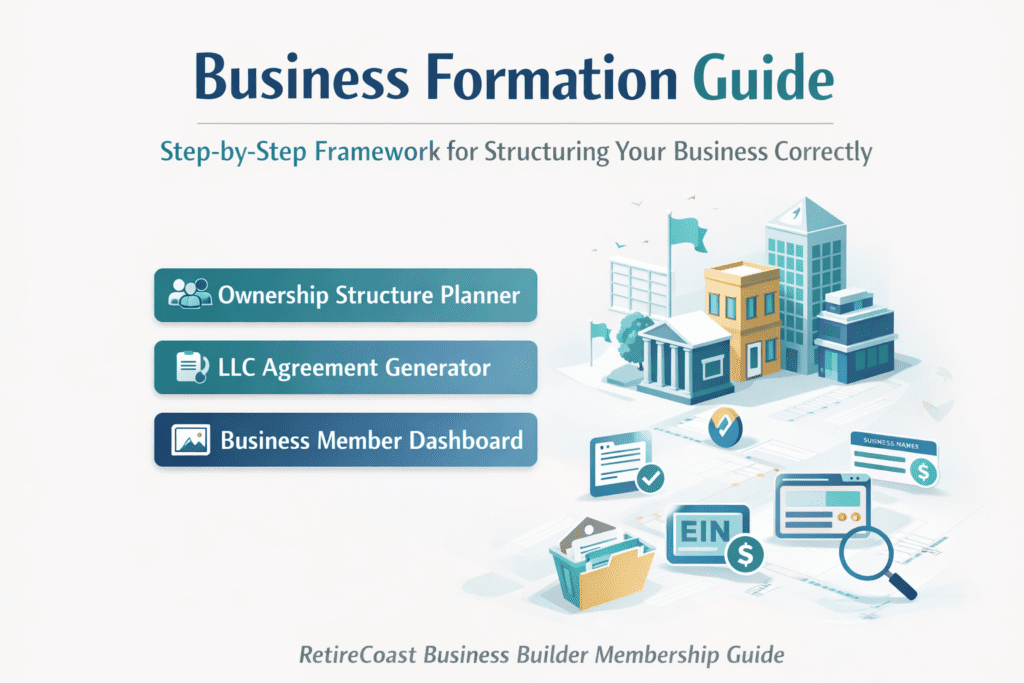
Business Formation Guide
Step-by-Step Framework for Structuring Your Business Entity Correctly
This guide is part of the RetireCoast Business Builder Membership.
It walks you through the essential steps of creating a legally sound business structure.
Use it together with our planning tools to organize ownership, define management roles, and create foundational documents for your company.
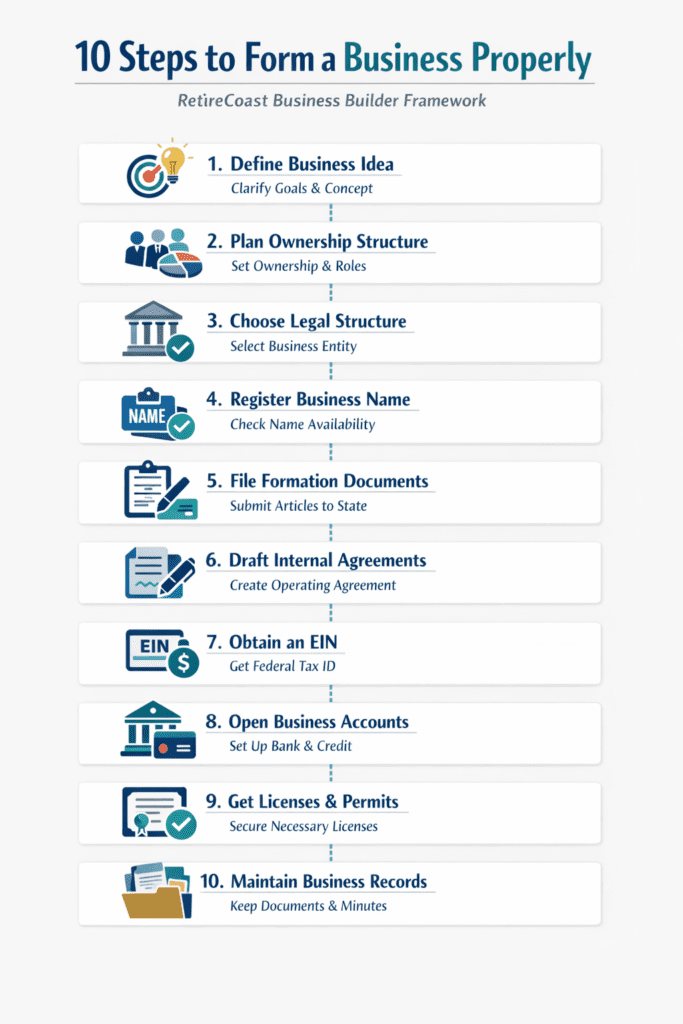
Step 1 — Clarify Your Business Idea and Objectives
Before selecting a legal structure, define what your business will do and how it will operate.
Important questions include:
- What products or services will you provide?
- Will the business operate locally, regionally, or online?
- Do you expect employees?
- Will you eventually sell the business?
- Do you need investors or outside capital?
Step 2 — Evaluate Ownership Structure
Determine how many owners the business will have and how decisions will be made.
Important factors include:
- Number of owners
- Ownership percentages
- Voting rights
- Management responsibilities
- Capital contributions
Recommended Tool:
Use the Ownership & Structure Planner to organize ownership percentages and management roles before filing formation documents.
Open Ownership Structure Planner
Use the Ownership & Structure Planner to organize ownership percentages and management roles before filing formation documents.
Open Ownership Structure Planner
Step 3 — Choose the Appropriate Legal Structure
Common business structures include:
- Sole Proprietorship – simplest structure but offers no liability protection.
- Partnership – shared ownership but partners may have personal liability.
- Limited Liability Company (LLC) – flexible structure providing liability protection.
- S-Corporation – tax election that can reduce self-employment taxes.
- C-Corporation – typically used by larger companies or those seeking investors.
- Limited liability protection
- Flexible taxation
- Simpler administration than corporations
Step 4 — Select and Register a Business Name
Your business name must be unique within the state where it is registered.
Typical steps include:
- Conduct a state business name search
- Check domain name availability
- Check trademark conflicts
- Reserve or register the business name
Step 5 — File Formation Documents
Once the structure and name are chosen, file the formation documents with the state.
Common documents include:
- Articles of Organization (LLC)
- Articles of Incorporation (Corporation)
- Registered agent designation
- State filing fee
Step 6 — Create Internal Governance Documents
Internal documents define how the business operates.
Examples include:
- LLC Membership Agreement
- Operating Agreement
- Corporate bylaws
- Ownership schedules
- Capital contribution records
Business Builder Tool:
Use the LLC Membership Agreement Generator to create a customized agreement defining ownership, management authority, and voting rights.
Launch LLC Membership Agreement Generator
Use the LLC Membership Agreement Generator to create a customized agreement defining ownership, management authority, and voting rights.
Launch LLC Membership Agreement Generator
Step 7 — Obtain Tax Identification
Most businesses must obtain an EIN from the IRS.
An EIN allows the business to:
- Open bank accounts
- Hire employees
- File tax returns
- Separate business and personal finances
Step 8 — Open Financial Accounts
Separating business finances is essential.
Typical steps include:
- Open a business bank account
- Obtain a business credit card
- Set up accounting software
- Create a bookkeeping system
Step 9 — Obtain Licenses and Permits
Depending on your business type and location you may need:
- Local business license
- Professional licenses
- Sales tax permits
- Health department approvals
Step 10 — Maintain Corporate Records
Once your business is formed, maintain proper records.
Recommended documents include:
- Formation documents
- Membership agreements
- Meeting minutes
- Financial statements
- Tax filings
Next Step: Build Your Business Framework
Now that you understand the formation process, the next step is to organize the core elements of your business:
- Ownership structure
- Management authority
- Operating agreements
- Financial planning