Last updated on June 2nd, 2026 at 04:07 am
The Man, the Mission, and the Navy That Helped Win a Revolution
At the start of the American Revolution, the colonies faced a reality that could not be ignored:
They could not win without challenging British control of the sea.
The Royal Navy was the most powerful naval force in the world. It protected British trade, transported troops, and enforced blockades. The colonies, by contrast, had no navy—only scattered merchant ships, privateers, and experienced seamen.
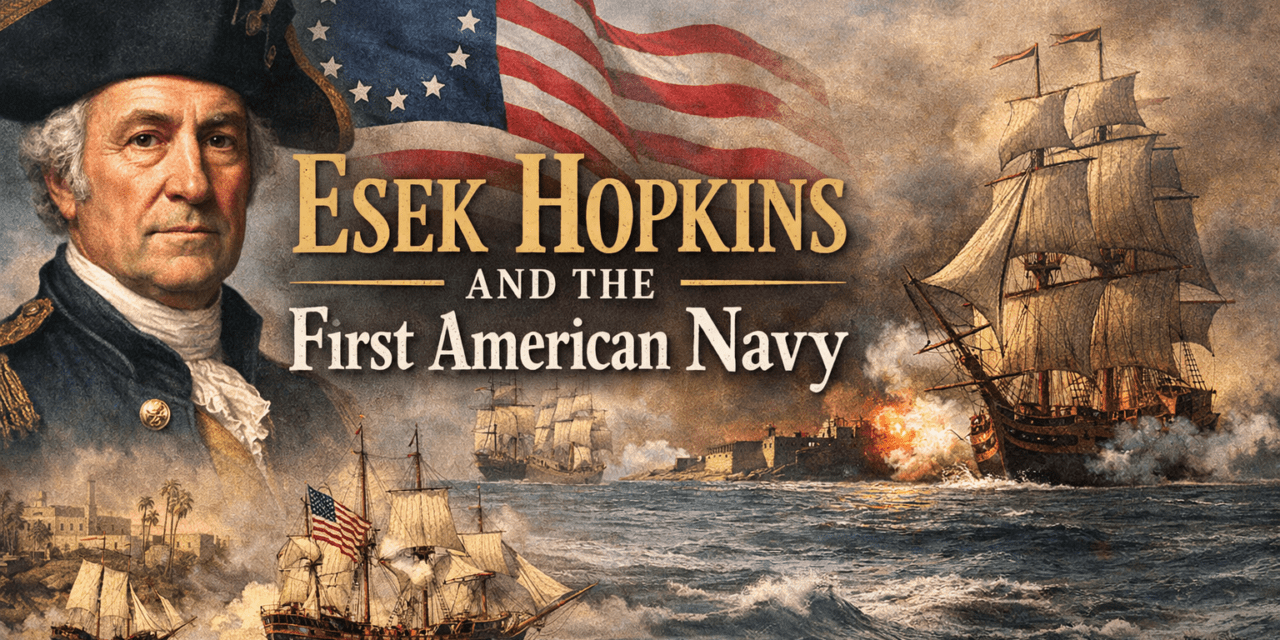
Into this uncertainty stepped Esek Hopkins—a sea captain, merchant, privateer, and political insider—who would become the commander-in-chief of the Continental Navy and, in many ways, the first naval leader of what would eventually become the United States Navy.
His story is not one of clean victory or simple heroism.
It is a story of risk, leadership, controversy, and beginnings.
- The Man, the Mission, and the Navy That Helped Win a Revolution
- ⚓ Before the War: A Life Built at Sea
- 🏛️ Political Influence
- ⚓ Why He Was Selected
- ⚓ Building a Navy from Nothing
- ⚔️ The First Major Operation: Nassau
- ⚠️ Disobedience and Removal
- ⚓ What Happened Next: The War at Sea Continues
- ⚔️ Commerce Warfare
- ⭐ Rise of Leaders Like John Paul Jones
- ⚓ Chesapeake Bay and Final Victory
- ⚓ The Human Cost
- ⚓ From Then to Today’s Navy
- ✍️ Author’s Note
- Birth of the United States Marines
- What Happened to Admiral Hopkins?
- ⚓ Final Reflection
Our goal is to expose Americans to aspects of the fight for independence that are not generally known. Click below to explore the full series, and check back often as we continue to publish more often-lost messages from the past.
Explore the America’s 250th Anniversary Series⚓ Before the War: A Life Built at Sea
To understand why Hopkins was selected, you must first understand who he was before the war.
He was not a career military officer.
There was no American Navy to rise through.
Instead, Hopkins built his reputation in the private sector of the 18th-century maritime world.
🚢 Merchant and Maritime Operator
Hopkins commanded and operated merchant ships engaged in Atlantic trade. This meant:
- Navigating long, dangerous ocean routes
- Managing crews under difficult conditions
- Protecting cargo and profit
He understood logistics, risk, and decision-making in ways few men in the colonies did.
A privateer was a privately owned ship authorized by a government to attack and capture enemy vessels during wartime. Unlike pirates, privateers operated legally under official permission known as a “letter of marque.”
During the American Revolution, privateers played a critical role in the war at sea. The colonies did not have a strong navy, so they relied heavily on private ship owners and experienced sailors to disrupt British trade and weaken the enemy’s economy.
- Captured enemy merchant ships and cargo
- Disrupted trade routes across the Atlantic
- Forced the British to divert naval resources to protect commerce
- Supplied goods and materials back to the American cause
Captured ships—called “prizes”—were sold, and the profits were shared among the crew. This made privateering both a patriotic effort and a financial opportunity.
Many early American naval leaders, including Commodore Esek Hopkins, had experience as privateers. This background shaped how they approached naval warfare—favoring speed, aggression, and opportunistic attacks over traditional fleet tactics.
Why this matters: Privateers were a force multiplier for the American cause. They allowed the colonies to challenge the powerful British fleet without the need for a large, formal navy in the early years of the war.
⚔️ Privateer Experience
During earlier conflicts, including colonial wars tied to European struggles, Hopkins served as a privateer.
Privateering was essentially legalized naval warfare:
- Privately owned ships
- Authorized to attack enemy merchant vessels and British vessels
This gave Hopkins:
- Combat experience
- Tactical awareness
- Confidence in aggressive action
👉 This experience would later influence his “best judgment” approach to command.
People often ask whether Commodore Esek Hopkins, the commander-in-chief of the Continental Navy, worked closely with General George Washington during the Revolutionary War.
The answer is yes—but only indirectly and in a limited way.
Both men were leading separate parts of the war effort. Washington commanded the Continental Army on land, while Hopkins led the newly formed naval force at sea. Coordination between the two branches was still developing, and much of their communication flowed through the Continental Congress and its committees rather than through direct, ongoing collaboration.
Their missions were, however, closely connected. Washington’s army faced severe shortages of gunpowder and supplies in the early stages of the war. Hopkins’ expedition to New Providence Island was launched in part to address that need by capturing military stores from British positions.
While the mission successfully brought back cannons and supplies, it did not secure as much gunpowder as hoped. There is no clear record of Washington personally thanking Hopkins for the effort, but he was certainly aware of the expedition and its outcome.
Key takeaway: Hopkins and Washington were part of the same strategy—but operated in parallel, not side by side. Their connection was driven by shared objectives, especially the urgent need to supply the American Army during the early days of the Revolution.
🏛️ Political Influence
Hopkins was not just a sailor—he was politically connected.
- Member of the Rhode Island General Assembly
- Brother of Stephen Hopkins
His brother was:
- A former governor
- A member of the Continental Congress
👉 This connection mattered.
In a time when leadership positions were filled by trust as much as merit, Hopkins was both:
Connected
Capable
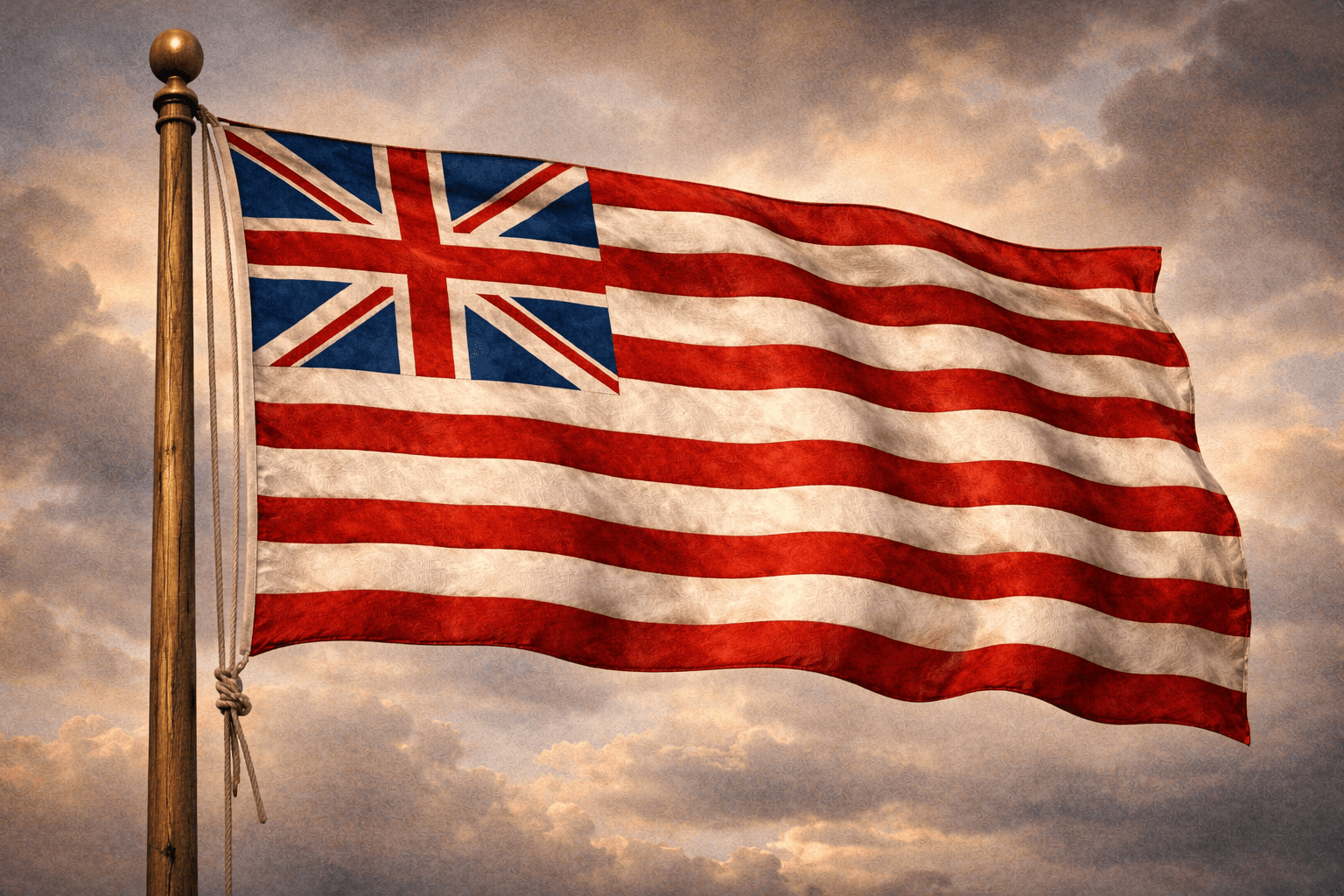
Readers may be surprised to see the first American naval flag displaying the British Union Jack. This image represents the Grand Union Flag, one of the earliest flags used at the beginning of the Revolution.
It included the British Union symbol in the canton because, in the early phase of the conflict, many colonists were still fighting as subjects demanding their rights rather than immediately declaring full independence.
The thirteen red and white stripes represented the united colonies, while the British section reflected a transitional moment in history—before the adoption of later, fully independent American flags.
⚓ Why He Was Selected
When the Marine Committee of the Journals of the Continental Congress moved to create a naval force, they faced a problem:
There was no established officer corps.
So they asked:
Who knows the sea? Who can command ships? Who can act?
Hopkins was selected under the authority of:
- John Hancock
- With support from leaders like John Adams
He was appointed:
Commander-in-Chief of the Continental Navy
Sometimes referred to as:
- Commodore Esek Hopkins
- The first commander of the U.S. Navy
```html
If you enjoy learning about the people, battles, and events that shaped the United States, don't miss RetireCoast's comprehensive Hessians and the American Revolution Series. This special 10-chapter project contains more than 60,000 words of original content exploring the German soldiers hired by Great Britain during the Revolutionary War, their experiences in America, and their lasting influence on the development of the United States.
The series examines the military campaigns, daily camp life, family connections, immigration stories, and the remarkable legacy left behind by thousands of Hessian soldiers who ultimately became part of the American story.
🧠 Why Him?
Hopkins represented a combination rarely found:
- ✔ Deep maritime experience
- ✔ Combat exposure through privateering
- ✔ Political trust and influence
- ✔ Willingness to act independently
👉 In short, he was a practical choice for an impractical situation
⚓ Building a Navy from Nothing
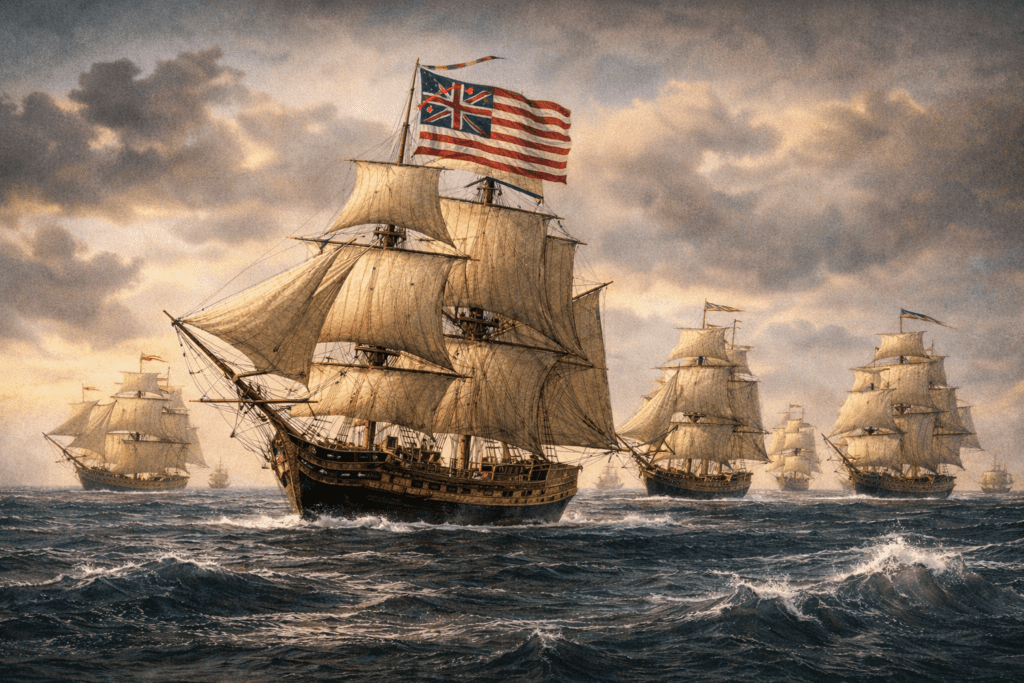
The early American Navy was not a navy in the modern sense.
Hopkins commanded:
- A small fleet
- Made up of converted merchant ships
- With crews drawn from sailors, privateers, and volunteers
There were:
- No formal navy deck log systems
- No training academies
- No doctrine
This was the naval history of the American Revolution in its earliest form.
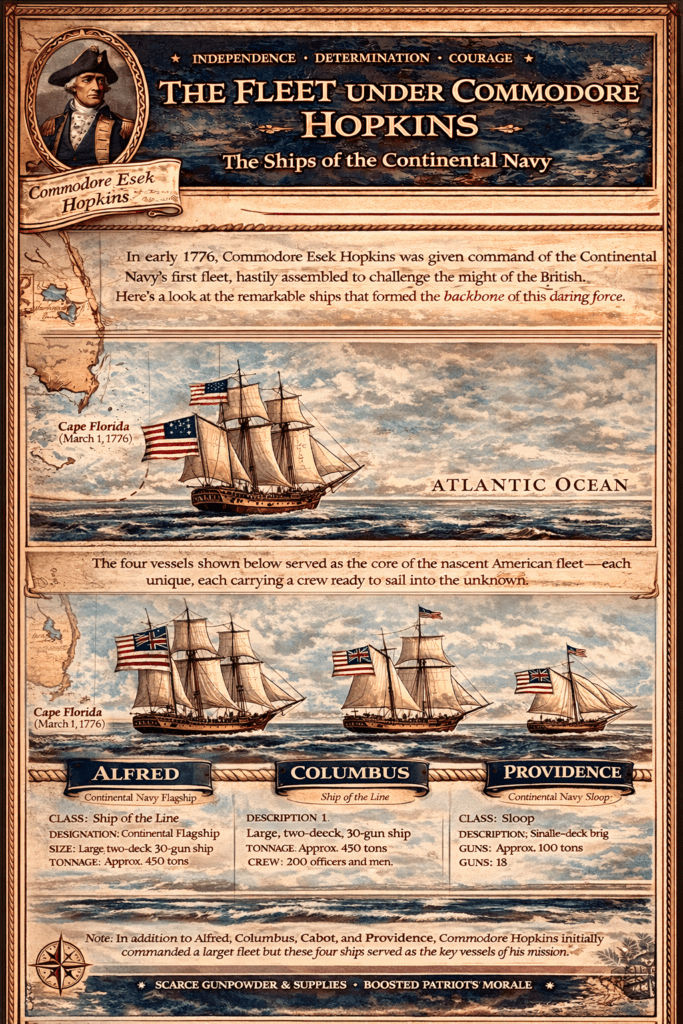
⚓ The Core Ships of Hopkins’ Fleet
The early Continental Navy relied on converted merchant vessels, each with different capabilities. While exact records vary, the following reflects the best historical estimates for the four core ships under Commodore Esek Hopkins:
⚓ Alfred (Flagship)
- Built: Originally a British merchant ship (Black Prince), likely constructed in England before being acquired in Philadelphia
- Tonnage: ~440–450 tons
- Guns: 20–30 cannons
- Crew: ~200–220 officers and men
- Captain: Dudley Saltonstall
👉 Served as Hopkins’ flagship and the most powerful vessel in the fleet
⚓ Columbus
- Built: Merchant vessel converted for naval use, likely built in the American colonies
- Tonnage: ~450 tons
- Guns: 20–28 cannons
- Crew: ~200 men
- Captain: Abraham Whipple
👉 A large and capable ship, central to fleet operations
⚓ Cabot
- Built: Originally a merchant brig, likely constructed in the colonies
- Tonnage: ~150–180 tons
- Guns: 12–14 cannons
- Crew: ~100 men
- Captain: John Burroughs Hopkins
👉 Smaller and faster, often used for scouting and support roles
⚓ Providence
- Built: Rhode Island merchant sloop, adapted for war
- Tonnage: ~100 tons
- Guns: 10–12 cannons
- Crew: ~70–80 men
- Captain: John Paul Jones
👉 One of the most agile ships—commanded early on by John Paul Jones
⚓ Key Insight
These ships were not purpose-built warships like those of the British fleet. They were converted merchant vessels, adapted quickly for combat. Their differences in size, speed, and firepower required Hopkins to operate with flexibility rather than strict formation tactics.👉 They were adapted tools for survival
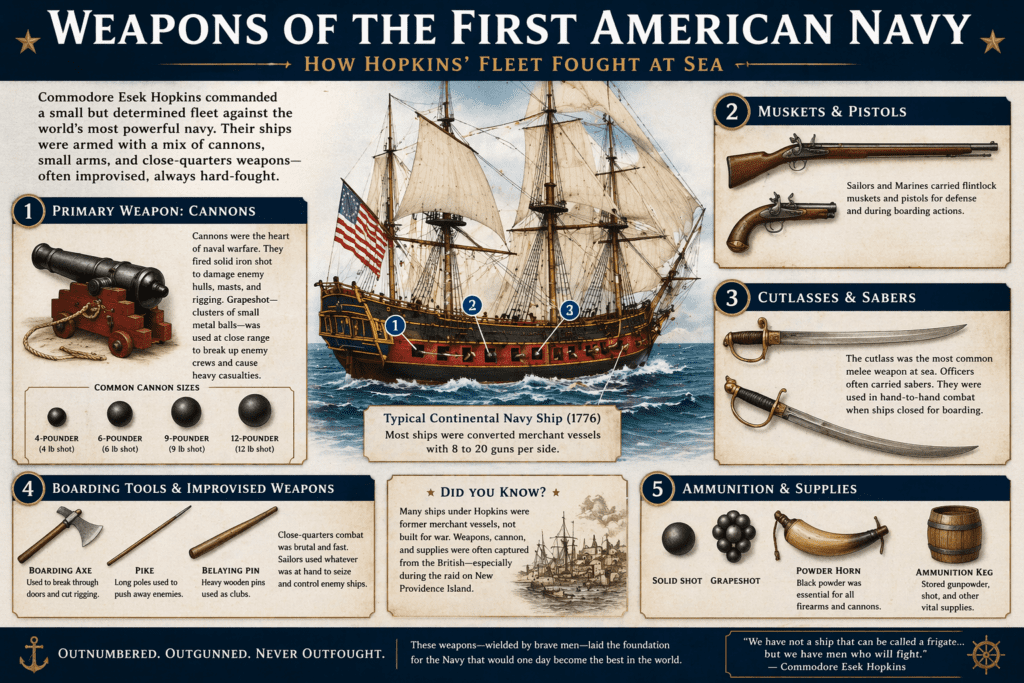
The ships under Commodore Esek Hopkins were not equipped like the powerful vessels of the British fleet. Instead, they carried a mix of weapons—some salvaged, some captured, and others adapted from merchant use. Despite these limitations, American sailors fought with determination using the tools available to them.
Cannons were the primary weapon aboard American ships. These naval guns fired solid iron shot designed to damage hulls, masts, and rigging. Some ships also used grapeshot—clusters of small metal balls that spread on impact, devastating enemy crews at close range.
Sailors and marines carried flintlock muskets and pistols for close combat. These weapons were essential during boarding actions, where fighting moved from ship to ship in tight quarters.
The cutlass—a short, curved blade—was the most common melee weapon at sea. Officers often carried sabers. These weapons were used when ships closed distance and combat became hand-to-hand.
Sailors used axes, pikes, and even tools from the ship itself during combat. Boarding an enemy vessel required speed, aggression, and whatever weapons were at hand.
Unlike the standardized arsenals of later naval forces, Hopkins’ fleet relied on a mix of weapons that reflected the early, improvised nature of the American Navy. Many cannons and supplies were captured from British positions, including during the raid on New Providence Island.
Why this matters: The weapons used by Hopkins’ fleet illustrate the reality of the early Revolutionary War—Americans were not fully equipped, but they adapted, improvised, and fought effectively against a far superior enemy.
The 1776 raid on Nassau marked the first amphibious assault by American forces, as Hopkins’ fleet landed Marines, captured Fort Montagu, and seized critical military supplies from the British.
⚔️ The First Major Operation: Nassau
Hopkins’ defining moment came with the attack on New Providence Island in the Bahamas.
This operation is often recognized as:
The first amphibious assault in American history
🎯 The Objective
The mission targeted:
- Military stores
- Gunpowder for the Continental Army under George Washington
At the time, Washington’s forces were critically short on supplies.
⚔️ The Operation
Hopkins:
- Led his fleet to the Bahamas
- Landed troops
- Captured Nassau
This was a successful raid, securing:
- Cannons
- Supplies
⚠️ The Problem
The British had already removed most of the gunpowder.
👉 The most critical objective was missed.
🧠 The Result
The mission became:
- A partial success
- But politically controversial
The Complete RetireCoast Historical Series
⚠️ Disobedience and Removal
Hopkins’ downfall came not from one event—but from a pattern.
⚖️ The Issues
- Accusations of disobedience of orders
- Failure to aggressively pursue the British fleet
- Complaints from officers under his command
Hopkins operated like a privateer:
- Independent
- Decisive
- Not always aligned with centralized command
👉 Congress expected coordination.
Hopkins delivered autonomy.
📉 The Outcome
By 1778:
- He was censured
- Then he was removed from command
His naval career ended abruptly.
The landing at Nassau in March 1776 was more than just a successful military operation—it was a bold statement that the American forces could strike British positions far from the mainland.
In addition to capturing Fort Montagu and seizing valuable British military supplies, Commodore Esek Hopkins achieved something even more significant—he captured the Royal Governor of the Bahamas, Montfort Browne.
The capture of a sitting British governor was an extremely embarrassing episode for the British during the Revolutionary War. It exposed weaknesses in colonial defenses and demonstrated that even established British strongholds were vulnerable.
Governor Browne was transported back to the American colonies as a prisoner of war. Unlike many captured American sailors who faced harsh conditions, Browne was held under officer status and was eventually exchanged for Continental prisoners.
Why this matters: The Nassau raid was not just about supplies—it was about momentum. Capturing a British governor signaled to both sides that the Americans were capable of bold, strategic action, helping to shift confidence early in the war.
⚓ What Happened Next: The War at Sea Continues
Hopkins’ removal did not end the naval war.
Instead, it evolved.
⚔️ Commerce Warfare
American naval strategy shifted to:
- Attacking British merchant ships
- Disrupting trade routes
- Targeting merchant vessels
Privateers captured hundreds of ships.
👉 This forced Britain to:
- Protect commerce
- Divert resources
⭐ Rise of Leaders Like John Paul Jones
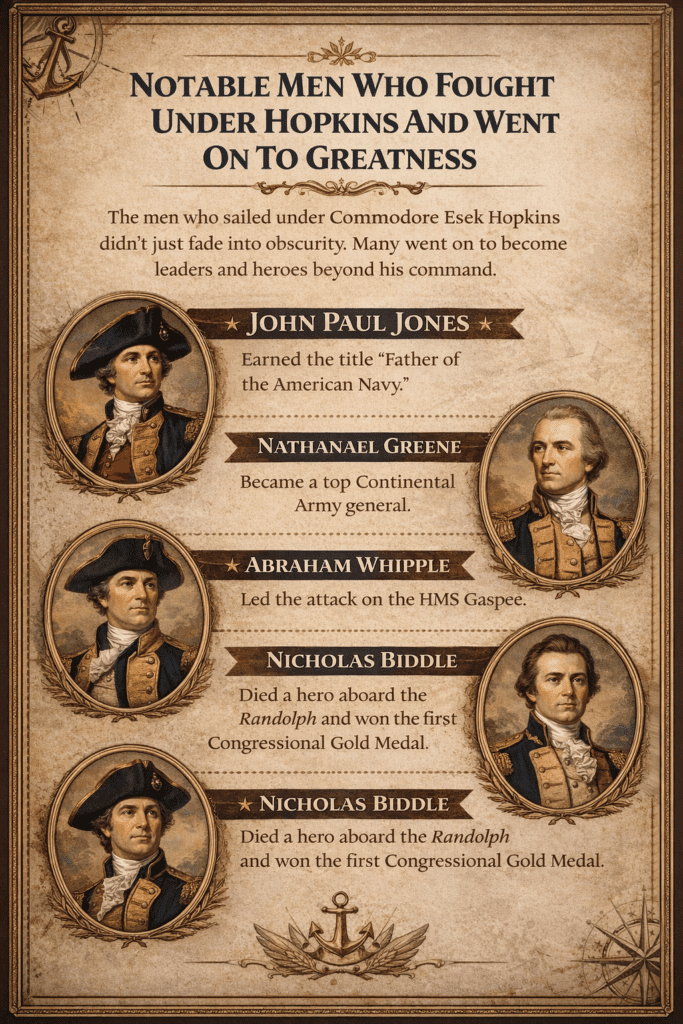
Many of history’s greatest leaders did not emerge in isolation. They rose through the ranks under others—often under leaders who were imperfect, demanding, or even controversial. Yet from those experiences, they learned what worked, what did not, and how to lead more effectively when their time came.
Commodore Esek Hopkins was given an almost impossible task: to confront the most powerful and professional navy in the world—the British fleet—with a small, improvised force made up of converted merchant ships and a ragtag group of capable but largely untested sailors.
His command was short and often criticized. But within that early fleet were men who would go on to define American naval leadership.
- John Paul Jones – Perhaps the most famous of all, Jones began his Continental Navy service under Hopkins. He would later become one of the most celebrated naval commanders of the Revolutionary War, known for his bold leadership and victories at sea.
- Abraham Whipple – A seasoned mariner who participated in the Nassau expedition and later rose to the rank of Commodore, playing a continued role in naval and coastal operations.
- Nicholas Biddle – A promising young officer who later commanded the USS Randolph and became known for his courage before being killed in action.
- Dudley Saltonstall – Though his later career ended in controversy, he commanded ships under Hopkins and was part of the early naval leadership experience that shaped the war at sea.
These men—and many others whose names are less widely known—gained their first real exposure to organized naval warfare under Hopkins’ command. They learned how to operate in uncertain conditions, how to lead crews under pressure, and how to fight a superior enemy with limited resources.
Not every lesson was positive. Some likely learned what to avoid. But that is often the nature of leadership development—growth comes not only from success, but from observing challenges and mistakes.
From this original fleet, a generation of officers emerged who helped carry forward the naval fight. They contributed to the transformation of a loosely organized naval force into a more capable and disciplined fighting arm.
Over time, these early experiences would contribute to the foundation of what would eventually become the modern United States Navy—a force that grew from uncertain beginnings into one of the most powerful naval institutions in the world.
Perspective: We remember figures like John Paul Jones, but many others who served under Hopkins remain unknown. Their contributions—and the lessons they carried forward—helped shape the early Navy. Leadership is rarely built in isolation, and the influence of those first commanders extended far beyond their time in command.
⚓ Chesapeake Bay and Final Victory
At the decisive moment near Chesapeake Bay, the American Navy itself was not dominant.
Instead:
- The French fleet defeated the British fleet
This led directly to:
- The victory at Yorktown
🧠 But Here’s the Truth
That moment was built on:
- Years of American naval resistance
- Disruption of British shipping
- Economic pressure
👉 Hopkins’ early efforts helped start that chain.
⚓ The Human Cost
Hundreds of sailors:
- Died in combat
- Perished in storms
- Suffered in captivity
Many were held on ships like:
- The HMS Jersey
👉 More died in captivity than in battle
Many Americans understand the battles of the Revolutionary War—but far fewer know that some of the greatest suffering did not occur on the battlefield.
Thousands of American sailors, privateers, and soldiers captured at sea were confined aboard British prison ships anchored in places like Wallabout Bay near New York. These ships were not designed to hold prisoners—they were old, overcrowded hulks where disease, starvation, and neglect became the primary killers.
Historians estimate that more than 11,000 Americans died aboard these prison ships—a number that may exceed those killed in combat during the entire Revolutionary War. :contentReference[oaicite:0]{index=0}
Conditions were brutal:
- Extreme overcrowding in the ship holds
- Little to no medical care
- Disease spreading rapidly through confined spaces
- Limited food and clean water
Many prisoners were not even treated as prisoners of war, but as rebels—leaving them without the protections typically afforded to captured soldiers. :contentReference[oaicite:1]{index=1}
For sailors captured from American ships, survival often depended on chance. Some escaped. Some were exchanged. But many never left these floating prisons.
Why this matters: The war for independence was not only fought in open battle—it was endured in silence. The sailors who died aboard these ships represent one of the least-known sacrifices of the Revolution, yet their suffering helped sustain the fight for freedom.
American sailors joined the Continental Navy or privateer crews, often aboard small, converted merchant ships. They sailed into dangerous waters to challenge the powerful British fleet.
Crews encountered British warships and merchant vessels. Battles were intense, close-range, and often chaotic. Victory meant prize ships—defeat meant capture.
When American ships were overpowered, surviving sailors were taken prisoner. Many expected treatment as prisoners of war—but that was often not the reality.
Prisoners were transported to British-controlled harbors, especially near New York. There, they were confined aboard aging ships no longer fit for naval service.
Conditions were brutal—overcrowding, disease, starvation, and lack of sanitation. Ships like the HMS Jersey became known as floating prisons where survival was uncertain.
Thousands died in captivity. Some were exchanged or escaped, but many never returned home. Their sacrifice remains one of the least-known losses of the Revolutionary War.
These sailors helped sustain the fight for independence. Their suffering weakened British resolve and contributed to the eventual success of the American cause.
Perspective: This timeline represents the reality faced by many early American sailors—an often overlooked path from service to sacrifice that played a critical role in the outcome of the Revolutionary War.
⚓ From Then to Today’s Navy
The modern United States Navy:
- Operates globally
- Includes technologies from:
- World War II advancements
- Unmanned Aerial Vehicles
- Even support for space exploration
From:
- The Navy Jack
To: - “Ex Scientia Tridens”
👉 The evolution is extraordinary
✍️ Author’s Note
I have always admired sailors who have served—and continue to serve—thousands of miles from home, often for months at a time. They face the constant challenges of the sea, the weather, and America’s enemies with a level of commitment that is easy to overlook from shore.
I hope all Americans can take a moment to recognize and celebrate Esek Hopkins—and the sailors who fought beside him—to help create this great nation.
Birth of the United States Marines
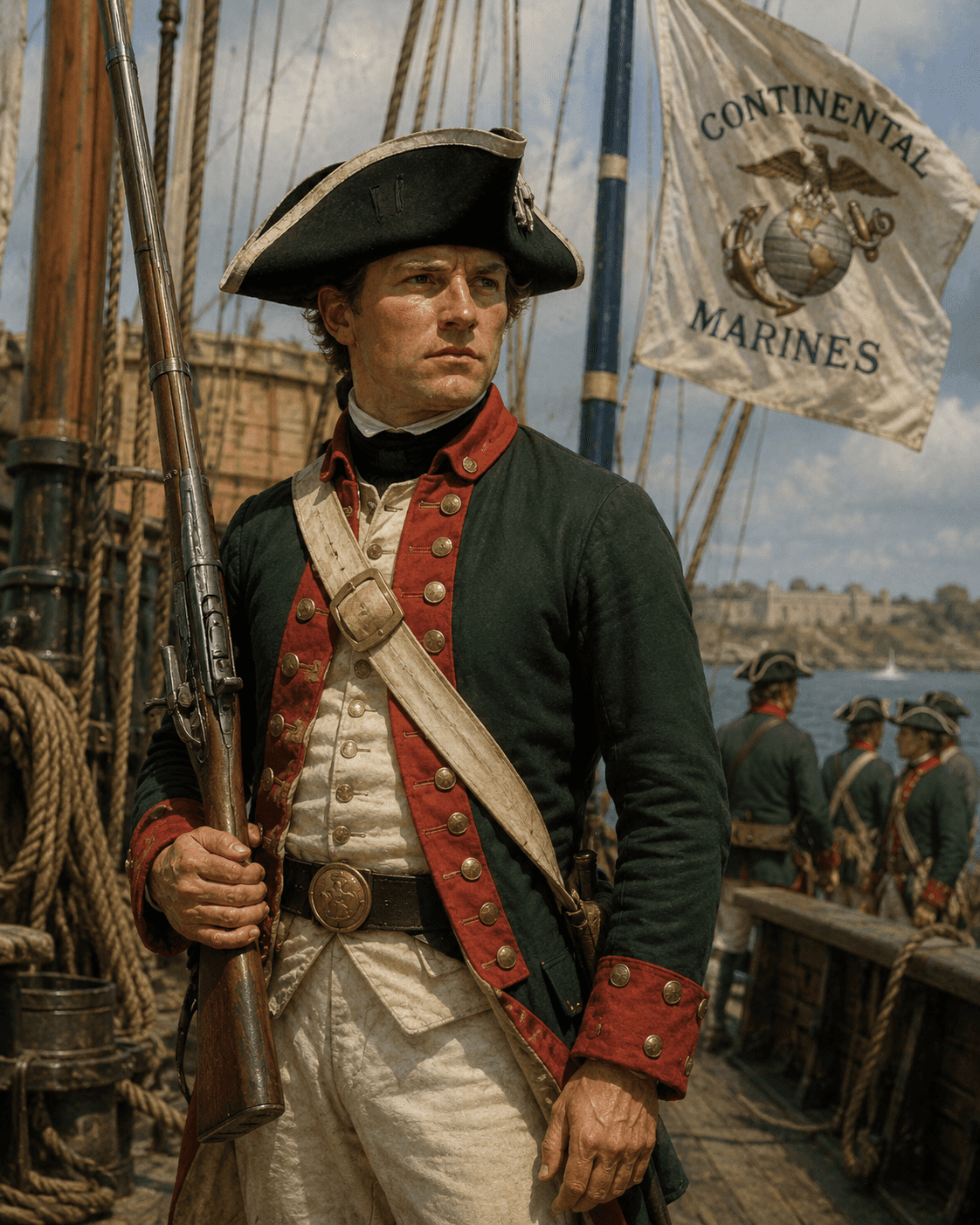
While Commodore Esek Hopkins was helping build the first American naval force, another legendary institution was also being born—the Continental Marines, the forerunner of today’s United States Marine Corps.
On November 10, 1775, the Second Continental Congress passed a resolution drafted by John Adams authorizing the creation of:
“Two Battalions of Marines”
These Marines were intended to serve aboard the newly formed Continental Navy and act as specialized landing forces capable of fighting both at sea and on land.
Recruitment was organized by Captain Samuel Nicholas, widely regarded as the first Commandant of the Marine Corps. Nicholas established recruiting operations at the famous Tun Tavern in Philadelphia, where volunteers were gathered for what would become the first generation of American Marines.
The newly formed Marines saw major combat almost immediately.
On March 3, 1776, during the raid on Nassau, Captain Nicholas led approximately:
- 230 Marines
- 50 sailors
The force landed on New Providence Island, captured Fort Montagu and Fort Nassau, and seized desperately needed cannons, gunpowder, and military supplies for the Continental Army.
Yes—but not in the highly standardized uniforms associated with today’s Marine Corps.
Early Continental Marines generally wore:
- Green coats with white trim
- Round hats or tricorn hats
- Leather gear for carrying ammunition and weapons
Uniforms varied because supplies were limited and the colonies lacked a centralized military supply system. Some Marines likely wore civilian clothing mixed with military items, especially during the early months of the war.
After the Revolutionary War ended, the Continental Marines were disbanded in 1783 due to funding shortages. However, Congress permanently re-established the force on July 11, 1798, creating the modern United States Marine Corps.
Why this matters: The landing at Nassau was not only an early American naval victory—it was also the first major combat operation carried out by the Marines, beginning a tradition of amphibious warfare that continues today.
What Happened to Admiral Hopkins?
The Quiet End of America’s First Naval Commander
After his removal from command in 1778, Commodore Esek Hopkins did not return to sea in any official capacity. His career as the commander-in-chief of the Continental Navy had ended—not in triumph, but in controversy.
Unlike many figures of the Revolutionary War, Hopkins did not transition into another prominent military or national leadership role. Instead, he returned home to Rhode Island, where he resumed a quieter life away from the national spotlight.
He remained a respected figure locally, known for his experience as a sea captain and his early role in building the American naval force. But nationally, his reputation had been overshadowed by the circumstances of his dismissal and the rise of other naval leaders.
Hopkins lived long enough to see the United States secure its independence—an outcome he had helped set in motion, even if his personal role had been cut short. He died in 1802, largely removed from the broader historical narrative that would later celebrate figures like John Paul Jones.
His story is not one of lasting command or celebrated victory. It is something more complex: the story of a man chosen for a moment when no system existed, who acted in that moment, and whose leadership—flawed as it was—helped begin a naval effort that would outlast him.
Historical perspective: Hopkins did not build a lasting fleet, nor did he leave behind a long command legacy. But he stood at the starting point of the American Navy—when success was uncertain, structure did not exist, and every decision carried risk.
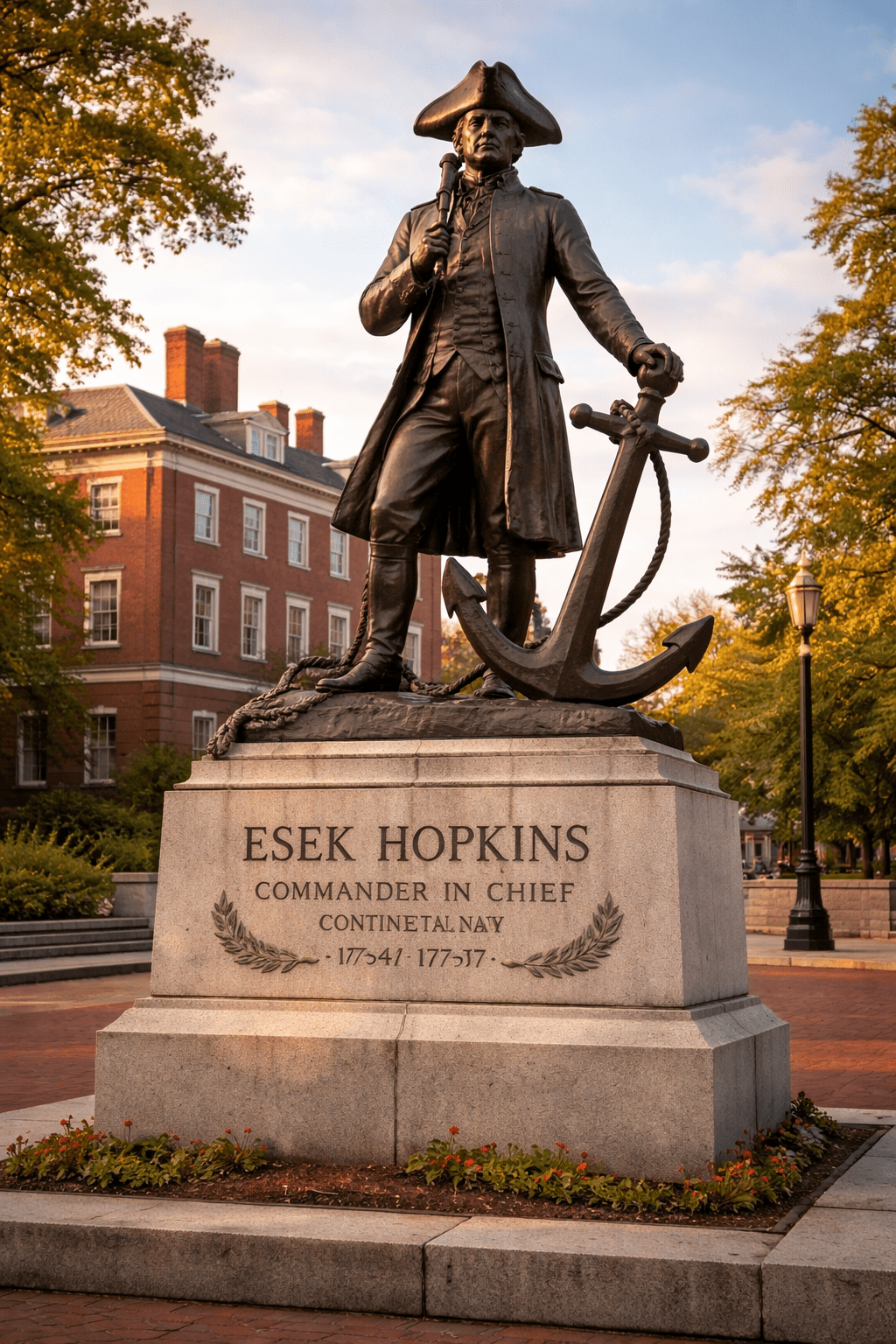
Though his command was short and his legacy often debated, Commodore Esek Hopkins has not been forgotten. His role as the first commander-in-chief of the Continental Navy ensures that his name remains part of American naval history—even if it is not as widely recognized as some of his contemporaries.
The United States Navy and historical institutions have preserved his memory in several ways, reflecting both respect for his position and acknowledgment of his place at the beginning of the American naval story.
Several U.S. Navy vessels have carried the name USS Hopkins, including destroyers in the early 20th century. In naval tradition, having ships bear your name is a significant honor—linking your legacy to generations of sailors who serve long after your time.
Hopkins is memorialized in his home state of Rhode Island, where a statue stands in Providence recognizing his role in the Revolutionary War. The monument helps preserve the memory of a man whose career was controversial but whose place in naval history remains secure.
His former home—the Esek Hopkins House—has also been preserved as a historic site, offering a physical connection to the man who helped launch the American naval effort.
Hopkins appears in official naval histories, including records maintained by the Naval History and Heritage Command. His leadership is studied as part of the early naval history of the American Revolution, particularly the challenges of building a navy from nothing.
Yet, unlike figures such as John Paul Jones, Hopkins is not widely celebrated in popular history. His story is more complex—marked by both initiative and controversy—and that complexity has shaped how he is remembered.
Why this matters: History often remembers clear victories and simple narratives. Hopkins represents something different—the reality that the beginnings of great institutions are rarely perfect. His legacy endures not because it was flawless, but because it was foundational.
The story of Commodore Esek Hopkins and the early American Navy is supported by a range of historical records, official publications, and scholarly research. The following sources provide additional depth and are considered authoritative references on the subject.
-
Naval History and Heritage Command (NHHC)
https://www.history.navy.mil/
Official U.S. Navy historical archives, including records on the Continental Navy and early naval leadership. -
Naval Documents of the American Revolution
View Collection
A comprehensive multi-volume set of primary source documents detailing naval operations during the Revolutionary War. -
Journals of the Continental Congress
Library of Congress Collection
Official congressional records documenting the formation of the Continental Navy and the appointment of Hopkins. -
American Naval Fighting Ships (DANFS)
https://www.history.navy.mil/research/histories/ship-histories/danfs.html
Detailed histories of U.S. Navy ships, including vessels from the Revolutionary War period. -
National Park Service – American Revolution Resources
https://www.nps.gov/subjects/americanrevolution/index.htm
Historical overviews and educational materials on key events, including naval operations. -
U.S. Navy Official Website
https://www.navy.mil/
Modern context and historical summaries connecting today’s Navy to its Revolutionary origins.
Why this matters: Using primary documents and official historical records helps ensure that the story of Esek Hopkins and the early American Navy is presented accurately, providing readers with a reliable foundation for understanding this critical period in American history.
⚓ Final Reflection
Esek Hopkins was not perfect.
He was:
- Independent
- Controversial
- Ultimately removed from command
But he was there at the beginning.
And from that uncertain beginning came:
- A navy
- A strategy
- A legacy
That continues today.
⚓ Closing Line
The first American sailors fought without certainty, without structure, and often without recognition—but their efforts helped build a nation that still depends on those willing to serve at sea.
Take our Short Quiz
Interactive Quiz⚓ Test Your Knowledge: The First American NavyThink you know the story of Commodore Esek Hopkins, the first Continental Navy fleet, and the landing at Nassau? Take this short quiz and see how much you remember.
PODCAST
Frequently Asked Questions FAQ
Who was Esek Hopkins?
Esek Hopkins was a sea captain, privateer, and political figure who became the first commander-in-chief of the Continental Navy during the American Revolution.
Why was Esek Hopkins selected to lead the Navy?
He was chosen due to his maritime experience, privateering background, and political connections, including ties to his brother Stephen Hopkins, a member of the Continental Congress.
What was Hopkins’ most important mission?
His most notable mission was the 1776 raid on Nassau, where American forces captured Fort Montagu and seized military supplies from the British.
Was the Nassau raid considered a success?
Yes, it was a tactical success, capturing supplies and a British governor, though it failed to secure as much gunpowder as originally intended.
What happened to Governor Montfort Browne?
He was captured during the Nassau raid, transported to the American colonies, and later exchanged for Continental prisoners.
Why was Esek Hopkins removed from command?
He faced criticism for disobedience of orders and failing to aggressively engage the British fleet, leading to his removal by Congress in 1778.
Did any notable leaders serve under Hopkins?
Yes, including John Paul Jones, who later became one of the most famous naval commanders of the Revolutionary War.
What weapons were used by Hopkins’ fleet?
His ships used cannons, grapeshot, muskets, pistols, cutlasses, and boarding tools, many of which were improvised or captured.
Were American naval forces present at Yorktown?
No, the decisive naval victory at Yorktown was achieved by the French fleet, though earlier American naval efforts helped make that alliance possible.
How is Esek Hopkins remembered today?
He is remembered as the first commander of the Continental Navy, with ships named after him and historical recognition for his role in establishing the American naval force.
Discover more from RetireCoast.com
Subscribe to get the latest posts sent to your email.