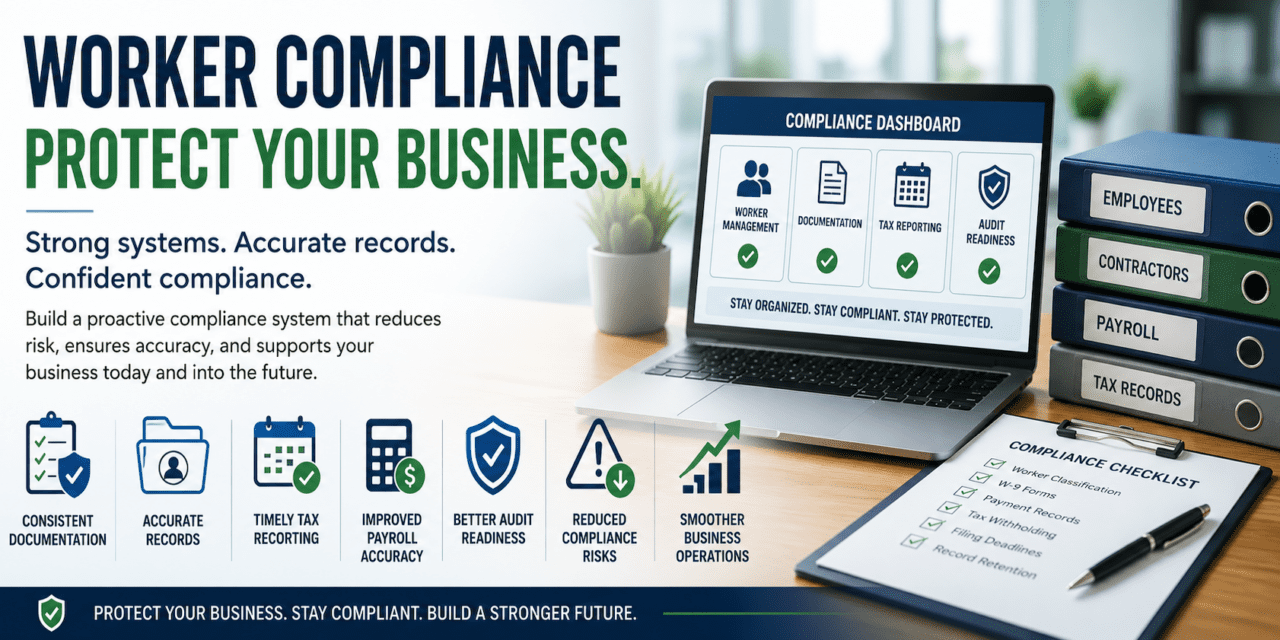
A strong Worker Compliance System is no longer optional for modern small businesses. Whether your company pays W-2 employees, independent contractors, freelancers, consultants, or seasonal workers, a structured Worker Compliance System helps reduce compliance risks, improve documentation, maintain accurate records, and avoid costly penalties tied to payroll taxes, worker classification, tax reporting, and IRS audits.
Many small business owners focus only on payroll compliance while overlooking contractor compliance issues such as W-9 collection, 1099 reporting, worker classification, and Taxpayer Identification Number (TIN) accuracy. Unfortunately, compliance problems involving independent contractors can create some of the most expensive and stressful mistakes a business faces during tax season.
This article serves as an introduction to the broader Worker Compliance Dashboard available inside the RetireCoast Business Membership. The dashboard was designed to help businesses manage both employee and contractor compliance through a structured system of tools that support payroll compliance, tax reporting, worker documentation, payment tracking, audit preparation, and workforce management.
- Start Here: Employee vs Contractor Classification
- Why Worker Compliance Is More Important Than Ever
- Payroll Compliance and Contractor Compliance Are Both Critical
- Today, businesses often manage a combination of:
- For W-2 employees, businesses may be responsible for:
- Businesses working with contractors often need to manage:
- Examples include:
- These compliance issues may trigger:
- As businesses grow, workforce management becomes increasingly complex. A company may simultaneously manage:
- That is why more businesses are moving toward centralized Worker Compliance Systems that combine:
- A well-designed Worker Compliance System helps businesses create:
- Case Study: How One Missing Social Security Number Cost a Business Owner Over $1,000
- Why Businesses Receive IRS Notices Even When They Try to Comply
- In many cases, businesses receive IRS notices because of relatively small compliance mistakes involving:
- Businesses frequently encounter compliance problems involving:
- Some of these issues may trigger:
- This is why businesses should avoid relying solely on:
- Instead, businesses should implement structured Worker Compliance Systems that include:
- Worker Classification Is One of the Most Important Compliance Decisions a Business Makes
- Why Small Businesses Need Systems Instead of One-Time Forms
- The problem is that workforce compliance is not a one-time event.
- It is an ongoing operational process involving:
- A company with only one or two workers may be able to track information informally. However, businesses managing:
- In many cases, businesses do not discover compliance problems until:
- Instead of relying on memory, scattered files, or disconnected payroll software, businesses create standardized systems for:
- A strong system helps ensure:
- They also help businesses create:
- The most effective businesses combine:
- The Worker Compliance Dashboard: A Centralized System for Modern Businesses
- Why a Centralized Compliance System Matters
- Tools Included in the Worker Compliance Dashboard
- A System Designed for Real-World Business Operations
- Compliance Is Becoming More Operational
- Compliance Problems Often Start Small
- Why Accurate Records Matter More Than Most Businesses Realize
- Final Thoughts: Workforce Compliance Is Becoming a Core Business Function
- PEOPLE OFTEN ASK
- FAQ
Start Here: Employee vs Contractor Classification
Before building a complete Worker Compliance System, businesses should first understand the difference between employees and independent contractors. Worker classification is one of the most important compliance decisions a company makes because classification errors can lead to back taxes, payroll tax compliance issues, overtime disputes, IRS audits, civil penalties, and legal action.
Our detailed Employees vs Contractors Guide explains:
- how worker classification works
- what factors government agencies review
- why financial control matters
- how payroll tax obligations differ
- why documentation is critical
This article complements the Worker Compliance Dashboard by explaining the foundation behind many of the compliance tools discussed throughout this guide.
Read the guide here:
https://retirecoast.com/employees-vs-contractors-guide/
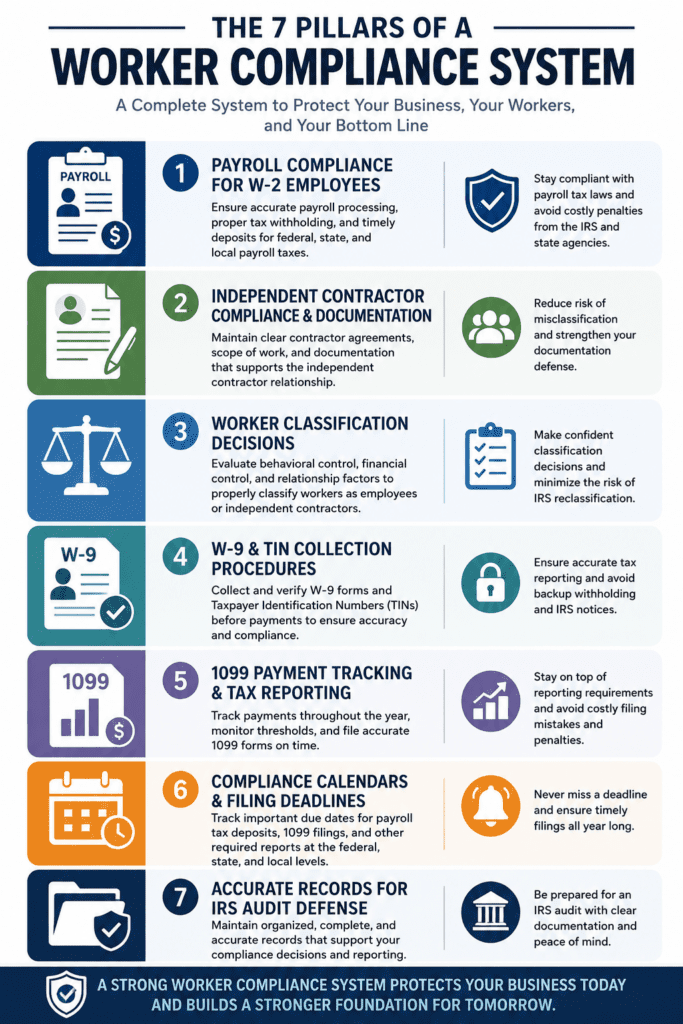
Unlike many payroll compliance articles that focus only on payroll software or payroll taxes, this guide takes a broader operational approach. A complete Worker Compliance System should help businesses manage:
- Payroll compliance for W-2 employees
- Independent contractor compliance and documentation
- Worker classification decisions
- W-9 and TIN collection procedures
- 1099 payment tracking and tax reporting
- Compliance calendars and filing deadlines
- Accurate records for IRS audit defense
Businesses that take a proactive approach to workforce compliance often gain a strategic advantage through stronger business operations, fewer compliance risks, better payroll processes, improved documentation, and greater peace of mind.

In the past, there were basically two classifications of workers: employees who received a W-2 at the end of the year and temporary contractors who received a 1099. Business structures were simpler, payroll systems were smaller, and worker relationships were often short term.
Today, many businesses rely on semi-permanent contractors who may work with a company for months or even years. There are consultants, freelancers, remote workers, project-based specialists, service providers, and many other classifications of workers that fall somewhere between traditional payroll employees and short-term contractors.
That is why we use the broader term "workers" throughout this article and throughout our Worker Compliance Dashboard. We are referring to virtually any person — or even another business entity — that you pay to perform work, provide services, complete projects, or support your business operations.
This is also why our Worker Compliance Dashboard was created. We are not focused only on payroll workers or salary employees. We built this system to help businesses manage compliance risks, documentation, worker classification, tax reporting, and payment tracking across the entire modern workforce.
Why Worker Compliance Is More Important Than Ever
Worker compliance has become significantly more complicated over the last decade. Small businesses are now expected to comply with a growing combination of federal regulations, payroll tax compliance requirements, labor laws, worker classification rules, tax reporting obligations, and local regulations that often vary between different states.
At the same time, the modern workforce has changed dramatically.
Many businesses now operate using a blend of:
- W-2 employees
- independent contractors
- consultants
- freelancers
- remote workers
- seasonal workers
- outsourced professional services
Each category may create different legal obligations, payroll processes, tax withholding requirements, reporting rules, and compliance risks.
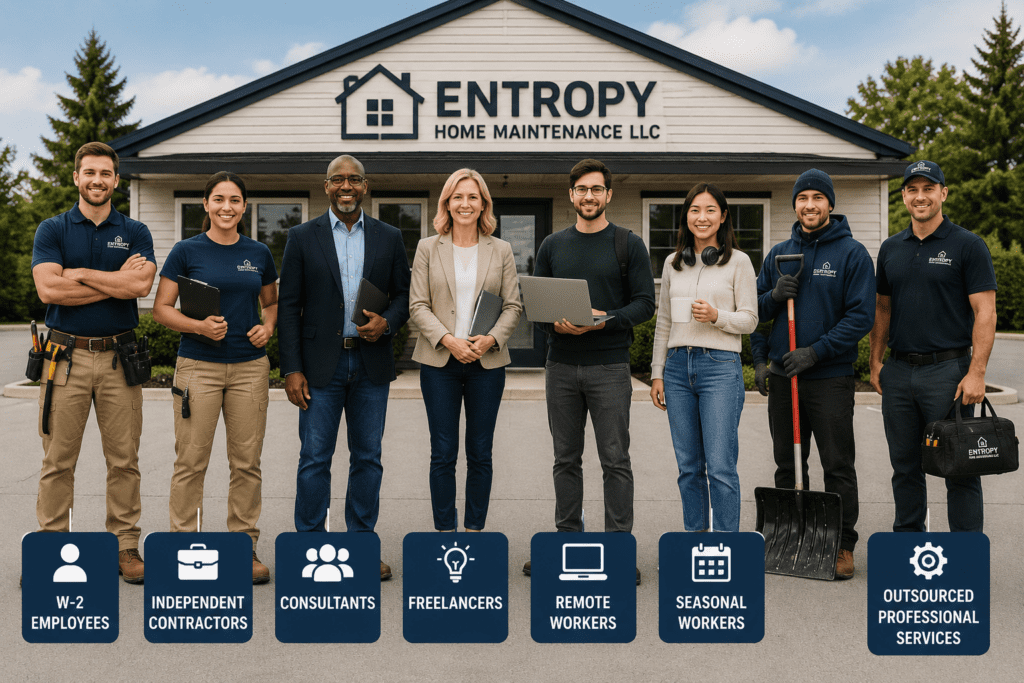
This creates a major challenge for small business owners because worker compliance is no longer limited to simply issuing payroll checks or sending out 1099 forms at the end of the tax year. Businesses are now expected to maintain accurate records, monitor worker classification decisions, comply with payroll regulations, and maintain documentation that can withstand an IRS audit or review by government agencies.
The Internal Revenue Service, Social Security Administration, U.S. Department of Labor, and various state agencies all play roles in enforcing compliance requirements tied to payroll taxes, worker status, overtime pay, unemployment insurance, employee compensation, and tax reporting.
Even businesses that attempt to comply with the rules can make costly mistakes.
Common compliance issues include:
- incorrect worker classification
- missing W-9 forms
- inaccurate TIN reporting
- payroll tax mistakes
- missed filing deadlines
- payroll errors
- incorrect tax withholding
- inaccurate payroll records
- late payroll tax deposits
- incomplete documentation
Some of these errors may result in:
- costly penalties
- civil penalties
- back taxes
- back wages
- legal action
- payroll tax compliance investigations
- IRS audits
In more serious cases, payroll tax compliance failures involving withheld payroll taxes may expose responsible parties to severe consequences, including the Trust Fund Recovery Penalty assessed by the Internal Revenue Service.
The good news is that many compliance risks can be reduced through a proactive approach that combines:
- accurate records
- standardized payroll processes
- worker classification procedures
- tax reporting systems
- compliance calendars
- documentation tracking
- the right compliance tools
This is one reason more businesses are moving toward centralized Worker Compliance Systems instead of relying on disconnected spreadsheets, scattered payroll software, or manual recordkeeping processes.
The goal is not simply avoiding penalties.
A structured Worker Compliance System can also improve:
- business operations
- workforce management
- audit readiness
- payroll accuracy
- documentation consistency
- strategic decision making
- overall peace of mind
For growing businesses that manage multiple workers across different classifications, compliance is no longer just an accounting task — it is now a core operational responsibility.
Sometimes even employers become confused about worker status after individuals become part of a team and begin working together closely. Long-term contractors, consultants, remote workers, and project-based specialists may gradually begin functioning similarly to employees in day-to-day business operations.
From a practical business perspective, it is important for teams to function well together. Businesses should avoid creating unnecessary division between workers simply because one individual receives a W-2 while another receives a 1099.
However, worker classification remains extremely important from a compliance standpoint. Employers must continue monitoring the legal distinctions between employees and independent contractors as those rules apply to the Internal Revenue Service, payroll tax compliance requirements, labor laws, and state regulations.
This is one reason businesses should maintain clear documentation, accurate records, worker classification procedures, and structured compliance systems as their workforce grows and evolves over time.
Payroll Compliance and Contractor Compliance Are Both Critical
Many small business owners think payroll compliance applies only to employees receiving regular paychecks through a payroll system. In reality, modern workforce compliance extends far beyond payroll taxes and traditional W-2 employees.
Today, businesses often manage a combination of:
- payroll employees
- independent contractors
- freelancers
- consultants
- outsourced professional services
- remote workers
- temporary and seasonal workers
Each category creates different tax obligations, reporting requirements, payroll processes, documentation standards, and compliance risks.
For W-2 employees, businesses may be responsible for:
- payroll tax withholding
- Medicare taxes
- FICA taxes
- unemployment insurance
- overtime pay requirements
- minimum wage compliance
- payroll tax deposits
- payroll reporting
- employee benefits administration
Businesses must also comply with federal regulations, state agencies, local laws, wage laws, and labor laws that may differ across different states and local jurisdictions.
Independent contractors create a different set of compliance responsibilities.
Businesses working with contractors often need to manage:
- worker classification decisions
- W-9 collection
- TIN verification
- 1099 payment tracking
- tax reporting
- contractor documentation
- accurate records supporting worker status
Unlike payroll employees, businesses generally do not withhold federal income tax, Social Security taxes, or Medicare taxes from contractor payments. However, that does not eliminate compliance obligations.
In fact, contractor compliance mistakes are among the most common and costly errors businesses make.
Examples include:
- paying contractors without collecting a W-9
- issuing incorrect 1099 forms
- using inaccurate TIN information
- failing to maintain contractor agreements
- misclassifying employees as independent contractors
- missing filing due dates
- failing to maintain detailed records
These compliance issues may trigger:
- IRS audits
- civil penalties
- back taxes
- back wages
- legal action
- payroll tax compliance investigations
Even businesses that use payroll software or payroll services may still experience contractor compliance problems because many payroll systems focus primarily on employee payroll rather than broader workforce compliance.
This is one reason a complete Worker Compliance System should address both:
- payroll compliance for employees
- contractor compliance for independent contractors
A business cannot fully protect itself by focusing on only one side of the workforce.
As businesses grow, workforce management becomes increasingly complex. A company may simultaneously manage:
- salaried employees
- hourly employees
- semi-permanent contractors
- project consultants
- outsourced bookkeeping services
- remote marketing specialists
- seasonal labor
- temporary administrative support
Each worker category may require different compliance procedures, documentation workflows, tax reporting systems, and filing calendars.
That is why more businesses are moving toward centralized Worker Compliance Systems that combine:
- payroll processes
- worker classification tools
- compliance calendars
- payment tracking
- tax reporting workflows
- audit documentation systems
- accurate record management
The goal is not simply avoiding payroll mistakes during tax season.
A well-designed Worker Compliance System helps businesses create:
- stronger business operations
- consistent documentation
- more accurate payroll
- reduced compliance risks
- improved audit readiness
- better long-term workforce management
- greater peace of mind
For many growing businesses, workforce compliance is no longer just an accounting responsibility — it has become a core operational and risk management function.
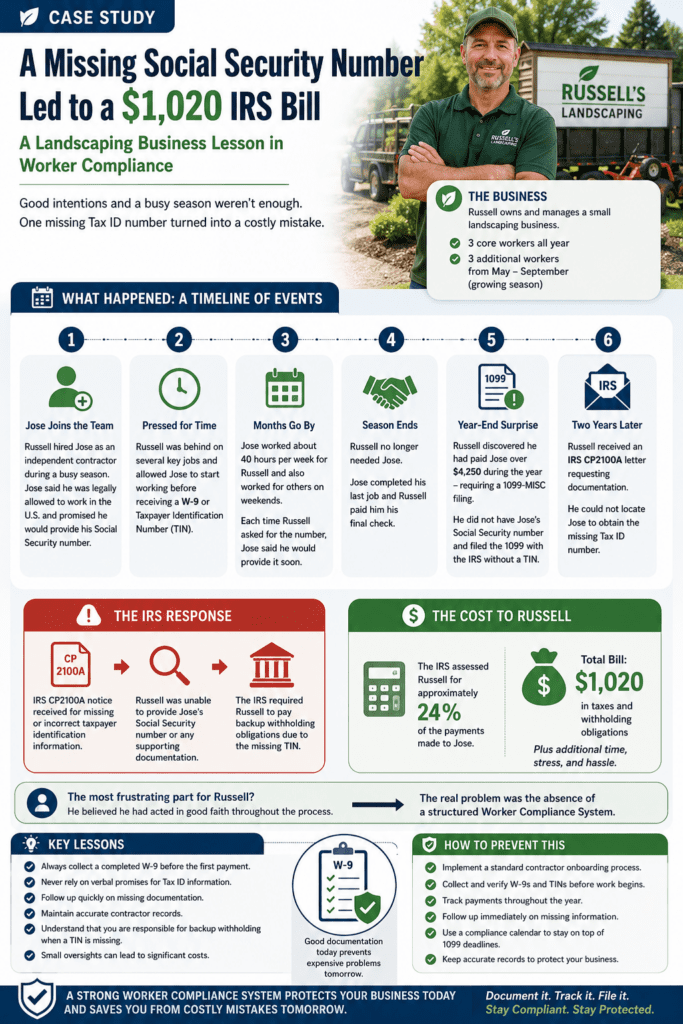
Case Study: How One Missing Social Security Number Cost a Business Owner Over $1,000
Russell owns and manages a small landscaping business. He maintains a core team of three workers throughout the year and supplements his workforce with three additional workers from May through September during the primary growing season.
Like many small business owners, Russell uses a combination of workers he considers independent contractors. Most of them work approximately 40 hours per week for his company during the busy season, although several also perform work for other businesses on weekends or during slower periods.
One year, Russell brought on a worker named Jose during a particularly busy stretch of projects.
Jose explained that he was legally authorized to work in the United States and assured Russell he would provide his Social Security number shortly after starting work. Because Russell was under pressure to complete several large landscaping jobs on time, he allowed Jose to begin working before obtaining a completed W-9 form or Taxpayer Identification Number (TIN).
Weeks turned into months.
Each time Russell requested the information, Jose promised he would provide it soon. Eventually the busy season ended, Jose completed his final job, and Russell issued his last payment.
At the end of the tax year, Russell discovered he had paid Jose approximately $4,250 during the year — enough to require filing a 1099 form with the Internal Revenue Service.
However, Russell still did not have Jose’s Social Security number.
Pressed by filing deadlines, Russell submitted the 1099 form to the IRS without the TIN information, hoping the issue would never become a problem.
Two years later, Russell received an IRS CP2100A notice.
The notice informed him that the taxpayer identification information associated with the filing was incorrect or incomplete and requested supporting documentation. Russell attempted to locate Jose but could not find him. Phone numbers had changed, messages went unanswered, and no forwarding address was available.
Eventually, the IRS required Russell to pay backup withholding obligations connected to the missing taxpayer identification information.
The IRS assessed Russell for approximately 24% of the payments made to Jose.
The total bill came to roughly:
- $1,020 in taxes and withholding obligations
- plus additional time, stress, and documentation issues
The most frustrating part for Russell was that he believed he had acted in good faith throughout the process.
The problem was not intentional wrongdoing.
The problem was the absence of a structured Worker Compliance System.
Lessons from This Case Study
Russell’s situation highlights several common compliance mistakes made by small businesses:
- allowing workers to begin before obtaining a completed W-9
- failing to verify taxpayer identification information
- relying on verbal promises instead of documentation
- waiting too long to resolve missing TIN issues
- maintaining incomplete contractor records
- failing to implement standardized onboarding procedures
This case study also demonstrates why contractor compliance extends far beyond simply issuing a 1099 form at the end of the year.
Worker compliance requires:
- documentation procedures
- accurate records
- payment tracking
- tax reporting systems
- compliance calendars
- proactive follow-up procedures
Even relatively small payment amounts can create compliance risks when documentation is incomplete.
This is one reason many businesses are now implementing centralized Worker Compliance Systems designed to help manage:
- W-9 collection
- TIN tracking
- contractor onboarding
- payment documentation
- tax reporting
- filing deadlines
- IRS audit preparation
The cost of maintaining proper documentation is usually far lower than the cost of correcting compliance problems years later.
Why Businesses Receive IRS Notices Even When They Try to Comply
Many small business owners assume IRS notices only happen when someone intentionally violates tax laws or ignores payroll tax compliance requirements.
That is often not true.
In many cases, businesses receive IRS notices because of relatively small compliance mistakes involving:
- inaccurate records
- missing taxpayer identification numbers
- payroll errors
- incorrect tax forms
- worker classification issues
- filing deadline problems
- documentation inconsistencies
Even businesses that operate in good faith and attempt to follow IRS guidelines may still encounter compliance issues if their payroll processes and worker documentation systems are incomplete.
One of the most common examples involves Taxpayer Identification Number (TIN) mismatches.
A business may:
- receive a completed W-9 form
- properly issue a 1099 form
- file tax reporting documents on time
—but still receive an IRS notice because the worker’s legal entity name does not exactly match the information maintained within Internal Revenue Service databases or Social Security Administration records.
Sometimes the differences are surprisingly small:
- abbreviations
- punctuation differences
- spelling variations
- omitted middle initials
- incorrect entity names
- transposed numbers
- outdated business information
The IRS matching system may still flag the filing as inaccurate.
This is one reason accurate records and standardized documentation procedures are so important for both payroll compliance and contractor compliance.
Businesses frequently encounter compliance problems involving:
- missing W-9 forms
- incomplete contractor files
- inaccurate payroll records
- missing tax withholding information
- late tax reporting
- duplicate worker records
- outdated addresses
- incorrect worker status classifications
Some of these issues may trigger:
- IRS CP2100 or CP2100A notices
- payroll tax compliance reviews
- requests for supporting documentation
- backup withholding requirements
- civil penalties
- additional tax obligations
Many business owners are surprised to learn that they may remain responsible for certain compliance obligations even when a contractor fails to provide accurate taxpayer information.
This is why businesses should avoid relying solely on:
- verbal promises
- informal onboarding
- handwritten notes
- memory-based recordkeeping
- disconnected spreadsheets
Instead, businesses should implement structured Worker Compliance Systems that include:
- standardized onboarding procedures
- W-9 collection processes
- worker classification documentation
- payment tracking systems
- compliance calendars
- detailed record retention
- audit preparation procedures
A proactive approach helps reduce the likelihood of costly mistakes while improving audit readiness and overall business operations.
Importantly, worker compliance is not simply about avoiding penalties.
Strong compliance systems can also help businesses:
- improve workforce management
- maintain more accurate payroll
- reduce administrative confusion
- create stronger documentation trails
- improve operational consistency
- gain greater peace of mind
As workforce structures become more complicated, compliance systems become increasingly valuable for small businesses managing multiple worker classifications and payment structures.
The IRS uses automated matching systems to compare taxpayer identification information submitted on forms such as 1099-MISC and 1099-NEC against records maintained by the Internal Revenue Service and the Social Security Administration.
Even small inconsistencies involving a worker’s legal name, business entity name, Social Security number, or Taxpayer Identification Number (TIN) may trigger a CP2100 or CP2100A notice requesting additional documentation or corrective action.
- The IRS actively reviews and matches 1099 filings against taxpayer records.
- Accuracy matters — even small spelling differences or entity name inconsistencies can create compliance issues.
- Businesses may still face documentation requests even when they attempted to follow the rules in good faith.
- Strong Worker Compliance Systems help reduce the risk of costly mistakes and missing documentation.
The example below shows an actual IRS CP2100A notice involving taxpayer identification inconsistencies connected to filed 1099 forms. Notices like this demonstrate why businesses should maintain accurate records, standardized onboarding procedures, W-9 collection systems, and detailed contractor documentation.
Worker Classification Is One of the Most Important Compliance Decisions a Business Makes
One of the largest compliance risks facing small businesses today involves worker classification.
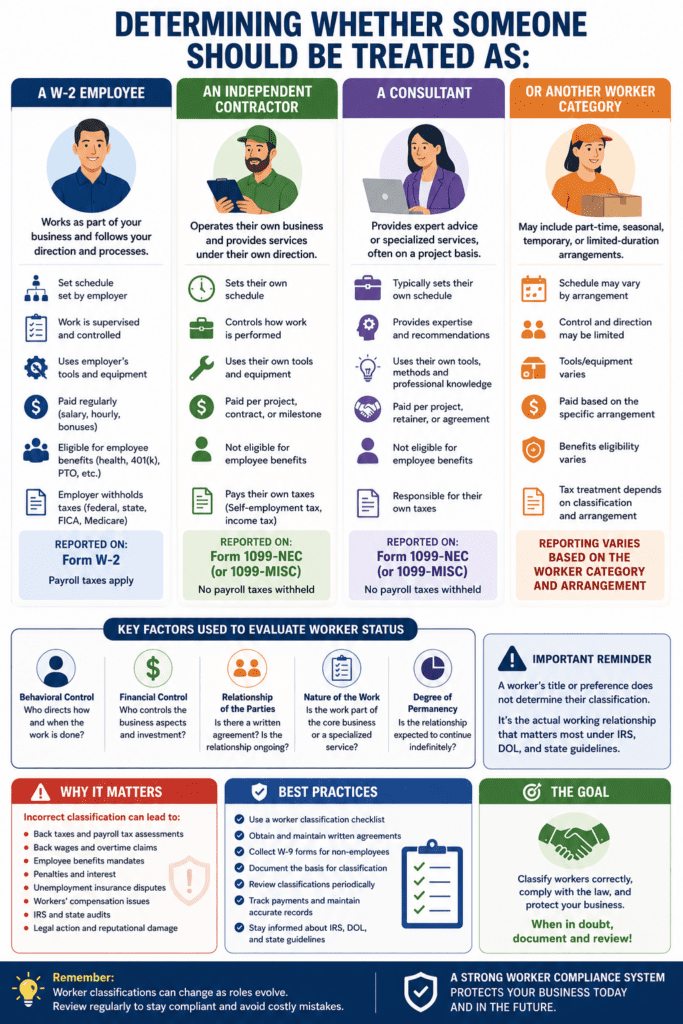
Determining whether someone should be treated as:
- a W-2 employee
- an independent contractor
- a consultant
- or another worker category
can significantly impact payroll taxes, tax withholding obligations, overtime pay requirements, employee benefits, payroll reporting responsibilities, and overall legal obligations.
Many small business owners assume worker classification is determined simply by:
- whether a worker receives a W-2 or 1099
- whether the worker prefers contractor status
- whether the worker works part time
- whether the worker signed an independent contractor agreement
In reality, worker classification rules are far more complicated.
Government agencies such as:
- the Internal Revenue Service
- the U.S. Department of Labor
- state agencies
- unemployment insurance divisions
- workers compensation regulators
may all apply different standards when evaluating worker status.
One of the most important concepts involves the degree of control a business exercises over the worker.
Classification reviews often evaluate:
- behavioral control
- financial control
- relationship structure
- scheduling authority
- equipment ownership
- payment methods
- exclusivity of work
- supervision levels
For example, a worker who:
- works primarily for one business
- follows strict schedules
- uses company equipment
- receives ongoing direction
- performs core business functions
may begin looking more like an employee even if both parties originally intended the relationship to operate as an independent contractor arrangement.
This is one reason worker classification often becomes more complicated over time.
A contractor who originally performed occasional project work may gradually evolve into a long-term operational member of the team. As that happens, compliance risks may increase if businesses fail to reevaluate worker status periodically.
Misclassification can create serious consequences for businesses.
Potential issues may include:
- payroll tax compliance investigations
- back taxes
- back wages
- unpaid overtime claims
- unemployment insurance disputes
- employee benefits disputes
- civil penalties
- legal action
- IRS audits
In some situations, businesses may also face obligations involving:
- tax withholding corrections
- payroll tax deposits
- Medicare taxes
- FICA taxes
- federal income tax withholding
- state payroll taxes
Importantly, worker classification decisions often affect more than taxes alone.
Classification may also influence:
- workplace safety obligations
- labor law compliance
- wage law requirements
- retirement plans
- health insurance obligations
- benefits administration
- employee compensation rules
This is why worker classification should never be treated as a one-time decision based solely on convenience or worker preference.
Instead, businesses should maintain:
- accurate records
- worker classification documentation
- contractor agreements
- onboarding procedures
- payment tracking systems
- periodic classification reviews
Many businesses unintentionally create compliance risks because operational changes happen gradually over time. Workers become trusted members of the team, relationships become long term, and businesses stop reevaluating whether the original classification still fits the actual working arrangement.
A strong Worker Compliance System helps businesses maintain clearer documentation and more consistent classification procedures as their workforce evolves.
The goal is not to eliminate independent contractors or flexible workforce arrangements.
The goal is to ensure businesses understand:
- their legal requirements
- their tax obligations
- their documentation responsibilities
- their compliance risks
before small mistakes turn into larger problems during an IRS audit or agency review.
In this audio discussion, we examine how worker compliance mistakes can create serious financial consequences for small businesses. Topics include IRS penalties, payroll tax compliance problems, worker classification disputes, backup withholding obligations, and how state labor laws may create additional compliance risks beyond federal regulations.
The discussion also explains why many businesses unintentionally create compliance problems through incomplete documentation, inaccurate records, or informal contractor onboarding procedures — and why a structured Worker Compliance System can help reduce long-term risk.
Why Small Businesses Need Systems Instead of One-Time Forms
Many small business owners approach worker compliance as a series of isolated tasks.
For example, a business may:
- download a contractor agreement template
- collect a W-9 form once
- run payroll every two weeks
- issue 1099 forms at the end of the tax year
- store records in separate folders or spreadsheets
While these individual actions are important, they do not create a complete Worker Compliance System.
The problem is that workforce compliance is not a one-time event.
It is an ongoing operational process involving:
- worker classification
- payroll compliance
- tax withholding
- payment tracking
- tax reporting
- filing deadlines
- documentation updates
- record retention
- audit preparation
As businesses grow, these responsibilities become increasingly difficult to manage manually.
A company with only one or two workers may be able to track information informally. However, businesses managing:
- multiple employees
- independent contractors
- consultants
- seasonal workers
- remote workers
- outsourced professional services
often begin experiencing compliance gaps when documentation and payroll processes are handled inconsistently.
For example:
- a W-9 form may never be collected
- a contractor agreement may not be updated
- a worker classification review may never occur
- payroll tax deposits may be overlooked
- filing due dates may be missed
- worker records may become incomplete
- taxpayer identification numbers may become outdated
Small mistakes compound over time.
In many cases, businesses do not discover compliance problems until:
- tax season arrives
- an IRS notice appears
- a state agency requests records
- an unemployment insurance claim is filed
- a worker disputes classification status
- payroll tax compliance issues surface during an audit
This reactive approach creates unnecessary compliance risks and operational stress.
A structured Worker Compliance System helps businesses move from a reactive approach to a proactive approach.
Instead of relying on memory, scattered files, or disconnected payroll software, businesses create standardized systems for:
- onboarding workers
- collecting W-9 forms
- maintaining contractor agreements
- tracking payments
- monitoring filing deadlines
- documenting worker classification decisions
- maintaining accurate payroll records
- preparing for IRS audits
This is one reason compliance calendars and centralized workforce tracking systems have become increasingly valuable for small businesses.
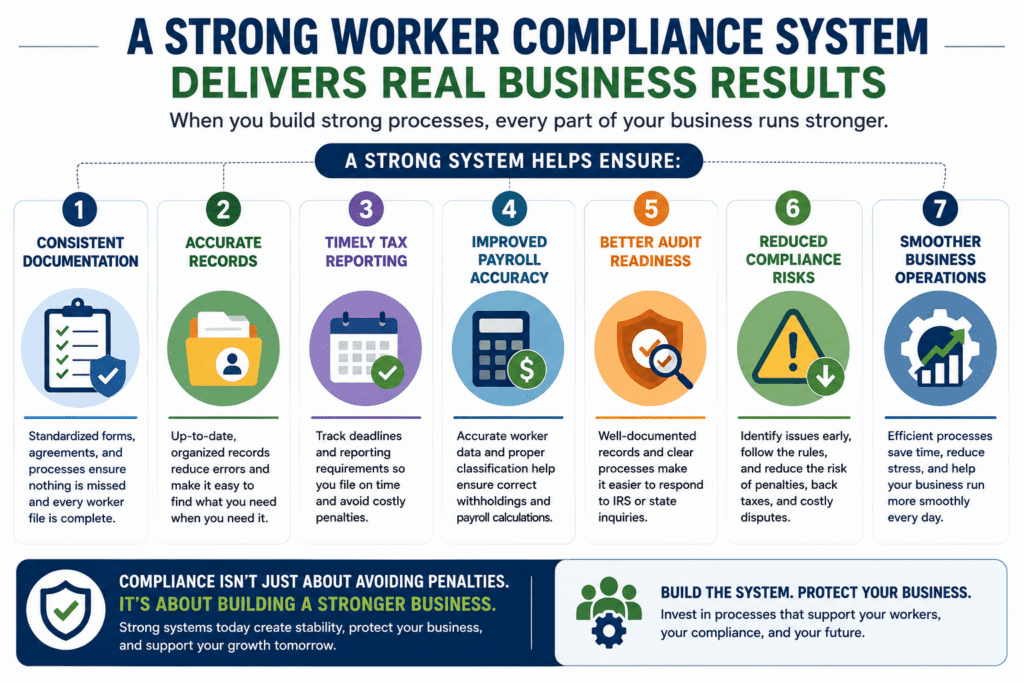
A strong system helps ensure:
- consistent documentation
- accurate records
- timely tax reporting
- improved payroll accuracy
- better audit readiness
- reduced compliance risks
- smoother business operations
Importantly, compliance systems are not only about avoiding costly penalties.
They also help businesses create:
- operational consistency
- stronger workforce management
- clearer documentation trails
- improved decision-making
- better long-term planning
- greater peace of mind
Many businesses invest heavily in payroll software or payroll services but fail to build systems around worker classification, contractor compliance, tax reporting, and documentation management.
That gap creates risk.
The most effective businesses combine:
- payroll systems
- compliance calendars
- worker classification procedures
- contractor onboarding systems
- accurate recordkeeping
- audit documentation processes
into a unified Worker Compliance System designed to support the entire workforce.
As labor structures continue evolving and businesses rely on increasingly diverse worker categories, operational compliance systems will likely become even more important for small business owners seeking to protect their bottom line while maintaining compliance with IRS guidelines, state laws, and federal regulations.
The Worker Compliance Dashboard: A Centralized System for Modern Businesses
As workforce structures become more complicated, many small businesses are discovering that disconnected spreadsheets, isolated payroll software, and manual recordkeeping are no longer enough to manage compliance effectively.
This is one reason we created the Worker Compliance Dashboard inside the RetireCoast Business Membership.
The dashboard was designed as a centralized Worker Compliance System that helps businesses manage:
- payroll compliance
- contractor compliance
- worker classification
- tax reporting
- payment tracking
- compliance calendars
- audit documentation
- workforce management
Instead of relying on scattered systems, businesses can organize compliance processes into a structured operational workflow.
This is especially important for businesses managing multiple worker categories such as:
- W-2 employees
- independent contractors
- consultants
- remote workers
- seasonal workers
- outsourced professional services
Each worker type may involve different payroll processes, tax obligations, reporting requirements, and documentation standards.
The Worker Compliance Dashboard helps businesses maintain greater consistency across the entire workforce.
Why a Centralized Compliance System Matters
Many businesses unknowingly create compliance risks because important information becomes fragmented across:
- payroll systems
- accounting software
- spreadsheets
- email conversations
- paper files
- contractor invoices
- text messages
- disconnected onboarding procedures
Over time, this fragmentation can lead to:
- inaccurate records
- missed filing deadlines
- incomplete contractor files
- worker classification confusion
- payroll mistakes
- tax reporting errors
- poor audit readiness
Centralized systems help reduce these operational gaps.
A structured dashboard approach allows businesses to maintain:
- consistent documentation
- standardized onboarding procedures
- centralized payment tracking
- classification records
- tax reporting workflows
- compliance reminders
- audit preparation files
The goal is to create a repeatable process rather than relying on memory or reactive problem solving.
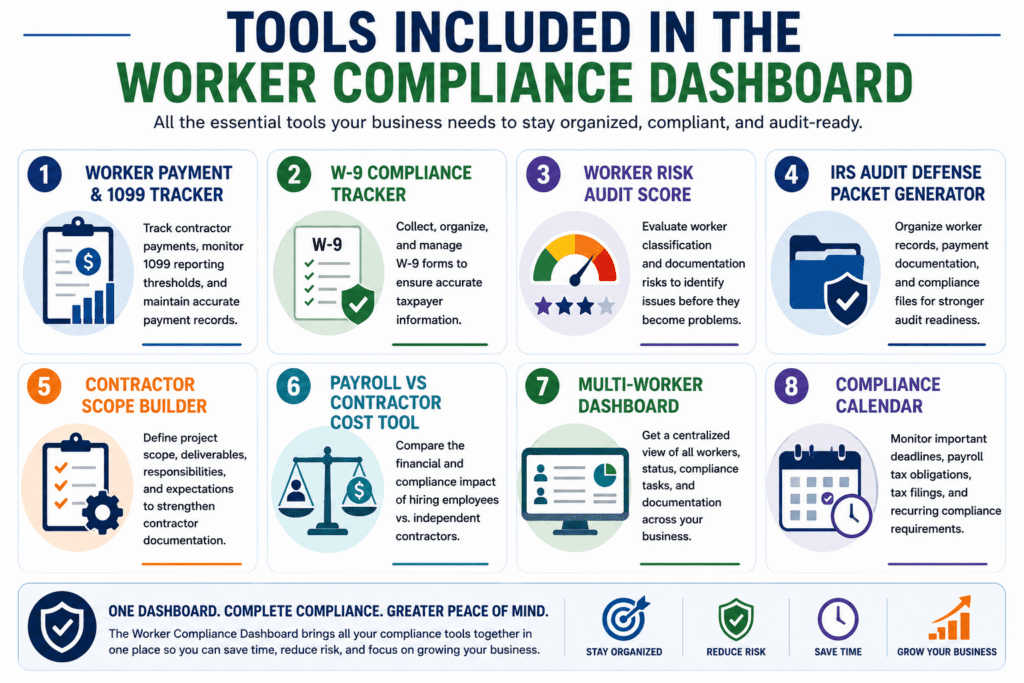
Tools Included in the Worker Compliance Dashboard
The dashboard includes multiple tools designed to work together as part of a complete Worker Compliance System.
Worker Payment & 1099 Tracker
Helps businesses track contractor payments, monitor reporting thresholds, maintain payment records, and improve tax reporting accuracy.
W-9 Compliance Tracker
Designed to help businesses collect and organize taxpayer identification information before compliance problems occur.
Worker Risk Audit Score
Evaluates worker classification and documentation risks to help businesses identify potential compliance issues before they escalate.
IRS Audit Defense Packet Generator
Organizes worker records, payment documentation, and compliance files into a more structured format for audit readiness.
Contractor Scope Builder
Helps businesses define project scope, responsibilities, and contractor relationships more clearly to improve documentation consistency.
Payroll vs Contractor Cost Tool
Allows businesses to compare the financial and compliance implications of hiring workers as employees versus independent contractors.
Multi-Worker Dashboard
Provides a centralized view of workforce records, worker status, compliance tasks, and documentation tracking across multiple worker categories.
Compliance Calendar
Helps businesses monitor filing deadlines, payroll tax obligations, tax reporting dates, and recurring compliance requirements throughout the year.
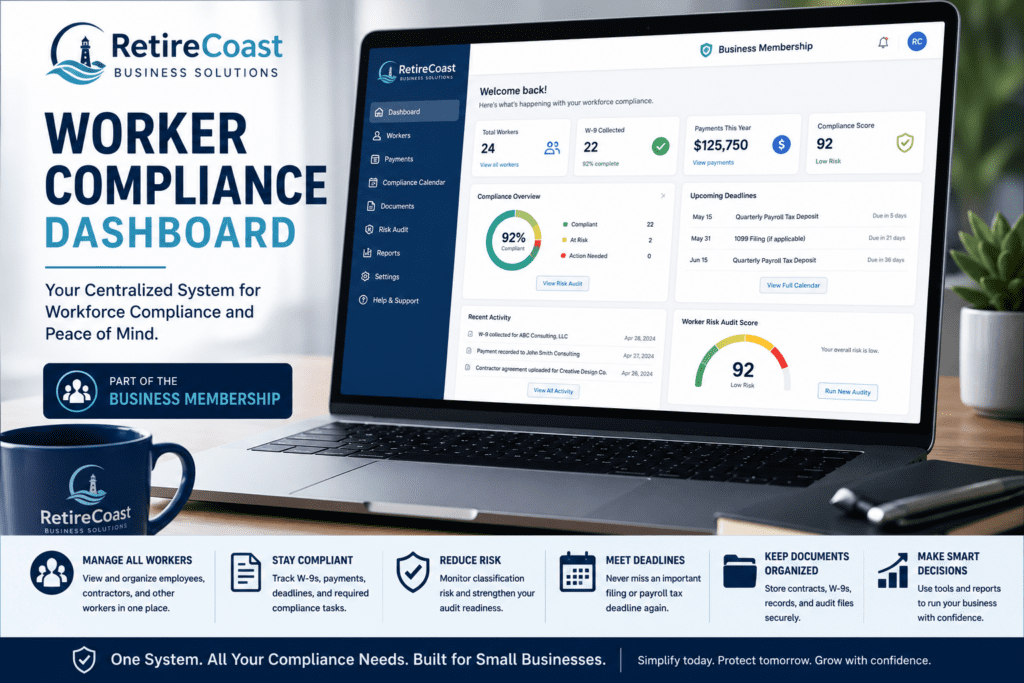
A System Designed for Real-World Business Operations
The Worker Compliance Dashboard was built around how small businesses actually operate.
Many businesses today manage workers across:
- multiple job sites
- remote environments
- seasonal cycles
- project-based assignments
- long-term contractor relationships
Compliance systems must adapt to those realities.
This is why the dashboard focuses not only on payroll compliance but also on:
- workforce organization
- documentation workflows
- classification procedures
- contractor onboarding
- audit preparation
- operational consistency
The system is designed to help businesses create better habits before compliance issues appear.
Compliance Is Becoming More Operational
Historically, many businesses treated worker compliance primarily as an accounting function.
Today, compliance increasingly overlaps with:
- operations management
- workforce planning
- payroll administration
- risk management
- documentation control
- tax reporting systems
As businesses grow, these responsibilities often become interconnected.
A missed W-9 form may later affect:
- tax reporting
- backup withholding obligations
- IRS notices
- audit documentation
- payroll records
A poorly documented contractor relationship may later affect:
- worker classification reviews
- overtime disputes
- unemployment insurance claims
- labor law compliance
This interconnected environment is one reason centralized Worker Compliance Systems are becoming increasingly valuable for modern businesses.
The goal is not simply avoiding costly penalties.
The goal is building stronger business operations supported by:
- accurate records
- proactive compliance procedures
- centralized documentation
- improved payroll accuracy
- audit readiness
- better workforce visibility
- greater peace of mind
Compliance Problems Often Start Small
One of the biggest misconceptions surrounding worker compliance is the belief that serious compliance problems only happen to large corporations or businesses intentionally violating tax laws.
In reality, many compliance problems begin with small operational mistakes.
A business owner may:
- delay collecting a W-9 form
- forget to update worker records
- miss a filing deadline
- rely on verbal agreements
- incorrectly classify a worker
- use outdated taxpayer information
- fail to maintain accurate payroll records
At the time, these issues often seem minor.
The problem is that workforce compliance systems are highly interconnected.
A single documentation mistake can eventually affect:
- tax reporting
- payroll compliance
- IRS matching systems
- worker classification reviews
- audit documentation
- backup withholding obligations
- state labor law compliance
For example:
- a missing taxpayer identification number may later trigger an IRS CP2100A notice
- inaccurate payroll calculations may create payroll tax compliance issues
- incomplete contractor agreements may weaken worker classification defenses
- inconsistent payment records may complicate IRS audits
- missed payroll tax deposits may create penalties and interest
Many small businesses do not recognize these risks because compliance problems often develop slowly over time.
A contractor relationship that initially appears simple may evolve into:
- long-term work arrangements
- regular schedules
- increased supervision
- operational dependence
- integrated workforce roles
Without periodic reviews, businesses may unintentionally create worker classification risks as workforce relationships change.
Similarly, businesses frequently underestimate how many systems influence workforce compliance simultaneously.
Worker compliance may involve:
- payroll systems
- accounting software
- HR procedures
- tax reporting
- contractor onboarding
- labor law compliance
- state regulations
- federal regulations
- unemployment insurance requirements
- employee benefits administration
This complexity is one reason reactive compliance management often fails.
Many businesses only address compliance issues after:
- receiving an IRS notice
- facing payroll tax penalties
- responding to an unemployment claim
- dealing with an overtime dispute
- preparing for an audit
- receiving requests for supporting documentation
At that point, reconstructing accurate records can become extremely difficult.
A proactive Worker Compliance System helps businesses reduce these risks by creating structured operational habits before problems occur.
Instead of reacting to compliance problems later, businesses can implement procedures for:
- worker onboarding
- W-9 collection
- worker classification reviews
- contractor documentation
- payment tracking
- compliance calendar monitoring
- payroll accuracy reviews
- record retention
This approach improves both compliance and overall business operations.
Importantly, strong compliance systems also help businesses create better internal organization.
Businesses with centralized compliance processes often experience:
- fewer documentation gaps
- improved workforce visibility
- stronger payroll accuracy
- reduced administrative confusion
- more efficient tax reporting
- better audit readiness
- improved operational consistency
In many cases, the operational benefits alone justify implementing stronger compliance systems even before considering potential IRS penalties or legal risks.
The goal is not simply avoiding costly mistakes.
The goal is building a business that operates more consistently, more accurately, and with greater long-term stability.
Some portions of this article may initially sound as though they are directed toward large businesses or major corporate payroll departments. Terms such as HR procedures, payroll systems, compliance calendars, and audit documentation can sometimes make workforce compliance appear overly technical or intimidating.
In reality, what we have created is a practical Worker Compliance System specifically designed for small businesses — many of which are organized as LLCs and operated directly by the owner.
Because we wanted this guide to be comprehensive, some readers may initially feel the system looks complicated or designed only for larger businesses. Actually, our goal was the opposite. We built the Worker Compliance Dashboard to simplify what would otherwise be a very confusing and stressful process for small business owners who may have little or no prior experience with payroll compliance, contractor documentation, worker classification rules, tax reporting, or IRS procedures.
Many businesses begin using the system with only one or two workers and gradually expand their compliance procedures as the business grows. The dashboard was designed to help organize these responsibilities into a more manageable operational system that small business owners can realistically use in day-to-day business operations.
- Businesses with only a few workers
- Owner-operated LLCs
- Businesses hiring contractors for the first time
- Companies managing seasonal workers
- Businesses transitioning from informal systems to organized compliance procedures
- Owners starting with little or no prior compliance knowledge
We hope you will find the Worker Compliance Dashboard and the RetireCoast Business Membership helpful in building stronger business operations, reducing compliance risks, improving organization, and creating greater confidence as your workforce grows over time.
Why Accurate Records Matter More Than Most Businesses Realize
Accurate records are one of the most important foundations of a strong Worker Compliance System.
Many compliance problems become significantly worse when businesses cannot produce supporting documentation during:
- IRS audits
- payroll tax compliance reviews
- unemployment insurance disputes
- worker classification investigations
- labor law complaints
- requests from state agencies
In many cases, businesses may honestly believe they handled worker relationships correctly but struggle to prove compliance because records were incomplete, inconsistent, or scattered across multiple systems.
For example, businesses may be unable to locate:
- signed contractor agreements
- completed W-9 forms
- worker classification documentation
- payment records
- payroll tax filings
- onboarding information
- compliance calendars
- communication records
- tax reporting confirmations
Without accurate records, businesses may face additional scrutiny even when they acted in good faith.
This is especially important because workforce relationships often evolve gradually over time.
A contractor initially hired for occasional work may later:
- work more hours
- become integrated into daily operations
- receive more supervision
- use company equipment
- perform core business functions
If businesses do not maintain detailed records documenting:
- worker status
- project scope
- payment arrangements
- classification reviews
- contractor independence
it becomes much more difficult to defend those decisions later.
Good documentation also improves day-to-day business operations.
Businesses with centralized records often experience:
- smoother payroll processes
- fewer reporting mistakes
- stronger workforce organization
- better communication
- more efficient onboarding
- improved tax reporting accuracy
- reduced administrative confusion
This is one reason many businesses are moving away from:
- handwritten notes
- disconnected spreadsheets
- scattered email records
- memory-based systems
and toward centralized Worker Compliance Systems designed to maintain consistent documentation across the entire workforce.
Importantly, maintaining accurate records is not simply about preparing for an IRS audit.
Strong recordkeeping helps businesses:
- improve operational consistency
- reduce compliance risks
- strengthen workforce management
- support long-term planning
- improve financial organization
- create greater peace of mind
In many ways, accurate records become the operational foundation supporting every other part of workforce compliance.
Final Thoughts: Workforce Compliance Is Becoming a Core Business Function
The modern workforce has changed dramatically.
Today’s small businesses often manage a combination of:
- W-2 employees
- independent contractors
- consultants
- freelancers
- remote workers
- seasonal labor
- outsourced professional services
As workforce structures become more complex, worker compliance responsibilities become more interconnected.
Payroll compliance, contractor documentation, worker classification, tax reporting, compliance calendars, and audit readiness can no longer be treated as isolated administrative tasks.
Instead, they are increasingly becoming part of core business operations.
This is one reason businesses that implement proactive Worker Compliance Systems often gain advantages beyond simple compliance.
Strong systems may help businesses:
- improve operational organization
- reduce costly mistakes
- strengthen payroll accuracy
- maintain more accurate records
- improve workforce visibility
- simplify tax reporting
- reduce administrative stress
- improve audit readiness
- create more scalable business operations
Importantly, the goal is not perfection.
The goal is creating a structured system that helps businesses operate more consistently while reducing long-term compliance risks.
For many small business owners, workforce compliance initially feels intimidating because regulations, payroll systems, tax reporting requirements, and worker classification rules appear complicated.
However, businesses do not need to master everything immediately.
Most successful systems begin with a few important habits:
- collecting documentation early
- maintaining accurate records
- reviewing worker classifications periodically
- tracking payments consistently
- organizing compliance responsibilities into repeatable processes
Over time, those habits create stronger operations and fewer compliance surprises.
The Worker Compliance Dashboard was created to help simplify that process for real-world small business owners who want practical systems rather than complicated corporate procedures.
As businesses grow and workforce structures continue evolving, centralized Worker Compliance Systems will likely become one of the most important operational tools small businesses implement to protect both their business operations and long-term financial stability.
The modern workforce is more complicated than ever. Businesses now manage employees, contractors, consultants, remote workers, seasonal labor, and outsourced professional services — each carrying different compliance obligations, documentation requirements, payroll considerations, and reporting risks.
The RetireCoast Worker Compliance System, included inside the Business Membership, was designed to help small business owners organize worker records, manage payroll and contractor compliance, track filing deadlines, improve documentation, and build stronger operational systems without needing enterprise-level HR departments or expensive compliance software.
Once businesses begin improving compliance systems, payroll organization, documentation, and operational structure, many owners naturally begin focusing on the next layer of protection: protecting the assets, business interests, and wealth they are building over time.
The RetireCoast Estate Planning Membership focuses on practical tools and educational resources related to revocable living trusts, asset organization, business continuity planning, wealth preservation, and protecting personal and business assets through stronger planning systems.
RetireCoast also publishes educational articles designed to help business owners better understand worker classification, payroll systems, contractor documentation, IRS reporting requirements, and operational risk management.
Strong businesses are rarely built through isolated tools alone. They are built through organized systems, accurate records, proactive planning, and long-term operational discipline.
PEOPLE OFTEN ASK
FAQ
What is a Worker Compliance System?
A Worker Compliance System is a structured process businesses use to manage payroll compliance, worker classification, tax reporting, W-9 collection, contractor documentation, payment tracking, and audit readiness for employees and independent contractors.
Why is worker classification important?
Worker classification affects payroll taxes, overtime pay obligations, tax withholding requirements, unemployment insurance, benefits administration, and legal compliance. Incorrect classification can result in IRS audits, back taxes, civil penalties, and legal action.
What happens if a contractor does not provide a W-9 form?
Businesses may still have tax reporting obligations even if a contractor fails to provide a completed W-9 form. Missing taxpayer identification information can lead to backup withholding requirements, IRS notices, and additional compliance risks.
Can the IRS audit 1099 forms?
Yes. The Internal Revenue Service uses matching systems to compare 1099 information against taxpayer records. Incorrect names, missing TINs, inaccurate reporting, or worker classification issues may trigger IRS notices or audit reviews.
What is a CP2100A notice?
A CP2100A notice is an IRS notice informing businesses that taxpayer identification information submitted on filed forms does not match IRS or Social Security Administration records. Businesses may need to obtain corrected information or address backup withholding obligations.
What records should businesses keep for contractors?
Businesses should maintain W-9 forms, contractor agreements, payment records, invoices, tax reporting forms, classification documentation, communication records, and any supporting documentation tied to the contractor relationship.
Why do businesses need compliance calendars?
Compliance calendars help businesses track filing deadlines, payroll tax deposits, tax reporting due dates, W-2 reporting requirements, 1099 filing dates, and other important compliance obligations throughout the year.
What is backup withholding?
Backup withholding is a federal tax withholding requirement that may apply when a contractor fails to provide a valid taxpayer identification number or when taxpayer information is incorrect. Businesses may become responsible for withholding a percentage of future payments.
Do payroll software systems handle contractor compliance?
Many payroll systems primarily focus on employee payroll processing and payroll tax compliance. Businesses often still need separate systems for worker classification, W-9 tracking, contractor agreements, 1099 reporting, and audit documentation.
How does a Worker Compliance Dashboard help businesses?
A Worker Compliance Dashboard helps businesses centralize worker records, payroll compliance tasks, contractor documentation, payment tracking, filing deadlines, classification reviews, and audit preparation into a structured system that improves accuracy and reduces compliance risks.
Discover more from RetireCoast.com
Subscribe to get the latest posts sent to your email.