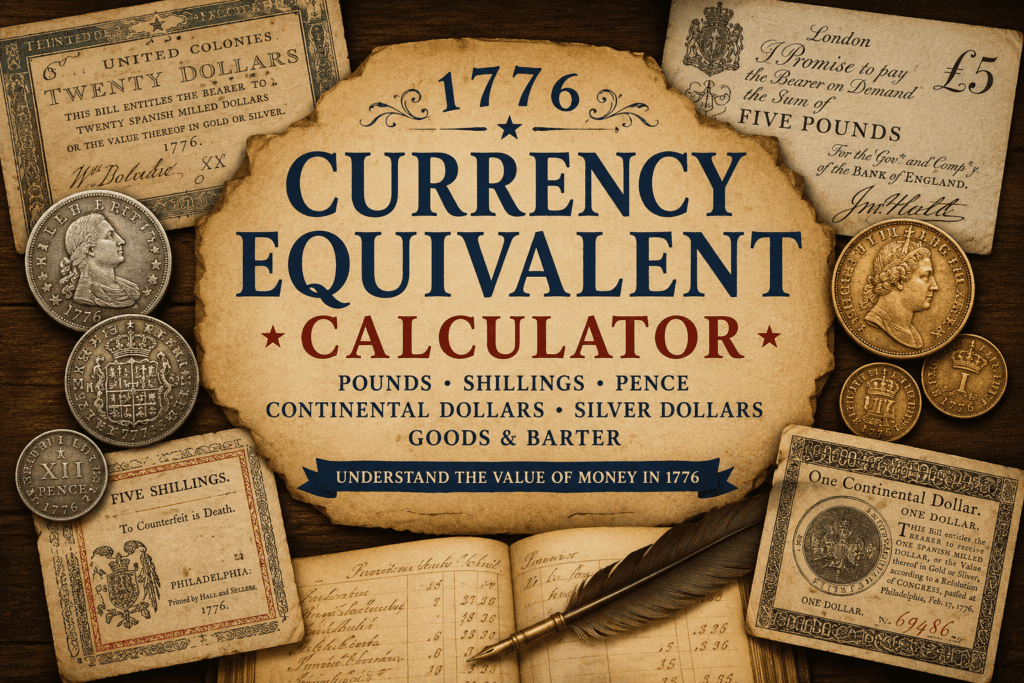
In 1776 there was no digital banking system, no standardized national currency, and certainly no electronic calculator capable of instantly converting one form of payment into another. Colonial America operated using a complicated mixture of British pounds, shillings, and pence, Spanish silver dollars, Continental paper currency, colonial notes issued by individual colonies, barter goods, and even personal credit recorded in handwritten ledgers.
Merchants, tavern owners, blacksmiths, printers, dock operators, farmers, and military suppliers often maintained large paper account books where transactions were carefully entered line by line using ink and quill pens. A customer might pay partially in silver coins, partially in paper notes, and partially in goods or labor. In many cases, the ledger keeper converted those mixed forms of payment into a single equivalent value for accounting purposes.
For example, a merchant might record:
- 2 Spanish silver dollars
- 5 shillings in coin
- a barrel of flour
- and a small amount of Continental paper money
…then enter the total as one combined amount expressed in pounds or shillings within the ledger.
This process was necessary because commerce during the Revolutionary period depended heavily on trust, local valuation systems, and practical equivalencies rather than a single universally accepted currency. Even the value of paper money could change dramatically depending on the colony, the date, military conditions, and public confidence in the issuing government.
This 1776 Currency Equivalent Calculator recreates the type of conversion work that colonial merchants and accountants likely performed manually in their ledgers. While no exact universal exchange system existed at the time, the calculator uses historically reasonable conversion estimates to help modern readers understand how different forms of Revolutionary-era payment related to one another.
Using this tool, you can estimate the relative equivalent values between:
- British pounds, shillings, and pence
- Continental dollars
- Spanish milled dollars (“pieces of eight”)
- silver coin values
- barter goods
- and other forms of colonial payment commonly used during the American Revolution.
The goal is not to produce an exact modern financial conversion, but rather to help readers better understand the economic reality of 1776 and the complex financial world that merchants, soldiers, printers, tavern keepers, and ordinary citizens navigated every day during the Revolutionary era.
Colonial Ledger Equivalent
Colonial America did not operate with one unified currency system. Merchants often converted mixed forms of payment into a single accounting value recorded in handwritten ledgers. Exchange values varied by colony, silver content, wartime inflation, and confidence in paper currency. This calculator provides educational estimates only.


The same principles that helped successful entrepreneurs survive in 1776 still matter today: preparation, organization, risk management, adaptability, and protecting what you build.
Whether you operate a modern business, manage investment property, plan for retirement, or simply want to protect your family’s future, our memberships are designed to help you build a stronger foundation in uncertain times.