Introduction
Many people dream about buying a mini farm after retirement. Some want to grow their own food, raise chickens, keep a few goats, enjoy a slower pace of life, or simply own a piece of land away from the city. Others see farming as a way to stay active, generate supplemental income, or leave a legacy for future generations.
While the idea of owning a retirement farm can be appealing, it is important to understand that farming requires time, money, physical effort, and careful planning. What works well for one retiree may not be practical for another.
Factors such as health, finances, acreage, distance from medical care, family support, and previous farming experience can all influence whether a mini farm is a good fit.
🌱 Before You Use This Calculator
If you arrived at this calculator before reading our comprehensive guide on farming after retirement, we strongly recommend that you read the article first and then return to complete the assessment.
The calculator can help evaluate your readiness for owning a mini farm, but understanding the realities of rural living, startup costs, workload requirements, lifestyle considerations, and potential business opportunities will help you answer the questions more accurately.
Recommended Reading:
Farming After Retirement: Business or Lifestyle?
After reading the article, return here and complete the Retirement Farm Suitability Assessment to determine whether farm ownership aligns with your retirement goals, finances, health, and desired lifestyle.
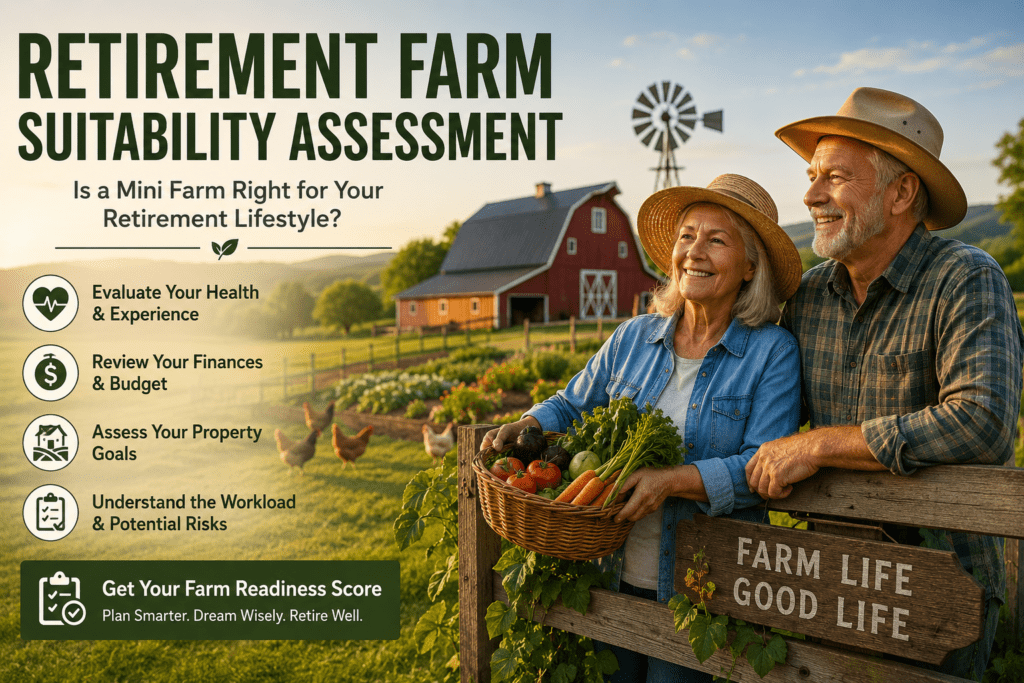
The Retirement Farm Suitability Assessment is designed to help you evaluate these factors before purchasing property. By answering a series of questions about your goals, resources, and lifestyle, you can gain a better understanding of your readiness for farm ownership and identify areas that may require additional planning.
No online assessment can predict the future, but this tool can help you think through important considerations before making what may be one of the largest purchases of your retirement years.
How to Use the Retirement Farm Suitability Assessment
- Enter Your Personal Information. Provide your age, overall health, and previous farming or gardening experience. These factors help estimate your ability to manage the physical demands of farm ownership.
- Describe Your Farm Goals. Enter the number of acres you hope to purchase and select the type of farming activity that most closely matches your plans, such as gardening, fruit trees, chickens, livestock, or a mixed mini farm.
- Evaluate Your Financial Readiness. Enter your annual retirement income, available cash reserves, and any financing you expect to use. Farm ownership often involves ongoing expenses beyond the purchase price.
- Consider Practical Factors. The tool also evaluates your distance from medical care, existing equipment ownership, willingness to perform farm labor, and support from your spouse or partner.
- Click “Calculate My Farm Readiness.” The tool will analyze your responses and generate a Retirement Farm Readiness Score.
- Review Your Results. You will receive:
- A readiness score.
- An overall assessment rating.
- An estimated workload level.
- A preliminary startup cost estimate.
- Suggestions for next steps.
- Use the Results as a Planning Tool. This assessment is not intended to tell you whether to buy a farm. Instead, it highlights strengths and potential challenges so you can make a more informed decision.
What to Do Next
If the assessment indicates that a retirement farm may be a good fit, consider using our Farm Business Plan Creator and Farm Budget Planner. These free tools can help you estimate startup costs, project ongoing expenses, evaluate income opportunities, and develop a practical roadmap for your retirement farming goals.
Remember that many successful retirement farmers start small. A few acres, a garden, fruit trees, and a handful of chickens can often provide more enjoyment and less stress than a large operation requiring significant capital and daily labor.
Retirement Farm Suitability Assessment
Use this free tool to estimate whether buying a mini farm after retirement fits your health, budget, lifestyle, and long-term goals.
This free calculator helps answer one important question. RetireCoast Memberships help you build a more complete plan.
Budgeting, debt reduction, major life decisions, retirement projections, and wealth-building tools.
Business formation, pricing, compliance, tax-saving strategies, and operational decision systems.
Draft documents, organize assets, evaluate trust strategies, and prepare before meeting an attorney.
Complete access to every RetireCoast membership, dashboard, tool, calculator, and planning system.
Why guess about retirement, business, estate planning, or long-term financial decisions? Use structured RetireCoast planning tools to move from a single calculation to a more complete plan.
Disclaimer
The Retirement Farm Suitability Assessment is provided for educational and informational purposes only. The results generated by this tool are based solely on the information entered by the user and should not be considered financial, legal, tax, real estate, agricultural, medical, or investment advice.
Farm ownership involves numerous factors that cannot be fully evaluated by an online assessment, including local land values, zoning regulations, environmental conditions, water availability, insurance requirements, health considerations, market conditions, and individual circumstances.
Actual costs, workload requirements, and financial outcomes may differ significantly from the estimates provided by this tool.
Before purchasing a farm, mini farm, homestead, or rural property, you should conduct independent research and consult with qualified professionals, including real estate brokers, attorneys, accountants, tax advisors, financial planners, agricultural extension agents, lenders, and medical professionals as appropriate.
RetireCoast, its owners, affiliates, contributors, and partners make no representations or warranties regarding the accuracy, completeness, suitability, or reliability of the information provided by this tool.
By using this assessment, you acknowledge that all decisions related to purchasing, financing, operating, or managing a farm remain your sole responsibility.
Past experiences and examples discussed on this website do not guarantee future results. Every retirement situation, property, and farming operation is unique.
Use this tool as a starting point for planning and education—not as a substitute for professional advice.