What Is the Best Business Legal Structure?
One of the most common questions new entrepreneurs ask is: “What is the best business legal structure?”
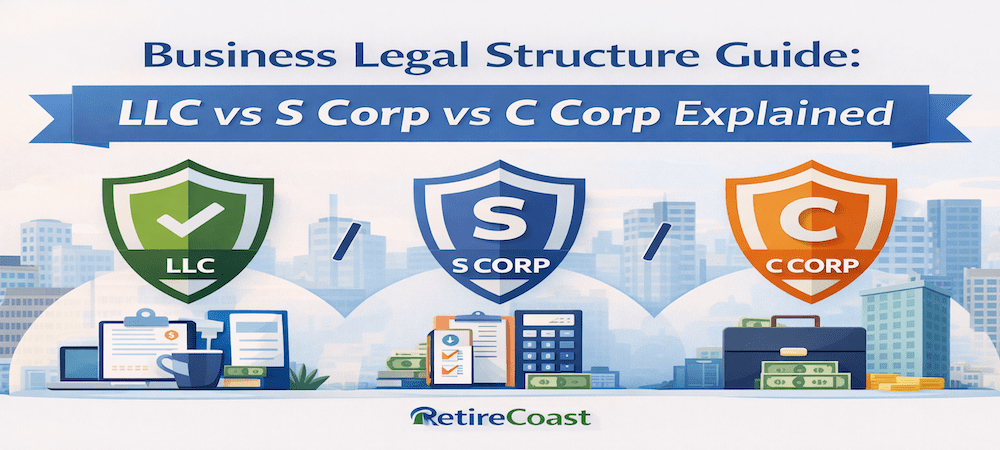
For most small businesses, the decision usually comes down to choosing between an LLC, an S Corporation, or a C Corporation. Each structure offers different advantages related to taxes, liability protection, ownership flexibility, and long-term growth.
The challenge is that many business owners choose a structure based on quick advice from friends, internet forums, or online filing services rather than understanding how each entity actually works. As a result, entrepreneurs sometimes select the wrong structure and later discover it creates higher taxes, unnecessary complexity, or legal complications.
Understanding how these business structures differ — and when each one is appropriate — is one of the most important steps in building a successful company.
- What Is the Best Business Legal Structure?
- Limited Liability Company (LLC)
- S Corporation
- C Corporation
- Short Quiz
- Why Choosing the Right Structure Matters
- Case Study: Eric’s Landscaping Business
- Choosing the Right Business Structure
- The Most Common Business Structures in the United States
- Sole Proprietorship
- A Hidden Detail: Many LLCs Are Taxed as Sole Proprietorships
- Why Pass-Through Businesses Dominate
- The Bottom Line
- Where the Decision Tool Fits
- Use the Business Structure Decision Tool
- Start the Business Structure Decision Tool
- Conclusion
Starting a business requires more than a good idea and a willingness to work hard. One of the first and most important decisions an entrepreneur must make is choosing the business’s legal structure that will govern how the company operates.
Answer these questions to see whether you may be better suited to building a business from the ground up or purchasing one that already exists.
The business legal structure you choose determines how the company is taxed, how profits are distributed, how owners are protected from liability, and how the business can grow in the future. It also affects your ability to bring in partners, attract investors, and implement tax strategies as the company becomes profitable.
Many new entrepreneurs hear terms such as LLC, S Corporation, and C Corporation, but they often do not fully understand the differences between these business structures. Choosing the wrong structure can create unnecessary taxes, administrative complexity, or legal complications later.
In this article, we focus primarily on the three most commonly discussed business legal structures — the LLC, S Corporation, and C Corporation — and explain how each works and when it may be appropriate. We also discuss sole proprietorships later in the article, including situations where operating as a sole proprietor may actually make sense when a business is first starting.
Understanding the differences between these structures will help you make a more informed decision and avoid costly mistakes as your business grows.
Limited Liability Company (LLC)
The Limited Liability Company (LLC) is the most popular structure for small businesses in the United States.
An LLC combines the liability protection of a corporation with the flexibility and simplicity of a partnership or sole proprietorship.
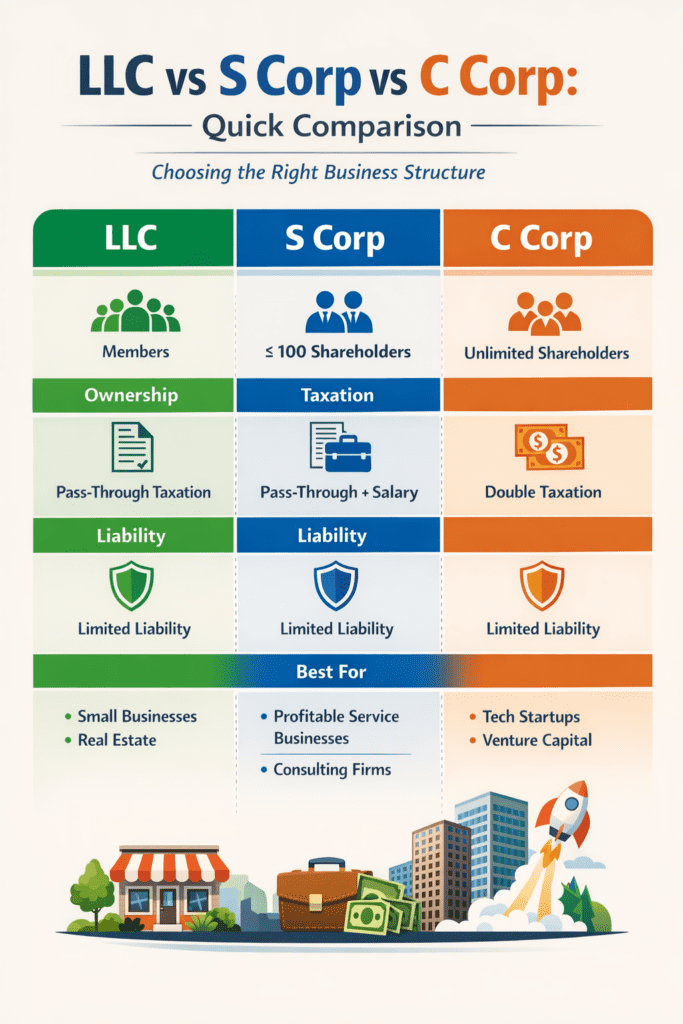
The owners of an LLC are called members, and the company can be owned by one person or multiple individuals.
Key Benefits of an LLC
• Personal liability protection
• Flexible management structure
• Pass-through taxation
• Fewer administrative requirements than corporations
• Simple ownership structure
In most cases, profits from an LLC pass directly to the owners’ personal tax returns, avoiding corporate taxation.
Because of this flexibility, LLCs are commonly used by:
• consulting businesses
• construction companies
• landscaping businesses
• online businesses
• real estate investors
• family-owned companies
S Corporation
An S Corporation is not a business entity itself. Instead, it is a tax election filed with the IRS.
Both LLCs and corporations may choose to be taxed as an S Corporation if they meet IRS requirements.
The main advantage of an S Corporation election is the potential to reduce self-employment taxes.
Owners of an S Corporation typically receive income in two forms:
• salary
• profit distributions
Only the salary portion is subject to payroll taxes, while distributions may avoid self-employment tax.
Requirements for S Corporations
To qualify for S Corporation taxation, the business must:
• have 100 or fewer shareholders
• be owned by U.S. citizens or residents
• have only one class of stock
Because of these restrictions, S Corporations are typically used by profitable service businesses rather than companies seeking outside investment.
C Corporation
The C Corporation is the traditional corporate structure used by larger companies and businesses that intend to raise significant outside capital.
Unlike pass-through structures, a C Corporation is a separate taxable entity.
This creates what is commonly known as double taxation.
The corporation first pays tax on its profits. Then shareholders pay personal tax again if those profits are distributed as dividends.
Advantages of C Corporations
Despite the double taxation, C Corporations offer advantages that make them attractive for certain types of businesses.
They allow:
• unlimited shareholders
• multiple classes of stock
• easier access to venture capital
• the ability to retain earnings for expansion
For this reason, C Corporations are often used by technology startups and companies seeking investors.
Short Quiz
Answer the questions below to see which business structure may align with your situation.
Why Choosing the Right Structure Matters
Many entrepreneurs assume they can easily change their business structure later if needed.
While this is sometimes possible, it can become complicated once the business owns assets, has employees, or has developed revenue.
Changing a structure may require:
• dissolving the original entity
• forming a new business
• transferring assets and contracts
• changing bank accounts and tax filings
• addressing potential tax consequences
For that reason, it is best to carefully evaluate the structure before filing formation documents.

Case Study: Eric’s Landscaping Business
Eric had worked in the landscaping industry for years and eventually decided to start his own company.
He partnered with a friend who planned to help with scheduling and customer relationships while Eric focused on the operational side of the business.
When it came time to form the company, Eric asked a friend for advice about what type of business entity to create.
The friend suggested forming a corporation, explaining that large companies were corporations and therefore, it must be the best option.
Without consulting an accountant or attorney, Eric and his partner created a C Corporation.
Early Success
The business grew quickly.
Within a few years, Eric had several trucks, multiple employees, and a steady list of residential and commercial customers.
Revenue increased every year, and the company became profitable.
However, when tax season arrived, Eric discovered something unexpected.
The Double Taxation Surprise
Because the business was structured as a C Corporation, profits were taxed twice.
First, the corporation paid corporate income tax.
Then Eric and his partner paid personal income tax again when profits were distributed.
Eric later learned that most landscaping businesses operate as LLCs or S Corporations, which avoid corporate taxation by passing profits directly to the owners.
Attempting to Change the Structure
Eric eventually spoke with an accountant who explained that converting the business structure would not be simple.
To move from the corporation to an LLC, he would need to:
• dissolve the corporation
• form a new LLC
• transfer vehicles and equipment
• update bank accounts and contracts
• evaluate potential tax implications
The process required professional assistance and considerable time.
While Eric eventually completed the conversion, he later realized that choosing the correct structure at the beginning would have avoided the complication entirely.
Choosing the Right Business Structure
The best structure for a business depends on several factors:
• number of owners
• expected profit levels
• tax planning strategy
• liability exposure
• whether outside investors will be involved
For many small businesses, an LLC is the most flexible starting point, with the option to elect S Corporation taxation later if the business becomes highly profitable.
However, businesses planning to raise venture capital often require a C Corporation structure.
Because the decision involves both legal and tax considerations, it helps to evaluate the factors carefully before filing any documents.
- Working directly on client property (contracting, landscaping, repairs)
- Employees or subcontractors
- Vehicles or expensive equipment
- Rental properties or real estate investments
- Customer injuries or liability risks
- Large contracts or long-term agreements
- Substantial annual income
The Most Common Business Structures in the United States
Before diving into the details of LLCs, S Corporations, and C Corporations, it helps to understand how businesses in the United States are actually structured.
There are roughly 33 million businesses operating in the United States, and the vast majority are small businesses rather than large corporations.
The distribution of these businesses across legal structures is surprisingly uneven.
Estimated Breakdown of U.S. Business Structures
• Sole Proprietorships — roughly 72% to 73%
• S Corporations — roughly 15%
• Partnerships / Multi-Member LLCs — roughly 8% to 10%
• C Corporations — roughly 5% to 6%
These percentages show an important reality: most businesses in America are not corporations at all.
Instead, they operate as pass-through entities where profits flow directly to the owners’ personal tax returns.
- Freelancers and consultants
- Online side businesses
- Creative professionals
- Independent contractors
- Seasonal or part-time businesses
Sole Proprietorship
The sole proprietorship is the simplest business structure in the United States and by far the most common.
In a sole proprietorship, the business and the owner are legally the same entity.
There is no separate legal organization, and the owner reports all income and expenses directly on their personal tax return.
This structure is extremely common among:
• freelancers
• consultants
• gig-economy workers
• independent contractors
• small service businesses
Many people operating a business for the first time begin as sole proprietors because no formal entity is required to start operating.
Key Characteristics
• The owner has complete control of the business
• Business income is reported on the owner’s personal tax return
• There are minimal administrative requirements
• The owner is personally responsible for all business debts
The Major Drawback: Unlimited Liability
The primary disadvantage of a sole proprietorship is personal liability.
Because the business is not legally separate from the owner, the owner’s personal assets may be exposed if the business is sued or incurs significant debt.
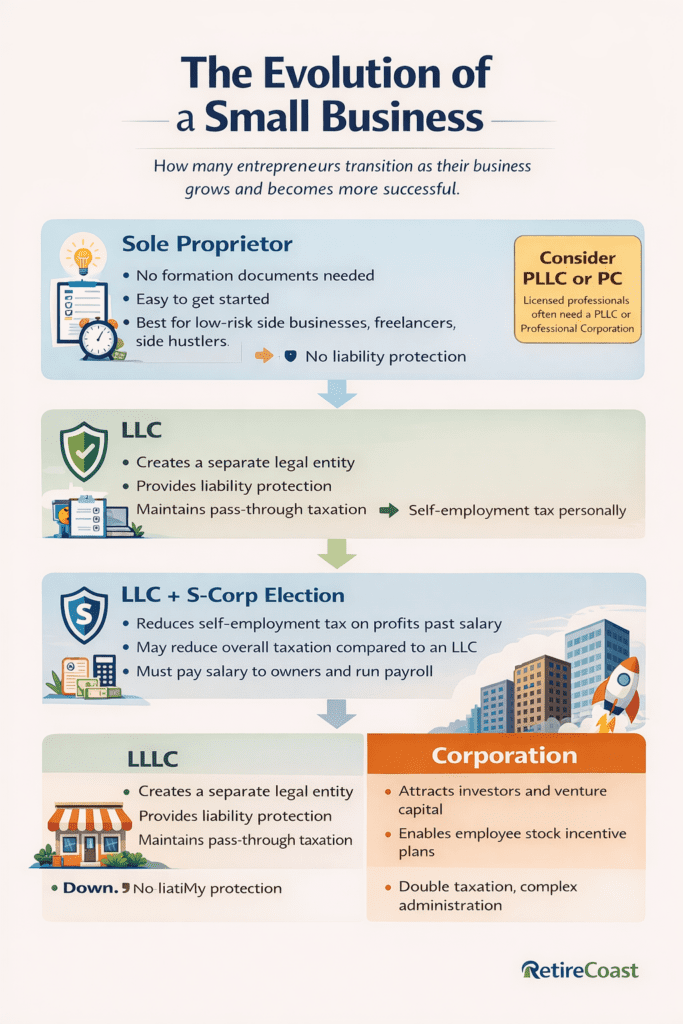
For this reason, many entrepreneurs eventually transition from a sole proprietorship to an LLC, which provides liability protection while maintaining tax simplicity.
A Hidden Detail: Many LLCs Are Taxed as Sole Proprietorships
The statistics above can be misleading at first glance.
Although sole proprietorships represent over 70% of U.S. businesses, a large portion of these are actually single-member LLCs.
By default, the IRS treats a single-member LLC as a “disregarded entity.”
This means the LLC provides liability protection under state law, but the income is still taxed as a sole proprietorship.
As a result, many businesses that legally operate as LLCs still appear in tax statistics as sole proprietorships.
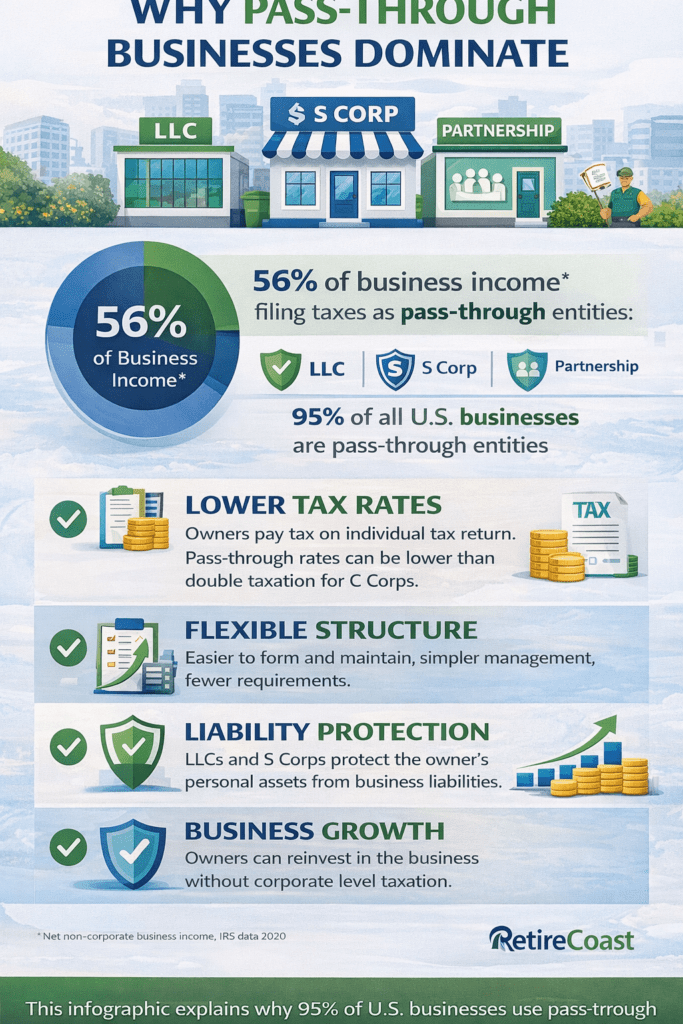
Why Pass-Through Businesses Dominate
Over the past several decades, business owners have increasingly chosen pass-through tax structures rather than traditional corporations.
A pass-through structure means the business itself does not pay income tax. Instead, profits pass directly to the owners.
This avoids the double taxation that occurs with C Corporations.
Today, the majority of small businesses operate as:
• LLCs
• S Corporations
• partnerships or multi-member LLCs
These structures provide a balance between liability protection and tax efficiency.
The Bottom Line
When looking at all businesses in the United States, sole proprietorships dominate the landscape simply because they are easy to start and require little paperwork.
However, if you exclude sole proprietorships and focus only on formal registered business entities, the picture changes.
Among structured businesses:
• S Corporations are the most common tax classification
• LLCs are the fastest-growing legal structure for new businesses
This is why many entrepreneurs start with an LLC and later elect S Corporation taxation once the business becomes profitable.
Choosing the correct structure at the beginning can save business owners significant time, complexity, and taxes later.
Where the Decision Tool Fits
Understanding these statistics is helpful, but every business is different.
The right structure depends on factors such as:
• number of owners
• expected profits
• liability exposure
• plans for investors
• tax planning strategy
For this reason, the RetireCoast Business Builder Membership includes a Business Structure Decision Tool that walks through the key questions entrepreneurs should evaluate before forming a company.
The tool generates a Business Structure Recommendation Report to help entrepreneurs make informed decisions before filing formation documents.
Use the Business Structure Decision Tool
To help entrepreneurs make this decision, we created a Business Structure Decision Tool inside the RetireCoast Business Builder Membership.
The tool evaluates several factors, including:
• number of owners
• expected profits
• investor plans
• liability risks
• tax considerations
After completing the evaluation, the system generates a Business Structure Recommendation Report explaining which structure may fit your situation and why.
This helps entrepreneurs make an informed decision before forming their business entity.
Start the Business Structure Decision Tool
Inside the membership, you will also find tools to help you build your business properly from the start, including:
• Ownership & Structure Planner
• LLC Operating Agreement Generator
• LLC Meeting Minutes Generator
• Business Plan Builder
• Business Budget Creator
These tools work together to help entrepreneurs create a properly structured and well-documented business from the beginning.
Conclusion
Choosing the right business structure is one of the most important decisions an entrepreneur makes. The structure determines how the business is taxed, how profits are distributed, and how well the owners are protected from liability.
While LLCs provide flexibility for most small businesses, S Corporations can offer tax advantages for profitable companies, and C Corporations are often necessary for businesses seeking outside investment.
Understanding the differences between these structures allows entrepreneurs to make informed decisions and avoid costly mistakes later.
- Search to see if your desired business name is available
- File the formation documents for an LLC or corporation
- Review state filing requirements and fees
- Business Structure Decision Engine
- Ownership & Structure Planner
- LLC Operating Agreement Generator
- LLC Meeting Minutes Generator
- Business Plan Builder
FAQ
What is the best business legal structure for most small businesses?
What is the difference between an LLC and an S Corporation?
Why do some business owners choose S Corporation taxation?
Why are C Corporations less common for small businesses?
Is a sole proprietorship ever the right choice?
Can I change my business structure later?
Do states and the IRS handle business structures differently?
What is a PLLC or professional corporation?
When should a business owner consider moving from an LLC to S Corporation taxation?
Where can I get help choosing the right business structure?
Discover more from RetireCoast.com
Subscribe to get the latest posts sent to your email.