Last updated on March 29th, 2026 at 08:18 pm
A Guide to Funding Your Revocable Living Trust
What It Means, Why It Matters, and Exactly How To Do It
When you create a Revocable Living Trust, signing the document is only the first step.
If you do not transfer assets into the trust, your estate plan may fail to accomplish its primary goal: avoiding probate and ensuring smooth management if you become incapacitated.
This article explains:
- What “funding” a trust actually means
- Why funding is critical
- How to transfer different types of assets
- How to handle real estate, LLCs, partnerships, and corporate shares
- Common mistakes to avoid
- How our tools simplify the process
- A Guide to Funding Your Revocable Living Trust
- What Does “Funding” a Trust Mean?
- Why Funding Matters
- Funding Real Estate
- How to Transfer Real Property Into Your Trust
- Where Do You File a Quit-Claim Deed?
- Obtaining the Correct Parcel Number
- Why Use a Quit-Claim Deed?
- Using Our Quit Claim Deed Tool
- Funding Bank Accounts
- Brokerage Accounts and Investment Accounts
- Retirement Accounts (Important Exception)
- Life Insurance Policies
- Funding LLC Interests
- How to Transfer LLC Membership to Your Trust
- Our LLC Member Minutes Tool (Coming Soon)
- Funding Business Partnerships
- Funding Corporate Shares
- Personal Property
- Digital Assets
- Common Funding Mistakes
- Should You Transfer Everything?
- The Practical Strategy
- Why This Matters for Business Owners
- Our Philosophy
- Final Thoughts
What Does “Funding” a Trust Mean?
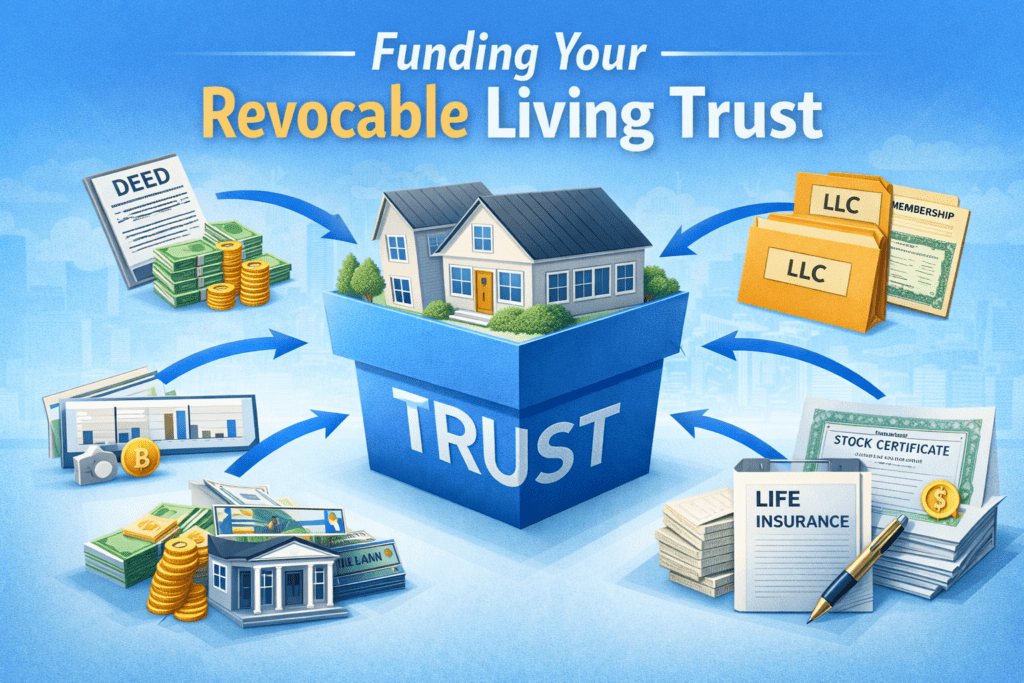
Funding your trust means retitling or assigning ownership of assets from your individual name to the name of your trust.
For example:
Instead of:
Richard Jones
You would hold the title as:
Richard Jones Trustee of the Jones Revocable Living Trust dated January 1, 2026
If the asset remains in your personal name, it is generally not controlled by the trust and may still require probate.
Why Funding Matters
Proper funding accomplishes three major objectives:
1️⃣ Avoids Probate
Assets properly titled in the trust typically avoid court-supervised probate proceedings.
2️⃣ Ensures Continuity During Incapacity
If you become incapacitated, your successor trustee can step in and manage trust-owned assets without court involvement.
3️⃣ Creates Administrative Simplicity
Your successor trustee can manage or distribute assets according to your written instructions without legal obstacles.
Funding Real Estate
Real estate is often the most important asset to transfer.
How to Transfer Real Property Into Your Trust
The standard method is a Quit Claim Deed.
Step-by-Step:
- Prepare a Quit Claim Deed transferring property:
- From: You (individually)
- To: You, as Trustee of your Trust
- Include:
- Full legal property description
- Parcel number
- Proper trust title format
- Required state disclosures
- Sign before a notary.
- Record the deed at the county land records office.
- Verify that the recorded deed reflects the trust as the owner.
Where Do You File a Quit-Claim Deed?
In the United States, real estate records are maintained at the county level.
Depending on your state, the recording office may be called:
- County Recorder
- Recorder of Deeds
- Register of Deeds
- Chancery Clerk
- Land Records Office
Each county manages its own recording system.
How to File
After the deed is:
- Properly prepared
- Correctly formatted
- Signed
- Notarized
You must record it with the county where the property is located.
In many counties, you can mail the notarized document.
However, if you are local to the courthouse, it is often best to deliver it in person. This allows you to:
- Confirm formatting requirements
- Verify margin and page standards
- Ensure the required information is present
- Avoid rejection delays
If the office accepts your deed, ask for a stamped receipt showing the date and time of recording.
Recording is what makes the transfer legally effective against third parties.
Obtaining the Correct Parcel Number
Every property parcel in the United States has a unique identification number, often called:
- Parcel Number
- Tax Parcel ID
- Assessor’s Number
- Property Identification Number
This number is usually listed on:
- Your current deed
- Property tax statements
- County tax assessor website
If you cannot locate your deed:
- Visit your county’s online land records site.
- Search by:
- Property address
- Your name
- Retrieve the legal description and parcel number.
Accuracy matters. An incorrect legal description or parcel number can invalidate the transfer.
Why Use a Quit-Claim Deed?
Many people ask:
Why not use a warranty deed?
There are several types of deeds commonly used in real estate transfers:
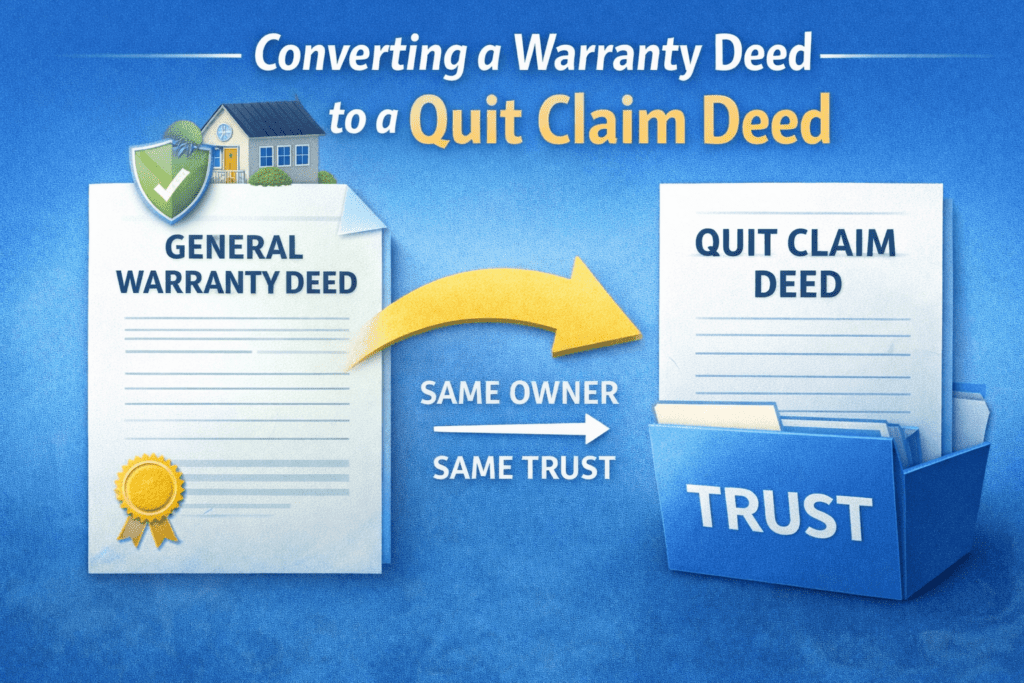
1️⃣ General Warranty Deed
Provides the highest level of protection.
The grantor guarantees clear title against all prior claims.
2️⃣ Special Warranty Deed
Provides limited protection.
The grantor guarantees title only during the period they owned the property.
3️⃣ Quit Claim Deed
Provides no warranties.
It transfers whatever interest the grantor currently holds.
Why a Quit Claim Deed Is Appropriate for Trust Funding
When you originally purchased your property, you likely received:
- A General Warranty Deed
or - A Special Warranty Deed
At that time, a title insurance company insured the property against defects in title.
When transferring your home into your revocable trust, you are:
Essentially transferring the property from yourself individually to yourself as trustee.
Because ownership is not changing to a third party, a Quit Claim Deed is typically appropriate and sufficient.
You are not selling the property.
You are not adding risk.
You are simply changing how title is held.
That is why Quit Claim Deeds are commonly used in estate planning.
Using Our Quit Claim Deed Tool
Members of RetireCoast can use our Quit Claim Deed Generator Tool to:
- Automatically format trustee language
- Insert correct vesting language
- Generate a printable deed
- Reduce drafting errors
- Avoid paying hourly legal drafting fees
This tool does not provide legal advice — but it ensures formatting accuracy and completeness.
Funding Bank Accounts
Most banks allow you to retitle accounts into the trust.
Steps:
- Contact your bank.
- Provide:
- Trust certification or abstract
- Trust name and date
- Open a new account in the trust name or retitle the existing account.
- Update checks and account agreements.
You may wish to maintain:
- Checking account
- Savings account
- Money market accounts
- CDs
Brokerage Accounts and Investment Accounts
Brokerages allow trust registration.
Steps:
- Contact brokerage.
- Provide trust documentation.
- Complete a new account or a change-of-registration form.
- Confirm title reflects trustee capacity.
Common accounts to review:
- Taxable brokerage accounts
- Individual investment accounts
- Non-retirement investment holdings
Retirement Accounts (Important Exception)
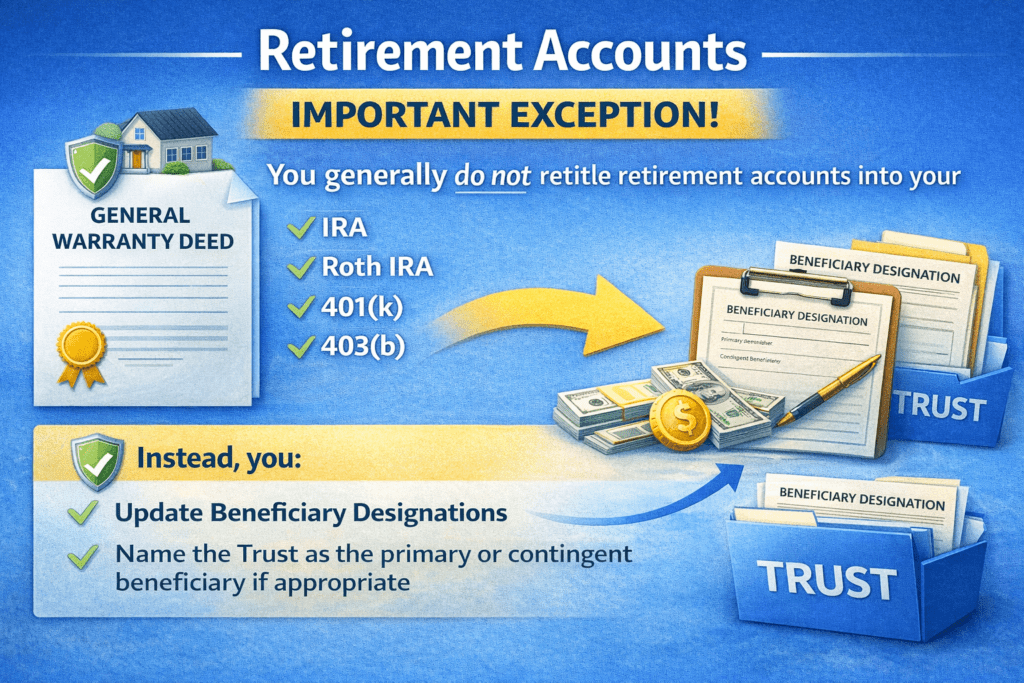
You generally do not retitle retirement accounts into your trust.
These include:
- IRA
- Roth IRA
- 401(k)
- 403(b)
Instead, you:
- Update beneficiary designations
- Name the trust as the primary or contingent beneficiary if appropriate
Always coordinate retirement planning carefully to avoid tax consequences.
Life Insurance Policies
You typically:
- Do not transfer ownership unless strategic
- Instead, update the beneficiary designation
Options:
- Name your spouse
- Name your trust
- Name children
- Use contingent beneficiaries
Funding LLC Interests
This is one of the most misunderstood areas.
If you own membership in a Limited Liability Company (LLC), you do not transfer the LLC’s real estate or assets individually.
You transfer:
Your membership interest in the LLC
How to Transfer LLC Membership to Your Trust
Step 1: Review the Operating Agreement
Check for restrictions on transfer.
Step 2: Prepare an Assignment of Membership Interest
You assign your ownership percentage to yourself as Trustee.
Step 3: Create Member Minutes
You document:
- Authorization of transfer
- Acceptance of trust as a new member
- Updated membership ledger
Our LLC Member Minutes Tool (Coming Soon)
We are creating a structured tool that will:
- Generate LLC transfer minutes
- Document assignment of membership
- Update ownership records
- Facilitate transfer of partnership interests
- Help transfer corporate shares
This tool can also assist in:
- Transferring business partnership interests
- Transferring shares in a closely held corporation
- Recording board or shareholder consent
Proper documentation protects:
- Liability shield
- Tax classification
- Internal ownership clarity
Funding Business Partnerships
If you are part of a partnership:
- Review the partnership agreement.
- Confirm transfers are permitted.
- Execute Assignment of Partnership Interest.
- Update partnership records.
Our upcoming business transfer documentation tool will help generate:
- Assignment documents
- Partner consent forms
- Meeting minutes
Funding Corporate Shares
For closely held corporations:
- Review shareholder agreement.
- Prepare Stock Assignment.
- Reissue stock certificate to trust.
- Record transfer in corporate ledger.
- Update minutes of meeting.
Failure to update corporate records can invalidate the transfer.
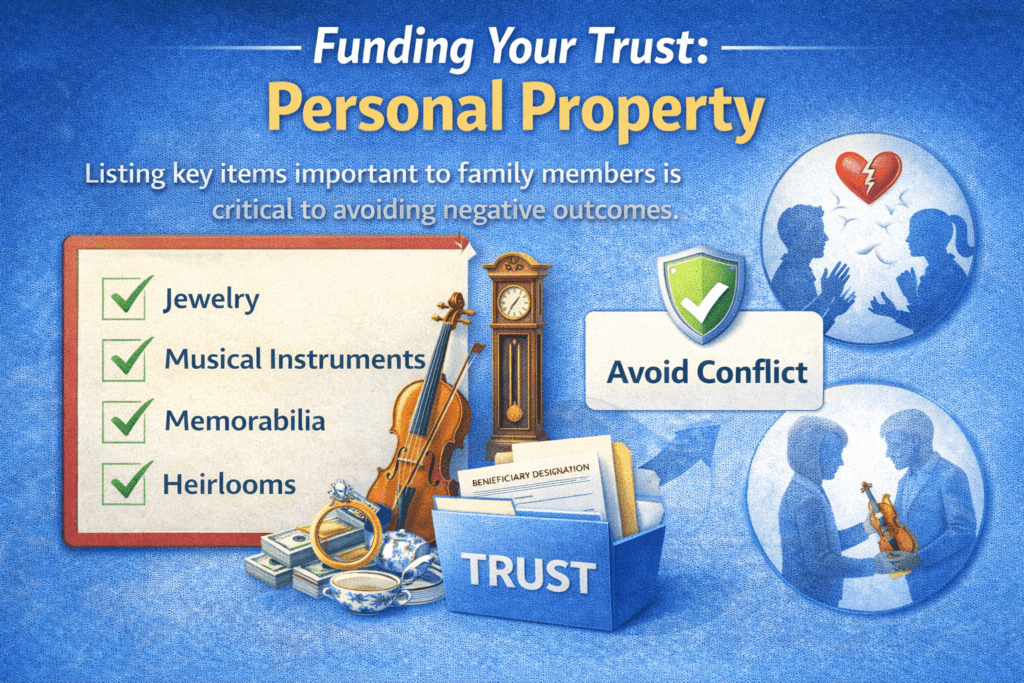
Personal Property
You may transfer:
- Furniture
- Jewelry
- Artwork
- Household goods
Often done through:
General Assignment of Personal Property
This is typically attached as Schedule A to your trust.
Digital Assets
Consider:
- Online accounts
- Crypto holdings
- Domain names
- Revenue platforms
These require:
- Access instructions
- Account inventory
- Possibly assignment documents
Common Funding Mistakes
❌ Forgetting to record the deed
❌ Not updating LLC operating agreements
❌ Failing to change beneficiary forms
❌ Transferring retirement accounts incorrectly
❌ Ignoring corporate stock ledgers
❌ Forgetting out-of-state property
Should You Transfer Everything?
Not necessarily.
Assets often not transferred:
- Vehicles (varies by state)
- Retirement accounts (retitle vs beneficiary)
- Certain small personal items
The Practical Strategy
At RetireCoast, we encourage a structured approach:
- Create the trust.
- Create a written funding checklist.
- Complete real estate transfers first.
- Address business interests.
- Retitle financial accounts.
- Update beneficiary designations.
- Maintain documentation.
Why This Matters for Business Owners
If you own:
- Rental property through an LLC
- Professional practice
- Family business
- Real estate partnerships
Funding is not optional.
Proper documentation:
- Preserves liability protection
- Ensures continuity
- Simplifies succession
- Avoids probate
Our Philosophy
RetireCoast does not provide legal advice.
Our goal is to:
- Educate you
- Provide structured tools
- Help you prepare intelligently
- Reduce unnecessary professional costs
When you walk into an attorney’s office with:
- Completed drafts
- Clear asset list
- Transfer documents prepared
- Minutes drafted
The meeting becomes review instead of preparation.
That can reduce fees substantially.
Final Thoughts
Creating a Revocable Living Trust without funding it is like building a safe and never putting anything inside.
Funding is the step that activates your plan.
Real estate.
LLC interests.
Corporate shares.
Bank accounts.
Brokerage accounts.
Each requires deliberate action.
With proper structure — and the right documentation tools — you can complete the process confidently and efficiently.
Funding your revocable living trust is a powerful step — but preparation matters. Before transferring assets, make sure you understand the structure, trustee responsibilities, and long-term strategy behind your estate plan.
- 📘 Read our complete guide: Revocable Living Trust Master Guide
- 🧭 Carefully evaluate your trustee selection using our member tools available inside the Estate Planning Membership — including the Successor Trustee Evaluator and Trust Funding Guide.
- 🛠️ Access structured estate planning tools designed to help you build, organize, and execute your plan inside the Estate Planning Membership
For additional perspective on passing assets efficiently, see these educational resources:
1) What does it mean to “fund” a revocable living trust?
2) What happens if I create a trust but don’t fund it?
3) Which assets usually should be moved into the trust?
4) How do I transfer real estate into my trust?
5) Where do I record a quit claim deed after it’s notarized?
6) Do I need the parcel number and legal description for a deed transfer?
7) Should retirement accounts be retitled into the trust?
8) How do I move bank or brokerage accounts into the trust?
9) Can an LLC membership interest be transferred into a revocable trust?
10) Why is listing personal property so important?
Discover more from RetireCoast.com
Subscribe to get the latest posts sent to your email.