A revocable living trust is one of the most commonly misunderstood estate planning tools. It is often described as complex or reserved for high-net-worth households. In reality, it is simply a legal framework for holding and managing assets during your lifetime and directing what happens to them afterward.
When structured properly, a revocable living trust can reduce delays, improve clarity, and provide flexibility that a will alone may not offer.
Unlike documents that only take effect after death, a revocable living trust operates while you are alive. You remain in control of the assets placed into the trust. You can amend or revoke it at any time. You decide how it should function if you become incapacitated.
This makes a revocable living trust both a planning tool and an asset-management tool — not just an end-of-life document.
This guide explains what a revocable living trust is, how it works in plain terms, and when it may make sense as part of a broader estate planning strategy. It is provided for educational purposes only and does not offer legal advice.
Understanding the structure is helpful. Seeing it in document form is even clearer.
Members of the Millennial Financial Lab have access to a guided Revocable Living Trust Builder that generates a clean, printable draft based on your inputs.
What a Revocable Living Trust Is
A revocable living trust is a legal arrangement that allows assets to be held and managed according to instructions you set while you are alive. Because the trust is revocable, you retain the ability to amend or dissolve it at any time. Assets placed into the trust are typically managed by a trustee, which is often the individual creating the trust during their lifetime.
This structure allows the trust to function both as a management tool during life and as a distribution framework after death.
What a Revocable Living Trust Does — and Does Not Do
A revocable living trust can help organize asset management, provide continuity if incapacity occurs, and outline how assets should be handled over time. It is often used to reduce delays, simplify administration, and provide privacy compared to court-supervised processes.
However, a revocable living trust does not eliminate the need for other estate planning documents. Guardianship provisions, healthcare decisions, and certain residual instructions are typically addressed through complementary documents such as a will, durable power of attorney, and advance healthcare directive.
When a Revocable Living Trust Is Commonly Used
A revocable living trust is often considered when individuals:
- Own real estate or multiple financial accounts
- Want continuity of management if incapacity occurs
- Prefer structured, private asset distribution
- Are coordinating multiple estate planning documents
- Want to reduce administrative delays for family members
Whether a revocable living trust makes sense depends on personal circumstances and long-term goals — not on a single universal rule. appropriate depends on personal circumstances and goals, not on a single universal rule.
Explore Related Estate Planning Topics
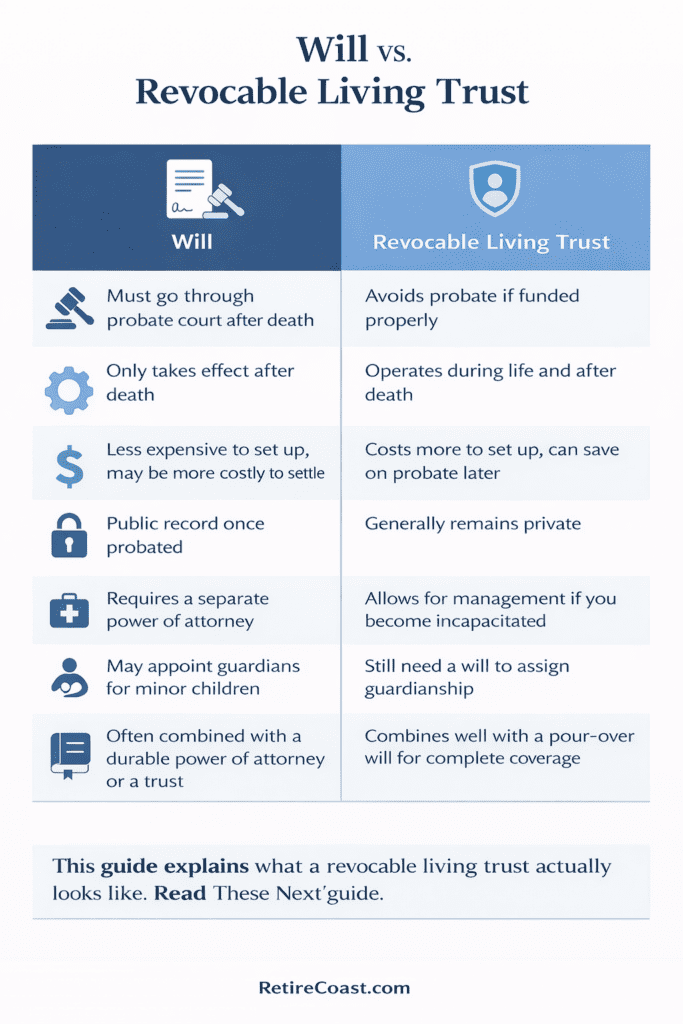
Understanding how a revocable living trust works is the first step. Seeing how it compares to other tools can help you build a complete plan.
👉 Compare a Living Trust and a Will
👉 See how estate planning documents work together
👉 Learn what varies by state and what typically does not
If you prefer a guided format, members can also use our Revocable Living Trust Builder to generate a draft document for review.
To Fully Understand a Revocable Living Trust, Read These Next
A revocable living trust does not exist in isolation. It works best when coordinated with other estate planning tools and when understood within the broader legal framework that governs asset ownership and administration.
The following guides expand on key areas that help complete the picture:
Living Trust vs. Will: Understanding the Key Differences
Learn how a revocable living trust compares to a will, where each tool fits, and why many plans include both.
Essential Estate Planning Documents and How They Work Together
See how trusts coordinate with powers of attorney, healthcare directives, and other foundational documents.
State-Specific Trust Rules: What Can Vary and What Usually Doesn’t
Understand which elements of a revocable living trust are generally consistent nationwide and where state-level differences may apply.
Create a Revocable Living Trust Using a Guided Builder
If you prefer a structured, step-by-step format, our guided builder allows members to generate a printable draft for review.
Reviewing these materials together provides a more complete understanding of how a revocable living trust functions within a responsible estate planning strategy.