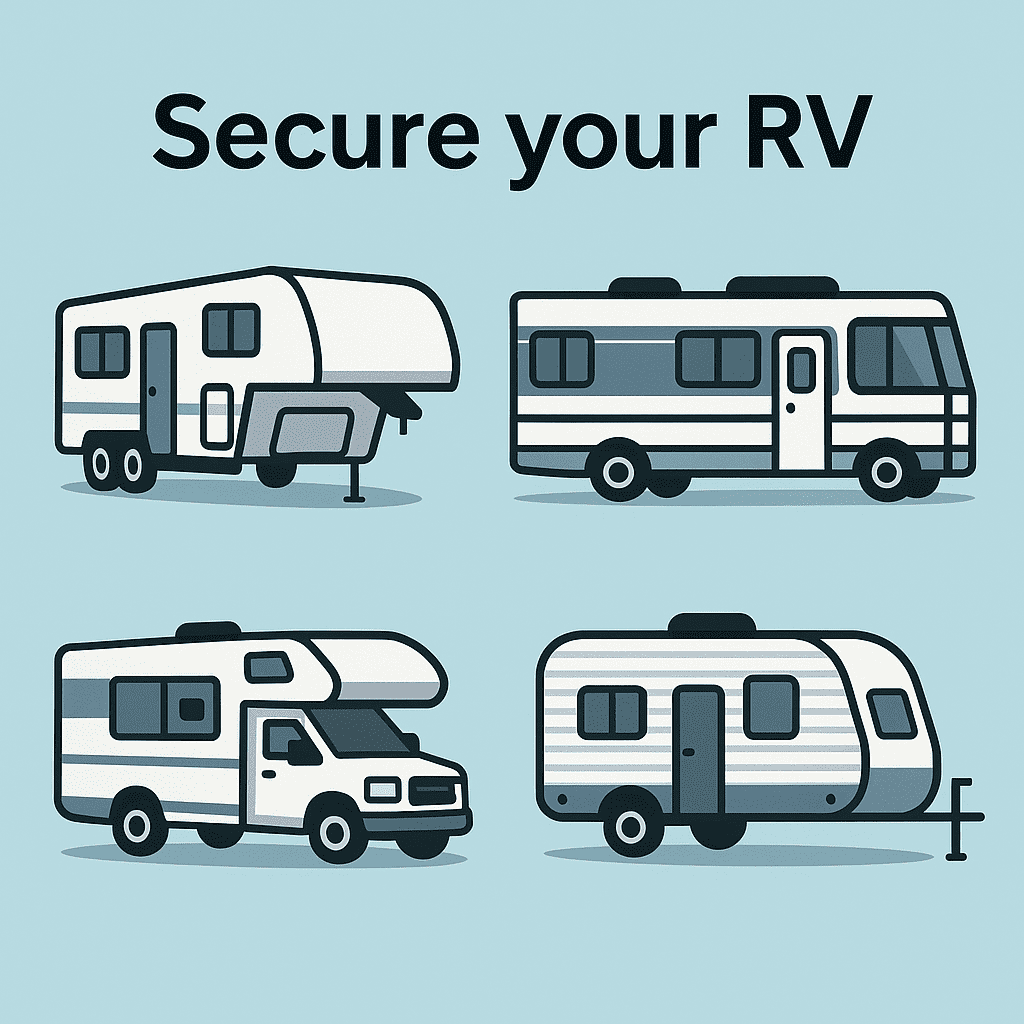
Your RV represents freedom, comfort, and the adventure you earned in retirement — but it also needs protection. Most people don’t realize how easy it is to break into or steal an RV until it happens to them. Learning how to secure your RV is essential to protect both your property and your peace of mind. Whether you travel full-time or keep your rig in storage, this RV security guide will show you how to safeguard your investment step-by-step.
I learned that lesson the hard way—after receiving the dreaded call that my catalytic converter had been stolen from my motorhome at a “secure” storage facility with lights, barbed wire, and cameras. It turns out that cameras and fences don’t stop determined thieves. The experience changed how I protect my property, and this guide shares exactly what works.
Why RV Security Matters
RV manufacturers rarely build in serious security features. Most locks are generic, windows are easy to pry open, and valuable components like catalytic converters can disappear in minutes.
For retirees, an RV isn’t just a vehicle—it’s an investment, sometimes even a home. Protecting it means protecting your peace of mind and your ability to travel freely. Read more in this article and our companion article about how to secure your RV.
Protect Your Family
Window Security
Most RV windows slide open with a simple latch. A small screwdriver can defeat that latch in seconds.
Buy a wooden dowel from the hardware store that fits snugly into the track. Cut a shallow groove along one side so it sits securely on the rail. Label each dowel and bundle them with Velcro when not in use. With these in place, even a strong pry bar won’t open your windows quietly.
Door Security
RV door locks are often identical across multiple brands. That means thousands of keys—and even master keys—can open your door. Replace the factory lock with a keyless entry system that fits your existing opening.
You’ll gain security, convenience, and the freedom to leave without carrying keys. Many models include Bluetooth, key fobs, or dual keypads if you have more than one door.
I personally installed an RVLock, a high-quality brand that includes a key fob and Bluetooth functionality. It can also be opened with a traditional key, but if you prefer to ditch the key entirely, you can lock and unlock your door with your smartphone. Each RVLock key is unique, eliminating the common issue of universal RV keys.
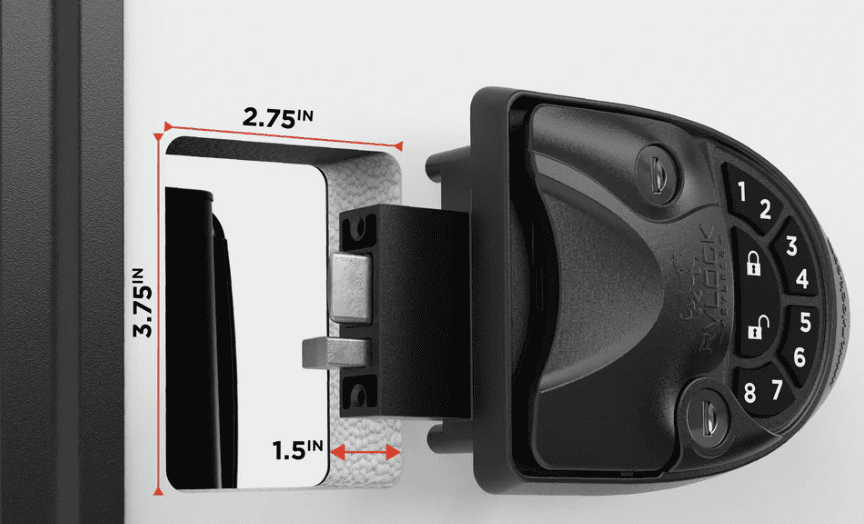
When I was at an RV repair facility, the technician mentioned that their keys could open most coaches. That’s exactly the problem—those keys are everywhere. I told them I had an RVLock, and they needed my specific key. Your RV will not be secure without changing the locks.
The RVLock system also includes a push-button keypad, giving you multiple ways to secure your RV. Separate models are available for both trailers and motorhomes, and the replacement process is simple—just a screwdriver and a few minutes of your time.
Personal Security
If you camp in isolated areas, think about personal protection. Some owners keep bear spray or, where lawful, a handgun secured in a biometric or push-button safe bolted to solid wood. The same safe can hold wallets, phones, and valuables while you’re away from the RV.
You can also buy small safes online—Amazon offers many options—and secure one in a place where it isn’t visible to anyone, such as behind the TV, under a seat, or inside a cabinet.
Every RV owner should install a small safe to store important documents, money, and firearms. Why RV manufacturers don’t include these from the factory is a mystery.
💡 Tip: If you visit a military base, always disclose that you have a firearm. In most cases, they will hold the weapon for you while you are on base property.
Protect Your Property
Outside Storage Compartments
Factory storage locks are notoriously weak and often keyed alike across entire brands. Replace all of your compartment locks—including those twist-style fasteners—with barrel-style locks purchased in a keyed-alike set so one key opens everything. These locks are far more resistant to prying or picking and provide real peace of mind when you leave your RV unattended.
The propane storage compartment, however, should not have a locking mechanism that slows emergency access. Propane doors are intentionally left unkeyed so you (or someone helping in an emergency) can quickly shut off the gas if there’s a leak or fire.
Instead of adding locks there, use small keyed-alike padlocks to secure the metal bands or brackets that hold the propane bottles in place. This prevents theft without compromising safety. Secure all of your RV.
Tires, Wheels, and Hitch
Use locking lug nuts on your wheels and chain your spare tire to the frame.
If you own a fifth wheel or trailer, invest in a hitch lock so no one can simply tow your RV away.
Catalytic Converter Protection
Catalytic converters are valuable for the precious metals they contain, and thieves can remove one in under two minutes.
Install a motion detector beneath your RV near the converter. Many wireless alarm kits allow you to attach a small sensor with Velcro or heavy-duty fasteners. If anyone crawls under, the siren will trigger instantly.
For best results, connect a motion detector directly to your RV security system. Regardless of the brand you choose, compatible sensors are easy to find. Buy the hook-and-loop (Velcro) type of fastener—choose a heavy-duty version. Clean the surface area where you’ll attach it, then secure the motion detector in place.
⚠️ Important: Do not travel with the sensor installed. It’s designed for parked or stored units only. When leaving your RV at a storage facility or campsite, simply reach under and stick it in place. Before moving, remove it and store it inside. Anyone crawling under your RV to cut off the converter will set off the alarm.
Also, engrave your VIN or phone number on the converter—a small deterrent that can help with recovery.
Security Systems That Work
Want an RV security system? You’ll need to buy a home security system and adapt it for your RV. I have used Ring, which worked very well. I installed sensors on each storage compartment, the entrance door, and a motion detector inside the RV—plus another by my catalytic converter.
This setup worked great until Ring required a paid subscription to connect my system to my phone. While Ring functions well as a standalone alarm, it will not notify you—or anyone else—without a monthly fee.
So, I looked around and found a system by Eufy that does the same thing as Ring, but Eufy does not require a monthly fee to connect your system via Wi-Fi to your phone. Also, while the Ring outdoor camera performed well, I found the Eufy SoloCam to be far superior.

I strongly suggest that you read my article about how to equip your RV, which explains in detail how to adapt these home-based systems for a 12-volt RV power setup.
Click here to read: How to choose and outfit your RV for your retirement adventures.
For remote monitoring, pair the system with a mobile hotspot or retired smartphone set up as a Wi-Fi source. If your storage location lacks electricity, portable solar panels can keep the system powered.
Lighting and Cameras
Bright light is the simplest deterrent. Mount battery-powered or solar motion lights high on your RV near the door or storage bays. Remove them before travel to prevent damage.
Add a wireless camera with two-way audio and siren capability. Many models record locally and send alerts to your phone. Mount it high enough to prevent tampering and angle it toward doors or high-value areas.
If you store your RV long-term, leave a few interior lights on timers. Closed curtains make it hard for anyone to know if someone is inside.
Most RVs already come with exterior lights, and they’re one of the easiest security tools you have. Turn them on when you’re away from your RV—or even while you’re inside at night—to give the impression that someone is always home.
You can also hang a string of LED lights from your awning or fasten them along the skirt of your RV and plug them in. The goal is simple: be visible. Lighting discourages curiosity and makes intruders move on to an easier target.
You may be wondering whether your batteries can support all of the wireless devices mentioned here—such as your alarm, cameras, or motion lights. It’s possible that if you only have a single house battery, or even two, keeping them charged could be challenging due to the small but constant power draw of these systems.
To solve this, I installed 300 watts of solar power on my RV and replaced my single 100 amp-hour battery with two 300 amp-hour lithium iron batteries. This setup easily supports all of my power needs during storage and while traveling.
For details on how and why I upgraded my RV’s power system—and how you can do the same—read this article: Secure Your RV and Keep It Safe.
Wi-Fi and Connectivity
Security systems and cameras rely on connectivity. Choose a storage site with Wi-Fi and electrical power whenever possible.
If not available, use a hotspot and solar panel combination to keep things running. The monthly data cost is minor compared to replacing stolen equipment—or an entire RV.
There are two basic options for Wi-Fi access when the storage facility does not provide it. You can purchase a hotspot unit, which is a small modem that connects to your mobile phone provider. Your Wi-Fi-enabled cameras, alarm systems, and other devices will connect through the hotspot, giving you access and alerts directly on your mobile phone.
The other option is Starlink, which offers satellite internet designed for travelers and RV owners who spend time in remote areas. It’s more expensive but provides dependable service where cell coverage is weak.
For detailed steps and equipment recommendations, read our article about how to set up your RV property and learn about Wi-Fi in your RV.
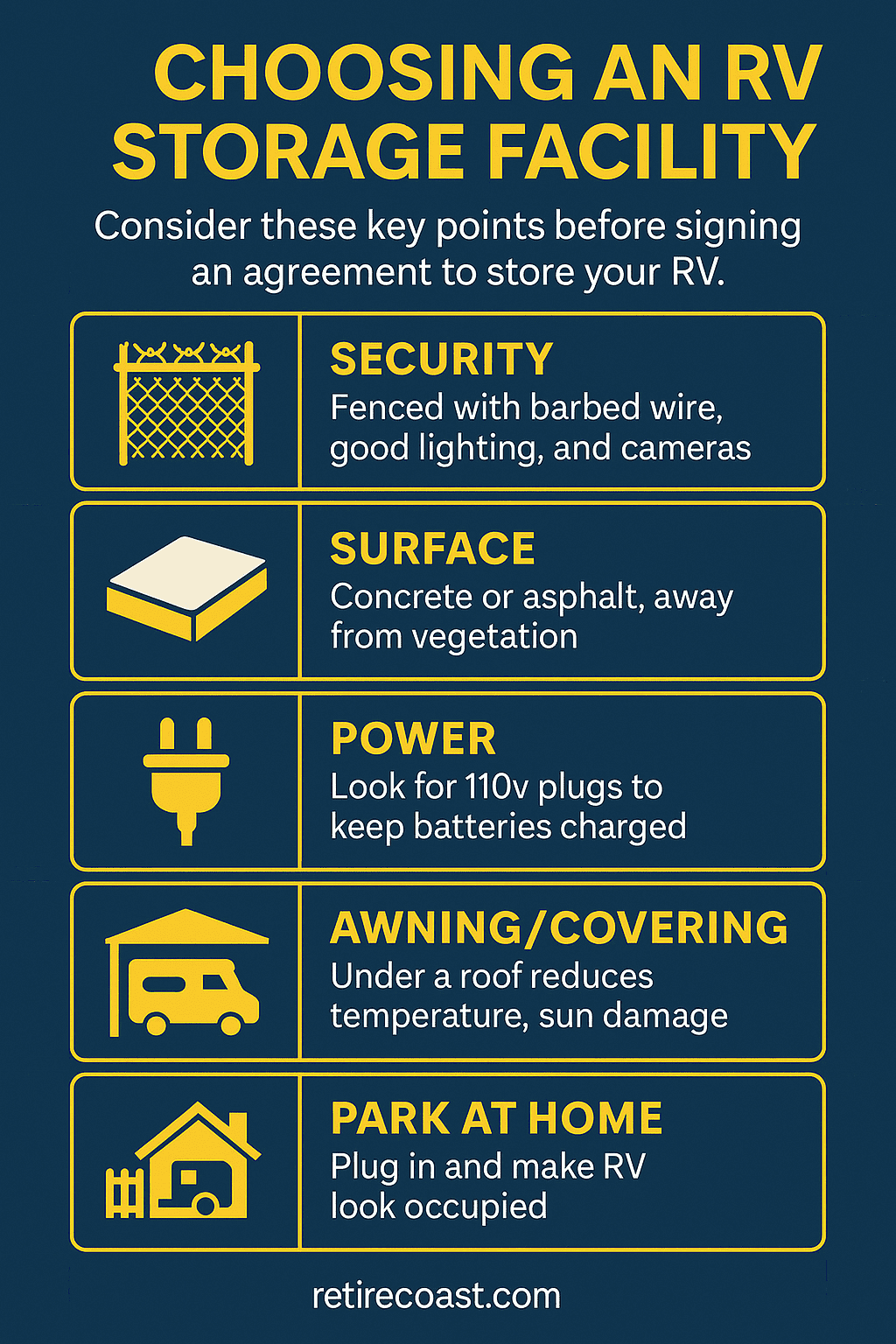
Choosing an RV Storage Facility
I have stored my RVs both at home and in facilities that specialize in RV storage. There are some things you should consider before signing an agreement to store your RV. Price is, of course, important—but it’s not the only factor. Below are some key points to keep in mind before you park your rig long-term.
1. Security:
The facility should be fenced with barbed wire at the top, not just block walls or chain-link fencing. There should be plenty of lights that stay on all night—choose a parking spot near one of them. Cameras are a must. Don’t settle for a facility that can’t show you recorded footage upon request.
2. Surface:
While you can park on gravel or grass, doing so near vegetation invites trouble. Ants, spiders, and other insects can invade your RV, and rats, mice, and squirrels may chew through your wiring or insulation. The best option is to park on asphalt or concrete, well away from trees, bushes, and other vegetation.
3. Power:
While external power isn’t necessary if you’ve set up your RV with solar and lithium batteries as I have (see above), having access to 110-volt power is a major advantage. It will keep your batteries charged and systems running. Few things are worse than discovering a dead house battery when you’re ready to hit the road.
4. Access:
Always ensure the facility provides 24/7 access, typically via a gate code or pass card. Avoid places that require you to contact an attendant to open the gate. If you return from a trip late at night and find the gate locked, that’s a problem you don’t want.
5. Awning or Covering:
A covered parking space is a nice bonus—it helps reduce interior temperatures and prevents sun bleaching or roof damage. Facilities with roofed spaces typically cost more, but they can extend the life of your RV’s finish and roof seals.
6. Parking at Home:
If you have room beside your home, consider parking your RV there. I had an electrician install a 50-amp outlet on the side of my house so I can plug in directly. If your HOA requires the RV to be behind a gate, it may be worth paving the area and installing one. I’ve found that when my RV is parked at home, I use it more often—and it’s easier to keep clean and secure.
Smart RV Storage Tips
Even “secure” facilities are vulnerable. Here’s how to reduce your risk:
✅ RV Storage Safety Checklist
- Replace factory locks with barrel locks
- Use motion-activated lights and cameras
- Install a wireless alarm or motion sensor
- Lock the wheels, hitch, and spare tire
- Keep a Wi-Fi connection active for alerts
- Use a locking fuel cap
- Store valuable gear inside the RV
- Avoid leaving heavy power cables exposed
If you must store off-site, pick a lot where someone actually lives on the property—or bring a loyal dog along when camping. Lights and fences alone don’t stop thieves.
Peace of Mind on the Road
A few simple upgrades can turn your RV into a fortress without sacrificing comfort. You don’t need a shop—just basic tools, a few hours, and a trip to the hardware store.
Owning an RV in retirement is about independence. Protecting it is about keeping that freedom safe.
From the Mississippi Gulf Coast to wherever the road leads, travel confidently knowing your rig—and your investment—are secure.
Secure Your RV Checklist
Download the following PDF checklist to help you secure your RV. Use the list to be sure you have not forgotten anything.
RV Security FAQ
1. Why are RVs so easy to break into?
Most RVs use thin doors, lightweight windows, and generic locks that are duplicated across many brands. Thieves know this. RV manufacturers focus on features and weight, not security. You have to upgrade locks, lighting, alarms, and storage security yourself if you want real protection.
2. Do I really need to replace the factory door lock?
Yes. Many RVs ship with locks that share keys across thousands of units, and dealers often have “master” keys. Upgrading to a keyless lock like RVLock (with unique keys, keypad, and Bluetooth/app access) stops someone from casually opening your door with a key they already have.
3. How do I secure the outside storage compartments?
Replace the cheap twist latches and standard compartment locks with barrel-style locks that are keyed alike for your rig only. These are harder to pick and much stronger. For propane storage, do not install a key lock on the door; instead, lock the tank hold-down bands with small keyed padlocks so the bottles can’t walk away but the gas can still be shut off in an emergency.
4. How do I protect my catalytic converter from being stolen?
Attach a wireless motion detector near the catalytic converter when your RV is parked. Use heavy-duty hook-and-loop fastener (Velcro) so you can stick the sensor in place under the RV when you store it, and remove it before you drive. If someone crawls under to cut the converter, the alarm triggers instantly. Also consider engraving your VIN or phone number on the converter to discourage resale.
5. Can I run a full security system in an RV?
Yes. You can adapt a home security system. I’ve used Ring and later Eufy. I put sensors on storage compartments, the entry door, and inside the coach, plus a motion sensor by the catalytic converter. Eufy will send alerts to your phone over Wi-Fi without a monthly subscription, which makes it a great choice for RV owners.
6. Will all these cameras, lights, and alarms drain my batteries?
They do use power, especially if you’re parked for long periods. With only a single house battery, you may struggle to keep everything charged. I solved this by installing 300 watts of solar and upgrading to two 300 amp-hour lithium iron batteries. With that setup, my alarm system, cameras, lights, and other electronics stay powered in storage without shore power.
7. What kind of lighting helps deter thieves?
Thieves hate light. Use motion-activated LED lights mounted high on the RV near doors and storage bays. Leave a couple of interior lights on timers so it looks like someone is inside. When you’re on the road or even sleeping in the RV, turn on your exterior lights. You can also hang a string of LED lights from the awning or along the skirt. The goal is to look occupied and watched.
8. How can I get Wi-Fi for cameras and alerts if the storage yard doesn’t offer it?
You have two main options. First, buy a hotspot (a small modem that uses your mobile provider); your cameras and alarm system connect to that, and you get alerts on your phone. Second, use Starlink for satellite internet if you camp or store the RV in areas with poor cell coverage. Both options let your system notify you instead of just sounding a local siren.
9. What should I look for in an RV storage facility?
Look for fencing with barbed wire at the top, 24/7 lighting, and camera coverage. Park on asphalt or concrete away from vegetation to avoid rodents and insects. Ask if they offer 24/7 gate access (not “call us and we’ll come open it”). Power on-site is a bonus to keep batteries charged. Covered parking helps protect the roof and paint from sun damage.
10. Is it safer to store my RV at home?
Usually, yes—if you can do it legally and physically. Parking at home means you can keep it plugged into a 30A or 50A outlet, check it often, and make it look occupied with lights and cameras. Some HOAs require you to keep the RV behind a gate or fence, but paving a side yard and adding a gate can be worth it. In my experience, when the RV is at home, I use it more and I keep it more secure.
Ready to make your RV truly secure?
Learn how to install the systems, locks, and lighting that protect your RV from theft and damage—step by step.
Read the full guide: How to Secure Your RV and Keep It Safe: A Retiree’s Guide to Protecting What You Own
Discover more from RetireCoast.com
Subscribe to get the latest posts sent to your email.