
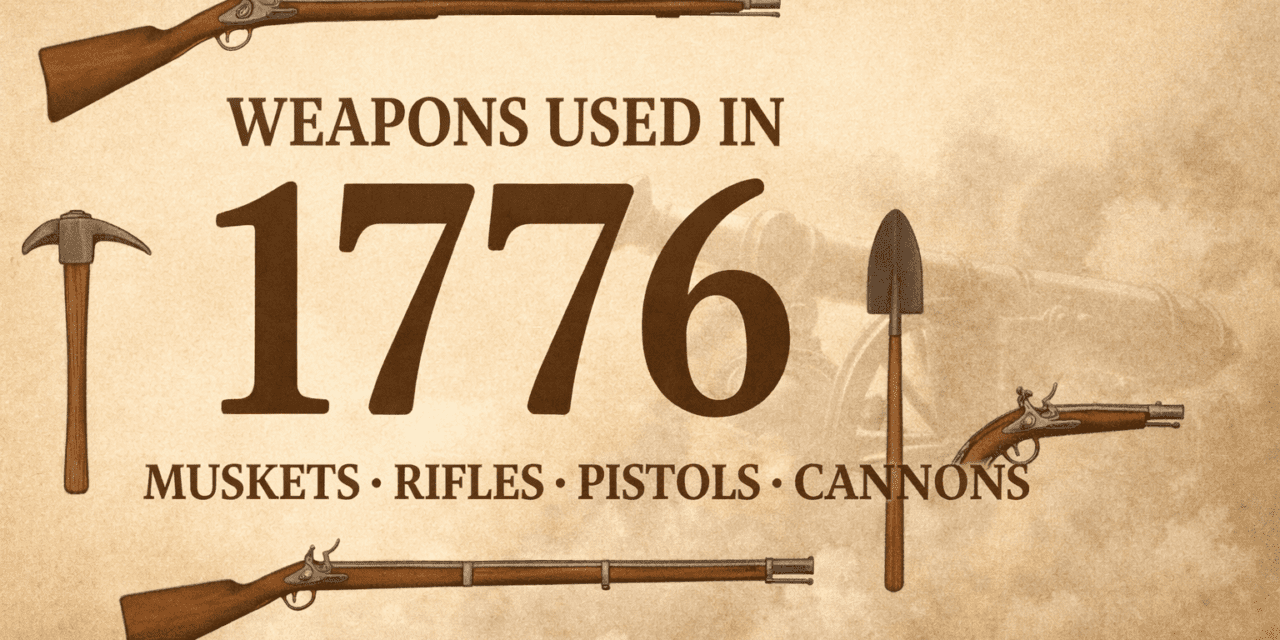
Weapons Used in 1776: Revolutionary War Guns, Rifles, and Artillery Explained
The primary weapons used in 1776 during the American Revolutionary War included the British Brown Bess musket, the American long rifle, flintlock pistols, and artillery such as cannons, mortars, and howitzers. British forces relied on fast-loading muskets and disciplined formations, while American fighters often used more accurate rifles for long-range shooting and guerrilla-style combat.
In 1776, the fight for American independence unfolded with an astonishing diversity of weapons used in 1776, along with tools and uniforms. The soldiers who fought—whether Continental regulars, frontier farmers, British Redcoats, or Hessian auxiliaries—entered battle with dramatically different equipment, levels of training, and resources.
Understanding the weapons used in 1776 provides a clear window into how the Revolutionary War was actually fought, how the American army evolved under extraordinary hardships, and why the British—despite superior logistics—struggled against an unconventional opponent.
The most important weapons used in 1776 included muskets, long rifles, pistols, and artillery, each playing a distinct role in how battles were fought and ultimately won.
The most important weapons used in 1776 included:
- Brown Bess musket – the standard British infantry weapon, valued for its fast reload speed and use in coordinated volleys
- American long rifle – a highly accurate, long-range firearm used by militia and frontier fighters
- Flintlock pistols – single-shot weapons typically carried by officers, cavalry, and naval personnel
- Cannons (3-, 6-, and 12-pounders) – essential artillery used in battlefield engagements and sieges
- Mortars and howitzers – specialized artillery designed to fire explosive shells over walls and into fortified positions
- Bayonets – attached to muskets for close combat, allowing infantry to engage after firing
Explore more about life, warfare, and strategy in 1776:
• Who We Were in 1776
• What Happened in Philadelphia on July 8, 1776
• Financing the United States in 1776
- The most important weapons used in 1776 included:
- 1. What Were the Primary Weapons Used in 1776?
- 🪶 The American Long Rifle
- How Fast Could Soldiers Reload in 1776? Musket vs Rifle Comparison
- 🔴 The British Brown Bess Musket
- Video of Continental Gun Making
- What happened to all of those Continental and Brown Bess Rifles?
- 2. Were Pistols Common Weapons Used in 1776?
- How Pistols Were Used in the Revolutionary War
- Colonial vs. British Pistols
- Why Pistols Did Not Dominate Warfare in 1776
- 3. What Types of Artillery Were Used in 1776?
- 4. How Accurate Were Cannons and Artillery in 1776?
- Did Cannons in 1776 Use Explosive Cannonballs?
- 5. How Were Weapons Made and Supplied in 1776?
- 6. What Tools Did Soldiers Use Alongside Weapons in 1776?
- 7. What Did Soldiers Wear in 1776? Uniforms and Equipment
- 🇺🇸 Continental Army Uniforms (or the lack of them)
- 8. A Soldier’s Perspective: Life and Weapons in 1776
- 9. Why the Weapons Used in 1776 Determined the Outcome of the War
- Conclusion
- 🇺🇸 Explore More in Our 250th Anniversary Series
- Frequently Asked Questions About Weapons Used in 1776
- People Often Ask
- What People Often Ask About Making and Supplying Weapons in 1776
- Short Quiz – Test Your Knowledge of 1776 Weapons
- Quiz: Rifles, Pistols, and Cannons of 1776
- PODCAST Weapons Used in 1776
This article ties together earlier entries in the RetireCoast 250th Series, including:
- Who We Were in 1776
- What Happened in Philadelphia on July 8, 1776
- Financing the United States in 1776
The Cost of Weapons in 1776
Firearms in 1776 were expensive and difficult to replace. A musket or long rifle often cost the equivalent of several months’ wages for a working farmer or laborer, making weapon ownership a serious financial commitment. Pistols were even more costly relative to their usefulness and were usually carried only by officers, cavalrymen, or wealthy individuals. Because of these high costs, many American soldiers brought their own weapons from home, and captured British arms were carefully repaired and reused.
Cannons represented an even greater investment, requiring skilled foundries, large quantities of iron or bronze, and extensive labor. Losing a cannon in battle was considered a major setback. The high cost and scarcity of weapons explains why the Continental Army emphasized conservation, repair, and the capture of enemy arms throughout the war.
1. What Were the Primary Weapons Used in 1776?
🪶 The American Long Rifle
No weapon symbolizes the American frontier more than the long rifle, used by hunters, scouts, and many militia volunteers. With its rifled barrel, it could hit targets at 200–300 yards—far beyond the range of contemporary smoothbore muskets.
Advantages:
- Exceptional accuracy
- Long-range effectiveness
- Ideal for guerrilla tactics, sharpshooting, and ambushes
Disadvantages:
- Slow to reload
- No bayonet lug
- Required a steady supply of powder and patches
Frontier soldiers often brought their own long rifles from home. They were personal instruments—maintained, decorated, and deeply valued.
Comparing Accuracy and Range: The American Long Rifle (1776) vs. the M1 Carbine (World War II)
The American long rifle used in 1776 was remarkably accurate for its time. Thanks to its rifled barrel and long sight radius, a skilled shooter could reliably hit targets at 200 yards, and under ideal conditions even farther. This accuracy far exceeded that of smoothbore muskets and made the long rifle especially effective for hunting, scouting, and targeted fire.
However, the rifle was slow to reload and unsuited for massed battlefield volleys. Its effectiveness depended almost entirely on the skill of the individual shooter.
By contrast, the M1 Carbine, introduced during World War II, was a lightweight semi-automatic firearm designed for rear-echelon troops, paratroopers, and officers. Its effective range was typically 150–300 yards, comparable on paper to the long rifle, but achieved through entirely different means.
The M1 Carbine WWII
The M1 Carbine fired a smaller, lighter cartridge at higher velocity and allowed rapid follow-up shots with minimal recoil. While it was not as precise shot-for-shot as a well-made long rifle in the hands of an expert marksman, it offered a vastly superior rate of fire, ease of use, and consistency across average soldiers.
The comparison highlights a striking truth: in terms of raw accuracy and range, an expert rifleman in 1776 could rival a 20th-century infantryman armed with an M1 Carbine. The difference lay not in technology alone, but in doctrine.
The long rifle emphasized individual skill and patience; the M1 Carbine emphasized speed, mobility, and volume of fire. Two weapons, separated by nearly 170 years, reflected the military realities of their respective eras.
The Missing Middle: The Civil War Rifle
The Springfield Model 1861 was the most widely used rifle of the American Civil War, especially by Union forces, with over one million produced. It represented a major technological shift:
- rifled barrel
- standardized manufacturing
- percussion cap ignition
- compatibility with massed infantry tactics
Unlike the handcrafted long rifles of 1776, the Springfield was designed for industrial-scale warfare, while still requiring manual loading. It bridged the gap between frontier marksmanship and modern military firepower.
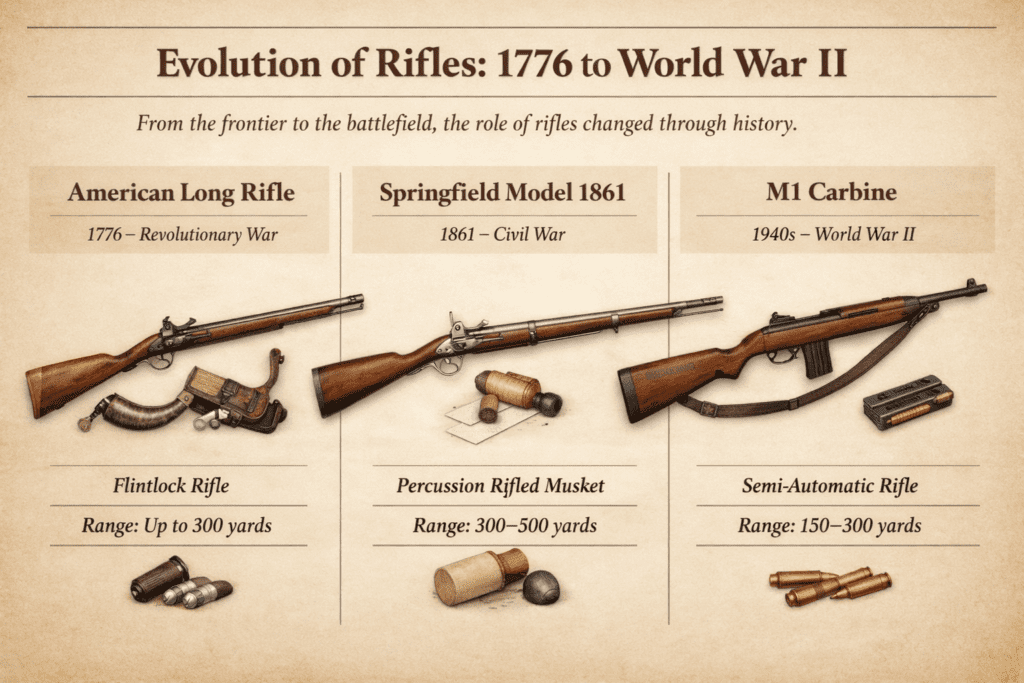
Comparison Across Three Wars
American Long Rifle (1776) vs. Springfield 1861 (Civil War) vs. M1 Carbine (WWII)
| Feature | American Long Rifle (1776) | Springfield Model 1861 (Civil War) | M1 Carbine (WWII) |
|---|---|---|---|
| Effective Range | ~200 yards (up to 300 in skilled hands) | ~300–500 yards | ~150–300 yards |
| Accuracy | Very high for single, aimed shots | High; improved consistency with Minié ball | Moderate; optimized for rapid fire |
| Rate of Fire | 1–2 rounds per minute | 2–3 rounds per minute | 30–45 rounds per minute |
| Reload Time | 20–30 seconds per shot | 15–20 seconds per shot | 2–3 seconds per magazine |
| Ignition System | Flintlock | Percussion cap | Gas-operated, semi-automatic |
| Ammunition | Loose powder, patched round ball | Paper cartridge with Minié ball | .30 Carbine metallic cartridge |
| Manufacturing | Handcrafted by individual gunsmiths | Industrial mass production | Fully industrialized mass production |
| Combat Doctrine | Individual marksmanship | Massed infantry formations | Mobile, high-volume fire |
| Typical Use | Hunting, militia, scouting | Line infantry | Support troops, airborne, mobile units |
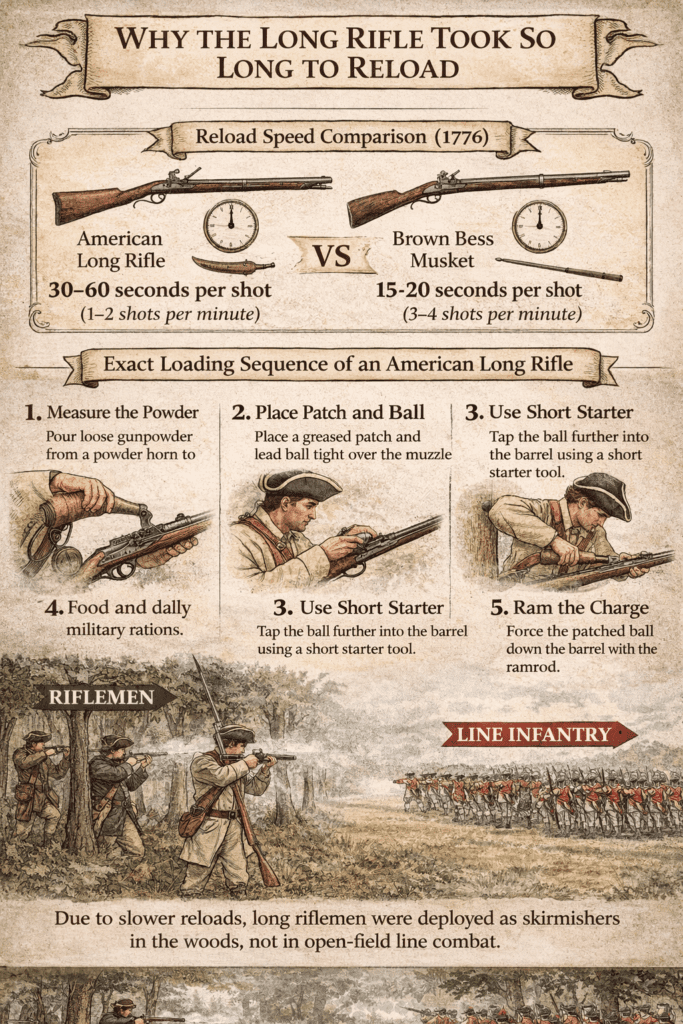
How long did it take to reload a rifle in 1776? An experienced American rifleman during the Revolutionary War typically required 30 to 60 seconds to reload a long rifle, allowing only 1 to 2 shots per minute. In contrast, British infantry using the Brown Bess musket could reload in about 15 to 20 seconds, firing approximately 3 to 4 rounds per minute. The difference came from the rifle’s tight-fitting patched ball and rifled barrel, which made it far more accurate but significantly slower to load.
How Fast Could Soldiers Reload in 1776? Musket vs Rifle Comparison
Reload speed was one of the most important differences between the weapons used in 1776. British muskets could fire much faster, while American long rifles traded speed for accuracy and range.
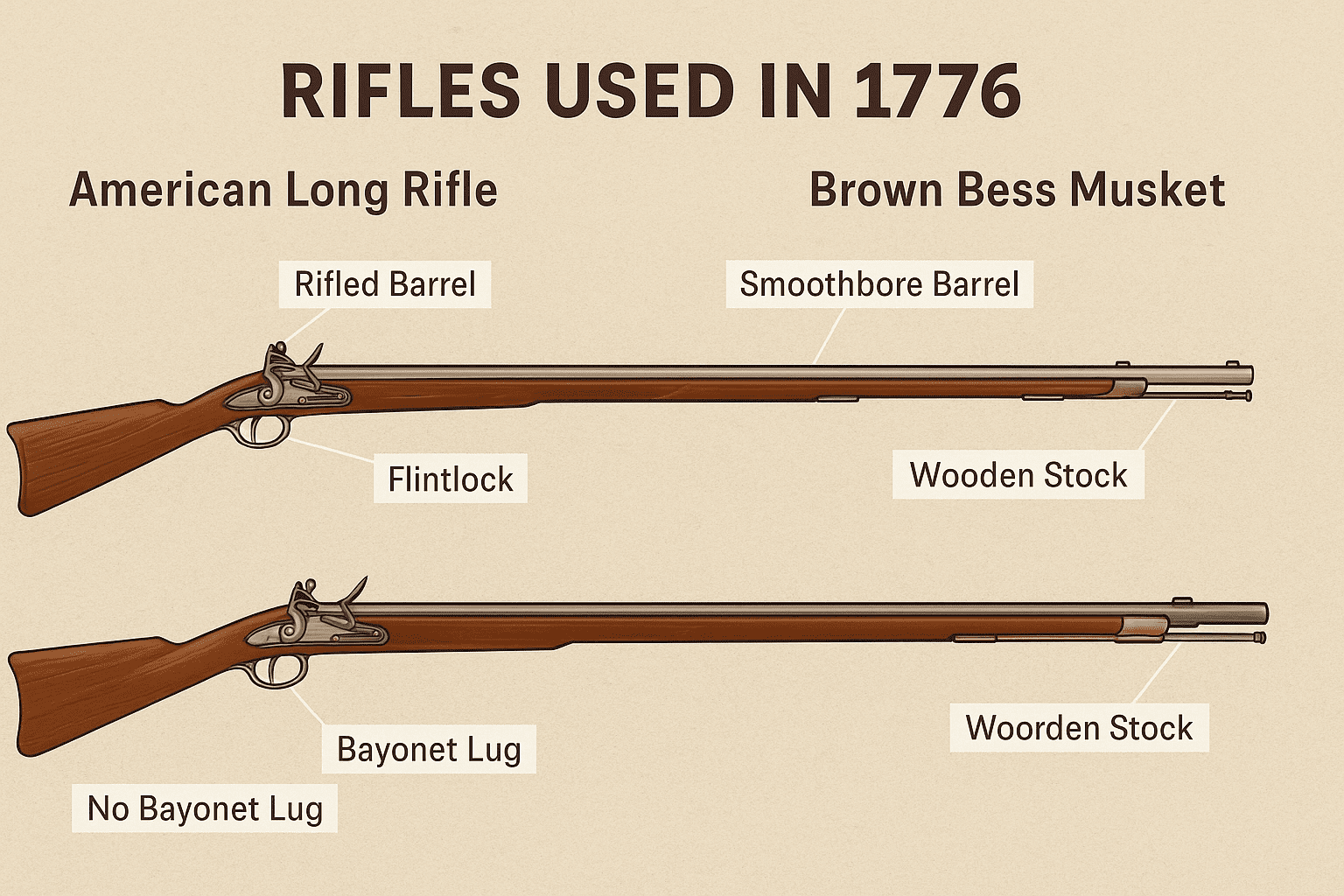
🔴 The British Brown Bess Musket
The most famous gun of the era, the British Brown Bess, was a smoothbore flintlock musket issued throughout the empire.
Advantages:
- Fast reload time
- Standardized parts
- Compatible with bayonet charges
- Devastating when fired in organized volleys
Disadvantages:
- Poor accuracy beyond 75–100 yards
- Heavy and prone to fouling
Many Americans also used captured Brown Bess muskets, especially early in the war.
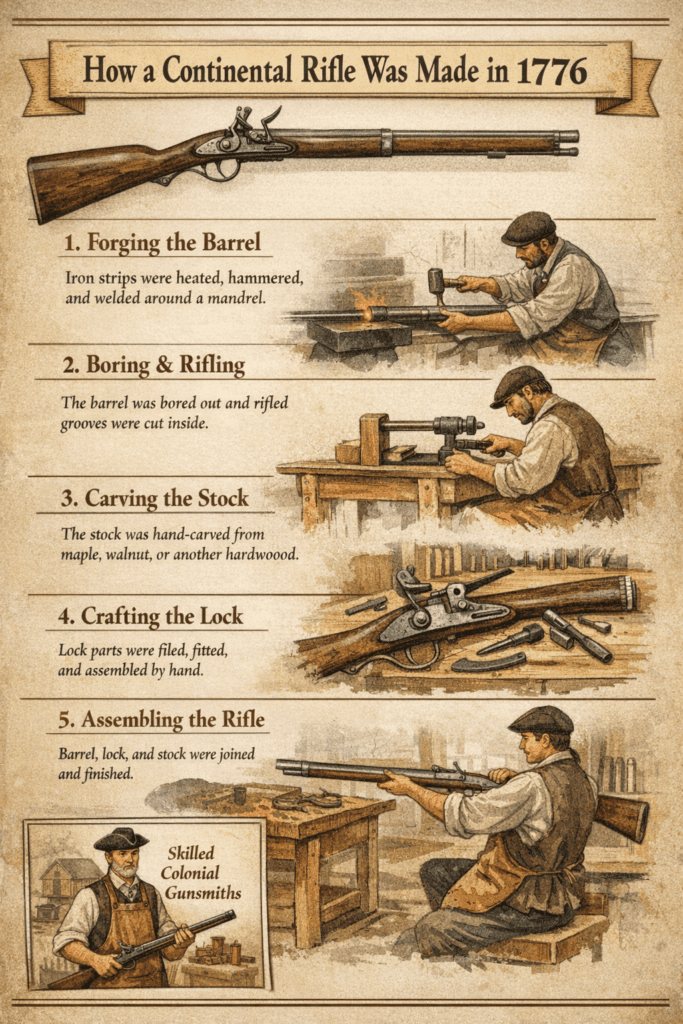
Video of Continental Gun Making
What happened to all of those Continental and Brown Bess Rifles?
Why 1776 Weapons Are So Rare
The low survival rate of 18th-century weaponry comes down to a few historical realities:
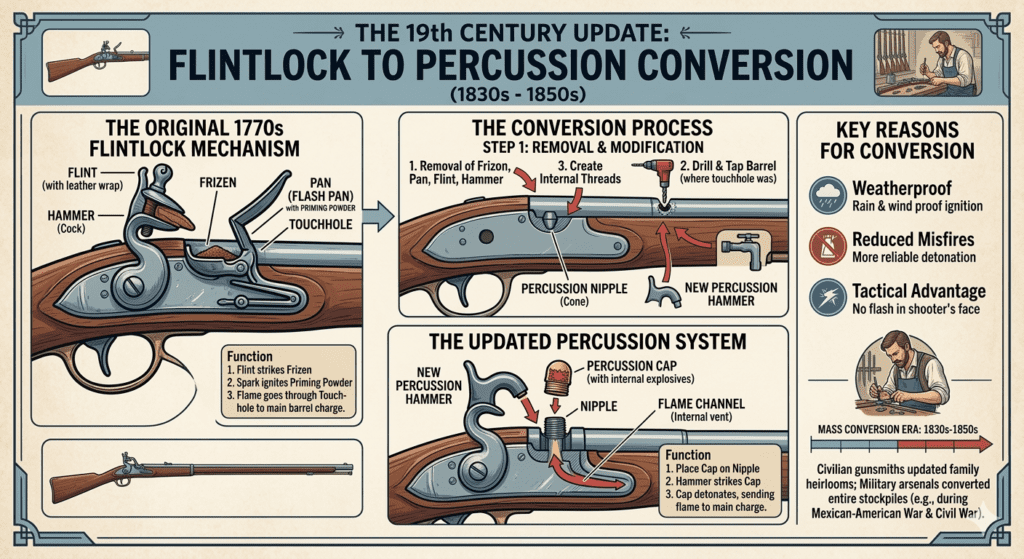
- The “Percussion Conversion”: This is the biggest reason original firearms are scarce. In the early to mid-19th century, military technology evolved. The vast majority of surviving 1770s flintlock muskets were modernized and converted to the newer, more reliable percussion cap system. Finding a musket still in its original, unconverted flintlock configuration is a “holy grail” for collectors.
- Corrosion and the Elements: Black powder is highly corrosive. Firearms and swords were working tools subjected to brutal battlefield conditions, bad weather, and poor maintenance. Wood rots, iron rusts, and barrels routinely burst.
- Recycling and Attrition: Weapons were expensive and difficult to produce. Broken muskets were aggressively cannibalized for parts. A damaged barrel might be melted down or turned into a tool; a shattered stock meant the metal lock was simply moved to a new piece of wood.
The mass conversion of flintlock firearms to the newer percussion cap system primarily took place between the 1830s and the 1850s, with military arsenals undertaking massive modernization campaigns in the 1840s and 1850s.
Here is how that timeline broke down and why it sealed the fate of most surviving 1776 weapons:
The Catalyst: The 1820s
The percussion cap—a tiny copper cylinder containing a shock-sensitive explosive (fulminate of mercury)—was patented and perfected in the early 1820s. Unlike a flintlock, which relied on a piece of flint striking steel to create a spark in an open pan of powder, the percussion system was enclosed. It was virtually weatherproof, eliminated the flash that gave away a shooter’s position, and vastly reduced misfires.
Because the technology was so vastly superior, the flintlock became obsolete almost overnight.
The Civilian Shift: 1830s–1840s
For the average citizen or militia member, buying a brand-new gun was expensive. Instead, they took their Revolutionary War-era heirlooms—such as the Kentucky long rifles or captured British Brown Bess muskets—to local gunsmiths.
The gunsmith would remove the intricate flint, steel, and powder pan assembly, plug the old touchhole, and thread a hollow “nipple” into the barrel to hold the new percussion caps. They would then replace the flint-holding hammer with a heavy, flat-faced hammer to crush the cap. This was a relatively cheap, fast upgrade that kept a 60-year-old family gun functioning for another generation.
The Military Arsenals: 1840s–1850s
By the 1840s, the U.S. government officially adopted the percussion system. They had tens of thousands of older flintlock muskets sitting in arsenals across the country. Rather than scrap them, the Ordnance Department initiated massive, systematic conversion programs.
While the primary focus was on newer models (like the 1816 and 1822 muskets), older Revolutionary-era muskets that were still in state armories or militia inventories were swept up in this modernization wave.
The Final Blow: The American Civil War (1861–1865)
The outbreak of the Civil War created a desperate, insatiable demand for weapons. Both the Union and the Confederacy emptied every armory, museum, and closet they could find. Any old 1770s flintlock that had somehow survived unconverted up to 1860 was likely pulled out, rapidly modernized to percussion by wartime contractors, and issued to front-line troops.
By the end of the Civil War in 1865, the era of muzzle-loading weapons was ending entirely, replaced by metallic cartridges. The 1776 muskets that survived both the percussion conversions and the Civil War were either hidden away, forgotten in attics, or already recognized as historical artifacts by early collectors.
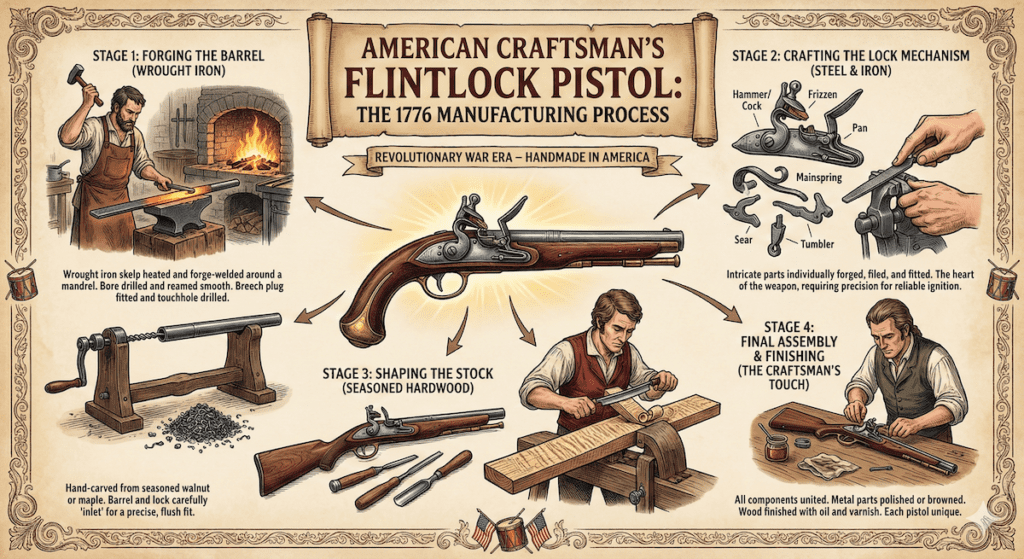
2. Were Pistols Common Weapons Used in 1776?
Pistols were not common battlefield weapons during the American Revolutionary War. In 1776, pistols were expensive, slow to reload, and unreliable, making them impractical for most infantry soldiers. As a result, pistols were carried primarily by officers, cavalry, naval personnel, and wealthy individuals, rather than ordinary Continental or British foot soldiers.
Most pistols used in 1776 were single-shot flintlock pistols, handmade by gunsmiths in Europe or the colonies. They were smoothbore weapons with very short barrels, giving them an effective range of only 10–20 yards. Accuracy beyond that distance was poor, and a pistol was generally intended for one close-range shot, after which the user would switch to a sword, saber, or bayonet.
How Pistols Were Used in the Revolutionary War
Pistols served a secondary or situational role, rather than being primary fighting weapons.
- Officers often carried pistols as a last-resort defensive weapon or symbol of authority
- Cavalry troops used pistols during charges, firing at close range before drawing sabers
- Naval officers and sailors favored pistols for boarding actions, where engagements were sudden and close
- Private citizens occasionally owned pistols for personal defense, but the cost limited widespread ownership
Reloading a flintlock pistol could take 20–30 seconds, similar to a musket, and misfires were common—especially in wet weather. For this reason, pistols were often paired with edged weapons, reinforcing their role as a single-use firearm rather than a sustained combat tool.
Colonial vs. British Pistols
British officers typically carried imported pistols from established European gunmakers, benefiting from better metallurgy and more consistent lock mechanisms. American pistols, when locally made, varied widely in quality and caliber due to the lack of standardized manufacturing.
As with rifles and muskets, captured weapons were frequently reused by American forces, and pistols taken from British officers were highly prized.
Why Pistols Did Not Dominate Warfare in 1776
The limited role of pistols highlights an important reality of 18th-century combat:
- Firearms were slow and unreliable
- Battles emphasized formation, discipline, and edged weapons
- A single accurate rifle shot was often more valuable than multiple pistol shots
Only with the introduction of repeating firearms and metallic cartridges in the late 19th and 20th centuries would pistols become a dominant personal weapon on the battlefield.
A Direct Result of the Revolutionary War
The Second Amendment was not born from abstract theory, but was a direct result of the experience of the Revolutionary War. The Founders had just survived a conflict that began when the British Army attempted to seize colonial gunpowder and disarm the populace.
They viewed the “standing army” as the primary tool of tyranny and the armed citizen as the last line of defense.
“The Amendment was written to ensure that the ultimate physical power remained with the citizenry, preventing the central government from possessing the monopoly on force that the British had tried to use against them.”
Moving Cannons in 1776: Labor, Ingenuity, and Sheer Determination
Cannons used in the Revolutionary War were massive and difficult to transport. A 6-pounder cannon could weigh 1,000 pounds or more, while larger siege guns could exceed 3,000 pounds. With no modern vehicles, soldiers relied on horse teams, oxen, sledges, and sheer manpower to move artillery over rough colonial roads.
During winter campaigns, cannons were often dragged on wooden sleds across snow and ice. In muddy seasons, they sank deep into the earth and required dozens of men to pry, lift, and roll them forward. Bridges had to be reinforced, trees cut for corduroy roads, and ropes tightened by hand to keep the artillery from sliding into rivers or ravines.
The most famous example is Henry Knox’s legendary transport of captured British cannons from Fort Ticonderoga to Boston in the winter of 1775–1776—over mountains, frozen lakes, and blinding storms—an extraordinary feat of endurance that helped drive the British from Boston.
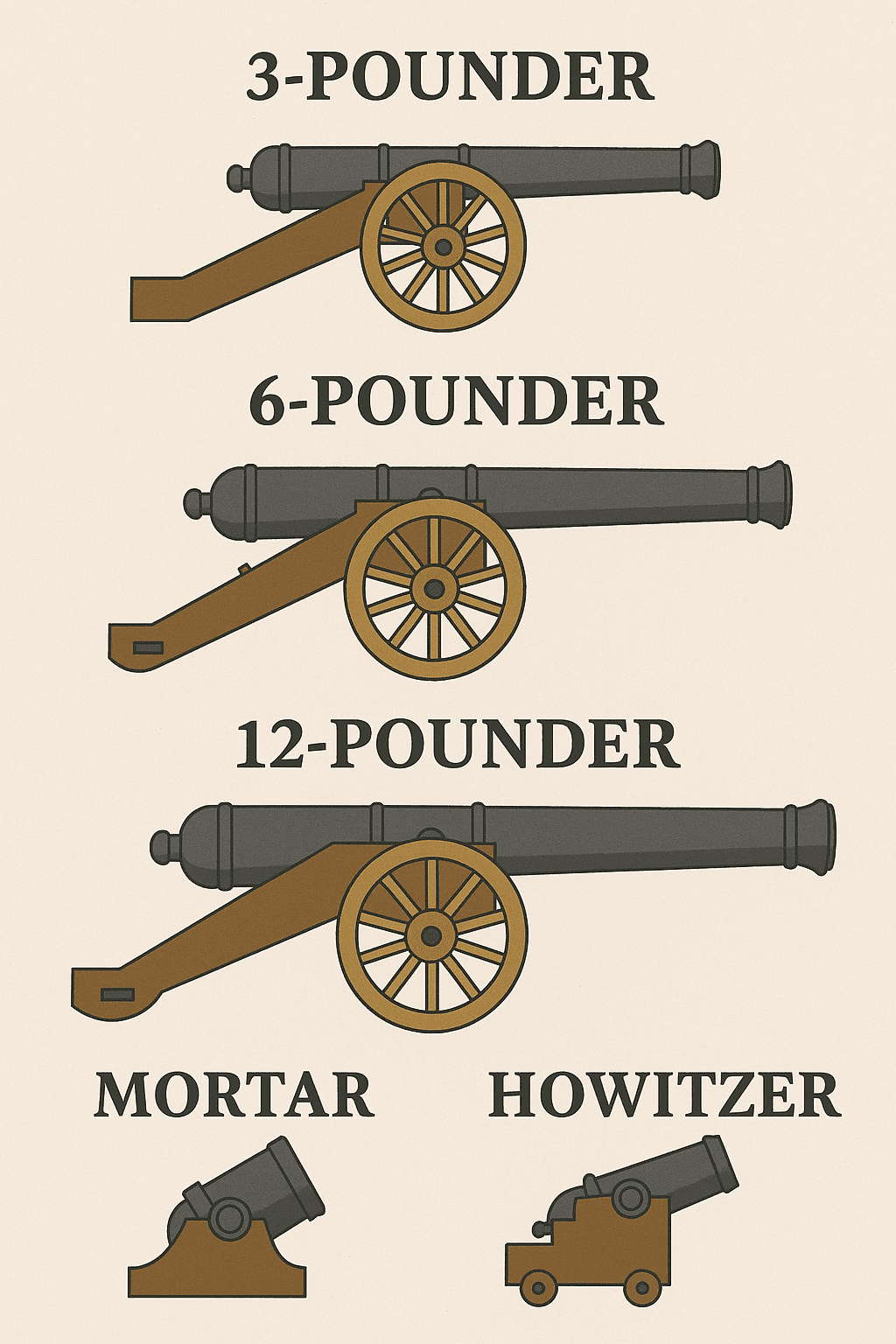
3. What Types of Artillery Were Used in 1776?
Cannons played a decisive role in many engagements, from the Siege of Boston to Trenton, Saratoga, and Yorktown. American artillery, organized under Henry Knox, dramatically improved during the war.
The most common cannons included:
3-Pounder Cannon
- Light and maneuverable
- Ideal for field use
6-Pounder Cannon
- Balanced power and mobility
- Standard for many Continental units
12-Pounder Cannon
- Heavy, powerful, used in major sieges
Mortars and Howitzers
- Launched explosive shells
- Used for defensive fortifications and sieges
These weapons were hauled over rivers, mountains, and frozen lakes—sometimes by hand—highlighting the incredible logistical challenges of the war.
To answer your questions directly: cannons in 1776 were not highly accurate by modern standards, and yes, they absolutely did use explosive balls, though with some important caveats regarding how they were fired.
Here is a detailed breakdown of 18th-century artillery accuracy and the types of ammunition used during the Revolutionary War.
4. How Accurate Were Cannons and Artillery in 1776?
Artillery during the American Revolution consisted of “smoothbore” weapons. Unlike modern gun barrels that have spiraled grooves (rifling) to spin and stabilize a projectile, smoothbore barrels were completely smooth inside. This led to several factors that limited accuracy:
- Windage: There had to be a small gap (called windage) between the cannonball and the inside of the barrel so the ball could be loaded easily, especially after powder residue built up. When fired, the ball would bounce down the barrel, meaning it exited on a slightly unpredictable trajectory.
- Target Size: Cannons were not sniper weapons. They were entirely inaccurate if trying to hit a point target (like a specific cart or person) at a distance. However, they were very effective against “area targets”—tightly packed formations of infantry, ships, or fortifications.
- Effective Range: A standard 6-pounder field gun (firing a 6-pound solid iron ball) had a maximum range of about 1,500 yards. However, its effective range for actually hitting an enemy formation was closer to 800 to 1,000 yards.
- Ricochet Fire: Gunners often didn’t aim directly at the enemy. Instead, they aimed at the ground in front of advancing troops. A solid iron ball would hit the ground and bounce (ricochet) through the enemy lines at waist or knee height, causing devastating damage.
Did Cannons in 1776 Use Explosive Cannonballs?
Did They Have Explosive Balls?
Yes, they did. These were called shells or “bombs” (this is where the phrase “bombs bursting in air” from the Star-Spangled Banner originates, though that was written later during the War of 1812 using the same technology).
However, explosive shells were rarely fired from standard, long-barreled cannons. Instead, they were fired from specialized artillery pieces:
- Mortars: Short, squat barrels that fired projectiles at a very high arc (plunging fire). They were primarily used in sieges to drop explosives over fort walls.
- Howitzers: A hybrid piece with a shorter barrel than a standard cannon but longer than a mortar. They fired on a medium arc and were highly effective on the battlefield.
How the Explosive Shells Worked:
The shells were hollow iron spheres filled with gunpowder. They did not explode on impact. Instead, they relied on a timed fuse.
- The gunner would pack a hollow wooden tube with slow-burning powder and hammer it into a hole in the shell.
- The fuse had to be cut to the exact right length based on the estimated flight time to the target.
- When the cannon fired, the flash of the propelling charge would ignite the fuse.
- If cut correctly, the shell would explode in the air just above the enemy troops, showering them with jagged iron shrapnel. If cut too long, the enemy could sometimes extinguish the fuse or run away before it exploded. If cut too short, it would explode mid-air harmlessly—or worse, right after leaving the barrel.
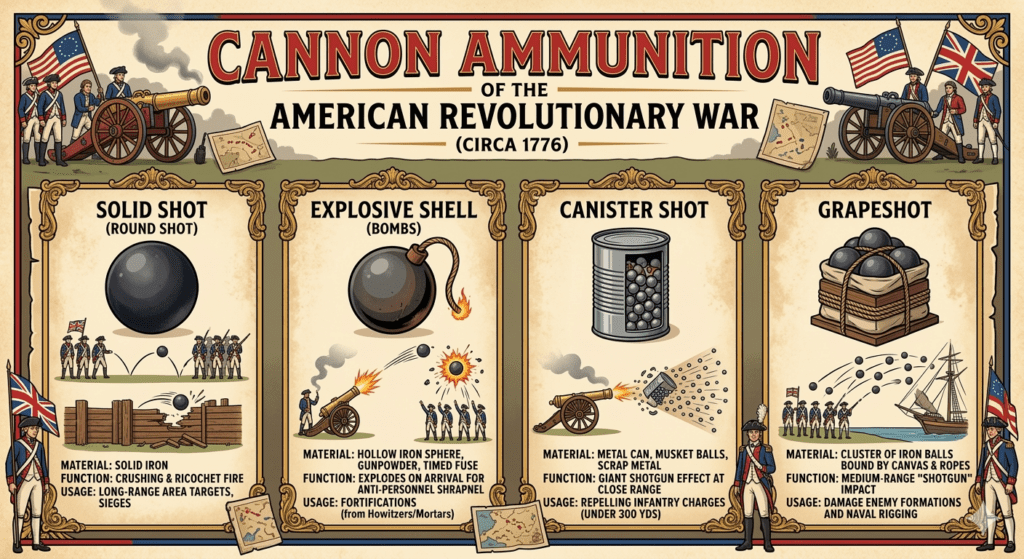
Other Types of Ammunition
Aside from solid round shot (for smashing formations and buildings) and explosive shells, artillery in 1776 heavily relied on Canister Shot and Grapeshot. These were basically giant shotgun shells. A tin can or canvas bag filled with dozens of musket balls or smaller iron chunks was loaded into the cannon.
When fired, it turned the cannon into a massive shotgun, creating a cone of lethal projectiles that was devastating to infantry at close ranges (under 300 yards).
Would you like to know more about the specific types of cannons used, or perhaps how the Continental Army under Henry Knox famously managed to transport their heavy artillery to Boston in the winter of 1776?
The National Park Service also offers a detailed explanation of Revolutionary War artillery, including how cannons, mortars, and howitzers were used and transported:
https://www.nps.gov/articles/000/artillery-in-the-revolution.htm
The story of the weapons used in 1776 and the wider Revolutionary War is not complete without Spain’s military role along the Gulf Coast.
5. How Were Weapons Made and Supplied in 1776?
Unlike Britain, the American colonies did not have large government armories in 1776. Most firearms used by American soldiers were handcrafted by local gunsmiths, often working out of small shops or even their own homes. Each rifle or pistol was made largely by hand, resulting in weapons that varied widely in size, caliber, and quality.
Barrels were forged by heating iron strips, wrapping them around a mandrel, and hammer-welding them into shape. Rifling grooves were then cut by hand using simple jigs—an extremely time-consuming process that made long rifles expensive but highly accurate.
Locks, the most complex part of a firearm, were often imported from England or Europe before the war. As supplies tightened, colonial smiths increasingly repaired, reused, or copied lock designs using salvaged metal.
Stocks were carved from local hardwoods such as maple or walnut, shaped to fit the shooter. Because many rifles were personal hunting weapons before becoming military arms, they were often customized to the owner’s height and shooting style.
Pistols were produced in much smaller numbers and were usually carried by officers or cavalry. Like rifles, colonial pistols were handmade, expensive, and far from standardized.
British Weapon Manufacturing: An Industrial Advantage
British soldiers benefited from a vastly different system. Firearms and pistols were produced in large quantities by professional manufacturers in Birmingham and London, following standardized patterns. This allowed British units to share ammunition, replace broken parts more easily, and train uniformly—advantages the Continental Army struggled to match.
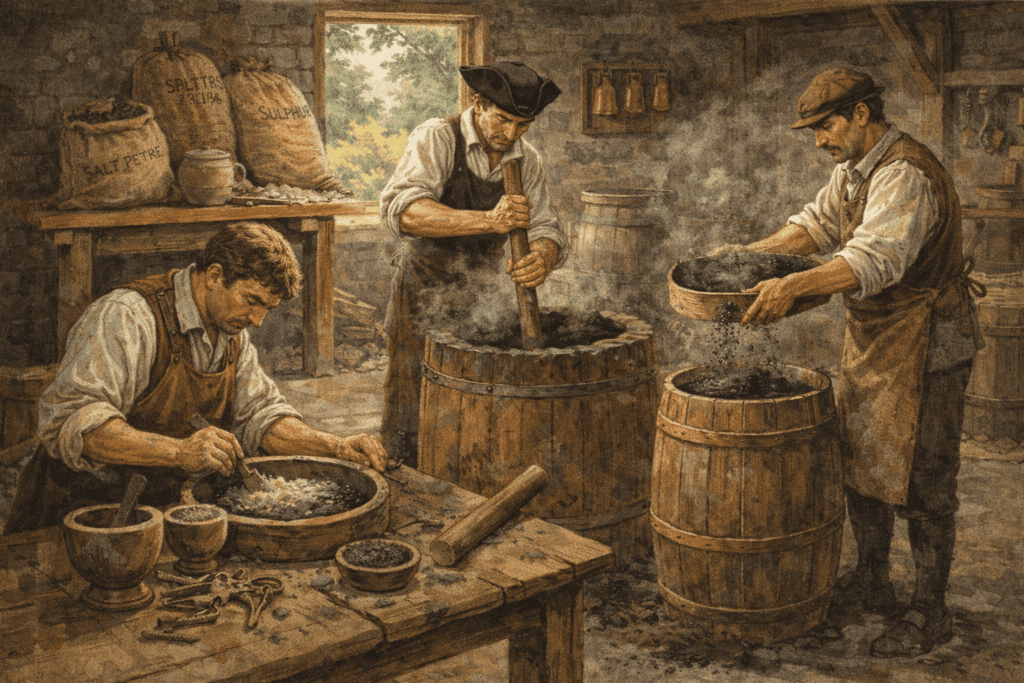
Making Gunpowder and Ammunition in 1776
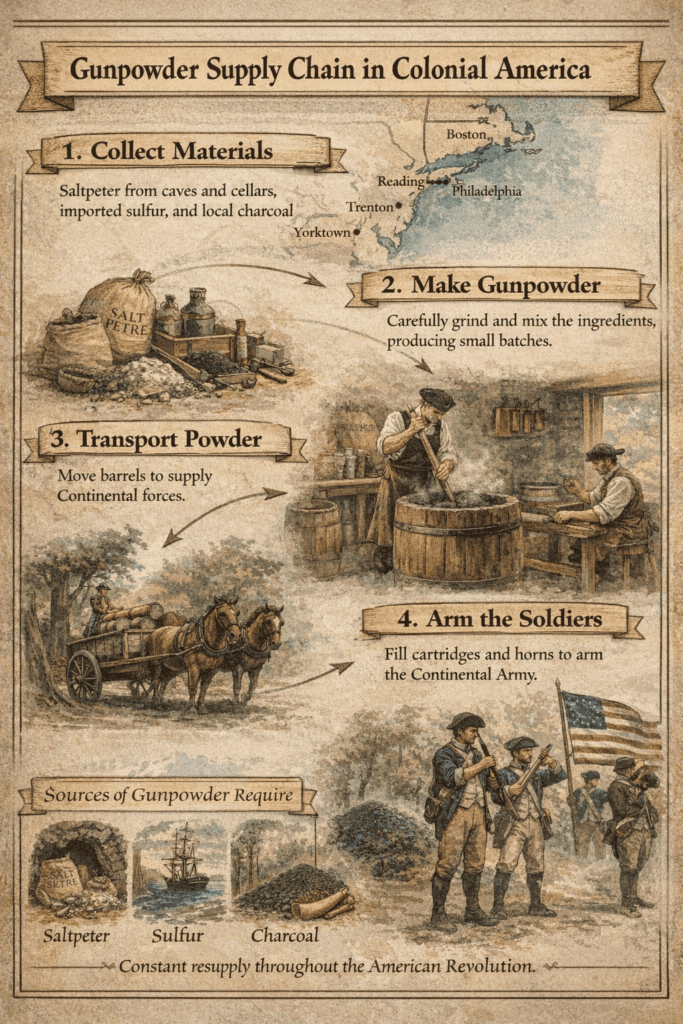
Ammunition shortages plagued the Continental Army throughout the war. Colonists produced gunpowder locally using saltpeter, sulfur, and charcoal, though quality varied widely. Lead for bullets was often melted down from household items such as window weights and church bells. Soldiers frequently cast their own musket balls using portable molds carried in their kits.
The Danger and Supply of Gunpowder in the American Colonies
Making gunpowder in the American colonies was extremely dangerous work. The process required grinding and blending saltpeter, sulfur, and charcoal in precise ratios, often by hand and without any modern safety protections. A single spark, a metal tool striking stone, or static from dry air could cause an explosion.
For this reason, gunpowder was typically produced in small batches, frequently outside town centers, in barns, sheds, or crude mills set near streams. Colonial leaders avoided large stockpiles in one place, as a single accident could destroy an entire facility and kill skilled workers who were difficult to replace.
Gunpowder was made wherever materials could be gathered and transported, with notable production in Pennsylvania, Virginia, New York, and New England. Saltpeter (potassium nitrate) was the most difficult ingredient to obtain and was often extracted from soil in caves, cellars, barns, and even beneath outhouses, where nitrates accumulated naturally.
Sulfur was imported in limited quantities from Europe and the Caribbean, while charcoal was produced locally by slowly burning hardwoods such as willow, alder, and maple. Because supplies were scarce, production rarely reached industrial scale; many colonial mills produced only enough powder to support nearby militias, forcing the Continental Army to rely on constant resupply, conservation, and foreign assistance throughout the war.

6. What Tools Did Soldiers Use Alongside Weapons in 1776?
Revolutionary War armies spent far more time digging, building, and fortifying than firing their weapons.
Common tools included:
- Axe – Cutting timber, clearing land
- Saw – Shaping logs and defensive works
- Shovel – Digging trenches, earthworks, and redoubts
- Wooden stake – Support structures and fortifications
- Entrenching tool – Essential for rapid defensive positions
These tools were as important as muskets, especially during sieges and winter encampments like Valley Forge.
According to local accounts, a group of British loyalist soldiers forced their way into her cabin. Hart pretended to cooperate, serving them food and drink while secretly removing their muskets one by one. When discovered, she seized a weapon, shot one soldier, and held the rest at gunpoint until help arrived.
Stories like hers highlight an often-overlooked reality: women not only supported the war effort—they sometimes took up arms themselves.
Continental Soldiers: Hardships in Clothing and Pay
Continental soldiers often fought in rags. Most owned only one or two changes of clothing and rarely had the opportunity to wash, mend, or replace worn garments. Their fortunes improved when their wives—known as camp followers—joined the army. These women washed clothing, repaired uniforms, and even created new garments from whatever cloth could be found.
Soldiers received very little pay, and when they did, Continental dollars were nearly worthless. By contrast, British soldiers were regularly supplied with standardized uniforms, steady pay, and reliable clothing replacements—highlighting the stark difference between the two armies.
7. What Did Soldiers Wear in 1776? Uniforms and Equipment
🇺🇸 Continental Army Uniforms (or the lack of them)
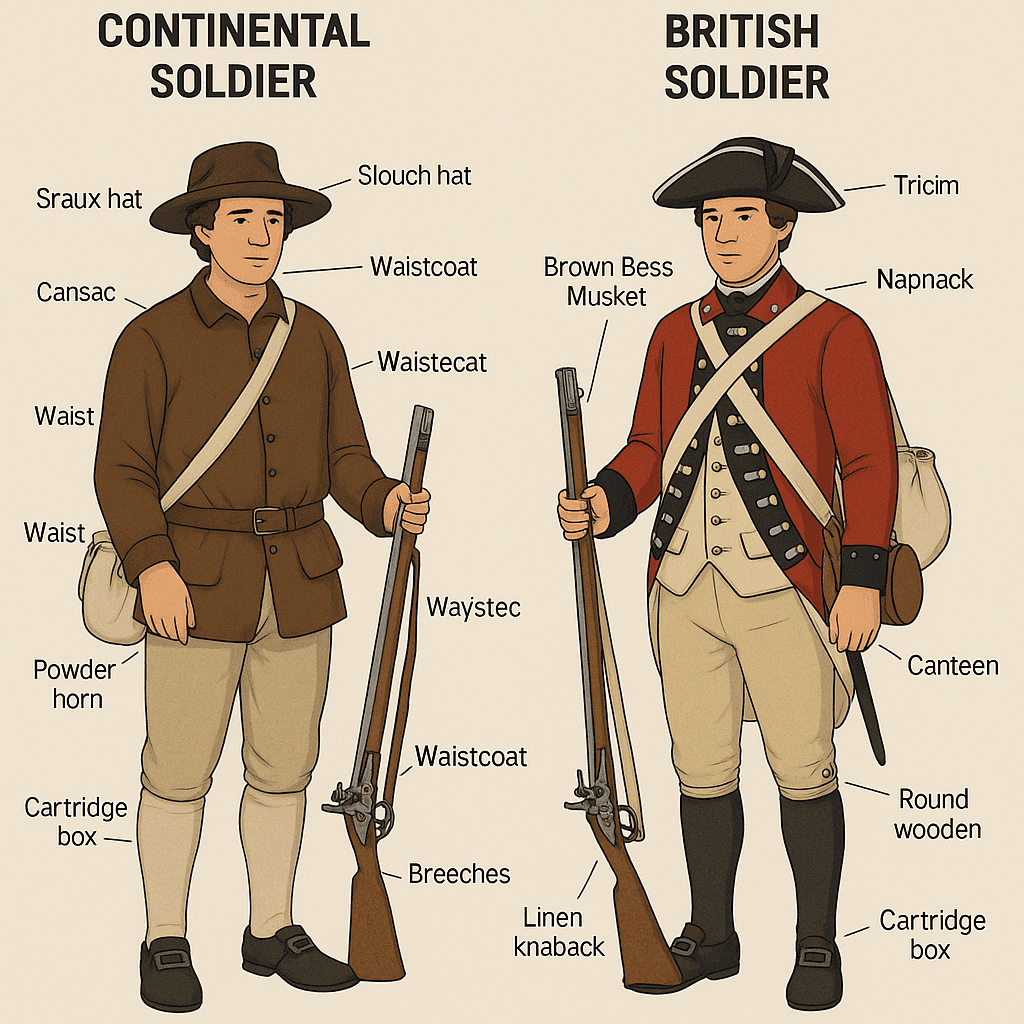
Uniforms as we know them today largely did not exist for the American army in 1776. Congress had no funds, and states struggled to supply even the basics. Most soldiers wore:
- Linen or wool shirts
- Homespun hunting frocks
- Breeches or work trousers
- Slouch hats
- Homemade moccasins or worn shoes
Their appearance varied dramatically: farmers, frontiersmen, merchants, and tradesmen all fought wearing their everyday clothing.
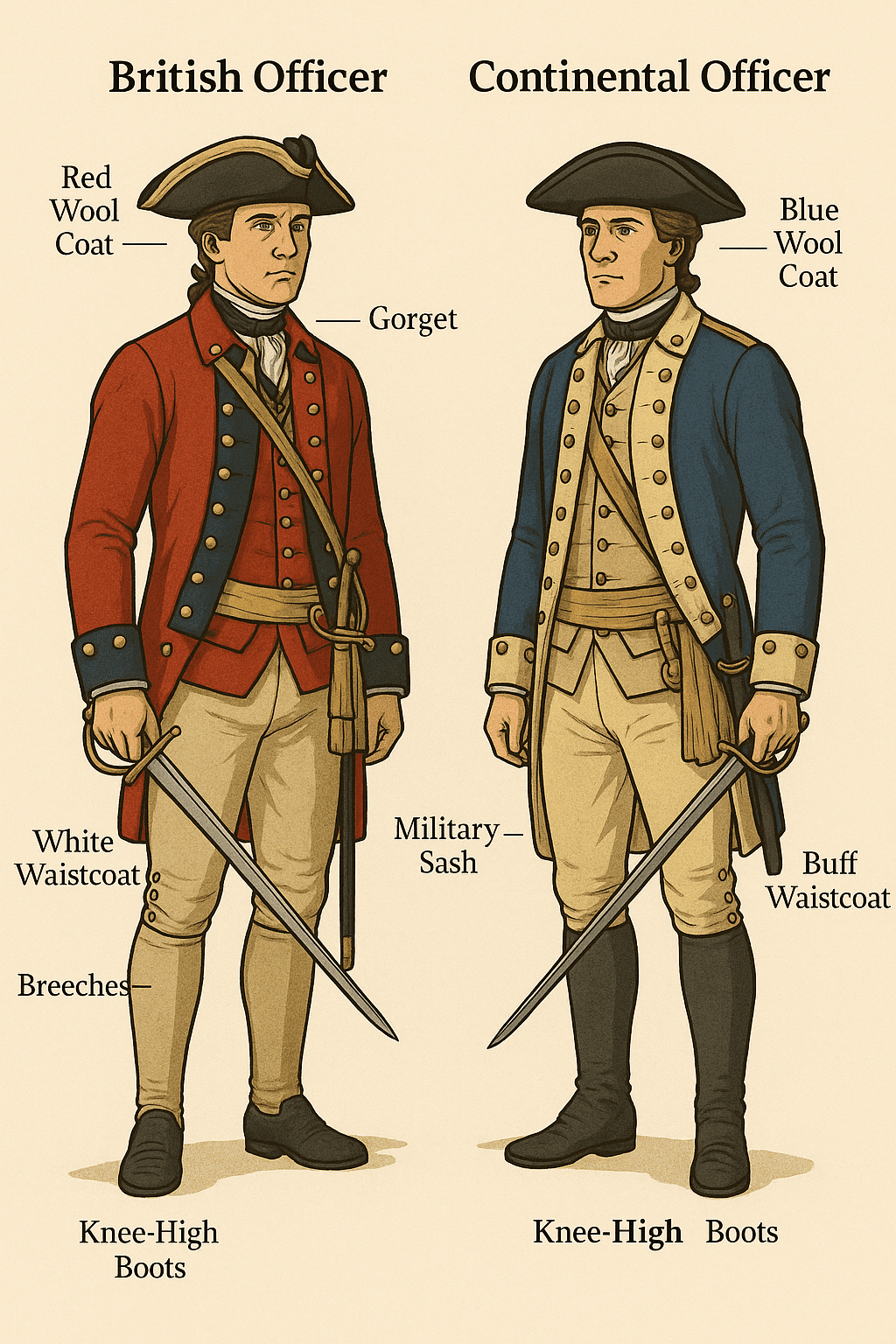
Officers
Officers who could afford it wore European-style coats, breeches, boots, gorgets, and military sashes.
George Washington himself purchased his uniforms privately.
🇬🇧 British Army Uniforms: Order and Discipline
The British Army, by contrast, was among the most standardized in the world.
A typical British Redcoat wore:
- Red wool coat with colored facings
- White or buff waistcoat
- Knee breeches
- Gaiters or high boots
- Black tricorn hat
- Crossbelts for bayonet and cartridge box
These uniforms were intended to project authority, cohesion, and fear. Their bright colors made British troops highly visible—effective in European open-field tactics but challenging in America’s forests.
Hessian allies, wearing blue or green coats, added to the British army’s disciplined appearance.
Who paid for British soldiers’ uniforms?
The Red Coat Was Not Free: How British Soldiers Paid for Their Own Uniforms in 1776
British soldiers in 1776 appeared well equipped and professionally dressed in their famous red uniforms. However, the financial system behind those uniforms reveals a surprising reality: soldiers effectively paid for much of their own clothing through deductions from their wages.
The Illusion of “Free” Clothing
A British infantry private officially earned about 8 pence per day. But this amount represented gross pay. Before a soldier received his wages, the army deducted mandatory charges—known as stoppages—to cover many of the expenses required to serve in the army.
- The uniform, including the red coat, waistcoat, and breeches.
- Daily food rations.
- Medical care provided by the regimental surgeon.
- “Necessaries” such as shoes, shirts, stockings, gaiters, and cleaning supplies required to maintain the uniform’s appearance.
The Colonel’s Profit: “Off-Reckonings”
Uniforms were not produced in centralized government factories. Instead, the British War Office issued each regiment’s colonel a lump sum of money called off-reckonings to purchase clothing for his soldiers. The colonel then hired civilian contractors to weave cloth and manufacture uniforms.
If a colonel negotiated inexpensive contracts for clothing, he was legally allowed to keep the remaining money as personal profit. As a result, the quality and fit of a soldier’s uniform could vary depending on how carefully—or how profitably—the regiment’s commander managed the funds.
What the Soldier Actually Received
After deductions for clothing, food, medical care, and other expenses were taken from the official 8-pence daily wage, most soldiers were left with only 1 or 2 pence per day in disposable income. This small amount might be spent on tobacco, extra food, or ale, leaving very little actual cash in the soldier’s pocket despite the appearance of steady military pay.
8. A Soldier’s Perspective: Life and Weapons in 1776
(Fictional but based on authentic weapons, uniforms, and field conditions.)
June 3, 1776
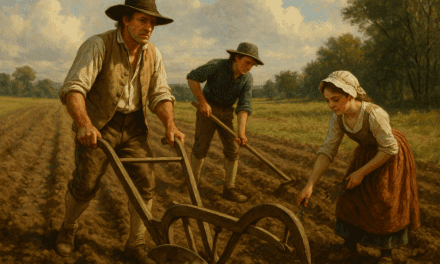
I have farmed this land in Pennsylvania since leaving Spain sixteen years ago. My long rifle feeds my family and guards my home. Word from the towns speaks of taxes, soldiers, and the heavy hand of a distant king. Trouble is coming.
September 14, 1776
I answer General Washington’s call. I bring my long rifle—accurate though slow—and wear my hunting shirt dyed brown with walnut hulls. We are a patchwork army of farmers, laborers, and tradesmen. Few wear uniforms.
December 25–26, 1776
We cross the Delaware through ice and storm. I fear water more than musket fire—wet powder means death. At Trenton, the Hessians in bright uniforms form quickly, firing muskets in volleys. My long rifle sends each ball true, though each shot takes precious time.
1783
I return home. My son now trains with my other long rifle. My own hunting shirt hangs near the hearth, worn and faded, yet to me finer than any officer’s coat. It is the garment of a free man.
Note: This diary is a fictional narrative created to illustrate historical weapons, clothing, and battlefield conditions.
9. Why the Weapons Used in 1776 Determined the Outcome of the War
The Revolutionary War succeeded in part because Americans:
- Used long rifles to offset British musket advantages
- Utilized guerrilla tactics in forests and rural terrain
- Constructed fortifications quickly using simple tools
- Fought in clothing suited to their environment
- Adapted captured British equipment
- Received critical French support for uniforms, muskets, and artillery
The conflict was one of technology, terrain, culture, and sheer determination.
Conclusion
The weapons used in 1776 tell the story of two very different armies—one built on tradition and discipline, the other on resourcefulness, individuality, and necessity. Yet both fought with courage, shaping the path to American independence. For additional context on the firearms carried by both armies, the American Battlefield Trust provides an excellent overview of Revolutionary War weapons, including muskets, rifles, bayonets, and artillery:
🇺🇸 Explore More in Our 250th Anniversary Series
Explore More in the America 250th Anniversary Series
Continue your journey through 1776 with our hub and featured articles.
Frequently Asked Questions About Weapons Used in 1776
The most common weapons used in 1776 were the British Brown Bess musket and the American long rifle. Muskets were widely used by both British and Continental forces due to their faster reload speed, while long rifles were favored by American militia for their superior accuracy and long-range effectiveness.
The primary guns used during the Revolutionary War were flintlock firearms, including muskets, long rifles, and pistols. These weapons relied on a flint striking steel to ignite gunpowder. Muskets were standard issue for infantry, while rifles were used for precision shooting by militia and specialized troops.
In addition to firearms, soldiers in 1776 used bayonets, swords, sabers, and a variety of artillery such as cannons, mortars, and howitzers. Field tools like axes and shovels were also essential for building defenses, fortifications, and camps during the Revolutionary War.
American soldiers used bayonets less frequently in 1776 because many early war muskets lacked bayonet fittings. Training and supply shortages also limited their use. British forces, by contrast, relied heavily on bayonet charges as part of disciplined battlefield tactics.
Pistols were not commonly used by regular infantry in 1776. They were expensive, slow to reload, and limited to a single shot. Pistols were typically carried by officers, cavalry, and naval personnel, where close-range combat made them more practical.
Common artillery in 1776 included 3-pounder, 6-pounder, and 12-pounder cannons, along with mortars and howitzers. These weapons were used in both battlefield engagements and sieges, firing solid shot, explosive shells, and canister rounds depending on the situation.
Reloading times in 1776 varied by weapon. A British musket could typically be reloaded in 15 to 20 seconds, allowing 3 to 4 shots per minute. A long rifle took longer, usually 30 to 60 seconds per shot, but offered much greater accuracy.
Most American weapons in 1776 were handcrafted by local gunsmiths, while British firearms were produced in larger quantities using early industrial methods. Barrels were forged by hand, stocks were carved from wood, and gunpowder was mixed from saltpeter, sulfur, and charcoal.
Soldiers in 1776 carried gunpowder in cartridge boxes, horns, or sealed containers to protect it from moisture. Keeping powder dry was critical, especially during rain or river crossings, as wet powder could render a firearm useless in combat.
The weapons used in 1776 played a major role in shaping battlefield tactics and outcomes. American forces used accurate rifles and guerrilla tactics to offset British advantages in discipline and firepower, while artillery and supply systems influenced major victories throughout the war.
People Often Ask
What People Often Ask About Making and Supplying Weapons in 1776
Beyond the battlefield, readers often wonder how weapons, ammunition, and equipment were actually made and supplied during the Revolutionary War.
1) Where were rifles and muskets made in the American colonies?
2) How were gun barrels and stocks made in 1776?
3) Where did the colonies get gunpowder and ammunition?
4) Why didn’t the Continental Army have standardized weapons?
5) How did weapon shortages affect American strategy?
6) How did foreign aid change weapon supply later in the war?
Short Quiz – Test Your Knowledge of 1776 Weapons
Quiz: Rifles, Pistols, and Cannons of 1776
Test your knowledge of the weapons used during the American Revolution. Answers are hidden below each question.
-
Which firearm was known for its long range and accuracy in 1776?
Answer
The American long rifle. -
What was the most common firearm carried by British infantry?
Answer
The Brown Bess smoothbore musket. -
Why were pistols not commonly used by ordinary foot soldiers?
Answer
They were expensive, inaccurate at distance, slow to reload, and generally reserved for officers, cavalry, or naval use. -
What type of ignition system did firearms use in 1776?
Answer
Flintlock ignition. -
Which weapon was better suited for bayonet charges?
Answer
The Brown Bess musket. -
What size cannons were commonly used during the Revolutionary War?
Answer
3-, 6-, and 12-pounder cannons, along with mortars and howitzers. -
How far could a skilled rifleman accurately fire a long rifle?
Answer
About 200 yards, and sometimes farther under ideal conditions. -
What was the effective range of most flintlock pistols?
Answer
Approximately 10–20 yards. -
Why was moving cannons so difficult in 1776?
Answer
Cannons were extremely heavy and had to be moved using horses, oxen, sledges, wagons, and large teams of soldiers. -
What did soldiers often do after firing a pistol in combat?
Answer
They switched to a sword, saber, or bayonet, since pistols were single-shot weapons.
PODCAST Weapons Used in 1776
{ “@context”: “https://schema.org”, “@type”: “FAQPage”, “mainEntity”: [ { “@type”: “Question”, “name”: “What were the most common weapons used in 1776?”, “acceptedAnswer”: { “@type”: “Answer”, “text”: “The most common weapons used in 1776 were the British Brown Bess musket and the American long rifle. Muskets were widely used by both British and Continental forces due to their faster reload speed, while long rifles were favored by American militia for their superior accuracy and long-range effectiveness.” } }, { “@type”: “Question”, “name”: “What kind of guns were used in the Revolutionary War?”, “acceptedAnswer”: { “@type”: “Answer”, “text”: “The primary guns used during the Revolutionary War were flintlock firearms, including muskets, long rifles, and pistols. These weapons relied on a flint striking steel to ignite gunpowder. Muskets were standard issue for infantry, while rifles were used for precision shooting by militia and specialized troops.” } }, { “@type”: “Question”, “name”: “What weapons were used in 1776 besides guns?”, “acceptedAnswer”: { “@type”: “Answer”, “text”: “In addition to firearms, soldiers in 1776 used bayonets, swords, sabers, and a variety of artillery such as cannons, mortars, and howitzers. Field tools like axes and shovels were also essential for building defenses, fortifications, and camps during the Revolutionary War.” } }, { “@type”: “Question”, “name”: “Why didn’t American soldiers use bayonets as often?”, “acceptedAnswer”: { “@type”: “Answer”, “text”: “American soldiers used bayonets less frequently in 1776 because many early war muskets lacked bayonet fittings. Training and supply shortages also limited their use. British forces, by contrast, relied heavily on bayonet charges as part of disciplined battlefield tactics.” } }, { “@type”: “Question”, “name”: “Were pistols commonly used in 1776?”, “acceptedAnswer”: { “@type”: “Answer”, “text”: “Pistols were not commonly used by regular infantry in 1776. They were expensive, slow to reload, and limited to a single shot. Pistols were typically carried by officers, cavalry, and naval personnel, where close-range combat made them more practical.” } }, { “@type”: “Question”, “name”: “What types of cannons were used in 1776?”, “acceptedAnswer”: { “@type”: “Answer”, “text”: “Common artillery in 1776 included 3-pounder, 6-pounder, and 12-pounder cannons, along with mortars and howitzers. These weapons were used in both battlefield engagements and sieges, firing solid shot, explosive shells, and canister rounds depending on the situation.” } }, { “@type”: “Question”, “name”: “How long did it take to reload a weapon in 1776?”, “acceptedAnswer”: { “@type”: “Answer”, “text”: “Reloading times in 1776 varied by weapon. A British musket could typically be reloaded in 15 to 20 seconds, allowing 3 to 4 shots per minute. A long rifle took longer, usually 30 to 60 seconds per shot, but offered much greater accuracy.” } }, { “@type”: “Question”, “name”: “How were weapons made in 1776?”, “acceptedAnswer”: { “@type”: “Answer”, “text”: “Most American weapons in 1776 were handcrafted by local gunsmiths, while British firearms were produced in larger quantities using early industrial methods. Barrels were forged by hand, stocks were carved from wood, and gunpowder was mixed from saltpeter, sulfur, and charcoal.” } }, { “@type”: “Question”, “name”: “How did soldiers keep gunpowder dry in battle?”, “acceptedAnswer”: { “@type”: “Answer”, “text”: “Soldiers in 1776 carried gunpowder in cartridge boxes, horns, or sealed containers to protect it from moisture. Keeping powder dry was critical, especially during rain or river crossings, as wet powder could render a firearm useless in combat.” } }, { “@type”: “Question”, “name”: “Why were weapons so important in the Revolutionary War?”, “acceptedAnswer”: { “@type”: “Answer”, “text”: “The weapons used in 1776 played a major role in shaping battlefield tactics and outcomes. American forces used accurate rifles and guerrilla tactics to offset British advantages in discipline and firepower, while artillery and supply systems influenced major victories throughout the war.” } } ] }Discover more from RetireCoast.com
Subscribe to get the latest posts sent to your email.






Trackbacks/Pingbacks