Last updated on June 1st, 2026 at 03:45 am
The untold story of the women, children, and families who kept the American Revolution alive.
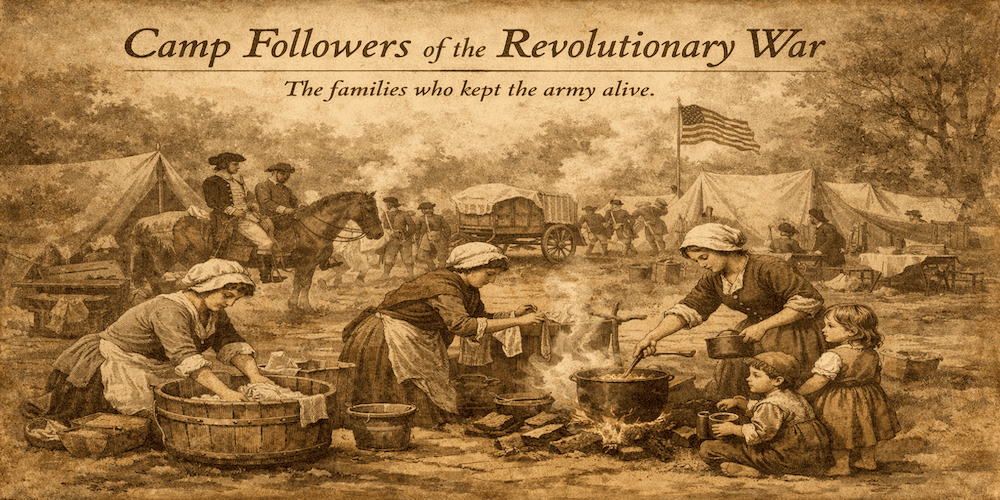
When we picture the Revolutionary War, we usually imagine ragged Continental soldiers on the battlefield—flintlocks raised, smoke thick, drums pounding. But the war could not have been fought, let alone won, without the thousands of camp followers who traveled with the army. These men, women, and children—today often referred to collectively as camp followers Revolutionary War—lived beside the troops, marched behind them, and worked tirelessly from before dawn until long after dark. Their labor kept the army alive, fed, clothed, and functioning through disease, hunger, and brutal winters.
- I. Who Were the Camp Followers?
- II. Why Did Families Follow the Army?
- III. Children in the Camps
- IV. Childbirth in the Camps
- V. Endless Labor: Laundry, Firewood, Nursing & More
- VI. Food, Rations, and the Daily Struggle to Eat
- VII. Letters from Camp Followers during the Revolutionary War
- VIII: Danger — Capture, Death, and Chaos
- IX. British vs. American Camp Followers
- X. George Washington and Camp Followers: “We Cannot Do Without the Women.”
- XI — Women Camp Followers of the Revolutionary War
- XII — Lessons for Today
- Frequently Asked Questions
- Dedication
- PODCAST
Far from being marginal figures, camp followers were central to the Continental Army’s survival. They cooked, washed, nursed, mended, gathered fuel, carried water, raised children, tended fires, and in many cases were the only medical support soldiers ever received. Without them, disease would have ravaged the camps, morale would have collapsed, and the war might have ended very differently.
To understand why these families traveled with the army, it helps to remember who Americans were in 1776: overwhelmingly rural, family-bound, and dependent on shared labor just to survive.
(See: Who We Were in 1776 – retirecoast.com/who-we-were-1776/)
Our special article https://retirecoast.com/women-of-the-revolutionary-war/ continues from where this one leaves off; don’t miss it.
I. Who Were the Camp Followers?
The Continental Army moved like a wandering village. Soldiers marched with muskets slung over their shoulders, but behind them came wagons, oxen, cook fires, laundry kettles, barrels of water, and lines of canvas tents. Children darted between guy ropes, women boiled shirts or stirred stews, and older relatives helped with whatever labor they could.
Camp followers during the Revolutionary War included:
• Wives of enlisted soldiers
• Children of all ages
• Widows and elderly parents
• Laundresses and cooks
• Seamstresses and tent repairers
• Midwives and informal nurses
• Free and enslaved Black people tied to officers and regiments
• Sutlers (civilians selling or trading goods)
Most families joined after harvest season, when winter loomed, and the farm could not be maintained without the husband’s labor. Others fled unsafe areas or followed husbands out of loyalty, necessity, or fear of starvation.
II. Why Did Families Follow the Army?
Economic survival.
A family farm could not function without its main laborer. Women faced woodpiles uncut, fields unplowed, and no income. Life in camp, while harsh, at least offered rations—however small—and the chance to earn a little money by washing, nursing, or mending.
Safety and stability.
The countryside was dangerous. British raiding parties, Loyalist neighbors, thieves, and hungry soldiers from any side might appear at the door. However rough army life was, many women felt safer within the moving community of the camp than alone on an isolated farm.
Family unity.
Some husbands simply refused to leave their families behind. Others threatened to desert if their wives were barred from following. For many families, separation felt more dangerous than the hardship of the march.
The army needed camp followers during the Revolutionary War
Officers complained about extra mouths to feed, but they also knew the truth: without women to cook, wash, nurse, mend, and gather fuel, the army would quickly fall into filth, disease, and low morale.
Read about what George Washington had to say about camp followers further into this article—it is enlightening, and it shows just how essential he believed these women were.
III. Children in the Camps
💭 A Modern Child’s Perspective
A modern child might wonder how they would ever watch TV or use their electronic devices if they had to complete the daily chores their ancestors performed in the 1770s—fetching water from a distant stream, gathering firewood in all weather, tending younger siblings, or helping keep the fire from going out.
As you read this section, consider how dramatically life has changed. We enjoy comforts in 2026 that would have been unimaginable to the children living in the Continental camps. Their hard labor reminds us of how fortunate we are today.
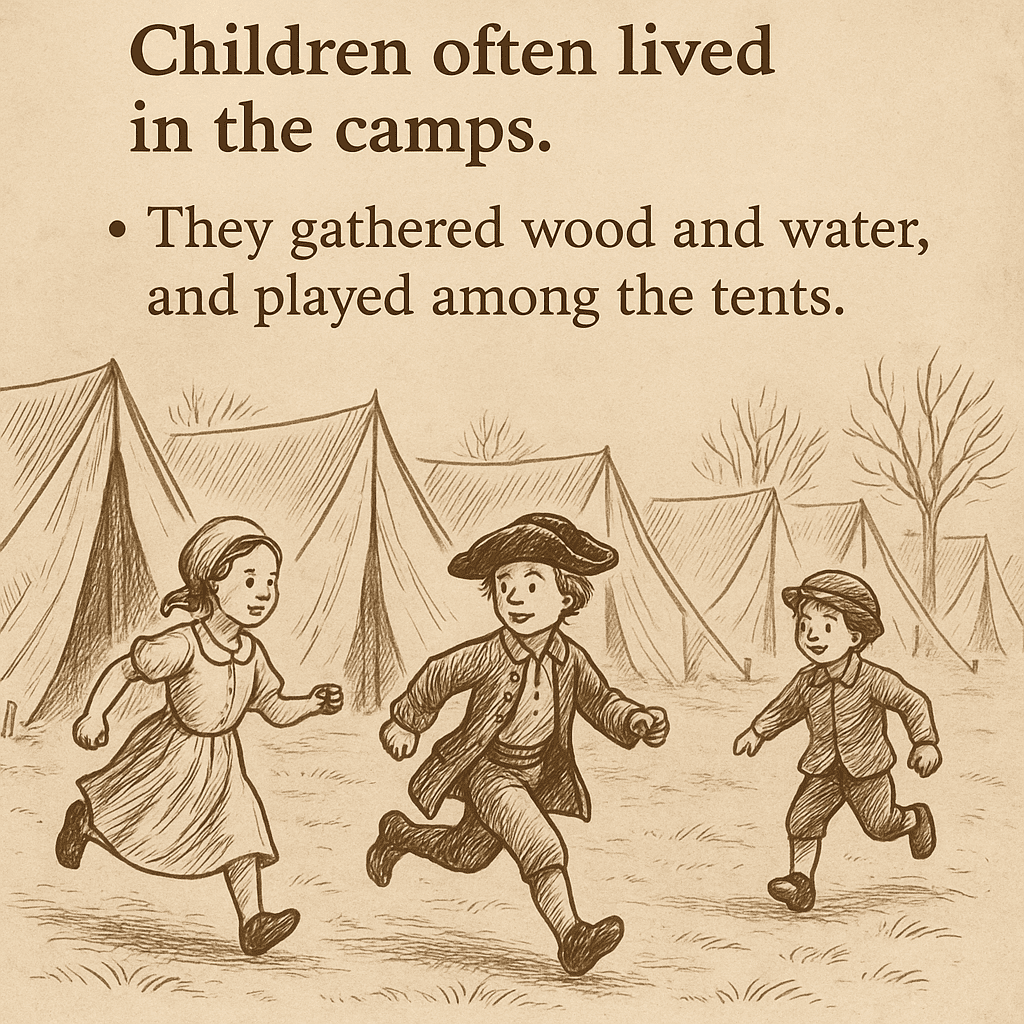
Children were common in the camps and contributed to daily life. They fetched water, gathered firewood, hauled small bundles, watched younger siblings, and—when given a moment—played among the tents.
Children received no formal schooling in camp. A chaplain or literate soldier might offer lessons, but instruction was mostly practical: keeping fires alive, avoiding wagon wheels, staying warm, and learning camp discipline.
IV. Childbirth in the Camps
Life did not pause for war. Women conceived and bore children while marching or living in crowded tents. Childbirth, already dangerous in the 18th century, became deadly in winter encampments where hunger, cold, infection, and exhaustion were constant threats.
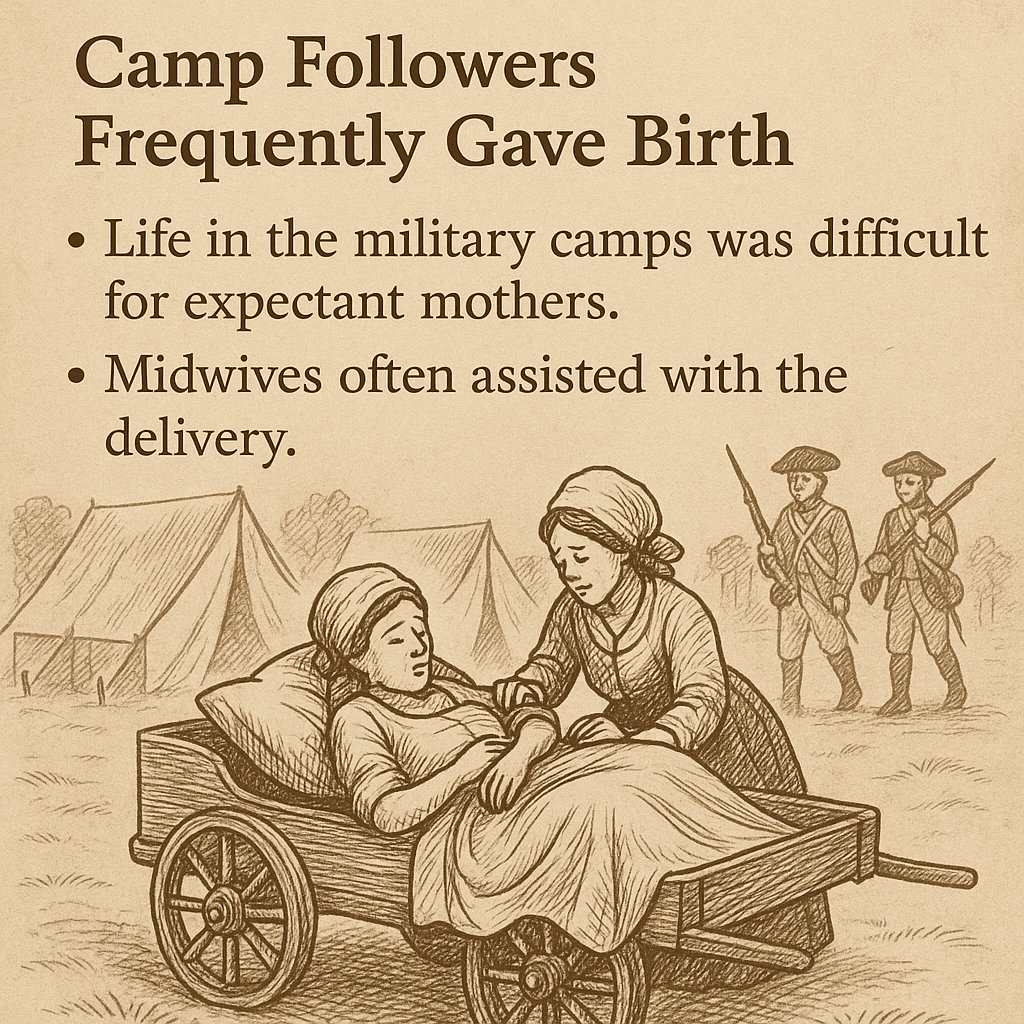
Midwives (when available) were invaluable. In many camps, childbirth occurred in makeshift huts, wagons, or even the open air during forced marches. Infant mortality was high, but mothers faced equal danger.
A Midwife’s Diary (Reconstructed)
Camp near Middlebrook, February 1777
“Before the sun crept over the ridge, I was called to attend a young wife. The tent was cold, and the wind slipped through every seam. With only a kettle of boiled water and scraps of linen, she brought forth a boy. He uttered, but the smallest cry before sleep took him. I fear he shall not last the week. The snow lies thick, and the mother has taken little nourishment these past days. This is the work the Lord has placed at my feet, though my heart grows heavier with each season.”
V. Endless Labor: Laundry, Firewood, Nursing & More
A Remarkable Sacrifice
It is almost inconceivable in 2026 that these women would work without pay so diligently to support the army. The closest America ever came to such widespread unpaid mobilization of women was during World War II, when women stepped into jobs traditionally held by men.
But even that comparison falls short. In 1776, soldiers lived side-by-side with the women who sustained them. They watched their wives, sisters, and daughters endure hunger, cold, exhaustion, and danger every day. Their suffering and contributions were not distant or symbolic—they were visible, immediate, and absolutely vital to the survival of the Continental Army.
Camp followers performed back-breaking labor every day, often from before dawn until late into the night. Their work was not optional; it was vital. Disease killed more soldiers than combat, and women’s constant efforts were the primary line of defense.
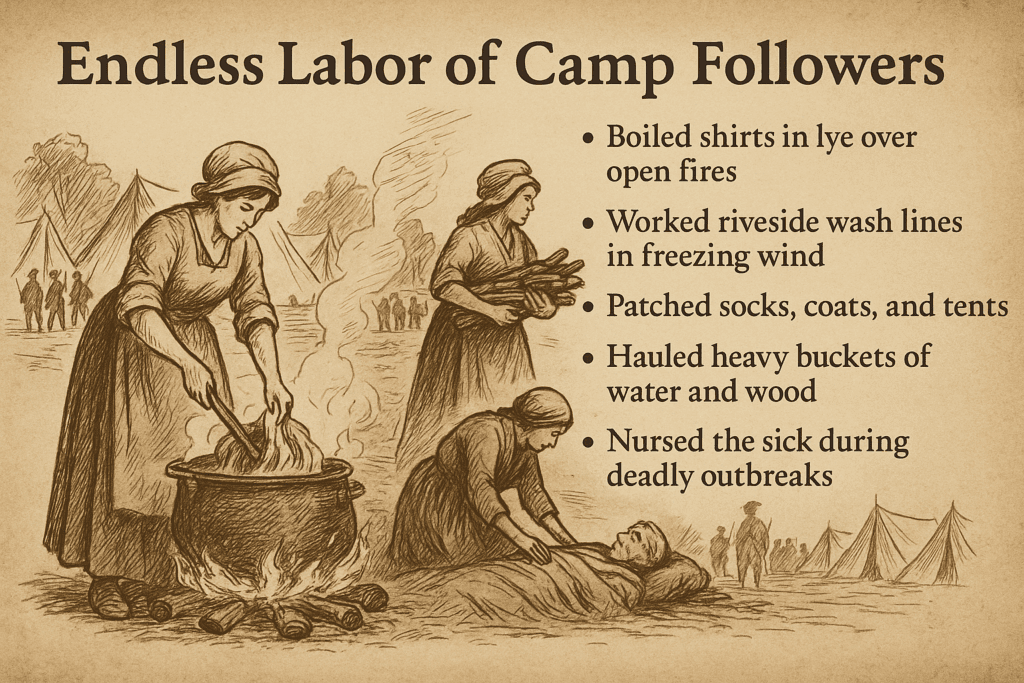
Women:
• Boiled shirts in lye over fires
• Worked riverside wash lines in freezing wind
• Mended socks, breeches, coats, tents
• Hauled water and wood for cooking and heat
• Prepared meals for soldiers and children
• Sat beside sick soldiers during outbreaks of smallpox and camp fever
This labor helped reduce disease—essential in camps where lice, dysentery, and fever ran rampant.
For context on the scarcity of resources and skyrocketing wartime costs, see:
250-Year Price Shock – retirecoast.com/250-year-price-shock/
Financing the United States in 1776 –
VI. Food, Rations, and the Daily Struggle to Eat
The official soldier ration looked generous: one pound of meat, one pound of flour or bread, vegetables when available, and a gill of rum or beer.
Actual rations rarely matched these numbers.
Supply lines were fragile. Malnutrition was constant. Camp followers typically received:
• Women: half a soldier’s ration
• Older children: one-quarter
• Younger children: sometimes nothing
When shortages hit, followers starved before soldiers did.
When we picture the Revolutionary War, we usually think of battle lines and famous founders. But women were there too—organizing supplies, nursing the wounded, keeping families afloat, carrying water under fire, and in rare cases even stepping into combat roles. Their work was essential, and their stories belong in any complete account of American independence.
VII. Letters from Camp Followers during the Revolutionary War
Including real voices brings camp life to life. These reconstructed letters are based on historic tone, structure, and documented accounts.
Letter from a Wife to Her Sister
Near Hackensack, November 1776
“My Dearest Sister,
The camp is muddy and cold, yet I find myself content. I rise before first light to heat the kettles and prepare the soldiers’ breakfast. The children gather sticks and help with the washing. Yesterday I baked bread for Captain Martin’s men and mended three coats. The work is endless, but it keeps me warm. General Washington remains steady, though the news is grim. Tell Mother I am safe.
Your loving sister, Abigail.”
Letter from a Young Soldier to His Parents
After the Victory at Trenton, January 1777
“Dearest Mother and Father,
If not for the wives of my friends and neighbors, life in camp would be unbearable. Martha, David’s wife, tends my wounded leg and keeps my laundry clean. It is like a great family here. The winds are harsh, but the fires and company ease the misery. Our spirits are lifted since our win at Trenton. Perhaps the British will return home soon, and I shall see you again.
Your loving son, Jonathan.”
Letter from a Widow to Her Husband’s Parents
Morristown, April 1777
“My Honored Mother and Father Marshall,
With deepest sorrow, I write to tell you Thomas was struck down last week. I sat with him until the end. Samuel asks when his father shall return—I have no answer that will not break his heart. When the weather softens, we will try to make our way home. The officers spoke kindly of Thomas. Pray for us as we travel.
Your daughter, Hannah Marshall.”
Voices of History: Baroness von Riedesel (1777)
The Person: Frederika von Riedesel was the wife of General Friedrich Adolf von Riedesel, commander of the German (Brunswick) troops fighting for the British. She traveled with three small children (ages 4, 2, and an infant) to the front lines.
The Event: The "cellar" mentioned is the cellar of the Marshall House in Schuylerville, NY. During the final days of the Siege of Saratoga, she sheltered there with her children and wounded officers while the house was being bombarded by American artillery.
Significance: This audio was created from actual letters she wrote to her husband. This demonstrates that camp followers on both sides experienced hardships although different.
Read Audio Transcript
"My dearest... we had such high hopes of victory when we first crossed the Hudson. General Burgoyne said, 'Britons never retreat,' and we were all in such high spirits. But now, the wilderness feels endless, and the people have fled before us."
"On September 19th, there was a battle. It resulted in our favor, yet it forced us to halt at this place they call Freeman's Farm. I saw the whole battle myself. Knowing that my husband was taking part in it, I was filled with fear and anguish. I shivered whenever a shot was fired, as nothing escaped my ear."
"But October 7th... that was a terrible bombardment. I was more dead than alive! I had hardly returned to the house when I heard firing, which grew heavier and heavier until the noise was frightful."
"We were at last obliged to descend into the cellar to survive. I laid myself in a corner near the door. My children put their heads upon my knees to sleep. Eleven cannonballs went right through the house that night, and we could clearly hear them rolling over our heads. The whole cellar is full of sick and wounded men... the smell is dreadful."
"And yet, when I finally saw my husband coming to visit us in that dark hole, I forgot all my sorrow and had no other thought but to thank God for sparing him."
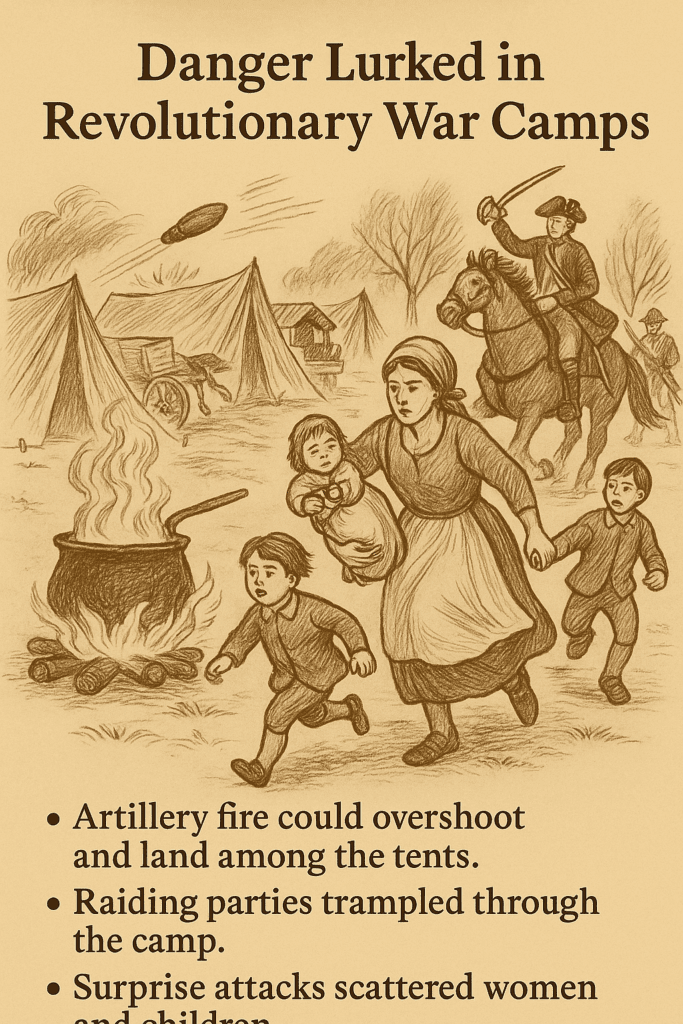
VIII: Danger — Capture, Death, and Chaos
Camp followers lived with every danger soldiers faced—sometimes more. Artillery overshot battle lines and exploded in tent rows. Cavalry charges crushed cooking fires and wagons. Surprise raids scattered baggage trains and left women and children fleeing through forests at night. Many followers were killed outright or succumbed to exposure, hunger, or disease shortly after.
Women were also vulnerable during retreats. In the confusion of a broken line or forced march, those unable to keep up were sometimes left behind, with grim consequences.
Captured women on the British side
When the British army captured American camp followers during the Revolutionary War—especially after battles such as Brandywine, Germantown, or the fall of Fort Washington in 1776—hundreds of women and children were taken prisoner. Some were confined in harsh conditions, including British prison ships or the Walnut Street jail in Philadelphia. Others were paroled, exchanged, or eventually released.
A small number ended up working for or remaining with the British army afterward, sometimes out of coercion, sometimes out of sheer necessity for survival. These cases, however, were exceptions—not representative of the broader experience of American camp followers.
Many incidents involving mistreatment, assault, or exploitation went unrecorded in official reports, leaving the suffering of countless women and children invisible to history.
IX. British vs. American Camp Followers
Both sides had camp followers, but their systems differed:
British Army
• Allowed a specific number of wives “on the strength.”
• Provided regular rations
• Assigned laundry and nursing duties as formal roles
• Maintained tighter control and record-keeping
Continental Army
• Followers were unofficial and irregular
• Rations inconsistent
• Numbers fluctuated wildly
• Lack of structure meant many suffered greater hardship
X. George Washington and Camp Followers: “We Cannot Do Without the Women.”
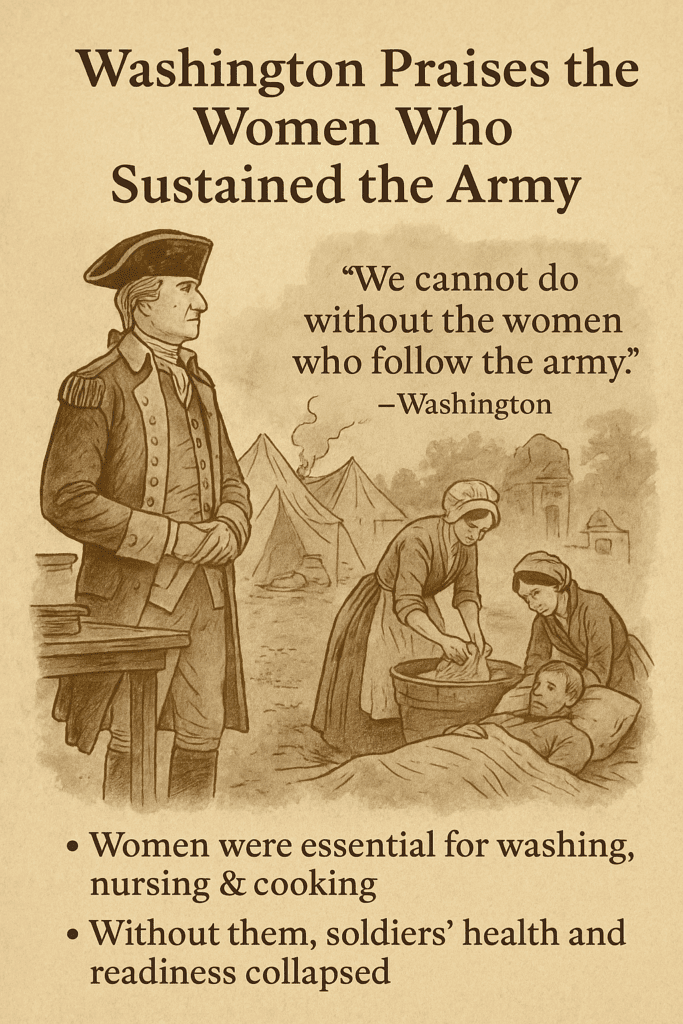
Washington struggled with the logistical burden followers created, yet he repeatedly acknowledged their essential contributions. His letters show irritation about numbers—but admiration for their necessity.
1777 (to the President of Congress):
“Without a sufficient number of women to wash for the Soldiers, the Soldiers must either be in a very dirty state, or the duty of washing must devolve on themselves… highly prejudicial to their health.”
Valley Forge, 1777–1778:
“The multitude of women… are absolutely necessary for washing… yet their usefulness makes it almost impossible to do without them.”
On nursing:
“The sick suffer extremely for want of women to nurse them… many must perish unless women are procured.”
To Gouverneur Morris, 1778:
“We cannot do without the women who follow the army… they are as necessary as the drums and fifes.”
Paraphrased in regulations:
“The women of the army are to be considered as part of it, and provided for accordingly.”
Washington’s words confirm what camp life already showed:
Women were essential to winning the war.
XI — Women Camp Followers of the Revolutionary War
Many women who followed the army will never be known by name. They tended wounded men under fire, and, in more than a few cases, were shot in the process. Their bravery was seldom recorded, and their sacrifices were rarely acknowledged in official reports.
Many women go unnamed as heroes for actually engaging in action—loading rifles, carrying powder to the front, and in some cases losing their lives.
We know of only a few standouts who essentially carry the water for the countless unknown women who risked their lives and, in many cases, lost them while supporting their husbands, the Continental Army, and the fragile new United States. These unnamed women are the silent backbone of the Revolution.
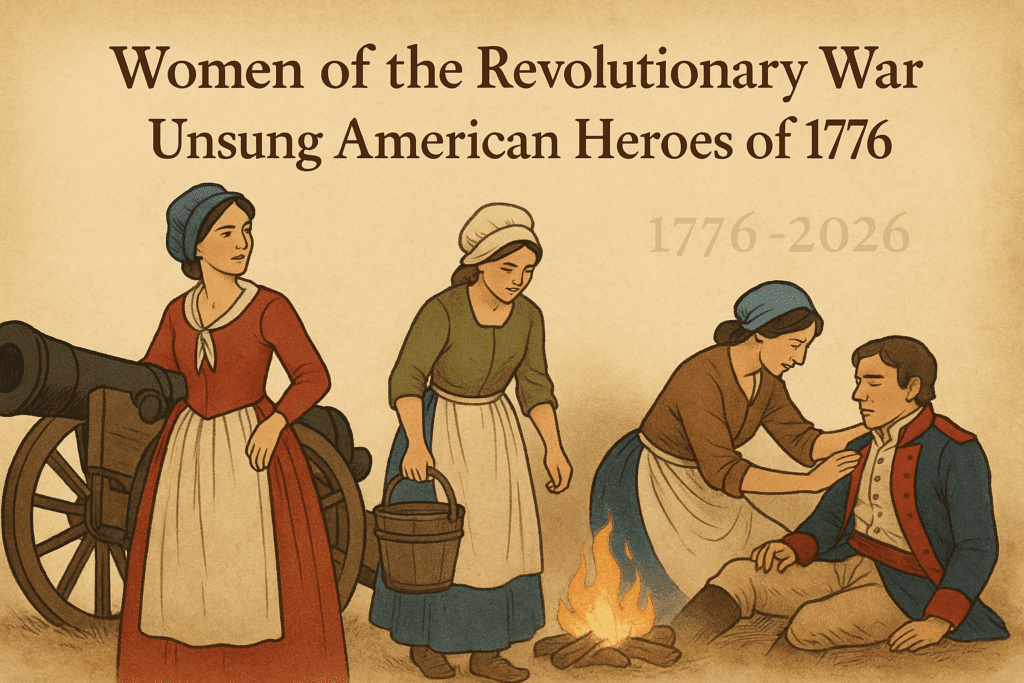
Among the few whose names survive are Margaret Corbin, Mary “Molly” Hayes, and Sarah Osborn—women who left behind documented accounts of courage at the guns, on the battlefield, and through years of unrelenting labor. Their stories shine a light on the thousands of anonymous women who did the same.
We have chosen to write about several of these women in greater detail in a separate article, which is a must-read for anyone interested in the real, human side of the Revolution:
Women of the Revolutionary War.
XII — Lessons for Today
The experiences of camp followers reveal the hidden labor that sustains every great effort. Their story highlights the resilience, unity, and sacrifice that powered the Revolution from behind the scenes. These families show us that survival often depends on cooperation and shared hardship far more than individual heroism.
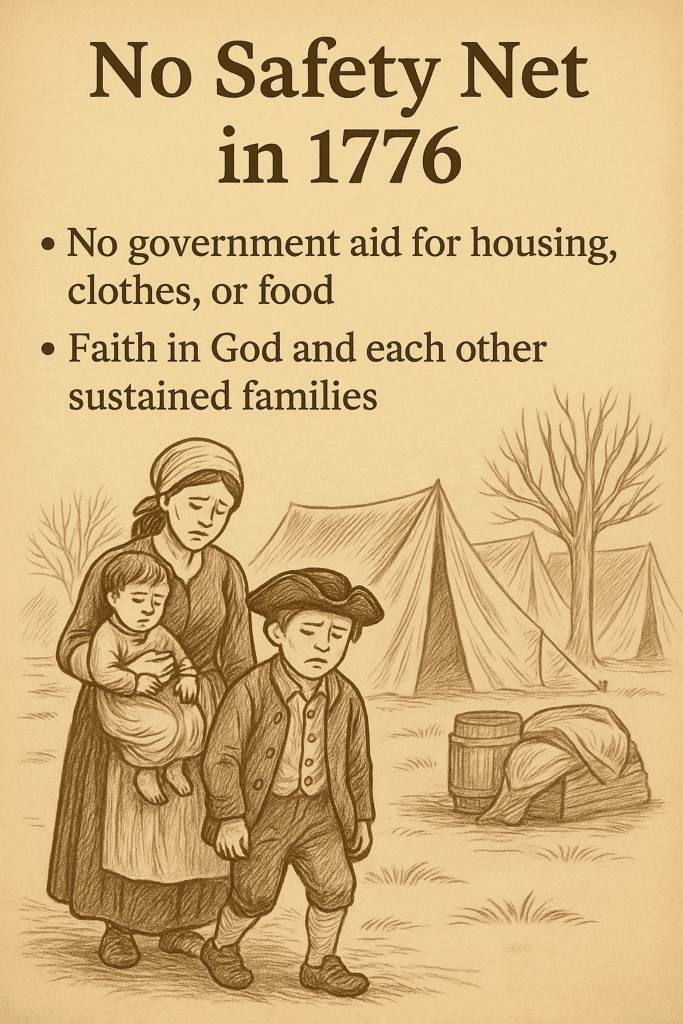
Families relied on each other for basic survival. They did what was necessary because there was no alternative. There was no social safety net—no government help for housing, food, clothing, medical care, or transportation. At times, there was little food, and sometimes none at all. Yet they continued fighting, marching, cooking, washing, and nursing.
People in 1776 placed their faith in each other, in their God, and in General Washington. Their perseverance under conditions that would break many of us today is a powerful reminder of the strength and endurance of earlier generations.
If you’re interested in drawing modern lessons from the Revolutionary era—especially about planning, resources, and family resilience—see:
What 1776 Teaches Retirees About Legacy Planning – retirecoast.com
Support the Daughters of the American Revolution to learn more about how our foremothers won the war: https://www.dar.org
Learn about the Military Women’s Memorial in Arlington, VA. Donate to the preservation of this important memorial: https://womensmemorial.org
Explore More in the America 250th Anniversary Series
Continue your journey through 1776 with our hub and featured articles.
Frequently Asked Questions
Dedication
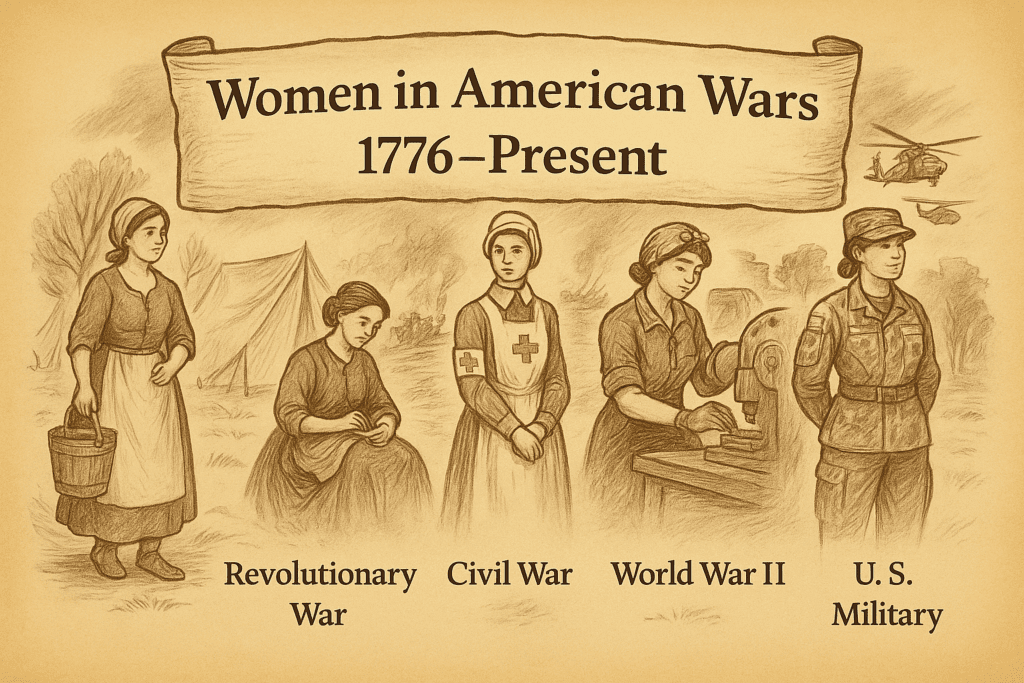
This article is dedicated to the countless women—named and unnamed—whose labor, courage, and sacrifices supported America’s struggle for independence and every conflict since. This includes my own mother, who worked in a factory producing tanks during World War II so American soldiers could fight overseas. Women like her, and the millions who came before and after, helped build and defend this nation in ways history has rarely acknowledged.
From the camp followers of 1776 to the workers, nurses, pilots, codebreakers, engineers, and modern servicewomen who continue to serve today—their contributions matter, and our country is stronger because of them.
These stories are preserved thanks to historians and institutions such as George Washington’s Mount Vernon and the National Women’s History Museum .
“To our mothers, sisters, aunts, grandmothers, and great-grandmothers—your strength helped write the story of the United States.”
[hessian_series_directory]
PODCAST



Discover more from RetireCoast.com
Subscribe to get the latest posts sent to your email.