Last updated on June 2nd, 2026 at 04:08 am
How the Mississippi Coast Became Part of the War for American Independence
When Americans picture the Revolutionary War, the story usually unfolds along the Atlantic seaboard—Lexington and Concord, Valley Forge, Saratoga, and Yorktown. The Mississippi Gulf Coast American Revolution story rarely enters the conversation.
This article is part of our ongoing series exploring the events, people, and places that shaped the founding of the United States as we approach the 250th anniversary of the signing of the Declaration of Independence on July 4, 2026.
Explore the USA 250th Anniversary Hub →- How the Mississippi Coast Became Part of the War for American Independence
- Before the Revolution: From French Louisiana to British West Florida
- A Light British Presence on the Mississippi Coast
- Gálvez Enters the Gulf Coast War
- The Mississippi Sound: A Hidden Military Highway
- Warships Offshore, Small Boats Inshore
- Natchez: Proof of Inland Reach
- Clearing the Coast: Biloxi and Pascagoula
- Weapons of the Gulf Campaign: Tools of War on the Mississippi Gulf Coast
- After the Battles: Spanish Control of the Mississippi Coast
- A Coastal Corridor That Made Larger Victories Possible
- Mississippi’s Place in the American Revolution
- Think you know the Mississippi Gulf Coast’s role in the American Revolution? Test your knowledge below.
- Looking Ahead to 2026: A Coast with More to Celebrate
- FAQ
Yet the Mississippi Gulf Coast was not isolated from the war. It was part of a broader conflict that stretched across continents, involved multiple empires, and depended as much on geography and logistics as on battlefield victories.
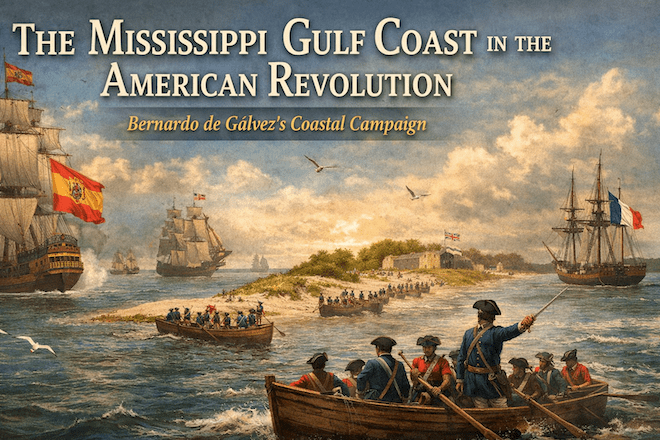
Under the leadership of Bernardo de Gálvez, Spanish forces swept through British West Florida, removing British control from key positions and securing the Gulf Coast. While no major battles were fought at Biloxi or Pascagoula, the Mississippi coast became part of the operational network that supported Spain’s campaign—and ultimately contributed to the defeat of British power in the region.
Before the Revolution: From French Louisiana to British West Florida
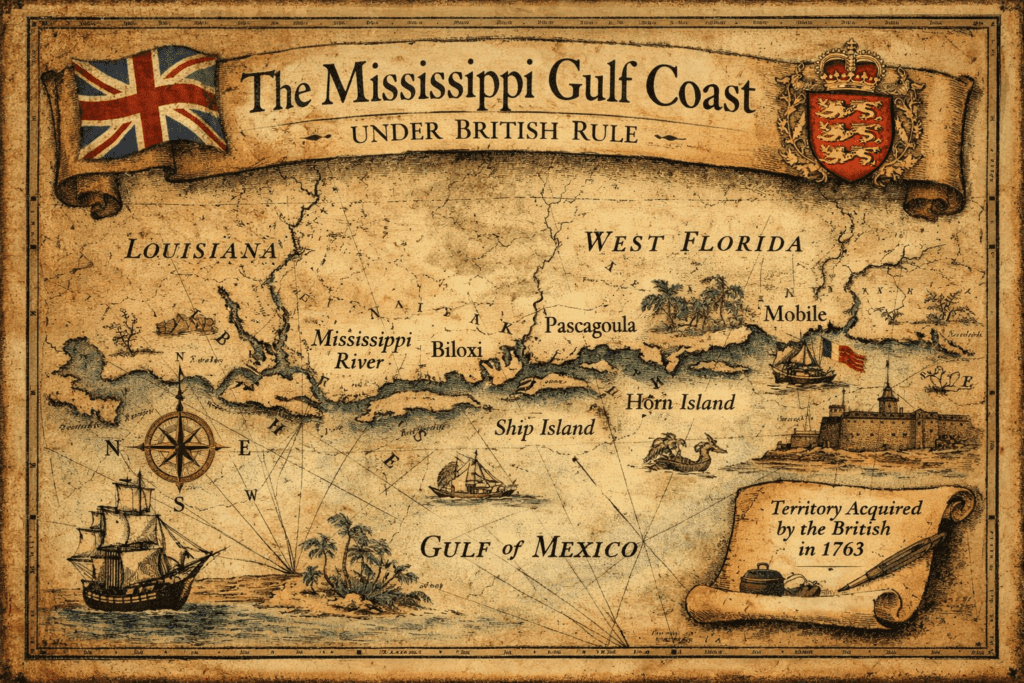
Before the war reached the Gulf Coast, the region had already undergone a major shift in control.
The Mississippi Gulf Coast began as part of French Louisiana. In 1699, Pierre Le Moyne d’Iberville established Fort Maurepas, marking the first sustained European presence in the area. For a time, Biloxi even served as the capital of the Louisiana colony before New Orleans was established.
That era ended after the Seven Years’ War, when the Treaty of Paris (1763) transferred all French lands east of the Mississippi River—including the Gulf Coast—to Great Britain.
The region became part of British West Florida. But British control along the Mississippi coast was thin, scattered, and lightly defended—conditions that would become critically important just over a decade later.
A Light British Presence on the Mississippi Coast
Unlike fortified British strongholds at Mobile and Pensacola, the Mississippi Gulf Coast was held by small, widely dispersed outposts.
At Biloxi and Pascagoula:
- Garrisons were often fewer than 10 to 20 men
- Many positions relied on local loyalists rather than regular troops
- The sites functioned as observation posts and minor administrative centers
For comparison:
- Mobile (Fort Charlotte): fewer than 300 troops
- Baton Rouge (Fort New Richmond): roughly 550 troops
By contrast, the Mississippi coast was weakly defended and strategically vulnerable.
Gálvez Enters the Gulf Coast War
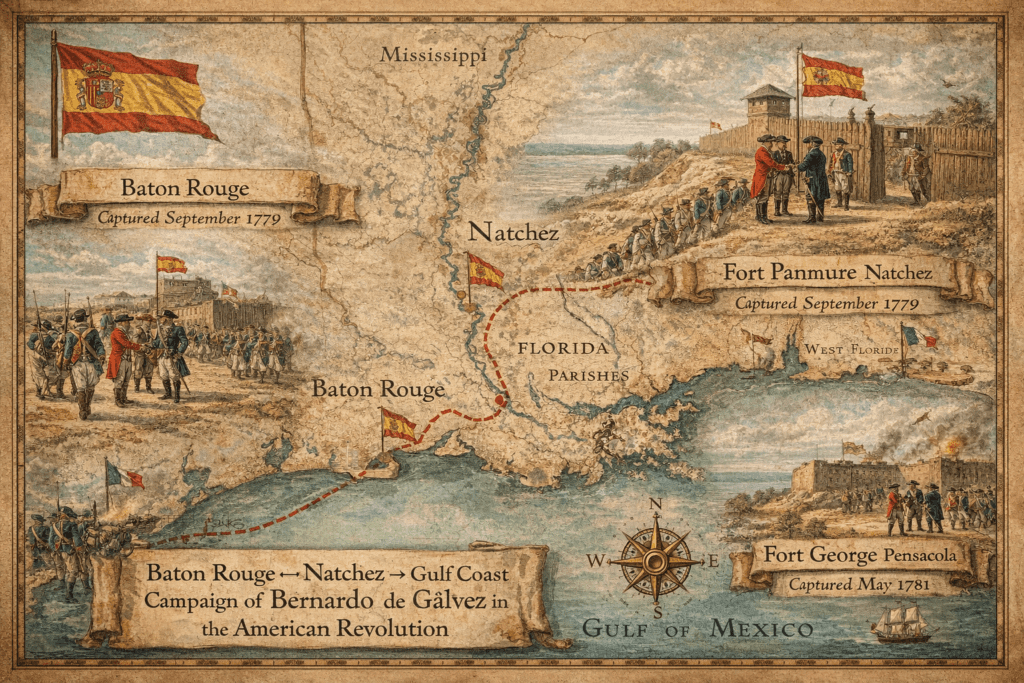
When Spain entered the war against Britain in 1779, Bernardo de Gálvez launched a coordinated campaign to eliminate British power in the Gulf region.
His victories were decisive:
- Baton Rouge (1779)
- Natchez (1779)
- Mobile (1780)
- Pensacola (1781)
As Spanish forces advanced, the lightly defended coastal outposts along the Mississippi Gulf Coast were quickly abandoned, occupied, or brought under Spanish control with minimal resistance.
While no large-scale battles took place at Biloxi or Pascagoula, their removal from British control formed part of a broader strategic sweep that secured the entire northern Gulf Coast.
The Mississippi Sound: A Hidden Military Highway
The true importance of the Mississippi Gulf Coast was not in major battles—but in movement.
The geography of the region created a natural corridor:
- Barrier islands such as Cat Island and Horn Island
- Shallow, protected waters of the Mississippi Sound
- Safe inland navigation routes shielded from open Gulf exposure
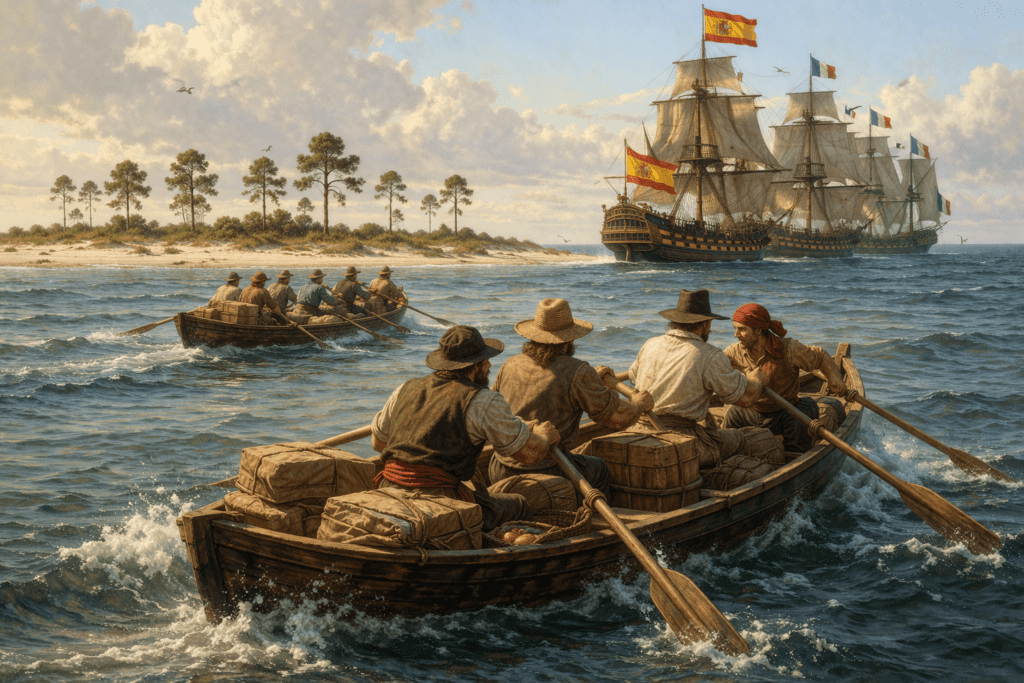
Large warships could not operate in these shallow waters. But smaller vessels could move freely behind the barrier islands, allowing Spanish forces to transport troops, supplies, and messages along the coast.
This made the Mississippi Sound a critical operational pathway connecting New Orleans to Mobile and Pensacola.
Warships Offshore, Small Boats Inshore
Gálvez’s campaign relied on a combination of naval power and coastal mobility.
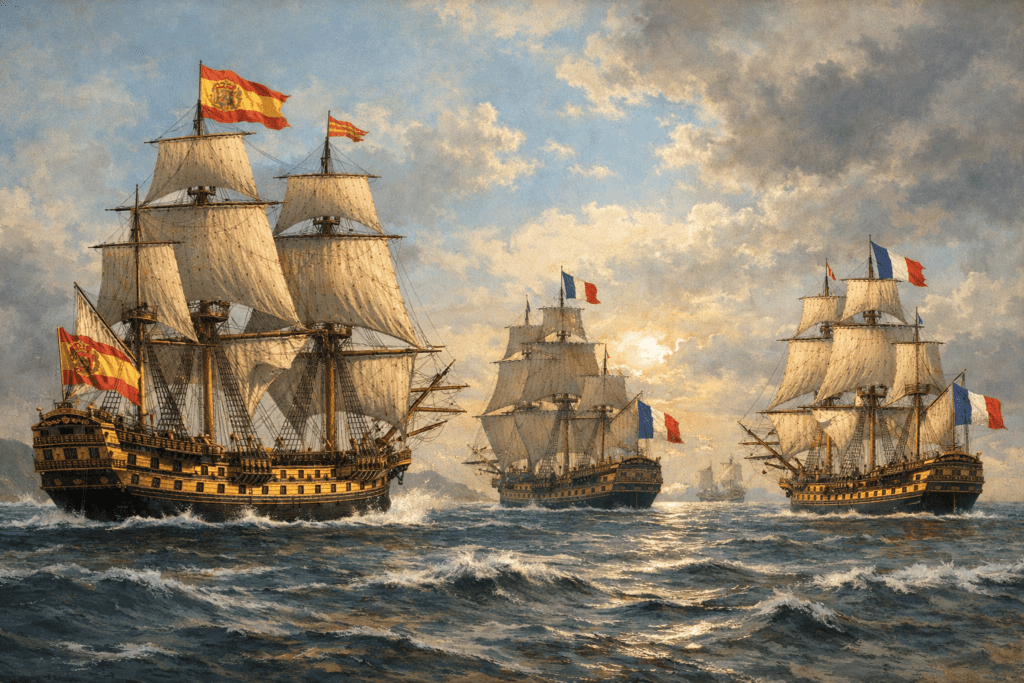
Offshore Power
Spain and its French allies deployed large warships, including:
- San Ramón (64 guns)
- San Luis (80 guns)
- French ships such as Palmier and L’Intrépide
These vessels dominated open water and supported major operations like the siege of Pensacola.
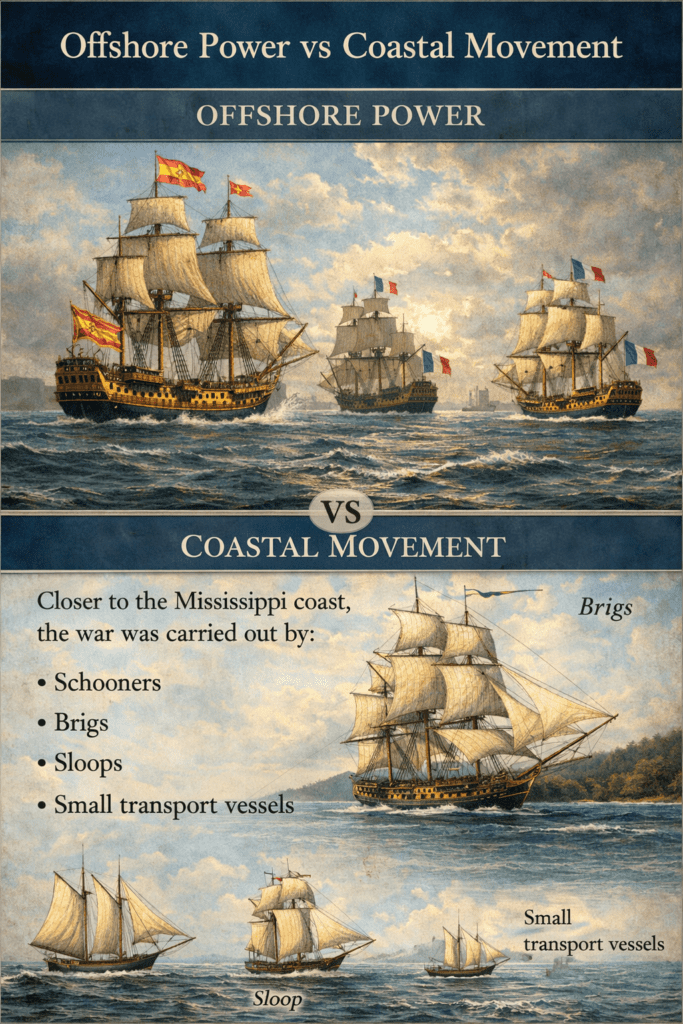
Inshore Movement
Closer to the Mississippi coast, the war was carried out by:
- Schooners
- Brigs
- Sloops
- Small transport vessels
These craft navigated:
- The Mississippi Sound
- Coastal inlets
- Barrier island channels
This is where the Mississippi Gulf Coast became essential—not as a battlefield, but as a transport and staging network.
Natchez: Proof of Inland Reach
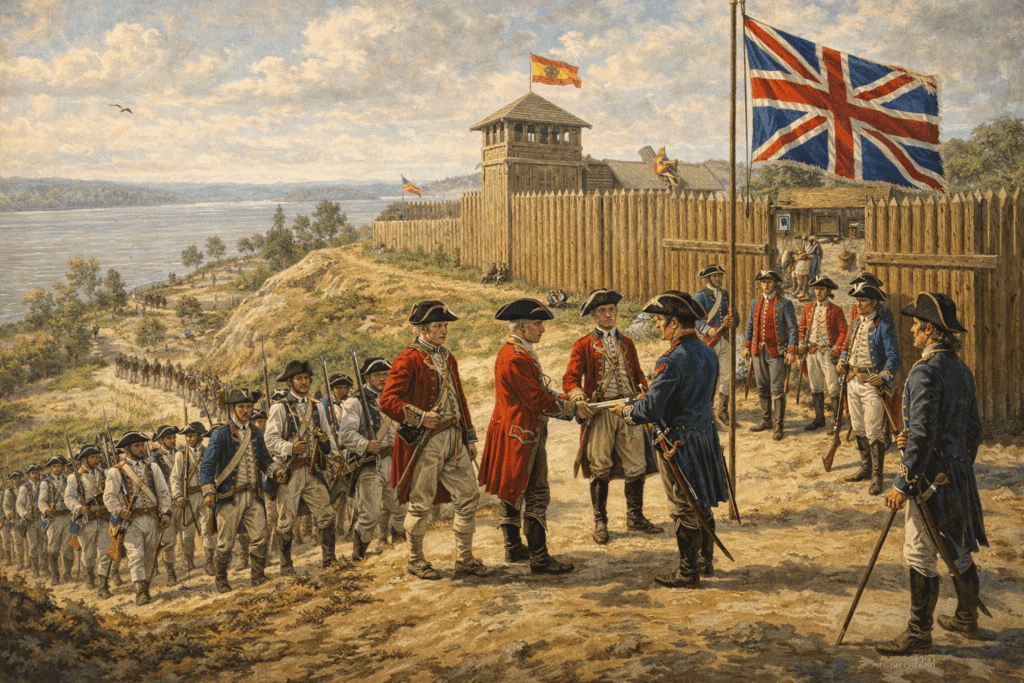
The capture of Fort Panmure demonstrated that Gálvez’s campaign extended beyond the coast into the Mississippi interior.
After forcing the British surrender, Spanish forces secured the area with a relatively small detachment while the main army continued its advance.
This “secure and move forward” strategy applied equally to the coastal regions.
Clearing the Coast: Biloxi and Pascagoula
The British presence along the Mississippi Gulf Coast did not collapse in a dramatic battle—but it disappeared quickly.
Spanish forces:
- Removed or displaced British outposts
- Secured coastal access points
- Established control over the Mississippi Sound
These actions ensured that:
- British forces could not reestablish coastal positions
- Spanish troops could move freely along the coast
- The Gulf Coast became a stable operational zone
While the Mississippi Gulf Coast is often described in terms of geography and strategy, the success of Bernardo de Gálvez’s campaign also depended on the people who lived there. In 1780, small communities of French and Creole settlers—fishermen, traders, and farmers—were scattered along the coast from Pass Christian to Biloxi and Pascagoula.
Though under British rule since 1763, these residents remained culturally and religiously distinct. As French-speaking Catholics, many viewed the arrival of Spanish forces as a return to familiar authority rather than a foreign occupation.
Local knowledge of the Mississippi Sound proved invaluable. Residents guided Spanish vessels through shallow waters and barrier island passes, provided small boats capable of navigating coastal bayous, and helped move troops and supplies where larger ships could not operate.
Coastal communities also supported the campaign with food, water, timber, and livestock, helping sustain Spanish forces as they advanced toward Mobile. Some residents went further, joining militia units and participating directly in the campaign.
Today, many Gulf Coast families trace their roots to these early settlers. The same waters and barrier islands that once supported a wartime campaign remain part of everyday life, creating a lasting connection between the region’s past and present.
Many families along the Mississippi Gulf Coast today can trace their roots back to the French colonial period and the era of Bernardo de Gálvez’s campaign. These were the people who knew the waterways, worked the coast, and supported life along the Gulf during a time of war.
- The Ladners and Morans: Early French and French-Canadian descendants known for their deep connection to coastal navigation and trade.
- The Fayards and Bosarges: Families rooted in Biloxi and Ocean Springs since the early 1700s who lived through multiple colonial transitions.
- The Krebs Family: Linked to the historic LaPointe-Krebs House in Pascagoula, with descendants still widely present across the Coast.
- The Gollotts (Grelots) and Seymours: Descendants of early French settlers tied to the maritime, timber, and seafood industries of the region.
Today, these names remain part of everyday life across Hancock, Harrison, and Jackson counties. The people who once helped sustain coastal communities during the Revolutionary era are the direct ancestors of today’s Gulf Coast residents, business owners, and families.
Weapons of the Gulf Campaign: Tools of War on the Mississippi Gulf Coast
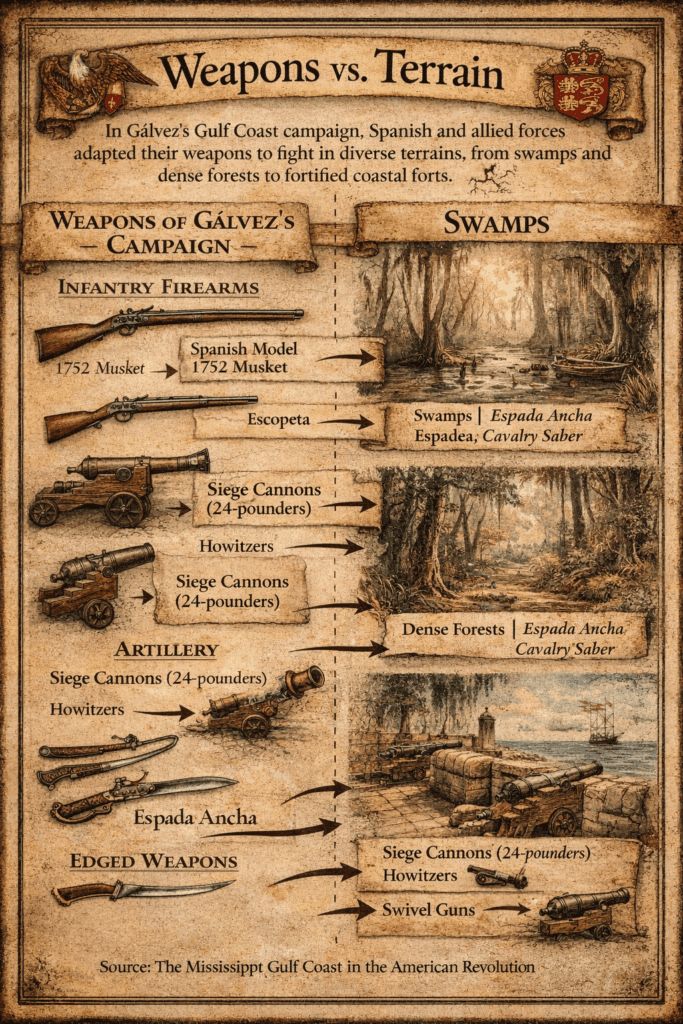
While strategy, geography, and local support played a decisive role in the Mississippi Gulf Coast American Revolution story, the outcome of Gálvez’s campaign also depended on the weapons carried by his diverse forces.
From smoothbore muskets to siege artillery and naval cannons, the Spanish and their allies relied on many of the same weapons used throughout the Revolutionary War. For a deeper look at the arms used during this era, see our detailed guide to weapons used in 1776, which explains how these firearms and artillery shaped battles across the colonies and beyond.
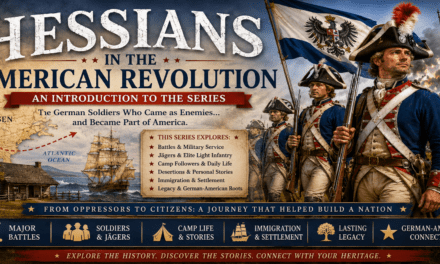
```htmlIf you enjoy learning about the people, battles, and events that shaped the United States, don't miss RetireCoast's comprehensive Hessians and the American Revolution Series. This special 10-chapter project contains more than 60,000 words of original content exploring the German soldiers hired by Great Britain during the Revolutionary War, their experiences in America, and their lasting influence on the development of the United States.
The series examines the military campaigns, daily camp life, family connections, immigration stories, and the remarkable legacy left behind by thousands of Hessian soldiers who ultimately became part of the American story.
Infantry Firearms
The backbone of Gálvez’s infantry, militias, and allied forces was the smoothbore musket, supported by shorter firearms for mounted troops and coastal operations.
- Spanish Model 1752 Musket: A .75 caliber smoothbore musket widely used by Spanish infantry. Many featured the durable Miquelet lock, designed for reliability in harsh frontier environments.
- Escopetas and Carbines: Shorter firearms carried by dragoons and mounted troops, allowing for quicker handling and easier use on horseback.
- Swivel Guns (Espingoles): Large-caliber wall guns mounted on naval vessels or temporary fortifications, often used to fire grapeshot during amphibious landings.
Artillery and Siege Weapons
Artillery proved decisive in the Gulf Coast campaign, particularly in the sieges of Baton Rouge and Pensacola.
- Siege Cannons: Heavy guns, including 24-pounders, were used to batter British fortifications. Spanish forces often advanced artillery under cover of darkness to gain closer firing positions.
- Howitzers and Mortars: These weapons fired explosive shells in high arcs over defensive walls. At Pensacola, a well-placed shell ignited the British powder magazine, devastating their defenses.
- Naval Guns: Gálvez’s fleet brought ship-mounted cannons ashore, converting them into land-based batteries to bombard British positions.
Edged Weapons
Close combat during assaults and fort breaches required traditional steel weapons.
- Bayonets: Fixed to muskets for charges and trench defense during sieges.
- Espada Ancha: A short, wide-bladed sword favored by Spanish frontier fighters, well-suited for dense Gulf Coast terrain.
- Cavalry Sabers: Used by officers and mounted troops for slashing attacks during engagements.
After the Battles: Spanish Control of the Mississippi Coast
Following the campaign, the Mississippi Gulf Coast became part of Spanish West Florida.
Rather than building large forts, Spain governed the region through:
- Small military detachments
- Local commandants
- Civil administration
Leaders such as Estevan Rodríguez Miró continued this system after Gálvez.
The result was a light but effective form of control, relying on local populations and minimal military presence.
In 1781, Bernardo de Gálvez personally granted Horn Island to Marie Catherine Vinconneau Baudrau of Pascagoula—an indication of how important the island was during the Spanish period.
Long before it became a destination for modern boaters, Horn Island held strategic value for European powers. The shallow waters between the island and the mainland created a protected corridor that allowed smaller vessels to move troops and supplies safely along the Mississippi coast.
Today, Horn Island is publicly owned and remains one of the most popular boating and recreational destinations on the Mississippi Gulf Coast—a place where history and geography still meet in plain sight.
A Coastal Corridor That Made Larger Victories Possible
The Mississippi Gulf Coast did not produce a defining battle like Yorktown—but it played a role in making victory possible.
By securing the coast and enabling movement:
- Spanish forces maintained supply lines
- Troops could be repositioned efficiently
- British control of the Gulf was systematically weakened
This logistical advantage contributed directly to the fall of Mobile and Pensacola—key turning points in the Gulf campaign.
Mississippi’s Place in the American Revolution
The Mississippi Gulf Coast was not the center of the Revolutionary War—but it was not outside of it either.
It was:
- Cleared of British control
- Integrated into Spanish operations
- Used as a strategic corridor
- Maintained as part of a functioning war network
In that sense, Mississippi was part of the war’s infrastructure—a region that helped make larger victories possible.
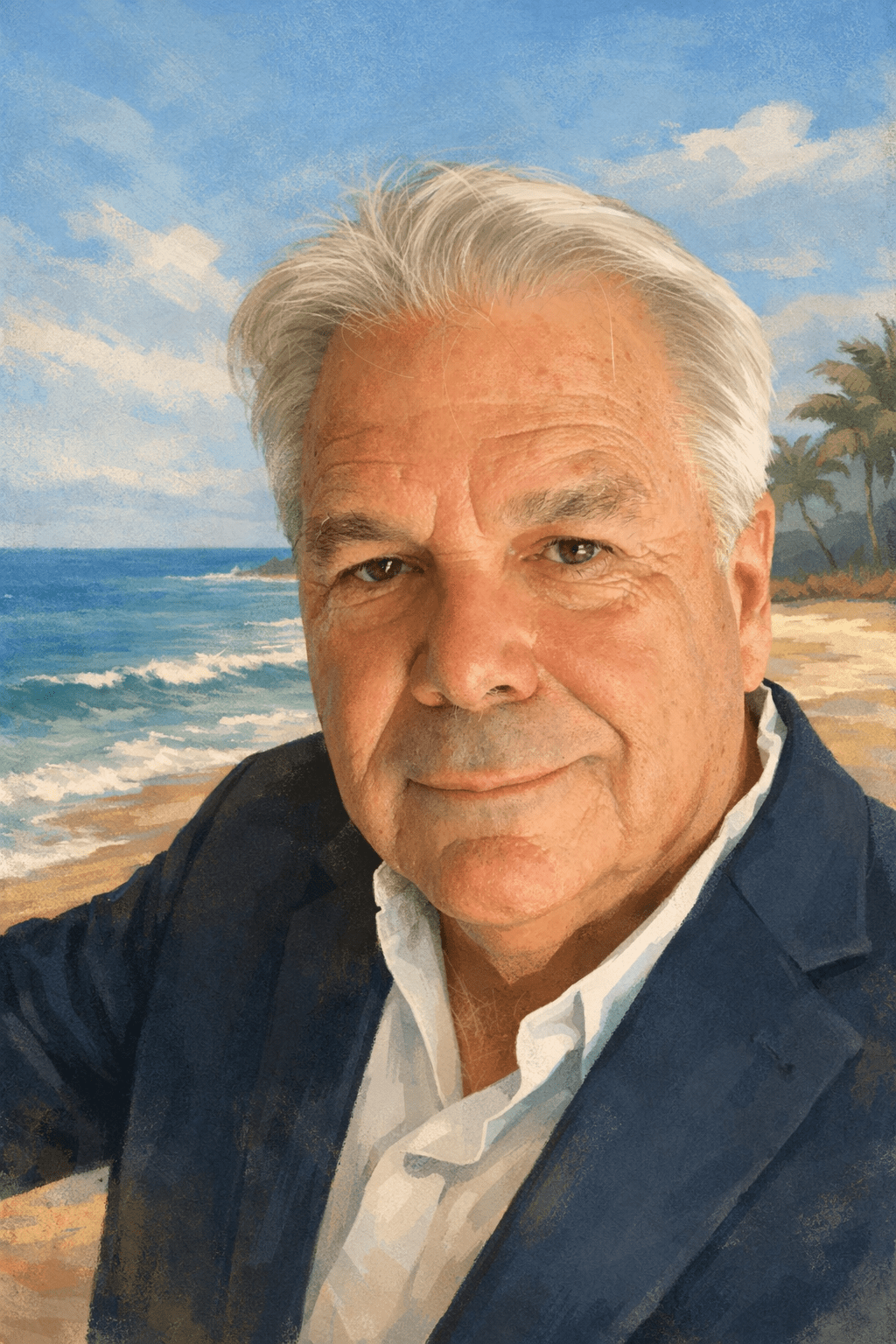
I live on the Mississippi Gulf Coast, and during my time here I have met individuals from families whose names trace back to the early settlers discussed in this article—families who may have quietly assisted Spanish forces as they moved along the coast and helped relieve pressure on George Washington’s army.
There are many more family names that could be included. In fact, one of my friends comes from a family that received a land grant from Bernardo de Gálvez for one of the barrier islands—a reminder that this history is not abstract, but directly tied to people who still live here today.
The Mississippi Gulf Coast is steeped in tradition in a way that many modern metro areas are not. Families here often have deep, multi-generational roots, and the connection between past and present is visible in everyday life—from the waterways to the communities that continue to thrive along the coast.
Think you know the Mississippi Gulf Coast’s role in the American Revolution? Test your knowledge below.
For readers who want to explore both the broader historical record and the deep local roots of the Mississippi Gulf Coast, these sources provide valuable context.
- National Park Service – Bernardo de Gálvez and the Gulf Coast Campaign
- Museum of the American Revolution – Spain’s Role in the American Revolution
- Smithsonian Magazine – Spain’s Secret Support for American Independence
- Ocean Springs Archives – Early Settlements and Families of the Mississippi Gulf Coast
- City of Ocean Springs – French Colonial Origins and Fort Maurepas History
Looking Ahead to 2026: A Coast with More to Celebrate
As the United States approaches the 250th anniversary of the Declaration of Independence, the story of the Gulf Coast deserves a broader audience.
From Biloxi to Pascagoula, from the Mississippi Sound to Horn Island, this region played a quiet but meaningful role in a global conflict that reshaped history.
The war for independence was not fought in one place. It unfolded across continents, coastlines, and communities—including the Mississippi Gulf Coast.
And for those who live here today, that history is closer than it might seem.
FAQ
Was the Mississippi Gulf Coast involved in the American Revolution?
Yes. While no major battles occurred in Biloxi or Pascagoula, Spanish forces under Bernardo de Gálvez removed British outposts and used the coast as a strategic corridor.
Did Bernardo de Gálvez fight in Mississippi?
Gálvez led campaigns that included Natchez and the Gulf Coast region. While he did not personally fight a major battle on the Mississippi coast, his forces secured the area.
Why was the Mississippi Sound important during the war?
The Mississippi Sound provided protected shallow waters that allowed Spanish forces to move troops and supplies safely along the Gulf Coast.
Were there British forts in Biloxi or Pascagoula?
No major forts existed. These areas were defended by small outposts with minimal troops, making them easy to capture.
What role did Horn Island play in the American Revolution?
Horn Island served as a strategic staging area due to the shallow waters between the island and the mainland, which allowed safe movement of small vessels.
Discover more from RetireCoast.com
Subscribe to get the latest posts sent to your email.

![The Best Places to Buy Property for Airbnb Rental [2023]](https://retirecoast.com/wp-content/uploads/2022/06/best-places-to-buy-property-1-1-440x264.png)