Running a small business today often means managing far more than customers, invoices, and day-to-day operations. A worker compliance system can help.
Business owners are now expected to navigate worker classification rules, tax compliance obligations, labor laws, documentation requirements, payment tracking, workplace safety concerns, and growing compliance risks that once seemed limited to large corporations with dedicated HR departments.
For many small businesses, these responsibilities can become overwhelming.
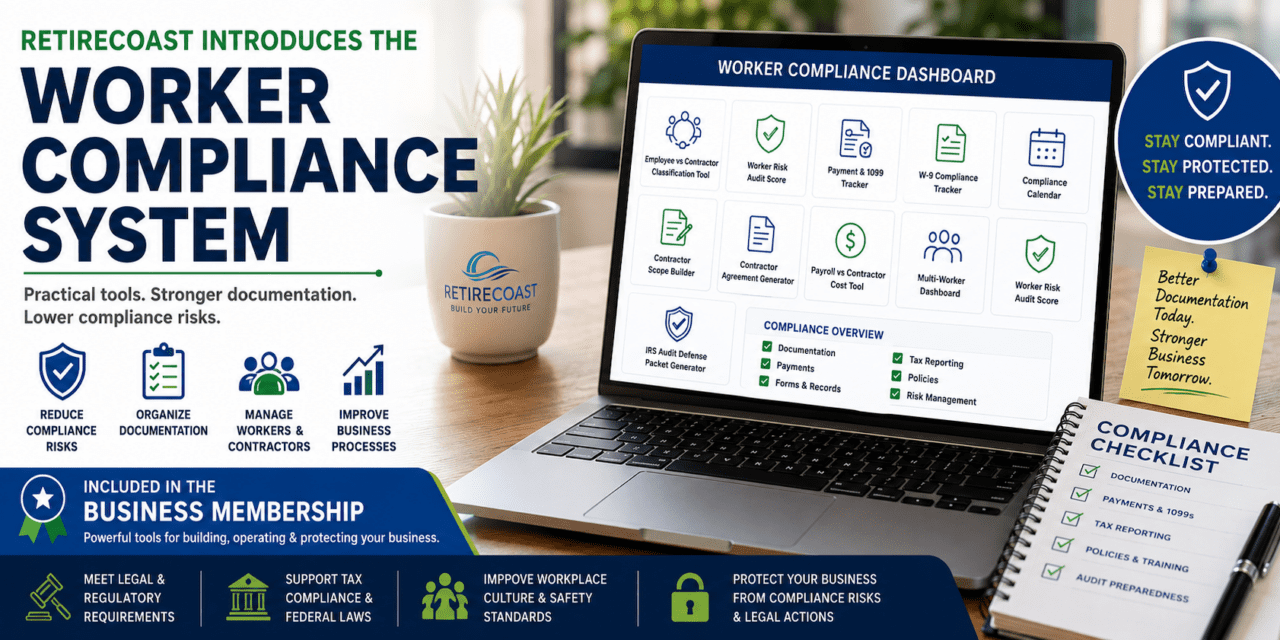
That is why RetireCoast has officially expanded the Business Builder Membership with a comprehensive Worker Compliance System designed specifically for practical, real-world business operations.
The RetireCoast Worker Compliance Dashboard was created to help small business owners improve documentation, organize compliance-related tasks, reduce operational confusion, and build better internal systems before problems arise.
Unlike many workforce compliance platforms designed for enterprise HR departments and large corporations, the RetireCoast system was built for:
- small businesses
- LLC owners
- independent operators
- retirees starting businesses
- contractors hiring subcontractors
- real estate investors
- property managers
- family-owned businesses
- growing service companies
This is not a complicated enterprise HR compliance platform.
It is a practical worker compliance system focused on helping business owners create stronger business processes using tools that are understandable, affordable, and useful in real-world situations.
Why Worker Compliance Matters More Than Ever
Many business owners incorrectly assume that workforce compliance only applies to large companies with human resources teams and corporate compliance officers.
In reality, small businesses often face some of the greatest compliance risks because they frequently operate with informal procedures, verbal agreements, incomplete documentation, and inconsistent payment tracking systems.
Questions involving:
- employee compliance
- worker classification
- contractor relationships
- payroll vs contractor decisions
- tax compliance
- labor laws
- workplace safety
- compliance audits
- federal regulations
- internal policies
- regulatory requirements
can quickly become serious operational problems if records are incomplete or expectations are unclear.
Government agencies increasingly evaluate worker relationships using multiple factors involving behavioral control, financial control, payment structures, operational integration, and documentation practices.
Even businesses acting in good faith may later discover they lack the records necessary to support their compliance efforts.
The RetireCoast Worker Compliance System was developed to help address those concerns proactively.
The IRS and Department of Labor both evaluate worker relationships using multiple factors. https://www.irs.gov/newsroom/understanding-employee-vs-contractor-designation and https://www.irs.gov/forms-pubs/about-form-w-9
A Practical Compliance Management System for Small Businesses
Most workforce compliance systems focus heavily on large enterprise operations, complex HR software integrations, global teams, and corporate compliance departments.
RetireCoast took a different approach.
The Worker Compliance Dashboard was built around the needs of practical small business operators who need better organization, stronger documentation, and clearer operational systems without unnecessary complexity.
The platform focuses on:
- operational efficiency
- compliance management
- workforce documentation
- compliance processes
- tax organization
- contractor management
- internal controls
- compliance-related tasks
- audit preparation
- risk reduction
The goal is not to create fear.
The goal is to help business owners create a stronger culture of compliance through better documentation, better workflows, and better communication.
Tools Included in the Worker Compliance Dashboard
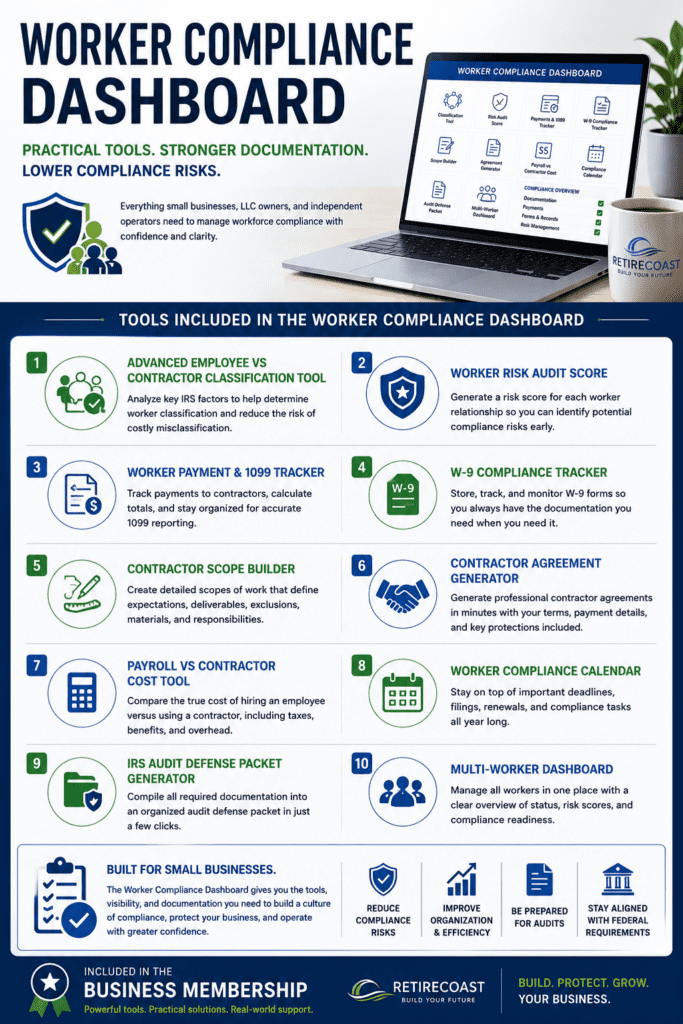
The Worker Compliance Dashboard now includes a growing suite of tools inside the Business Membership.
Current tools include:
- Advanced Employee vs Contractor Classification Tool
- Worker Risk Audit Score
- Worker Payment & 1099 Tracker
- W-9 Compliance Tracker
- Contractor Scope Builder
- Contractor Agreement Generator
- Payroll vs Contractor Cost Tool
- Worker Compliance Calendar
- IRS Audit Defense Packet Generator
- Multi-Worker Dashboard
Together, these tools help business owners organize compliance tasks involving:
- contractor documentation
- workforce compliance
- tax compliance
- payment tracking
- worker classification analysis
- compliance audits
- policy organization
- compliance training preparation
- audit defense preparation
- internal compliance procedures
The system is designed to improve visibility into business processes while reducing manual work and documentation gaps that often create potential compliance risks later.

During the process of creating the Worker Compliance tools for RetireCoast, a real-life situation arose involving a family member who hired a contractor to replace the front lawn of his home. The project involved removing the existing grass and installing new sod.
As the project neared completion, the contractor requested final payment. My family member pointed out that several sections of old grass had not been removed and portions of the work appeared incomplete. A disagreement then arose regarding whether certain sections were actually included within the agreed scope of work.
The challenge was that the contractor had previously measured the entire area and prepared a written pricing document that appeared to include the disputed sections. Unfortunately, the exact expectations, exclusions, cleanup responsibilities, and completion standards were never fully documented in a detailed written scope of work.
Eventually, the disagreement escalated into a legal dispute — a situation that may have been avoided with clearer documentation before the work ever began.
If the Contractor Scope Builder inside the RetireCoast Worker Compliance Dashboard had existed before this project began, the chances of a dispute likely would have been reduced significantly. The tool was specifically designed to help both parties define expectations in advance, including the exact work area, exclusions, materials, payment terms, contractor status, and change-order procedures.
This experience reinforced something important while building the Worker Compliance System: many contractor disputes begin not with fraud or bad intentions, but with assumptions, incomplete documentation, and verbal agreements remembered differently by each party.
More Than a Single Tool
RetireCoast did not want to build a single calculator or isolated HR compliance worksheet.
The goal was to create a growing operational system inside the Business Membership that helps business owners improve organization, documentation, and compliance processes across multiple areas of their business.
The Worker Compliance Dashboard is now becoming one of the core sections of the Business Membership, alongside:
- business formation tools
- operational planning tools
- short-term rental business systems
- financial organization resources
- asset protection education
- business management resources
Additional worker compliance tools and workflow systems are expected to be added over time.
Learn More About the Worker Compliance System
RetireCoast has also published supporting educational articles discussing worker compliance, contractor management, and employee vs contractor classification issues.
Start here:
These articles help explain why workforce compliance has become increasingly important for small businesses operating in today’s regulatory environment.
Many small businesses operate using verbal agreements, incomplete records, scattered payment tracking, and inconsistent contractor documentation. This short self-assessment may help you identify areas where your business could improve organization and reduce potential compliance risks.
Access the Worker Compliance Dashboard
The complete Worker Compliance Dashboard is included with the RetireCoast Business Builder Membership.
Business members receive access to:
- worker compliance systems
- business operations tools
- compliance organization resources
- business documentation systems
- calculators and workflow tools
- Ongoing educational content
For many businesses today, compliance is no longer something handled only by large HR departments.
It has become part of everyday business operations.
The RetireCoast Worker Compliance System was built to help make that process more organized, more understandable, and more practical for real-world business owners.
What is a worker compliance system?
A worker compliance system helps businesses organize workforce documentation, contractor records, payment tracking, tax reporting, worker classification analysis, and compliance-related business processes. The goal is to reduce compliance risks while improving organization and operational efficiency.
Why is worker classification important?
Worker classification affects payroll taxes, labor law obligations, contractor documentation requirements, benefits eligibility, and federal compliance responsibilities. Misclassification can create significant financial and legal risks for businesses.
What is the difference between an employee and an independent contractor?
Employees are typically subject to greater behavioral and financial control by the business, while independent contractors generally maintain greater independence regarding how work is performed. Government agencies often evaluate multiple factors when analyzing worker relationships.
Why should businesses use written contractor agreements?
Written contractor agreements help clarify project expectations, payment terms, responsibilities, scope of work, and documentation requirements. Clear agreements may help reduce misunderstandings and disputes later.
What documents should businesses keep for contractors?
Businesses often maintain records involving W-9 forms, payment records, contractor agreements, invoices, scope of work documents, insurance information, and project communications as part of their compliance processes.
What is a W-9 compliance tracker?
A W-9 compliance tracker helps businesses organize contractor tax documentation and monitor whether required forms have been collected before issuing payments or preparing 1099 reporting.
Where can I learn more about employee vs contractor rules?
RetireCoast provides a free educational guide discussing workforce compliance, contractor relationships, and worker classification issues:
The RetireCoast Worker Compliance Dashboard was designed to help small businesses, LLC owners, contractors, real estate investors, and independent operators organize workforce documentation, reduce compliance risks, and improve operational efficiency using practical real-world tools.
Inside the Business Membership, members gain access to tools for worker classification analysis, contractor agreements, W-9 tracking, payroll vs contractor cost comparisons, compliance calendars, audit preparation, payment tracking, and contractor scope documentation workflows.
RetireCoast also publishes free educational articles covering worker compliance, contractor management, workforce documentation, and employee vs contractor classification issues. One of the most popular resources is our guide:
Employees vs Contractors Guide
The Worker Compliance Dashboard is part of the RetireCoast Business Membership. The Estate Planning Membership is designed to help business owners and retirees explore strategies involving trusts, business succession, asset protection education, and long-term organizational planning.
Discover more from RetireCoast.com
Subscribe to get the latest posts sent to your email.