Introduction
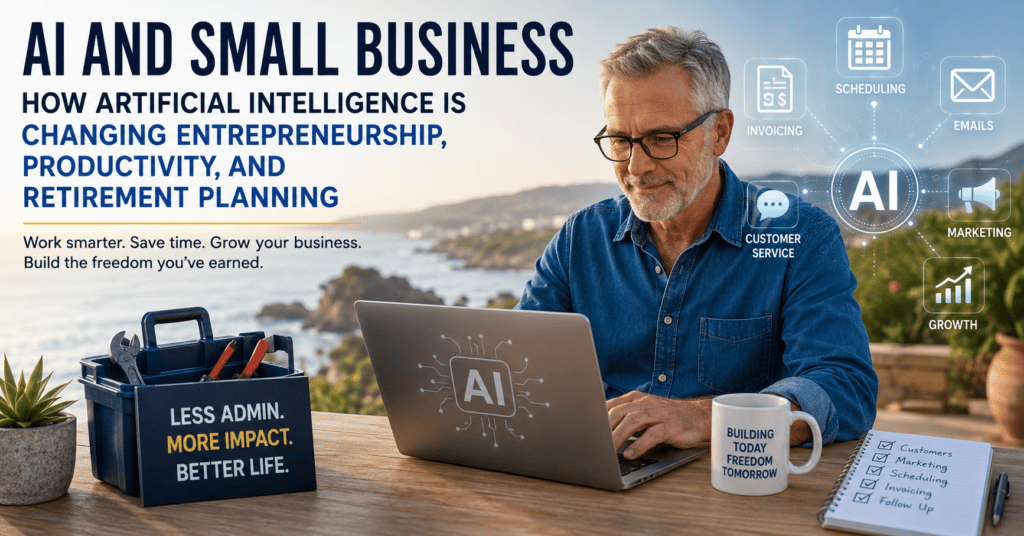
AI and Small Business is rapidly becoming one of the most important topics in entrepreneurship, productivity, and retirement planning.
Business owners are discovering that artificial intelligence is often less about replacing employees and more about eliminating repetitive tasks, reducing administrative burdens, and creating new opportunities for growth.
Much of the public discussion surrounding AI focuses on large corporations, massive technology companies, and concerns about job displacement. The real question for most small business owners is far more practical: How can AI help me run my business more efficiently and serve my customers better?
For many entrepreneurs, the answer is already becoming clear. AI-powered tools are helping business owners create marketing content, improve customer service, automate routine tasks, streamline business operations, and make better decisions using data-driven insights.
- Introduction
- What Is Artificial Intelligence and Why Does It Matter to Small Businesses?
- The Real Question: Is AI Replacing Employees or Administrative Work?
- How Small Business Owners Are Using AI Today
- AI Is Becoming a Business Tool, Not Just a Technology Tool
- Customer Service and Customer Support
- Marketing and Content Creation
- Administrative Tasks and Data Entry
- Customer Relationship Management
- Financial Planning and Business Analysis
- AI Can Help Owners See What They May Be Missing
- AI Does Not Have to Run the Entire Business
- Start With the Tasks You Dislike Doing
- The Next Step: Applying AI to Real Businesses
- AI for Trades and Service Businesses: An Opportunity Hiding in Plain Sight
- What People Often Ask About AI and Small Business
- 1. Can artificial intelligence really help a small business make more money?
- 2. Do I need to be a computer expert to use AI?
- 3. Which types of small businesses benefit the most from AI?
- 4. Is artificial intelligence going to replace small business owners?
- 5. Is now a good time for a small business to begin using AI?
- AI-Powered Marketing Tools Can Help Local Companies Compete
- Customer Records Can Become More Valuable
- AI May Help Reduce Operational Costs
- Why these businesses rank so highly
- Key Takeaway
- The Smallest Firms May Have the Most to Gain
- AI Creates Opportunities Beyond Using the Technology
- The Human Element Becomes More Important, Not Less
- From Theory to Two Real Businesses
- How AI Can Help a Landscaping Company
- Consider a Typical Small Landscaping Business
- AI Can Help Capture New Customers
- AI Can Help Prepare Estimates
- Scheduling Can Become Smarter
- Weather Creates Another Opportunity
- Customer Service Can Become More Consistent
- AI Can Help Build Better Customer Relationships
- Marketing Becomes Easier
- AI Can Help Manage Equipment
- Inventory and Supply Management
- Financial Analysis Can Reveal Which Work Is Actually Profitable
- AI Could Help the Owner Reclaim Evenings
- Bill Anderson’s Perspective: Don’t Start With AI
- What Could an AI Consultant Do for This Business?
- We Are Going to Build an Example
- How AI Can Help an HVAC Company
- Start With the Customer’s First Call
- AI Can Help Prioritize Service Calls
- Smarter Scheduling and Dispatching
- AI Can Help the Technician Before Arrival
- AI Can Assist With Technical Information
- Documentation Can Become Faster
- AI Can Help Explain Repairs to Customers
- Maintenance Agreements Create a Major AI Opportunity
- Customer Relationship Management Can Become More Intelligent
- Predictive Analytics Could Help Identify Replacement Opportunities
- Inventory Management Is Another Opportunity
- AI Can Help With Supply Chain Management
- Marketing Can Become More Timely
- AI Can Help Create Educational Content
- Financial Analysis Can Identify Profitable Services
- AI Could Reduce After-Hours Administrative Work
- Bill Anderson’s Perspective: Look Beyond the Technician
- What Could an AI Consultant Do for an HVAC Company?
- We Will Build an HVAC Tool Too
- The Bigger Lesson
- This Is Only the Beginning
- I Didn’t Mean to Write a Book!
- References
- FAQ
Part of our series on Artificial Intelligence
This article serves as the cornerstone content for RetireCoast’s Artificial Intelligence and Small Business Series. It is designed to provide a comprehensive overview of how AI technologies are changing the way businesses operate today and how they may influence entrepreneurship in the years ahead.
As the series grows, additional articles will explore specific industries, business functions, and use cases in greater depth. Readers will find contributions from guest writers, business owners, industry professionals, and subject matter experts with real-world experience applying AI solutions in their respective fields.
One of the goals of this series is to separate hype from reality. While the rise of AI has created excitement across the business world, successful implementation requires understanding both the benefits of AI and its limitations.
Customer support tools
The series will also showcase practical examples of AI applications that small businesses can use today. These examples will include AI agents, content creation systems, customer support tools, marketing campaigns, predictive analytics platforms, and business planning resources.
Many small business owners assume artificial intelligence is only relevant to technology companies. In reality, landscapers, contractors, property managers, vacation rental operators, consultants, retailers, and retirees starting new businesses may have just as much to gain from AI adoption as larger companies.
As a serial entrepreneur who has built businesses before the internet, through the rise of websites and social media, and now during the AI revolution, I have witnessed how technological advancement can reshape entire industries.
The businesses that learn to adapt often gain significant advantages, while those that ignore new technologies frequently struggle to keep pace.
AI is creating a more level playing field for small business
Throughout this article, we will examine how artificial intelligence tools are creating a more level playing field for smaller companies and smaller teams. We will also explore how AI systems are helping entrepreneurs focus less on paperwork and more on serving customers, solving problems, and growing their businesses.
Most importantly, we will examine why AI may be one of the most powerful tools ever made available to small business owners. For many entrepreneurs, artificial intelligence is not replacing people—it is replacing administrative friction.

What Is Artificial Intelligence and Why Does It Matter to Small Businesses?
Artificial intelligence is one of the most significant technological advancements to impact the business world since the introduction of the internet. While many people associate AI with robots or science fiction, most business applications are far more practical and accessible.
At its core, artificial intelligence refers to computer systems that can perform tasks traditionally requiring human intelligence. These tasks may include problem solving, content creation, data analysis, customer support, pattern recognition, and decision-making assistance.
Understanding the Different Types of AI
Most small business owners interact with artificial intelligence without realizing it. Search engines, navigation apps, fraud detection systems, recommendation engines, and customer service chatbots have used AI technologies for years.
The recent surge in interest comes from the development of generative AI and large language models. These AI systems can create written content, answer questions, generate ideas, summarize information, and assist with many business functions.
Generative AI
Generative AI creates new content based on prompts provided by users. It can produce blog posts, social media posts, marketing content, customer emails, business plans, and countless other forms of communication.
For small business owners, this capability can dramatically reduce the time required for content creation. Tasks that once took hours may now take minutes.
Machine Learning
Machine learning is a branch of artificial intelligence that identifies patterns within large amounts of data. These systems improve over time as they process more information.
Many AI-powered tools rely on machine learning to provide data-driven insights, forecast trends, and support better decision-making.
AI Agents
AI agents represent one of the newest developments in artificial intelligence. These systems can perform multiple actions, interact with software, gather information, and complete tasks with limited human supervision.
Many experts believe AI agents will become a standard business tool in the coming years. Small businesses may eventually use AI agents to handle scheduling, customer support, marketing campaigns, and administrative work.
A Family Story About Technology and Opportunity
Long before artificial intelligence entered the business world, I learned an important lesson about technology from my own son.
Years before the IBM PC became a household name, I purchased one of the early personal computers for him. Like many curious young people fascinated by technology, he immediately took it apart to understand how it worked and then rebuilt it.
What began as curiosity quickly turned into expertise.
When he was only 15 years old, he began helping our company implement technology that many businesses had not yet embraced. While attending school and working part-time, he helped us install our first computer network, select hardware, implement software, and create many of the systems that modernized our operations.
The results were remarkable. Our sales and marketing teams gained capabilities that many competing companies simply did not have. We were able to communicate faster, share information more effectively, and develop marketing programs that stood out in our industry.
Over the next several years, our company benefited from his growing knowledge and enthusiasm for technology. Watching him learn, experiment, and innovate reinforced something I had already begun to understand: businesses that embrace new technology often gain advantages long before their competitors recognize the opportunity.
When he was 21, I encouraged him to move beyond our company and gain broader experience. He did exactly that. Through hard work, continuous learning, and a passion for technology, he advanced through several organizations and today serves as a Director of Technology.
Ironically, many years later, he became the person who first introduced me to artificial intelligence.
Since then, we have spent countless hours discussing AI, testing new tools, exploring use cases, and sharing ideas about how this technology can help businesses operate more efficiently. Our conversations continue today.
Having witnessed the rise of personal computers, networking, the internet, mobile technology, cloud computing, and now artificial intelligence, I have learned that innovation rarely arrives all at once. It begins with people willing to explore what is possible.
That is why I believe AI represents an opportunity rather than a threat for many entrepreneurs. Just as previous generations of technology helped businesses become more productive, AI has the potential to help small business owners spend less time on administration and more time serving customers, building relationships, and growing their companies.
Why AI Matters More to Small Businesses Than Large Corporations
Large corporations often have departments dedicated to marketing, customer service, accounting, human resources, and information technology. Small businesses rarely have that luxury.
Many small business owners perform all of these responsibilities themselves. They are the salesperson, accountant, marketer, customer service representative, and operations manager all at the same time.
This is where AI and small business become closely connected.
Artificial intelligence allows smaller teams to access capabilities that were once available only to larger companies. AI-powered tools help level the playing field by giving entrepreneurs access to resources that would otherwise require additional employees or expensive consultants.
The Real Value of AI
Many media stories focus on whether AI will replace jobs. For most small firms, that is not the real question.
The real question is whether AI can eliminate repetitive tasks that prevent business owners from focusing on customers and revenue-producing activities.
Consider how much time is spent every week on:
- Responding to emails
- Creating estimates
- Scheduling appointments
- Posting on social media
- Managing customer records
- Drafting marketing campaigns
- Producing reports
- Organizing documents
Most of these activities are necessary. Few directly generate revenue.
AI solutions can often reduce the amount of time spent on these routine tasks. That allows business owners to focus on serving customers, developing new products, improving customer experiences, and growing their businesses.
A Technology Shift Similar to the Internet
When the internet first appeared, many business owners dismissed it as unnecessary. Some believed it was a fad that would never impact their industry.
Today it is difficult to imagine operating a business without websites, email, online marketing, or digital communication.
The rise of AI may follow a similar path.
Business owners who learn how to use artificial intelligence tools effectively may gain a significant competitive advantage. Those who ignore the technology entirely may find themselves operating at a disadvantage compared to competitors who embrace it.
Key Takeaway
Artificial intelligence is not just for technology companies and large corporations. AI and small business are becoming increasingly connected because AI helps entrepreneurs reduce administrative friction, improve productivity, and operate more efficiently.
The businesses that understand how to leverage AI capabilities may discover that the greatest benefit is not replacing employees. It is helping people accomplish more with the resources they already have. Millennials starting businesses can benefit.
The Real Question: Is AI Replacing Employees or Administrative Work?
One of the biggest concerns surrounding artificial intelligence is whether it will replace workers. News headlines often focus on job losses, automation, and the impact of AI on the workforce.
For most small businesses, however, that is not the real question.
The real question is whether AI can eliminate the repetitive tasks and administrative tasks that consume valuable time without generating revenue.
Small Business Owners Wear Too Many Hats
Large corporations often have dedicated departments for customer service, human resources, marketing, accounting, information technology, and customer relationship management.
Small business owners rarely have that luxury.
In many small firms, the owner is also the salesperson, marketer, bookkeeper, customer support representative, scheduler, and operations manager.
This creates a common challenge.
Business owners spend enormous amounts of time working on their business rather than growing their business.
The Hidden Cost of Administrative Work
Many administrative tasks are necessary.
Few generate revenue.
Examples include:
- Responding to emails
- Scheduling appointments
- Creating invoices
- Posting social media posts
- Updating websites
- Managing customer records
- Performing data entry
- Creating reports
- Tracking expenses
These time-consuming tasks can easily consume hours every week.
For small teams and smallest firms, those lost hours can represent significant opportunity costs.
We cannot discuss artificial intelligence without also discussing how it works. The answers, images, calculations, and business tools people expect from AI depend on enormous data centers filled with advanced computer systems, networking equipment, cooling technology, and supporting infrastructure.
Fortunately, many investors and technology companies are prepared to build more data centers. However, a cloud of uncertainty often surrounds proposed projects because of incomplete information, speculation, political arguments, and understandable concerns about electricity, water, land use, taxes, noise, and local infrastructure.
In our next article, RetireCoast will try to clear the air. We will examine the potential benefits and disadvantages of data center development, present non-biased facts, and provide sources so readers can form their own informed opinions.
Rather than immediately saying at the dinner table, “Not in my backyard,” you may find yourself saying, “I need more facts before I decide what my position is.” That is exactly where thoughtful public discussion should begin.
Why AI and Small Business Are a Natural Fit
AI and small business work well together because AI-powered tools excel at handling routine and repetitive tasks.
Artificial intelligence can help draft customer responses, organize information, create marketing content, summarize meetings, and automate portions of business operations.
The business owner remains responsible for decisions, strategy, and customer relationships.
The AI handles much of the administrative friction.
A Level Playing Field for Smaller Companies
One reason the impact of AI is receiving so much attention is that it helps create a more level playing field.
Historically, larger companies possessed advantages because they could hire specialists.
They employed dedicated marketers, analysts, customer support teams, and administrative staff.
Today, many AI solutions allow small business owners to access similar capabilities at a much lower cost.
The playing field is not completely level, but it is becoming more competitive.
The Landscaping Company Example
Consider a landscaping company with three employees.
The owner spends the day servicing customers and the evening handling paperwork.
Customer emails must be answered.
Invoices must be prepared.
Marketing campaigns must be created.
Equipment maintenance records must be updated.
An AI-powered tool can assist with many of these business functions.
The owner still cuts grass, manages employees, and serves customers.
The difference is that less time is spent performing administrative work.
The Contractor Example
A contractor may spend hours preparing estimates, responding to inquiries, documenting projects, and maintaining customer records.
Many of these tasks can now be accelerated using AI-powered writing assistants and other AI-driven tools.
The contractor still provides the expertise.
The AI simply helps organize and communicate information more efficiently.
The Real Impact of AI
The impact of AI on small businesses may not be measured by jobs eliminated.
It may be measured by productivity gained.
A business owner who recovers five hours each week gains approximately 260 hours annually.
That is more than six full workweeks.
For many entrepreneurs, those additional hours create opportunities for business growth, customer service improvements, professional development, and strategic thinking.
Human Expertise Still Matters
Artificial intelligence remains a powerful tool.
It is not a replacement for human expertise.
Customers still want to work with people they trust.
Relationships, creativity, leadership, and problem solving remain human strengths.
The businesses seeing the greatest benefits from AI adoption are often those combining technology with experience rather than replacing experience with technology.
The real question is not whether AI will replace people.
The real question is whether AI can eliminate repetitive tasks, reduce operational costs, improve customer service, and give entrepreneurs more time to focus on growth.
For many small businesses, the answer is already yes.
How Small Business Owners Are Using AI Today
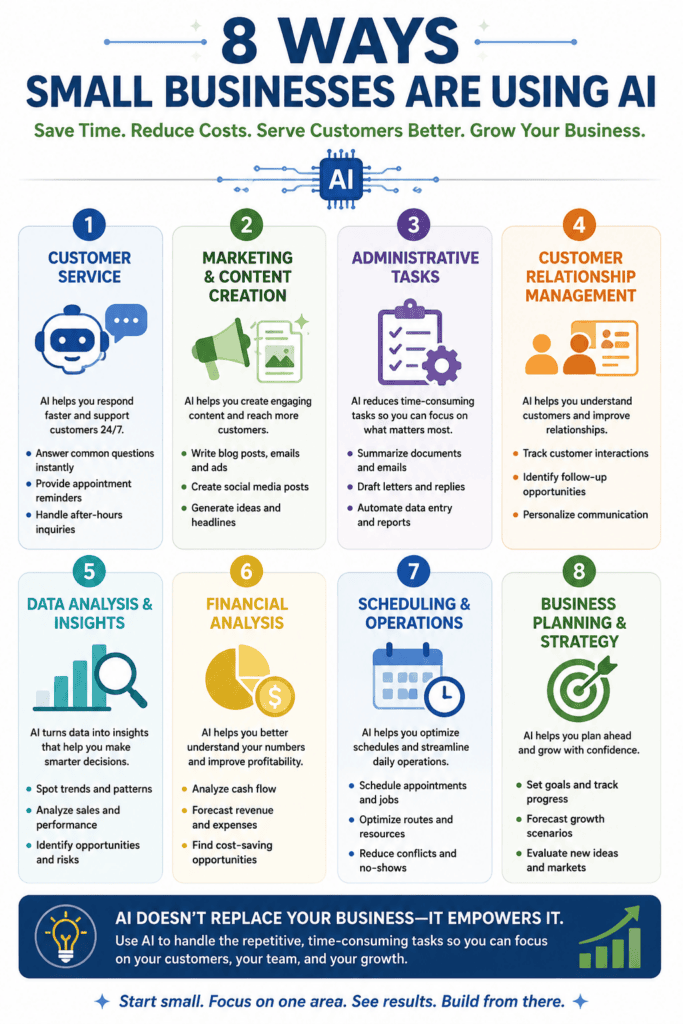
The use of AI in small businesses is moving beyond experimentation. Small business owners are beginning to use AI-powered tools for everyday business operations, from answering customer questions to creating marketing content and organizing information.
The important distinction is that most of these applications do not require replacing existing employees. Instead, AI technology helps owners and small teams accomplish routine and time-consuming tasks faster.
AI Is Becoming a Business Tool, Not Just a Technology Tool
You do not need to understand machine learning, neural networks, or computer programming to benefit from artificial intelligence tools. Most business owners do not understand exactly how their accounting software or customer relationship management system works either.
They understand what the software does for their business. AI adoption is beginning to work the same way.
The question for a small business owner should not be, “How does artificial intelligence work?” The more useful question is, “Which parts of my business could artificial intelligence help me improve?”
Customer Service and Customer Support
Customer service is one of the most obvious areas where AI capabilities can help small businesses. AI-powered tools can assist with routine customer questions, appointment reminders, follow-up messages, and requests for information.
AI chatbots and virtual assistants can also provide customer support when an employee is unavailable. Human intervention remains important when customers have unusual problems, complaints, or situations requiring judgment.
Faster Does Not Have to Mean Less Personal
Automation should not become an excuse for poor customer service. A customer who needs to speak with a person should still have a reasonable way to reach one.
The best use of AI may be handling simple requests quickly so employees have more time for customers who actually need human expertise. Used properly, technology can improve the customer experience rather than make it less personal.
Marketing and Content Creation
Marketing is another business area where generative AI has created immediate opportunities. AI-powered writing assistants can help create blog posts, social media posts, email campaigns, advertising ideas, and other marketing content.
This can be particularly valuable for the smallest firms. A local contractor or landscaping company may not have the budget for a full-time marketing employee or outside agency.
AI does not eliminate the need for a marketing strategy. It can, however, help a business execute that strategy with less time and at a lower cost.
Administrative Tasks and Data Entry
Administrative work can consume a surprising amount of a business owner’s day. Emails, meeting notes, documents, customer records, reports, and data entry all compete for attention.
AI solutions can help summarize information, organize documents, draft correspondence, extract specific information, and reduce repetitive tasks. The goal is not necessarily complete automation.
Even reducing a 30-minute task to 10 minutes creates value. Multiply that savings across dozens of tasks every month and the impact on employee productivity can become substantial.
Customer Relationship Management
A customer relationship management system can contain years of valuable information. The problem for many businesses is turning all of those data points into something useful.
AI systems can help identify customer patterns, summarize previous interactions, suggest follow-up opportunities, and identify customers who may need additional products or services. These data-driven insights can help owners make better decisions while maintaining the human element of customer relationships.
For a service company, this could be extremely valuable. A customer who purchased one service three years ago may now be an excellent candidate for another.
⚠️ Bill Anderson’s Reality Check
Many people ask whether AI will replace employees. In my experience, most small businesses cannot afford enough administrative help in the first place.
For many entrepreneurs, AI is replacing paperwork, repetitive tasks, scheduling headaches, and administrative friction—not people.
Financial Planning and Business Analysis
Artificial intelligence can also help business owners understand financial information. AI-powered tools can organize data, compare results, identify trends, and help owners ask better questions about their businesses.
This does not mean an AI system should replace a CPA, financial planner, financial advisor, or other qualified professional. Financial decisions involving taxes, investments, retirement planning, or legal consequences may still require professional expertise.
AI’s potential is often found in preparing and understanding information before those decisions are made. A better-informed business owner can have a much more productive conversation with a professional advisor.
AI Can Help Owners See What They May Be Missing
One of the most interesting applications of AI is its ability to analyze large amounts of information quickly. Business owners frequently accumulate information without having enough time to analyze it.
Sales records, customer inquiries, expenses, service histories, website activity, and marketing results can contain useful patterns. Predictive analytics and other AI-driven tools may help identify trends that traditional methods overlook.
That could reveal a profitable service, an inefficient business process, a seasonal trend, or a potential cost-saving opportunity. The final business decision still belongs to the owner.
AI Does Not Have to Run the Entire Business
Small business owners should not assume AI adoption requires transforming every business function at once. Starting with one specific area is often more practical.
A business might begin by using generative AI to create marketing content. Another might start with customer support, while another could focus on administrative tasks.
Successful AI implementation should solve a real problem. Adding new technology simply because it is available rarely produces lasting value.
Start With the Tasks You Dislike Doing
An interesting place to look for AI opportunities is the owner’s own daily routine. Identify the repetitive tasks you continually postpone or the work you find yourself completing after everyone else has gone home.
Those activities may include preparing estimates, answering similar emails, creating marketing content, scheduling customers, preparing reports, or organizing information. They are excellent places to investigate whether an AI solution could help.
The objective is simple: spend less time performing low-value administrative work and more time doing the things that actually require your experience.
The Next Step: Applying AI to Real Businesses
General descriptions of AI capabilities only go so far. The potential of AI becomes much easier to understand when we apply the technology to an actual small business.
Later in this guide, we will examine two businesses that could exist in almost any American community: a landscaping company and an HVAC company. We will identify specific areas where AI could improve their operations without replacing the people who perform the skilled work.
We will go one step further and build examples of tools that these businesses could actually use. That will demonstrate an important point about AI and small business: the power of AI becomes much easier to understand when you stop talking about technology and start solving real business problems.
The next section should narrow the discussion from general AI use cases to trades and service businesses. This also sets up the landscaping and HVAC deep dives without using those examples too early.
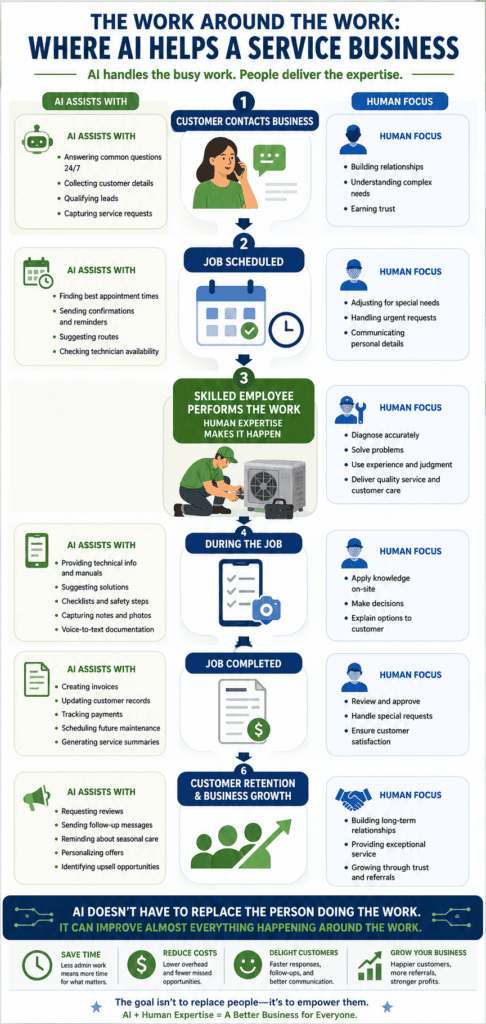
AI for Trades and Service Businesses: An Opportunity Hiding in Plain Sight
When people discuss AI and small business, they often think about offices, technology companies, or online businesses. Yet some of the greatest opportunities for AI adoption may exist in landscaping, HVAC, plumbing, electrical contracting, construction, property management, and other service businesses.
The reason is simple. These businesses require substantial administrative work, but many operate with small teams and limited office staff.
The Skilled Work Still Requires Skilled People
Artificial intelligence cannot replace the technician repairing an air conditioner on a hot summer afternoon. It cannot climb onto a roof, replace an electrical panel, repair a leaking pipe, or operate a commercial lawn mower.
Those jobs require human expertise, physical skills, judgment, and experience. That makes trades and service businesses particularly interesting examples of AI’s potential.
AI technology can support the skilled worker without attempting to replace the skilled work.
The Owner Often Has Two Jobs
Many small business owners in the trades effectively work two jobs.
During the day, they operate the business.
At night, they administer it.
A contractor may spend the day meeting customers and supervising projects. After dinner, that same owner may prepare estimates, answer emails, send invoices, update schedules, order materials, and create marketing content.
Those administrative tasks are where AI-powered tools can become a powerful tool for small firms.
Start by Looking at Everything That Happens Around the Job
Consider an HVAC service call.
The technician repairing the equipment is only one part of the entire business process.
Before the technician arrives, someone may need to answer the customer’s call, collect information, schedule the appointment, determine which technician is available, and send confirmation information.
After the repair, someone may prepare an invoice, update the customer relationship management system, document the service performed, schedule future maintenance, and request a customer review.
The repair itself may take an hour.
The business processes surrounding that repair can continue long after the technician leaves.
📖 Bill Anderson’s Story
When I first introduced internet technology to a nationwide sales organization, many people viewed it as a novelty. Within a few years, it became impossible to imagine operating without it.
Today, I see many of the same reactions to artificial intelligence. The businesses that learn how to use it effectively may gain advantages that compound for years.
AI Can Help With the Work Around the Work
This is one of the easiest ways for small business owners to understand the use of AI.
Do not begin by asking whether artificial intelligence can perform the primary service your company sells.
Ask what happens before, during, and after that service.
Before the Job
AI solutions may assist with:
- Customer inquiries
- Appointment scheduling
- Estimate preparation
- Route planning
- Customer reminders
- Reviewing previous service information
During the Job
AI-powered tools may help employees:
- Retrieve technical information
- Document work performed
- Organize photographs and notes
- Prepare customer explanations
- Access previous customer records
Human intervention remains essential. AI can help provide information, but experienced employees still determine what actually needs to be done.
After the Job
AI systems may assist with:
- Preparing invoices
- Sending follow-up messages
- Updating customer records
- Requesting reviews
- Scheduling future service
- Creating maintenance reminders
- Identifying additional customer needs
None of these examples require replacing the technician.
They help the technician and the business become more productive.
Customer Service Can Continue After Everyone Goes Home
Small service businesses frequently lose opportunities because nobody can answer every telephone call or website inquiry.
A potential customer may contact three companies after business hours. The company that responds first may have an advantage.
AI chatbots and other customer support systems can provide basic information in real time. They may collect the customer’s name, contact information, type of problem, preferred appointment time, and other specific information.
The AI does not necessarily need to solve the customer’s problem.
Sometimes its most valuable job is simply making sure the opportunity is not lost.
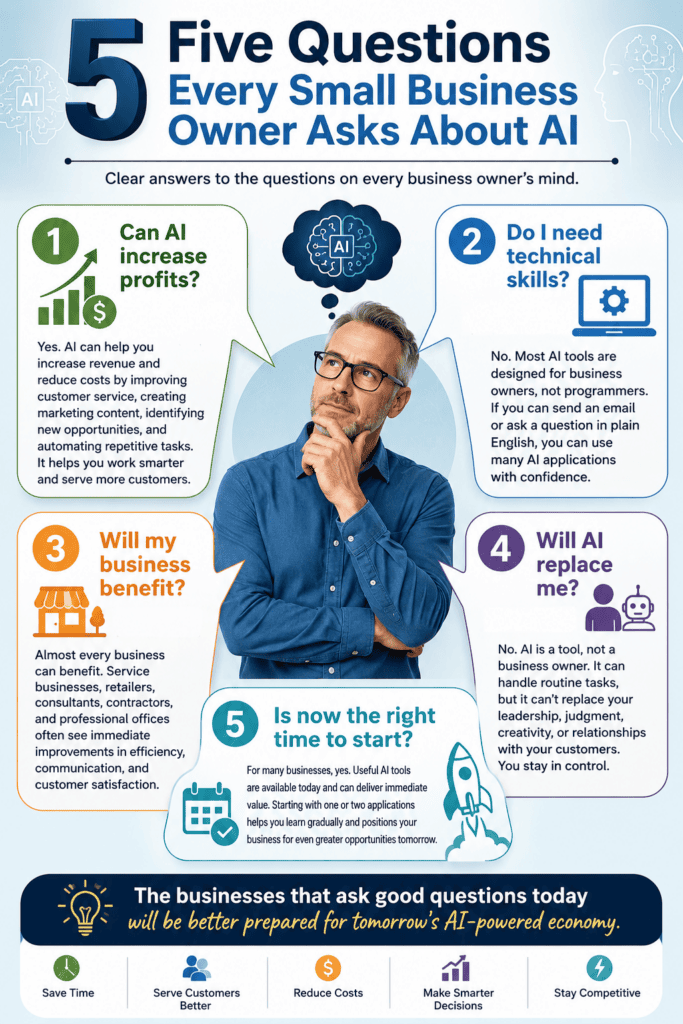
What People Often Ask About AI and Small Business
1. Can artificial intelligence really help a small business make more money?
Yes. While AI does not guarantee higher profits, it can help businesses increase revenue by improving customer service, generating marketing content, responding to inquiries faster, following up with prospects, and identifying new sales opportunities. Just as important, AI often reduces operating costs by automating repetitive administrative tasks, allowing owners and employees to spend more time serving customers and growing the business.
2. Do I need to be a computer expert to use AI?
No. Most modern AI tools are designed for business owners, not programmers. If you can write an email or ask a question in plain English, you can begin using many AI applications. The technology has become much more conversational, allowing users to describe what they need instead of writing computer code.
3. Which types of small businesses benefit the most from AI?
Almost every business can benefit from AI in some way. Service businesses such as landscapers, HVAC contractors, plumbers, electricians, real estate agents, vacation rental managers, consultants, retailers, and professional offices often see immediate benefits because they spend significant time scheduling appointments, communicating with customers, creating estimates, preparing invoices, and managing administrative work.
4. Is artificial intelligence going to replace small business owners?
No. AI is a tool—not a business owner. It can organize information, analyze data, draft documents, and automate routine tasks, but it cannot replace leadership, judgment, creativity, ethics, or relationships with customers. Successful entrepreneurs will likely use AI as a business assistant while continuing to make the important decisions that determine the direction of their companies.
5. Is now a good time for a small business to begin using AI?
For many businesses, yes. Artificial intelligence is evolving rapidly, but there are already practical tools that can improve productivity, customer communication, marketing, scheduling, and business planning. Starting with one or two well-defined applications allows business owners to learn the technology gradually while preparing for even greater opportunities as AI continues to develop.
The businesses that ask good questions today will be better prepared for tomorrow’s AI-powered economy.
Why I'm Excited About the Future of AI
In our next article, I'm going to move beyond discussing how businesses use artificial intelligence and explore something I believe is even more exciting—how AI is creating opportunities for entirely new businesses that simply could not have existed a few years ago.
I'll introduce a real business model that combines experienced entrepreneurs with AI-savvy professionals to help local businesses modernize, become more efficient, and compete more effectively. I believe this concept has the potential to create meaningful new careers while helping thousands of small businesses benefit from AI without depending entirely on large technology companies located hundreds or even thousands of miles away.
If you've been skeptical about what artificial intelligence will do to the workforce, I understand. Every major technological advancement brings uncertainty. But history has shown that while technology changes jobs, it also creates new industries, new professions, and opportunities that were difficult to imagine beforehand.
If you can tell that I'm excited about AI, you're absolutely right.
After spending a lifetime building businesses and watching the personal computer, the internet, and mobile technology transform the way we work, I believe artificial intelligence represents the next great leap forward. I see challenges that deserve thoughtful discussion, but I also see tremendous opportunities for entrepreneurs, retirees, small business owners, and the next generation of innovators.
In the articles ahead, I'll share why I've reached that conclusion, the opportunities I believe are emerging, and practical ways you can position yourself to benefit from one of the most significant technological shifts of our lifetime.
AI-Powered Marketing Tools Can Help Local Companies Compete
Marketing represents another challenge for trades and service businesses.
A large company may employ an entire marketing department. A local contractor may have one person occasionally updating the company website or social media accounts.
Generative AI and AI-powered writing assistants can help create marketing content, social media posts, customer newsletters, seasonal promotions, advertising ideas, and educational articles.
The business owner’s expertise remains important. AI can help communicate that expertise to a much larger audience.
Customer Records Can Become More Valuable
Many established service businesses have years of customer information stored in accounting software, email platforms, spreadsheets, and customer relationship management systems.
That information may represent an overlooked business asset.
AI capabilities combined with data analysis may eventually help identify customers who are likely to need additional services, maintenance, replacement equipment, or follow-up communication.
Instead of simply storing historical data, businesses can begin using it to generate data-driven insights.
AI May Help Reduce Operational Costs
Labor costs represent one of the largest expenses for many service companies.
That does not mean the goal should be eliminating employees.
AI adoption may instead allow existing employees to accomplish more without continually expanding administrative staff.
A growing company might be able to serve additional customers with the same office team. For a small business, that improvement in employee productivity can have a significant impact on profitability.
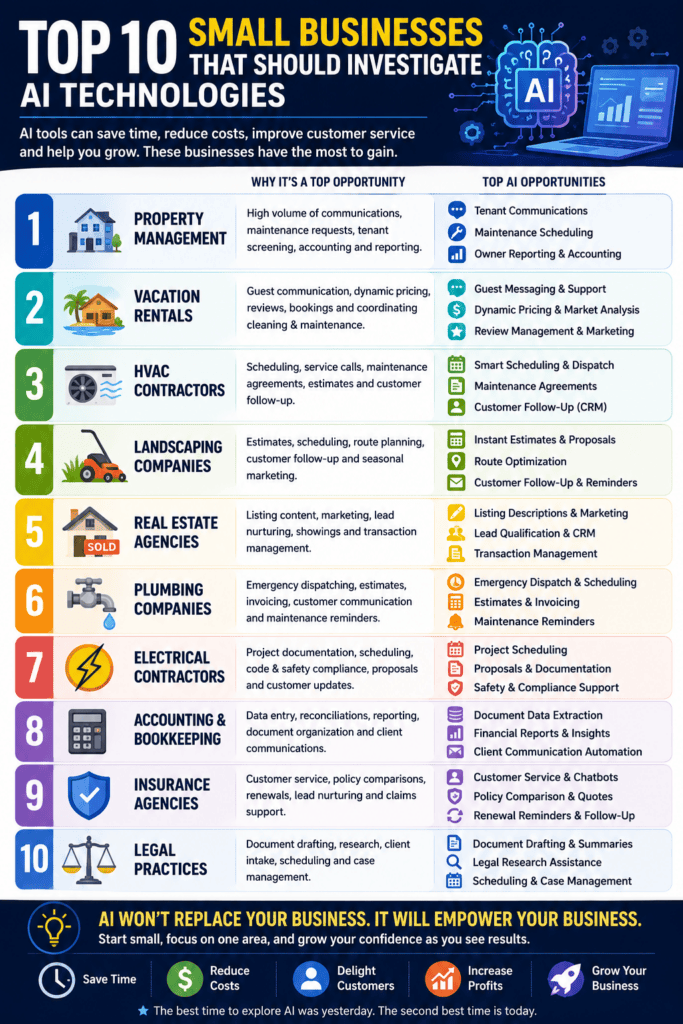
Why these businesses rank so highly
| Business | Where AI Can Help Most |
|---|---|
| Property Management | Tenant communications, maintenance scheduling, lease management, owner reporting, accounting, marketing |
| Vacation Rentals | Guest messaging, pricing analysis, reviews, maintenance coordination, marketing, reservations |
| HVAC Contractors | Dispatching, estimates, maintenance agreements, CRM, invoicing, service documentation |
| Landscaping Companies | Estimates, scheduling, route optimization, proposals, customer follow-up |
| Real Estate Agencies | Listing descriptions, marketing, CRM, lead nurturing, transaction management |
| Plumbing Companies | Emergency dispatching, estimates, customer communication, maintenance reminders |
| Electrical Contractors | Scheduling, project documentation, proposals, safety documentation |
| Accounting & Bookkeeping | Document organization, reporting, client communications, workflow automation |
| Insurance Agencies | Customer service, renewals, lead qualification, policy comparisons |
| Legal Practices | Document drafting, client intake, scheduling, research assistance, workflow management |
Key Takeaway
The common thread among these businesses is not that they are technology companies. They all spend significant time on administrative work, customer communication, scheduling, documentation, and follow-up.
AI can automate much of that work, allowing owners and employees to focus on delivering professional services and growing their businesses.
The Smallest Firms May Have the Most to Gain
A company with 500 employees can spread administrative costs across a large organization.
A company with five employees cannot.
This is one reason AI-powered tools could help level the playing field between smaller companies and larger businesses.
Artificial intelligence tools increasingly provide capabilities that previously required specialized employees, consultants, or expensive software systems.
AI Creates Opportunities Beyond Using the Technology
There is another side to this transformation.
Small business owners need people who can help them determine which AI solutions are useful and which are unnecessary.
An HVAC contractor does not necessarily want to spend weekends researching the latest AI tools. A landscaper probably does not want to become an expert in large language models, machine learning, or AI agents.
They want someone to show them how the technology can improve their business.
That creates an entirely new category of potential businesses providing AI implementation, training, workflow development, and AI services to local companies.
The Human Element Becomes More Important, Not Less
There is an interesting paradox in the AI revolution.
As technology becomes more capable, human relationships may become more valuable.
Customers still want technicians they trust. Employees still need good managers, and business owners still need professional advisors who understand their goals.
The best AI implementation may therefore be the one customers barely notice.
The technology works quietly behind the scenes while people provide the customer experience.
From Theory to Two Real Businesses
The potential of AI becomes much clearer when we stop discussing artificial intelligence in general terms.
For that reason, we will examine two familiar businesses in detail: a landscaping company and an HVAC company.
We will follow the work from the first customer inquiry through scheduling, service, billing, marketing, and follow-up. We will also create practical AI-powered tools to demonstrate what this new technology can actually accomplish for a small business.
The objective is not to imagine a business without employees.
It is to demonstrate what employees and business owners may accomplish when AI removes some of the work that gets in their way.
💡 RetireCoast Perspective: The Unexpected Career Opportunity Created by AI
For decades, many parents encouraged their children to attend college and pursue professional careers rather than enter the skilled trades. One result has been persistent demand for people who can perform work that requires physical skill, experience, judgment, and an actual human presence.
The rise of artificial intelligence may cause families to look at those career decisions differently. Some knowledge-based and administrative tasks can increasingly be assisted or performed by AI, while a leaking pipe still needs a plumber, an electrical problem still needs an electrician, and many forms of health care still require a trained professional standing beside the patient.
This does not mean college or professional careers are disappearing. It means the definition of an “ideal career” may be changing as parents and young people consider which occupations are difficult for AI systems to perform.
If you own a landscaping business, HVAC company, plumbing business, electrical company, or another skilled service business, you may find yourself in an unexpected sweet spot. The work customers pay you to perform remains difficult to automate, while AI-powered tools can increasingly help with the administrative work surrounding it.
That combination could be extremely powerful. Skilled workers may use AI for scheduling, customer service, marketing, estimating, documentation, and business operations while continuing to provide the hands-on expertise customers actually need.
One unexpected benefit of the AI revolution may therefore be renewed interest in careers that society sometimes undervalued. Instead of eliminating opportunity, artificial intelligence could make certain skilled trades and service businesses even more attractive to the next generation of entrepreneurs.
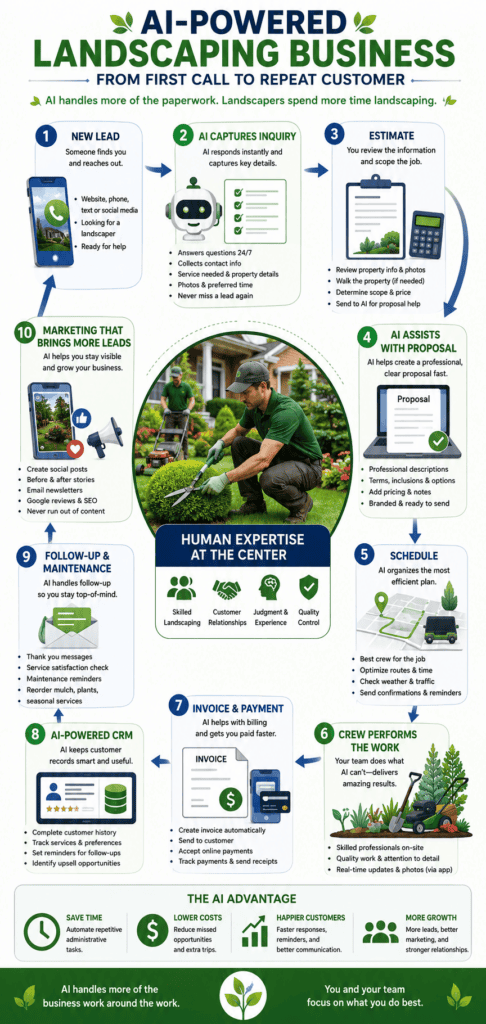
How AI Can Help a Landscaping Company
A landscaping company provides an excellent example of AI and small business working together. Artificial intelligence cannot mow a lawn, repair an irrigation system, trim a tree, or transform an overgrown property, but it can help manage much of the work surrounding those services.
That distinction is important. The objective is not to replace landscapers with AI technology but to help landscaping companies become more productive, responsive, and profitable.
Consider a Typical Small Landscaping Business
Imagine a landscaping company with an owner and four employees. The crews spend their days mowing lawns, maintaining properties, installing landscaping, and completing seasonal projects.
Meanwhile, the owner may be answering calls, preparing estimates, scheduling crews, collecting payments, maintaining equipment, ordering supplies, and trying to find new customers. Much of that work occurs before the crews leave in the morning or after they return in the afternoon.
This is exactly the type of small business where AI-powered tools can provide value.
AI Can Help Capture New Customers
A homeowner searching for a landscaper may contact several companies.
If one company responds quickly while another takes two days, the faster company may have an advantage.
An AI chatbot or automated customer support system could collect basic information such as:
- Customer name and contact information
- Property address
- Type of service requested
- Approximate property size
- Desired service frequency
- Photographs of the property
- Preferred appointment times
The system does not necessarily need to quote the job. Its first responsibility may simply be ensuring that a potential customer receives a response and the business captures the opportunity.
AI Can Help Prepare Estimates
Preparing estimates can consume considerable time.
A business owner may repeatedly write similar descriptions for lawn maintenance, landscaping installation, cleanup services, irrigation repairs, or other work.
Generative AI can help create professional estimate descriptions using information supplied by the owner. The business can develop templates that reflect its services, pricing structure, warranties, exclusions, and customer expectations.
Human review remains important.
The landscaper knows the property, labor requirements, equipment requirements, and potential problems. AI helps organize that expertise into a professional customer document.
Scheduling Can Become Smarter
Scheduling is one of the biggest challenges in a landscaping business.
Crews may serve dozens or hundreds of properties spread across a geographic area. Weather, employee availability, equipment problems, and customer requests can disrupt even the best schedule.
AI systems combined with scheduling and mapping software can help organize routes and identify more efficient ways to group customers.
Reducing unnecessary driving can mean lower fuel costs, less vehicle wear, and more productive time at customer properties.
Weather Creates Another Opportunity
Landscaping businesses are heavily affected by weather.
Rain can delay mowing, storms can create cleanup opportunities, drought can change irrigation requirements, and extreme temperatures can affect employee scheduling.
AI-powered tools can combine weather information with schedules to help owners anticipate disruptions.
Instead of reacting after the weather changes, the business can become more proactive about communicating with customers and reorganizing work.
Customer Service Can Become More Consistent
A landscaping customer may have a simple question:
“When will my crew arrive?”
“Can you skip my property this week?”
“Can someone look at my irrigation system?”
These requests can interrupt an owner throughout the day.
AI-powered customer service systems can help answer routine questions, collect requests, and route more complex issues to the appropriate person.
The human element remains important.
A complaint about damaged property or an unhappy customer should probably receive personal attention rather than an automated response.
AI Can Help Build Better Customer Relationships
Landscaping companies often have something extremely valuable: recurring customers.
A company may visit the same property every week for years.
A customer relationship management system combined with AI capabilities can help organize those relationships and identify opportunities for additional services.
For example, a lawn maintenance customer might also need:
- Mulch installation
- Irrigation maintenance
- Tree trimming
- Seasonal cleanup
- Landscape lighting
- Fertilization
- New plantings
AI can help identify appropriate follow-up opportunities based on customer history.
That does not mean bombarding customers with sales messages.
The objective is providing relevant services when customers are likely to need them.
Marketing Becomes Easier
Many landscapers have excellent photographs of completed projects but do very little with them.
AI-powered marketing tools can help turn those photographs and project descriptions into social media posts, website content, email campaigns, and before-and-after stories.
A business owner might upload photographs from a landscaping project and provide a few details.
An AI-powered writing assistant could help create a Facebook post, website description, customer email, and Google Business Profile update from the same information.
One completed project can therefore generate several pieces of marketing content.
AI Can Help Manage Equipment
Equipment represents a substantial investment for landscaping companies.
Commercial mowers, trailers, trucks, trimmers, blowers, and other equipment require regular maintenance.
An AI-assisted maintenance system could track:
- Operating hours
- Oil changes
- Blade replacements
- Tire replacement
- Repairs
- Warranty information
- Fuel consumption
- Service history
Predictive analytics may eventually help identify patterns indicating when equipment is likely to require maintenance.
Preventing one major equipment failure during the busiest part of the season could provide significant value.
Inventory and Supply Management
Landscaping companies may also maintain inventories of fertilizer, chemicals, irrigation parts, mulch, plants, fuel, and replacement equipment.
AI-assisted inventory management can help track consumption and identify when supplies need to be reordered.
Larger landscaping businesses could potentially combine historical data with upcoming schedules to forecast supply requirements.
Again, AI is not making the final purchasing decision.
It is helping the owner make that decision with better information.
Financial Analysis Can Reveal Which Work Is Actually Profitable
Revenue does not necessarily equal profit.
A landscaping company may have services that appear successful but generate poor margins after labor, fuel, equipment, materials, and travel time are considered.
AI-assisted data analysis can help owners compare jobs, customers, crews, routes, and service categories.
This can provide data-driven insights into questions such as:
- Which services produce the highest margins?
- Which routes consume excessive fuel?
- Which customers require excessive travel?
- Which jobs consistently exceed estimated labor hours?
- Which equipment costs the most to maintain?
The owner still determines what to do with that information.
AI helps make the information easier to see.
AI Could Help the Owner Reclaim Evenings
This may ultimately be one of the greatest benefits of AI adoption.
The landscaping crew may finish working at 4:30 or 5:00 p.m., but the owner’s workday frequently continues.
There are estimates to prepare, customer messages to answer, tomorrow’s schedule to review, invoices to send, and marketing that never seems to get done.
If AI solutions reduce even part of that workload, the value is not limited to labor costs.
The owner gets something equally valuable back: time.
Bill Anderson’s Perspective: Don’t Start With AI
The first question I would ask a landscaping company is not, “Which AI software should you buy?”
I would ask the owner to describe everything they do during a normal week.
Then I would identify the repetitive tasks, administrative work, customer problems, and activities that consume the most time.
Only then would I start looking for AI solutions.
Technology should solve a business problem. A business should never create a problem simply because someone wants to sell it new technology.
What Could an AI Consultant Do for This Business?
Now consider this landscaping company from the perspective of someone providing AI implementation services.
The consultant could spend several hours interviewing the owner and employees and mapping the company’s business processes.
The consultant might discover that the owner spends ten hours every week answering customer messages, preparing estimates, reorganizing schedules, and performing data entry.
Instead of proposing a massive technology project, the consultant could begin with one or two specific areas.
Solve those problems first.
Measure the results.
Then expand AI adoption if the results justify it.
This is why helping small businesses implement artificial intelligence may itself become an attractive small business opportunity.
We Are Going to Build an Example
Rather than simply telling you that AI can help a landscaping company, we are going to demonstrate it.
As part of this series, RetireCoast will create an example AI-powered landscaping business tool.
The tool will illustrate how a small business owner could use technology to identify administrative bottlenecks, estimate potential time savings, and determine which business areas may be good candidates for AI adoption.
That is where the discussion about the potential of AI becomes much more interesting.
We stop talking about what artificial intelligence might someday accomplish and start demonstrating what small business owners can actually do with it.
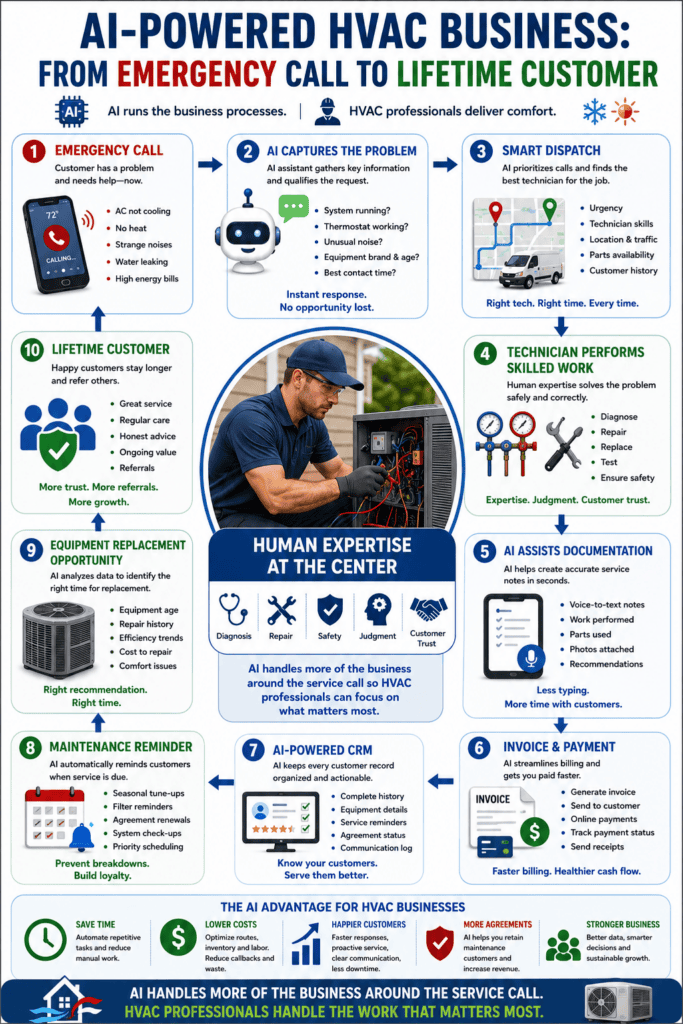
How AI Can Help an HVAC Company
An HVAC company may be one of the best examples of AI and small business working together. Heating and air-conditioning systems still require trained technicians, but almost every business process surrounding the technician can potentially benefit from AI technology.
An HVAC business also combines emergency service, recurring maintenance, expensive equipment, customer relationships, scheduling, inventory, and seasonal demand. That combination creates numerous opportunities for AI-powered tools.
Start With the Customer’s First Call
Imagine that a homeowner’s air conditioner stops working on a hot July afternoon.
The homeowner probably does not contact just one HVAC company. They may call several companies or submit multiple online service requests looking for someone who can respond quickly.
An AI-powered customer support system could respond immediately and collect specific information about the problem.
AI Could Collect Useful Information Before Dispatch
The system might ask:
- Is the system running?
- Is the thermostat working?
- Is there any unusual noise?
- Is water leaking?
- When was the system last serviced?
- What is the equipment brand?
- Is this an existing customer?
- Is anyone in the home especially vulnerable to extreme heat?
The purpose is not to allow AI to diagnose every HVAC problem.
The objective is to give the dispatcher and technician better information before the service call begins.
AI Can Help Prioritize Service Calls
Not every service request has the same urgency.
A maintenance appointment can often be rescheduled. A failed air conditioner during extreme heat may require immediate attention.
AI systems could help organize incoming service requests based on urgency, location, technician availability, customer history, and other business rules.
Human intervention should remain available for unusual circumstances.
The technology helps organize information. The business determines priorities.
Smarter Scheduling and Dispatching
Scheduling becomes more complicated as an HVAC company grows.
The company may have multiple technicians with different certifications, skills, schedules, and service areas.
An AI-assisted scheduling system could consider technician location, job type, estimated repair time, traffic conditions, and upcoming appointments.
Reducing unnecessary travel may lower operational costs while allowing technicians to complete more service calls.
AI Can Help the Technician Before Arrival
An established HVAC company may have years of service records for a customer’s equipment.
Before arriving, an AI system could summarize previous repairs, maintenance history, equipment age, recurring problems, warranty information, and previous recommendations.
Instead of searching through years of customer records, the technician receives the most relevant information.
That is an excellent example of AI assisting human expertise rather than replacing it.
AI Can Assist With Technical Information
HVAC technicians encounter equipment from many manufacturers and model years.
Finding manuals, specifications, error codes, and service information can take time.
AI-powered tools using accurate manufacturer information could help technicians locate relevant technical documentation more quickly.
The technician still diagnoses the equipment.
AI helps reduce the time required to find information.
Documentation Can Become Faster
Service documentation is essential but time-consuming.
A technician may finish repairing equipment and then spend additional time entering notes describing what was found and what was done.
Natural language and voice-to-text AI systems can help transform spoken notes into organized service documentation.
The technician could describe the work performed and then review the resulting service summary for accuracy.
That means less time typing and more time serving customers.
AI Can Help Explain Repairs to Customers
Technical explanations are not always easy for customers to understand.
A technician may know exactly why a capacitor failed or why an evaporator coil needs replacement, but the customer may not understand the terminology.
Generative AI can help translate technical information into plain language.
The technician remains responsible for ensuring the explanation is accurate.
AI simply helps communicate human expertise more clearly.
Maintenance Agreements Create a Major AI Opportunity
Recurring maintenance agreements can be extremely valuable to HVAC companies.
Customers need seasonal inspections, filter changes, equipment cleaning, and preventative maintenance.
AI-powered customer relationship management systems can help identify customers who are due for service and automatically prepare reminders.
Instead of waiting for equipment to fail, the company can maintain an ongoing relationship with the customer.
Customer Relationship Management Can Become More Intelligent
An HVAC company may have thousands of customer records accumulated over many years.
Those records contain valuable data points.
AI systems could help identify:
- Customers overdue for maintenance
- Older equipment approaching replacement
- Expiring warranties
- Previous recommendations not completed
- Customers without maintenance agreements
- Recurring equipment problems
- Opportunities for additional services
This is where customer relationship management can evolve from recordkeeping into a business growth tool.
Predictive Analytics Could Help Identify Replacement Opportunities
HVAC equipment does not last forever.
Historical data involving equipment age, repair frequency, maintenance history, and repair costs may help businesses identify systems that are approaching replacement.
Predictive analytics could eventually help prioritize customers who may benefit from a replacement discussion.
Human judgment remains essential.
A homeowner should receive an honest recommendation based on the condition of the equipment, not simply because an algorithm identified a sales opportunity.
Inventory Management Is Another Opportunity
HVAC technicians frequently carry common replacement parts in their service vehicles.
Running out of the correct part can mean another trip to the supplier and a frustrated customer.
AI-assisted inventory management could track which parts are being used and identify when truck inventory or warehouse supplies need replenishment.
Historical data could also reveal seasonal patterns.
A business may discover that certain parts are used much more frequently during particular months.
AI Can Help With Supply Chain Management
Larger HVAC companies may purchase substantial quantities of equipment and replacement parts.
AI systems can potentially assist with supply chain management by comparing historical usage, scheduled installations, seasonal demand, and existing inventory.
The objective is not necessarily to automate purchasing.
It is to give the person responsible for purchasing better information.
Marketing Can Become More Timely
HVAC marketing is highly seasonal.
The first major heat wave can suddenly remind thousands of homeowners that they have not serviced their air conditioners.
AI-powered marketing tools can help businesses prepare seasonal email campaigns, social media posts, educational content, and maintenance reminders.
Marketing strategies can also become more targeted.
Customers with 15-year-old systems should not necessarily receive the same message as customers who installed new equipment last year.
AI Can Help Create Educational Content
HVAC companies possess enormous amounts of useful knowledge.
Customers routinely ask:
“How often should I change my filter?”
“Why is my electric bill increasing?”
“How long should my air conditioner last?”
“Should I repair or replace my system?”
AI-powered writing assistants can help turn the company’s human expertise into blog posts, FAQs, email newsletters, and social media posts.
That content can improve customer service while also supporting local search visibility.
Financial Analysis Can Identify Profitable Services
An HVAC company may generate revenue from repairs, installations, maintenance agreements, indoor air quality products, ductwork, and other services.
Not every business area produces the same profit margin.
AI-assisted data analysis can help compare revenue, labor costs, equipment costs, travel time, warranty callbacks, and other expenses.
Those data-driven insights may help owners understand which services contribute most to business growth.
AI Could Reduce After-Hours Administrative Work
As with the landscaping company, one of the biggest benefits may occur after the technicians stop working.
Someone still needs to review service records, send invoices, answer customer messages, update schedules, prepare marketing content, and plan tomorrow’s workload.
AI solutions can help reduce the time required for many of these administrative tasks.
For the owner, saving time may be just as important as saving money.
Bill Anderson’s Perspective: Look Beyond the Technician
When I look at an HVAC company, I do not begin by asking whether AI can repair an air conditioner.
That misses the opportunity.
I look at everything surrounding the technician: the first telephone call, scheduling, dispatching, service history, documentation, invoicing, customer follow-up, maintenance reminders, marketing, inventory, and financial analysis.
That is where I see the power of AI.
The technician remains essential.
The business surrounding the technician becomes more efficient.
What Could an AI Consultant Do for an HVAC Company?
An AI implementation consultant could begin by mapping the company’s entire customer journey.
Where does information enter the business?
Where does someone manually enter the same information again?
Where are customers waiting for responses?
Where are employees spending time searching for information?
Where are opportunities being lost?
Those questions can reveal potential AI applications without requiring the company to replace its existing systems.
The best AI implementation may begin with one frustrating process and solve it.
We Will Build an HVAC Tool Too
RetireCoast will also create a practical example specifically for an HVAC business.
Rather than building technology simply because AI capabilities exist, the tool should solve a measurable business problem.
One strong candidate is an HVAC Maintenance Agreement Revenue Planner.
The business owner could enter the number of maintenance customers, annual agreement price, renewal rate, service costs, and potential additional service revenue.
The tool could then demonstrate the financial impact of increasing maintenance agreement participation and customer retention.
Another possibility is an HVAC AI Opportunity Assessment that identifies areas where the company may save administrative time.
We may ultimately build both.
The Bigger Lesson
The landscaping and HVAC examples demonstrate why the impact of artificial intelligence may look very different in small businesses than it does in large corporations.
AI does not need to perform the company’s primary skilled service to transform the business.
It only needs to make everything surrounding that service work better.
That may prove to be one of the most important benefits of AI and small business.
This Is Only the Beginning
Artificial intelligence is evolving at an extraordinary pace. New AI-powered tools, AI agents, business applications, and implementation strategies seem to appear almost every week.
For that reason, it would be impossible to cover every aspect of AI and small business in a single article.
Rather than attempting to create one massive guide, RetireCoast will continue expanding this series with in-depth articles, practical examples, downloadable tools, and real-world case studies designed specifically for entrepreneurs and small business owners.
Our goal is not simply to report on the latest AI technologies. Our mission is to help business owners understand how these technologies can solve real business problems, improve customer service, reduce administrative work, increase productivity, and create new opportunities for growth.
As artificial intelligence continues to mature, this cornerstone guide will also be updated to reflect new developments and link to additional resources throughout the RetireCoast website.
Coming Soon in the RetireCoast AI and Small Business Series
Here are just a few of the topics already planned for this growing series:
- Starting an AI Implementation Business: A New Opportunity for Entrepreneurs and Retirees
- The AI Business Architect: A New Profession for the Next Generation
- How to Build an AI Business Hub for a Small Company
- AI for Landscapers: Saving Time While Growing Your Business
- AI for HVAC Companies: Improving Customer Service and Increasing Revenue
- AI for Property Management Companies
- AI for Real Estate Agents and Brokers
- AI for Vacation Rental Owners and Managers
- AI for Electricians, Plumbers, and Contractors
- How AI Agents Will Change Small Business
- Building AI Customer Service Systems for Local Businesses
- Creating AI-Powered Marketing That Actually Generates Customers
- How to Measure the Return on Investment of AI
- The Best AI Tools for Small Business Owners
- How to Choose the Right AI Solutions for Your Business
- Avoiding Common AI Mistakes Made by Small Businesses
- AI and Retirement Planning: Starting a Business After Retirement
- Creating an AI Roadmap for Your Business
- Designing Custom AI Workflows for Service Businesses
- The Future of Artificial Intelligence and Small Business
This Is a Conversation, Not a Conclusion
Here’s a polished version that keeps your conversational voice while strengthening the flow and ending with a clear invitation.I Didn’t Mean to Write a Book!
I owe you a bit of an apology.
As I worked on this article, I became so absorbed in explaining artificial intelligence and its potential for small businesses that I realized I was trying to fit an entire book into a single guide. Every time I thought I was finished, another important topic came to mind that deserved its own section.
Eventually, I had to make a decision. Rather than continuing to add more pages, I wrapped up this article knowing I had left out many ideas that deserve a much deeper discussion.
Perhaps the biggest topic I haven’t fully covered is this: I explained how AI can improve your business and why I believe it represents an extraordinary opportunity—but I haven’t yet shown you exactly how to get started.
Don’t worry—that’s coming next.
In the upcoming articles, I’ll walk you through practical implementation strategies, show you how small businesses can begin using AI today, and introduce what I believe could become an entirely new business opportunity for entrepreneurs and retirees who want to help local businesses adopt AI successfully.
Stay With Me
If you’ve enjoyed this article, I encourage you to sign up using the email subscription box in the upper-right corner of this page. Simply enter your email address, and we’ll notify you whenever a new article in this AI series is published. I have a lot more to share, and I think the best is still to come.
Thank you for your patience, your encouragement, and for joining me as we explore one of the most significant technological changes of our lifetime. I look forward to continuing the journey together.
Artificial intelligence is not standing still, and neither are we.
As we continue researching, testing, and implementing AI-powered tools, we will share both our successes and our lessons learned. Whenever possible, we’ll include practical examples, downloadable resources, business tools, and interviews with entrepreneurs who are successfully integrating AI into their daily operations.
If there is one message we hope readers take away from this guide, it is this:
Artificial intelligence is not just changing technology.
It is changing the way small businesses compete, communicate, market, serve customers, and grow.
For entrepreneurs willing to learn and adapt, the future has never looked more exciting.
And for those looking beyond the technology itself, AI may also create one of the greatest small business opportunities of the next decade—helping other businesses harness its power.
Build Your Business with Confidence
Throughout this guide, you've seen how artificial intelligence can help entrepreneurs improve productivity, automate repetitive tasks, make better business decisions, and provide better customer service.
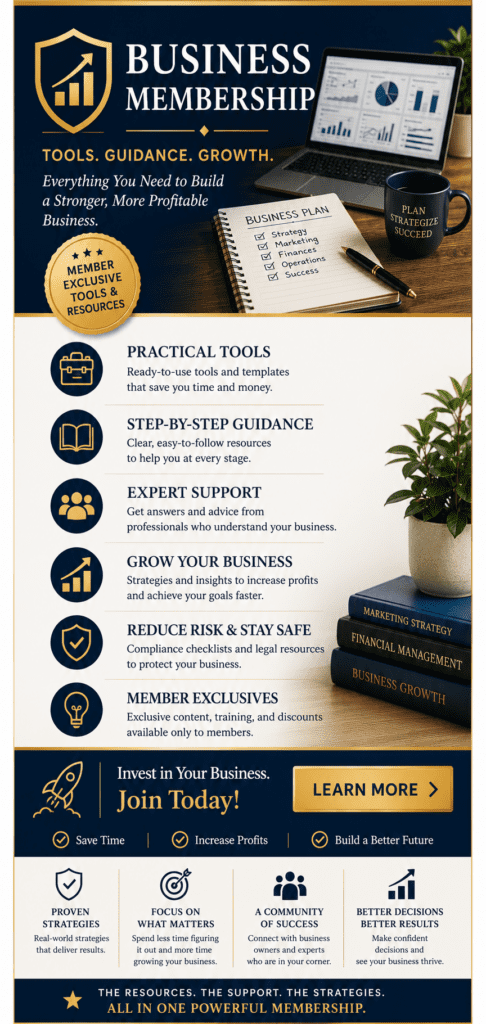
While many of the AI-powered solutions discussed in this article are still evolving, RetireCoast Business Membership already provides practical business resources you can begin using today.
Members have access to a growing collection of business planning tools, financial calculators, decision-making worksheets, legal document builders, startup resources, and business management tools designed to help entrepreneurs build stronger companies.
Whether you're evaluating a new business idea, organizing your finances, planning for growth, managing business risks, or even creating an LLC using our guided tools, our goal is simple: help you make informed decisions with confidence.
The RetireCoast Philosophy
First Education. Then Action.
We believe the best decisions begin with understanding. That's why we focus first on teaching the concepts, explaining your options, and helping you understand the "why" behind each decision. Once you have that foundation, we provide the practical tools that allow you to put what you've learned into action.
Education without action produces little progress. Action without education can produce costly mistakes. RetireCoast is designed to provide both.
As artificial intelligence becomes an increasingly important part of running a successful business, our membership will continue expanding with new AI resources, implementation guides, business tools, calculators, and educational content to help entrepreneurs stay ahead of the curve.
Ready to Build a Smarter Business?
Artificial intelligence is changing the way businesses operate—but technology alone doesn't create success. The businesses that thrive will be those led by owners who continue learning, embrace innovation, and use the right tools to make better decisions.
At RetireCoast, our mission is simple: First Education. Then Action. We teach you the concepts, explain the opportunities, and provide practical tools that help you put your knowledge to work.
Business Membership
Access a growing collection of business planning tools, calculators, legal document builders, startup resources, and entrepreneur-focused guides designed to help you build and manage a successful business.
Stay Ahead of AI
We're continuously publishing new articles, implementation guides, business strategies, calculators, and AI resources to help entrepreneurs stay competitive in a rapidly changing world.
Today's successful businesses don't simply adopt technology—they learn how to use it wisely.
Join RetireCoast as we explore the future of artificial intelligence, entrepreneurship, retirement, and small business success—one practical guide at a time.
Editor’s Note: Artificial intelligence is evolving rapidly. We periodically review and update this guide to reflect significant technological developments, new research, and emerging best practices for small businesses.
References
- U.S. Chamber of Commerce Foundation – Small Business Owners Say AI Is Already Changing Work – Research on how small business owners are using AI to improve productivity and business operations. (U.S. Chamber Foundation)
- U.S. Chamber of Commerce Foundation – Main Street AI Monitor – National survey examining AI adoption among employees and small businesses. (U.S. Chamber Foundation)
- U.S. Chamber of Commerce – Empowering Small Business Report – Annual report on technology adoption, including generative AI, among America’s small businesses. (U.S. Chamber of Commerce)
- OpenAI – AI Is Becoming a First Hire for Small Businesses – Analysis discussing how entrepreneurs are using AI to start, operate, and grow businesses. (OpenAI)
- U.S. Chamber of Commerce Small Business Index – Quarterly data and trends on the outlook and challenges facing U.S. small businesses. (U.S. Chamber of Commerce)
- U.S. Chamber of Commerce – AI in the Workplace Quarterly Spotlight – Survey examining how small businesses are experimenting with and implementing AI tools. (U.S. Chamber of Commerce)
- Stanford HAI – Artificial Intelligence Index Report 2024 – Comprehensive annual report tracking global AI development, investment, research, and adoption. (arXiv)
- GPTs are GPTs: An Early Look at the Labor Market Impact Potential of Large Language Models – Research paper examining how large language models may affect work tasks across occupations. (arXiv)
- Microsoft – 2025 Work Trend Index: Why Small and Medium Businesses May Have the Advantage – Research on AI adoption, human-agent collaboration, and the emergence of AI-enabled organizations. (TECHCOMMUNITY.MICROSOFT.COM)
- Impact of Artificial Intelligence on Businesses: From Research, Innovation, Market Deployment to Future Business Models – Academic research exploring how AI is changing business strategy and entrepreneurship. (arXiv)
Additional Resources
- U.S. Small Business Administration (SBA)
- National Institute of Standards and Technology (NIST) AI Resources
- OpenAI
- Microsoft AI
- Google AI
- Anthropic
- RetireCoast Business Membership
FAQ
Frequently Asked Questions About AI and Small Business
Click on any question below to learn more about how artificial intelligence is changing small businesses and entrepreneurship.
1. What is artificial intelligence (AI)?
Artificial intelligence refers to computer systems that can perform tasks traditionally requiring human intelligence, such as writing, analyzing information, recognizing patterns, answering questions, and assisting with decision-making.
2. How can AI help a small business?
AI can automate administrative work, improve customer service, assist with marketing, create content, analyze business data, schedule appointments, generate proposals, and help business owners make better decisions.
3. Is AI only for large corporations?
No. Many AI tools are inexpensive or free, making them accessible to startups, solo entrepreneurs, family businesses, and local service companies.
4. Will AI replace employees?
In many cases AI replaces repetitive administrative tasks rather than skilled workers. Employees often become more productive by allowing AI to handle paperwork and routine communication.
5. Can AI help service businesses like landscapers and HVAC companies?
Yes. AI can assist with scheduling, estimating, invoicing, customer communication, maintenance reminders, marketing, and customer relationship management while technicians continue performing the skilled work.
6. Do I need technical experience to use AI?
No. Most modern AI applications use simple conversational prompts and are designed for everyday business owners rather than software developers.
7. Can AI write marketing content?
Yes. AI can generate blog posts, email campaigns, advertisements, social media posts, newsletters, and website content that business owners can review and customize.
8. Can AI improve customer service?
Yes. AI chatbots, automated email responses, appointment scheduling, and customer follow-up systems can improve response times while reducing administrative workload.
9. Is AI expensive for small businesses?
Not necessarily. Many AI tools offer free plans or affordable monthly subscriptions that can often save more time than they cost.
10. What types of businesses benefit the most from AI?
Nearly every business can benefit, including contractors, landscapers, HVAC companies, real estate agents, vacation rental managers, retailers, consultants, accountants, attorneys, restaurants, and healthcare providers.
11. Can AI help me start a new business?
Yes. AI can assist with business plans, market research, website creation, marketing strategies, financial projections, and operational planning.
12. Is my business data safe when using AI?
Business owners should carefully review each AI provider's privacy policy and avoid sharing confidential or sensitive information unless appropriate safeguards are in place.
13. Can AI create a website for my business?
AI can help design website content, generate graphics, write product descriptions, and assist with website development, although many businesses still benefit from professional customization.
14. What is an AI agent?
An AI agent is software that can perform specific tasks automatically, such as answering customer questions, scheduling appointments, sending reminders, or managing workflows with limited human intervention.
15. Can retirees build a business around AI?
Absolutely. Many retirees possess decades of business experience that can be combined with AI tools to help local businesses improve operations and increase productivity.
16. Will AI continue changing over the next few years?
Yes. Artificial intelligence is evolving rapidly, with new tools, capabilities, and business applications being introduced regularly.
17. Should every small business develop an AI strategy?
Developing an AI strategy can help business owners identify opportunities to reduce costs, improve customer satisfaction, streamline operations, and remain competitive.
18. Does AI eliminate the need for human judgment?
No. AI provides information and recommendations, but experienced business owners still make the important decisions involving customers, finances, employees, and long-term strategy.
19. Where can I learn more about AI for small businesses?
Continue following the RetireCoast AI and Small Business series. We'll regularly publish new guides, implementation strategies, business tools, calculators, and real-world examples showing how entrepreneurs can successfully use AI.
20. What is RetireCoast's philosophy regarding AI?
Our philosophy is simple: First Education. Then Action. We believe business owners should understand how AI works, what problems it solves, and how it fits into their business before investing in technology. Once you understand the concepts, our tools and educational resources help you put that knowledge into practice.
Discover more from RetireCoast.com
Subscribe to get the latest posts sent to your email.