Last updated on July 13th, 2026 at 04:11 pm
Introduction
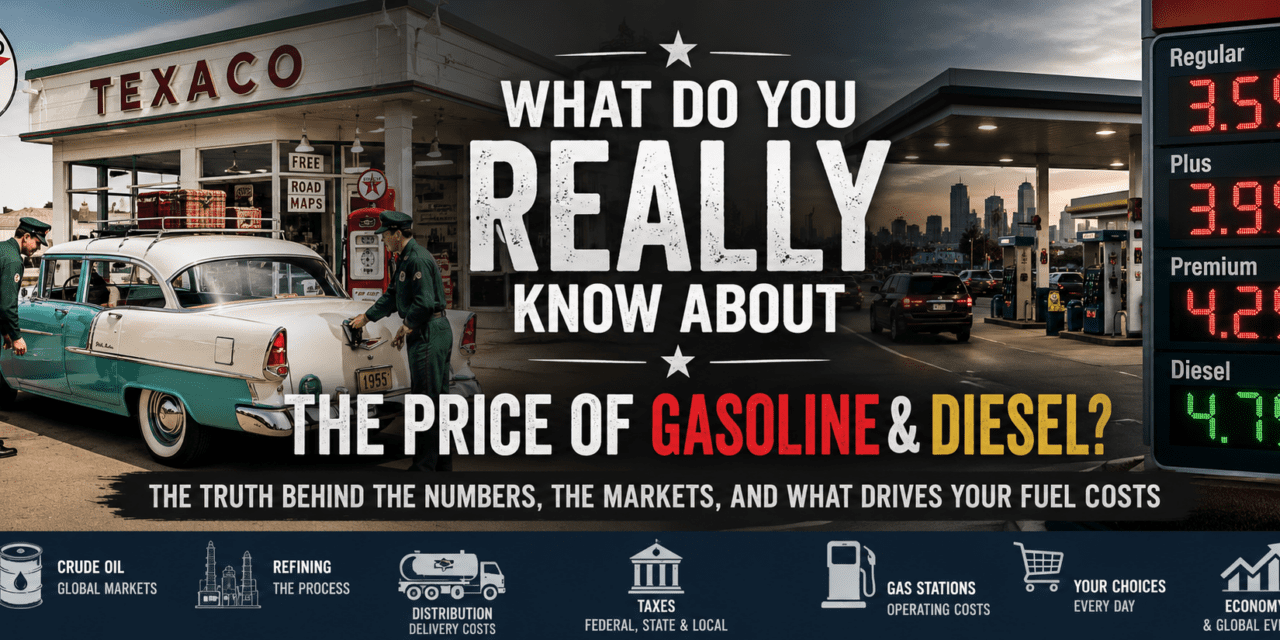
Most Americans know the current price of gasoline and diesel within a few cents per gallon. We notice when prices rise, celebrate when prices fall, and often use fuel prices as a measure of how well the economy is performing.
Yet surprisingly few people understand what actually determines the price of gasoline and diesel. Why is diesel sometimes more expensive than gasoline? Why do prices rise quickly but seem to fall slowly? How much of every gallon goes toward taxes, refining, transportation, and distribution costs?
The price of gasoline and diesel affects nearly every household and business in the United States. Fuel costs influence family vacations, daily commuting expenses, airline tickets, shipping costs, food prices, and the cost of almost every product delivered to a store.
Many discussions about the price of gasoline and diesel focus only on today’s headlines. However, understanding fuel prices requires looking beyond the gas pump and into crude oil markets, refineries, government policies, consumer behavior, and even world events occurring thousands of miles away.
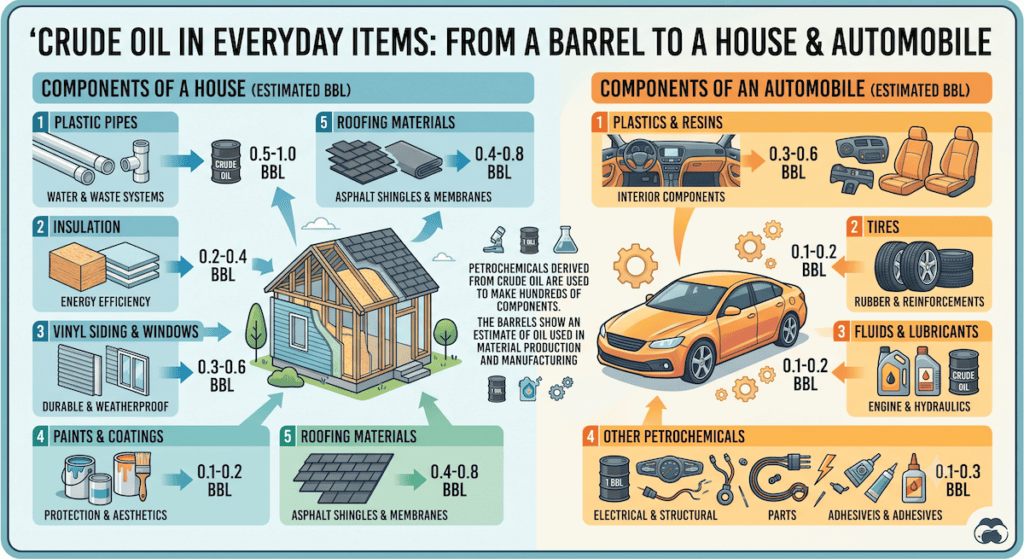
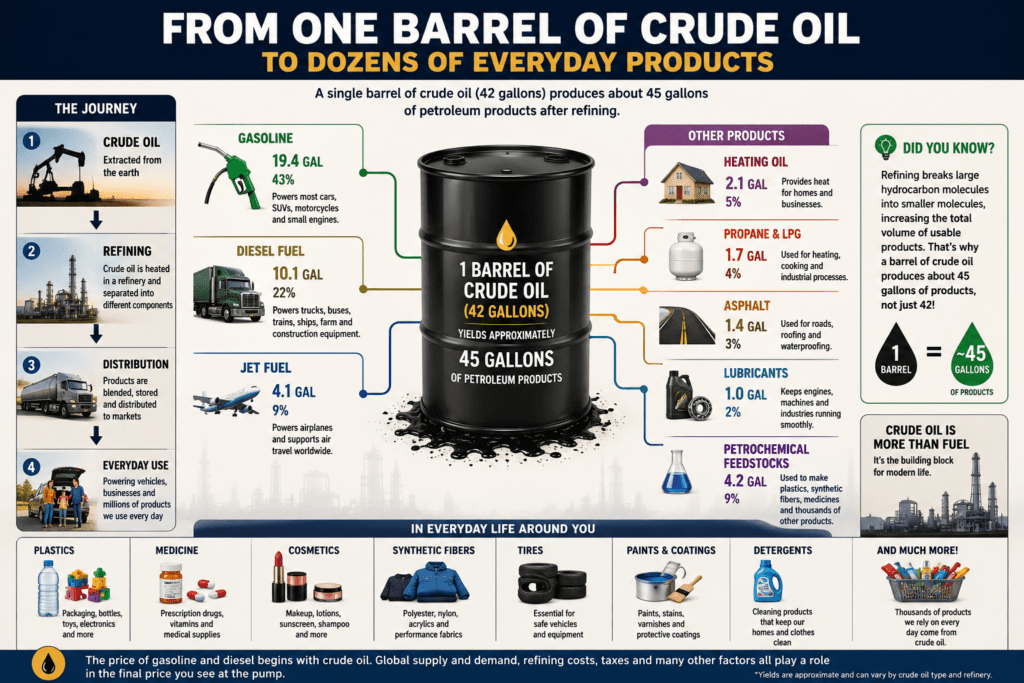
Figure 1: This infographic illustrates the hidden footprint of petrochemicals in manufacturing, estimating the fractional amounts of a standard barrel of crude oil required to produce the essential synthetic and structural components of a modern house and automobile.
- Introduction
- Major Factors that Influence the Price of Gasoline and Diesel Fuel
- How Good Is Your Memory?
- The Rise and Fall of the American Service Station
- How a Barrel of Crude Oil Becomes Gasoline and Diesel
- The Cost of Crude Oil: The Single Largest Factor in the Price of Gasoline and Diesel
- Why Crude Oil Matters
- Crude Oil Trades in a Global Market
- Supply and Demand Drive Prices
- Why Wars Affect Fuel Prices
- The Importance of the Middle East
- Hurricanes and Natural Disasters
- Refinery Turnarounds
- OPEC and Oil-Producing Countries
- Why Increased U.S. Production Matters
- More Production Does Not Guarantee Lower Prices
- The Difference Between High Prices and Shortages
- Why This Matters
- Did You Know?
- Why Doesn’t Gasoline Move Immediately?
- Keep This in Perspective
- Take our Survey
- What Are You Paying For When You Buy Gasoline or Diesel?
- Why Do Gasoline Prices Rise Quickly but Fall Slowly?
- One of the Most Common Complaints
- Gas Stations Must Replace Their Inventory
- The Replacement Cost Principle
- Why Prices Fall More Slowly
- Competition Still Matters
- Fuel Margins Are Often Smaller Than People Think
- Why Percentage Margins Matter
- The Convenience Store Connection
- Are Gas Stations Price Gouging?
- Why This Matters
- Why Small Businesses Pay Close Attention to the Price of Gasoline and Diesel
- Fuel Costs Are Eventually Passed to Consumers
- Fuel Is a Major Operating Expense
- Landscaping and Lawn Care
- Independent Trucking and Hotshot Hauling
- HVAC, Plumbing, and Electrical Contractors
- Mobile Pet Groomers and Food Trucks
- Industry Comparison
- Why Oil and Fluids Matter Too
- Why This Matters
- Planning Ahead for Fuel Costs
- How Much of the Price of Gasoline and Diesel Is Taxes?
- Refining: The Hidden Factor Most Consumers Never Think About
- Crude Oil Is Only the Beginning
- What Does a Refinery Do?
- Why Refining Costs Affect Fuel Prices
- Refinery Capacity Matters
- What Is a Refinery Turnaround?
- Why Turnarounds Can Affect Prices
- Why Hurricanes Affect Fuel Prices
- The Gulf Coast’s Importance
- Why California Often Experiences Larger Price Swings
- Why Diesel and Gasoline Have Different Prices
- Ultra-Low Sulfur Diesel
- Why Refining Is So Important
- Why This Matters
- 🏭 Did You Know?
- 🌽 Did You Know? About 10% of Your Gasoline Comes From Corn
- Corn in Your Fuel Tank.
- Why Are Gasoline and Diesel Prices Different?
- One of the Most Common Fuel Questions
- Both Fuels Come From the Same Barrel
- Gasoline Primarily Serves Passenger Vehicles
- Diesel Powers the Economy
- Diesel Demand Is Different
- Environmental Regulations Matter
- Why Diesel Sometimes Costs More
- Why Diesel Sometimes Costs Less
- Why Truckers Watch Diesel Prices So Closely
- Why This Matters
- Author Note: What You See Is Not Always the Whole Story
- Why Do Gasoline Prices Rise Quickly but Fall Slowly?
- One of the Most Common Complaints
- Fuel Is Purchased Before It Is Sold
- Why Prices Often Rise Quickly
- Cash Flow Matters
- Why Prices Sometimes Fall More Slowly
- Inventory Replacement Economics
- Maintaining a Consistent Margin
- What About Gas Station Profits?
- Why Convenience Stores Became Essential
- The Fuel Business Has Changed
- Why This Matters
- California and Mississippi: Two Different Approaches to Fuel Pricing
- Why Americans Watch Gasoline Prices So Closely
- What Really Determines the Price of Gasoline and Diesel?
- Quiz about Gasoline and Diesel
- FAQ
Major Factors that Influence the Price of Gasoline and Diesel Fuel
This article explores the major factors that influence the price of fuel, including crude oil prices, refining costs, federal and state taxes, environmental regulations, transportation costs, seasonal demand, and global market forces.
Along the way, we will also examine why Americans pay so much attention to fuel prices and why the price displayed on a gas station sign has become one of the nation’s most visible economic indicators.
Before we dive into the mechanics behind the price of gasoline and diesel, let’s take a trip back to a very different era. There was a time when fuel prices remained relatively stable for years, service stations were community gathering places, and filling up the family car was often an event rather than a chore.
Understanding the rise and fall of the American service station provides valuable perspective on how dramatically the fuel industry has changed—and why the price of gasoline and diesel matters so much today.
How Good Is Your Memory?
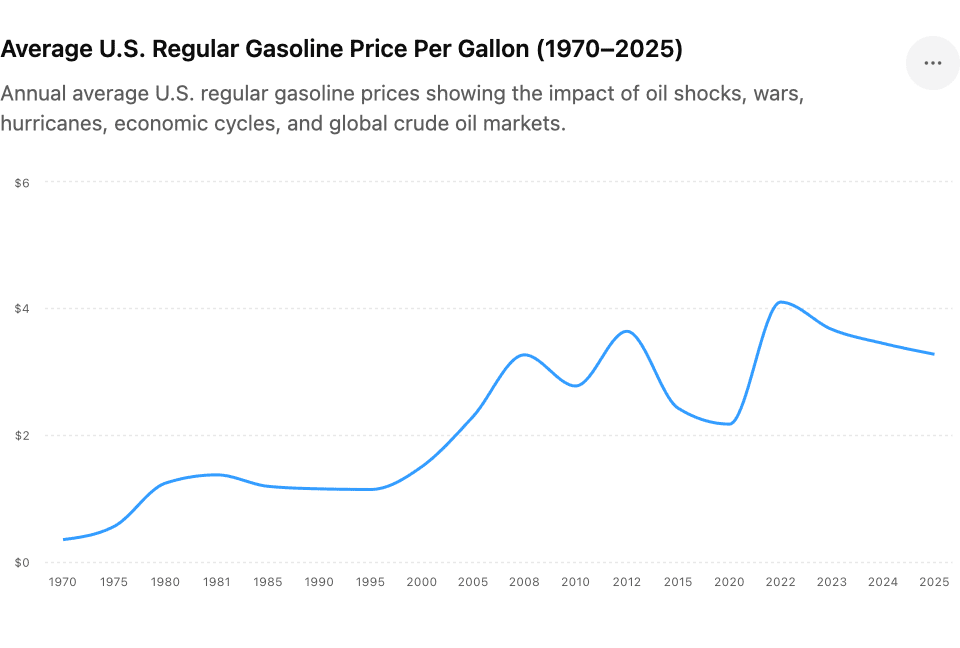
Many Americans can remember exactly what they paid for gasoline when they bought their first car, took their first family vacation, or drove to their first job. Enter any year from 1970 through 2025 and see the average U.S. gasoline price. You may be surprised by what you discover.
⛽ Gasoline Price Memory Quiz
How good is your memory? Enter a year between 1970 and 2025 to see the average U.S. regular gasoline price, who was president, and what was happening in the fuel market.
The Rise and Fall of the American Service Station
Before Gas Stations Existed
Before dedicated service stations existed, early motorists bought gasoline from hardware stores, blacksmith shops, pharmacies, and general stores. Fuel was often stored in cans or barrels and poured manually into the vehicle.
This was not convenient, clean, or especially safe. As automobile ownership increased in the early twentieth century, America needed a better way to sell fuel.
The Birth of the Drive-In Service Station
The modern service station began taking shape in the early 1900s. Instead of buying gasoline from the back of another business, motorists could pull off the road and drive directly to a pump.
One of the most important milestones came in 1913, when Gulf Refining opened a purpose-built drive-in service station in Pittsburgh, Pennsylvania. It offered fuel, free air, water, and road maps.
That idea changed the relationship between Americans and gasoline. Buying fuel became part of the growing automobile culture.
Why Service Became the Business Model
By the 1920s, automobile ownership was expanding rapidly. Oil companies learned that drivers were not just buying gasoline; they were buying trust, convenience, and service.
Stations added uniformed attendants, clean restrooms, repair bays, tire service, batteries, oil changes, and mechanics. The local service station became one of the most important small businesses in town.
This history matters because the price of gasoline and diesel was only part of the customer relationship. In many cases, the real profit came from repairs, tires, batteries, oil, accessories, and maintenance services.
The Golden Age of the Service Station
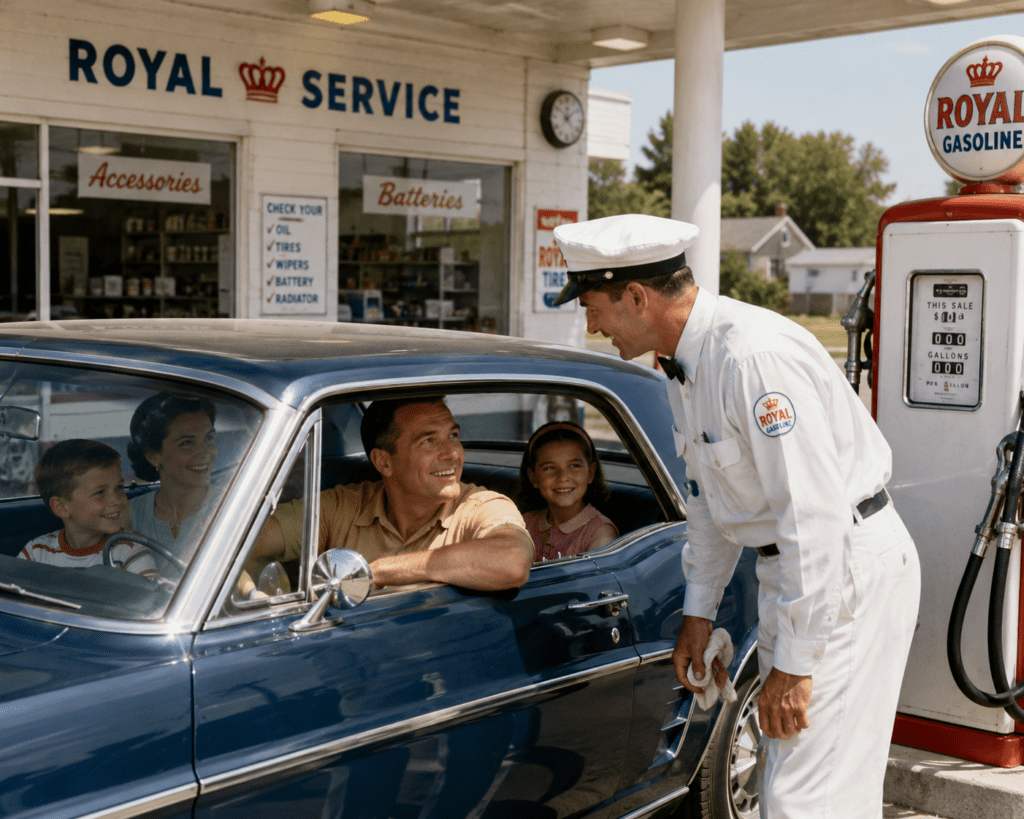
Pulling into a service station in the 1950s was less of a chore and more of a ritual. A family car rolled over the rubber hose, the bell rang inside the station, and uniformed attendants came out to greet the driver.
One attendant might pump the fuel while another cleaned the windshield. They often checked the oil, radiator water, tire pressure, battery, and windshield wipers.
If they found worn wipers, low oil, a weak battery, or a tire problem, they might recommend a repair or replacement. Many customers said yes because they knew and trusted the local station owner.
More Than a Place to Buy Gasoline
The service station was often a community gathering place. Teenagers found their first jobs there, families stopped before road trips, and neighbors visited with the owner or mechanic.
Many stations had repair bays where customers brought their cars for maintenance. They bought tires, batteries, oil changes, belts, hoses, and other automotive services.
That added income helped the station survive. Fuel alone was not always enough, even when the price of gasoline and diesel was stable for long periods.
Why the Old Model Began to Collapse
Several forces began weakening the full-service station model. Labor costs increased, cars became more reliable, and drivers became more focused on the lowest fuel price.
The 1970s oil shocks accelerated the shift. When gasoline prices rose sharply and shortages developed, customers became more willing to pump their own fuel if it saved a few cents per gallon.
Self-service reduced labor costs and allowed stations to compete more aggressively on price. The traditional full-service model began to disappear.
The Rise of the Convenience Store
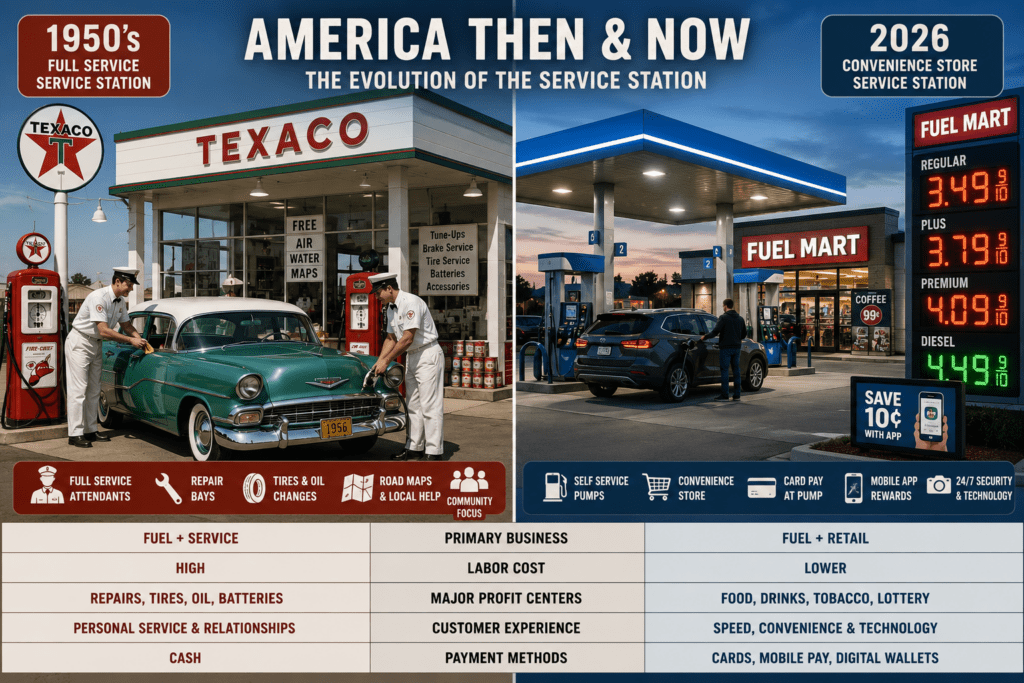
As repair bays disappeared, convenience stores moved in. Coffee, fountain drinks, snacks, prepared food, tobacco, lottery tickets, and basic household items became important profit centers.
This change was not accidental. Fuel margins were often thin, and the price of gasoline and diesel left station owners with limited profit after credit card fees, payroll, utilities, insurance, taxes, environmental compliance, and equipment costs.
Gasoline brought customers onto the property. The convenience store helped make the business profitable.
What Was Lost
Modern stations are faster, cleaner, and more efficient than many older service stations. Pay-at-the-pump technology, bright lighting, large convenience stores, and digital signs have made fuel buying easier.
But something was lost when the old service station disappeared. The uniformed attendant, the local mechanic, the free road map, and the familiar neighborhood owner were once part of everyday American life.
The old service station helps explain why fuel still feels personal to many Americans. The price of gasoline and diesel is not just a number on a sign; it is connected to driving, work, family trips, local businesses, and memories of a very different America.
How a Barrel of Crude Oil Becomes Gasoline and Diesel
It All Starts With Crude Oil
Every gallon of gasoline and diesel begins as crude oil. Crude oil is a naturally occurring mixture of hydrocarbons that formed over millions of years from ancient marine organisms, plants, and other organic matter.
Crude oil is produced around the world and traded in a global market. Because it is a global commodity, the price of gasoline and diesel is heavily influenced by events occurring far beyond your local gas station.
What Is a Barrel of Crude Oil?
When oil companies discuss production, they typically measure crude oil in barrels. A standard barrel contains 42 U.S. gallons.
Many people assume that a 42-gallon barrel of crude oil produces only 42 gallons of finished products. Surprisingly, modern refining processes often produce approximately 45 gallons of petroleum products from a single barrel.
This increase occurs because refining breaks large hydrocarbon molecules into smaller molecules, increasing the total volume of usable products.
The Refining Process
Crude oil cannot be pumped directly into a car, truck, airplane, or ship. It must first be processed at a refinery.
Refineries use heat, pressure, catalysts, and chemical processes to separate crude oil into various products. Each product boils at a different temperature and is collected during refining.
This process is one of the key factors influencing the price of gasoline and diesel.
What Comes From a Barrel of Crude Oil?
A typical barrel of crude oil produces a variety of products, including:
- Gasoline
- Diesel fuel
- Jet fuel
- Heating oil
- Propane
- Asphalt
- Lubricants
- Petrochemical feedstocks
Gasoline is usually the largest single product produced by a refinery, but it is only one part of the barrel.
Why Gasoline and Diesel Prices Are Different
One of the most frequently asked questions about the price of gasoline and diesel is why the two fuels often cost different amounts.
The answer begins at the refinery.
Gasoline and diesel require different refining processes. Diesel fuel must meet strict specifications, including ultra-low sulfur requirements, which add processing costs.
Demand patterns are also different. Gasoline is driven largely by passenger vehicles, while diesel powers trucks, trains, ships, farm equipment, construction equipment, and many industrial operations.
Crude Oil Is More Than Transportation Fuel
Many people think crude oil exists primarily to make gasoline. In reality, petroleum products are found throughout modern life.
Products derived from crude oil include:
- Tires
- Plastics
- Medical supplies
- Cosmetics
- Pharmaceuticals
- Packaging materials
- Synthetic fibers
- Paints and coatings
Understanding these products helps explain why crude oil remains important even as vehicle technologies evolve.
Why This Matters
The price of gasoline and diesel begins long before fuel arrives at a service station. It starts with crude oil production, global markets, refinery operations, and the complex process of converting crude oil into the products that power modern civilization.
Before we examine taxes, service stations, and consumer behavior, we first need to understand the single largest factor affecting the price of gasoline and diesel: the cost of crude oil itself.
The Cost of Crude Oil: The Single Largest Factor in the Price of Gasoline and Diesel
Why Crude Oil Matters
If there is one factor that has the greatest influence on the price of gasoline and diesel, it is the cost of crude oil.
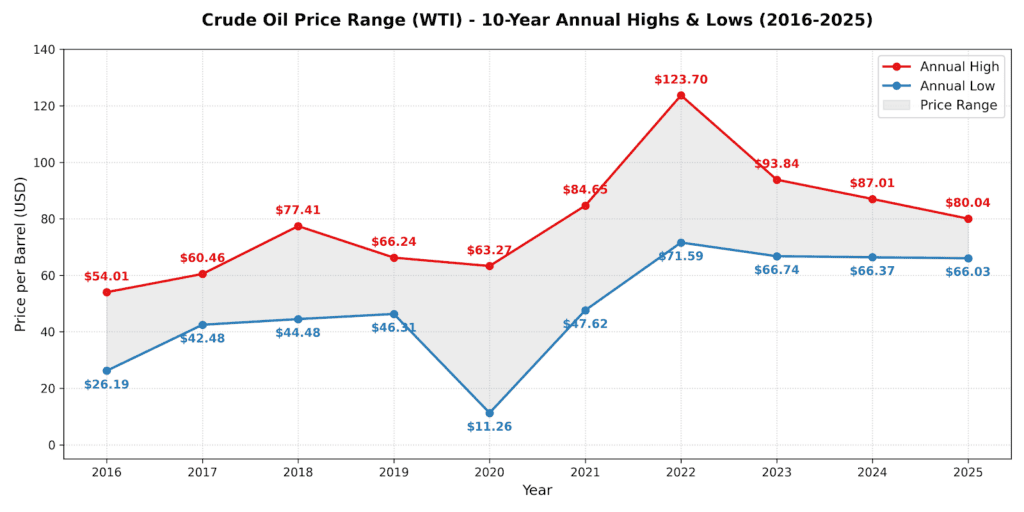
For most years, crude oil accounts for approximately one-half to three-fifths of the retail price of gasoline and diesel. When crude oil prices rise significantly, fuel prices almost always follow.
This is why energy analysts, investors, governments, and consumers closely monitor crude oil markets.
Crude Oil Trades in a Global Market
Many Americans assume that oil produced in Texas only affects Texas gasoline prices. In reality, crude oil is a globally traded commodity.
Oil produced in the United States competes in the same market as oil produced in Saudi Arabia, Canada, Brazil, Iraq, and dozens of other countries.
Because of this global market, events occurring thousands of miles away can influence the price of gasoline and diesel in your hometown.
Supply and Demand Drive Prices
Like most commodities, crude oil prices are heavily influenced by supply and demand.
When global demand increases faster than supply, prices tend to rise. When supply grows faster than demand, prices often fall.
Even small changes can have a significant impact because the world consumes enormous quantities of oil every day.
Why Wars Affect Fuel Prices
One of the fastest ways to move crude oil prices is through geopolitical instability.
When conflicts occur in major oil-producing regions, traders become concerned about future supply disruptions. In some cases, prices rise before a single barrel of oil is actually lost.
This uncertainty can quickly influence the price of gasoline and diesel.
The Importance of the Middle East
The Middle East contains some of the world’s largest oil reserves. Because of this, events in the region often receive significant attention from energy markets.
Particular attention is paid to transportation routes such as the Strait of Hormuz. A large percentage of the world’s oil supply passes through this narrow shipping corridor.
Any threat to these routes can influence crude oil prices worldwide.
Hurricanes and Natural Disasters
Not all supply disruptions originate overseas.
Major hurricanes in the Gulf of Mexico can temporarily shut down offshore production platforms, pipelines, ports, and refineries.
When significant production or refining capacity is interrupted, the price of gasoline and diesel may increase due to concerns about reduced supply.
Refinery Turnarounds
Most consumers have never heard the term “refinery turnaround.”
A refinery turnaround is a planned shutdown used for maintenance, inspections, repairs, and equipment upgrades. These shutdowns are necessary to maintain safe and efficient operations.
When large refineries reduce production during turnarounds, fuel supplies may tighten and contribute to higher prices.
OPEC and Oil-Producing Countries
Several major oil-producing countries coordinate production policies through organizations such as OPEC.
By increasing or decreasing production, these countries can influence global oil supplies and, ultimately, crude oil prices.
Because crude oil is the largest component of fuel costs, these decisions often affect the price of gasoline and diesel.
Why Increased U.S. Production Matters
For decades, U.S. crude oil production generally declined. During the past fifteen years, however, technological advances dramatically increased domestic production.
Horizontal drilling and hydraulic fracturing unlocked large new supplies of oil. The United States became one of the world’s largest oil producers.
More Production Does Not Guarantee Lower Prices
Many people assume that higher U.S. production automatically means lower fuel prices.
The reality is more complicated because crude oil remains part of a global market. Domestic production helps increase supply and improve energy security, but global events still influence pricing.
The Difference Between High Prices and Shortages
One of the biggest benefits of increased U.S. production may not be lower prices.
Instead, it may be a reduced risk of widespread shortages.
Many Americans remember the fuel lines of the 1970s. While the price of gasoline and diesel remains vulnerable to world events, today’s larger domestic production base helps reduce the likelihood of severe physical shortages.
Why This Matters
Before a refinery produces a gallon of gasoline or diesel fuel, crude oil must first be purchased.
That purchase price becomes the foundation upon which refining costs, transportation costs, taxes, marketing expenses, and retail margins are added.
Understanding crude oil markets is the first step toward understanding the price of gasoline and diesel that consumers see every day.
I like the concept, but I’d strengthen it and tie it directly to the calculator you’re planning.
Did You Know?
Most Americans know the price of gasoline and diesel, but few understand how closely fuel prices are tied to crude oil.
A standard barrel contains 42 gallons of crude oil. Because there are 42 gallons in a barrel, a $1 increase in crude oil prices increases the raw crude cost of gasoline by approximately 2.4 cents per gallon before refining, transportation, taxes, and retail margins are added.
A Quick Example
| Change in Crude Oil Price | Approximate Change in Raw Gasoline Cost |
|---|---|
| $1 per barrel | 2.4¢ per gallon |
| $5 per barrel | 12¢ per gallon |
| $10 per barrel | 24¢ per gallon |
| $20 per barrel | 48¢ per gallon |
Why Doesn’t Gasoline Move Immediately?
Many consumers expect gasoline prices to fall instantly when crude oil prices decline.
In reality, crude oil must be refined, transported, distributed, and sold through a network of wholesalers and retailers. Existing inventories purchased at higher prices may also delay price reductions.
As a result, changes in crude oil prices often take days or weeks to fully work their way through the system and affect the retail price of gasoline and diesel.
Keep This in Perspective
If crude oil rises from $60 to $70 per barrel, many people expect gasoline prices to increase by a full dollar per gallon.
In reality, the crude oil portion of the increase is closer to 24 cents per gallon. The remainder of the price of gasoline and diesel is influenced by refining costs, transportation costs, taxes, marketing expenses, environmental regulations, local competition, and retail margins.
Try Our Crude Oil Impact Calculator: Enter any crude oil price increase or decrease and see the estimated impact on the price of gasoline and diesel at the pump.
This callout naturally leads readers into your calculator and reinforces one of the most important lessons in the article: crude oil is the largest factor affecting fuel prices, but it is not the only factor.
Take our Survey
What Are You Paying For When You Buy Gasoline or Diesel?
More Than Just Crude Oil
Many consumers assume the price of gasoline and diesel is simply the cost of crude oil plus a small profit for the gas station.
In reality, several costs are added to crude oil before fuel reaches your vehicle. Every gallon represents the combined cost of extraction, transportation, refining, taxes, distribution, marketing, and retail operations.
Understanding these costs helps explain why the price of gasoline and diesel can vary significantly from one state to another.
The Four Major Components of Fuel Prices
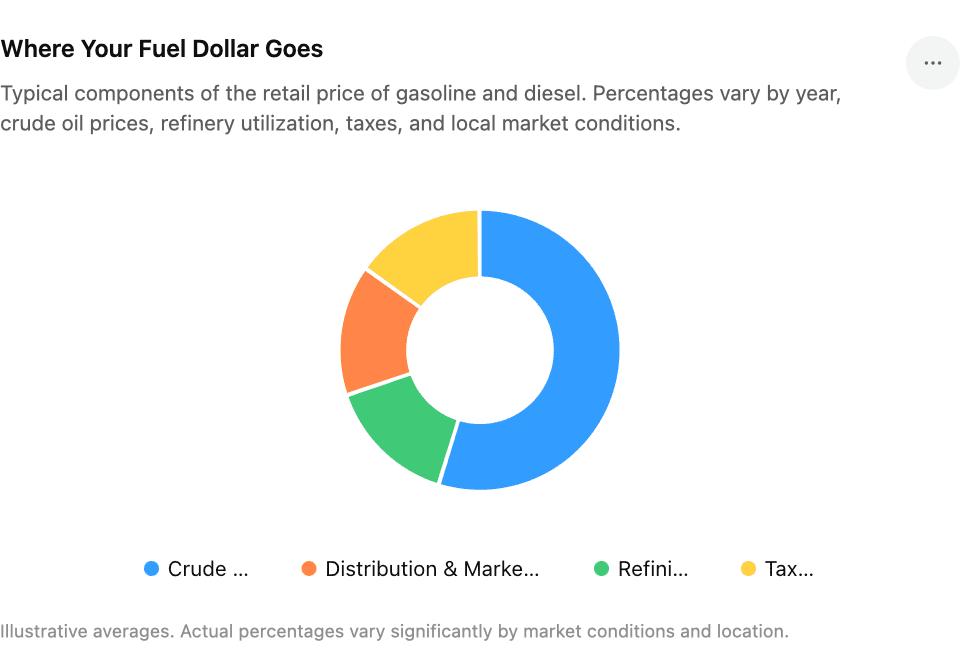
According to industry estimates and data from the U.S. Energy Information Administration, the retail price of gasoline and diesel generally consists of four major components:
- Crude oil costs
- Refining costs
- Distribution and marketing costs
- Taxes
The percentage attributed to each category changes over time as market conditions change.
Crude Oil Costs
Crude oil is usually the largest component of the price of gasoline and diesel.
For many years, crude oil has accounted for approximately 50% to 60% of the retail price of fuel. When crude oil prices increase, gasoline and diesel prices usually follow.
This is why news reports frequently discuss the price of crude oil when explaining fuel price movements.
Refining Costs
Crude oil cannot be used directly in most vehicles. It must first be refined into gasoline, diesel fuel, jet fuel, and other petroleum products.
Refineries are expensive to build, operate, maintain, and periodically upgrade. Environmental regulations, equipment maintenance, labor costs, and energy costs all contribute to refining expenses.
Refining costs become especially important when refinery capacity is tight or when refineries undergo planned maintenance known as turnarounds.
Distribution and Marketing Costs
After refining, fuel must be transported to distribution terminals and local service stations.
This process may involve:
- Pipelines
- Tanker ships
- Barges
- Railroads
- Tanker trucks
Storage costs, handling costs, transportation expenses, and marketing expenses all become part of the final price of gasoline and diesel.
Taxes
Federal, state, and sometimes local governments impose taxes on fuel sales.
These taxes vary significantly by location. As a result, the price of gasoline and diesel can differ substantially between states even when wholesale fuel costs are nearly identical.
We’ll take a closer look at fuel taxes in the next section.
Why Prices Differ From One Location to Another
Many consumers wonder why fuel may be cheaper across town or in a neighboring state.
The answer often involves a combination of:
- Different tax structures
- Transportation costs
- Local competition
- Supply conditions
- Environmental fuel requirements
Even though crude oil trades in a global market, local factors still influence the final price of gasoline and diesel.
Building the Pump Price
Think of fuel pricing as a series of layers.
First comes crude oil. Then refining costs are added. Next come transportation and distribution costs. Taxes are added along the way. Finally, the retailer adds a modest margin to cover operating expenses and earn a profit.
By the time a gallon reaches the pump, it has traveled through one of the most complex supply chains in the world.
Why This Matters
The next time you see the price of gasoline and diesel increase, remember that crude oil is only one part of the equation.
Refineries, pipelines, tanker trucks, taxes, environmental requirements, local competition, and distribution networks all play important roles in determining the final price displayed on the sign outside your local station.
Try the Crude Oil to Gasoline Price Impact Calculator
Want to see how a change in crude oil prices may affect the price of gasoline? Enter today’s crude oil price and a “what-if” price to estimate the raw per-gallon impact.
A $1 change in crude oil equals approximately 2.4 cents per gallon before refining, transportation, taxes, distribution costs, and retail margins are added.
Estimate how a change in the price of crude oil could affect gasoline prices and your monthly fuel spending.
Compare a current crude oil price with a possible future price. You can also adjust how much of the crude oil change reaches retail gasoline prices.
Results update automatically as you change the inputs.
A $10.00 increase in crude oil prices equals approximately 23.8 cents of additional crude oil cost per gallon before applying the selected 70% pass-through assumption. That produces an estimated gasoline-price increase of about 16.7 cents per gallon.
Crude price change ÷ 42 gallons per barrel × pass-through percentage = estimated gasoline price change per gallon.
You can also open the calculator on its own page or explore more free RetireCoast calculators.
Why Do Gasoline Prices Rise Quickly but Fall Slowly?
One of the Most Common Complaints
Almost everyone who drives has experienced it.
Crude oil rises on the news, and within days the price of gasoline and diesel seems to increase. Yet when crude oil prices fall, gasoline prices often appear to decline much more slowly.
Many consumers assume this means gas stations are taking advantage of customers. In reality, the answer is usually more complicated.
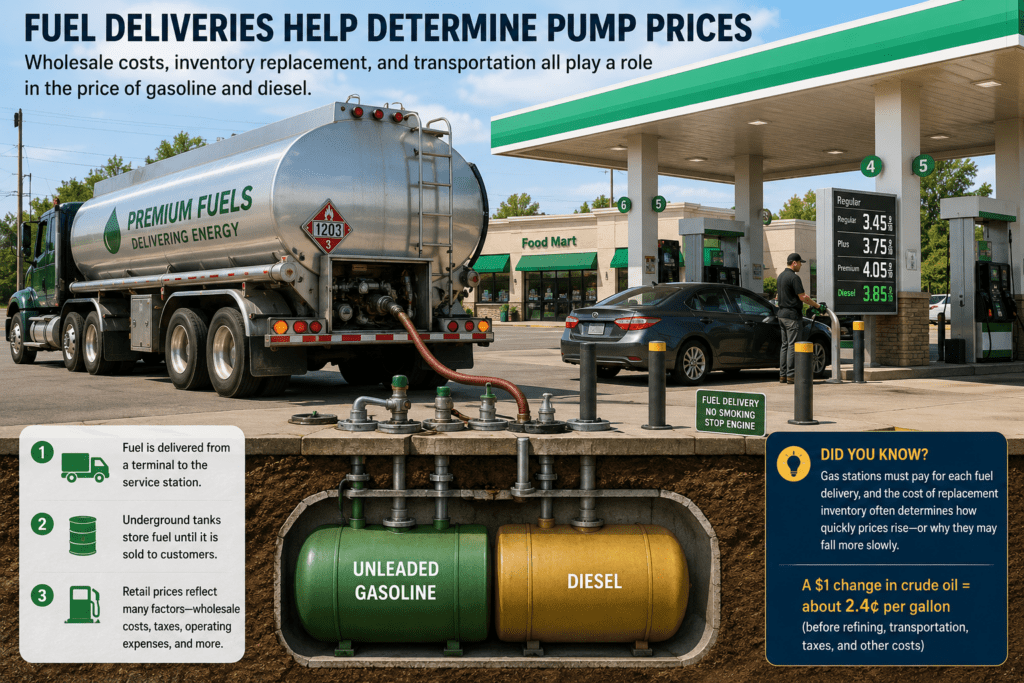
Gas Stations Must Replace Their Inventory
When a service station receives a fuel delivery, the owner must generally pay for that fuel immediately or through an electronic funds transfer arrangement with the supplier.
The new fuel arrives at the station with a specific wholesale cost. If the next delivery costs more than the previous one, the station owner knows future inventory will be more expensive.
As a result, prices often increase soon after a higher-priced delivery arrives.
The Replacement Cost Principle
Imagine a station purchases fuel at $3.00 per gallon and sells it for $3.15.
A few days later, the next delivery arrives at $3.10 per gallon. Even if some lower-cost fuel remains in the underground tanks, the owner knows replacement inventory will cost more.
To avoid selling future inventory at a loss, the station may increase prices immediately.
Why Prices Fall More Slowly
The opposite situation also occurs.
Suppose a station receives fuel at a wholesale cost of $3.10 per gallon. A day later, wholesale prices fall.
The station still has inventory purchased at the higher price. If prices are lowered immediately, some of that inventory may be sold at little profit or even at a loss.
This is one reason the price of gasoline and diesel may appear to fall more slowly than it rises.
Competition Still Matters
Consumers sometimes imagine that station owners can charge whatever they want.
In reality, most stations operate in highly competitive local markets. Owners closely monitor nearby competitors and often adjust prices multiple times each day.
A station that prices fuel too high may quickly lose customers to a competitor down the street.
Fuel Margins Are Often Smaller Than People Think
Many people assume gas stations make enormous profits from fuel sales.
The truth is that fuel margins are often surprisingly small. In many cases, the gross profit on a gallon of gasoline may be only a few cents.
Out of that margin, owners must pay labor costs, utilities, insurance, maintenance, property taxes, environmental compliance costs, credit card processing fees, and other business expenses.
Why Percentage Margins Matter
Suppose a station owner targets a 10% gross margin.
If wholesale fuel costs rise by 10 cents per gallon, maintaining the same percentage margin may require increasing the retail price by slightly more than 10 cents.
This helps explain why retail fuel prices sometimes move more than consumers expect.
The Convenience Store Connection
The limited profitability of fuel sales explains why most modern stations include convenience stores.
Coffee, soft drinks, snacks, prepared food, lottery tickets, and other merchandise often generate higher profit margins than fuel itself.
For many locations, fuel attracts customers to the property while convenience store sales help support the business.
Are Gas Stations Price Gouging?
Most of the time, no.
While isolated examples of price gouging occasionally occur during emergencies, the vast majority of fuel pricing reflects wholesale costs, replacement inventory costs, local competition, taxes, and operating expenses.
Understanding these factors helps explain why the price of gasoline and diesel sometimes behaves differently than consumers expect.
Why This Matters
The next time gasoline prices change unexpectedly, remember that the number displayed on the sign reflects much more than today’s crude oil price.
Fuel deliveries, wholesale costs, competition, inventory replacement costs, operating expenses, and consumer demand all play a role in determining the final price of gasoline and diesel at your local station.
Why Small Businesses Pay Close Attention to the Price of Gasoline and Diesel
Fuel Costs Are Eventually Passed to Consumers
When the price of gasoline and diesel rises, small business owners have limited options. They can absorb the additional costs and accept lower profits, become more efficient, or increase prices.
Over time, most fuel cost increases are passed along to consumers through higher prices for products and services. This is one reason fuel prices receive so much attention—they affect far more than what motorists pay at the pump.
Fuel Is a Major Operating Expense
For many small businesses, fuel is not a minor line item buried deep within an accounting report. Fuel is a critical operating necessity that keeps vehicles moving, equipment running, employees working, and customers served.
Industry benchmarks from trade associations, fleet operators, and small business accounting reports show that certain industries spend a surprisingly large percentage of their revenue and operating budgets on fuel and oil.
Landscaping and Lawn Care
Landscaping companies face what many owners describe as a “double fuel burden.”
Fuel is required to transport crews, trucks, trailers, and equipment to job sites. Additional fuel is consumed by commercial mowers, trimmers, blowers, chainsaws, and other power equipment.
Typical Fuel and Oil Costs
- 5% to 10% of gross revenue
- 10% to 15% of total operating expenses
A landscaping company generating $200,000 in annual revenue may spend $10,000 to $20,000 on gasoline, diesel fuel, two-cycle fuel mixtures, engine oil, and related fluids.
During periods of high fuel prices, those percentages can increase significantly and quickly reduce profitability.

Independent Trucking and Hotshot Hauling
Few industries are more sensitive to fuel costs than transportation.
For owner-operators and small trucking companies, diesel fuel is often the largest variable expense in the entire business.
Typical Fuel and Oil Costs
- 20% to 35% of gross revenue
- 30% to 50% of total operating expenses
A small trucking operation generating $150,000 in annual revenue may spend $35,000 to $50,000 or more on diesel fuel, engine oil, filters, and fluid maintenance.
When diesel prices rise, transportation costs increase almost immediately, and those costs eventually work their way through the economy.
HVAC, Plumbing, and Electrical Contractors
These businesses operate mobile workshops that travel continuously between customer locations.
Their fuel costs are somewhat lower as a percentage of revenue because a large portion of their income comes from skilled labor and parts sales.
Typical Fuel and Oil Costs
- 3% to 6% of gross revenue
- 7% to 12% of total operating expenses
Even so, heavily loaded service vans carrying tools, parts, and equipment often experience poor fuel economy, especially in stop-and-go traffic.
Mobile Pet Groomers and Food Trucks
These businesses consume fuel in ways many people never consider.
Not only must they drive to customer locations or events, but many also operate onboard generators, refrigeration systems, water heaters, air conditioning systems, and other equipment throughout the day.
Typical Fuel and Oil Costs
- 6% to 12% of gross revenue
- 12% to 20% of total operating expenses
Because engines and generators may run continuously for hours, fuel consumption can rival that of businesses traveling much greater distances.
Industry Comparison
| Business Type | % of Gross Revenue | % of Operating Expenses | Primary Fuel Use |
|---|---|---|---|
| Independent Trucking | 20%–35% | 30%–50% | Diesel-powered transportation |
| Mobile Grooming & Food Trucks | 6%–12% | 12%–20% | Generators and vehicle operation |
| Landscaping & Lawn Care | 5%–10% | 10%–15% | Trucks, trailers, mowers, and equipment |
| HVAC, Plumbing & Electrical | 3%–6% | 7%–12% | Service vans and mobile operations |
Why Oil and Fluids Matter Too
Fuel is only part of the equation.
The same engines that consume gasoline and diesel also require regular oil changes, filters, lubricants, hydraulic fluids, transmission fluids, and other maintenance items.
For many businesses, oil and fluid maintenance accounts for approximately 5% to 10% of their total fuel and fluid budget.
Landscaping equipment often requires frequent oil changes because small engines operate at extremely high RPMs. Heavy-duty diesel trucks may require 10 to 15 quarts of oil or more per service, turning routine maintenance into a significant expense.
Why This Matters
The next time the price of gasoline and diesel rises, remember that the impact extends far beyond personal driving budgets.
Fuel costs affect landscapers, contractors, truckers, food trucks, mobile service providers, and countless other small businesses. As operating expenses increase, many businesses eventually pass those higher costs to consumers in the form of higher prices for goods and services.
This is one reason fuel prices remain one of the most closely watched economic indicators in the United States.
Planning Ahead for Fuel Costs
Fuel prices can change rapidly, but your budget does not have to be caught by surprise.
Whether you have a long daily commute, operate a landscaping company, manage service vehicles, or run a trucking business, fuel is often one of the most unpredictable expenses in your budget.
Successful businesses do not just react to today’s price of gasoline and diesel. They build forecasts and evaluate how future changes in crude oil prices may affect operating costs, pricing decisions, and profitability.
The RetireCoast Business Membership includes planning tools designed to help business owners forecast fuel expenses, model operating costs, evaluate pricing strategies, and plan for changes in crude oil, gasoline, and diesel prices.
The next section should be one of the strongest in the article because it addresses a question that every driver asks:
“How much of the price of gasoline and diesel is taxes?”
This section also allows you to discuss federal excise taxes, state fuel taxes, road funding, electric vehicles, and why prices vary dramatically between states.
How Much of the Price of Gasoline and Diesel Is Taxes?
Taxes Are Part of Every Gallon
When consumers see the price of gasoline and diesel, they are looking at more than crude oil, refining costs, transportation expenses, and retail margins.
Federal, state, and sometimes local governments also collect taxes on every gallon sold.
These taxes can account for a significant portion of the final price at the pump.
Federal Fuel Taxes
The federal government imposes excise taxes on motor fuels sold in the United States.
As of 2025:
- Gasoline: 18.4 cents per gallon
- Diesel Fuel: 24.4 cents per gallon
Unlike a sales tax that changes as prices rise or fall, these taxes are charged on a per-gallon basis.
Whether gasoline costs $2.50 or $5.00 per gallon, the federal fuel tax remains the same.
State Fuel Taxes
Every state imposes its own fuel tax structure.
Some states apply a fixed per-gallon tax. Others combine excise taxes with environmental fees, inspection fees, storage fees, or percentage-based assessments.
As a result, the tax burden can vary dramatically from one state to another.
Why California and Mississippi Are Different
California and Mississippi provide a good example of how taxes influence the price of gasoline and diesel.
California has some of the highest fuel taxes and environmental compliance costs in the nation. Special fuel formulations required by environmental regulations also increase refining costs.
Mississippi generally has lower fuel taxes and fewer specialized fuel requirements, contributing to lower pump prices.
Taxes are not the only reason prices differ between states, but they are an important factor.
What Do Fuel Taxes Pay For?
Historically, fuel taxes were designed as a user fee.
The theory was simple:
People who use roads more frequently purchase more fuel and therefore contribute more toward road maintenance and transportation infrastructure.
Fuel tax revenue commonly helps fund:
- Highway construction
- Road maintenance
- Bridge repairs
- Transportation infrastructure
- Traffic safety programs
- Certain transit projects
The Electric Vehicle Challenge
Fuel taxes worked reasonably well when nearly every vehicle consumed gasoline or diesel.
The rapid growth of electric vehicles has created a new challenge.
Because electric vehicles purchase little or no gasoline, they contribute less—or nothing—to traditional fuel tax systems despite using the same roads and bridges.
The Search for New Funding Sources
Many states are evaluating alternatives to traditional fuel taxes.
Potential solutions include:
- Annual electric vehicle registration fees
- Vehicle miles traveled (VMT) fees
- Road usage charges
- Increased registration fees
- Alternative transportation taxes
The debate is likely to continue as electric vehicle adoption increases.
Why Fuel Taxes Matter
Fuel taxes may seem relatively small on a single fill-up.
However, for commuters, trucking companies, landscapers, contractors, and businesses operating large vehicle fleets, these costs add up over time.
They become another component of the price of gasoline and diesel that ultimately affects both consumers and businesses.
Why This Matters
When discussing the price of gasoline and diesel, many people focus entirely on crude oil prices.
Yet taxes represent a meaningful portion of every gallon sold. Understanding how these taxes work helps explain why fuel prices differ between states and why transportation funding remains an important public policy issue.
Suggested Infographic
Fuel Taxes by State Comparison
| State | Gasoline Tax (Approx.) |
|---|---|
| California | High |
| Illinois | High |
| Pennsylvania | High |
| Texas | Moderate |
| Florida | Moderate |
| Mississippi | Low |
| Alaska | Very Low |
(Use current figures when you build the infographic.)
Suggested Callout
Did You Know?
A driver who purchases 600 gallons of gasoline per year pays approximately $110 per year in federal gasoline taxes alone, before any state fuel taxes are added. For businesses operating fleets of vehicles, fuel taxes can become a significant operating expense.
Refining: The Hidden Factor Most Consumers Never Think About
Crude Oil Is Only the Beginning
Many people assume that crude oil prices alone determine the price of gasoline and diesel.
Crude oil is certainly the largest component of fuel costs, but crude oil has little value to motorists until it is converted into usable fuels. That conversion process occurs inside a refinery.
Without refineries, crude oil is simply a raw material that cannot power cars, trucks, tractors, ships, or airplanes.
What Does a Refinery Do?
A refinery is one of the most complex industrial facilities in the world.
Its job is to separate crude oil into various products and then process those products into fuels and other useful materials. Refineries operate around the clock and process hundreds of thousands of barrels of crude oil every day.
The refining process requires enormous investments in equipment, energy, maintenance, environmental compliance, and skilled labor.
Why Refining Costs Affect Fuel Prices
Every gallon of gasoline and diesel sold in the United States must pass through a refinery.
As a result, refinery operating costs become part of the final price of gasoline and diesel.
These costs include:
- Labor
- Electricity and natural gas
- Maintenance
- Environmental compliance
- Equipment replacement
- Safety systems
- Transportation infrastructure
When refining costs rise, fuel prices often rise as well.
Refinery Capacity Matters
The United States consumes enormous amounts of transportation fuel every day.
If refinery capacity exceeds demand, fuel supplies remain plentiful and prices generally remain stable.
However, when refinery capacity becomes constrained, even temporarily, fuel prices can increase rapidly.
This is one reason the price of gasoline and diesel sometimes rises even when crude oil prices remain relatively stable.
What Is a Refinery Turnaround?
One of the least understood terms in the energy industry is the refinery turnaround.
A turnaround is a planned shutdown of part or all of a refinery for inspections, repairs, equipment replacement, and preventive maintenance.
These shutdowns are necessary to ensure safety and reliability.
While a turnaround is underway, refinery production declines, reducing the volume of fuel entering the marketplace.
Why Turnarounds Can Affect Prices
Most refinery turnarounds are scheduled months or even years in advance.
Even so, removing a large refinery from service can temporarily tighten supplies of gasoline, diesel fuel, or jet fuel.
If several refineries conduct turnarounds at the same time, the effect on the price of gasoline and diesel can become noticeable.
Why Hurricanes Affect Fuel Prices
Americans often hear that hurricanes in the Gulf of Mexico affect fuel prices.
The reason is simple.
A large percentage of U.S. refining capacity is located along the Gulf Coast. Hurricanes can disrupt:
- Offshore oil production
- Refineries
- Pipelines
- Fuel terminals
- Shipping channels
- Fuel deliveries
Even when facilities suffer little physical damage, precautionary shutdowns may reduce fuel production and increase prices.
The Gulf Coast’s Importance
The Gulf Coast is one of the most important energy regions in the world.
Crude oil arrives by pipeline, tanker ship, and offshore production platforms. Massive refineries convert that crude oil into gasoline, diesel fuel, jet fuel, and other products that are shipped throughout the United States.
This concentration of infrastructure makes the region extremely efficient, but it also means disruptions can affect fuel prices nationwide.
Why California Often Experiences Larger Price Swings
California’s fuel market operates differently than most of the country.
The state requires specialized fuel formulations designed to meet strict environmental standards. These fuels are not widely produced elsewhere.
As a result, when a major California refinery experiences operational problems, replacement supplies can be difficult to obtain quickly.
This helps explain why the price of gasoline and diesel in California often moves more dramatically than prices in other states.
Why Diesel and Gasoline Have Different Prices
One of the most frequently asked questions about the price of gasoline and diesel is why the two fuels often cost different amounts.
The answer begins at the refinery.
Although both products originate from crude oil, they require different refining processes and serve different markets.
Diesel fuel powers:
- Commercial trucks
- Trains
- Ships
- Agricultural equipment
- Construction equipment
- Backup generators
Gasoline primarily powers passenger vehicles.
Because demand patterns differ, diesel and gasoline prices often move independently of one another.
Ultra-Low Sulfur Diesel
Modern diesel fuel must meet strict environmental standards.
Ultra-low sulfur diesel requires additional processing to remove sulfur compounds from the fuel.
These extra refining steps increase production costs and can contribute to higher diesel prices.
Why Refining Is So Important
Most consumers focus on crude oil prices because those prices receive the most media attention.
However, even if crude oil supplies are abundant, consumers still need refineries to convert that crude oil into usable fuels.
A refinery outage can sometimes affect the price of gasoline and diesel more quickly than a change in crude oil prices.
Why This Matters
The next time you hear news about refinery maintenance, a refinery fire, a hurricane in the Gulf Coast region, or a refinery outage in California, remember that these events can influence fuel prices even when crude oil prices remain unchanged.
Refining is one of the most important—and least understood—factors affecting the price of gasoline and diesel.
🏭 Did You Know?
A modern refinery is one of the most expensive industrial facilities ever built. Constructing a major refinery can cost billions of dollars and often requires years of permitting, engineering, environmental review, and construction before the first gallon of fuel is produced.
Because relatively few new refineries have been built in the United States during recent decades, the nation relies heavily on a limited number of existing facilities. These refineries have become critical infrastructure supporting transportation, manufacturing, agriculture, aviation, and national commerce.
When a major refinery experiences a fire, hurricane shutdown, equipment failure, or planned maintenance turnaround, fuel production can decline significantly. Even if crude oil supplies remain plentiful, reduced refining capacity can increase the price of gasoline and diesel.
In some cases, the effects of a refinery outage can be felt hundreds or even thousands of miles away as fuel distributors compete for limited supplies. This is one reason refinery news often affects fuel prices almost as much as changes in crude oil markets.
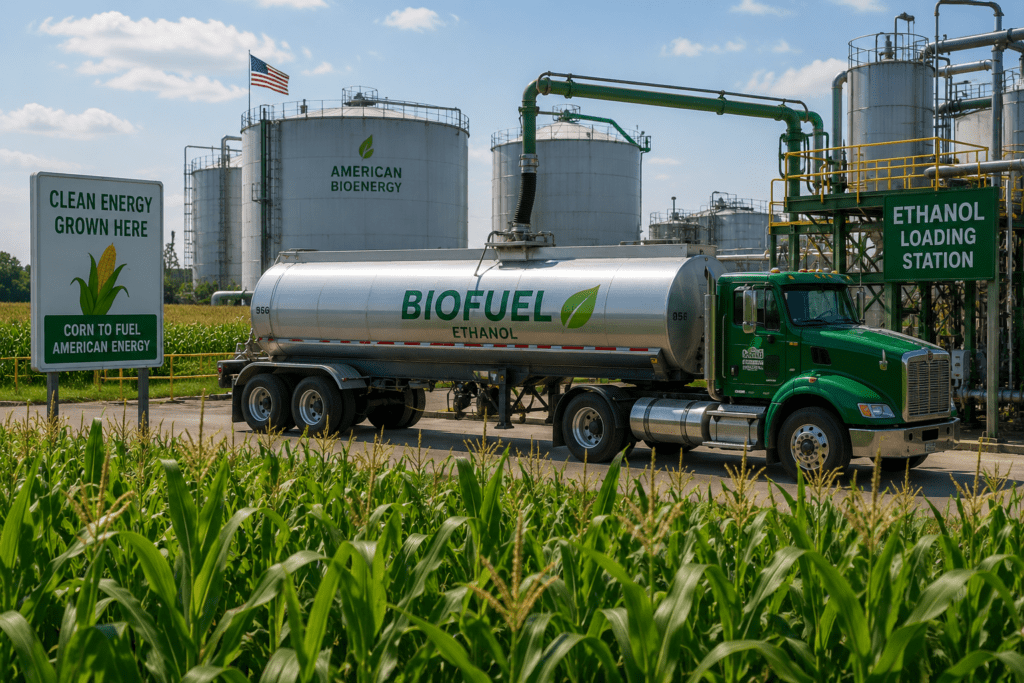
🌽 Did You Know? About 10% of Your Gasoline Comes From Corn
Many Americans are surprised to learn that a portion of the gasoline they purchase contains a biofuel produced from corn grown by American farmers.
Today, more than 98% of gasoline sold in the United States is blended as E10, meaning approximately 10% of every gallon consists of ethanol. Some stations also offer E15 for newer vehicles, while specialized E85 fuel is available for Flex-Fuel Vehicles designed to operate on much higher ethanol concentrations.
Producing this amount of ethanol requires an enormous agricultural effort. In recent years, approximately 35% to 40% of the entire U.S. corn crop has been used for ethanol production rather than direct food consumption.
Supporters argue that ethanol helps reduce dependence on imported oil, supports American farmers, strengthens rural economies, and diversifies the nation’s fuel supply. Critics question whether such a large percentage of agricultural production should be devoted to fuel when advances in domestic oil and natural gas production have significantly increased U.S. energy supplies.
Unlike crude oil, which is traded in a global market, ethanol is produced primarily from crops grown in the United States. As a result, weather conditions, crop yields, agricultural policies, and farming economics can influence a small but meaningful portion of the price of gasoline and diesel.
Regardless of where one stands in the debate, ethanol demonstrates that the modern fuel supply depends on far more than oil fields and refineries. Farms, weather, government policies, and agricultural markets all play a role in determining the fuel that eventually reaches your vehicle.
Corn in Your Fuel Tank.
Approximately 10% of most gasoline sold in the United States is ethanol produced from corn. While supporters view ethanol as an important domestic energy source and a benefit to American agriculture, critics question whether such a large share of the U.S. corn crop should be used for fuel production. Regardless of perspective, ethanol illustrates how farms and agricultural policy influence the modern fuel supply alongside crude oil and refineries.
🌽 Did You Know? About 10% of Your Gasoline Comes From Corn
Many Americans are surprised to learn that a portion of the gasoline they purchase contains a biofuel produced from corn grown by American farmers.
Today, more than 98% of gasoline sold in the United States is blended as E10, meaning approximately 10% of every gallon consists of ethanol. Some stations also offer E15 for newer vehicles, while specialized E85 fuel is available for Flex-Fuel Vehicles designed to operate on much higher ethanol concentrations.
Producing this amount of ethanol requires an enormous agricultural effort. In recent years, approximately 35% to 40% of the entire U.S. corn crop has been used for ethanol production rather than direct food consumption.
Supporters argue that ethanol helps reduce dependence on imported oil, supports American farmers, strengthens rural economies, and diversifies the nation’s fuel supply. Critics question whether such a large percentage of agricultural production should be devoted to fuel when advances in domestic oil and natural gas production have significantly increased U.S. energy supplies.
Unlike crude oil, which is traded in a global market, ethanol is produced primarily from crops grown in the United States. As a result, weather conditions, crop yields, agricultural policies, and farming economics can influence a small but meaningful portion of the price of gasoline and diesel.
Regardless of where one stands in the debate, ethanol demonstrates that the modern fuel supply depends on far more than oil fields and refineries. Farms, weather, government policies, and agricultural markets all play a role in determining the fuel that eventually reaches your vehicle.
Why Are Gasoline and Diesel Prices Different?
One of the Most Common Fuel Questions
One of the most frequently asked questions about the price of gasoline and diesel is why the two fuels often sell for different prices.
Sometimes diesel costs less than gasoline. At other times, diesel may cost significantly more.
The answer involves refining, demand, regulations, and the different industries that rely on each fuel.
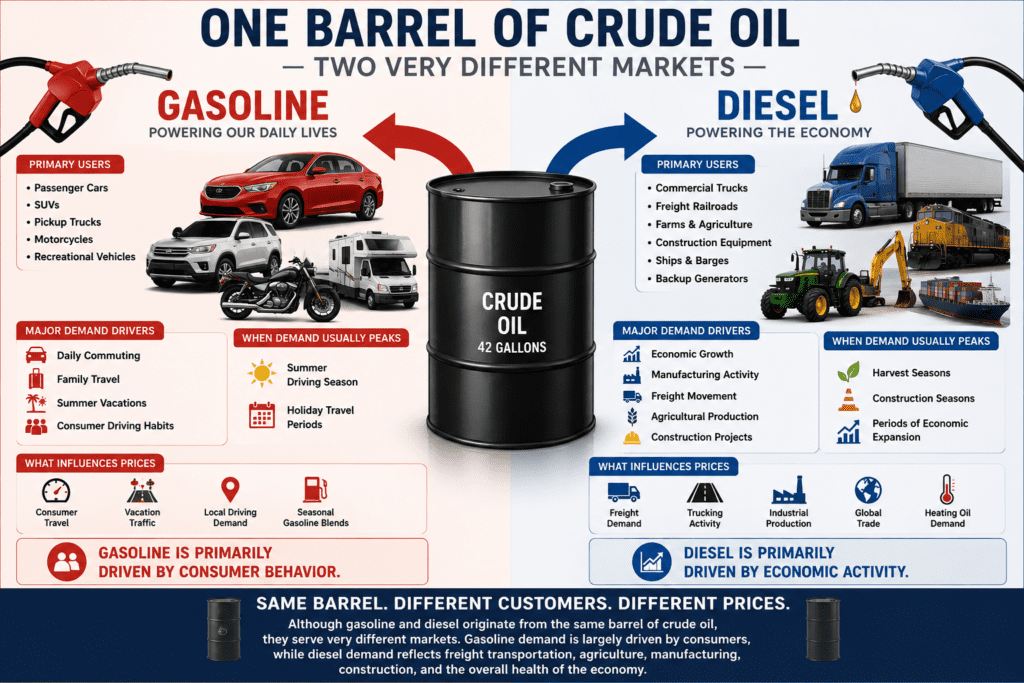
Both Fuels Come From the Same Barrel
Gasoline and diesel both begin as crude oil.
Inside a refinery, crude oil is heated and separated into various products based on their boiling points. Gasoline and diesel emerge from different portions of the refining process.
Although they come from the same barrel of crude oil, they serve very different markets.
Gasoline Primarily Serves Passenger Vehicles
Gasoline is used primarily by:
- Passenger cars
- SUVs
- Pickup trucks
- Motorcycles
- Recreational vehicles
- Small engines
As a result, gasoline demand is heavily influenced by consumer driving habits.
Summer vacation travel often increases gasoline consumption and can contribute to seasonal price increases.
Diesel Powers the Economy
Diesel fuel is often called the fuel of commerce.
It powers:
- Commercial trucks
- Freight transportation
- Trains
- Ships
- Construction equipment
- Farm equipment
- Backup generators
- Industrial machinery
Nearly every product delivered to a store has likely traveled part of its journey using diesel-powered transportation.
Diesel Demand Is Different
Gasoline demand tends to peak during the summer driving season.
Diesel demand is influenced more by:
- Freight activity
- Manufacturing output
- Construction projects
- Agricultural production
- Economic growth
Strong economic activity often increases diesel demand even when gasoline demand remains stable.
Environmental Regulations Matter
Modern diesel fuel must meet strict environmental standards.
Ultra-low sulfur diesel requires additional refining and processing compared to earlier diesel formulations.
These additional requirements increase production costs and can contribute to higher diesel prices.
Why Diesel Sometimes Costs More
Diesel prices often exceed gasoline prices when:
- Freight demand is strong
- Economic activity is expanding
- Refining capacity is constrained
- Heating oil demand increases during winter
Because heating oil and diesel fuel are closely related products, cold winters can increase demand for refinery output that competes directly with diesel supplies.
Why Diesel Sometimes Costs Less
There are also periods when diesel costs less than gasoline.
This can occur when:
- Freight demand weakens
- Economic activity slows
- Gasoline demand surges during summer travel
- Refiners increase diesel production
Like all commodities, supply and demand ultimately determine market prices.
Why Truckers Watch Diesel Prices So Closely
For many trucking companies, fuel is one of the largest operating expenses.
A relatively small increase in diesel prices can significantly affect profitability and may ultimately increase transportation costs throughout the economy.
Those higher transportation costs are often reflected in the prices consumers pay for groceries, building materials, appliances, and countless other products.
Why This Matters
When discussing the price of gasoline and diesel, it is important to remember that these fuels serve different markets.
Gasoline reflects the driving habits of millions of consumers. Diesel reflects the movement of goods, industrial activity, agriculture, construction, and the overall health of the economy.
Although they originate from the same barrel of crude oil, they often follow different pricing patterns for very different reasons.

Author Note: What You See Is Not Always the Whole Story
I spent part of my career as a senior manager for a Fortune 500 oil refiner, and I learned an important lesson: what appears obvious is often only part of the story.
Most people know that crude oil is converted into gasoline, diesel fuel, jet fuel, lubricants, asphalt, and many other products. What surprises many people is that the refining process does not always produce the amount of product they expect.
Before reading further, test your knowledge with this quick quiz. See if you can correctly estimate the amount of finished petroleum products that can be produced from a standard barrel of crude oil.
The answer is based on data published by the U.S. Energy Information Administration (EIA), the federal agency responsible for collecting and reporting U.S. energy statistics.
Why Do Gasoline Prices Rise Quickly but Fall Slowly?
One of the Most Common Complaints
Few topics generate more frustration than the perception that the price of gasoline and diesel rises overnight but seems to take forever to decline.
Many consumers have experienced the same situation.
Crude oil prices rise and gasoline prices jump almost immediately. Then crude oil prices fall, yet pump prices seem slow to follow.
This leads many people to believe that gas stations are gouging consumers.
The reality is usually much more complicated.
Fuel Is Purchased Before It Is Sold
Most gasoline stations do not manufacture fuel.
Instead, they purchase gasoline and diesel from wholesalers, distributors, or refiners and then resell it to motorists.
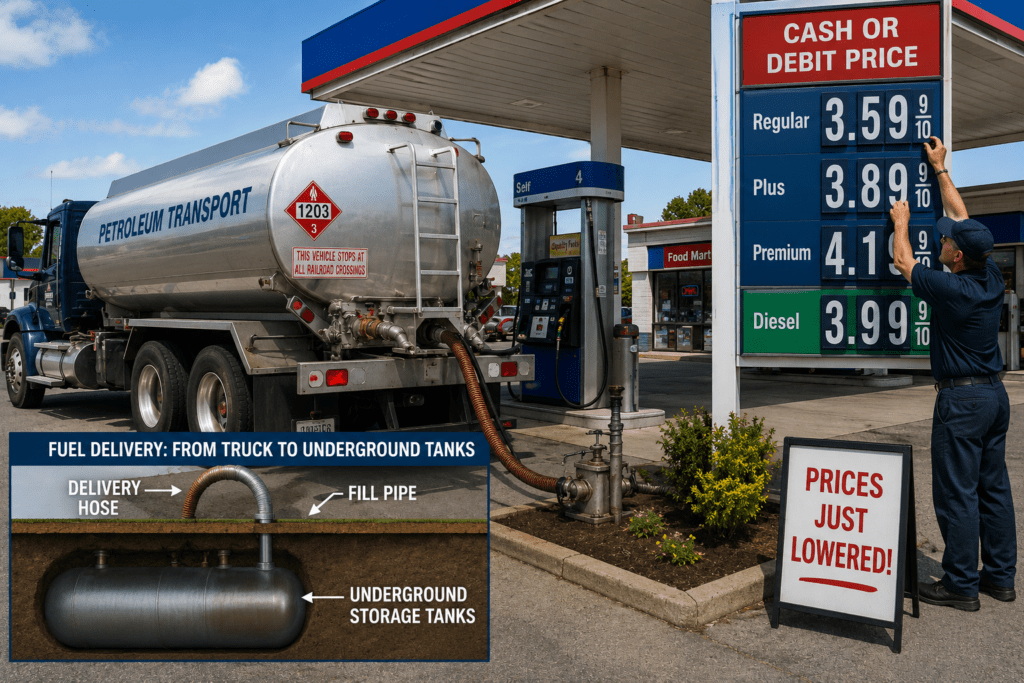
The fuel sitting in the station’s underground storage tanks was purchased before it was sold to customers.
Why Prices Often Rise Quickly
When a station receives a new delivery at a higher wholesale price, the owner typically adjusts prices almost immediately.
The reason is simple.
The next load of fuel may cost significantly more than the previous one. If the station continues selling at the old price, it may not generate enough revenue to replace the inventory it is currently selling.
Cash Flow Matters
Many independent station owners pay for fuel deliveries through electronic funds transfer, commercial credit arrangements, or other financing mechanisms tied directly to wholesale fuel purchases.
Fuel is often one of the largest expenses a station owner faces.
When wholesale prices increase, retail prices generally increase as well.
Why Prices Sometimes Fall More Slowly
When wholesale fuel prices decline, stations often continue selling inventory that was purchased at higher prices.
The fuel currently being sold may have arrived days earlier at a higher wholesale cost.
Until that inventory is replaced with lower-cost fuel, price reductions may be gradual.
Inventory Replacement Economics
Imagine a station receives a tanker load purchased at $3.00 per gallon.
The next day, wholesale prices drop to $2.90.
The station still has thousands of gallons purchased at the higher price.
Reducing prices immediately could result in selling existing inventory below the replacement cost originally paid.
Maintaining a Consistent Margin
Another factor involves profit margins.
Suppose a station owner targets a profit margin of approximately 10%.
If wholesale costs increase by several cents per gallon, the retail price may need to increase slightly more than the wholesale increase to maintain the same percentage margin.
Conversely, when wholesale prices decline, retail prices typically follow, but not always at the exact same pace.
What About Gas Station Profits?
Many consumers assume gas stations earn large profits from fuel sales.
In reality, fuel margins are often surprisingly small.
For many stations, the convenience store generates more profit than the gasoline pumps.
Why Convenience Stores Became Essential
Several decades ago, service stations often generated significant income from:
- Vehicle repairs
- Tire sales
- Oil changes
- Batteries
- Full-service fueling
Today, many stations have eliminated repair bays and rely heavily on convenience store sales.
Items such as:
- Soft drinks
- Coffee
- Snacks
- Prepared foods
- Tobacco products
- Lottery tickets
often generate more profit than the fuel itself.
The Fuel Business Has Changed
Modern fuel stations increasingly use gasoline and diesel as a way to attract customers to the store.
The fuel brings customers onto the property.
The convenience store often generates the profits that keep the business viable.
Why This Matters
The next time the price of gasoline and diesel changes rapidly, remember that fuel prices reflect more than the cost of crude oil.
Wholesale fuel costs, transportation expenses, inventory replacement costs, cash flow requirements, and competitive pressures all influence what appears on the sign at the corner station.
The process is rarely as simple as “oil prices went down, so gasoline prices should immediately fall.”
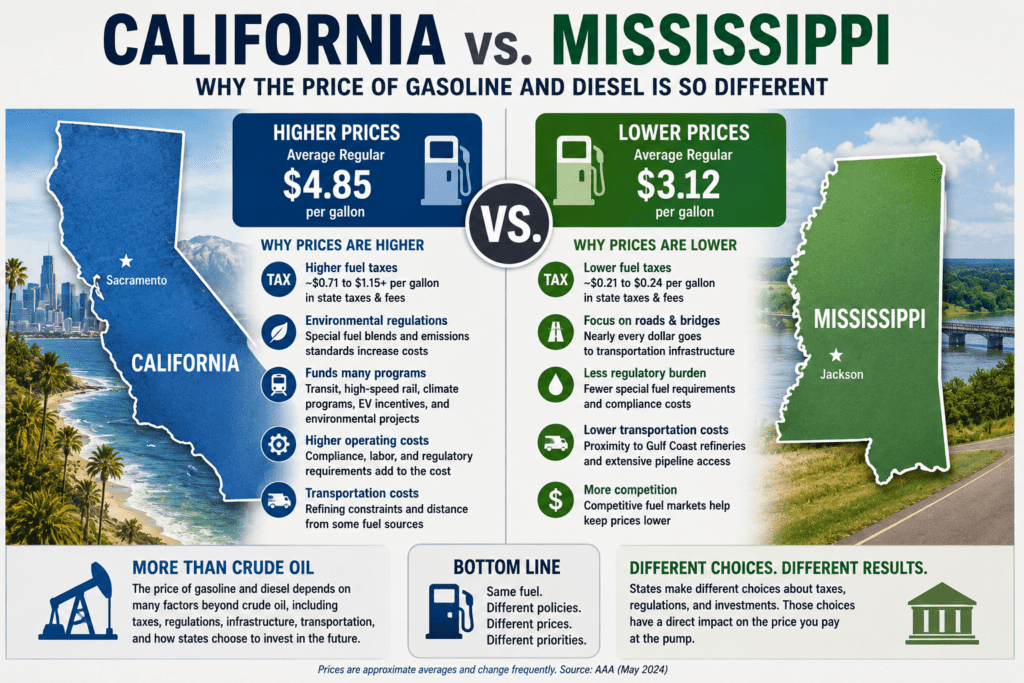
California and Mississippi: Two Different Approaches to Fuel Pricing
A Real-World Example
California and Mississippi provide an interesting comparison because they represent two very different approaches to transportation funding, environmental policy, and fuel taxation.
Neither approach is inherently right or wrong. Instead, each state has made different policy choices that ultimately affect the price of gasoline and diesel paid by consumers.
Understanding these differences helps explain why fuel prices can vary dramatically across the United States even when the gasoline itself originates from the same crude oil supply.
The Side-by-Side Comparison
| Feature | California | Mississippi |
|---|---|---|
| Total State Taxes & Fees Per Gallon | Approximately $0.71 to $1.15+ depending on fuel prices and regulatory costs | Approximately $0.21 to $0.24 per gallon |
| Percentage Directed Outside Traditional Road & Bridge Projects | Approximately 40%–45% | Less than 1% |
| Examples of Non-Road Spending | Mass transit, high-speed rail, climate programs, EV incentives, environmental projects | Boat ramps, marine law enforcement, groundwater protection |
| Primary Policy Goal | Multi-modal transportation and environmental objectives | Roads, bridges, and transportation infrastructure |
Difference #1: Different Philosophies
California generally follows a broader transportation and environmental funding model.
The state uses fuel-related taxes, fees, and regulatory programs not only to support roads and bridges but also to support public transportation, alternative transportation systems, environmental initiatives, and climate-related programs.
Mississippi follows a more traditional “user pays, user benefits” model.
The underlying philosophy is that motorists purchasing fuel should primarily fund the roads and bridges they use.
Difference #2: How Taxes Are Adjusted
California’s fuel tax structure includes inflation adjustments designed to preserve purchasing power as construction and maintenance costs increase over time.
Mississippi historically maintained one of the nation’s lowest fuel tax rates for decades. Because those taxes were not automatically adjusted for inflation, lawmakers eventually faced increasing pressure to raise rates as road construction and maintenance costs increased.
Difference #3: Additional Taxes and Fees
California layers fuel excise taxes, sales taxes, environmental compliance costs, and regulatory programs onto the final pump price.
When retail fuel prices increase, percentage-based taxes can also generate additional revenue.
Mississippi relies primarily on fixed per-gallon fuel taxes and generally avoids adding broad state sales taxes to motor fuel purchases. This results in a simpler and often more predictable tax structure.
Where Does the Money Go?
One of the biggest differences between the two states involves how fuel-related revenue is used.
In Mississippi, nearly every dollar collected from fuel taxes is directed toward transportation infrastructure, including highways, bridges, and local roads.
In California, a significant portion of fuel-related taxes, fees, and environmental program revenues support projects beyond traditional road construction. These may include public transit systems, high-speed rail projects, electric vehicle incentives, climate initiatives, wildfire prevention programs, bicycle infrastructure, and pedestrian improvements.
The Consumer Perspective
For consumers, the result is visible every time they pull up to a fuel pump.
A driver in Mississippi may pay significantly less for the same gallon of gasoline or diesel than a driver in California.
The difference is not caused by crude oil prices alone.
Instead, it reflects a combination of:
- Fuel taxes
- Environmental regulations
- Specialized fuel requirements
- Transportation costs
- Infrastructure investments
- Public policy decisions
The Bigger Lesson
The price of gasoline and diesel is influenced by far more than the cost of crude oil.
State governments make different choices about how fuel-related revenue should be collected and spent. Those decisions can have a meaningful impact on what consumers ultimately pay at the pump.
Reasonable people can disagree about which approach is preferable. The purpose of this comparison is not to advocate for one system over another, but to help readers understand why fuel prices vary so dramatically from one state to the next.
Understanding where the money comes from—and where it goes—provides valuable context whenever fuel prices become part of the national conversation.
Why Americans Watch Gasoline Prices So Closely
The Price Everyone Knows
Ask most Americans the current price of gasoline and many can provide a reasonably accurate answer.
Ask the same person the current price of milk, bread, chicken, or laundry detergent and they may have no idea.
Why?
The answer is surprisingly simple.
Fuel Prices Are Public
Most products are hidden inside stores.
Gasoline and diesel prices are displayed on large signs visible from busy roads and highways.
Millions of motorists see those prices every day whether they intend to purchase fuel or not.
This constant visibility makes the price of gasoline and diesel one of the most widely recognized prices in the economy.
Most Drivers Buy Fuel Frequently
Many households purchase gasoline every week.
Commuters may purchase fuel multiple times per month.
Because fuel is a recurring expense, even small changes in price quickly become noticeable.
A 25-cent increase per gallon may not sound significant, but it can add hundreds of dollars per year to a family’s transportation budget.
Fuel Affects More Than Transportation
Most consumers understand that gasoline powers their vehicles.
Many do not realize how extensively diesel fuel influences the broader economy.
Diesel powers:
- Freight trucks
- Railroads
- Farm equipment
- Construction machinery
- Ships and barges
- Backup generators
When diesel prices rise, the cost of moving goods often rises as well.
Those higher costs can eventually appear in grocery stores, retail shops, and construction projects.
Gasoline Prices Often Reflect Consumer Confidence
Historically, Americans have used fuel prices as an informal economic indicator.
When gasoline prices fall, consumers often feel more optimistic.
When prices rise sharply, many households feel immediate financial pressure.
Whether accurate or not, fuel prices frequently influence public perceptions about the economy.
The Daily Reminder
Most utility bills arrive once per month.
Property tax bills may arrive once or twice per year.
Fuel prices provide a daily reminder of changing economic conditions.
Every trip past a service station sign reinforces what consumers are paying to keep their vehicles moving.
Why Politicians Watch Fuel Prices
Because gasoline prices are highly visible, elected officials often pay close attention to fuel costs.
Voters notice fuel prices quickly.
As a result, gasoline and diesel frequently become part of public discussions about:
- Inflation
- Energy policy
- Transportation
- Taxes
- Economic growth
- Household affordability
Fuel Prices and Retirement
Retirees often pay close attention to the price of gasoline and diesel because transportation expenses represent a meaningful portion of many retirement budgets.
For retirees living on fixed incomes, higher fuel costs can affect:
- Travel plans
- Family visits
- Recreational activities
- Overall discretionary spending
The Bottom Line
Gasoline is more than a fuel.
It is one of the most visible products in the American economy.
Because consumers purchase it frequently, see its price daily, and feel its effects throughout the economy, the price of gasoline and diesel remains one of the most closely watched indicators of household affordability in the United States.
💡 Did You Know?
A driver traveling 15,000 miles per year in a vehicle averaging 25 miles per gallon will use approximately 600 gallons of fuel annually.
If the price of gasoline and diesel increases by just 50 cents per gallon, that driver will spend about $300 more per year on fuel.
For households with multiple vehicles, long commutes, recreational travel, or small businesses that rely on trucks and equipment, the annual impact can easily reach hundreds or even thousands of additional dollars.
What Really Determines the Price of Gasoline and Diesel?
There Is No Single Answer
Many people assume the price of gasoline and diesel is determined by a single factor.
Some blame oil companies.
Others point to taxes, environmental regulations, or world events.
The reality is far more complicated.
Every Gallon Has a Story
Before gasoline reaches your fuel tank, it has traveled through a vast global supply chain.
That journey may include:
- Oil fields thousands of miles away
- Pipelines and tanker ships
- Refineries operating around the clock
- Fuel terminals and storage facilities
- Tank trucks delivering fuel to local stations
- Federal, state, and local taxes
- Environmental regulations and fuel standards
Every step contributes to the final price you see on the sign.
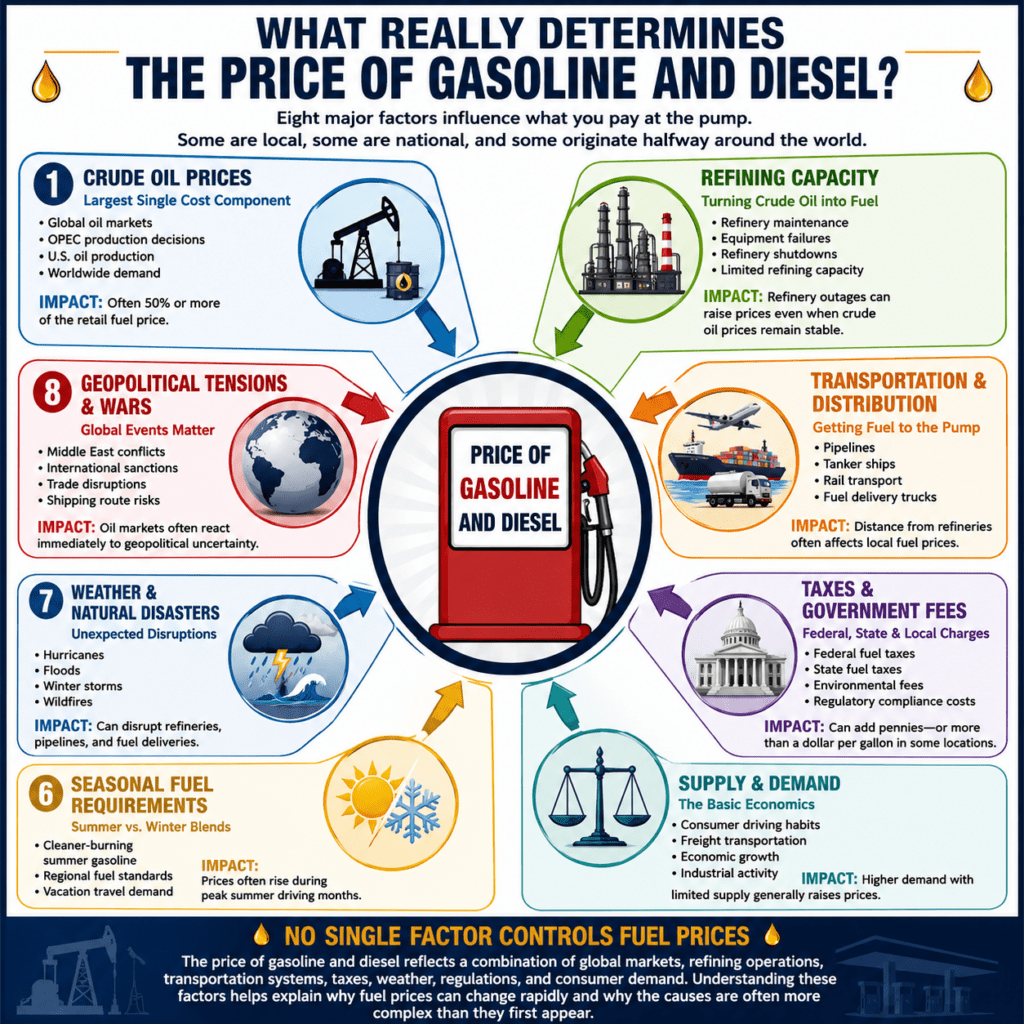
What Really Determines the Price of Gasoline and Diesel? While crude oil is usually the largest single component of fuel costs, it is far from the only factor. Refining capacity, transportation and distribution systems, taxes and government fees, supply and demand, seasonal fuel requirements, weather-related disruptions, and geopolitical events all play important roles in determining what consumers ultimately pay at the pump. Understanding these interconnected factors helps explain why fuel prices can change rapidly and why no single event is usually responsible for rising or falling gasoline and diesel prices.
The Biggest Factors
Although many variables influence fuel prices, the largest factors generally include:
- Crude oil prices
- Refining capacity
- Transportation and distribution costs
- Taxes and government fees
- Supply and demand
- Seasonal fuel requirements
- Weather events and natural disasters
- Geopolitical tensions and wars
When several of these factors occur simultaneously, prices can move rapidly.
Why Understanding Matters
Understanding how fuel prices work does not make filling your tank any cheaper.
However, it can help consumers better understand why prices change and why the explanations offered in news headlines are often incomplete.
The price of gasoline and diesel is rarely driven by a single event.
Instead, it reflects the combined effects of economics, engineering, government policy, transportation systems, weather, and consumer behavior.
The Fuel Industry Is Larger Than Most People Realize
Gasoline may be the most visible petroleum product, but it is only one piece of a much larger system.
The same crude oil that produces gasoline also contributes to:
- Diesel fuel
- Jet fuel
- Heating fuels
- Lubricants
- Asphalt
- Plastics
- Medical products
- Cosmetics
- Thousands of everyday items
Modern civilization depends on these products in ways that are often invisible to consumers.
The Next Time You Pass a Gas Station
The next time you drive past a service station sign, remember that the number displayed there represents far more than the cost of a gallon of fuel.
Behind that price lies a global network of producers, refiners, transporters, retailers, regulators, engineers, farmers, and consumers all interacting within one of the largest industries in the world.
Understanding fuel prices is only the beginning. Visit the RetireCoast Fuel Price Intelligence Center™ to compare fuel prices in every state, estimate household and small business fuel costs, see how crude oil prices may affect gasoline prices, and explore additional fuel planning resources as new tools and educational content are added.
Quiz about Gasoline and Diesel
Why is the price of gasoline and diesel different?
Gasoline and diesel come from the same barrel of crude oil, but they serve different markets. Gasoline is driven mostly by consumer travel, while diesel powers trucks, trains, farms, construction equipment, and freight transportation.
Why do gasoline prices rise quickly but fall slowly?
Gas stations often adjust prices based on replacement inventory costs. If the next fuel delivery costs more, prices may rise quickly. When wholesale prices fall, stations may still be selling fuel purchased at higher prices.
How much does crude oil affect gasoline prices?
A $1 change in crude oil prices changes the raw crude oil cost of gasoline by about 2.4 cents per gallon. Actual pump prices also include refining, transportation, taxes, distribution, and retail costs.
Do gas stations make most of their money from fuel?
Usually no. Fuel margins are often small. Many stations rely on convenience store sales, coffee, snacks, prepared food, and other retail items to remain profitable.
How much ethanol is in most gasoline?
Most gasoline sold in the United States is E10, meaning it contains about 10% ethanol. Ethanol is usually made from corn grown by American farmers.
Why are fuel prices different in California and Mississippi?
California generally has higher fuel taxes, environmental compliance costs, specialized fuel requirements, and additional regulatory programs. Mississippi generally has lower fuel taxes and a more traditional road-and-bridge funding model.
Do all fuel taxes go toward roads and bridges?
No. Some fuel tax revenue funds roads and bridges, but certain states also direct fuel-related revenue toward transit systems, environmental programs, bicycle infrastructure, pedestrian projects, and other transportation priorities.
Why do refinery outages affect gasoline and diesel prices?
Crude oil must be refined before it becomes usable fuel. If a refinery shuts down for maintenance, a fire, hurricane, or equipment problem, fuel supply may tighten even if crude oil remains available.
Why do Americans pay so much attention to gasoline prices?
Gasoline prices are posted on large roadside signs and seen daily by millions of drivers. Because fuel is purchased frequently, the price of gasoline and diesel has become one of America’s most visible economic indicators.
What is the biggest factor in the price of gasoline and diesel?
Crude oil is usually the largest single component, but the final price also depends on refining costs, taxes, transportation, ethanol blending, state policies, local competition, and global events.
One Final Thought
Most Americans purchase gasoline every week, yet relatively few understand how it reaches the pump or why prices change.
Hopefully, this article has helped pull back the curtain on the complex world behind the price of gasoline and diesel and provided a better understanding of one of the most closely watched prices in the American economy.
Continue the Conversation
Now that you’ve finished the article:
- Take the Fuel Knowledge Quiz
- Participate in the polls throughout the article
- Share your memories of full-service stations
- Tell us what you think has the greatest impact on fuel prices
We would love to hear your perspective.
FAQ
Why is the price of gasoline and diesel different?
Gasoline and diesel come from the same barrel of crude oil, but they serve different markets. Gasoline is driven mostly by consumer travel, while diesel powers trucks, trains, farms, construction equipment, and freight transportation.
Why do gasoline prices rise quickly but fall slowly?
Gas stations often adjust prices based on replacement inventory costs. If the next fuel delivery costs more, prices may rise quickly. When wholesale prices fall, stations may still be selling fuel purchased at higher prices.
How much does crude oil affect gasoline prices?
A $1 change in crude oil prices changes the raw crude oil cost of gasoline by about 2.4 cents per gallon. Actual pump prices also include refining, transportation, taxes, distribution, and retail costs.
Do gas stations make most of their money from fuel?
Usually no. Fuel margins are often small. Many stations rely on convenience store sales, coffee, snacks, prepared food, and other retail items to remain profitable.
How much ethanol is in most gasoline?
Most gasoline sold in the United States is E10, meaning it contains about 10% ethanol. Ethanol is usually made from corn grown by American farmers.
Why are fuel prices different in California and Mississippi?
California generally has higher fuel taxes, environmental compliance costs, specialized fuel requirements, and additional regulatory programs. Mississippi generally has lower fuel taxes and a more traditional road-and-bridge funding model.
Do all fuel taxes go toward roads and bridges?
No. Some fuel tax revenue funds roads and bridges, but certain states also direct fuel-related revenue toward transit systems, environmental programs, bicycle infrastructure, pedestrian projects, and other transportation priorities.
Why do refinery outages affect gasoline and diesel prices?
Crude oil must be refined before it becomes usable fuel. If a refinery shuts down for maintenance, a fire, hurricane, or equipment problem, fuel supply may tighten even if crude oil remains available.
Why do Americans pay so much attention to gasoline prices?
Gasoline prices are posted on large roadside signs and seen daily by millions of drivers. Because fuel is purchased frequently, the price of gasoline and diesel has become one of America’s most visible economic indicators.
What is the biggest factor in the price of gasoline and diesel?
Crude oil is usually the largest single component, but the final price also depends on refining costs, taxes, transportation, ethanol blending, state policies, local competition, and global events.
Discover more from RetireCoast.com
Subscribe to get the latest posts sent to your email.