Last updated on July 16th, 2026 at 09:35 pm
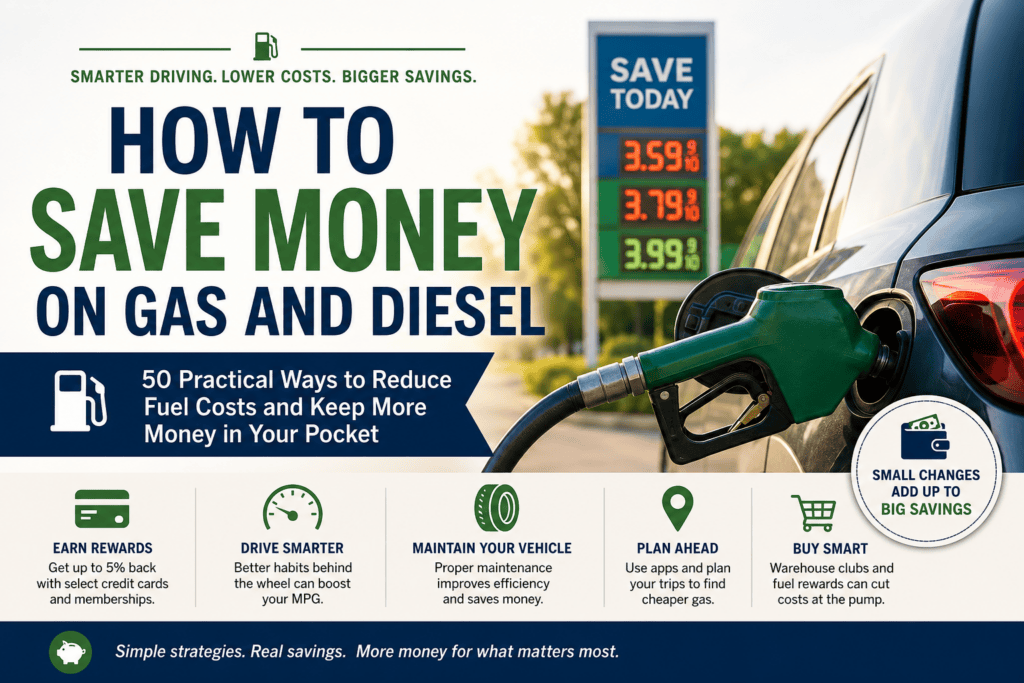
Saving Money on Gas Starts Long Before You Reach the Gas Pump
For millions of Americans, gasoline and diesel are among the largest recurring household expenses after housing, food, insurance, and groceries. Learning how to save money on gas is one of the simplest ways to reduce everyday living expenses, and even small changes in your driving habits, vehicle maintenance, and fuel-buying decisions can add up to hundreds—or even thousands—of dollars in annual savings.
Whether you commute to work every day, own a small business, operate a fleet of vehicles, travel in an RV, or simply enjoy weekend road trips, fuel costs can quietly consume a significant portion of your household budget.
Dozens of proven strategies
Fortunately, there are dozens of practical, proven strategies that can help you save money on gas or diesel without sacrificing convenience or dramatically changing your lifestyle.
The good news is that lowering your fuel expenses doesn’t require buying a new vehicle or making major lifestyle changes.
Many of the most effective ways to save money on gas involve simple habits that almost anyone can adopt, from choosing the correct octane fuel and taking advantage of rewards programs to driving more efficiently, maintaining proper tire pressure, and planning trips more effectively.
Throughout this guide, we’ll explain not only how to save money on gas, but also why these strategies work, using real-world examples and estimated annual savings whenever possible.
Free RetireCoast Fuel Savings Calculator
At the end of this guide, you’ll also find our free RetireCoast Fuel Savings Calculator™, a personalized tool that estimates how much you could save based on your vehicle, annual mileage, fuel economy, driving habits, and fuel-buying decisions.
It’s a valuable companion to this guide and can help you identify the savings opportunities that are most meaningful for your own situation.Take advantage of rewards
Choosing where you buy fuel, driving a little more efficiently, keeping your vehicle properly maintained, and taking advantage of rewards programs can all make a noticeable difference over the course of a year.
Some opportunities are well known, such as comparing prices before filling up or joining a warehouse club like Costco or Sam’s Club for lower-priced fuel. Others are less obvious.
Certain credit cards offer generous cash-back rewards on fuel purchases, some grocery stores provide fuel discounts based on your shopping, and even small changes—such as maintaining the correct tire pressure or reducing highway speed by a few miles per hour—can improve fuel economy.
- Saving Money on Gas Starts Long Before You Reach the Gas Pump
- Know What You’re Spending Before You Try to Save
- Fuel Rewards and Cash-Back Credit Cards: Let Your Purchases Work for You
- Don’t Buy Premium Gasoline Unless Your Vehicle Requires It
- Slow Down: Your Right Foot May Be Costing You Hundreds of Dollars Every Year
- Keep Your Tires Properly Inflated: One of the Easiest Ways to Save Fuel
- 💰 Estimated Annual Savings
- Stop Idling: You’re Burning Fuel While Going Nowhere
- 💰 Estimated Annual Savings
- Current Potential Annual Savings: $803 per year
- Plan Your Trips and Combine Errands
- 💰 Estimated Annual Savings
- Current Potential Annual Savings: $883 per year
- Lighten the Load: Extra Weight and Roof Racks Can Cost You at the Pump
- 💰 Estimated Annual Savings
- Current Potential Annual Savings: $933 per year
- Keep Your Vehicle Properly Maintained
- 💰 Estimated Annual Savings
- Running Total of Potential Annual Savings
- Current Potential Annual Savings: $993 per year
- Continue Your Research with These Authoritative Resources
- Use Technology to Find the Lowest Fuel Prices
- 💰 Estimated Annual Savings
- Running Total of Potential Annual Savings
- Current Potential Annual Savings: $1,063 per year
- Are Warehouse Club Memberships Worth It for Fuel Savings?
- 💰 Estimated Annual Savings
- Running Total of Potential Annual Savings
- Current Potential Annual Savings: $1,153 per year
- Special Fuel-Saving Tips for RVs, Travel Trailers, and Fifth Wheels
- Tire Pressure Matters Even More
- Slow Down and Enjoy the Journey
- Travel Lighter
- Plan Fuel Stops in Advance
- 💰 Estimated Annual Savings (Typical RV Owner)
- Estimated Annual RV Fuel Savings: Approximately $175
- $1,328 per year
- Use Cruise Control Wisely
- 💰 Estimated Annual Savings
- Running Total of Potential Annual Savings
- Current Potential Annual Savings: $1,198 per year
- Reduce Wind Resistance: Small Changes Can Make a Big Difference
- 💰 Estimated Annual Savings
- Running Total of Potential Annual Savings
- Current Potential Annual Savings: $1,258 per year
- Track Your Fuel Economy: What Gets Measured Gets Improved
- 💰 Estimated Annual Savings
- Running Total of Potential Annual Savings
- Current Potential Annual Savings: $1,308 per year
- A RetireCoast Perspective
- Track Your Fuel Economy: What Gets Measured Gets Improved
- 💰 Estimated Annual Savings
- Running Total of Potential Annual Savings
- Current Potential Annual Savings: $1,308 per year
- A RetireCoast Perspective
- Sometimes the Best Way to Save Fuel Is to Drive Less
- 💰 Estimated Annual Savings
- Running Total of Potential Annual Savings
- Current Potential Annual Savings: $1,518 per year
- Your Next Vehicle Purchase Could Be Your Biggest Fuel-Saving Decision
- 💰 Estimated Annual Savings
- Running Total of Potential Annual Savings
- Build Your Personal Fuel Savings Plan
- Your Fuel Savings Checklist
- 💰 Estimated Annual Savings
- Estimated Total Potential Annual Savings
- Approximately $1,500+
- One Last Step…
- PODCAST
Practical, evidenced-based strategies
This guide brings together many of the most practical, evidence-based strategies for lowering your gasoline and diesel expenses.
Some tips may save only a few dollars each month, while others could reduce your annual fuel bill by several hundred dollars. Individually they may seem modest, but together they can have a meaningful impact on your household or business budget.
At RetireCoast, we’ve also created the Fuel Price Intelligence Center™ to help you better understand and manage fuel expenses.
There you’ll find free tools to estimate your household fuel budget, calculate how changes in crude oil prices may affect gasoline prices, compare average fuel prices across the United States, and explore additional resources designed to help you make smarter financial decisions.
It’s also important to understand that no single strategy works for everyone. A retired couple driving 5,000 miles a year will have different opportunities than a sales representative driving 30,000 miles annually or a small business operating multiple service vehicles.
It seems everything affects fuel prices
Fuel prices will always fluctuate. Global oil markets, refinery maintenance, seasonal fuel blends, taxes, severe weather, and world events all influence what you’ll pay at the pump.
Throughout this guide, we’ll point out which techniques produce the greatest savings for different types of drivers so you can focus on the changes that matter most.
While you can’t control those factors, you can control how efficiently you use fuel and how much you pay for every gallon. The strategies in this guide are designed to help you do exactly that—and perhaps keep hundreds of dollars in your pocket every year. Save money on gas or diesel with this article.
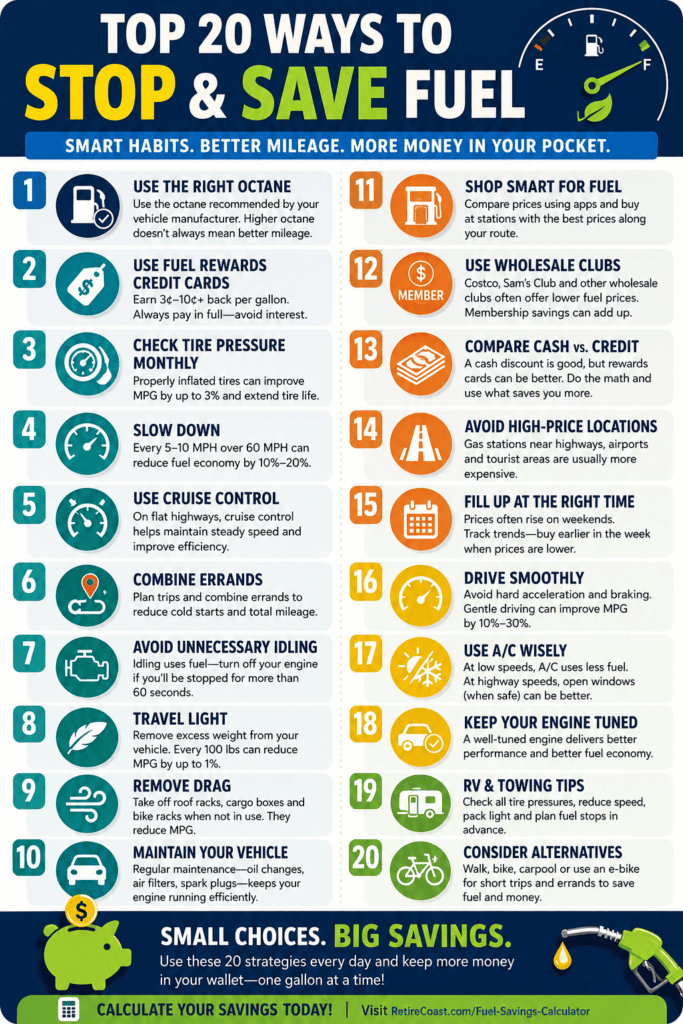
Know What You’re Spending Before You Try to Save
One of the biggest mistakes people make when trying to reduce fuel costs is focusing entirely on the price at the pump. Saving five or ten cents per gallon certainly helps, but it’s only one piece of the puzzle.
Your total fuel expense is determined by several factors, including how many miles you drive, your vehicle’s fuel economy, your driving habits, maintenance, and where you choose to buy fuel.
Before you can develop a strategy for reducing fuel costs, you need to understand what you’re currently spending. Many drivers are surprised to discover that fuel is one of their largest annual transportation expenses.
$2,100 per year
A commuter driving 15,000 miles per year in a vehicle that averages 25 miles per gallon will purchase about 600 gallons of fuel annually. At $3.50 per gallon, that’s approximately $2,100 every year—and that’s before considering price increases or additional recreational travel.
For families with multiple vehicles, those costs can double or even triple. Small businesses with delivery vans, contractors with work trucks, and companies operating service fleets may spend tens of thousands of dollars on fuel each year. When viewed over five or ten years, even modest improvements in fuel efficiency can translate into significant savings.
Start with a baseline
That’s why we recommend starting with a baseline. Measure your current fuel expenses before trying to reduce them. Once you know where your money is going, you can evaluate which fuel-saving strategies will have the greatest impact.
The RetireCoast Fuel Price Intelligence Center™ includes several free tools designed to help you do exactly that:
- Household Fuel Budget Calculator – Estimate how much your family spends on gasoline each month and annually.
- Small Business Fuel Calculator – Calculate fuel expenses for business vehicles or an entire fleet.
- State Fuel Price Lookup – Compare average gasoline and diesel prices across all 50 states.
- Crude Oil Impact Calculator – Understand how changes in crude oil prices can influence gasoline prices at the pump.
Think of these tools as your financial dashboard. Once you understand your current spending, every fuel-saving strategy becomes measurable. If changing your driving habits improves fuel economy by just 5%, or switching to a cash-back rewards card saves another 3% to 5%, you’ll be able to see the real dollar impact instead of simply guessing.
Save money on gas
The goal isn’t just to pay less each time you fill up—it’s to reduce your total annual fuel expense. Throughout the remainder of this guide, we’ll examine dozens of proven strategies that can help you accomplish exactly that, beginning with one of the easiest ways to save money: taking advantage of fuel rewards programs and cash-back credit cards.
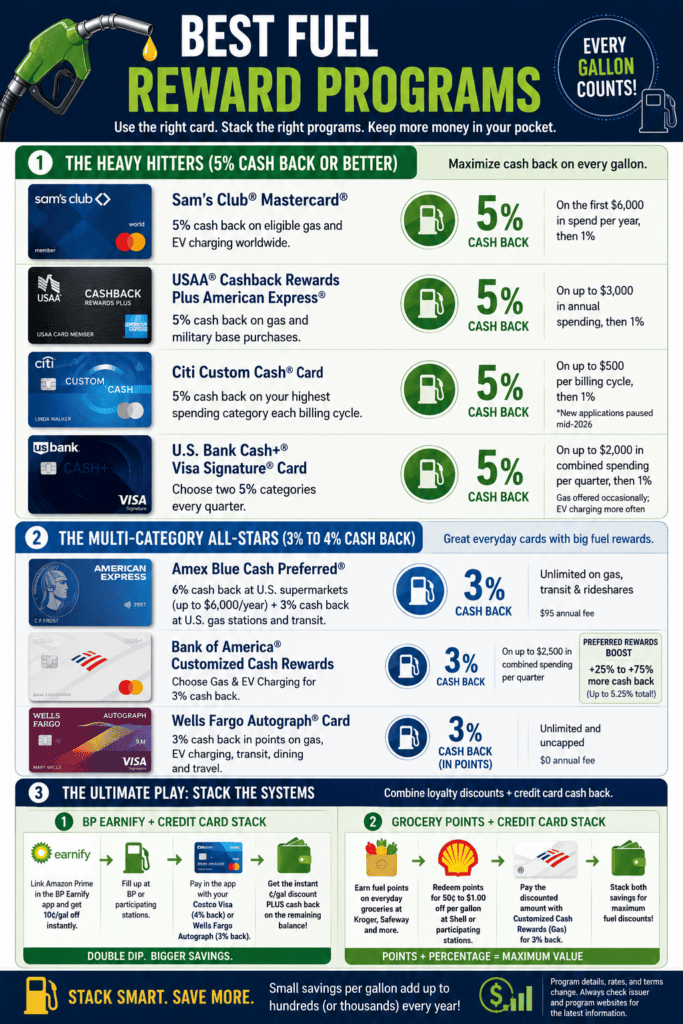
Best Fuel Reward Programs: One of the smartest ways to save money on gas is to combine immediate pump discounts with cash-back credit card rewards. Warehouse clubs, grocery store fuel point programs, and fuel loyalty apps can often be “stacked” with eligible rewards credit cards to maximize savings on every gallon purchased. Before choosing a program, compare annual fees, spending caps, eligible fuel stations, redemption rules, and reward limits to determine which combination best fits your driving habits and annual fuel budget. By choosing the right combination of rewards programs, many drivers can save money on gas every time they fill their tank while earning valuable cash back throughout the year.
Fuel Rewards and Cash-Back Credit Cards: Let Your Purchases Work for You
One of the easiest ways to save money on gas requires no changes to your driving habits at all. If you’re already buying gasoline or diesel every week, why not earn cash back or fuel discounts on purchases you were going to make anyway?
Over the past decade, warehouse clubs, fuel retailers, banks, and credit card companies have introduced a variety of rewards programs designed to encourage customer loyalty.
While each program has different rules, the concept is the same: spend money on eligible purchases and receive cash back, statement credits, points, or discounts on future fuel purchases.
For many households, these rewards can offset a meaningful portion of their annual fuel bill. For drivers looking to save money on gas, rewards programs can be one of the simplest strategies because they reduce your fuel costs without requiring you to drive fewer miles or change your vehicle.
Warehouse Club Fuel Programs
Warehouse clubs have become some of the most popular places to purchase fuel because they often sell gasoline and diesel at prices below nearby retail stations. Depending on your location, the savings may range from just a few cents to more than 20 cents per gallon.
In addition to lower prices, some warehouse clubs offer credit cards that provide enhanced rewards for fuel purchases.
Costco Anywhere Visa® Card by Citi
One of the best-known examples is the Costco Anywhere Visa® Card. Subject to the card’s current terms and conditions, eligible purchases at Costco gas stations and many other gas stations earn enhanced cash-back rewards.
For members who drive frequently, these rewards can add up quickly over the course of a year. Combined with Costco’s competitive fuel prices, these rewards can help members save money on gas every time they fill up.
Keep in mind that a Costco membership is required to purchase fuel at most Costco locations, and credit card reward categories and limits may change over time. Always review the current card agreement before applying.
Sam’s Club Mastercard®
Sam’s Club also offers a rewards credit card that provides enhanced cash back on eligible fuel purchases, subject to program limits and membership requirements.
If you already shop at Sam’s Club, combining lower fuel prices with credit card rewards may provide even greater savings. For frequent drivers, this combination can be another effective way to save money on gas throughout the year.
Grocery Store Fuel Rewards
Many grocery chains operate fuel rewards programs that allow customers to earn discounts based on grocery purchases.
Examples include:
- Kroger Fuel Points
- Safeway for U Rewards
- Albertsons Rewards
- Fred Meyer Fuel Rewards
- Winn-Dixie rewards (where available)
These programs typically award points for qualifying purchases that can later be redeemed for discounts at participating fuel stations. If you already shop at one of these stores, enrolling in the rewards program is often free and can provide additional savings throughout the year. If you’re already shopping at these stores, using their rewards programs is another easy way to save money on gaswithout changing your normal routine.
Fuel Station Loyalty Programs
Many national fuel retailers also offer free loyalty programs through mobile apps or membership accounts.
Examples include:
- Shell Fuel Rewards®
- Exxon Mobil Rewards+™
- BPme Rewards
- Circle K Inner Circle
- Murphy Drive Rewards
- Love’s Connect
- Pilot Flying J myRewards Plus™
These programs frequently offer introductory discounts, bonus reward periods, promotional offers, or cents-per-gallon savings for repeat customers. When combined with a rewards credit card, these programs can help you save money on gas by stacking multiple discounts on the same fuel purchase.
Other Cash-Back Credit Cards
Beyond warehouse clubs, several major credit card issuers periodically offer elevated rewards on gasoline purchases. Depending on the card, rewards may be permanent or rotate throughout the year.
Examples have included:
- Discover it® Cash Back
- Chase Freedom Flex®
- Citi Custom Cash® Card
- Wells Fargo Autograph® Card
- Bank of America® Customized Cash Rewards
- PenFed Platinum Rewards Visa Signature®
Because reward structures change regularly, it’s important to compare current offers before applying. Pay particular attention to annual fees, spending limits, redemption options, and whether rewards apply to warehouse club fuel purchases.
A Word of Caution
Fuel rewards are valuable only if you avoid carrying a balance. Paying high credit card interest can quickly eliminate any savings earned through cash-back programs. The best strategy is to treat a rewards credit card like a debit card—pay the balance in full every month and enjoy the rewards without paying interest.
Also remember that no rewards program justifies driving across town to save a few cents per gallon. Consider your time, traffic, and the fuel required to reach a lower-priced station. The best savings often come from combining lower-priced stations with rewards programs at locations you already visit as part of your normal routine.
For many drivers, fuel rewards are the easiest “set it and forget it” savings strategy available. Once you’re enrolled in the right program and using the appropriate payment method, every fill-up begins working a little harder for your budget—all without changing how much you drive. It’s one of the easiest ways to save money on gas year after year.
Editor’s Note: Because credit card benefits and fuel rewards programs change periodically, always verify current terms, reward percentages, eligibility requirements, and spending limits before applying or making financial decisions based on promotional offers.

Many people assume paying cash is always the least expensive option because some stations advertise a cash discount. Before choosing cash, take a moment to do the math.
Suppose gasoline costs $3.50 per gallon and the station offers a 10-cent-per-gallon cash discount. That sounds like a great deal. However, if your rewards credit card earns 5% cash back on eligible fuel purchases, your reward equals 17.5 cents per gallon (5% of $3.50). In this example, using the credit card saves you an additional 7.5 cents per gallon compared with paying cash.
Of course, this won’t always be true. The better option depends on the pump price, the size of the cash discount, and the terms and limits of your rewards program. That’s why it’s worth doing the calculation instead of assuming one payment method is always best.
What I Do: I carry both the Sam’s Club Mastercard® and the Costco Anywhere Visa® Card by Citi. Both currently offer enhanced cash-back rewards on eligible fuel purchases (subject to their terms and annual spending limits). If I approach the reward limit on one card, I simply begin using the other. Over the course of a year, those rewards can add up to hundreds of dollars.
One important rule: I use these cards only for fuel purchases and pay the balance in full every month. Carrying a balance and paying credit card interest will quickly eliminate any rewards you’ve earned. Used responsibly, however, rewards cards can be one of the easiest ways to reduce your annual fuel costs without changing your driving habits.
Note: Credit card rewards, annual spending limits, and fuel reward programs change periodically. Always review the current terms and conditions before applying for or relying on a particular card.
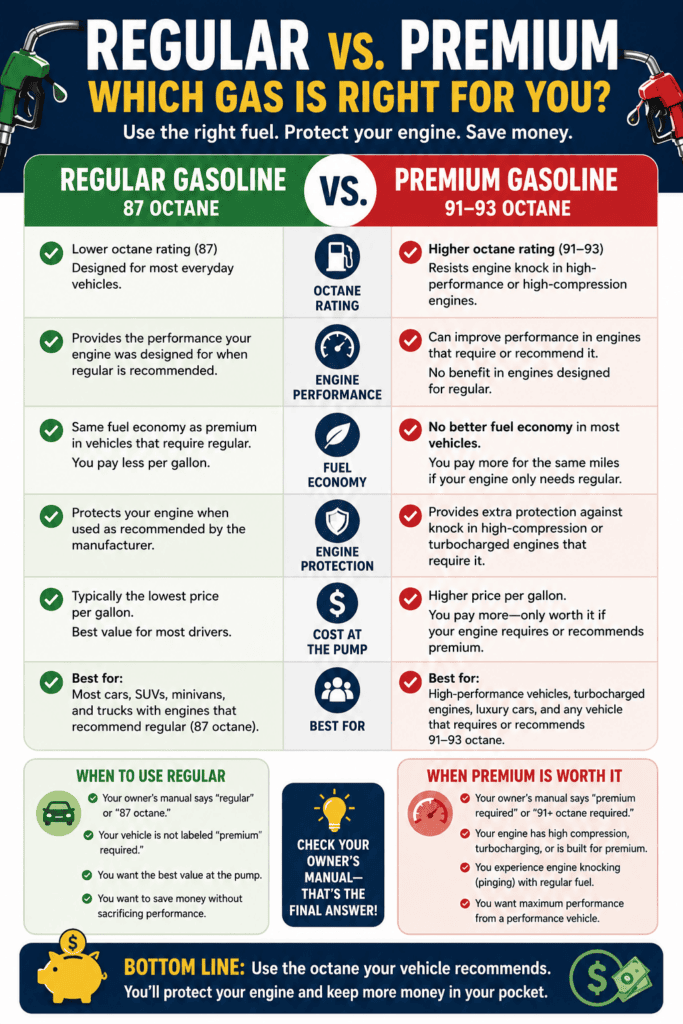
Don’t Buy Premium Gasoline Unless Your Vehicle Requires It
Few topics generate more confusion at the gas pump than premium gasoline. Many drivers believe that paying more for premium fuel will automatically improve performance, increase fuel economy, or help their engine last longer. For most vehicles, that’s simply not the case.
The octane rating displayed on the pump—typically 87 for regular, 89 for mid-grade, and 91 to 93 for premium—does not measure the quality of the gasoline or how much energy it contains. Instead, it measures the fuel’s resistance to engine knocking or pre-ignition, conditions that can occur in high-compression or turbocharged engines.
What Does Your Owner’s Manual Say?
The best place to determine which fuel your vehicle should use is the owner’s manual or the fuel door. Manufacturers generally fall into one of three categories:
- Regular Unleaded Required – Your vehicle is designed to run on regular gasoline (usually 87 octane). Buying premium provides little or no benefit and simply costs more.
- Premium Recommended – The engine is optimized for premium fuel, but it can often operate safely on regular gasoline with a slight reduction in performance or fuel economy. Check your owner’s manual for guidance.
- Premium Required – Some luxury, performance, and high-compression engines are engineered to operate on premium fuel. Using regular gasoline in these vehicles may reduce performance and could potentially lead to engine damage over time.
If your manufacturer specifies that regular gasoline is appropriate, purchasing premium is generally an unnecessary expense.
How Much Could You Save?
The price difference between regular and premium gasoline varies throughout the year and from one region to another. A spread of 40 to 80 cents per gallon is common, although the difference can occasionally be even greater.
Let’s look at an example.
Suppose you drive 15,000 miles per year, your vehicle averages 25 miles per gallon, and premium gasoline costs 60 cents more per gallon than regular.
- Annual fuel consumption: 600 gallons
- Extra cost for premium: 600 × $0.60 = $360 per year
That’s $360 every year spent on higher-octane fuel that your vehicle may not need.
Over five years, the unnecessary expense grows to $1,800—money that could be invested, used for travel, or applied toward vehicle maintenance that actually improves reliability.
Premium Isn’t “Better” Fuel
This is one of the biggest misconceptions among drivers.
Premium gasoline doesn’t contain more energy than regular gasoline. It doesn’t automatically clean your engine better, improve mileage, or make every vehicle run smoother.
Many drivers notice no measurable difference when using premium in vehicles designed for regular gasoline because the engine cannot take advantage of the higher octane rating.
What matters more is purchasing quality fuel from reputable stations and following your manufacturer’s maintenance schedule.
An Exception Worth Understanding
If your owner’s manual says premium is recommended, the decision becomes less straightforward.
Many modern engines use electronic controls that can adjust ignition timing when lower-octane fuel is detected. In everyday driving, you may notice little difference.
However, under heavy loads—such as towing a trailer, climbing steep grades, or accelerating aggressively—the engine may produce slightly less power and, in some cases, slightly lower fuel economy when using regular gasoline.
Whether the savings justify the trade-off depends on your vehicle and how you use it.
The Bottom Line
One of the easiest ways to reduce your annual fuel bill is also one of the simplest:
Use the octane rating recommended by your vehicle’s manufacturer—no more and no less.
If your vehicle was designed for regular gasoline, buying premium is usually money left at the pump. On the other hand, if your manufacturer requires premium fuel, consider it part of the cost of owning that vehicle. Following the manufacturer’s recommendation is almost always the best balance between performance, reliability, and long-term operating costs.
In the next section, we’ll look at another surprisingly effective way to save money—how your driving speed affects fuel economy and why slowing down just a little on the highway can save more than many drivers realize.
Good example—but we need one assumption that affects every calculation: your vehicle’s fuel economy (MPG). Since the article doesn’t specify it, I’d use 25 MPG because it’s close to the average for many gasoline vehicles and is easy for readers to follow.
Example Savings: Switching from 93 Octane to 87 Octane
As this article is being written, one service station in Gulfport, Mississippi, is selling:
- Regular Unleaded (87 Octane): $3.16 per gallon
- Premium (93 Octane): $3.99 per gallon
- Difference: $0.83 per gallon
Now let’s assume your vehicle is designed to use 87-octane gasoline, averages 25 miles per gallon, and you drive approximately 300 miles each week.
| Calculation | Amount |
|---|---|
| Miles driven each week | 300 miles |
| Vehicle fuel economy | 25 MPG |
| Fuel used each week | 12 gallons |
| Savings per gallon | $0.83 |
| Weekly Savings | $9.96 |
| Estimated Annual Savings | $517.92 |
That’s more than $500 every year simply by purchasing the fuel your vehicle was designed to use. If your owner’s manual specifies regular gasoline, switching from premium could become one of the easiest ways to lower your annual fuel bill. Of course, if your manufacturer requires premium fuel, continue using the recommended octane to protect your engine and maintain its intended performance.
Imagine investing that $518 each year instead of spending it at the pump. Over 20 years, even without considering investment returns, that’s more than $10,000 kept in your pocket.
Slow Down: Your Right Foot May Be Costing You Hundreds of Dollars Every Year
If there’s one driving habit that consistently affects fuel economy, it’s speed. Many drivers assume that driving 75 or 80 miles per hour instead of 65 doesn’t make much difference. In reality, the faster you drive, the harder your engine has to work to push your vehicle through the air.
At lower speeds, most of your engine’s energy is used to overcome rolling resistance from the tires and drivetrain. As speed increases, however, aerodynamic drag becomes the dominant force.
Unlike many other factors that affect fuel economy, aerodynamic drag doesn’t increase in a straight line—it increases rapidly as speed rises. That means every additional mile per hour on the highway requires more fuel than the last.
The “Sweet Spot” for Fuel Economy
Every vehicle is different, but many gasoline-powered cars and SUVs achieve their best highway fuel economy somewhere between 50 and 65 miles per hour. Once speeds climb above that range, fuel efficiency often begins to decline noticeably.
For example, a vehicle that averages:
- 32 MPG at 60 mph
- 30 MPG at 65 mph
- 27 MPG at 75 mph
- 24 MPG at 80 mph
may not seem dramatically different at first glance. But over the course of a year, those lost miles per gallon translate into additional fuel purchases and higher costs.
The Time Savings May Surprise You
One reason people drive faster is to save time. However, the actual time savings are often much smaller than expected.
Consider a 100-mile trip:
- At 60 mph, the trip takes about 1 hour and 40 minutes.
- At 70 mph, it takes about 1 hour and 26 minutes.
You’ve saved approximately 14 minutes, but you’ve likely used noticeably more fuel in the process. If traffic, construction, or stoplights slow you down, the actual time savings may be even less.
Now ask yourself:
Is arriving 10 to 15 minutes earlier worth spending hundreds of dollars more on fuel each year?
For some drivers the answer may be yes. For many others, especially retirees and budget-conscious families, it probably isn’t.
Driving Smoothly Saves Even More
Reducing your highway speed works best when combined with smooth driving habits.
Instead of:
- Accelerating aggressively from stoplights
- Racing to the next red light
- Braking hard at the last moment
Try to:
- Accelerate gradually.
- Maintain a consistent speed.
- Look farther down the road to anticipate traffic.
- Coast whenever it’s safe and practical.
- Use cruise control on open highways when conditions permit.
These habits not only improve fuel economy but also reduce wear on brakes, tires, and other vehicle components.
An Added Safety Benefit
Driving at moderate speeds doesn’t just save fuel—it can also improve safety.
Lower speeds generally provide:
- More time to react to hazards.
- Shorter stopping distances.
- Less severe impacts if a collision occurs.
- Reduced driver stress on long trips.
Saving money and increasing safety is a combination that’s hard to ignore.
The Bottom Line
You don’t have to become the slowest driver on the highway to reduce fuel costs.
Simply reducing your cruising speed by 5 to 10 miles per hour on longer trips can produce measurable fuel savings over the course of a year. Combined with the other strategies in this guide, it’s another small change that can keep more money in your pocket without requiring you to drive any fewer miles.
In the next section, we’ll look at another surprisingly simple way to improve fuel economy: keeping your tires properly inflated. It’s a maintenance task that takes only a few minutes but can improve efficiency, extend tire life, and make your vehicle safer to drive.
Keep Your Tires Properly Inflated: One of the Easiest Ways to Save Fuel
If someone asked you to name a maintenance task that takes less than five minutes, costs nothing at many gas stations, improves safety, extends the life of your tires, and can even save money on fuel, what would you choose?
For many drivers, the answer should be checking tire pressure.
It’s one of the simplest things you can do to improve fuel economy, yet it’s also one of the most overlooked. Millions of vehicles travel America’s roads every day with one or more tires that are underinflated.
In many cases, the driver has no idea there’s a problem until the tire pressure warning light appears—and even then, some drivers continue driving for weeks before adding air.
Why Tire Pressure Matters
When a tire doesn’t contain enough air, more of its surface comes into contact with the road. This increases rolling resistance, meaning your engine has to work harder to keep the vehicle moving.
Think about riding a bicycle with partially flat tires. You can still pedal, but it requires noticeably more effort. The same principle applies to your car or truck.
The harder the engine works, the more fuel it consumes.
It Also Saves Your Tires
Fuel savings are only part of the benefit.
Properly inflated tires can also:
- Last thousands of miles longer.
- Improve steering response.
- Shorten stopping distances.
- Reduce uneven tire wear.
- Improve handling during wet weather.
- Reduce the likelihood of a tire failure caused by excessive heat.
Considering that replacing four tires can easily cost $800 to $1,500 or more, proper inflation may save you money in more ways than one.
Don’t Rely Only on the Tire Pressure Monitoring System (TPMS)
Many newer vehicles include a Tire Pressure Monitoring System (TPMS). While it’s a valuable safety feature, it isn’t intended to replace regular pressure checks.
Most TPMS systems don’t alert you until a tire has already lost a significant amount of air—often around 25% below the recommended pressure. By the time the warning light comes on, you’ve already lost some fuel efficiency and may be accelerating tire wear.
A simple tire pressure gauge costs only a few dollars and provides much more accurate information.
Check the Correct Pressure
One of the most common mistakes is inflating tires to the pressure printed on the tire’s sidewall.
Don’t do that.
Instead, use the pressure recommended by your vehicle’s manufacturer. You’ll usually find it:
- On a sticker inside the driver’s door jamb.
- In your owner’s manual.
- Occasionally inside the fuel door.
These recommendations are based on your vehicle’s weight, suspension, and tire size—not the tire’s maximum allowable pressure.
Make It a Monthly Habit
Tires naturally lose a small amount of air over time, and temperature changes can affect pressure as well. A good rule is to check your tire pressure:
- Once each month.
- Before long road trips.
- Whenever temperatures change significantly.
- Before towing a trailer or carrying heavy loads.
Checking tire pressure when the tires are cold provides the most accurate reading.
💰 Estimated Annual Savings
Example Assumptions
- 15,000 miles driven per year
- 25 MPG vehicle
- Gasoline at $3.50 per gallon
- Tires consistently maintained at the manufacturer’s recommended pressure
Potential Savings
| Benefit | Estimated Annual Value |
|---|---|
| Improved fuel economy | $45–$80 |
| Longer tire life | $75–$150 |
| Reduced chance of premature tire replacement | Additional long-term savings |
Estimated Fuel Savings: Approximately $60 per year
While $60 may not sound life-changing by itself, remember that this is just one of many small improvements. Combined with using the correct octane fuel, earning cash-back rewards, and adopting more fuel-efficient driving habits, these savings begin to add up.
Running Total of Potential Annual Savings (Example Driver)
- Switching from premium to regular gasoline: $518
- Driving at more fuel-efficient highway speeds: $175
- Maintaining proper tire pressure: $60
Current Total Potential Annual Savings: $753 per year
That’s the equivalent of several monthly fuel fill-ups—or money that could instead be invested, used for a family vacation, or simply left in your bank account.
In the next section, we’ll look at another habit that wastes more fuel than many drivers realize: excessive idling and unnecessary warm-ups.
One of the best automotive purchases I’ve made cost less than a single tank of gasoline. Many service stations now charge for compressed air, and unfortunately it’s not uncommon to find the air pump out of service just when you need it.
Instead, I recommend purchasing a portable rechargeable tire inflator. Many quality models are available from Amazon for under $40. They fit easily in your trunk or cargo area, can check and inflate your tires at home or on the road, and recharge from your vehicle’s USB port or 12-volt outlet.
Because it’s always with you, you’re much more likely to check your tire pressure regularly instead of waiting until you happen to stop at a service station. That small convenience can improve fuel economy, extend tire life, and provide peace of mind before a long trip.
RetireCoast Tip: Keep your inflator, an accurate tire pressure gauge, a flashlight, and a pair of work gloves together in your vehicle. They take up very little space and can save you time, money, and frustration throughout the year.
Stop Idling: You’re Burning Fuel While Going Nowhere
Most drivers don’t think twice about letting their vehicle idle. Maybe you’re waiting to pick someone up, sitting in a drive-through line, warming up the engine on a cold morning, or checking your phone before heading into the grocery store.
It doesn’t seem like much at the time, but those minutes add up. Over the course of a year, unnecessary idling can waste gallons of fuel without adding a single mile to your odometer.
How Much Fuel Does an Idling Vehicle Use?
There’s no single answer because fuel consumption depends on the size of the engine, outside temperature, and whether you’re driving a gasoline or diesel vehicle. However, a typical passenger vehicle may consume between 0.2 and 0.5 gallons of fuel per hour while idling.
Larger pickup trucks, SUVs, and commercial vehicles often use even more.
While a few minutes here and there may seem insignificant, consider someone who idles just 10 minutes each weekdaybefore work or while waiting for family members.
- 10 minutes per day
- 5 days per week
- 50 weeks per year
That’s more than 40 hours of engine idling every year—all while the vehicle is sitting still.
Modern Vehicles Don’t Need Long Warm-Ups
Years ago, carbureted engines often required several minutes of warm-up before they would run properly. Today’s fuel-injected engines are very different.
In most weather conditions, your vehicle only needs enough time to circulate the engine oil—usually 30 seconds or less. After that, the best way to warm the engine is simply to begin driving gently until it reaches normal operating temperature.
Long warm-up periods waste fuel and increase unnecessary engine wear because the engine takes longer to reach its most efficient operating temperature.
Waiting? Turn the Engine Off
If you expect to remain parked for more than a minute or two, turning off the engine is often the better choice.
Examples include:
- Waiting to pick up children after school.
- Sitting outside a store while someone shops.
- Waiting for a train to pass.
- Stopping to answer a phone call.
- Waiting in parking lots before appointments.
Modern starters are designed to handle frequent starts, so restarting the engine typically uses less fuel than allowing it to idle for several minutes.
Drive-Throughs Can Cost More Than You Think
We’ve all been there—a drive-through line that barely moves.
If the line stretches around the building and you expect a long wait, consider whether parking and going inside might actually save time and fuel.
The same applies to bank drive-throughs, pharmacies, and other businesses where long lines are common.
Newer Vehicles Help Automatically
Many newer vehicles include automatic start-stop technology, which temporarily shuts off the engine when the vehicle comes to a complete stop and restarts it when you release the brake.
Some drivers find the system unusual at first, but its purpose is simple: reduce unnecessary fuel consumption and emissions while stopped in traffic.
Fuel Savings Add Up Faster Than You Think
Unlike some fuel-saving strategies that require planning or changing your routine, reducing unnecessary idling costs nothing.
It simply requires paying attention to situations where your engine is running but your vehicle isn’t moving.
💰 Estimated Annual Savings
Example Assumptions
- Vehicle idles an average of 10 minutes each weekday.
- Fuel consumption while idling: approximately 0.3 gallons per hour.
- Gasoline costs $3.50 per gallon.
Potential Savings
| Improvement | Estimated Annual Savings |
|---|---|
| Eliminate unnecessary daily idling | $35–$60 |
Estimated Fuel Savings: Approximately $50 per year
It may not seem like a large amount, but remember that every savings opportunity builds on the last.
Running Total of Potential Annual Savings
- Switch from premium to regular gasoline: $518
- Drive at more efficient highway speeds: $175
- Maintain proper tire pressure: $60
- Reduce unnecessary idling: $50
Current Potential Annual Savings: $803 per year
That’s over $800 every year without buying a new vehicle, reducing your annual mileage, or making any major lifestyle changes. It’s simply the result of making smarter decisions with the vehicle you already own.
In the next section, we’ll explore another surprisingly effective strategy: combining errands and planning your trips, which can reduce both fuel consumption and the amount of time you spend behind the wheel.
Plan Your Trips and Combine Errands
One of the easiest ways to save fuel has nothing to do with your vehicle. Instead, it involves how you plan your day.
Think about the last time you left home to buy groceries, returned home, then later drove back out to pick up a prescription, came home again, and then headed back out to grab dinner. Those short trips may not seem expensive individually, but together they can add up to dozens of extra miles every week.
A little planning can significantly reduce both the number of miles you drive and the amount of fuel you consume.
Combine Several Stops Into One Trip
Instead of making four separate trips, try combining them into one.
For example:
- Pick up groceries.
- Stop by the pharmacy.
- Visit the bank.
- Fill up with gasoline.
- Grab dinner on the way home.
By organizing errands geographically, you reduce unnecessary driving and often spend less time sitting in traffic.
Cold Engines Use More Fuel
There’s another reason to combine errands that many people overlook.
Your engine is least efficient when it’s cold. During the first few minutes after starting your vehicle, the engine uses extra fuel while it reaches normal operating temperature.
Five separate short trips mean your vehicle operates in this less-efficient mode five different times.
One longer trip allows the engine to warm up once and remain at its most efficient operating temperature throughout the remainder of your errands.
Use Technology to Your Advantage
Today’s navigation apps do much more than provide directions.
Applications such as Google Maps, Apple Maps, and Waze can help you:
- Avoid traffic congestion.
- Reroute around accidents.
- Find faster routes.
- Estimate travel times.
- Locate nearby fuel stations.
- Identify road construction before you leave.
Saving even ten or fifteen minutes of stop-and-go traffic each week can reduce fuel consumption while making your trips less stressful.
Think Before You Start the Engine
Before leaving your driveway, ask yourself a simple question:
“Is there anything else I can accomplish while I’m already out?”
You may discover that one extra stop today eliminates another round trip tomorrow.
Over the course of a year, those small decisions can eliminate hundreds of unnecessary miles.
Businesses Can Benefit Even More
Trip planning isn’t just for families.
Contractors, real estate agents, inspectors, delivery drivers, and service companies often save substantial amounts of fuel by scheduling appointments in the same geographic area rather than driving back and forth across town.
Many businesses now use route optimization software that automatically determines the most efficient sequence of customer visits.
Even if you don’t operate a fleet, simply organizing your appointments by location can reduce fuel costs while allowing you to serve more customers in less time.
💰 Estimated Annual Savings
Example Assumptions
- Eliminate approximately 10 unnecessary miles each week by combining errands and planning routes.
- Vehicle averages 25 MPG.
- Gasoline costs $3.50 per gallon.
Potential Savings
| Improvement | Estimated Annual Savings |
|---|---|
| Fewer unnecessary miles driven | $70–$90 |
Estimated Fuel Savings: Approximately $80 per year
Many households can save even more if they routinely make multiple short trips each day.
Running Total of Potential Annual Savings
- Switch from premium to regular gasoline: $518
- Drive at more efficient highway speeds: $175
- Maintain proper tire pressure: $60
- Reduce unnecessary idling: $50
- Combine errands and plan trips: $80
Current Potential Annual Savings: $883 per year
You’re approaching $900 in annual savings simply by making better decisions with the vehicle you already own. None of these strategies require expensive modifications, and most cost nothing to implement.
In the next section, we’ll look at another overlooked fuel waster: carrying unnecessary weight and using roof racks or cargo carriers when you don’t need them. These items increase the amount of energy your vehicle needs to move—and that means higher fuel costs.
Lighten the Load: Extra Weight and Roof Racks Can Cost You at the Pump
Many of us use our vehicles as rolling storage units. The trunk becomes a place for golf clubs, tools, sports equipment, emergency supplies, bags of salt, beach gear, and anything else we might need “someday.” Before long, we’re carrying around hundreds of pounds of extra weight without even realizing it.
While your vehicle is designed to carry passengers and cargo, hauling unnecessary weight every day requires additional energy—and additional fuel.
Every Pound Has a Cost
The effect of extra weight varies depending on the type of vehicle and where you drive.
In stop-and-go city traffic, your engine must repeatedly accelerate that extra weight every time you leave a traffic light or stop sign. The heavier the vehicle, the more fuel is required to get it moving again.
On the highway, weight has less impact than aerodynamic drag, but it still contributes to higher fuel consumption.
You don’t need to empty your trunk completely, but it’s worth taking a few minutes to remove items you haven’t used in months.
The Hidden Fuel Thief: Roof Racks
Many people leave roof racks, cargo boxes, bike carriers, or kayak racks installed year-round because they’re convenient.
Unfortunately, convenience comes at a price.
Unlike extra weight, which mostly affects city driving, roof-mounted accessories increase aerodynamic drag. Even an empty roof rack disturbs the airflow around your vehicle, forcing the engine to work harder at highway speeds.
Large cargo boxes and bike racks can reduce fuel economy even more, especially during long highway trips.
If you only use these accessories a few weekends each year, consider removing them when they’re not needed.
Organize Instead of Carrying Everything
Ask yourself a few questions:
- Do I really need to carry this every day?
- Have I used this item in the last month?
- Would it make more sense to store it in the garage instead of my trunk?
Many drivers are surprised to discover they are carrying:
- Multiple toolboxes
- Cases of bottled water
- Sports equipment
- Camping gear
- Bags of sand or mulch left over from winter
- Boxes that were never unpacked after moving
Removing unnecessary items won’t transform your fuel economy overnight, but combined with the other strategies in this guide, it contributes to meaningful long-term savings.
Don’t Forget Towing Equipment
Trailer hitches themselves have little effect on fuel economy, but towing a trailer, boat, or camper dramatically increases fuel consumption because of both additional weight and aerodynamic drag.
If you’re planning a towing trip, remember that slower highway speeds become even more important. Reducing speed while towing often produces surprisingly large fuel savings.
💰 Estimated Annual Savings
Example Assumptions
- Remove approximately 100 pounds of unnecessary cargo from your vehicle.
- Remove roof rack or cargo carrier when not in use.
- Drive 15,000 miles per year.
- Gasoline costs $3.50 per gallon.
Potential Savings
| Improvement | Estimated Annual Savings |
|---|---|
| Remove unnecessary cargo | $20–$35 |
| Remove unused roof rack or cargo box | $30–$70 |
Estimated Fuel Savings: Approximately $50 per year
The biggest savings usually come from removing roof-mounted accessories that create aerodynamic drag during highway driving.
Running Total of Potential Annual Savings
- Switch from premium to regular gasoline: $518
- Drive at more efficient highway speeds: $175
- Maintain proper tire pressure: $60
- Reduce unnecessary idling: $50
- Combine errands and plan trips: $80
- Remove unnecessary weight and roof accessories: $50
Current Potential Annual Savings: $933 per year
You’re now approaching $1,000 in potential annual fuel savings, and every recommendation so far has involved changing habits—not purchasing a new vehicle.
As the list grows, you’ll notice something important: no single tip makes the biggest difference. Instead, it’s the combined effect of many small, smart decisions that can dramatically reduce your annual fuel bill.
In the next section, we’ll look at another often-overlooked strategy: keeping your vehicle properly maintained, including oil changes, air filters, spark plugs, wheel alignment, and other maintenance items that can improve both fuel economy and long-term reliability.
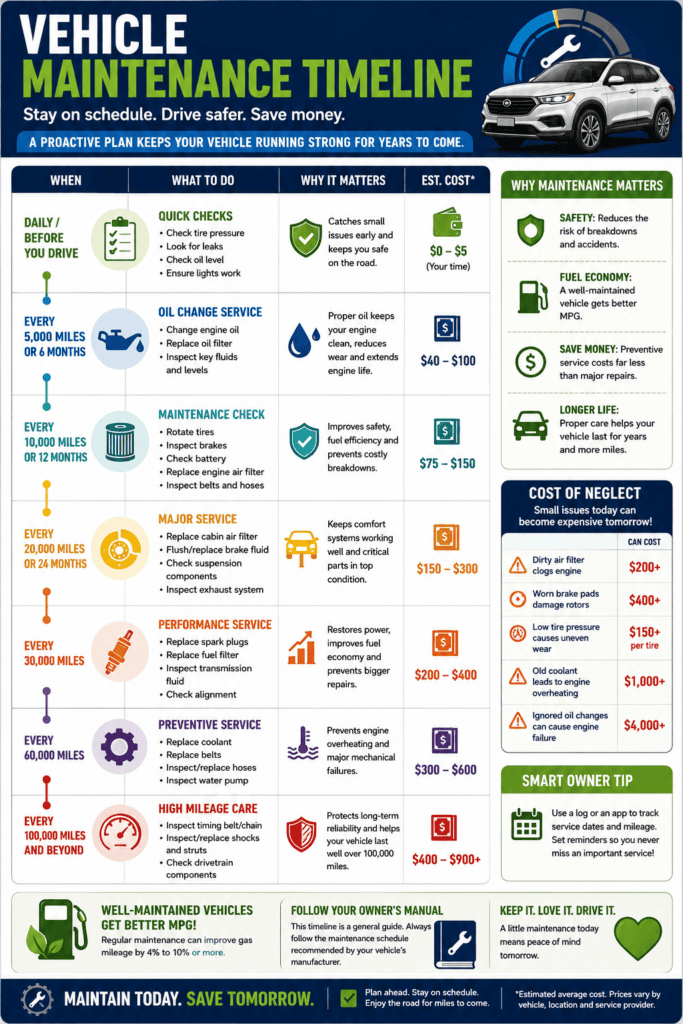
Vehicle Maintenance Timeline: Following your vehicle’s recommended maintenance schedule is one of the smartest ways to save money on gas while reducing long-term ownership costs. Regular oil changes, properly inflated tires, clean air filters, brake inspections, and scheduled preventive maintenance help your engine run more efficiently, improve fuel economy, and reduce the risk of costly breakdowns. Always follow the maintenance schedule in your owner’s manual, as recommended service intervals vary by manufacturer, model, driving conditions, and engine type. Staying ahead of routine maintenance not only helps save money on gas, but also extends the life, reliability, and resale value of your vehicle.
Keep Your Vehicle Properly Maintained
One of the best ways to save money on fuel isn’t found at the gas station—it’s found in your garage or repair shop.
A properly maintained vehicle simply operates more efficiently. When your engine, tires, transmission, and other systems are working as designed, your vehicle requires less fuel to travel the same distance.
The good news is that most maintenance items are things you should already be doing. Fuel savings become an added bonus.
Follow the Manufacturer’s Maintenance Schedule
Every vehicle has a maintenance schedule published by the manufacturer. Following it not only improves reliability but also helps your vehicle operate at peak efficiency.
Typical maintenance items include:
- Engine oil and filter changes
- Engine air filter replacement
- Cabin air filter replacement
- Spark plug replacement
- Transmission service
- Coolant replacement
- Wheel alignment
- Tire rotation
- Brake inspections
Skipping routine maintenance may save a little money today, but it often leads to higher repair costs—and increased fuel consumption—later.
Use the Recommended Motor Oil
Modern engines are designed to use specific oil viscosities.
Using oil that is thicker than recommended can increase internal engine resistance, forcing the engine to work harder.
Always follow the viscosity recommendations in your owner’s manual unless your mechanic advises otherwise for a specific operating condition.
Don’t Ignore the Check Engine Light
A check engine light doesn’t always indicate a major repair.
Sometimes it’s something as simple as:
- A loose gas cap
- A faulty oxygen sensor
- A worn spark plug
- An emissions component
However, many of these problems can reduce fuel economy if left uncorrected.
Ignoring the warning light for months could end up costing far more in wasted fuel than the repair itself.
Wheel Alignment Matters More Than You Think
If your vehicle pulls slightly to one side or your steering wheel isn’t centered while driving straight, your wheels may be out of alignment.
Poor alignment causes:
- Increased rolling resistance
- Faster tire wear
- Reduced fuel economy
- Less predictable handling
An alignment not only saves fuel but can also add thousands of miles to the life of your tires.
Air Filters: Not Always What You Think
You’ve probably heard that replacing your engine air filter dramatically improves fuel economy.
That was often true on older carbureted vehicles.
Most modern fuel-injected engines automatically adjust the air-fuel mixture, so replacing a dirty air filter usually produces only modest fuel savings unless the filter is severely clogged.
That doesn’t mean you should ignore it. A clean air filter helps your engine breathe properly and supports overall performance.
Listen to Your Vehicle
Your vehicle often tells you when something isn’t right.
Pay attention to:
- Reduced fuel economy
- Rough idling
- Hesitation during acceleration
- Unusual noises
- Vibrations
- Tire wear patterns
Addressing small problems early is almost always less expensive than waiting until they become major repairs.
💰 Estimated Annual Savings
Example Assumptions
- Vehicle receives scheduled maintenance.
- Tire alignment corrected when needed.
- Engine operates at peak efficiency.
- Gasoline costs $3.50 per gallon.
Potential Savings
| Maintenance Item | Estimated Annual Savings |
|---|---|
| Timely oil changes | $10–$20 |
| Proper wheel alignment | $20–$40 |
| Correct minor engine issues | $20–$50 |
| Following maintenance schedule | Long-term reliability benefits |
Estimated Fuel Savings: Approximately $60 per year
While maintenance may not produce dramatic fuel savings by itself, it helps ensure your vehicle continues delivering the fuel economy it was designed to achieve—and it often prevents expensive repairs down the road.
Running Total of Potential Annual Savings
- Switch from premium to regular gasoline: $518
- Drive at more efficient highway speeds: $175
- Maintain proper tire pressure: $60
- Eliminate unnecessary idling: $50
- Combine errands and plan trips: $80
- Remove unnecessary weight and roof accessories: $50
- Keep your vehicle properly maintained: $60
Current Potential Annual Savings: $993 per year
We’re now approaching $1,000 per year in potential savings from practical changes that don’t require purchasing a different vehicle. Most of these recommendations cost little or nothing to implement, making them some of the highest-return financial decisions a driver can make.
Author’s Observation
One lesson I’ve learned over many years is that deferred maintenance almost always costs more than preventive maintenance. Spending $60 on an oil change, replacing a worn air filter, or correcting a wheel alignment is far less expensive than replacing an engine, buying a new set of prematurely worn tires, or paying for poor fuel economy year after year.
The next section will explore another area where many drivers leave money on the table: using technology and smartphone apps to find lower fuel prices and avoid paying more than necessary at the pump.
Continue Your Research with These Authoritative Resources
Fuel prices, vehicle technology, and maintenance recommendations continue to evolve. If you’d like to explore these topics in more depth, the following organizations publish research, consumer guidance, and technical information that complements the ideas discussed in this guide.
Recommended Resources
- U.S. Department of Energy – Fuel Economy
Learn how driving habits, vehicle maintenance, and fuel economy affect your annual fuel costs.
https://www.fueleconomy.gov - U.S. Department of Energy – Energy Saver
Practical advice on reducing fuel consumption, improving vehicle efficiency, and lowering transportation costs.
https://www.energy.gov/energysaver - Environmental Protection Agency (EPA)
Information on vehicle emissions, fuel economy, and Green Vehicle Guides.
https://www.epa.gov - AAA
Fuel prices, automotive research, maintenance advice, and driving resources.
https://www.aaa.com - National Highway Traffic Safety Administration (NHTSA)
Tire safety, recalls, vehicle maintenance, and safe driving recommendations.
https://www.nhtsa.gov - Consumer Reports
Independent vehicle testing, fuel economy evaluations, and ownership cost information.
https://www.consumerreports.org - Car Care Council
Preventive maintenance schedules and educational resources for vehicle owners.
https://www.carcare.org - Society of Automotive Engineers (SAE International)
Technical standards and research relating to automotive engineering and transportation.
https://www.sae.org
RetireCoast Tip
These organizations are excellent sources for objective information about fuel economy, vehicle maintenance, and transportation costs.
Throughout this guide, we’ve combined many of these established best practices with practical real-world experience and the interactive tools available in the RetireCoast Fuel Price Intelligence Center™ to help you identify opportunities to reduce your own fuel expenses.
Why this helps SEO
This placement offers several advantages:
- It demonstrates topical authority before the end of the article.
- It provides outbound links to highly trusted
.gov, nonprofit, and industry sources. - It reinforces your content rather than making references appear to be an afterthought.
- It encourages readers to continue exploring the topic, which supports the article’s educational purpose.
I would still include a traditional References section at the end of the article with any additional sources used for statistics, examples, or specific claims. This creates a strong “bookend” approach: authoritative resources in the middle for further reading, and formal references at the end for documentation.
This guide is just one part of the RetireCoast Fuel Price Intelligence Center™. We’ve created an entire resource dedicated to helping drivers, families, RV owners, commuters, retirees, and small businesses better understand crude oil, gasoline, diesel fuel, fuel pricing, and transportation costs.
Inside you’ll find free calculators, interactive tools, practical buying guides, and in-depth articles designed to help you make informed decisions instead of relying on headlines, rumors, or social media speculation.
Every time fuel prices rise, conversations begin about price gouging, government policies, taxes, oil companies, refinery shutdowns, or world events. Some of those discussions are accurate. Many are not.
Our mission is to explain what actually drives fuel prices, separate fact from fiction, and give you the knowledge to understand what’s happening at the pump. Instead of guessing why prices changed, you’ll have the information needed to explain it confidently to your family, friends, and coworkers.
Whether you’re trying to save money, understand why prices change, or simply become a more informed consumer, the Fuel Price Intelligence Center continues to grow with new articles, calculators, and educational resources.
Visit the Fuel Price Intelligence Center™ →Use Technology to Find the Lowest Fuel Prices
Years ago, finding the least expensive gasoline simply meant looking across the street to see which station had the lower price. Today, your smartphone can compare prices at hundreds of stations before you even leave your driveway.
A difference of just 10 or 15 cents per gallon may not seem significant, but if you fill up every week, those savings can quickly add up over the course of a year.
The key is to use technology wisely.
Gas Price Apps Can Save You Money
Several smartphone apps allow drivers to compare fuel prices in real time.
Popular examples include:
- GasBuddy
- Upside
- Google Maps
- Waze
- AAA TripTik
Many of these applications rely on a combination of user reports and participating fuel retailers to display current prices.
Before making a special trip to save a few cents per gallon, however, remember to consider the additional driving required. Driving six miles across town to save 10 cents per gallon on a 15-gallon fill-up saves only $1.50—an amount that can easily be offset by the extra fuel consumed getting there.
Buy Fuel Along Your Normal Route
The smartest strategy is often the simplest:
Choose lower-priced stations that are already along your regular commute or errands.
If you’re already passing a Costco, Sam’s Club, or another competitively priced station on your way home, stopping there usually makes financial sense.
Driving well out of your way often does not.
Compare Before Long Trips
Fuel prices can vary dramatically from one city—or even one highway exit—to the next.
Before beginning a road trip:
- Check fuel prices along your route.
- Identify stations near interstate exits.
- Compare prices before entering expensive tourist areas.
- Fill up before reaching locations known for higher fuel prices.
Planning ahead can easily save $10 to $20 on a single vacation simply by choosing where you stop.
Use the RetireCoast State Fuel Price Lookup
Fuel prices don’t just vary by neighborhood—they vary significantly by state.
Taxes, environmental regulations, transportation costs, and local competition all influence what you’ll pay at the pump.
The RetireCoast State Fuel Price Lookup allows you to compare average gasoline and diesel prices across all 50 states. Whether you’re planning a road trip, relocating, or simply curious about regional price differences, it’s an easy way to understand how location affects your fuel budget.
If you’re crossing multiple state lines, checking average prices in advance can help you decide where it makes the most sense to fill your tank.
Don’t Chase Every Penny
Some drivers become so focused on finding the absolute lowest fuel price that they spend excessive time driving from station to station.
Remember:
Your time has value too.
Saving two dollars on a fill-up isn’t always worth adding twenty minutes to your day.
Focus on stations that consistently offer competitive prices without requiring major detours.
Fuel Quality Still Matters
While price is important, it shouldn’t be the only factor.
Buying fuel from reputable, high-volume stations helps ensure you’re purchasing fresh fuel that meets current quality standards.
Many experts recommend using stations certified as Top Tier™ retailers, particularly for modern engines with sophisticated fuel systems.
Paying a penny or two more for consistently high-quality fuel may prove worthwhile over the long run.
💰 Estimated Annual Savings
Example Assumptions
- Compare prices before filling up.
- Save an average of 10 cents per gallon.
- Purchase approximately 600 gallons annually (15,000 miles at 25 MPG).
Potential Savings
| Strategy | Estimated Annual Savings |
|---|---|
| Choose lower-priced stations along your route | $60 |
| Better planning during road trips | $10–$20 |
Estimated Fuel Savings: Approximately $70 per year
The important lesson isn’t to drive farther looking for cheaper gas—it’s to make smarter purchasing decisions where you’re already driving.
Running Total of Potential Annual Savings
- Switch from premium to regular gasoline: $518
- Drive at fuel-efficient speeds: $175
- Maintain proper tire pressure: $60
- Eliminate unnecessary idling: $50
- Combine errands and plan trips: $80
- Remove unnecessary weight and roof accessories: $50
- Keep your vehicle properly maintained: $60
- Use technology to find lower fuel prices: $70
Current Potential Annual Savings: $1,063 per year
We’ve now crossed the $1,000-per-year mark for our example driver. While your personal savings will vary depending on where you live, how much you drive, and the type of vehicle you own, the message is clear:
Small changes, consistently applied, can produce surprisingly large financial results.
In the next section, we’ll explore whether warehouse clubs such as Costco and Sam’s Club are worth the membership fee solely for their fuel savings—and how to determine if the math works in your favor.
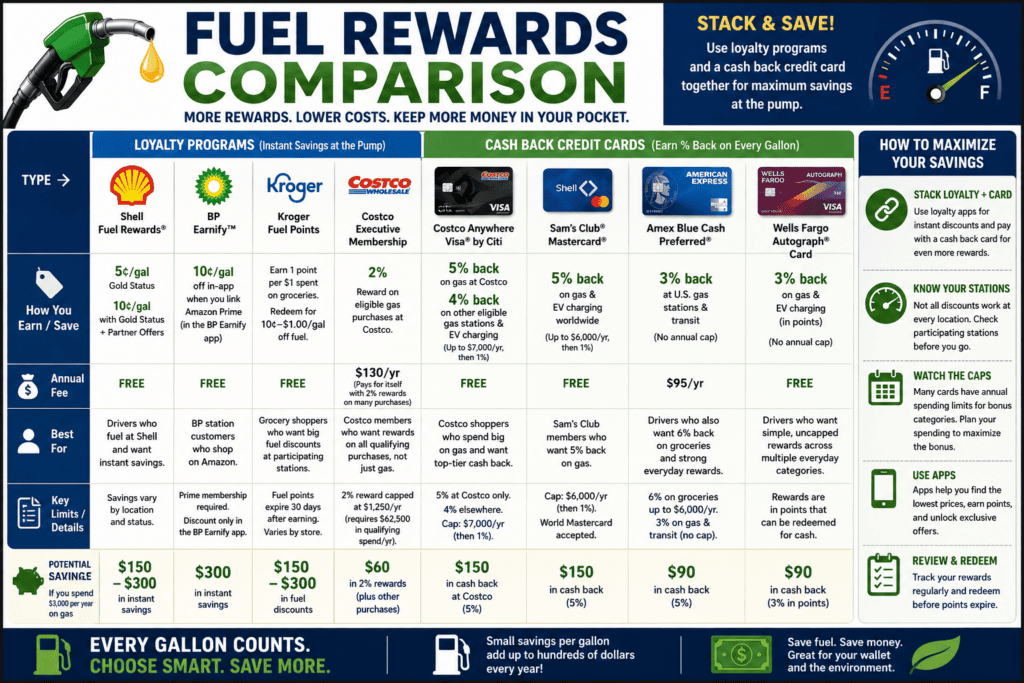
Fuel Rewards Comparison: One of the easiest ways to save money on gas is to choose a fuel rewards program that matches your driving and spending habits. Not all fuel rewards programs work the same way. Some provide immediate discounts per gallon, while others offer cash back, points, or statement credits after your purchase. In many cases, the greatest savings come from stacking a fuel loyalty program with a rewards credit card, allowing you to earn both an instant discount and cash back on the same purchase. Because reward rates, spending limits, participating stations, and program terms can change, always review the latest details before choosing the combination that best fits your annual fuel budget. With a little planning, the right rewards strategy can help you save money on gas every time you fill up.
Are Warehouse Club Memberships Worth It for Fuel Savings?
For many drivers, the answer is yes—but not for everyone.
Warehouse clubs such as Costco and Sam’s Club are known for selling gasoline at prices that are often lower than nearby service stations. In some communities, the difference may be only a few cents per gallon. In others, it can exceed 20 or even 30 cents per gallon.
If you already shop at one of these stores, the fuel savings are simply an added benefit. But if you’re considering joining primarily to save money on gasoline, it’s worth doing the math first.
How Much Can You Really Save?
Let’s look at a simple example.
Assume:
- You drive 15,000 miles per year.
- Your vehicle averages 25 MPG.
- You purchase approximately 600 gallons of gasoline annually.
- Your warehouse club charges 15 cents less per gallon than nearby stations.
Your annual savings would be:
600 gallons × $0.15 = $90 per year
If the average savings is 25 cents per gallon, your annual savings increases to:
600 gallons × $0.25 = $150 per year
For households with two or three vehicles, those numbers can easily double or triple.
Don’t Forget the Credit Card Rewards
This is where the savings can become even more significant.
Many warehouse clubs offer co-branded credit cards that provide enhanced cash-back rewards on eligible fuel purchases.
For example, if you purchase fuel at a discounted warehouse price and earn cash-back rewards on your credit card, you’re stacking two different savings opportunities:
- Lower pump price.
- Cash-back rewards.
Over the course of a year, the combined savings can substantially exceed what either strategy provides on its own.
But Consider the Membership Fee
A warehouse club membership isn’t free.
Before joining solely for fuel savings, ask yourself:
- Will I also shop inside the warehouse?
- Will I save money on groceries or household items?
- Is the station conveniently located along my normal route?
- How often will I actually buy fuel there?
If the station requires a 15-mile round trip every time you fill up, much of your savings could disappear in the process.
Watch the Lines
Anyone who has visited a Costco or Sam’s Club on a Saturday morning knows that fuel stations can become extremely busy.
If you’re spending 20 minutes waiting in line every week, ask yourself whether the savings justify your time.
Many experienced members avoid this problem by:
- Filling up early in the morning.
- Visiting during weekday afternoons.
- Purchasing fuel during regular shopping trips.
- Avoiding weekends and holidays whenever possible.
Fuel Quality
Some drivers wonder whether warehouse club gasoline is lower quality because it’s less expensive.
Generally, that’s not the case.
Both Costco and Sam’s Club sell fuel that meets applicable federal standards, and many locations participate in the Top Tier™ fuel program, which includes higher detergent standards designed to help keep engines clean.
Lower prices are typically the result of high sales volume, efficient operations, and the membership business model—not lower-quality gasoline.
💰 Estimated Annual Savings
Example Assumptions
- Purchase 600 gallons annually.
- Warehouse fuel averages 15 cents less per gallon.
- Fuel station is conveniently located on your normal route.
- Membership already provides additional shopping value.
Potential Savings
| Strategy | Estimated Annual Savings |
|---|---|
| Lower fuel prices | $90 |
| Additional credit card rewards (where applicable) | Already included in earlier section |
Estimated Fuel Savings: Approximately $90 per year
If your household owns multiple vehicles, your savings could easily exceed $200 to $300 annually, making the membership even more valuable.
Running Total of Potential Annual Savings
- Switch from premium to regular gasoline: $518
- Drive at fuel-efficient speeds: $175
- Maintain proper tire pressure: $60
- Eliminate unnecessary idling: $50
- Combine errands and plan trips: $80
- Remove unnecessary weight and roof accessories: $50
- Keep your vehicle properly maintained: $60
- Use technology to find lower fuel prices: $70
- Buy fuel at warehouse clubs: $90
Current Potential Annual Savings: $1,153 per year
A Final Thought
Warehouse club memberships should be viewed as part of an overall savings strategy—not the entire strategy. The greatest financial benefit comes when you combine several of the ideas in this guide:
- Buy the correct octane fuel.
- Use a rewards credit card responsibly.
- Purchase fuel at competitive prices.
- Maintain your vehicle.
- Drive efficiently.
- Plan your trips.
Individually, each idea saves a little. Together, they can reduce your annual fuel bill by well over $1,000 for many households.
In the next section, we’ll examine another common question: Should you use cruise control, and does it actually save fuel? The answer depends on where—and how—you drive.
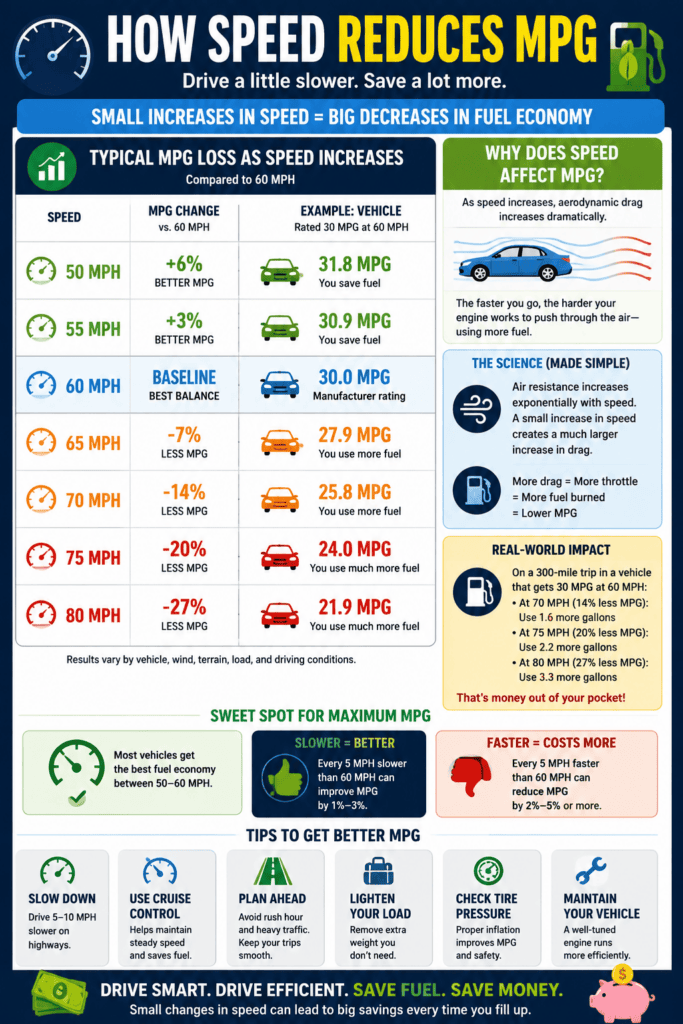
How Speed Affects Fuel Economy: One of the easiest ways to save money on gas is simply to reduce your highway speed. As speed increases, aerodynamic drag rises dramatically, forcing your engine to burn more fuel. Driving just 5 to 10 MPH slower on the interstate can improve fuel economy, extend your driving range, reduce wear on your vehicle, and save hundreds of dollars each year—especially for trucks, SUVs, RVs, and vehicles towing trailers. If you’re looking for a simple habit that can save money on gas every time you travel, easing off the accelerator is one of the most effective changes you can make.
Special Fuel-Saving Tips for RVs, Travel Trailers, and Fifth Wheels
Driving a motorhome or towing a travel trailer is one of the most enjoyable ways to explore the country—but it’s also one of the most fuel-intensive forms of travel. A large motorhome may average 6 to 10 miles per gallon, while a pickup towing a heavy travel trailer often sees fuel economy drop by 30% to 50% compared with normal driving.
When you’re burning twice as much fuel as the average passenger car, every fuel-saving habit becomes even more valuable.
Tire Pressure Matters Even More
Earlier we discussed the importance of keeping your vehicle’s tires properly inflated. When towing a trailer or driving a motorhome, proper tire inflation becomes even more critical.
Underinflated tires:
- Increase rolling resistance.
- Reduce fuel economy.
- Generate excessive heat.
- Wear out more quickly.
- Increase the risk of tire failure or blowouts.
Remember that you have two sets of tires to maintain:
- The tow vehicle.
- The trailer.
Many RV owners carefully maintain their truck while forgetting to check the trailer tires until the day they leave on vacation. By then, the trailer may have been sitting for months and lost a significant amount of air pressure.
Before every trip, check the tire pressure on every tire, including the spare.
Slow Down and Enjoy the Journey
Perhaps the single biggest way RV owners can save money is by reducing highway speed.
Large RVs and trailers push a tremendous amount of air. Aerodynamic drag increases rapidly as speed increases, meaning every additional mile per hour requires noticeably more fuel.
For example, towing at:
- 60 MPH
- 65 MPH
- 70 MPH
- 75 MPH
can produce dramatically different fuel economy.
Many experienced RV travelers report improving fuel economy by 1 to 2 miles per gallon simply by reducing cruising speed from 70 MPH to around 60–65 MPH.
That may not sound like much until you consider the amount of fuel consumed during a long trip.
Example
Imagine a 2,000-mile vacation.
If your motorhome averages:
- 8 MPG at higher speeds
- 9 MPG by slowing down
Fuel used:
- At 8 MPG = 250 gallons
- At 9 MPG = 222 gallons
That’s a savings of 28 gallons.
At $3.50 per gallon, you’ve saved almost $100 on a single vacation, simply by driving a little slower.
You’ll likely arrive more relaxed, experience less driver fatigue, and reduce wear on both your vehicle and trailer.
Travel Lighter
It’s tempting to pack everything “just in case.”
However, every additional pound requires energy to move.
Before a long trip, ask yourself whether you really need:
- Extra tools
- Duplicate camping equipment
- Cases of bottled water
- Heavy outdoor furniture
- Firewood (often available near campgrounds)
- Clothing you probably won’t wear
Traveling lighter won’t double your fuel economy, but every pound you leave behind reduces the work your engine must perform.
Plan Fuel Stops in Advance
Unlike passenger cars, large RVs can’t always fit into every service station.
Planning your fuel stops before leaving home can help you:
- Avoid expensive stations.
- Find truck-friendly fuel islands.
- Reduce unnecessary detours.
- Stay off congested city streets.
Truck stop apps and navigation software designed specifically for RV travelers can make trip planning much easier.
💰 Estimated Annual Savings (Typical RV Owner)
Example Assumptions
- One 2,000-mile RV vacation.
- Several shorter camping trips.
- Proper tire inflation.
- Cruising speed reduced from approximately 70 MPH to 62–65 MPH.
| Strategy | Estimated Savings |
|---|---|
| Proper tire inflation | $30 |
| Reduced highway speed | $100 |
| Better trip planning | $25 |
| Reduced vehicle weight | $20 |
Estimated Annual RV Fuel Savings: Approximately $175
Running Total of Potential Annual Savings
For households that also own an RV or regularly tow a trailer, these additional strategies can increase the running total from:
$1,153 per year
to approximately
$1,328 per year
Author’s Note
I’ve owned boats, towed trailers, and spent many years traveling long distances, and one lesson has remained constant: slowing down is almost always the easiest way to save fuel. When you’re driving a motorhome or towing a travel trailer, you’re on vacation—not racing to the campground.
Arriving 30 minutes later while saving close to $100 in fuel, reducing stress, and enjoying the scenery is usually a trade worth making. That’s one of those rare situations where saving money actually makes the journey more enjoyable.
When I purchased my fifth-wheel RV, the dealer told me the tires had been properly inflated before delivery. Like many new RV owners, I accepted that at face value and didn’t check them myself for several months.
After completing a cross-country trip, I finally decided to verify the tire pressure. To my surprise, every trailer tire was about 20 PSI below the manufacturer’s recommended pressure. I immediately inflated them to the correct pressure and installed a Bluetooth Tire Pressure Monitoring System (TPMS) so I could monitor all of the tires while traveling.
On my next trip—approximately 1,200 miles—I observed an improvement of about 0.9 miles per gallon. While several factors can influence fuel economy, proper tire inflation was the most significant change I had made before that trip.
Today I still periodically check every tire with a quality pressure gauge to confirm that my TPMS is reading accurately. Technology is a great tool, but I never rely on electronics alone when it comes to tire safety.
The lesson: Whether you’re towing a travel trailer, a fifth wheel, or driving a motorhome, never assume your tire pressure is correct simply because someone else says it is. A five-minute inspection before a trip can improve safety, extend tire life, and potentially save money at the fuel pump.
Use Cruise Control Wisely
Cruise control has been around for decades, yet many drivers never use it—or they use it in situations where it actually reduces fuel economy. When used appropriately, cruise control can be one of the simplest ways to improve highway fuel efficiency.
The reason is straightforward: people are not very good at maintaining a constant speed.
Even experienced drivers tend to speed up without realizing it, then slow down, then accelerate again. These constant changes require additional fuel. Cruise control eliminates much of that unnecessary acceleration by maintaining a steady speed.
Why Steady Speed Saves Fuel
Every time you accelerate, your engine consumes more fuel.
When you maintain a consistent highway speed:
- Fuel delivery remains more constant.
- The transmission shifts less frequently.
- The engine operates more efficiently.
- You avoid the “accordion effect” that occurs when drivers repeatedly speed up and slow down.
Over a long highway trip, those small improvements can translate into measurable fuel savings.
Cruise Control Works Best On…
Cruise control is most effective on:
- Interstate highways.
- Rural highways with little traffic.
- Long, relatively flat stretches of road.
- Lightly traveled divided highways.
If your route allows you to drive for miles without frequent braking, cruise control is usually an excellent choice.
When Not to Use Cruise Control
Cruise control isn’t appropriate for every situation.
Avoid using it:
- In heavy traffic.
- During rain, snow, or icy conditions.
- On winding mountain roads.
- Where frequent speed adjustments are necessary.
- On slippery pavement.
Safe driving should always take priority over fuel economy.
What About Hills?
If you’ve ever driven through mountainous terrain with cruise control engaged, you’ve probably noticed your vehicle aggressively accelerating uphill to maintain the exact programmed speed.
That additional acceleration often uses more fuel than necessary.
Many experienced drivers, particularly those towing RVs or travel trailers, temporarily disengage cruise control on rolling hills and allow their speed to vary naturally by a few miles per hour.
For example:
- Lose 3 to 5 MPH while climbing.
- Regain that speed while descending.
This approach often requires less fuel than forcing the engine to maintain a perfectly constant speed.
Adaptive Cruise Control
Many newer vehicles now include Adaptive Cruise Control (ACC).
Unlike traditional cruise control, ACC automatically adjusts your speed to maintain a safe following distance from the vehicle ahead.
Besides making long trips less tiring, adaptive cruise control often encourages smoother driving with fewer abrupt accelerations and braking events—habits that can also contribute to improved fuel economy.
RV and Trailer Owners
Cruise control can also be useful when towing, but use it carefully.
On steep grades, your transmission may repeatedly shift between gears as the system tries to maintain speed. If you notice excessive shifting, it may be more efficient—and less stressful on your drivetrain—to drive manually until the terrain levels out.
💰 Estimated Annual Savings
Example Assumptions
- 10,000 highway miles per year.
- Cruise control used whenever practical.
- Smooth driving conditions.
- Gasoline at $3.50 per gallon.
Potential Savings
| Strategy | Estimated Annual Savings |
|---|---|
| Maintain a consistent highway speed | $30–$60 |
Estimated Fuel Savings: Approximately $45 per year
The greatest benefit isn’t simply cruise control itself—it’s the smoother, more consistent driving that cruise control encourages.
Running Total of Potential Annual Savings
- Switch from premium to regular gasoline: $518
- Drive at fuel-efficient highway speeds: $175
- Maintain proper tire pressure: $60
- Eliminate unnecessary idling: $50
- Combine errands and plan trips: $80
- Remove unnecessary weight and roof accessories: $50
- Keep your vehicle properly maintained: $60
- Use technology to find lower fuel prices: $70
- Buy fuel at warehouse clubs: $90
- Use cruise control effectively: $45
Current Potential Annual Savings: $1,198 per year
Fuel-Saving Philosophy
One of the themes running through this guide is that consistency saves fuel.
A consistent speed.
Properly inflated tires.
Regular maintenance.
Planned trips.
Buying the correct fuel.
Using rewards programs.
None of these changes alone will transform your budget, but together they create meaningful savings. For our example driver, we’re now approaching $1,200 per year—and we still have several more practical strategies to explore.
One habit that has saved me money for years is avoiding gasoline stations located directly on interstate exits whenever possible. These stations know they’re serving travelers who may not know the local area, and it’s common to find prices that are significantly higher than stations located just a mile or two away.
Before a long trip, I usually identify a fuel stop in advance. Instead of pulling into the first service station I see from the interstate, I’ll often drive a short distance into town where prices are frequently much lower. In many cases, the savings easily justify the extra minute or two of driving.
Even better: Combine your fuel stop with lunch, dinner, or a grocery stop. You’re already leaving the interstate, so take advantage of the opportunity to eat, stretch your legs, use the restroom, and fill your tank—all in one stop. You’ll often find better food, lower fuel prices, and avoid making multiple stops later in the day.
Apps such as Google Maps, GasBuddy, and Waze make it easy to compare fuel prices before reaching an exit. Spending just a few minutes planning ahead can save money on every road trip, especially if you’re driving an SUV, pickup, motorhome, or towing a travel trailer where every fill-up may cost well over $100.
My rule of thumb: If I’m traveling, I try to make every stop count. Fuel, food, a restroom break, and a quick walk all at the same location is usually more efficient than making several separate stops—and it almost always saves both time and money.
When I’m traveling with my fifth wheel, I also think about how easy it will be to get in and out of the station. I often choose larger travel centers such as Buc-ee’s or major truck stops because they typically have wide entrances, spacious fueling areas, and plenty of room to maneuver a large RV or trailer. Saving a few cents per gallon isn’t worth getting stuck trying to navigate a tight parking lot or crowded neighborhood gas station.
My rule of thumb: Every stop should accomplish several things at once. I plan my fuel stops around meals, restroom breaks, and opportunities to stretch my legs. By combining activities, choosing stations with competitive prices, and selecting locations that are easy to enter and exit with an RV or trailer, I save both time and money—and make the trip much less stressful.
Reduce Wind Resistance: Small Changes Can Make a Big Difference
Most drivers think about fuel economy in terms of engine size or tire pressure, but once you’re traveling at highway speeds, your biggest enemy is often something you can’t even see—the air.
As your speed increases, your vehicle must push more and more air out of the way. Engineers call this aerodynamic drag, and it’s one of the primary reasons fuel economy drops so quickly above 60 to 65 miles per hour.
While you can’t eliminate wind resistance, you can reduce its impact.
Roll the Windows Up at Highway Speeds
There’s an old debate among drivers:
Is it more fuel efficient to use the air conditioner or drive with the windows down?
The answer depends on your speed.
At lower city speeds, driving with the windows down usually has very little effect on fuel economy.
However, once you reach highway speeds, open windows create turbulence that disrupts the smooth flow of air around your vehicle. Your engine must work harder to overcome that additional drag.
As a general rule:
- Below about 40 MPH: Open windows are usually fine.
- Above about 50–60 MPH: Using the air conditioner is often the more fuel-efficient choice.
Every vehicle is different, but this rule works well for most modern passenger cars.
Remove Accessories You Aren’t Using
Earlier we discussed roof racks, but they’re worth mentioning again because they are one of the biggest contributors to aerodynamic drag.
If you aren’t using your:
- Roof rack
- Cargo box
- Bicycle rack
- Kayak carrier
- Ski rack
take it off.
Many people leave these accessories installed year-round even though they only use them a few weekends each year.
Removing them can improve fuel economy while also reducing wind noise.
Watch the Wind
Strong headwinds affect fuel economy almost as much as increasing your speed.
For example, driving:
- 65 MPH into a 20 MPH headwind
creates roughly the same aerodynamic effect as driving about 85 MPH on a calm day.
You can’t control the weather, but you can adjust your speed.
Slowing down a few miles per hour during particularly windy conditions often saves more fuel than trying to maintain your normal cruising speed.
RV Owners Feel It Even More
If you own a motorhome or tow a travel trailer, you’ve probably noticed how dramatically fuel economy changes on windy days.
Large, flat-sided RVs act almost like sails.
A stiff headwind can reduce fuel economy by one to two miles per gallon—or even more.
When conditions are especially windy, consider:
- Reducing your cruising speed.
- Traveling earlier or later in the day if winds are forecast to be lighter.
- Planning additional fuel stops.
- Allowing extra travel time instead of trying to “make up time” by driving faster.
Sometimes Slower Is Actually Faster
That may sound strange, but here’s what many experienced travelers discover:
Driving slightly slower often means:
- Fewer fuel stops.
- Less driver fatigue.
- Lower stress.
- Longer vehicle range.
- More enjoyable travel.
When you’re on vacation, arriving a little later while spending less money is usually a winning combination.
💰 Estimated Annual Savings
Example Assumptions
- Highway driving represents a significant portion of annual mileage.
- Windows remain closed at highway speeds.
- Roof accessories removed when not needed.
- Speed adjusted during strong headwinds.
Potential Savings
| Strategy | Estimated Annual Savings |
|---|---|
| Remove unnecessary aerodynamic drag | $20–$40 |
| Use A/C instead of open windows on highways | $10–$20 |
| Reduce speed during windy conditions | $20–$40 |
Estimated Fuel Savings: Approximately $60 per year
These changes cost nothing to implement and are especially valuable for drivers who spend a great deal of time on the interstate.
Running Total of Potential Annual Savings
- Switch from premium to regular gasoline: $518
- Drive at fuel-efficient speeds: $175
- Maintain proper tire pressure: $60
- Eliminate unnecessary idling: $50
- Combine errands and plan trips: $80
- Remove unnecessary weight and roof accessories: $50
- Keep your vehicle properly maintained: $60
- Use technology to find lower fuel prices: $70
- Buy fuel at warehouse clubs: $90
- Use cruise control effectively: $45
- Reduce aerodynamic drag: $60
Current Potential Annual Savings: $1,258 per year
Looking Ahead
Notice what’s happening: we haven’t recommended buying a hybrid, purchasing an electric vehicle, or replacing your current car. We’ve simply focused on getting the maximum value from the vehicle you already own.
For many households, that’s the smartest financial decision of all.
Next, we’ll explore one final strategy that many drivers overlook: tracking your fuel economy over time. By monitoring your miles per gallon, you can spot maintenance problems early, verify that your fuel-saving habits are working, and measure your progress year after year.
Throughout this guide we’ve shown dozens of practical ways to reduce your fuel costs and, whenever possible, estimated the potential annual savings. Some recommendations can save nearly every driver money, while others may only apply to certain lifestyles or occupations.
- Move to a lower fuel-cost state. If you’re planning a relocation anyway, remember that gasoline and diesel prices vary widely across the country. A household moving from a higher-cost state such as California to a lower-cost state such as Texas may save hundreds of dollars per year on fuel alone, depending on annual mileage.
- Live closer to where you work. Reducing your daily commute by just a few miles can save fuel every week while also reducing wear on your vehicle and giving you more personal time.
- Consider shared housing. If housing costs near your workplace are high, sharing an apartment or renting a room may allow you to live closer to work. The reduction in commuting costs, combined with lower transportation expenses, can offset part of the higher housing cost.
- Work from home when possible. Even working remotely one day each week can eliminate hundreds or even thousands of commuting miles each year, reducing fuel, maintenance, depreciation, and parking expenses.
Saving money on fuel isn’t always about finding the lowest gas price. Sometimes the greatest savings come from reducing the number of miles you drive or changing where and how you live. While these decisions aren’t practical for everyone, they’re worth considering if you’re looking for long-term ways to lower your transportation costs.
The cheapest gallon of gasoline isn’t necessarily the one that’s on sale—it’s often the gallon you never have to buy.
Track Your Fuel Economy: What Gets Measured Gets Improved
One of the simplest ways to save money on fuel doesn’t involve changing how you drive at all. It starts by paying attention.
Most drivers know approximately how much they spend to fill their tank, but very few know their actual fuel economy. Ask someone what mileage their vehicle is getting today versus six months ago, and most couldn’t tell you.
That’s unfortunate because fuel economy is one of the earliest indicators that something may be changing with your vehicle—or your driving habits.
Start Keeping a Fuel Log
Tracking your fuel economy is easier than ever.
Each time you fill your tank, record:
- Date
- Odometer reading
- Gallons purchased
- Price per gallon
- Total amount spent
Within a few fill-ups, you’ll begin seeing patterns.
If your average fuel economy suddenly drops, ask yourself:
- Did I change my driving habits?
- Have I been driving faster?
- Is one of my tires low?
- Have I started towing a trailer?
- Am I carrying more weight?
- Is the check engine light on?
- Is my vehicle due for maintenance?
Finding these changes early can save money long before they become expensive repairs.
Most Vehicles Already Do the Math
Many newer vehicles include onboard computers that display:
- Current MPG
- Average MPG
- Distance to empty
- Fuel used
- Trip mileage
These displays are excellent tools for learning how your driving habits affect fuel consumption.
Watch what happens when you:
- Accelerate aggressively.
- Increase your highway speed.
- Tow a trailer.
- Drive into a strong headwind.
- Inflate your tires to the correct pressure.
You’ll often see the results almost immediately.
Apps Can Help
If your vehicle doesn’t display fuel economy, several smartphone apps make tracking simple.
Some drivers prefer a notebook in the glove compartment.
Others use spreadsheets.
The method doesn’t matter.
The important thing is establishing a baseline so you’ll know when something changes.
Businesses Should Track Every Vehicle
If you operate a small business, monitoring fuel economy becomes even more valuable.
Tracking each vehicle separately can help identify:
- Poor driving habits.
- Maintenance issues.
- Vehicles that should be replaced.
- Unexpected increases in operating costs.
Many commercial fleets save thousands of dollars annually simply by paying attention to the numbers.
Turn Fuel Savings Into Investment Savings
Here’s a thought that goes beyond saving money at the pump.
Suppose you’ve followed the advice in this guide and reduced your annual fuel expenses by $800 to $1,200.
Instead of allowing that money to disappear into everyday spending, consider investing it.
A simple automatic monthly investment equal to your fuel savings could grow substantially over time.
Saving money is important.
Putting those savings to work is even better.
💰 Estimated Annual Savings
Tracking fuel economy doesn’t directly reduce fuel consumption, but it helps you identify problems before they become expensive.
Potential Savings
| Strategy | Estimated Annual Value |
|---|---|
| Early detection of maintenance issues | $25–$75 |
| Better awareness of driving habits | $25–$50 |
| Improved budgeting and planning | Long-term benefit |
Estimated Annual Fuel Savings: Approximately $50
The real value isn’t just the fuel you save today—it’s the ability to prevent higher fuel costs tomorrow.
Running Total of Potential Annual Savings
- Previous Running Total: $1,258
- Track fuel economy and identify problems early: $50
Current Potential Annual Savings: $1,308 per year
A RetireCoast Perspective
One thing I’ve learned during my career is that you can’t effectively manage what you don’t measure.
Whether it’s investing, running a business, managing rental property, or reducing fuel costs, the same principle applies. The people who consistently save the most money are usually the ones who pay attention to the numbers.
You don’t need to become obsessed with every gallon of fuel. But spending just a few minutes each month tracking your mileage and fuel purchases can reveal trends that most drivers never notice.
Those small insights often lead to meaningful savings—not just for one year, but for as long as you own the vehicle.
This section also sets up the conclusion perfectly because your final message can be: “You’ve now identified more than $1,300 in potential annual savings. The question isn’t whether you’ll implement all of them—it’s which ones you’ll start using today.” I think that’s a very strong way to close the article.
I think this is the perfect place to introduce something that almost nobody does—but every financially minded person should.
Track Your Fuel Economy: What Gets Measured Gets Improved
One of the simplest ways to save money on fuel doesn’t involve changing how you drive at all. It starts by paying attention.
Most drivers know approximately how much they spend to fill their tank, but very few know their actual fuel economy. Ask someone what mileage their vehicle is getting today versus six months ago, and most couldn’t tell you.
That’s unfortunate because fuel economy is one of the earliest indicators that something may be changing with your vehicle—or your driving habits.
Start Keeping a Fuel Log
Tracking your fuel economy is easier than ever.
Each time you fill your tank, record:
- Date
- Odometer reading
- Gallons purchased
- Price per gallon
- Total amount spent
Within a few fill-ups, you’ll begin seeing patterns.
If your average fuel economy suddenly drops, ask yourself:
- Did I change my driving habits?
- Have I been driving faster?
- Is one of my tires low?
- Have I started towing a trailer?
- Am I carrying more weight?
- Is the check engine light on?
- Is my vehicle due for maintenance?
Finding these changes early can save money long before they become expensive repairs.
Most Vehicles Already Do the Math
Many newer vehicles include onboard computers that display:
- Current MPG
- Average MPG
- Distance to empty
- Fuel used
- Trip mileage
These displays are excellent tools for learning how your driving habits affect fuel consumption.
Watch what happens when you:
- Accelerate aggressively.
- Increase your highway speed.
- Tow a trailer.
- Drive into a strong headwind.
- Inflate your tires to the correct pressure.
You’ll often see the results almost immediately.
Apps Can Help
If your vehicle doesn’t display fuel economy, several smartphone apps make tracking simple.
Some drivers prefer a notebook in the glove compartment.
Others use spreadsheets.
The method doesn’t matter.
The important thing is establishing a baseline so you’ll know when something changes.
Businesses Should Track Every Vehicle
If you operate a small business, monitoring fuel economy becomes even more valuable.
Tracking each vehicle separately can help identify:
- Poor driving habits.
- Maintenance issues.
- Vehicles that should be replaced.
- Unexpected increases in operating costs.
Many commercial fleets save thousands of dollars annually simply by paying attention to the numbers.
Turn Fuel Savings Into Investment Savings
Here’s a thought that goes beyond saving money at the pump.
Suppose you’ve followed the advice in this guide and reduced your annual fuel expenses by $800 to $1,200.
Instead of allowing that money to disappear into everyday spending, consider investing it.
A simple automatic monthly investment equal to your fuel savings could grow substantially over time.
Saving money is important.
Putting those savings to work is even better.
💰 Estimated Annual Savings
Tracking fuel economy doesn’t directly reduce fuel consumption, but it helps you identify problems before they become expensive.
Potential Savings
| Strategy | Estimated Annual Value |
|---|---|
| Early detection of maintenance issues | $25–$75 |
| Better awareness of driving habits | $25–$50 |
| Improved budgeting and planning | Long-term benefit |
Estimated Annual Fuel Savings: Approximately $50
The real value isn’t just the fuel you save today—it’s the ability to prevent higher fuel costs tomorrow.
Running Total of Potential Annual Savings
- Previous Running Total: $1,258
- Track fuel economy and identify problems early: $50
Current Potential Annual Savings: $1,308 per year
A RetireCoast Perspective
One thing I’ve learned during my career is that you can’t effectively manage what you don’t measure.
Whether it’s investing, running a business, managing rental property, or reducing fuel costs, the same principle applies. The people who consistently save the most money are usually the ones who pay attention to the numbers.
You don’t need to become obsessed with every gallon of fuel. But spending just a few minutes each month tracking your mileage and fuel purchases can reveal trends that most drivers never notice.
Those small insights often lead to meaningful savings—not just for one year, but for as long as you own the vehicle.
This section also sets up the conclusion perfectly because your final message can be: “You’ve now identified more than $1,300 in potential annual savings. The question isn’t whether you’ll implement all of them—it’s which ones you’ll start using today.” I think that’s a very strong way to close the article.
If you drive for business, one of the most useful apps I’ve found is MileIQ. Once installed, it automatically detects and records your trips using your phone’s GPS. At the end of each drive, you simply swipe to classify the trip as business or personal.
For anyone who is self-employed, owns rental property, works as a real estate professional, or operates a small business, this can be a tremendous time saver. Instead of trying to reconstruct your mileage at tax time, you’ll have a detailed log showing the date, starting point, destination, distance traveled, and business purpose for each trip.
RetireCoast Tip: I recommend reviewing and categorizing your trips every week or two rather than waiting until the end of the year. It only takes a few minutes, and your mileage records will be much more accurate if the details are still fresh in your mind.
Remember that IRS mileage records should include more than just the number of miles driven. You should also document the business purpose of the trip and maintain records that support your deduction. An automatic mileage tracking app can make this process much easier.
Disclosure: This is simply a tool I have found useful. There are several mileage-tracking apps available, and you should choose the one that best fits your business needs.
Sometimes the Best Way to Save Fuel Is to Drive Less
Most of the ideas in this guide focus on making your vehicle more efficient or reducing the amount you pay at the pump. But there’s another strategy that’s often overlooked:
Reduce the number of miles you drive.
That doesn’t mean giving up vacations or staying home. It simply means becoming more intentional about when and how you use your vehicle.
For many families, this can produce some of the largest fuel savings of all.
Work From Home When Possible
The growth of remote work has changed how millions of Americans commute.
If your employer allows you to work from home even one day each week, the savings can be significant.
Consider a commuter who drives:
- 30 miles each day
- Five days per week
Working from home one day each week eliminates approximately:
- 30 miles per week
- 1,500 miles each year
For a vehicle averaging 25 MPG, that’s roughly 60 gallons of fuel you never have to buy.
Even if working remotely isn’t an option every day, occasional telecommuting can reduce both fuel costs and vehicle wear.
Share the Ride
Carpooling has been around for decades because it works.
Whether you’re commuting with coworkers, taking children to school activities, or traveling with friends, sharing transportation reduces:
- Fuel expenses.
- Parking costs.
- Vehicle wear.
- Traffic congestion.
Even carpooling just once or twice each week can noticeably reduce annual driving costs.
Walk or Ride a Bicycle
Many Americans automatically reach for their car keys, even for trips of less than a mile.
If you’re picking up a few items at a nearby store or visiting a neighborhood restaurant, consider walking or riding a bicycle instead.
Not only will you save fuel, but you’ll also add physical activity to your day.
Your wallet—and your health—may both benefit.
Combine Household Vehicles
Many families naturally take two vehicles whenever they leave the house.
Ask yourself:
Do we really need to drive separately?
If you’re both going to the same shopping center or attending the same event, taking one vehicle instead of two immediately cuts the fuel required for that trip in half.
Consider Public Transportation
Public transportation isn’t practical everywhere, particularly in rural communities.
However, if you live in an area with reliable bus, rail, or commuter services, using them occasionally can reduce both fuel costs and parking expenses.
Some employers even provide commuter benefits that help offset the cost.
Think About Every Trip
One question has helped me reduce unnecessary driving over the years:
“Does this trip really need to happen today?”
Sometimes the answer is yes.
Sometimes it can wait until tomorrow when I’m already headed that direction.
Those small decisions accumulate over months and years.
💰 Estimated Annual Savings
Example Assumptions
- Eliminate approximately 1,500 miles of driving annually through remote work, carpooling, walking, and better planning.
- Vehicle averages 25 MPG.
- Gasoline costs $3.50 per gallon.
Potential Savings
| Strategy | Estimated Annual Savings |
|---|---|
| Drive fewer miles | $210 |
Estimated Fuel Savings: Approximately $210 per year
Unlike many other recommendations, reducing unnecessary driving also decreases:
- Vehicle maintenance costs.
- Tire wear.
- Oil changes.
- Depreciation.
- Accident exposure.
The total financial benefit is often much greater than fuel savings alone.
Running Total of Potential Annual Savings
- Previous Running Total: $1,308
- Reduce unnecessary driving: $210
Current Potential Annual Savings: $1,518 per year
More Than Just Fuel Savings
Notice something interesting:
The farther we’ve progressed through this guide, the more we’ve begun saving money in other areas of vehicle ownership.
Driving fewer miles doesn’t just reduce fuel consumption—it also extends the life of your tires, postpones maintenance, lowers depreciation, and reduces the likelihood of costly repairs.
In other words, every mile you don’t drive is one you don’t have to pay for twice.
One of the biggest fuel-saving decisions you can make isn’t changing how you drive—it’s occasionally leaving your car at home. Modern electric bicycles have become practical transportation for millions of Americans, especially those with shorter commutes or who live in urban and suburban areas.
Many commuter e-bikes can travel at speeds of up to 20 MPH (or faster where permitted by law) and provide a range of 30 to 70 miles on a single battery charge, depending on the model, terrain, rider weight, and level of pedal assistance.
One manufacturer I’ve been impressed with is Lectric eBikes. They offer several commuter-friendly models that are relatively affordable and designed for everyday transportation. If your commute is only a few miles each way, an e-bike can dramatically reduce fuel costs while also providing excellent exercise and reducing wear and tear on your vehicle.
Think beyond commuting. An electric bike can also replace many short trips to the grocery store, pharmacy, post office, coffee shop, or local restaurant. Every trip you take on two wheels instead of four is one less trip to the gas station.
Besides saving fuel, you’ll also reduce maintenance costs on your vehicle, postpone oil changes, extend tire life, and slow depreciation. For many people, the long-term savings can offset much of the cost of the bike itself.
Safety First: Always wear a properly fitted helmet, obey local traffic laws, use lights and reflective clothing when riding in low-light conditions, and make sure your route is suitable for bicycle travel.
💰 Potential Annual Savings
| Replace | Annual Savings |
|---|---|
| 3-mile commute, 5 days/week | $250–$450 |
| Plus reduced maintenance | $100–$300 |
Estimated Annual Savings: $350–$750
For some readers, an e-bike could produce more savings than any other recommendation in the entire article, making it a compelling addition. It also opens another excellent affiliate opportunity through Lectric or another e-bike manufacturer.
I think this next section should be about choosing the right vehicle, but not in the typical “buy a hybrid” sense. Instead, it should encourage readers to keep the vehicle they have if it makes financial sense, which aligns well with the RetireCoast philosophy of making smart financial decisions rather than expensive ones.
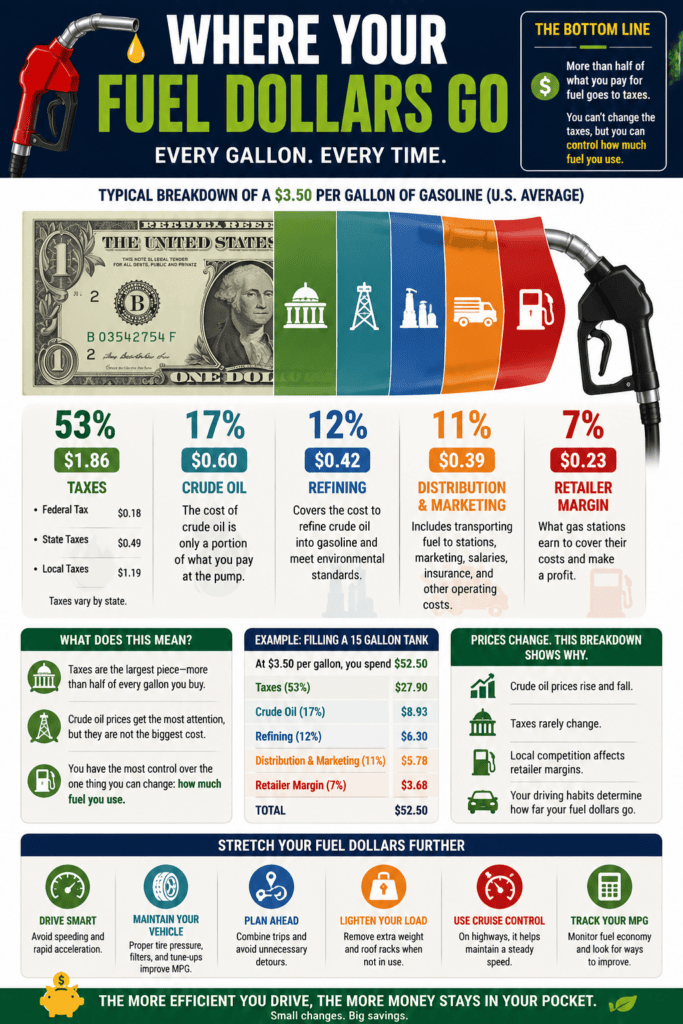
Your Next Vehicle Purchase Could Be Your Biggest Fuel-Saving Decision
Most of the ideas in this guide are designed to help you save money with the vehicle you already own. In many cases, that’s the smartest financial decision. Buying a new vehicle simply to improve fuel economy rarely makes sense if your current vehicle is reliable and already paid for.
However, every vehicle eventually reaches the end of its useful life. When that time comes, fuel economy should be one of the factors you consider before signing the purchase agreement.
Look Beyond the Monthly Payment
One of the biggest mistakes car buyers make is focusing only on the monthly payment.
Instead, consider the total cost of ownership, including:
- Fuel
- Insurance
- Maintenance
- Repairs
- Registration fees
- Tires
- Depreciation
- Financing costs
A vehicle that costs slightly more to purchase may actually be less expensive to own over ten years if it consistently uses less fuel and requires fewer repairs.
Match the Vehicle to Your Lifestyle
Many people drive vehicles that are much larger than they actually need.
Ask yourself:
- Do I tow a trailer regularly?
- Do I need four-wheel drive every day?
- How often do I carry more than two passengers?
- Am I driving a full-size pickup simply because I like the look of it?
There’s nothing wrong with owning a truck or large SUV if it fits your lifestyle. But if you’re paying for capabilities you rarely use, downsizing at your next purchase could substantially reduce your fuel bill.
Consider Hybrids
Hybrid vehicles have become remarkably efficient.
Unlike fully electric vehicles, hybrids don’t require charging stations because they generate electricity while driving and braking.
Many modern hybrids routinely achieve 45 to 60 MPG, making them an excellent choice for commuters and families.
Plug-In Hybrids
Plug-in hybrid electric vehicles (PHEVs) combine the benefits of an electric vehicle with the convenience of a gasoline engine.
Many can travel 20 to 50 miles on electricity alone before switching to gasoline.
For drivers with short daily commutes, that can significantly reduce fuel purchases while eliminating concerns about long-distance travel.
Fully Electric Vehicles
Electric vehicles continue to improve every year.
They eliminate gasoline purchases altogether but require access to reliable charging infrastructure and may not be the best fit for every driver or every travel pattern.
For some households, an EV is an outstanding financial decision.
For others, particularly those who tow heavy trailers or frequently travel long distances through rural areas, a gasoline or diesel vehicle may still be the more practical choice.
Diesel Still Has a Place
Diesel engines continue to make sense for certain applications.
If you regularly:
- Tow heavy trailers
- Operate large pickup trucks
- Drive high annual mileage
- Travel long interstate distances
the improved torque and fuel efficiency of diesel engines may offset their higher purchase price and maintenance costs.
Sometimes Keeping Your Current Vehicle Is the Smartest Choice
Here’s something you won’t hear in most automotive advertisements:
If your current vehicle is reliable, well-maintained, and meets your needs, keeping it may be the most economical decision of all.
Avoiding a new car payment can save hundreds of dollars every month—often far more than switching to a slightly more fuel-efficient vehicle would save in gasoline.
The goal isn’t to own the newest vehicle.
The goal is to own the right vehicle.
💰 Estimated Annual Savings
Choosing a more fuel-efficient vehicle depends entirely on your circumstances.
Potential Savings
| Strategy | Estimated Annual Savings |
|---|---|
| Choosing a vehicle that better matches your needs | $200–$1,000+ |
| Avoiding an unnecessary vehicle upgrade | Potentially thousands in avoided ownership costs |
Estimated Fuel Savings: Varies Widely
Unlike the previous sections, this isn’t a simple annual savings calculation. Your decision may affect your transportation costs for the next 10 to 15 years, making it one of the most important financial choices you’ll make.
Running Total of Potential Annual Savings
We’ll leave our running total at $1,518 per year, because vehicle replacement decisions are highly personal and shouldn’t be added to the running total used for our example driver.
RetireCoast Perspective
One of the principles we emphasize throughout RetireCoast is this:
The least expensive vehicle to own is often the one that’s already paid for.
A dependable vehicle that meets your needs, is maintained properly, and delivers reasonable fuel economy is frequently a better financial choice than taking on years of new loan payments simply to save a few dollars at the gas pump.
Fuel savings are important—but they should always be considered as part of your overall financial picture, not in isolation.
This section also creates a natural bridge to your Millennial Financial Lab, where readers can evaluate the long-term financial impact of major purchasing decisions such as replacing a vehicle.
Don’t Let One Large Repair Push You Into Buying a New Car
Generation Z and Millennials often feel the impact of higher fuel prices and vehicle expenses especially strongly. Many are balancing housing costs, student loans, young families, and other demands on a limited monthly budget.
I know what it feels like to own a car that suddenly needs new tires, brakes, or another expensive repair. Faced with a large repair estimate, it may seem easier—and even more cost-effective—to replace the vehicle.
Trust me: it usually is not.
A $1,500 repair bill is painful, but a replacement vehicle can bring years of monthly payments, higher insurance premiums, registration costs, financing charges, and depreciation. Before replacing a dependable vehicle, compare the total cost of both choices rather than reacting to the repair estimate alone.
That is one reason we created the RetireCoast Car Buying Decision Engine for members of the Millennial Financial Lab. The tool helps users evaluate the broader financial consequences of a vehicle decision instead of focusing only on the purchase price or monthly payment.
A repair may still be the wrong choice when a vehicle is unreliable, unsafe, or repeatedly breaking down. But new tires, brakes, or one major repair do not automatically mean it is time to buy another car. In many cases, repairing the vehicle you already own can save thousands of dollars.
I think we’ve covered almost every practical way to save money on fuel. The next section should shift from individual tips to helping the reader build a plan. It also creates a natural transition to your Fuel Savings Calculator™.
Build Your Personal Fuel Savings Plan
We’ve covered a lot of ideas in this guide.
Some take only a few minutes to implement. Others require changing a habit or making a small investment. The important thing to remember is that you don’t have to do everything to start saving money.
Instead, choose the ideas that best fit your lifestyle and begin with those.
Start With the Biggest Opportunities
For most drivers, these strategies usually provide the greatest return:
✓ Use the octane rating recommended by your vehicle’s manufacturer.
✓ Join a warehouse club or fuel rewards program if it makes financial sense.
✓ Use a rewards credit card responsibly and pay the balance in full every month.
✓ Keep your tires properly inflated.
✓ Slow down on the highway.
These five changes alone could save many households several hundred dollars each year.
Add the Easy Wins
Next, focus on the habits that cost nothing to implement.
- Combine errands into one trip.
- Avoid unnecessary idling.
- Remove unused roof racks and excess cargo.
- Compare fuel prices before filling up.
- Use cruise control on long highway trips.
- Keep up with scheduled maintenance.
- Track your fuel economy.
Each one may only save a few dollars each month, but together they make a meaningful difference.
If You Own an RV
If you travel with a motorhome, travel trailer, or fifth wheel, remember that every gallon counts even more.
Small improvements such as:
- Maintaining proper tire pressure.
- Reducing highway speed.
- Planning fuel stops.
- Traveling lighter.
can save hundreds of dollars during a busy camping season.
Invest Your Savings
Here’s one final thought.
Suppose you save $100 each month by following the suggestions in this guide.
Instead of allowing that money to disappear into everyday spending, consider investing it.
Over time, those fuel savings could help pay for:
- Your next vacation.
- A family emergency fund.
- Retirement savings.
- College expenses.
- Paying off debt faster.
Saving money at the pump is good.
Using those savings to improve your financial future is even better.
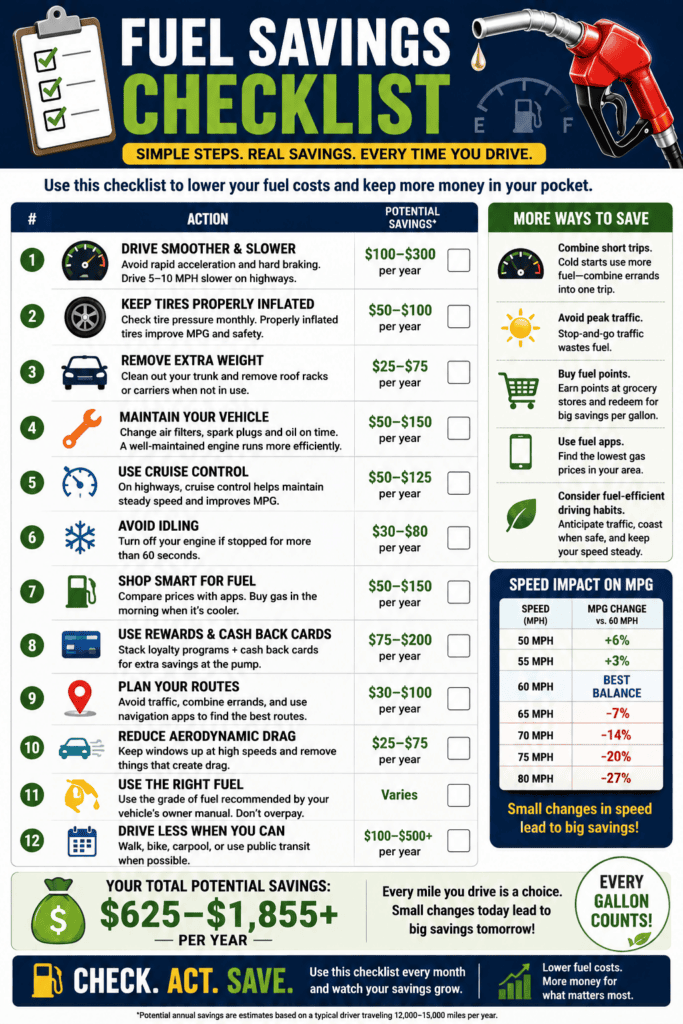
Your Fuel Savings Checklist
Before considering yourself finished, ask yourself these questions:
✅ Am I buying the correct octane fuel?
✅ Am I using a fuel rewards credit card responsibly?
✅ Do I compare fuel prices before filling up?
✅ Are my tires properly inflated?
✅ Do I follow my vehicle’s maintenance schedule?
✅ Do I avoid unnecessary idling?
✅ Do I combine errands whenever possible?
✅ Do I keep unnecessary weight out of my vehicle?
✅ Do I drive at fuel-efficient highway speeds?
✅ Do I track my fuel economy?
If you answered “No” to even one of these questions, you’ve probably found an opportunity to reduce your annual fuel costs.
💰 Estimated Annual Savings
Using the examples throughout this article, our typical driver identified approximately:
| Strategy | Annual Savings |
|---|---|
| Correct octane fuel | $518 |
| Slower highway speeds | $175 |
| Proper tire inflation | $60 |
| Eliminate unnecessary idling | $50 |
| Better trip planning | $80 |
| Remove excess weight | $50 |
| Regular maintenance | $60 |
| Compare fuel prices | $70 |
| Warehouse club fuel | $90 |
| Cruise control | $45 |
| Reduce aerodynamic drag | $60 |
| Track fuel economy | $50 |
| Drive fewer miles | $210 |
Estimated Total Potential Annual Savings
Approximately $1,500+
Remember, these are illustrative examples based on a typical driver. Your actual savings may be higher or lower depending on your annual mileage, fuel economy, driving habits, local fuel prices, and the recommendations that apply to your situation.
One Last Step…
Don’t guess how much you can save.
Use the RetireCoast Fuel Savings Calculator™ to create your own personalized savings report.
Simply answer a few questions about:
- Your vehicle
- Annual mileage
- Fuel economy
- Driving habits
- Rewards programs
- Fuel purchases
and we’ll estimate where your greatest savings opportunities are.
You may discover that making just three or four small changes could save enough each year to pay for your next vacation, eliminate a monthly bill, or accelerate your financial goals.
After all, the cheapest gallon of gasoline is the one you never have to buy.
These answers address common questions about gasoline, diesel, rewards cards, fuel economy, vehicle maintenance, road trips, and recreational vehicles.
1. What is the easiest way to start saving money on fuel?
2. Does premium gasoline improve fuel economy?
3. How do I know which octane my vehicle needs?
4. Is paying cash always cheaper than using a credit card for gasoline?
5. Are fuel rewards credit cards worth using?
6. Can Costco or Sam's Club fuel save enough to cover the membership fee?
7. How much does driving faster reduce fuel economy?
8. Does cruise control save gasoline?
9. How does tire pressure affect fuel economy?
10. Can I rely entirely on my tire pressure monitoring system?
11. Is a portable tire inflator worth buying?
12. Does idling waste much fuel?
13. Why does combining errands save fuel?
14. Do roof racks and cargo boxes reduce MPG?
15. Is it worth driving several miles to buy cheaper gasoline?
16. Are interstate gas stations usually more expensive?
17. How can RV owners and trailer users reduce fuel costs?
18. Can an electric bicycle reduce transportation costs?
19. Should I buy a new car just to get better gas mileage?
20. How much can an average driver save using several of these strategies?
Use the free RetireCoast Fuel Savings Calculator™ to estimate which changes could make the greatest difference in your household or business fuel budget.
Try the Fuel Savings Calculator™ →PODCAST
Discover more from RetireCoast.com
Subscribe to get the latest posts sent to your email.