
Introduction
In this comprehensive guide on how to create a will, we will explain in plain English what all of the legal terms mean. This guide is provided as a public service by RetireCoast for our readers. It’s considered definitive meaning that it literally covers every element of a Last Will and Testament.
Have you ever been exposed to a situation where a family member or friend passed away and failed to let their heirs know their wishes through a will?
If you have, you already know how quickly things can become chaotic. Family members who are already dealing with grief suddenly find themselves trying to determine what their loved one wanted, who should receive certain assets, who should manage the estate, and in some cases, who should care for minor children.
What should be a time for healing can quickly turn into a stressful and emotionally draining process.
Prefer listening instead of reading? Every major RetireCoast pillar guide includes a complete audio edition so you can learn while commuting, exercising, traveling, or relaxing at home. The narration follows this article closely, allowing you to switch seamlessly between reading and listening whenever it’s most convenient.
- Introduction
- What Is a Will?
- A Will Is More Than a List of Assets
- Why Every Adult Should Consider Having a Will
- What Happens If You Die Without a Will?
- State Law Takes Control
- Your Family May Face Unnecessary Delays
- Minor Children Face Additional Uncertainty
- Family Disagreements Become More Likely
- Intestate Does Not Mean Simple
- The Good News
- Continue Building Your Estate and Financial Planning Knowledge
- Famous People Who Died Without a Will
- A Will Provides Clarity During Difficult Times
- A Will Is Often the First Step in Estate Planning
- What a Will Can and Cannot Do
- What a Will Can Do
- What a Will Cannot Do
- Why Many Estate Plans Include Both a Trust and a Will
- The Bottom Line
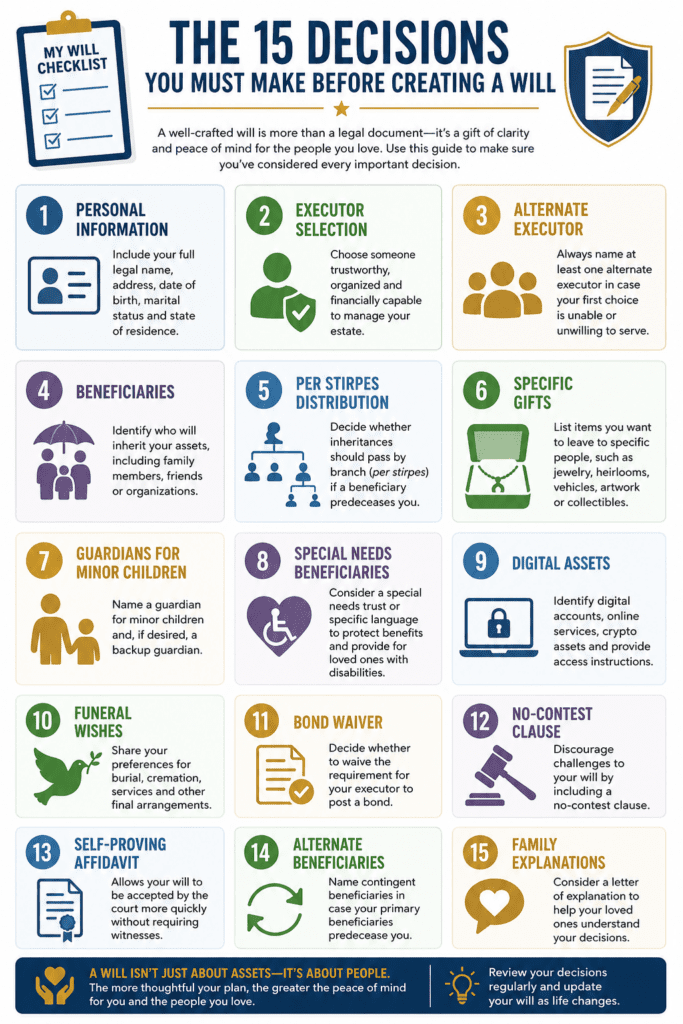
- The 15 Decisions You Must Make Before Creating a Will
- Decision #1: Your Personal Information
- Decision #2: Choosing Your Executor
- Decision #3: Naming an Alternate Executor
- Decision #4: Identifying Your Beneficiaries
- Decision #5: Choosing Per Stirpes or Per Capita Distribution
- Decision #6: Specific Gifts
- Decision #7: Minor Children
- Decision #8: Children With Special Needs
- Decision #9: Digital Assets
- Decision #10: Funeral and Final Wishes
- Decision #11: Bond Waiver
- Decision #12: No-Contest Clause
- Decision #13: Self-Proving Affidavit
- Decision #14: Alternate Beneficiaries
- Decision #15: Communicating Your Decisions
- The Good News
- How to Choose the Right Executor for Your Will
- What Does an Executor Do?
- The Biggest Mistake People Make
- Characteristics of a Good Executor
- Should Your Spouse Be Your Executor?
- Should You Name Co-Executors?
- Professional Executors
- Questions to Ask Before Naming an Executor
- Executor vs. Trustee
- The Bottom Line
- Understanding Per Stirpes vs. Per Capita: One of the Most Important Decisions in Your Will
- Why This Decision Matters
- What Does Per Stirpes Mean?
- What Does Per Capita Mean?
- Why Most Families Choose Per Stirpes
- A Real-World Example
- There Is No Right or Wrong Answer
- The Bottom Line
- Specific Gifts, Family Heirlooms, and Avoiding Family Disputes
- What Is a Specific Gift?
- Why Families Fight Over Small Things
- The Story of the Family Watch
- Make a List Before You Create Your Will
- Consider Talking With Your Family
- Fair Is Not Always Equal
- Consider a Separate Personal Property Memorandum
- The Goal Is Family Harmony
- A Valuable Lesson
- Guardianship for Minor Children and Planning for Special Needs Beneficiaries
- Why Guardianship Matters
- Choosing a Guardian
- Always Name an Alternate Guardian
- Should Guardians and Executors Be the Same Person?
- Planning for the Financial Needs of Minor Children
- Special Needs Beneficiaries Require Additional Planning
- Case Study: The Parents Who Planned Ahead
- The Real Purpose of Guardianship Planning
- Key Takeaway
- Digital Assets, Passwords, Cryptocurrency, and Online Accounts
- What Are Digital Assets?
- Why Digital Assets Matter
- The Family Photo Problem
- The Hidden Wealth Problem
- Cryptocurrency Requires Special Attention
- Your Executor Cannot Read Your Mind
- Creating a Digital Asset Inventory
- Social Media Accounts
- Online Businesses and Digital Income
- A Modern Estate Planning Necessity
- The Bottom Line
- Funeral Wishes, Final Arrangements, and Reducing Stress for Your Family
- Why Funeral Planning Matters
- The Financial Reality of Funeral Expenses
- Burial or Cremation?
- Military Honors
- Religious and Personal Preferences
- Prepaid Funeral Plans
- Don’t Leave the Family Guessing
- A Practical Suggestion
- Case Study: The Family That Didn’t Have to Guess
- The Bottom Line
- No-Contest Clauses, Bond Waivers, and Self-Proving Affidavits: Small Clauses That Can Make a Big Difference
- What Is a No-Contest Clause?
- What Is a Bond Waiver?
- What Is a Self-Proving Affidavit?
- Why These Clauses Matter
- A Real-World Example
- The Bottom Line
- Do You Need a Will, a Trust, or Both?
- What Is a Will?
- What Is a Revocable Living Trust?
- The Biggest Difference: Probate
- A Trust Does Not Replace a Will
- What Is a Pour-Over Will?
- Who Might Benefit From a Trust?
- Who Might Start With a Will?
- Case Study: The Couple Who Started Small
- Case Study: The Family Who Needed More Than a Will
- The Bottom Line
- “I Put My Adult Child on My Bank Account and My House Has a Mortgage. Why Do I Need a Will?”
- Case Study #2: Dad Put One Child on the Bank Account
- When Should You Update Your Will?
- Why Wills Become Outdated
- Major Life Events That Should Trigger a Review
- Retirement Is an Excellent Time for a Review
- How Often Should You Review Your Will?
- The Forgotten Documents Problem
- Case Study #3: The Will That Was Never Updated
- The Bottom Line
- Case Study #4: “Dad Took Care of Everything”
- Conclusion: The Greatest Gift You Leave Behind Is Peace of Mind
- Ready to Create Your Estate Planning Portfolio?
- References and Additional Resources
- FAQ
- PODCAST
Creating a will now can eliminate many of these problems and create a clear structure to ensure your wishes are fulfilled. It provides direction for your loved ones, reduces confusion, and often helps prevent disagreements that can permanently damage family relationships.
There is tremendous peace of mind that comes from knowing you have taken the time to organize your affairs and provide guidance to the people you care about most.
I understood this many years ago, which is why I created my own estate planning portfolio long before I ever thought I would need it. As a business owner, husband, father, and someone who has witnessed both successful and unsuccessful estate settlements, I realized that estate planning is not really about the person creating the documents.
It is about helping those left behind navigate a difficult period in their lives.
Part of my mission through RetireCoast is helping people improve their financial lives and make informed decisions about retirement, wealth preservation, and legacy planning.
Creating an estate planning portfolio often begins with a simple but critically important document—a Last Will and Testament or, in many cases, a Pour-Over Will that works alongside a Revocable Living Trust.
Our Estate Planning Membership was created specifically to help individuals and families work through this process. Inside the membership, you will find tools, worksheets, educational resources, and document builders designed to help you organize your information and create a comprehensive estate planning portfolio.
Whether your goal is to create a basic will, establish a living trust, appoint powers of attorney, prepare healthcare directives, or organize important financial information, the membership provides a structured path to help you accomplish those goals.
Understand what estate planning is
Before you begin creating your will, it is important to understand that estate planning is much more than deciding who gets your property. You will need to think about executors, beneficiaries, guardians for minor children, specific gifts, digital assets, healthcare decisions, funeral wishes, charitable gifts, and many other topics that people often overlook.
The more thoughtful your planning process, the easier it will be for your loved ones to carry out your wishes.
This article is intentionally comprehensive. It will take some time to read, but I encourage you to invest that time. The knowledge you gain here will help you better understand the estate planning process and prepare you to make informed decisions when creating your own will.
More importantly, it will help you avoid many of the common mistakes that families make when they postpone planning or fail to communicate their intentions.
You will learn what you can and cannot do!
As we move through this guide, you will learn what a will can and cannot do, how to select an executor, how to protect minor children, how to distribute assets fairly, how to avoid common estate planning mistakes, and when it may be appropriate to consider additional planning tools such as a Revocable Living Trust.
By the time you finish reading, you will have a much clearer understanding of the decisions that need to be made and the steps required to create an estate plan that reflects your values, protects your family, and preserves your legacy.
Let’s begin with a simple question: What exactly is a will, and why is it one of the most important documents you will ever create?
A Revocable Living Trust only controls assets that were actually transferred into the trust. If an account, vehicle, personal item, or piece of property was left outside the trust, the trust may not control it after death.
That is why many trust-based estate plans also include a Pour-Over Will. It acts like a safety net, directing assets left outside the trust to be transferred into the trust after death.
A will can also name guardians for minor children, appoint an executor, and provide backup instructions for property that was not properly titled in the trust.
What Is a Will?
A will, sometimes called a Last Will and Testament, is one of the foundational documents of a comprehensive estate plan. It is a legal document that allows you to specify how your assets should be distributed after your death, who will manage your estate, and who will care for your minor children if both parents pass away.
While most people understand that a will distributes property, many do not realize how many important decisions are contained within this single document. A properly drafted will can help reduce confusion, prevent family disputes, and provide clear instructions to the people responsible for carrying out your wishes.
Simply put, a will allows you—not the state government or a probate court—to make decisions regarding your estate.
A Will Is More Than a List of Assets
One of the biggest misconceptions about wills is that they are simply documents used to divide money and property.
In reality, a will can address many important issues, including:
- Who receives your assets
- Who serves as executor of your estate
- Who serves as an alternate executor
- Who cares for your minor children
- How specific family heirlooms are distributed
- Whether distributions should be made per stirpes
- Funeral and burial preferences
- Charitable gifts
- Instructions regarding digital assets
Many families discover that the emotional value of certain items greatly exceeds their financial value. A family Bible, grandfather’s watch, military medals, photo albums, jewelry, firearms, or collectibles can become sources of disagreement if your wishes are not clearly documented.
A well-prepared will helps eliminate uncertainty.
The legal term is called “dying intestate.” While that may sound like legal jargon, what it really means is that you failed to provide instructions for what should happen to your family, your assets, and in some cases, your minor children.
In simple terms, Judge Bubba will decide for you.
A judge you have never met and who knows nothing about your family, values, relationships, or personal wishes will be required to follow state law when determining who receives your assets and, in some situations, who may become the legal guardian of your children.
The court will not know:
- Which child should receive a family heirloom
- Who you trust most to manage your estate
- Your wishes regarding minor children
- Your charitable intentions
- Your concerns about specific beneficiaries
- Why you wanted certain assets distributed a particular way
Do you really want a stranger to interpret your final wishes without a roadmap?
A properly prepared will provides that roadmap. It tells your family, your executor, and the court exactly what you want to happen. Creating a will is one of the simplest and most important steps you can take to protect your loved ones and preserve family harmony after you are gone.
Why Every Adult Should Consider Having a Will
Many people delay estate planning because they believe they are too young, do not have enough assets, or assume everything will automatically pass to their spouse.
Unfortunately, life rarely follows a predictable schedule.
Consider the following situations:
- A married couple with young children.
- An unmarried couple living together.
- A business owner.
- A divorced parent.
- A retiree with investment accounts.
- A homeowner with significant equity.
Each of these individuals has reasons to create a will.
The reality is that estate planning is not reserved for the wealthy. In many cases, middle-income families have the most to gain because they often lack the financial resources to absorb lengthy probate proceedings, family disputes, and legal expenses.
What Happens If You Die Without a Will?
One of the most common misconceptions in estate planning is that if you do nothing, everything will simply “work itself out.”
Unfortunately, that is rarely the case.
When someone dies without a valid Last Will and Testament, the legal system considers them to have died intestate.
While the word sounds complicated, its meaning is simple:
You did not leave legally recognized instructions explaining what should happen to your estate.
Because no instructions exist, your state’s intestate succession laws determine who inherits your assets.
In other words, the government has already written a will for you.
The problem is that it almost certainly does not reflect your personal wishes.
State Law Takes Control
When there is no will, the probate court must follow state law.
The judge does not know:
- Who you trusted most.
- Which child cared for you during your final years.
- Which grandchild you wanted to receive your military medals.
- Which charity you hoped to support.
- Who should inherit sentimental family heirlooms.
- Your personal family relationships.
The court simply applies the law as written.
That may produce results you never intended.
Your Family May Face Unnecessary Delays
Without a will, someone must still settle your estate.
The probate court may need to:
- Appoint an estate administrator.
- Identify legal heirs.
- Determine who receives your assets.
- Resolve disagreements among family members.
- Supervise the administration of your estate.
This often creates additional paperwork, court hearings, legal expenses, and delays.
During an already emotional time, your family may spend months—or even years—resolving issues that could have been avoided with proper planning.
Minor Children Face Additional Uncertainty
If you have minor children, the consequences can be even more significant.
Without a will, you lose the opportunity to nominate the person you want to serve as their guardian.
Instead, the court must determine who will raise your children.
The judge will certainly try to make the best decision possible.
But no judge knows your family as well as you do.
Naming a guardian in your will provides valuable guidance and greatly increases the likelihood that your wishes will be followed.
Family Disagreements Become More Likely
Most families do not begin arguing because they are greedy.
They argue because they genuinely believe they know what their loved one would have wanted.
Imagine three adult children standing in their parents’ home after the funeral.
One believes Mom promised her the family piano.
Another remembers Dad saying the antique grandfather clock would someday belong to him.
The third insists everything should simply be divided equally.
Without written instructions, everyone believes they are honoring their parents’ wishes.
Unfortunately, nobody truly knows.
A properly prepared will removes the guesswork.
Intestate Does Not Mean Simple
Some people assume that if they do not have a will, the probate process becomes easier.
The opposite is often true.
Without clear instructions, the court must answer questions that you could have answered yourself while you were alive.
Creating a will allows you—not the court—to make those decisions.
The Good News
Fortunately, avoiding intestate succession is remarkably simple.
Creating a valid Last Will and Testament gives you the opportunity to:
- Choose your beneficiaries.
- Name an executor.
- Nominate guardians for minor children.
- Leave specific gifts.
- Provide guidance for your family.
- Reduce confusion and potential conflict.
The peace of mind that comes from having a will extends far beyond the legal document itself.
It comes from knowing your loved ones will not be left wondering what you wanted.
In the next section, we’ll look at several well-known individuals whose families experienced the very real consequences of dying without a will. Their stories demonstrate that estate planning is not about how much money you have—it’s about making life easier for the people you leave behind.ransfers those decisions to others.
Famous People Who Died Without a Will
Many people assume that wills are only necessary for the wealthy or those with large estates. History tells a very different story.
In fact, some of the most famous estate battles in modern history occurred because successful individuals failed to leave behind a valid will. The legal term for dying without a will is intestate. When this happens, state law—not personal wishes—determines who receives assets and who controls the estate.
When an ordinary family dies intestate, the results can be difficult. When a celebrity dies intestate, the consequences often become public, expensive, and incredibly chaotic.
The following examples demonstrate why having a will is one of the most important steps in protecting your family and preserving your legacy.
Prince (2016)
When music icon Prince passed away unexpectedly in 2016, he left behind an estate estimated at approximately $156 million, a vast music catalog, and hundreds of unreleased recordings.
What he did not leave behind was a will.
Because Prince had no spouse or living parents, numerous individuals came forward claiming to be heirs. Some claimed to be children, while others asserted family relationships that required extensive investigation and court review.
The result was years of legal battles and administrative proceedings before the courts ultimately determined the rightful heirs.
Lesson: Even extraordinary wealth cannot compensate for the absence of clear instructions.
Jimi Hendrix (1970)
Legendary guitarist Jimi Hendrix died at only 27 years old without a will.
While his estate was not considered enormous at the time of his death, the value of his music catalog and intellectual property rights grew dramatically over the following decades.
Because there was no will, ownership passed according to state law. After additional family deaths and changing circumstances, disputes arose regarding who should control the rights to Hendrix’s music and legacy.
The legal battles surrounding the estate continued for decades.
Lesson: Estate planning is not just about current assets. Future appreciation can create substantial value that your heirs may later fight over.
Aretha Franklin (2018)
When the Queen of Soul, Aretha Franklin, died in 2018, it was initially believed she had left no will for her estimated $18 million estate.
Under those circumstances, Michigan’s intestate succession laws would have determined how her estate was distributed among her heirs.
Months later, family members discovered multiple handwritten documents hidden in her home. Some were found in a locked cabinet while another was reportedly discovered in a notebook under a couch cushion.
The discovery sparked years of litigation as family members argued over which document reflected her true intentions and whether the handwritten documents qualified as valid wills.
Lesson: Even when instructions exist, failing to organize and properly document them can create confusion, delays, and significant legal expenses.
The Real Cost of Dying Intestate
The biggest misconception about wills is that they are primarily designed to save taxes.
While taxes may be a consideration for some estates, the most immediate benefit of a will is usually much simpler:
Clarity.
A properly prepared will tells your family exactly what you want to happen. It provides a roadmap for your executor, guidance for your beneficiaries, and instructions for the court.
Without that roadmap, surviving family members are often left to guess your intentions, and those guesses can lead to disagreements, lawsuits, and permanently damaged relationships.
The lesson from these famous cases is the same lesson that applies to every family: estate planning is not about how much money you have. It is about making life easier for the people you leave behind.
A Will Provides Clarity During Difficult Times
One of the greatest benefits of a will is not legal—it is emotional.
Family members are often dealing with grief, uncertainty, and financial concerns following the loss of a loved one. The last thing they need is confusion about your wishes.
A clear will provides direction.
Instead of arguing about what Mom or Dad “would have wanted,” family members can focus on supporting one another and carrying out the instructions already provided.
Many estate disputes begin not because family members are greedy, but because they genuinely believe they know what the deceased intended. A written will removes much of that uncertainty.
A Will Is Often the First Step in Estate Planning
For many individuals and families, creating a will is the first step toward building a complete estate planning portfolio.
As your financial situation grows more complex, additional documents may become appropriate, including:
- Revocable Living Trusts
- Pour-Over Wills
- Financial Powers of Attorney
- Healthcare Directives
- HIPAA Authorizations
- Trustee Selection Documents
- Asset Inventories
The good news is that creating a will forces you to begin thinking about these important issues. It helps organize your thoughts and establish the framework for a more comprehensive estate plan in the future.
Before you can create an effective will, however, it is important to understand exactly what a will can—and cannot—do.
The legal term is called “dying intestate.” While that may sound like legal jargon, what it really means is that you failed to provide instructions for what should happen to your family, your assets, and in some cases, your minor children.
In simple terms, Judge Bubba will decide for you.
A judge you have never met and who knows nothing about your family, values, relationships, or personal wishes will be required to follow state law when determining who receives your assets and, in some situations, who may become the legal guardian of your children.
The court will not know:
- Which child should receive a family heirloom
- Who you trust most to manage your estate
- Your wishes regarding minor children
- Your charitable intentions
- Your concerns about specific beneficiaries
- Why you wanted certain assets distributed a particular way
Do you really want a stranger to interpret your final wishes without a roadmap?
A properly prepared will provides that roadmap. It tells your family, your executor, and the court exactly what you want to happen. Creating a will is one of the simplest and most important steps you can take to protect your loved ones and preserve family harmony after you are gone.
What a Will Can and Cannot Do
One of the biggest misconceptions in estate planning is that a will controls everything you own and automatically solves all estate administration problems.
Unfortunately, that is not true.
A will is an incredibly important legal document, but it has limitations. Understanding what a will can and cannot do will help you determine whether a simple will is sufficient for your situation or whether additional planning tools such as a Revocable Living Trust should be considered.
Many people spend considerable time creating a will only to discover later that some of their largest assets pass outside of the will entirely.
Let’s look at the differences.
What a Will Can Do
A properly drafted will gives you significant control over your estate and allows you to make important decisions that otherwise would be left to state law.
A will can:
Name Your Beneficiaries
Perhaps the most obvious purpose of a will is deciding who receives your assets.
You may leave assets to:
- Your spouse
- Children
- Grandchildren
- Other family members
- Friends
- Charities
- Religious organizations
Without a will, state law generally determines who inherits your property.
Appoint an Executor
An executor is responsible for carrying out your wishes.
The executor may be responsible for:
- Filing probate documents
- Gathering assets
- Paying debts
- Filing tax returns
- Distributing property
- Closing financial accounts
Selecting the right executor is one of the most important decisions you will make.
Name Guardians for Minor Children
For parents, this may be the most important function of a will.
If both parents pass away while children are still minors, a will allows you to nominate the person you want to serve as guardian.
Without this guidance, the court may be forced to decide.
Distribute Specific Gifts
A will allows you to specifically identify who receives certain items.
Examples include:
- Jewelry
- Firearms
- Vehicles
- Family heirlooms
- Artwork
- Collectibles
- Family photographs
Specific gifts often prevent family disputes.
Explain Your Wishes
Some people include personal explanations regarding certain distributions.
These explanations may help family members better understand why decisions were made.
What a Will Cannot Do
Just as important as understanding what a will can do is understanding what it cannot do.
A Will Does Not Avoid Probate
This surprises many people.
A will actually serves as the instruction manual used during probate.
The existence of a will does not automatically avoid the probate process.
In many states, the will must still be submitted to the court for administration.
A Will Cannot Override Beneficiary Designations
Many financial accounts pass directly to named beneficiaries.
Examples include:
- Life insurance policies
- IRAs
- 401(k) plans
- Annuities
- Transfer-on-death accounts
- Payable-on-death accounts
If your beneficiary designation conflicts with your will, the beneficiary designation generally controls.
This is one reason why beneficiary reviews should be part of every estate planning review.
A Will Cannot Control Jointly Owned Property
Jointly owned assets often transfer automatically to the surviving owner.
Examples may include:
- Joint bank accounts
- Joint brokerage accounts
- Jointly owned real estate
These assets may pass outside of the will.
A Will Cannot Manage Assets During Incapacity
A will becomes effective after death.
If you become incapacitated due to illness or injury, your will generally provides no authority for someone to manage your finances or make healthcare decisions.
This is why many estate plans also include:
- Financial Power of Attorney
- Healthcare Directive
- HIPAA Authorization
A Will Cannot Control Assets Already Owned by a Trust
If assets have been transferred into a Revocable Living Trust, the trust—not the will—controls those assets.
This is where many people become confused.
The trust and the will often work together as part of a larger estate planning strategy.
Why Many Estate Plans Include Both a Trust and a Will
People often ask:
“If I have a trust, why do I need a will?”
The answer is simple.
A trust only controls assets that have actually been transferred into the trust.
A will serves as a backup plan for assets that were accidentally left outside the trust.
This is why many attorneys recommend a Pour-Over Will when creating a Revocable Living Trust.
The will acts as a safety net, directing remaining assets into the trust after death.
The Bottom Line
A will is one of the most important documents in your estate planning portfolio, but it is only one piece of the puzzle.
Think of your will as the foundation.
As your family grows, your assets increase, or your circumstances become more complex, you may need additional planning tools to fully protect your family and your legacy.
The next step is understanding the specific decisions you must make before sitting down to create your will. Most people are surprised to learn there are far more decisions involved than simply deciding who gets their property.
The 15 Decisions You Must Make Before Creating a Will
Many people assume that creating a will is simply a matter of deciding who gets the house, bank account, or family heirlooms.
In reality, creating a will requires a series of important decisions that affect your family, your beneficiaries, your executor, and potentially future generations.
This is one reason why so many people procrastinate. They sit down intending to create a simple will and quickly realize there are far more decisions involved than they expected.
The good news is that once you understand these decisions and work through them one at a time, the process becomes much easier.
In fact, the RetireCoast Will Builder was specifically designed to guide you through each of these decisions step-by-step so that you can create a comprehensive estate plan rather than simply filling in blanks on a legal form.
Let’s examine each decision in detail.
Decision #1: Your Personal Information
The first step seems obvious, but accuracy matters.
Your will should clearly identify:
- Your full legal name
- Current address
- State of residence
- Marital status
This information helps eliminate confusion and ensures there is no doubt regarding the identity of the person creating the will.
If you have recently moved, remarried, or changed your name, your estate planning documents should be updated accordingly.
Decision #2: Choosing Your Executor
Your executor is the person responsible for carrying out your instructions after your death.
Think of your executor as the project manager of your estate.
Responsibilities may include:
- Filing probate paperwork
- Gathering assets
- Paying debts
- Managing property
- Filing tax returns
- Distributing inheritances
The executor does not need to be your oldest child, closest relative, or spouse.
The best executor is usually the person who is:
- Organized
- Trustworthy
- Financially responsible
- Able to communicate effectively
Many people choose a spouse first and then designate an adult child or trusted family member as an alternate executor.
Decision #3: Naming an Alternate Executor
Life happens.
The person you originally select may:
- Pass away before you
- Become incapacitated
- Move away
- Decline to serve
Always name at least one alternate executor.
This simple step can save your family significant time and expense later.
Decision #4: Identifying Your Beneficiaries
A beneficiary is anyone who receives assets under your will.
Beneficiaries may include:
- Spouse
- Children
- Grandchildren
- Friends
- Charities
- Religious organizations
This is often where people begin thinking about fairness versus equality.
Those are not always the same thing.
One child may have already received substantial financial assistance during your lifetime. Another may have special needs. A third may have helped care for you during retirement.
These are personal decisions that only you can make.
Decision #5: Choosing Per Stirpes or Per Capita Distribution
This is one of the most important decisions in modern estate planning.
Most people have never heard the term “per stirpes” until they begin creating a will.
A simple example explains it best.
Suppose you have three children.
Each child receives one-third of your estate.
However, one child dies before you and leaves two children of their own.
Under a Per Stirpes distribution, that deceased child’s share passes to their children.
Many families prefer this approach because it preserves inheritance rights across generations.
Without a per stirpes provision, the outcome may be very different.
This is why the Per Stirpes option is pre-selected in our Will Builder. It reflects the choice most families make after understanding how the distribution works.
Decision #6: Specific Gifts
Specific gifts are individual items or assets you want distributed to particular people.
Examples include:
- Jewelry
- Watches
- Firearms
- Vehicles
- Family photographs
- Coin collections
- Military memorabilia
- Artwork
Many estate disputes involve items with little monetary value but tremendous sentimental value.
A five-dollar pocket watch may become the most contested item in an estate if everyone believes it should belong to them.
Being specific can eliminate confusion and prevent future arguments.
Decision #7: Minor Children
If you have minor children, this may be the most important decision in your entire will.
Who would raise your children if both parents pass away?
Many parents assume family members already know the answer.
Often they do not.
You should:
- Select a guardian
- Select an alternate guardian
- Discuss the decision with those individuals
Naming a guardian provides guidance to the court and significantly increases the likelihood that your wishes will be honored.
Decision #8: Children With Special Needs
Estate planning becomes more complex when a beneficiary has special needs.
A direct inheritance could potentially impact eligibility for certain government assistance programs.
In these situations, professional legal advice is often appropriate.
The goal is to provide financial support while protecting long-term benefits and care.
Decision #9: Digital Assets
A generation ago this decision did not exist.
Today many people have significant digital assets including:
- Email accounts
- Social media accounts
- Online photographs
- Cloud storage
- Cryptocurrency
- Online businesses
- Digital subscriptions
If nobody knows these assets exist, they may never be located.
A comprehensive estate plan should address digital assets and provide guidance regarding access and management.
Decision #10: Funeral and Final Wishes
Your family will appreciate having guidance during one of the most difficult periods of their lives.
Consider documenting:
- Burial or cremation preferences
- Religious services
- Memorial preferences
- Military honors
- Donation requests
The clearer your instructions, the easier it becomes for your family to honor your wishes.
Decision #11: Bond Waiver
Some wills waive the requirement that an executor obtain a bond.
A bond acts as a type of insurance policy protecting beneficiaries.
Waiving the bond requirement may reduce administrative costs and simplify the probate process.
Decision #12: No-Contest Clause
A no-contest clause discourages beneficiaries from challenging the will.
While state laws vary, these clauses can sometimes reduce the likelihood of litigation among family members.
They are particularly common in situations involving:
- Blended families
- Unequal inheritances
- Significant estates
- Prior family conflicts
Decision #13: Self-Proving Affidavit
A self-proving affidavit may help streamline probate administration.
This document is signed alongside the will and helps verify the authenticity of the document.
In many jurisdictions, this can reduce delays after death.
Decision #14: Alternate Beneficiaries
Never assume your primary beneficiary will outlive you.
Life is unpredictable.
Always identify backup beneficiaries who will inherit if the primary beneficiary is unable to receive their inheritance.
Decision #15: Communicating Your Decisions
This final decision may be more important than all the others.
A will is a legal document.
Communication is a family tool.
Many disputes arise because family members are surprised by what they discover after death.
You do not need to disclose exact dollar amounts.
However, discussing your overall intentions with your family can dramatically reduce misunderstandings and conflict later.
The Good News
At first glance, fifteen decisions may seem overwhelming.
Fortunately, most of these decisions only need to be made once and reviewed periodically as your life changes.
The reward for taking the time to work through them is substantial: peace of mind for you and clarity for the people you care about most.
Now that you understand the decisions involved, let’s look at one of the most important choices in the entire process—selecting the right executor to carry out your wishes.

Harry and Jennifer spent several years preparing for retirement and understood that estate planning was not just about money. It was about reducing stress for their adult children and making sure their wishes were clear.
They created a Last Will and Testament, updated their beneficiary designations, organized their financial accounts, prepared healthcare directives, and later added a Revocable Living Trust with a Pour-Over Will.
More importantly, they talked with their three adult children. They explained who would serve as executor, how specific family items would be handled, and why certain decisions were made. No one had to guess. No one was surprised.
When Harry passed away unexpectedly, the family still grieved, but they were not forced to fight over missing instructions. Jennifer and the children had a roadmap.
The Result:
The estate transition was orderly, the family relationships remained intact, and the documents Harry and Jennifer created years earlier did exactly what they were intended to do: protect the people they loved.
How to Choose the Right Executor for Your Will
If your will is the roadmap for your estate, your executor is the person responsible for following that roadmap.
Many people spend considerable time deciding who should inherit their assets but give very little thought to who will actually carry out those instructions. In reality, choosing the right executor may be one of the most important decisions in your entire estate plan.
A great executor can make the administration of an estate efficient and relatively stress-free. A poor choice can lead to delays, confusion, family disputes, and unnecessary expenses.
Before naming an executor, it is important to understand exactly what the job involves.
What Does an Executor Do?
An executor is the individual responsible for administering your estate after your death.
Their responsibilities often include:
- Locating your will
- Filing probate documents
- Notifying beneficiaries
- Collecting and safeguarding assets
- Paying debts and taxes
- Closing financial accounts
- Managing real estate
- Distributing inheritances
- Maintaining records of estate transactions
In larger estates, the executor may work closely with attorneys, accountants, financial advisors, real estate professionals, and financial institutions.
The role can last several months and sometimes several years depending on the complexity of the estate.
The Biggest Mistake People Make
One of the most common mistakes is automatically naming the oldest child.
There is no law that says the oldest child should serve as executor.
Likewise, there is no rule requiring you to select:
- The oldest child
- The child who lives closest
- The wealthiest child
- The child who expects the role
The best executor is usually the person most capable of performing the job.
Sometimes that person is the oldest child.
Sometimes it is not.
Characteristics of a Good Executor
A strong executor is generally:
Organized
Estate administration involves paperwork, deadlines, financial records, and communication with multiple parties.
An organized person can dramatically simplify the process.
Honest
The executor owes a fiduciary duty to the beneficiaries.
They must act in the best interests of the estate rather than their own interests.
Financially Responsible
An executor does not need to be a financial expert, but they should be comfortable dealing with financial matters and keeping accurate records.
Able to Communicate
Family members often have questions.
A good executor communicates clearly and professionally.
Emotionally Stable
The executor is often dealing with their own grief while managing estate responsibilities.
Someone who can remain calm under pressure is often a better choice.
Should Your Spouse Be Your Executor?
For married couples, the surviving spouse is often the first choice.
This is perfectly reasonable in many situations.
However, you should always name at least one alternate executor in case:
- Both spouses die together
- The surviving spouse becomes incapacitated
- The spouse declines to serve
Never assume your primary executor will always be available.
Should You Name Co-Executors?
Some people name multiple children as co-executors in an effort to be fair.
While the idea sounds reasonable, it often creates complications.
If every decision requires agreement among multiple people, simple tasks can become difficult.
Examples include:
- Selling a home
- Closing accounts
- Hiring professionals
- Distributing assets
In many situations, naming one executor and one alternate executor is more practical.
Professional Executors
Some individuals choose:
- Attorneys
- Trust companies
- Banks
- Professional fiduciaries
This approach may be appropriate when:
- Family relationships are strained
- The estate is particularly large
- There is no suitable family member
- Significant business interests are involved
Professional executors generally charge fees but can provide neutrality and expertise.
Questions to Ask Before Naming an Executor
Before making your decision, ask yourself:
✓ Does this person handle their own finances responsibly?
✓ Can they work with family members who may disagree?
✓ Do they have the time to serve?
✓ Are they organized?
✓ Would I trust them with every asset I own?
✓ Have I discussed the role with them?
The last question is especially important.
Never assume someone is willing to serve.
Ask them.
Executor vs. Trustee
Many people become confused about the difference between an executor and a trustee.
An executor administers your estate after death.
A trustee manages assets held in a trust.
In some cases, the same person serves both roles.
In other situations, different individuals are selected.
As you continue building your estate planning portfolio, understanding these distinctions becomes increasingly important.
The Bottom Line
Choosing an executor is not a popularity contest.
It is a business decision made on behalf of your family.
Select the person most capable of carrying out your wishes, managing the estate responsibly, and communicating effectively with beneficiaries.
Your executor may ultimately determine whether your estate administration is smooth and efficient—or stressful and expensive.
Now that you understand the importance of selecting the right executor, let’s examine one of the most misunderstood estate planning concepts: Per Stirpes vs. Per Capita distributions and how those choices can affect future generations of your family.
One of the most important words in estate planning is fiduciary.
A fiduciary is a person who has a legal and ethical duty to act in someone else’s best interests rather than their own. In other words, a fiduciary must put your interests—or the interests of your beneficiaries—ahead of personal gain.
Think of it this way:
When you choose an executor, trustee, guardian, or agent under a Financial Power of Attorney, you are selecting someone who has a fiduciary responsibility. That person is legally expected to make decisions honestly, prudently, and solely for the benefit of you or your beneficiaries.
- Executor — Carries out the instructions contained in your will.
- Trustee — Manages property held in a trust for the benefit of beneficiaries.
- Agent under a Financial Power of Attorney — Makes financial decisions if you become unable to do so.
- Guardian — Cares for the personal well-being of a minor child or incapacitated adult.
RetireCoast Tip: When selecting any fiduciary, choose someone who is honest, organized, financially responsible, and willing to serve. The best choice isn’t always your oldest child or closest relative—it’s the person who will faithfully carry out your wishes and put the interests of your beneficiaries first.
Understanding Per Stirpes vs. Per Capita: One of the Most Important Decisions in Your Will
If you remember only one legal term from this article, make it Per Stirpes.
This is one of the most important decisions you will make when creating a will, yet many people have never heard the term until they begin the estate planning process.
The good news is that the concept is much simpler than the Latin words make it sound.
In fact, understanding Per Stirpes can help ensure that your grandchildren and future generations are protected if something unexpected happens.
Why This Decision Matters
Most people assume that when they leave assets to their children, the assets will eventually stay within that child’s family line.
Unfortunately, that is not always what happens.
Consider a simple example.
You have three children:
- John
- Sarah
- Michael
Your will leaves your estate equally among your three children.
Everything seems straightforward.
However, what happens if Sarah dies before you?
Should Sarah’s share go to her children?
Or should Sarah’s share be divided between John and Michael?
The answer depends entirely on how your will is written.
This is where Per Stirpes and Per Capita become important.
What Does Per Stirpes Mean?
Per Stirpes is a Latin term that essentially means:
“By family branch.”
Under a Per Stirpes distribution, if one of your beneficiaries dies before you, that person’s share passes down to their descendants.
Let’s look at an example.
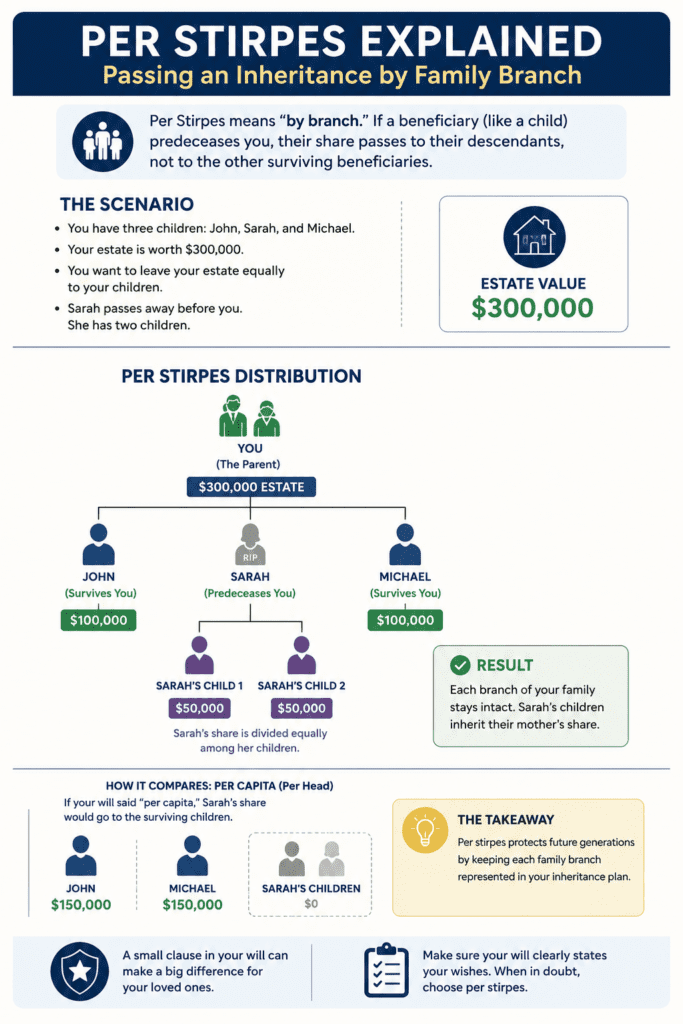
Example: Per Stirpes Distribution
You have a $300,000 estate.
You have three children:
- John
- Sarah
- Michael
Each child would receive:
- John = $100,000
- Sarah = $100,000
- Michael = $100,000
Now assume Sarah passes away before you and leaves two children of her own.
Under a Per Stirpes distribution:
- John receives $100,000
- Michael receives $100,000
- Sarah’s two children split her $100,000 share
Each grandchild receives $50,000.
Sarah’s family line remains protected.
This is why many families prefer Per Stirpes distributions.
What Does Per Capita Mean?
Per Capita means:
“By the head” or “equally among surviving beneficiaries.”
Using the same example:
You have:
- John
- Sarah
- Michael
Sarah passes away before you.
Under a Per Capita distribution:
- John receives $150,000
- Michael receives $150,000
- Sarah’s children receive nothing
Sarah’s share is redistributed among the surviving beneficiaries.
Some people prefer this method because it treats all living beneficiaries equally at the time of death.
Why Most Families Choose Per Stirpes
Most parents and grandparents want their descendants to remain represented even if one of their children dies before they do.
When people understand the difference, they often choose Per Stirpes because:
- It protects grandchildren.
- It preserves family branches.
- It reflects how many families naturally think about inheritance.
- It prevents one branch of the family from being unintentionally disinherited.
This is one reason the Per Stirpes option is commonly selected in our Will Builder.
A Real-World Example
Imagine a family farm that has been owned for generations.
The parents have three children.
One child dies unexpectedly but leaves behind two children who grew up working on the farm.
If the will uses Per Stirpes language, those grandchildren can inherit their parent’s share.
Without it, their inheritance may disappear entirely depending on how the will is written.
This single clause can have a significant impact on future generations.
There Is No Right or Wrong Answer
Per Stirpes is not automatically better.
Per Capita is not automatically worse.
The correct choice depends on your goals.
Ask yourself:
- Do I want my grandchildren to inherit their parent’s share if my child dies before me?
- Do I want assets distributed only among living beneficiaries?
- How important is preserving inheritance within each family branch?
Your answers will help determine which approach best reflects your wishes.
The Bottom Line
Many people spend more time deciding who receives a piece of jewelry or a vehicle than they spend thinking about how their estate will be distributed if a beneficiary dies before they do.
Yet this single decision can affect multiple generations of your family.
Fortunately, once you understand the difference between Per Stirpes and Per Capita, the choice often becomes much easier.
The next major decision involves another area that can dramatically affect family harmony after your death: how to handle specific gifts, family heirlooms, collectibles, and sentimental property.
Specific Gifts, Family Heirlooms, and Avoiding Family Disputes
One of the biggest mistakes people make when creating a will is focusing only on major assets such as homes, bank accounts, retirement accounts, and investment portfolios.
In reality, some of the most heated family disputes involve items with very little financial value.
Why?
Because emotional value and financial value are rarely the same thing.
A watch worth $50 may trigger more disagreement among family members than a bank account worth $50,000.
That watch may have belonged to a grandfather, been worn during military service, or have become a symbol of a cherished relationship. To the beneficiaries, it may be priceless.
This is why specific gifts are such an important part of estate planning.
What Is a Specific Gift?
A specific gift is an item or asset that you intentionally leave to a particular person.
Examples include:
- Jewelry
- Watches
- Firearms
- Vehicles
- Boats
- Family photographs
- Military medals
- Artwork
- Antiques
- Coin collections
- Musical instruments
- Family Bibles
- Collectibles
Rather than allowing beneficiaries to decide who receives these items after your death, you make the decision in advance.
This removes uncertainty and significantly reduces the likelihood of disagreements.

Why Families Fight Over Small Things
After many years in business and real estate, I have observed numerous estate situations involving families.
One lesson appears repeatedly.
Family disputes are rarely about money.
They are usually about emotions.
One child may believe they deserve a family heirloom because they spent the most time with a parent.
Another may feel entitled because they cared for a parent during illness.
A third may simply want the item because it reminds them of childhood memories.
None of these feelings are necessarily wrong.
The problem is that everyone may feel equally justified.
Without written instructions, disagreements can quickly develop.
The Story of the Family Watch
Imagine a father who owns a simple pocket watch.
The watch is not particularly valuable.
An appraiser might estimate its value at less than $100.
However, after the father passes away, all three children want the watch.
Why?
Because each remembers seeing their father wear it throughout their childhood.
Suddenly an item worth less than a restaurant dinner becomes the center of a family dispute.
The disagreement is not about the watch.
It is about memories.
A simple sentence in a will could have completely eliminated the conflict.
Make a List Before You Create Your Will
One of the best exercises you can perform before creating a will is to walk through your home with a notebook.
Make a list of items that may have either:
Financial Value
Examples include:
- Vehicles
- Jewelry
- Firearms
- Precious metals
- Artwork
- Collections
Sentimental Value
Examples include:
- Family photographs
- Military memorabilia
- Scrapbooks
- Heirloom furniture
- Wedding items
- Family keepsakes
You may be surprised how many items deserve consideration.
Consider Talking With Your Family
This may be one of the most valuable steps in the entire estate planning process.
Ask family members whether there are specific items that are particularly meaningful to them.
The answers may surprise you.
Sometimes two people want the same item.
Other times, an item you assumed everyone wanted is of interest to nobody.
Having these conversations while you are alive often prevents misunderstandings later.
Fair Is Not Always Equal
Parents often struggle with the difference between fairness and equality.
Suppose you have three children.
One child has always loved fishing and spent years fishing with you.
The other two have no interest in boats or fishing equipment.
Would it really be unfair to leave the boat and fishing gear to that child?
Not necessarily.
Many successful estate plans focus on honoring relationships and personal interests rather than creating perfectly equal distributions of every asset.
Consider a Separate Personal Property Memorandum
Some states allow a separate written list that identifies who should receive personal property.
This can be helpful because the list may be updated without rewriting the entire will.
Examples include:
- Father’s watch → John
- Military medals → Sarah
- Coin collection → Michael
- Family photo albums → Jennifer
Consult legal counsel regarding whether this approach is recognized in your state.
The Goal Is Family Harmony
When people think about estate planning, they often focus on legal documents.
The real objective is much broader.
The goal is family harmony.
Every instruction you provide removes uncertainty.
Every item you identify eliminates guesswork.
Every conversation you have with your beneficiaries reduces the potential for conflict.
A well-crafted will is not merely a document that distributes property.
It is a tool that protects relationships.
And in many cases, preserving family relationships becomes one of the most valuable gifts you leave behind.
A Valuable Lesson
Many people spend years accumulating assets but only a few hours thinking about how those assets will be distributed.
Take the time to identify the items that matter.
Document your wishes clearly.
Discuss them when appropriate.
The effort you invest today may prevent years of confusion and disagreement for your loved ones tomorrow.
Now let’s turn our attention to another critically important topic for parents and grandparents: selecting guardians for minor children and planning for loved ones who may require special care after you are gone.
Guardianship for Minor Children and Planning for Special Needs Beneficiaries
If you ask most parents what their greatest concern is, few will mention bank accounts, investment portfolios, or real estate.
Most will answer the same way:
“My children.”
For parents of minor children, the guardianship section of a will may be the single most important provision in the entire document.
While many people think of a will as a tool for distributing assets, parents often use a will primarily to answer a much more important question:
Who will care for my children if I cannot?
Why Guardianship Matters
Imagine the unthinkable.
Both parents pass away unexpectedly while their children are still minors.
Someone must immediately make decisions regarding:
- Housing
- Schooling
- Medical care
- Daily supervision
- Financial support
- Religious upbringing
- General welfare
Without guidance from the parents, the court may be required to determine who will serve as guardian.
The judge will attempt to make the best decision possible, but the court cannot know your wishes as well as you do.
A will provides a roadmap.
Choosing a Guardian
Many parents assume the choice is obvious.
Unfortunately, it is often more complicated than expected.
Potential guardians may include:
- Grandparents
- Adult siblings
- Close friends
- Aunts and uncles
- Other relatives
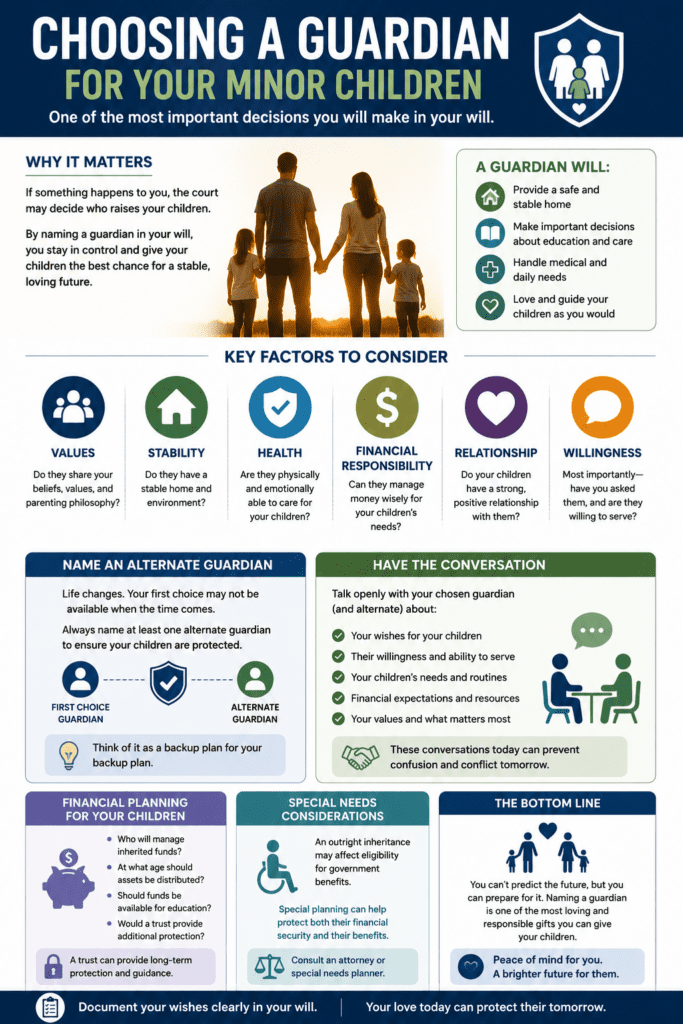
When evaluating potential guardians, consider:
Values
Do they share your beliefs and parenting philosophy?
Stability
Do they have a stable home environment?
Health
Are they physically capable of raising children?
Financial Responsibility
Can they responsibly manage funds intended for the children’s benefit?
Willingness
Perhaps the most overlooked question:
Have you asked them?
Never assume someone is willing or able to serve as a guardian.
Have the conversation.
Always Name an Alternate Guardian
Life changes.
The person you select today may:
- Relocate
- Develop health problems
- Experience financial difficulties
- Become unable to serve
For this reason, every will should include an alternate guardian.
Think of it as a backup plan for your backup plan.
Should Guardians and Executors Be the Same Person?
Not necessarily.
Some families choose the same person.
Others separate the responsibilities.
For example:
- A sibling may be an excellent parent figure.
- Another sibling may be more financially organized.
In this situation, one person might serve as guardian while another serves as executor or trustee.
There is no single correct answer.
The goal is selecting the best person for each responsibility.
Planning for the Financial Needs of Minor Children
Naming a guardian solves only part of the problem.
Children also require financial support.
Questions to consider include:
- Who will manage inherited funds?
- At what age should children receive assets?
- Should distributions occur gradually?
- Should funds be available for education?
Many parents eventually determine that a trust structure provides additional protection and flexibility for minor children.
This is one reason Revocable Living Trusts are frequently used by families with young children.
Special Needs Beneficiaries Require Additional Planning
Estate planning becomes even more important when a child or beneficiary has special needs.
Parents naturally want to provide financial support and security.
However, an outright inheritance can sometimes create unintended consequences.
In certain situations, receiving assets directly may affect eligibility for government assistance programs.
This is why families with special needs beneficiaries should carefully evaluate their options and seek professional guidance when appropriate.
Case Study: The Parents Who Planned Ahead
David and Michelle had two children ages 8 and 11.
When creating their estate plan, they initially focused on who would receive their assets.
A financial advisor asked a simple question:
“Who would raise your children if both of you were gone?”
The question stopped them cold.
They realized they had never discussed it.
After several conversations, they selected Michelle’s sister as guardian and named a trusted family friend as alternate guardian.
They also purchased additional life insurance and created instructions regarding education and healthcare decisions.
Years later, both parents were still healthy and active.
The documents had never been needed.
But they both slept better knowing that if the unexpected occurred, their children would be protected.
The Real Purpose of Guardianship Planning
Many parents delay creating a will because discussing these topics feels uncomfortable.
That reaction is completely normal.
No parent enjoys thinking about scenarios where they are no longer present.
However, estate planning is not about predicting tragedy.
It is about preparing for uncertainty.
Creating a guardianship plan is one of the most loving acts a parent can perform.
It removes doubt.
It provides guidance.
And most importantly, it helps ensure that the people you trust most will be in a position to care for the people you love most.
Key Takeaway
If you have minor children, your will is about far more than money.
It is about protection.
Take the time to carefully consider who would step into your role if necessary.
Then document those wishes clearly.
Your children deserve nothing less.
In the next section, we will examine one of the fastest-growing areas of estate planning: digital assets, online accounts, passwords, social media profiles, and the hidden wealth that many families never discover after a loved one passes away.
You are obviously reading this article to learn more about creating a will. Most readers naturally think about themselves first. That is understandable.
As you work through this guide, also consider your adult children and how a will could benefit them.
A will is not only for older people, retirees, or individuals with significant assets. A will is a basic planning tool that every adult should consider.
Your adult children may have vehicles, bank accounts, pets, digital assets, personal belongings, minor children, or specific wishes that should be documented. Encouraging them to create a will now can help them protect their own families and avoid unnecessary confusion later.
Digital Assets, Passwords, Cryptocurrency, and Online Accounts
Twenty years ago, most estate planning discussions focused on homes, bank accounts, vehicles, retirement plans, and personal property.
Today, a significant portion of many people’s lives exists online.
In fact, some families spend months trying to locate digital assets after a loved one passes away. Others never find them at all.
This is one of the fastest-growing areas of estate planning and one of the most overlooked.
What Are Digital Assets?
Digital assets include far more than social media accounts.
Examples include:
- Email accounts
- Online banking
- Investment accounts
- Cryptocurrency wallets
- PayPal and payment accounts
- Cloud storage
- Family photographs
- Online businesses
- Websites and blogs
- Domain names
- Subscription services
- Reward programs and airline miles
- Digital music and media libraries
Many people are surprised to discover how much of their financial and personal lives exist online.
Why Digital Assets Matter
Imagine that you are the executor of an estate.
You know the deceased owned:
- Several bank accounts
- An investment account
- A website
- Cryptocurrency
- Thousands of family photographs
The problem?
You have no idea where any of it is located.
No passwords.
No account list.
No instructions.
You can quickly see why digital assets have become a major estate planning issue.
The Family Photo Problem
Let’s start with something simple.
Many families no longer store photographs in albums.
Instead, photos may exist in:
- Google Photos
- Apple Photos
- Dropbox
- OneDrive
- External hard drives
- Social media accounts
Without instructions, decades of family memories could become inaccessible.
Many people focus on financial assets while overlooking the emotional value of family photographs and videos.
The Hidden Wealth Problem
Now consider financial assets.
Every year, billions of dollars are transferred to state unclaimed property programs because heirs never locate accounts.
Common examples include:
- Forgotten bank accounts
- Brokerage accounts
- Savings bonds
- Online payment accounts
- Cryptocurrency holdings
If your family doesn’t know an account exists, they cannot claim it.
Cryptocurrency Requires Special Attention
Cryptocurrency creates unique estate planning challenges.
Unlike traditional bank accounts, cryptocurrency often depends entirely on access credentials.
If the wallet information, passwords, or recovery phrases are lost, the assets may become inaccessible forever.
There are stories of individuals whose families were unable to recover substantial cryptocurrency holdings because nobody knew how to access them.
Whether you own $500 or $500,000 in cryptocurrency, it should be documented as part of your estate plan.
Your Executor Cannot Read Your Mind
Many people assume family members will “figure it out.”
Unfortunately, that assumption is often wrong.
Your executor may not know:
- Which institutions you use
- What accounts exist
- Which subscriptions are active
- How to access important information
Creating a simple inventory can save hundreds of hours of work later.
Creating a Digital Asset Inventory
One of the best estate planning exercises you can perform is creating a digital asset inventory.
The inventory should identify:
Financial Accounts
- Banks
- Brokerage firms
- Retirement accounts
- Cryptocurrency platforms
Online Accounts
- Email providers
- Cloud storage
- Social media accounts
Important Websites
- Business websites
- Domain registrations
- Revenue-generating platforms
Password Management
Rather than listing passwords directly in your will, consider maintaining a secure password manager or separate confidential document that your executor can access when needed.
Social Media Accounts
Many people want instructions regarding:
- Facebook accounts
- Instagram accounts
- LinkedIn profiles
- X (formerly Twitter) accounts
- YouTube channels
Questions to consider include:
- Should the account be deleted?
- Should it be memorialized?
- Should family members have access?
Providing instructions can simplify these decisions.
Online Businesses and Digital Income
For some individuals, digital assets generate income.
Examples include:
- Websites
- Blogs
- Affiliate marketing businesses
- YouTube channels
- E-commerce stores
If these assets produce income, your executor should understand:
- How they operate
- Where revenue originates
- How expenses are paid
- How ownership can be transferred
Without documentation, a valuable online business can quickly lose value.
A Modern Estate Planning Necessity
A generation ago, estate planning focused primarily on physical property.
Today, comprehensive estate planning requires addressing both physical and digital assets.
Ignoring digital assets can create confusion, delays, and even permanent financial losses for your beneficiaries.
The good news is that organizing these assets is often easier than people expect.
A simple inventory, updated periodically, can provide tremendous value to your executor and family.
The Bottom Line
Your digital life is part of your estate.
The accounts, photographs, financial records, subscriptions, websites, and online assets you manage today may become important to your family tomorrow.
Taking the time to document them now is one of the most practical gifts you can leave behind.
Next, we’ll discuss another topic that many families avoid but every estate plan should address: funeral wishes, final arrangements, and how clear instructions can reduce stress during one of life’s most difficult moments.
One of the biggest challenges faced by executors and family members today is locating and accessing online accounts. A password manager can help solve this problem while improving your cybersecurity.
A password manager stores your usernames, passwords, and account information in an encrypted vault. Only individuals with the proper login credentials can access the information.
Unlike handwritten notebooks, sticky notes, or spreadsheets, a password manager reduces the risk of passwords being lost, forgotten, or falling into the wrong hands. It also makes it much easier for your executor or trusted family members to locate important accounts when the time comes.
Popular Options Include:
- Apple Passwords – Built into Apple devices and integrated across the Apple ecosystem.
- Bitwarden – A highly regarded password manager with a robust free version suitable for most users.
- Proton Pass – Designed with privacy and security in mind and popular among users seeking enhanced protection.
Some password managers require a subscription, while others offer free versions. For estate planning purposes, many people prefer a solution with a free tier so there is no concern about maintaining another monthly payment throughout retirement.
Estate Planning Action Item
If you use a password manager, be sure your spouse, executor, trustee, or another trusted individual knows how to access it in an emergency. A password manager is only valuable if someone can locate and access it when needed.
Funeral Wishes, Final Arrangements, and Reducing Stress for Your Family
Few estate planning topics are more uncomfortable to discuss than funeral arrangements.
Most people avoid the conversation entirely.
Unfortunately, that decision often transfers the burden to family members who are already dealing with grief, uncertainty, and emotional stress.
One of the greatest gifts you can leave your loved ones is clear guidance regarding your final wishes.
Why Funeral Planning Matters
When a death occurs, decisions often must be made quickly.
Family members may need to determine:
- Burial or cremation
- Religious services
- Funeral home selection
- Cemetery preferences
- Military honors
- Memorial services
- Obituary details
- Distribution of personal effects
Without guidance, family members may struggle to determine what you would have wanted.
Even well-intentioned relatives may disagree.
One child may believe you wanted burial.
Another may insist you preferred cremation.
A surviving spouse may have one opinion while adult children have another.
Clear instructions eliminate much of this uncertainty.
The Financial Reality of Funeral Expenses
Many people are surprised by the cost of final arrangements.
Expenses may include:
- Funeral home services
- Burial plots
- Cremation services
- Caskets or urns
- Headstones
- Flowers
- Transportation
- Clergy services
- Obituaries
- Reception expenses
The total cost can range from a few thousand dollars to well over ten thousand dollars depending on the services selected.
Planning ahead helps reduce financial stress for surviving family members.
Burial or Cremation?
One of the most important decisions involves burial versus cremation.
Neither choice is right or wrong.
The decision is highly personal and may be influenced by:
- Religious beliefs
- Family traditions
- Cost considerations
- Environmental concerns
- Personal preferences
The important thing is documenting your wishes.
Military Honors
Veterans may qualify for military funeral honors and burial benefits.
These may include:
- Honor guard services
- Presentation of the United States flag
- Taps ceremony
- Burial in a national cemetery (if eligible)
Many families are unaware of these benefits until after a loved one passes away.
Veterans should ensure discharge documents and military records are readily accessible.
Religious and Personal Preferences
Some individuals want detailed instructions.
Others prefer broad guidance.
Examples may include:
- Preferred clergy member
- Religious readings
- Favorite songs or hymns
- Charitable donations in lieu of flowers
- Celebration of life events
- Private family gatherings
Providing direction can make planning easier for your loved ones.
One of the most thoughtful gifts you can leave your family is a plan for your final expenses. Consider pre-paying for funeral services, cremation, burial arrangements, or other final wishes while you are alive.
By paying today, you may be able to lock in current pricing and remove both the financial burden and difficult decision-making process from your loved ones during an emotional time.
If you are a veteran, take time now to investigate the benefits available through the Department of Veterans Affairs. Eligible veterans may qualify for valuable burial and interment benefits, including burial in a national cemetery and military funeral honors.
Do not assume your family knows what benefits may be available. Gather your military records and discuss these benefits with your spouse, executor, or adult children so they know exactly what to do when the time comes.
Don’t Forget Social Security
As of this writing, Social Security provides a one-time lump-sum death benefit of $255 to certain eligible surviving family members. While this amount will not cover funeral expenses, it is a benefit that many families overlook during the estate settlement process.
Prepaid Funeral Plans
Some individuals choose to prearrange and prepay funeral expenses.
Potential benefits include:
- Reducing financial burden on family
- Locking in certain costs
- Ensuring specific preferences are followed
However, prepaid plans should be reviewed carefully.
If you relocate later in life, transferring arrangements may become more complicated depending on the provider.
Don’t Leave the Family Guessing
One of the most common statements heard after a death is:
“I wish we knew what Mom wanted.”
Those six words often lead to unnecessary stress and disagreements.
A few written instructions can prevent those situations entirely.
Remember, your family will already be dealing with grief.
The more decisions you make in advance, the fewer difficult decisions they will need to make during an emotional time.
A Practical Suggestion
Many estate planning professionals recommend creating a separate funeral instruction document rather than placing detailed funeral instructions inside your will.
Why?
Because wills are often reviewed after funeral arrangements have already occurred.
A separate document can be stored with your estate planning materials and shared with your executor, spouse, or trusted family members.
This allows your wishes to be located immediately when needed.
Case Study: The Family That Didn’t Have to Guess
Margaret lived into her late eighties and spent several years organizing her estate planning portfolio.
In addition to her will, she created a simple funeral instruction document.
The document included:
- Her preference for cremation
- The funeral home she preferred
- Military honors for her late husband’s service
- A favorite hymn
- Her request that donations be made to a local charity instead of sending flowers
When Margaret passed away, her children found the document within minutes.
Instead of debating what she might have wanted, they simply carried out her wishes.
Years later, they still talk about how helpful that simple document was during one of the most difficult periods of their lives.
The Bottom Line
Funeral planning is not about dwelling on death.
It is about reducing uncertainty.
Your family will face enough emotional challenges after your passing. Providing clear instructions helps remove unnecessary stress and allows them to focus on honoring your life rather than guessing your wishes.
A well-prepared estate plan addresses more than money and property. It addresses the practical realities your loved ones will face and provides guidance when they need it most.
Next, let’s discuss another powerful estate planning tool that many families overlook: no-contest clauses, bond waivers, self-proving affidavits, and other provisions that can simplify estate administration and reduce family conflict.
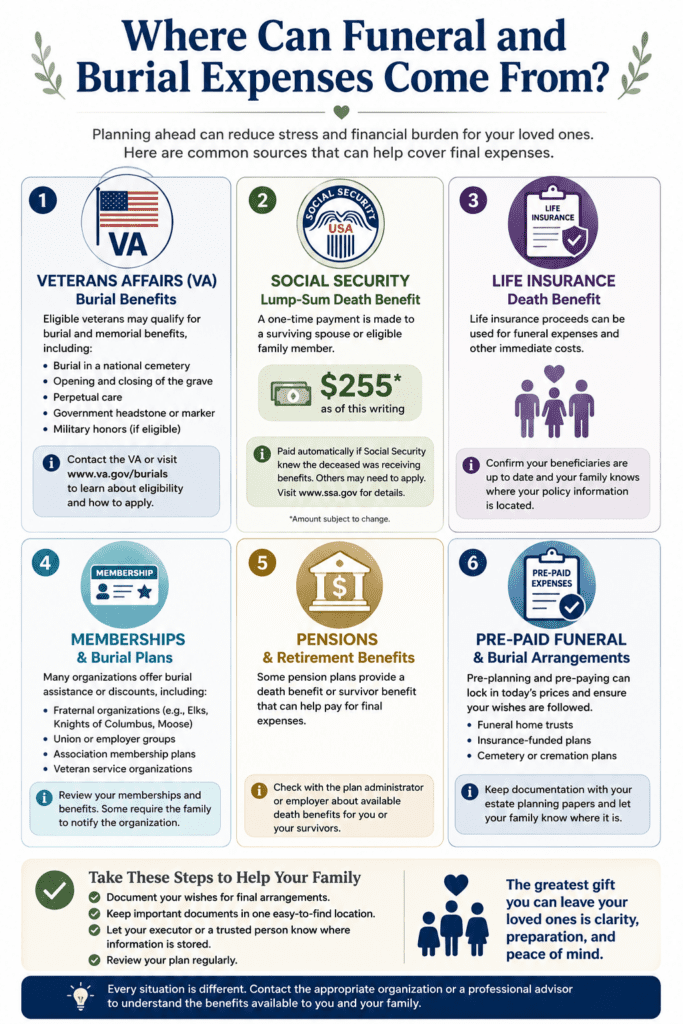
No-Contest Clauses, Bond Waivers, and Self-Proving Affidavits: Small Clauses That Can Make a Big Difference
By now you have probably noticed a common theme throughout this article:
Good estate planning is often about preventing problems before they occur.
Most people focus on the major decisions such as beneficiaries, executors, guardians, and asset distribution. However, there are several smaller provisions commonly found in wills that can help reduce family conflict, simplify administration, and make the probate process easier for your loved ones.
These provisions may seem minor, but they can have a significant impact on how smoothly your estate is administered.
What Is a No-Contest Clause?
A no-contest clause is designed to discourage beneficiaries from challenging your will.
The concept is simple.
If a beneficiary contests the will and loses, they may forfeit all or part of their inheritance.
The purpose is not to punish beneficiaries.
The purpose is to discourage unnecessary litigation and family disputes.
Why People Use No-Contest Clauses
These clauses are often considered when:
- A child is receiving less than other beneficiaries.
- A blended family is involved.
- Family relationships are strained.
- A large estate is involved.
- Previous disputes have occurred among family members.
For example, suppose a parent leaves one child $5,000 and another child $250,000.
Without an explanation or deterrent, the disinherited child may be tempted to challenge the will.
A properly drafted no-contest clause may reduce that risk.
Important Consideration
State laws vary significantly regarding no-contest clauses.
Some states enforce them strongly.
Others impose limitations.
This is one reason professional legal guidance may be appropriate in certain situations.
What Is a Bond Waiver?
Many people have never heard of an executor bond.
A bond functions much like an insurance policy.
It protects beneficiaries if an executor improperly manages estate assets.
The court may require an executor to obtain a bond before administering an estate.
While bonds can provide protection, they also:
- Cost money
- Create additional paperwork
- Delay administration
For this reason, many wills include a bond waiver provision.
Why Bond Waivers Are Common
Most people choose an executor because they trust that individual.
If you trust someone enough to manage your estate, you may feel there is little need to require them to purchase a bond.
Waiving the bond requirement can:
- Reduce costs
- Simplify administration
- Speed up the probate process
This is one reason the Bond Waiver option is commonly selected in many wills.
What Is a Self-Proving Affidavit?
A self-proving affidavit may be one of the simplest and most valuable documents in your estate planning portfolio.
When a will is signed, witnesses generally observe the signing process.
Years later, after the person creating the will has passed away, the probate court may need evidence that the will was properly executed.
Imagine trying to locate witnesses twenty years after the will was signed.
People move.
People pass away.
Memories fade.
A self-proving affidavit helps solve this problem.
How It Works
The affidavit is signed at the same time as the will and is usually notarized.
The document verifies that:
- The person signing the will was competent.
- The witnesses observed the signing.
- Proper procedures were followed.
This can significantly simplify probate administration.
Why Most People Should Consider One
A self-proving affidavit can:
- Reduce delays
- Minimize court complications
- Eliminate the need to locate witnesses later
- Make the probate process more efficient
Because of these benefits, many estate planning attorneys recommend including one whenever possible.
Why These Clauses Matter
None of these provisions changes who receives your assets.
However, they can dramatically affect how smoothly your estate is administered.
Think of them as preventative maintenance.
You hope they are never needed.
But if problems arise, they can save your family considerable time, money, and frustration.
A Real-World Example
Consider two nearly identical estates.
Both contain:
- A home
- Retirement accounts
- Investment accounts
- Three adult children
The first estate includes:
- A no-contest clause
- A bond waiver
- A self-proving affidavit
The second estate does not.
The first estate may move through probate more quickly and with fewer administrative hurdles.
The second estate may require additional court procedures, additional documentation, and potentially greater expense.
The difference often comes down to a few carefully drafted paragraphs.
The Bottom Line
Estate planning is not only about deciding who receives your assets.
It is also about making the process as simple as possible for the people you leave behind.
No-contest clauses, bond waivers, and self-proving affidavits may seem like small details, but they can have a meaningful impact on the administration of your estate.
The best estate plans do two things:
- Clearly identify your wishes.
- Make it easy for others to carry them out.
Now that we’ve covered many of the major components of a will, it’s time to address a question that many readers have been wondering about from the beginning:
Do you need only a will, or should you consider a Revocable Living Trust and a Pour-Over Will as part of a more comprehensive estate plan?
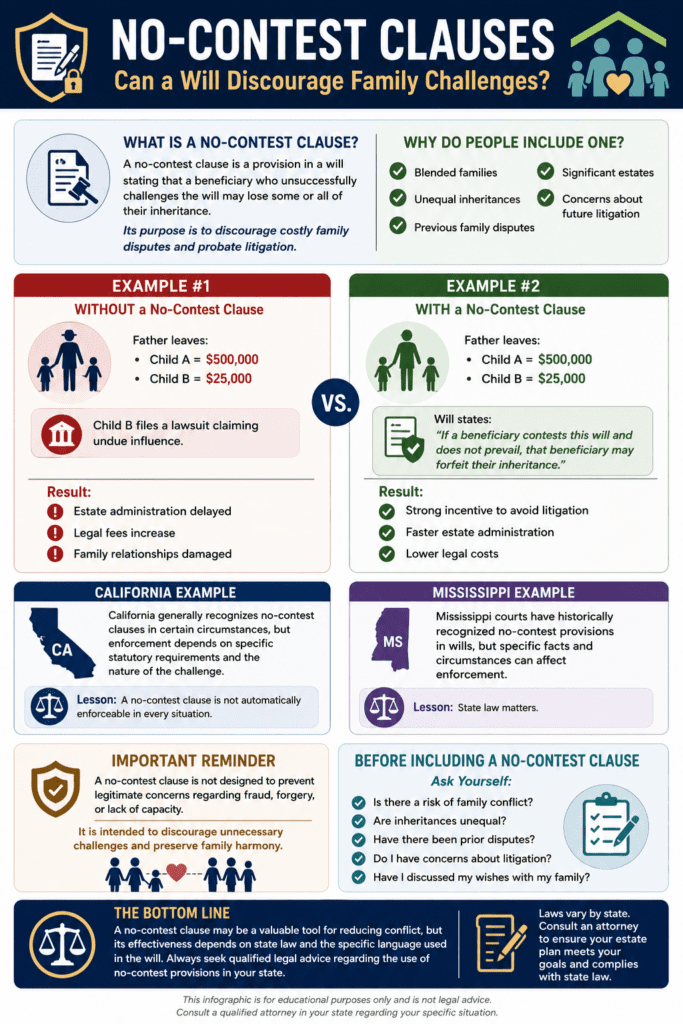
Do You Need a Will, a Trust, or Both?
By now you may be wondering:
“If a will is this important, why do so many people talk about trusts?”
This is one of the most common questions people ask when they begin estate planning.
The answer is simple:
A will and a trust are not competitors.
In many situations, they work together.
Unfortunately, there is a tremendous amount of misinformation surrounding trusts. Some people believe everyone needs one. Others believe trusts are only for the wealthy.
The truth lies somewhere in the middle.
Understanding the differences will help you determine which approach may be appropriate for your situation.
What Is a Will?
A will is a legal document that becomes effective upon your death.
It allows you to:
- Name beneficiaries
- Select an executor
- Name guardians for minor children
- Distribute assets
- Make specific gifts
- Document your wishes
A will is often the foundation of an estate plan.
For many individuals, creating a will is the first and most important step.
What Is a Revocable Living Trust?
A Revocable Living Trust is a legal entity that holds assets during your lifetime and distributes those assets after your death.
Unlike a will, a trust can become effective immediately after it is created and funded.
A trust can:
- Own property
- Own investment accounts
- Own bank accounts
- Hold business interests
- Continue operating after your death
The person who creates the trust is generally called the grantor or trustmaker.
Most people initially serve as their own trustee and maintain complete control over their assets.
The Biggest Difference: Probate
The primary reason many people create trusts is probate avoidance.
Assets Controlled by a Will
Assets governed by a will typically pass through probate.
Probate may involve:
- Court supervision
- Filing fees
- Legal expenses
- Administrative delays
The complexity varies significantly by state.
Assets Held in a Trust
Assets properly titled in a trust generally pass according to the trust instructions.
This often reduces:
- Court involvement
- Administrative delays
- Public disclosure
Many families appreciate the privacy and efficiency that trusts can provide.
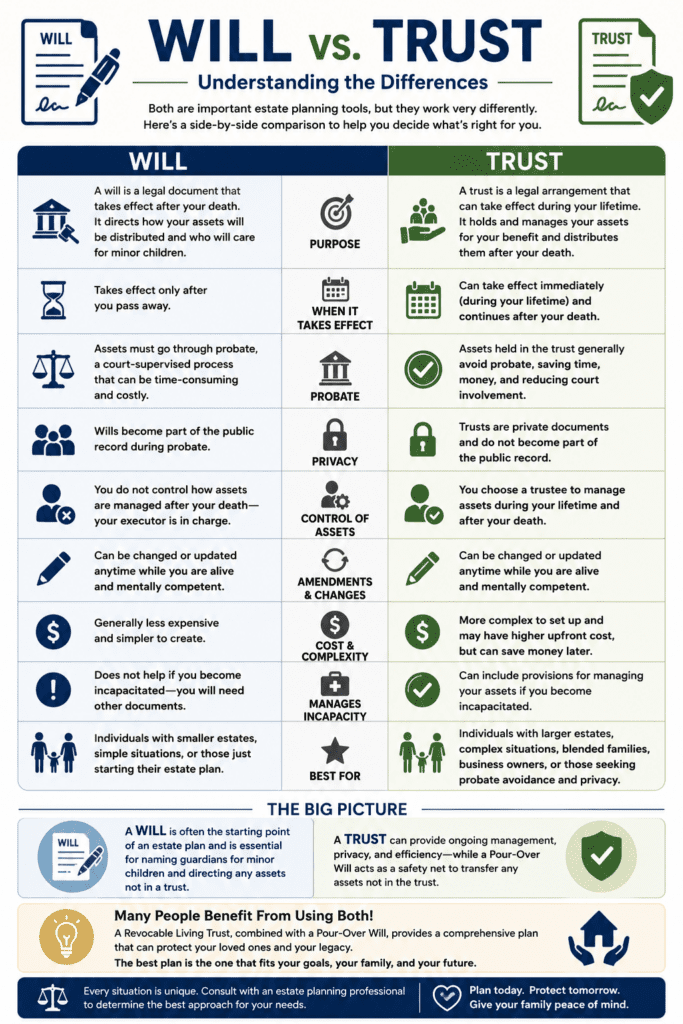
A Trust Does Not Replace a Will
This surprises many people.
Even individuals with trusts often have a will.
The reason is simple.
No estate plan is perfect.
People:
- Open new accounts
- Buy vehicles
- Acquire property
- Forget to retitle assets
If an asset remains outside the trust, a will may be needed to direct what happens to it.
This is where a Pour-Over Will enters the picture.
What Is a Pour-Over Will?
A Pour-Over Will is designed to work alongside a trust.
Think of it as a safety net.
The will directs that assets accidentally left outside the trust should be transferred, or “poured over,” into the trust after death.
Instead of creating conflicting instructions, the will supports the trust.
This is why many trust-based estate plans include both documents.
Who Might Benefit From a Trust?
Every situation is different, but trusts are often considered by:
- Homeowners
- Business owners
- Individuals with significant investments
- Families with minor children
- Blended families
- People seeking probate avoidance
- Individuals concerned about privacy
The more complex the estate becomes, the more valuable a trust may become.
Who Might Start With a Will?
Many people begin with a will because it is:
- Easier to understand
- Less expensive to implement
- A critical first step in estate planning
A will is often far better than having no plan at all.
Remember, the biggest estate planning mistake is usually not choosing the wrong document.
The biggest mistake is doing nothing.
Case Study: The Couple Who Started Small
Robert and Susan were recently retired.
Their estate consisted of:
- A home
- Retirement accounts
- Two vehicles
- Savings accounts
Initially, they created a comprehensive will and organized their financial information.
Several years later, they inherited additional assets, purchased investment property, and became interested in probate avoidance.
At that point, they established a Revocable Living Trust and added a Pour-Over Will.
Their estate plan evolved as their circumstances changed.
This is a common and perfectly reasonable approach.
Case Study: The Family Who Needed More Than a Will
David and Jennifer owned:
- Multiple rental properties
- A family business
- Significant investment accounts
After reviewing their situation, they determined that a Revocable Living Trust would provide additional benefits for their family.
The trust allowed them to organize assets, simplify administration, and provide detailed instructions regarding future management of the estate.
The trust became the centerpiece of their estate plan, supported by a Pour-Over Will.
The Bottom Line
There is no universal answer.
Some people need only a will.
Others benefit from a trust.
Many families ultimately use both.
The important thing is understanding your options and choosing the approach that best aligns with your goals, family structure, and assets.
If you remember nothing else from this section, remember this:
A will is often the starting point. A trust may become the next step as your estate planning needs become more sophisticated.
In the next section, we’ll examine one of the most overlooked parts of estate planning: how often you should review and update your will, and the major life events that should trigger an immediate review.
“I Put My Adult Child on My Bank Account and My House Has a Mortgage. Why Do I Need a Will?”
This is one of the most common estate planning questions people ask.
In fact, many people believe they have already completed their estate planning because they added an adult child to a bank account or because they assume their house will automatically transfer to someone else after they pass away.
Unfortunately, estate planning is rarely that simple.
Let’s look at some common misunderstandings.
Putting a Child on Your Bank Account Does Not Create a Complete Estate Plan
Suppose you have three children.
You add your oldest daughter to your bank account because she helps you pay bills and assists with financial matters.
Your intention is not necessarily to leave her all the money.
You simply want someone you trust to help manage the account.
However, when you pass away, that account may legally belong to the surviving joint owner.
Your other children may be shocked to learn that an account containing $100,000 passed entirely to one sibling.
Now imagine trying to explain that situation after you’re gone.
Without written instructions, misunderstandings can quickly develop into family disputes.
Your House Having a Mortgage Changes Nothing
Another common misconception is:
“I don’t really own my house because I still have a mortgage.”
The reality is that you do own your house.
The mortgage company simply has a lien securing repayment of the loan.
Your equity—the difference between the home’s value and the mortgage balance—is still part of your estate.
For example:
- Home value: $400,000
- Mortgage balance: $150,000
- Equity: $250,000
That $250,000 may represent one of the largest assets in your estate.
A will helps determine what happens to that asset.
What About Personal Property?
Even if your bank account and home transfer outside your estate, what about:
- Vehicles
- Jewelry
- Firearms
- Family photographs
- Collectibles
- Digital assets
- Personal belongings
Who receives those items?
Without a will, state law may answer that question for you.
Who Is Your Executor?
Adding a child to an account does not name an executor.
Someone still needs authority to:
- Handle estate administration
- File tax returns
- Pay debts
- Manage property
- Communicate with beneficiaries
A will allows you to select that person.
What If Circumstances Change?
Many people add a child to an account when everyone gets along.
Years later:
- Family relationships change.
- Children move away.
- Marriages occur.
- Divorces happen.
- Financial circumstances evolve.
A will provides a structured framework that can adapt to changing circumstances through periodic updates.
The Real Question
Instead of asking:
“Do I need a will?”
Ask yourself:
“Have I clearly documented my wishes so my family will not have to guess?”
If the answer is no, then additional planning may be appropriate.
The Bottom Line
Adding an adult child to a bank account may solve one specific problem.
Having a mortgage does not eliminate your ownership interest in a home.
Neither of these actions replaces a will.
A will provides instructions, names decision-makers, identifies beneficiaries, protects minor children, and creates a roadmap for your family during a difficult time.
The goal is not simply transferring assets.
The goal is providing clarity, reducing confusion, and protecting the people you care about most.
Case Study #2: Dad Put One Child on the Bank Account
Frank was a widower with three adult children.
As he grew older, his daughter Susan helped him with many day-to-day financial tasks. She drove him to appointments, assisted with online banking, and occasionally helped him pay bills.
To make things easier, Frank added Susan as a joint owner on his primary checking and savings accounts.
In Frank’s mind, this was simply a convenience.
He assumed that after his death Susan would divide the money equally among her siblings.
Unfortunately, Frank never discussed his intentions, never created a will, and never documented his wishes.
When Frank passed away, the accounts contained approximately $185,000.
The bank informed Susan that, as the surviving joint owner, the funds now legally belonged to her.
Susan believed she was honoring her father’s wishes by keeping the money because she had spent years helping him while her brothers lived out of state.
Her brothers saw things very differently.
They believed their father intended the money to be shared equally among all three children.
Within months:
- Family relationships deteriorated.
- Communication stopped.
- Attorneys became involved.
- Tens of thousands of dollars were spent arguing over an account that could have been addressed with a simple estate plan.
Years later, the siblings still were not speaking to one another.
What Went Wrong?
Frank made two common mistakes:
- He confused convenience with estate planning.
- He failed to document his intentions in a will or trust.
Adding a child to a bank account may help with bill paying and financial management, but it does not necessarily communicate your wishes regarding inheritance.
How Could This Have Been Avoided?
A simple will could have clearly stated:
- Who should inherit the account.
- Whether assets should be divided equally.
- Who should serve as executor.
- How disputes should be handled.
Even better, a conversation with his children while he was alive could have eliminated misunderstandings before they occurred.
The Lesson
Never assume family members know what you intended.
If your wishes exist only in your mind, your loved ones may be forced to guess after you’re gone.
A properly drafted will provides the roadmap your family needs and can prevent misunderstandings from becoming permanent family divisions.
When Should You Update Your Will?
Creating a will is a major accomplishment.
Unfortunately, many people make the mistake of believing that once a will is signed, their estate planning is complete forever.
Nothing could be further from the truth.
A will is not a one-time project.
It is a living document that should evolve as your life changes.
The good news is that updating a will is usually much easier than creating one from scratch.
Why Wills Become Outdated
Life rarely stands still.
Families grow.
Assets change.
Relationships evolve.
Tax laws are updated.
Children become adults.
Grandchildren arrive.
The instructions that made perfect sense ten years ago may no longer reflect your wishes today.
An outdated will can sometimes create almost as many problems as having no will at all.
Major Life Events That Should Trigger a Review
Certain events should immediately cause you to pull out your estate planning documents and review them carefully.
Marriage
Marriage affects nearly every aspect of estate planning.
You should review:
- Beneficiaries
- Executors
- Healthcare directives
- Powers of attorney
- Property ownership
Divorce
Divorce is one of the most important reasons to update a will.
Many people are shocked to discover that old estate planning documents still contain references to former spouses.
Review everything immediately following a divorce.
Birth of a Child
A new child often changes inheritance plans and guardianship decisions.
Parents should consider:
- Guardians
- Alternate guardians
- Financial provisions
- Educational planning
Birth of a Grandchild
Many grandparents revise their wills to include grandchildren either directly or through Per Stirpes provisions.
Death of a Beneficiary
If someone named in your will passes away, you should review your estate plan as soon as practical.
Questions to consider include:
- Who should receive that share now?
- Are alternate beneficiaries identified?
- Does the distribution still reflect your wishes?
Death of an Executor
Your executor cannot serve if they are no longer living.
Review successor executors regularly.
Moving to Another State
Estate laws vary from state to state.
If you relocate, especially after retirement, your estate planning documents should be reviewed to ensure they remain appropriate under your new state’s laws.
Significant Financial Changes
Examples include:
- Receiving an inheritance
- Selling a business
- Purchasing investment property
- Large increases in net worth
- Major charitable intentions
As your assets grow, your estate plan should evolve as well.
Retirement Is an Excellent Time for a Review
Retirement is one of the best opportunities to revisit estate planning.
Many retirees experience major changes:
- Downsizing a home
- Relocating
- Starting a business
- Purchasing vacation property
- Becoming grandparents
- Revising financial goals
The retirement years often create the perfect opportunity to organize estate planning documents and update outdated instructions.
How Often Should You Review Your Will?
Even if nothing major changes, a good rule of thumb is:
Every Three to Five Years
A periodic review helps ensure:
- Contact information remains current
- Executors are still appropriate
- Beneficiaries are accurate
- Assets remain properly addressed
Think of it like a medical checkup for your estate plan.
The Forgotten Documents Problem
Many people update their will but forget related documents.
When reviewing your estate plan, also review:
- Trusts
- Powers of attorney
- Healthcare directives
- HIPAA authorizations
- Beneficiary designations
- Digital asset inventories
- Funeral instructions
Remember that your estate plan functions as a system.
One outdated document can create confusion.
Case Study #3: The Will That Was Never Updated
Tom created a will shortly after his first child was born.
At the time, the document accurately reflected his wishes.
Over the next twenty years:
- He had two additional children.
- He moved to another state.
- He purchased investment property.
- His original executor passed away.
- Several beneficiaries died.
Unfortunately, Tom never reviewed the document.
When he passed away, the will still named deceased individuals and failed to address significant assets acquired over the years.
The result was additional legal work, confusion, and delays that could have been avoided with a simple review every few years.
The Lesson
Creating a will is important.
Maintaining it is equally important.
The Bottom Line
Your estate plan should evolve as your life evolves.
The goal is not simply to have a will.
The goal is to have a will that accurately reflects your current wishes, family circumstances, and financial situation.
A periodic review can help ensure your estate plan remains one of the most valuable gifts you leave behind.
Now let’s address some of the most common questions people ask when creating a will, including whether they need an attorney, whether handwritten wills are valid, and what happens if family members disagree with their decisions.
Case Study #4: “Dad Took Care of Everything”
Richard was never wealthy.
He and his wife Linda worked hard throughout their lives, paid off their modest home, raised three children, and slowly built a comfortable retirement.
Richard often joked that he didn’t have enough money to worry about estate planning.
One day, after attending a retirement seminar, he realized estate planning wasn’t about how much money he had—it was about making life easier for his family.
Over the next several months, Richard completed a comprehensive estate plan.
He:
- Created a Last Will and Testament.
- Named an executor and alternate executor.
- Prepared a Revocable Living Trust for their home and investments.
- Updated beneficiary designations.
- Completed Healthcare Directives and Financial Powers of Attorney.
- Organized life insurance policies and retirement accounts.
- Created a Digital Asset Inventory.
- Wrote funeral instructions.
- Placed everything into a clearly labeled estate planning binder.
Most importantly, he invited his three adult children over for dinner.
After the meal, he showed them the binder and said:
“I hope you won’t need this for many years. But when that day comes, I don’t want you arguing over what I wanted. I want you spending your time taking care of each other.”
His children were surprised.
They had never considered how difficult estate administration could become without proper planning.
Several years later, Richard passed away peacefully after a brief illness.
His family was heartbroken.
But they were not overwhelmed.
Within minutes they located the estate planning binder.
Everyone already knew:
- Who the executor was.
- Where the original documents were stored.
- How the assets were to be distributed.
- Richard’s funeral wishes.
- The location of account information and important contacts.
There were no arguments.
No confusion.
No one questioned Richard’s decisions because he had taken the time to explain them while he was alive.
Months later, during a family gathering, Richard’s oldest daughter quietly said something that no estate planning attorney could ever place into a legal document:
“Dad gave us one last gift. He gave us peace.”
The Lesson
Estate planning is not really about preparing for your death.
It is about protecting the people who will continue living after you’re gone.
Your will, trust, powers of attorney, healthcare directives, and other estate planning documents are more than legal paperwork.
They are expressions of responsibility, love, and consideration for the people who matter most.
The greatest legacy most of us leave behind is not the size of our estate.
It is the peace of mind we provide our families by taking the time to prepare.
Conclusion: The Greatest Gift You Leave Behind Is Peace of Mind
If you’ve made it this far, congratulations.
You have invested the time to learn one of the most important financial and personal planning topics of your lifetime.
As you’ve discovered throughout this guide, creating a will is about much more than deciding who receives your home, bank accounts, or personal belongings. It is about protecting your family, reducing confusion, minimizing conflict, and making one of life’s most difficult moments just a little easier for the people you love.
Many people postpone estate planning because they believe they have plenty of time.
Unfortunately, life doesn’t always give us the opportunity to finish tomorrow what we intended to do today.
Estate planning is not about expecting the worst.
It is about being prepared for the unexpected.
Whether you are 25 or 85, single or married, have children or not, own a modest home or a large investment portfolio, a properly prepared will provides something every family needs:
Clarity.
It tells your loved ones what you wanted.
It appoints someone you trust to carry out your wishes.
It protects your children.
It helps preserve family relationships.
Most importantly, it gives your family confidence during one of the most emotional periods of their lives.
As you have seen throughout this article, creating a will is only one part of a comprehensive estate plan. Depending on your circumstances, you may also benefit from a Revocable Living Trust, Pour-Over Will, Financial Power of Attorney, Advance Healthcare Directive, HIPAA Authorization, Digital Asset Inventory, and other planning documents that work together to protect both you and your family.
That is exactly why I created the RetireCoast Estate Planning Membership.
Rather than searching for information from dozens of different websites, you can follow a structured, step-by-step process using educational guides, interactive planning tools, downloadable worksheets, and document builders designed to help you organize your affairs and make informed decisions before you ever meet with an attorney—or, in many cases, complete your estate planning yourself.
Inside the membership you’ll find tools that help you:
- Build a comprehensive Last Will and Testament or Pour-Over Will.
- Create a Revocable Living Trust.
- Prepare Financial Powers of Attorney and Advance Healthcare Directives.
- Organize your digital assets and important documents.
- Evaluate trustees and executors.
- Create estate planning worksheets and inventories.
- Build a complete estate planning portfolio that can be reviewed and updated throughout your lifetime.
One of my goals has always been to make estate planning understandable for everyday families. Legal terminology should never prevent someone from protecting the people they love. By breaking the process into manageable steps, I hope this guide has shown that estate planning is not nearly as intimidating as many people believe.
If there is one message I hope you remember, it is this:
The best estate plan is not the most expensive one. It is the one that actually gets completed.
Don’t wait for the “perfect” time.
Don’t assume someone else knows what you want.
Don’t leave your family guessing.
Take the first step today.
Years from now, your loved ones may never fully appreciate the countless hours of confusion, stress, legal expenses, and family conflict that your planning prevented.
And that’s exactly the point.
The greatest compliment an estate plan can receive is that everything went smoothly because you took the time to prepare.
Your legacy is more than the assets you leave behind.
Your legacy is the peace of mind, clarity, and love you leave with the people who matter most.
Ready to Create Your Estate Planning Portfolio?
Use our step-by-step estate planning tools to create your will, pour-over will, revocable living trust, powers of attorney, healthcare directives, digital asset inventory, and more.
Your family deserves more than good intentions. They deserve a clear plan.
Start Your Estate Planning MembershipBuild your estate planning portfolio at your own pace with tools, worksheets, document builders, and plain-English guidance.
References and Additional Resources
Estate planning laws vary by state, and every family’s situation is unique. The following authoritative resources provide additional information regarding wills, probate, estate administration, taxation, veterans benefits, Social Security, and consumer protection.
Federal Government Resources
Internal Revenue Service (IRS) – Estate and Gift Taxes
https://www.irs.gov/businesses/small-businesses-self-employed/estate-and-gift-taxes
Internal Revenue Service – Publication 559: Survivors, Executors, and Administrators
https://www.irs.gov/forms-pubs/about-publication-559
Internal Revenue Service – Frequently Asked Questions on Estate Taxes
https://www.irs.gov/businesses/small-businesses-self-employed/frequently-asked-questions-on-estate-taxes
Social Security Administration – Lump-Sum Death Benefit
https://www.ssa.gov/benefits/survivors/
Social Security Administration – Survivor Benefits
https://www.ssa.gov/benefits/survivors/
U.S. Department of Veterans Affairs – Burial Benefits
https://www.va.gov/burials-memorials/
National Cemetery Administration – Eligibility
https://www.cem.va.gov/
Consumer Protection
Consumer Financial Protection Bureau – Managing Someone Else’s Money Guides
https://www.consumerfinance.gov/consumer-tools/managing-someone-elses-money/
Federal Trade Commission – Identity Theft After a Loved One Dies
https://consumer.ftc.gov/articles/what-do-when-loved-one-dies
State Law Resources
Legal Information Institute (Cornell Law School) – Wills
https://www.law.cornell.edu/wex/will
Legal Information Institute – Probate
https://www.law.cornell.edu/wex/probate
Uniform Law Commission – Uniform Probate Code
https://www.uniformlaws.org/
Educational Resources
American Bar Association – Estate Planning Resources
https://www.americanbar.org/groups/real_property_trust_estate/
AARP – Estate Planning Guide
https://www.aarp.org/money/investing/info-2020/estate-planning.html
National Institute on Aging – Advance Care Planning
https://www.nia.nih.gov/health/advance-care-planning
Unclaimed Property
National Association of Unclaimed Property Administrators (NAUPA)
https://www.unclaimed.org/
RetireCoast Estate Planning Resources
If you would like to build your own estate planning portfolio using step-by-step tools and educational resources, visit:
Estate Planning Membership
https://retirecoast.com/estate-planning-membership/
Estate Planning Hub
https://retirecoast.com/category/estate-planning/
Why These Resources Matter
Estate planning involves legal, financial, healthcare, tax, and family considerations. The resources above are designed to help you better understand the estate planning process. However, because every family’s circumstances are different and laws vary by state, you should review your state’s requirements and consult qualified legal, tax, or financial professionals whenever appropriate.
FAQ
1. Do I really need a will if I do not have many assets?
Yes. A will is not just about money. A will allows you to name an executor, select guardians for minor children, distribute personal property, leave specific instructions, and reduce confusion for your family.
Even if your estate is modest, your loved ones will benefit from having clear guidance.
2. At what age should someone create their first will?
Every adult should consider creating a will. Many people believe estate planning begins around retirement, but young adults often have vehicles, bank accounts, retirement plans, pets, digital assets, and sometimes children.
A will protects much more than wealth.
3. Can I change my will later?
Yes. As long as you remain mentally competent, you can revise or replace your will whenever your circumstances change.
Common reasons include marriage, divorce, birth of children, grandchildren, buying or selling property, moving to another state, or changing beneficiaries.
4. Do I need an attorney to create a will?
That depends on your circumstances. Many straightforward estates can be organized using high-quality estate planning tools and educational resources.
However, people with large estates, businesses, multiple properties, blended families, special needs beneficiaries, or tax concerns should consider consulting an experienced estate planning attorney.
5. Can I write my own will?
Possibly. Every state has its own laws regarding the execution of wills. Some states recognize handwritten wills under certain circumstances, while others have more restrictive requirements.
Regardless of how a will is prepared, it must satisfy your state’s legal requirements to be enforceable.
6. What happens if I die without a will?
Dying without a will is called dying intestate. In that situation, state law determines who receives your assets.
The court does not know your personal wishes, family history, concerns about beneficiaries, or preferences regarding specific property. A will provides the roadmap your family and the court need.
7. Does a will avoid probate?
Usually, no. A will often serves as the instruction manual used during probate. The will tells the court how you want your estate administered.
If avoiding probate is a major goal, a Revocable Living Trust may be worth considering.
8. What is an executor?
An executor is the person responsible for carrying out the instructions in your will.
The executor may locate assets, file probate documents, pay debts, communicate with beneficiaries, file tax returns, and distribute property according to your instructions.
9. Who should I choose as executor?
Choose someone who is organized, trustworthy, financially responsible, and willing to serve.
The executor does not have to be your oldest child or closest relative. The best executor is the person most capable of doing the job.
10. Should I name an alternate executor?
Yes. Your first choice may pass away, become incapacitated, move away, or decline to serve.
Naming an alternate executor helps prevent delays and gives your estate plan a backup option.
11. Can I name more than one executor?
You may be able to name co-executors, but this can create complications if they disagree.
In many families, naming one executor and one alternate executor is simpler and more efficient.
12. What is per stirpes?
Per stirpes means inheritance passes by family branch.
For example, if one of your children dies before you, that child’s share can pass to his or her children instead of being divided only among your surviving children.
13. What is the difference between per stirpes and per capita?
Per stirpes preserves each family branch. If a beneficiary dies before you, that beneficiary’s descendants may receive that share.
Per capita generally divides assets among surviving beneficiaries. Depending on your goals, this may leave a deceased child’s children with nothing.
14. Can a will name guardians for minor children?
Yes. One of the most important functions of a will is naming guardians for minor children.
If both parents pass away and no guardian is named, the court may have to decide who should raise the children.
15. Should I ask someone before naming them as guardian?
Yes. Never assume someone is willing or able to serve as guardian.
Discuss your wishes, your children’s needs, financial expectations, and your reasons for choosing that person. Also name an alternate guardian.
16. Can I leave specific items to certain people?
Yes. A will can leave specific gifts such as jewelry, watches, firearms, vehicles, artwork, collectibles, family photos, or heirlooms to particular people.
Specific gifts often prevent disputes over sentimental property.
17. Should I include digital assets in my estate plan?
Yes. Digital assets may include email accounts, cloud storage, social media, online banking, cryptocurrency, websites, domain names, and digital photos.
Your executor needs to know what exists and how to locate important information.
18. Should I put passwords directly in my will?
Usually, no. Wills may become part of the public probate record.
A safer approach is to use a secure password manager or separate confidential document and make sure your executor or trusted person knows how to access it when needed.
19. Does a will control life insurance or retirement accounts?
Usually, beneficiary designations control life insurance, IRAs, 401(k)s, annuities, and certain payable-on-death or transfer-on-death accounts.
This is why your beneficiary forms should be reviewed regularly along with your will.
20. If I have a trust, do I still need a will?
Often, yes. A trust only controls assets that have actually been transferred into the trust.
A Pour-Over Will can act as a safety net by directing assets left outside the trust to be transferred into the trust after death.
21. What is a Pour-Over Will?
A Pour-Over Will works with a Revocable Living Trust. It directs assets accidentally left outside the trust to be “poured over” into the trust after death.
It is commonly used as part of a trust-based estate plan.
22. Should my family know what is in my will?
This is a personal decision. Some families openly discuss estate planning, while others prefer privacy.
However, communicating your general intentions often reduces misunderstandings and surprises after death.
23. Where should I store my will?
Store your will somewhere safe, dry, and easy for your executor to locate.
A will hidden so well that no one can find it provides little benefit. Tell your executor where the original document is kept.
24. Can someone challenge my will?
Yes. Wills may be challenged based on claims such as lack of mental capacity, undue influence, fraud, or improper execution.
Thoughtful planning, proper signing procedures, clear communication, and professional review when needed can reduce the likelihood of a successful challenge.
25. How often should I review my will?
A good rule of thumb is every three to five years.
You should also review your will after marriage, divorce, birth of children, death of a beneficiary, retirement, moving to another state, buying property, or major financial changes.
Every question above has one thing in common: people simply want to protect the people they love. Estate planning does not have to be intimidating. Once you understand the process and work through each decision one step at a time, creating a will becomes much less overwhelming.
The important thing is to begin. A will that exists today is almost always more valuable than the perfect will that never gets written.
PODCAST
Discover more from RetireCoast.com
Subscribe to get the latest posts sent to your email.