Last updated on June 8th, 2026 at 12:49 pm
The Explosive Story Behind America’s Fight for Independence
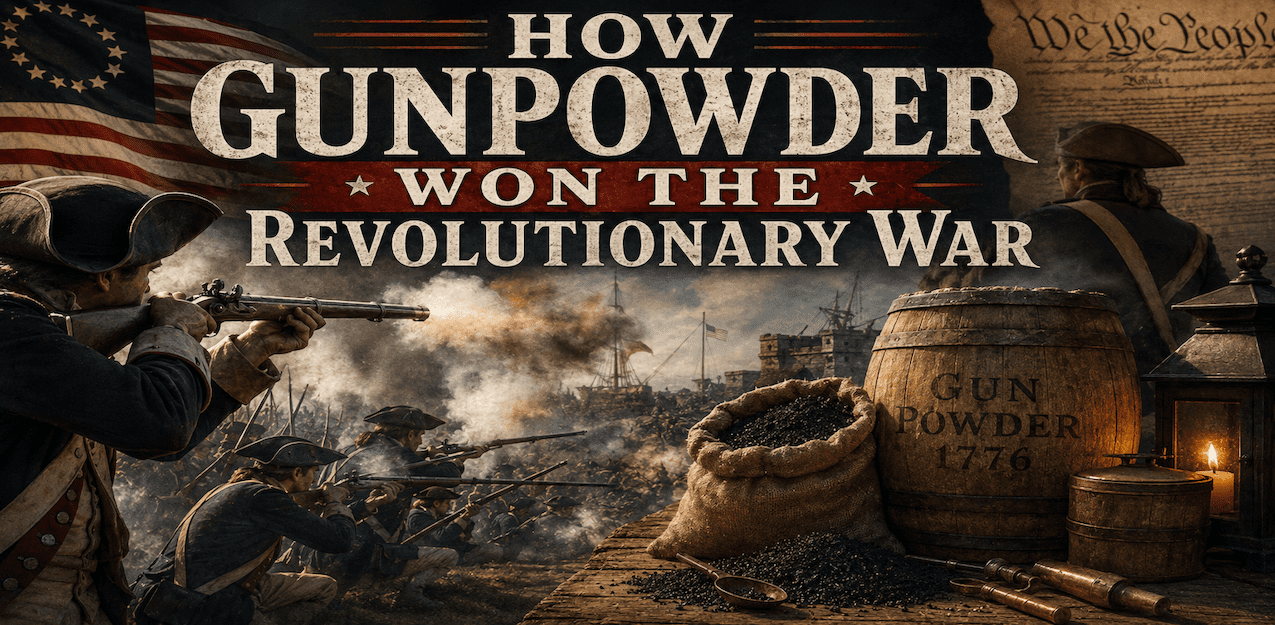
When Americans remember the Revolutionary War, they usually picture muskets, flags, George Washington, the Continental Army, and the Declaration of Independence. But behind every musket shot, every cannon blast, every naval raid, and every battlefield stand was a simple fact: the American Revolution could not be fought without gunpowder.
In many ways, gunpowder won the Revolutionary War.
How Gunpowder Won the Revolutionary War is one in the RetireCoast series about the 250th Anniversary of the Signing of the Declaration of Independence and forming of the United States. Click on the button at the end to visit the entire series hub and read some of our fascinating articles.
The American colonies had brave militia, determined leaders, and a powerful political cause. But courage alone could not defeat Great Britain. The British Army and British Navy were professional, supplied, and backed by one of the strongest governments in the world.
The rebel forces had to find powder, manufacture black powder, smuggle powder, steal powder, and protect powder before the British commanders’ worst fears could come true: a rebellion that could actually shoot back.
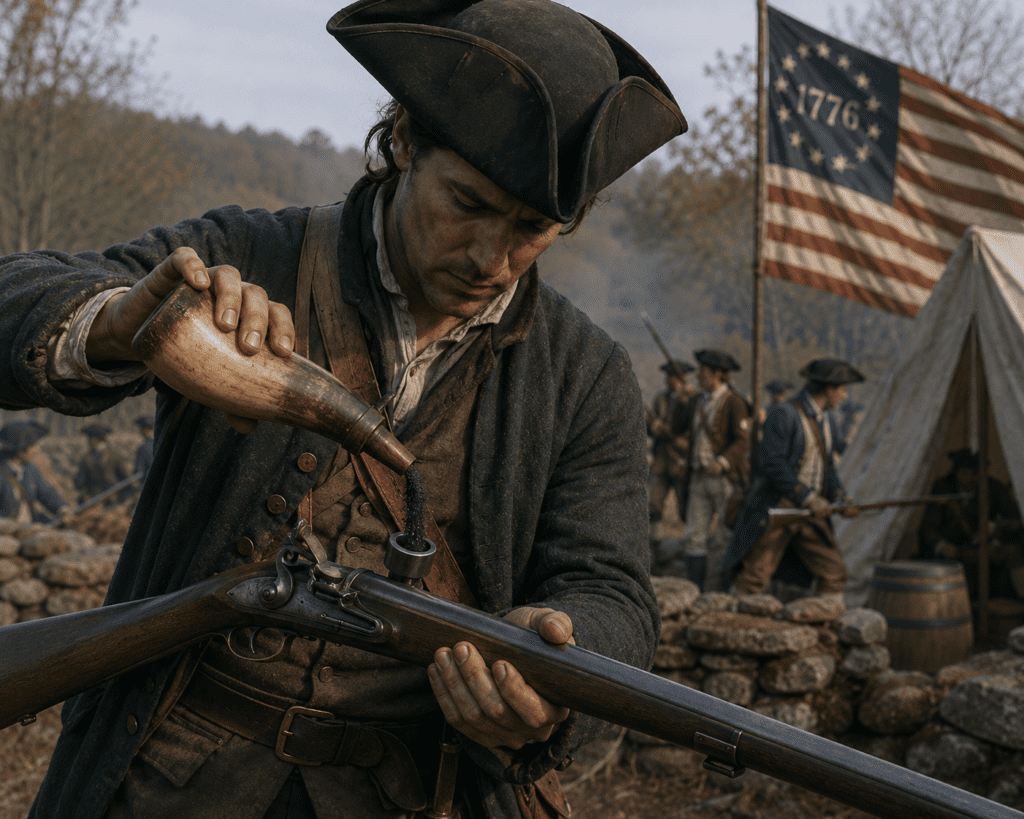
American forces nearly out of ammunition
At the beginning of the war, the American forces were nearly out of ammunition. George Washington’s Continental soldiers outside Boston had shockingly little powder. The Second Continental Congress, colonial governments, merchants, privateers, women, farmers, chemists, and smugglers all became part of a desperate supply chain that would eventually become one of the greatest examples of Revolutionary War logistics in American history.
They scraped nitrate-rich dirt from stables, cellars, tobacco warehouses, and places rich with animal droppings in an effort to increase the manufacture of black powder. They sent armed vessels into dangerous waters to intercept British supply ships and protect American ports.
They traded through the West Indies while searching desperately for potassium nitrate, muskets, artillery supplies, and barrels of powder. They looked to the French government while still officially fighting alone before France openly entered the war.
The Revolutionary War was not only a war of ideas. It was a war of supply, chemistry, transportation, and survival.
And nothing mattered more than gunpowder.
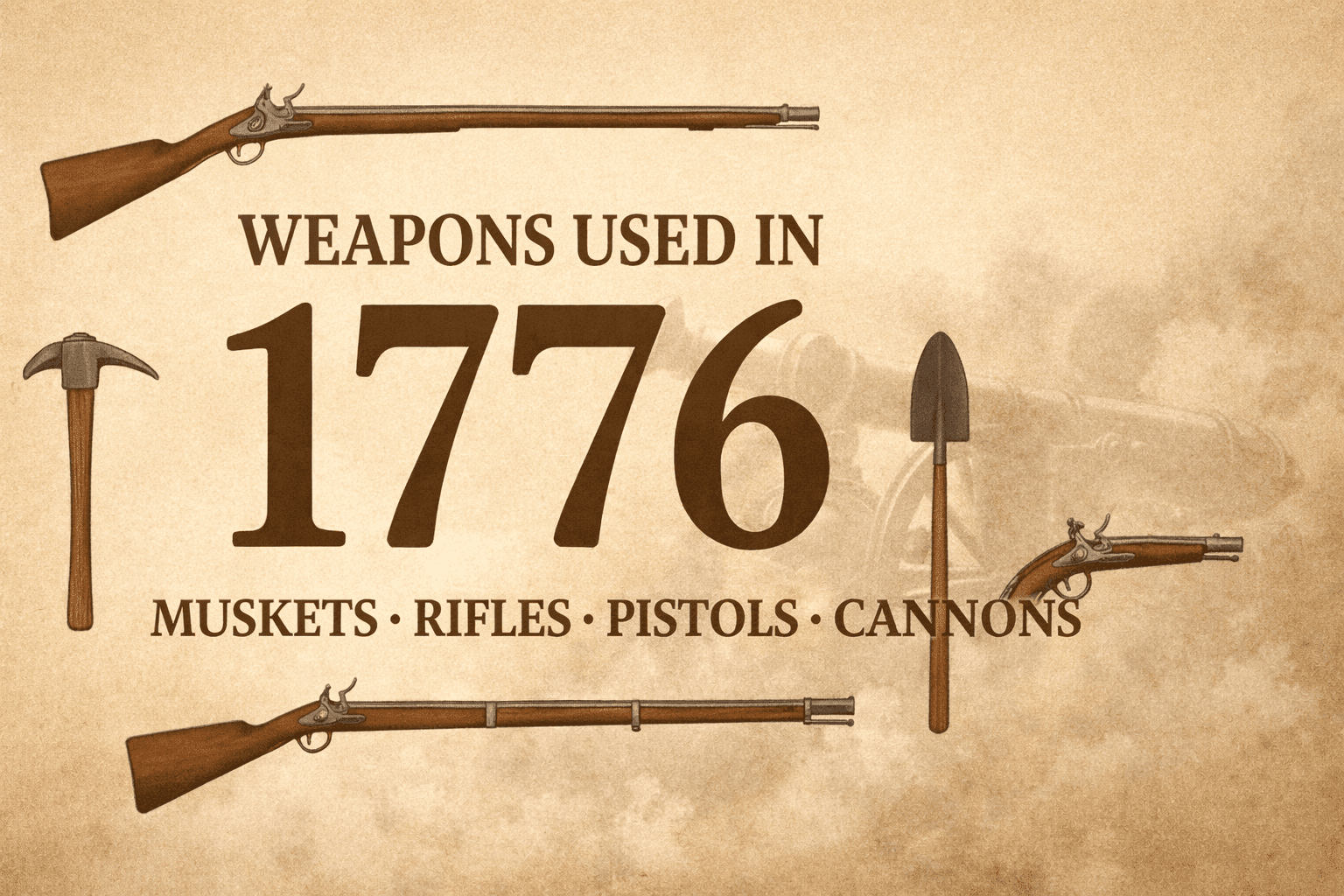
You are reading about the gunpowder that helped sustain the American Revolution. Now discover the muskets, rifles, cannons, swords, and battlefield weapons that actually used it.
According to Google search results, our article on Weapons Used in 1776 has become one of the definitive online resources covering Revolutionary War weaponry, battlefield technology, and military equipment used during America’s fight for independence.
Read Weapons Used in 1776- The Explosive Story Behind America’s Fight for Independence
- The Colonies Entered the War Almost Empty
- That is why powder became one of the earliest flashpoints of the Revolution.
- The Powder Alarm Was a Warning Shot Before Lexington
- Fort William and Mary: New Hampshire Moves First
- Washington’s Nightmare Outside Boston
- Benjamin Franklin’s Desperate Idea: Bows and Arrows
- The Second Continental Congress Takes Action
- How Black Powder Was Made
- Saltpeter: The Gross Chemistry That Helped Save the Revolution
- Women and Households Joined the Powder War
- The Powder Mills: America’s Dangerous Industrial Beginning
- Frankford Mill and Paul Revere’s Industrial Espionage
- Domestic Production Helped, But It Was Not Enough
- The West Indies Became America’s Powder Pipeline
- Washington’s Armed Vessels and the Birth of a Naval Supply War
- Bermuda: The Raid That Helped Save the Revolution
- South Carolina and the Southern Colonies
- France Before the French Alliance
- Saratoga: Powder Before Diplomacy
- British Commanders’ Worst Fears
- African Americans and the Powder War
- Lead Ball, Muskets, and the Full Ammunition Problem
- Why Powder Was So Hard to Move
- Gunpowder Was the Hidden Weapon of Independence
- Conclusion: Independence Required More Than Courage
- From Colonial Scarcity to Modern Chemistry: Where Gunpowder Ingredients Come From Today
- The Modern Chemical Process
- The World’s Modern Production Centers
- Are Natural Deposits Still Used?
- What Potassium Nitrate Is Used For Today
- From Revolution to Everyday Life
- PODCAST
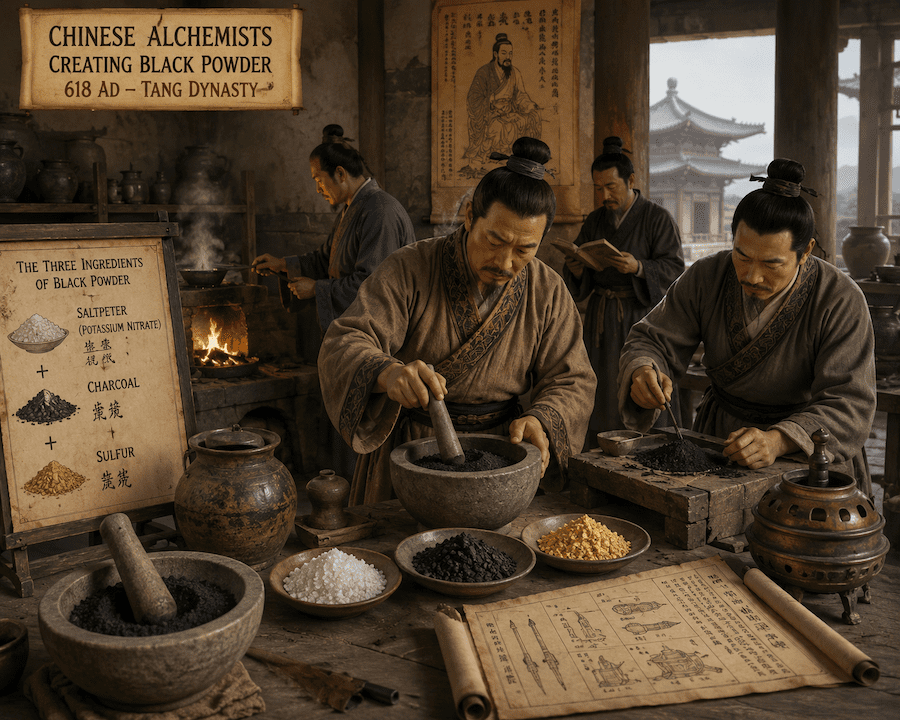
Black powder, known globally as gunpowder, was the first chemical explosive in human history. Its discovery transformed warfare, engineering, mining, trade, and eventually the balance of power across entire civilizations.
75% saltpeter (potassium nitrate)
15% charcoal
10% sulfur
Mongol conquests across Eurasia helped spread gunpowder technology westward along trade and military routes.
By the 13th century, Middle Eastern scholars such as Hasan al-Rammah documented gunpowder formulas and saltpeter purification methods.
European scholars and armies adopted gunpowder technology in the 13th and 14th centuries, revolutionizing warfare and castle design.
The Colonies Entered the War Almost Empty
The American colonies did not begin the Revolutionary War with a large military stockpile. Much of the powder in colonial magazines had been left over from earlier conflicts, including the French and Indian War.
The few powder mills in the colonies were limited, damaged, or insufficient, and the manufacture of black powder was almost a lost art in many places. Supplies of potassium nitrate, the key ingredient in black powder, were especially scarce throughout the American colonies.
One historian writing in the American Historical Review described gunpowder supply as one of the most serious problems faced by the colonists during the first two and a half years of the American Revolution.
This weakness was obvious to both sides.
The British government understood that disarming the colonies did not require confiscating every musket. If British officials could seize the powder magazines, they could make thousands of privately owned firearms almost useless.
A musket without powder and a lead ball was little more than a club. British commanders understood that controlling ammunition and military supplies could cripple the Continental Army before it became a sustained fighting force.
That is why powder became one of the earliest flashpoints of the Revolution.
In Massachusetts, General Thomas Gage seized powder from the Charlestown arsenal and withheld powder from the legal owners of the Boston magazine. In Virginia, Royal Governor Lord Dunmore seized gunpowder from the colony’s principal stores around the same time that the conflict in Massachusetts turned violent.
These actions spread alarm through the American colonies and convinced many colonists that British rule was moving from taxation and regulation to military disarmament. The growing fear of losing access to arms, ammunition, and gunpowder helped push many previously cautious colonists toward open resistance against Great Britain.
The struggle for independence began as a struggle over arms and ammunition.
The Powder Alarm Was a Warning Shot Before Lexington
Before Lexington and Concord, the colonies had already experienced the Powder Alarm of 1774. British troops removed gunpowder from a magazine near Boston, and rumors raced through New England that war had begun.
Thousands of militia members mobilized. Men marched toward Boston. Communities prepared for open conflict.
The reports were exaggerated, but the reaction was real.
The Powder Alarm revealed that the colonists were watching powder stores closely. It also showed that British attempts to control gunpowder could trigger mass resistance. The event did not start the Revolutionary War, but it proved the colonies were ready to respond when British soldiers moved against military supplies.
By April 1775, when British soldiers marched toward Concord, both sides understood the stakes. The British were not simply looking for a symbolic confrontation. They were targeting military stores.
Powder was power.
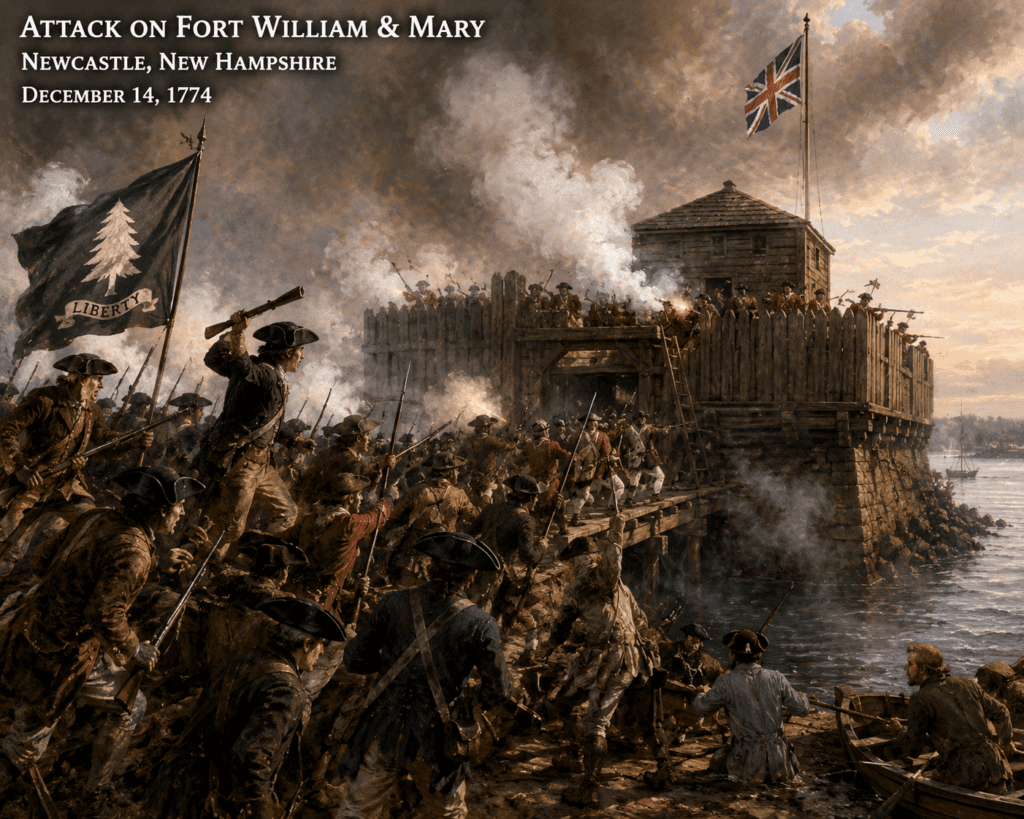
Fort William and Mary: New Hampshire Moves First
One of the most important early powder seizures occurred before Lexington and Concord.
In December 1774, patriots in New Hampshire attacked Fort William and Mary at Portsmouth, also known as Jerry’s Point. Over time, more than 10,000 pounds of powder were taken for the patriot cause. This was not a minor local episode. It was part of a larger colonial effort to secure powder before the British could remove or destroy it.
New Hampshire’s powder became part of the broader American war supply. Other colonies also gathered what they could. According to the American Historical Review article, the rebellious colonies obtained roughly 80,000 pounds of powder from internal colonial sources at the beginning of the war.
That included powder from New Hampshire, Massachusetts, Connecticut, Rhode Island, Pennsylvania, Maryland, the Carolinas, Virginia, and Georgia.
Eighty thousand pounds sounds like a great deal.
It was not.
Once armies began firing muskets, cannons, and naval guns, that supply disappeared rapidly.
Washington’s Nightmare Outside Boston
When George Washington arrived to command the Continental Army outside Boston in 1775, he discovered a terrifying truth. His army did not have enough powder to fight a major battle.
Washington understood that if the British Army attacked in force, the American position might collapse not because the soldiers lacked courage, but because they lacked ammunition.
The shortage was so severe that powder use had to be tightly controlled. Training fire was limited. Waste was condemned. Officers tried to track the ammunition carefully. Washington complained that much of the existing powder had been consumed quickly and sometimes wastefully, and rain-damaged supplies made the problem worse.
This changes how we should think about the Siege of Boston.
The American army surrounding Boston looked like a major military force, but for part of that campaign, it was dangerously hollow. If British commanders had known exactly how little powder Washington possessed, they might have launched a more aggressive attack.
Washington’s greatest fear was that the British would discover the truth.
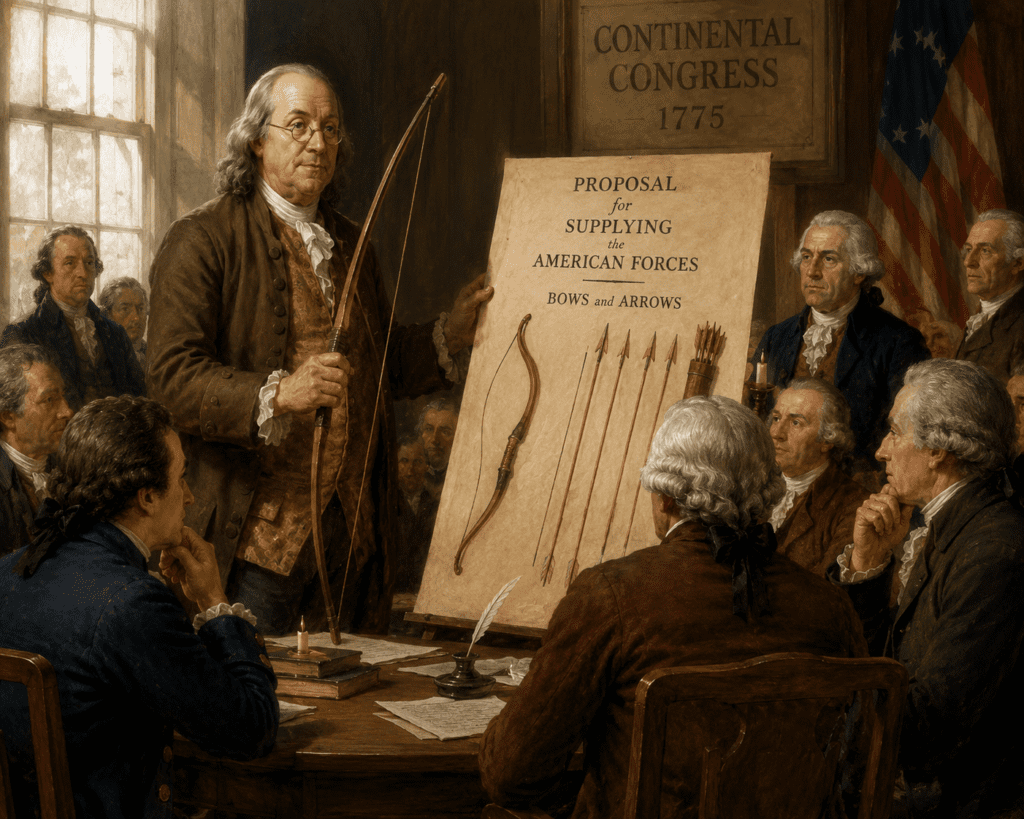
Benjamin Franklin’s Desperate Idea: Bows and Arrows
The shortage was so extreme that Benjamin Franklin considered alternatives that sound strange today.
Franklin suggested that American soldiers might use bows and arrows, along with pikes, if powder became unavailable. His reasoning was practical. A skilled archer could fire arrows faster than a soldier could reload a musket, and arrows could be recovered and reused.
Franklin was not trying to romanticize medieval warfare. He was confronting a brutal logistical fact: a musket army without powder could not function.
That idea tells us how desperate the powder crisis became.
The American Revolution was close enough to failure in 1775 that serious leaders were considering weapons that did not require gunpowder.
The Second Continental Congress Takes Action
The Second Continental Congress quickly realized that powder was a national emergency. Congress authorized the purchase of large quantities of powder and pushed colonial governments to expand production.
Congress also sent instructions and pamphlets explaining how to manufacture saltpeter, the key ingredient in black powder. The goal was to turn the American colonies into a decentralized supply network. Every colony, town, farm, and household that could help was urged to do so.
John Adams captured the optimism and urgency in 1775 when he wrote that people in Philadelphia believed every stable, dovecote, cellar, and vault might be a “Mine of Salt Petre.” In other words, ordinary dirty spaces might contain the chemical foundation of American independence.
That was not poetry.
It was chemistry.
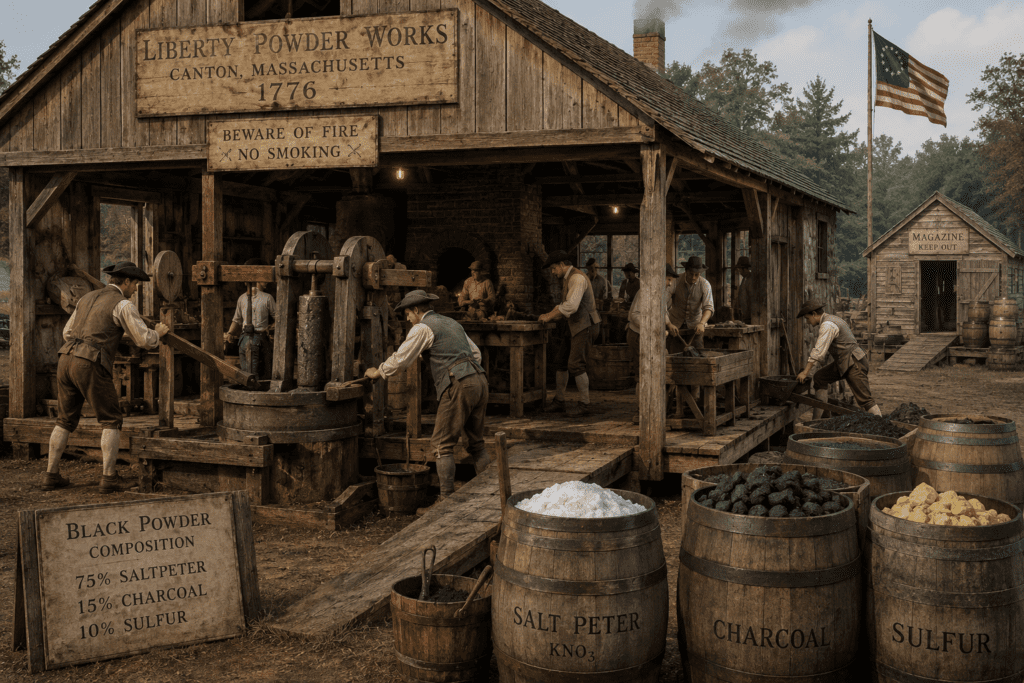
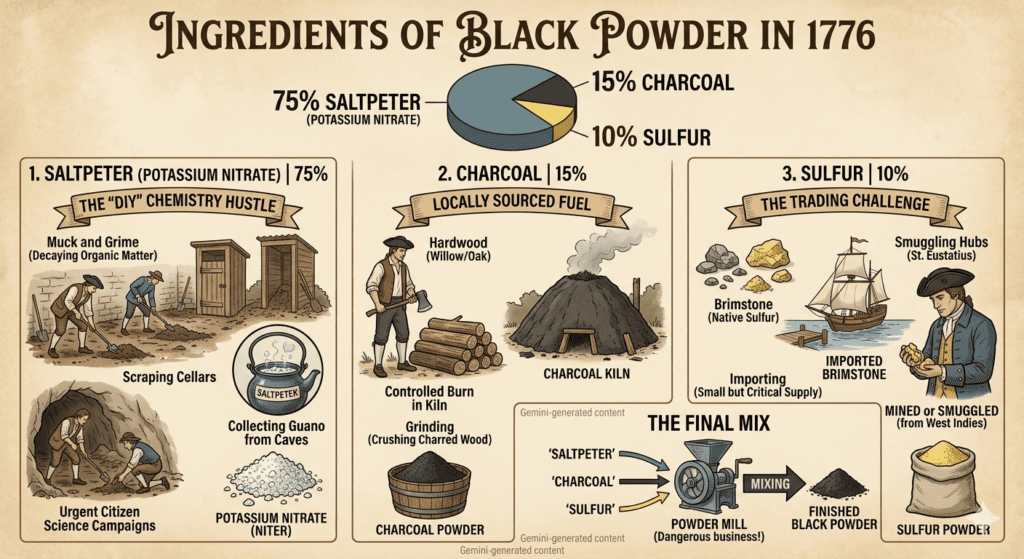
How Black Powder Was Made
Black powder was made from three main ingredients:
75 percent saltpeter, or potassium nitrate
15 percent charcoal
10 percent sulfur
The charcoal and sulfur served as fuel. Saltpeter supplied oxygen, allowing the mixture to burn rapidly and create expanding gas. That gas propelled a lead ball from a musket or a cannonball from artillery.
The challenge was not understanding the recipe.
The challenge was producing enough of it.
Charcoal could be made from wood. Sulfur could often be imported. Saltpeter was the hardest ingredient to obtain in large quantities.
The colonies lacked major natural saltpeter deposits, so they had to produce nitrates from decomposing organic material. This meant gathering dirt and waste from places where nitrogen-rich material had accumulated over time.
That included stables, barn floors, tobacco warehouses, cellars, privies, slaughterhouse sweepings, and areas affected by urine and animal droppings.
The process was dirty, slow, and essential.
Saltpeter: The Gross Chemistry That Helped Save the Revolution
The production of saltpeter required collecting organic refuse, mixing it with materials such as old mortar, ashes, and limestone, keeping it moist, leaching it with water, evaporating the liquid, and crystallizing the nitrate.
This was not glamorous work.
It smelled bad. It required patience. It took knowledge, labor, and persistence.
Congress and colonial governments urged people to gather the necessary materials. Tobacco colonies were especially important because tobacco warehouses and yards often contained soil rich in nitrates.
Revolutionary War Journal notes that tobacco warehouse owners were asked to erect saltpeter factories near rivers where the material could be processed more efficiently.
This is one of the least remembered parts of the Revolutionary War.
American independence depended partly on people digging, boiling, filtering, and crystallizing material from some of the dirtiest places in colonial life.
Women and Households Joined the Powder War
The gunpowder crisis was not solved only by generals and Congress.
Women helped sustain the war effort by collecting materials, managing households, supporting production, and circulating useful information. Printers, including women printers, helped distribute wartime instructions and public notices. Households became part of the production network.
This matters because the Revolutionary War was not simply fought by men in uniform. It was sustained by families, farms, workshops, kitchens, printing offices, and local communities.
Every pound of saltpeter mattered.
Every pound of powder could keep American soldiers in the field a little longer.
The Powder Mills: America’s Dangerous Industrial Beginning
Domestic gunpowder production required powder mills.
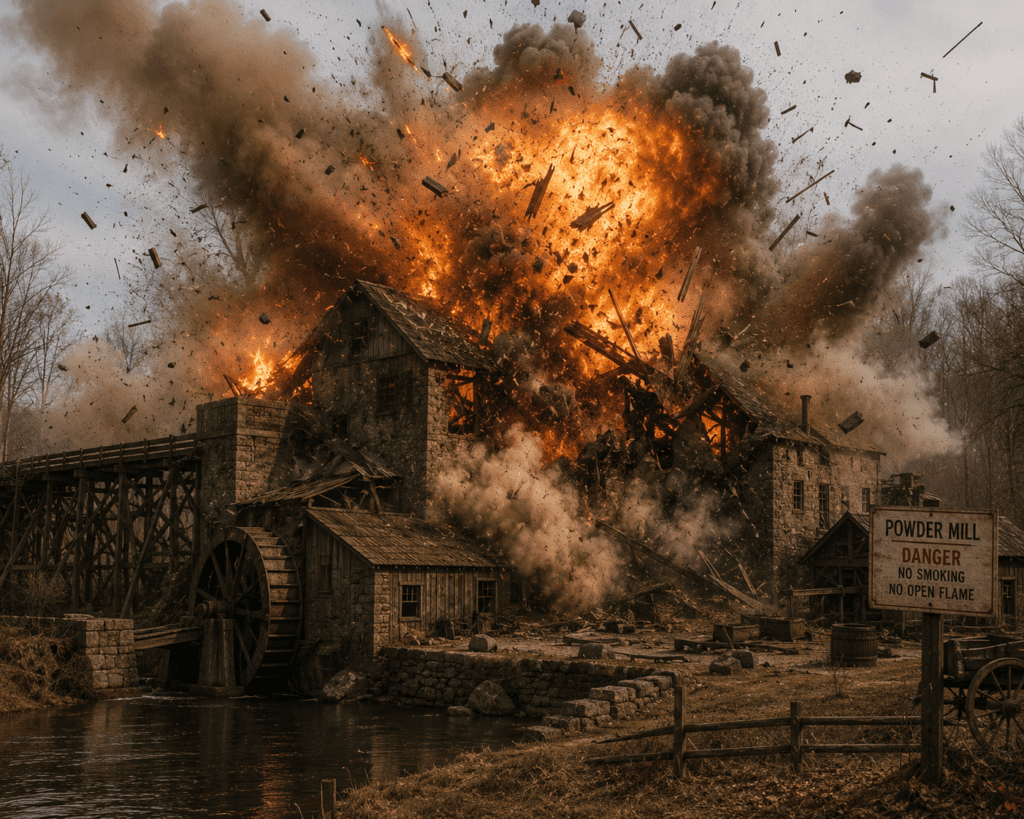
A typical powder mill included a dam, mill race, grinding machinery, graining mill, drying houses, powder magazine, saltpeter house, and a nearby residence for the powder master.
The work was usually powered by water or wind. Heavy rollers or wheels ground the ingredients. The powder was moistened to reduce sparks, pressed, corned, dried, sifted, and graded.
Powder mills were usually located away from dense settlements because explosions were common and devastating. Some were built with intentionally weak walls so that, if an explosion occurred, the blast could be directed away from workers or nearby structures.
The danger was constant.
A spark could kill everyone nearby.
Powder mill workers were not famous battlefield heroes, but they risked their lives for the American cause every day.
Frankford Mill and Paul Revere’s Industrial Espionage
One of the most important powder mills was the Frankford Powder Mill near Philadelphia, owned by Oswald Eve and his son. Revolutionary War Journal identifies Frankford as the largest of the early mills and notes that it became a model for later production.
Paul Revere, remembered mainly for his midnight ride, also played a role in powder production. Massachusetts sent him to Philadelphia to study the process. According to the traditional account, the mill owner would not fully reveal his methods, but Revere was allowed to inspect the operation.
As a skilled mechanic, Revere observed the machinery carefully and returned to New England able to help establish a powder mill in Massachusetts.
This was not battlefield espionage.
It was industrial espionage.
And it mattered.
The Revolution required mechanics as much as musketeers.
Domestic Production Helped, But It Was Not Enough
The colonies did increase domestic production, but the numbers show a hard truth: America could not manufacture enough powder by itself during the early war.
The American Historical Review article estimated that before Saratoga, the Americans had access to about 2,347,455 pounds of powder for Continental purposes. That total included powder already on hand, powder made from domestic saltpeter, powder made from imported saltpeter, and imported powder.
The same analysis concluded that well over 90 percent of the powder available during the first two and a half years of the war came from outside the country.
That is one of the most important facts in the story.
The American Revolution survived because the colonies imported, smuggled, captured, and manufactured powder all at once.
If they had relied only on internal sources, the war might have ended early.
The West Indies Became America’s Powder Pipeline
The West Indies were critical to the American powder supply.
Ships moved between American ports, French colonies, Dutch islands, and other Caribbean markets. The tiny Dutch island of St. Eustatius became especially important as a smuggling center. American merchants could trade tobacco, indigo, rice, and other goods for powder, muskets, lead, and military supplies.
British commanders understood the danger. Every barrel of powder that slipped through the blockade increased the odds that the rebellion would continue.
Revolutionary War Journal notes that large quantities of powder arrived from places such as Martinique in 1776, and that American ships also traveled to European ports such as Marseilles for powder, muskets, and lead.
The American war effort depended on ships that could outrun, deceive, or evade British warships.
This is why the gunpowder story belongs not only to the Continental Army, but also to merchants, sailors, smugglers, armed vessels, and privateers.
Washington’s Armed Vessels and the Birth of a Naval Supply War
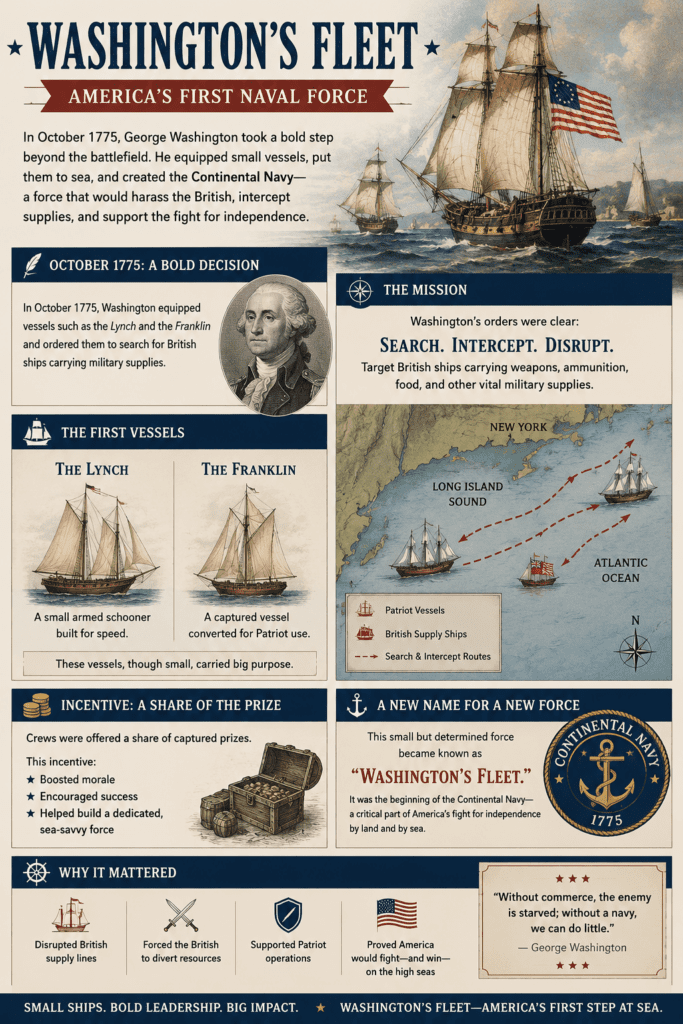
Before the United States had a fully developed navy, Washington ordered armed vessels to intercept British supply ships.
In October 1775, Washington equipped vessels such as the Lynch and the Franklin and ordered them to search for British ships carrying military supplies. Crews were offered a share of captured prizes. This small force became known as “Washington’s fleet.”
This early naval activity shows that the American Revolution was a supply war from the beginning.
American ships were not merely trying to win naval glory. They were trying to capture powder, lead, arms, and equipment that could keep the rebellion alive.
Every captured barrel mattered.
Bermuda: The Raid That Helped Save the Revolution
One of the most dramatic powder stories involved Bermuda.
As the Second Continental Congress met, Benjamin Franklin communicated with Henry Tucker, a prominent Bermudian with American connections. Tucker knew that Bermuda had a valuable gunpowder magazine near St. George’s. The powder had accumulated over time because Bermuda required visiting ships to contribute money or gunpowder.
On the night of August 14, 1775, conspirators gathered at the Bermuda powder magazine while Governor George James Bruere slept nearby. The powder was taken, and no one was convicted. Many Bermudians were quietly sympathetic because trade with the American colonies mattered to their survival.
Smithsonian Magazine reports that enough of the Bermuda powder eventually reached Washington’s men at Boston. That supply helped carry the American forces through the end of the Boston campaign and even into June 1776, when powder was used in the defense of Charleston against British invasion.
That detail is powerful.
Powder stolen from Bermuda helped Washington near Boston and later helped defend South Carolina.
The Revolution was connected by barrels.
South Carolina and the Southern Colonies
The southern colonies were also part of the powder story.
South Carolina, Virginia, Georgia, and North Carolina all faced the same problem: they needed powder to resist British rule, defend ports, arm militia, and support the broader American cause.
Charleston was especially important. It was a major southern port and a vital link in the American supply network. If the British had taken Charleston early and cut off southern access, the rebellion could have been severely weakened.
The defense of Charleston in 1776 showed how powder shortages and powder success could affect the entire war. Gunpowder secured from Bermuda and other sources helped American forces resist British attack.
This connects the powder crisis directly to the survival of the southern colonies during the early war.
France Before the French Alliance
France did not openly join the Revolutionary War until after Saratoga, but French assistance began earlier through unofficial and covert channels.
The French government wanted to weaken Great Britain, but open war was politically and diplomatically risky. So French aid moved through intermediaries, merchants, front companies, and colonial ports.
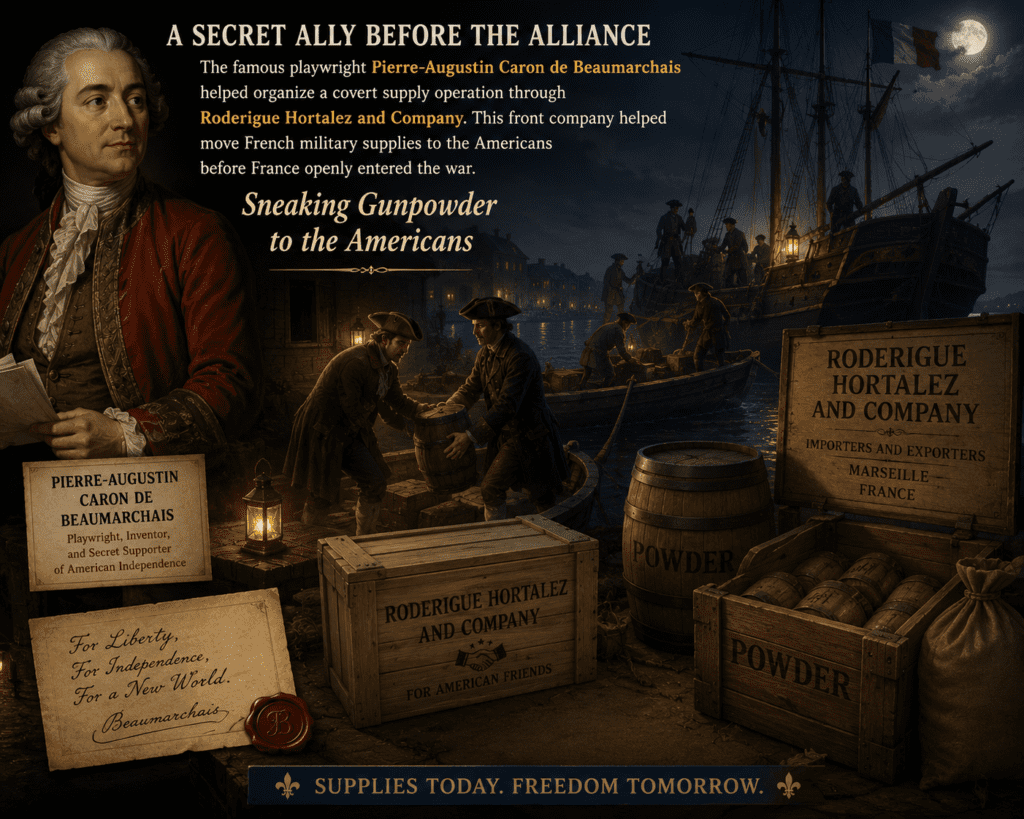
The famous playwright Pierre-Augustin Caron de Beaumarchais helped organize a covert supply operation through Roderigue Hortalez and Company. This front company helped move French military supplies to the Americans before France openly entered the war.
This was one reason the American forces had enough powder and equipment to keep fighting long enough to win at Saratoga.
Saratoga then convinced France to formally enter the war.
The powder came first.
The alliance followed.
Saratoga: Powder Before Diplomacy
The Battles of Saratoga in 1777 are often described as the turning point of the American Revolution. That is true, but Saratoga was possible only because American forces had enough ammunition to fight.
The American victory convinced France that the rebellion had a real chance of success. Without that victory, French recognition and open military support might have been delayed or denied.
But without imported and smuggled powder, Saratoga might not have happened.
The gunpowder supply chain helped produce the victory that helped produce the French alliance.
That is why powder was not just a battlefield supply.
It was a diplomatic weapon.
British Commanders’ Worst Fears
British commanders feared that the colonies would transform from angry provinces into a sustained military resistance.
Gunpowder made that possible.
The British Army could defeat mobs. It could disperse poorly supplied militia. It could occupy cities. But defeating a continental rebellion became much harder when American forces could fire, retreat, resupply, and fight again.
British commanders understood something extremely important: angry colonists could become a true military threat if they gained enough gunpowder to keep fighting.
African Americans and the Powder War
The gunpowder story also connects to African Americans in the Revolutionary War.
African Americans served in various roles during the conflict, including as soldiers, sailors, laborers, teamsters, fortification workers, and support personnel. Some fought for the American cause, while others joined British forces after British proclamations offered freedom to enslaved people who escaped rebel owners.
The powder supply affected all of them.
Continental soldiers, militia units, armed vessels, and fort defenses all required powder. African American soldiers and sailors who served in American forces depended on the same fragile supply chain as everyone else.
The Revolutionary War was not experienced the same way by all people. Some fought for liberty while others remained enslaved. That tension should not be ignored. But in military terms, the powder crisis touched every part of the war, including the service of Black Americans on land and at sea.
Lead Ball, Muskets, and the Full Ammunition Problem
Gunpowder alone was not enough.
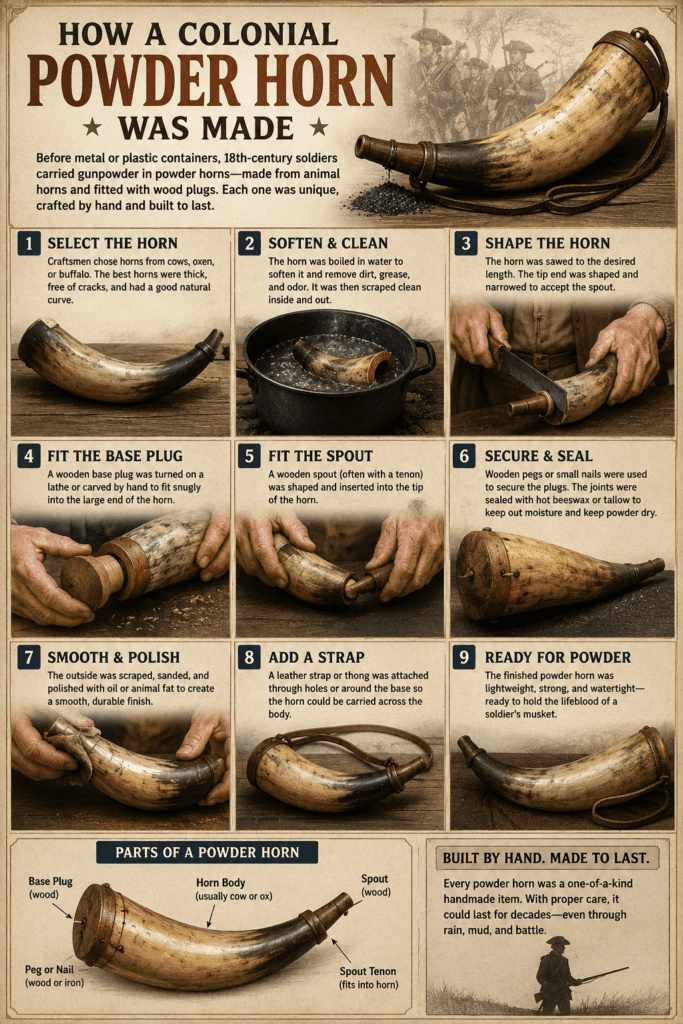
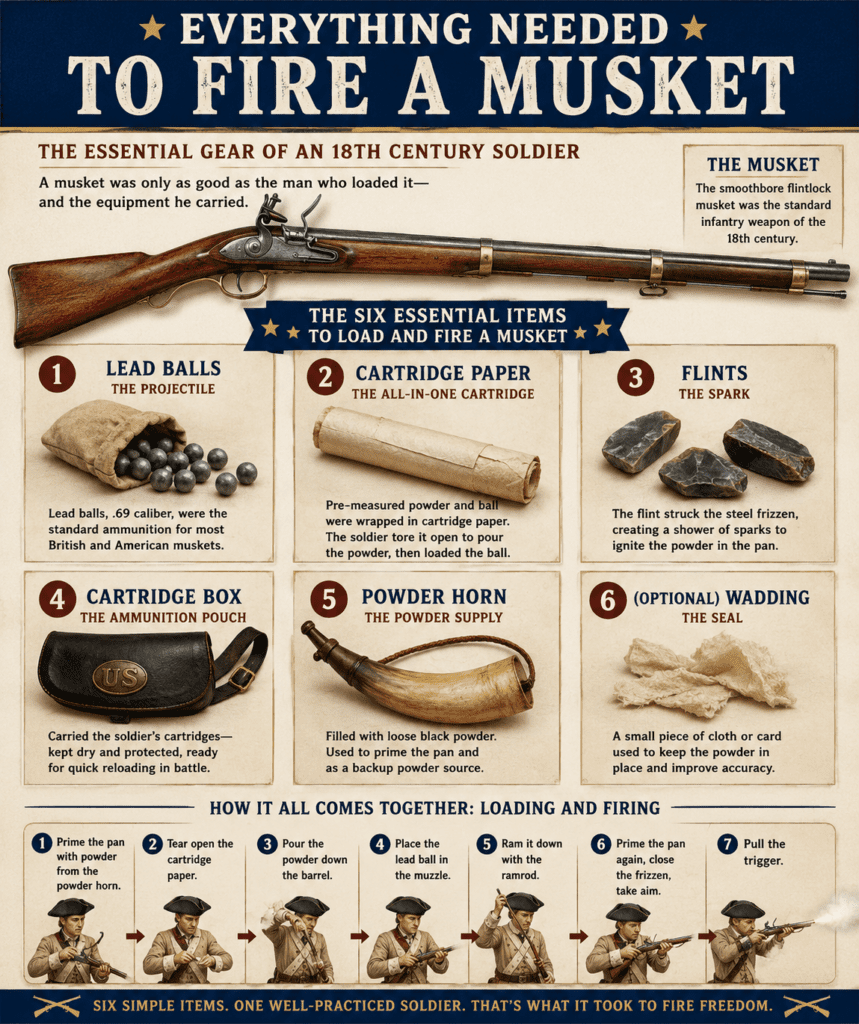
American soldiers also needed lead balls, cartridge paper, flints, cartridge boxes, muskets, artillery, wagons, barrels, and powder horns. A musket cartridge typically required powder and a lead ball wrapped in paper. Cannon required powder charges and projectiles.
The same ships that brought powder often brought lead and muskets. Revolutionary War Journal notes that ships sent to Marseilles brought powder as well as muskets and lead.
This matters because the gunpowder crisis was part of a larger ammunition crisis.
A soldier needed a complete firing system.
Powder made the system work.
Why Powder Was So Hard to Move
Gunpowder was dangerous cargo.
It had to be kept dry. It had to be protected from sparks. It had to be stored in barrels and magazines. It had to be hidden from British raids. It had to move through bad roads, rough seas, and enemy patrols.
Rain could ruin powder. Poor tents and bad storage could damage supplies. Washington complained that weather and waste contributed to shortages.
This made powder not just a production challenge, but a transportation challenge.
Getting powder from a West Indies port to an American harbor was only the first step. It then had to reach the army, militia, fort, or ship that needed it.
The Revolution depended on logistics.
The story of Revolutionary War gunpowder includes famous names like George Washington, Benjamin Franklin, John Adams, Paul Revere, and French military officials. But the American cause also depended on thousands of ordinary people whose names were rarely recorded in history books.
These people rarely appear in paintings of the Revolutionary War, but they helped make independence possible. The Revolution was won by soldiers — but it was sustained by supply workers, chemists, laborers, sailors, and ordinary citizens across the American colonies.
These people may not appear in most paintings of the Revolution, but they helped make independence possible.
The Revolution was won by soldiers, but it was sustained by supply workers.
Gunpowder Was the Hidden Weapon of Independence
The phrase “gunpowder won the Revolutionary War” may sound exaggerated, but the evidence supports the central idea.
Without powder, muskets could not fire.
Without muskets, the militia could not resist.
Without artillery powder, forts and armies could not defend themselves.
Without naval powder, armed vessels and privateers could not fight or capture supplies.
Without imported powder, the early war might have collapsed.
Without enough powder at Saratoga, France might not have entered the war openly.
Gunpowder connected the entire Revolution.
It linked New Hampshire to Boston, Bermuda to Charleston, Philadelphia to Massachusetts, the West Indies to American ports, and French supply networks to the battlefield.
The Declaration of Independence announced the cause.
Gunpowder helped make the cause survive.
Conclusion: Independence Required More Than Courage
The American Revolution was a political revolution, but it was also a logistical miracle.
The colonies began the war under British rule with little powder, limited manufacturing, few functioning mills, and no guarantee of foreign support. They faced the British Army, British soldiers, British warships, royal governors, and a powerful British government determined to crush the rebellion.
Yet the Americans found a way.
They seized powder from magazines. They smuggled powder through the West Indies. They raided Bermuda. They built powder mills. They manufactured saltpeter from potassium nitrate sources hidden in dirt, stables, cellars, tobacco warehouses, and animal waste. They sent armed vessels after British supply ships. They accepted secret help from Europe. They turned desperation into a supply system.
Gunpowder did not write the Declaration of Independence.
Gunpowder did not command the Continental Army.
Gunpowder did not create the American cause.
But without gunpowder, the American Revolution may have ended before the United States had a chance to be born.
That is why gunpowder was one of the most important weapons of 1776.
And in a very real sense, gunpowder helped win the Revolutionary War.
The men and women of 1776 lived in a world where preparation mattered. They built businesses, protected property, planned for uncertainty, and relied on practical skills to survive difficult times.
At RetireCoast, our memberships focus on many of those same principles today — helping individuals and families prepare financially, protect assets, build businesses, and make informed decisions for the future.
From business formation and worker compliance tools to estate planning resources and financial decision systems, RetireCoast memberships are designed to help modern Americans prepare for the future with the same spirit of independence and practical thinking that shaped the early republic.
The story of gun ownership in 1776 is only one part of the struggle for independence. Explore our growing collection of detailed historical articles covering the weapons, leaders, battles, ships, and untold stories that shaped the birth of the United States.
Our in-depth article on Revolutionary War weapons explores the muskets, rifles, pistols, cannons, bayonets, naval weapons, and battlefield technology used by both American and British forces during the fight for independence.
From Colonial Scarcity to Modern Chemistry: Where Gunpowder Ingredients Come From Today
The Revolutionary War forced the American colonies to confront a brutal reality: independence required chemistry as much as courage. Colonists scraped nitrate-rich dirt from stables, caves, tobacco warehouses, and areas filled with animal droppings because they desperately needed potassium nitrate, the critical ingredient in black powder.
Today, the process could not be more different.
The world no longer depends on “petermen” mining caves for nitrates or citizens boiling filthy soil in makeshift backyard operations. The production of potassium nitrate has shifted almost entirely from biological decomposition to modern industrial chemistry.
The same chemical that once helped sustain the Continental Army is now manufactured on a massive global scale using advanced industrial methods.
The Modern Chemical Process
During the American Revolution, producing saltpeter could take months. Colonists relied on microbes slowly breaking down organic waste into nitrates that could eventually be extracted and purified.
Modern chemistry eliminated that waiting period.
Today, potassium nitrate is typically synthesized through industrial chemical reactions that can produce highly purified material quickly and efficiently. In agriculture, potassium nitrate is often referred to as nitrate of potash, or NOP.
The most common manufacturing process uses a chemical exchange reaction involving:
- Potassium chloride
- Nitric acid
- Sodium nitrate
- Ammonium nitrate
When these materials react, the chemical ions swap positions, producing potassium nitrate along with industrial byproducts such as sodium chloride or ammonium chloride.
Unlike colonial production, modern factories can create enormous quantities of highly controlled, consistent material suitable for agriculture, energy production, food preservation, and industrial applications.
The chemistry that once depended on rotting organic matter is now part of a sophisticated global industrial system.
The World’s Modern Production Centers
In 1776, the American colonies relied heavily on smuggling powder from Europe and the Caribbean.
Today, potassium nitrate production is a global multi-billion-dollar industry dominated by major chemical and agricultural corporations.
The Asia-Pacific region, especially China, now leads much of the world’s production and consumption.
Major global producers include:
- Haifa Negev Technologies (Israel)
- SQM S.A. (Chile)
- Yara International (Norway)
- Uralchem Group (Russia)
These companies operate on a scale unimaginable to the colonial powder mills of the Revolutionary War.
What once required dangerous manual labor in isolated mills can now be produced continuously in massive industrial facilities serving global markets.
Are Natural Deposits Still Used?
Yes, but far less than in the past.
Potassium nitrate still occurs naturally in mineral deposits known as nitrocalite, especially in extremely dry desert regions of South America, particularly Chile.
However, naturally occurring deposits often contain impurities such as sodium and calcium compounds. Modern industries usually require highly refined and predictable formulas, making synthetic production far more reliable and economical.
As a result, industrial chemistry replaced nature as the primary source.
This represents one of the most remarkable technological shifts since the Revolutionary War. Colonists once struggled to extract enough usable nitrates from caves and manure piles to keep muskets firing. Modern industry can manufacture vast quantities with precision measured at the molecular level.
What Potassium Nitrate Is Used For Today
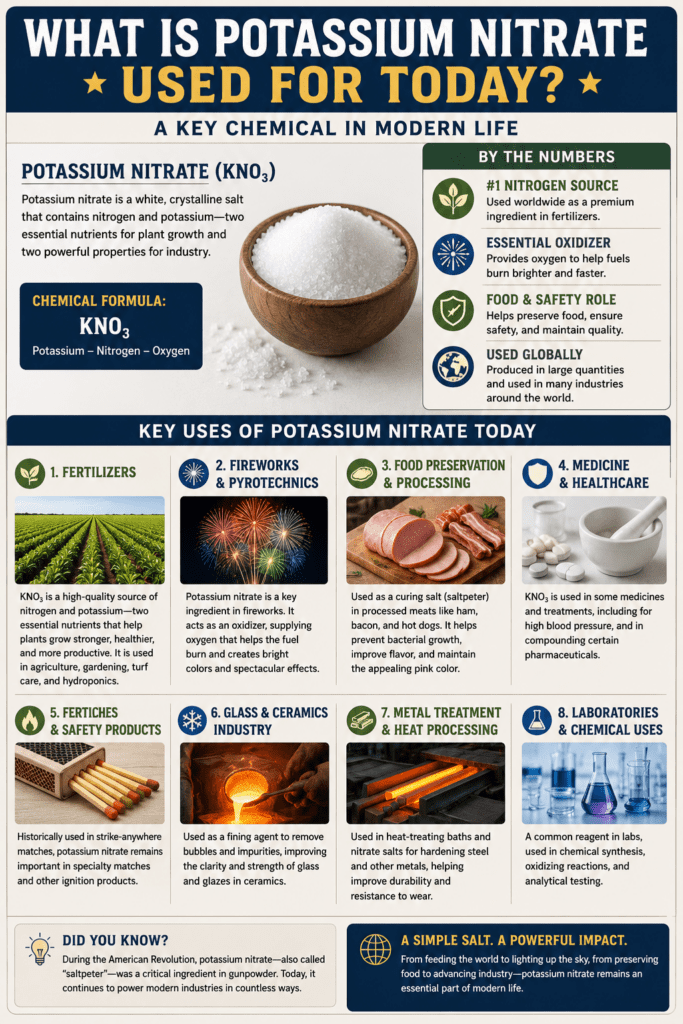
In 1776, potassium nitrate was tied directly to survival in wartime.
Today, most of it has peaceful civilian uses.
Agriculture
Agriculture is now the largest consumer of potassium nitrate worldwide.
Modern fertilizers use potassium nitrate because it provides crops with two critical nutrients:
- Potassium
- Nitrogen
Unlike some other fertilizers, potassium nitrate does not introduce large amounts of chloride into the soil, making it valuable for sensitive crops and advanced irrigation systems.
The chemical once used to fire Revolutionary War muskets is now more likely helping grow tomatoes, strawberries, lettuce, and other food crops around the world.
Solar Energy Storage
One of the most fascinating modern uses involves renewable energy.
Some concentrated solar power plants use molten mixtures of potassium nitrate and sodium nitrate to store thermal energy. These systems allow solar plants to continue generating electricity even after sunset.
In a remarkable twist of history, a chemical once associated with war is now helping support clean energy infrastructure.

Toothpaste for Sensitive Teeth
Potassium nitrate is also used in specialty toothpaste.
It helps reduce tooth sensitivity by calming nerve responses inside teeth. Millions of people use products containing potassium nitrate without ever realizing the same chemical once played a critical role in the American Revolution.
The ingredient that once helped fire muskets at British troops now helps people eat ice cream without pain.
Food Preservation
Potassium nitrate still plays a role in food preservation and curing processes.
It helps preserve color and quality in some processed meats and cheeses, continuing a preservation practice that dates back centuries.
Fireworks and Modern Propellants
Potassium nitrate still appears in fireworks, pyrotechnics, and certain propellant systems, preserving at least part of its historical connection to combustion and explosive energy.
But compared to 1776, these uses represent only a small portion of modern demand.
From Revolution to Everyday Life
The transformation is extraordinary.
During the Revolutionary War:
- Colonists scraped cellar dirt for nitrates
- Powder mills exploded with deadly force
- Smugglers risked capture by British warships
- The Continental Army feared running out of ammunition
- Gunpowder shortages threatened the survival of the Revolution itself
Today, the same chemical foundations support agriculture, renewable energy, food systems, and consumer products.
The substance that once helped sustain the fight for American independence is now mostly associated with fertilizers, industrial chemistry, and toothpaste.
Yet the historical importance remains impossible to ignore.
Without potassium nitrate, there would have been no black powder.
Without black powder, the Continental Army could not have fought effectively.
And without gunpowder, the American Revolution may never have succeeded.
The chemistry that once shook battlefields now quietly supports modern life across the world.
Is this addition helpful
This series about the Hessians in the American Revolution is just one part of the much larger RetireCoast 250th Anniversary historical project celebrating the birth of the United States.
We invite you to continue exploring our growing collection of Revolutionary War articles covering battles, weapons, ships, camp followers, frontier life, hidden history, and the people who shaped the American story.
PODCAST
Discover more from RetireCoast.com
Subscribe to get the latest posts sent to your email.