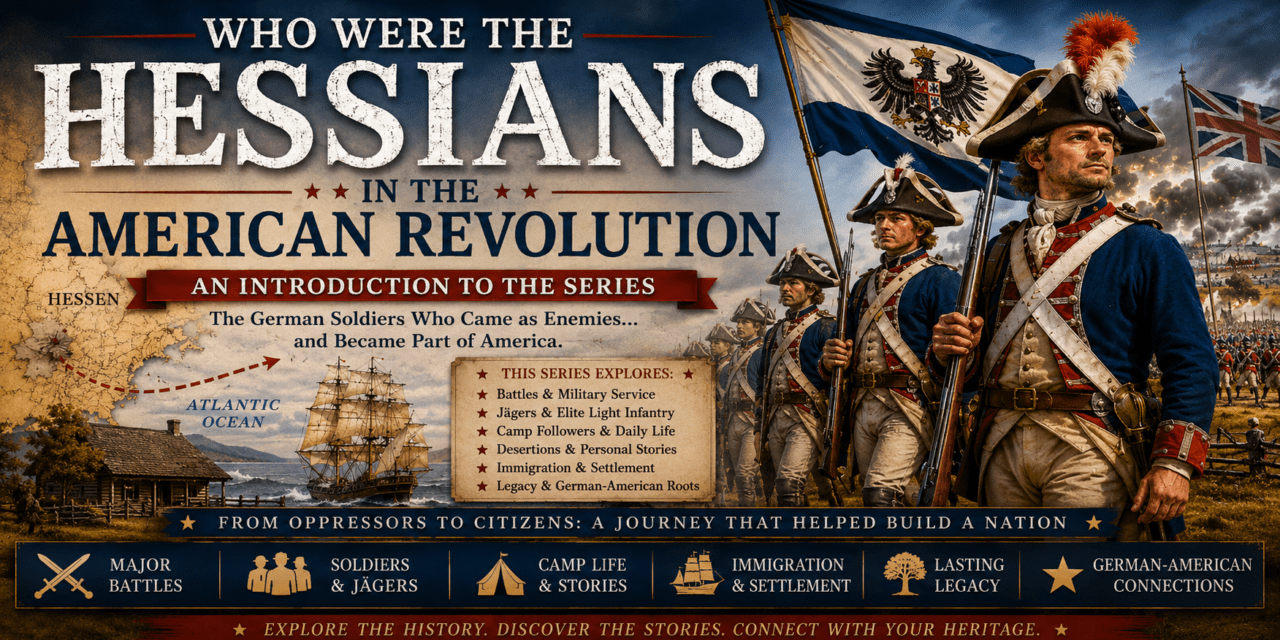

In this audio introduction, the author explains why the story of the Hessians in the American Revolution is far more complex than many Americans realize. He discusses the German states that supplied troops to Britain, the political world of 1776 Europe, and how thousands of German soldiers eventually became connected to the early history of the United States.
This introduction also explains how the Hessian series fits into the broader RetireCoast America’s 250th Anniversary project, exploring overlooked people, armies, and events that helped shape the Revolutionary War era.
This is the first article in the RetireCoast Hessians in the American Revolution series. To truly understand the Hessians and the German soldiers who fought in the American Revolutionary War, it is important to first understand the world they came from.
- Video Presentation: Who Were the Hessians in the American Revolution?
- Hessians in the American Revolution Began in a Divided German World
- Who Were the Hessians in the American Revolution, Really?
- Why Hessians in the American Revolution Appeared Mysterious to the Colonists
- King George III and the German Connection to the Hessians in the American Revolution
- Quiz
- The Hessians in the American Revolution Arrive in North America
- There is more to the story
- FAQ
- References
Video Presentation: Who Were the Hessians in the American Revolution?
The Hessians became some of the most feared and misunderstood soldiers of the American Revolutionary War. Hired by Great Britain from German states such as Hesse-Kassel, these professional troops crossed the Atlantic in 1776 and quickly became central figures in some of the war’s most important campaigns.
This video explores who the Hessians really were, how the German military system worked, why King George III relied upon foreign troops, and how the Hessians became connected to the Declaration of Independence itself. The presentation also examines the arrival of Hessian forces in New York, their role in the British war effort, and why many eventually chose to remain in America after the war ended.
Watch the complete video below as part of the RetireCoast America’s 250th Anniversary series exploring the overlooked people, armies, and events that shaped the Revolutionary War.
Hessians in the American Revolution Began in a Divided German World
In 1776, Germany did not yet exist as a unified nation.
The German Empire would not officially form until 1871 under Prussian leadership. During the Revolutionary War period, central Europe was instead a patchwork of feudal territories, military states, church-controlled lands, and independent cities that had evolved over centuries from the ancient Holy Roman Empire.
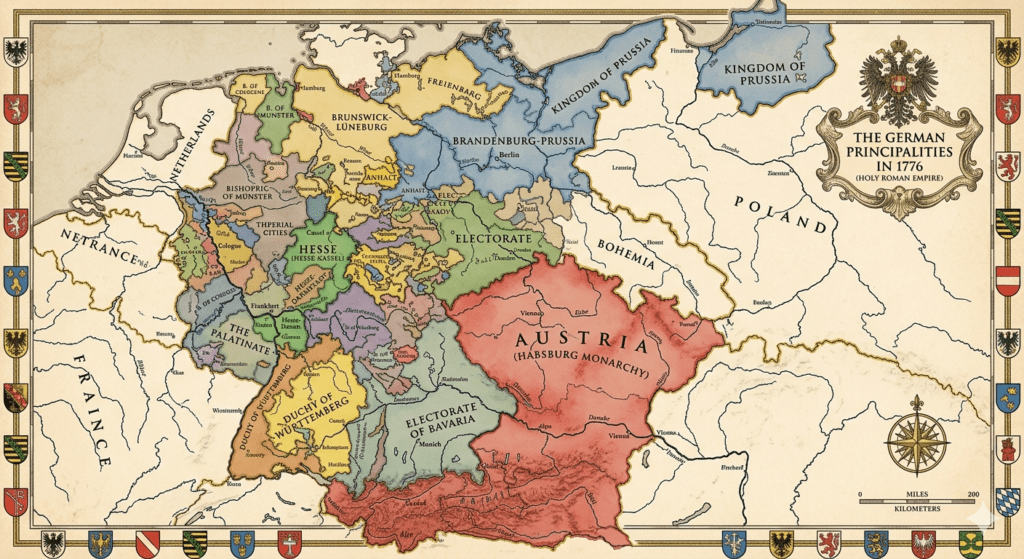
The Holy Roman Empire and the German States of 1776
The Holy Roman Empire itself was not a unified country in the modern sense. It was a sprawling political system made up of hundreds of individual territories that often operated almost independently while still recognizing the authority of the Holy Roman Emperor.
Some of these German states were large and militarily powerful. Others were tiny principalities ruled by noble families whose survival depended upon careful alliances, diplomacy, and military service.
Among the most important secular principalities were kingdoms and electorates such as Prussia, Bavaria, Saxony, Hanover, and Austria. The Austrian Habsburg monarchy traditionally held the title of Holy Roman Emperor and exercised enormous influence across central Europe.
Prussia Was Growing in Influence During the Hessians in the American Revolution
Prussia, meanwhile, was rapidly developing into one of the most disciplined and militarized states in Europe. Its army became famous for strict training, rigid discipline, and battlefield effectiveness, traits that would later influence military systems across the continent.
Alongside these larger powers existed smaller German principalities such as Hesse-Kassel and Brunswick. These are especially important to the story of the Hessians in the American Revolution because they supplied many of the German troops hired by Great Britain.
Smaller German Principalities Supplied Troops to Britain
The rulers of these states maintained professional standing armies that were often larger than their small populations would normally require. Maintaining such armies was expensive, but it also provided an opportunity.
European rulers frequently rented or leased troops to allied nations as part of diplomatic agreements and military alliances. In many ways, these auxiliary troops functioned as a valuable export industry for smaller German rulers.
The German-Speaking World of 1776 Was a Collection of Small Principalities
The German world of 1776 also included ecclesiastical territories ruled directly by powerful church officials. Prince-bishops controlled lands such as Mainz, Cologne, Trier, and Salzburg.
These church rulers governed their territories much like secular princes while simultaneously holding religious authority. The blending of political and religious power reflected the medieval origins of the Holy Roman Empire and created a political structure that often seemed confusing even to Europeans of the time.
Scattered throughout the empire were also Free Imperial Cities such as Hamburg, Frankfurt, Bremen, and Nuremberg. These self-governing city republics answered directly to the Emperor and operated as wealthy commercial centers.
Merchants, bankers, craftsmen, and traders moved goods through these cities across Europe and beyond. They were economically sophisticated places connected to global trade networks stretching from the Baltic Sea to the Atlantic Ocean.
Who Were the Hessians in the American Revolution, Really?
We know where the Hessians came from, who sent them to the Colonies, and why they fought in America — but who were they as individuals?
Far from the ruthless, cold-blooded mercenaries often depicted in Revolutionary War folklore, most Hessians in the American Revolution were farmers, artisans, laborers, and village tradesmen from small German states.
Many were not volunteers in the modern sense. They were ordinary citizens caught inside a rigid military system operated by rulers who effectively traded military manpower for state revenue and political alliances.
For many Hessian soldiers, the voyage to America was not a quest for wealth or plunder. It was a forced deployment across the Atlantic Ocean into a distant and unfamiliar war.
Ironically, thousands of these German soldiers later discovered that parts of America felt strangely familiar. The farmland, forests, and expanding rural communities resembled portions of central Europe.
Some Hessians deserted during the war. Others remained after the fighting ended, eventually blending into the very nation they had originally been sent to fight against.
The Canton System Controlled Hessians in the American Revolution
The military structure used by Hesse-Cassel functioned very much like a draft, but with a far longer and more intense commitment than most modern military systems.
Hesse-Cassel was one of the most heavily militarized societies in Europe during the eighteenth century. The state operated under a strict universal registration system designed to keep the army permanently prepared for war.
Instead of a temporary wartime obligation lasting only a few years, the Hessian military structure was built around lifelong readiness and state control.

Every Male Child Was Registered for Military Service
The Hessian conscription model operated through a territorial structure known as the canton system.
Every male child was officially registered for possible military service at approximately seven years old. From the ages of sixteen to thirty, eligible men were required to appear before local military authorities for periodic review and selection.
If a man’s name was chosen, military service became part of his life indefinitely.
Unlike a modern enlistment contract with a clearly defined end date, most Hessian soldiers served until they became physically unable to continue, were severely injured, or were considered too old for military duty.
Hessian Soldiers Lived Between Civilian and Military Life
Despite its harsh reputation, the Hessian system did not always function like a full-time standing army during peacetime.
After completing an exhausting initial training period that could last nearly a year, many soldiers were allowed to return home temporarily during harvest seasons or winter months.
These men resumed work on family farms, practiced trades, or supported local businesses while remaining legally tied to the military system.
During certain periods each year, however, they were required to report back for drilling, inspections, and military exercises. This hybrid structure allowed Hesse-Cassel to maintain a massive trained reserve force without completely destroying the local economy.
Who Was Most Likely to Become a Hessian Soldier?
The Hessian military system did not affect every citizen equally.
Men considered economically essential were often protected from frontline military service. This included eldest sons expected to inherit productive farms, highly skilled craftsmen, important landholders, and certain specialized tradesmen.
Others faced a much greater risk of military conscription.
Younger sons without inheritance rights, laborers, apprentices, unemployed men, and individuals viewed by authorities as idle or troublesome were often pushed directly into regular military ranks.
During the American Revolution, Great Britain paid enormous sums of money to the German princes who supplied troops for military service in North America.
In total, Britain distributed more than £1.77 million sterling in subsidies and levy payments directly to the German rulers who provided soldiers, including the powerful state of Hesse-Kassel.
Modern US Dollar Equivalent
~$380 million to $430 million
For Landgrave Friedrich II of Hesse-Kassel, the financial impact was staggering. The payments from Britain equaled roughly 13 years of normal national tax revenue collected almost all at once.
The massive wartime income transformed Friedrich II into one of the wealthiest rulers in Europe and allowed him to reduce domestic taxes for many civilian citizens in Hesse-Kassel by approximately one-third.
Historical Impact: The financial system behind the Hessian troop agreements reveals that the American Revolution was not only a military struggle but also a major international business and political enterprise involving European monarchies, subsidies, military contracts, and state-controlled war economies.
Britain Suddenly Activated the Hessians for War in America
When Great Britain signed subsidy treaties with German rulers to obtain troops for the American Revolutionary War, thousands of these part-time soldier-farmers were suddenly recalled to active military service.
Men who had expected periodic military obligations inside Germany instead found themselves packed aboard crowded transport ships bound for North America.
Many would spend years fighting in a brutal overseas conflict far from home. Some would never return to Germany at all.
For the Hessians in the American Revolution, the war in America became far more than a temporary military assignment. It became a life-changing journey that permanently connected the German states to the birth of the United States.
Why Hessians in the American Revolution Appeared Mysterious to the Colonists
To Americans living in the colonies, however, the German states often appeared mysterious and intimidating. Most colonists had little understanding of the complicated political structure of central Europe.
What they did understand was that Great Britain had hired thousands of highly trained foreign soldiers to crush the American rebellion. Newspapers and patriot writers frequently described these men as “mercenaries,” a word designed to provoke fear and anger among the colonists.
But from the perspective of the German rulers, providing troops for foreign service was not unusual. European warfare during the eighteenth century depended heavily upon professional standing armies, alliances, and military contracts between states.
The British government needed soldiers quickly to suppress the growing rebellion in North America. The German princes needed money, political favor, and military prestige.
The arrangement benefited both sides, even if it shocked many Americans.
Hessian Soldiers Lived Under Strict Military Discipline
For the soldiers themselves, military service was often simply part of life. Many Hessian soldiers came from rural farming communities where opportunities were limited.
Military duty offered steady pay, food, clothing, structure, and sometimes social advancement. These men drilled constantly, marched in rigid formation, obeyed harsh discipline, and lived within military systems that demanded complete obedience to commanding officers.
Crossing the Atlantic Changed the Hessians Forever
When these German troops crossed the Atlantic Ocean to serve with the British Army, they entered a completely unfamiliar world. North America was vastly different from the crowded villages, fortified towns, and structured societies of central Europe.
The dense forests, rough roads, expanding frontier settlements, and independent attitudes of the American colonists must have seemed chaotic and strange to men raised in tightly controlled military states.
Yet despite the distance from home, the Hessians would soon become one of the most important parts of the British war effort during the American Revolution. Their arrival would influence battles, shape colonial propaganda, terrify civilians, and eventually alter the course of the war itself.
```html id="hznrqp"During the American Revolutionary War, King George III — through the British government — paid the ruler of Hesse-Kassel and other German states substantial sums of money for each soldier sent to fight in America.
Britain paid the Landgrave of Hesse-Kassel a one-time “levy money” payment of roughly £7 4s to £7 6s per Hessian soldier. In official treaty terms, this was approximately 30 bank crowns (écus de banque) for each infantry soldier provided to the British Army.
- Levy money: Approximately £7 4s. 4½d. paid for each soldier supplied.
- Purpose: Intended to cover recruiting, uniforms, weapons, and military equipment.
- Annual subsidies: Britain also paid enormous yearly subsidies to Hesse-Kassel and other German rulers for maintaining the troops.
- Scale: Britain eventually hired about 18,000 soldiers from Hesse-Kassel alone.
The arrangement generated extraordinary revenue for the Hessian ruler. Historians estimate the British payments equaled more than a decade of normal tax income for Hesse-Kassel.
Importantly, the individual Hessian soldiers did not personally receive this “head payment.” The money went directly to the prince and government of Hesse-Kassel. The soldiers themselves received ordinary military wages, food, uniforms, equipment, and supplies under British service.
Although Americans commonly described the Hessians as “mercenaries,” the system technically involved auxiliary troops supplied through formal military subsidy treaties between governments. This type of arrangement was relatively common in eighteenth-century Europe, where smaller states often leased their professional armies to larger powers.
To many American colonists, however, the idea that King George III had effectively paid foreign rulers for soldiers to fight in America became one of the most controversial and emotionally charged issues of the Revolutionary War.
King George III and the German Connection to the Hessians in the American Revolution
The relationship between Great Britain and the German states was also far closer than many Americans realized in 1776. One of the most important reasons Britain turned to German troops during the American Revolution was that the British monarchy itself had deep German roots.
King George III, who ruled Great Britain during the American Revolutionary War, belonged to the House of Hanover, a German royal dynasty originating from the Electorate of Hanover within the Holy Roman Empire.
Although George III was born in England and became the first Hanoverian monarch to speak English as his primary language from birth, the royal family still maintained strong political, cultural, and family ties to the German states.
The House of Hanover Connected Britain to the German States
The Hanoverian connection began earlier in the eighteenth century when the British crown passed to George I in 1714. Under British succession law, Protestant German relatives inherited the throne because many closer Catholic claimants were excluded.
As a result, Britain entered into a dynastic union with Hanover that lasted for more than a century.
King George III Was of German Descent
By the time of the American Revolution, King George III still possessed extensive family connections throughout the German territories. He spoke German, communicated regularly with German rulers, and viewed many of the German princes as political allies and relatives within the interconnected world of European royal families.
To George III and the British government, negotiating military agreements with German rulers such as the Landgrave of Hesse-Kassel or the Duke of Brunswick was therefore not unusual or culturally distant.
These were familiar courts operating within the same aristocratic and dynastic system that shaped much of European politics.
Why Britain Needed Hessians in the American Revolution
This close relationship also helps explain why Britain looked to the German states for military assistance instead of relying solely upon British troops.
The British Empire possessed a powerful navy capable of projecting power around the globe. Maintaining a massive standing army was another matter entirely.
Britain already faced military commitments across Europe, the Caribbean, Canada, the Mediterranean, Africa, and India. Suppressing the rebellion in North America required tens of thousands of additional soldiers.
The German states offered an immediate solution. Their rulers maintained disciplined professional armies that could be deployed quickly.
Agreements between Britain and the German princes provided a steady supply of trained troops who were already organized into military units with experienced officers, artillery, engineers, and support personnel.
The Declaration of Independence directly referenced the Hessians in the American Revolution, although it never used the word “Hessian.”
Thomas Jefferson was referring primarily to the German soldiers hired by Great Britain, especially the Hessians from states such as Hesse-Kassel and Brunswick.
To many American colonists, the arrival of thousands of foreign troops confirmed their fears about King George III and British military power. Patriot newspapers used the Hessians as symbols of tyranny, foreign oppression, and the dangers of standing armies controlled by distant rulers.
Ironically, many Hessian soldiers themselves likely knew little about the political arguments behind the Revolution. Most were ordinary men serving under military orders within the rigid systems of the German states.
The Declaration of Independence Condemned Hessians in the American Revolution
To many American colonists, however, the arrival of these German troops seemed deeply offensive. Patriot leaders used the presence of foreign soldiers as propaganda against the Crown, portraying George III as a king willing to unleash foreign armies against his own subjects.
Thomas Jefferson Accused the King of Hiring Foreign Mercenaries
Thomas Jefferson even referenced this issue in the Declaration of Independence, accusing the king of transporting “large armies of foreign mercenaries” to complete works of “death, desolation, and tyranny.”
This accusation became one of the most emotionally powerful political themes of the American rebellion. The idea that the British monarch had hired German soldiers to fight in the American colonies fueled patriot outrage and strengthened support for independence.
For many colonists, the Hessians symbolized everything they feared about distant monarchy, standing armies, and authoritarian government.
Ironically, many Hessian soldiers themselves probably understood little about the political causes behind the conflict. Most were professional soldiers following orders within a military system that demanded obedience to rulers and commanding officers.
Their presence nevertheless transformed the war and permanently linked the story of the German states to the birth of the United States.
Quiz
Test your knowledge about the Hessians, the German states of 1776, and the role these soldiers played during the American Revolutionary War.
The Hessians in the American Revolution Arrive in North America
On August 15, 1776, the first large contingents of Hessian soldiers arrived in North America as part of Great Britain’s effort to crush the American rebellion.
After crossing the Atlantic Ocean in crowded transport ships, the German troops dropped anchor off Sandy Hook, New Jersey, before disembarking on Staten Island to join the growing British campaign against New York City.
For many American colonists, the sight must have been terrifying. Thousands of disciplined foreign soldiers wearing unfamiliar uniforms, speaking a different language, and marching under the authority of King George III suddenly appeared near the heart of the rebellion.
Patriot newspapers quickly spread alarming reports about these German troops, often portraying them as ruthless mercenaries sent by the British government to intimidate the colonies into submission.
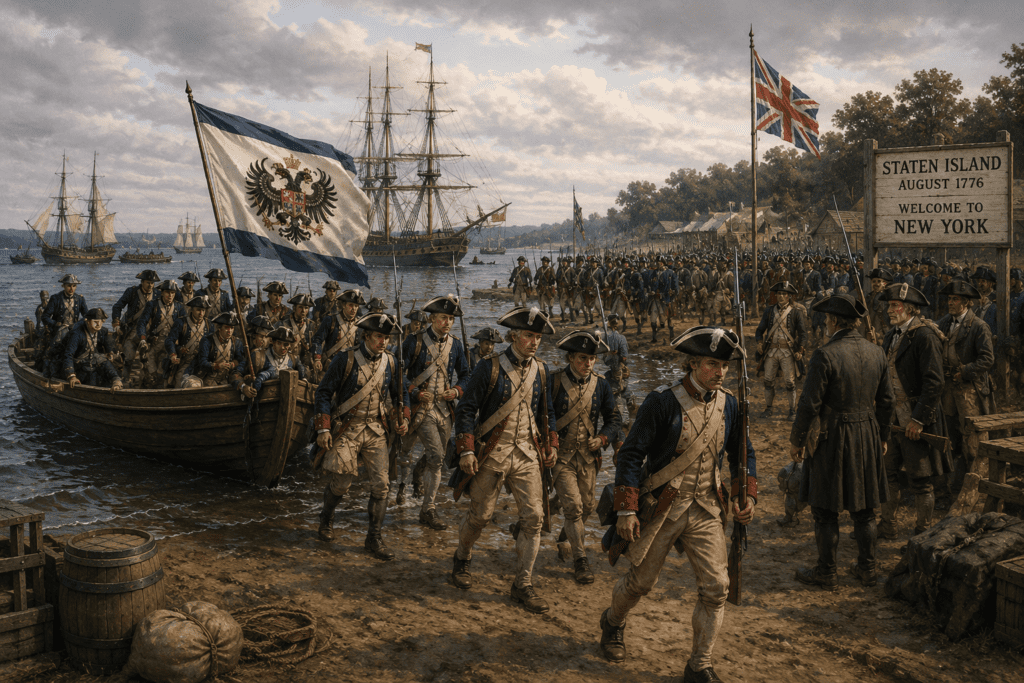
Staten Island Became a Massive British Staging Area
The arrival of the Hessians dramatically strengthened the British war effort at a critical moment. British commanders understood that control of New York City was essential because of its excellent harbor, access to the Hudson River, and strategic position connecting New England to the middle and southern colonies.
Staten Island became an enormous staging area for British forces gathering for what would become one of the largest military campaigns of the American Revolutionary War.
The Hessians who stepped onto Staten Island came from a world very different from the American colonies. The region we now call Germany did not yet exist as a unified country.
Instead, central Europe remained divided into numerous territories that had evolved from the ancient Holy Roman Empire over centuries.
Some of these were powerful secular principalities such as Prussia, Bavaria, Saxony, Hanover, and Austria. The Austrian Habsburg monarchy still held the title of Holy Roman Emperor, while Prussia had become famous throughout Europe for its military discipline and highly organized standing army.
Alongside these major powers were smaller but militarily important states such as Hesse-Kassel and Brunswick, the very territories supplying troops to the British Army during the Revolution.
There is more to the story
Our next articles continue this incredible story. Check below for a link to each of our articles.
FAQ
Who were the Hessians in the American Revolution?
The Hessians were German soldiers hired by Great Britain to fight against the American colonies during the Revolutionary War. Most came from small German states such as Hesse-Kassel and Brunswick within the Holy Roman Empire.
Why did Britain hire Hessian soldiers?
Britain needed large numbers of trained troops quickly to suppress the American rebellion. German states such as Hesse-Kassel maintained professional standing armies that could be supplied through military subsidy treaties.
Were the Hessians mercenaries?
Americans commonly called the Hessians mercenaries, especially in Patriot propaganda and the Declaration of Independence. Technically, however, they were auxiliary troops supplied by German rulers under formal military treaties rather than private soldiers fighting independently for money.
Did the Declaration of Independence mention the Hessians?
Yes. Thomas Jefferson referred to the Hessians when he accused King George III of transporting “large Armies of foreign Mercenaries” to the colonies. This became one of the most famous accusations in the Declaration of Independence.
How were Hessian soldiers recruited?
Many Hessian soldiers were part of a strict military registration system known as the canton system. Boys could be registered for military service at a young age, and adult men were subject to long-term military obligations controlled by the state.
Did Hessian soldiers want to fight in America?
Many Hessian soldiers likely had little interest in the political conflict between Britain and the American colonies. Most served because military duty was required within the systems of the German states.
How many Hessians fought in the American Revolution?
Approximately 30,000 German troops served with the British during the Revolutionary War. Around 18,000 came from Hesse-Kassel alone, making it the largest contributor of Hessian forces.
Did some Hessians stay in America after the Revolutionary War?
Yes. Thousands of Hessian soldiers either deserted during the war or remained in North America afterward. Many settled in farming communities and eventually became part of early American society.
What battle are the Hessians most famous for?
The Hessians are most famous for the Battle of Trenton in December 1776, when George Washington crossed the Delaware River and launched a surprise attack against the Hessian garrison stationed in New Jersey.
Why are the Hessians important to American history?
The Hessians became one of the most important military forces supporting Britain during the Revolutionary War. Their presence influenced colonial propaganda, major battles, immigration patterns, and the broader relationship between Europe and the emerging United States.
References
The RetireCoast Hessians in the American Revolution series draws from battlefield organizations, museum resources, genealogy collections, military archives, and historical research focused on German soldiers, prisoners, settlers, and families connected to the Revolutionary War.
- FamilySearch — Hessian Soldiers
- Franklin & Marshall College Archives — Johannes Schwalm Historical Association Collection
- FamilySearch Catalog — Journal of the Johannes Schwalm Historical Association
- Journal of the American Revolution — The Hessians: Journal of the Johannes Schwalm Historical Association
The arrival of the Hessians in America shocked the colonies and strengthened the British military campaign in 1776. But the most famous moment involving the Hessians was still ahead.
In the next article, we examine the dramatic events surrounding George Washington’s crossing of the Delaware River and the surprise attack on the Hessian garrison at Trenton — a battle that became one of the most important turning points of the American Revolution.
The complete list of articles in the Hessians in the American Revolution series is listed below for readers who want to explore the full story of the German soldiers who fought during the Revolutionary War.
You can also visit the larger RetireCoast America’s 250th Anniversary Series Hub featuring Revolutionary War history, weapons of 1776, camp followers, Bernardo de Gálvez, prison ships, the first American navy, and many other fascinating historical articles.
This series about the Hessians in the American Revolution is just one part of the much larger RetireCoast 250th Anniversary historical project celebrating the birth of the United States.
We invite you to continue exploring our growing collection of Revolutionary War articles covering battles, weapons, ships, camp followers, frontier life, hidden history, and the people who shaped the American story.
Discover more from RetireCoast.com
Subscribe to get the latest posts sent to your email.