Last updated on June 7th, 2026 at 11:25 pm
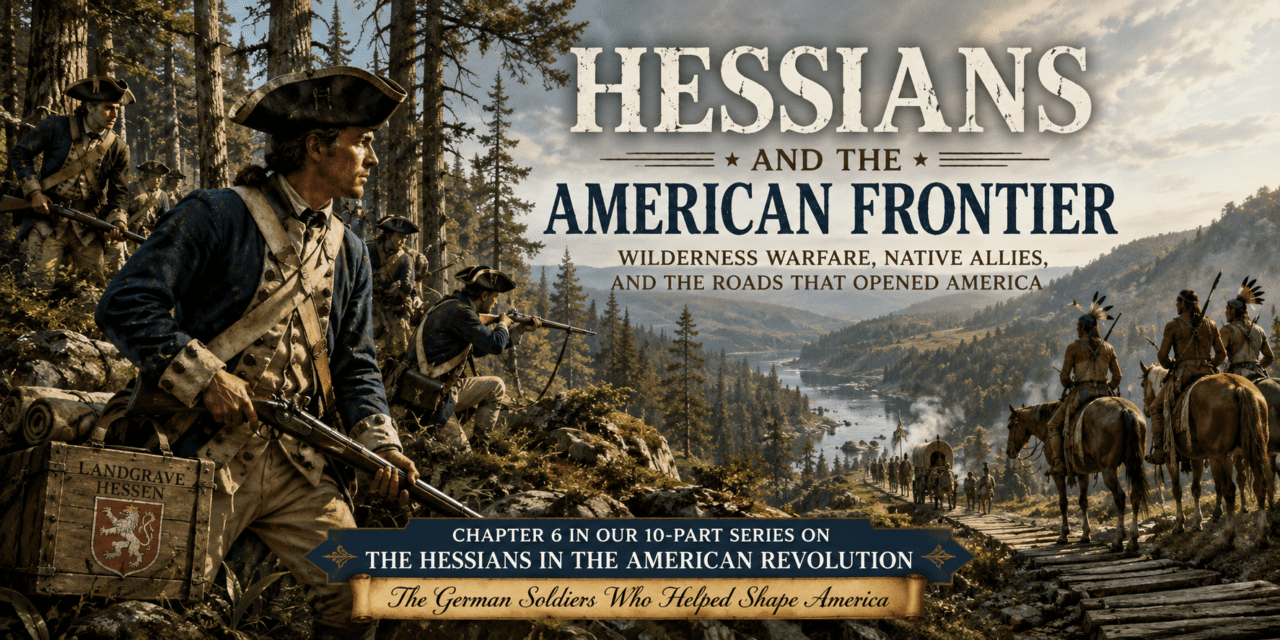
This article is Chapter 6 in our 10-part series on the Hessians in the American Revolution: the German soldiers who helped shape America. While many people picture the war being fought around major cities and famous battlefields, thousands of Hessian soldiers also experienced the dangerous and unpredictable American frontier.
Dense forests, isolated forts, and brutal wilderness conditions created a style of warfare unlike anything most European soldiers had ever known.
The story of the Hessians and the American frontier includes encounters with Native American allies of the British, frontier raids, survival in harsh wilderness conditions, and the growing importance of elite Hessian Jägers trained for woodland combat.
On the frontier, formal European battlefield tactics often gave way to ambushes, scouting missions, and small-unit fighting deep in the forests of North America.
- What Was Considered the Wilderness in 1776?
- The Colonies Were Mostly Coastal Settlements
- Wilderness Meant More Than Forests
- The American Wilderness Shocked European Soldiers
- Hessian Encounters With Native Americans
- Why the British Used Native American Allies
- The Saratoga Campaign and Early Encounters
- Cultural Shock for Hessian Soldiers
- 1. Ethnographic Fascination and First Impressions
- 2. Shock Over “The Little War” (Kleinkrieg)
- 3. Notable Historical Encounters in the Records
- Where to Find These Translated Records
- Did Hessians marry Native Americans
- Hessians and the American Frontier: What Did Native Americans Teach the Hessians?
- Wilderness Survival and Frontier Mobility
- The Birchbark Canoe and River Travel
- Shelter and Campcraft on the American Frontier
- Hunting, Foraging, and Frontier Food Sources
- Indigenous Agriculture and Frontier Crops
- Herbal Medicine and Frontier Survival
- The Hessians Adapted to the American Wilderness
- Did Native Americans and Hessians Camp Together
- Military Roads That Helped Open the American Frontier
- Braddock’s Road
- The Wilderness Road
- The Forbes Road
- Native Trails Became Colonial Roads
- How These Roads Connect to the Hessians
This chapter also explores how military roads built for British and Hessian troop movements later became migration routes for settlers moving westward into the expanding United States.
In many ways, the frontier campaigns of the Revolutionary War helped open pathways that would shape the future growth of America long after the fighting ended.
1. What made frontier warfare in America very different from traditional European warfare?
2. Why did some Native American tribes ally with the British during the Revolutionary War?
3. Which Hessian troops were best adapted for frontier combat?
4. What weapon gave Hessian Jägers an advantage in wilderness fighting?
5. What role did Native American allies often serve for British and Hessian forces?
6. Which was a major danger faced by Hessian soldiers on the frontier?
7. Why were military roads important after the Revolutionary War?
8. What type of fighting often replaced formal battlefield formations on the frontier?
9. Why did many European soldiers find the American frontier difficult?
10. What lasting effect did frontier campaigns have on America?
What Was Considered the Wilderness in 1776?
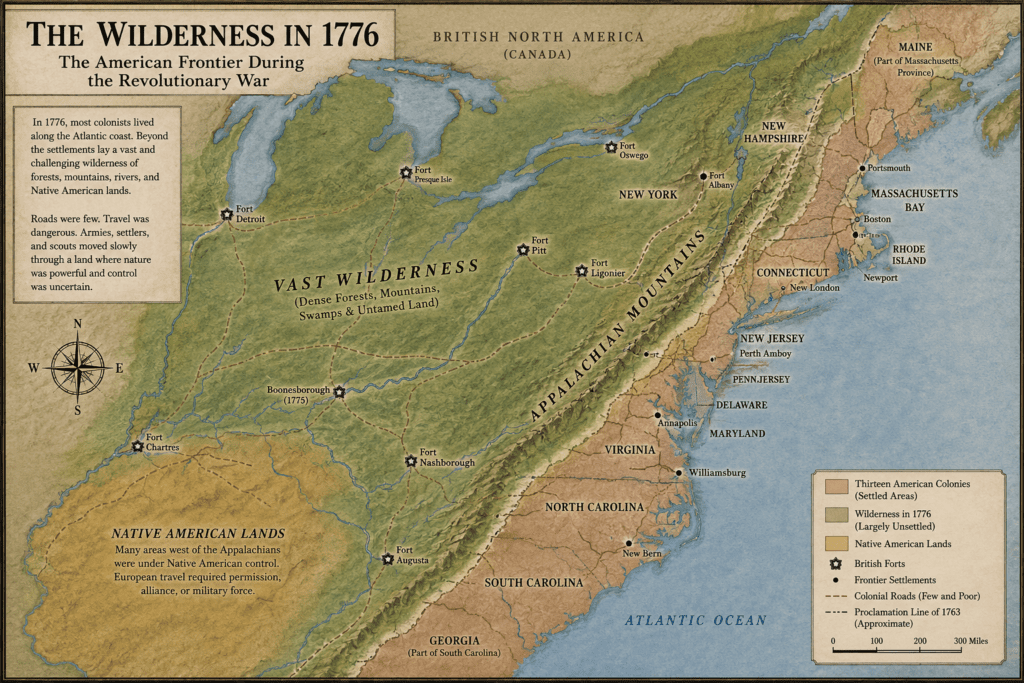
To modern Americans, the eastern United States can feel heavily populated and developed. In 1776, however, much of North America beyond the coastal settlements was viewed as an immense and dangerous wilderness.
Even areas that today contain major cities were often little more than isolated settlements surrounded by forests.
For Hessian soldiers arriving from Germany, the scale of the American wilderness was almost unimaginable. Europe contained centuries-old towns, farms, roads, and villages packed closely together. America appeared very different.
Vast forests stretched for hundreds of miles with few roads, scattered forts, and enormous regions controlled not by colonial governments but by Native American nations.
The Colonies Were Mostly Coastal Settlements
In 1776, most of the population lived near the Atlantic coast.
Beyond those settled areas lay:
- Dense forests
- Swamps
- Mountains
- Rivers without bridges
- Isolated frontier cabins
- Small military forts
- Native American territory
Travel inland could quickly become dangerous.
A person leaving the larger colonial towns might enter wilderness within only a few miles.
The Appalachian Mountains Marked a Major Frontier Barrier
The Appalachian Mountains formed one of the greatest obstacles to western expansion.
Crossing them meant entering territory that many colonists considered remote and hazardous.
For Hessian troops, these regions seemed wild beyond comparison.
Roads were narrow or nonexistent.
Heavy wagons became trapped in mud.
Supplies could disappear for weeks.
Communication between forts or settlements often depended on horseback riders traveling through dangerous territory.
Wilderness Meant More Than Forests
In Revolutionary America, “wilderness” did not simply mean trees.
It meant regions where:
- Governments had limited control
- Armies struggled to operate
- Native nations remained powerful
- Settlers lived in fear of raids or attacks
- Disease and starvation threatened survival
The wilderness represented uncertainty.
A soldier or settler traveling too far from established settlements could quickly become isolated from civilization entirely.
Many Colonial Maps Were Incomplete
Large sections of North America remained poorly mapped by Europeans in 1776.
Some frontier roads were little more than widened animal trails or Native paths.
German soldiers frequently wrote about the endless forests, difficult rivers, and harsh travel conditions they encountered during campaigns away from the coast.
The American Wilderness Shocked European Soldiers
Many Hessians had never experienced true wilderness before arriving in America.
In Germany, even rural regions remained connected by villages, farmland, and established road systems.
America felt vastly different.
The forests seemed endless.
Wild animals were common.
Frontier settlements appeared isolated and vulnerable.
For Hessian troops operating on the frontier, survival itself became part of the war.
Hessian Encounters With Native Americans
One of the most unfamiliar experiences for many Hessian soldiers during the American Revolution was their encounter with Native American warriors and tribes allied with the British.
For German troops arriving from Europe, the frontier introduced not only a new kind of warfare but entirely new cultures, languages, and military alliances.
The first major Hessian encounters with Native Americans occurred during the 1777 Saratoga Campaign led by British General John Burgoyne.
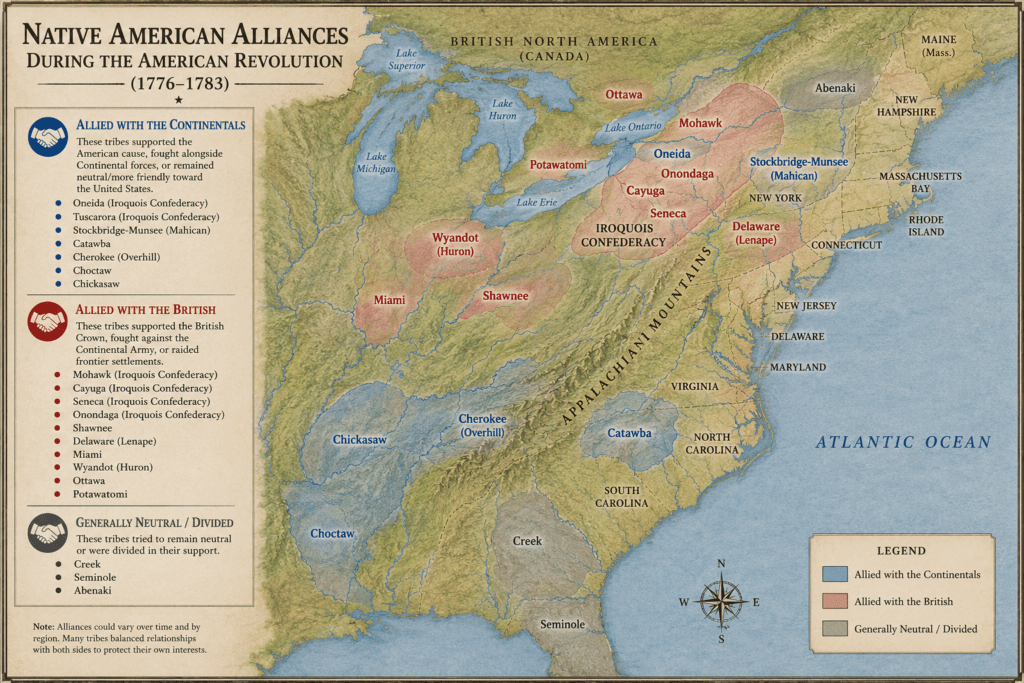
As Burgoyne’s army marched south from Canada toward New York, it included not only British regulars and Hessian troops from Brunswick and Hesse-Hanau, but also hundreds of Native American allies from tribes connected to the Iroquois Confederacy and other northern nations.
The British wanted Native American warriors involved for several important reasons.
Why the British Used Native American Allies
British commanders understood that frontier warfare in North America differed greatly from European combat.
Native American warriors possessed skills that European armies lacked, including:
- Tracking through forests
- Wilderness survival
- Scouting enemy positions
- Fast-moving raids
- Ambush tactics
- Knowledge of rivers, mountains, and frontier trails
For British officers, Native allies provided an important advantage in the vast wilderness between Canada and the American colonies.
Native Warriors Were Viewed as Frontier Specialists
Many Hessian soldiers had never seen Native Americans before arriving in North America.
Their diaries often described Native warriors as:
- Extremely skilled in forest movement
- Fearless in combat
- Difficult to detect in wilderness terrain
- Capable of surviving with few supplies
German troops were often amazed by how quickly Native scouts could travel through forests that Europeans considered nearly impassable.
Did Hessians marry Native Americans?
What skills did Native Americans teach the Hessians?
Did Hessians help build bridges and roads?
The Saratoga Campaign and Early Encounters
As Burgoyne’s army advanced southward in 1777, Hessians and Native warriors operated alongside one another during scouting missions and frontier operations.
The campaign moved through heavily wooded territory where traditional European battlefield formations became difficult to use.
Native scouts helped:
Locate American Positions
Frontier scouting became critical in wilderness terrain where enemy armies could disappear into forests.
Protect British Supply Routes
Long supply lines stretching back into Canada remained vulnerable to militia attacks.
Spread Fear on the Frontier
The presence of Native warriors frightened many frontier settlers, who feared raids against isolated communities.
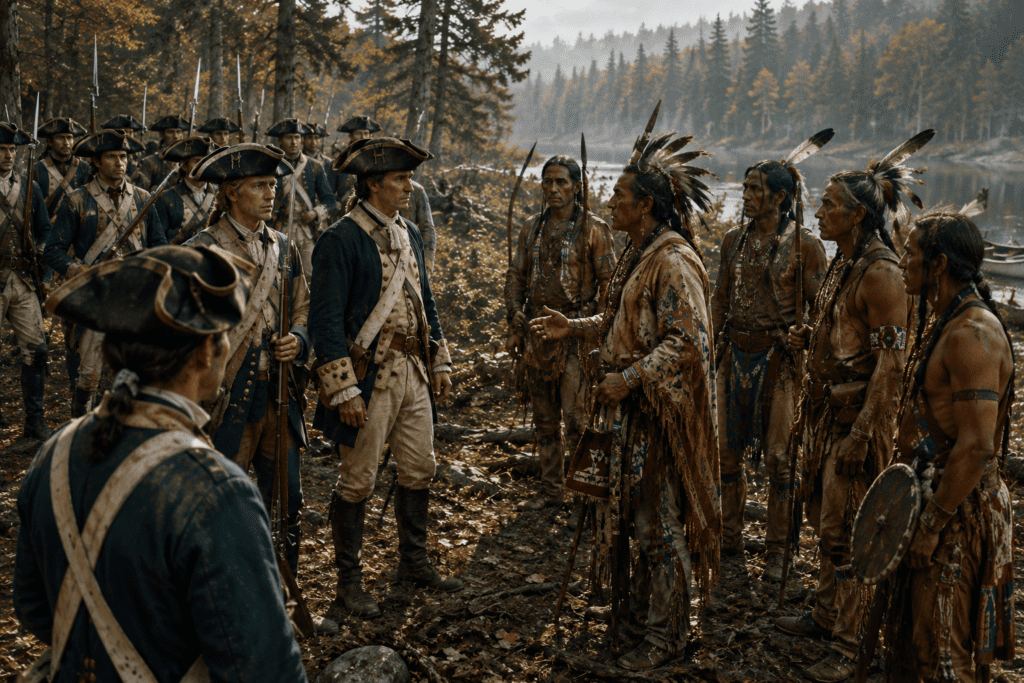
Cultural Shock for Hessian Soldiers
The encounters created powerful impressions on the Hessians.
Some German soldiers admired Native fighting skills and wilderness abilities.
Others feared the brutality associated with frontier warfare.
European military traditions emphasized organized battlefield combat, while frontier fighting often involved ambushes, raids, and surprise attacks far from formal battle lines.
For Hessians newly arrived from Germany, the American frontier revealed an entirely different kind of war.
Yes, there are a wealth of primary records—specifically journals, diaries, and letters written by German officers and enlisted men—that document their first encounters with Native Americans during the Revolutionary War (Barker, n.d.).
Coming from Central Europe, many Hessian soldiers arrived in North America with romanticized Enlightenment concepts of the “noble savage” (Barker, n.d.).
When they came face-to-face with Native American warriors, their written impressions transformed into a mix of intense ethnographic curiosity, tactical shock, and vivid descriptions of appearance and warfare methods.
1. Ethnographic Fascination and First Impressions
Many German soldiers recorded their first sightings of Native Americans with meticulous detail, treating them almost like an anthropological study. They frequently wrote about physical appearance, clothing, tattooing, and body paint.
- The Stature and Demeanor: German diarists often remarked on the tall, athletic build and dignified posture of the warriors they encountered. They noted the contrast between traditional dress (such as deer hides, breechcloths, and intricate beadwork) and European military uniforms.
- Tattoos and Face Paint: The German troops were deeply fascinated by body modification. Multiple diaries describe the warriors’ practice of shaving their heads except for a scalplock, slit ears elongated with weights, and the striking use of red, black, and yellow paint before entering a campaign.
- Camps and Customs: Hessian observers who encountered pro-British or neutral tribes behind the lines wrote detailed descriptions of native housing (which British and German troops frequently called “wigwams” or brush huts), diet (such as maize and wild game), and the complex, performative nature of treaties and alliances, including the chanting and rhythmic elements used when exchanging wampum belts (Rath, n.d.).
2. Shock Over “The Little War” (Kleinkrieg)
Tactically, Hessian forces were trained in highly disciplined, linear European warfare—marching in strict formation and firing in volleys. Meeting Native American warriors on the battlefield or watching them deploy alongside British forces introduced them to Kleinkrieg (the “little war” or irregular/guerrilla warfare) on a terrifying scale (Parker, n.d.).
- The War Whoop: German accounts frequently mention the chilling effect of the traditional war whoops echoing from the woods, noting that it was deliberately designed to strike panic into uninitiated European regular troops.
- Marksmanship and Stealth: Hessians quickly realized that traditional formations were useless in the dense American wilderness. They noted with a mix of fear and professional respect how native warriors utilized the terrain, moving with absolute silence, striking from cover, and utilizing camouflage.
- The “Tomahawk” and Scalping: To regular soldiers used to standard bayonet and musket wounds, the physical aftermath of frontier skirmishes was gruesome. German diaries explicitly record their horror at witnessing the results of a tomahawk blow or discovering dead soldiers who had been scalped (Walling, n.d.; Somerville, 2007).
July 12th, 1777 — Near Fort Ticonderoga
The heat of these boundless American forests remains oppressive, and our uniforms, designed for the manicured plains of Germany, prove heavy armor against the tangled brushwood. This morning, our detachment was ordered to reconnoiter the western flanks along the marshy creekbed, where our scouts rumored a party of our Indian allies had established an encampment. It was here that we first came face-to-face with the native inhabitants of this rugged continent.
To a European eye, their appearance is both striking and terrifying. They are men of exceptional, tall stature, possessing limbs of lean muscle hardened by a lifetime in the wilderness. Their heads are entirely shaven, save for a singular crest or "scalplock" at the crown, which they adorn with dyed deer hair and the feathers of wild birds. Their skin, naturally of a dark copper hue, was heavily smeared with grease and painted in grotesque patterns of soot-black and vivid vermilion paint1. Some among them had their earlobes slit and weighted with heavy pieces of brass wiring, drawing them down to their shoulders in a manner we found exceedingly foreign.
They observed our approach with a severe, unblinking dignity, sitting cross-legged about a small fire over which they roasted ears of Indian corn and wild game. Through our interpreter, Captain von Mallet, we exchanged greetings. Though they spoke not a word of our tongue, their expressions possessed a noble, unyielding composure. One of their chiefs, an elder warrior bearing deep scars across his chest, presented a long pipe adorned with intricate beadwork—a custom they term the smoking of the calumet.
While our regular infantry regards them with extreme trepidation due to the terrible rumors of their "tomahawk" axes and the practice of scalping, our Jägers feel a certain professional kinship with them. They move through the dense brushwood with an utter, supernatural silence that defies belief; a hundred of them can vanish into the thicket in a blink, leaving not a single displaced leaf or broken twig behind. Our regular tactics of marching in rigid line and firing by platoon volleys appear entirely useless in this theater. If we are to survive this campaign, we must learn from these native warriors the art of the Kleinkrieg2—the little war of cover, ambush, and swift retreat.
1 Red and black paint patterns were heavily documented by Hessian troops as standard preparations for warfare among the Iroquois and Algonquin allies.
2 Kleinkrieg refers to the 18th-century European military concept of irregular or guerrilla warfare, an area where the Hessian Jägers specialized, though they still found themselves outmatched by Native American stealth tactics.
3. Notable Historical Encounters in the Records
The most prominent accounts of German and Native American interaction involve two specific scenarios: the Northern Campaign (1777) and the local skirmishes around New York (1778).
The Burgundy/Burgoyne Campaign (1777)
During General John Burgoyne’s campaign from Canada down into upstate New York, thousands of Brunswick and Hesse-Hanau troops marched alongside a sizable force of Native American allies (primarily Iroquois, Algonquin, and Ottawa).
- The Diaries: German officers like Friedrich Adolph Riedesel (commander of the Brunswick forces) and his wife, Baroness von Riedesel, kept extensive journals.
- The Content: They wrote extensively about the difficulty of managing these irregular forces. While the Baroness expressed deep fascination with their customs and child-rearing, General Riedesel frequently complained about the tactical unpredictability of the warriors, who preferred ambush and scouting to holding a static defensive line.
The Stockbridge Massacre (August 31, 1778)
The most direct and violent tactical encounter between Hessians and Native Americans occurred in what is now Van Cortlandt Park in the Bronx, New York (Walling, n.d.).
- The Context: The Stockbridge Militia—a unit of Mohican and Wappinger warriors from Massachusetts—fought bravely as patriots for the Continental Army (Walling, n.d.). They were deployed to scout the lines between the two armies (Walling, n.d.).
- The Clash: On August 31, a combined British force featuring the Hessian Jäger Corps (elite riflemen and woodsmen) under Lieutenant Colonel Ludwig von Wurmb ambushed the Stockbridge warriors.
- The Record: The encounter was brutal and fought hand-to-hand in the brush. The Jägers, who were the closest thing the German army had to specialized wilderness scouts, ultimately overwhelmed the militia. The event was recorded in detail in the diaries of several Hessian officers, who marked it down as a fierce engagement against a uniquely skilled and fiercely brave foe.
Where to Find These Translated Records
If you are looking to read these direct accounts, the most reliable English translations of these diaries were compiled by military historian Bruce E. Burgoyne, who spent decades translating Hessian journals from their original 18th-century German script (Zimmerman, 2019):
- A Hessian Diary of the American Revolution by Johann Conrad Döhla – A detailed journal from an Ansbach-Bayreuth private who recorded daily life, impressions of the American landscape, and encounters with the civilian population and various combatants (Dziennik, 2011; Fackrell, 2017).
- Defeat, Disaster, and Dedication: The Diaries of the Hessian Officers Jakob Piel and Andreas Wiederhold – Offers an excellent look at the strategic and cultural shock experienced by the officer corps (Zimmerman, 2019).
- Journal of Lieutenant John Charles Philip von Krafft (1776–1784) – A highly detailed, first-person look at the war through the eyes of a Hessian lieutenant who was a sharp observer of local populations (Zimmerman, 2019).
Did Hessians marry Native Americans
The intersection of Hessian soldiers and Native Americans during and after the Revolutionary War is an under-studied but fascinating chapter of early American history.
While the vast majority of the roughly 5,000 to 6,000 Hessians who chose to remain in North America after 1783 integrated into established German-American communities (particularly in Pennsylvania, Maryland, and Virginia) or French-Canadian communities in Quebec, documentation confirms that marriages and unions between German auxiliary soldiers and Native Americans did occur.
These intersections occurred in three primary contexts:
1. The Canadian Frontier (Quebec and the Maritimes)
A large contingent of German troops, particularly the Hesse-Hanau Chasseurs (Jägers) and Brunswick regiments, spent the war stationed in Quebec, Nova Scotia, and parts of northern New York.
- The Lifestyle: Unlike the infantry regiments stationed in dense urban areas like New York or Philadelphia, these woodsmen and riflemen lived deep in the Canadian wilderness. Contemporary journals from Hessian officers noted that their men lived a “wholesome life in the Canadian woods,” often working, hunting, and marching alongside local indigenous populations.
- The Outcome: When the war ended, between 1,000 and 1,500 German soldiers chose to remain in Canada. While many married French-Canadian women, a significant number who settled in the remote backcountry and frontier posts took Native American wives from local tribes (such as the Mi’kmaq, Abenaki, and Huron-Wendat), fully assimilating into frontier or tribal life.
2. Prisoners of War and the Backcountry
Following massive capitulations like the Battle of Trenton (1776) and the surrender at Saratoga (1777), thousands of Hessian prisoners were marched into the interior of the continent.
- The “Farming Out” System: Because the Continental Congress lacked the resources to feed thousands of POWs, many Hessians were paroled or “farmed out” as laborers to local farmers, iron foundries, and frontier settlements in western Pennsylvania, Virginia, and the Ohio Valley.
- Frontier Integration: In these backcountry borderlands, the social structures of the East Coast faded. German laborers frequently encountered, worked alongside, and occasionally married women from local or displaced Native American communities. Over generations, these surnames became anglicized or absorbed into the local lineage, making them difficult for genealogists to track without modern DNA testing.
3. The Deep South and West Florida
A lesser-known deployment of Hessian forces occurred in the late 1770s and early 1780s, when regiments from Waldeckwere sent to British West Florida (including Pensacola and parts of modern-day Mississippi and Alabama) to defend against Spanish forces.
- Tribal Contact: In the South, these German soldiers were exposed to a completely different frontier environment, working in shifting alliances with the Creek, Choctaw, and Chickasaw nations who were also allied with the British.
- Desertion and Settlement: Chronic illness, heat, and isolation led to high desertion rates among the Waldeckers. Deserting into the interior meant relying entirely on the hospitality and lifestyle of the Southern tribes. Soldiers who went missing in action or deserted frequently chose to stay, taking native wives and blending into the Native American or early Gulf Coast pioneer communities.
The Genealogical Challenge
Tracking these specific marriages in the historical record is notoriously difficult for a few reasons:
- Name Changes: Hessian soldiers frequently anglicized their names upon staying (e.g., Fehr became Fair, Jaegerbecame Hunter).
- Lack of Formal Records: On the frontier or within tribal lands, marriages were rarely recorded in church ledgers. When they were, Native American wives were often recorded under generic Christian names (e.g., “Martha” or “Mary”), completely obscuring their indigenous heritage in standard text documents.
Today, many families tracing their lineage back to the American frontier find this unique convergence through a combination of early military muster rolls, land grants, and modern autosomal DNA tracking that reveals distinct Central European and Native American markers co-existing in the same late-18th-century branches.
Hessians and the American Frontier: What Did Native Americans Teach the Hessians?
When Hessian soldiers encountered Native Americans on the American frontier, they found themselves exposed to an entirely different way of life and warfare.
Whether serving alongside Native allies during British campaigns, observing frontier survival techniques, or living near indigenous communities during imprisonment and settlement, the Hessians quickly realized that Native Americans possessed skills essential for surviving North America’s wilderness.
For soldiers raised in the rigid military culture of 18th-century Germany, the frontier was overwhelming. Dense forests, harsh winters, rivers without bridges, and unreliable supply lines created dangers few European armies were prepared to face.
Hessian diaries and journals, including writings by Johann Conrad Döhla and Captain Johann Ewald, reveal a deep fascination with Native American knowledge and frontier survival methods.
The story of the Hessians and the American frontier cannot be fully understood without recognizing how Native Americans influenced the German soldiers’ ability to travel, fight, hunt, and survive in North America.
Wilderness Survival and Frontier Mobility
European armies were trained for open battlefields and organized maneuver warfare.
The American frontier operated by completely different rules.
Native Americans taught Hessian soldiers how to survive and move through terrain that Europeans often considered nearly impassable.
Snowshoes and Winter Travel
In the northern theater of the war — especially around Quebec, Canada, and northern New York — Hessian troops encountered brutal winters unlike anything most had experienced in Germany.
Deep snow immobilized entire military units.
Native Americans taught Hessian Jägers and frontier patrols how to:
- Construct snowshoes
- Walk efficiently over deep snow
- Travel long winter distances
- Patrol frozen wilderness routes
This dramatically improved the mobility of Hessian light infantry operating on the frontier.
Winter Warfare Changed Frontier Operations
Without snowshoes, movement during northern winters could become nearly impossible.
The adoption of indigenous winter travel methods helped Hessian patrols scout remote areas and maintain communication between isolated frontier positions.
The Birchbark Canoe and River Travel
North America’s interior depended heavily on rivers for transportation.
European-style boats proved too heavy and impractical for many frontier waterways filled with rapids, rocks, and shallow crossings.
Native Americans introduced Hessians to the birchbark canoe.
Why Canoes Were Essential on the Frontier
Birchbark canoes allowed soldiers to:
- Travel quickly along rivers
- Carry supplies through wilderness areas
- Navigate shallow waterways
- Portage around rapids and obstacles
For Hessian troops accustomed to European roads and wagons, these lightweight canoes revealed an entirely new transportation system built around North America’s river networks.
Shelter and Campcraft on the American Frontier
Standard European military tents performed poorly in wilderness conditions.
Heavy rain, snow, and storms frequently damaged traditional camp setups.
Native Americans demonstrated more practical frontier shelter methods.
Frontier Shelter Techniques
Hessians learned how to build:
- Bark lean-tos
- Brush shelters
- Temporary woodland camps
- Storm-resistant structures
These techniques helped frontier troops survive severe weather far from established forts or settlements.
Campcraft Became a Survival Skill
On the frontier, poor shelter could mean death from exposure.
Learning to construct fast, durable shelters became as important as military training itself.
Hunting, Foraging, and Frontier Food Sources
British supply lines frequently failed during frontier campaigns.
Food shortages became common.
Native American hunting and agricultural knowledge often became critical for survival.
Woodland Hunting Techniques
Hessian Jägers were already experienced marksmen, but Native Americans taught them how to hunt effectively in dense North American forests.
This included:
- Tracking deer and bear
- Moving silently through forests
- Using camouflage
- Hunting without large organized parties
The frontier required stealth and patience rather than traditional European hunting methods.
Indigenous Agriculture and Frontier Crops
Hessians became fascinated by unfamiliar American crops.
Native Americans introduced them to:
- Maize (“Indian Corn”)
- Squash
- Pumpkins
- Preservation methods for winter storage
These crops proved valuable because they could survive harsh frontier conditions better than many European food sources.
Frontier Farming Knowledge
Some Hessians who later settled permanently in North America continued using agricultural techniques first learned from Native Americans during the war.
Herbal Medicine and Frontier Survival
Disease killed enormous numbers of soldiers during the Revolutionary War.
European medical knowledge often proved ineffective against frontier illnesses.
Native Americans introduced Hessians to local medicinal plants and natural remedies.
Indigenous Medical Knowledge
This included treatments using:
- Spruce tea for scurvy prevention
- Willow bark for pain relief
- Medicinal roots and herbal teas
- Forest plants used for fever treatment
A Frontier Lifeline
Spruce tea became especially important because it contained Vitamin C, helping prevent scurvy during long frontier campaigns.
Willow bark contained salicin, a natural compound related to modern aspirin.
For many Hessians, Native American medical knowledge became a literal lifesaver on the frontier.
The Hessians Adapted to the American Wilderness
The experience of the Hessians and the American frontier transformed many German soldiers.
Native Americans taught them:
- How to travel through wilderness
- How to survive harsh winters
- How to hunt and forage
- How to build practical shelters
- How to adapt military tactics to forest warfare
These lessons permanently shaped how Hessian Jägers and frontier troops operated during the Revolutionary War.
For many German soldiers, North America was not simply another battlefield.
It was an entirely new world that forced them to rethink survival itself.
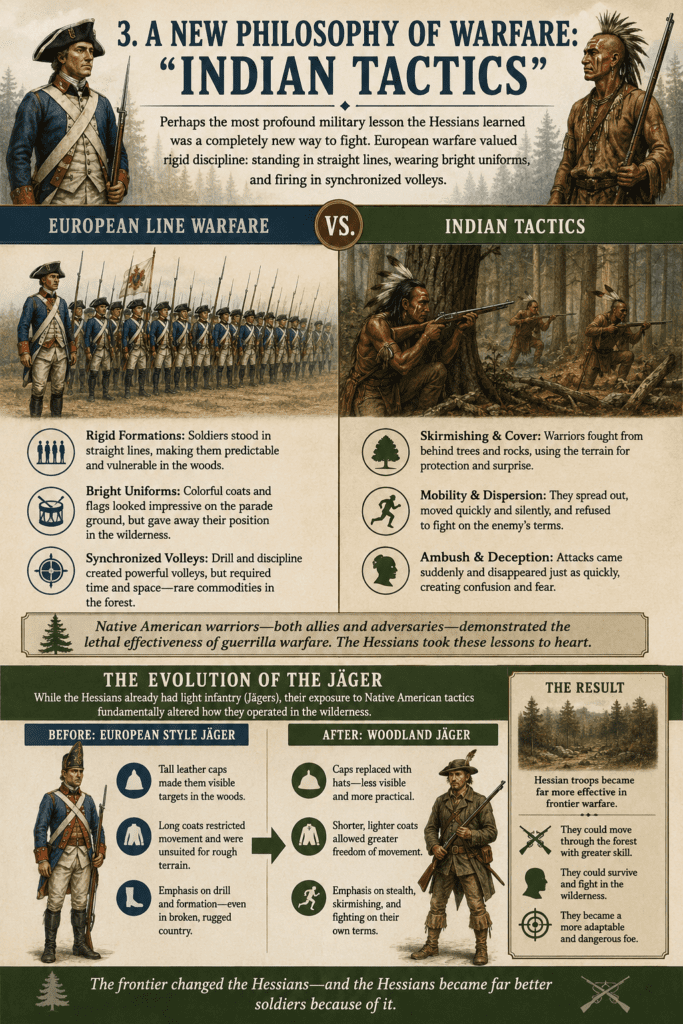
3. A New Philosophy of Warfare: “Indian Tactics”
Perhaps the most profound military lesson the Hessians learned was a completely new way to fight. European warfare valued rigid discipline: standing in straight lines, wearing bright uniforms, and firing in synchronized volleys.
- Skirmishing and Cover: Native American warriors (both allies and adversaries) demonstrated the lethal effectiveness of guerrilla warfare. They taught the Hessians the value of fighting from behind trees, utilizing natural camouflage, dispersing during an attack, and executing rapid, silent ambushes.
- The Evolution of the Jäger: While the Hessians already had light infantry (Jägers), their exposure to Native American tactics fundamentally altered how they operated. They began shedding their heavy leather caps, shortening their coats, and adopting the fluid, decentralized style of woodland combat.
4. Tracking and Reading the Landscape
To a European soldier, a forest was just a wall of trees. Native Americans taught the Hessians to read the wilderness like a book. They learned how to spot bent twigs, overturned leaves, and subtle disturbances in the soil to track enemy movements or avoid ambushes.
They also learned to read the behavior of local wildlife—such as the sudden silence of birds or the flight of deer—as early warning systems that an enemy was near.
From the Journal of a Hessian Soldier:
Many Hessian journals express absolute awe at how effortlessly Native Americans moved through the woods. Soldiers noted that while European troops made enough noise to be heard from miles away, their indigenous guides could slip through dense brush without making a single sound, a skill the Germans desperately tried to emulate.
When thousands of Hessians chose to desert or stay behind after the war ended in 1783, it was this specialized knowledge—taught to them by the continent’s original inhabitants—that allowed them to successfully settle, survive, and build new lives on the rugged American frontier.
Did Native Americans and Hessians Camp Together
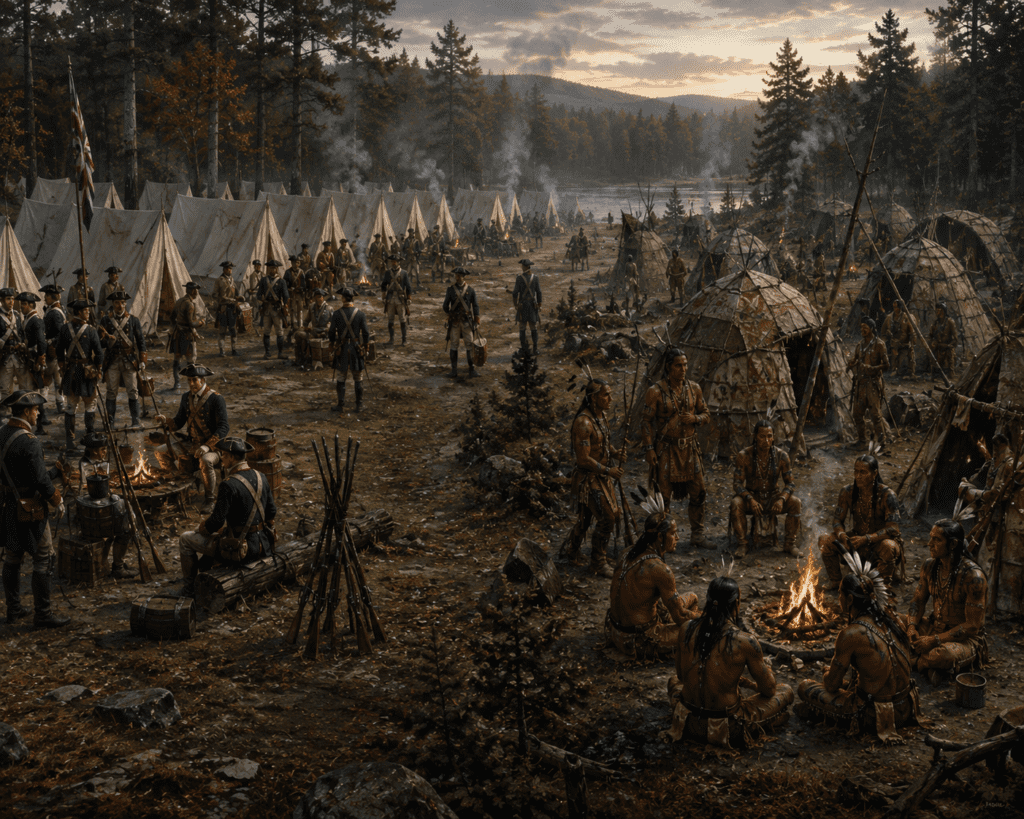
Native Americans and Hessians traveled and campaigned together, they maintained completely separate camps.
Even though they were fighting for the same British cause, their military structures, cultural habits, and ways of organizing daily life were vastly different. These boundaries were maintained deliberately by both sides.
The Layout: Distinct “Sectors”
When a large British expeditionary force—comprising British regulars, German auxiliaries (Hessians and Brunswickers), and Native American warriors (such as the Mohawk or Wyandot)—set up for the night, the camp was divided into strict sectors.
- The German Camp: The Hessians set up highly structured, uniform military camps. Their tents were pitched in perfectly straight lines according to regiment and company. Sentries were posted at precise intervals, and drums or bugles dictated the schedule.
- The Native American Camp: Native American warriors usually camped a short distance away, often in an adjacent woods, near a water source, or on the fringes of the main army. They erected traditional, lightweight shelters like brush huts, lean-tos, or bark wigwams.
Why They Kept Separate Camps
The separation wasn’t necessarily driven by hostility, but by practical and cultural realities:
- Sovereignty and Command Structure: Native Americans did not view themselves as subjects or regular soldiers of the British King; they were independent allies. They fought under their own war chiefs (like the Mohawk leader Joseph Brant) rather than German or British officers. Keeping a separate camp reinforced their political autonomy.
- Clashing Lifestyles: The rigid, noisy, and strictly scheduled life of a European military camp did not appeal to Native American warriors. Conversely, European officers found the fluid, highly active social atmosphere of native camps—which included nighttime war councils, dances, and rituals—disruptive to regular army discipline.
- Security and Scouting Roles: Native Americans acted as the “eyes and ears” of the army. Because they were constantly slipping out of camp on long-range scouting patrols or returning at odd hours of the night, camping on the perimeter or slightly apart from the main army made tactical sense.
Where the Intermingling Happened
While they slept and ate in separate camps, the actual “traveling together” involved constant daily interaction:
- On the March: German Jägers (light infantry riflemen) regularly marched alongside Native American scouts at the very front of the army, as both groups were trained for woodland navigation.
- The Trade Economy: Soldiers from the Hessian camps frequently visited the Native American camps to trade. Hessians would trade European goods like metal buttons, mirrors, or tobacco for fresh game, corn, waterproof moccasins, or herbal medicines.
- Joint Councils: High-ranking German officers regularly attended official war councils held at the Native American camps, participating in diplomatic smoke ceremonies to plan battle strategies.
So while they shared the same muddy trails and fought the same enemies by day, at night they retreated to their own spaces—the Hessians to their straight rows of canvas tents, and the Native Americans to the quiet of the surrounding woods.
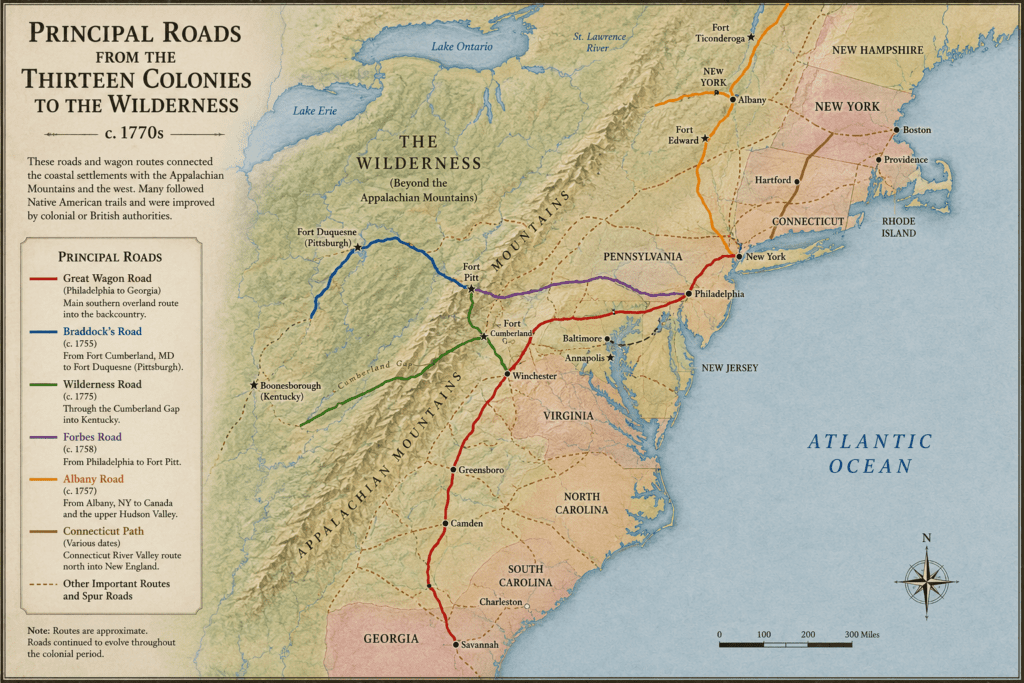
Several important roads and military routes developed or expanded by the British during the colonial and Revolutionary War periods later became major migration corridors into the American frontier and the expanding western United States.
For your Hessians and frontier article, these are the most historically important examples:
Military Roads That Helped Open the American Frontier
The Great Wagon Road
The Great Wagon Road was not entirely created by the British military, but British colonial authorities improved and protected large sections of it before and during the Revolutionary War.
The route stretched from Pennsylvania south through:
- Maryland
- Virginia
- North Carolina
- South Carolina
- Georgia
It became one of the most important migration routes in colonial America.
Why It Mattered
After the war, settlers used the road to move inland into the Appalachian frontier and beyond.
Large numbers of:
- German immigrants
- Scots-Irish settlers
- Veterans
- Frontier farmers
traveled these roads westward.
Hessian soldiers who remained in America after the war would likely have traveled portions of these same routes.
Braddock’s Road
One of the most famous military frontier roads was Braddock’s Road.
It was built during the French and Indian War in 1755 by British General Edward Braddock’s army during its campaign against Fort Duquesne (modern Pittsburgh).
The road cut through wilderness from western Maryland into Pennsylvania.
Why Braddock’s Road Became Important
The road later became a major western migration route.
It helped settlers move toward:
- The Ohio River Valley
- Western Pennsylvania
- Kentucky territory
British and Hessian troops operating during later frontier campaigns often used sections of these earlier military corridors.
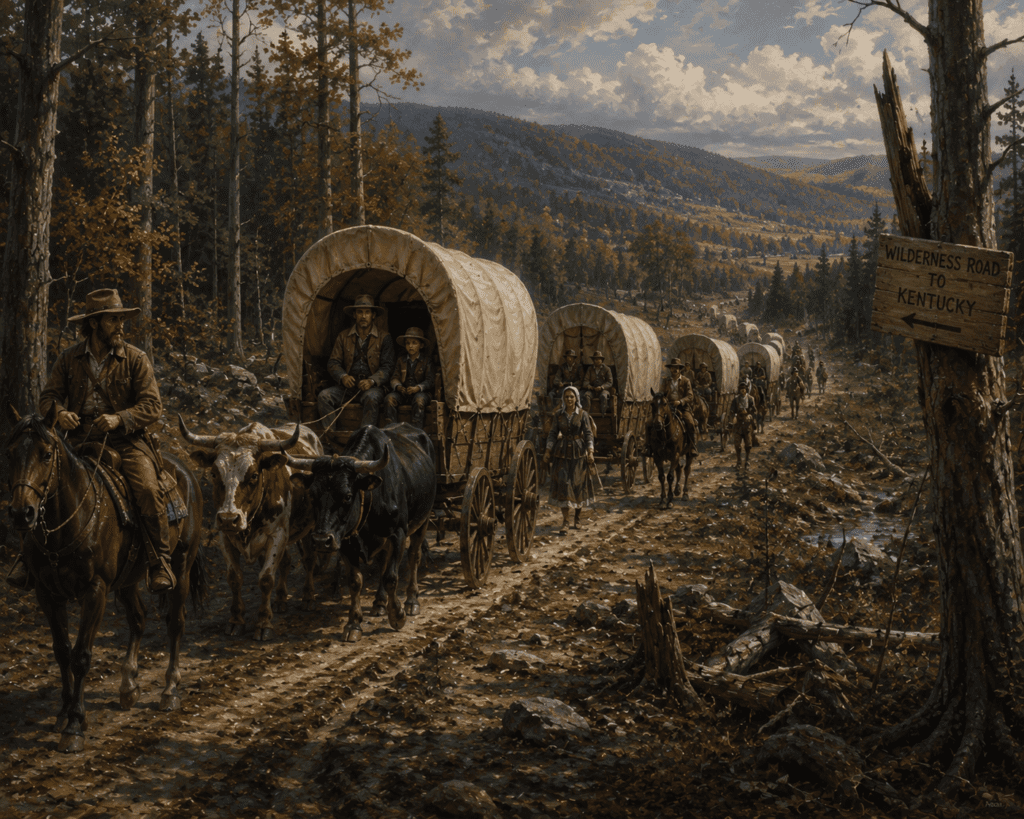
The Wilderness Road
The Wilderness Road became one of the most important migration routes into Kentucky.
Although strongly associated with Daniel Boone and frontier settlers, portions followed earlier military and Native American paths first explored and widened during British frontier operations.
The route crossed the Cumberland Gap through the Appalachian Mountains.
Why It Changed America
After the Revolutionary War, more than 200,000 settlers traveled the Wilderness Road into Kentucky and the western frontier.
The road helped transform Kentucky from frontier wilderness into a rapidly growing settlement region.
The Forbes Road
The Forbes Road was another major British military road built during the French and Indian War.
Constructed in 1758 by General John Forbes, it connected eastern Pennsylvania to Fort Pitt.
Frontier Legacy
The route later became vital for:
- Western settlement
- Trade routes
- Wagon traffic
- Frontier migration
Communities and towns emerged along the road system after the war.
Native Trails Became Colonial Roads
An important historical reality is that many “British” military roads actually followed much older Native American trade routes and hunting trails.
British engineers often widened:
- Native footpaths
- Tribal trade routes
- Portage trails
- Frontier travel corridors
This means the expansion westward after the Revolution often followed transportation networks originally developed by Native Americans long before Europeans arrived.
How These Roads Connect to the Hessians
Hessian soldiers campaigning with British forces on the frontier marched along many of these rough military roads and wilderness trails.
What began as supply routes for armies later became the pathways that opened the American West to migration and settlement.
In many ways, frontier military operations during the Revolutionary era unintentionally helped shape the future expansion of the United States.
The experience of the Hessians and the American frontier transformed many German soldiers in ways they never expected. What began as a military contract to fight for the British Crown became an encounter with a vast wilderness, Native American cultures, frontier warfare, survival challenges, and the enormous open spaces of North America.
The Hessians learned new methods of fighting, wilderness travel, hunting, survival, and frontier mobility from Native Americans and frontier conditions unlike anything found in Europe. Many German soldiers who survived these campaigns would later remain in North America permanently, helping settle the expanding frontier they once marched through as foreign troops.
The next chapter explores one of the most fascinating parts of the Hessian story: the thousands of German soldiers captured during the Revolutionary War, what life was like inside American prison camps, and how many Hessians gradually assimilated into American society rather than return to Germany after the war ended.
- Who Were the Hessians? — Why German soldiers fought for Britain in the American Revolution
- Hessians at Trenton, Long Island, and Saratoga — The major campaigns that shaped their reputation
- Hessian Jägers, Weapons, and Military Tactics — The elite riflemen and frontier combat specialists
- Hessian Camp Followers and Military Families — The women and children who traveled with the armies
- Daily Life in the Hessian Army — Camp routines, discipline, uniforms, food, and survival
- Hessians and the American Frontier — Native Americans, wilderness warfare, survival, and westward expansion
- Hessian Prisoners, Captivity, and Assimilation — POW camps, desertion, and becoming American settlers
- Hessians Who Stayed in America — German soldiers who built new lives after the Revolution
- The Legacy of the Hessians in the United States — German influence on American culture and communities
- The Hessians and the 250th Anniversary of the American Revolution — Why their story still matters today
Barker, T. M. (n.d.). "Die Hessen in Amerika, 1776-1783", by Inge Auerbach (Book Review). ProQuest.
Dziennik, M. (2011). The Fatal Land. The University of Edinburgh.
Fackrell, J. (2017). Measuring Rural Revolutionary Mobilization: The Militiamen, Soldiers, and Minutemen of Fauquier County, Virginia 1775 - 1782. Digital Commons@USU.
Parker, D. E. (n.d.). The Little War Meets British Military Discipline in America 1755-1781. DTIC.
Rath, R. C. (n.d.). Hearing Wampum. Way Net.
Somerville, K. (2007). A Case Study in Frontier Warfare: Racial Violence, Revenge, and the Ambush at Fort Laurens, Ohio. Purdue e-Pubs.
Walling, R. S. (n.d.). The Stockbridge Indian Massacre: Death in the Bronx. AmericanRevolution.org.
Zimmerman, C. E. (2019). Clinton's March: A Strategic and Logistical Study of the Crown Forces' March Through New Jersey in 1778. Scholars Crossing.
Did Hessians really fight alongside Native Americans during the Revolutionary War?
What did Native Americans teach the Hessians?
Why were Hessian Jägers better suited for frontier warfare?
What was considered the wilderness in 1776?
Did the Hessians help build frontier roads?
What roads opened the frontier after the Revolutionary War?
Did Hessians learn guerrilla warfare tactics from Native Americans?
Did former Hessians later settle on the American frontier?
The Complete RetireCoast Historical Series
This series about the Hessians in the American Revolution is just one part of the much larger RetireCoast 250th Anniversary historical project celebrating the birth of the United States.
We invite you to continue exploring our growing collection of Revolutionary War articles covering battles, weapons, ships, camp followers, frontier life, hidden history, and the people who shaped the American story.
Discover more from RetireCoast.com
Subscribe to get the latest posts sent to your email.