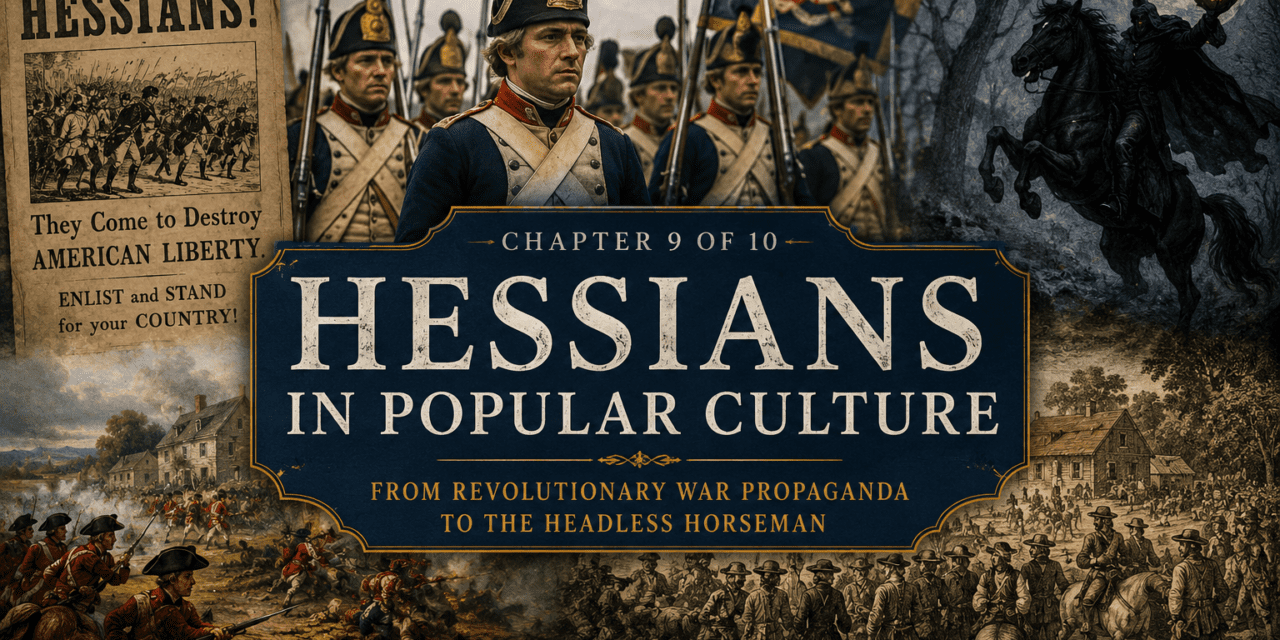
Introduction: Hessians in Popular Culture
More than two centuries after the American Revolution, the Hessians remain among the most recognizable foreign soldiers in American history.
Thousands of German troops served with British forces between 1776 and 1783. Yet their influence extends far beyond the battlefields where they fought.
This chapter explores Hessians in Popular Culture and examines how Americans remembered, portrayed, and sometimes misunderstood these German soldiers long after the war ended.
- Introduction: Hessians in Popular Culture
- Revolutionary War Propaganda and the Birth of the Hessian Image
- Hessian Ghost Stories and American Folklore
- Sleepy Hollow and the Headless Horseman
- People Also Ask About the Hessian Headless Horseman
- Hessians in Paintings, Illustrations, and Historical Art
- Hessians in Movies, Television, and Modern Entertainment
- Early Hollywood and Revolutionary War Films
- The Enduring Influence of Sleepy Hollow
- Hessians in Television
- Hessians in Video Games and Popular Media
- A Changing Image
- Popular Culture Keeps the Hessians Alive
- Famous Film and Television Depictions of Hessians
- Hessians in Horror and Folklore
- Modern Documentary Perspectives
- The Hessians on Screen
- How Americans Remember the Hessians Today
- Hessians in German Memory: Returning Home After the American Revolution
- Returning to a Changed Homeland
- Were Returning Hessians Considered Failures?
- Families Wondered Why So Many Never Returned
- The Veterans Who Chose America
- Did Hessians Encourage Later German Immigration?
- Hessians in German Historical Memory
- Two Different Legacies
- The Ultimate Irony
- How German Newspapers Reported the Return of the Hessians
- What the Newspapers Did Not Say
- Reading Between the Lines
- The Soldiers Who Chose America
- A Different Voice Emerges
- People Also Ask About Returning Hessian Soldiers
- The Hessians and America’s Changing Historical Memory
- Conclusion: The Hessians Who Refused to Be Forgotten
- References
- FAQ
From Soldiers to Symbols
The historical Hessians were professional soldiers recruited from several German states and hired by Great Britain during the American Revolution.
Over time, however, they became much more than military figures.
In American memory, Hessians evolved into symbols of foreign power, mysterious strangers, feared enemies, and eventually characters in folklore, literature, and popular entertainment.
Why Hessians Captured the American Imagination
The arrival of thousands of German-speaking troops shocked many American colonists in 1776.
Patriot leaders quickly recognized the political value of emphasizing the presence of foreign soldiers fighting against the colonies.
A Powerful Propaganda Tool
Newspapers, pamphlets, and political speeches often portrayed the Hessians as mercenaries sent by King George III to crush American liberty.
These depictions helped fuel support for independence and left a lasting impression on the public.
Many Americans who never saw a Hessian soldier in person nevertheless developed strong opinions about them through wartime propaganda.
The Birth of Revolutionary War Legends
Stories about Hessian soldiers began circulating almost immediately during the war.
Some were based on real events.
Others became exaggerated through retellings, local traditions, and family memories passed from generation to generation.
Hessians in Popular Culture Beyond the Revolution
As the Revolutionary generation faded, Hessians remained part of the American cultural landscape.
Artists painted them.
Authors wrote about them.
Storytellers transformed them into legendary figures.
The Headless Horseman Connection
For many Americans, the most famous Hessian is not a historical soldier at all.
It is the Headless Horseman from Washington Irving’s The Legend of Sleepy Hollow, a fictional Hessian cavalryman whose ghost continues to ride through one of America’s most famous stories.
Paintings, Literature, and Historical Memory
Throughout the nineteenth and twentieth centuries, Hessians appeared in paintings, historical illustrations, novels, textbooks, films, and television programs.
Each generation reinterpreted them in different ways.
Sometimes they were portrayed as ruthless mercenaries.
Other times, they appeared as disciplined soldiers, immigrants, or tragic figures caught in a distant conflict.
What This Chapter Covers
This chapter examines Hessians in Popular Culture through several different lenses.
Revolutionary War Propaganda
How American patriots used Hessian soldiers in newspapers, pamphlets, and political messaging.
Folklore and Ghost Stories
How Hessians became characters in local legends, battlefield stories, and regional folklore.
Paintings and Historical Art
How artists depicted Hessian soldiers and shaped public perceptions of the Revolution.
Sleepy Hollow and the Headless Horseman
How a fictional Hessian became one of the most enduring characters in American literature.
Modern American Historical Memory
How museums, reenactors, educators, filmmakers, and historians continue to interpret the Hessian story today.
Test your knowledge of how the Hessians were remembered in propaganda, folklore, literature, art, film, and historical memory.
1. What fictional character became the most famous Hessian in American popular culture?
Answer: The Headless Horseman.
Washington Irving's Legend of Sleepy Hollow transformed a fictional Hessian cavalryman into one of the most recognizable figures in American folklore.
2. Which American author made a Hessian soldier famous through literature?
Answer: Washington Irving.
Irving's 1820 story introduced generations of readers to the Hessian Headless Horseman.
3. According to Revolutionary War-era Patriot propaganda, Hessians were often portrayed as what?
Answer: Foreign mercenaries and enemies of liberty.
Patriot newspapers frequently exaggerated the threat posed by Hessian troops to rally support for independence.
4. What famous battle is most closely associated with the capture of Hessian troops?
Answer: The Battle of Trenton.
Washington's surprise attack on December 26, 1776 resulted in the capture of nearly 900 Hessian soldiers.
5. What common legend claimed retreating Hessians buried valuable items before leaving an area?
Answer: Gold and silver treasure.
Stories of buried Hessian payroll chests and hidden treasure became part of local folklore across the Northeast.
6. Which film portrayed a terrifying supernatural Hessian Horseman played by Christopher Walken?
Answer: Sleepy Hollow (1999).
Tim Burton's film embraced the darker folklore surrounding Hessian soldiers and the Headless Horseman legend.
7. How did official newspapers in Hesse-Kassel generally report the return of Hessian soldiers after the war?
Answer: As a triumphant and orderly homecoming.
State-controlled newspapers emphasized loyalty, discipline, and military honor while minimizing casualties and desertions.
8. What important fact did many German newspapers avoid discussing?
Answer: Large numbers of Hessians died, deserted, or remained in America.
The official press rarely highlighted the thousands of soldiers who never returned home.
9. Were most widows of ordinary Hessian soldiers compensated when their husbands were killed during the war?
Answer: No.
Widows of enlisted soldiers generally received little or no compensation. Formal survivor benefits were usually reserved for officers or exceptional circumstances.
10. What is perhaps the greatest irony of Hessian history?
Answer: Many Hessians—and even descendants of the ruling family that sent them—eventually became part of the United States they were sent to help defeat.
Former Hessian soldiers and their descendants blended into American society and helped shape the nation for generations.
🏆 Score Yourself
8–10 Correct:
Hessian Historian — You have a strong understanding of how the Hessians became part of both American history and American culture.
5–7 Correct:
Revolutionary Scholar — You know the major events, legends, and cultural influences surrounding the Hessians.
3–4 Correct:
Curious Patriot — You've learned some fascinating facts about the Hessians and their legacy.
0–2 Correct:
Time to Revisit the Series — Explore the complete Hessian series below and discover one of the most fascinating stories of the American Revolution.
About This Series
This article is Chapter 9 of 10 in our comprehensive series on the Hessians and other German soldiers who served in North America during the American Revolution.
Previous chapters explored who the Hessians were, why they came to America, how they fought, how they lived, and what happened to many of them after the war.
This chapter shifts from military history to cultural history by examining Hessians in Popular Culture and the lasting image these soldiers left in the American imagination.
Complete Series Index Available
Readers who would like to explore the entire Hessian series can find a complete linked index at the end of this article.
The index includes all ten chapters and provides a convenient starting point for understanding the full story of the Hessians in America.
Revolutionary War Propaganda and the Birth of the Hessian Image
The story of Hessians in Popular Culture began long before Washington Irving wrote about the Headless Horseman.
It started in 1776 when thousands of German soldiers arrived in North America to fight for Great Britain.
American political leaders quickly realized that the presence of foreign troops could be used as a powerful propaganda weapon.
Why the Hessians Shocked American Colonists
Many colonists viewed their dispute with Britain as a disagreement between Englishmen over rights and representation.
The arrival of German troops changed that perception dramatically.
To many Americans, King George III was no longer relying solely on British soldiers. He was bringing foreign armies to suppress his own subjects.
The Declaration of Independence Complaint
The issue became so controversial that Thomas Jefferson included it in the Declaration of Independence itself.
One of the grievances against King George III accused him of transporting large armies of foreign mercenaries to America.
This accusation helped cement the image of the Hessians as outsiders sent to destroy American liberty.
The “Mercenary” Label
Patriot newspapers frequently described Hessians as mercenaries.
The term carried a negative meaning even in the eighteenth century.
American writers portrayed the German soldiers as men willing to fight solely for money rather than loyalty to a nation or cause.
The Reality Was More Complicated
Most Hessian soldiers did not personally volunteer to fight in America.
Many served because their rulers entered military agreements with Great Britain.
Others were professional soldiers fulfilling obligations to their states.
The reality was far more complex than the simple image presented in Patriot propaganda.
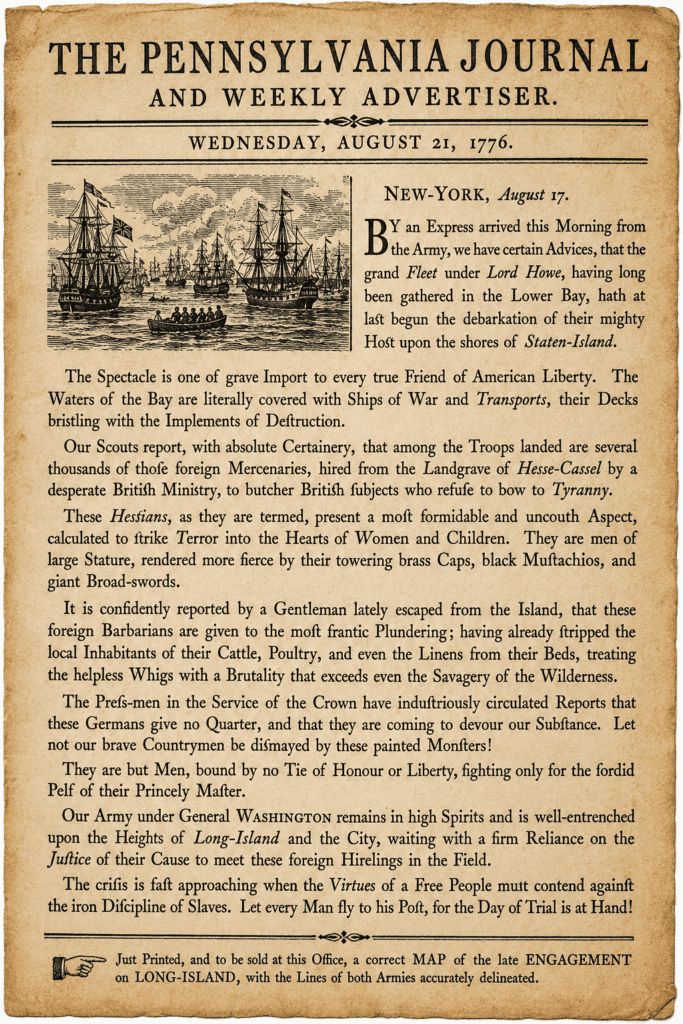
Newspapers Spread the Message
Colonial newspapers regularly published stories about Hessian soldiers.
Some reports were accurate.
Others exaggerated Hessian brutality or military effectiveness.
The goal was often to motivate enlistments and strengthen support for independence.
Stories Designed to Inspire Resistance
Patriot writers understood that fear could be a powerful recruiting tool.
Articles frequently warned readers that foreign troops had been sent across the Atlantic to crush American freedoms.
Such stories encouraged undecided colonists to support the Revolutionary cause.
Political Cartoons and Public Perception
Visual propaganda played an important role in shaping how Americans viewed Hessians.
Broadsides, engravings, and political cartoons often depicted German soldiers as intimidating figures marching under British command.
These images circulated throughout the colonies.
Even people who could not read newspapers could understand the message being conveyed.
Creating a Lasting Stereotype
Many Americans never encountered a Hessian soldier personally.
Their opinions were formed through newspapers, speeches, pamphlets, and illustrations.
As a result, the public image of the Hessian often became more powerful than the reality.
The Trenton Effect
No event shaped the reputation of the Hessians more than the Battle of Trenton on December 26, 1776.
George Washington’s surprise attack transformed a military victory into a propaganda triumph.
American newspapers celebrated the defeat of the Hessian garrison and portrayed it as proof that the seemingly invincible foreign troops could be beaten.
From Feared Soldiers to Defeated Enemies
Before Trenton, Hessians were often depicted as dangerous professional soldiers.
After Trenton, they increasingly appeared in American stories as symbols of British failure.
The battle became one of the most frequently retold episodes of the Revolutionary War.
Its influence on Hessians in Popular Culture would continue for generations.
The Beginning of an American Legend
By the end of the Revolution, the Hessians had become far more than soldiers.
They had become characters in the American story.
Propaganda created an image that mixed fear, mystery, foreignness, and military discipline.
That image would survive long after the last Hessian veterans were gone and would eventually find new life in folklore, ghost stories, literature, and popular culture.
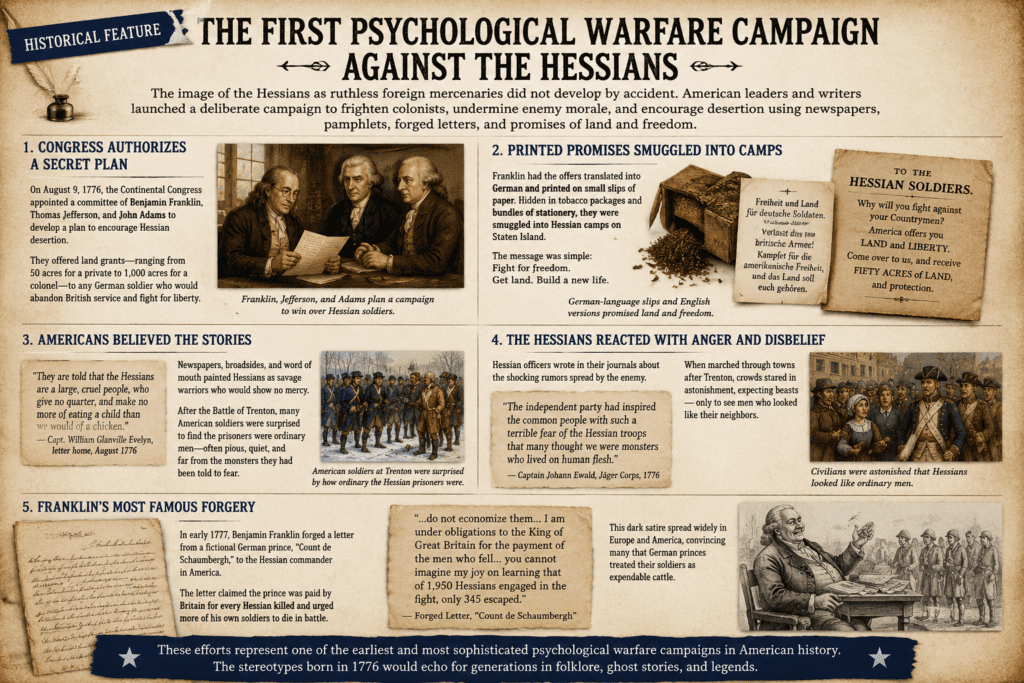
The image of the Hessians as ruthless foreign mercenaries did not develop by accident.
American leaders quickly recognized that the arrival of thousands of German soldiers could be used as a powerful propaganda weapon. Patriot newspapers warned colonists that foreign troops had been hired to crush American liberty, while Congress itself actively encouraged efforts to undermine Hessian morale and encourage desertion.
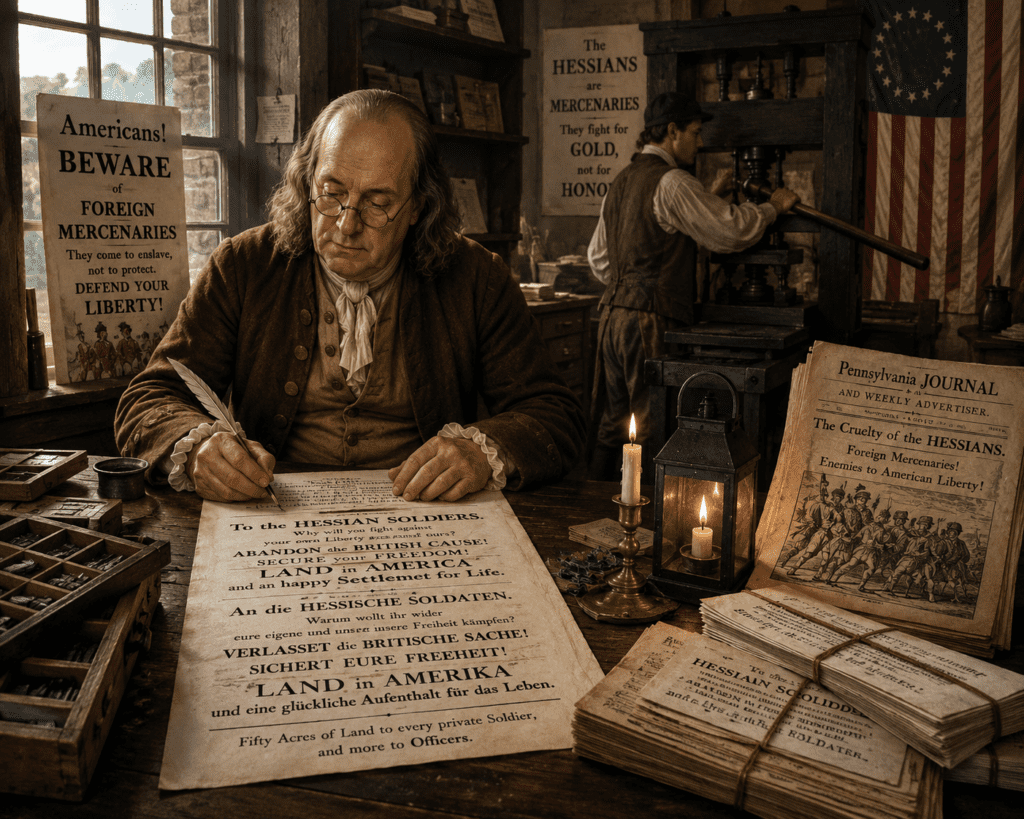
Benjamin Franklin's Secret Campaign
On August 9, 1776, the Continental Congress appointed a committee consisting of Benjamin Franklin, Thomas Jefferson, and John Adams to develop a plan aimed directly at Hessian soldiers.
The committee offered generous land grants to any German soldier willing to abandon British service. A private could receive 50 acres, while senior officers could receive as much as 1,000 acres.
Franklin had the offers translated into German and secretly printed. Copies were smuggled into Hessian camps on Staten Island hidden inside tobacco packages and other goods.
Americans Believed the Stories
The campaign worked. Many Americans genuinely believed Hessian soldiers were savage warriors who gave no quarter.
One officer observed that colonists had been told the Hessians were cruel men who would show no mercy to civilians or prisoners. Such reports spread rapidly through newspapers, broadsides, and word of mouth.
The Hessians Were Shocked by Their Reputation
German officers quickly discovered that many Americans feared them before ever seeing them.
Captain Johann Ewald of the Hessian Jägers recorded that Patriot supporters had convinced ordinary people that Hessian troops were monsters who lived on human flesh.
When captured Hessians were marched through American towns after Trenton, many civilians were reportedly surprised to discover that the Germans looked like ordinary men rather than the terrifying figures described in wartime propaganda.
Benjamin Franklin's Most Famous Forgery
Perhaps the most remarkable propaganda document of the war was a forged letter written by Benjamin Franklin in 1777.
The document falsely claimed to be a letter from a German prince celebrating the deaths of Hessian soldiers because Britain paid compensation for casualties.
The forgery circulated widely in both Europe and America and helped reinforce the belief that German rulers treated their soldiers as expendable property rather than human beings.
Historical Significance: These efforts may represent one of the earliest large-scale psychological warfare campaigns in American history. The stereotypes created during the Revolution would survive for generations and become an important part of Hessians in Popular Culture.
Hessian Ghost Stories and American Folklore
Long after the guns of the American Revolution fell silent, Hessian soldiers continued to march through the American imagination.
In towns, villages, and former battlefields across the new nation, stories about Hessians survived long after the last veterans had died.
These tales became an important part of Hessians in Popular Culture and helped transform historical soldiers into legendary figures.
Why Hessians Became Folklore Characters
The Hessians possessed several characteristics that naturally lent themselves to storytelling.
They spoke a foreign language.
They wore unusual uniforms.
Many carried distinctive weapons and served in regions where local residents had never encountered Germans before.
Outsiders in a New Land
For many Americans, Hessians seemed mysterious.
Their accents, customs, and military discipline made them stand out from both British soldiers and colonial militias.
Stories about strangers often become legends, and Hessians were no exception.
The Lingering Memory of War
The Revolutionary War affected nearly every community along the eastern seaboard.
Former campsites, battlefields, and military roads became places where local residents shared stories about what had happened there.
Over time, real events blended with imagination.
Battlefield Ghost Stories
Many early American ghost stories centered on locations connected to the Revolution.
Old battlefields were especially fertile ground for legends.
Residents claimed to hear marching feet, distant drums, or phantom cavalry moving through the night.
Hessians Among the Most Common Ghosts
Because Hessian soldiers were viewed as outsiders, they frequently appeared in these stories.
Local legends often described ghostly German soldiers wandering battlefields where they had been killed or captured.
Some stories claimed Hessian sentries still stood watch centuries after the war ended.
Others described phantom patrols riding through forests and along forgotten roads.
The Legend of the Wandering Soldier
One recurring theme involved a Hessian soldier separated from his unit.
According to local folklore, these lost soldiers wandered endlessly in search of their comrades.
The stories varied from region to region.
Yet the central image remained remarkably consistent: a lonely foreign soldier trapped between history and legend.
A Reflection of American Memory
These tales often revealed more about Americans than they did about the Hessians themselves.
The stories reflected lingering memories of the Revolution, fears of war, and fascination with the unfamiliar.
As the actual Hessians faded from living memory, folklore preserved a romanticized version of them.
Hessians in Local Legends
Numerous communities in New York, New Jersey, Pennsylvania, and other former war zones developed their own Hessian legends.
Some involved hidden treasure.
Others focused on haunted houses, abandoned camps, or mysterious riders seen after dark.
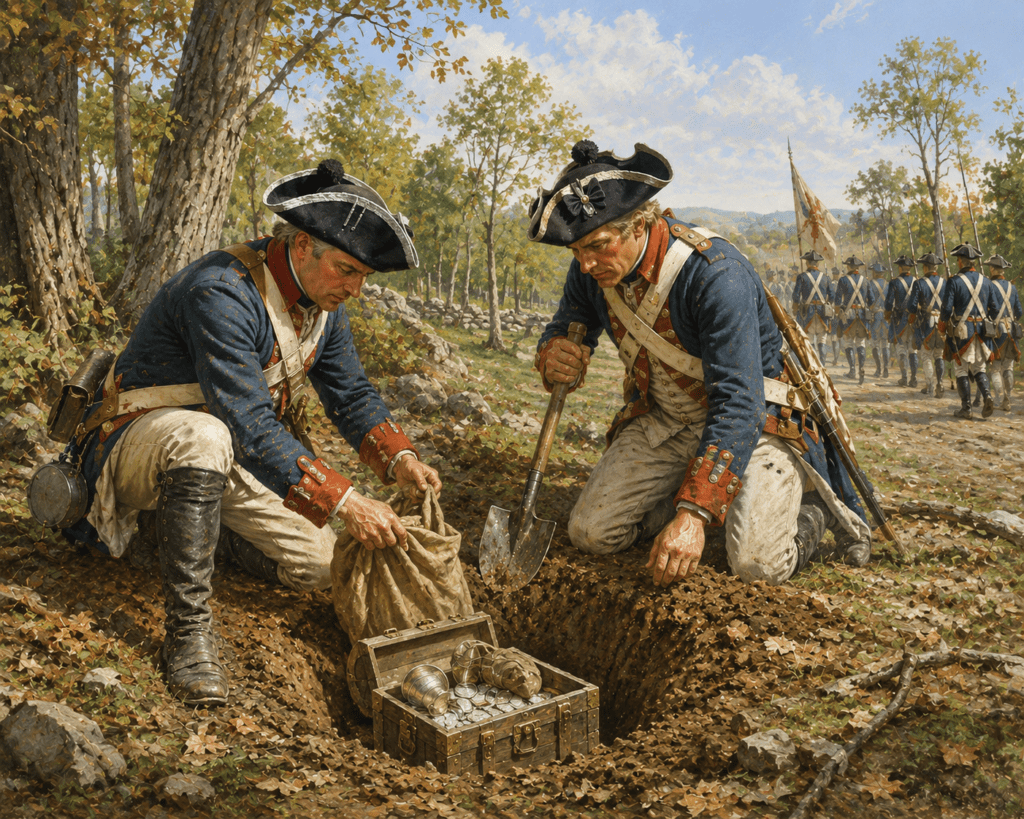
The Hessian Treasure Stories
Several legends claimed retreating Hessians buried gold, silver, or military payrolls before fleeing advancing American forces.
Generations of treasure hunters searched for these supposed caches.
Most were never found because they likely never existed.
Nevertheless, the stories endured.
Haunted Roads and Forests
Travelers in some regions reported seeing strange riders dressed in old military uniforms.
Others described hearing German voices carried on the wind.
Whether believed or not, such tales helped cement the Hessians’ place in American folklore.
From History to Myth
As decades passed, the historical Hessian gradually gave way to the legendary Hessian.
Facts became stories.
Stories became myths.
Myths became part of American culture.
This transformation represents one of the most important developments in Hessians in Popular Culture.
The process reached its most famous expression in the early nineteenth century when a young American author named Washington Irving introduced readers to a ghostly Hessian horseman who would become one of the most recognizable figures in American literature.
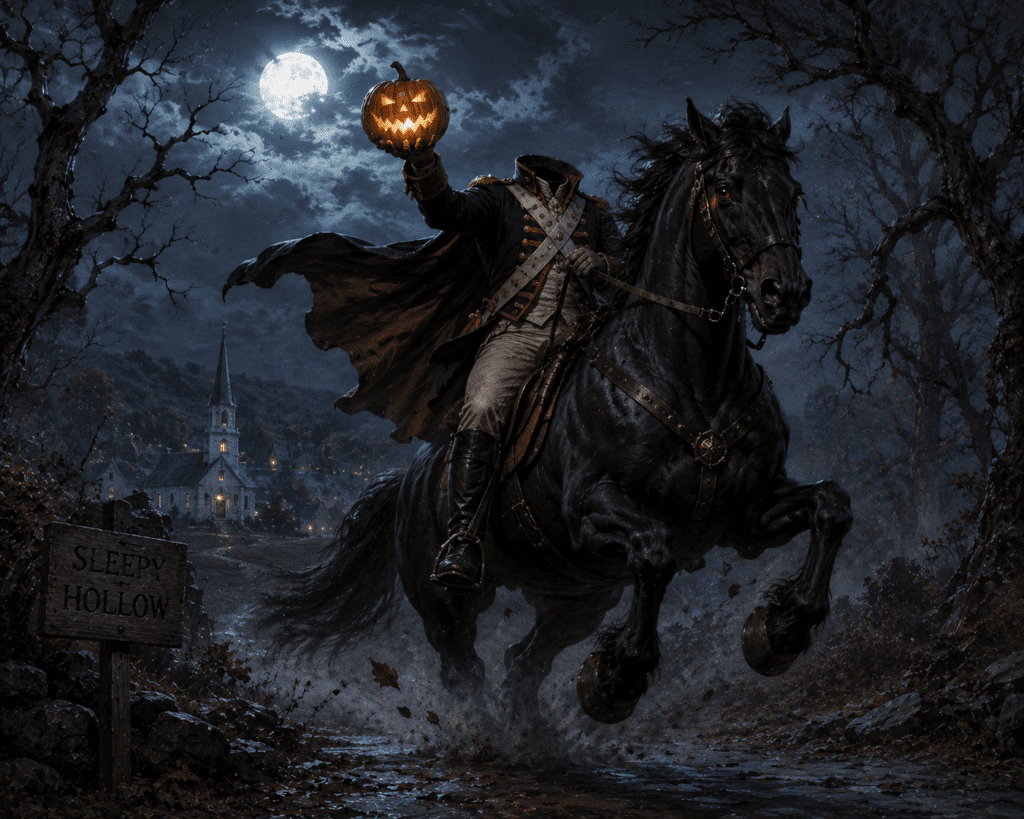
Sleepy Hollow and the Headless Horseman
No discussion of Hessians in Popular Culture would be complete without examining the most famous Hessian of them all.
Ironically, the best-known Hessian in American history never actually existed.
He was the fictional Headless Horseman created by Washington Irving in The Legend of Sleepy Hollow.
The Story That Made a Hessian Famous
In 1820, Washington Irving published The Legend of Sleepy Hollow as part of The Sketch Book of Geoffrey Crayon, Gent.
The story takes place in a quiet Dutch community along the Hudson River in New York.
Its central character is Ichabod Crane, a schoolmaster who encounters a terrifying supernatural figure known as the Headless Horseman.
A Hessian Cavalryman Without a Head
According to the legend, the ghost was once a Hessian soldier who fought for the British during the American Revolution.
During a battle, an American cannonball supposedly removed his head.
The horseman now rides through Sleepy Hollow each night searching for the missing part of his body.
Irving described him as a spectral Hessian trooper mounted on a powerful black horse.
Why Irving Chose a Hessian
Washington Irving could have selected almost any historical figure as the ghostly rider.
Instead, he chose a Hessian.
That decision reveals how deeply the Hessians had already entered American folklore by the early nineteenth century.
Foreign, Mysterious, and Familiar
To Irving’s readers, Hessians were ideal characters for ghost stories.
They were connected to a dramatic period in American history.
They were foreign enough to seem mysterious.
Yet they were familiar enough that readers immediately recognized the reference.
The Hessian already occupied a unique place between history and legend.
Revolutionary War Memories Still Lingered
When Irving wrote the story, the American Revolution was still within living memory.
Many readers personally knew veterans of the war.
Stories about Hessian soldiers continued to circulate throughout New York and New Jersey.
The Headless Horseman drew upon those existing traditions.
Was the Legend Based on a Real Hessian?
Historians have long debated whether Irving based the character on an actual soldier.
No definitive evidence has ever emerged.
Several battles occurred in the Hudson Valley during the Revolution, and Hessian troops served throughout the region.
However, no confirmed record exists of a Hessian cavalryman losing his head in the manner described by Irving.
A Blend of History and Folklore
Most scholars believe the Headless Horseman represents a combination of different influences.
Irving borrowed from European ghost stories.
He incorporated local Hudson Valley folklore.
He added Revolutionary War themes that American readers would immediately recognize.
The result was one of the most enduring characters in American literature.
From Local Legend to American Icon
The success of The Legend of Sleepy Hollow transformed the Hessian horseman into a cultural icon.
Generations of readers encountered Hessians for the first time through Irving’s story.
For many Americans, the Headless Horseman became more recognizable than any actual Hessian officer or soldier.
Adaptations Across Two Centuries
The story has been adapted countless times.
It has appeared in books, illustrations, stage productions, films, television programs, comic books, and animated features.
Each new adaptation introduced the Hessian horseman to another generation.
As a result, the fictional Hessian became far more famous than the historical men who inspired him.
The Hessian Who Never Dies
Most military units eventually fade into history.
The Hessians experienced something unusual.
One of their number became immortal through literature.
More than 200 years after Washington Irving first published his story, the Headless Horseman continues to ride through American culture.
His presence demonstrates the extraordinary influence of Hessians in Popular Culture and shows how folklore can preserve historical memory long after the facts themselves have been forgotten.
Beyond Sleepy Hollow
The Headless Horseman may be the most famous Hessian in American culture, but he was far from the only one.
Artists, illustrators, historians, and filmmakers continued to depict Hessian soldiers throughout the nineteenth and twentieth centuries.
Their work helped shape how later generations visualized the German soldiers of the American Revolution.
In the next section, we examine how Hessians appeared in paintings, illustrations, monuments, and historical artwork that preserved their image long after the war ended.
People Also Ask About the Hessian Headless Horseman
Was the Headless Horseman really a Hessian soldier?
According to Washington Irving’s The Legend of Sleepy Hollow, the Headless Horseman was the ghost of a Hessian cavalryman who lost his head to an American cannonball during the Revolutionary War. Historians have never found evidence that a specific Hessian soldier inspired the story, making the character a blend of folklore, local legends, and Revolutionary War history.
Why did Washington Irving choose a Hessian as the Headless Horseman?
Irving chose a Hessian because Hessian soldiers were already well known in American folklore by the early 1800s. Their foreign origins, distinctive uniforms, and association with the Revolutionary War made them ideal figures for a ghost story. Readers immediately recognized the Hessian as a mysterious outsider connected to a dramatic period in American history.
Did the Sleepy Hollow legend change how Americans remember the Hessians?
Yes. For many Americans, the Headless Horseman became their first introduction to Hessian soldiers. The enormous popularity of The Legend of Sleepy Hollow transformed the fictional Hessian horseman into one of the most recognizable figures in American literature, ensuring that Hessians remained a lasting part of American popular culture long after the Revolutionary War ended.
Hessians in Paintings, Illustrations, and Historical Art
Long before movies and television, Americans learned about history through paintings, engravings, illustrations, and monuments.
These visual representations played an important role in shaping Hessians in Popular Culture and influenced how generations of Americans imagined the German soldiers of the Revolutionary War.
The Challenge of Remembering the Hessians
Very few Americans ever saw a Hessian soldier in person.
Most people who lived after the Revolution relied on artists to show them what Hessians looked like.
As a result, artwork often became more influential than eyewitness accounts.
Art Shapes Historical Memory
Paintings do more than record events.
They help determine how future generations remember those events.
For many Americans, the image of a Hessian soldier came not from a history book but from a painting hanging in a museum or an illustration printed in a school textbook.
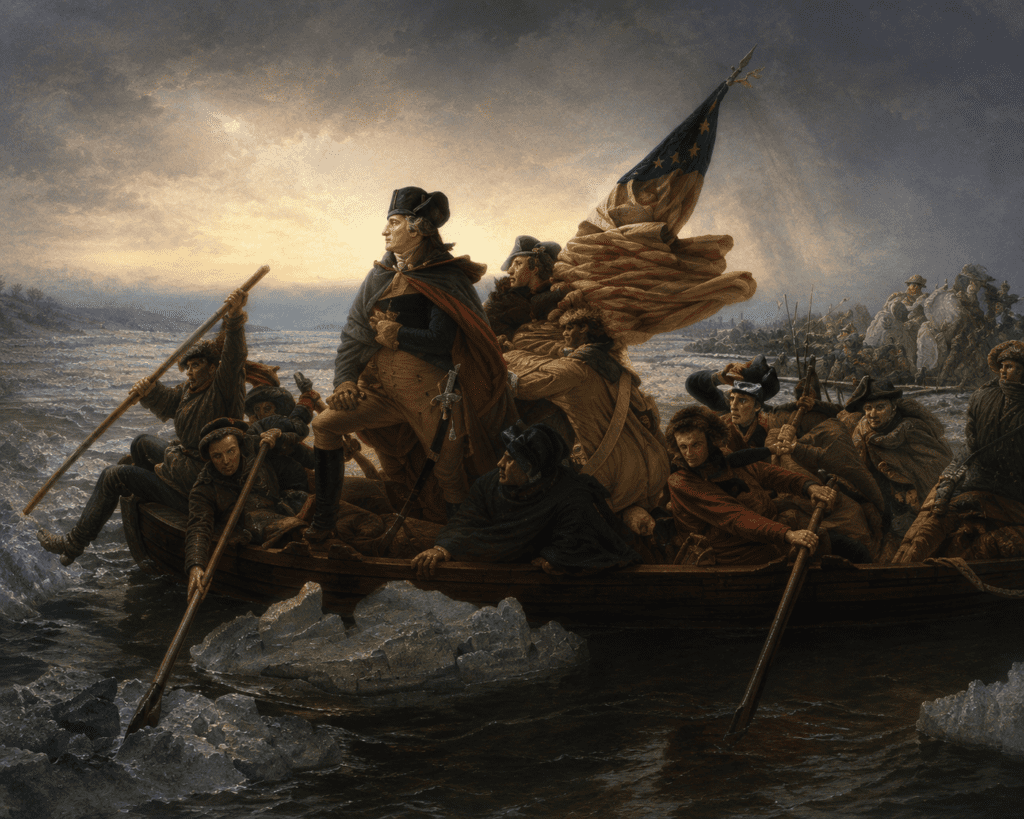
Early Revolutionary War Artwork
Artists who depicted the American Revolution frequently included Hessian soldiers in major battle scenes.
The Battle of Trenton was especially popular.
Hessians at Trenton
Numerous nineteenth-century paintings portrayed Washington’s surprise attack on Trenton.
These works often showed Hessians as disciplined professional soldiers caught in a sudden crisis.
Many artists emphasized their distinctive uniforms, brass-fronted caps, and European military appearance.
The visual contrast between Hessians and American militia made the scenes immediately recognizable.
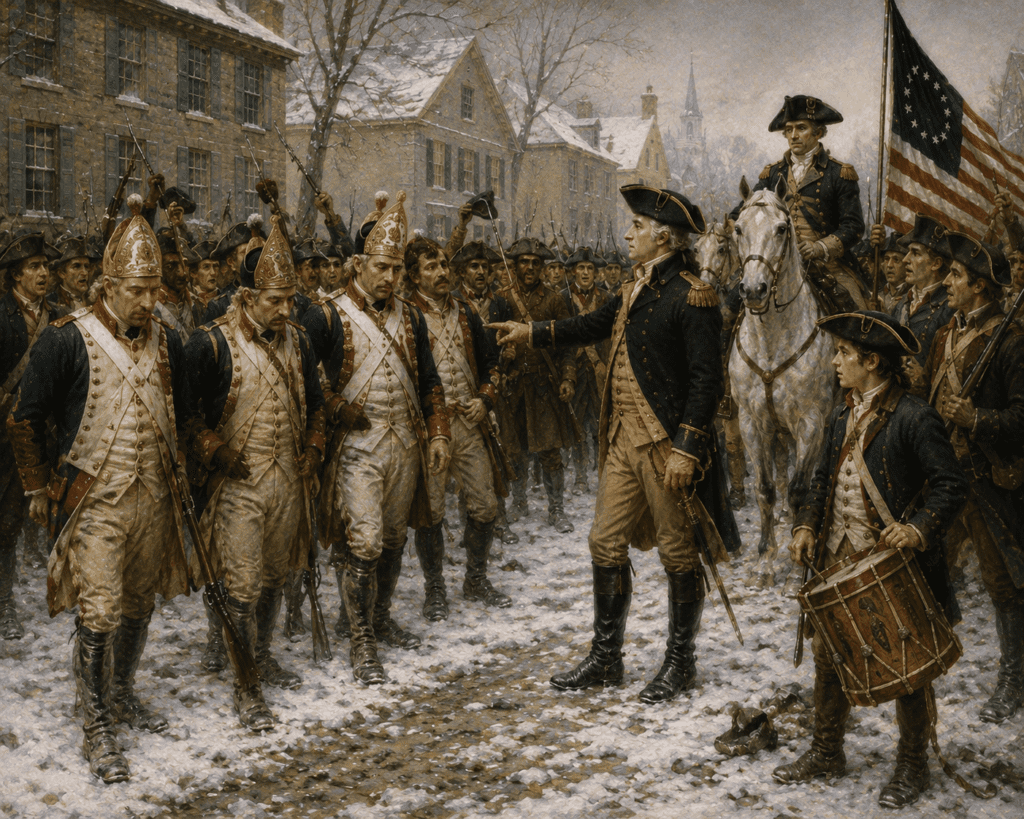
The Defeated Enemy
As American patriotic art developed, Hessians frequently appeared as symbols of British defeat.
Artists often depicted captured Hessian soldiers surrendering after Trenton or marching into captivity.
These images reinforced the importance of Washington’s victory.
Nineteenth-Century Illustrations
The nineteenth century witnessed an explosion in illustrated books and magazines.
Publishers frequently commissioned artwork depicting famous moments from the Revolution.
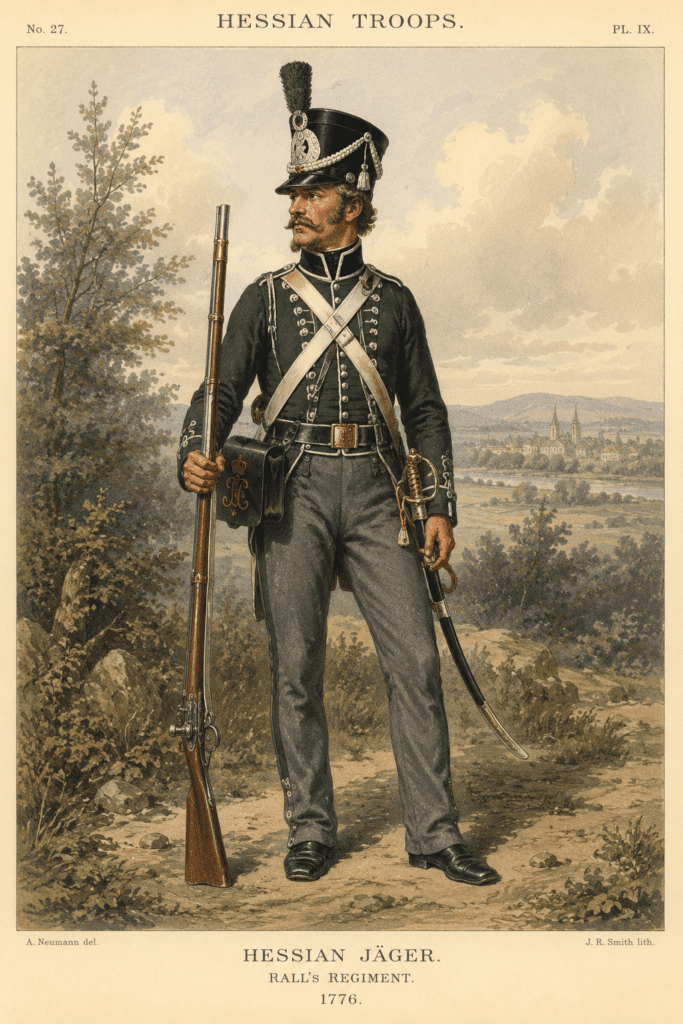
Harper’s Weekly and Historical Publishing
Popular magazines introduced millions of readers to illustrated scenes featuring Hessians.
Artists often relied on earlier paintings, military records, and their own imagination.
The result was a growing collection of images that helped define the public image of Hessian soldiers.
Creating the “Classic” Hessian Look
Many illustrations emphasized certain features repeatedly.
Artists highlighted military discipline, distinctive uniforms, mustaches, and formal European appearance.
Over time, these artistic choices created a recognizable visual stereotype that remains familiar today.
Hessian Uniforms Fascinated Artists
One reason Hessians appeared frequently in artwork was their striking appearance.
Their uniforms differed significantly from those worn by American soldiers.
Distinctive Military Fashion
Blue coats, colorful facings, polished equipment, and elaborate headgear made Hessians visually interesting subjects.
Artists appreciated the dramatic contrast between Hessian regulars and the more varied appearance of American forces.
The uniforms helped make Hessian figures stand out immediately in battle scenes.
Monuments and Historical Displays
As the United States approached the centennial of the Revolution in 1876, interest in Revolutionary history surged.
Museums, monuments, and historical societies began preserving artifacts connected to Hessian troops.
Museum Collections
Today, museums across the United States display Hessian weapons, uniforms, documents, and personal belongings.
These exhibits provide visitors with a more balanced view than earlier propaganda and folklore.
They help transform Hessians from legends back into real people.
Battlefield Interpretation
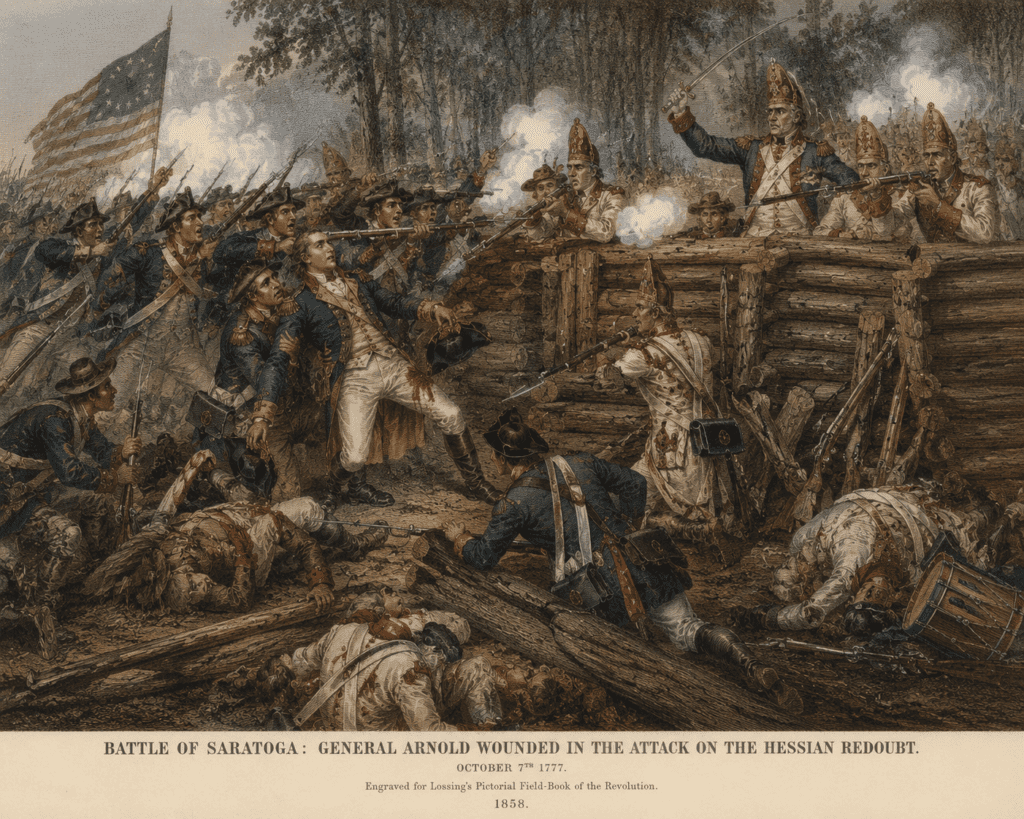
Historic sites such as Trenton, Saratoga, and other Revolutionary War locations often include Hessian perspectives in their exhibits.
Modern historians increasingly recognize that understanding the Revolution requires understanding the experiences of all participants.
From Villains to Historical Figures
The way artists portrayed Hessians changed over time.
Early images often reflected wartime hostility.
Later generations became more interested in accuracy and historical understanding.
A More Nuanced View
Modern artwork tends to present Hessians as professional soldiers caught in a complex international conflict.
Rather than depicting them solely as villains, many contemporary artists emphasize their humanity, military skill, and individual experiences.
This evolution reflects broader changes in how Americans remember the Revolutionary War.
Preserving the Image of the Hessians
Paintings, illustrations, museums, and monuments ensured that Hessian soldiers remained visible long after the war ended.
These visual representations became a crucial part of Hessians in Popular Culture.
They bridged the gap between history and memory, helping later generations visualize the German soldiers who fought in America’s struggle for independence.
In the next section, we examine how Hessians appeared in novels, films, television programs, and modern entertainment, where their image continued to evolve well into the twentieth and twenty-first centuries.
Hessians in Movies, Television, and Modern Entertainment
The image of the Hessian did not remain confined to history books and museum exhibits.
As new forms of entertainment emerged, Hessian soldiers found their way into movies, television programs, comic books, video games, and popular fiction.
These appearances introduced the Hessians to audiences who knew little about the American Revolution.
Early Hollywood and Revolutionary War Films
Hollywood filmmakers quickly discovered that Hessian soldiers made visually striking antagonists.
Their distinctive uniforms, foreign origins, and association with the British Army made them instantly recognizable on screen.
The Traditional Villain
Many early films followed the same pattern established by Revolutionary War propaganda.
Hessians were often portrayed as ruthless mercenaries serving an oppressive empire.
These portrayals frequently emphasized military discipline and foreignness while overlooking the complex reasons the soldiers found themselves in America.
Historical Accuracy Was Often Secondary
Filmmakers rarely worried about exact uniform details or the political realities of eighteenth-century Germany.
The goal was entertainment rather than historical scholarship.
As a result, movie Hessians sometimes resembled popular stereotypes more than actual soldiers.
The Enduring Influence of Sleepy Hollow
No Hessian has appeared more often in modern entertainment than the Headless Horseman.
Washington Irving’s fictional cavalryman continues to inspire new adaptations.
Disney Introduces a New Generation
In 1949, Walt Disney released The Adventures of Ichabod and Mr. Toad.
The animated adaptation introduced millions of children to the Hessian Headless Horseman.
For many Americans, this became their first encounter with a Hessian soldier.
Modern Film Adaptations
Tim Burton’s 1999 film Sleepy Hollow revived interest in the legend.
The film presented the Headless Horseman as a terrifying supernatural Hessian cavalryman whose image became deeply embedded in modern popular culture.
The character remains one of the most recognizable figures associated with the Revolutionary War.
Hessians in Television
Television programs have also contributed to the public image of Hessian soldiers.
Historical dramas, documentaries, and educational programming frequently include Hessian characters.
Revolutionary War Documentaries
Modern documentaries often present a more balanced interpretation than earlier films.
Historians increasingly emphasize that Hessians were professional soldiers rather than simple villains.
This approach has helped audiences better understand their role in the war.
Fictional Portrayals
Television dramas often continue to use Hessians as symbols of danger, mystery, or military authority.
While entertaining, these portrayals sometimes blur the line between historical fact and fiction.
Hessians in Video Games and Popular Media
The digital age introduced Hessians to entirely new audiences.
Video games set during the American Revolution frequently include Hessian soldiers as opponents or historical characters.
Bringing History to Life
Game designers often recreate Hessian uniforms, weapons, and military formations with impressive detail.
Players encounter Hessians on battlefields, in historical campaigns, and during interactive recreations of Revolutionary War events.
Fact and Fiction Combined
As with films and television, games often mix historical reality with dramatic storytelling.
The result is another chapter in the continuing evolution of Hessians in Popular Culture.
A Changing Image
Perhaps the most important trend in recent decades is the growing effort to portray Hessians as real people.
Historians have uncovered diaries, letters, military records, and personal accounts that reveal the experiences of individual soldiers.
From Stereotypes to Human Stories
Modern audiences are increasingly interested in understanding the men behind the uniforms.
Many were farmers, craftsmen, laborers, husbands, and fathers who found themselves fighting in a distant war.
This perspective has gradually replaced some of the older stereotypes.
The Hessians Become Part of the American Story
Today, Hessians are often viewed not simply as enemies of the Revolution but as participants in a shared history.
Some eventually settled in America.
Others left descendants who became part of the nation’s story.
Their legacy extends far beyond the battlefield.
Popular Culture Keeps the Hessians Alive
Without novels, artwork, films, television programs, museums, and historical reenactments, many Americans might never hear of the Hessians at all.
Popular culture has preserved their memory for more than 250 years.
Whether portrayed as villains, ghosts, professional soldiers, or immigrants, the Hessians remain firmly embedded in American historical consciousness.
Their continued presence in entertainment demonstrates the remarkable staying power of Hessians in Popular Cultureand explains why these German soldiers remain familiar long after the Revolutionary War passed into history.
Famous Film and Television Depictions of Hessians
While Hessian soldiers appear less frequently on screen than British redcoats or Continental Army soldiers, they continue to occupy a unique place in historical dramas, documentaries, and folklore-based entertainment.
Their portrayals generally fall into two categories.
Some productions attempt to present Hessians as professional soldiers operating within the realities of the Revolutionary War.
Others embrace the darker folklore and propaganda traditions that depicted Hessians as frightening foreign mercenaries.
The Crossing (2000)
One of the most respected portrayals of Hessian soldiers appeared in The Crossing, an A&E television film starring Jeff Daniels as George Washington.
The movie focuses on Washington’s desperate decision to cross the Delaware River and attack the Hessian garrison at Trenton.
A More Nuanced View of the Hessians
Unlike many earlier productions, The Crossing portrays the soldiers of the Rall Regiment as disciplined and experienced professionals rather than cartoon villains.
The film presents the Battle of Trenton as a clash between a desperate Continental Army and a highly trained European military force caught by surprise.
TURN: Washington’s Spies (2014–2017)
AMC’s historical drama TURN: Washington’s Spies examined intelligence operations and military affairs during the Revolutionary War.
The series regularly included German auxiliary troops serving with British forces.
Accurate Depictions of the Jägers
One of the strengths of the series was its portrayal of Hessian Jäger units.
The production accurately depicted their green uniforms, rifles, and specialized role as scouts, skirmishers, and advance guards.
For many viewers, the series provided a rare look at the diversity of German troops serving in America.
Revolution (1985)
The film Revolution, starring Al Pacino, presented a much grittier interpretation of the war.
Set during the major campaigns around New York, the movie emphasized the chaos and brutality experienced by ordinary people caught in the conflict.
The Fear of European Regulars
In the film, Hessians appear as disciplined formations of professional soldiers whose training and battlefield experience dwarf that of many colonial militia forces.
The portrayal helps modern viewers understand why the arrival of Hessian troops caused such concern among American colonists in 1776.
Hessians in Horror and Folklore
Not all portrayals of Hessians focus on military history.
Some draw directly from the myths and legends that emerged after the Revolution.
Sleepy Hollow (1999)
Tim Burton’s gothic horror adaptation of Sleepy Hollow remains one of the most famous Hessian portrayals in modern cinema.
Christopher Walken appears as the Hessian Horseman before his death and supernatural return.
The Ultimate Propaganda Villain
The film embraces the terrifying image of the Hessian found in Revolutionary-era folklore.
Walken’s horseman is depicted as a savage warrior who appears to enjoy violence for its own sake.
The portrayal mirrors many of the exaggerated stories that Patriot newspapers circulated during the war.
1776, or The Hessian Renegades (1909)
One of the earliest films ever made about the American Revolution was D.W. Griffith’s silent short The Hessian Renegades.
The film reflected nineteenth-century American attitudes toward Hessians more than historical reality.
Hessians as Melodramatic Villains
The German soldiers are portrayed as ruthless enemies who threaten Patriot civilians and pursue American messengers.
While historically simplistic, the film demonstrates how deeply Revolutionary War propaganda influenced early American cinema.
Modern Documentary Perspectives
Recent documentary filmmakers have generally moved away from the older stereotypes.
Instead, they focus on the actual experiences of Hessian soldiers and their role in the war.
Ken Burns’ The American Revolution (2025–2026)
Ken Burns’ documentary series devoted substantial attention to the New York campaign, Trenton, Princeton, and the experiences of German troops in America.
Looking Beyond the Myths
Drawing from letters, diaries, and military records, the documentary portrays Hessians as individuals rather than stereotypes.
Viewers learn about farmers, craftsmen, and laborers who suddenly found themselves fighting on another continent.
The series reflects the continuing evolution of Hessians in Popular Culture, moving from wartime propaganda and folklore toward a more complete historical understanding.
The Hessians on Screen
Taken together, these films and television programs reveal how the image of the Hessian has changed over time.
Some productions continue to portray them as terrifying mercenaries.
Others present them as professional soldiers trapped in a conflict not entirely of their own making.
Both approaches reflect the enduring influence of Hessians in Popular Culture and demonstrate how a group of German soldiers from the eighteenth century continues to fascinate audiences more than 250 years later.
How Americans Remember the Hessians Today
More than 250 years after the American Revolution, the Hessians occupy a unique place in American historical memory.
They are remembered simultaneously as enemies, immigrants, professional soldiers, folklore figures, and ancestors.
Few groups from the Revolutionary War have undergone such a dramatic transformation in public perception.
From Foreign Mercenaries to Historical Figures
During the Revolution, many Americans viewed Hessians through the lens of wartime propaganda.
Patriot newspapers frequently portrayed them as foreign mercenaries sent by King George III to crush American liberty.
Over time, however, historians gained access to letters, diaries, military records, and personal accounts that revealed a far more complex story.
A More Human Perspective
Modern Americans increasingly see Hessians as individuals rather than stereotypes.
Many were farmers, craftsmen, laborers, and tradesmen who had little control over the political decisions that sent them across the Atlantic.
Their surviving writings reveal concerns about family, food, weather, military service, and the uncertainty of life in a distant land.
Hessian Descendants Across America
One reason interest in Hessians remains strong is that thousands never returned to Germany.
Many settled permanently in North America after the war.
Others deserted and joined existing German-speaking communities in Pennsylvania, New York, Maryland, and elsewhere.
Family Histories Continue the Story
Today, countless Americans can trace at least part of their ancestry to German soldiers who served during the Revolution.
Genealogists regularly uncover Hessian connections through military records, church registers, land records, and family Bibles.
For many descendants, discovering a Hessian ancestor transforms a distant historical event into a personal family story.
Museums and Historic Sites
Modern museums have played an important role in reshaping public understanding of the Hessians.
Rather than presenting them solely as enemies, exhibits increasingly explore their experiences and contributions.
Preserving Hessian Artifacts
Uniforms, weapons, letters, maps, and personal belongings help visitors understand the daily lives of Hessian soldiers.
These objects reveal individuals rather than caricatures.
They also demonstrate the professionalism and military skill that made Hessian units among the most respected troops in the British Army.
Revolutionary War Battlefields
Sites such as Trenton, Princeton, Saratoga, and Yorktown regularly interpret events from both American and Hessian perspectives.
Visitors are encouraged to understand the experiences of all participants in the conflict.
Living History and Reenactments
Reenactors have become some of the most visible ambassadors of Hessian history.
Across the United States, living-history groups portray Hessian infantry, artillery, grenadiers, and Jägers at public events.
Bringing the Past to Life
These programs allow visitors to see uniforms, equipment, and military drill firsthand.
They help separate historical reality from centuries of myth and folklore.
Many Americans encounter Hessian history for the first time through reenactment events.
The Hessians and Genealogy
The growth of online genealogy and DNA testing has created renewed interest in Hessian soldiers.
Many families discover German ancestors and begin investigating whether a Revolutionary War connection exists.
Family Bibles and Military Records
Researchers often uncover clues in old family documents.
Church records, military rolls, immigration records, and family Bibles frequently provide the evidence needed to connect a modern family to an eighteenth-century Hessian soldier.
For some Americans, the search becomes a journey through both family history and Revolutionary War history.
A Legacy Larger Than the War
The most remarkable aspect of Hessians in Popular Culture may be the fact that they are remembered at all.
Most auxiliary troops in history disappear into obscurity after the wars they fought.
The Hessians followed a different path.
Through propaganda, folklore, literature, art, film, genealogy, and historical preservation, they became permanent figures in the American story.
The Hessians in American Memory
Today, the Hessians are no longer viewed solely as the enemy.
They are remembered as soldiers, immigrants, settlers, and participants in one of the most important events in American history.
Their story demonstrates how historical memory evolves over time.
The Hessians who arrived in America as foreign troops in 1776 eventually became part of the nation they were sent to defeat.
That transformation may be the most enduring legacy of all.
Hessians in German Memory: Returning Home After the American Revolution
While Americans were creating stories, legends, and paintings about the Hessians, people in Germany were forming their own opinions about the war and the men who fought it.
For returning soldiers, the journey home was often more complicated than the voyage to America.
Returning to a Changed Homeland
Thousands of Hessians eventually returned to Hesse-Kassel and the other German states after the war ended.
Many had spent years overseas.
Some had traveled farther than anyone in their villages had ever gone.
Others returned carrying stories of fertile farmland, abundant food, and opportunities unavailable at home.
America Left a Lasting Impression
Many returning soldiers spoke of the vast forests, rich farmland, and relative freedom they had encountered in North America.
Letters written during the war often expressed admiration for American farms and living conditions.
For some veterans, Germany seemed smaller and more restrictive after their experiences abroad.
Were Returning Hessians Considered Failures?
Surprisingly, most returning Hessians were not treated as failures.
The soldiers had generally fulfilled their military obligations.
The defeat of Britain was not viewed as their personal responsibility.
Military Service Was Their Duty
Most Hessians considered themselves professional soldiers serving under lawful orders.
Whether Britain won or lost was largely beyond their control.
Returning veterans resumed their lives much as soldiers had done after previous European wars.
Families Wondered Why So Many Never Returned
One of the greatest mysteries for many German communities was the large number of soldiers who remained in America.
Thousands never came home.
Some died.
Others deserted.
Many simply chose to stay.
The Missing Men
Families often waited years for news.
Parents, spouses, and siblings sometimes never learned exactly what happened to a loved one.
In some villages, former soldiers effectively disappeared from the historical record after leaving for America.
The Veterans Who Chose America
Reports from returning soldiers helped spread stories about opportunities across the Atlantic.
Veterans described inexpensive land, economic freedom, and growing German-speaking communities.
America as a Land of Opportunity
Many Hessians had come from regions where land ownership was difficult for ordinary people.
In America, land could sometimes be acquired through work, purchase, or settlement opportunities.
These stories helped create interest in future emigration.
Did Hessians Encourage Later German Immigration?
Many historians believe the Hessians served as an early bridge between Germany and America.
Their letters and stories provided information that later immigrants could use.
The First Wave Before the Great Wave
The massive German immigration of the nineteenth century would not begin for decades.
Yet Hessian soldiers were among the first large groups of Germans to experience life in North America firsthand.
Their accounts helped create awareness of America long before the great immigration waves of the 1800s.
Hessians in German Historical Memory
For many years, the Hessian experience in America occupied only a small place in German history.
The unification of Germany, the Napoleonic Wars, and later European conflicts overshadowed the Revolutionary War.
A Different Perspective
Americans remembered the Hessians because they fought in the Revolution.
Germans remembered them as soldiers who had served overseas in one of many eighteenth-century wars.
As a result, the Hessians became much more prominent in American memory than in German memory.
Two Different Legacies
In the United States, Hessians became characters in folklore, paintings, novels, and movies.
In Germany, they were more often remembered through military records, family histories, and local village traditions.
The same soldiers created two very different historical legacies on opposite sides of the Atlantic.
The Ultimate Irony
Perhaps the greatest irony of all is that many Hessians who remained in America eventually became Americans themselves.
Their descendants fought in later American wars, farmed American land, built American towns, and helped shape the nation.
The men once hired to suppress the Revolution ultimately became part of the society that emerged from it.
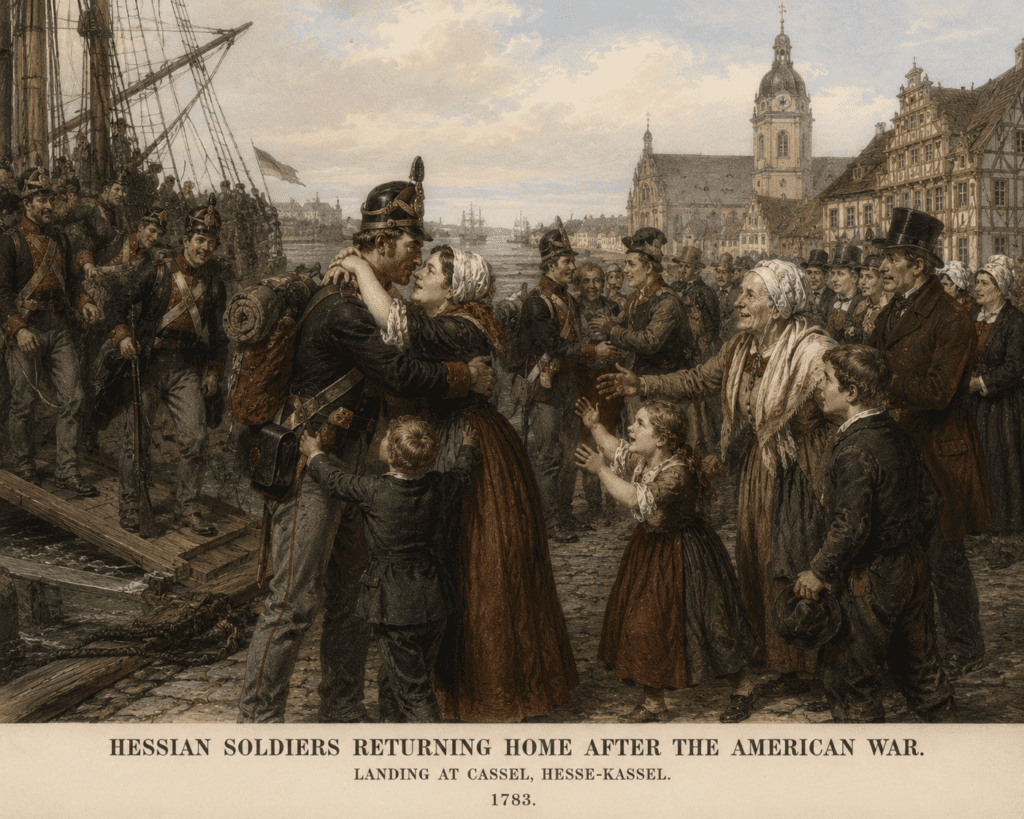
How German Newspapers Reported the Return of the Hessians
While Americans were celebrating independence and debating the meaning of the Revolution, newspapers in Hesse-Kassel and other German states reported the return of the auxiliary troops in a very different way.
The reports that survive today provide a fascinating glimpse into how German rulers wanted the war to be remembered.
Official Newspapers Told an Official Story
Most newspapers in the German principalities were tightly controlled by the state.
Unlike American newspapers, which openly argued politics and criticized public officials, publications such as the Casselische Zeitung generally reflected the views of the ruling government.
As a result, coverage of returning Hessian soldiers resembled official announcements more than modern journalism.
A Carefully Choreographed Homecoming
Newspaper reports emphasized ceremony, order, and loyalty.
Articles described soldiers marching home beneath regimental colors, public celebrations, church services, military reviews, and formal receptions by government officials.
The focus was on discipline and faithful service rather than military defeat.
In many accounts, the return of the troops was presented as a successful conclusion to a difficult overseas assignment.
What the Newspapers Did Not Say
The most revealing aspect of the surviving newspaper accounts may be what they omitted.
Official reports rarely discussed the human cost of the war.
The Missing Thousands
Thousands of Hessian soldiers never returned to Germany.
Some died in battle.
Many succumbed to disease.
Others deserted or chose to settle permanently in North America.
The official newspapers generally avoided highlighting the scale of these losses.
Wounds, Disability, and Trauma
The returning formations presented in official reports projected military order and discipline.
Less visible were the veterans who returned with amputations, chronic illness, or psychological scars from years of campaigning overseas.
Many required long-term support from state pension systems.
Reading Between the Lines
For historians, the surviving newspapers must be read alongside personal diaries, letters, and military records.
When combined, these sources reveal two very different versions of the same story.
The official press emphasized loyalty and successful repatriation.
Private writings often described hardship, loss, homesickness, and uncertainty about the future.
The Soldiers Who Chose America
Perhaps the most difficult subject for state-controlled newspapers was the large number of men who never came back.
Many Hessians had discovered opportunities in America that simply did not exist at home.
Cheap land, economic opportunity, and established German-speaking communities encouraged thousands to remain behind.
Their decision helped create one of the earliest direct links between Germany and the future United States.
A Different Voice Emerges
Not all German writers accepted the official narrative.
Outside the states that supplied troops, some intellectuals and former soldiers openly criticized the practice of renting armies to foreign powers.
Among the most notable was Johann Gottfried Seume, who later wrote critically about military service and the experiences of German soldiers sent abroad.
These alternative voices offered a stark contrast to the carefully managed accounts appearing in official state newspapers.
The American Revolution ended in 1783, but for thousands of Hessian soldiers the story was not over.
When the surviving regiments finally returned home, newspapers in Hesse-Kassel reported the event very differently than newspapers in America or Britain. Because the Landgrave's government tightly controlled the press, reports focused on loyalty, discipline, and celebration rather than casualties, desertion, or the hardships of the war.
The official newspaper of Hesse-Kassel, the Casselische Zeitung, portrayed the homecoming as a triumph worthy of public admiration.
Read a Translated Newspaper Report from October 1783
CASSELISCHE ZEITUNG
MID-OCTOBER REPORT, 1783
CASSEL, October 14.
With the most profound Joy and deepest Gratitude toward the Almighty, this Capital has witnessed the glorious and orderly Return of our brave Troops, who have for these several Years past gathered such immortal Laurels while serving His Britannic Majesty in the North American Campaigns.
On the morning of the 10th, the highly esteemed Regiment von Ditfurth, alongside the remnants of the gallant Grenadier Battalions, made their formal Entry through the city gates. Despite the long and treacherous Voyage across the Great Ocean from New-York, and the subsequent March from the ports of the Weser, the Men presented an Appearance of the highest Military Precision and unimpeachable Discipline, which did strike all Spectators with Admiration.
His Serene Highness, our beloved Landgrave, accompanied by his most distinguished Generals and the glittering Court, did review the Columns upon the grand Parade-platz. The Regiments, having preserved their military Order through so many severe Trials in the Wilderness, maneuvered with the exactitude of a peacetime Review.
With immense Solemnity, the weathered Regimental Colors—honored and defended through numerous Engagements against the American Rebels—were formally returned and presented to His Serene Highness, who expressed his highest Approbation and satisfaction with the unwavering Fidelity, Courage, and good Conduct of his Soldiers.
Following the Review, a grand Service of Thanksgiving was celebrated in the Court Chapel, where prayers were offered for the preservation of these brave Men and the continued Prosperity of our State under the wise and benevolent Rule of His Serene Highness.
By special Command, those Men who have returned with Wounds or Infirmities suffered in the Field shall immediately receive the compassionate Care of the State Foundations, while the healthy non-commissioned Officers and Privates shall be granted a temporary Furlough to return to their native Districts and assist in the harvest, carrying with them the Pride of having served their Sovereign with the highest Honour on the distant shores of the New World.
The Citizens assembled in great Number throughout the principal Streets and public Squares, expressing the warmest Sentiments toward these faithful Defenders of the State. Many Families were observed rejoicing at the long-awaited Return of Sons, Brothers, and Fathers who had for so many Years been absent beyond the Ocean in the Service of their Prince.
The Military Bands performed throughout the Day, and numerous Houses displayed Illuminations in Honour of the returning Troops. The orderly Conduct and excellent Bearing of the Men were universally remarked upon by all Persons present.
His Serene Highness was pleased to declare that the Fidelity and steadfast Service rendered by these brave Regiments in the North American Campaigns shall forever remain a source of Honour to this Landgraviate and a shining Example of Duty to future Generations.
Thus concluded a Day of public Thanksgiving and Celebration, in which the Blessings of Divine Providence were acknowledged and the safe Return of so many faithful Soldiers was received with Gratitude by the Government and People alike.
🔍 Reading Between the Lines
The Missing Half: The article praises the returning soldiers but never mentions how many failed to return. Thousands died from disease, combat, or chose to remain permanently in North America. Many regiments returned at only a fraction of their original strength.
The Black Hessians: Contemporary observers noted that some returning units included Black Loyalists and former enslaved individuals who had accompanied the regiments from America. Official newspaper reports largely ignored this remarkable detail.
The Harvest Problem: The order directing soldiers to help with the harvest was practical economics. Hesse-Kassel needed labor, and the government wanted returning veterans quickly reintegrated into civilian life while reducing the cost of supporting thousands of idle soldiers.
What Was Not Discussed: The newspapers emphasized discipline and loyalty but largely avoided discussing amputations, disease, trauma, desertions, and the thousands of soldiers who never came home.
Historical Significance: While Americans remembered the Hessians through battles, folklore, and the Headless Horseman, the official press in Hesse-Kassel presented their return as a triumphant homecoming. The contrast reveals how the same historical event could be remembered in dramatically different ways on opposite sides of the Atlantic.
People Also Ask About Returning Hessian Soldiers
Were widows compensated if their Hessian soldier husband was killed in America?
In most cases, no. Ordinary Hessian soldiers’ widows generally did not receive automatic death benefits or long-term compensation from the state. Military pensions and survivor benefits were typically reserved for officers, senior officials, or special cases involving severe hardship. As a result, many widows relied on family members, local church support, or remarriage to survive economically after losing a husband in the war.
Did Hessian soldiers who returned from America ever have to fight again?
Yes. Returning Hessian soldiers remained subjects of their rulers and could be recalled for future military service. Many veterans returned to civilian life, but some later served during conflicts associated with the French Revolutionary Wars and the Napoleonic era. Younger veterans, in particular, often found themselves back in uniform as Europe entered another generation of warfare after 1789.
Could a Hessian soldier’s wife remarry if her husband was missing in America?
Yes, but the process could be lengthy and complicated. In most German states, a wife could not simply assume her missing husband was dead. Local authorities, churches, and courts often required evidence of death or a prolonged period without news before declaring a soldier legally deceased. Once that declaration was made, the widow was generally free to remarry. For families whose husbands disappeared through desertion or settlement in America, uncertainty sometimes lasted for many years.
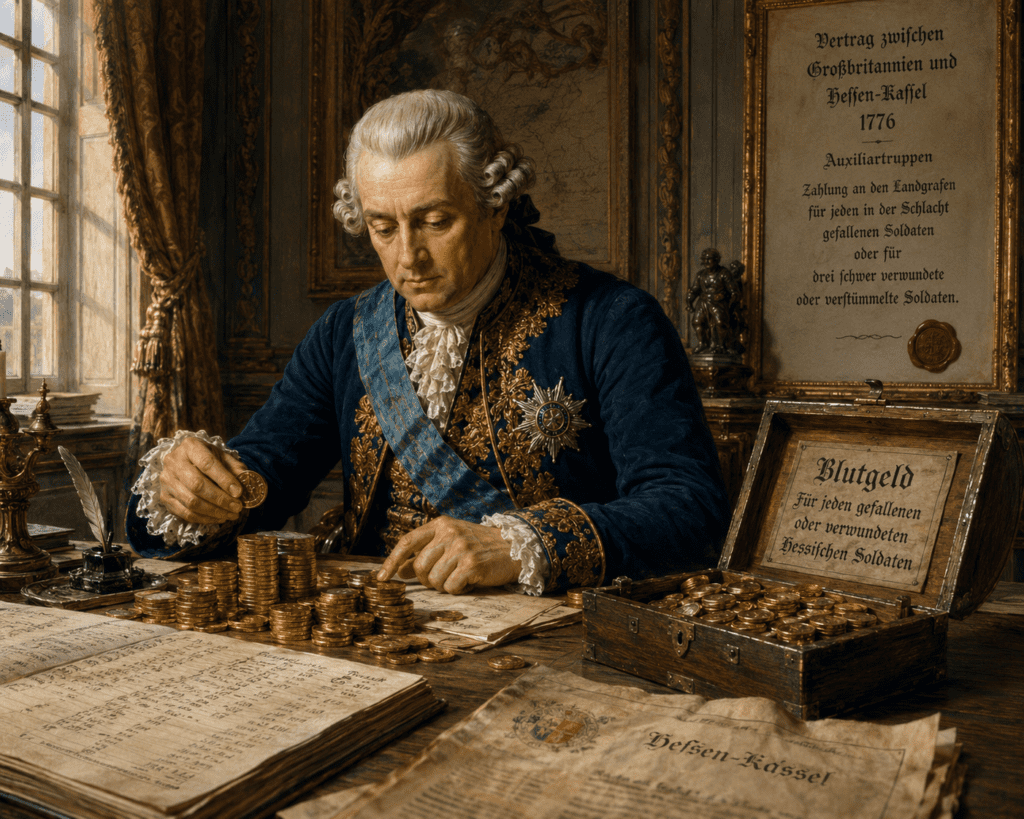
One of the strangest twists in Hessian history occurred long after the American Revolution ended.
Landgrave Friedrich II of Hesse-Kassel earned enormous revenues by supplying German auxiliary troops to Great Britain during the Revolutionary War. The subsidies, recruitment payments, and casualty compensation clauses paid by Britain brought millions of thalers into the treasury of Hesse-Kassel.
To many Americans of the era, Friedrich II became the very symbol of the "soldier trade"—a ruler willing to rent his subjects to a foreign power in exchange for money.
The irony?
Within a few generations, descendants of the very ruling family that profited from sending Hessian soldiers to America began emigrating to the United States themselves.
Members of collateral branches connected to the House of Hesse, including descendants associated with the line of Friedrich II's son, Wilhelm IX (later Elector Wilhelm I), eventually settled in North America carrying family wealth, education, and connections that had been accumulated during the same era that produced the Hessian treaties.
Meanwhile, thousands of ordinary Hessian soldiers had already made the same journey decades earlier.
Some deserted during the war. Others accepted discharge in North America. Many settled in Pennsylvania, New York, Maryland, Virginia, and the frontier regions that would later become part of the expanding United States.
Their children became farmers, craftsmen, merchants, soldiers, and citizens of the new republic.
Over time, they married into English, Dutch, Scots-Irish, French, and other German immigrant families. Their descendants fought in later American wars, helped build towns and businesses, cleared farmland, and contributed to the growth of the nation.
A Historical Paradox
In 1776, Hessian soldiers arrived in America as foreign troops hired to suppress the rebellion.
By the nineteenth century, many of their descendants were voting in American elections, serving in American militias, and participating in the country's westward expansion.
Even members of the ruling family connected to Hesse-Kassel eventually found their way to the United States.
The ultimate irony is difficult to miss: money earned by sending Hessian soldiers to America helped support a dynasty whose descendants would later become part of the very nation those soldiers had been sent to defeat.
History rarely produces a more remarkable reversal. The Hessians arrived as outsiders in 1776, but over the generations they became woven into the fabric of American life, transforming from foreign auxiliaries into Americans themselves.
The Hessians and America’s Changing Historical Memory
The story of the Hessians demonstrates how historical memory changes over time.
The men who landed on Staten Island in 1776 were viewed very differently by each generation that followed.
The Revolutionary Generation Saw an Enemy
To Americans living through the Revolution, the Hessians represented a frightening reality.
They were foreign soldiers hired by the British government to suppress a colonial rebellion.
Patriot newspapers portrayed them as dangerous mercenaries who threatened American liberty.
Wartime Propaganda Shaped Public Opinion
Many Americans never encountered a Hessian soldier personally.
Instead, they learned about them through newspapers, broadsides, sermons, and political speeches.
These sources often exaggerated Hessian brutality to strengthen support for independence.
The Nineteenth Century Turned Hessians into Legends
After the Revolution faded into history, the Hessians became figures of folklore and literature.
Washington Irving’s Headless Horseman transformed one fictional Hessian into one of the most famous characters in American culture.
History Became Myth
As eyewitnesses died, stories grew larger.
Ghost tales, buried treasure legends, and local folklore replaced firsthand knowledge.
The Hessian became both a historical figure and a folk character.
The Twentieth Century Rediscovered the Soldiers
Historians eventually began studying the surviving diaries, letters, and military records left behind by Hessian troops.
These sources revealed people rather than stereotypes.
Real Men Behind the Uniforms
Researchers discovered soldiers worrying about food, weather, family, pay, and survival.
The letters revealed humor, homesickness, fear, and admiration for aspects of American life.
The image of the Hessian began to shift once again.
The Twenty-First Century Seeks Balance
Today, historians generally reject both extremes.
The Hessians were neither bloodthirsty monsters nor misunderstood heroes.
They were professional soldiers serving under the political systems of eighteenth-century Europe.
A More Complete Picture
Modern scholarship attempts to understand the Hessians within the context of their own time.
Many were conscripted.
Others volunteered.
Some remained loyal to their German rulers while others embraced America and never returned home.
Why Americans Still Remember the Hessians
Most foreign auxiliary forces disappear from public memory once a war ends.
The Hessians proved to be an exception.
Their distinctive uniforms, dramatic role in the Revolution, connection to Trenton and Saratoga, appearance in folklore, and eventual assimilation into American society gave them an unusually long afterlife.
More Than Soldiers
The Hessians became symbols.
At different times they represented tyranny, military professionalism, immigration, folklore, and cultural assimilation.
Few groups from the Revolutionary War have occupied so many different roles in the American imagination.
A Legacy That Endures
More than 250 years after their arrival, Hessians remain visible in museums, books, films, historical reenactments, genealogy research, and popular culture.
Their story continues to fascinate Americans because it combines war, immigration, folklore, and identity into a single narrative.
The Hessians may have arrived as foreign soldiers, but history ultimately transformed them into part of the American story itself.
Conclusion: The Hessians Who Refused to Be Forgotten
When the first Hessian soldiers stepped ashore on Staten Island in August 1776, few could have imagined that their story would still be discussed more than two and a half centuries later.
They arrived as foreign auxiliaries in British service, viewed by many Americans as symbols of royal oppression and military power. Patriot newspapers transformed them into villains, while later generations turned them into ghosts, treasure hunters, and legendary figures of folklore.
Yet the real Hessians were far more complicated than the myths that surrounded them.
They were farmers, craftsmen, laborers, fathers, sons, and professional soldiers who found themselves fighting in a distant land they had never expected to see. Their letters and diaries reveal not monsters, but ordinary people attempting to survive extraordinary circumstances.
Over time, American memory of the Hessians evolved dramatically. The feared mercenaries of Revolutionary propaganda became the Headless Horseman of Sleepy Hollow, subjects of famous paintings, characters in films and television programs, and eventually figures of historical curiosity and scholarly research.
Perhaps the greatest irony of all is that many Hessians never left America. Some deserted, others accepted discharge, and many chose to build new lives in the very nation they had been sent to help defeat. Their descendants blended into the fabric of American society, contributing to the growth and development of the country for generations.
Today, the Hessians occupy a unique place in American historical memory. They are remembered not only as soldiers of the Revolutionary War but also as immigrants, ancestors, folklore figures, and participants in the broader story of the United States.
The evolution of their image—from feared foreign troops to enduring cultural icons—demonstrates how history and memory are rarely the same thing. The Hessians who once marched beneath the banners of German princes ultimately became part of both German and American history.
More than 250 years later, they remain among the most recognizable and fascinating participants in the American Revolution, proving that some stories continue long after the battles have ended.
The Hessians arrived in America as foreign soldiers hired to fight against the Revolution. Yet their story did not end when the war ended.
Thousands remained behind, married American women, purchased farmland, opened businesses, and raised families whose descendants spread across the growing United States. Former Hessian soldiers helped settle frontier communities, strengthen German-American culture, and contribute to the economic development of the young republic.
In the final chapter of this series, we explore how these former soldiers became Americans, how their descendants influenced the nation, and why the Hessian legacy can still be found across the United States more than 250 years later.
This is the final chapter in our 10-part Hessian series. The complete series directory is available below.
References
[refrences_hessians]
FAQ
Explore some of the most common questions readers ask about how Hessian soldiers were remembered in American folklore, literature, art, and history.
Who were the Hessians in the American Revolution?
Hessians were German auxiliary troops hired by Great Britain to serve during the American Revolutionary War. Although commonly called "Hessians," they came from several German states, including Hesse-Kassel, Brunswick, Ansbach-Bayreuth, and others.
Why did Americans fear the Hessians?
Patriot newspapers and political leaders portrayed Hessians as foreign mercenaries hired to suppress American liberty. Many colonists had never encountered German soldiers before, making them appear mysterious and intimidating. Wartime propaganda often exaggerated their reputation for brutality.
Was the Headless Horseman really a Hessian soldier?
According to Washington Irving's The Legend of Sleepy Hollow, the Headless Horseman was the ghost of a Hessian cavalryman killed during the Revolutionary War. However, there is no evidence that a real Hessian soldier inspired the story. The character is a blend of folklore, local legends, and Revolutionary War history.
Did Hessians really bury treasure in America?
Many local legends claim that retreating Hessians buried gold, silver, or military payroll chests before fleeing advancing American forces. While these stories became popular folklore, historians have found little evidence that most of these treasure tales are true.
How were Hessians portrayed in Revolutionary War propaganda?
Patriot newspapers often described Hessians as ruthless foreign mercenaries who threatened American families and communities. These stories helped rally support for the Revolutionary cause and encouraged resistance against British rule.
Did Hessians appear in famous paintings and artwork?
Yes. Hessians appear in many Revolutionary War paintings, including scenes depicting Trenton, Saratoga, and the surrender of British and German forces. Nineteenth-century artists helped create the visual image of Hessian soldiers that many people recognize today.
How are Hessians portrayed in modern movies and television?
Modern portrayals vary widely. Historical dramas often depict Hessians as disciplined professional soldiers, while folklore-based productions such as Sleepy Hollow emphasize the darker legends that developed around them.
How did Germany remember the Hessians after the war?
Official newspapers in Hesse-Kassel generally portrayed returning soldiers as loyal veterans who had honorably served their ruler. Unlike American accounts, German reports focused on military discipline, public celebrations, and successful homecomings rather than battlefield defeats.
Did many Hessians remain in America after the Revolution?
Yes. Thousands of Hessian soldiers never returned to Germany. Some deserted, some accepted discharge, and others settled permanently in North America. Many eventually became farmers, tradesmen, and citizens of the new United States.
Why are Hessians still remembered more than 250 years later?
The Hessians occupy a unique place in American history. Their role in the Revolution, connection to the Battle of Trenton, appearance in folklore and literature, and eventual assimilation into American society combined to create a legacy that continues to fascinate historians and the public alike.
The Complete RetireCoast Historical Series
This series about the Hessians in the American Revolution is just one part of the much larger RetireCoast 250th Anniversary historical project celebrating the birth of the United States.
We invite you to continue exploring our growing collection of Revolutionary War articles covering battles, weapons, ships, camp followers, frontier life, hidden history, and the people who shaped the American story.



Discover more from RetireCoast.com
Subscribe to get the latest posts sent to your email.

![Biloxi Mississippi is a great place to live/visit [2025]](https://retirecoast.com/wp-content/uploads/2022/06/Biloxi-light-house-440x264.jpeg)