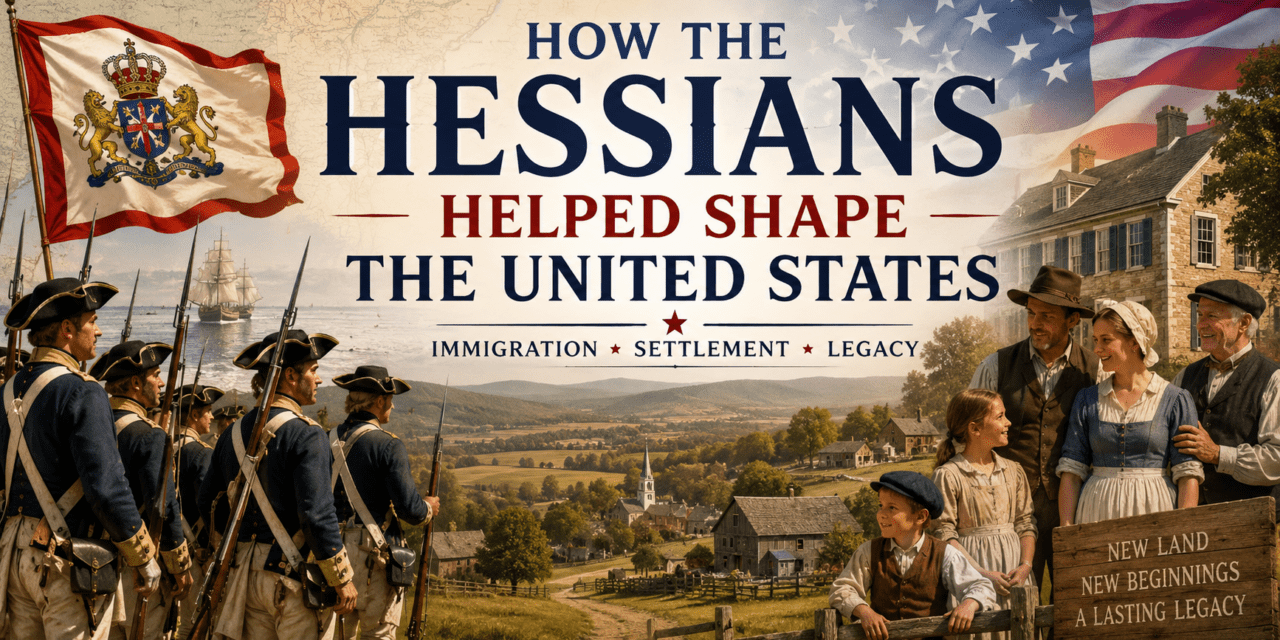
Introduction: The War Ended, but the Hessian Story Continued
When most Americans think about the Hessians, they picture German soldiers fighting for Great Britain during the American Revolution. Images of Trenton, Saratoga, and the famous Hessian regiments often dominate the historical narrative.
Yet the Revolutionary War did not end the Hessian story. In many ways, it marked the beginning of a new chapter that would help shape the future of the United States.
- More Than Soldiers
- Quiz
- How the Hessians Helped Shape the United States
- What You Will Learn in This Article
- From Enemy Soldiers to American Citizens
- What Did Hessians Do After They Settled in America?
- The Skilled Tradesmen and Business Owners
- How the Hessians Integrated So Quickly
- Building German-American Communities
- A Foundation for Future Immigration
- Hessian Descendants Helped Build a Growing Nation
- The Economic Impact of German-American Communities
- German-Americans Changed Everyday American Life
- German-American Scientists Helped Transform the Modern World
- Around the Campfire: How We Got Here
- The Unexpected Legacy of the Hessians
- References
- FAQ
More Than Soldiers
Thousands of Hessian soldiers crossed the Atlantic between 1776 and 1783. While many eventually returned to the German states, thousands remained in North America after the war.
Some settled voluntarily after being discharged. Others had deserted during the conflict and established new lives among the American population.
Why America Looked Different
For many former Hessians, America offered opportunities that were difficult to find in Europe. Land was more plentiful, wages were often higher, and social mobility was greater than in many German principalities.
These opportunities encouraged former soldiers to become farmers, craftsmen, merchants, and eventually American citizens.
Quiz
1. Approximately how many Hessian soldiers remained in North America after the Revolutionary War?
A. 500–1,000
B. 2,000–3,000
C. 5,000–6,000 ✅
D. More than 20,000
2. What occupation did most former Hessians pursue after settling in America?
A. Merchants
B. Farmers ✅
C. Politicians
D. Soldiers
3. What incentive did the Continental Congress offer to encourage Hessian desertions?
A. Free passage to France
B. Military pension
C. Land and livestock ✅
D. Government jobs
4. Which state became the center of many German-American communities?
A. Virginia
B. Massachusetts
C. Pennsylvania ✅
D. South Carolina
5. What does the term "Pennsylvania Dutch" actually refer to?
A. Settlers from the Netherlands
B. English settlers
C. French settlers
D. German settlers ("Deutsch") ✅
6. Which famous freight wagon was developed by German-American craftsmen in Pennsylvania?
A. Prairie Schooner
B. Stagecoach
C. Conestoga Wagon ✅
D. Pony Express Wagon
7. Which holiday tradition was heavily influenced by German immigrants?
A. Thanksgiving Turkey
B. Christmas Trees ✅
C. Fourth of July Fireworks
D. Groundhog Day
8. What popular American food traces its roots to German immigrant traditions?
A. Pizza
B. Sushi
C. Hamburger ✅
D. Taco
9. Which scientist immigrated to America and helped transform modern physics?
A. Wernher von Braun
B. Max Delbrück
C. Albert Einstein ✅
D. Carl Bosch
10. Which engineer helped develop the Saturn V rocket that sent Americans to the Moon?
A. Henry Heinz
B. Carl Schurz
C. Albert Einstein
D. Wernher von Braun ✅
11. Descendants of former Hessians later served in which American conflicts?
A. The Civil War
B. World War II
C. Vietnam
D. All of the Above ✅
12. Which German-American entrepreneur helped revolutionize food processing and distribution?
A. Henry J. Heinz ✅
B. John Roebling
C. Carl Bosch
D. Chester Nimitz
13. Why did many Hessians decide to remain in America after the war?
A. Better economic opportunities
B. Available farmland
C. Existing German-speaking communities
D. All of the Above ✅
14. What happened to many German-language institutions during World War I?
A. They expanded rapidly
B. They moved to Canada
C. They faced pressure to assimilate ✅
D. They became government agencies
15. According to the campfire story, why are we here today?
A. Because Friedrich became wealthy
B. Because Friedrich became a general
C. Because Friedrich and Hilda chose to become Americans ✅
D. Because Friedrich returned to Germany
13–15 Correct: Hessian History Expert 🇺🇸
10–12 Correct: German-America Scholar 📚
7–9 Correct: Frontier Settler 🚜
4–6 Correct: New Arrival from Europe ⛵
0–3 Correct: Time to revisit the Hessian Series!
How the Hessians Helped Shape the United States
The story of how the Hessians Helped Shape the United States extends far beyond military history. Former Hessian soldiers participated in the settlement of frontier regions, contributed to local economies, and helped establish German-speaking communities throughout the young nation.
Their descendants spread across the expanding United States and became part of the country’s growth during the nineteenth century.
A Legacy Hidden in Plain Sight
Today, millions of Americans have German ancestry. Some may even descend from Hessian soldiers without realizing it.
The Hessian legacy survives in family histories, churches, towns, businesses, farms, military service, and communities across the nation.
What You Will Learn in This Article
In this final chapter of our Hessian series, we will examine how the Hessians Helped Shape the United States through immigration, settlement, farming, military service, entrepreneurship, and the growth of German-American communities.
We will also explore how former Hessian soldiers became part of the American story and why their influence can still be seen nearly 250 years after the Revolutionary War ended.
The Final Chapter of the Hessian Series
The Hessians arrived in America as foreign soldiers hired by the British Crown. Many left as Americans in all but name.
The remarkable story of how the Hessians Helped Shape the United States remains one of the most unexpected legacies of the American Revolution.
From Enemy Soldiers to American Citizens
When the American Revolution ended in 1783, thousands of Hessian soldiers faced a life-changing decision. They could return to the German states they had left years earlier, or they could remain in North America and begin new lives.
For many former Hessians, the choice was not difficult.
Returning Home Was Not Always Attractive
Many Hessian soldiers came from regions where land was scarce and economic opportunities were limited. Life in states such as Hesse-Kassel often involved high taxes, rigid social structures, and few opportunities for ordinary citizens to improve their circumstances.
America offered a very different future.
Former soldiers saw vast amounts of available farmland, growing communities, and opportunities that simply did not exist in much of Europe.
The Promise of Land Ownership
One of the biggest attractions was land ownership.
In Germany, many Hessian soldiers had little chance of ever owning significant property. In America, even ordinary laborers and farmers could aspire to own land and pass it to future generations.
For men who had spent years observing American farms, villages, and frontier settlements, the prospect was highly appealing.
America Was a Land of Opportunity
Former Hessians witnessed firsthand the abundance of resources available in North America.
They saw fertile farmland, forests filled with timber, rivers rich with fish, and growing towns in need of workers, craftsmen, merchants, and farmers.
Many concluded that remaining in America offered greater opportunity than returning home.
Existing German Communities Made Settlement Easier
Another important factor was the presence of established German-speaking communities.
Pennsylvania, New York, Maryland, and other colonies already contained large populations of German immigrants. Former Hessians could often settle among people who spoke their language and shared many cultural traditions.
This made the transition from soldier to civilian much easier.
From Hessian Soldier to American Neighbor
Some former Hessians married American women and started families.
Others purchased farms, opened businesses, or worked as skilled craftsmen.
Within a generation, many former Hessian soldiers were no longer viewed as foreign mercenaries. They had become neighbors, property owners, taxpayers, and citizens contributing to their local communities.
The story of how the Hessians Helped Shape the United States began with this remarkable transformation—from wartime enemies to participants in the growth of a new nation.
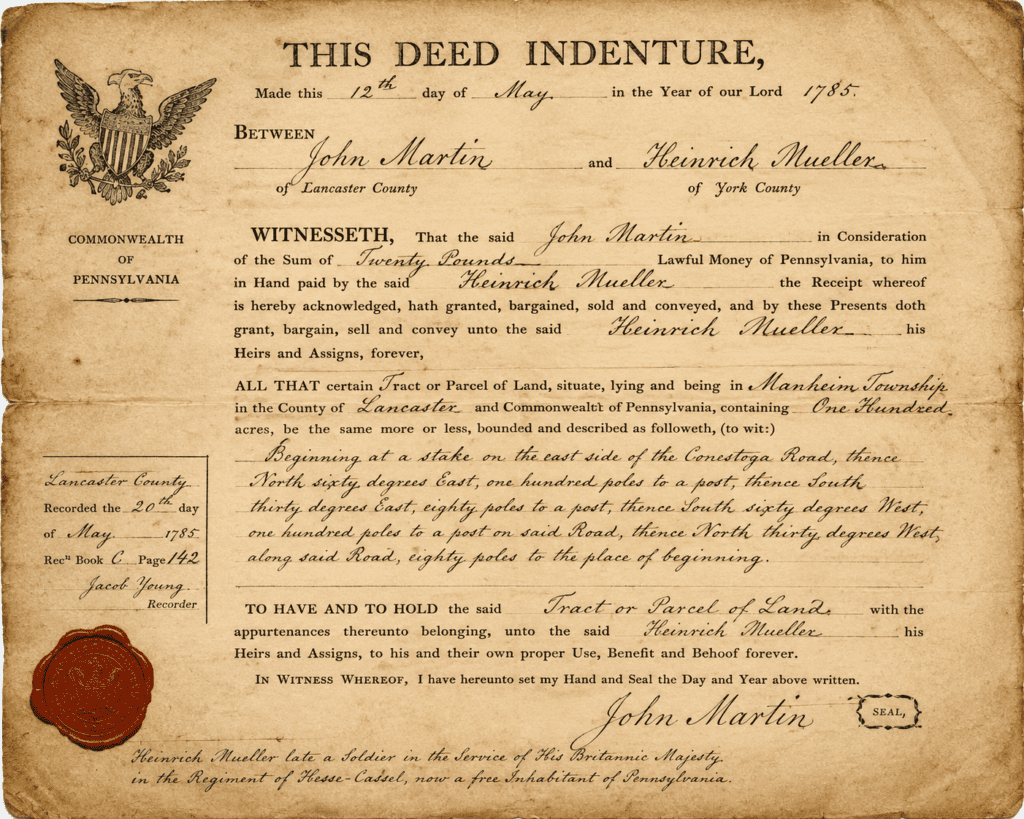
What Did Hessians Do After They Settled in America?
One of the most common questions readers ask is what former Hessian soldiers actually did after the Revolutionary War ended.
While eighteenth-century records do not provide precise statistics, historical research, prison camp records, and settlement patterns reveal a very clear answer. The vast majority of former Hessian soldiers who remained in America became farmers.
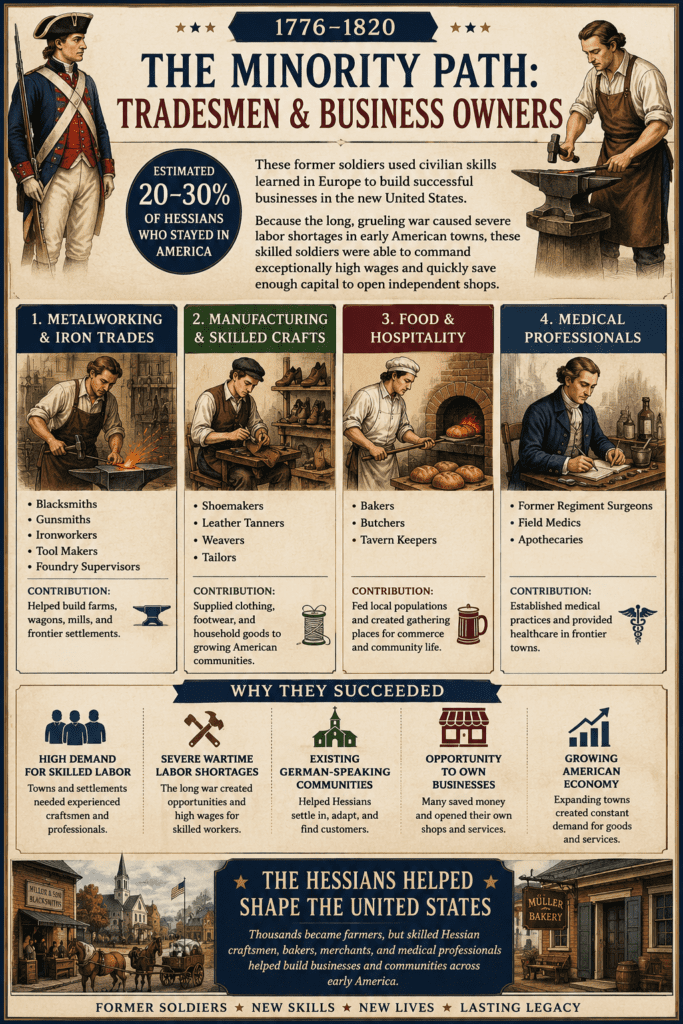
Historians generally estimate that among the approximately 5,000 to 6,000 Hessians who settled permanently in North America, roughly 70 to 80 percent entered agriculture. The remaining 20 to 30 percent became craftsmen, skilled tradesmen, merchants, or business owners.
This pattern was not accidental.
The occupations former Hessians pursued were heavily influenced by wartime incentives, economic opportunity, and the skills they brought with them from Europe.
Why Farming Became the Most Popular Choice
For many Hessian soldiers, land ownership represented something they could rarely achieve in their German homelands.
America offered a completely different future.
The Continental Congress Encouraged Desertion
Benjamin Franklin and the Continental Congress understood that German soldiers were often fighting for pay rather than political loyalty.
To encourage desertion, Congress circulated German-language offers promising substantial rewards to soldiers willing to leave British service.
These incentives eventually included:
- Fifty acres of land
- A cow
- Two pigs
- The opportunity to become an independent landowner
For many Hessians, this offer represented more wealth and opportunity than they could realistically expect to achieve in Europe.
Prison Camps Became Recruiting Grounds for America
Captured Hessians were frequently housed in regions that already contained large German-speaking populations.
Communities such as Lancaster, Pennsylvania, and Frederick, Maryland exposed prisoners to prosperous farms, established churches, and fellow German settlers.
Many Hessians were permitted to work for local farmers while awaiting exchange or discharge.
They saw firsthand what life in America could offer.
Falling in Love with American Farming
Former Hessian soldiers often discovered fertile farmland, abundant natural resources, and opportunities unavailable in Europe.
Some married local women.
Others purchased farms or worked for established landowners until they could acquire their own property.
Many simply decided that returning to Germany no longer made sense.
The Foundation of the Hessian Legacy in America
The story of how the Hessians Helped Shape the United States begins in these farm communities.
Thousands of former soldiers exchanged muskets for plows and became part of the agricultural foundation of the young republic.
The Skilled Tradesmen and Business Owners
Not every Hessian became a farmer.
A significant minority possessed specialized civilian skills before entering military service and quickly found opportunities in America’s growing economy.
Because the Revolutionary War created labor shortages throughout many communities, skilled workers were in high demand.
Common Trades Brought from Europe
Former Hessians entered a variety of occupations:
| Skilled Background | Typical Occupation in America |
|---|---|
| Metalworkers | Blacksmiths, gunsmiths, ironworkers |
| Leather Workers | Tanners, saddle makers, shoemakers |
| Textile Craftsmen | Weavers, tailors, cloth merchants |
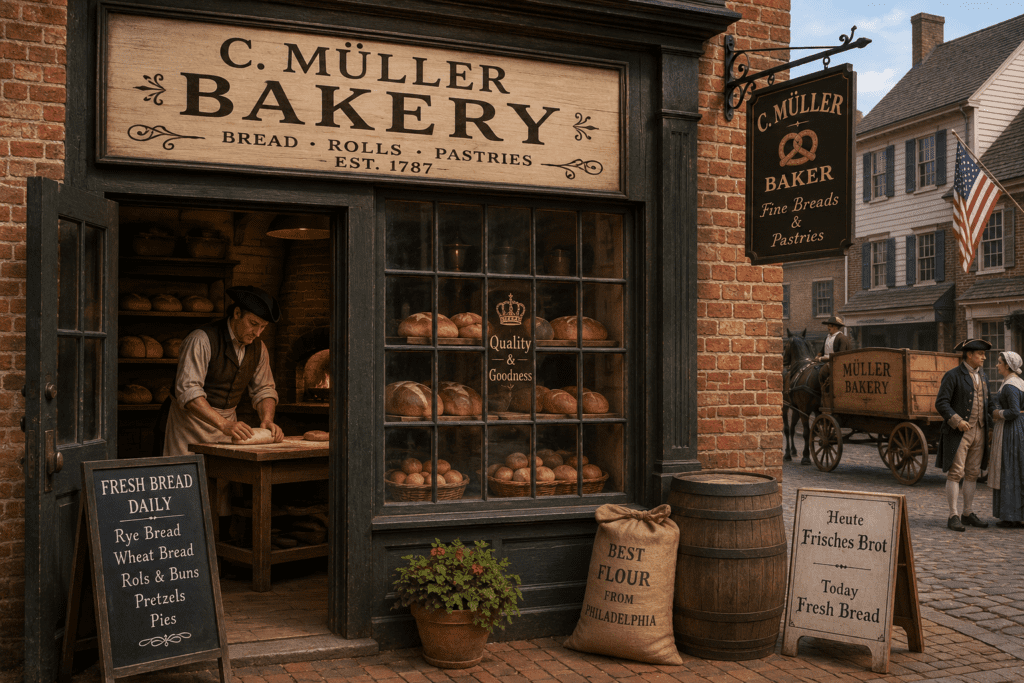
| Food Trades | Bakers, butchers, tavern operators |
| Construction Trades | Carpenters, masons, millwrights |
| Medical Personnel | Physicians, surgeons, apothecaries |
Building New Lives
Many of these skilled workers accumulated savings quickly.
Some opened independent shops.
Others became respected members of growing towns and frontier settlements.
Their businesses contributed to local economies throughout Pennsylvania, Maryland, Virginia, New York, and the expanding western frontier.
How the Hessians Integrated So Quickly
One reason the Hessians Helped Shape the United States so effectively was their ability to integrate into existing German-American communities.
Large sections of Pennsylvania, Maryland, and Virginia already contained substantial German-speaking populations.
Former Hessian soldiers could attend German churches, conduct business in their native language, and interact with people who shared similar customs and traditions.
A New Name, A New Life
Many Hessian surnames gradually became Anglicized.
Examples included:
- Müller becoming Miller
- Jaeger becoming Yager
- Schneider becoming Snyder
- Schmidt becoming Smith or Schmitt
Within a generation, many descendants no longer identified themselves as former Hessians.
They identified themselves as Americans.
From Enemy Soldier to American Citizen
Whether they became farmers, craftsmen, merchants, or business owners, former Hessians integrated into American society with remarkable speed.
The result was one of the most successful examples of assimilation in early American history and an important chapter in understanding how the Hessians Helped Shape the United States.
German Craftsmen Helped Build America
The story of how the Hessians Helped Shape the United States extends beyond farming and small businesses.
German craftsmen brought practical skills that helped transform the American frontier.
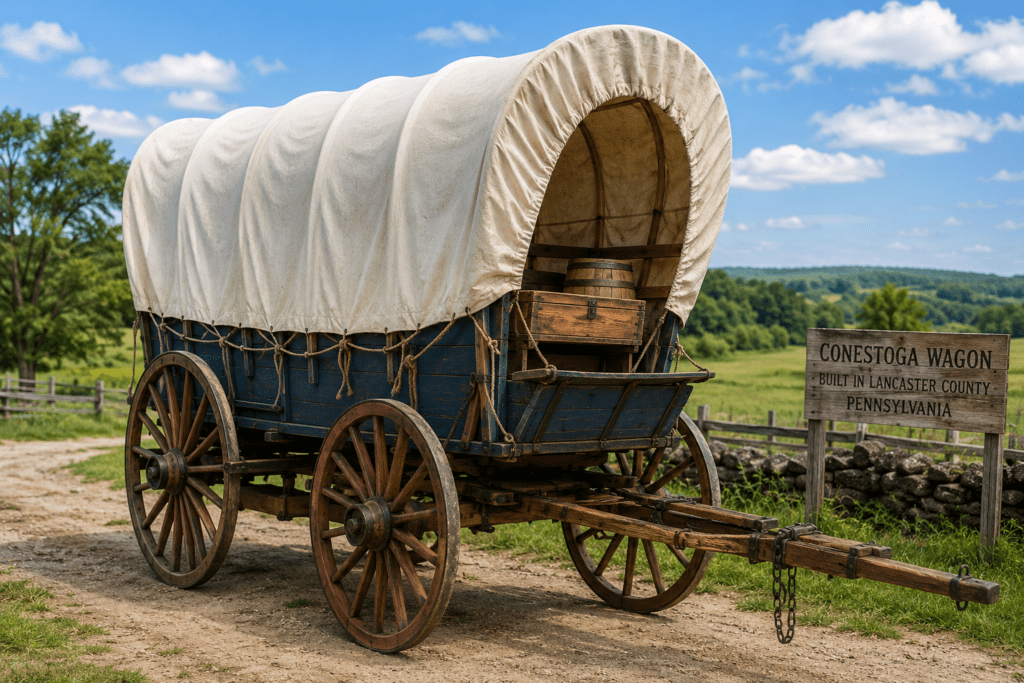
One of the most important examples was the famous Conestoga wagon.
The German Origins of the Conestoga Wagon
The Conestoga wagon was developed by German-American wheelwrights, blacksmiths, and carpenters in Lancaster County, Pennsylvania.
Its design evolved from heavy farm wagons used in the Rhineland and southern Germany, but American craftsmen modified the concept to handle the rough terrain of the colonies.
The result became the freight-hauling giant of eighteenth-century America.
Engineering Ahead of Its Time
The wagon included several innovative features.
The Curved Bed
Unlike a flat wagon, the floor curved upward at both ends.
This design kept cargo centered while traveling over steep hills and rough roads.
Massive Wheels
Large iron-rimmed wheels allowed the wagon to pass over rocks, tree stumps, and muddy terrain.
The height also helped protect cargo when crossing streams and rivers.
Weather Protection
The famous canvas cover helped shield valuable cargo from rain, snow, and mud.
Together, these features created one of the most successful transportation systems in early America.
The Semi-Truck of the Colonial Era
The Conestoga wagon could carry several tons of freight.
Teams of powerful horses hauled goods between Philadelphia, Baltimore, frontier settlements, and inland markets.
Before railroads existed, these wagons formed the backbone of long-distance commerce.
Opening the Frontier
The Conestoga wagon helped transport:
- Food
- Manufactured goods
- Iron products
- Farm equipment
- Household supplies
Without these freight systems, westward expansion would have been far more difficult.
A Legacy That Continues Today
Many Americans associate covered wagons with the Oregon Trail.
However, the original Conestoga wagon was a much larger commercial freight vehicle.
Later prairie schooners were smaller adaptations of the same German-American design principles.
In this way, German craftsmen—and the communities that welcomed former Hessians—helped create transportation systems that connected early America and supported its expansion westward.
While many former Hessians became farmers and craftsmen, German-American artisans helped create one of the most important transportation innovations in early American history: the Conestoga wagon.
Developed by German wheelwrights, blacksmiths, and carpenters in Lancaster County, Pennsylvania, the wagon evolved from heavy farm wagons used in the German Rhineland. The design was completely re-engineered to survive the rough roads, muddy trails, and mountain passes of colonial America.
The Conestoga wagon was not the wagon used by most pioneers on the Oregon Trail. It was the heavy-duty commercial freight hauler of the eighteenth and early nineteenth centuries—the equivalent of today's long-haul semi-truck.
Three Brilliant Engineering Features
🛶 Curved "Boat-Shaped" Bed
Unlike ordinary wagons, the floor curved upward at both ends. This forced cargo to settle naturally toward the center of the wagon, preventing loads from shifting dangerously on steep hills.
🛞 Massive Iron-Rimmed Wheels
The oversized wheels allowed the wagon to roll over rocks, stumps, deep ruts, and muddy terrain while keeping valuable cargo elevated above water and debris.
⛺ Protective Canvas Cover
The iconic canvas top shielded cargo from rain, snow, and harsh weather while allowing merchants to transport goods long distances across the colonies.
Opening the American Frontier
Teams of six to eight powerful horses hauled Conestoga wagons loaded with flour, iron, tools, household goods, and commercial merchandise between Philadelphia, Baltimore, frontier settlements, and inland markets.
Before railroads existed, these wagons formed the backbone of long-distance commerce and helped connect the growing nation.
Building German-American Communities
The story of how the Hessians Helped Shape the United States extends beyond individual farms and businesses. Former Hessian soldiers became part of a growing network of German-speaking communities that stretched across the young republic.
These communities preserved elements of their heritage while simultaneously helping build America.
Pennsylvania Became the Center of German America
No state attracted more former Hessians than Pennsylvania.
By the time the Revolutionary War began, hundreds of thousands of German-speaking settlers already lived throughout the colony. Many had arrived decades earlier from regions that today are part of Germany, Switzerland, and Austria.
Former Hessians found familiar language, customs, churches, and traditions waiting for them.
A Natural Place to Settle
Pennsylvania offered several advantages:
- Established German-speaking communities
- Productive farmland
- Religious freedom
- Expanding trade opportunities
- Access to growing American markets
Many Hessians settled in or near communities such as Lancaster, Reading, Bethlehem, York, and Allentown.
The Pennsylvania Dutch Connection
Many Americans mistakenly believe the term “Pennsylvania Dutch” refers to settlers from the Netherlands.
In reality, the word “Dutch” evolved from the German word “Deutsch,” meaning German.
As former Hessian soldiers integrated into these communities, they became part of one of the most influential cultural groups in early American history.
Shared Language Made Assimilation Easier
German churches, schools, newspapers, and businesses allowed former Hessians to adapt gradually to American life.
Many families continued speaking German at home for generations.
At the same time, they embraced American citizenship, participated in local government, and contributed to the economic growth of their communities.
Churches Served as Community Centers
Religion played a major role in assimilation.
German Lutheran, Reformed, Moravian, and Mennonite congregations provided more than worship services.
Churches became places where former Hessians could:
- Meet future spouses
- Establish business relationships
- Receive assistance during difficult times
- Educate their children
- Preserve cultural traditions
These institutions helped transform former soldiers into permanent members of American society.
Raising the Next Generation
The children of former Hessians often grew up speaking both German and English.
Many attended American schools, worked family farms, entered local trades, and served in community organizations.
Within a generation, these families had become fully integrated into American life while still maintaining pride in their German heritage.
A Foundation for Future Immigration
The communities established by former Hessians created a foundation for later waves of German immigration.
Letters sent back to Europe described fertile farmland, economic opportunity, and political freedom.
These reports encouraged relatives, friends, and neighbors to follow.
The Beginning of a Much Larger Migration
During the nineteenth century, millions of Germans immigrated to the United States.
Many settled in communities where former Hessians and earlier German settlers had already established roots.
In this way, the Hessians Helped Shape the United States not only through their own contributions but also by helping create the German-American communities that would influence the nation for generations.
The Legacy Continues
Today, the influence of these communities can still be seen in churches, architecture, family names, festivals, foods, and cultural traditions throughout the United States.
The impact of former Hessian soldiers extends far beyond the battlefields of the American Revolution and remains part of the broader story of German-American history.
Illinois and the Growth of German America
The story of how the Hessians Helped Shape the United States did not end with the original soldiers who remained after the Revolutionary War.
Former Hessians helped establish German-American communities that later welcomed millions of additional immigrants from the German states. Few places illustrate this better than Illinois.
By 1900, Germans represented the largest single immigrant group in Illinois. Approximately one-quarter of all foreign-born residents in the state were German-born, and their influence could be found from Chicago to the Mississippi River Valley.
Southwestern Illinois: The First German Settlements
Long before Chicago became a major metropolis, German immigrants were settling in southwestern Illinois.
Beginning in the 1830s and 1840s, many Germans crossed the Mississippi River from St. Louis and established communities in and around Belleville, Illinois.
Some of these settlers were highly educated intellectuals, political reformers, teachers, and professionals who had fled political repression in Europe.
Local residents sometimes referred to them as the “Latin Farmers” because they were known for discussing classical literature while working their fields.
Building Agricultural Communities
Later waves of German immigrants expanded throughout central and northern Illinois.
These settlers introduced advanced farming methods, crop rotation techniques, dairy operations, and highly productive grain farms.
German communities flourished in areas including:
- Belleville
- Quincy
- Alton
- Peru
- Springfield
- Peoria
Many descendants of former Hessians and later German immigrants became successful farmers, merchants, and civic leaders throughout the state.
Chicago: One of the Largest German Cities in America
By the late nineteenth century, Chicago had become one of the leading destinations for German immigrants anywhere in the world.
Nearly half a million Chicago residents claimed German ancestry by 1900.
Entire neighborhoods on Chicago’s North and Northwest sides operated primarily in the German language.
German Influence on Chicago
German immigrants helped build much of Chicago’s economy.
They became prominent as:
- Blacksmiths
- Cabinetmakers
- Bricklayers
- Butchers
- Merchants
- Brewers
- Manufacturers
German-owned breweries became especially important.
Companies founded by entrepreneurs such as Schönhofen, Conrad Seipp, and Peter Hand supplied beer throughout the Midwest and became major employers in the growing city.
World War I and Rapid Assimilation
German culture remained highly visible throughout Illinois until the United States entered World War I in 1917.
At that time, anti-German sentiment spread across much of the country.
German-language newspapers declined, German language instruction disappeared from many schools, and numerous organizations adopted English names.
Some communities and families Anglicized names that had been used for generations.
A Lasting Legacy
Despite these pressures, the German influence on Illinois never disappeared.
Millions of Illinois residents today claim German ancestry.
Historic churches, farmsteads, breweries, brick buildings, family names, and cultural traditions continue to reflect the contributions of German immigrants and their descendants.
In many ways, the growth of German Illinois demonstrates how the Hessians Helped Shape the United States. The small number of former Hessian soldiers who remained after the Revolutionary War helped create communities that later welcomed and supported one of the largest immigrant movements in American history.
Author’s Note: A Personal Connection to the German-American Story
While researching this Hessian series, I discovered that the story was more personal than I initially realized.
My mother’s family immigrated from Germany to Illinois around 1840, settling in one of the German communities mentioned in this article. Like thousands of other German immigrants arriving during that period, they came seeking opportunity, land, and a better future for their families.
Through my research, I learned that one of my ancestors had been discharged from the Prussian Army before emigrating to the United States.
Prussia was one of the German states that supplied troops during the era of the American Revolution, including forces that served alongside or in support of the same military traditions that produced the Hessian soldiers discussed throughout this series.
After arriving in Illinois, my family did what many German immigrants did—they farmed. Over the generations they acquired additional acreage, established deep roots in the community, and created what could best be described as a small family farming empire.
According to my research, members of my extended family still own farmland in the same region today.
Working on this series helped me appreciate how German immigration shaped not only American history but also my own family history. Although my ancestors arrived decades after the Revolutionary War, they followed paths that earlier German settlers—including former Hessians—had helped establish.
In that sense, the story of the Hessians is not just a military story. It is also a story about immigration, opportunity, land ownership, and the generations of families who helped build America.
Hessian Descendants Helped Build a Growing Nation
By the early nineteenth century, the children and grandchildren of former Hessian soldiers considered themselves Americans.
Many still spoke German at home and attended German churches, but their daily lives were increasingly tied to the growth and expansion of the United States.
The story of how the Hessians Helped Shape the United States continued through these later generations.
Moving Beyond the Original Settlements
As America expanded westward, descendants of former Hessians moved beyond Pennsylvania, Maryland, and Virginia.
They participated in the settlement of:
- Ohio
- Indiana
- Illinois
- Missouri
- Wisconsin
- Iowa
- Kansas
Many purchased farmland while others established businesses in newly developing towns.
Following the Frontier
Throughout the nineteenth century, land remained one of America’s greatest attractions.
Families that had once settled in Pennsylvania often sold their farms and moved west in search of larger properties and new opportunities.
This migration helped populate much of the American Midwest.
Building Farms, Towns, and Businesses
The descendants of former Hessians contributed to nearly every aspect of community development.
They built:
- Farms
- Mills
- Churches
- Schools
- General stores
- Banks
- Manufacturing businesses
As communities grew, many German-American families became respected civic leaders and local officials.
A Reputation for Stability
German-American communities developed a reputation for hard work, education, and financial stability.
Many emphasized:
- Home ownership
- Agricultural productivity
- Skilled trades
- Community involvement
- Religious institutions
- Education
These values helped strengthen many of the communities they established.
Military Service Continued Across Generations
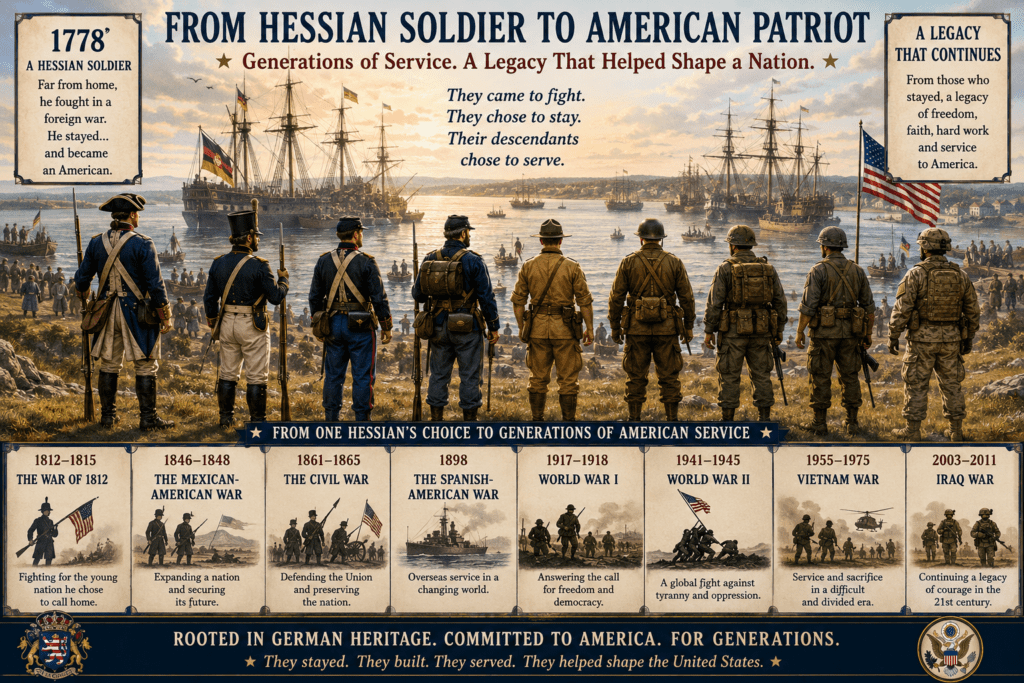
One of the greatest ironies in American history is that descendants of soldiers originally hired to fight Americans later served in American uniforms.
German-American descendants of former Hessians participated in numerous conflicts including:
- The War of 1812
- The Mexican-American War
- The Civil War
- The Spanish-American War
- World War I
- World War II
Many served with distinction and became deeply woven into America’s military tradition.
From Foreign Soldiers to American Patriots
The transformation was remarkable.
The grandsons and great-grandsons of men who had once marched under British command would eventually fight to defend the United States.
Few stories better illustrate how completely former Hessians became part of American society.
The Economic Impact of German-American Communities
The influence of former Hessians and later German immigrants extended far beyond farming.
German-American communities helped drive economic growth throughout the nineteenth century.
Contributions to American Industry
German-Americans became leaders in:
- Brewing
- Manufacturing
- Banking
- Agriculture
- Transportation
- Retail trade
- Construction
Their businesses employed thousands of Americans and helped fuel economic development throughout the expanding nation.
A Lasting Influence
The economic contributions of these communities can still be seen today.
Family farms, historic businesses, churches, and civic institutions founded by German-Americans remain active throughout many parts of the United States.
In countless ways, the descendants of former Hessians continued the process by which the Hessians Helped Shape the United States long after the Revolutionary War had ended.
German-Americans Changed Everyday American Life
More Than Farmers and Soldiers
The story of how the Hessians Helped Shape the United States extends beyond battlefields, farms, and businesses.
The German-American communities that grew throughout the nineteenth century influenced education, holidays, food, transportation, architecture, and countless aspects of daily life that millions of Americans still enjoy today.
Education and Childhood
One of the most significant German-American contributions was the concept of kindergarten.
German educator Margarethe Schurz introduced America’s first kindergarten in Wisconsin during the nineteenth century. The idea that young children should learn through structured play, social interaction, and guided development eventually spread throughout the United States.
German-American Turnverein organizations also promoted physical fitness, helping popularize gymnasiums, organized athletics, and physical education programs in American schools.
Christmas Trees and Easter Bunnies
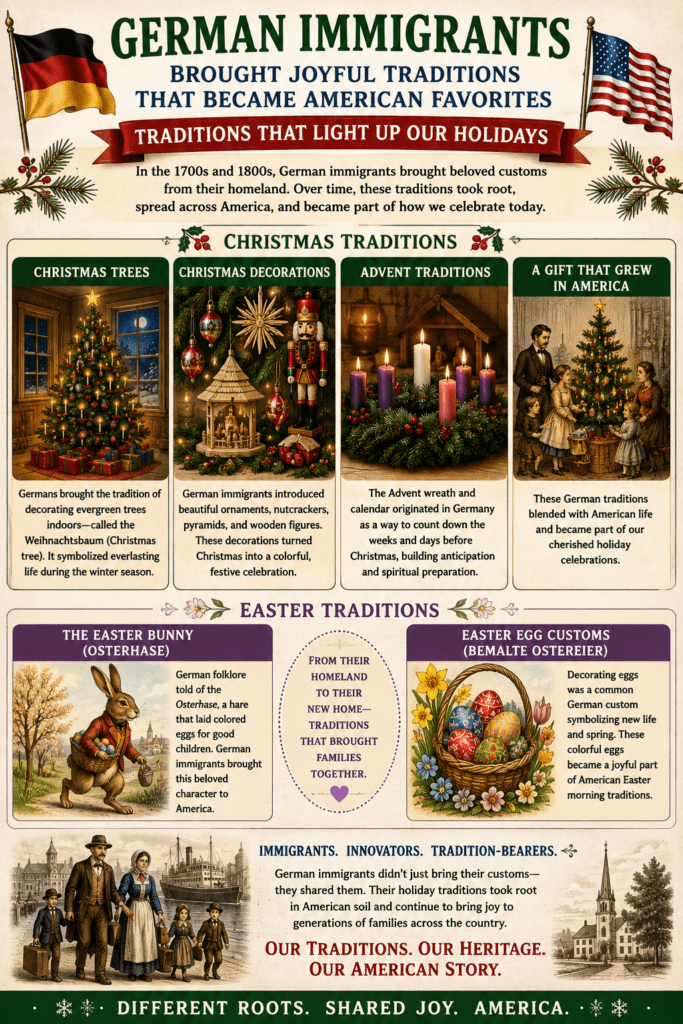
Many Americans celebrate traditions with German roots without realizing their origin.
German immigrants helped popularize:
- Christmas trees
- Christmas decorations
- Advent traditions
- The Easter Bunny
- Easter egg customs
These customs eventually became part of mainstream American culture.
Shaping the American Menu
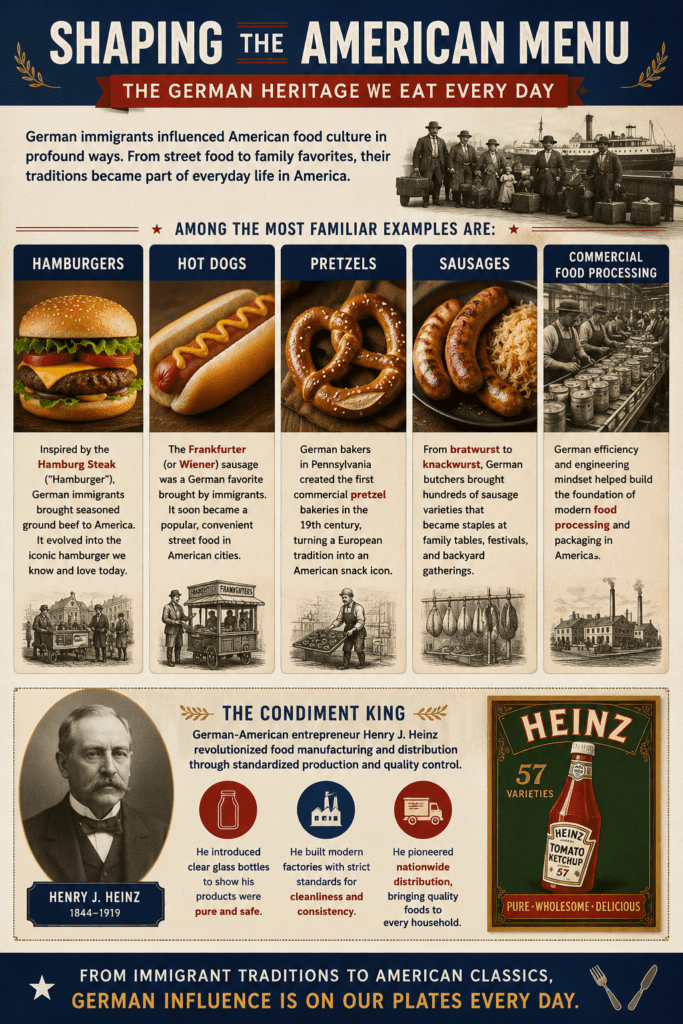
German immigrants influenced American food culture in profound ways.
Among the most familiar examples are:
- Hamburgers
- Hot dogs
- Pretzels
- Sausages
- Commercial food processing
German-American entrepreneur Henry J. Heinz helped revolutionize food manufacturing and distribution through standardized production and quality control practices.
Building America
German craftsmen and engineers also left their mark on the physical landscape of the nation.
Their influence can be seen in:
- Barn construction
- Agricultural buildings
- Wagon manufacturing
- Bridge engineering
- Firearms design
- Transportation systems
The famous Conestoga wagon and the Pennsylvania rifle both emerged from German-American innovation and played important roles in westward expansion.
A Legacy Hidden in Plain Sight
Many of the traditions, foods, buildings, and institutions Americans encounter every day have German roots.
While former Hessians represented only a small portion of German immigration, they helped establish communities that later welcomed millions of German immigrants whose influence continues to shape American life today.
German-American Scientists Helped Transform the Modern World
The story of how the Hessians Helped Shape the United States extends far beyond farms, businesses, and military service.
The German-American communities that grew throughout the nineteenth century produced generations of scientists, engineers, physicians, and innovators who helped transform the United States into a global leader in science and technology.
While most of these individuals were not descendants of Hessian soldiers themselves, they emerged from the broader German-American communities that former Hessians helped establish and strengthen.
The Rise of Scientific Leadership
By the twentieth century, the United States had become a magnet for talented scientists from around the world.
German-speaking immigrants and their descendants played an especially important role in this transformation.
Many arrived seeking opportunity, academic freedom, or refuge from political turmoil in Europe.
Others were children and grandchildren of earlier immigrants who had already built successful lives in America.
Building America’s Scientific Power
German-American scientists contributed to:
- Physics
- Chemistry
- Medicine
- Biology
- Engineering
- Aerospace
- Astronomy
Their discoveries changed the modern world and helped establish the United States as a scientific superpower.
Albert Einstein and the Atomic Age
Among the most famous immigrants in American history was Albert Einstein.
After fleeing Nazi Germany in 1933, Einstein settled in the United States and later became an American citizen.
His theories of relativity revolutionized modern physics and changed humanity’s understanding of space, time, and energy.
Influencing the Course of History
Einstein’s famous equation is shown below:
E=mc^2
This concept helped establish the theoretical foundation for nuclear energy and atomic research.
In 1939, Einstein signed the famous letter warning President Franklin D. Roosevelt that Nazi Germany might pursue atomic weapons research.
Maria Goeppert Mayer and Nuclear Physics
Another remarkable German-American scientist was Maria Goeppert Mayer.
After immigrating to the United States in 1930, she became one of the leading nuclear physicists of the twentieth century.
Her Nuclear Shell Model explained why certain atomic nuclei exhibit exceptional stability.
Nobel Prize Recognition
In 1963, Mayer became only the second woman ever awarded the Nobel Prize in Physics.
Her work remains a cornerstone of modern nuclear science.
Max Delbrück and Molecular Biology
German-born scientist Max Delbrück helped establish the field of molecular biology.
Working in the United States, he used bacterial viruses to study genetics and biological replication.
His discoveries helped pave the way for the later understanding of DNA and genetic inheritance.
Feeding the Modern World
German scientists also transformed agriculture.
The industrial process developed by Carl Bosch and collaborators made it possible to produce synthetic fertilizer on a massive scale.
The process is represented by:
N_2+3H_2\rightarrow 2NH_3
This breakthrough dramatically increased agricultural productivity and helped support the food supply for billions of people around the world.
Impact on American Agriculture
Modern farming throughout the Midwest relies heavily on fertilizer technologies that emerged from these scientific advances.
The descendants of German immigrants continued contributing to the agricultural productivity that helped make the United States a global agricultural leader.
Wernher von Braun and the Space Age
One of the most influential figures in American aerospace history was Wernher von Braun.
After World War II, von Braun became a key figure in America’s space program.
As director of NASA’s Marshall Space Flight Center, he led development of the Saturn V rocket.
Reaching the Moon
The Saturn V launch vehicle carried the Apollo astronauts to the Moon in 1969.
The success of the Apollo program remains one of the greatest engineering achievements in human history.
A Legacy of Innovation
The contributions of German-American scientists helped transform medicine, agriculture, physics, engineering, and space exploration.
Their work demonstrates another way the Hessians Helped Shape the United States.
The German-American communities that grew from the eighteenth century onward produced generations of innovators whose discoveries influenced not only America, but the entire world.
The story of German influence on American military leadership began at Valley Forge and continued through some of the most important conflicts in United States history.
In 1778, Major General Friedrich Wilhelm von Steuben, a former Prussian officer, helped transform George Washington's struggling Continental Army into a disciplined fighting force. His training methods became the foundation of the early U.S. Army.
Over the next two centuries, German-Americans would rise to command some of America's most significant military campaigns:
- Friedrich Wilhelm von Steuben — Professionalized the Continental Army during the Revolutionary War.
- Carl Schurz — Union general during the Civil War who later served as a U.S. Senator and Secretary of the Interior.
- General of the Armies John J. Pershing — Built and commanded the American Expeditionary Forces during World War I.
- General Dwight D. Eisenhower — Supreme Allied Commander who directed the D-Day invasion and Allied victory in Europe during World War II.
- Fleet Admiral Chester W. Nimitz — Commanded American naval forces in the Pacific and helped secure victory over Japan.
- General H. Norman Schwarzkopf — Led coalition forces during Operation Desert Storm and liberated Kuwait in 1991.
Few examples better illustrate how German immigrants—and the communities that former Hessians helped establish—became woven into the fabric of the United States.
[hessians_descendents]
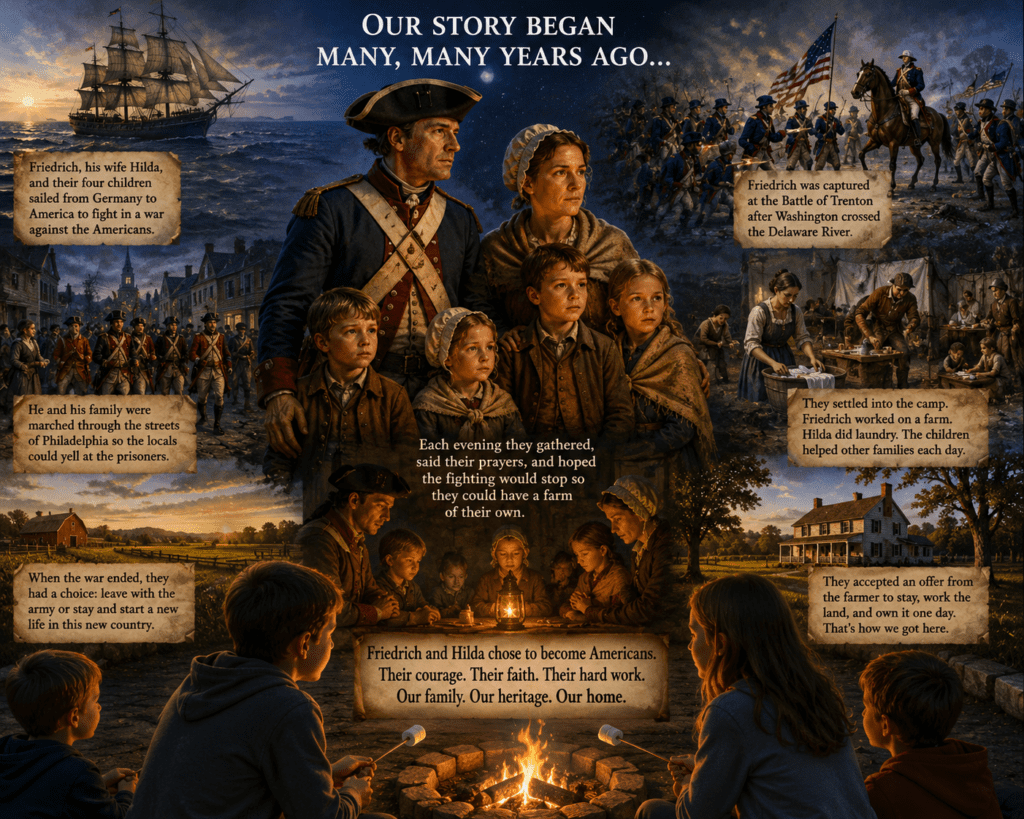
Around the Campfire: How We Got Here
Imagine sitting around a backyard fire pit on a cool evening. The marshmallows are roasting, the stars are coming out, and one of the children asks:
“Grandpa, where did our family come from?”
You smile and point toward the night sky.
“Well, many, many years ago—about eight generations ago—your grandfather came to America on a sailing ship.”
“His name was Friedrich, and your grandmother’s name was Hilda.”
“They didn’t come looking for America. They came because a king sent them.”
The children lean a little closer to the fire.
“You see, Friedrich was a Hessian soldier. He came all the way across the Atlantic Ocean with Hilda and their four children. They landed in New Jersey during the American Revolution.”
“They were supposed to fight against the Americans.”
You pause and turn one of the marshmallows.
“But things didn’t go exactly as planned.”
“You remember the painting I showed you of George Washington crossing the Delaware River?”
The children nod.
“Well, after Washington crossed that icy river, his army attacked the Hessians at Trenton. Friedrich was captured during the battle.”
The fire crackles.
“After the battle, Friedrich and many other prisoners were marched through Philadelphia. The local people lined the streets. Some shouted at the prisoners. Some stared. Others simply watched as these tired soldiers passed by.”
“But Friedrich wasn’t alone.”
“Hilda and the children were with him.”
The children around the fire look surprised.
“Yes, many Hessian families traveled with the army.”
“Eventually they settled into a prisoner camp. Life wasn’t easy, but something unexpected happened.”
“They began to like America.”
“Friedrich was allowed to leave the camp during the day to work on a nearby farm. Hilda earned money doing laundry for local families and businesses. The children helped other families with chores and errands.”
“Every evening they came back together.”
“They shared what food they had.”
“They said their prayers.”
“And they hoped the fighting would end.”
“They dreamed about having a farm of their own someday.”
The flames dance in the darkness.
“Then one day the war was over.”
“Friedrich and Hilda faced a difficult decision.”
“They could leave with the army and return to Germany.”
“Or they could stay.”
“The farmer Friedrich worked for had no children. He trusted Friedrich and respected his hard work.”
“So he made an offer.”
“‘Stay here,’ he said. ‘Help me work the farm. One day it can be yours.'”
Friedrich and Hilda talked long into the night.
They thought about Germany.
They thought about America.
They thought about their children.
And then they made their choice.
They stayed.
Over time they became farmers.
Their children became Americans.
Their grandchildren became Americans.
Their great-grandchildren became Americans.
Generation after generation followed.
The fire burns lower now.
You look around at the family gathered together.
And then you smile.
“And that’s how we got here.”
“If Friedrich and Hilda had boarded a ship back to Germany, none of us would be sitting around this fire tonight.”
“Everything that happened afterward began because they decided to become Americans.”
The children stare quietly into the glowing embers.
For a moment, eight generations don’t seem very far away at all.
The Unexpected Legacy of the Hessians
When the first Hessian transports arrived in New York Harbor during the summer of 1776, neither the British government nor the German princes who supplied the troops could have imagined the long-term consequences.
The soldiers were hired to fight a war.
Instead, many helped build a nation.
What Britain Thought It Was Buying
King George III and the British government viewed the Hessians as professional soldiers who would help suppress a rebellion.
The contracts negotiated with German rulers focused on military manpower, battlefield performance, and financial compensation.
No one expected thousands of those soldiers to become future Americans.
A Different Outcome Than Anyone Expected
Some Hessians died in battle.
Others returned to Germany after the war.
But thousands chose another path.
They remained in North America and became part of the new country that emerged from the Revolution.
The Legacy Was Built One Family at a Time
The story of how the Hessians Helped Shape the United States was not created by a handful of famous individuals.
It was built through thousands of ordinary decisions made by ordinary people.
Former Hessian soldiers married local women.
Families purchased farms.
Children attended American schools.
Communities established churches and businesses.
Generation after generation continued building upon those foundations.
The American Dream Before It Had a Name
Many former Hessians came from societies where social mobility was limited.
In America, they discovered opportunities that were difficult to imagine in much of eighteenth-century Europe.
Land ownership, entrepreneurship, religious freedom, and economic advancement allowed many families to prosper.
Their Influence Still Surrounds Us
Today, the legacy of former Hessians can be found throughout the United States.
It survives in:
- Family names
- Historic churches
- Farming communities
- Businesses
- Military service
- Scientific achievements
- Local traditions
- Family stories
Most Americans encounter this legacy without ever realizing its connection to the Revolutionary War.
More Than a Military Story
The Hessian story began as a military story.
It became an immigration story.
It became a settlement story.
It became a family story.
Most importantly, it became part of the American story.
The Hessians Helped Shape the United States
The phrase “Hessians Helped Shape the United States” is not simply a historical observation.
It is the central lesson of their legacy.
The former soldiers who remained after the Revolution helped populate frontier regions, establish communities, strengthen the economy, defend the nation, and raise generations of Americans.
Their descendants became part of the fabric of the United States.
And nearly 250 years later, their influence remains visible across the country they helped build.
Congratulations—you have reached the final chapter of our comprehensive Hessian series.
Over the course of 10 chapters and more than 60,000 words, we have followed the Hessians from their homes in the German states, across the Atlantic Ocean, onto the battlefields of the American Revolution, through prison camps, frontier settlements, German-American communities, and ultimately into the fabric of the United States itself.
This series was created to provide readers with a thorough, balanced, and historically grounded examination of the Hessians and their impact on America. From military campaigns and camp life to immigration, assimilation, farming, business, science, and culture, few topics related to the Hessians have been left unexplored.
If this is your first article in the series, a complete list of the other nine chapters appears below. Simply click any title to begin exploring another part of the Hessian story.
We also invite you to explore our growing collection of articles celebrating the 250th Anniversary of the United States. These articles examine the people, events, technology, economy, military campaigns, and everyday lives that shaped the nation during its founding era.
The link to our America's 250th Anniversary Hub appears below this article.
Whether you read a single chapter or all ten, thank you for joining us on this journey through one of the most fascinating and often misunderstood stories of the American Revolution.
The Hessians arrived in America as foreign soldiers. Many remained as neighbors, farmers, business owners, parents, grandparents, and ultimately Americans.
Their story became part of our story.
Thank you for reading this article and the others in this series.
References
The RetireCoast Hessians in the American Revolution series draws from battlefield organizations, museum resources, genealogy collections, military archives, and historical research focused on German soldiers, prisoners, settlers, and families connected to the Revolutionary War.
- FamilySearch — Hessian Soldiers
- Franklin & Marshall College Archives — Johannes Schwalm Historical Association Collection
- FamilySearch Catalog — Journal of the Johannes Schwalm Historical Association
- Journal of the American Revolution — The Hessians: Journal of the Johannes Schwalm Historical Association
FAQ
1. How did the Hessians help shape the United States?
Former Hessian soldiers who remained in America became farmers, craftsmen, business owners, soldiers, and citizens. Their families helped build German-American communities, expand frontier settlements, and contribute to American economic and cultural life.
2. Did Hessian soldiers stay in America after the Revolutionary War?
Yes. Thousands of Hessian soldiers remained in North America after the Revolutionary War through desertion, marriage, post-war settlement, or local employment. Many became permanent residents and raised families in the new United States.
3. What did most former Hessians do for work?
Most former Hessians became farmers. Others used civilian skills learned in Europe to become blacksmiths, shoemakers, bakers, tailors, tavern keepers, carpenters, or medical practitioners.
4. Why did many Hessians choose to remain in America?
America offered land, higher wages, religious freedom, and greater social mobility than many German states. Existing German-speaking communities also made it easier for former Hessians to settle and assimilate.
5. Where did former Hessians settle?
Many settled in Pennsylvania, Maryland, Virginia, New York, and New Jersey. Later generations moved west into Ohio, Indiana, Illinois, Missouri, Wisconsin, Iowa, and other frontier regions.
6. Were Hessians part of German-American history?
Yes. Former Hessian soldiers became part of the broader German-American story. Their communities helped create settlement networks that later German immigrants used during the large immigration waves of the nineteenth century.
7. Did Hessian descendants serve in the U.S. military?
Yes. Descendants of former Hessians and later German-American families served in American conflicts including the War of 1812, Civil War, World War I, World War II, Vietnam, Iraq, and other military campaigns.
8. What cultural traditions did German immigrants bring to America?
German immigrants helped popularize Christmas trees, Christmas decorations, Advent traditions, the Easter Bunny, Easter egg customs, pretzels, sausages, hamburgers, hot dogs, and many forms of community celebration.
9. What was the Conestoga wagon?
The Conestoga wagon was a heavy freight wagon developed by German-American craftsmen in Pennsylvania. It helped transport goods across early America and served as the commercial “semi-truck” of the colonial and early national period.
10. Are there Hessian descendants in the United States today?
Yes. Many Americans may descend from former Hessian soldiers without knowing it. Clues may appear in German surnames, family Bibles, church records, Revolutionary War pension records, land deeds, and oral family traditions.
The Complete RetireCoast Historical Series
[membership_cta]
Discover more from RetireCoast.com
Subscribe to get the latest posts sent to your email.