
Hessian Camp Life in the American Revolution
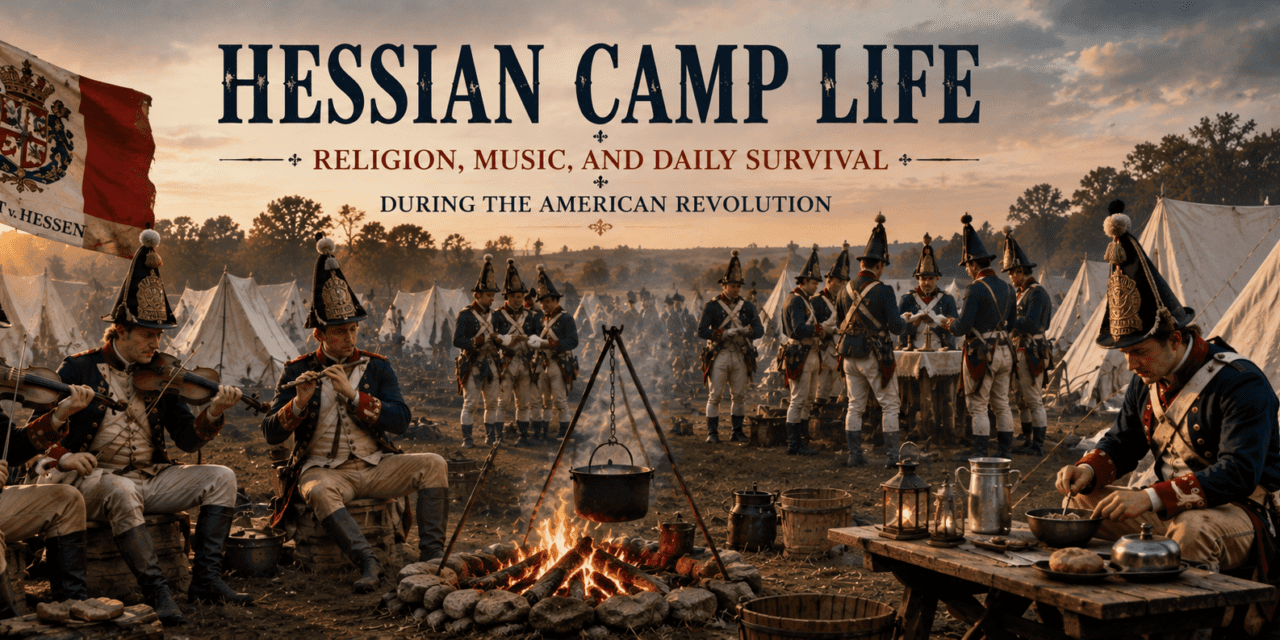
This fourth article in the series, Hessians in the American Revolution: The German Soldiers Who Helped Shape America, explores camp life, religion, music, and daily survival among the German troops who fought for the British during the Revolutionary War.
Most Americans know the Hessians from dramatic battlefield moments such as Trenton. Yet the majority of their experience in America was spent away from combat inside military camps filled with hardship, routine labor, discipline, prayer, music, sickness, and constant uncertainty.
Hessian camp life was often harsh and exhausting. Soldiers faced freezing winters, muddy camps, disease outbreaks, poor food, homesickness, and the ever-present threat of sudden attack.
- Hessian Camp Life in the American Revolution
- Hessian Camp Followers in Hessian Camp Life
- Hessian Camp Life Included Entire Families
- Hessian Camp Followers Represented Every Level of Society
- The Fate of the Hessian Camp Followers
- Hessian Religion, Faith, and the Churches They Brought to America
- Hessian Music, Drums, and the Sound of War
The Human Side of the Hessians
The Hessians were not a single army from one nation. They came from several German states including Hesse-Kassel, Brunswick, Waldeck, and Ansbach-Bayreuth.
Many had never traveled far from their villages before crossing the Atlantic Ocean. America itself seemed strange, enormous, and dangerous to soldiers raised in the structured military culture of 18th century Europe.
For many Hessians, camp life became their true battlefield.
Daily Survival Became a Constant Struggle
Soldiers spent much of their time searching for firewood, preparing meals, repairing uniforms, cleaning muskets, digging drainage trenches, and trying to stay warm and dry. Heavy rain, snow, and mud often turned camps into miserable landscapes.
Even simple necessities such as clean water and dry socks could become difficult to obtain during long campaigns.
Military Camps Never Truly Rested
Hessian camps operated under strict discipline. Guards stood watch day and night while officers maintained constant inspections and drills.
Camp followers, including wives and children, performed critical labor such as cooking, washing clothing, carrying supplies, and nursing the sick. Their contributions were essential to keeping Hessian regiments functioning in the field.
Religion Was Central to Hessian Camp Life
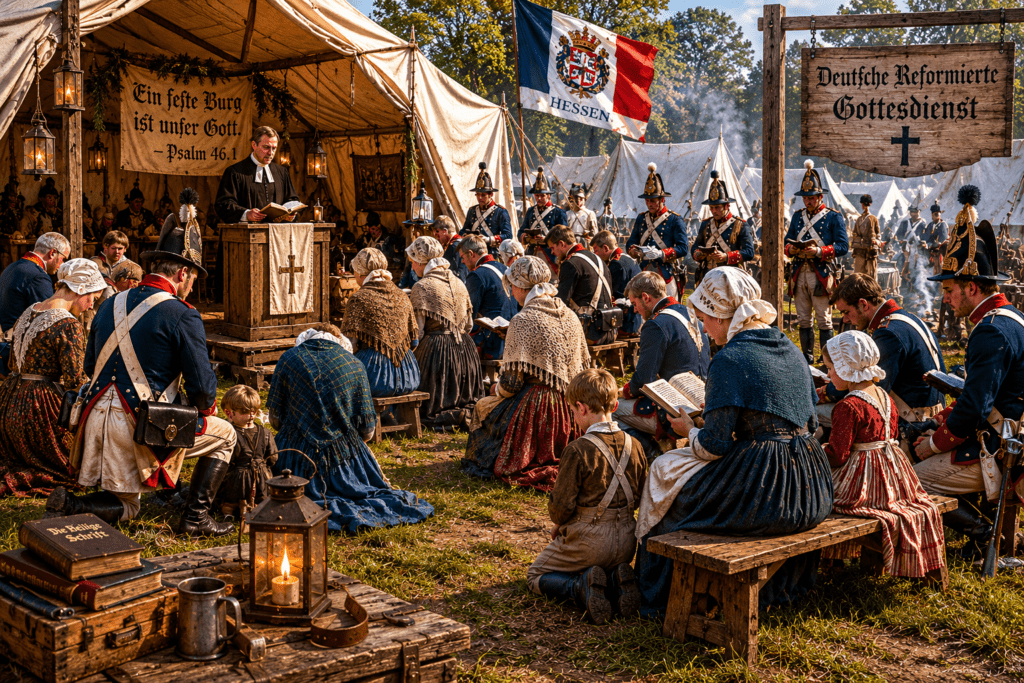
Faith played a major role in the daily lives of many Hessian soldiers. Most were Protestant Lutherans or members of the German Reformed Church.
Military chaplains accompanied regiments and conducted religious services whenever conditions allowed. Prayer services, scripture readings, and hymns helped provide emotional stability in the middle of war.
Religion also helped soldiers cope with fear, death, disease, and separation from home.
Soldiers Frequently Wrote About God and Fate
Letters and journals written by Hessian soldiers often described divine protection, providence, and survival. Many believed their fate rested in God’s hands.
Religious observances became especially important after major battles, during severe winters, or during outbreaks of camp disease.
Music Helped Preserve Morale
Music formed an important part of Hessian camp life. German military tradition relied heavily on drums, fifes, horns, and military bands to regulate camp activity and battlefield movement.
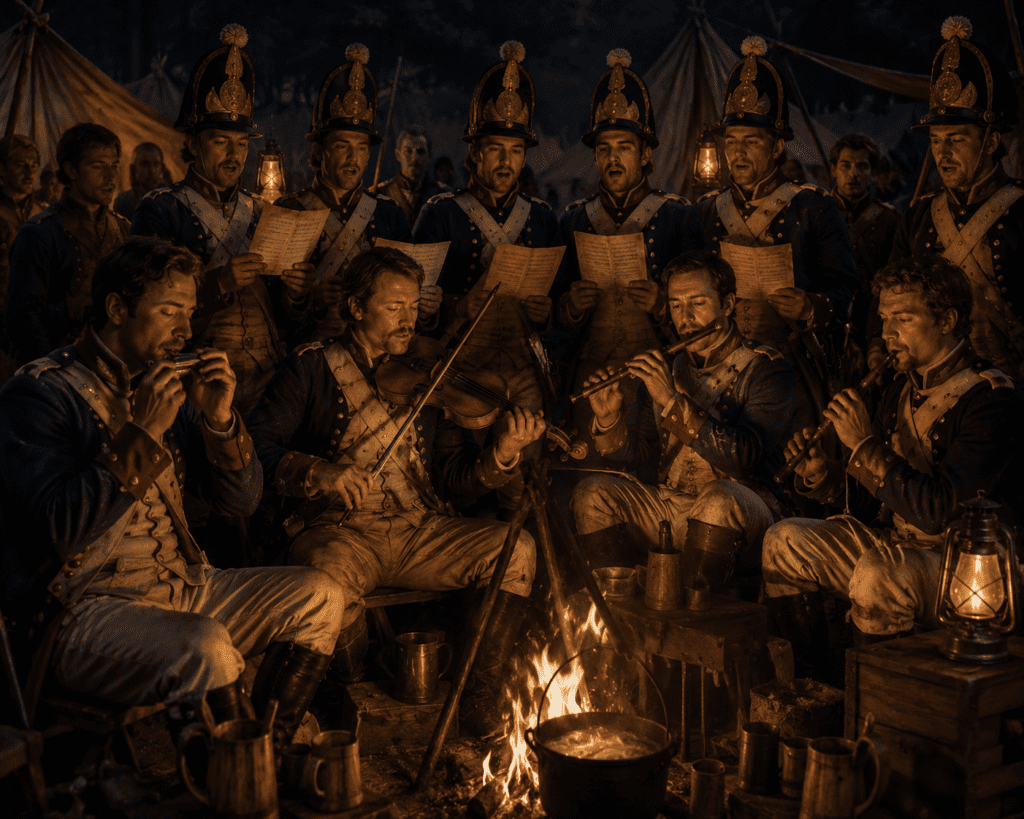
Music also served a deeply personal purpose. Hessian soldiers often sang traditional German folk songs around campfires at night, reminding them of home and family thousands of miles away.
These songs helped maintain morale during long periods of fear, boredom, and isolation.
Campfire Music Connected Soldiers to Home
Some Hessian regiments included highly trained military musicians. Formal performances occurred during inspections, marches, and ceremonies.
At night, however, music became more intimate. Soldiers gathered around fires singing familiar songs from their villages and regions in Germany.
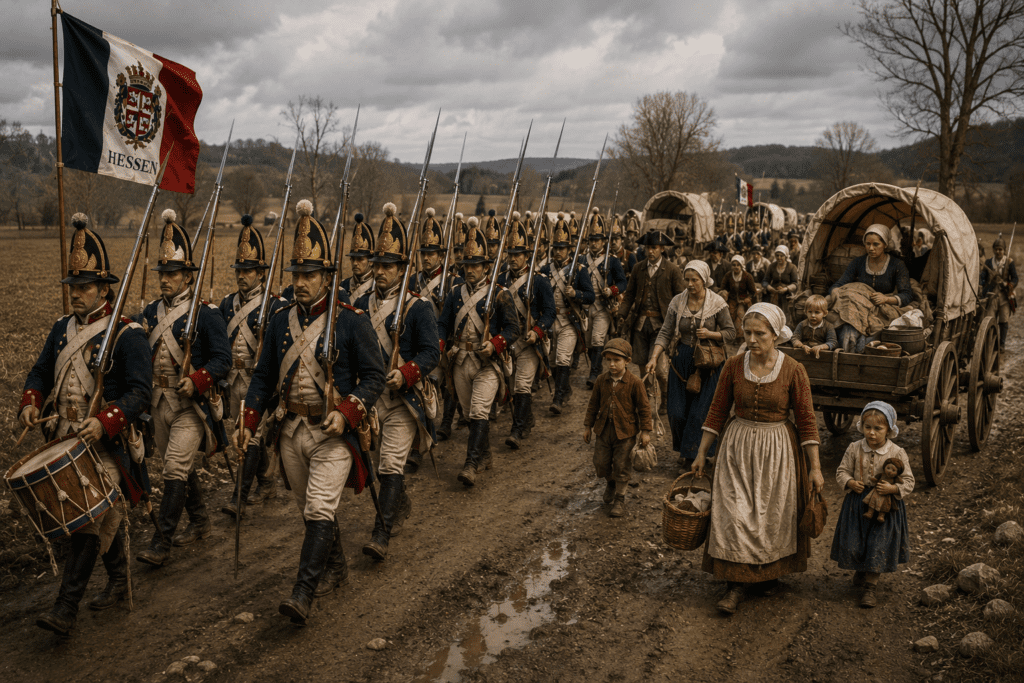
Behind every marching Hessian regiment stood a hidden army of wives, children, servants, laundresses, cooks, laborers, and support workers struggling to survive the hardships of the Revolutionary War.
Non-combatants and soldiers performed the essential daily labor needed to keep Hessian forces functioning in the field. The reality of military life included hand-stirred cauldrons, muddy encampments, wet laundry hanging beside tents, sickness, exhaustion, and endless logistical work.
These same camp systems followed Hessian troops through the New York campaign and eventually into New Jersey before the famous defeat of the Hessians at Trenton.
The complete story of Hessian camp followers, religion, military music, survival, battlefield families, Christmas traditions, disease, food preparation, and daily life during the American Revolution is explored in:
Disease and Exposure Killed Thousands
One of the greatest dangers in Hessian camp life was not combat but disease. Poor sanitation, spoiled food, contaminated water, and overcrowded camps created deadly conditions.
Smallpox, dysentery, typhus, and respiratory illness spread rapidly through military encampments.
Long winters and inadequate shelter weakened already exhausted soldiers. Many died without ever fighting in a major battle.
Winter Camps Were Especially Brutal
During winter campaigns, Hessians often lived in crude huts, barns, churches, abandoned houses, or worn canvas tents. Firewood shortages and inadequate clothing created severe suffering.
The harsh realities of Hessian camp life shocked many soldiers who had expected organized European-style warfare rather than extended survival in wilderness conditions.
The Trenton Attack Revealed the Dangers of Camp Life
The Hessian defeat at Trenton demonstrated how vulnerable military camps could become. On Christmas night in 1776, many Hessian soldiers were resting after weeks of hardship and winter duty.
Before dawn, George Washington’s forces crossed the icy Delaware River and launched a surprise attack against the Hessian garrison.
The sudden collapse of the Trenton camp became one of the most famous moments of the American Revolution.
Hessian Camp Followers in Hessian Camp Life
Hessian camp life involved far more than soldiers alone. When German troops crossed the Atlantic Ocean during the American Revolution, many wives and children traveled with them as part of the military community.
These camp followers became an essential part of daily survival inside the camps. Without their labor, many Hessian regiments would have struggled to function in the field.
Women and Children Traveled With the Hessian Army
To modern readers, the idea of families traveling with an invading army may seem unusual. In eighteenth-century Europe, however, camp followers were considered a normal part of military life.
The German states that supplied troops to Britain generally permitted more military families to accompany regiments than the British Army normally allowed. Even so, restrictions existed to prevent dangerous overcrowding aboard the transport ships crossing the Atlantic.
Historical records suggest that many Hessian units included roughly one woman for every fifteen to twenty-two soldiers.
Thousands Crossed the Atlantic
As the Revolutionary War expanded, thousands of women and children eventually sailed to North America alongside the German troops commonly called Hessians.
One example involved the Ansbach-Bayreuth contingent in 1777. Official records noted sixty-two women accompanying approximately 1,300 military personnel as they prepared to leave Europe for America.
Camp Followers Were Essential to Hessian Camp Life
These women were not simply passengers traveling with the army. Camp followers performed labor that military commanders considered necessary for survival and daily operations.
Women worked as laundresses, cooks, seamstresses, nurses, and caretakers inside the camps. Their labor helped keep the Hessian military system functioning during long campaigns.
In an era before organized military medical systems, their contribution often meant the difference between life and death.
Disease Was a Constant Threat
Disease killed enormous numbers of soldiers during the American Revolution. Poor sanitation, contaminated water, exposure, infection, and crowded camps created deadly conditions.
Camp followers helped prepare meals, clean clothing, maintain camp areas, and care for sick or wounded soldiers. Military hospitals often depended heavily on their labor during disease outbreaks and after battles.
Hessian Camp Followers Received Military Support
Because their work was considered important, the British military authorized food rations for many camp followers and their children.
Women often received half-rations while children received quarter-rations. Soldiers also frequently paid camp followers directly for sewing repairs, washing clothing, and other services inside the camps.
Americans Observed the Traveling Military Communities
American civilians were often fascinated by the appearance of these moving military camps. Observers described Hessian women carrying enormous baskets filled with supplies as the army moved through the countryside.
Many carried kettles, blankets, pots, furniture, tools, and sometimes even small children inside the basket frames strapped to their backs.
Hessian Camp Life Included Entire Families
The presence of wives and children reveals the deeply human side of Hessian camp life during the American Revolution. Military camps were not simply collections of soldiers preparing for battle.
They were traveling communities struggling to survive war, disease, hunger, weather, exhaustion, and uncertainty in a foreign land far from home.
The Hessian camp followers were not unique to the German armies. George Washington and the Continental Army also encouraged camp followers for many of the exact same practical reasons.
These women and children:
- washed clothing,
- cooked meals,
- cared for the wounded,
- hauled water,
- mended uniforms,
- and helped keep entire armies functioning in the field.
Without camp followers, eighteenth-century armies would have struggled to survive for long periods on campaign. Military logistics during the Revolutionary War depended heavily on wives, children, and civilian laborers operating behind the lines.
Our complete article on camp followers explores the Revolutionary War from a completely different perspective — the wives and children who quietly helped armies survive and played a hidden role in helping their husbands and families endure the war.
Hessian Camp Followers Represented Every Level of Society
Hessian camp life included far more than ordinary soldiers. The camp followers who traveled with the German regiments represented nearly every level of eighteenth-century society.
Most were wives or relatives of enlisted soldiers. A small number, however, came from aristocratic families connected to senior military officers.
Baroness von Riedesel and Hessian Camp Life
The most famous aristocratic woman connected to Hessian camp life was Frederika Charlotte Louise, Baroness von Riedesel. She was the wife of Major General Friedrich Adolf Riedesel, commander of Brunswick troops serving with the British Army during the American Revolution.
In 1776, despite strong objections from her family, the Baroness traveled to America with her three young daughters. One child was only weeks old when the family crossed the Atlantic Ocean.
Unlike many aristocratic women who remained safely in Europe, she followed the army directly into the dangers of war.
The Saratoga Campaign
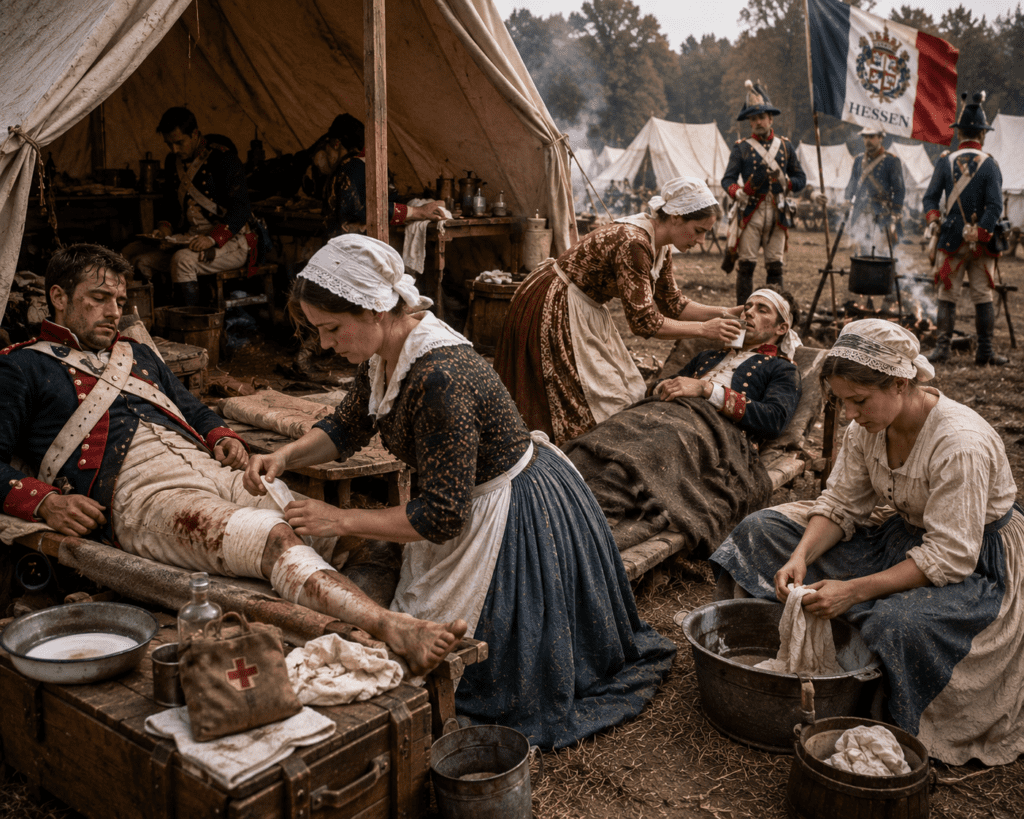
During the Saratoga campaign, Baroness von Riedesel became famous for helping care for wounded soldiers while artillery shells struck near the military camps. Her courage and observations later became part of one of the most valuable firsthand accounts of Hessian camp life during the Revolutionary War.
Her memoirs provide historians with a detailed description of military camps, marches, fear, disease, and daily survival in revolutionary America.
Hessian Camp Life Changed Over Time
As the war continued, the composition of the Hessian camp communities slowly evolved. Some German wives remained with the regiments throughout the conflict despite years of hardship, military campaigns, disease outbreaks, and forced marches.
Other Hessian soldiers formed relationships with local women in New York, New Jersey, Pennsylvania, and other occupied regions.
Over time, American and Loyalist women became part of the traveling military communities surrounding the German regiments.
Hessian Camps Became Traveling Communities
The existence of camp followers reveals an important truth about eighteenth-century warfare. Armies were not simply columns of marching soldiers moving from battlefield to battlefield.
Hessian camp life involved entire moving societies made up of soldiers, wives, children, workers, servants, officers, tradespeople, and civilians all attempting to survive amid one of the largest military conflicts in North American history.
The Fate of the Hessian Camp Followers
The story of the Hessian camp followers remains one of the most overlooked human dramas of the American Revolution. These women and children crossed the Atlantic Ocean alongside the German troops and faced many of the same dangers experienced by the soldiers themselves.
Because their lives were tied directly to the regiments, every military defeat, disease outbreak, forced march, surrender, or prison transfer shaped their fate as well.
Hessian Camp Life Became a Struggle for Survival
For many of these families, the Revolutionary War became not simply a military conflict but a years-long struggle for survival in an unfamiliar world thousands of miles from home.
Hessian camp life exposed women and children to hunger, disease, severe weather, exhaustion, uncertainty, and the constant danger of war.
Hessian Religion, Faith, and the Churches They Brought to America
Religion played a major role in Hessian camp life during the American Revolution. The German soldiers who arrived in North America brought far more than muskets, cannon, and military discipline.
They also carried deeply rooted religious traditions shaped by centuries of German history, the Protestant Reformation, and the political structure of the old Holy Roman Empire.
For many Hessians, faith stood at the center of both personal identity and military culture.
Lutheran and Reformed Traditions in Hessian Camp Life
Most Hessian soldiers came from Protestant regions of central Germany. The two dominant religious traditions among the Hessians were Lutheranism and the German Reformed faith.
These traditions traced directly back to the Protestant Reformation launched by Martin Luther during the early 1500s.
By the eighteenth century, many German principalities officially aligned themselves with one of these Protestant branches.
Religion and Government Were Closely Connected
In Hesse-Kassel and related territories, religion and government were tightly linked. Churches often functioned alongside the military system itself, reinforcing loyalty, discipline, obedience, and service to the ruling prince.
Military chaplains regularly accompanied Hessian regiments into the field.
Religion Inside the Army
The Hessian military system viewed religion as essential to maintaining order and discipline. Soldiers attended formal worship services, military prayers, religious holidays, and ceremonial observances throughout their service.
Many officers believed moral discipline and battlefield discipline were inseparable.
This religious culture shaped daily Hessian camp life in important ways. Chaplains marched with regiments, prayer services were held before campaigns, and funerals followed strict ceremonial traditions.
Faith Helped Soldiers Endure War
For ordinary soldiers facing disease, battle, homesickness, and uncertainty in a foreign land, religion often provided emotional stability.
Faith became especially important during severe winters, after major battles, and during outbreaks of camp disease.
Encountering Religious Freedom in America
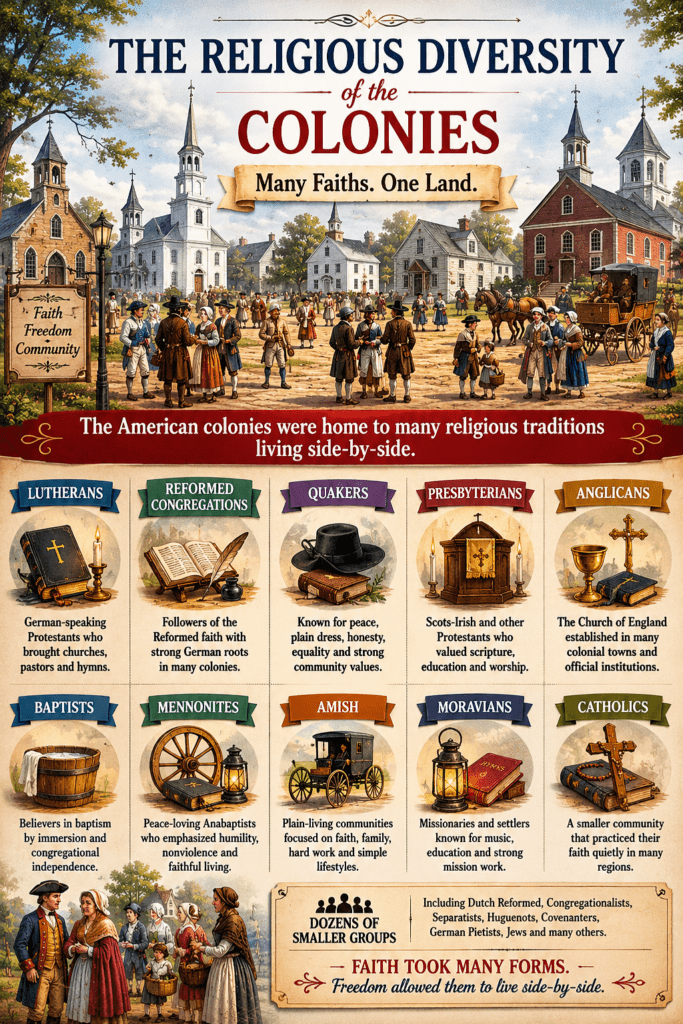
One of the most surprising discoveries for many Hessians was the extraordinary diversity of religion in the American colonies.
Eighteenth-century Europe remained heavily tied to state churches and government-controlled religious systems. In many German states, religion closely followed political boundaries established by rulers.
America appeared radically different.
The Religious Diversity of the Colonies
The colonies contained Lutherans, Reformed congregations, Quakers, Presbyterians, Anglicans, Baptists, Mennonites, Amish, Moravians, Catholics, and dozens of smaller religious groups living side-by-side.
This level of religious diversity fascinated many German soldiers.
German-Speaking Churches in Pennsylvania
In Pennsylvania especially, Hessians encountered thriving German-speaking religious communities where sermons were preached in German and familiar hymns were sung.
Many churches resembled those back home in central Germany. For prisoners and deserters alike, these communities often felt comforting and familiar.
Faith and the Decision to Remain in America
Religion also influenced why many Hessians remained in America after the war ended. The colonies offered the opportunity to worship freely within German-speaking communities while also pursuing economic opportunity and land ownership.
For some Hessians, America represented both financial freedom and spiritual freedom.
The Growth of German-American Churches
By the nineteenth century, German-American churches had spread across Pennsylvania, Ohio, Illinois, Wisconsin, Missouri, and much of the Midwest.
Former Hessians and their descendants became part of this expanding religious landscape and helped shape the spiritual and cultural identity of German-America for generations.
Hessian Dragoon Marching Music
Watch the video where the band is playing the actual music that Hessians played in 1776
Hessian Music, Drums, and the Sound of War
One of the most unforgettable parts of Hessian camp life was not simply how the German troops looked, but how they sounded.
Eighteenth-century warfare was loud, smoky, chaotic, and confusing. Battles often unfolded through thick clouds of black powder smoke where visibility collapsed after only a few volleys.
Under those conditions, armies depended heavily on sound to maintain order and coordination.
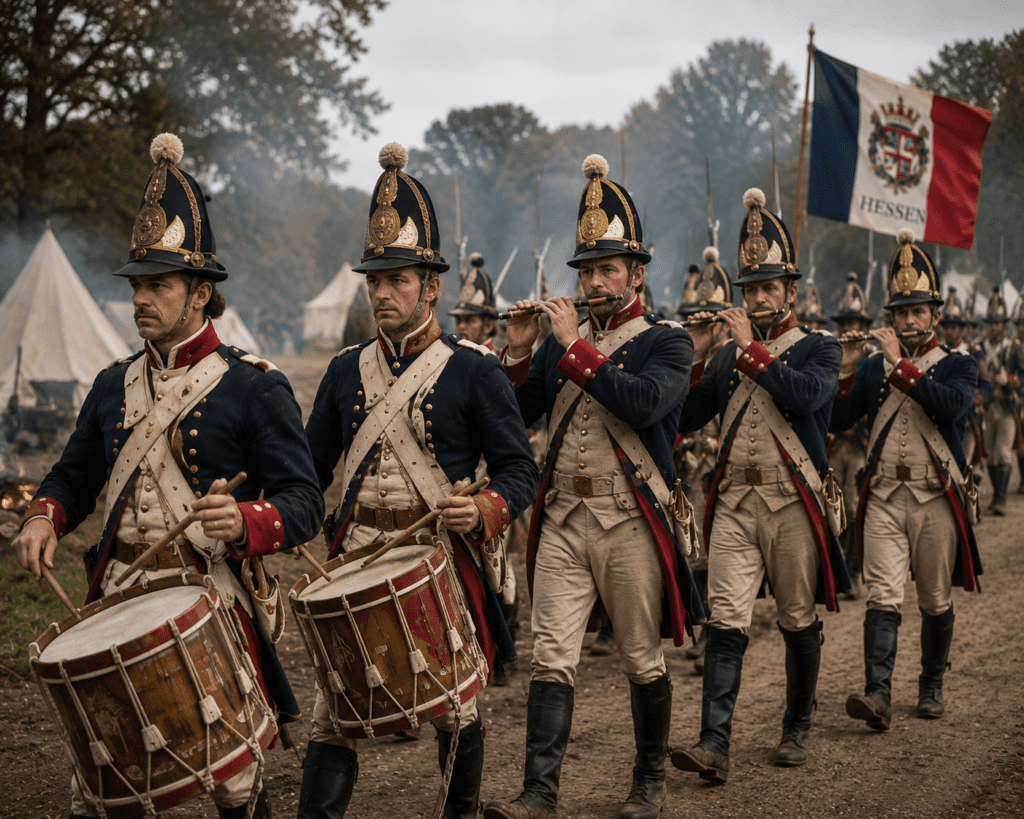
Drums and fifes were essential to Hessian camp life and battlefield communication, helping German regiments maintain discipline, marching cadence, and coordinated battlefield movements during the Revolutionary War.
Drums as Battlefield Communication
Modern armies rely on radios and electronic communication systems. In the eighteenth century, armies communicated through drums, fifes, bugles, whistles, flags, and shouted commands.
Every Hessian regiment maintained trained military musicians whose duties extended far beyond entertainment or ceremony.
Drum Signals Controlled the Battlefield
Drummers transmitted battlefield orders through specific rhythmic patterns memorized during endless military drills. Different drumbeats signaled soldiers to advance, retreat, form ranks, prepare to fire, fix bayonets, change formation, or assemble camp.
In battle, these sounds often determined whether a regiment remained organized or collapsed into confusion.
The Hessians became famous for the precision of these signals.
The Psychological Effect on American Forces
American militia units often lacked the same level of formal training and battlefield coordination found in European armies.
As a result, the sound of disciplined Hessian formations advancing with synchronized drums, fixed bayonets, and steady marching cadence could be psychologically overwhelming.
Witnesses frequently described the Germans marching with near-mechanical precision while drums echoed across the battlefield.
The Role of the Fifes
Alongside the drums came the sharp sound of fifes. These small military flutes produced piercing tones capable of carrying across crowded battlefields.
Together, fifes and drums helped maintain marching rhythm while also transmitting commands amid smoke and confusion.
Different armies developed distinct musical traditions, and Hessian military music reflected centuries of German martial culture.
Military Musicians Required Constant Practice
Military musicians trained constantly because mistakes during battlefield communication could create deadly confusion.
Within Hessian camp life, music served both practical military purposes and emotional ones tied to morale and identity.
Hunting Horns and the Hessian Jägers
The elite Hessian Jägers added another distinctive sound to the battlefield: the hunting horn.
Because the Jägers originally came from professional hunters and foresters, they carried civilian hunting traditions into military service.
Hunting Horns in Forest Warfare
Hunting horns allowed Jäger detachments to communicate quickly through forests and rough terrain where visual signals became difficult.
Different horn calls could signal movement, enemy sightings, regrouping, or tactical maneuvers.
To American soldiers moving through wooded terrain, hearing distant German hunting horns echoing through the forests could be deeply unsettling.
The Meaning Behind the Sound
The sound often meant skilled Hessian riflemen were nearby. The Jägers earned a reputation as some of the most effective specialized troops serving with the British Army during the Revolutionary War.
Camp Music and Hessian Camp Life
Music also shaped daily life inside Hessian camps. Military musicians performed during parades, guard changes, funerals, religious services, celebrations, and official ceremonies.
Songs from Germany helped maintain morale among soldiers living thousands of miles from home.
Music Preserved Regimental Identity
Some Hessian regiments maintained musical traditions connected directly to their home states or ruling princes. These traditions reinforced regimental identity and loyalty during long military campaigns.
Music became part of the emotional survival system within Hessian camp life.
Music During the Surrender at Yorktown
The final surrender at Yorktown in 1781 included one of the most famous musical moments of the American Revolution.
As British and Hessian troops marched out to surrender their weapons, military bands played traditional surrender marches.
Discipline Even in Defeat
Legend later attached enormous symbolism to the tune “The World Turned Upside Down,” although historians continue debating whether it was actually performed during the ceremony.
Observers nevertheless carefully noted the disciplined composure of the Hessian troops during the surrender. Even in defeat, the German regiments maintained their military bearing while marching to the sound of drums and fifes.
Hessians Celebrated Christmas While Fighting in the Colonies
Hessian camp life did not stop during the Christmas season. Even while fighting thousands of miles from Germany, many Hessian soldiers attempted to preserve familiar holiday traditions inside the military camps of revolutionary America.
For the German troops, Christmas remained both a religious observance and an important emotional connection to home.
Christmas Inside Hessian Camps
Hessian soldiers often celebrated Christmas with religious services, prayers, hymns, shared meals, music, and drinking when supplies allowed. Military chaplains conducted worship services while soldiers gathered to sing traditional German Christmas songs and Protestant hymns.
In many camps, musicians played fifes, flutes, fiddles, and drums during evening gatherings around campfires.
Even under harsh wartime conditions, Hessian camp life still included efforts to maintain holiday traditions that reminded soldiers of their families and villages back in Germany.
Longing for Home During the Holidays
Letters and journals written by Hessian soldiers frequently described homesickness during Christmas. Many soldiers deeply missed their families, churches, winter festivals, and familiar customs from central Germany.
For men living in muddy military camps far from home, Christmas could become emotionally difficult despite attempts at celebration.
The Famous Christmas at Trenton
The most famous Christmas connected to Hessian camp life occurred in December 1776 at Trenton, New Jersey.
After weeks of harsh winter duty, many Hessian soldiers under Colonel Johann Rall spent Christmas Day resting, eating, drinking, attending church services, and trying to enjoy a brief moment of peace during the war.
At the time, few expected an immediate American attack because freezing weather and ice-covered rivers appeared to make major military movement impossible.
Washington’s Surprise Attack
During the night of December 25–26, George Washington led Continental Army forces across the icy Delaware River and launched a surprise attack against the Hessian garrison at Trenton before dawn.
The sudden assault shocked the German troops and became one of the most famous turning points of the American Revolution.
Although popular myths later exaggerated claims that the Hessians were drunk or completely careless, historical evidence shows many soldiers were exhausted from winter conditions, constant alert status, poor weather, and the hardships of Hessian camp life.
Christmas Traditions Traveled Across the Atlantic
The Hessians also helped bring German holiday customs into North America. Many German-speaking communities in Pennsylvania and other colonies already practiced Christmas traditions familiar to the soldiers.
These traditions included:
- Christmas hymns
- Candlelit church services
- Seasonal feasts
- Evergreen decorations
- German folk music
- Family-centered celebrations
Over time, German-American communities helped shape many Christmas traditions that later became part of broader American culture.
Faith and Music During Wartime
Even during war, religion and music remained central to Hessian camp life during Christmas celebrations. Choral singing, hymns, prayer services, and simple instruments helped soldiers maintain morale while facing uncertainty, fear, and homesickness in a foreign land.
For many Hessians, Christmas represented one of the few moments during the Revolutionary War when soldiers attempted to briefly reclaim a sense of normal life far from the battlefield.
Why the “Camp Christmas Tree” is a Myth
The image of Hessians neglecting their guard posts because they were dancing around a lighted Christmas tree in Trenton was largely popularized decades later by Victorian-era writers.
- A Regional, Indoor Tradition: In 1776, the Christmas tree (Weihnachtsbaum) was not yet a universal German tradition. It was a localized, predominantly Protestant, bourgeois custom centered mostly in the Upper Rhine region (like Strasbourg). The concept of an outdoor, public, or military camp Christmas tree did not exist yet.
- The Reality at Trenton: The Hessians at Trenton under Colonel Johann Rall were exhausted, not partying. They had been on constant alert for weeks, subjected to near-continuous raids by American militia. On Christmas night, they were dealing with a brutal winter storm of sleet, snow, and driving wind. They weren’t huddled around a decorated tree outdoors, nor did they have the resources or inclination to set them up in their cramped winter quarters.
Where Did the Legend Come From?
The myth persists because Hessian soldiers did introduce the Christmas tree to North America—just not in active military camps, and not in 1776. The earliest documented instances of Hessians and Christmas trees come from prisoners of war and occupied areas later in the war:
- Sorel, Quebec (1781): The first firmly documented Christmas tree in North America was set up by a German. Baroness Riedesel—the wife of General Friedrich Adolf Riedesel, commander of the Brunswick troops (often lumped under the “Hessian” umbrella)—hosted a Christmas party for British and German officers in Canada. She decorated a traditional fir tree with candles and fruits, sparking a massive trend among the local elite.
- Windsor Locks, Connecticut (1777): Local records indicate that a Hessian soldier named Hendrick Roddmore, who was captured at the Battle of Bennington in 1777, went to work on a local farm. Starting that winter, he reportedly set up a decorated Christmas tree in the family’s home, repeating the tradition for over a decade.
How the Hessians Actually Celebrated: While they didn’t have trees in camp, the Hessians did celebrate Christmas with deep religious reverence. They observed Weihnachten by singing traditional German hymns and carols, conducting church services, and—when supplies allowed—sharing a ration of rum or wine.
It wasn’t until the mid-19th century, when Queen Victoria’s German husband, Prince Albert, popularized the tree in England, and German immigrants flooded into the United States, that the Christmas tree became a staple of the American holiday season.
The RetireCoast Hessians in the American Revolution series draws from battlefield organizations, museum resources, genealogy collections, military archives, and historical research focused on German soldiers, prisoners, settlers, and families connected to the Revolutionary War.
- FamilySearch — Hessian Soldiers
- Franklin & Marshall College Archives — Johannes Schwalm Historical Association Collection
- FamilySearch Catalog — Journal of the Johannes Schwalm Historical Association
- Journal of the American Revolution — The Hessians: Journal of the Johannes Schwalm Historical Association
FAQ
Yes. Many Hessian regiments traveled with camp followers, including wives and children who became part of Hessian camp life during the American Revolution.
These women often worked as cooks, laundresses, seamstresses, nurses, and caretakers while helping the military camps survive under difficult wartime conditions.
Most Hessian soldiers belonged to Protestant Lutheran or German Reformed churches. Religion played a major role in Hessian camp life and military culture.
Military chaplains traveled with the regiments, conducting worship services, prayers, funerals, and religious observances throughout the war.
Hessian camp life involved constant labor, strict discipline, military drills, guard duty, equipment maintenance, and survival under harsh conditions.
Soldiers frequently struggled with disease, exhaustion, hunger, severe weather, homesickness, and overcrowded camps during long campaigns in America.
Drums and fifes served as battlefield communication systems during the eighteenth century. Different musical signals instructed soldiers when to march, fire, retreat, or change formation.
Music also played an important emotional role in Hessian camp life by helping maintain morale and preserve German cultural traditions far from home.
Yes. Hessian soldiers often celebrated Christmas with religious services, hymns, music, shared meals, and camp gatherings whenever military conditions allowed.
The most famous Christmas connected to Hessian camp life occurred at Trenton in December 1776 shortly before George Washington launched his surprise attack.
Many camp followers became trapped alongside the soldiers during defeats, surrenders, and prisoner transfers. Women and children often struggled to find food, shelter, and protection after major battles.
Some eventually returned to Europe while others remained in America and became part of growing German-American communities after the war.
The Complete RetireCoast Historical Series
This series about the Hessians in the American Revolution is just one part of the much larger RetireCoast 250th Anniversary historical project celebrating the birth of the United States.
We invite you to continue exploring our growing collection of Revolutionary War articles covering battles, weapons, ships, camp followers, frontier life, hidden history, and the people who shaped the American story.
Discover more from RetireCoast.com
Subscribe to get the latest posts sent to your email.