Last updated on June 30th, 2026 at 12:31 pm
The introduction below is designed to establish authority, create a personal connection, improve engagement time, and set up the article as a definitive evergreen Mississippi Gulf Coast fishing guide.
Fishing on the Mississippi Gulf Coast is far more than simply dropping a line into the water. Along this stretch of coastline, fishing is part of the culture, part of the economy, part of family traditions, and for many people, part of everyday life.
From the marshes and bayous to the barrier islands and deep Gulf waters, nearly every community along the Coast has a direct connection to fishing in one form or another.
This article has been a work in progress for quite a while. I wanted to create a truly comprehensive guide to fishing on the Mississippi Gulf Coast — something that goes beyond a simple list of fish species or bait recommendations.
This is a long article, 17,000 words but the good news is that you can click on the table of contents and go to your favorite section. I will be writing companion articles focusing on some specific topics such as boats, the barrier islands and more, check back later or sign up on the right to notification of new articles.
The Mississippi Gulf Coast offers one of the most unique fishing environments in the United States, combining shallow estuaries, productive marsh systems, protected bays, barrier islands, artificial reefs, and deep offshore waters all within relatively short travel distances.
Fish stories
Over the years, many of my friends who are avid fishermen and women have shared their “fish stories” with me. Some involve massive bull redfish caught near the islands. Others involve giant speckled trout landed under dock lights late at night.
🎣 Did You Know?
Saltwater recreational fishing is one of the Mississippi Gulf Coast’s most important outdoor industries. Studies by Mississippi State University have estimated that Mississippi’s saltwater recreational fishing industry generates approximately $97 million annually in economic activity and supports more than 1,100 jobs throughout the state.
Every year, anglers travel to the Mississippi Gulf Coast to fish for speckled trout, redfish, flounder, snapper, tuna, king mackerel, cobia, and many other species. Their spending supports charter captains, marinas, hotels, vacation rentals, restaurants, bait shops, fuel docks, tackle stores, and countless local businesses.
Whether you’re planning a weekend fishing trip or a week-long offshore adventure, fishing remains one of the biggest reasons visitors choose the Mississippi Gulf Coast.
Source: Mississippi State University Extension and Mississippi-Alabama Sea Grant economic impact studies.
A few stories involve sharks that nearly emptied reels before disappearing into the Gulf. Some of those stories — or at least versions of them — are included throughout this guide because fishing on the Coast is as much about the experience as it is the catch itself.
Fishing is also one of the primary reasons people visit the Mississippi Gulf Coast each year. I know this personally because I regularly see anglers fishing the bayou near my home, and nearly every day I watch boats heading into the Gulf of America before sunrise. Some are small bay boats targeting redfish and trout inside the Mississippi Sound.
Others are larger offshore vessels heading toward reefs, wrecks, oil platforms, and deep-water fishing grounds in search of snapper, grouper, king mackerel, tuna, and sharks.
The sheer variety of fish
What makes the Mississippi Gulf Coast special is the sheer variety of fishing opportunities available here. A family can fish from a public pier in the morning, wade fish along the beach in the afternoon, and book an offshore charter the next day — all without traveling very far.
Whether you are an experienced angler with years of offshore experience or someone introducing children to fishing for the very first time, the Coast offers opportunities almost year-round.
The Mississippi Gulf Coast is also uniquely positioned geographically. Protected by the barrier islands of Ship Island, Horn Island, and Cat Island, the Mississippi Sound creates productive estuary waters that serve as nurseries for baitfish, shrimp, crabs, and countless sportfish species.
- Fish stories
- The sheer variety of fish
- Understanding the Waters of the Mississippi Gulf Coast
- What People Ask About Mississippi Gulf Coast Fishing
- The “Big Three” Inshore Fish of the Mississippi Gulf Coast
- Inshore vs Offshore Fishing Selector Tool
- What People Ask About Redfish, Trout & Flounder
- Other Popular Inshore & Nearshore Fish Species
- What People Ask About Mississippi Gulf Coast Inshore Fishing
- Offshore & Deep Water Fishing on the Mississippi Gulf Coast
- 🎣 Did You Know?
- Artificial Reefs & Offshore Structure
- Red Snapper: The King of Gulf Reef Fishing
- Grouper: The Bottom-Dwelling Powerhouses
- Cobia: The Spring Gulf Coast Favorite
- King Mackerel & Fast Offshore Action
- Tuna, Wahoo & Blue Water Fishing
- Sharks of the Gulf Coast
- What People Ask About Offshore Fishing
- Fishing From Piers, Beaches & Shorelines on the Mississippi Gulf Coast
- Pier Fishing Along the Coast
- Surf Fishing on the Mississippi Gulf Coast
- Bridge Fishing & Dock Lights
- Wade Fishing the Flats & Beaches
- Kayak Fishing Explosion
- What People Ask About Shore Fishing
- Seasonal Fishing Patterns on the Mississippi Gulf Coast
- Spring Fishing: The Coast Comes Alive
- Summer Fishing: Offshore Season & Early Mornings
- Fall Fishing: Bull Reds & Flounder Runs
- Winter Fishing: Slower But Still Productive
- Weather, Tides & Water Conditions
- Hurricane Season & Fishing
- What People Ask About Seasonal Fishing
- Fishing Regulations, Conservation & Responsible Angling
- Mississippi Department of Marine Resources (MDMR)
- Red Snapper Regulations
- Speckled Trout & Flounder Restrictions
- Fishing Licenses
- Catch & Release Fishing
- Shark Conservation & Responsible Handling
- Artificial Reef Programs
- Respecting the Water & Other Anglers
- What People Ask About Fishing Regulations
- Where the Fish Come From: The Mississippi Gulf Coast Nursery System
- What People Ask About Estuaries & Fish Nurseries
- Mississippi Estuaries: The Hidden Foundation of Gulf Coast Fishing
- The Structural Impact on Gulf Fishing
- Fishing Communities & Culture Along the Mississippi Gulf Coast
- Biloxi: A Historic Fishing Port
- Gulfport & Charter Fishing
- Ocean Springs & Marsh Fishing Culture
- Bay St. Louis & Pass Christian
- Fishing Tournaments & Community Events
- The Seafood Connection
- Fishing as a Lifestyle
- What People Ask About Gulf Coast Fishing Culture
- Commercial Fishing, Shrimping & the Working Waterfront
- Shrimp Boats: Symbols of the Gulf Coast
- The Importance of Mississippi Shrimp
- Oyster Harvesting & Reef Systems
- Seafood Markets & Gulf Coast Culture
- Challenges Facing Commercial Fishing
- The Connection Between Commercial & Recreational Fishing
- What People Ask About Commercial Fishing
- Fishing Tool Best Months
- Fishing Safety on the Mississippi Gulf Coast
- Weather Awareness Is Critical
- Heat & Hydration
- Boating Safety
- Offshore Fishing Risks
- Wade Fishing & Marine Wildlife
- Shark Fishing Precautions
- Pier & Surf Fishing Safety
- Respecting Wildlife & the Environment
- Hurricane Awareness
- What People Ask About Fishing Safety
- Fishing Equipment, Bait & Tackle Used on the Mississippi Gulf Coast
- Rods & Reels
- Artificial Lures
- Live Bait Fishing
- Cast Nets & Catching Bait
- Tackle Shops & Local Knowledge
- Electronics & Modern Technology
- Ice Chests, Fish Cleaning & Preparation
- What People Ask About Fishing Equipment
- Family Fishing Vacations on the Mississippi Gulf Coast
- Mississippi Gulf Coast Fishing Trip Planner
- What People Ask About Family Fishing Trips
- Legendary Fishing Destinations on the Mississippi Gulf Coast
- The Mississippi Sound
- The Barrier Islands
- Cat Island
- Ship Island
- Horn Island Wilderness
- Pascagoula River System
- Bayous & Marsh Drains
- Artificial Reefs & Oil Platforms
- Bridges & Causeways
- What People Ask About Fishing Locations
- The Mississippi Gulf Coast Fishing Uniform
- The Famous “Fishing Shirt”
- Sun Protection Is Serious Business
- Sunglasses With Straps
- Shorts, Boat Shoes & Bare Ankles
- The Long Sleeve Debate
- Fishing Gloves, Neck Gaiters & Face Coverings
- Fishing Vests & Utility Gear
- Men & Women Dress Very Similarly
- The Boat Ramp Fashion Show
- What People Ask About Fishing Clothing
- Wildlife, Dolphins & Other Things You See While Fishing
- Dolphins Following the Boats
- Pelicans & Diving Birds
- Ospreys & Eagles
- Stingrays & Rays Gliding Through Shallow Water
- Sea Turtles
- Sharks in the Sound
- Jellyfish & Seasonal Visitors
- Alligators in Coastal Marshes
- Migratory Birds & Seasonal Wildlife
- Sunrises, Sunsets & Quiet Moments
- What People Ask About Gulf Coast Wildlife
- Seafood, Fish Fries & Cooking the Catch
- The Gulf Coast Fish Fry Tradition
- Shrimp Boils & Seafood Gatherings
- Grilling Fresh Fish
- Cleaning Fish at the Dock
- Seafood Restaurants & “Hook to Table” Culture
- The Great Shrimp Debate
- Fish Stories Around the Table
- Cooking as Part of the Fishing Experience
- What People Ask About Gulf Coast Seafood
- Why People Move to the Mississippi Gulf Coast for Fishing
- A Lifestyle Built Around the Water
- Easy Access to Fishing
- A More Relaxed Coastal Lifestyle
- Fishing for Retirement
- The Social Side of Fishing
- Affordable Access Compared to Other Coastal Areas
- Fishing Creates Lasting Memories
- Why the Fishing Lifestyle Endures
- What People Ask About Moving to the Gulf Coast for Fishing
- Final Thoughts: Fishing Is the Mississippi Gulf Coast
- More Than a Sport
- 🎣 Author Fish Story: Salmon Fishing on Lake Huron
- Every Trip Becomes a Story
- A Coast Built Around Water
- Why the Mississippi Gulf Coast Is Different
- A Living Coastal Tradition
- The Gulf Always Calls You Back
- What People Ask About Mississippi Gulf Coast Fishing
- Quiz
- Fishing Charter Operators
- Podcast
These protected waters support thriving populations of redfish, speckled trout, flounder, sheepshead, black drum, and many other inshore species. Just beyond the islands, the deeper Gulf waters open entirely different fishing opportunities focused on snapper, grouper, cobia, king mackerel, and powerful pelagic species.
In this guide, we will explore:
- the best fish species found on the Mississippi Gulf Coast,
- the differences between inshore and offshore fishing,
- seasonal fishing patterns,
- fishing from piers, beaches, kayaks, and boats,
- barrier island fishing,
- offshore reef fishing,
- local fishing culture,
- regulations and conservation,
- charter fishing opportunities,
- and the unique coastal lifestyle that makes fishing such an important part of life on the Mississippi Gulf Coast.
We have also included graphics, species guides, practical tips, fishing locations, stories, and additional multimedia content designed to make this one of the most complete Mississippi Gulf Coast fishing resources available online.
Whether you are planning a fishing vacation, relocating to the Coast, booking a charter trip, or simply trying to decide what fish are biting this season, we hope this guide helps you better understand why fishing continues to define life along the Mississippi Gulf Coast.
Understanding the Waters of the Mississippi Gulf Coast
Before discussing specific fish species, bait choices, fishing techniques, or offshore adventures, it is important to understand why the Mississippi Gulf Coast is such an incredibly productive fishing environment. The Coast is not simply one body of water.
Instead, it is a massive interconnected ecosystem made up of shallow estuaries, winding bayous, oyster reefs, river systems, marshes, barrier islands, sandy beaches, deep channels, and offshore Gulf waters.
This diversity is exactly why anglers can target everything from speckled trout and redfish in only a few feet of water to snapper, grouper, tuna, and sharks farther offshore.
The Mississippi Gulf Coast is also uniquely protected geographically. Unlike many open Gulf coastlines, the Coast benefits from the barrier islands that shield the Mississippi Sound from the full force of Gulf waves and weather. This protection creates calmer, nutrient-rich waters that support enormous populations of shrimp, crabs, mullet, pogies, and countless other bait species that larger game fish depend upon.
Many experienced fishermen believe the Mississippi Gulf Coast offers one of the most underrated fisheries in the United States because anglers have access to such a wide range of habitats within relatively short travel distances. In many places, a fisherman can leave shallow marsh water in the morning and reach offshore reef systems by midday.
The Mississippi Sound
The Mississippi Sound forms the heart of much of the Coast’s inshore fishing activity. This large body of protected water stretches behind the barrier islands and serves as a critical nursery for marine life throughout the northern Gulf.
The Sound combines:
- freshwater inflows from rivers and bayous,
- tidal saltwater from the Gulf,
- marsh nutrients,
- oyster reefs,
- and shallow grass flats.
This combination creates ideal feeding conditions for many of the Coast’s most popular gamefish.
The Sound includes productive fishing areas surrounding:
- Bay St. Louis
- Pass Christian
- Long Beach
- Gulfport
- Biloxi
- Ocean Springs
- Pascagoula
These waters are home to:
- redfish,
- speckled trout,
- flounder,
- sheepshead,
- black drum,
- Spanish mackerel,
- sharks,
- and many seasonal migratory species.
One of the reasons anglers love fishing the Sound is that weather conditions are often more manageable than fully offshore waters. Even on days when Gulf conditions become rough, fishermen can frequently continue fishing protected bays, marshes, rivers, and bayous.
Bayous, Marshes & Backwaters
The Mississippi Gulf Coast contains countless small bayous, creeks, marsh drains, and tidal backwaters that provide excellent habitat for inshore species.
Many of these areas are loaded with:
- shrimp,
- finger mullet,
- mud minnows,
- crabs,
- and juvenile baitfish.
These protected environments become feeding grounds for redfish, flounder, and speckled trout throughout much of the year.
Some of the most productive fishing often occurs where moving tidal water funnels bait through narrow cuts or marsh drains. Experienced local anglers pay close attention to:
- tides,
- water clarity,
- salinity,
- wind direction,
- and bait movement.
In fact, many fishermen on the Coast will tell you that understanding tides is often more important than understanding the weather itself.
Barrier Islands: Natural Protection for the Coast
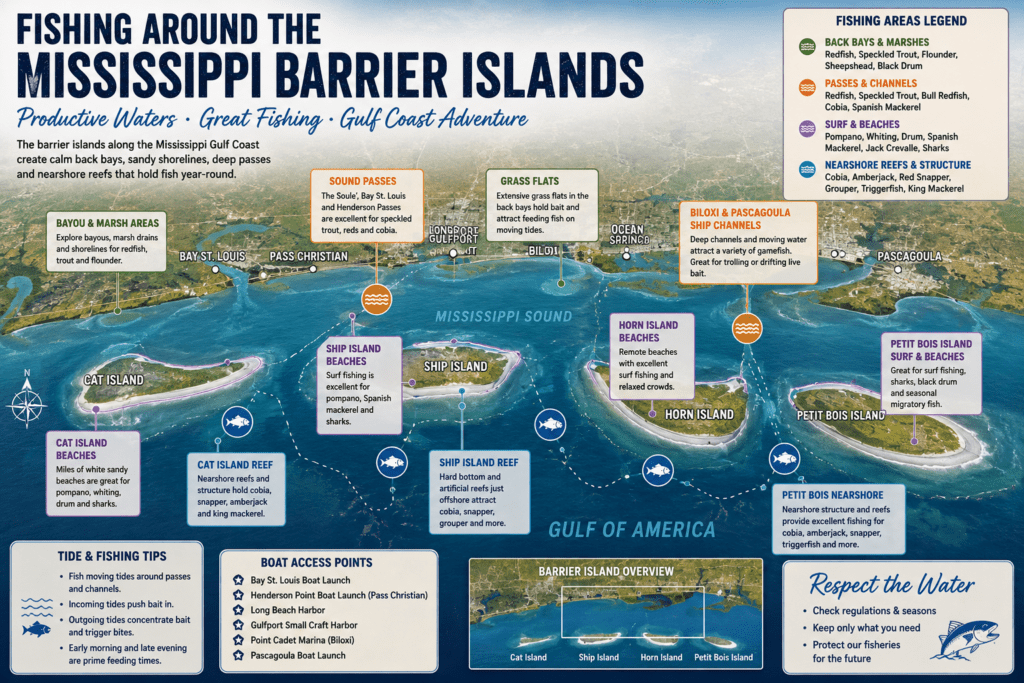
The barrier islands are one of the defining features of Mississippi Gulf Coast fishing.
These islands include:
- Ship Island
- Horn Island
- Cat Island
- Petit Bois Island
These islands help block heavy Gulf surf and create calmer waters inside the Sound while also acting as major feeding and migration corridors for fish species.
The islands are famous for:
- surf fishing,
- wade fishing,
- nearshore trolling,
- shark fishing,
- sight fishing for cobia,
- and targeting trout and redfish around sandy cuts and grass flats.
Many anglers consider the islands among the most beautiful fishing destinations anywhere along the Gulf Coast. Clearer water, white sand beaches, bird activity, and relatively undeveloped shorelines create an experience that feels very different from mainland fishing.
Offshore Waters & Artificial Reefs
Once anglers move beyond the barrier islands, the environment changes dramatically.
The open Gulf contains:
- artificial reefs,
- shipwrecks,
- oil platforms,
- natural ledges,
- deep-water structure,
- and offshore blue water environments.
These offshore areas support entirely different fish species than the shallow inshore waters.
This is where fishermen begin targeting:
- red snapper,
- grouper,
- amberjack,
- king mackerel,
- cobia,
- mahi-mahi,
- tuna,
- wahoo,
- and sharks.
Mississippi has invested heavily in artificial reef development over the years, helping create productive offshore fishing environments that attract both baitfish and larger predators.
For many anglers, offshore fishing becomes an entirely different experience involving:
- larger boats,
- advanced electronics,
- heavy tackle,
- trolling techniques,
- bottom fishing,
- live baiting,
- and long runs into Gulf waters.
The transition from calm marsh fishing at sunrise to battling large offshore species later the same day is one of the unique aspects that makes fishing on the Mississippi Gulf Coast so special.
🌴 Looking for More Outdoor Adventures?
Fishing is the number one outdoor activity on the Mississippi Gulf Coast, but it’s far from the only way to enjoy our beautiful coastal region.
From kayaking and paddleboarding to hiking, biking, birdwatching, camping, boating, and beach activities, the Gulf Coast offers outdoor opportunities for every age and interest.
Discover dozens of additional ways to enjoy the outdoors by reading our comprehensive guide:
Explore Mississippi Gulf Coast Outdoor Activities →
Whether you’re planning a vacation, considering retirement on the Coast, or simply looking for your next adventure, you’ll find plenty of ideas waiting for you.
What People Ask About Mississippi Gulf Coast Fishing
What is the best type of fishing on the Mississippi Gulf Coast?
That depends on personal preference. Inshore fishing for redfish and speckled trout is extremely popular because it is accessible and productive, while offshore fishing attracts anglers seeking larger sportfish such as snapper, grouper, tuna, and sharks.
Why is the Mississippi Sound so productive for fishing?
The Mississippi Sound combines freshwater rivers, saltwater Gulf tides, marsh systems, oyster reefs, and barrier island protection, creating ideal nursery and feeding habitat for many fish species.
Can beginners fish successfully on the Mississippi Gulf Coast?
Absolutely. Public piers, beaches, bayous, and guided charter trips make the Coast one of the most beginner-friendly fishing destinations on the Gulf Coast.
The “Big Three” Inshore Fish of the Mississippi Gulf Coast
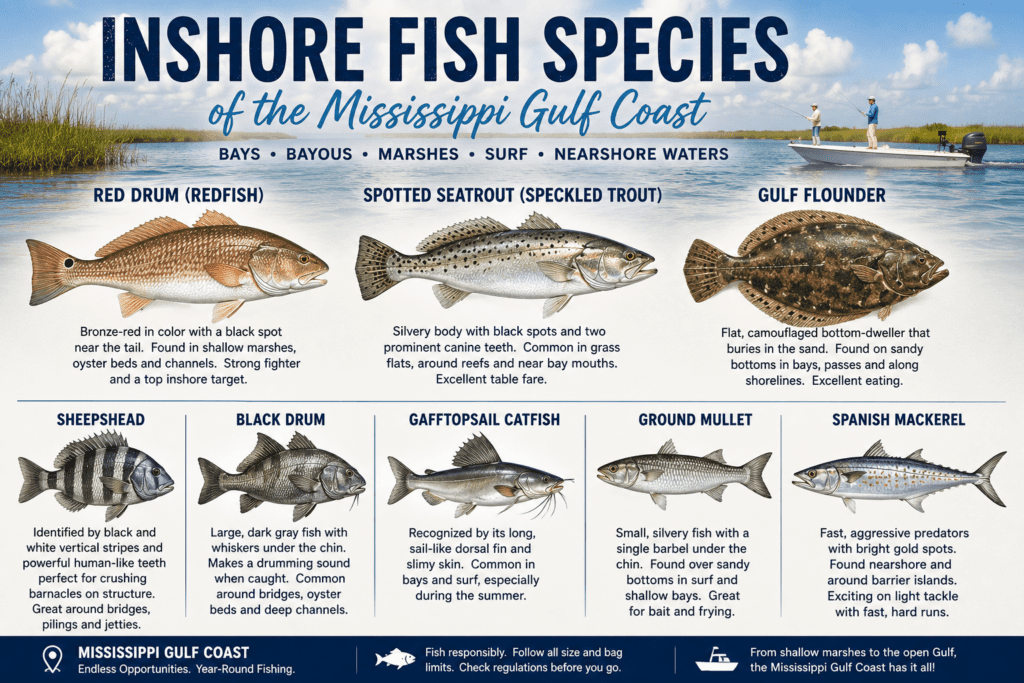
For many local anglers, fishing on the Mississippi Gulf Coast revolves around three primary inshore species:
- Red Drum (Redfish)
- Spotted Seatrout (Speckled Trout)
- Gulf & Southern Flounder
These fish dominate conversations at bait shops, marinas, fishing piers, and boat launches all along the Coast. They are the species most commonly targeted by:
- weekend fishermen,
- professional guides,
- kayak anglers,
- pier fishermen,
- surf fishermen,
- and tournament competitors.
One reason these fish are so popular is accessibility. Unlike deep offshore species that may require large boats and long runs into the Gulf of America, the “Big Three” can often be caught:
- from shore,
- around bridges,
- near marshes,
- inside bayous,
- from kayaks,
- or only a short distance offshore.
They are also active for much of the year, although their feeding patterns shift with:
- water temperature,
- tides,
- bait migrations,
- salinity,
- and seasonal weather changes.
For generations, local fishermen have developed techniques specifically designed around these species. Many of those techniques are still used today with only minor changes in tackle and electronics.
Inshore vs Offshore Fishing Selector Tool
Trying to decide between inshore fishing and offshore fishing on the Mississippi Gulf Coast? This interactive selector helps determine which type of fishing trip may best fit your experience level, budget, comfort level, group type, and fishing goals.
- Inshore fishing is popular around bays, marshes, bayous, barrier islands, and nearshore waters.
- Offshore trips typically head into the Gulf for deeper-water species and larger fish.
- Weather and wind conditions may affect offshore trips more significantly.
- Inshore fishing is often ideal for families, first-time anglers, and shorter trips.
- Offshore fishing can require longer travel times, larger boats, and higher fuel costs.
Planning a Mississippi Gulf Coast fishing trip? Explore more free calculators, planners, retirement tools, vacation rental resources, and coastal lifestyle guides on RetireCoast.com.
Red Drum (Redfish)
Among all inshore fish on the Mississippi Gulf Coast, the redfish may be the most iconic.
Known for their bronze-red coloration and distinctive black tail spot, redfish are powerful, aggressive feeders capable of living in an enormous range of habitats. They are found:
- deep inside marsh systems,
- around oyster reefs,
- along grass flats,
- near docks and bridges,
- in surf zones,
- and even far offshore during certain parts of the year.
Many local anglers consider redfish one of the most exciting inshore species because of their strength. Large “bull reds” can make long drag-screaming runs and are capable of overpowering light tackle.
One longtime Coast fisherman once told me:
“You never really forget your first big redfish. You think you’re hung on the bottom until the bottom suddenly starts moving.”
That statement perfectly captures the experience many anglers have when fighting larger redfish.
Redfish are commonly targeted using:
- live shrimp,
- finger mullet,
- cut bait,
- gold spoons,
- soft plastics,
- and topwater lures.
Tidal movement often becomes critical. Many experienced fishermen specifically target:
- falling tides near marsh drains,
- moving water around oyster reefs,
- or current breaks near points and islands.
During autumn, huge schools of bull redfish often move through passes and around the barrier islands creating some of the most exciting fishing opportunities of the year.
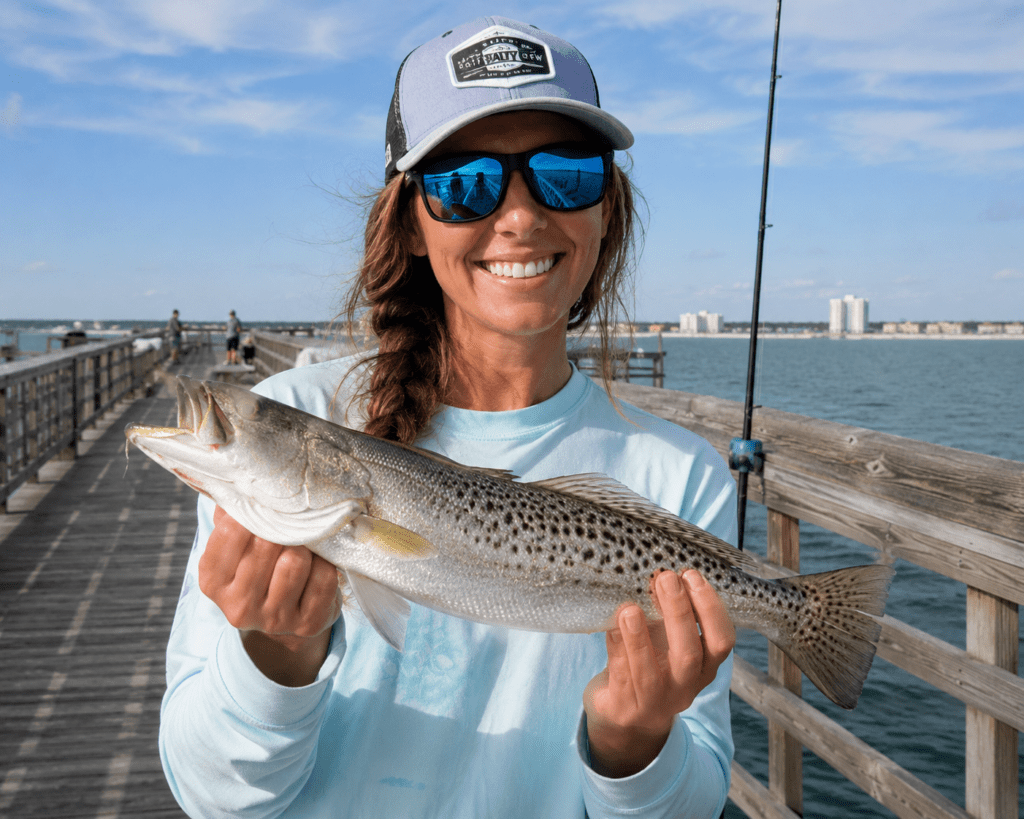
Spotted Seatrout (Speckled Trout)
If redfish are known for power, speckled trout are known for popularity.
Speckled trout are one of the most sought-after inshore fish anywhere along the Gulf Coast because they:
- strike aggressively,
- are relatively abundant,
- fight well on light tackle,
- and provide outstanding table fare.
Recognized by their silver bodies and distinctive black spots, speckled trout thrive in:
- grass flats,
- oyster reefs,
- bay mouths,
- bridge structures,
- and current-moving water.
Many local anglers become obsessed with trout fishing because the patterns can become extremely technical. Successful fishermen constantly monitor:
- tides,
- bait movement,
- water clarity,
- bird activity,
- and water temperature.
Night fishing for speckled trout under dock lights has also become extremely popular across the Mississippi Gulf Coast. Bridges, piers, marinas, and waterfront neighborhoods often attract baitfish after dark, which in turn attract feeding trout.
One common mistake inexperienced anglers make is setting the hook too hard. Speckled trout have relatively fragile mouths compared to redfish, and overly aggressive hooksets can tear hooks free during the fight.
Popular trout baits include:
- live shrimp under popping corks,
- croakers,
- soft plastic paddle tails,
- suspending twitch baits,
- and topwater plugs during low-light conditions.
Many fishermen believe the sound of a popping cork closely imitates feeding fish activity and helps attract trout from surprisingly long distances.
Gulf & Southern Flounder
Flounder are very different from redfish and trout, but they are every bit as popular among Mississippi Gulf Coast anglers.
Unlike active cruising predators, flounder are ambush hunters that spend much of their time lying motionless on sandy or muddy bottoms waiting for baitfish to pass overhead.
Their camouflage is remarkable. A flounder can nearly disappear against the bottom while remaining perfectly positioned to attack prey.
Flounder are commonly found:
- near marsh drains,
- around docks,
- beside bridge pilings,
- near sandy drop-offs,
- and along passes connecting bays to the Gulf.
Many local fishermen specifically target flounder during seasonal migration periods in the fall when fish begin moving toward deeper Gulf waters.
Fishing for flounder often requires patience and slower presentations. Anglers commonly bounce:
- soft plastic jigs,
- mud minnows,
- finger mullet,
- or live shrimp
slowly along the bottom.
One longtime Gulf Coast fishing tradition involves “flounder gigging,” where fishermen use lights at night in shallow water to locate flounder lying on sandy bottoms.
Flounder remain highly prized because of their mild flavor and excellent table quality. Many local seafood restaurants along the Coast feature flounder during peak fishing seasons.
What People Ask About Redfish, Trout & Flounder
What is the most popular inshore fish on the Mississippi Gulf Coast?
Redfish and speckled trout are generally considered the two most popular inshore sportfish because they are widely available and excellent fighters.
What bait works best for Mississippi Gulf Coast fishing?
Live shrimp, finger mullet, croakers, soft plastics, and cut bait are among the most productive baits used by local anglers.
What is the best tasting fish on the Mississippi Gulf Coast?
Many anglers consider speckled trout, flounder, and red snapper among the best eating fish found along the Mississippi Gulf Coast.
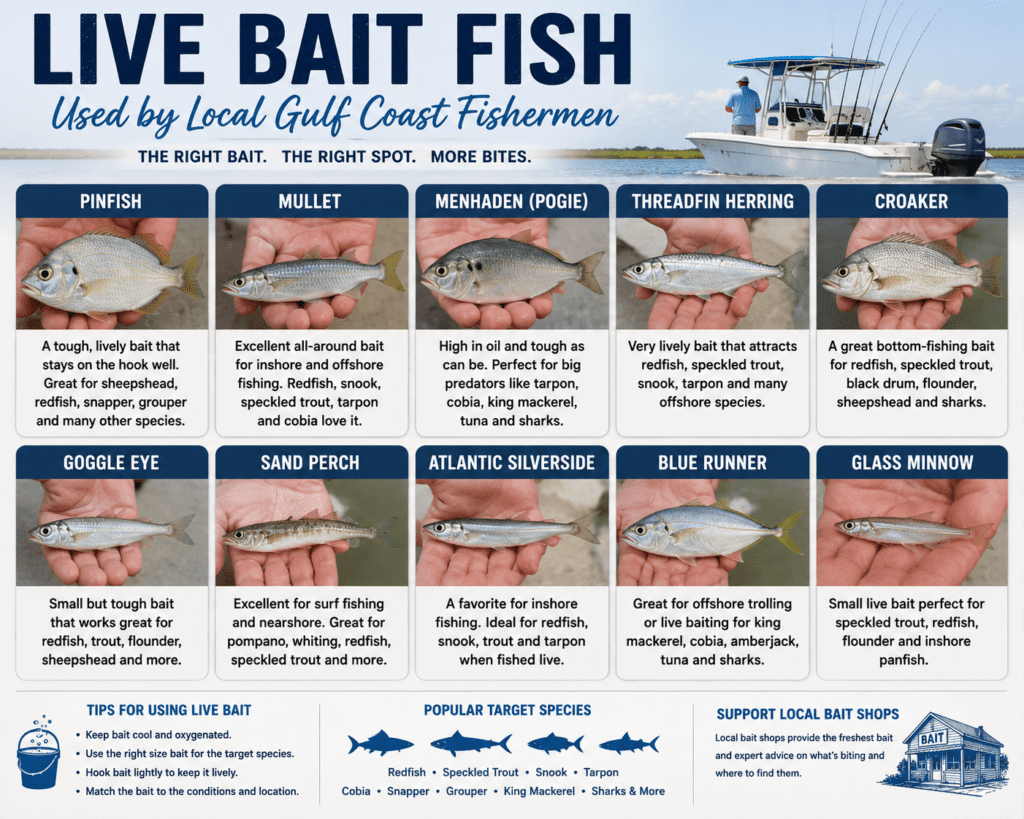
Other Popular Inshore & Nearshore Fish Species
While redfish, speckled trout, and flounder dominate much of the attention on the Mississippi Gulf Coast, they are far from the only fish species available to local anglers. In fact, one of the reasons fishing is so popular along the Coast is the incredible diversity of fish that can be caught throughout the year.
Depending on:
- water temperature,
- tides,
- salinity,
- bait movement,
- and season,
fishermen may encounter dozens of different species during a single trip.
Some species are prized for their table quality. Others are known for brute strength or nonstop action. Certain fish are targeted specifically around bridges and structure, while others roam the open waters of the Mississippi Sound or the beaches near the barrier islands.
For many local fishermen, part of the excitement comes from not always knowing exactly what may hit the line next.
Sheepshead: The Structure Experts
Among experienced local anglers, sheepshead are famous for being both excellent table fare and frustratingly difficult to hook.
Easily recognized by their:
- bold black vertical stripes,
- deep bodies,
- and strange human-like teeth,
sheepshead specialize in feeding around heavy structure.
They commonly gather near:
- bridge pilings,
- docks,
- seawalls,
- oyster reefs,
- jetties,
- and marina structures.
Their powerful teeth are designed for crushing:
- barnacles,
- crabs,
- shrimp,
- and shellfish.
One reason sheepshead are difficult to catch is that they are extremely subtle feeders. Many anglers new to sheepshead fishing never even realize the fish has stolen their bait.
Local fishermen often joke:
“If you actually feel the bite, you’re already too late.”
Successful sheepshead anglers usually use:
- fiddler crabs,
- shrimp,
- small crabs,
- or barnacle-based natural baits
fished very close to structure.
Winter and early spring are often considered prime seasons for larger sheepshead on the Mississippi Gulf Coast.
Black Drum: The Heavyweights of the Bays
Black drum are close relatives of redfish and can grow to enormous sizes in Mississippi waters.
These fish are commonly found around:
- deep channels,
- bridges,
- oyster reefs,
- harbors,
- and muddy bottom areas.
Large black drum produce a distinctive “drumming” vibration using muscles near their swim bladder, which is how they earned their name.
While smaller black drum are considered excellent table fare, giant mature fish are usually targeted more for sport due to their tremendous size and strength.
Black drum commonly feed on:
- shrimp,
- crabs,
- oysters,
- and bottom-dwelling organisms.
Anglers frequently catch them while fishing for redfish or sheepshead near bridges and structure.
Some of the largest black drum caught on the Coast can exceed:
- 40 pounds,
- 50 pounds,
- or even larger.
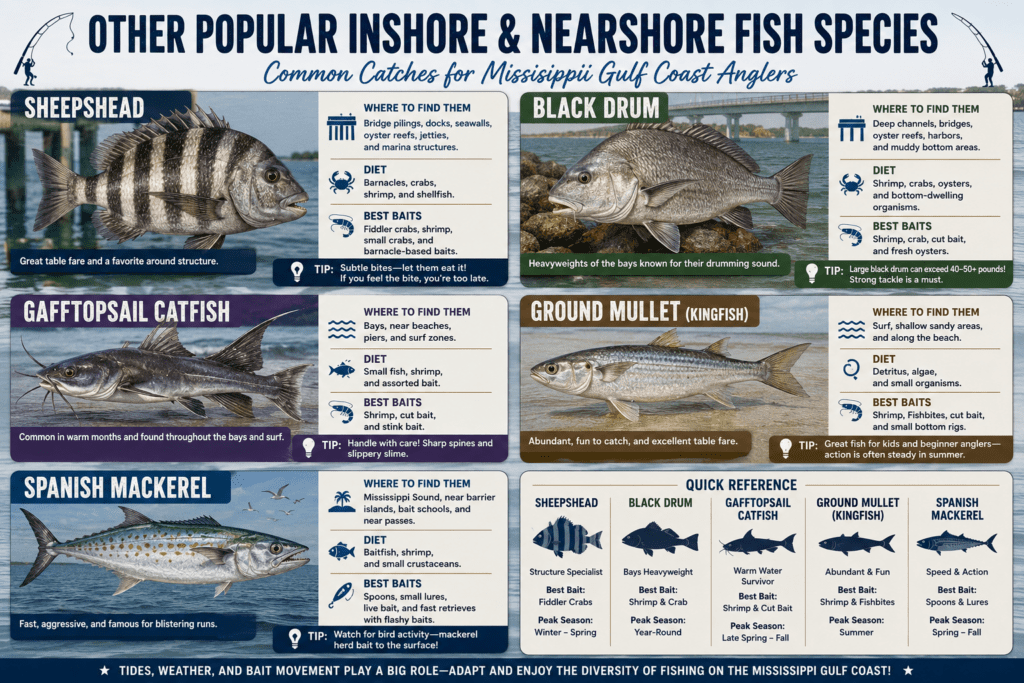
Gafftopsail Catfish: The Gulf Coast Survivor
Few fish generate stronger opinions among Gulf Coast fishermen than the gafftopsail catfish.
These fish are extremely common during warmer months and are instantly recognizable by:
- their long flowing dorsal fins,
- whiskers,
- and heavy slime coating.
Many fishermen dislike handling them because of:
- sharp fin spines,
- slippery bodies,
- and painful punctures from dorsal spines.
However, despite their reputation, some anglers actually consider smaller gafftops surprisingly good eating when properly cleaned.
They are commonly caught:
- in bays,
- near beaches,
- from piers,
- and in surf zones.
Because they tolerate a wide range of salinity conditions, they thrive throughout much of the Mississippi Gulf Coast.
Ground Mullet (Kingfish)
Ground mullet — often called “kingfish” locally — are small bottom-feeding fish commonly caught in the surf and shallow sandy areas.
Although they rarely receive the attention of larger sportfish, they remain popular because:
- they are abundant,
- fun for children,
- and excellent table fare when fried.
Ground mullet are commonly caught using:
- shrimp,
- Fishbites,
- cut bait,
- and small bottom rigs.
Many family beach fishermen specifically target them because action can be steady during summer months.
Spanish Mackerel: Speed in the Mississippi Sound
Spanish mackerel bring a completely different type of excitement to Mississippi Gulf Coast fishing.
These sleek, fast-moving predators travel in schools and aggressively attack baitfish near the surface.
Recognized by:
- their silver bodies,
- bright gold spots,
- and razor-sharp teeth,
Spanish mackerel are famous for blistering runs and chaotic feeding frenzies.
They are commonly found:
- near the barrier islands,
- around bait schools,
- near passes,
- and in open sections of the Mississippi Sound.
Bird activity often helps fishermen locate feeding schools as mackerel push baitfish toward the surface.
Popular techniques include:
- casting spoons,
- trolling small lures,
- live bait fishing,
- and fast retrieves with flashy artificial baits.
Many local anglers enjoy Spanish mackerel because action can become nonstop when schools move through an area.
What People Ask About Mississippi Gulf Coast Inshore Fishing
What fish are easiest to catch on the Mississippi Gulf Coast?
Ground mullet, gafftopsail catfish, croakers, and smaller trout are often among the easiest fish for beginners and children to catch.
What fish fight the hardest inshore?
Bull redfish, jack crevalle, black drum, and large sharks are considered some of the strongest inshore fighters on the Coast.
What fish are best around bridges and pilings?
Sheepshead, black drum, speckled trout, and redfish are all commonly caught around bridge structures and docks on the Mississippi Gulf Coast.
Offshore & Deep Water Fishing on the Mississippi Gulf Coast
For many anglers, offshore fishing represents the ultimate Gulf Coast adventure.
While inshore fishing provides exciting action in marshes, bays, and the Mississippi Sound, heading offshore into the open Gulf of America introduces an entirely different world of fishing. The water becomes deeper, the boats become larger, the tackle becomes heavier, and the fish become significantly more powerful.
Offshore fishermen along the Mississippi Gulf Coast routinely travel:
- 20 miles,
- 50 miles,
- 75 miles,
- or even well over 100 miles offshore
in search of reefs, wrecks, oil platforms, underwater ledges, temperature breaks, and blue-water current systems holding larger sportfish.
For many visitors, the first offshore trip becomes unforgettable. Long before sunrise, boats leave marinas in:
- Biloxi
- Gulfport
- Pass Christian
- Pascagoula
As the shoreline disappears behind them, anglers head toward some of the Gulf’s most productive offshore fishing grounds.
🎣 Did You Know?
Mississippi has only about 44 miles of Gulf coastline, yet it supports one of America’s most productive recreational fishing regions. Thanks to the Mississippi Sound, barrier islands, abundant reefs, and easy access to offshore waters, the Mississippi Gulf Coast delivers a remarkable amount of fishing opportunity in a relatively small geographic area.
From inshore redfish and speckled trout to offshore tuna and red snapper, anglers can access an incredible variety of fisheries without the long boat runs required in many larger coastal states.
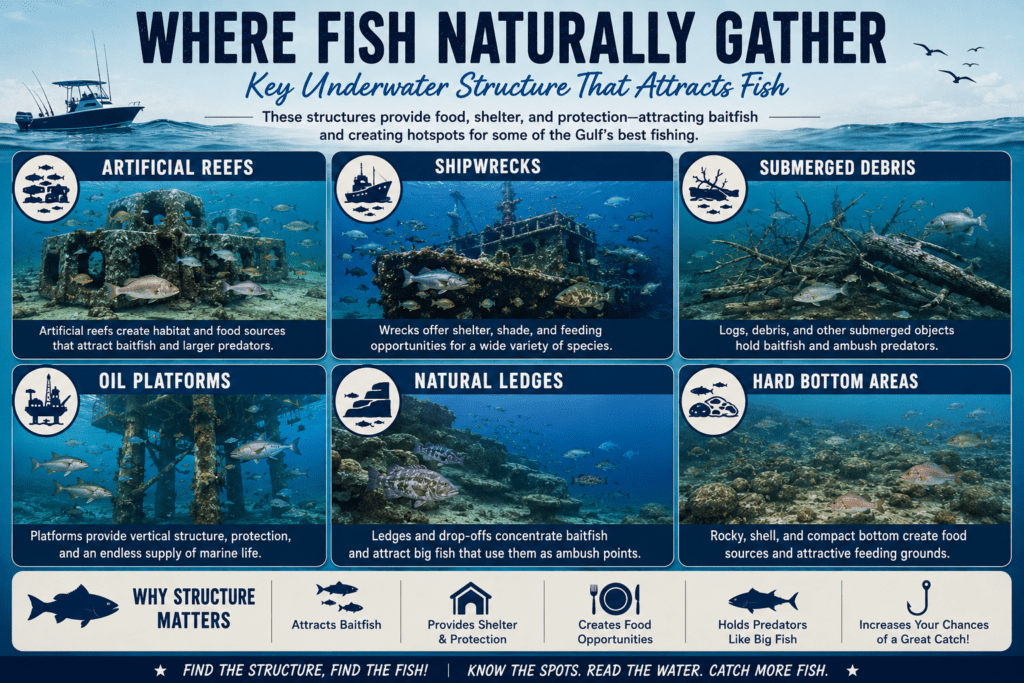
Artificial Reefs & Offshore Structure
One reason offshore fishing is so productive off Mississippi is the large amount of underwater structure available in Gulf waters.
Fish naturally gather around:
- artificial reefs,
- shipwrecks,
- submerged debris,
- oil platforms,
- natural ledges,
- and hard bottom areas.
These structures attract:
- baitfish,
- shrimp,
- squid,
- and smaller reef fish,
which in turn attract larger predators.
Mississippi has invested heavily in artificial reef programs over the years, creating reef zones that support healthy fish populations and recreational fishing opportunities.
Many offshore captains maintain extensive GPS databases containing:
- reef coordinates,
- wreck locations,
- oil platform numbers,
- and productive bottom structure accumulated over decades.
Some fishing spots are guarded almost like family secrets.
Red Snapper: The King of Gulf Reef Fishing
Among offshore species, red snapper remains the most famous and heavily targeted fish on the Mississippi Gulf Coast.
Bright red in color with sharp teeth and strong bodies, red snapper are prized for:
- their fighting ability,
- excellent table fare,
- and abundance around deep structure.
Snapper fishing typically involves:
- bottom fishing near reefs,
- live bait fishing,
- cut bait,
- squid,
- cigar minnows,
- and vertical jigging techniques.
When a school of large snapper is active beneath the boat, the action can become extremely fast-paced.
However, red snapper regulations are tightly controlled through seasonal openings, size limits, and bag restrictions. Many local anglers carefully monitor announcements from the:
Mississippi Department of Marine Resources
during snapper season.
Grouper: The Bottom-Dwelling Powerhouses
Grouper are among the strongest fish found around offshore structure.
These fish:
- live near reefs and ledges,
- strike aggressively,
- and immediately attempt to dive back into structure after being hooked.
This creates one of offshore fishing’s greatest challenges:
pulling the fish away from the bottom before it can break the line.
Gag grouper and related species are commonly caught around:
- deep reefs,
- wrecks,
- oil platforms,
- and hard-bottom structure.
Heavy tackle is usually required because large grouper can overpower lighter gear very quickly.
Many experienced offshore fishermen consider grouper one of the most physically demanding Gulf species to target.
Cobia: The Spring Gulf Coast Favorite
Cobia are one of the Mississippi Gulf Coast’s most exciting migratory fish.
These powerful fish often appear:
- near buoys,
- around floating debris,
- beside rays and turtles,
- and near offshore platforms.
From above, cobia sometimes resemble small sharks moving slowly near the surface.
Spring cobia migration season generates enormous excitement across the Coast. Many fishermen specifically target cobia by:
- sight fishing,
- live bait fishing,
- freelining eels or pinfish,
- or casting large artificial lures.
Large cobia are exceptionally strong and can create chaos once brought near the boat.
Many Gulf Coast anglers have stories involving cobia:
- breaking equipment,
- tangling rods,
- or violently thrashing across the deck after landing.
King Mackerel & Fast Offshore Action
King mackerel — often simply called “kings” — are built entirely for speed.
These fish:
- roam offshore waters,
- aggressively chase bait schools,
- and frequently strike trolling lures at extremely high speeds.
King mackerel fishing often involves:
- trolling live bait,
- ribbonfish,
- spoons,
- or artificial trolling rigs.
Many anglers specifically target kings near:
- the barrier islands,
- offshore reefs,
- and bait-rich current areas.
Their initial runs are often explosive and can strip line rapidly from reels.
Tuna, Wahoo & Blue Water Fishing
Farther offshore, some Mississippi Gulf Coast captains target true blue-water species including:
- yellowfin tuna,
- blackfin tuna,
- mahi-mahi,
- and wahoo.
These trips often require:
- larger boats,
- overnight runs,
- extensive fuel capacity,
- and advanced offshore navigation.
Wahoo are particularly respected for their:
- incredible speed,
- razor-sharp teeth,
- and violent strikes.
Yellowfin tuna, meanwhile, can become absolute battles of endurance capable of lasting hours depending on fish size and tackle used.
For many serious offshore anglers, tuna fishing represents the pinnacle of Gulf sportfishing.
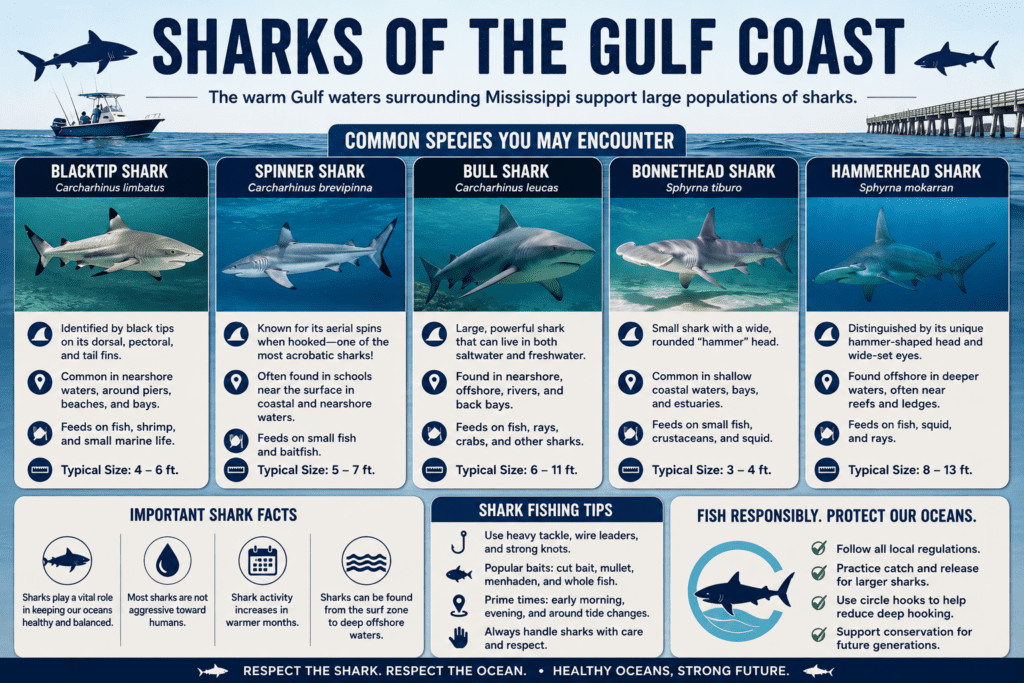
Sharks of the Gulf Coast
The warm Gulf waters surrounding Mississippi support large populations of sharks.
Common species include:
- blacktip sharks,
- spinner sharks,
- bull sharks,
- bonnetheads,
- and hammerheads.
Shark fishing has become increasingly popular both:
- offshore,
- and directly from Gulf beaches.
Many fishermen specifically target sharks during summer months using:
- large cut bait,
- heavy tackle,
- surf rods,
- and kayak-deployed bait systems.
Conservation has become increasingly important in shark fishing, and many anglers now practice catch-and-release techniques for larger species.
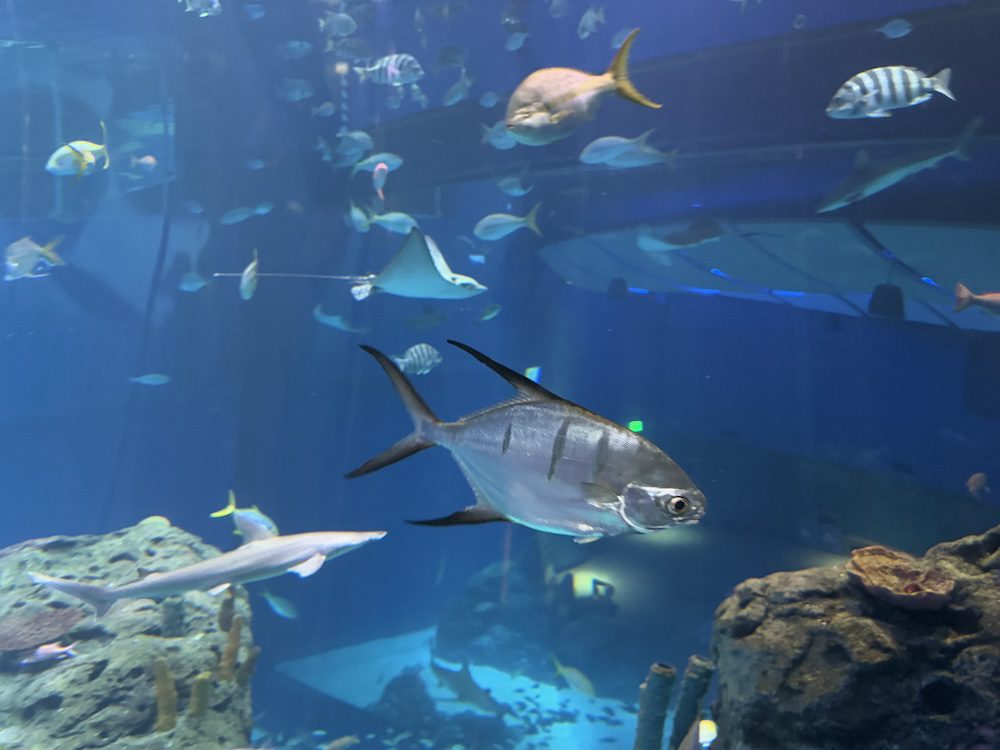
Want to see some of the local fish species found along the Mississippi Gulf Coast?
Visit the Mississippi Aquarium located on Beach Boulevard directly across from Gulfport Harbor in :contentReference[oaicite:0]{index=0}.
The aquarium is an outstanding place to experience many of the fish, marine animals, and coastal ecosystems discussed throughout this guide. Visitors can view local game fish and other Gulf species up close while learning more about the Mississippi Sound, barrier islands, marshes, reefs, and offshore environments that make Gulf Coast fishing so unique.
What People Ask About Offshore Fishing
How far offshore do Mississippi Gulf Coast fishermen travel?
Many offshore trips range from 20 to over 100 miles offshore depending on the target species and weather conditions.
What is the most popular offshore fish in Mississippi?
Red snapper is generally considered the most popular offshore reef fish on the Mississippi Gulf Coast.
Can beginners go offshore fishing?
Yes. Many charter boats offer beginner-friendly offshore trips targeting snapper, king mackerel, cobia, and other Gulf species.
Fishing From Piers, Beaches & Shorelines on the Mississippi Gulf Coast
Not everyone fishing on the Mississippi Gulf Coast owns a boat — and fortunately, you do not need one to enjoy outstanding fishing opportunities along the Coast.
In fact, thousands of residents and visitors fish successfully every year from:
- public piers,
- bridges,
- beaches,
- jetties,
- seawalls,
- harbors,
- and shoreline access areas.
For many families, pier and beach fishing become part of the overall Mississippi Gulf Coast vacation experience. It is common to see:
- children catching ground mullet from the surf,
- anglers fishing under bridge lights at night,
- shark fishermen setting heavy surf rods along the beaches,
- and locals casting for speckled trout during sunrise and sunset tides.
One of the biggest advantages of shore fishing is accessibility. Visitors can often begin fishing with only:
- basic tackle,
- shrimp or cut bait,
- a small cooler,
- and a fishing license.
Pier Fishing Along the Coast
Public piers remain some of the most popular fishing locations on the Mississippi Gulf Coast because they provide access to deeper water without requiring a boat.
Popular pier and harbor fishing areas can be found near:
- Biloxi
- Gulfport
- Long Beach
- Pass Christian
- Bay St. Louis
- Pascagoula
Depending on season and water conditions, pier fishermen commonly catch:
- speckled trout,
- redfish,
- sheepshead,
- black drum,
- Spanish mackerel,
- sharks,
- croakers,
- and ground mullet.
Night fishing around lighted piers and bridges is especially productive because lights attract:
- shrimp,
- baitfish,
- and feeding predators.
Many experienced anglers specifically target moving tides around bridge structures where fish wait for bait to sweep past with the current.
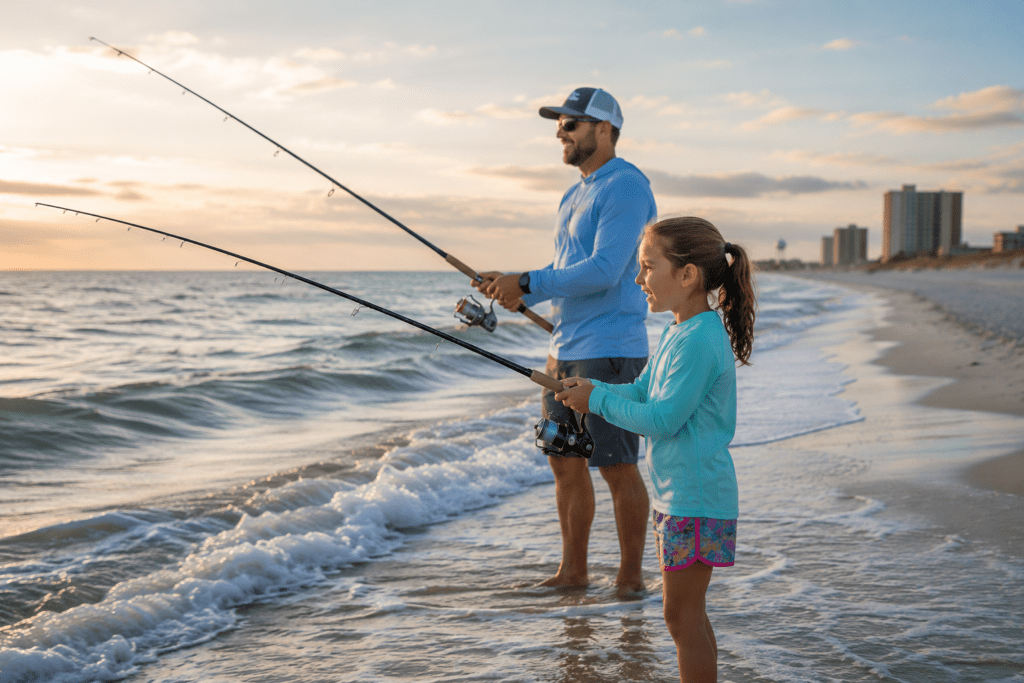
Surf Fishing on the Mississippi Gulf Coast
Surf fishing is another major part of coastal fishing culture.
Unlike the massive waves seen along parts of the Atlantic coast, Mississippi beaches are somewhat protected by the barrier islands, creating calmer surf conditions that are ideal for family fishing.
Popular surf species include:
- pompano,
- whiting,
- redfish,
- black drum,
- sharks,
- Spanish mackerel,
- and flounder.
During mullet migration periods, larger predators often move surprisingly close to shore.
Many anglers fish directly from:
- sandbars,
- beach access points,
- near piers,
- or along cuts between sandbars.
One of the unique aspects of Mississippi Gulf Coast surf fishing is how dramatically conditions can change depending on:
- tides,
- wind direction,
- water clarity,
- and bait movement.
A beach that appears empty one day may suddenly become extremely productive the next when bait schools move through the area.
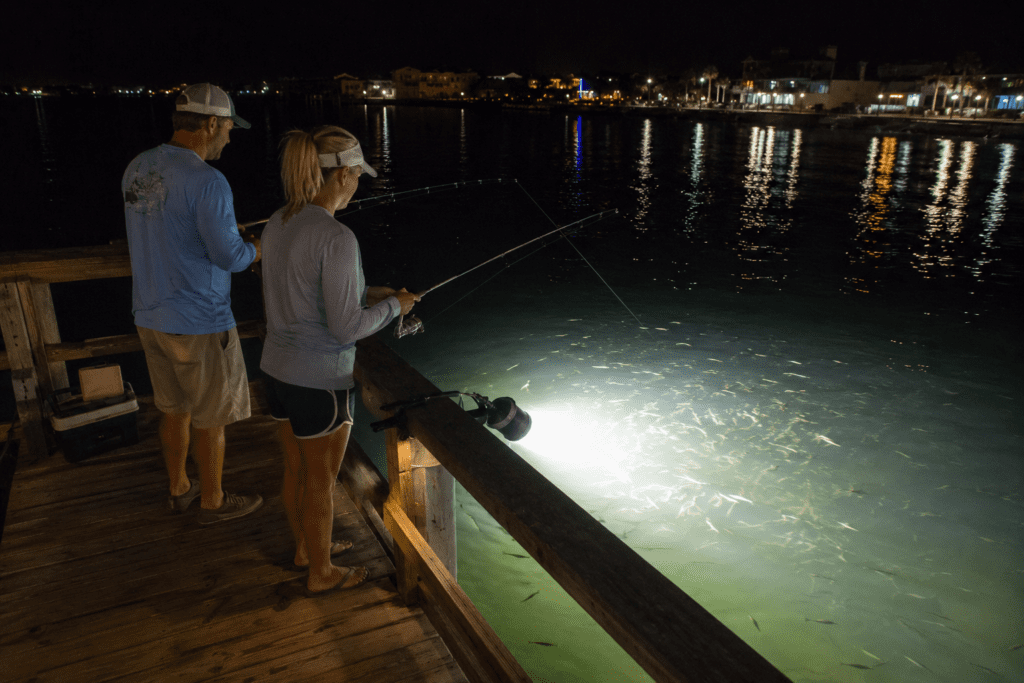
Bridge Fishing & Dock Lights
Bridge fishing has become almost legendary among local fishermen.
Bridges crossing bays, bayous, and passes often create:
- current breaks,
- ambush points,
- deeper holes,
- and nighttime feeding zones.
Dock lights and bridge lights attract baitfish after dark, which in turn attract larger predators such as:
- speckled trout,
- redfish,
- and flounder.
Many local anglers consider nighttime bridge fishing one of the best ways to target larger speckled trout during warmer months.
One longtime fisherman described it this way:
“At night under the lights, sometimes it feels like the water is alive.”
Fishing under lights often requires:
- lighter tackle,
- live shrimp,
- soft plastics,
- and quiet presentations.
Too much noise or excessive boat traffic can quickly scatter feeding fish.
Wade Fishing the Flats & Beaches
Wade fishing is especially popular around:
- shallow grass flats,
- marsh edges,
- barrier islands,
- and sandy shorelines.
Many fishermen prefer wading because:
- it allows stealthier presentations,
- gives access to shallow areas boats cannot reach,
- and creates a more direct connection to the environment.
Wade fishermen commonly target:
- speckled trout,
- redfish,
- and flounder
using artificial lures or live bait.
Early morning and late evening periods are often especially productive during warmer months.
Kayak Fishing Explosion
Over the past decade, kayak fishing has exploded in popularity along the Mississippi Gulf Coast.
Modern fishing kayaks allow anglers to access:
- marsh drains,
- shallow bays,
- grass flats,
- oyster reefs,
- and remote shoreline areas
that larger boats often cannot reach.
Kayak anglers regularly catch:
- redfish,
- speckled trout,
- flounder,
- black drum,
- and even sharks.
Many fishermen enjoy kayak fishing because it combines:
- fishing,
- exercise,
- exploration,
- and quiet access to nature.
The relatively protected waters of the Mississippi Sound help make kayak fishing especially popular compared to rougher open-coast environments.
What People Ask About Shore Fishing
Can you catch big fish from shore on the Mississippi Gulf Coast?
Yes. Large redfish, black drum, sharks, jack crevalle, and even tarpon are occasionally caught directly from beaches, piers, and bridges.
What bait works best for surf fishing?
Live shrimp, cut mullet, squid, Fishbites, and sand fleas are all commonly used for Mississippi Gulf Coast surf fishing.
Is pier fishing good for beginners?
Absolutely. Pier fishing is one of the easiest and most affordable ways for beginners and families to experience fishing on the Mississippi Gulf Coast.
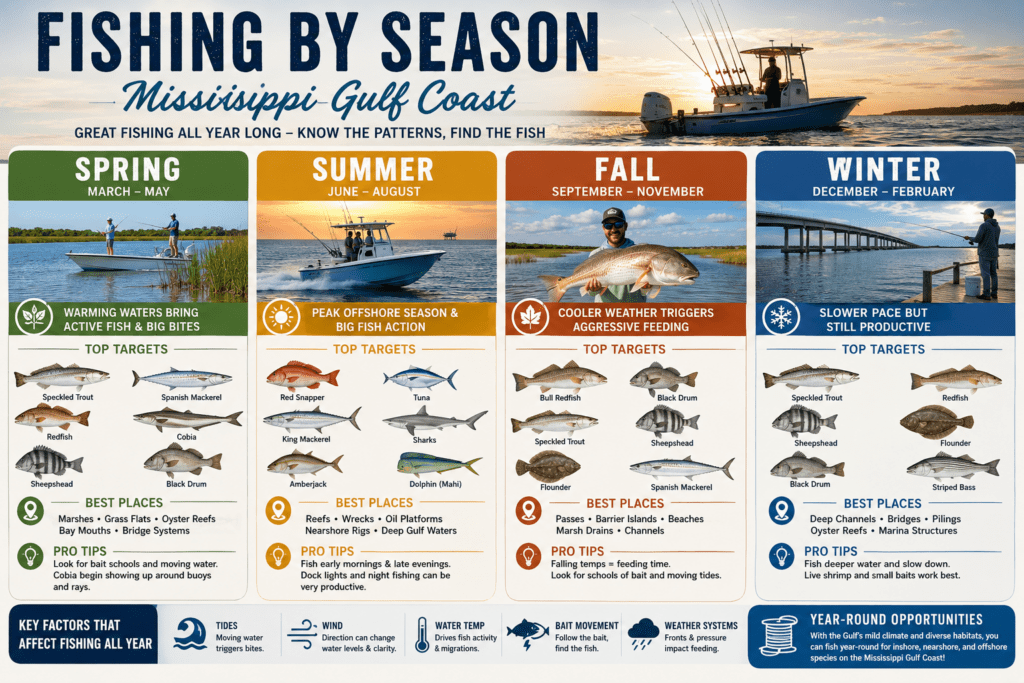
Seasonal Fishing Patterns on the Mississippi Gulf Coast
One of the reasons fishing remains so popular on the Mississippi Gulf Coast is that there is always something biting somewhere during the year.
Unlike colder northern fisheries that may shut down seasonally, the Gulf Coast offers year-round opportunities for both inshore and offshore anglers. However, successful fishermen quickly learn that fishing patterns constantly change depending on:
- water temperature,
- bait migrations,
- salinity,
- tides,
- storms,
- and seasonal weather systems.
Experienced local anglers often plan their fishing calendars around the annual movement of specific species.
Many fishermen on the Coast can tell you exactly:
- when the first Spanish mackerel usually appear,
- when bull redfish begin moving through the passes,
- when cobia migrate near the barrier islands,
- or when water temperatures push speckled trout into deeper winter holes.
Understanding these seasonal shifts is one of the keys to consistently successful fishing.
Spring Fishing: The Coast Comes Alive
For many anglers, spring is the beginning of the prime fishing season.
As water temperatures warm, baitfish populations increase rapidly throughout:
- marshes,
- bays,
- bayous,
- and the Mississippi Sound.
This increase in bait activity triggers aggressive feeding behavior among many gamefish species.
Spring commonly brings excellent action for:
- speckled trout,
- redfish,
- sheepshead,
- black drum,
- Spanish mackerel,
- and cobia.
Speckled trout fishing often improves dramatically during spring as fish become more active around:
- oyster reefs,
- grass flats,
- bridge systems,
- and bay mouths.
Cobia migration also becomes a major event during spring months. Anglers frequently begin scanning near:
- buoys,
- rays,
- floating debris,
- and barrier island waters
for cruising cobia near the surface.
Many local fishermen consider spring one of the most comfortable times to fish because:
- temperatures are moderate,
- humidity is lower,
- and fish activity increases substantially.
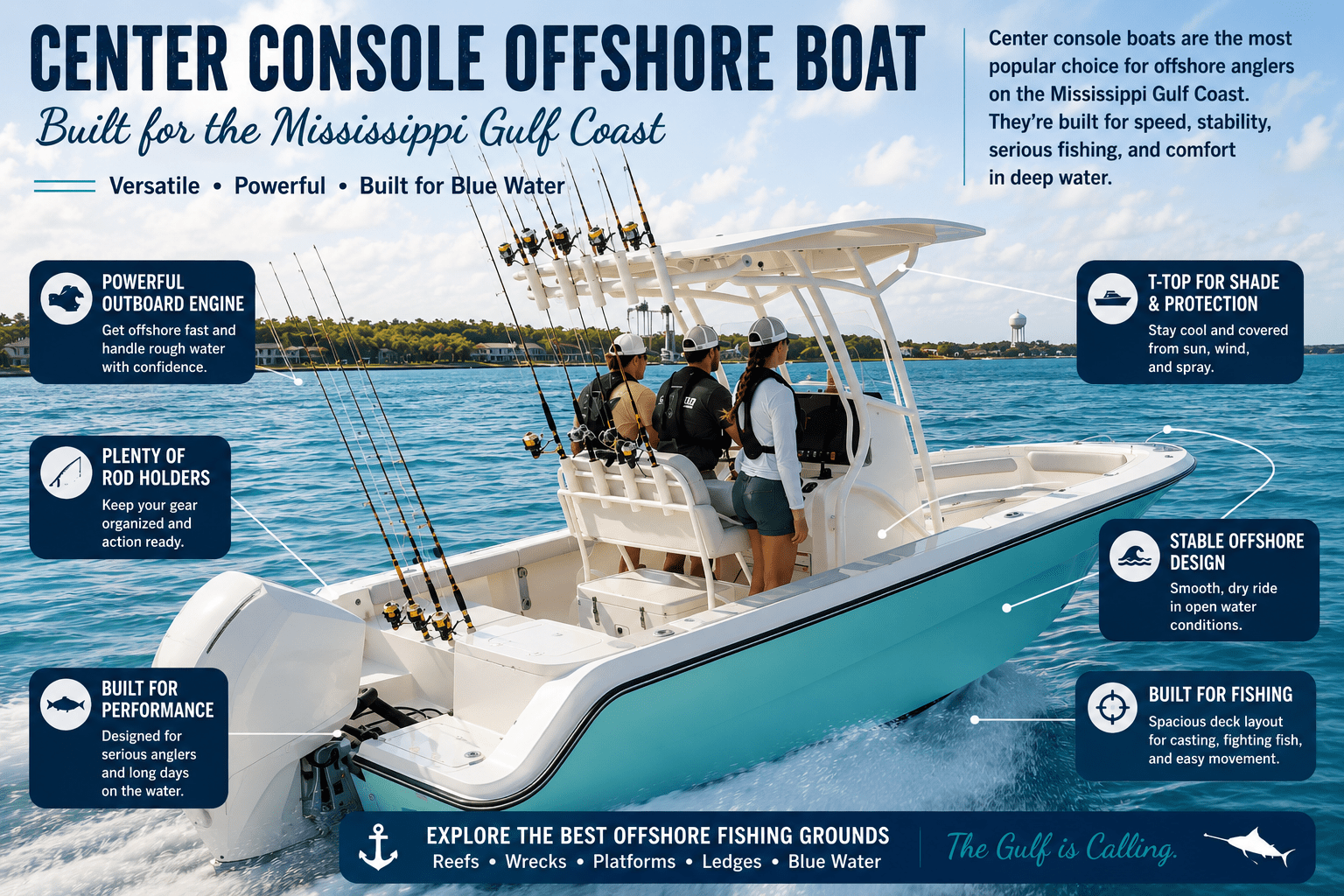
Fishing by boat is extremely popular on the Mississippi Gulf Coast, and the most common style used by local anglers is the center console offshore boat.
These boats are specifically designed for serious fishing and are capable of traveling from shallow bays and marshes to deep offshore Gulf waters. Their open layout allows fishermen to move completely around the boat while fighting fish, managing tackle, or landing catches.
Propulsion typically comes from one or multiple high-powered outboard engines. Some larger offshore boats use:
- single-engine setups,
- twin outboards,
- triple-engine configurations,
- or even four engines producing well over 1,000 horsepower.
Unlike luxury cruising boats, center consoles are purpose-built for fishing utility. Most prioritize:
- large casting areas,
- rod storage,
- live wells,
- electronics,
- coolers,
- and offshore stability.
Along the Mississippi Gulf Coast, these boats have become an iconic part of the fishing culture seen daily leaving marinas before sunrise heading toward reefs, barrier islands, oil platforms, and deep Gulf waters.
Summer Fishing: Offshore Season & Early Mornings
Summer transforms the Mississippi Gulf Coast into a fishing destination filled with activity both inshore and offshore.
This is peak season for:
- offshore charter fishing,
- red snapper trips,
- shark fishing,
- king mackerel,
- tuna,
- and deep-water reef fishing.
Marinas become especially busy before sunrise as boats head offshore toward:
- reefs,
- wrecks,
- oil platforms,
- and deep Gulf waters.
Inshore fishing remains productive during summer, although many anglers adjust their schedules because of heat.
Early morning and nighttime fishing often become the most productive periods for:
- speckled trout,
- redfish,
- flounder,
- and sharks.
Dock-light fishing becomes especially popular during hot summer nights.
Summer also brings larger populations of:
- baitfish,
- shrimp,
- pogies,
- and mullet
into Mississippi waters, creating feeding opportunities for larger predators.
Beach fishing becomes extremely popular with visitors during summer vacation season.
Fall Fishing: Bull Reds & Flounder Runs
Many experienced Gulf Coast anglers consider fall the absolute best fishing season of the year.
Cooling water temperatures often trigger aggressive feeding activity as fish prepare for winter.
Fall is famous for:
- bull redfish migrations,
- flounder movement,
- large speckled trout,
- and excellent nearshore fishing.
Massive schools of bull redfish often gather:
- near passes,
- around barrier islands,
- and along beaches.
These large fish can produce some of the most exciting inshore battles of the year.
Flounder fishing also becomes especially productive during autumn migration periods as fish move toward deeper Gulf waters.
Many fishermen specifically target:
- marsh drains,
- channels,
- sandy drop-offs,
- and passes
during the fall flounder run.
One longtime Coast angler once explained:
“When the first real cool fronts start coming through, everybody suddenly wants to fish.”
Winter Fishing: Slower But Still Productive
Winter fishing on the Mississippi Gulf Coast slows somewhat compared to warmer months, but productive fishing opportunities still exist.
Speckled trout often move into:
- deeper holes,
- channels,
- rivers,
- and protected waters.
Sheepshead fishing frequently improves during winter as fish gather around:
- bridges,
- pilings,
- oyster reefs,
- and marina structures.
Black drum also remain active during colder months.
Winter fishing often rewards:
- patience,
- slower presentations,
- and targeting deeper water.
Calm winter days can produce surprisingly good fishing, particularly when stable weather patterns develop between cold fronts.
Weather, Tides & Water Conditions
On the Mississippi Gulf Coast, weather conditions may influence fishing as much as season itself.
Experienced anglers constantly monitor:
- wind direction,
- tidal movement,
- barometric pressure,
- water clarity,
- salinity,
- and incoming weather systems.
Strong north winds can rapidly lower water levels in shallow bays and marshes, while southern winds may push cleaner Gulf water toward the shoreline.
Tides are especially important around:
- marsh drains,
- bridge systems,
- passes,
- and current breaks.
Many local fishermen believe moving water is one of the most important factors in successful fishing.
Hurricane Season & Fishing
Hurricane season also affects Gulf Coast fishing patterns.
Tropical systems can temporarily:
- alter salinity,
- shift sandbars,
- move baitfish,
- and change water clarity.
However, many fishermen note that fishing can become excellent shortly before or after weather systems when conditions stabilize.
Storms can also reshape:
- barrier islands,
- marsh systems,
- passes,
- and nearshore structure
over time.
What People Ask About Seasonal Fishing
What is the best month for fishing on the Mississippi Gulf Coast?
Many anglers consider October one of the best overall fishing months because of cooler weather, bull redfish activity, and aggressive feeding patterns.
Can you fish year-round on the Mississippi Gulf Coast?
Yes. Fishing opportunities exist throughout the year for both inshore and offshore species.
What season is best for offshore fishing?
Summer is generally considered the peak offshore fishing season because of calmer Gulf conditions and active reef fish seasons.
Fishing Regulations, Conservation & Responsible Angling
Fishing on the Mississippi Gulf Coast is supported by one of the most productive marine ecosystems in the Gulf of America, but maintaining healthy fish populations requires careful management and responsible fishing practices.
Over the years, fisheries managers have worked to balance:
- recreational fishing,
- commercial harvest,
- tourism,
- conservation,
- and long-term sustainability.
As a result, many popular species are now managed using:
- bag limits,
- minimum size requirements,
- seasonal closures,
- slot limits,
- and reef fish regulations.
Experienced local anglers understand that regulations can change frequently depending on:
- fish population surveys,
- spawning conditions,
- environmental impacts,
- and federal fishery management decisions.
For that reason, one of the most important habits any fisherman can develop is checking the latest regulations before every trip.
Mississippi Department of Marine Resources (MDMR)
The primary state agency responsible for saltwater fisheries management in Mississippi is the:
Mississippi Department of Marine Resources
The MDMR provides current information regarding:
- saltwater fishing licenses,
- size limits,
- daily bag limits,
- seasonal openings,
- reef fish regulations,
- and conservation programs.
Many local fishermen regularly monitor the MDMR website during:
- red snapper season,
- speckled trout regulation changes,
- flounder restrictions,
- and reef fish announcements.
Because regulations can sometimes change rapidly, relying on outdated information can create expensive problems for anglers.
Red Snapper Regulations
Few species generate more discussion on the Mississippi Gulf Coast than red snapper.
Red snapper fishing remains heavily regulated because of:
- federal management plans,
- population rebuilding efforts,
- and pressure from both commercial and recreational fisheries.
Modern snapper seasons often include:
- limited open dates,
- reporting requirements,
- specific size restrictions,
- and strict bag limits.
Despite these regulations, red snapper remains one of the most popular offshore species targeted from Mississippi ports.
During open seasons, offshore marinas become extremely busy as anglers rush to take advantage of favorable weather windows.
Speckled Trout & Flounder Restrictions
Speckled trout and flounder regulations have also become increasingly important over recent years.
Biologists carefully monitor these fisheries because they are heavily targeted by:
- recreational anglers,
- charter boats,
- and shoreline fishermen.
Weather events, environmental changes, and fishing pressure can significantly affect populations over time.
Flounder management in particular has received increased attention because of concerns regarding spawning stock levels throughout parts of the Gulf region.
Many experienced fishermen support conservation measures because they understand the importance of maintaining healthy fisheries for future generations.
Fishing Licenses
Most anglers fishing Mississippi saltwater areas are required to possess a valid fishing license unless exempt under state law.
Licensing requirements may vary depending on:
- residency,
- age,
- military status,
- disability exemptions,
- and fishing location.
Different permits may also apply for:
- freshwater fishing,
- saltwater fishing,
- charter operations,
- and certain reef fish species.
Visitors planning fishing vacations should verify licensing requirements before fishing.
Catch & Release Fishing
Catch and release has become increasingly common on the Mississippi Gulf Coast, particularly for:
- large breeding fish,
- sharks,
- oversized redfish,
- tarpon,
- and trophy trout.
Many fishermen now recognize that releasing larger breeding fish helps support future populations.
Modern catch-and-release practices often include:
- circle hooks,
- minimizing handling time,
- avoiding dry surfaces,
- supporting larger fish properly,
- and reviving exhausted fish before release.
This conservation mindset has grown substantially among Gulf Coast anglers over the past decade.
Shark Conservation & Responsible Handling
Shark fishing continues to grow in popularity both offshore and from Gulf beaches.
However, shark conservation has also become a major topic because many shark species reproduce slowly and are vulnerable to overharvest.
Responsible shark fishermen often:
- practice catch and release,
- use heavy tackle to shorten fights,
- avoid dragging sharks onto dry sand,
- and release fish quickly.
Large sharks remain one of the Gulf’s most important apex predators and play a critical role in maintaining healthy marine ecosystems.
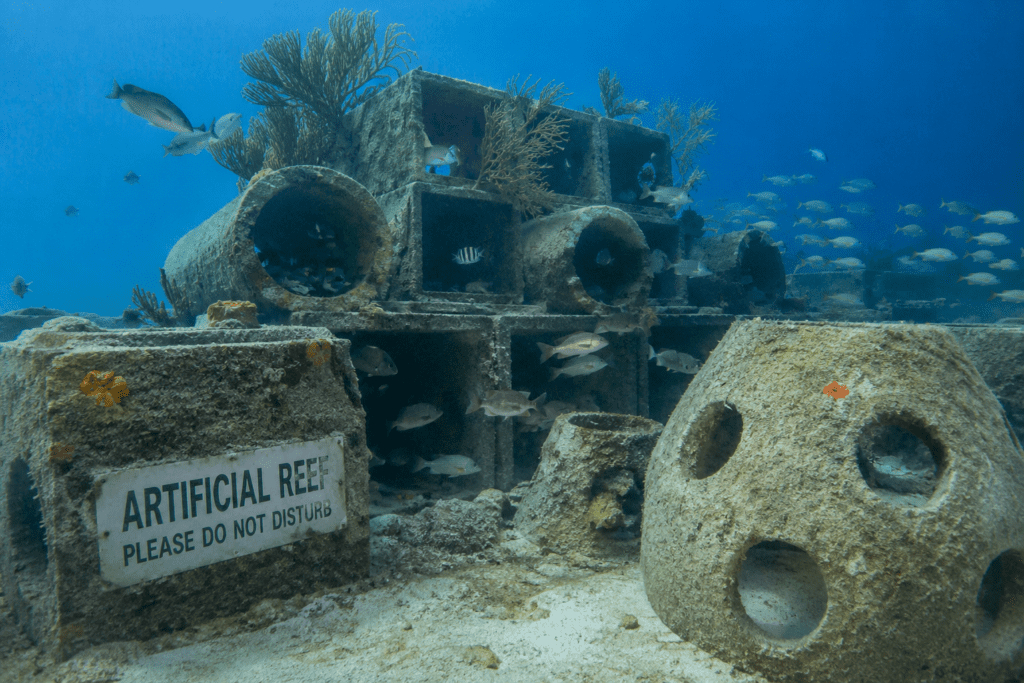
Artificial Reef Programs
Mississippi has invested heavily in artificial reef development designed to:
- improve fish habitat,
- support reef fish populations,
- increase fishing opportunities,
- and reduce pressure on natural structure.
Artificial reefs now attract:
- snapper,
- grouper,
- amberjack,
- triggerfish,
- baitfish,
- and countless other species.
Many offshore captains depend heavily on these reef systems throughout the fishing season.
Respecting the Water & Other Anglers
One of the strongest traditions along the Mississippi Gulf Coast fishing community is mutual respect.
Most experienced fishermen understand the importance of:
- respecting private property,
- avoiding litter,
- protecting marshes and seagrass,
- obeying no-wake zones,
- and giving other anglers adequate space.
Boat ramps, marinas, beaches, and piers can become extremely busy during peak fishing periods, particularly:
- summer weekends,
- snapper season,
- and major fishing tournaments.
Simple courtesy goes a long way toward maintaining the friendly fishing culture found throughout the Coast.
What People Ask About Fishing Regulations
Do you need a fishing license on the Mississippi Gulf Coast?
Yes. Most anglers fishing saltwater areas in Mississippi are required to possess a valid fishing license unless specifically exempt.
Why are red snapper seasons limited?
Red snapper seasons are regulated to protect fish populations and maintain long-term sustainability within Gulf fisheries.
Is catch and release common on the Mississippi Gulf Coast?
Yes. Many anglers voluntarily release large breeding fish, sharks, oversized redfish, and trophy trout to help preserve healthy fisheries for future generations.
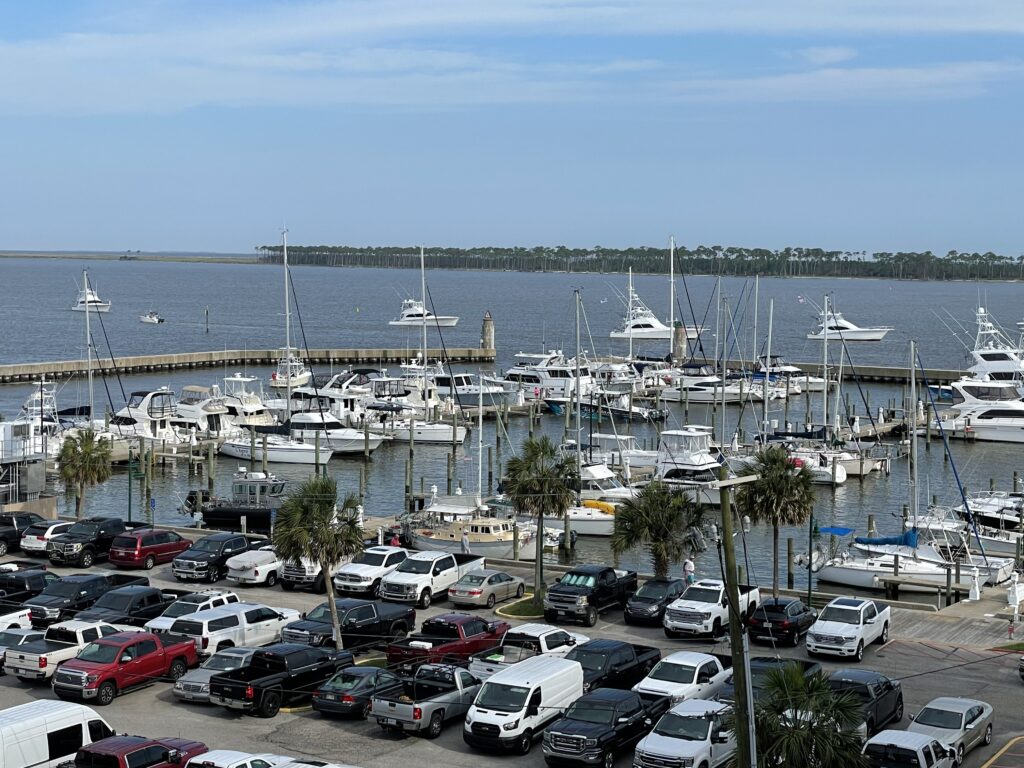
Where the Fish Come From: The Mississippi Gulf Coast Nursery System
One of the most fascinating aspects of fishing on the Mississippi Gulf Coast is understanding where these fish actually begin their lives.
Many anglers focus on:
- reefs,
- offshore rigs,
- barrier islands,
- bays,
- and fishing techniques,
but the true foundation of Gulf Coast fishing begins much farther inland inside the protected estuaries, marshes, rivers, and bayous that serve as marine nurseries for the Gulf of America.
Without these nursery systems, many of the fish species that support:
- recreational fishing,
- charter operations,
- seafood industries,
- and coastal tourism
would struggle to survive.
In many ways, the future of Gulf Coast fishing depends directly on the health of these estuarine ecosystems.
Mississippi’s Estuaries: Nature’s Fish Hatcheries
The Mississippi Gulf Coast contains some of the most productive estuarine systems in the United States.
These include areas surrounding:
- Pascagoula River
- Old Fort Bayou
- Biloxi Bay
- Back Bay of Biloxi
- St. Louis Bay
The Pascagoula River is especially important because it remains one of the last large unimpeded river systems in the continental United States. Unlike many major rivers that have been heavily dammed or altered, the Pascagoula still maintains extensive natural flow patterns that support enormous biological productivity.
Combined with Mississippi’s marshes and shallow coastal bays, these systems create ideal conditions for juvenile marine life.
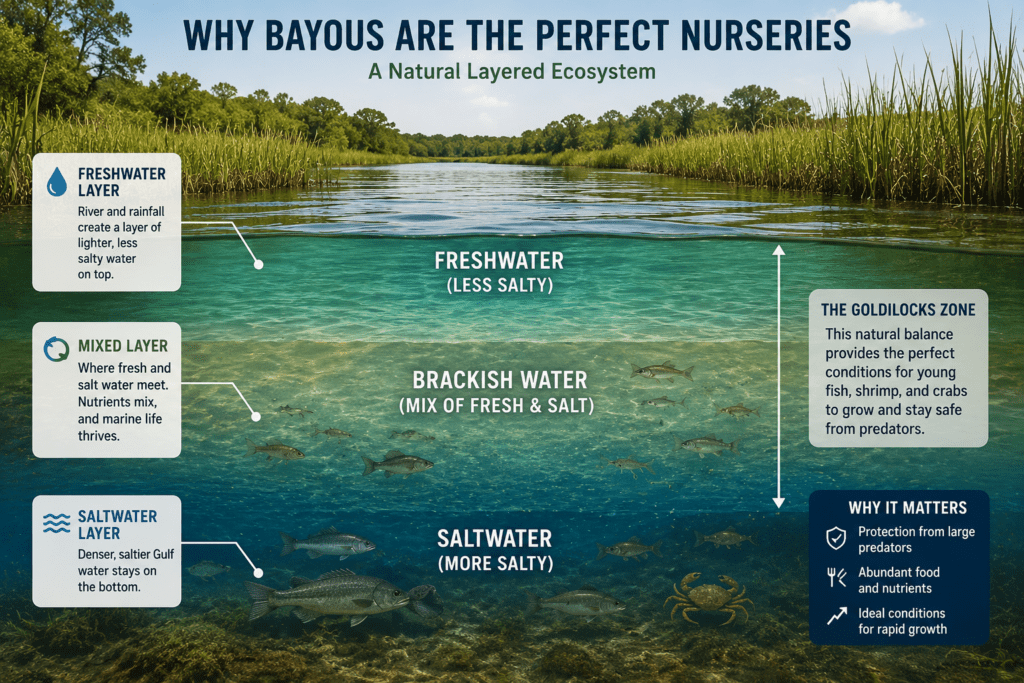
The “Goldilocks Zone” for Young Fish
Biologists often describe estuaries as the perfect “Goldilocks environment” because conditions are:
- not too salty,
- not too fresh,
- not too deep,
- and not too exposed.
The mixing of freshwater from rivers with salty Gulf water creates brackish environments that are ideal for many juvenile fish species.
This unique balance helps support:
- rapid growth,
- abundant food sources,
- and protection from predators.
For countless fish species, these estuaries become the safest place to spend the earliest and most vulnerable portions of their lives.
1. Natural Protection From Predators
One of the primary reasons estuaries function so effectively as nurseries is physical protection.
Dense marsh grasses and underwater vegetation create environments where large predators struggle to hunt effectively.
Common marsh vegetation includes:
- black needlerush,
- smooth cordgrass,
- seagrasses,
- and submerged vegetation beds.
These areas create a maze-like environment filled with:
- shallow water,
- roots,
- mud flats,
- oyster beds,
- and narrow tidal channels.
Large predators such as:
- sharks,
- jack crevalle,
- bull redfish,
- and other aggressive fish
often cannot maneuver efficiently through these shallow marsh systems.
Young fish, shrimp, and crabs can safely feed in water only inches deep where larger predators cannot easily follow.
This protection dramatically increases survival rates for juvenile marine life.
2. An Endless Food Supply
Estuaries are also biological feeding machines.
Freshwater rivers constantly deliver:
- nutrients,
- sediment,
- organic material,
- and microscopic organisms
into the coastal system.
When this freshwater mixes with nutrient-rich Gulf tides, it fuels explosive biological productivity.
The food chain begins with:
- plankton,
- algae,
- microscopic organisms,
- and detritus.
This supports enormous populations of:
- grass shrimp,
- blue crabs,
- baitfish,
- mullet,
- menhaden (pogies),
- and juvenile forage species.
In turn, these smaller organisms feed larger juvenile predators such as:
- speckled trout,
- redfish,
- flounder,
- black drum,
- and countless other species.
Many local fishermen may never actually see this process happening beneath the surface, but every successful fishing trip depends on it.
3. Salinity & Juvenile Fish Development
Another major reason estuaries are so important involves salinity.
Many offshore species begin life far offshore in the Gulf where adults spawn in deeper water. Tiny larvae and juvenile fish then drift inland on tides and currents toward coastal marshes and estuaries.
The lower-salinity brackish water found inside bays and rivers helps many juvenile species grow more efficiently.
Biologists believe this reduced salinity lowers osmotic stress on young fish. In simple terms, juvenile fish expend less energy balancing salt concentrations within their bodies and can instead direct more energy toward:
- feeding,
- growth,
- survival,
- and development.
This may help explain why estuaries support such incredible concentrations of juvenile marine life.
The Foundation of Gulf Coast Fishing
Marine biologists estimate that as many as:
90% of the commercial and recreational fish species in the Gulf of Mexico spend at least part of their lives inside estuaries.
That statistic alone demonstrates how important these environments truly are.
When anglers catch:
- trophy speckled trout,
- giant bull redfish,
- flounder,
- black drum,
- shrimp,
- crabs,
- or countless other species,
there is a very good chance those fish began life hidden safely inside Mississippi marshes and estuaries.
Many of the fish eventually caught:
- around the barrier islands,
- in offshore waters,
- near bridges,
- or throughout the Mississippi Sound
likely spent their juvenile stages feeding and growing within places like the Pascagoula River estuary or Old Fort Bayou.
Marshes Protect More Than Fish
These ecosystems also provide important environmental benefits beyond fishing.
Healthy marshes help:
- reduce coastal erosion,
- absorb storm surge,
- filter water,
- improve water quality,
- stabilize shorelines,
- and support bird populations and wildlife.
For the Mississippi Gulf Coast, protecting estuaries ultimately means protecting:
- fishing,
- seafood industries,
- tourism,
- boating,
- and the overall coastal lifestyle.
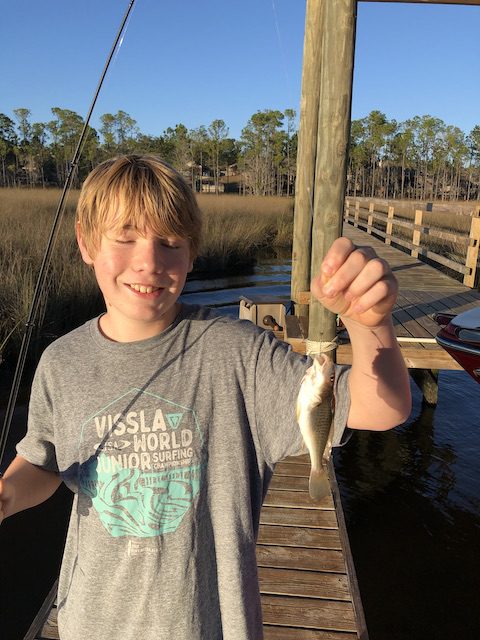
What People Ask About Estuaries & Fish Nurseries
Why are marshes important for fishing?
Marshes provide protection, food, and nursery habitat for juvenile fish, shrimp, crabs, and countless marine species.
Where do Gulf Coast fish begin their lives?
Many Gulf species begin life in protected estuaries, marshes, and bayous before eventually moving into the Mississippi Sound and offshore Gulf waters.
What percentage of Gulf fish depend on estuaries?
Biologists estimate that up to 90% of Gulf commercial and recreational fish species rely on estuaries during some portion of their life cycles.
Mississippi Estuaries: The Hidden Foundation of Gulf Coast Fishing
Estuaries along the Mississippi Gulf Coast act as the ultimate marine nurseries, and their health directly influences the quality of both commercial and recreational fishing throughout the Gulf of America.
Some of the most important nursery systems include:
The Pascagoula River is especially unique because it remains one of the last major unimpeded river systems in the lower 48 states. Combined with the brackish marshes surrounding Old Fort Bayou, these environments create the perfect “Goldilocks zone” for young marine life.
Coastal marshes, tidal creeks, seagrass beds, and shallow estuaries serve as protected nurseries where juvenile fish can grow before eventually moving into the Mississippi Sound and offshore Gulf waters.
1. The Perfect Hideout (Physical Protection)
The dense underwater root systems of:
- black needlerush,
- smooth cordgrass,
- marsh vegetation,
- and submerged seagrass beds
create an intricate natural barrier that protects young marine life.
Large predators such as:
- sharks,
- jack crevalle,
- bull redfish,
- and other powerful gamefish
simply cannot maneuver efficiently through these shallow, tightly packed marsh systems.
Juvenile species can safely forage in water only inches deep where larger predators cannot easily follow.
This physical protection dramatically increases survival rates for:
- juvenile fish,
- shrimp,
- blue crabs,
- and bait species.
2. A Nutrient-Rich Buffet
Estuaries are among the most biologically productive ecosystems on Earth because they combine:
- nutrient-rich freshwater,
- tidal Gulf water,
- sediment,
- organic matter,
- and sunlight.
This fuels an enormous food web beginning with:
- microscopic plankton,
- algae,
- and detritus.
Those organisms support massive populations of:
- grass shrimp,
- blue crabs,
- mullet,
- menhaden (pogies),
- minnows,
- and juvenile baitfish.
In turn, these bait populations feed growing sportfish including:
- speckled trout,
- redfish,
- flounder,
- black drum,
- sheepshead,
- and many offshore species during juvenile stages.
For Gulf Coast fishing, healthy estuaries essentially function as giant natural feeding grounds.
3. Salinity Accommodation
Many offshore species begin life far offshore in the Gulf of America where adults spawn in deeper water.
Microscopic larvae and juvenile fish then drift inward on:
- tides,
- currents,
- and weather systems
toward protected coastal estuaries.
The lower-salinity brackish water found in marshes and bayous reduces osmotic stress on many juvenile fish species. This allows them to dedicate more energy toward:
- feeding,
- growth,
- development,
- and survival
rather than constantly regulating internal salt balance.
This is one reason juvenile fish populations become so concentrated inside Mississippi estuaries.
The incredible fishing found along the Mississippi Gulf Coast depends entirely on healthy marshes, estuaries, rivers, barrier islands, and coastal nursery systems. Fortunately, several outstanding public facilities and preserves allow visitors to experience and better understand these ecosystems firsthand.
The Mississippi Aquarium in Gulfport provides an outstanding overview of the region’s interconnected aquatic environments, explaining how rivers, marshes, estuaries, barrier islands, and offshore Gulf waters all support the fishing industry and marine life throughout coastal Mississippi.
Visit Mississippi AquariumLocated in Moss Point, the Pascagoula River Audubon Center offers direct access to one of the last major free-flowing river systems in the lower 48 states. Visitors can experience firsthand the marshes and estuarine systems that function as critical fish nurseries for the Gulf Coast.
Visit Pascagoula River Audubon CenterThe GCRL Marine Education Center in Ocean Springs serves as the public education arm of the University of Southern Mississippi’s Gulf Coast Research Laboratory. The center helps visitors understand the science behind estuaries, marshes, fisheries management, and marine ecosystems that support Gulf Coast fishing.
Visit GCRL Marine Education CenterThe Davis Bayou Area of Gulf Islands National Seashore in Ocean Springs offers one of the best real-world examples of a functioning coastal estuary. The protected marshes, tidal creeks, and bayou systems demonstrate how juvenile fish and marine life thrive inside these nursery environments.
Visit Davis Bayou AreaLocated within the Davis Bayou Area, the William M. Colmer Visitor Center serves as the primary educational hub for Gulf Islands National Seashore. Exhibits help explain the role of estuaries, marshes, barrier islands, and marine wildlife in supporting the Gulf Coast ecosystem.
Learn More About Davis BayouThe Structural Impact on Gulf Fishing
Marine biologists estimate that:
up to 90% of the commercial and recreational fish species caught in the Gulf of Mexico spend at least part of their life cycles inside coastal estuaries.
That means when anglers catch:
- trophy speckled trout,
- giant redfish,
- flounder,
- shrimp,
- crabs,
- or black drum
throughout the Mississippi Sound and Gulf waters, there is a very strong chance those fish originally began life hidden safely within the marsh grass and protected waters of places like the Pascagoula River estuary or Old Fort Bayou.
The health of these nursery systems directly influences:
- recreational fishing,
- seafood harvests,
- charter industries,
- coastal tourism,
- and the entire Gulf Coast ecosystem.
Fishing Communities & Culture Along the Mississippi Gulf Coast
Fishing on the Mississippi Gulf Coast is not simply a recreational activity — it is deeply woven into the identity, economy, and daily life of the region.
Long before modern tourism, casinos, and condominium developments arrived, coastal Mississippi communities depended heavily on:
- commercial fishing,
- shrimping,
- oystering,
- crabbing,
- boat building,
- seafood processing,
- and maritime trade.
Even today, many Gulf Coast communities maintain strong cultural and economic ties to the water.
It is common to see:
- shrimp boats leaving harbors before sunrise,
- charter captains preparing offshore vessels,
- families fishing public piers,
- commercial seafood docks unloading catches,
- and recreational boats returning at sunset with coolers full of fish.
Along the Coast, fishing is often passed down through generations.
Many local fishermen learned:
- how to throw a cast net,
- clean shrimp,
- read tides,
- identify bait movement,
- and navigate marshes
from parents, grandparents, relatives, or longtime family friends.
🎣 Planning a Mississippi Gulf Coast Fishing Trip?
Many fishing groups discover that staying together in a vacation rental is often more enjoyable than booking multiple hotel rooms.
After a day on the water, your group can relax together, clean and package your catch, prepare a fresh fish dinner, share fishing stories, and plan the next day’s adventure.
Many Christies Gulf Beach Rentals properties offer full kitchens, outdoor grilling areas, parking for boats, and space for fishing groups and families to stay together under one roof.
Whether you’re coming for offshore tuna fishing, inshore redfish trips, charter boat excursions, or a weekend fishing tournament, consider making your fishing trip part of a complete Gulf Coast vacation.
Biloxi: A Historic Fishing Port
Biloxi remains one of the most historically important fishing communities on the Gulf Coast.
For generations, Biloxi served as:
- a seafood processing center,
- shrimping hub,
- charter fishing destination,
- and commercial fishing port.
The city’s maritime history helped shape the development of:
- seafood restaurants,
- shrimp fleets,
- oyster industries,
- fish markets,
- and coastal tourism.
Even today, Biloxi harbors remain filled with:
- charter boats,
- commercial vessels,
- shrimp boats,
- and recreational fishing boats.
Visitors can still experience the Coast’s fishing heritage at:
The seafood industry continues to play an important role in Biloxi’s identity.
Gulfport & Charter Fishing
Gulfport is home to one of the busiest ports on the Gulf Coast and supports a large recreational and offshore charter fishing industry.
From Gulfport marinas, charter captains regularly take anglers offshore targeting:
- red snapper,
- tuna,
- mahi-mahi,
- king mackerel,
- sharks,
- and billfish.
Gulfport also serves as a gateway to:
- Ship Island
- nearshore reefs,
- barrier island fishing,
- and Mississippi Sound fishing grounds.
Fishing tourism has become an important economic driver for Gulfport, particularly during:
- red snapper season,
- summer tourism periods,
- and major fishing tournaments.
Ocean Springs & Marsh Fishing Culture
Ocean Springs has developed a strong reputation among anglers for:
- marsh fishing,
- kayak fishing,
- estuary systems,
- and access to productive inshore waters.
Nearby areas such as:
- Old Fort Bayou
- Davis Bayou
- and the Back Bay systems
provide excellent habitat for:
- redfish,
- speckled trout,
- flounder,
- and juvenile bait species.
Kayak fishing has become especially popular in these calmer waters because anglers can quietly access shallow marsh systems that larger boats cannot easily reach.
Bay St. Louis & Pass Christian
Bay St. Louis and Pass Christian remain closely tied to:
- boating,
- fishing,
- shrimping,
- and waterfront living.
The shallow bays, bayous, and marshes surrounding these communities support productive fishing for:
- redfish,
- speckled trout,
- black drum,
- and flounder.
Many residents maintain private docks, boats, and direct water access, making fishing part of everyday coastal life.
Fishing Tournaments & Community Events
Fishing tournaments are extremely popular throughout the Mississippi Gulf Coast.
These events range from:
- children’s fishing rodeos,
- local redfish tournaments,
- charity fishing events,
- kayak tournaments,
- and pier competitions
to massive offshore events such as the: - Mississippi Gulf Coast Billfish Classic.
Fishing tournaments help support:
- tourism,
- marinas,
- restaurants,
- hotels,
- bait shops,
- and local businesses.
For many coastal communities, tournament weekends become major social events.
The Seafood Connection
One reason fishing remains so important culturally is the direct connection between Gulf waters and Gulf Coast cuisine.
Many local restaurants feature:
- fresh shrimp,
- oysters,
- flounder,
- redfish,
- speckled trout,
- crab,
- and snapper
caught locally.
This seafood tradition has shaped:
- local restaurants,
- festivals,
- seafood markets,
- and family gatherings
for generations.
Fishing and seafood remain deeply connected throughout Mississippi coastal culture.
Fishing as a Lifestyle
For many Mississippi Gulf Coast residents, fishing is not viewed as a hobby alone.
It becomes:
- relaxation,
- family tradition,
- recreation,
- stress relief,
- outdoor adventure,
- and connection to nature.
Many local anglers organize daily schedules around:
- tides,
- weather,
- sunrise,
- bait activity,
- and seasonal fish movement.
Some fishermen may spend entire lifetimes learning the Coast’s:
- marshes,
- reefs,
- tides,
- channels,
- and hidden fishing locations.
That deep connection to the water remains one of the defining characteristics of Mississippi Gulf Coast culture.
What People Ask About Gulf Coast Fishing Culture
Why is fishing so important to the Mississippi Gulf Coast?
Fishing supports tourism, seafood industries, recreation, charter businesses, restaurants, and longstanding coastal traditions throughout Mississippi.
Which Mississippi Gulf Coast city is best known for fishing?
Biloxi is historically one of the most famous fishing communities because of its seafood industry, charter fishing fleet, and maritime heritage.
Is fishing part of everyday life on the Coast?
Absolutely. Fishing remains deeply connected to family traditions, local culture, tourism, and the coastal lifestyle throughout the Mississippi Gulf Coast.
Commercial Fishing, Shrimping & the Working Waterfront
While recreational fishing attracts enormous attention on the Mississippi Gulf Coast, commercial fishing remains one of the foundational industries that helped build coastal Mississippi communities.
Long before offshore charter boats and modern marinas became common, Gulf Coast families made their living from:
- shrimping,
- oystering,
- crabbing,
- net fishing,
- seafood processing,
- and maritime transportation.
Even today, working waterfronts remain active across the Coast, particularly in:
- Biloxi
- Gulfport
- Pass Christian
- Bay St. Louis
- Pascagoula
The sight of shrimp boats leaving harbor before sunrise remains one of the iconic images of the Mississippi Gulf Coast.
One of the most unique seafood experiences on the Mississippi Gulf Coast can be found at Quality Seafood in :contentReference[oaicite:0]{index=0}.
Walk into the seafood market and select your fish directly from their large fresh seafood selection, including locally caught Gulf fish depending on the season and daily catches.
After selecting your fish, tell the staff you would like it prepared next door at Rosetti’s Café. The market staff will filet the fish for you, and then you simply walk down the hall and tell the restaurant exactly how you would like it cooked.
- fried,
- grilled,
- blackened,
- or prepared another way.
For visitors, it becomes much more than a meal — it’s a true Gulf Coast seafood adventure and one of the best ways to experience the connection between Mississippi fishing culture and local cuisine.
Shrimp Boats: Symbols of the Gulf Coast
Shrimp boats are among the most recognizable working vessels on the Coast.
These boats are specifically designed for dragging large shrimp nets across Gulf bottoms and estuarine waters. Their towering rigging systems, trawl arms, winches, cables, and nets give them a very distinctive appearance.
Many shrimp boats operate seasonally depending on:
- shrimp migration patterns,
- state openings,
- fuel prices,
- weather,
- and market demand.
Commercial shrimpers often work extremely long hours in difficult conditions, sometimes staying offshore for extended periods while monitoring:
- tides,
- shrimp movement,
- water temperatures,
- and bottom conditions.
For generations, shrimping has supported:
- family businesses,
- seafood processors,
- restaurants,
- fish markets,
- and coastal economies.
The Importance of Mississippi Shrimp
Mississippi Gulf shrimp remain highly valued for:
- flavor,
- freshness,
- texture,
- and Gulf seafood traditions.
Local shrimp are commonly served:
- fried,
- grilled,
- boiled,
- blackened,
- or inside classic Gulf Coast dishes such as:
- gumbo,
- po-boys,
- shrimp and grits,
- seafood platters,
- and étouffée.
Fresh shrimp directly from local boats remain one of the most sought-after seafood products on the Coast.
Many seafood markets still display signs advertising:
“Fresh Gulf Shrimp”
because local seafood remains strongly connected to Gulf Coast identity and tourism.
Oyster Harvesting & Reef Systems
Oysters have also played a major role in Mississippi coastal history.
Mississippi oyster reefs depend heavily on:
- clean estuarine water,
- proper salinity,
- healthy marsh systems,
- and balanced freshwater inflow.
Oyster reefs themselves become important ecosystems supporting:
- baitfish,
- crabs,
- shrimp,
- redfish,
- black drum,
- and sheepshead.
Many inshore fishermen specifically target areas near oyster reefs because they attract feeding fish.
However, oyster harvesting can be heavily affected by:
- hurricanes,
- freshwater flooding,
- salinity changes,
- pollution concerns,
- and environmental conditions.
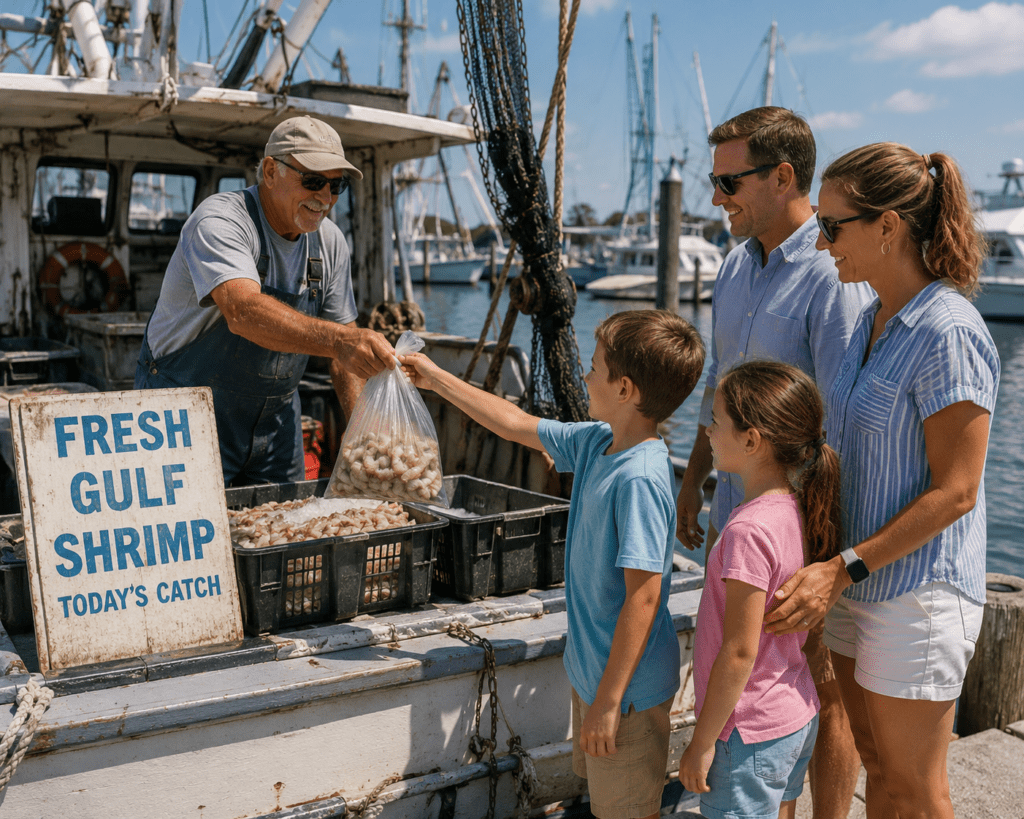
Seafood Markets & Gulf Coast Culture
Commercial fishing connects directly to one of the Gulf Coast’s most beloved traditions:
fresh local seafood.
Throughout coastal Mississippi, seafood markets remain extremely popular with both residents and tourists.
Visitors can often purchase:
- shrimp,
- oysters,
- crab,
- snapper,
- flounder,
- tuna,
- mullet,
- and other locally caught species
directly from seafood markets or docks.
Some markets even allow visitors to:
- select their fish,
- have it cleaned,
- and have nearby restaurants cook it fresh the same day.
This direct connection between:
- Gulf waters,
- fishermen,
- seafood markets,
- and restaurants
remains one of the defining cultural experiences of the Mississippi Gulf Coast.
Challenges Facing Commercial Fishing
Modern commercial fishermen face numerous challenges including:
- fuel costs,
- imported seafood competition,
- hurricanes,
- changing regulations,
- environmental pressures,
- and fluctuating seafood prices.
Despite these challenges, the commercial fishing industry continues to play an important role in:
- local employment,
- tourism,
- seafood supply,
- and preserving Gulf Coast heritage.
Many residents believe protecting working waterfronts remains essential to preserving the authentic culture of the Mississippi Gulf Coast.
The Connection Between Commercial & Recreational Fishing
Commercial and recreational fishing are deeply connected.
Healthy marshes, estuaries, and offshore ecosystems support:
- shrimp populations,
- baitfish,
- oysters,
- sportfish,
- and commercial harvest species alike.
When coastal ecosystems remain healthy, both industries benefit.
That connection explains why conservation and habitat protection have become increasingly important topics throughout the Gulf Coast fishing community.
What People Ask About Commercial Fishing
Is shrimping still important on the Mississippi Gulf Coast?
Yes. Shrimping remains an important part of the Gulf Coast economy, seafood industry, and coastal culture.
Can visitors buy fresh seafood directly from local markets?
Absolutely. Many Mississippi Gulf Coast seafood markets sell fresh local shrimp, fish, crab, and oysters directly to the public.
Why are shrimp boats so common on the Coast?
Commercial shrimping has been part of Mississippi Gulf Coast life for generations and remains one of the region’s most recognizable maritime industries.
Fishing Tool Best Months
Choose a month and fishing style to see common Mississippi Gulf Coast fish, where to look, and simple bait ideas. Always verify current Mississippi regulations before fishing.
Educational tool only. Seasons, limits, closures, weather, tides, and water conditions change. Check Mississippi Department of Marine Resources rules before keeping fish.
Fishing Safety on the Mississippi Gulf Coast
Fishing on the Mississippi Gulf Coast can be incredibly rewarding, but Gulf waters also demand respect.
Conditions can change quickly depending on:
- weather,
- tides,
- storms,
- currents,
- boat traffic,
- and seasonal conditions.
Whether someone is:
- surf fishing,
- kayak fishing,
- wade fishing,
- pier fishing,
- or heading 100 miles offshore,
understanding basic Gulf Coast fishing safety is essential.
Experienced local anglers often say:
“The Gulf can go from calm to dangerous very quickly.”
That statement becomes especially important during:
- summer thunderstorms,
- tropical weather,
- strong frontal systems,
- and offshore trips.
Weather Awareness Is Critical
One of the biggest safety factors on the Mississippi Gulf Coast is rapidly changing weather.
Summer mornings may begin:
- calm,
- sunny,
- and nearly windless,
only for severe thunderstorms to develop later in the day.
Lightning becomes a major concern for:
- offshore fishermen,
- pier fishermen,
- kayak anglers,
- and anyone exposed on open water.
Most experienced captains constantly monitor:
- radar,
- marine forecasts,
- wind direction,
- barometric pressure,
- and storm movement.
Important weather resources include:
Many local boaters also use:
- marine radios,
- radar apps,
- GPS systems,
- and satellite weather systems
for real-time updates.
Heat & Hydration
Summer heat on the Gulf Coast can become extremely intense.
Temperatures combined with:
- humidity,
- direct sun exposure,
- reflective water glare,
- and long hours outdoors
can quickly lead to: - dehydration,
- heat exhaustion,
- and sunburn.
Experienced anglers commonly bring:
- large amounts of water,
- electrolyte drinks,
- sunscreen,
- hats,
- long-sleeve sun shirts,
- sunglasses,
- and cooling towels.
Heat-related illness can become especially dangerous offshore where returning to shore may take hours.

When I first arrived on the Mississippi Gulf Coast, I quickly noticed something unusual — almost every home seemed to have a boat sitting in the driveway or yard.
Then I started listening carefully in restaurants and public places. Everywhere I went people were talking about:
- fishing trips,
- weather conditions,
- boats,
- bait,
- the islands,
- and who was catching what.
Eventually I decided to try an experiment.
The next time we were seated near another couple at a restaurant, I simply leaned over and asked:
Of course they immediately began telling me all about it.
After doing this multiple times, I eventually started joking with visitors that on the Mississippi Gulf Coast you do not ask if someone owns a boat — you ask what type of boat they own because seemingly EVERYONE has a boat.
And for the small minority who do not own one, they usually know somebody who does.
Boating and fishing are not simply hobbies here. They are part of the culture, identity, and lifestyle of the Mississippi Gulf Coast.
The Coast even celebrates and honors this maritime tradition through annual events such as the famous Blessing of the Fleet and Blessing of the Boats ceremonies held in coastal communities.
Boating Safety
Boating safety is one of the most important aspects of Gulf Coast fishing.
Even experienced boaters can encounter:
- sudden storms,
- engine problems,
- rough seas,
- shallow bars,
- floating debris,
- and navigational hazards.
Responsible boaters typically carry:
- life jackets,
- marine radios,
- emergency beacons,
- navigation lights,
- first aid kits,
- spare fuel,
- GPS systems,
- and emergency signaling equipment.
Before leaving the dock, many captains:
- file float plans,
- check fuel levels,
- inspect weather forecasts,
- and verify engine operation.
Offshore Fishing Risks
Offshore fishing introduces additional safety concerns because boats may travel:
- dozens of miles from land,
- outside cellular coverage,
- and into rapidly changing sea conditions.
Offshore captains must constantly monitor:
- wave height,
- wind forecasts,
- fuel reserves,
- storm development,
- and mechanical reliability.
Many experienced offshore anglers refuse to “push the weather” because Gulf conditions can deteriorate extremely fast.
Large offshore seas can become dangerous even for experienced fishermen.
Wade Fishing & Marine Wildlife
Wade fishermen should also remain aware of Gulf marine life and bottom conditions.
Potential hazards may include:
- stingrays,
- jellyfish,
- oyster shells,
- deep mud,
- sudden drop-offs,
- sharp debris,
- and strong currents.
Many wade fishermen shuffle their feet while walking through shallow water to avoid accidentally stepping on stingrays.
Protective footwear is highly recommended around:
- oyster reefs,
- shell bottoms,
- and marsh environments.
Shark Fishing Precautions
Shark fishing has become increasingly popular along Gulf beaches, but it requires careful handling and safety awareness.
Large sharks can remain extremely dangerous:
- even after landing,
- while being released,
- or while still partially submerged.
Responsible shark anglers often use:
- heavy gloves,
- long-handled dehooking tools,
- bolt cutters,
- and quick-release techniques.
Many fishermen now prioritize:
- safe handling,
- minimal stress,
- and rapid release practices.
Pier & Surf Fishing Safety
Pier and beach fishermen should remain aware of:
- slippery surfaces,
- strong currents,
- changing tides,
- and weather conditions.
Children should always be supervised near:
- piers,
- rocks,
- passes,
- and surf zones.
Fishing lines, hooks, and casted weights can also create hazards in crowded areas during busy tourism seasons.
Respecting Wildlife & the Environment
Fishing responsibly also means protecting the natural environment that supports Gulf Coast fisheries.
Responsible anglers avoid:
- littering,
- damaging marsh grass,
- leaving fishing line behind,
- dumping bait,
- or disturbing wildlife unnecessarily.
Discarded fishing line can seriously injure:
- birds,
- turtles,
- dolphins,
- and marine animals.
Many local fishermen actively participate in:
- coastal cleanups,
- reef restoration,
- habitat protection,
- and conservation efforts.
Hurricane Awareness
Hurricane season is a major reality of life on the Mississippi Gulf Coast.
Tropical systems can rapidly affect:
- tides,
- currents,
- wave conditions,
- water levels,
- and boating safety.
Even storms located far away in the Gulf can generate:
- dangerous surf,
- rip currents,
- and rough offshore conditions.
Most experienced fishermen monitor tropical forecasts closely during hurricane season.
What People Ask About Fishing Safety
Is offshore fishing dangerous?
Offshore fishing can be very safe when proper weather monitoring, boating safety, and preparation are followed. However, Gulf conditions can change rapidly.
What safety gear should every boat carry?
Life jackets, marine radios, navigation equipment, emergency signaling devices, first aid kits, and sufficient fuel are all extremely important.
Are sharks common near Mississippi beaches?
Yes. Several shark species are common in Gulf waters, especially during warmer months, although shark attacks remain very rare.
Fishing Equipment, Bait & Tackle Used on the Mississippi Gulf Coast
One of the most interesting parts of fishing on the Mississippi Gulf Coast is the incredible variety of equipment used depending on:
- location,
- target species,
- season,
- water depth,
- and fishing style.
The gear used by:
- a child catching ground mullet from the beach,
- a kayak angler targeting redfish in marsh grass,
- and an offshore crew fighting tuna 100 miles offshore
may look completely different.
Yet all of these anglers are participating in the same larger Gulf Coast fishing culture.
Rods & Reels
Fishing rods used on the Mississippi Gulf Coast range from lightweight inshore tackle to massive offshore setups designed to battle giant fish.
Inshore Tackle
For species such as:
- speckled trout,
- redfish,
- flounder,
- sheepshead,
- and black drum,
many anglers prefer:
- medium-light spinning rods,
- baitcasting setups,
- braided fishing line,
- and fluorocarbon leaders.
These lighter setups allow anglers to:
- cast artificial lures accurately,
- detect subtle bites,
- and enjoy stronger fights from medium-sized fish.
Popular inshore fishing styles include:
- popping cork rigs,
- jig heads,
- soft plastics,
- live shrimp fishing,
- and topwater lures.
Offshore Tackle
Offshore fishing requires dramatically heavier equipment.
Targeting:
- tuna,
- sharks,
- grouper,
- amberjack,
- wahoo,
- and billfish
demands heavy-duty rods and reels capable of handling enormous pressure.
Offshore setups often include:
- conventional reels,
- heavy braided line,
- steel leaders,
- fighting harnesses,
- trolling rods,
- and large landing gear.
Some offshore reels can hold:
- hundreds of yards of line
because large fish may make extremely long runs.
Artificial Lures
Artificial lures are extremely popular throughout the Mississippi Gulf Coast.
Common lure types include:
- soft plastic paddle tails,
- shrimp imitations,
- topwater plugs,
- spoons,
- crankbaits,
- suspending twitch baits,
- jigs,
- and trolling lures.
Many local anglers become highly specialized in artificial lure fishing because it allows:
- covering more water,
- matching baitfish patterns,
- and avoiding constant live bait replacement.
Topwater fishing for speckled trout and redfish can be especially exciting during:
- sunrise,
- sunset,
- overcast days,
- and calm summer mornings.
Explosive surface strikes are one reason many anglers become addicted to Gulf Coast fishing.
Live Bait Fishing
Despite advances in artificial lures, live bait remains one of the most effective fishing methods on the Coast.
Popular live bait species include:
- live shrimp,
- croakers,
- finger mullet,
- pogies (menhaden),
- pinfish,
- mud minnows,
- and crabs.
Live shrimp may be the single most universal bait used on the Mississippi Gulf Coast because so many species feed on them naturally.
Bait shops throughout coastal Mississippi often become gathering places where anglers:
- discuss fishing conditions,
- share reports,
- monitor tides,
- and prepare for trips.
Cast Nets & Catching Bait
Many local fishermen prefer catching their own bait using cast nets.
Early mornings frequently involve anglers throwing cast nets for:
- pogies,
- mullet,
- shrimp,
- and baitfish
near: - harbors,
- bridges,
- bayous,
- and marsh drains.
Learning to throw a cast net properly is considered almost a rite of passage among many Gulf Coast fishermen.
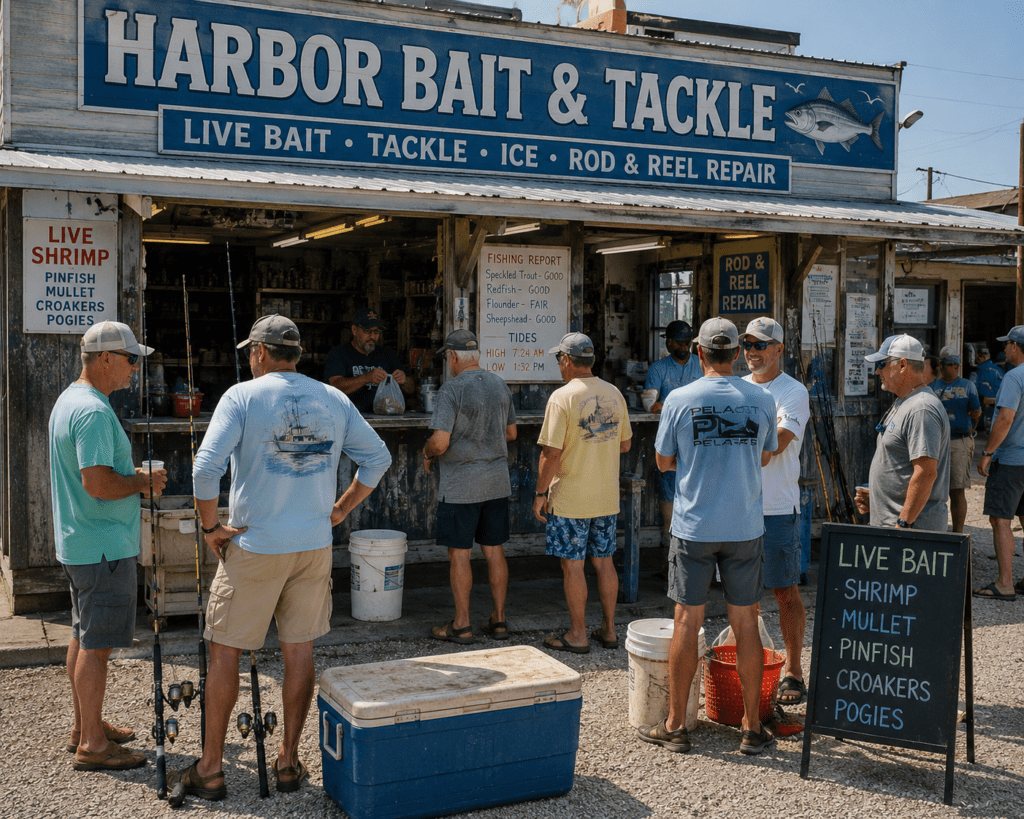
Tackle Shops & Local Knowledge
Local tackle shops remain extremely important along the Mississippi Gulf Coast.
Beyond selling equipment, many shops provide:
- fishing reports,
- tide advice,
- bait availability,
- seasonal information,
- and local fishing knowledge.
Many experienced anglers trust local bait shops more than online reports because conditions can change so quickly.
Good tackle shops often know:
- where fish are feeding,
- what bait is working,
- which tides are best,
- and how recent weather has affected fishing.
Electronics & Modern Technology
Modern fishing technology has dramatically changed Gulf Coast fishing.
Today many anglers use:
- GPS systems,
- fish finders,
- side-scan sonar,
- radar,
- trolling motors,
- marine apps,
- satellite weather,
- and digital mapping systems.
Offshore captains may maintain thousands of GPS coordinates marking:
- reefs,
- wrecks,
- oil rigs,
- ledges,
- and productive fishing spots.
At the same time, many longtime fishermen still emphasize:
“Electronics help, but they don’t replace experience.”
Understanding:
- tides,
- bait movement,
- seasonal patterns,
- water clarity,
- and weather
still remains critical.
Ice Chests, Fish Cleaning & Preparation
Fishing on the Mississippi Gulf Coast often continues long after leaving the water.
Many anglers:
- clean fish at public stations,
- vacuum seal catches,
- prepare fish fries,
- boil shrimp,
- grill snapper,
- or host seafood gatherings with family and friends.
Large coolers and ice management become extremely important during hot summer months to preserve fish quality.
For many fishermen, preparing and sharing fresh seafood becomes one of the best parts of the entire experience.
What People Ask About Fishing Equipment
What is the best all-around rod for Mississippi Gulf Coast fishing?
Many anglers prefer medium spinning tackle because it works well for speckled trout, redfish, flounder, and general inshore fishing.
What is the most common live bait on the Gulf Coast?
Live shrimp are probably the most commonly used bait because nearly every Gulf species feeds on shrimp naturally.
Do you need expensive equipment to fish the Mississippi Gulf Coast?
No. Many people successfully fish from beaches, piers, and bridges using affordable beginner equipment and simple bait rigs.
One of the most unique outdoor adventures on the Mississippi Gulf Coast is spending time on Deer Island, located directly across the Mississippi Sound from the Biloxi harbor area near the Hard Rock Casino.
Believe it or not, you can:
- camp on the island,
- fish from shore,
- explore the beaches,
- kayak the shoreline,
- and stay for days at virtually no cost.
The island is primitive and undeveloped, so visitors should bring necessary supplies and always follow the important rule:
Help protect Deer Island by removing all trash and belongings when leaving the island.
Many local fishermen report excellent fishing along the south side of the island where Gulf waters and currents attract a variety of species depending on season and tides.
Visitors typically reach the island by:
- boat,
- kayak,
- canoe,
- or paddleboard.
Learn more about this unique Mississippi Gulf Coast experience in our article:
Family Fishing Vacations on the Mississippi Gulf Coast
One reason fishing remains so important to the Mississippi Gulf Coast economy is that it appeals to virtually every age group and experience level.
Families visit the Coast every year specifically because fishing offers:
- outdoor adventure,
- relaxation,
- affordable entertainment,
- time together,
- and opportunities to experience nature firsthand.
Unlike some vacation activities that only appeal to certain age groups, fishing can involve:
- children,
- teenagers,
- parents,
- grandparents,
- and entire multi-generational families.
Whether someone wants to:
- catch fish from the beach,
- take a deep-sea charter trip,
- fish from a pier,
- kayak through marshes,
- or simply watch shrimp boats at the harbor,
there are fishing-related activities available throughout the Coast.
Mississippi Gulf Coast Fishing Trip Planner
Mississippi Gulf Coast Fishing Trip Planner
Planning a fishing trip on the Mississippi Gulf Coast involves more than simply launching the boat. This planner helps estimate what type of trip may work best based on the season, fishing style, target species, and weather conditions commonly found along the Gulf Coast.
Trip Basics
Target Species
Conditions & Gear
Why Families Love Fishing on the Coast
The Mississippi Gulf Coast offers several advantages that make it especially attractive for family fishing vacations.
Protected Waters
Because the Mississippi barrier islands partially shield the mainland coastline, many fishing areas remain calmer than more exposed Gulf coastlines.
This helps create:
- calmer surf,
- safer boating conditions,
- easier kayak access,
- and more beginner-friendly fishing opportunities.
Variety of Fishing Options
Families can choose from:
- surf fishing,
- pier fishing,
- charter fishing,
- dock fishing,
- marsh fishing,
- offshore trips,
- kayak rentals,
- and guided excursions.
This flexibility allows families to match activities to:
- age,
- budget,
- comfort level,
- and fishing experience.
Affordable Fishing Opportunities
Many fishing experiences on the Coast are surprisingly affordable.
Families can often:
- buy inexpensive tackle,
- fish directly from public beaches,
- use public piers,
- or visit local bait shops
without needing expensive boats or equipment.
Some visitors spend entire vacations simply:
- fishing from the beach,
- crabbing,
- watching dolphins,
- collecting shells,
- and exploring coastal communities.
Charter Fishing Trips
Charter fishing has become extremely popular for visitors wanting a guided fishing experience.
Mississippi Gulf Coast charter captains provide:
- boats,
- bait,
- tackle,
- fishing licenses,
- navigation,
- and local expertise.
Families can choose from:
- inshore trips,
- nearshore trips,
- shark fishing,
- snapper fishing,
- trolling trips,
- or full offshore adventures.
For many children, catching:
- their first redfish,
- speckled trout,
- shark,
- or snapper
becomes one of the highlights of the vacation.
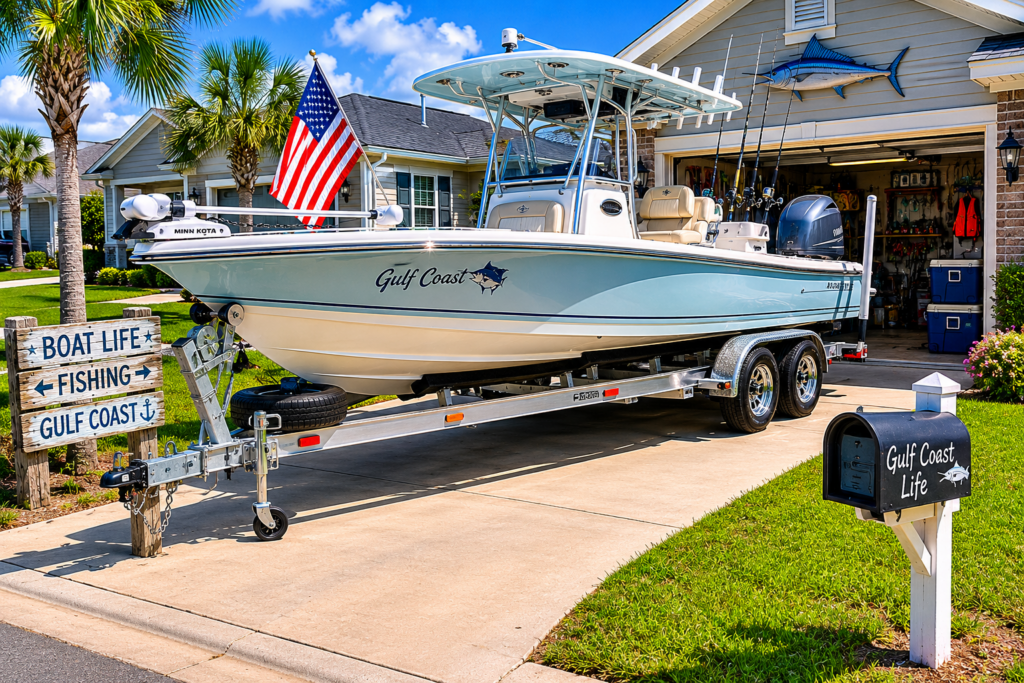
Fishing & Coastal Tourism
Fishing also connects naturally with many other Gulf Coast attractions including:
- seafood restaurants,
- aquariums,
- beaches,
- boating,
- island excursions,
- wildlife preserves,
- and maritime museums.
Families often combine fishing trips with visits to:
This combination of:
- education,
- recreation,
- food,
- and outdoor experiences
helps make the Mississippi Gulf Coast unique.
Teaching Children About Nature
Fishing also provides valuable educational opportunities for children.
Kids quickly begin learning about:
- tides,
- fish species,
- marshes,
- weather,
- baitfish,
- birds,
- conservation,
- and marine ecosystems.
Many lifelong fishermen first became interested in the outdoors during childhood fishing trips with parents or grandparents.
Simple experiences such as:
- catching bait with a cast net,
- seeing dolphins,
- releasing fish,
- or watching shrimp boats unload
can leave lasting memories.
Fishing at Sunrise & Sunset
Some of the best Gulf Coast fishing experiences happen during:
- sunrise,
- sunset,
- and nighttime dock-light fishing.
Early morning fishing trips often provide:
- cooler temperatures,
- calmer winds,
- active fish,
- and beautiful coastal scenery.
Sunset fishing from beaches and piers has become especially popular because it combines:
- fishing,
- coastal views,
- wildlife,
- and relaxation.
Many visitors discover that even on days when fishing is slow, simply being near the water becomes part of the experience.
The Relaxation Factor
For many visitors, fishing becomes an escape from:
- traffic,
- schedules,
- phones,
- work,
- and daily stress.
The slower pace of:
- watching tides,
- listening to marsh sounds,
- waiting for bites,
- and spending time outdoors
creates a completely different vacation experience compared to crowded attractions or theme parks.
That relaxed coastal atmosphere remains one of the biggest reasons many families return to the Mississippi Gulf Coast year after year.
What People Ask About Family Fishing Trips
Is the Mississippi Gulf Coast good for beginner fishermen?
Yes. Beaches, piers, marshes, and charter trips provide excellent opportunities for beginners and families.
Can children fish on the Mississippi Gulf Coast?
Absolutely. Many areas are ideal for children including piers, beaches, docks, and calm bayous.
Do charter boats provide equipment?
Most charter boats provide rods, reels, bait, tackle, licenses, and instruction for guests.
Mississippi fishing regulations require most residents and non-residents aged 16 and older to possess a valid fishing license when fishing public freshwater or saltwater areas.
- Residents: Mississippi residents ages 16–64 generally require a fishing license.
- Non-Residents: All non-residents age 16 and older must possess a valid fishing license.
- Freshwater Fishing: Licenses are required for public freshwater fishing areas.
- Saltwater Fishing: Separate saltwater licensing requirements apply for marine waters.
- Federal Waters: Additional federal rules and permits may apply depending on the species targeted offshore.
- Freshwater Fishing: Mississippi residents age 65 or older generally do not need to purchase a freshwater fishing license.
- Saltwater Fishing: Residents age 65+ must obtain a Resident Lifetime Saltwater Fishing License, currently a low-cost one-time fee valid for life south of Interstate 10.
- Proof Required: Seniors should carry proof of age and Mississippi residency such as a valid Mississippi driver’s license or state ID.
- Optional Senior Exempt Card: Mississippi also offers an optional Senior Exempt License card that serves as convenient proof of exemption status while helping support wildlife conservation programs.
- Eligibility: Mississippi residents who are 100% service-connected disabled through the VA may qualify for exemptions from both hunting and fishing licenses.
- Coverage: The exemption applies to both freshwater and saltwater fishing.
- Documentation: Qualified veterans should carry proof of Mississippi residency and official VA disability documentation while fishing.
- Optional Disabled Exempt Card: Mississippi offers a convenient Disabled Exempt License card allowing veterans to avoid carrying sensitive VA paperwork on boats or around water.
If fishing between Interstate 10 and U.S. Highway 90, either a freshwater or saltwater license may generally be accepted.
However, if fishing south of Highway 90, a valid saltwater fishing credential is required.
Mississippi anglers must also comply with:
- minimum size limits,
- daily possession limits,
- seasonal closures,
- reef fish regulations,
- and species-specific rules.
These regulations may change from year to year depending on fish populations, conservation goals, and federal fishery management decisions.
Legendary Fishing Destinations on the Mississippi Gulf Coast
The Mississippi Gulf Coast offers an incredible variety of fishing locations ranging from quiet marshes and bayous to deep offshore waters beyond the barrier islands.
Some areas are famous for:
- speckled trout,
- others for redfish,
- others for offshore reef fishing,
- and some simply for the overall experience and scenery.
Many local fishermen spend decades learning the subtle differences between:
- tides,
- bottom structure,
- marsh drains,
- reefs,
- and seasonal fish movement
at these locations.
The Mississippi Sound
The Mississippi Sound is the heart of Mississippi coastal fishing.
Protected by the barrier islands, the Sound creates a vast estuarine system filled with:
- baitfish,
- shrimp,
- oyster reefs,
- marshes,
- grass flats,
- and productive fishing structure.
The Sound supports:
- speckled trout,
- redfish,
- flounder,
- black drum,
- sharks,
- jack crevalle,
- Spanish mackerel,
- and countless bait species.
Many local fishermen spend their entire lives fishing different portions of the Sound.
The Barrier Islands
The Mississippi barrier islands create some of the Coast’s most unique fishing environments.
These islands include:
- Cat Island
- Ship Island
- Horn Island
- Petit Bois Island
- Deer Island
The islands help:
- protect the mainland coastline,
- reduce wave energy,
- stabilize estuaries,
- and create productive fishing habitat.
Fishing around the islands commonly targets:
- speckled trout,
- redfish,
- flounder,
- sharks,
- Spanish mackerel,
- cobia,
- tripletail,
- and offshore reef species.
The southern beaches of several islands face directly into the Gulf of America and can provide outstanding surf fishing opportunities.
Cat Island
Cat Island is one of the most unique islands on the Gulf Coast because of its unusual shape and diverse habitat.
The island features:
- shallow flats,
- grass beds,
- sandy beaches,
- tidal cuts,
- and deeper surrounding channels.
Many fishermen target:
- speckled trout,
- redfish,
- tripletail,
- sharks,
- and cobia
around Cat Island depending on season.
Its remote appearance gives anglers the feeling of being far removed from the mainland despite being relatively close to shore.
Ship Island
Ship Island is famous for both tourism and fishing.
The waters surrounding Ship Island support:
- Spanish mackerel,
- sharks,
- trout,
- redfish,
- and nearshore reef species.
Many charter boats stop near Ship Island during:
- nearshore fishing trips,
- shark fishing excursions,
- and sightseeing tours.
The island also attracts:
- beach fishermen,
- kayak anglers,
- and boaters.
Horn Island Wilderness
Horn Island offers one of the most remote and natural fishing environments on the Coast.
Part of the Gulf Islands National Seashore wilderness system, Horn Island contains:
- marshes,
- tidal pools,
- grass flats,
- beaches,
- and pristine shoreline habitat.
Fishing here often feels dramatically different from heavily developed mainland areas.
Many experienced anglers consider Horn Island one of the Coast’s most beautiful natural fishing destinations.
Pascagoula River System
The Pascagoula River and surrounding marshes support incredible estuarine fishing.
This river system provides habitat for:
- redfish,
- black drum,
- speckled trout,
- flounder,
- bass,
- catfish,
- and countless bait species.
Because it remains one of the last large free-flowing river systems in the lower 48 states, the Pascagoula ecosystem plays a major role in supporting Gulf fisheries.
Bayous & Marsh Drains
Many of the Coast’s best fishing spots are not large open-water areas at all.
Instead, experienced local fishermen often focus on:
- narrow marsh drains,
- tidal creeks,
- oyster points,
- bayou mouths,
- and hidden shoreline structure.
These areas concentrate:
- shrimp,
- baitfish,
- crabs,
- and feeding predators during moving tides.
Some of the best fishing locations may look insignificant to inexperienced anglers.
Artificial Reefs & Oil Platforms
Offshore fishermen often target:
- artificial reefs,
- wrecks,
- oil platforms,
- and hard-bottom ledges.
These structures attract:
- snapper,
- grouper,
- amberjack,
- triggerfish,
- king mackerel,
- cobia,
- and baitfish.
Some offshore captains maintain private GPS coordinate collections developed over decades.
Good offshore structure locations are often guarded carefully.
Bridges & Causeways
Bridges crossing bays and estuaries become major fishing hotspots because they create:
- shade,
- current breaks,
- ambush points,
- deeper channels,
- and nighttime light systems.
Popular bridge fishing areas frequently attract:
- speckled trout,
- sheepshead,
- black drum,
- redfish,
- and flounder.
Nighttime fishing under bridge lights can become especially productive during warmer months.
What People Ask About Fishing Locations
What is the best fishing area on the Mississippi Gulf Coast?
The answer depends on the target species, season, and fishing style, but the Mississippi Sound and barrier islands are among the most productive overall areas.
Are the barrier islands good for fishing?
Yes. The barrier islands provide some of the Coast’s best opportunities for surf fishing, nearshore fishing, and marsh fishing.
Can you fish without a boat on the Mississippi Gulf Coast?
Absolutely. Beaches, piers, bridges, marsh shorelines, and public access areas provide excellent fishing opportunities from shore.
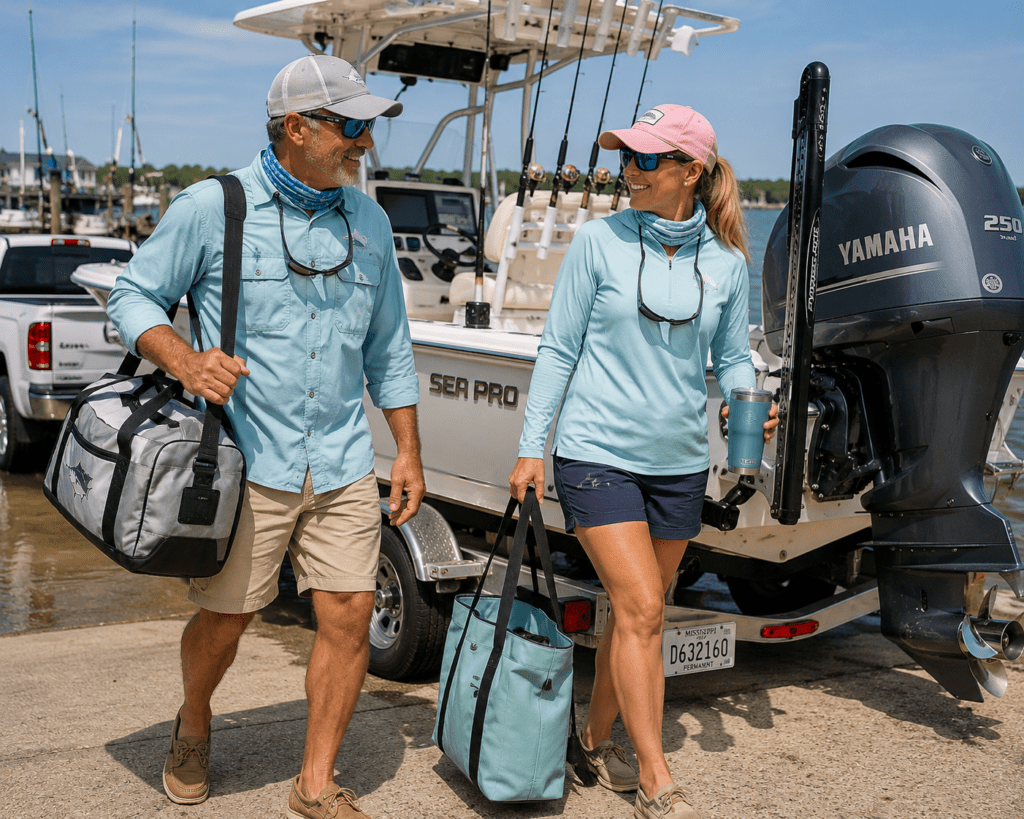
The Mississippi Gulf Coast Fishing Uniform
You cannot simply jump in the truck, haul the boat to the dock, and start fishing on the Mississippi Gulf Coast without the proper “uniform.”
Spend even a single weekend around:
- marinas,
- bait shops,
- boat ramps,
- fishing tournaments,
- seafood markets,
- or waterfront restaurants
and you will quickly realize Gulf Coast fishermen and women have developed a very recognizable style.
Much of it is practical.
Some of it is cultural.
And some of it simply becomes part of fitting into the Gulf Coast boating lifestyle.
The Famous “Fishing Shirt”
The centerpiece of the Gulf Coast fishing uniform is unquestionably the:
fishing shirt.
These shirts are usually made from:
- lightweight performance fabric,
- moisture-wicking material,
- breathable synthetic blends,
- and quick-dry fabrics.
Most also include:
- vented backs,
- UV sun protection,
- lightweight collars,
- and loose comfortable fits designed for hot weather.
Fishing shirts can be:
- short-sleeved,
- long-sleeved,
- solid-colored,
- brightly patterned,
- or covered with fish logos and coastal graphics.
On the Mississippi Gulf Coast, colorful fishing shirts are everywhere.
Many visitors who arrive from other parts of the country immediately notice them.
One common reaction is:
“I never saw these back home, but now I want one.”
Of course, once someone buys their first fishing shirt, they quickly discover:
one is never enough.
Soon the closet begins filling with:
- tournament shirts,
- marina shirts,
- charter shirts,
- fish species shirts,
- and shirts from favorite bait shops and coastal businesses.
The Mississippi Gulf Coast offers incredible opportunities for entrepreneurs interested in fishing, boating, tourism, seafood, and outdoor recreation businesses.
Possible business ideas include:
Some vacation rental owners even partner with local fishing charter captains to create complete fishing vacation packages for visitors.
The Mississippi Gulf Coast remains highly supportive of small business growth, tourism, boating, fishing, and hospitality-related enterprises.
RetireCoast’s Business Builder Membership includes tools, calculators, business guidance, operating resources, and planning systems designed to help entrepreneurs launch and manage new businesses.
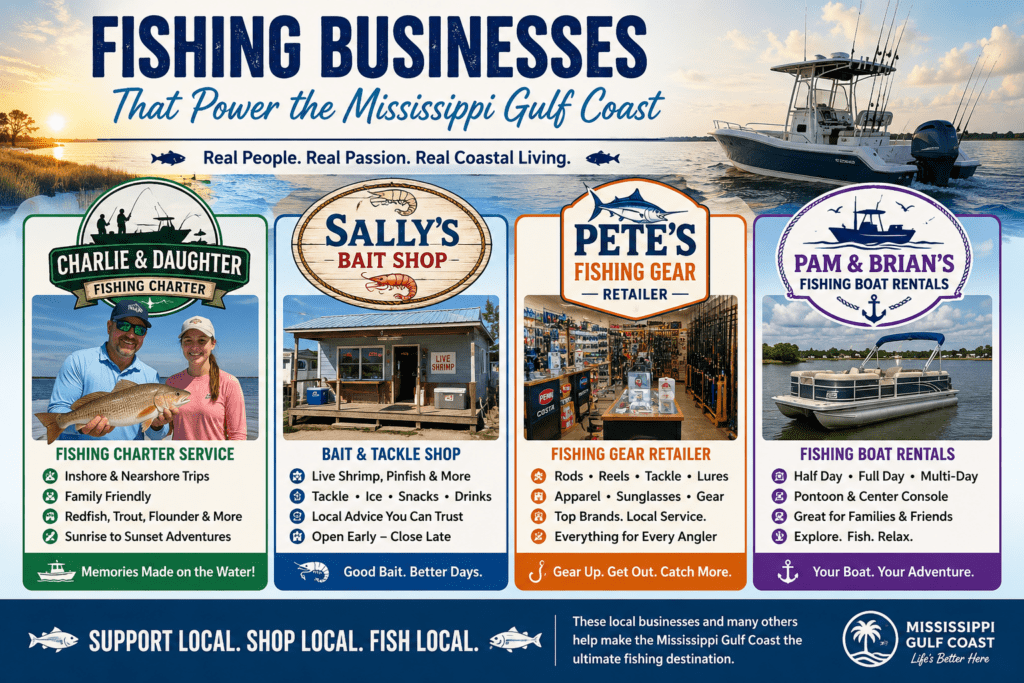
Sun Protection Is Serious Business
The Mississippi Gulf Coast sun can be brutal, especially:
- offshore,
- on reflective water,
- during summer,
- or while fishing for hours at a time.
Because of this, proper sun protection becomes almost mandatory.
Wide-brim fishing hats are extremely popular because they protect:
- ears,
- neck,
- face,
- and shoulders
better than standard baseball caps.
Still, baseball caps remain common — although experienced boaters quickly learn:
you better have a tight-fitting cap or a chin strap when the wind picks up.
It does not take much Gulf wind to launch a favorite hat into the Mississippi Sound forever.
Sunglasses With Straps
Polarized sunglasses are another essential part of the Gulf Coast fishing lifestyle.
Good sunglasses help fishermen:
- see through water glare,
- spot fish movement,
- locate marsh drains,
- identify bait schools,
- and protect eyes from harsh sunlight.
However, almost every experienced fisherman eventually learns another important lesson:
always use a sunglasses strap.
Wind, waves, casting, landing fish, or simply leaning over the side of the boat can instantly send expensive sunglasses into the Gulf.
Many Gulf Coast fishermen can probably tell stories about:
- “the pair I lost offshore,”
- “the ones that went overboard at Cat Island,”
- or “the pair the redfish knocked off.”
Shorts, Boat Shoes & Bare Ankles
Shorts are practically standard equipment along the Coast.
Lightweight shorts help fishermen stay cooler in:
- heat,
- humidity,
- and direct sun exposure.
A few brave individuals may wear pants during winter cold fronts, but for most Gulf Coast fishermen:
shorts are simply part of the culture.
Boat shoes are also extremely common.
These shoes are designed for:
- wet surfaces,
- slippery decks,
- quick drying,
- and comfort.
And yes:
boat shoes are usually worn without socks.
The Long Sleeve Debate
One interesting surprise to many visitors is that long sleeves are actually very common in hot weather.
Many experienced Gulf Coast fishermen wear:
- lightweight hooded fishing shirts,
- neck gaiters,
- gloves,
- and full sun-protection clothing
even during summer.
Why?
Because after spending entire days exposed to:
- intense sun,
- reflected glare,
- heat,
- and wind,
many anglers discover covering up is actually cooler and far more comfortable.
Fishing Gloves, Neck Gaiters & Face Coverings
Modern Gulf Coast fishing gear increasingly includes:
- UV neck gaiters,
- performance gloves,
- face coverings,
- and lightweight sun masks.
These items help protect against:
- sunburn,
- windburn,
- hooks,
- fish slime,
- and harsh weather.
Offshore fishermen especially rely on these items during long runs in open water.
Fishing Vests & Utility Gear
Fishing vests remain popular for:
- river fishing,
- marsh fishing,
- kayak fishing,
- and wade fishing.
They provide easy access to:
- lures,
- hooks,
- pliers,
- leader material,
- tools,
- and tackle.
Some anglers now prefer:
- sling packs,
- waterproof backpacks,
- or chest packs,
but the traditional fishing vest still appears regularly around Gulf waters.
Men & Women Dress Very Similarly
One interesting aspect of Gulf Coast fishing culture is how similar the clothing styles are between men and women.
The same:
- fishing shirts,
- hats,
- sunglasses,
- shoes,
- and sun-protection gear
are widely worn by both.
Women’s fishing apparel has become especially popular and stylish in recent years, with many brands producing Gulf Coast-inspired designs specifically for female anglers.
The Boat Ramp Fashion Show
Boat ramps on busy weekends almost become unofficial fishing fashion events.
People arrive wearing:
- matching tournament shirts,
- polarized sunglasses,
- fishing brand apparel,
- deck boots,
- performance gear,
- and expensive coolers.
And somehow, even fishermen who insist:
“I’m just heading out for a casual trip”
still often arrive looking fully prepared for a national television fishing tournament.
What People Ask About Fishing Clothing
Why do Gulf Coast fishermen wear long sleeves in summer?
Lightweight long-sleeve fishing shirts actually help protect against sunburn and can feel cooler than direct sun exposure.
What are fishing shirts made from?
Most are made from moisture-wicking synthetic fabrics designed for ventilation, UV protection, and quick drying.
Are polarized sunglasses important for fishing?
Absolutely. Polarized lenses reduce glare and help anglers see baitfish, underwater structure, and fish movement much more clearly.
Wildlife, Dolphins & Other Things You See While Fishing
One of the unexpected pleasures of fishing on the Mississippi Gulf Coast is that the experience often becomes much more than simply catching fish.
A typical fishing trip may also include encounters with:
- dolphins,
- pelicans,
- ospreys,
- sea turtles,
- rays,
- sharks,
- jellyfish,
- alligators,
- migratory birds,
- and countless other forms of marine wildlife.
Many fishermen say some of their favorite memories were not necessarily the fish they caught, but rather the things they witnessed while spending time on the water.
Dolphins Following the Boats
Bottlenose dolphins are extremely common throughout:
- the Mississippi Sound,
- bay systems,
- barrier islands,
- and nearshore Gulf waters.
It is very common for dolphins to:
- follow boats,
- ride wakes,
- feed near bait schools,
- or suddenly surface beside fishermen.
Children especially love seeing dolphins during fishing trips.
Some dolphins have even learned to associate fishing boats with feeding opportunities and may appear regularly near:
- marinas,
- harbors,
- shrimp boats,
- and charter vessels.
While dolphins are entertaining to watch, experienced fishermen generally avoid feeding them because it can create unhealthy dependence on humans.
Pelicans & Diving Birds
Pelicans are among the most recognizable birds on the Mississippi Gulf Coast.
Brown pelicans frequently:
- glide just above the water,
- rest on pilings,
- gather near harbors,
- and dramatically dive into schools of baitfish.
Experienced fishermen often watch bird activity carefully because diving birds may indicate:
- shrimp movement,
- schooling baitfish,
- Spanish mackerel,
- trout feeding activity,
- or surface action.
Birds can sometimes help anglers locate fish faster than electronics.
Ospreys & Eagles
Ospreys are also common along coastal marshes and waterways.
These powerful birds of prey hover over the water before diving feet-first to capture fish.
Many fishermen enjoy watching:
- ospreys carrying mullet,
- pelicans diving,
- herons stalking baitfish,
- and seabirds working bait schools.
Bald eagles can occasionally be seen near:
- rivers,
- marshes,
- barrier islands,
- and remote coastal areas.
Stingrays & Rays Gliding Through Shallow Water
Southern stingrays and cownose rays are frequently encountered in shallow Gulf Coast waters.
Wade fishermen often spot rays:
- cruising sand flats,
- buried near beaches,
- or moving along marsh shorelines.
This is one reason experienced wade fishermen often:
shuffle their feet while walking through shallow water.
The movement warns stingrays before someone accidentally steps on them.
Sea Turtles
Several species of sea turtles inhabit Gulf waters surrounding Mississippi.
Sea turtles are occasionally observed:
- surfacing offshore,
- feeding near barrier islands,
- floating near weed lines,
- or swimming around nearshore structure.
These protected animals are an important part of the Gulf ecosystem.
Responsible fishermen avoid:
- disturbing turtles,
- littering,
- or leaving fishing line in the water.
Discarded line can seriously injure marine wildlife.
Sharks in the Sound
Many visitors are surprised to learn how common sharks actually are throughout Mississippi waters.
Species commonly encountered include:
- blacktip sharks,
- spinner sharks,
- bonnetheads,
- bull sharks,
- and hammerheads.
However, sharks generally avoid people and attacks remain extremely rare.
For fishermen, sharks are simply considered another normal part of the Gulf ecosystem.
Some anglers intentionally target sharks from:
- beaches,
- piers,
- and offshore boats,
while others become frustrated when sharks steal hooked fish during offshore battles.
Jellyfish & Seasonal Visitors
Jellyfish populations can vary dramatically depending on:
- season,
- tides,
- salinity,
- and weather patterns.
During certain periods, fishermen may encounter:
- moon jellies,
- sea nettles,
- or Portuguese man o’ war drifting into Gulf waters.
Most fishermen quickly learn:
if the jellyfish arrive, conditions may be changing.
Alligators in Coastal Marshes
Although most people associate alligators with freshwater swamps, they are also commonly found in:
- coastal rivers,
- marsh systems,
- bayous,
- and brackish estuaries.
Kayak fishermen and marsh anglers occasionally encounter large alligators in remote backwater areas.
Generally, alligators avoid people when left undisturbed.
Migratory Birds & Seasonal Wildlife
The Mississippi Gulf Coast lies directly within a major migratory bird route.
Throughout the year fishermen may encounter:
- herons,
- egrets,
- roseate spoonbills,
- terns,
- gulls,
- ducks,
- geese,
- and countless migratory species.
Barrier islands and marshes provide critical habitat for many birds during seasonal migrations.
Sunrises, Sunsets & Quiet Moments
Many longtime fishermen eventually realize some of the best parts of Gulf Coast fishing have little to do with catching fish at all.
The experience may include:
- watching fog rise off marshes,
- hearing mullet jump at sunrise,
- listening to bait popping along grass edges,
- watching dolphins surface,
- or sitting quietly offshore beneath a Gulf sunset.
For many people, these moments become just as memorable as the fish themselves.
What People Ask About Gulf Coast Wildlife
Are dolphins common on the Mississippi Gulf Coast?
Yes. Bottlenose dolphins are extremely common throughout the Mississippi Sound and nearshore Gulf waters.
Are sharks common in Mississippi waters?
Yes. Several shark species regularly inhabit Gulf Coast waters, especially during warmer months.
What birds do fishermen commonly see?
Pelicans, ospreys, herons, gulls, egrets, and many migratory birds are commonly seen while fishing along the Coast.
Seafood, Fish Fries & Cooking the Catch
On the Mississippi Gulf Coast, fishing rarely ends when the boat returns to the dock.
For many fishermen and families, bringing home fresh seafood is one of the most rewarding parts of the entire experience.
The Coast maintains a deep connection between:
- fishing,
- cooking,
- seafood traditions,
- family gatherings,
- and local restaurants.
In many Gulf Coast households, a successful fishing trip naturally leads to:
- fish fries,
- shrimp boils,
- grilling,
- oyster roasts,
- crab boils,
- and outdoor gatherings.
The Gulf Coast Fish Fry Tradition
Few traditions are more common on the Mississippi Gulf Coast than the:
fish fry.
Fresh catches such as:
- speckled trout,
- white trout,
- flounder,
- ground mullet,
- sheepshead,
- black drum,
- and catfish
are often cleaned the same day and prepared immediately.
Many Gulf Coast fish fries involve:
- cornmeal coatings,
- Cajun seasoning,
- hot oil,
- hushpuppies,
- coleslaw,
- French fries,
- baked beans,
- and homemade sauces.
Fish fries frequently become social events involving:
- neighbors,
- relatives,
- fishing buddies,
- and entire families.
Shrimp Boils & Seafood Gatherings
Fresh Gulf shrimp play a central role in Mississippi coastal cooking.
Boiled shrimp gatherings often include:
- corn,
- potatoes,
- sausage,
- onions,
- mushrooms,
- and spicy seafood seasoning.
Outdoor seafood boils are especially popular during:
- summer,
- holidays,
- fishing tournaments,
- and football weekends.
Many Gulf Coast residents consider fresh local shrimp one of the defining foods of coastal Mississippi culture.
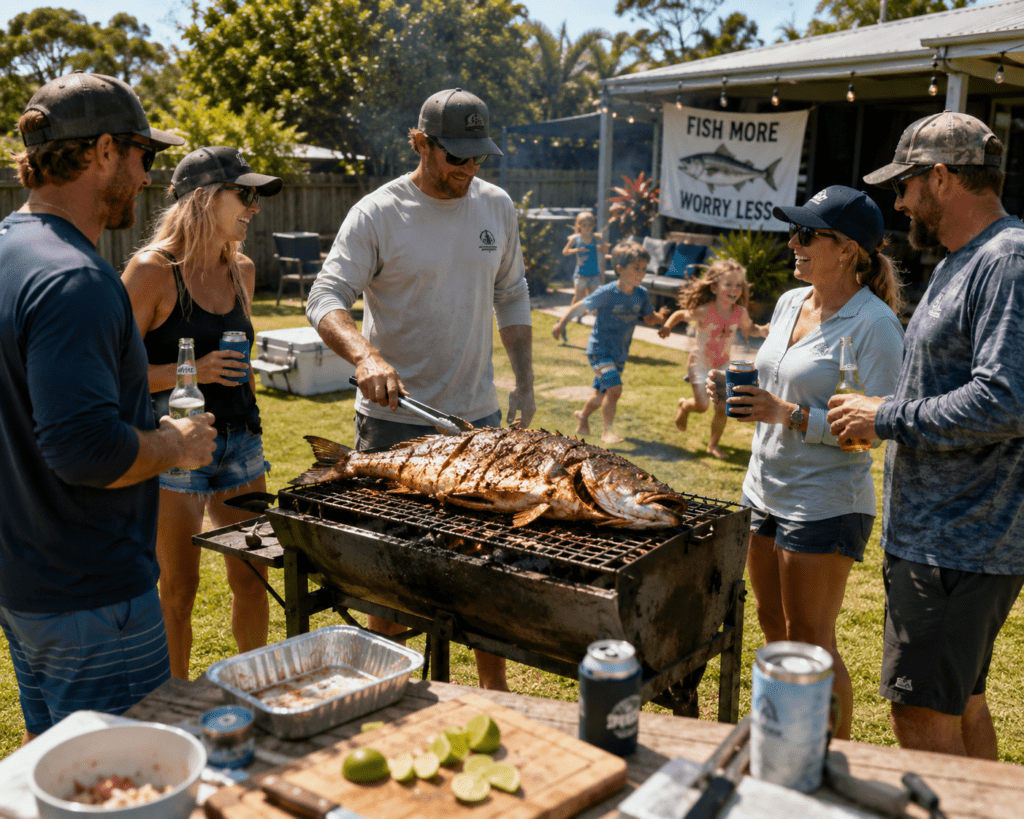
Grilling Fresh Fish
Many anglers also prefer grilling fresh fish rather than frying.
Popular grilled species include:
- redfish,
- snapper,
- tuna,
- cobia,
- mahi-mahi,
- and amberjack.
Simple Gulf Coast recipes often emphasize:
- fresh seafood,
- butter,
- lemon,
- garlic,
- blackening seasoning,
- and open-flame cooking.
Some fishermen believe:
“The fresher the fish, the simpler the recipe should be.”
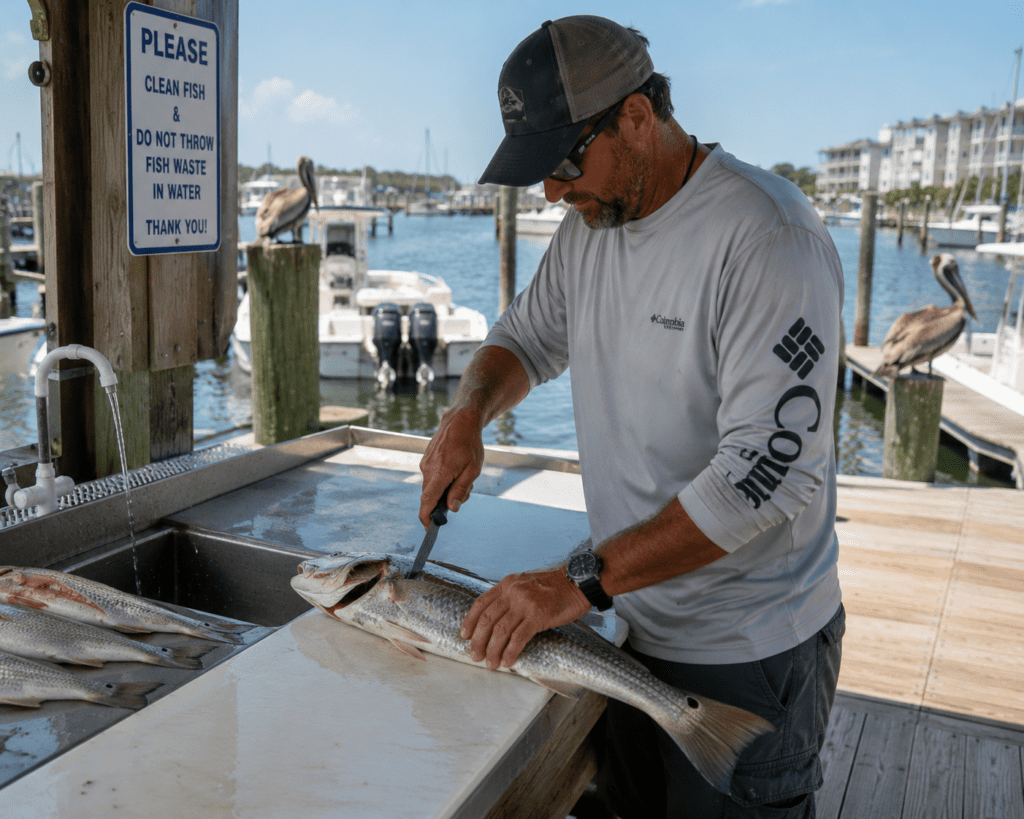
Cleaning Fish at the Dock
Cleaning fish becomes almost a ritual on the Gulf Coast.
Many marinas and public harbors include:
- fish-cleaning stations,
- water access,
- cleaning tables,
- and disposal areas.
Experienced fishermen often clean fish remarkably quickly while discussing:
- tides,
- weather,
- where the fish were caught,
- and what bait worked best.
Cleaning fish at sunset while pelicans wait nearby for scraps is a familiar coastal scene throughout Mississippi.
Seafood Restaurants & “Hook to Table” Culture
The Mississippi Gulf Coast is filled with seafood restaurants connected directly to local fishing culture.
Many restaurants feature:
- locally caught shrimp,
- snapper,
- oysters,
- crab,
- flounder,
- and seasonal Gulf species.
Some establishments even allow visitors to:
- purchase seafood from local markets,
- then have nearby restaurants prepare it fresh.
This “hook-to-table” experience remains one of the most unique parts of Gulf Coast dining.
The Great Shrimp Debate
Along the Coast, people can become surprisingly passionate about shrimp.
Many locals strongly prefer:
- fresh Gulf shrimp
over: - imported farm-raised shrimp.
Some residents carefully ask restaurants:
“Are these real Gulf shrimp?”
before ordering.
Fresh Gulf shrimp are prized for:
- flavor,
- texture,
- size,
- and freshness.
Supporting local shrimpers also helps preserve the working waterfront culture found throughout coastal Mississippi.
Fish Stories Around the Table
One thing that never changes on the Mississippi Gulf Coast:
fish stories grow larger during dinner.
Somehow:
- the fish always become bigger,
- the sharks become more aggressive,
- the weather becomes rougher,
- and the “one that got away” becomes nearly legendary.
Fishing stories are part of Gulf Coast culture.
And usually, the best stories are told:
- while cleaning fish,
- around the grill,
- at seafood restaurants,
- or while eating fresh shrimp after sunset.
Cooking as Part of the Fishing Experience
For many Gulf Coast residents, cooking the catch is considered part of fishing itself.
The experience includes:
- catching the fish,
- cleaning it,
- preparing it,
- sharing it,
- and gathering with others.
That connection between:
- water,
- food,
- family,
- and tradition
helps make Mississippi Gulf Coast fishing culture unique.
What People Ask About Gulf Coast Seafood
What fish are best for frying on the Mississippi Gulf Coast?
Flounder, speckled trout, white trout, ground mullet, catfish, and sheepshead are all popular fish-fry choices.
Are Gulf shrimp better than imported shrimp?
Many locals strongly prefer fresh Gulf shrimp because of their flavor, texture, and freshness.
Do people cook fish the same day they catch them?
Very often, yes. Many Gulf Coast fishermen clean and cook their catch within hours of returning to the dock.
Why People Move to the Mississippi Gulf Coast for Fishing
For many visitors, fishing on the Mississippi Gulf Coast begins as part of a vacation.
But for a surprising number of people, that first fishing trip eventually becomes something much larger:
the reason they decide to relocate permanently.
Spend enough time around:
- marinas,
- bait shops,
- waterfront restaurants,
- charter docks,
- and coastal neighborhoods
and you will eventually hear someone say:
“We came down here on vacation… and never left.”
A Lifestyle Built Around the Water
One of the biggest attractions of the Mississippi Gulf Coast is how closely daily life remains connected to the water.
In many coastal communities:
- boats sit in driveways,
- fishing rods remain in trucks,
- seafood is part of normal weekly meals,
- and weather conversations often revolve around tides and fishing conditions.
For many residents:
- boating,
- fishing,
- shrimping,
- kayaking,
- and beach life
are not occasional hobbies.
They are simply part of everyday living.
Easy Access to Fishing
Unlike many coastal regions where waterfront access can become extremely limited or overcrowded, the Mississippi Gulf Coast still offers many practical ways to enjoy the water.
Residents can often access:
- public boat launches,
- fishing piers,
- beaches,
- bayous,
- marinas,
- marshes,
- and barrier islands
within a relatively short drive.
Some homeowners even maintain:
- private docks,
- boat lifts,
- canal access,
- or nearby marina slips.
For serious fishermen, that convenience becomes a major quality-of-life advantage.
A More Relaxed Coastal Lifestyle
Many people relocating from larger metropolitan areas notice the Mississippi Gulf Coast operates at a different pace.
Compared to heavily congested coastal cities, many Gulf Coast communities feel:
- slower,
- more relaxed,
- less crowded,
- and more connected to outdoor living.
Fishing fits naturally into that environment.
Early mornings on the Coast may involve:
- launching a boat before sunrise,
- grabbing live shrimp at the bait shop,
- fishing for a few hours,
- then returning home before lunch.
For many residents, that becomes a normal routine rather than a rare vacation experience.
Fishing for Retirement
Fishing also plays a major role in retirement decisions for many people moving to coastal Mississippi.
Retirees are often attracted by:
- year-round fishing,
- boating access,
- mild winters,
- seafood culture,
- outdoor recreation,
- and lower overall living costs compared to some coastal states.
Some retirees specifically search for:
- canal homes,
- waterfront property,
- marina access,
- or neighborhoods designed around boating lifestyles.
For lifelong fishermen, retirement on the Gulf Coast can feel like finally having permanent access to the lifestyle they always wanted.
The Social Side of Fishing
Fishing communities also create strong social connections.
People often meet through:
- marinas,
- fishing tournaments,
- boat ramps,
- bait shops,
- seafood restaurants,
- fishing clubs,
- and online fishing groups.
On the Gulf Coast, conversations between strangers frequently begin with:
- “What are they biting on?”
- “Where did you launch?”
- “How was the water?”
- or “Did you catch anything?”
Fishing becomes an easy way for newcomers to connect with local residents.
Affordable Access Compared to Other Coastal Areas
Another reason many people move to the Mississippi Gulf Coast is relative affordability compared to some other waterfront regions.
While waterfront property can still be expensive, many visitors are surprised they can still find:
- homes near water,
- marina access,
- fishing camps,
- canal properties,
- and boating communities
at prices often lower than heavily developed coastal markets elsewhere.
That affordability helps make boating and fishing lifestyles accessible to a wider range of people.
Fishing Creates Lasting Memories
For many families, fishing becomes tied directly to:
- childhood memories,
- vacations,
- grandparents,
- outdoor traditions,
- and time spent together.
Some people move to the Coast specifically because they want:
- children growing up near the water,
- easier outdoor recreation,
- and stronger connections to nature.
Fishing provides opportunities to disconnect from:
- screens,
- traffic,
- schedules,
- and stress
in ways many people increasingly value.
Why the Fishing Lifestyle Endures
Ultimately, fishing on the Mississippi Gulf Coast represents much more than catching fish.
It represents:
- freedom,
- outdoor living,
- family traditions,
- seafood culture,
- boating,
- community,
- and connection to the Gulf itself.
That combination helps explain why so many visitors eventually become permanent residents — and why Gulf Coast fishing culture continues growing generation after generation.
What People Ask About Moving to the Gulf Coast for Fishing
Is the Mississippi Gulf Coast good for retirement fishing?
Yes. Many retirees choose coastal Mississippi because of year-round fishing, boating access, mild winters, and relatively affordable coastal living.
Do many residents own boats?
Absolutely. Boats are extremely common throughout Gulf Coast communities and are considered part of everyday coastal life.
Can you fish year-round on the Mississippi Gulf Coast?
Yes. Different species become active during different seasons, creating fishing opportunities throughout the entire year.
Final Thoughts: Fishing Is the Mississippi Gulf Coast
After spending time on the Mississippi Gulf Coast, it becomes impossible to separate:
- the people,
- the seafood,
- the boats,
- the marshes,
- the barrier islands,
- and the fishing itself.
Fishing influences:
- conversations,
- businesses,
- tourism,
- restaurants,
- neighborhoods,
- family traditions,
- and even the rhythm of daily life along the Coast.
It is present:
- at sunrise boat launches,
- in harbor seafood markets,
- on restaurant menus,
- during fish fries,
- at marina docks,
- and in the endless stories shared by fishermen and women throughout coastal Mississippi.
More Than a Sport
For many people, fishing begins as recreation.
But over time it often becomes:
- relaxation,
- stress relief,
- family bonding,
- exploration,
- and connection to nature.
Some fishermen enjoy:
- the challenge,
- the strategy,
- the tides,
- the weather,
- and the pursuit itself.
Others simply enjoy:
- being on the water,
- watching dolphins,
- hearing the marsh wake up at sunrise,
- or sitting quietly while waiting for a bite.
On the Mississippi Gulf Coast, all of these experiences become part of the same larger culture.
🎣 Author Fish Story: Salmon Fishing on Lake Huron
Author Fish Story: In this short audio presentation, RetireCoast author Bill Anderson shares a memorable fishing experience aboard a charter boat on Lake Huron while salmon fishing with a group of fellow anglers. Like many fishing adventures, the trip produced not only fish but also stories that have lasted far longer than the catch itself.
Every Trip Becomes a Story
One thing becomes clear quickly around Gulf Coast fishermen:
every fishing trip eventually turns into a story.
Sometimes the story involves:
- giant redfish,
- sharks,
- rough seas,
- or a trophy speckled trout.
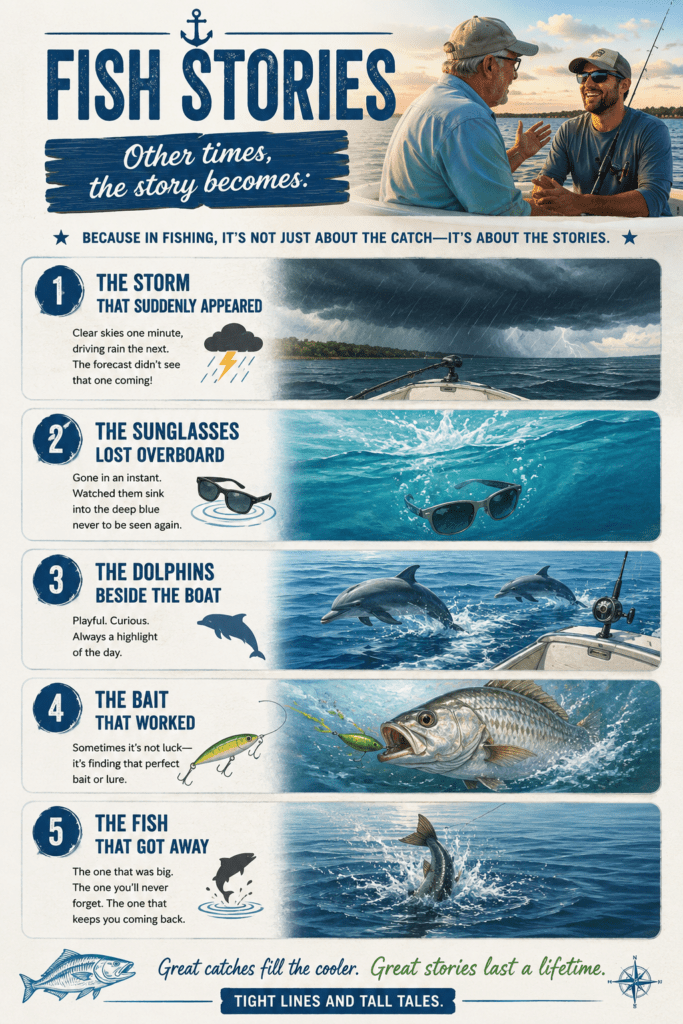
Other times the story becomes:
- the storm that suddenly appeared,
- the sunglasses lost overboard,
- the dolphins beside the boat,
- the bait that worked,
- or the fish that got away.
And somehow, with every retelling:
- the fish become larger,
- the weather becomes rougher,
- and the battle becomes more dramatic.
That storytelling tradition is part of Gulf Coast fishing culture itself.
A Coast Built Around Water
The Mississippi Gulf Coast remains one of the few places where:
- working shrimp boats,
- offshore fishing boats,
- family beach fishermen,
- charter captains,
- seafood markets,
- and marsh kayakers
all continue operating side-by-side within the same coastal culture.
This creates an environment where visitors can experience:
- commercial fishing traditions,
- modern offshore sportfishing,
- primitive marsh ecosystems,
- barrier island wilderness,
- and fresh Gulf seafood
all within a relatively small geographic area.
Why the Mississippi Gulf Coast Is Different
What makes the Mississippi Gulf Coast special is not simply the fishing itself.
It is the combination of:
- accessible water,
- rich estuaries,
- barrier islands,
- seafood traditions,
- boating culture,
- and coastal communities
that still maintain authentic ties to the Gulf.
Many places offer fishing.
Fewer places still build daily life around it.
The Mississippi Gulf Coast still does.
A Living Coastal Tradition
Fishing here is not frozen in history.
It continues evolving through:
- new technology,
- conservation efforts,
- changing regulations,
- tourism growth,
- and new generations learning the water.
Yet the core traditions remain remarkably consistent:
- boats leaving before sunrise,
- fresh shrimp at the dock,
- stories told around seafood dinners,
- and fishermen quietly protecting their favorite spots.
The Gulf Always Calls You Back
Many visitors discover something else about Gulf Coast fishing:
it has a way of pulling people back.
People often return because they miss:
- the marshes,
- the seafood,
- the sunsets,
- the barrier islands,
- the relaxed atmosphere,
- and the feeling of life centered around the water.
Some eventually move here permanently.
Others return year after year.
But very few people forget their time fishing on the Mississippi Gulf Coast.
What People Ask About Mississippi Gulf Coast Fishing
Why is fishing so popular on the Mississippi Gulf Coast?
The Coast combines productive estuaries, barrier islands, offshore waters, seafood traditions, boating culture, and year-round fishing opportunities.
Is the Mississippi Gulf Coast good for beginner fishermen?
Yes. Beaches, piers, marshes, charter boats, and public access areas make the Coast extremely beginner-friendly.
What makes Gulf Coast fishing unique?
The combination of marsh nurseries, barrier islands, offshore reefs, seafood culture, working waterfronts, and strong boating traditions creates a fishing culture unlike almost anywhere else in the United States.
Fishing is only one part of what makes the Mississippi Gulf Coast such an incredible place to visit, retire, vacation, invest, and enjoy life on the water.
At RetireCoast.com we publish detailed guides covering:
We also provide advanced calculators, planning tools, business resources, estate planning memberships, and financial education designed specifically for people building a better life along the Gulf Coast and beyond.
Whether you came here for the fishing, the seafood, the beaches, the boating, or simply the slower pace of life, the Mississippi Gulf Coast has a way of staying with people long after the trip is over.
Fishing is only one part of what makes the Mississippi Gulf Coast such an incredible place to visit, retire, vacation, invest, and enjoy life on the water.
At RetireCoast.com we publish detailed guides covering:
We also provide advanced calculators, planning tools, business resources, estate planning memberships, and financial education designed specifically for people building a better life along the Gulf Coast and beyond.
Whether you came here for the fishing, the seafood, the beaches, the boating, or simply the slower pace of life, the Mississippi Gulf Coast has a way of staying with people long after the trip is over.
Quiz
Test your knowledge of Gulf Coast fishing, boating, seafood, wildlife, and coastal culture with this fun Mississippi Gulf Coast fishing trivia challenge.
If you scored high, you may already be living the Mississippi Gulf Coast fishing lifestyle. If not, it may be time to grab a fishing shirt, load the boat, and head for the water.
Fishing Charter Operators
The Mississippi Gulf Coast offers a wide range of charter fishing services, bait shops, tackle suppliers, and boat rental businesses supporting both local fishermen and visiting anglers.
- Dominator Fishing Charters
C Pier, Biloxi Small Craft Harbor (Behind Golden Nugget Casino), Biloxi, MS 39530 - Legends of the Lower Marsh Fishing Charters
Jones Park Harbor, 2250 Jones Park Dr, Gulfport, MS 39501 - Fisher-Man Guide Service
Pass Christian Harbor (Next to Shaggy's), 120 Hiern Ave, Pass Christian, MS 39571 - Southern Comfort Fishing Charters
Pass Christian Harbor, 120 Hiern Ave, Pass Christian, MS 39571 - Shore Thing Fishing Charters
Pass Christian Harbor, 120 Hiern Ave, Pass Christian, MS 39571 - Biloxi Bluewater Charters
632 Bayview Ave, Biloxi, MS 39530 - Three Jays Charters
Point Cadet Marina, 119 Beach Blvd, Biloxi, MS 39530 - Captain Ron's Charter
Gulfport Yacht Harbor, 2250 Jones Park Dr, Gulfport, MS 39501 - Secret Coast Fishing Charters
Pass Christian Harbor, 120 Hiern Ave, Pass Christian, MS 39571 - Amberjack Sport Fishing Charters
Point Cadet Marina, 119 Beach Blvd, Biloxi, MS 39530 - Fish On Charters
Biloxi Small Craft Harbor, 693 Beach Blvd, Biloxi, MS 39530
- Biloxi Bait & Tackle
1795 Pass Rd, Biloxi, MS 39531 - Sea Level Bait & Tackle
1625 25th Ave, Gulfport, MS 39501 - Coastal Bait & Tackle
6500 Washington Ave, Ocean Springs, MS 39564 - Pass Christian Bait & Tackle
120 Hiern Ave, Pass Christian, MS 39571 - Long Beach Bait & Tackle
501 Klondyke Rd, Long Beach, MS 39560
- Gorenflo's Boat Rentals
119 Beach Blvd, Biloxi, MS 39530 - Everything Ice Boat Rentals
10398 D'Iberville Rd, D'Iberville, MS 39540 - Mississippi Boat Rentals
115 1st St, Ocean Springs, MS 39564 - Waveland Boat Rentals
611 US-90, Waveland, MS 39576
Podcast
Discover more from RetireCoast.com
Subscribe to get the latest posts sent to your email.