Last updated on May 22nd, 2026 at 03:03 pm
In 1776, a person could start a small business without filing an LLC, applying for an EIN, obtaining workers’ compensation insurance, setting up payroll tax accounts, or navigating thousands of pages of federal regulations. There were no online filing systems, no social media marketing campaigns, no SBA loans, and almost no formal liability protection for ordinary entrepreneurs.
Yet across the colonies that would soon become the United States of America, thousands of ambitious men and women still launched businesses, built workshops, printed newspapers, operated taverns, forged iron, repaired ships, manufactured tools, and traded goods in an economy that was rapidly changing during the American Revolution.
What might have happened if printers, merchants, blacksmiths, builders, and small business owners in 1776 had access to simple digital business tools? While colonial entrepreneurs relied on handwritten ledgers, apprenticeships, and years of experience to manage their businesses, modern technology can now simplify calculations, production planning, bookkeeping, pricing, and decision making in ways the Founding Fathers could never have imagined.
Throughout this article, you will find several interactive tools inspired by the business challenges of colonial America. These educational calculators explore how early entrepreneurs may have estimated production, supplies, labor, and revenue during the American Revolution. At the end of this article, you will also find a link to the RetireCoast Calculators Hub, where you can explore our collection of historical and modern lifestyle calculators.
For readers who want deeper modern business planning tools, the RetireCoast Business Builder Membership includes practical guides, calculators, compliance systems, and decision-making resources designed to help today’s small business owners build stronger and more organized enterprises.
According to the Library of Congress and the National Park Service, most colonial businesses operated through informal partnerships, apprenticeships, family ownership, and personal reputation rather than modern corporate structures.
The legal and economic systems familiar to modern small business owners simply did not yet exist. Entrepreneurs in 1776 often relied on handwritten agreements, merchant credit, local trade relationships, and word-of-mouth marketing to survive.
- The Business World of 1776: How Small Businesses Operated in Colonial America
- The Entrepreneurs Who Helped Build America’s Economy in 1776
- Video Presentation: Starting a Business in 1776
- No LLCs, No Limited Liability, and Very Little Protection for Business Owners
- Financing a Business in 1776: Entrepreneurship Before Modern Banking
- Marketing and Advertising in 1776: Building a Business Without the Internet
- Visibility mattered.
- Apprenticeships and Skilled Trades: How Entrepreneurs Learned Business in 1776
- Practical business knowledge.
- Turning knowledge into profitable operations.
- Taxes, Regulations, and Corporate Charters in 1776
- What Modern Entrepreneurs Can Learn From Starting a Business in 1776
- Starting a Business in 1776 vs Today: Which Was Easier?
- Could Someone Really Build Wealth Starting a Business in 1776?
- Could Entrepreneurs Become Extremely Wealthy in 1776?
- Acquiring strategic assets early can create enormous long-term economic power.
- Women, Family Businesses, and Hidden Entrepreneurship in 1776
- The Legacy of Entrepreneurship From 1776 to Today
- Could the Founding Fathers Have Succeeded as Entrepreneurs Today?
- The First True Startups in American History?
- Scalable technology.
- What Types of Businesses Failed Most Often in 1776?
- How the American Revolution Created New Business Opportunities
- What 1776 Can Still Teach Entrepreneurs Today
- From Colonial Forge to Digital Startup: The Entrepreneurial Spirit Endures
- REFERENCES
- QUIZ
- PODCAST
But while starting a business in colonial America may sound simpler on the surface, the reality was far more dangerous and uncertain. Business owners faced risks modern entrepreneurs rarely consider today, including fire, disease, piracy, crop failures, unreliable transportation, currency instability, and the possibility that imported supplies might never arrive.
There was little separation between personal and business finances, meaning a failed enterprise could financially destroy an entire family.
Some of the most fascinating entrepreneurs of the Revolutionary era were not politicians or military leaders, but printers, craftsmen, merchants, builders, and early manufacturers attempting to scale their operations long before the Industrial Revolution fully reached America.
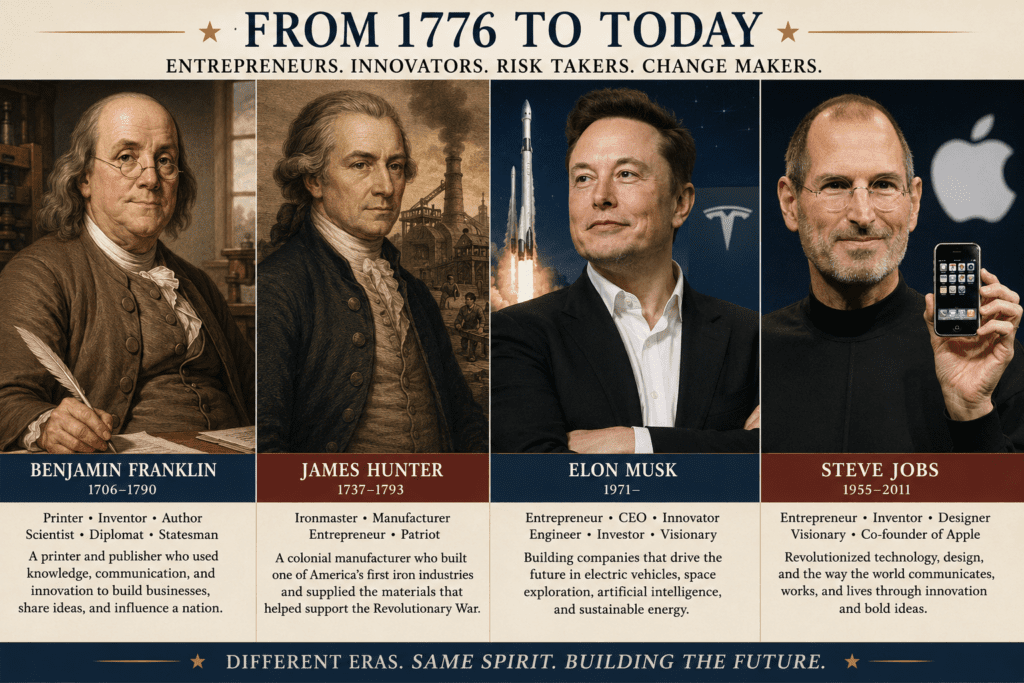
Men like Benjamin Franklin built printing businesses that shaped public opinion throughout the colonies, while industrial pioneers such as James Hunter attempted to create large-scale manufacturing operations capable of producing iron goods, tools, and weapons for the growing American economy.
This article explores what it was actually like starting a business in 1776 compared to today. Along the way, we will examine the entrepreneurs, manufacturers, printers, merchants, and skilled craftsmen who helped build the economic foundation of the new nation during the founding of America.
We will compare how businesses were financed, marketed, staffed, regulated, and protected in the late 18th century versus the modern world of LLCs, digital marketing, insurance policies, labor regulations, and corporate charters.
For readers interested in the military equipment and manufacturing capabilities of the Revolutionary era, our detailed article on the weapons used during the American Revolution provides additional historical background on the tools, firearms, and industrial production systems that supported America’s independence.
While the term small business owner did not exist in 1776, many of the 56 men who signed the Declaration of Independence operated businesses, managed agricultural enterprises, owned printing operations, or participated in commercial trade throughout colonial America. According to research from the National Archives and the Library of Congress, the signers often held multiple occupations simultaneously, blending law, politics, commerce, agriculture, and manufacturing in ways that would still feel familiar to modern entrepreneurs.
If business ownership is defined narrowly to include merchants and printers only, approximately 20% to 23% of the signers operated commercial enterprises. However, when plantation owners and large-scale farmers are included — many of whom managed extensive agricultural operations employing large workforces and complex supply chains — the percentage rises significantly.
| Primary Occupation | Estimated Number | Approximate Percentage |
|---|---|---|
| Lawyers & Jurists | 23–24 | 41%–43% |
| Merchants | 11–12 | 20%–21% |
| Plantation Owners & Farmers | 9–12 | 16%–21% |
| Printers, Physicians, Ministers & Others | Approximately 10 | 18% |
Figures such as Thomas Jefferson, George Washington, and Benjamin Franklin were not only political leaders but also operators of complex economic enterprises involving publishing, agriculture, land management, manufacturing, trade, and international commerce. In many ways, the founding of America itself involved men who understood entrepreneurship, risk, financing, supply chains, and long-term strategic planning.
The overlap between the Declaration of Independence, colonial commerce, and small businesses is one reason entrepreneurship played such an important role in the American economy from the very beginning of the United States of America.
The close relationship between entrepreneurship and public leadership did not end with the American Revolution. Just as merchants, printers, plantation operators, and lawyers played major roles during the founding of America, modern elected officials across the United States still include a significant number of business owners and executives.
According to occupational studies of state legislatures and Congress, business owners and executives remain one of the most heavily represented professional groups in government today. Research compiled by organizations such as the National Conference of State Legislatures shows that business-oriented professionals continue to play a major role in shaping public policy and the American economy.
| Government Level | Estimated Percentage with Business Backgrounds |
|---|---|
| State Legislatures | Approximately 37% |
| U.S. Congress | Approximately 22%–25% |
While the structure of the American economy has changed dramatically since 1776, the connection between entrepreneurship, commerce, and political leadership remains remarkably consistent. Many of the same traits valued during the Revolutionary era — financial independence, professional networks, leadership experience, and business knowledge — still provide advantages to individuals seeking public office today.
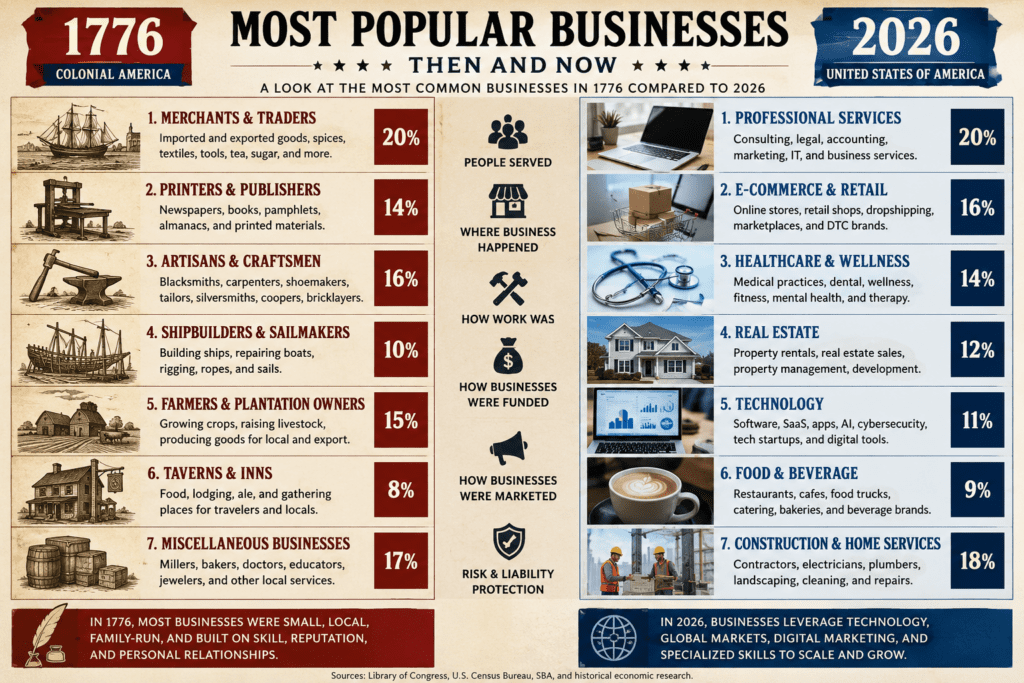
The Business World of 1776: How Small Businesses Operated in Colonial America
By the time the Declaration of Independence was signed in 1776, the colonies already supported a surprisingly active and diverse American economy. Although the United States of America did not yet formally exist as an independent nation, colonial America contained thousands of small businesses operating in towns, ports, farms, workshops, and trading centers from New Hampshire to Georgia.
Unlike today’s highly regulated environment, most colonial businesses operated with very few formal requirements. There were no LLC filings, federal business licenses, payroll tax systems, OSHA inspections, or corporate compliance departments. Instead, business owners in 1776 relied heavily on personal reputation, trade relationships, apprenticeships, and local trust to build successful enterprises.
According to research from the Colonial Williamsburg Foundation and the Museum of the American Revolution, the majority of small businesses in colonial America were family-operated and often passed down through generations.
Sons frequently apprenticed under fathers or local craftsmen, learning trades such as printing, blacksmithing, carpentry, tailoring, shipbuilding, silversmithing, and merchant trade long before they operated independent businesses of their own.
In many ways, entrepreneurship in 1776 looked far more local than modern business operations. A merchant in New York City might sell imported textiles, tea, tools, paper, or iron goods directly from a storefront near the harbor.
A printer in Philadelphia could operate as a publisher, newspaper owner, political commentator, and advertiser simultaneously. Builders and craftsmen often worked directly from their homes or workshops, using apprentices and family labor instead of large payroll systems.

Transportation and communication limitations also shaped the business environment. Without railroads, telephones, or the internet, even relatively short-distance commerce moved slowly. Goods traveled primarily by horse, wagon, riverboat, or sailing ship.
A delayed shipment from Rhode Island or New Jersey could disrupt a merchant’s inventory for months. Weather, piracy, damaged roads, and war frequently interrupted trade throughout the American Revolution.
Because modern banking systems barely existed, colonial entrepreneurs depended heavily on merchant credit, personal loans, land ownership, and partnerships. According to the Federal Reserve History project, colonial currency systems were fragmented and often unstable, forcing many business owners to conduct transactions through barter, foreign coins, handwritten credit arrangements, or commodity exchanges.
Despite these limitations, many of the Founding Fathers themselves were deeply involved in business activities. Benjamin Franklin built a highly successful printing operation and publishing network. Thomas Jefferson managed extensive agricultural operations at Monticello, while George Washington oversaw farming, land development, and commercial enterprises connected to Mount Vernon.
The line between politics, commerce, agriculture, and entrepreneurship was often blurred during the founding of America.
One major difference between starting a business in 1776 and today involved corporate charters. Modern entrepreneurs can create LLCs or corporations online within hours, but corporate charters in colonial America were rare and often controlled by colonial governments or the Continental Congress. According to the Yale Avalon Project, most ordinary business owners operated as sole proprietors or informal partnerships because limited liability protections were largely unavailable to the average citizen.
At the same time, colonial entrepreneurs faced risks that modern small businesses rarely encounter today. Fire could destroy an entire workshop in a single night. Imported materials might never arrive.
Disease outbreaks could shut down commerce for weeks or months. Insurance markets were limited, transportation systems were unreliable, and political instability during the American Revolution created enormous uncertainty for merchants, printers, manufacturers, and builders alike.
Yet despite these obstacles, colonial America produced an extraordinary generation of entrepreneurs whose businesses helped shape the early American economy. Some operated small local shops, while others attempted ambitious manufacturing operations that resembled early factories decades before the Industrial Revolution transformed the United States.
One of the biggest differences between starting a business in 1776 and today involved access to knowledge and training. In colonial America, most young people did not simply decide to launch a business on their own. Instead, they typically entered long apprenticeships under experienced craftsmen, printers, blacksmiths, merchants, carpenters, silversmiths, or shipbuilders.
According to the Colonial Williamsburg Foundation, apprentices often worked for many years earning little compensation while learning a trade. In exchange, they received housing, food, training, discipline, and access to valuable business knowledge that might eventually allow them to become independent tradesmen or small business owners themselves.
For many colonial entrepreneurs, the path to business ownership was slow and uncertain. A young apprentice might spend years sweeping floors, preparing materials, repairing tools, assisting customers, and learning bookkeeping before ever operating an independent shop. Even after completing an apprenticeship, access to tools, inventory, workspace, and financing remained major obstacles.
Today, the journey into entrepreneurship can move much faster. Modern business owners have access to online education, internships, community colleges, mentorship programs, SBA resources, business memberships, financing options, digital marketing platforms, and software tools that dramatically shorten the learning curve. A person can now learn bookkeeping, business formation, pricing strategies, website development, and marketing from home in ways that would have been unimaginable during the founding of America.
While modern entrepreneurs still benefit from experience and mentorship, the democratization of knowledge has fundamentally changed small business ownership in the United States of America. Information that once required years of apprenticeship and personal connections can now be accessed almost instantly by determined entrepreneurs willing to learn.
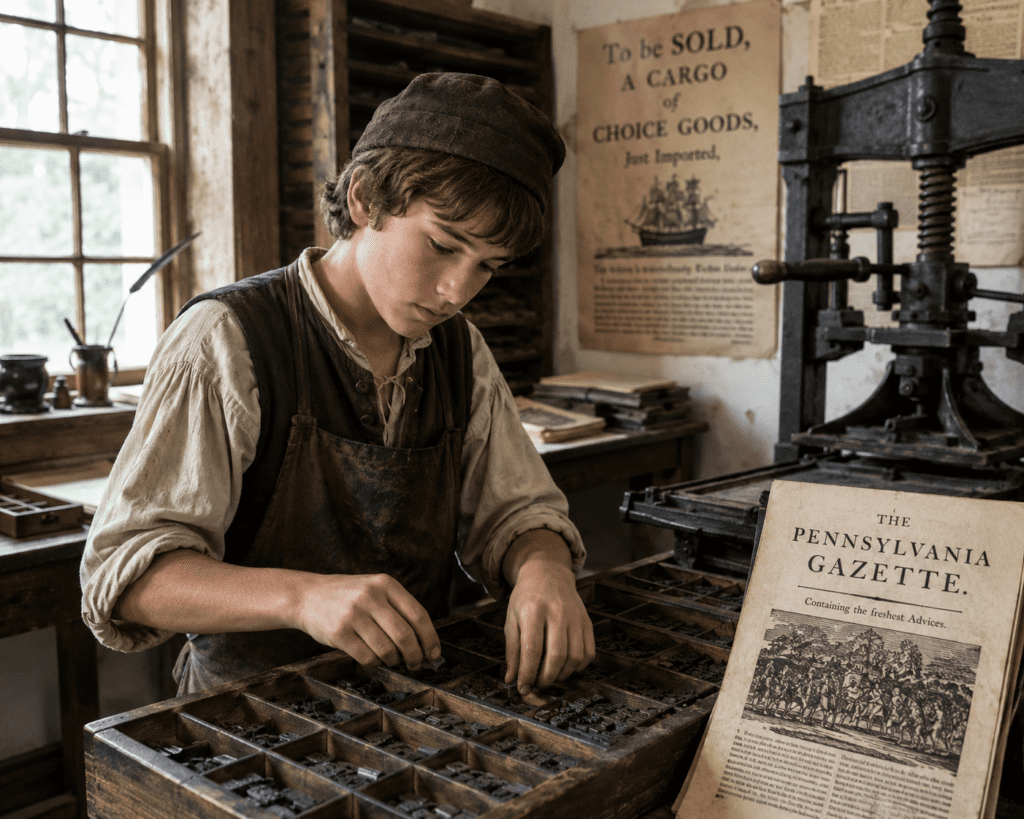
Colonial printers were among the most influential small business owners in 1776. Printers produced newspapers, pamphlets, political essays, merchant advertisements, public notices, and broadsides that helped spread information throughout the colonies. Figures such as Benjamin Franklin operated successful print businesses long before the United States of America formally existed.
Unlike modern business owners, colonial printers often learned their trade through long apprenticeships and years of low-paid labor before opening independent print shops. Paper shortages, imported supplies, damaged printing presses, and transportation delays created constant challenges for small businesses during the American Revolution.
Today, entrepreneurs have access to modern financing, digital marketing, online education, business memberships, and software tools that dramatically shorten the learning curve for starting and managing a successful business.
The Entrepreneurs Who Helped Build America’s Economy in 1776
When people think about the American Revolution, they often picture soldiers, battlefields, and the signing of the Declaration of Independence. Far less attention is given to the small businesses, workshops, merchants, printers, and manufacturers that helped support the growing American economy during the founding of America.
Yet without these entrepreneurs, many of the colonies would have struggled to function economically, politically, and logistically during the Revolutionary era.
In 1776, most small businesses in colonial America operated on a highly local level. A blacksmith might serve a single town. A printer could distribute newspapers to surrounding communities. Merchants relied on ships arriving from New York City, Rhode Island, or overseas trading routes to keep inventory on their shelves.
Unlike modern national corporations, colonial entrepreneurs often depended entirely on personal reputation and local relationships to survive.
Still, some business owners attempted something far more ambitious: scaling production beyond the traditional apprentice-and-workshop system that dominated the 18th century.
One of the most fascinating examples was James Hunter, owner of the Rappahannock Forge in Virginia. According to historical records preserved through the National Park Service and various Revolutionary War archives, Hunter expanded his iron works into one of the largest manufacturing operations in colonial America.
His business produced iron goods, camp kettles, tools, swords, pistols, and muskets at a scale rarely seen in the colonies before the Industrial Revolution.
At its peak, Hunter’s operation employed hundreds of workers and functioned more like an early factory than a traditional colonial workshop. In many ways, his enterprise resembled a modern manufacturing startup attempting to scale production under extremely difficult conditions. Material shortages, transportation delays, labor challenges, financing issues, and political instability constantly threatened the operation.
Yet these problems would sound familiar to many modern entrepreneurs.
Today’s small business owners still struggle with:
- supply chain disruptions,
- rising material costs,
- workforce shortages,
- financing challenges,
- inflation,
- and changing government policies.
The difference is that colonial entrepreneurs faced these problems without modern banking systems, digital communication, advanced transportation networks, or liability protections such as LLCs and corporations.
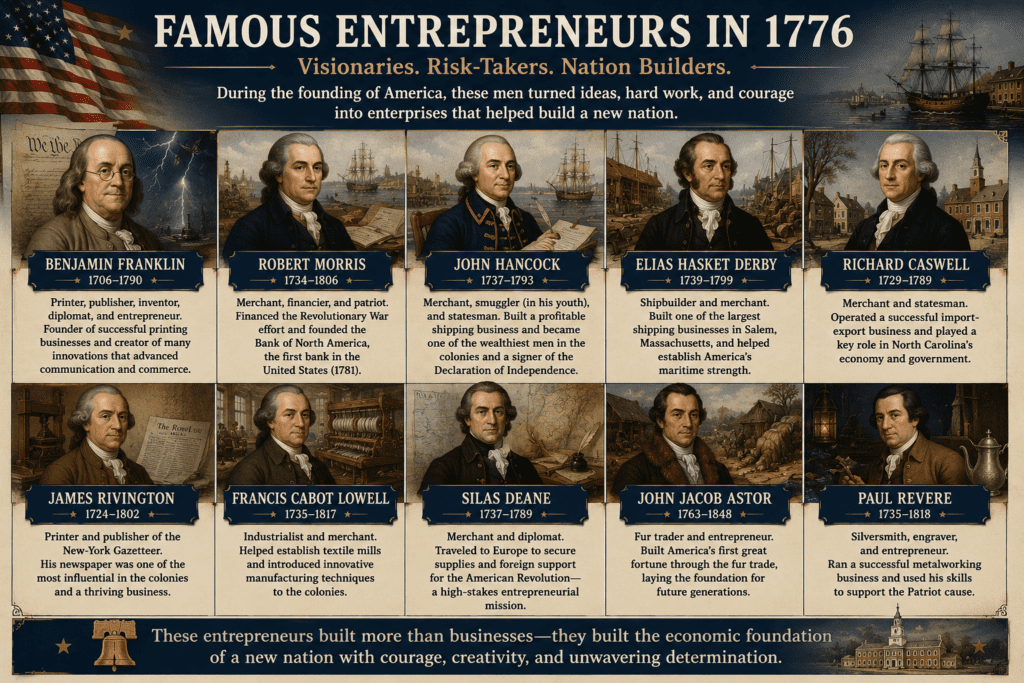
Another important entrepreneurial figure of the era was Benjamin Franklin. While Franklin is often remembered as one of the Founding Fathers and a diplomat involved in the Continental Congress, he was also one of the most successful business owners in colonial America. His printing business expanded far beyond a simple local newspaper.
Franklin operated printing presses, published newspapers, sold books, distributed advertisements, and built one of the earliest franchising-style print networks in the colonies.
Printers in 1776 served as media companies, advertisers, publishers, and communication hubs all at once. In an era before radio, television, or the internet, printers shaped public opinion and connected communities across the American economy. Political notices, merchant advertisements, shipping schedules, public announcements, and debates about America’s independence all passed through colonial print shops.
These businesses also required substantial skill and training. Most printers learned through long apprenticeships that could last years before they were capable of operating independent businesses. Equipment was expensive, paper was often imported, and damaged presses could financially cripple a small business owner.
Video Presentation: Starting a Business in 1776
Meanwhile, merchants throughout New Jersey, New Hampshire, Pennsylvania, and New York City managed increasingly complex trade operations during the American Revolution. Imported goods arriving by ship supplied many colonial businesses with paper, iron, textiles, tools, tea, and manufactured products. Delayed shipments or naval disruptions could devastate local commerce.
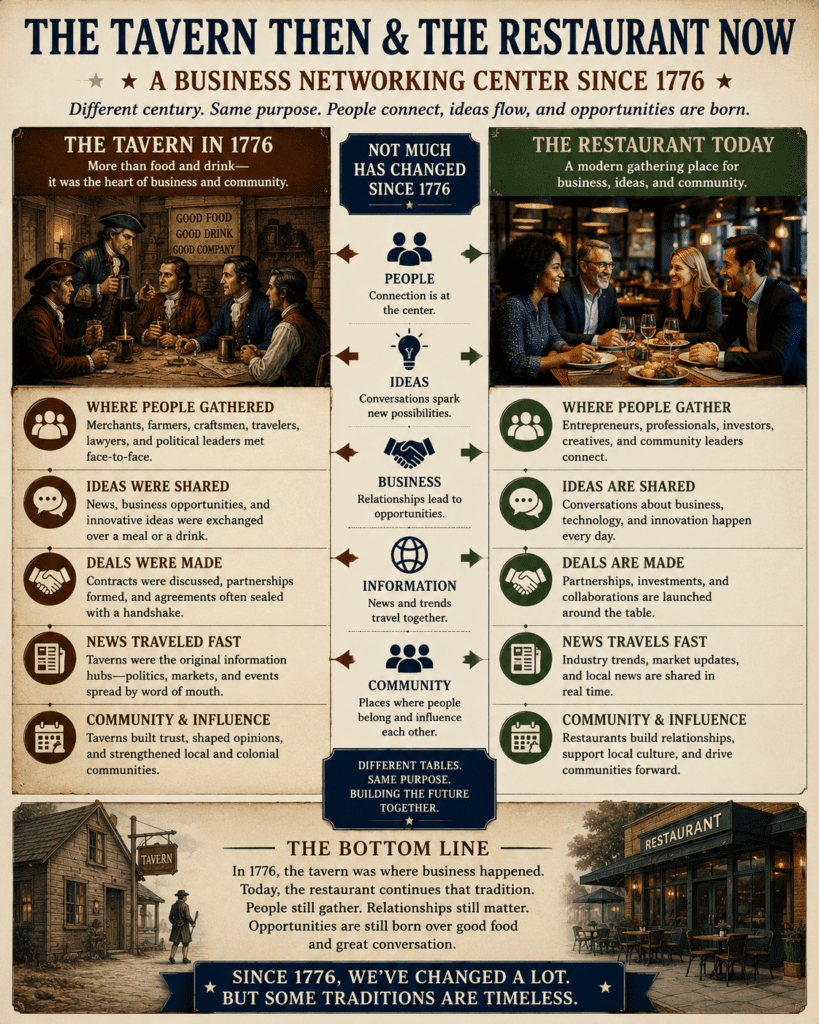
Even tavern owners played a surprisingly important role in the colonial business world. Taverns were not simply places to eat or drink. They often served as meeting halls, lodging houses, post offices, recruiting stations, and business networking centers.
Many colonial entrepreneurs used taverns to exchange information, negotiate contracts, advertise services, and discuss political developments affecting the American economy.
Unlike today, however, almost all of these businesses operated without formal corporate charters or legal liability protection. A failed business in 1776 could financially destroy an owner and his family because personal and business assets were rarely separated.
Modern entrepreneurs can create LLCs, obtain insurance, use digital accounting systems, and access financing programs in ways that would have been unimaginable during the founding of the United States of America.
Despite these limitations, colonial entrepreneurs built businesses that helped support trade, manufacturing, communication, and economic growth during one of the most uncertain periods in American history. Their businesses were often small by modern standards, but collectively they formed part of the economic foundation of the young nation.
One of the best ways to understand entrepreneurship during the American Revolution is to examine the chain of business transactions required to operate a manufacturing enterprise such as James Hunter’s Rappahannock Forge in Virginia. Unlike modern factories with banks, automated systems, supply-chain software, and instant communication, colonial manufacturers operated through a complex web of personal relationships, credit arrangements, labor management, transportation systems, and constant financial risk.
- Family money
- Merchant credit
- Local investors
- Partnerships
- Informal loans
- Iron ore and finished iron
- Coal or charcoal
- Wood and leather
- Tools and supplies
- Gunpowder components
- Wagons and horses
- River transport
- Ships and docks
- Drivers and laborers
- Dangerous colonial roads
- Blacksmiths
- Apprentices
- Carpenters
- Gunsmiths
- Furnace operators
- Forging metal parts
- Creating barrels and locks
- Carving wooden stocks
- Assembly and testing
- Hand craftsmanship
No LLCs, No Limited Liability, and Very Little Protection for Business Owners
One of the biggest differences between starting a business in 1776 and launching a small business today involved personal financial risk. Modern entrepreneurs in the United States of America can choose from LLCs, corporations, partnerships, insurance policies, trusts, and numerous legal structures designed to separate business liabilities from personal assets.
In colonial America, those protections were extremely limited or entirely unavailable for most ordinary business owners.
During the American Revolution, the overwhelming majority of colonial entrepreneurs operated as sole proprietors or informal partnerships. According to historical material preserved through the Library of Congress and the Yale Avalon Project, formal corporate charters were relatively rare in 1776 and usually reserved for institutions considered important to the public interest, such as banks, universities, infrastructure projects, or large trading enterprises.
For the average printer, merchant, blacksmith, tavern owner, builder, or craftsman, there was little separation between personal wealth and business operations. A failed shipment, destroyed workshop, unpaid debt, or lawsuit could place an entrepreneur’s home, land, tools, livestock, inventory, and personal property at risk.
This reality created enormous pressure on small businesses throughout colonial America.
Imagine operating a print shop like Benjamin Franklin without business interruption insurance, commercial liability coverage, modern accounting software, or a legal entity separating your family assets from your business debts. If imported paper failed to arrive, customers refused payment, or a fire damaged expensive equipment, the financial consequences could be devastating.
The same risks affected manufacturers such as James Hunter. Hunter’s Iron Works required workers, imported materials, transportation systems, furnaces, tools, contracts, and continuous production. A major accident, political disruption, military raid, or supply shortage could threaten the survival of the entire operation. Because limited liability structures were largely unavailable, the risks were deeply personal.
This is one reason reputation mattered so heavily in the American economy of 1776.
Colonial entrepreneurs depended on:
- personal trust,
- family relationships,
- merchant credit,
- local reputation,
- and community standing.
A damaged reputation could ruin a business owner financially long before modern credit scores or digital reviews existed.
In many towns throughout New Hampshire, Rhode Island, New Jersey, and other colonies, business owners often knew their customers personally. Commerce operated on relationships built over years rather than automated banking systems or anonymous online transactions. Handwritten ledgers, verbal agreements, and local references carried enormous importance in the colonial business world.
Today, entrepreneurs still face significant risks, but the legal environment is dramatically different. Modern small business owners can:
- form LLCs online,
- purchase liability insurance,
- separate personal and business finances,
- use contracts reviewed by attorneys,
- create operating agreements,
- and access compliance guidance unimaginable during the founding of America.
The rise of modern legal protections has fundamentally changed entrepreneurship in the United States of America. A person can now launch an online business, operate from home, protect personal assets through legal structures, and access financing or educational resources with far fewer barriers than existed during the American Revolution.
Ironically, however, modern entrepreneurs also face far more regulation and legal complexity than colonial business owners ever encountered. While the printer or merchant of 1776 had little liability protection, they also operated in a world with far fewer licensing requirements, payroll regulations, employment laws, zoning restrictions, and tax compliance systems.
This tradeoff between freedom and protection forms one of the most fascinating comparisons between starting a business in 1776 and operating a small business today.
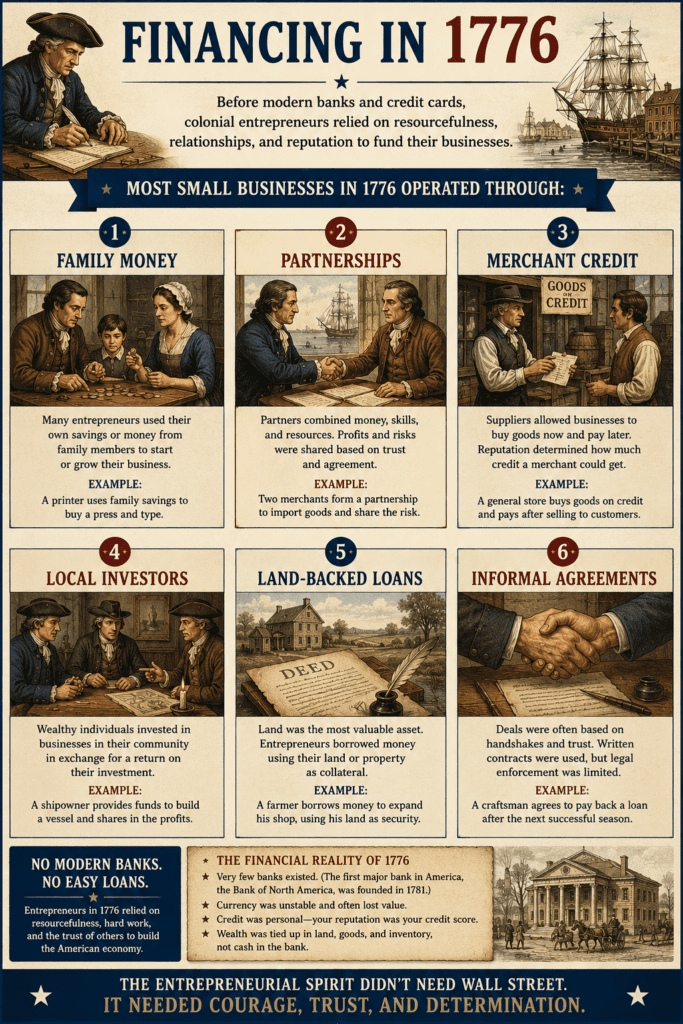
Financing a Business in 1776: Entrepreneurship Before Modern Banking
Modern entrepreneurs have access to business credit cards, SBA loans, online banking, venture capital, crowdfunding platforms, equipment financing, and digital payment systems. A person starting a small business today can apply for funding online in minutes and potentially receive capital within days. In 1776, the process of financing a business looked dramatically different.
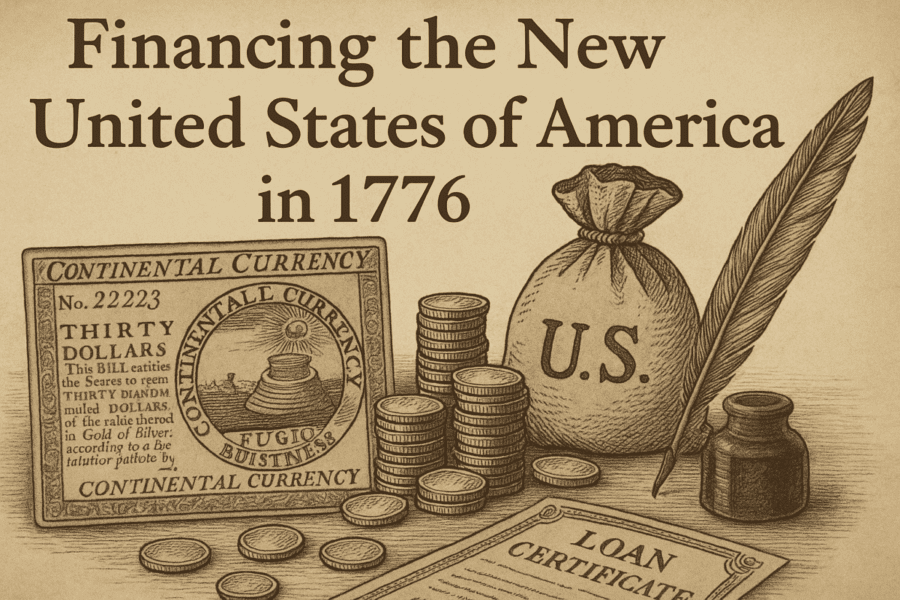
During the American Revolution, modern banking systems barely existed in colonial America. According to historical information preserved through the Federal Reserve History project and the Library of Congress, most small businesses relied on personal wealth, merchant credit, partnerships, family connections, or land ownership to fund operations.
For many colonial entrepreneurs, access to credit depended almost entirely on reputation.
A merchant in New York City or Philadelphia might receive imported goods from overseas suppliers on credit with the expectation that payment would arrive months later, after inventory was sold. A printer purchasing paper, ink, and equipment often relied on trust-based relationships with suppliers rather than formal financing agreements.
Builders and craftsmen frequently depended on deposits, installment payments, or handshake agreements to purchase materials and hire labor.
This system worked reasonably well during stable economic periods, but the American Revolution created enormous financial uncertainty throughout the colonies.
Currency shortages became a constant problem. The colonies used a confusing mixture of:
- British pounds,
- Spanish silver coins,
- colonial paper currency,
- barter arrangements,
- and handwritten credit agreements.
Inflation and unstable paper money complicated business operations even further. The Continental Congress issued paper currency to help finance the Revolutionary War effort, but widespread depreciation eventually reduced confidence in much of the circulating money supply. For small businesses, this created serious challenges involving pricing, payroll, inventory purchases, and debt collection.
Colonial merchants also faced transportation and trade risks that modern business owners rarely encounter today. A delayed ship, storm damage, piracy, military blockade, or damaged cargo could financially devastate an entrepreneur. Imported goods from Europe often required months to arrive, meaning merchants had to predict customer demand far in advance without modern supply chain data or digital inventory systems.
Entrepreneurs such as James Hunter faced even greater financing pressures because manufacturing operations required expensive infrastructure. Furnaces, iron works, tools, labor, transportation systems, and raw materials demanded significant capital investment long before products could be sold. Hunter’s iron works resembled an early industrial startup operating in an economy with very limited access to modern financing.
At the same time, many colonial entrepreneurs diversified their income streams to reduce risk.
A printer such as Benjamin Franklin did not rely solely on newspaper subscriptions. Printers often earned money from:
- advertisements,
- pamphlets,
- book sales,
- government printing contracts,
- merchant notices,
- and public announcements.
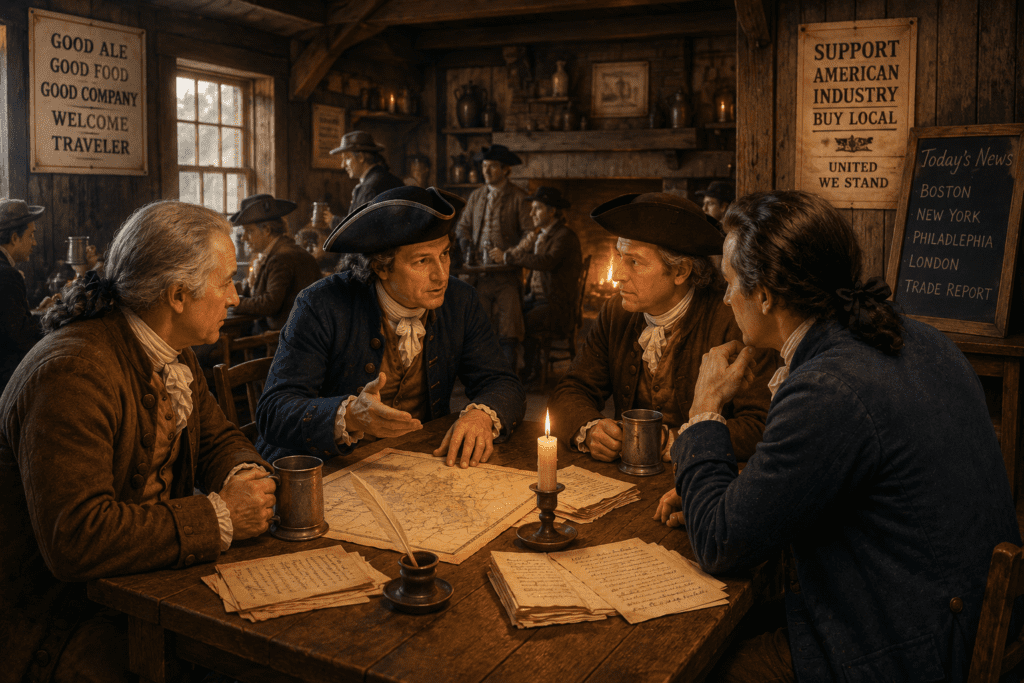
Likewise, tavern owners frequently combined:
- lodging,
- food service,
- alcohol sales,
- meeting space,
- postal services,
- and business networking.
This diversification strategy remains remarkably common among modern small business owners today.
One major advantage modern entrepreneurs possess is access to knowledge and financial transparency. A business owner today can:
- Compare loan terms online,
- track expenses digitally,
- review financial projections,
- access accounting software,
- monitor cash flow in real time,
- and seek guidance from business memberships, consultants, or educational resources.
Colonial entrepreneurs rarely had these advantages. Financial planning often depended on experience, handwritten ledgers, local advice, and years of apprenticeship training.
Yet despite these limitations, the small businesses of colonial America helped lay the foundation for the future American economy. Merchants, printers, builders, manufacturers, and craftsmen operated in an environment filled with uncertainty, but their willingness to take risks helped support commerce and economic growth during the founding of the United States of America.
Marketing and Advertising in 1776: Building a Business Without the Internet
Modern entrepreneurs can launch websites, create social media campaigns, purchase digital advertisements, send email newsletters, and reach customers across the world within hours. In 1776, marketing a small business was far slower, far more local, and heavily dependent on personal relationships and printed communication.
Yet colonial entrepreneurs still understood something modern business owners continue to recognize today:
Visibility mattered.
A merchant, printer, blacksmith, builder, tavern owner, or craftsman could not survive if potential customers did not know the business existed.
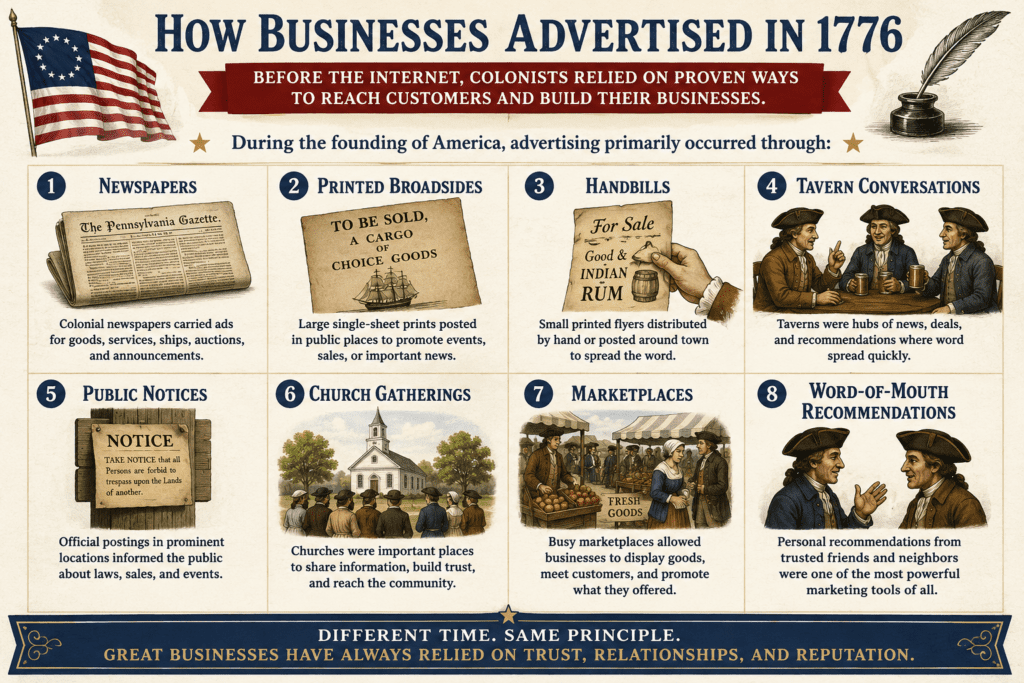
During the founding of America, advertising primarily occurred through:
- newspapers,
- printed broadsides,
- handbills,
- tavern conversations,
- public notices,
- church gatherings,
- marketplaces,
- and word-of-mouth recommendations.
According to the Library of Congress and the Colonial Williamsburg Foundation, colonial newspapers played a central role in both commerce and communication throughout the American economy. Newspapers published:
- merchant advertisements,
- shipping schedules,
- auction notices,
- runaway servant notices,
- imported goods announcements,
- legal notices,
- and political commentary related to the American Revolution.
Printers such as Benjamin Franklin understood that advertising itself was a business opportunity. Franklin’s newspapers generated income not only from subscriptions but also from commercial advertisements placed by merchants, tavern owners, craftsmen, and local businesses throughout colonial America.
In many ways, colonial printers functioned much like modern digital media companies.
A successful printer in New York City, Philadelphia, or Boston controlled:
- communication networks,
- advertising space,
- public information,
- and political messaging.
This influence became especially important during the American Revolution, when newspapers and pamphlets helped shape public opinion surrounding the Declaration of Independence, taxation, trade restrictions, and America’s independence from Britain.
One major difference between 1776 and today involved the speed of information.
Modern businesses can advertise nationally or globally within minutes using:
- websites,
- search engines,
- social media,
- video platforms,
- and digital marketing systems.
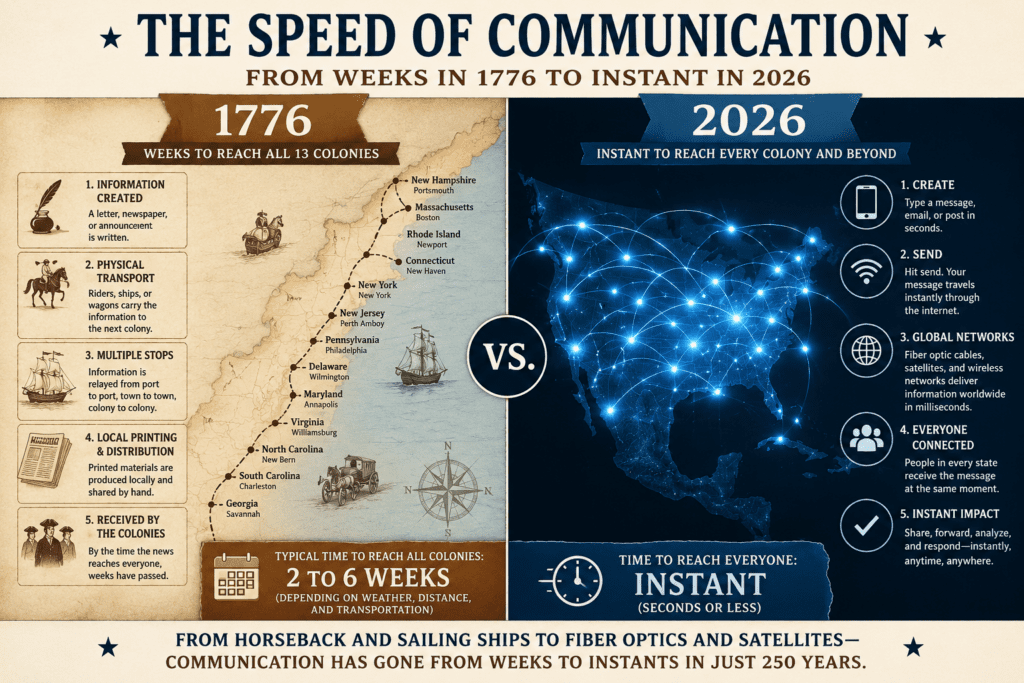
Colonial entrepreneurs operated in a far slower information environment. News traveled by horse, ship, messenger, or printed paper. A merchant advertisement placed in one colony might not reach another region for weeks.
Because advertising options were limited, reputation became one of the most valuable assets a colonial entrepreneur could possess.
A respected blacksmith, printer, merchant, or builder often gained customers through:
- repeat business,
- community recommendations,
- church relationships,
- family networks,
- and long-term trust.
Negative public opinion could severely damage a business long before online reviews existed. In smaller communities throughout Rhode Island, New Hampshire, New Jersey, and other colonies, word spread quickly about dishonest merchants, poor workmanship, or unpaid debts.
Physical location also mattered enormously.
Many successful small businesses operated near:
- ports,
- taverns,
- marketplaces,
- churches,
- courthouses,
- and busy travel routes.
Taverns in particular served as important business networking centers during the founding of America. Business owners exchanged news, negotiated deals, discussed shipping arrivals, and shared political developments affecting the American economy. Some taverns effectively operated as informal commercial hubs where entrepreneurs gathered to exchange information and build relationships.
Visual branding existed as well, although it looked very different from modern corporate logos.
Because many colonists could not read fluently, businesses often relied on:
- painted signs,
- symbols,
- wood carvings,
- and recognizable imagery.
A tavern might display a painted horse, crown, or anchor outside the building rather than relying solely on written advertising. Printers and merchants frequently used decorative typography, illustrated borders, and recognizable symbols to attract attention to advertisements and notices.
Today’s entrepreneurs possess marketing tools that colonial business owners could never have imagined:
- SEO,
- digital analytics,
- targeted advertising,
- online reviews,
- e-commerce,
- podcasts,
- and social media platforms.
But despite all these technological changes, one important principle remains remarkably similar between 1776 and 2026:
Successful businesses still depend heavily on trust, reputation, visibility, and the ability to communicate value to customers.
Apprenticeships and Skilled Trades: How Entrepreneurs Learned Business in 1776
One of the most important differences between starting a business in 1776 and becoming an entrepreneur today involved education and training. In colonial America, there were no online business courses, YouTube tutorials, digital marketing certifications, MBA programs, or modern mentorship platforms.
Instead, most small business owners learned through apprenticeships, long-term practical experience, and years of direct labor under established craftsmen.
During the American Revolution, apprenticeships formed the backbone of workforce development throughout the American economy. Young men entering trades such as printing, blacksmithing, shipbuilding, carpentry, tailoring, silversmithing, and merchant operations often committed years of their lives to learning a profession before they could operate independent small businesses of their own.
According to the Colonial Williamsburg Foundation and the Library of Congress, apprentices in colonial America frequently worked for very low wages while receiving housing, food, instruction, and hands-on training from master craftsmen. The apprenticeship system allowed experienced business owners to pass knowledge, techniques, customer relationships, and trade secrets directly to the next generation of entrepreneurs.
This system shaped nearly every aspect of starting a business in 1776.
A colonial printer, for example, did not simply purchase a press and begin publishing newspapers. Future printers often spent years:
- setting type,
- mixing ink,
- repairing presses,
- carrying paper,
- organizing advertisements,
- and learning bookkeeping procedures
before operating independent print shops.
The same pattern existed throughout colonial America.
Blacksmiths learned how to shape iron, repair tools, and manage forge operations. Builders and carpenters learned construction techniques through direct experience rather than classroom instruction. Merchants studied inventory management, shipping schedules, pricing, and customer negotiations by working inside existing businesses long before opening stores of their own.
Entrepreneurs such as Benjamin Franklin famously entered trades through apprenticeship systems. Franklin began working in his brother’s print shop as a teenager, where he learned the practical skills that eventually helped him build one of the most successful printing businesses in colonial America.
The apprenticeship process could be slow and difficult, but it provided something extremely valuable:
Practical business knowledge.
Many colonial entrepreneurs gained deep operational experience before ever risking their own capital. By the time they launched independent small businesses, they often understood:
- customer service,
- pricing,
- production,
- labor management,
- purchasing,
- bookkeeping,
- and marketing.
Modern entrepreneurs frequently attempt to learn these same skills after launching businesses.
Today, however, the path to entrepreneurship has changed dramatically.
A person interested in starting a business today can access:
- online courses,
- free educational content,
- accounting software,
- financing platforms,
- digital marketing tools,
- business memberships,
- and mentorship communities
from almost anywhere in the United States of America.
This democratization of knowledge has shortened the path to entrepreneurship in ways colonial Americans could never have imagined during the founding of America.
At the same time, many modern business owners still struggle with the same core challenge faced by entrepreneurs in 1776:
Turning knowledge into profitable operations.
Technology may have changed, but successful businesses still depend heavily on:
- discipline,
- practical skills,
- customer trust,
- reputation,
- and consistent execution.
In some ways, the apprenticeship system of colonial America forced entrepreneurs to develop patience and operational experience before assuming the risks of business ownership. Modern entrepreneurs can often move much faster, but they also face far more competition, distractions, regulations, and rapidly changing technologies than existed during the American Revolution.
This contrast between slow apprenticeship-based learning and modern instant-access education remains one of the most fascinating comparisons between starting a business in 1776 and operating a small business today.
Taxes, Regulations, and Corporate Charters in 1776
One of the most common assumptions about starting a business in 1776 is that colonial entrepreneurs operated in a completely unregulated environment. Compared to the modern American economy, business regulations during the founding of America were certainly far simpler.
However, small businesses in colonial America still dealt with taxes, trade restrictions, licensing systems, and government oversight that affected commerce throughout the colonies during the American Revolution.
The difference was not the complete absence of regulation — it was the scale and complexity of regulation compared to modern entrepreneurship in the United States of America.
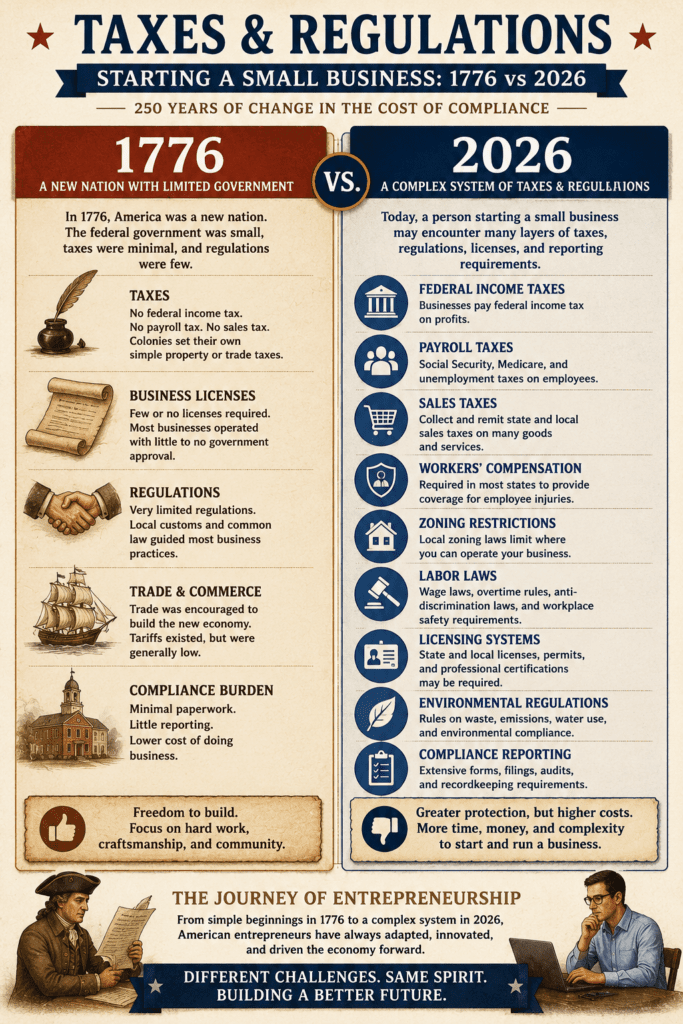
Today, a person starting a small business may encounter:
- federal income taxes,
- payroll taxes,
- sales taxes,
- workers’ compensation requirements,
- zoning restrictions,
- labor laws,
- licensing systems,
- environmental regulations,
- and extensive compliance reporting.
Colonial entrepreneurs in 1776 generally operated under far fewer layers of government administration. There was no IRS, OSHA, SEC, or modern federal labor system. Most business regulation occurred at the colonial or local level and focused heavily on trade, imports, shipping, taverns, public marketplaces, and merchant activity.
At the same time, taxes and economic controls played a major role in shaping the political tensions that eventually contributed to the Declaration of Independence and America’s independence from Britain.
According to the National Archives and the Library of Congress, British taxation policies such as the Stamp Act, Sugar Act, and Townshend Acts directly affected the American economy by increasing costs on:
- paper,
- printed materials,
- imported goods,
- shipping,
- legal documents,
- and commercial trade.
These taxes hit small businesses particularly hard because merchants, printers, importers, and craftsmen often operated on narrow profit margins. Printers such as Benjamin Franklin openly discussed these economic pressures in colonial newspapers and pamphlets, helping spread resistance throughout colonial America.
For many entrepreneurs during the founding of America, the issue was not simply taxation itself, but taxation imposed without direct colonial representation in Parliament. Economic frustration became deeply connected to the broader political movement surrounding the Continental Congress, the Declaration of Independence, and the future of the United States of America.
Another major difference between starting a business in 1776 and today involved corporate charters.
Modern entrepreneurs can form LLCs or corporations online within hours. During the American Revolution, however, corporate charters were rare and heavily controlled by colonial governments or legislative bodies. According to the Yale Avalon Project, corporations during the 18th century were generally viewed as special entities created for public purposes involving:
- banks,
- ports,
- infrastructure projects,
- universities,
- and major trading enterprises.
Ordinary small businesses rarely operated under formal corporate structures.
Instead, most entrepreneurs in colonial America functioned as:
- sole proprietors,
- family businesses,
- partnerships,
- or apprenticeship-based operations.
This meant that nearly all financial risk remained personal.
A merchant in New York City, a printer in Pennsylvania, or a craftsman in Rhode Island typically used personal land, tools, inventory, and family assets to support business operations. There was little legal separation between business liabilities and private property, making entrepreneurship during the American Revolution far riskier on a personal level than many modern small business owners realize today.
Licensing systems did exist in certain industries. Tavern operators often required local approval because taverns served alcohol, hosted travelers, and acted as community gathering places. Merchants involved in international trade faced customs duties, import restrictions, shipping inspections, and British trade regulations that heavily influenced the American economy before America’s independence.
Still, compared to modern entrepreneurship, the regulatory environment of 1776 remained remarkably simple.
A colonial blacksmith, printer, merchant, or builder could often begin operating a business with:
- tools,
- training,
- inventory,
- apprentices,
- and local relationships
rather than navigating the extensive permitting and compliance systems required in many industries today.
Ironically, however, modern entrepreneurs also possess protections that colonial business owners never had access to. Small business owners in the United States of America can now use:
- LLC liability protection,
- insurance policies,
- banking systems,
- accounting software,
- operating agreements,
- legal contracts,
- and educational business resources
that dramatically reduce certain operational risks.
This contrast creates one of the most fascinating comparisons between entrepreneurship in 1776 and modern business ownership:
Colonial entrepreneurs enjoyed greater economic freedom and fewer regulations, but they also faced far greater personal financial exposure and business risk than most entrepreneurs operating in the modern American economy today.
What Modern Entrepreneurs Can Learn From Starting a Business in 1776
Although the American economy has changed dramatically since the founding of America, many of the core lessons surrounding entrepreneurship remain surprisingly similar. The tools, technology, financing systems, and regulations available to modern small business owners would have seemed unimaginable during the American Revolution, yet the people who succeeded in starting a business in 1776 often relied on principles that still matter today.
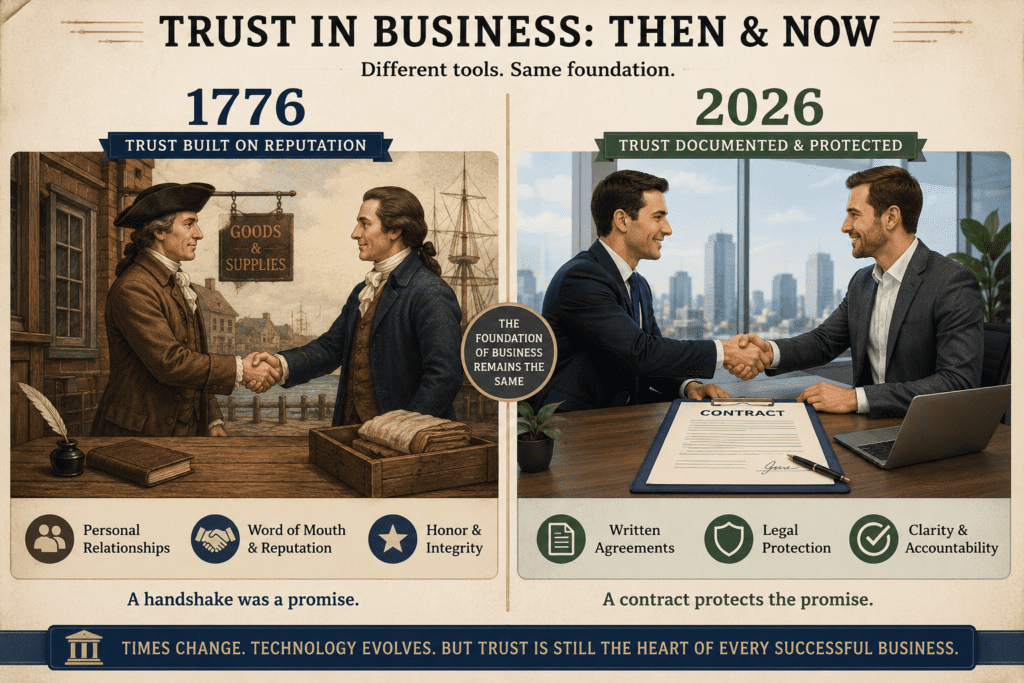
One of the biggest lessons from starting a business in 1776 involved the importance of reputation and trust.
Colonial entrepreneurs operated in tightly connected communities where customers often knew the business owner personally. A printer, merchant, blacksmith, builder, or tavern operator who failed to honor agreements or produced poor-quality work could quickly damage his reputation throughout the local community.
Because advertising systems were limited and business relationships were highly personal, trust served as one of the most valuable assets in colonial America.
Modern entrepreneurs still depend heavily on trust, although it now appears through:
- online reviews,
- social media reputation,
- customer referrals,
- branding,
- and digital visibility.
In many ways, the challenges involved in starting a business in 1776 and building customer confidence remain connected to the same human principles that drive successful businesses today.
Another important lesson from starting a business in 1776 involved resilience.
Colonial business owners faced extraordinary obstacles:
- unstable currency,
- delayed shipments,
- war disruptions,
- poor transportation,
- fires,
- imported supply shortages,
- labor limitations,
- and personal financial risk.
Yet small businesses throughout colonial America continued operating despite enormous uncertainty during the American Revolution. Entrepreneurs adapted constantly because survival depended on flexibility and persistence.
Modern business owners face a different type of uncertainty involving:
- inflation,
- rapidly changing technology,
- global competition,
- cybersecurity threats,
- labor shortages,
- and regulatory complexity.
The environment has changed, but the need for adaptability remains remarkably similar.
A third lesson from starting a business in 1776 is the value of practical knowledge and operational experience.
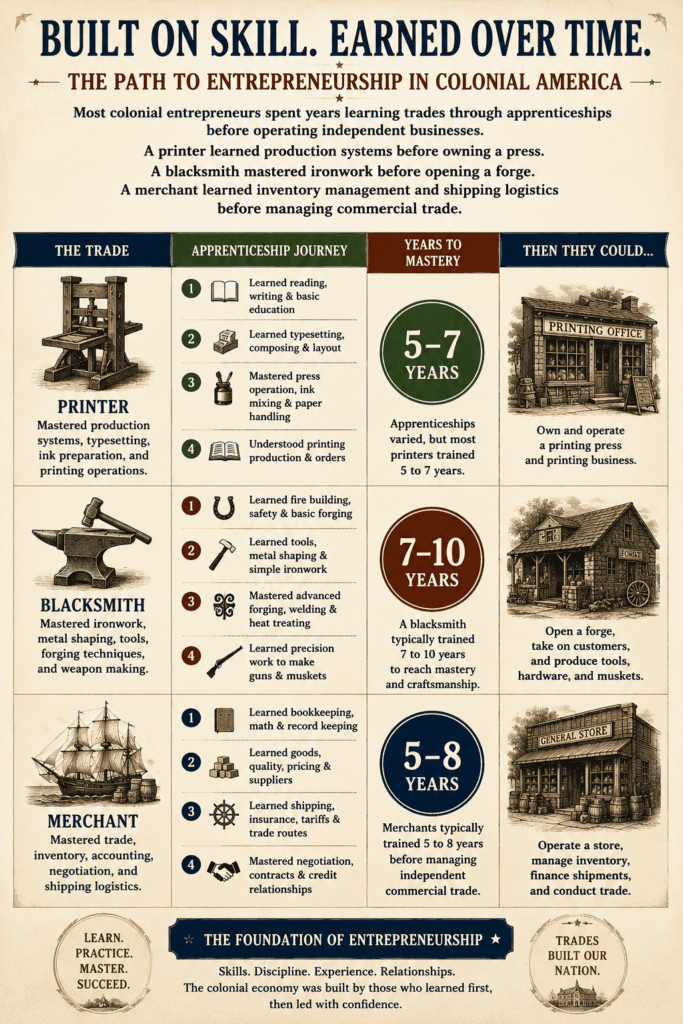
Most colonial entrepreneurs spent years learning trades through apprenticeships before operating independent businesses. A printer learned production systems before owning a press. A blacksmith mastered ironwork before opening a forge. A merchant learned inventory management and shipping logistics before managing commercial trade.
Today, modern entrepreneurs often attempt to move directly into business ownership without gaining operational experience first. While access to online education and financing has shortened the path to entrepreneurship in the United States of America, many small businesses still fail because owners underestimate the importance of:
- systems,
- customer service,
- pricing,
- bookkeeping,
- marketing,
- and operational discipline.
The contrast between starting a business in 1776 and launching a business today also highlights the extraordinary value of knowledge itself.
Colonial entrepreneurs had limited access to:
- formal business education,
- financing guidance,
- legal resources,
- accounting systems,
- or organized mentorship.
Most knowledge was passed slowly through apprenticeships, personal relationships, and direct experience. Modern entrepreneurs now possess access to online learning, calculators, memberships, software platforms, compliance systems, and educational communities that can dramatically improve decision-making.
In many ways, this may represent the single greatest advantage modern entrepreneurs possess over the business owners of 1776.
A person interested in starting a business in 1776 often needed:
- years of apprenticeship,
- family connections,
- access to tools,
- merchant relationships,
- and local trust
before opening a small business. Today, a determined entrepreneur can research markets, build a website, form an LLC, open financial accounts, and begin marketing products or services within days.
At the same time, modern entrepreneurs should not overlook the strengths of colonial business culture.
Many businesses in colonial America focused heavily on:
- craftsmanship,
- local relationships,
- community trust,
- durability,
- and long-term reputation.
These values often created loyal customer relationships that lasted for generations. In an era dominated by automation and digital transactions, some of the lessons from starting a business in 1776 may actually feel surprisingly modern again.
Perhaps the most important lesson from starting a business in 1776 is that entrepreneurship has always required courage.
Whether operating a print shop during the American Revolution, managing a merchant business in New York City, forging iron in Virginia, or launching a modern online business in the United States of America, entrepreneurs consistently face uncertainty, competition, financial risk, and changing economic conditions.
The technologies have changed dramatically since 1776, but the willingness to take risks, solve problems, and create opportunities remains one of the defining characteristics of successful small business owners throughout American history.
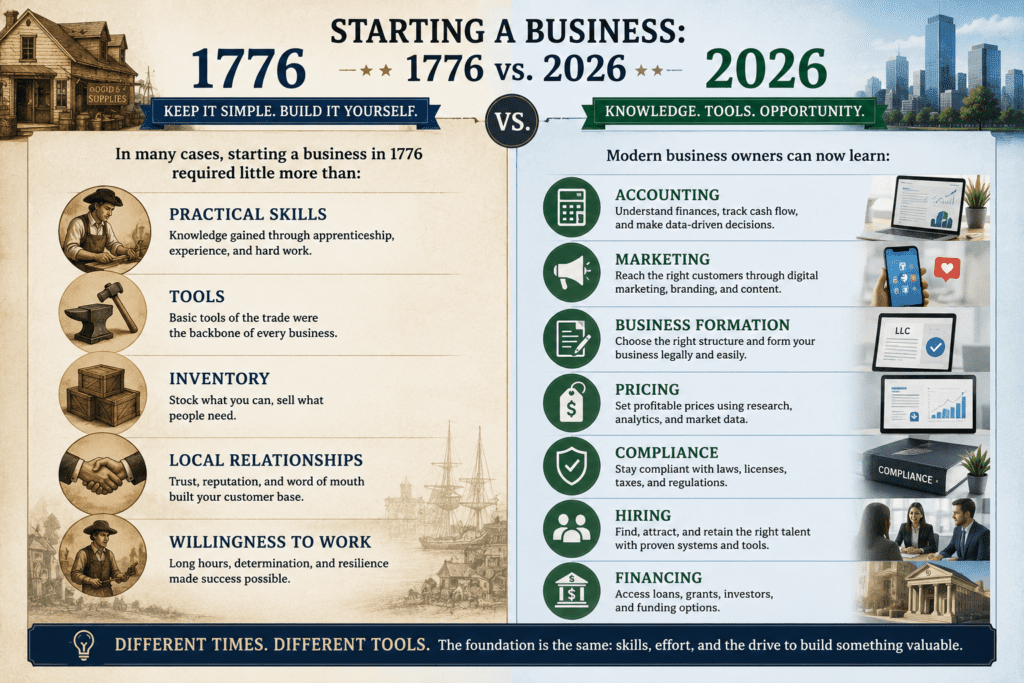
Starting a Business in 1776 vs Today: Which Was Easier?
At first glance, starting a business in 1776 may appear far easier than launching a modern company in the United States of America today. Colonial entrepreneurs did not face federal payroll taxes, online compliance reporting, workers’ compensation systems, OSHA regulations, digital privacy laws, or the enormous administrative complexity that modern small businesses often encounter.
In many cases, starting a business in 1776 required little more than:
- practical skills,
- tools,
- inventory,
- local relationships,
- and a willingness to work.
A blacksmith could begin forging tools from a small workshop. A printer could operate from a modest print shop. A merchant might sell imported goods from a storefront near a port or marketplace. Compared to the modern American economy, the legal barriers to entrepreneurship during the founding of America were remarkably low.
However, starting a business in 1776 also involved enormous disadvantages that modern entrepreneurs rarely face today.
One of the biggest differences involved access to knowledge.
Modern business owners can now learn:
- accounting,
- marketing,
- business formation,
- pricing,
- compliance,
- hiring,
- and financing
through online courses, videos, software systems, business memberships, and educational resources. A person interested in entrepreneurship today can access more business information in a single afternoon than many colonial entrepreneurs encountered during years of apprenticeship training.
By comparison, starting a business in 1776 often required long periods of direct apprenticeship under experienced craftsmen or merchants. Knowledge moved slowly through personal relationships and hands-on labor rather than instant digital communication.
Another major challenge involved transportation and supply chains.
Modern businesses benefit from:
- highways,
- rail systems,
- airports,
- overnight shipping,
- global logistics,
- digital inventory tracking,
- and real-time communication.
Colonial entrepreneurs during the American Revolution relied on:
- horses,
- wagons,
- sailing ships,
- handwritten correspondence,
- and weather-dependent transportation routes.
A delayed shipment from New York City, Rhode Island, or overseas markets could disrupt inventory for months. Imported paper, iron, textiles, tools, and supplies often traveled slowly and unpredictably throughout colonial America.
Financial protection also differed dramatically.
Modern entrepreneurs can:
- form LLCs,
- purchase insurance,
- separate business liabilities,
- use accounting software,
- and protect personal assets through legal structures.
Starting a business in 1776 offered almost none of these protections. Most colonial business owners operated as sole proprietors or informal partnerships, meaning personal property and family wealth remained exposed to business risks. A failed shipment, damaged workshop, unpaid debt, or fire could financially devastate an entrepreneur.
At the same time, competition during the founding of America was often far more local than today’s global marketplace.
A merchant in Pennsylvania or a printer in Boston generally competed against nearby businesses rather than thousands of international online competitors. Modern small businesses may possess better tools and financing opportunities, but they also face:
- global competition,
- digital advertising costs,
- rapid technological change,
- cybersecurity threats,
- and constantly shifting consumer behavior.
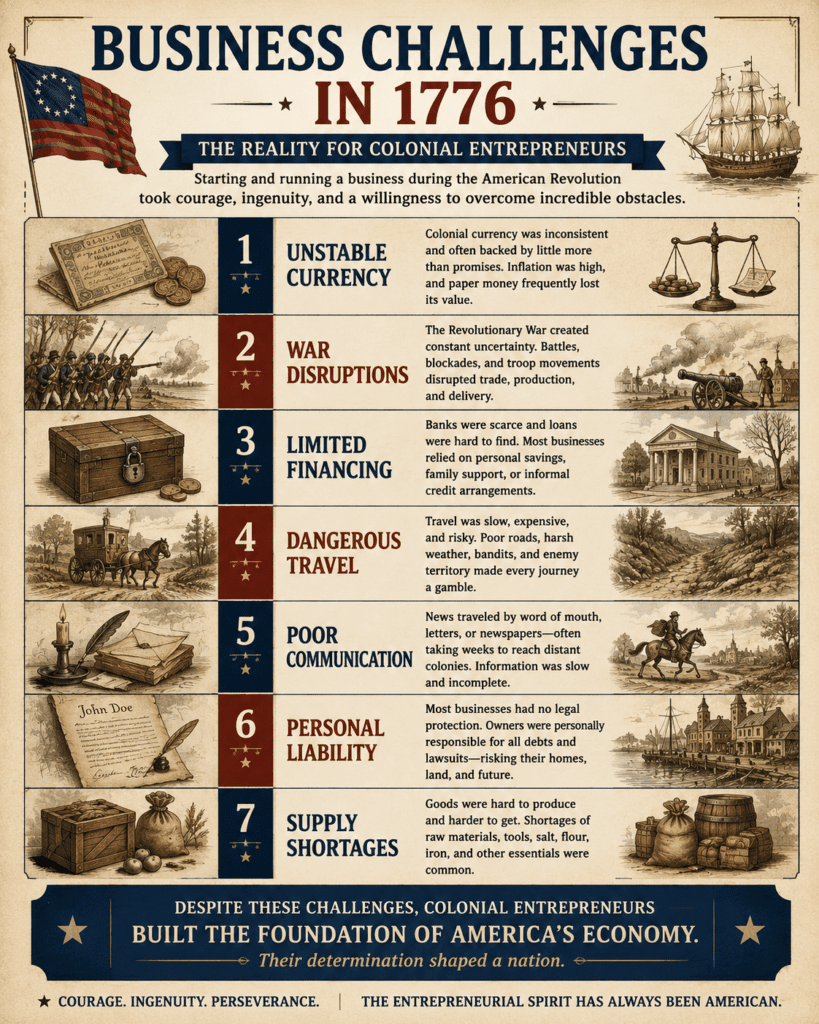
In many ways, starting a business in 1776 involved fewer regulations but far harsher operating conditions.
Colonial entrepreneurs dealt with:
- unstable currency,
- war disruptions,
- limited financing,
- dangerous travel,
- poor communication,
- personal liability,
- and supply shortages
during one of the most uncertain periods in American history.
Yet despite these difficulties, small businesses throughout colonial America helped build the foundation of the future American economy. Merchants, printers, builders, craftsmen, manufacturers, and tavern owners created enterprises that supported commerce, communication, trade, and local communities during the American Revolution.
The comparison between starting a business in 1776 and entrepreneurship today ultimately reveals something important:
Modern entrepreneurs possess far greater access to knowledge, protection, financing, and technology, but the willingness to take risks, solve problems, and build trust remains just as essential now as it was during the founding of America.
Could Someone Really Build Wealth Starting a Business in 1776?
For many people living in colonial America, starting a business in 1776 represented one of the few realistic paths toward financial independence, social mobility, and long-term wealth.
While the American economy during the founding of America was far smaller and less developed than today, ambitious entrepreneurs still found opportunities to build successful enterprises through trade, manufacturing, publishing, agriculture, shipping, and skilled craftsmanship.
However, wealth creation during the American Revolution looked very different from modern entrepreneurship in the United States of America.
Today, a successful small business owner may build wealth through:
- LLC ownership,
- stock investments,
- franchising,
- real estate portfolios,
- intellectual property,
- online businesses,
- retirement accounts,
- and digital scalability.
In 1776, wealth accumulation depended far more heavily on:
- land ownership,
- merchant trade,
- agricultural production,
- manufacturing capacity,
- shipping access,
- and personal relationships.
For many colonial entrepreneurs, owning property represented the single most important path toward long-term financial security. Land in colonial America often served multiple purposes at once:
- business location,
- farming operation,
- investment asset,
- collateral for credit,
- and generational wealth transfer.
This connection between business ownership and land ownership shaped much of the American economy during the founding of America.
Merchants who successfully expanded trade operations could accumulate significant wealth through imported goods, shipping contracts, and regional commerce. Printers who built influential newspapers gained not only income but political and social influence as well. Manufacturers such as James Hunter attempted to scale industrial production long before modern factories became common in the United States of America.
At the same time, building wealth through entrepreneurship in 1776 involved enormous personal risk.
A colonial entrepreneur faced:
- fire,
- war disruptions,
- unstable currency,
- shipping losses,
- disease outbreaks,
- supply shortages,
- political instability,
- and complete personal financial liability.
Because LLCs and modern liability protections did not exist for most small businesses, failed ventures could financially destroy entire families.
The American Revolution itself also created both opportunities and dangers for entrepreneurs.
Some business owners benefited from military supply contracts, increased manufacturing demand, and expanding local commerce as America’s independence movement accelerated. Others suffered devastating losses from disrupted trade routes, damaged property, British occupation, inflation, or shortages of imported goods.
Printers such as Benjamin Franklin demonstrated how entrepreneurship, communication, and influence could combine to create both wealth and national significance. Franklin’s printing operations expanded into publishing, advertising, newspapers, and intellectual networks that stretched throughout colonial America and beyond.
Yet even highly successful colonial entrepreneurs rarely enjoyed the financial protections or scalability available to modern business owners today.
Modern entrepreneurs can:
- build national brands online,
- access global markets,
- automate operations,
- protect assets through legal entities,
- use insurance systems,
- and create recurring revenue models
in ways that would have been unimaginable during the American Revolution.
Still, the comparison between starting a business in 1776 and building wealth today reveals an important similarity:
Entrepreneurship has always rewarded individuals willing to accept uncertainty, develop valuable skills, build trust, and identify opportunities others fail to see.
Many of the entrepreneurs who helped shape the early American economy began with limited resources but used persistence, reputation, craftsmanship, and local relationships to gradually build successful enterprises.
That lesson remains remarkably relevant in the modern American economy.
Whether operating a colonial print shop in 1776 or launching a digital business in 2026, entrepreneurs continue pursuing the same fundamental goal:
Creating economic opportunity through knowledge, effort, and calculated risk.
people also ask business 1776 4
Could Entrepreneurs Become Extremely Wealthy in 1776?
While many small businesses in colonial America remained modest family operations, a handful of entrepreneurs during the founding of America accumulated fortunes so large that, when adjusted to modern economic scale, they would rival some of the wealthiest business figures in the United States of America today.
However, comparing wealth from 1776 to the modern American economy is extraordinarily difficult.
According to economic historians and research preserved through institutions such as the Library of Congress and various university economic studies, the fortunes of Revolutionary-era entrepreneurs cannot be measured simply through inflation calculators. Much of their wealth existed in:
- land ownership,
- agricultural production,
- shipping networks,
- trade goods,
- merchant operations,
- and large physical enterprises
rather than modern liquid investment portfolios or publicly traded stock.
Historians generally use two methods when comparing wealth from the American Revolution to modern entrepreneurship:
- simple inflation adjustments,
- or relative economic share, which measures how much of the total American economy an individual controlled at the time.
When viewed through the lens of relative economic power, several entrepreneurs and business figures connected to the Declaration of Independence would likely qualify as modern billionaires.
One of the most fascinating examples was Robert Morris.
Often called the “Financier of the Revolution,” Morris built a massive trade and shipping empire before and during the American Revolution. Historians estimate that, depending on the method used, his modern equivalent wealth could range anywhere from approximately $1 billion to well over $20 billion.
Morris used much of his fortune to help finance America’s independence and support the Continental Congress during periods when the young nation struggled financially.
Ironically, Morris’s story also demonstrates the enormous risks involved in entrepreneurship during the founding of America. Despite his immense wealth and influence, aggressive speculation and financial overextension eventually led him into bankruptcy and debtor’s prison later in life.
Another remarkable figure was Charles Carroll of Carrollton, whose vast Maryland land holdings and agricultural enterprises likely placed him firmly within modern billionaire territory when measured by land value and economic influence. Carroll’s wealth was grounded less in volatile trade and more in massive long-term property ownership, which functioned as one of the most important forms of wealth generation in colonial America.
George Washington also accumulated extraordinary wealth through land speculation, agriculture, and diversified business operations connected to Mount Vernon. By the end of his life, economic historians estimate Washington’s modern equivalent net worth likely ranged between $500 million and $600 million. Washington understood something many modern entrepreneurs and investors still recognize today:
Acquiring strategic assets early can create enormous long-term economic power.
Meanwhile, John Hancock inherited and expanded one of the largest merchant fortunes in colonial America. Hancock’s shipping, trade, and mercantile operations generated wealth that modern historians frequently estimate in the hundreds of millions of dollars when translated into the modern American economy.
The comparison between these Revolutionary-era fortunes and modern entrepreneurs becomes especially interesting when examining figures such as Elon Musk and other modern billionaires.
Today’s wealthiest entrepreneurs often build fortunes through:
- technology companies,
- digital platforms,
- financial systems,
- global logistics,
- software,
- manufacturing,
- and stock ownership.
By contrast, entrepreneurs during the founding of America built wealth through:
- land,
- merchant trade,
- shipping,
- agriculture,
- manufacturing,
- and physical infrastructure.
Yet the similarities between the two eras are surprisingly strong.
Both Revolutionary-era entrepreneurs and modern billionaires often shared:
- high risk tolerance,
- aggressive expansion strategies,
- large-scale infrastructure thinking,
- political influence,
- financing leverage,
- and the ability to identify major economic opportunities before competitors.
In many ways, figures such as Robert Morris resembled modern high-risk financial entrepreneurs, while industrial operators such as James Hunter reflected early versions of manufacturing founders attempting to scale production under difficult economic conditions.
The biggest difference may involve access to scale.
Modern entrepreneurs can now build companies serving billions of people globally through digital technology and instant communication. Colonial entrepreneurs in 1776 operated in a much smaller and slower economy dependent on ships, horses, handwritten correspondence, and local trade networks.
Still, the fact that individuals during the American Revolution could accumulate fortunes comparable to modern billionaires reveals something important about the American economy from its very beginning:
Entrepreneurship, risk-taking, and private enterprise were deeply embedded in the economic culture surrounding the founding of the United States of America.
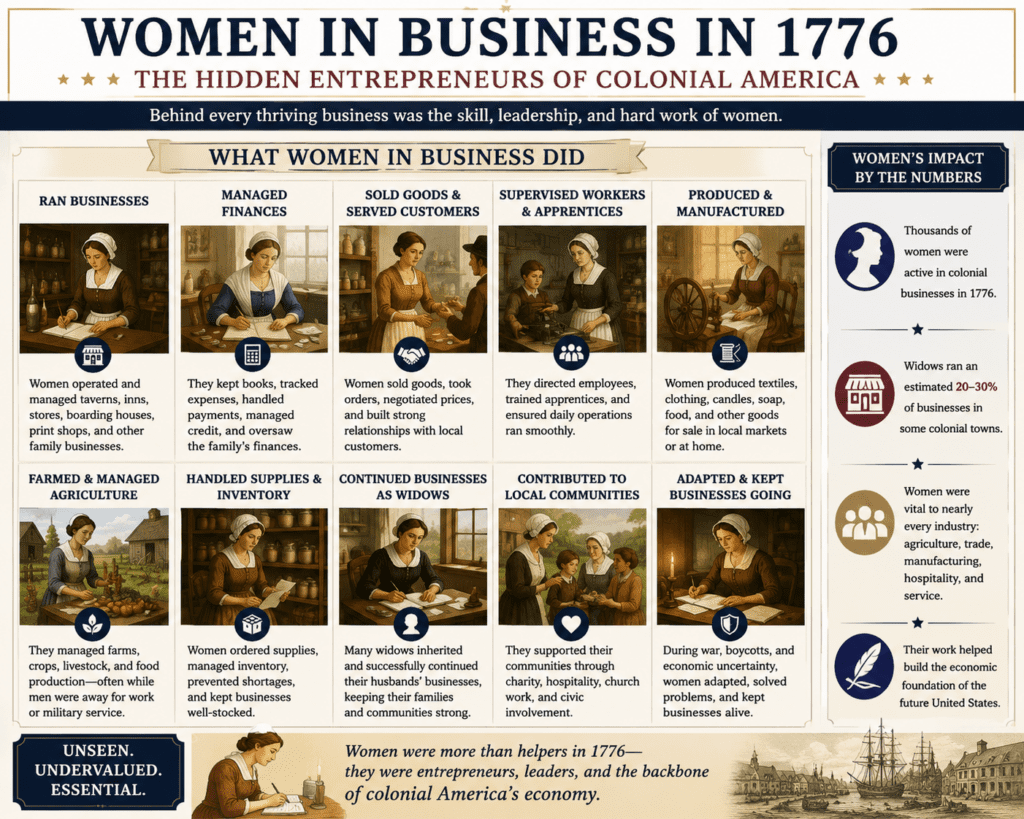
Women, Family Businesses, and Hidden Entrepreneurship in 1776
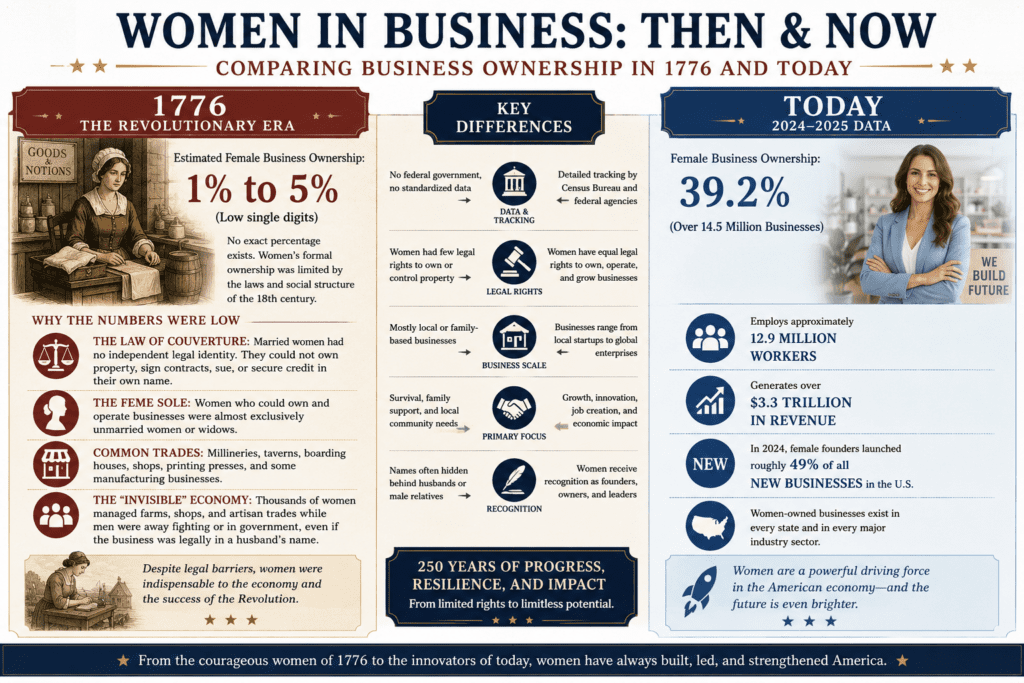
When discussing starting a business in 1776, much of the historical focus naturally centers on merchants, printers, manufacturers, and prominent male entrepreneurs connected to the American Revolution. However, women played a far larger role in the colonial American economy than many people realize today.
Throughout the founding of America, countless small businesses depended heavily on family labor and informal partnerships involving wives, daughters, widows, and extended relatives. In many cases, women operated behind the scenes, managing bookkeeping, supervising workers, running taverns, assisting in shops, handling customers, and continuing businesses after the deaths of husbands or fathers.
The structure of the American economy in 1776 often blurred the line between:
- family life,
- household production,
- and entrepreneurship.
The role of women during the founding of America was tremendous and is often overlooked or minimized in traditional histories, documentaries, and movies. Women helped operate businesses, manage farms, supervise households, maintain trade operations, produce goods, care for soldiers, and support local economies throughout the American Revolution.
Women were not simply observers of history in 1776. They helped sustain families, communities, commerce, and in many cases the Revolutionary cause itself. From managing taverns and print shops to supporting military camps and surviving the brutal realities of war, women played a critical role in helping shape the future United States of America.
RetireCoast honors the women of the Revolutionary era through a growing collection of historical articles exploring their sacrifices, labor, resilience, and contributions to the founding of America. We invite you to continue learning about the women whose efforts helped bring us to where we are today.
Unlike many modern businesses that operate separately from home life, colonial enterprises were frequently family-centered operations. A print shop, tavern, blacksmith forge, farm, merchant store, or carpentry business might involve nearly every member of the household contributing labor in some form.
According to historical research preserved through the National Women’s History Museum and the Smithsonian Institution, widows in colonial America sometimes inherited and continued operating businesses after their husbands died. This was especially common in:
- taverns,
- print shops,
- boarding houses,
- retail stores,
- and family trade operations.
One fascinating example involved women in the printing industry during the American Revolution. When printers died, widows occasionally continued publishing newspapers and managing print businesses themselves.
These women often supervised apprentices, handled finances, negotiated contracts, and maintained important communication networks during a period when newspapers played a major role in political and commercial life throughout colonial America.
Even though women faced severe legal and social restrictions during the founding of America, they still participated extensively in the practical operation of small businesses.
Many women contributed through:
- textile production,
- food preparation,
- bookkeeping,
- hospitality,
- inventory management,
- farming,
- retail trade,
- and household manufacturing.
Some women also operated informal home-based businesses that generated additional family income. These activities might include sewing, baking, candle making, laundry services, weaving, or selling goods through local marketplaces.
The American Revolution itself created new economic pressures and opportunities for women connected to entrepreneurship.
As men left for military service or became involved in political activity surrounding the Continental Congress and America’s independence, women often assumed greater responsibility for maintaining businesses, farms, and commercial operations. In some communities, women effectively became temporary business managers during wartime disruptions.
Compared to modern entrepreneurship in the United States of America, however, women in 1776 operated with very limited legal rights.
Most married women could not:
- independently sign many contracts,
- vote,
- hold office,
- or fully control property in the same way men could.
Business ownership and financial rights often depended heavily on marital status, inheritance structures, and local colonial laws.
Today, women entrepreneurs participate throughout nearly every sector of the American economy:
- technology,
- finance,
- manufacturing,
- healthcare,
- real estate,
- media,
- retail,
- and global commerce.
Modern business owners also benefit from legal protections, educational opportunities, financing systems, and professional networks that were unavailable during the founding of America.
Yet despite these dramatic changes, one important truth remains clear:
Family support systems and shared labor have always played a critical role in successful entrepreneurship.
Many colonial businesses survived because entire families contributed effort, skills, labor, and resilience during extremely uncertain economic times. That tradition of family-driven entrepreneurship continues throughout the United States of America today, particularly among small businesses, family-owned companies, and local enterprises built through generations of work and trust.
The Legacy of Entrepreneurship From 1776 to Today
The story of starting a business in 1776 is ultimately much larger than the history of merchants, printers, taverns, blacksmiths, or manufacturers during the American Revolution. It is the story of how entrepreneurship became deeply woven into the economic identity of the United States of America from the very beginning.
During the founding of America, small businesses helped sustain local communities, spread information, support trade, manufacture goods, and build the economic foundation of the young nation. Colonial entrepreneurs operated in an environment filled with uncertainty:
- unstable currency,
- dangerous transportation,
- war disruptions,
- limited financing,
- supply shortages,
- and enormous personal financial risk.
Yet despite these obstacles, people throughout colonial America continued building businesses, creating opportunities, and taking risks in pursuit of economic independence.
That entrepreneurial mindset remains one of the defining characteristics of the American economy today.
Modern entrepreneurs benefit from advantages that business owners in 1776 could never have imagined:
- instant communication,
- online education,
- LLC protections,
- banking systems,
- accounting software,
- digital marketing,
- global shipping,
- artificial intelligence,
- and access to worldwide markets.
At the same time, many of the fundamental challenges involved in starting a business in 1776 still exist in different forms today.
Entrepreneurs in both eras must:
- build trust,
- manage risk,
- control expenses,
- solve problems,
- adapt to uncertainty,
- compete for customers,
- and continuously learn.
The tools have changed dramatically over the last 250 years, but the human side of entrepreneurship remains remarkably consistent.
The Founding Fathers themselves understood the importance of commerce, trade, manufacturing, and private enterprise in shaping the future United States of America. Many of the men connected to the Declaration of Independence were not simply politicians — they were also merchants, printers, land speculators, manufacturers, lawyers, farmers, and business owners navigating the realities of the colonial American economy.
Entrepreneurs such as Benjamin Franklin demonstrated how knowledge, communication, and innovation could create influence far beyond a single business. Manufacturers such as James Hunter showed how ambitious production systems could begin transforming colonial industry long before the Industrial Revolution fully arrived in America.
Even ordinary tavern owners, builders, craftsmen, printers, and merchants contributed to the development of local economies that eventually supported the growth of the nation itself.
The comparison between entrepreneurship in 1776 and today also reveals how dramatically access to opportunity has expanded over time.
Groups that faced major legal and social barriers during the founding of America — including women and many working-class individuals — now participate throughout nearly every sector of the modern American economy. Education, financing systems, legal protections, and digital tools have opened doors that were unimaginable during the American Revolution.
Yet perhaps the most important lesson from starting a business in 1776 is that entrepreneurship has always been tied closely to optimism.
Colonial entrepreneurs invested time, labor, money, and reputation into uncertain ventures because they believed opportunities existed beyond their current circumstances. That same belief still drives millions of small business owners throughout the United States of America today.
Whether operating a print shop in Philadelphia during the American Revolution or launching a digital company in 2026, entrepreneurs continue pursuing the same core idea:
The belief that knowledge, effort, risk-taking, and innovation can create a better future.
Could the Founding Fathers Have Succeeded as Entrepreneurs Today?
One of the most fascinating questions raised by comparing entrepreneurship during the American Revolution to the modern American economy is whether the business leaders of 1776 would still succeed in today’s world.
In many ways, the answer is probably yes.
The entrepreneurs connected to the founding of America operated under extraordinarily difficult conditions:
- unstable currency,
- primitive transportation,
- limited financing,
- dangerous trade routes,
- supply shortages,
- political instability,
- and very little legal protection.
Yet many still managed to build successful enterprises through innovation, networking, communication, manufacturing, and calculated risk-taking.
Benjamin Franklin would likely thrive in the modern digital economy. Franklin combined:
- publishing,
- media,
- marketing,
- scientific experimentation,
- branding,
- diplomacy,
- and communication
in ways that resemble today’s technology founders, media entrepreneurs, and public intellectuals. His ability to build influence through information networks strongly parallels how modern entrepreneurs use podcasts, social media, publishing platforms, and online audiences today.
Meanwhile, industrial entrepreneurs such as James Hunter might resemble modern manufacturing founders or infrastructure builders. Hunter expanded production capacity, managed workers, handled supply logistics, and attempted to scale manufacturing operations during the American Revolution under extremely difficult economic conditions.
Modern entrepreneurs such as Elon Musk operate on a far larger technological scale, but many of the core entrepreneurial characteristics remain similar:
- high risk tolerance,
- aggressive expansion,
- manufacturing ambition,
- infrastructure investment,
- and willingness to challenge existing systems.
The comparison becomes even more interesting when examining how the modern American economy rewards communication and innovation.
Today’s entrepreneurs can:
- build global brands online,
- raise capital digitally,
- automate operations,
- access worldwide markets,
- and communicate instantly with millions of people.
During the founding of America, entrepreneurs relied on:
- newspapers,
- taverns,
- handwritten correspondence,
- local trade routes,
- and personal reputation.
Information moved slowly, but influence still mattered enormously.
Some of the Founding Fathers also possessed skills that remain highly valuable in modern entrepreneurship:
- persuasive communication,
- strategic planning,
- networking,
- negotiation,
- and adaptability.
These skills helped colonial entrepreneurs survive during one of the most uncertain periods in American history and remain essential for business owners in the United States of America today.
At the same time, modern entrepreneurs face challenges that would have been unimaginable in 1776:
- cybersecurity threats,
- digital competition,
- global market pressures,
- regulatory complexity,
- social media scrutiny,
- and rapidly changing technologies.
A colonial entrepreneur could spend years building a local reputation with limited competition. Today, a small business may compete instantly against national and international companies operating online twenty-four hours a day.
Yet despite these enormous technological differences, the entrepreneurial mindset itself has changed surprisingly little over the last 250 years.
Whether launching a colonial print shop during the American Revolution or building a technology company in 2026, successful entrepreneurs typically share:
- curiosity,
- resilience,
- innovation,
- persistence,
- adaptability,
- and the willingness to pursue opportunity despite uncertainty.
That continuity may be one of the strongest connections between starting a business in 1776 and entrepreneurship in the modern American economy. What Would Surprise a Business Owner From 1776 About America Today?
If an entrepreneur from the American Revolution could suddenly step into the modern United States of America, the technological changes would likely seem almost unimaginable. A printer, merchant, blacksmith, tavern owner, or manufacturer from 1776 would encounter a business environment transformed by electricity, computers, automobiles, aircraft, digital banking, artificial intelligence, and global communication networks.
Yet beyond the technology itself, many aspects of the modern American economy would probably shock colonial entrepreneurs even more.
One of the biggest surprises would involve the sheer speed of commerce.
During the founding of America, business communication moved at the speed of:
- horses,
- sailing ships,
- handwritten letters,
- and printed newspapers.
A merchant in New York City might wait weeks or months to receive updates about shipments, pricing, inventory, or overseas markets. Today, entrepreneurs can communicate instantly through:
- smartphones,
- email,
- video conferencing,
- websites,
- and social media platforms.
A modern business owner can sell products globally within minutes from a laptop or mobile phone — something completely unimaginable during the American Revolution.
Colonial entrepreneurs would also be stunned by the scale of modern corporations.
Most small businesses in 1776 were:
- family-operated,
- locally focused,
- labor-intensive,
- and physically limited by geography.
Even the largest commercial enterprises of colonial America were tiny compared to the multinational corporations that dominate portions of the modern American economy today.
A business owner from the founding of America would likely struggle to comprehend:
- global supply chains,
- billion-dollar technology companies,
- online retail systems,
- instant financial transactions,
- or factories producing millions of products annually.
Modern transportation would seem equally astonishing.
In 1776, moving goods between colonies could take days or weeks, depending on weather, road conditions, and shipping routes. Today, products move across the United States of America and around the world through:
- interstate highways,
- rail systems,
- cargo aircraft,
- container ships,
- and overnight delivery networks.
Entrepreneurs during the American Revolution constantly worried about damaged roads, storms, piracy, blockades, and delayed shipments. Modern logistics systems would appear almost magical by comparison.
At the same time, colonial entrepreneurs might also be surprised by how dependent modern businesses have become on regulation and administration.
A business owner from 1776 would likely find:
- payroll reporting,
- tax compliance,
- labor regulations,
- licensing systems,
- digital recordkeeping,
- insurance requirements,
- and legal documentation
far more complex than anything encountered during the founding of America.
Many colonial entrepreneurs operated with little more than:
- handwritten ledgers,
- apprenticeship training,
- personal relationships,
- and local reputation.
Modern business owners, by contrast, often rely heavily on software systems, legal structures, accounting professionals, and compliance advisors simply to navigate the modern American economy.
Colonial entrepreneurs would probably be especially fascinated by the role of information itself.
During the American Revolution, knowledge moved slowly and was often difficult to access. A successful printer, such as Benjamin Franklin, gained enormous influence because newspapers and printed materials controlled the flow of information.
Today, information is nearly unlimited.
Modern entrepreneurs can instantly research:
- competitors,
- pricing,
- financing,
- marketing strategies,
- customer behavior,
- legal requirements,
- and business education resources.
In many ways, knowledge itself has become one of the most valuable assets in the modern American economy.
Yet despite all the changes, a business owner from 1776 might still recognize something very familiar about entrepreneurship today:
People continue building businesses for many of the same reasons they did during the founding of America — to create opportunity, support families, improve communities, achieve independence, and pursue a better future through hard work and innovation.
The First True Startups in American History?
Modern entrepreneurs often use terms such as:
- startup culture,
- disruption,
- scalability,
- innovation,
- venture capital,
- and growth strategy
to describe ambitious new businesses attempting to transform industries. While those terms did not exist during the founding of America, some historians argue that many enterprises operating during the American Revolution closely resembled early startup companies.
In fact, starting a business in 1776 often required the same entrepreneurial mindset associated with modern startups today:
- identifying opportunities,
- solving problems,
- raising capital,
- managing uncertainty,
- building networks,
- and scaling operations under pressure.
Colonial America itself was, in many ways, an emerging economy filled with opportunity and instability.
Merchants, printers, manufacturers, and land speculators constantly searched for ways to expand trade, improve transportation, increase production, and gain advantages over competitors. The American economy was still developing rapidly, meaning ambitious entrepreneurs could sometimes build influence and wealth faster than in older European economic systems.
Some of the manufacturing operations connected to the American Revolution looked remarkably similar to early industrial startups.
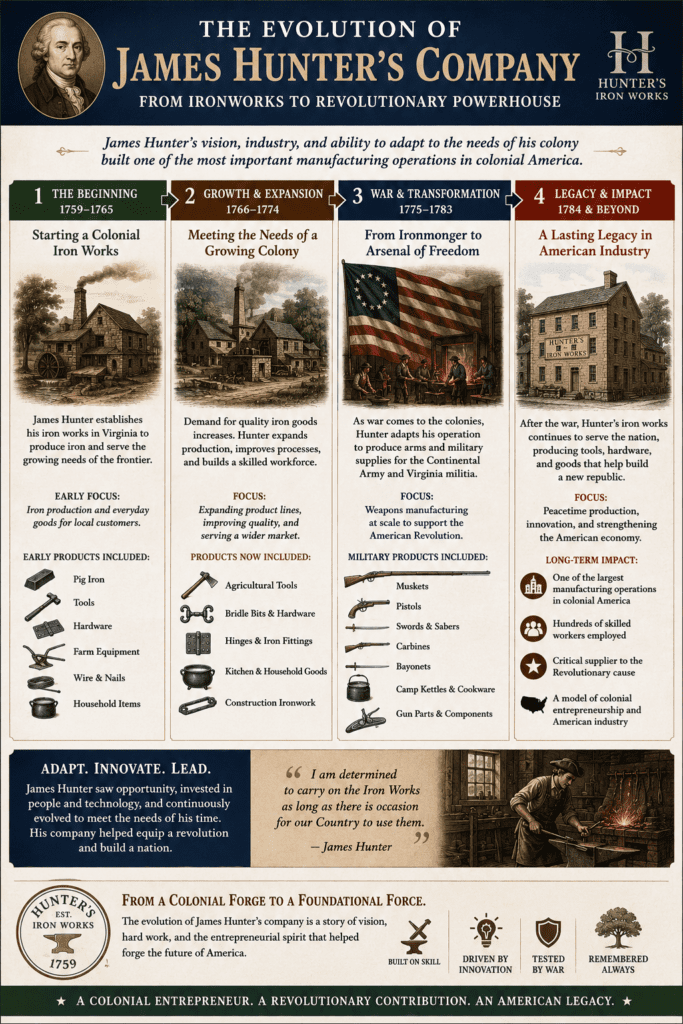
James Hunter expanded the Rappahannock Forge into one of the largest manufacturing operations in colonial America. His enterprise produced:
- muskets,
- swords,
- camp kettles,
- iron products,
- and military supplies
for the Continental Army and the Virginia militia.
Hunter faced many of the same challenges encountered by modern manufacturing founders:
- labor management,
- supply shortages,
- financing pressures,
- transportation problems,
- production scaling,
- and government contracts.
Likewise, the Pennsylvania Gun Factory represented an early attempt to centralize manufacturing operations rather than relying solely on independent craftsmen. Colonial leaders understood that scaling production would become essential if the young United States of America hoped to sustain military operations and support the broader American economy during wartime.
Even colonial printers resembled startup founders in certain ways.
A printer such as Benjamin Franklin combined:
- publishing,
- advertising,
- distribution,
- communication,
- networking,
- and information control
into a scalable business system. Franklin expanded beyond simple printing into newspapers, books, public notices, scientific experimentation, and political influence. In many respects, he operated more like a modern media entrepreneur than a traditional craftsman.
Colonial taverns also functioned as entrepreneurial hubs.
Tavern owners frequently provided:
- lodging,
- food service,
- meeting space,
- postal services,
- political discussion areas,
- and business networking environments.
Some taverns effectively operated as the coworking spaces and networking centers of the Revolutionary era, where merchants, travelers, printers, and political leaders exchanged information and formed commercial relationships.
At the same time, starting a business in 1776 lacked one enormous advantage available to modern startups:
Scalable technology.
Modern entrepreneurs can rapidly expand businesses through:
- software,
- automation,
- online commerce,
- artificial intelligence,
- digital marketing,
- and global communication systems.
Colonial entrepreneurs remained limited by:
- physical production,
- local transportation,
- labor-intensive operations,
- and geographic constraints.
A printer could only produce as much material as presses and labor allowed. A blacksmith could only forge a limited number of tools or weapons. A merchant depended entirely on ships, roads, and physical inventory movement.
Still, the entrepreneurial spirit behind these enterprises remains strikingly familiar today.
The founders of many colonial businesses were:
- innovators,
- risk-takers,
- network builders,
- manufacturers,
- investors,
- and problem solvers
attempting to create opportunity in a rapidly changing economy.
That may be one of the strongest parallels between entrepreneurship during the American Revolution and modern startup culture:
Both periods rewarded individuals willing to build something new before clear systems or guarantees existed.
What Types of Businesses Failed Most Often in 1776?
Not every entrepreneur during the American Revolution succeeded. In fact, starting a business in 1776 carried enormous financial risk, and many colonial enterprises failed due to conditions that modern entrepreneurs would immediately recognize:
- cash flow problems,
- supply chain disruptions,
- debt,
- inflation,
- competition,
- transportation delays,
- and economic uncertainty.
The difference was that colonial business failures could be personally devastating because legal protections such as LLCs and modern bankruptcy systems barely existed during the founding of America.
One of the most vulnerable sectors of the colonial American economy involved merchant trade.
Merchants depended heavily on:
- imported goods,
- overseas shipping,
- credit arrangements,
- and long-distance trade networks.
During the American Revolution, British naval blockades, wartime disruptions, piracy, damaged ports, and delayed shipments created enormous uncertainty for commercial businesses throughout colonial America. A single lost cargo shipment could financially destroy a merchant because so much capital was tied directly to physical inventory.
Entrepreneurs involved in shipping and international commerce also faced unstable currency and fluctuating market prices. Colonial paper money often lost value rapidly during the war, making it difficult for business owners to price goods, repay debts, or maintain purchasing power.
Manufacturing operations faced different challenges.
Industrial enterprises such as iron works, gun factories, and production shops required:
- labor,
- furnaces,
- imported materials,
- transportation systems,
- tools,
- and large upfront investments.
Entrepreneurs such as James Hunter attempted to scale manufacturing during extremely unstable economic conditions. These businesses frequently struggled with:
- labor shortages,
- raw material access,
- financing pressures,
- equipment costs,
- and wartime threats.
Even successful operations sometimes collapsed under debt or government payment delays.
Taverns and boarding houses could also fail quickly if travel patterns shifted or local economies weakened. Since many colonial taverns relied on travelers, merchants, and trade activity, war disruptions sometimes reduced customer traffic dramatically in certain regions.
Printers faced unique financial risks as well.
A colonial printer depended on:
- imported paper,
- ink,
- skilled labor,
- subscriptions,
- and advertising revenue.
Supply shortages or political instability could interrupt operations rapidly. Printers involved in controversial political discussions surrounding the Declaration of Independence or the Continental Congress also faced reputational and legal risks depending on local loyalties during the American Revolution.
Another major cause of failure involved overexpansion.
Some entrepreneurs attempted to grow too quickly without sufficient capital reserves or stable supply chains. This problem still affects modern small businesses today.
One of the most dramatic examples involved Robert Morris. Morris became one of the wealthiest men connected to the founding of America through shipping, finance, and trade. Yet aggressive speculation and heavy leverage eventually contributed to financial collapse and debtor’s prison later in life.
Modern entrepreneurs might recognize this pattern immediately:
Rapid growth without a sustainable financial structure can become dangerous even for highly successful businesses.
At the same time, many colonial businesses failed for reasons completely outside the owner’s control.
Entrepreneurs during the founding of America constantly dealt with:
- fires,
- disease outbreaks,
- storms,
- military occupation,
- damaged roads,
- unstable governments,
- and unpredictable transportation systems.
Business continuity planning barely existed compared to the modern American economy.
Today, entrepreneurs benefit from:
- insurance systems,
- diversified financing,
- legal protections,
- digital communication,
- accounting software,
- and advanced logistics.
Colonial entrepreneurs had far fewer safeguards.
Yet despite the high failure rates and harsh conditions surrounding starting a business in 1776, countless entrepreneurs continued taking risks because the opportunities within the growing American economy remained enormous.
That willingness to pursue opportunity despite uncertainty remains one of the strongest connections between colonial entrepreneurs and modern business owners in the United States of America today.
How the American Revolution Created New Business Opportunities
While the American Revolution brought enormous uncertainty to colonial America, it also created entirely new business opportunities for entrepreneurs willing to adapt to changing economic conditions. In many ways, the founding of America reshaped the American economy and opened doors for merchants, manufacturers, printers, builders, and small businesses throughout the colonies.
Periods of disruption often create new markets.
That was true during the American Revolution, just as it remains true in the modern United States of America today.
Before the war, many colonial businesses depended heavily on imported British goods. Merchants sold products manufactured overseas, while local craftsmen frequently competed against cheaper imported materials and finished products arriving through British trade networks.
Once tensions escalated surrounding the Declaration of Independence and America’s independence movement, imports became less reliable and, in some cases, politically unpopular. This created new demand for locally produced goods throughout colonial America.
Entrepreneurs who could manufacture products domestically suddenly found themselves operating in a growing market.
Blacksmiths, gunsmiths, iron works operators, textile producers, printers, wagon builders, leather workers, and food suppliers all experienced increased demand connected to wartime needs and disrupted trade routes.
Manufacturing operations such as those run by James Hunter expanded rapidly because the Continental Congress and colonial governments desperately needed:
- weapons,
- tools,
- camp equipment,
- iron products,
- and military supplies.
The pressure to reduce dependence on British imports helped stimulate portions of the early American manufacturing economy long before the Industrial Revolution transformed the United States of America.
Printers also experienced major opportunities during the American Revolution.
Public demand for:
- newspapers,
- pamphlets,
- political essays,
- military updates,
- advertisements,
- and government notices
increased dramatically during the founding of America.
Printers such as Benjamin Franklin operated at the center of this information economy. Newspapers became essential for spreading political arguments, military news, commercial advertisements, and public debate surrounding America’s independence.
Taverns likewise benefited from increased travel, political discussion, and commercial activity in many areas.
Tavern owners often hosted:
- merchants,
- military officers,
- travelers,
- political organizers,
- printers,
- and local business leaders.
Some taverns effectively became communication centers where information, commerce, and politics merged together during the American Revolution.
Transportation and logistics businesses also gained importance.
Moving:
- supplies,
- weapons,
- food,
- paper,
- textiles,
- and military equipment
across colonial America became a critical challenge during wartime. Entrepreneurs involved in shipping, wagon transport, horse breeding, storage, and supply coordination found opportunities supporting both local economies and military operations.
At the same time, the American Revolution also accelerated entrepreneurial thinking in the colonies.
Many business owners recognized that the future United States of America might eventually develop independently:
- manufacturing systems,
- banking institutions,
- transportation networks,
- and trade relationships
separate from British economic control.
This vision encouraged some entrepreneurs to think beyond local village commerce and begin imagining larger-scale economic opportunities within the growing American economy.
The parallels to modern entrepreneurship are surprisingly strong.
Major economic disruptions today — including technological revolutions, market changes, supply chain crises, and shifts in consumer behavior — often create opportunities for entrepreneurs willing to adapt faster than competitors.
The same principle applied during the founding of America.
While the American Revolution created hardship, uncertainty, and financial risk, it also encouraged innovation, domestic production, new trade relationships, and entrepreneurial expansion throughout colonial America.
In many ways, the Revolution itself acted as a powerful economic disruption that forced entrepreneurs to rethink how businesses operated, supplied customers, manufactured goods, and communicated with the public.
That pattern continues throughout the modern American economy:
Periods of uncertainty often create some of the greatest opportunities for innovation and entrepreneurship.
What 1776 Can Still Teach Entrepreneurs Today
One of the most remarkable aspects of studying entrepreneurship during the American Revolution is realizing how many lessons from 1776 still apply to modern business owners today.
Technology has changed dramatically over the last 250 years. The American economy now operates through:
- digital communication,
- artificial intelligence,
- online banking,
- global shipping,
- cloud computing,
- and instant information systems.
Yet the core realities of entrepreneurship remain surprisingly familiar.
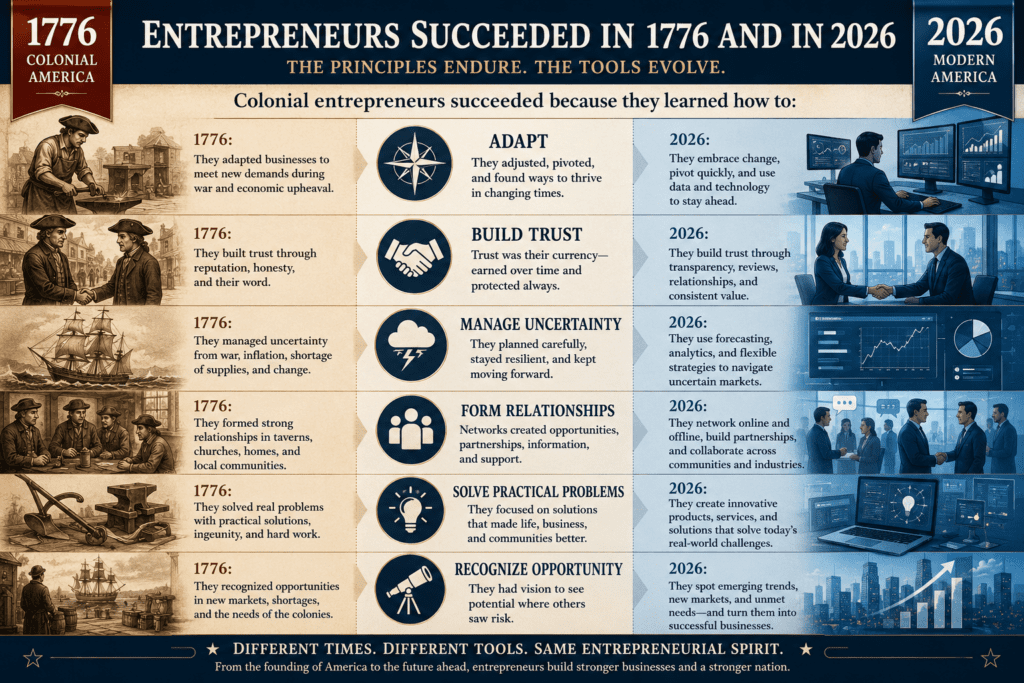
Colonial entrepreneurs succeeded because they learned how to:
- adapt,
- build trust,
- manage uncertainty,
- form relationships,
- solve practical problems,
- and recognize opportunity during periods of disruption.
Those same skills continue shaping successful businesses throughout the United States of America today.
One of the clearest lessons from the founding of America involves adaptability.
Entrepreneurs during the American Revolution constantly adjusted to:
- shortages,
- unstable currency,
- changing governments,
- dangerous transportation,
- military conflict,
- and supply-chain disruptions.
Manufacturers such as James Hunter transformed ordinary iron works into critical military suppliers. Printers shifted from local advertising to political communication networks. Merchants adapted to embargoes, tariffs, and wartime trade disruptions.
Modern entrepreneurs face different forms of disruption:
- inflation,
- economic uncertainty,
- technology shifts,
- cybersecurity threats,
- changing regulations,
- labor shortages,
- and rapidly evolving markets.
The tools have changed, but the need to adapt has not.
Another major lesson from 1776 is the importance of relationships.
Before modern banking systems, most colonial entrepreneurs depended heavily on:
- trust,
- partnerships,
- reputation,
- family networks,
- merchant credit,
- and local communities.
A handshake in a tavern could launch a business relationship that lasted years. Personal reputation often determined whether someone received financing, transportation assistance, or commercial opportunities.
Even today, relationships remain central to entrepreneurship despite modern technology. Networking, referrals, partnerships, reputation, and trust still influence business success throughout the modern American economy.
That reality becomes especially clear when studying the taverns, ports, and gathering places that connected people during the founding of America. Taverns during the American Revolution often functioned as the business networking centers of colonial society — much like restaurants, conferences, and professional gatherings today.
The same pattern appears throughout many Revolutionary-era stories explored in the RetireCoast 250th Anniversary series.
For example, our article on The Mississippi Gulf Coast and the American Revolution explores how geography, trade routes, shipping access, and local knowledge shaped both military and economic strategy along the Gulf Coast during the founding of America.
Likewise, Esek Hopkins and the First American Navy demonstrate how logistics, supply chains, weapons procurement, and maritime transportation became essential components of both military success and commercial activity during the American Revolution.
Entrepreneurship in 1776 was deeply connected to transportation and trade.
That is also evident in the story of Bernardo de Gálvez and Spain’s Support for American Independence, where international shipping networks, Gulf Coast ports, and coordinated logistics played a critical role in supporting America’s independence movement.
At the same time, the Revolutionary era also reminds modern entrepreneurs that economic progress often carries a tremendous human cost.
The realities explored in:
- British Prison Ships During the Revolutionary War,
- Camp Followers of the Revolutionary War,
- and Women of the Revolutionary War
reveal how ordinary people endured enormous hardship while supporting families, communities, and the broader struggle surrounding the Declaration of Independence and the founding of America.
These stories help modern readers understand that entrepreneurship in 1776 existed within a much larger human struggle involving survival, sacrifice, labor, and resilience.
Another lesson from colonial America involves the importance of long-term thinking.
Many entrepreneurs during the American Revolution were not simply trying to survive the next month — they were attempting to build businesses, land holdings, trade relationships, and family legacies that could last generations.
That same concept appears in modern discussions about:
- wealth preservation,
- estate planning,
- business succession,
- and legacy building.
Our article What 1776 Teaches Retirees About Legacy Planning explores how the Founding generation thought carefully about inheritance, property, responsibility, and the future they hoped to leave behind.
The comparison between 1776 and today also reveals how dramatically prices, wages, and purchasing power have changed over time.
Our article 250 Years of Price Shock explores how the costs of everyday goods evolved from the colonial American economy into the modern marketplace. Entrepreneurs in 1776 faced many of the same concerns business owners discuss today:
- inflation,
- supply costs,
- labor expenses,
- transportation costs,
- and purchasing power.
Perhaps most importantly, studying entrepreneurship during the American Revolution reminds us that the Founding generation consisted of real people navigating uncertainty rather than mythical historical figures.
Our article Who We Were in 1776 examines the everyday realities of life during the founding of America — including the workers, merchants, families, craftsmen, laborers, women, soldiers, and entrepreneurs who helped shape the early United States of America.
In many ways, the entrepreneurs of 1776 were not so different from entrepreneurs today.
They worried about:
- paying bills,
- finding customers,
- managing debt,
- securing supplies,
- training workers,
- building reputations,
- and surviving uncertain economic conditions.
What changed over 250 years was not the entrepreneurial spirit itself.
What changed were the tools available to pursue opportunity.
That may be one of the most important lessons modern entrepreneurs can still learn from the founding of America:
Innovation matters, but resilience, adaptability, trust, and relationships remain timeless foundations of successful business ownership.
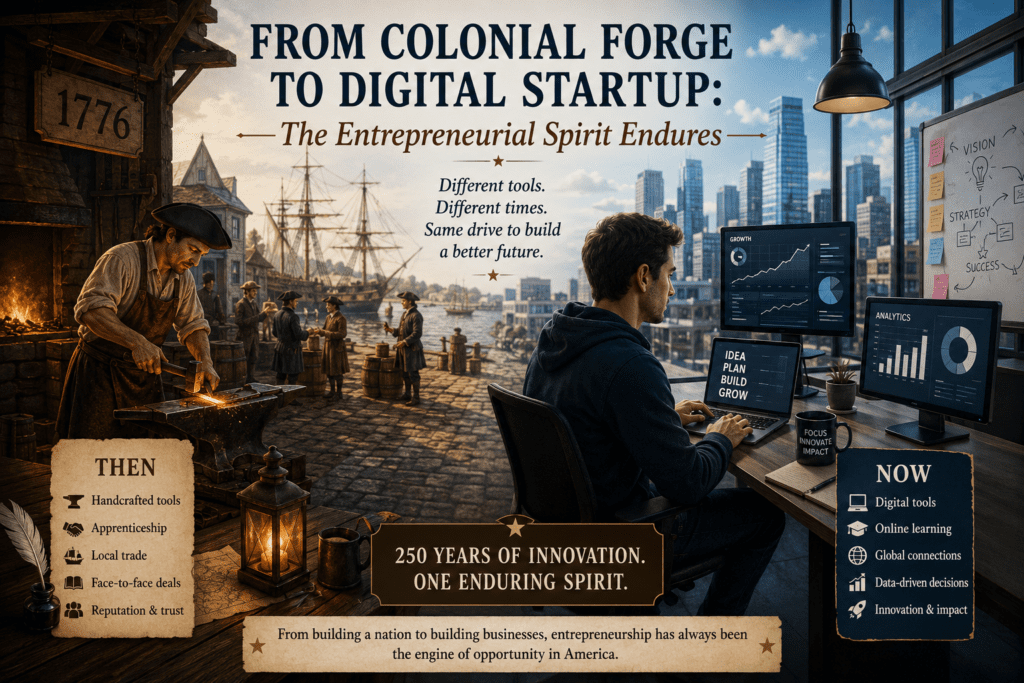
From Colonial Forge to Digital Startup: The Entrepreneurial Spirit Endures
More than 250 years separate the founding of America from the modern digital economy, yet the entrepreneurial spirit that helped shape the United States of America remains remarkably recognizable today.
In 1776, entrepreneurs built businesses with:
- handwritten ledgers,
- apprenticeships,
- wagons,
- sailing ships,
- local reputation,
- and face-to-face relationships.
Modern entrepreneurs operate through:
- smartphones,
- artificial intelligence,
- online banking,
- digital marketing,
- cloud software,
- and global communication systems.
The tools have evolved dramatically.
The human drive to create opportunity has not.
The entrepreneurs of the American Revolution faced extraordinary uncertainty. They operated during:
- political upheaval,
- war,
- inflation,
- supply shortages,
- dangerous transportation,
- and unstable financial systems.
Yet they continued building businesses anyway.
Printers continued publishing newspapers.
Blacksmiths continued forging tools and weapons.
Merchants continued trading goods.
Manufacturers expanded production.
Tavern owners created gathering places where information and opportunity flowed through colonial communities.
They adapted because they believed opportunity still existed despite uncertainty.
That same mindset continues driving entrepreneurs throughout the modern American economy today.
Small business owners in 2026 still wake up every morning thinking about:
- customers,
- cash flow,
- marketing,
- staffing,
- financing,
- competition,
- and long-term survival.
The details may differ from 1776, but the emotional realities of entrepreneurship remain surprisingly familiar.
One of the strongest lessons from studying the founding of America is that entrepreneurship has always depended heavily on knowledge and adaptability.
Colonial entrepreneurs spent years learning:
- trades,
- accounting,
- negotiation,
- manufacturing,
- transportation,
- and relationship-building
before operating independent businesses.
Today, entrepreneurs can shorten that learning curve dramatically through:
- online education,
- business tools,
- mentorship,
- digital resources,
- professional networks,
- and modern financial systems.
Knowledge that once required years of apprenticeship can now be learned far more quickly — one of the greatest advantages available to modern entrepreneurs.
At the same time, studying 1776 reminds us that tools alone do not guarantee success.
The entrepreneurs who survived and succeeded during the American Revolution shared traits that still matter today:
- resilience,
- discipline,
- creativity,
- adaptability,
- persistence,
- and the willingness to continue moving forward during uncertain times.
Those characteristics helped build the early American economy.
They continue shaping successful businesses today.
The story of entrepreneurship during the founding of America is ultimately not just about:
- muskets,
- taverns,
- printers,
- merchants,
- iron works,
- or shipping routes.
It is about people.
It is about individuals who recognized opportunity, accepted risk, learned valuable skills, formed partnerships, adapted to changing conditions, and attempted to create better futures for themselves, their families, and their communities.
That story remains deeply connected to the American experience more than 250 years later.
Whether operating:
- a colonial forge in Virginia,
- a print shop in Philadelphia,
- a merchant business in Boston,
- or a digital startup in 2026,
entrepreneurs continue participating in the same long tradition of innovation, problem-solving, and opportunity-building that helped shape the United States of America from the very beginning.
As America approaches the 250th anniversary of the Declaration of Independence, studying the entrepreneurs of 1776 offers more than historical curiosity.
It offers perspective.
The Founding generation built businesses and communities during one of the most uncertain periods in American history. Their experiences remind us that innovation, adaptability, and determination have always been central parts of the American economy.
And perhaps that is the final lesson of starting a business in 1776:
While technology changes, the entrepreneurial spirit that helped build America continues to endure across every generation.
REFERENCES
This article combines historical research, economic analysis, Revolutionary War studies, colonial business history, and modern entrepreneurship comparisons to examine what it was like starting a business in 1776 during the founding of America. The following historical organizations, archives, museums, and educational sources helped support the information presented throughout this article.
QUIZ
Entrepreneurship during the American Revolution required resilience, adaptability, trust, practical skills, and the ability to survive uncertain times. Take this short quiz to see how your modern business mindset might have performed during the founding of America.
The story of starting a business in 1776 is ultimately a story about resilience, adaptability, opportunity, and the willingness to build something meaningful during uncertain times. Colonial entrepreneurs operated with limited technology, unstable financing, dangerous transportation systems, and enormous personal risk — yet they still helped create the economic foundations of the United States of America.
More than 250 years later, modern entrepreneurs continue navigating many of the same challenges in different forms: competition, inflation, financing, regulation, labor management, supply chains, and rapidly changing markets. The tools have changed dramatically since the founding of America, but the entrepreneurial spirit that helped shape the American economy continues to endure.
RetireCoast’s America’s 250th Anniversary Series explores the people, businesses, military history, economics, innovation, sacrifices, and daily realities that helped shape the Revolutionary era. We invite you to continue exploring the entrepreneurs, manufacturers, printers, merchants, soldiers, women, and ordinary citizens who helped build the early United States of America.
PODCAST
Discover more from RetireCoast.com
Subscribe to get the latest posts sent to your email.