Last updated on July 24th, 2026 at 01:18 pm
Alligators are not just found in Florida. The Mississippi Gulf Coast has a large healthy population. Unlike Florida however, Alligators don’t usually knock at the door waiting to be let in. Mississippi Alligators are not as forward as those in Florida, they would rather avoid human contact.
Alligators in Mississippi generally do not swim in your pool. You have to go out of your way to see an Alligator in Mississippi unless you live on a bayou. As it happens, I do live on a bayou and the only Alligator that I have seen in my bayou the past many years has been a dead one on the bank while boating.
I thought that since I had not seen any there were very few. As it happens, I spoke with my neighbor who has a pier and boat house on the bayou. My neighbor told me that he had seen several Alligators on the bayou behind his house.
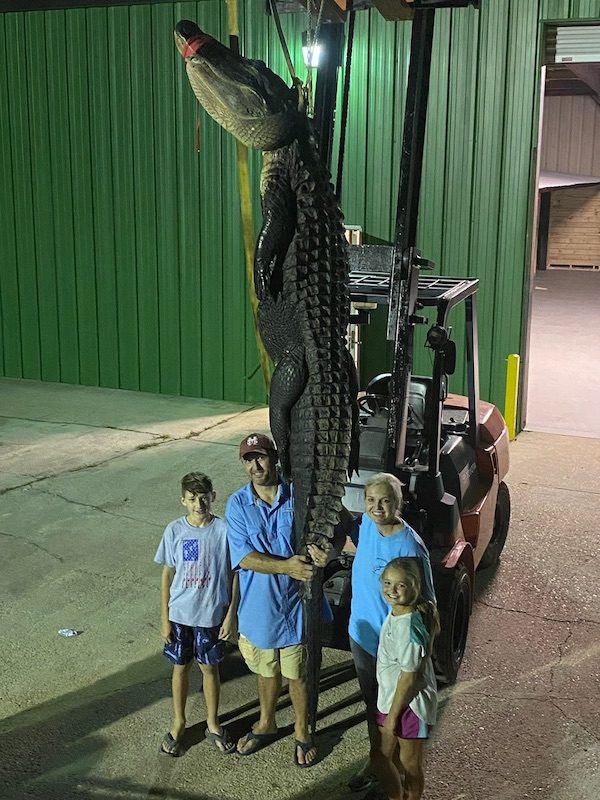
To make my astonishment even greater, he showed me a photo on his phone of a giant alligator. The photo was of an alligator hanging from a lift.
Horn Island has an alligator population living near freshwater ponds more than 10 miles offshore. Read about this in our comprehensive guide about Horn Island
The largest alligator ever captured in Mississippi
Read this article
Then, I learned that my neighbor down the street buys an alligator hunting license each year. This past year, he was in his boat on my bayou (his too) where he snagged this giant alligator. It took him and his family hours to deal with the alligator.
He had to tow it in the water behind his boat about 6 miles to a boat fueling dock where they had a forklift. See the photo below of this massive creature.
Another alligator story
Another story about alligators starts with a new housing development in Biloxi on the Mississippi Gulf Coast. My wife and I stopped by the development to look at the homes (my brother was interested in moving here). We noticed a large pond in the development. I asked the agent if there were any alligators in the pond.
She was reluctant to answer in the affirmative if we did not like alligators. I then told her we liked them as long as they stayed in their environment. At that point, she volunteered that someone told her that they had seen one.
My brother and his wife arrived and we stopped at the same agent’s office in the development and my brother asked about alligators. She paused and my brother said he did not want them around.
The agent said that she had never seen one. After we left the office, I told my brother about my encounter with her and we laughed. It seems people either like alligators or they do not. Some may prefer black bears walking about rather than alligators.
Alligator Hunting Stats for 2023
Mississippi
In 2023, Mississippi issued approximately 1,000 permits for alligator hunting. Notably, a record-breaking alligator was captured during the season, measuring 14 feet, 3 inches and weighing over 800 pounds.
Total Alligators Hunted in Mississippi: Around 1,000 alligators harvested
Florida
Florida’s alligator hunting season is highly regulated. In 2023, approximately 7,000 alligators were harvested across the state. The Florida alligator hunting program, which began in 1988, remains a model of sustainable wildlife management.
Total Alligators Hunted in Florida: Around 7,000 alligators harvested
Both Mississippi and Florida maintain strict regulations to ensure the sustainability of their alligator populations.
Alligators’ reputation precedes them
Unfortunately for alligators, their reputation from Florida proceeds them. We have all seen on TV or read an article about how an alligator dragged a person into the water and ate them. How about the number of alligators each year that end up in swimming pools or on the front porch?
Florida seems to have a unique alligator situation which has caused people to not move to Florida just because they did not want an unwanted guest. Nuisance alligators must be removed from private property and roads on a regular basis.
Southern Florida at times may seem to have more wild alligators than humans in the large swamps. This Florida situation is completely different than the Mississippi experience. Our alligators in Mississippi do not play golf so they will never be considered a hazard. In Florida, golf courses are their natural environment.
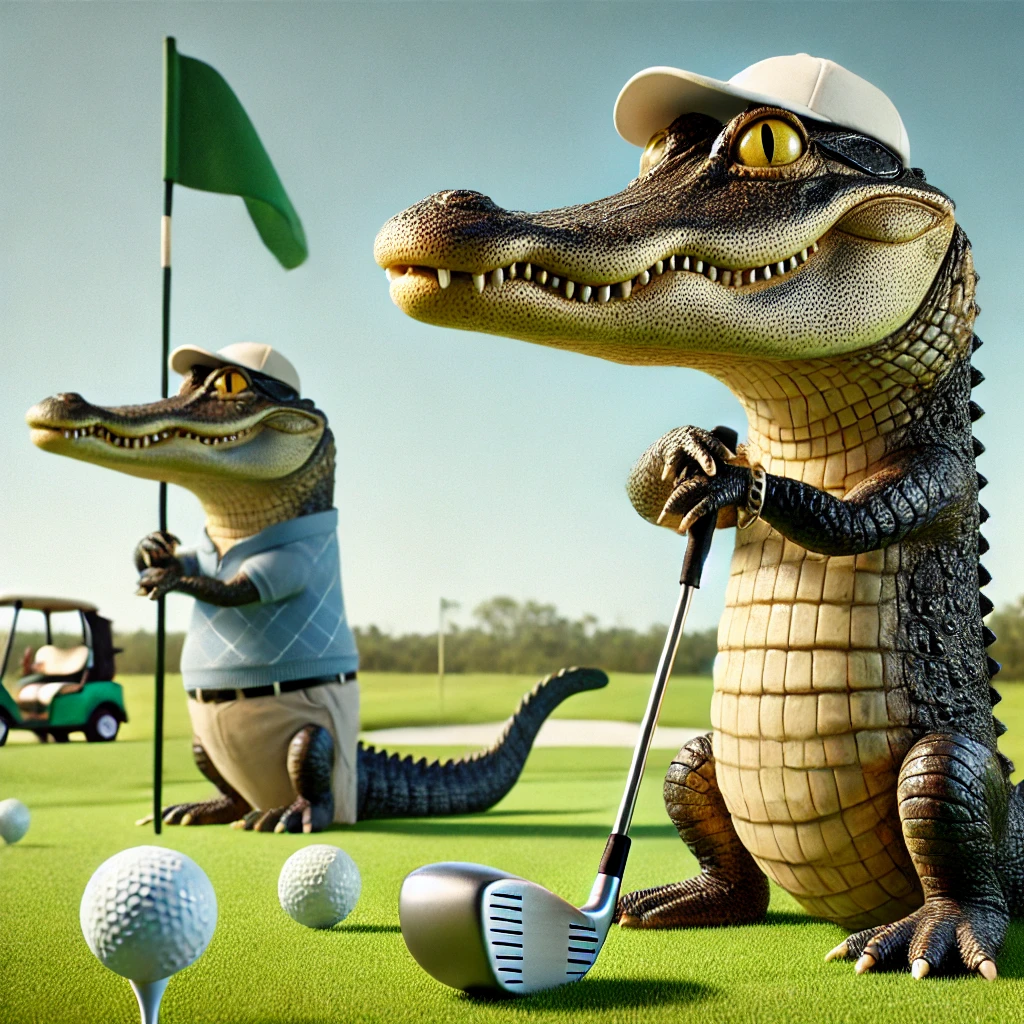
Alligators love the golf course
The first time you golf in Florida you will learn not to try and remove a ball from a water hazard. Not only will you have the typical hazards any golf course has but alligators are an added benefit. The first thing you do is to assess how fast your teammates can run. You will need to run faster.
After talking with a golfer friend, he indicated that from time to time he encounters a baby alligator on the golf course he plays on the Mississippi Gulf Coast. The course is very close to the Gulf and there are grasslands and bayous nearby. So far, no fatalities from baby alligators on any Mississippi golf course that I am aware of.
An alligator’s natural habitat in Mississippi is usually swimming in a bayou or river near the Gulf Coast. For some reason, alligators in Mississippi don’t care for open water or to walk along the side of the road.
The American Alligators (alligator mississippinensis):
- The most common and widely known species in the U.S. (the only one in the wild)
- Found primarily in the southeastern United States, including states like Florida, Louisiana, Georgia, Alabama, Mississippi, Texas, and the Carolinas.
- They inhabit freshwater environments like swamps, rivers, lakes, and marshes.
- Adult males can grow up to 15 feet (4.6 meters) in length, though most are smaller.
Alligators are often blamed for being alligators. They are opportunists. They will eat almost anything if they are hungry. People’s dogs and cats are often on the menu. We recommend that you keep our pets away from areas with alligators.
As you can see, Mississippi is one of the best places to see alligators at an alligator farm or at the Gulf Islands National Seashore located in Ocean Springs, Mississippi. There are several parts to the Gulf Islands National Seashore. The Davis Bayou Area is the facility that has alligators.
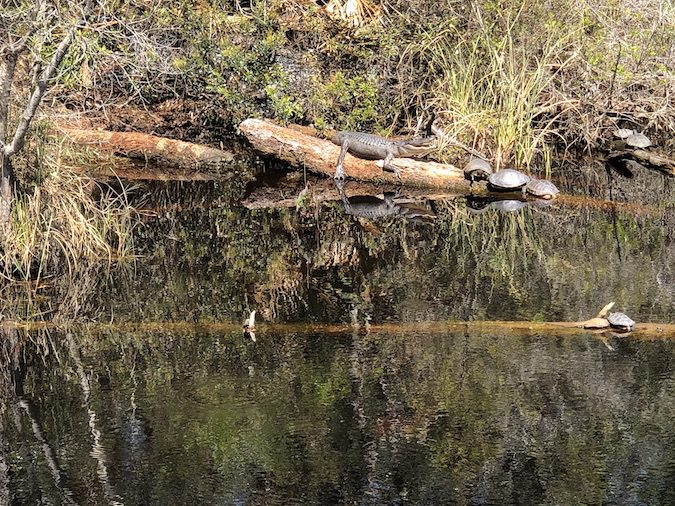
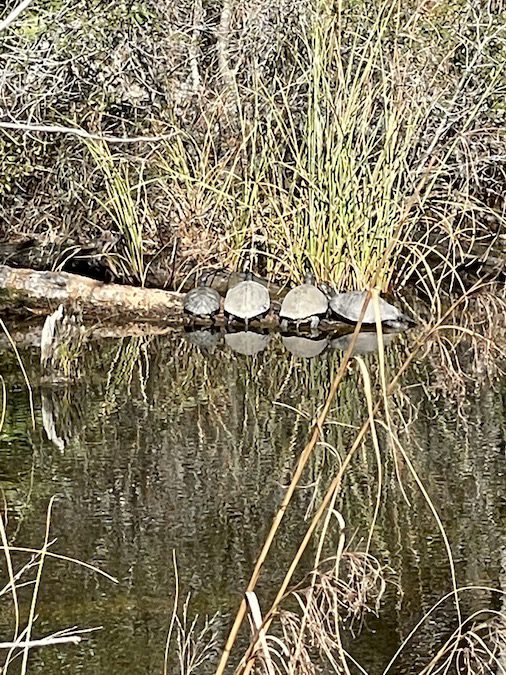
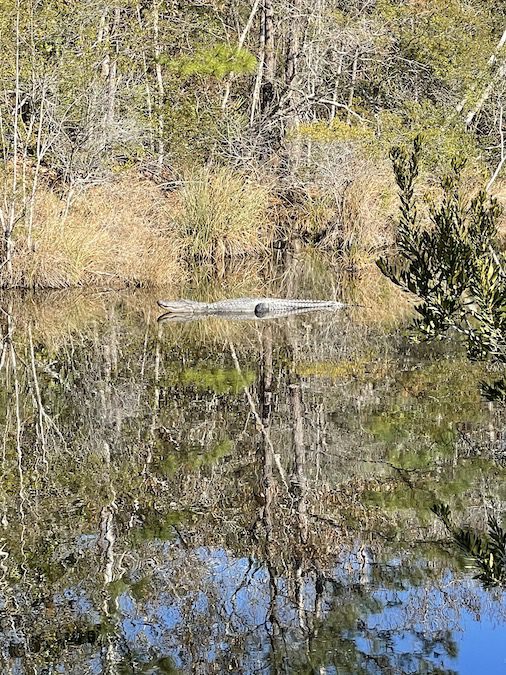
I have been there many times and some of the photos of alligators are below for you to see. My wife and I are not sure if it’s the same alligator or if the one we see is part of a family. The alligator is usually sunbathing and as mentioned often has turtles as company.
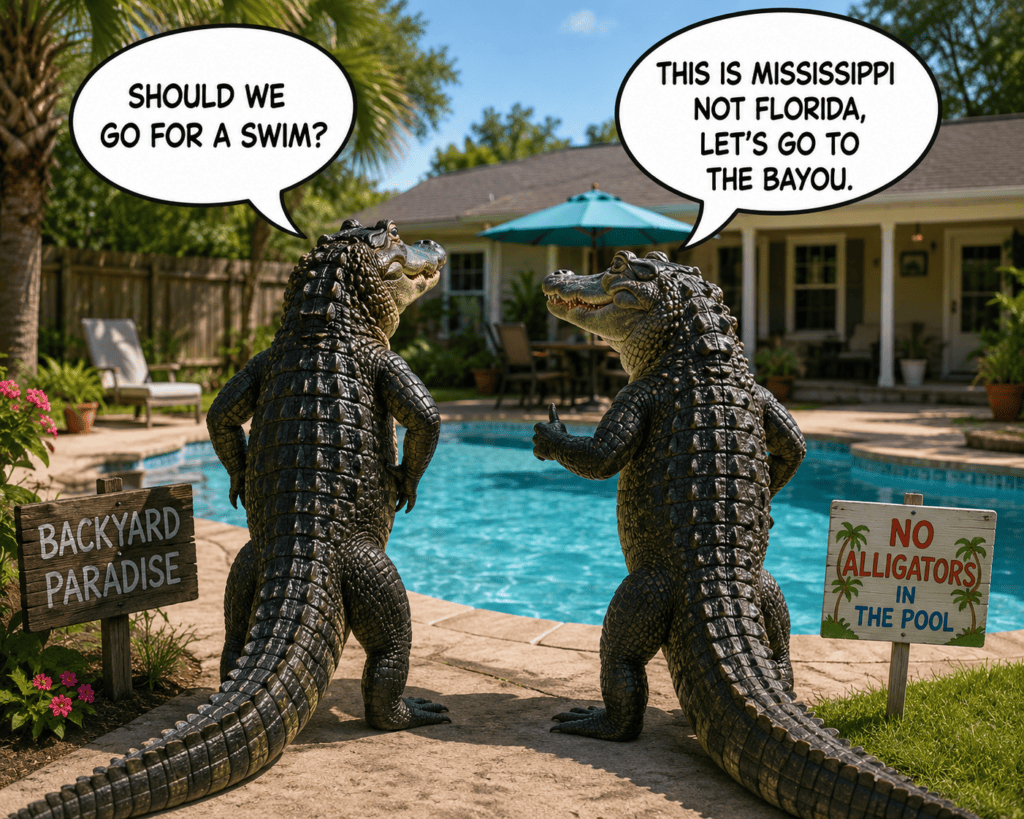
No alligator alley in Mississippi
Unfortunately, Mississippi does not have an alligator alley as you will find in Florida. Zoos in the South usually have alligators and sometimes in a live show. The best way to see an alligator is to arrive where they are expected to be in the afternoon when it’s warm and the sun is out.
As mentioned above, they love mud banks and sunny days. See the photo below of an alligator lounging on the mud bank while large wild turtles line up on a branch. Alligators love turtles yet they seem to coexist.
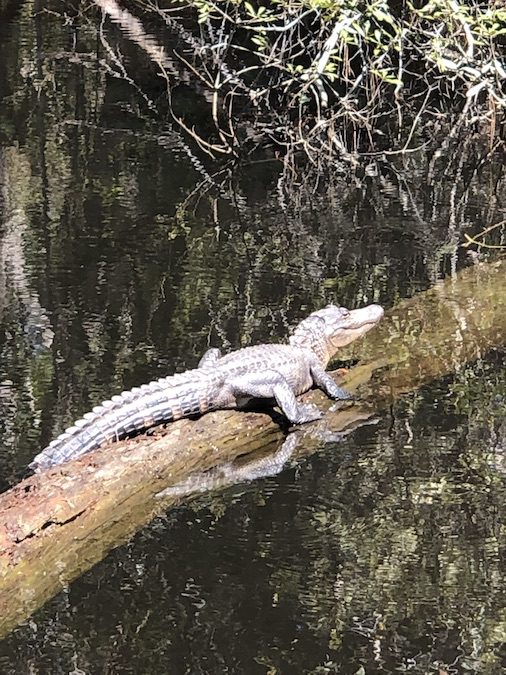
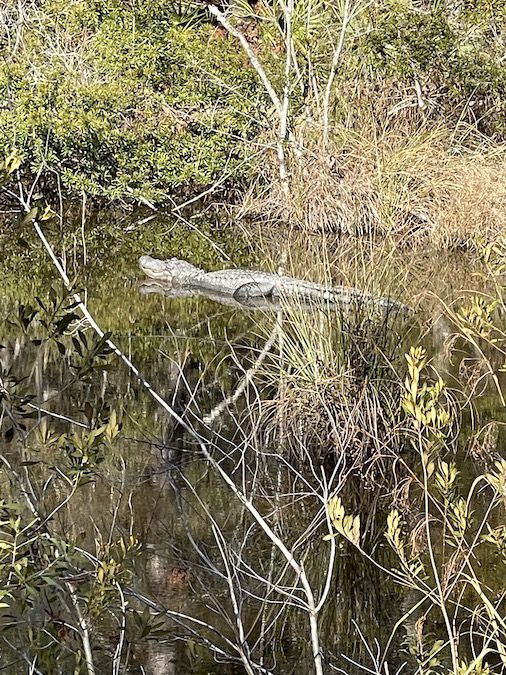
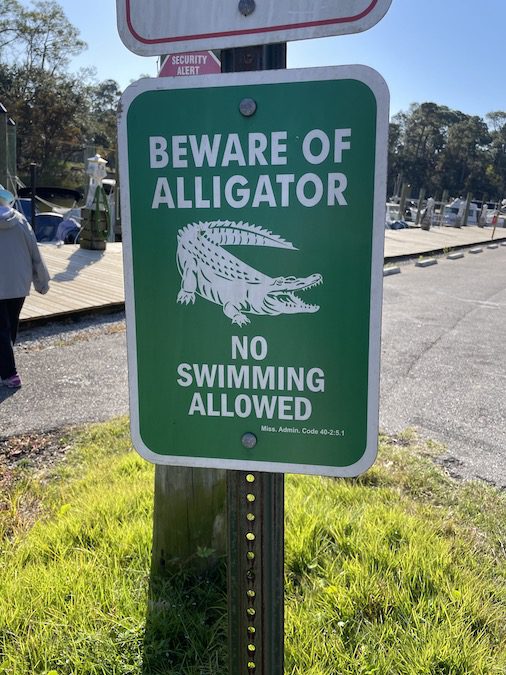
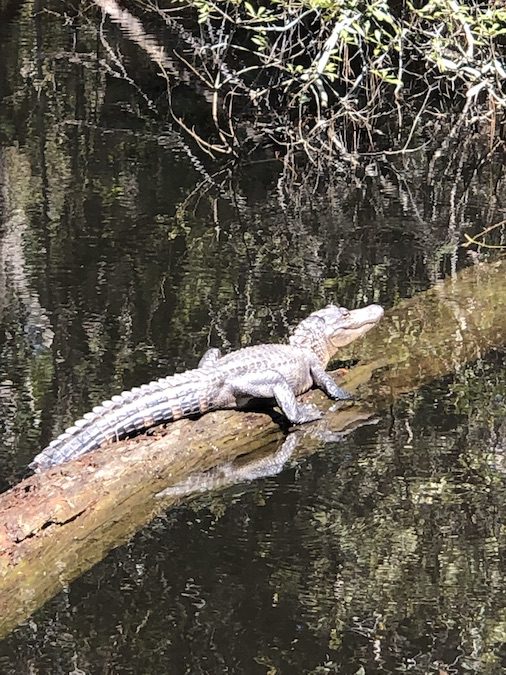
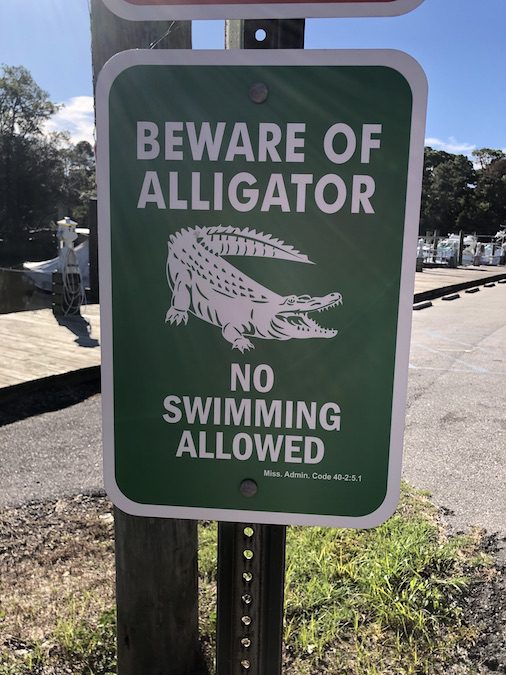
I recommend to people who come to the Mississippi Gulf Coast to see at least one live alligator. One place to find plenty of alligators is Horn Island located in the Gulf of Mexico just off of the Mississippi Gulf Coast. You must find someone with a boat to take you out there.
This island has some freshwater ponds where the alligators tend to congregate. They are further away from the areas where boaters love to camp. These alligators swim out from the mainland. Keep a safe distance from the alligators, they can be fast.
Best Time of Year to See Wild Alligators
If you’re looking to observe alligators in their natural habitat, the best time of year to do so is during the **spring and summer months**, specifically from **April to June**. Here’s why:
Warmer Weather and Activity
Alligators are cold-blooded reptiles, meaning they rely on external temperatures to regulate their body heat. As the weather warms up in the spring and summer, alligators become more active and are often seen basking in the sun along the banks of rivers, lakes, and wetlands.
Mating Season
The alligator mating season occurs during **late spring and early summer**, making these months a particularly active time for alligator movement. You may hear male alligators bellowing to attract females, and they may be seen moving more frequently to find mates.
Best Months to See Alligators: April, May, and June
Where to Spot Them
Alligators are commonly found in **freshwater habitats** like swamps, rivers, lakes, and marshes, particularly in the southeastern U.S. states such as **Florida**, **Louisiana**, **South Carolina**, and **Georgia**.
While alligators can be seen year-round in warmer climates, they are most visible when the temperatures rise. Always remember to keep a safe distance when observing them in the wild.
Alligators can run how fast?
Alligators are surprisingly fast on land over short distances. They can run up to **35 miles per hour (56 kilometers per hour)** in short bursts. However, this speed is usually only seen when they are trying to escape a threat rather than chase prey.
Their sprinting speed is impressive, but it’s important to note that alligators tire quickly and are not built for long-distance running. They typically use this speed to move between water sources or when they feel threatened, so they’re more dangerous in the water than on land.
Most experts recommend that if you ever need to run from an alligator, run in a straight line as they usually give up after a short chase.
The Gulf Coast Gator Ranch
A great place to see alligators in their natural environment is a swamp at the Gulf Coast Gator Ranch. Located in Moss Point, MS, they take you on airboat rides and point out a baby alligator from time to time. Often alligators only have their nose and eyes sticking out of the water so they are hard to spot.
A friend of mine who lives in Louisiana (another place with lots of alligators) can spot an alligator in a pond while driving on the interstate. If you go to the Gator Ranch, take a closer look at the ripple in the water. Feeding time is always interesting.
Your guided tour on the airboat tour is a great way to experience part of the country most people never see. There are other wild animals in the swamp which are all potential food for an alligator.
Nature lovers will appreciate the natural landscape. If you are lucky you may see a white-tailed deer which a lucky alligator may catch from time to time.
What Do Alligators Eat?
Alligators are carnivorous and their diet varies depending on their size and age. Here’s a breakdown of what alligators typically eat at different life stages:
Young Alligators
- Insects like beetles, snails, and spiders
- Small fish and amphibians
- Crustaceans like crabs and crawfish
Adult Alligators
- Fish such as gar, catfish, and bass
- Birds including waterfowl and wading birds
- Small mammals such as muskrats and raccoons
- Reptiles like turtles and snakes
Larger Alligators
- Large mammals including deer and wild boar
- Occasionally other alligators
- Scavenge on carrion when available
Alligators are opportunistic feeders and will consume almost any animal they can catch. They typically swallow smaller prey whole and tear larger prey into smaller, digestible pieces.
Cajun Encounters Tour Co
Another place to experience alligators in a swamp is the Cajun Encounters Tour Co. located near New Orleans. They use flat-bottomed boats to guide you through the swamp. You will see giant cypress trees covered with moss and some of the largest birds in North America plus abundant wildlife.
There are many types of wildlife living with the alligators. They include possums, nutras, raccoons, deer, foxes, bobcats and more. The alligator show is similar to the Gulf Coast Gator Ranch but for those of you who can not get enough of the swamp, try out the Cajun Encounters operation.
Taking one of the swamp tours is an unforgettable experience for those who live in the big city. Our swamps are not the same as the Florida Everglades but they are big enough to give you a sense of being in a strange new environment.
Please leave comments and tell us how the article can be improved.
Here is a breakdown of peak American Alligator (Alligator mississippiensis) statistics, covering historical size records, biology, and physical performance.
📊 Ultimate Alligator Records & Biological Stats
🏆 All-Time Record Holders
| Category | Record / Measurement | Details & Location | Notes |
| Longest (Verified) | 15 ft 9 in(4.80 m) | Mandy Stokes Alligator (2014) — Alabama River, AL | Officially measured by wildlife biologists; weighed 1,011.5 lbs. |
| Heaviest (Recorded) | 1,380 lbs(625.9 kg) | Mike Cottingham Alligator (2012) — Arkansas | Measured 13 ft 3 in; contained an entire 5 ft alligator in its stomach. |
| Heaviest (Certified State Record) | 1,043 lbs(473.1 kg) | Orange Lake / Gainesville Gator (1989) — Florida | Longest-standing official state weight record in Florida. |
| Longest Unverified Claim | 19 ft 2 in(5.84 m) | Marsh Island Gator (1890) — Vermilion Parish, LA | Shot by E.A. McIlhenny; measured with a gun barrel, but no official carcass preserved. |
📏 Average Physical Benchmarks
| Metric | Adult Male | Adult Female |
| Average Length | 11.2 to 13 ft (3.4 – 4.0 m) | 8.2 to 9.8 ft (2.5 – 3.0 m) |
| Average Weight | 500 to 1,000 lbs (227 – 453 kg) | 200 to 400 lbs (90 – 181 kg) |
| Hatchling Size | ~9 to 10 in (23 – 25 cm) | ~9 to 10 in (23 – 25 cm) |
| Hatchling Weight | 1.5 to 2.0 oz (42 – 56 g) | 1.5 to 2.0 oz (42 – 56 g) |
⚡ Performance & Biological Extremes
| Feature | Dynamic | Key Detail |
| Bite Force | ~2,125 to 2,980 lbsper sq in (PSI) | One of the strongest laboratory-measured bites in the animal kingdom, capable of crushing bone and turtle shells. |
| Top Land Speed | Up to 11 – 15 mph(short bursts) | Fast initial lunges, but they fatigue quickly on land due to lactic acid buildup. |
| Top Swim Speed | Up to 20 mph | Driven by powerful, muscular tails that act as propulsive rudders. |
| Lifespan | 30 to 50+ years | Can live over 60–70 years in protected or captive environments. |
Note on Measurements: While 18th- and 19th-century accounts often cited wild gators stretching 18 to 20 feet, modern biological standards generally recognize the 15-foot-9-inch Alabama specimen as the benchmark for definitive, scientifically verified wild length.
Here is the estimated wild American alligator (Alligator mississippiensis) population broken down by state:
🐊 Estimated Wild Alligator Population by State
| Rank | State | Estimated Wild Population | Key Habitat / Primary Regions |
| 1 | Louisiana | ~2,000,000 | Coastal marshes, Atchafalaya Basin, bayous (plus ~1M on commercial farms) |
| 2 | Florida | ~1,300,000 | Everglades, Lake Okeechobee, inland lakes, rivers, & canals statewide |
| 3 | Texas | 400,000 – 500,000 | East Texas piney woods, Trinity River basin, & Gulf coast marshes |
| 4 | Georgia | 200,000 – 250,000 | Okefenokee Swamp, coastal rivers, & areas south of the Fall Line |
| 5 | South Carolina | ~100,000 | Lowcountry coastal marshes, ACE Basin, & Santee Cooper lakes |
| 6 | Alabama | ~70,000 | Mobile-Tensaw Delta, coastal waterways, & southern river systems |
| 7 | Mississippi | 32,000 – 38,000 | Coastal bayous, Pascagoula River basin, & Ross Barnett Reservoir |
| 8 | Arkansas | 2,000 – 3,000 | Millwood Lake, Arkansas River Valley, & southern oxbow lakes |
| 9 | North Carolina | 1,000+ | Coastal wetlands south of Albemarle Sound & Cape Fear River |
| 10 | Oklahoma | 100 – 200 | Southeastern tip (Red River basin & Little River NWR) |
📌 Regional Context & Notes
- Total US Population: Estimated at over 4 million wild alligators in the Southeastern United States.
- Concentration: Louisiana and Florida combined account for roughly 75–80% of the entire wild population.
- Geographic Limits: Their native range is strictly bounded by winter freeze lines; populations in North Carolina, Arkansas, and Oklahoma represent the extreme northern/western limits where cold weather slows growth rates.
🏛️ Federal Protection Status
Under the U.S. Endangered Species Act (ESA), the American alligator is federally listed as “Threatened Due to Similarity of Appearance” (S/A).
- Why? Biological populations are healthy and no longer at risk of extinction. However, the federal government maintains this listing to protect the American Crocodile (which is endangered). Because alligator and crocodile hides look virtually identical when processed, regulating all crocodilian trade prevents poachers from illegally harvesting protected crocodiles and selling their hides under the guise of legal alligator skin.
- Impact: It is a federal crime to transport, buy, or sell alligator hides, meat, or parts across state or international borders without proper CITES tags and federal permits.
📜 State-Level Rules & Regulations
In all 10 native states (LA, FL, TX, GA, SC, AL, MS, AR, NC, OK), state wildlife agencies maintain strict protective laws:
| Action | Legal Status | Details |
| Killing or Poaching | 🚫 Illegal | It is illegal to shoot, trap, or kill an alligator without a valid state tag/permit. |
| Harassment or Capture | 🚫 Illegal | You cannot catch, handle, feed, or intentionally disturb wild alligators. |
| Feeding | 🚫 Illegal | Feeding wild gators is a misdemeanor in almost every state because it causes them to lose their natural fear of humans. |
| Regulated Hunting | ✅ Permitted | Most native states run highly controlled annual hunting lotteries/seasons where a strictly limited number of tags are issued. |
| Nuisance Gators | ✅ Managed | Only certified, state-contracted nuisance trappers or wildlife officers are legally allowed to remove or euthanize problem alligators. |
An alligator’s daily travel distance depends heavily on whether it is going about its normal routine or trying to get back to its home territory.
🏃 Distance Breakdown: Routine vs. Maximum
   ┌──────────────────────────────────────────────────────────────┐
   │ Typical Daily Routine (Forging/Basking)                       │
   │  [==========] 0.5 – 2.0 Miles                                │
   │                                                              │
   │ Long-Distance Migration / Homing (Driven & Direct)           │
   │  [=================================================>] 5 – 10+ Miles
   └──────────────────────────────────────────────────────────────┘
1. Typical Daily Routine: 0.5 to 2 Miles
- In-Habitat Range: Under normal circumstances, an alligator is an ambush predator built for energy conservation. In its home territory (a lake, bayou, or marsh system), an adult male typically travels between 0.5 and 2 miles (0.8 to 3.2 km) per day.
- Females vs. Males: Adult females usually stay within tighter home ranges (often under 0.5 miles a day), especially when nesting or tending to hatchlings. Males cover broader territories, patrolling several miles of water per week to monitor food sources and females.
2. Directed Travel or Homing: 5 to 10+ Miles
- Relocation Homing: When an alligator is displaced or driven by necessity (like mating season in the spring or finding water during a severe drought), its daily output surges. Alligators possess a powerful homing instinct.
- Long-Distance Bursts: GPS satellite-telemetry tracking studies show that adult alligators actively trying to return to their home range can travel 5 to 10+ miles in a single 24-hour period through interconnected waterways.
🧭 Key Factors Influencing Daily Movement
- Homing Ability: Because alligators can navigate back to their original capture site even after being relocated over 100 miles away, state wildlife agencies generally do not relocate “nuisance” alligators. They will simply walk or swim right back.
- Water vs. Land: Alligators prefer to do nearly all of their long-distance travelling via continuous waterways, where they can glide efficiently at 2–3 mph using minimal energy. Overland travel is much more taxing; while they canmarch miles overland between isolated ponds if forced by drought, they must stop frequently to cool down and rest.
- Seasonal Drivers:
- Spring (April–June): Activity peaks during breeding season when males actively search for mates.
- Summer/Drought: Fluctuating water levels or rising salinity levels force gators out of coastal estuaries and into deeper freshwater.
- Winter: Daily movement drops to near zero as they enter brumation (a dormant state).
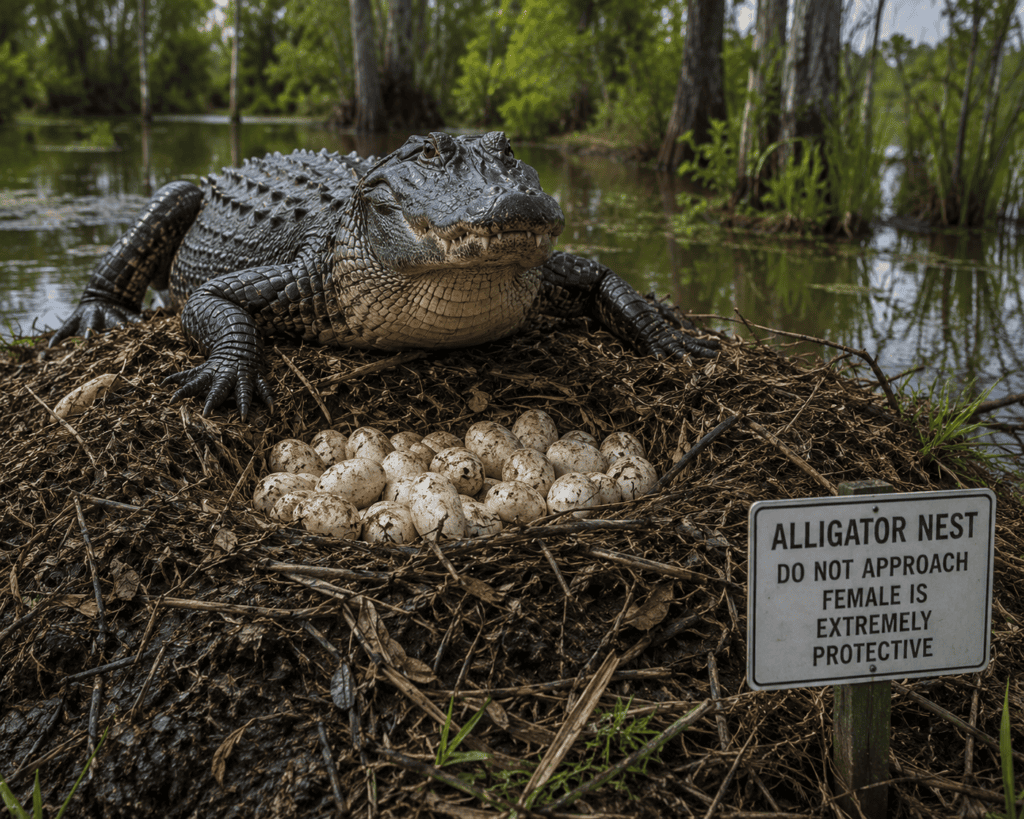
An American alligator typically lays a clutch of 30 to 50 eggs per nest.
However, the exact number depends heavily on the female’s age, size, health, and location:
🥚 Nest & Egg Statistics
| Metric | Average / Range | Notes |
| Typical Clutch Size | 30 to 50 eggs | Standard size for a mature, healthy female. |
| Maximum Record Clutch | Up to 70 – 90 eggs | Exceptionally large, older females can lay massive clutches, though 60+ is rare. |
| Minimum Clutch Size | 10 to 20 eggs | Common for young, first-time nesting females. |
| Frequency | 1 clutch per year | Layed during early summer (late May through June). |
| Incubation Time | ~65 days | Eggs hatch in late August to early September. |
🌡️ The “Cool” Biological Details
- Size of an Egg: An alligator egg is roughly the size of a large goose egg—about 3 inches long with a hard, porcelain-like shell.
- Temperature Determines Sex: Alligator eggs do not have sex chromosomes. The temperature of the nest during the middle third of incubation determines whether the hatchlings are male or female:
- Warm Nests (90°F / 32.5°C and above): Result in mostly males.
- Cool Nests (86°F / 30°C and below): Result in mostly females.
- Mid-range (87°F – 89°F): Yields a mix of both sexes.
Survival Rate Note: While a female may lay 40+ eggs, nature keeps the population in balance. Due to nest flooding, extreme heat, and predators like raccoons, wild hogs, wading birds, and fish, less than 10% of hatchlings survive to reach their first birthday.
Discover more from RetireCoast.com
Subscribe to get the latest posts sent to your email.