Introduction
The Isle of Caprice is unlike any other island in the Mississippi Gulf Coast Barrier Islands series because it no longer exists. While visitors can still explore Horn Island, Ship Island, Deer Island, and Cat Island today, the Isle of Caprice has disappeared beneath the waters of the Mississippi Sound—yet its remarkable history continues to capture the imagination of historians, divers, and Gulf Coast residents.
The island has been known by several names throughout history. In Gulf Coast folklore, it was often referred to as Dog Island or Dog Key, names that likely originated from the nearby Dog Keys Shoals, a hazardous stretch of shallow water that challenged sailors for centuries.
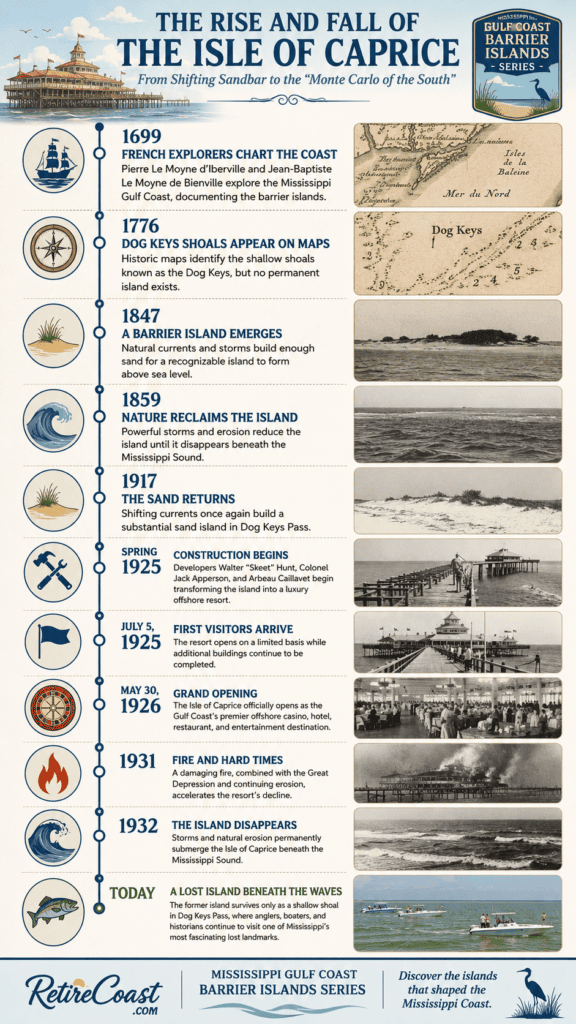
During the British and early Spanish colonial era, maps from 1776 identified the area as the Dog Keys Shoals, not as a true island but as a dangerous underwater obstacle for wooden sailing ships navigating the Mississippi coast.
The Isle of Caprice was never a permanent landform. Historical records show that it was an ephemeral barrier island, appearing and disappearing as storms, tides, currents, and shifting sands reshaped the Gulf Coast.
Re-emerged around 1917
It is believed to have washed away entirely by 1859, re-emerged around 1917, grown into the famous resort and casino island of the 1920s, and then disappeared beneath the Gulf once again after powerful hurricanes by 1932.
Even these cycles of disappearance may not have been the first. Local Gulf Coast traditions preserve Native American stories describing a mysterious “disappearing island” in this same pass, suggesting that sandbars and shoals may have periodically risen above the surface only to be reclaimed by the sea long before European settlement.
While these accounts cannot be verified archaeologically, they align remarkably well with the area’s long history of shifting shoals and changing coastlines.
Today, almost nothing remains above the water to mark where the Isle of Caprice once stood.
Yet beneath the waves lies one of the most fascinating stories in Mississippi history—a tale of a glamorous resort, illegal gambling, big-band entertainment, devastating hurricanes, and the relentless forces of nature that created an island, made it famous, and ultimately erased it from the map.
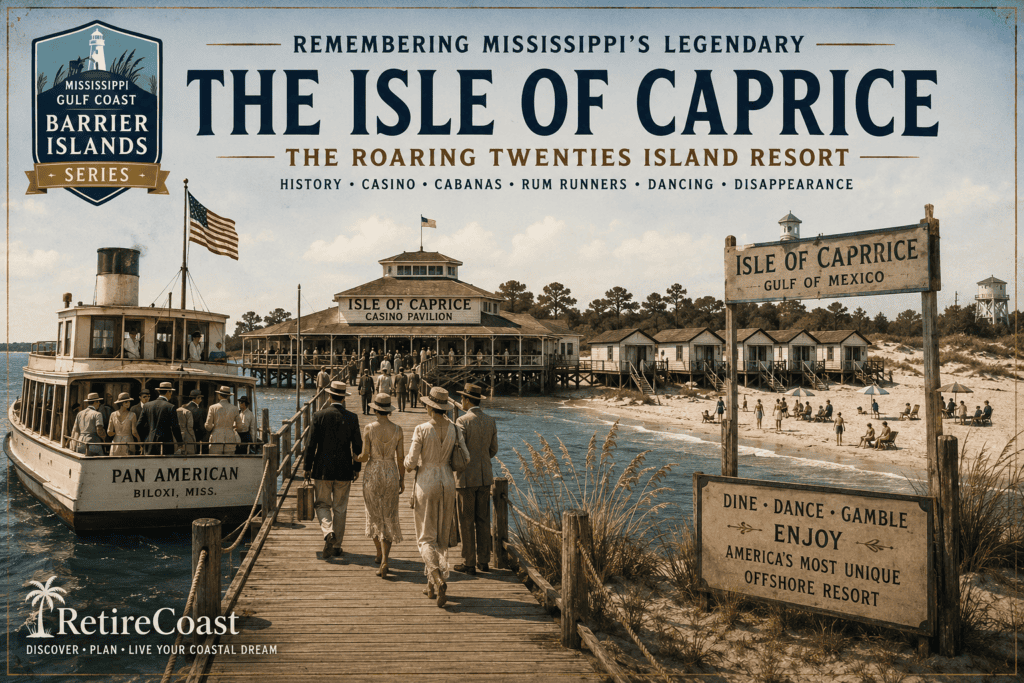
Step back into the Roaring Twenties and discover the remarkable story of the Isle of Caprice, Mississippi's legendary offshore casino resort that once attracted hundreds of visitors to the middle of the Mississippi Sound.
In this episode, we follow the island from its beginnings as Dog Island through its transformation into a glamorous destination filled with jazz, dancing, gambling, beach cabanas and elegant nights beside the Gulf of Mexico.
- Why the Isle of Caprice formed in the Mississippi Sound
- How developers built a resort on a low, shifting barrier island
- How Captain Pete Skrmetta and the Pan American ferry carried visitors offshore
- What guests experienced inside the casino and dance pavilion
- How Prohibition, rum runners and offshore gambling shaped the island's reputation
- Why storms, erosion and changing currents eventually erased the island
The story includes historical facts, colorful local legends and original RetireCoast reconstructions that help bring this vanished Mississippi destination back to life.
This podcast is part of the RetireCoast series exploring Horn Island, Ship Island, Cat Island, Deer Island and the vanished Isle of Caprice. After listening, explore the complete illustrated guide with maps, historical reconstructions, photographs and additional island history.
Author’s Note
One of the things I enjoy most about exploring the Mississippi Gulf Coast is visiting places that few people ever get to experience. The last time I was boating near Horn Island, I found myself looking across the Mississippi Sound and wondering exactly where the Isle of Caprice once stood.
I never found it—although I have joked that my boat’s propeller may have bumped the old island because much of the former site now lies only a few feet beneath the surface.
This guide is different from every other article in our Mississippi Gulf Coast Barrier Islands series because the Isle of Caprice is no longer an island at all. Horn Island, Ship Island, Deer Island, and Cat Island are still here to explore, but Caprice has been reclaimed by the Gulf, leaving behind little more than underwater shoals and an extraordinary story.
What fascinated me most wasn’t simply that an island disappeared—it was that an entire community disappeared with it. Hotels, dance halls, casinos, boardwalks, docks, and the infrastructure that supported one of the Gulf Coast’s most famous entertainment destinations all vanished beneath the water.
Nature created the island, people transformed it into a thriving resort, and then the Gulf quietly took it back.
That’s a story worth preserving. Even though you can’t walk its beaches today, the Isle of Caprice remains an important chapter in Mississippi’s coastal history, and it deserves its place in this series exploring the remarkable barrier islands of the Mississippi Gulf Coast.
Credit for the information collected for this article goes to several sources listed at the end of this article. As no living visitors are here to tell their story, we needed to scour archives to paint a complete story, please enjoy our article.
— Bill Anderson
Founder, RetireCoast.com
- Introduction
- Where Was the Isle of Caprice?
- How Big Was the Isle of Caprice?
- Getting to the Isle of Caprice
- Who Visited the Isle of Caprice?
- The Roaring Twenties: Dancing, Jazz, and a Night to Remember
- Why Build a Resort on a Vanishing Island?
- Building a Luxury Resort on a Sand Island
- The Freshwater Miracle
- Who Owned the Isle of Caprice?
- Prohibition and the Rum-Runners
- Before the Resort: A Wild Barrier Island
- Building an Island Resort in Record Time
- Racing Against the Calendar
- A Remarkably Fast Construction Schedule
- An Amphibious Construction Project
- Barges Carried an Entire Resort Across the Mississippi Sound
- Building on Sand
- Drilling for Fresh Water
- Biloxi’s Maritime Workforce
- The Death of the Isle of Caprice
- The Island Slips Beneath the Gulf
- A Barrier Island That Returned to the Sea
- Could the Isle of Caprice Return?
- Who Owns the Isle of Caprice Today?
- Why the Resort Will Almost Certainly Never Be Rebuilt
- A Different Kind of Restoration
- The Legacy of the Isle of Caprice
- A Ferry Captain’s Memories of the Isle of Caprice
- Ready to Visit the Resting Place of the Isle of Caprice?
- GPS Coordinates
- A Great Consolation Prize: Outstanding Fishing
- Local Fishing Tips
- More Than a Fishing Trip
- People Often Ask About the Isle of Caprice
- FAQ
- Image Attributions
- Historical Research & References
- Additional Reading
🏝️ Welcome to Our Mississippi Gulf Coast Barrier Islands Series
You're currently reading our guide to the Isle of Caprice, Mississippi's legendary "lost island." But its story is only one chapter in the fascinating history of the Mississippi Gulf Coast's barrier islands.
Each island has its own unique personality, history, wildlife, and recreational opportunities. Our growing series includes comprehensive guides packed with original photography, custom maps, infographics, videos, quizzes, boating tips, wildlife information, and local knowledge you won't find in typical travel articles.
🌲 Horn Island
Mississippi's largest wilderness island is famous for pristine beaches, camping, wildlife, alligators, fishing, Walter Anderson's legacy, and miles of untouched shoreline.
Includes: Videos, infographics, maps, quizzes, boating guidance, camping tips, wildlife guides, and much more.
🦌 Deer Island
Just offshore from Biloxi, Deer Island offers beautiful beaches, kayaking, boating, paddleboarding, fishing, overnight camping, and spectacular views of the Mississippi coastline.
Perfect for: Day trips, family adventures, and boaters looking for a nearby island escape.
🐱 Cat Island
Discover Mississippi's most unusual barrier island with its distinctive T-shaped shoreline, fascinating history, abundant wildlife, excellent fishing, and private ownership.
Learn about: Beaches, boating access, wildlife, history, and what makes Cat Island unlike any other barrier island.
🏰 Ship Island
Explore the home of historic Fort Massachusetts, one of Mississippi's most popular beaches, Civil War history, ferry excursions, wildlife, and crystal-clear Gulf waters.
Highlights: History, beaches, swimming, snorkeling, fishing, birding, and everything you need to plan your visit.
RetireCoast Tip: We recommend reading these guides together. Each island tells a different chapter in the story of the Mississippi Gulf Coast, from the vanished Isle of Caprice to the wilderness of Horn Island, the historic defenses of Ship Island, the recreational paradise of Deer Island, and the unique landscape of Cat Island.
Where Was the Isle of Caprice?
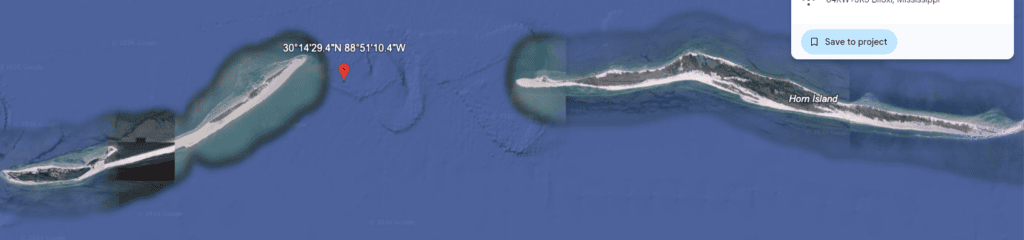
Unlike the other islands in this series, locating the Isle of Caprice on a modern map requires a bit of imagination. The island no longer rises above the waters of the Mississippi Sound, but historians have been able to pinpoint its former location between Horn Island and Ship Island, approximately 12 miles south of Biloxi.
At its height during the 1920s, the island stretched roughly three miles long and one-quarter mile wide. It occupied a shallow sand formation that had developed over centuries from sediment carried westward along the Mississippi Gulf Coast by waves, tides, and coastal currents.
Unlike the more stable barrier islands nearby, Caprice rested on a constantly shifting shoal that was especially vulnerable to erosion during tropical storms and hurricanes.
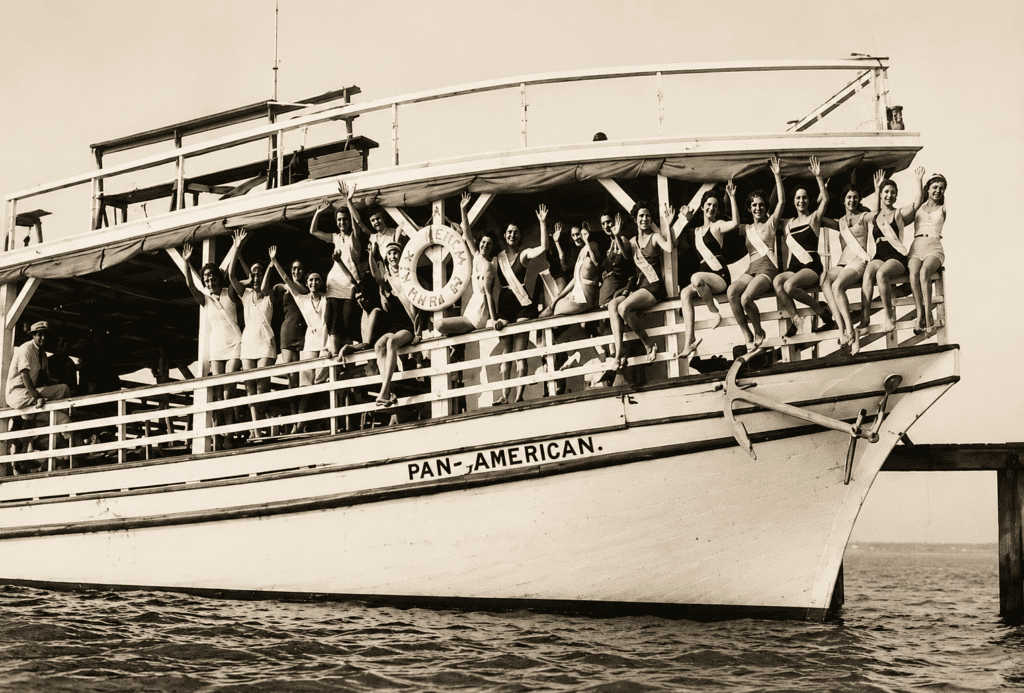
Visitors traveling from Biloxi boarded excursion ferries such as the Pan-American and Non Pareil for the journey across the Mississippi Sound.
Depending on weather and sea conditions, the trip generally took about 90 minutes, giving passengers time to enjoy music, refreshments, and anticipation before arriving at what newspapers proudly promoted as one of the Gulf Coast’s premier entertainment destinations.
Although no buildings remain today, the underwater shoal still exists. In many places, the former island lies only a few feet below the surface, making the area a well-known navigation hazard for local boaters.
Modern GPS and nautical charts clearly identify the shallow water, but casual visitors passing through the area would never realize they are crossing what was once Mississippi’s most glamorous resort island.
Why This Location Was So Important
The developers of the Isle of Caprice chose its location for more than its beautiful beaches. Because the island lay offshore in the Mississippi Sound, it offered visitors a feeling of escaping to an exclusive destination while remaining close enough for convenient day trips from Biloxi.
Its location also provided another advantage during the 1920s. Being offshore placed the resort beyond many of the practical limitations faced by businesses on the mainland, allowing gambling and entertainment to flourish in a way that helped earn the island its famous nickname—the “Monte Carlo of the South.”
Unfortunately, the same forces that made the island possible also sealed its fate. Built on a constantly moving sand body rather than a stable foundation, the Isle of Caprice was always at the mercy of storms, tides, and shifting currents. Nature had created the island, and over time nature reclaimed it.
RetireCoast Insight: If you boat between Biloxi, Ship Island, and Horn Island today, you may unknowingly pass directly over the site of the former Isle of Caprice. There are no visible ruins above the water, but beneath the surface lies one of the most fascinating lost landmarks in Mississippi Gulf Coast history.
How Big Was the Isle of Caprice?
Unlike Mississippi’s larger barrier islands, the Isle of Caprice was never a massive landform. It was a long, narrow ribbon of sand that constantly changed shape as winds, waves, tides, and hurricanes moved enormous amounts of sediment through the Mississippi Sound.
At its greatest extent during the mid-1920s—just as developers began transforming the island into a resort—the Isle of Caprice reached its largest recorded size.
The Island at Its Peak
Although its exact dimensions varied from season to season, historical accounts describe the island as measuring approximately:
- Length: Between 2 and 3½ miles
- Width: Between 200 and 400 yards (approximately one-quarter mile at its widest point)
- Elevation: Only 3 to 6 feet above sea level
Its highest points consisted of low sand hummocks and small dunes covered primarily by native sea oats and other coastal grasses. There were no cliffs, hills, or forests—just gently rolling dunes surrounded by white sand beaches and the emerald waters of the Gulf.
Despite its modest size, the island provided enough space for a deep-water pier, casino, hotel pavilion, restaurants, dance hall, overnight cabanas, boardwalks, bathhouses, and wide public beaches.
A Barrier Island in Constant Motion
Even at its largest, the Isle of Caprice was never a permanent island.
Contemporary newspaper accounts described it as “a long, sandy stretch, only a few feet above the water, with dune grass waving across its hummocks.” That description perfectly captures the fragile nature of the island. Every storm, strong tide, or changing current could reshape its shoreline within days.
Unlike today’s engineered beaches, the Isle of Caprice depended entirely on natural processes to survive. Sand carried by waves and currents continually built portions of the island while eroding others, creating an ever-changing landscape that challenged both nature and the resort developers.
Within only a few years, the island began shrinking.
By 1929, erosion had noticeably reduced its length. By 1931, much of the island had broken into narrow sand spits separated by shallow channels. Within another year, the remaining land had disappeared beneath the waters of the Mississippi Sound, leaving only submerged shoals where one of the Gulf Coast’s most famous resorts had once stood.
RetireCoast Coastal Insight
Visitors Stripped the Sea Oats
One of the Isle of Caprice’s greatest natural defenses was also one of its most overlooked.
During the 1920s, visitors frequently picked the island’s beautiful sea oats to take home as souvenirs or decorative dried arrangements. At the time, few people understood that these graceful plants were far more than beach vegetation—they were the very foundation of the island’s survival.
Sea oats develop extensive root systems that trap windblown sand and gradually build dunes. Every clump helped anchor the loose quartz sand against Gulf winds, tides, and storm waves. Removing them weakened the island’s natural ability to rebuild itself after storms.
To be fair, the tourists of the Roaring Twenties had no way of knowing what coastal scientists understand today. Sea oats were often viewed as little more than beach grass—or even a nuisance that blocked views or made walking through the dunes more difficult.
Today, our understanding has changed dramatically.
Communities all along the Mississippi Gulf Coast actively plant sea oats to stabilize beaches and dunes. Along sections of the mainland shoreline, they help prevent blowing sand from drifting onto roads and coastal highways. On Mississippi’s barrier islands, sea oats are now recognized as one of the most important native plants for protecting these fragile landscapes, and removing or disturbing them is prohibited in many protected areas.
While the loss of sea oats alone did not cause the Isle of Caprice to disappear—powerful hurricanes, shifting currents, and the island’s inherently unstable geology were the primary forces—the removal of this critical vegetation almost certainly reduced the island’s ability to recover naturally after storms.
RetireCoast Insight: Every time you visit Horn Island, Ship Island, Cat Island, or the other Mississippi barrier islands, you’ll see sea oats waving in the breeze. They aren’t just part of the scenery—they are living engineers, quietly holding the islands together one grain of sand at a time. That lesson was learned the hard way after the rise and fall of the Isle of Caprice.
Getting to the Isle of Caprice
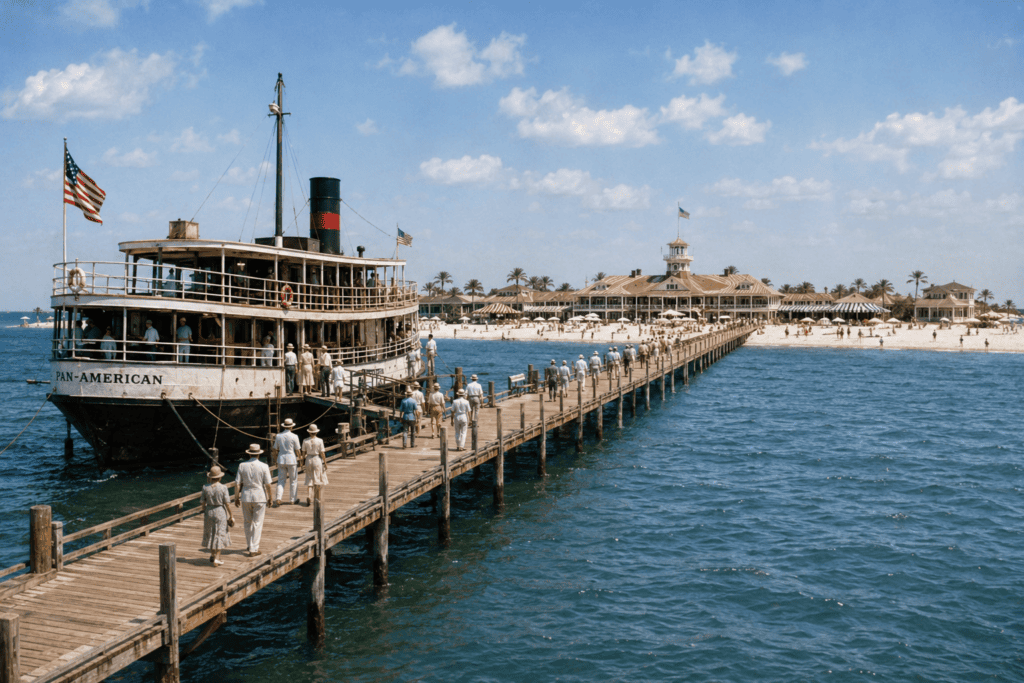
For many visitors, the journey to the Isle of Caprice was almost as memorable as the destination itself. Long before modern casinos and cruise ships, a trip to the island was an excursion across the Mississippi Sound that began the moment passengers stepped aboard one of Biloxi’s famous excursion boats.
Departing from Biloxi
Most visitors boarded ferries along the Biloxi waterfront near today’s Small Craft Harbor and Biloxi Lighthouse. During the busy summer months, excursion boats departed several times each day, carrying vacationers, families, gamblers, musicians, and curious sightseers twelve miles into the Gulf.
Depending on weather and sea conditions, the voyage typically lasted between one and one-and-a-half hours. As the Mississippi coastline gradually disappeared behind them, passengers knew they were leaving everyday life behind for one of the Gulf Coast’s most exciting destinations.
The Famous Excursion Boats
Two vessels became especially well known for transporting thousands of visitors to the island.
The Pan American
No boat is more closely associated with the Isle of Caprice than the Pan American.
Owned by Biloxi entrepreneur Captain Peter “Pete” Skrmetta, the vessel began life as a working Gulf Coast boat before being converted into an excursion ferry to meet the growing demand for trips to the island. As the resort became more popular, the Pan American was enlarged to carry well over one hundred passengers and eventually operated multiple trips each day.
The ferry ride became part of the entertainment. Passengers enjoyed sea breezes, music, and spectacular views across the Mississippi Sound while anticipating an afternoon or evening of gambling, dancing, swimming, and fine dining.
Perhaps the greatest legacy of Captain Pete was what happened after the Isle of Caprice disappeared. Rather than abandon the excursion business, he shifted his operation to Ship Island, laying the foundation for what would eventually become today’s Ship Island Excursions. Nearly a century later, the Skrmetta family continues that tradition, making Captain Pete one of the most influential figures in Mississippi coastal tourism.
The Non Pareil
The Non Pareil was another popular passenger launch serving the Isle of Caprice. Newspaper advertisements promoted regular departures from Biloxi, giving visitors another convenient way to reach the island.
Like the Pan American, the Non Pareil carried vacationers eager to experience the beaches, casino, dance pavilion, and restaurants that had made the resort famous throughout the Gulf South.
Arriving at the Island
Landing on the Isle of Caprice required careful planning because the island sat atop shallow, constantly shifting sandbars.
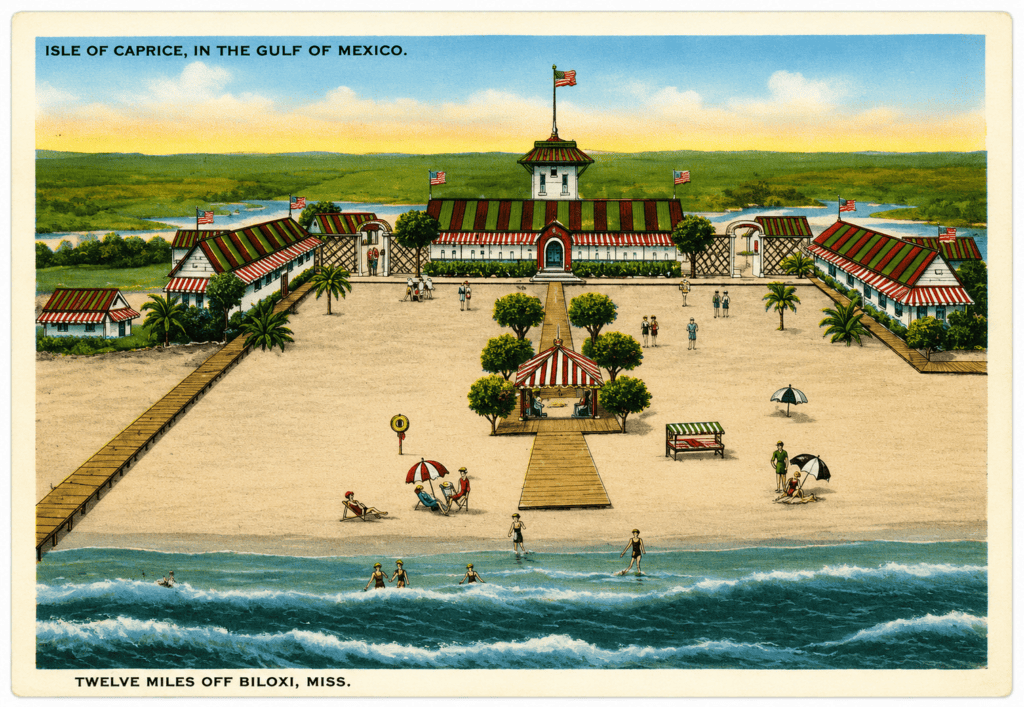
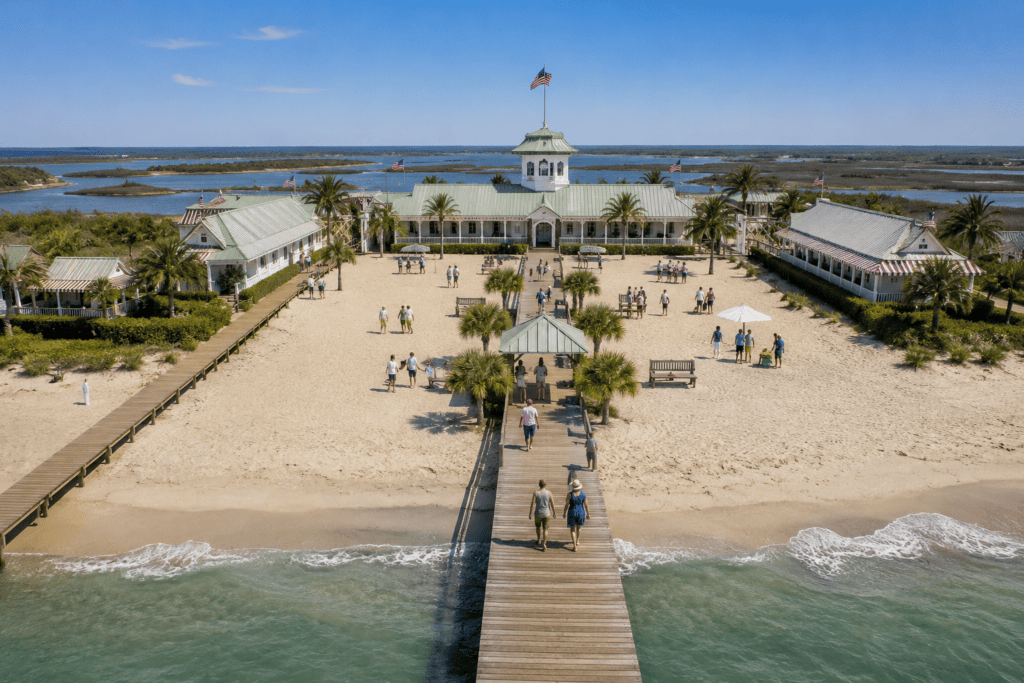
Developers constructed a long wooden pier extending into deeper water so excursion boats could dock safely without running aground. From there, visitors walked along elevated wooden boardwalks leading directly to the heart of the resort, where the hotel, casino, restaurants, and dance pavilion awaited.
For many first-time visitors, stepping off the ferry and onto the island felt like arriving in another world.
Private Boats and Offshore Traffic
Not everyone arrived by excursion ferry.
Private yachts, fishing boats, and pleasure craft frequently anchored near the island, especially on weekends. During the Prohibition era, the surrounding waters also attracted rum-runners and commercial vessels operating throughout the Gulf Coast.
The Isle of Caprice’s offshore location placed it along important maritime routes, and its deep artesian well became a valuable source of fresh water for boats spending extended periods offshore.
Although the resort itself welcomed tourists rather than smugglers, its location made it part of the colorful maritime culture that defined the Mississippi Gulf Coast during the 1920s.
Returning Home
As evening came to a close, excursion boats gathered once again at the island’s long pier.
Some passengers returned sunburned after a day on the beach. Others carried memories of an elegant dinner, a winning streak at the gaming tables, or an evening spent dancing beneath the stars.
The final “moonlight” excursions crossed the Mississippi Sound with the lights of Biloxi gradually appearing on the horizon—a fitting end to a day at what many called the Monte Carlo of the South.
RetireCoast Insight: The Isle of Caprice may have disappeared beneath the Gulf nearly a century ago, but Captain Pete Skrmetta’s greatest legacy still sails today. Every ferry that departs Gulfport for Ship Island traces its heritage to the excursion boats that once carried thousands of visitors to Mississippi’s most famous lost island.
Who Visited the Isle of Caprice?
The Isle of Caprice may have been a small barrier island, but during its brief heyday it attracted visitors from across the Gulf South and beyond. Some came for the beaches, others for the dancing and entertainment, while many simply wanted to experience the excitement of a destination unlike anything else in the region.
For a few remarkable years during the Roaring Twenties, people from every walk of life boarded excursion boats in Biloxi bound for what newspapers proudly called the “Monte Carlo of the South.”
Local Residents Looking for an Island Getaway
The resort’s most frequent visitors came from communities along the Mississippi Gulf Coast. Residents of Biloxi, Gulfport, Pass Christian, Long Beach, Ocean Springs, and Pascagoula could spend the day—or an evening—on the island before returning home on one of the scheduled ferries.
For many local families, the Isle of Caprice offered something completely different from the mainland. They came to swim in the Gulf, enjoy fresh seafood, dance to live music, stroll the beach, and experience the excitement surrounding the island’s famous casino.
Visitors from New Orleans, Mobile, and the Gulf South
The island also benefited from the excellent railroad network serving the Gulf Coast.
Visitors from New Orleans, Mobile, and other Southern cities could travel to Biloxi aboard the Louisville & Nashville Railroad, then transfer directly to one of the excursion boats waiting along the waterfront. What might have seemed like a remote island paradise was, in reality, an easy weekend destination for much of the Gulf South.
As the island’s reputation spread, newspapers throughout Louisiana, Mississippi, and Alabama promoted the resort as one of the most exciting entertainment destinations on the Gulf Coast.
Wealthy Tourists from the Midwest
During the 1920s, Biloxi had become an increasingly popular winter resort for affluent travelers escaping the harsh winters of the Midwest.
Passenger trains brought visitors from cities such as Chicago, St. Louis, Memphis, and other northern communities to the Mississippi Gulf Coast. Many stayed at Biloxi’s finest hotels, including the Buena Vista Hotel, the White House Hotel, and the Edgewater Gulf Hotel.
The Isle of Caprice was heavily promoted to these visitors as a must-see attraction. After arriving by train and checking into their hotel, guests could spend an unforgettable day aboard an excursion ferry before enjoying gambling, dining, music, and dancing on the island.
Business Leaders, Politicians, and Curious Travelers
The Isle of Caprice attracted more than vacationers. Business executives, elected officials, traveling salesmen, entertainers, and prominent citizens from across the South visited the island out of curiosity as much as recreation.
Its offshore location gave the resort an air of exclusivity. Reaching the island required planning, a ferry ride, and a sense of adventure, making the experience feel far more glamorous than simply visiting a mainland hotel.
The Appeal of Prohibition
For many visitors, however, the greatest attraction was the opportunity to temporarily leave the restrictions of the mainland behind.
During Prohibition, the Isle of Caprice developed a reputation as a place where adults could enjoy cocktails, legal gambling, live jazz, and dancing—all while surrounded by the beauty of the Mississippi Sound.
Whether every rumor was true hardly mattered. The island’s reputation became part of its marketing, and thousands of visitors eagerly made the journey to see it for themselves.
More Than a Casino
Although the casino generated much of the publicity, many visitors never placed a single bet.
Families spent their time swimming in the Gulf, relaxing on the wide sandy beaches, dining in the resort’s restaurant, listening to orchestras, watching endurance swim races, attending special events, or simply enjoying the ferry ride across the Mississippi Sound.
Like today’s destination resorts, the Isle of Caprice offered something for almost everyone. Gambling may have put the island on the map, but it was the complete vacation experience that kept visitors returning throughout the late 1920s.
RetireCoast Insight: Imagine arriving in Biloxi by train from Chicago or New Orleans, checking into one of the Gulf Coast’s finest hotels, then boarding the Pan American for a cruise across the Mississippi Sound to spend an evening at a glamorous island resort that no longer exists. For thousands of visitors, that was the unforgettable experience of the Isle of Caprice during the Roaring Twenties.
The Roaring Twenties: Dancing, Jazz, and a Night to Remember
When the Isle of Caprice welcomed its first visitors in the mid-1920s, America was experiencing one of the most exciting periods in its cultural history. The decade became known as the Roaring Twenties or the Jazz Age, a time when prosperity, new technology, and changing social attitudes transformed how Americans spent their leisure time.
Across the country, dance halls, ballrooms, and jazz clubs became gathering places where people escaped the routines of everyday life. Radio broadcasts introduced the latest songs into millions of homes, while phonograph records spread the sounds of jazz orchestras from New York to New Orleans and every town in between.
Dancing wasn’t simply an activity—it was one of the nation’s favorite forms of entertainment.
For Gulf Coast residents, the Isle of Caprice offered something unlike anything else in the region.
Visitors could board Captain Pete Skrmetta’s Pan American ferry in Biloxi, enjoy a scenic cruise across the Mississippi Sound, dine overlooking the Gulf of Mexico, spend time in the casino, and then dance late into the evening before returning home under the stars.
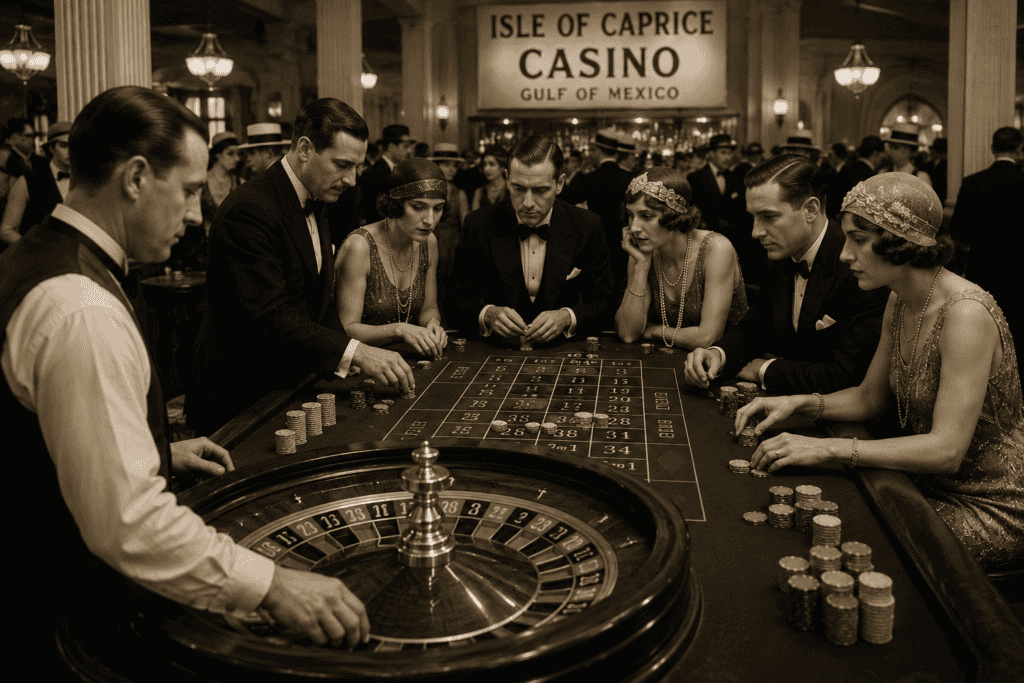
The Charleston Comes to the Mississippi Gulf Coast
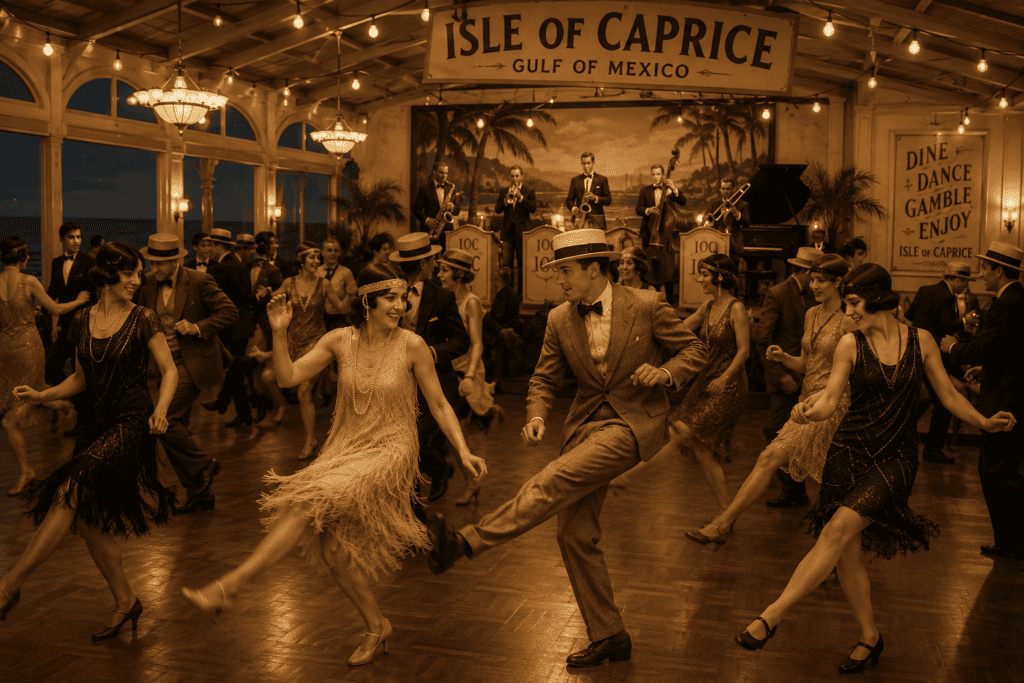
Many of the dances that defined the decade found their way to the Isle of Caprice. Couples performed energetic dances such as the Charleston, the Black Bottom, and the early Lindy Hop, while more traditional ballroom dances like the Foxtrot, Waltz, and Tango remained enormously popular.
The Charleston, with its fast footwork, swinging arms, and lively kicks, became the signature dance of the era. It perfectly matched the upbeat rhythms of jazz bands and symbolized the carefree optimism of the decade.
Fashion Changed with the Music
The dance floor also transformed American fashion. Women traded restrictive Victorian clothing for lighter flapper dresses decorated with fringe, beads, and sequins that shimmered with every movement.
Shorter hemlines and comfortable shoes made energetic dancing possible, while bobbed hairstyles and feathered headbands became symbols of the new generation.
Men arrived in tailored suits, polished leather shoes, straw boaters, or fedoras, completing an evening that was as much about socializing as it was about dancing.
More Than Gambling
Although the Isle of Caprice became famous for its casino, gambling was only part of the experience. Many visitors made the trip simply to enjoy dinner, listen to live music, dance with friends, or experience an elegant evening unlike anything available elsewhere along the Mississippi Gulf Coast.
For many young couples, an evening on the Isle of Caprice was the equivalent of today’s destination entertainment venues—a place to celebrate, meet friends, and create lasting memories.
A Reflection of an Era
The Isle of Caprice lasted only a few short years, but it perfectly captured the spirit of the Roaring Twenties. It combined jazz music, fashionable crowds, fine dining, dancing, gambling, and the excitement of arriving by boat at an island resort in the middle of the Mississippi Sound.
Looking back today, it is easy to understand why so many former visitors remembered the island with such affection. It wasn’t just a casino—it was the Mississippi Gulf Coast’s own Jazz Age playground.
Why Build a Resort on a Vanishing Island?
At first glance, building a luxury resort on a shifting sand island miles offshore seems like a risky business decision. Yet during the early 1920s, the location offered two enormous advantages that simply could not be duplicated on the Mississippi mainland.
Gambling Beyond the Three-Mile Limit
The Isle of Caprice was located beyond the three-mile territorial waters recognized at the time. That meant the resort operated outside the practical reach of Mississippi’s gambling laws. While casinos were illegal on the mainland, visitors who made the ferry trip could legally enjoy games of chance in an elegant setting overlooking the Gulf.
The casino quickly became the centerpiece of the resort. Guests played roulette, craps, faro, and other popular games of the era while relaxing in richly decorated rooms furnished with heavy carpets, comfortable seating, and upscale décor that rivaled fashionable resorts elsewhere in the country.
Before Las Vegas became America’s gambling capital, the Isle of Caprice offered Gulf Coast visitors a taste of resort gaming just offshore.
A Haven During Prohibition
The resort also benefited from another unique circumstance. The United States was in the midst of Prohibition (1920–1933), when the manufacture and sale of alcoholic beverages were prohibited nationwide under the Eighteenth Amendment.
Although the Isle of Caprice did not openly advertise liquor sales, its offshore location gave visitors a reputation for enjoying freedoms that were difficult to find on the mainland. Many guests brought their own alcohol aboard the excursion boats, while others expected that drinks would be available once they arrived.
Whether for gambling, dancing, or simply escaping the restrictions of the day, the island developed a reputation as a place where adults could relax and enjoy themselves.
An Escape Unlike Anywhere Else
The ferry ride itself became part of the adventure. Boarding a boat in Biloxi and spending more than an hour crossing the Mississippi Sound made visitors feel as though they were traveling to an exclusive island paradise rather than simply visiting another Gulf Coast beach.
Once ashore, guests found wide sandy beaches, music, dancing, swimming, restaurants, and one of the most exciting entertainment venues on the Gulf Coast. Newspapers promoted the island as a glamorous destination where visitors could spend the day—or an unforgettable evening—surrounded by the sights and sounds of the Roaring Twenties.
The “Monte Carlo of the South”
It did not take long for newspapers and visitors to give the Isle of Caprice its most famous nickname: the “Monte Carlo of the South.” The comparison reflected more than just the casino.
The island represented elegance, excitement, and escape—a place where people arrived by boat, dressed for an evening of entertainment, and enjoyed an atmosphere unlike anywhere else on the Mississippi Gulf Coast.
RetireCoast Insight: Today it may seem surprising that one of Mississippi’s earliest and most famous gambling destinations stood on a barrier island that has completely disappeared. Yet for a few remarkable years during the Roaring Twenties, the Isle of Caprice became one of the Gulf Coast’s most talked-about vacation destinations, drawing visitors from across Mississippi, Louisiana, and beyond.
Building a Luxury Resort on a Sand Island
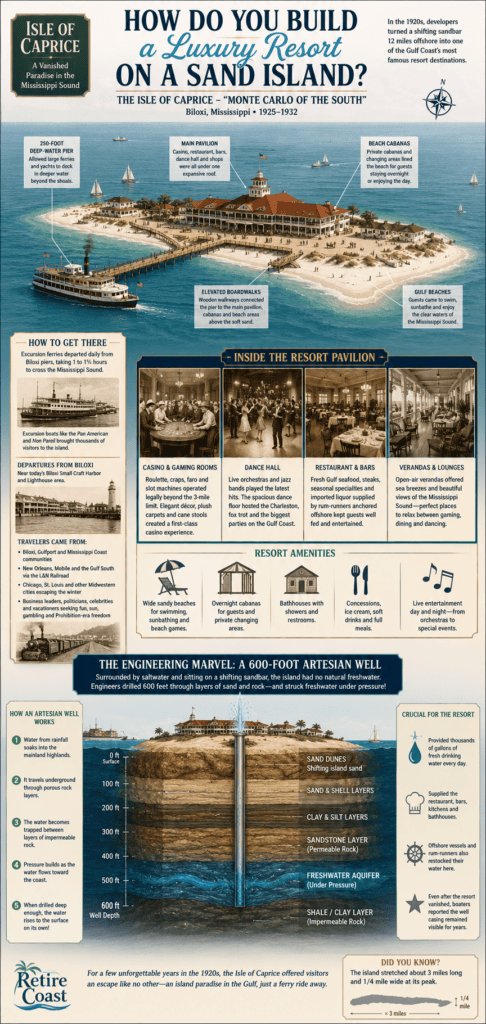
Constructing a first-class resort on the Isle of Caprice was an extraordinary engineering achievement for the 1920s. The island itself was little more than a shifting ribbon of sand surrounded by the Mississippi Sound and the Gulf of Mexico. Every board, nail, brick, and piece of equipment had to arrive by boat.
The developers were undeterred.
Designed by Biloxi architect Carl Matthes and constructed under the direction of contractor Eric Johansen, the resort transformed a barren sand island into one of the Gulf Coast’s most remarkable vacation destinations. Visitors stepping off the ferry found an island that felt more like an exclusive tropical resort than a remote barrier island.
A Deep-Water Pier Welcomed Visitors
The first challenge was simply getting people ashore.
Because the waters surrounding the island were shallow, developers constructed a long 250-foot wooden pier extending into deeper water where excursion boats such as the Pan American and Non Pareil could safely dock. Without the pier, larger passenger vessels would have been forced to anchor offshore and shuttle passengers by smaller boats.
For thousands of visitors, that pier became their first glimpse of the famous Isle of Caprice.
Elevated Boardwalks Across the Sand
After leaving the ferry, guests followed elevated wooden boardwalks that crossed the island’s soft sand dunes.
The boardwalks protected the fragile dunes while allowing visitors—many dressed in their finest summer clothing—to walk comfortably between the dock, casino, restaurant, dance pavilion, cabanas, and beach without sinking into loose sand.
At night, the illuminated walkways added to the island’s atmosphere, guiding guests between the various attractions under the Gulf sky.
The Resort Pavilion
At the heart of the island stood the large wooden pavilion that served as the social center of the resort.
Inside were elegant gaming rooms furnished with plush carpets, comfortable seating, decorative finishes, and tables for popular games including roulette, craps, faro, and other favorites of the era. Nearby, restaurants served fresh Gulf seafood while musicians entertained guests throughout the day and evening.
Attached to the main complex was a spacious dance hall where orchestras performed the latest jazz and big-band music. During the Roaring Twenties, evenings on the Isle of Caprice were filled with dancing, laughter, and the sounds of live music drifting across the Mississippi Sound.
Beach Cabanas and Resort Amenities
The Isle of Caprice offered much more than gambling.
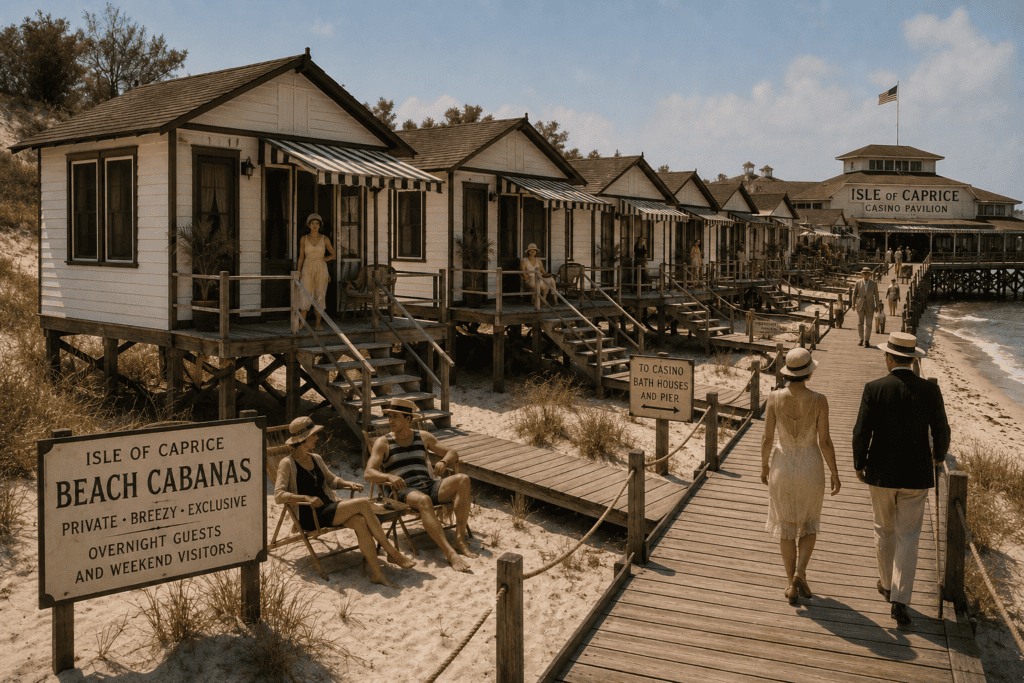
Guests could rent beach cabanas, relax beneath umbrellas, change in bathhouses, swim in the Gulf, or simply spend the day enjoying one of the most beautiful beaches on the Mississippi coast.
The developers wanted visitors to view the island as a complete resort destination rather than simply a casino, and they invested accordingly in amenities that encouraged guests to spend the entire day—or even stay overnight.
The Freshwater Miracle
Perhaps the most remarkable engineering accomplishment was something few visitors ever thought about after pouring a glass of water.
Although the Isle of Caprice was surrounded by saltwater, the developers needed a dependable source of fresh drinking water for hundreds of daily visitors, restaurant kitchens, employees, and resort operations. Hauling every gallon from Biloxi would have been expensive and unreliable.
Instead, they attempted something that seemed almost impossible.
Engineers drilled an artesian well approximately 600 feet deep through the island’s sand and underlying sediments. To the surprise of many, they struck a pressurized freshwater aquifer buried far beneath the Gulf Coast. Water rose naturally through the well, providing a continuous supply of clean drinking water without the need for pumps.
The well became one of the engineering marvels of the resort. It supplied the hotel, restaurant, kitchens, bathhouses, and employees with fresh water while demonstrating the remarkable geology hidden beneath the Mississippi Sound.
The artesian well also became well known among mariners. Boats operating offshore—including commercial fishing vessels and others spending extended periods at sea—could replenish their drinking water before continuing their voyages.
Long after the resort itself had disappeared beneath the Gulf, local stories claimed that the well casing remained visible above the water, allowing passing boaters to fill their water jugs until it, too, eventually vanished beneath the waves.
RetireCoast Insight: The Isle of Caprice proved that even a remote sand island could support a thriving resort with enough vision and engineering. The deep artesian well, long wooden pier, illuminated boardwalks, and elegant pavilion reflected the optimism of the Roaring Twenties—and made the island one of the most ambitious resort developments ever attempted on the Mississippi Gulf Coast.
Who Owned the Isle of Caprice?
Contrary to what many people assume, the Isle of Caprice was not developed by organized crime or by what would later become known as the Dixie Mafia. Instead, it was the vision of several respected Biloxi businessmen who saw an opportunity to create a first-class resort unlike anything else on the Gulf Coast.
Among the principal developers was Walter Henry “Skeet” Hunt, a well-known Biloxi businessman and entrepreneur. He joined forces with Colonel Jack Apperson, owner of Biloxi’s Buena Vista Hotel, and businessman Arbeau Caillavetto purchase the island from the federal government during the early 1920s.
Together they transformed a barren sand island into one of the most talked-about vacation destinations in the South.
The partners invested heavily in developing the island. They constructed a long pier capable of handling excursion ferries, drilled a deep artesian freshwater well, built a hotel and casino, established restaurants and dance facilities, and created an island resort that attracted visitors from across the Gulf Coast.
Built for Entertainment, Not Organized Crime
Because the Isle of Caprice featured gambling and operated during Prohibition, it is sometimes associated with organized crime. However, there is no credible historical evidence that the island was owned or controlled by organized crime syndicates or by the Dixie Mafia, which did not emerge until decades later.
Instead, the resort functioned much like other offshore gambling destinations of the era. Its location beyond Mississippi’s territorial waters allowed the owners to offer entertainment that was prohibited on the mainland while marketing the island as an exclusive destination for vacationers.
Prohibition and the Rum-Runners
The Isle of Caprice opened during one of the most unusual periods in American history. Prohibition, in effect from 1920 to 1933, outlawed the manufacture, transportation, and sale of alcoholic beverages throughout the United States.
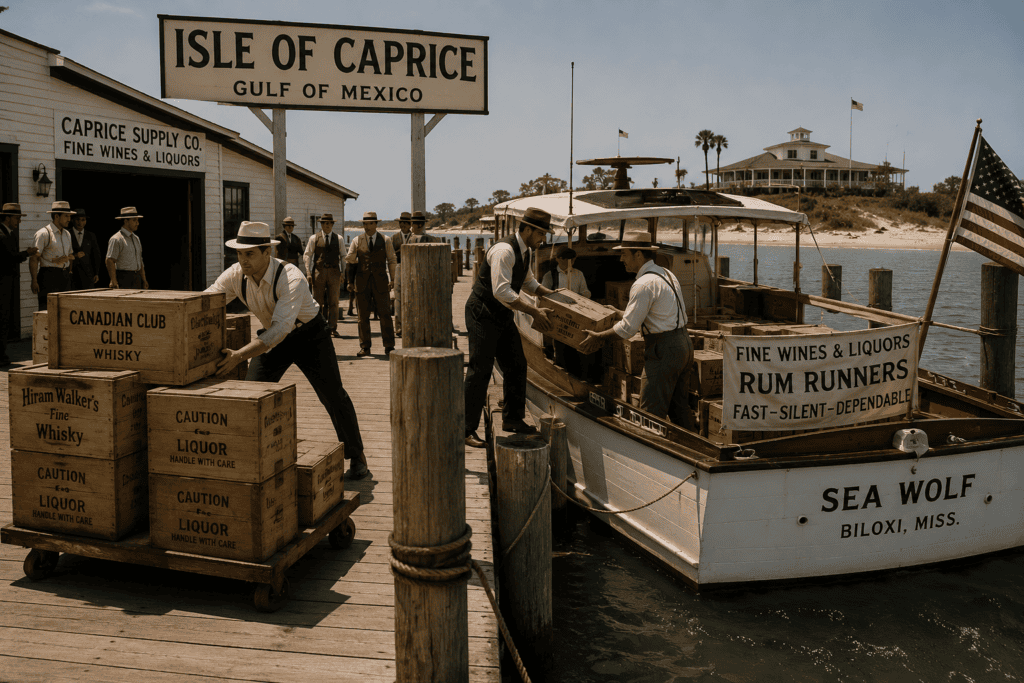
That created a thriving black market along the Gulf Coast, where smugglers known as rum-runners transported liquor from the Caribbean, Mexico, and other foreign ports.
The island’s offshore location made it a natural waypoint for maritime traffic operating beyond the immediate reach of mainland law enforcement.
Historical accounts indicate that rum-running vessels frequently operated in the waters surrounding the island, and the resort’s artesian well became a valuable source of fresh drinking water for boats spending extended periods offshore.
While the Isle of Caprice earned a reputation as a place where visitors could enjoy drinks and nightlife unavailable on the mainland, its greater significance may have been its location within the broader Gulf Coast maritime network.
Smaller boats could move between offshore vessels and secluded coastal inlets under the cover of darkness, while federal authorities and the U.S. Coast Guard worked to intercept smugglers throughout the Mississippi Sound.
Whether visitors came for the gambling, the music, the beaches, or the excitement of the Roaring Twenties, the Isle of Caprice became part of a colorful chapter in Gulf Coast history where tourism, Prohibition, and maritime commerce briefly intersected.
RetireCoast Insight: The Isle of Caprice was not an outlaw island built by gangsters. It was an ambitious resort developed by local Mississippi businessmen who took advantage of a unique legal location offshore. Its association with bootlegging reflects the realities of the Prohibition era rather than evidence that the resort itself was operated by organized crime.
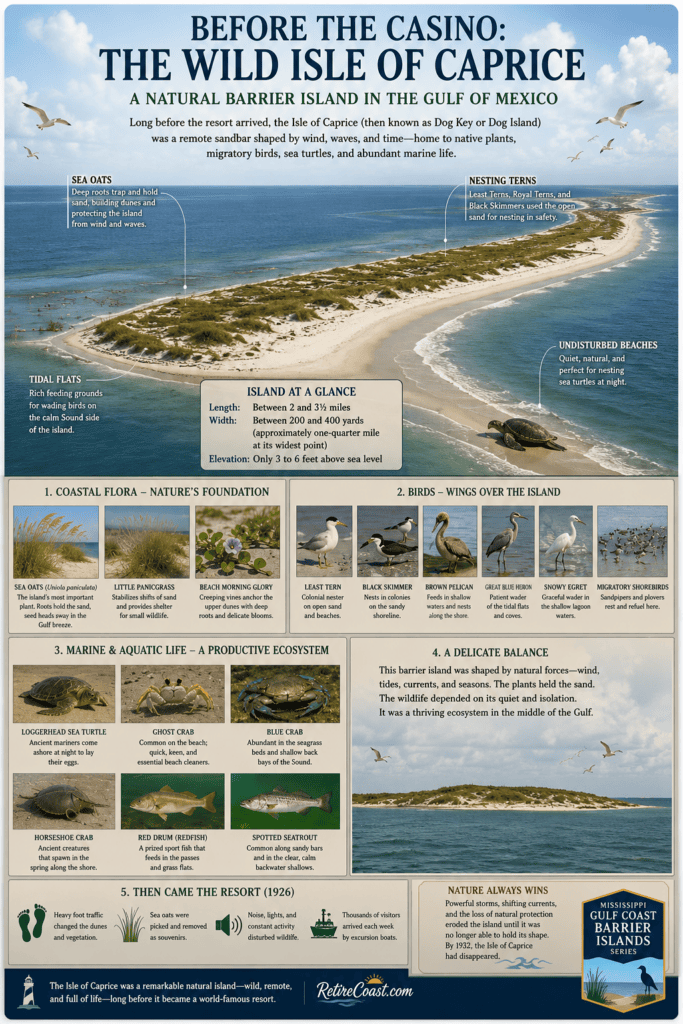
Before the Resort: A Wild Barrier Island
Long before excursion boats carried visitors to the Isle of Caprice, the island was simply another windswept sandbar in the Mississippi Sound. Known at various times as Dog Key, Dog Island, or part of the Dog Keys Shoals, it was an ever-changing barrier island shaped by waves, tides, and Gulf storms rather than human hands.
Although it appeared and disappeared over the centuries, whenever the island emerged above the water it quickly became home to a surprisingly rich coastal ecosystem.
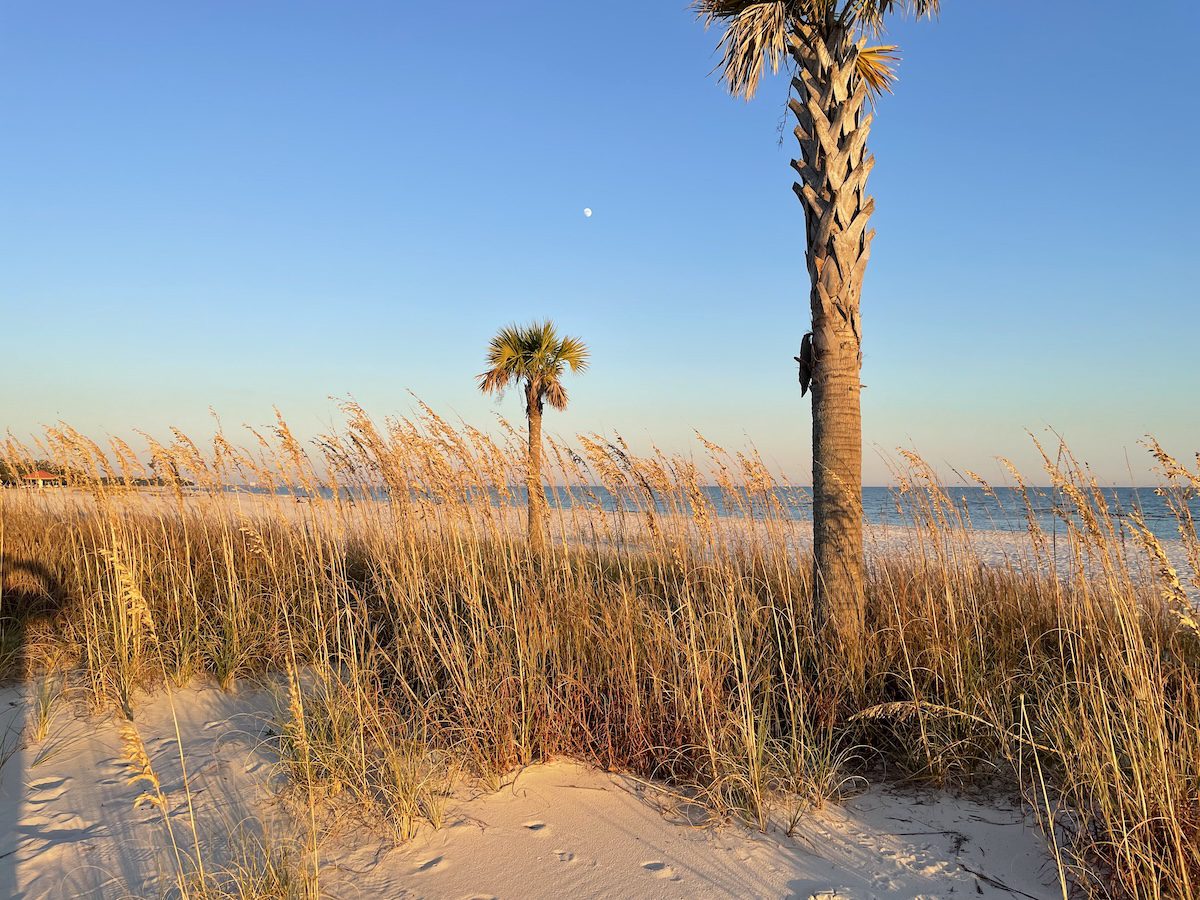
Sea oats are among the most important plants found on Mississippi's barrier islands. What appears above the sand is only a small part of a much larger natural system working beneath the surface.
Their long leaves and tall seed heads slow the wind as it moves across the beach. Windblown sand collects around the stems, gradually building small mounds that can develop into protective dunes.
Beneath the surface, sea oats spread through an extensive network of roots and underground stems called rhizomes. These intertwined roots bind loose grains of sand together, creating what can be described as a form of living cement.
The leaves and stems reduce wind speed near the ground, allowing airborne sand to settle around the plants.
As more sand accumulates, the plants grow upward through it and help create larger, more stable dune ridges.
Underground roots and rhizomes spread through the dune, reducing the amount of sand that can be carried away by wind.
Dune vegetation creates shelter for insects, shorebirds and small animals while helping protect nesting and feeding areas.
Barrier islands are naturally mobile landforms. Sand is continually moved by waves, tides, currents and storms, causing islands to migrate, narrow, widen or change shape over time.
Sea oats help slow that movement by holding the upper beach and dune system together. Where dunes remain healthy, they form a first line of natural protection against wind, waves and storm surge.
When people walk repeatedly across dunes, the plants can be crushed and their roots damaged. Once the vegetation dies, wind can open a gap in the dune and begin carrying sand away, creating a pathway that storm water may later follow.
Sea Oats: The Island’s Natural Engineers
The first plants to colonize the new sand were the ones most responsible for keeping it in place.
Thick stands of sea oats (Uniola paniculata) covered the low dunes, their extensive root systems trapping windblown sand and gradually building the island higher above the tide. Without sea oats, the loose quartz sand would simply blow away or wash back into the Gulf.
Growing alongside the sea oats were other hardy coastal plants, including bitter panicgrass, beach morning glory, seaside grasses, and creeping vines that spread across the dunes. Together these plants created a living barrier that protected the island from everyday winds and waves.
A Sanctuary for Birds
Before the arrival of tourists, the island provided ideal habitat for thousands of coastal birds.
Its isolated beaches were attractive nesting sites for Least Terns, Royal Terns, Black Skimmers, and other colonial nesting birds that preferred open sand free from land predators. Brown Pelicans, Laughing Gulls, and migrating shorebirds regularly stopped on the island to rest and feed during their journeys along the Gulf Coast.
On the protected Mississippi Sound side, shallow tidal flats attracted Great Blue Herons, Snowy Egrets, Great Egrets, and other wading birds searching for fish, shrimp, and crabs.
Life Beneath the Water
The waters surrounding the Isle of Caprice were just as productive as the island itself.
The shallow sand flats and nearby grass beds supported blue crabs, ghost crabs, hermit crabs, horseshoe crabs, shrimp, oysters, and countless small marine organisms that formed the foundation of the coastal food chain.
These productive waters attracted popular game fish including speckled trout, red drum (redfish), flounder, and Spanish mackerel, making the area a favorite feeding ground for both wildlife and fishermen.
During nesting season, loggerhead sea turtles may also have used the island’s undeveloped beaches, much as they continue to nest on other Mississippi barrier islands today.
Then Came the Resort
Everything changed during the mid-1920s.
Construction crews built a long pier, elevated boardwalks, a casino, restaurants, dance halls, cabanas, and other resort facilities. Within a short time, thousands of visitors were arriving each week.
The sounds of wind and seabirds were replaced by excursion boats, orchestras, laughter, and the excitement of one of the Gulf Coast’s premier entertainment destinations.
Nature Never Stopped Working
Even at the height of the resort’s success, nature continued shaping the island.
Visitors frequently walked across fragile dunes, and sea oats were sometimes collected as decorative souvenirs, reducing some of the vegetation that helped stabilize the sand.
While these human impacts likely increased erosion in localized areas, coastal scientists generally agree that the island’s greatest challenge was one it had faced for centuries: it was built on an exceptionally unstable sand body continually reshaped by tides, currents, hurricanes, and storm surge.
In the end, the same natural forces that had created the Isle of Caprice slowly reclaimed it.
RetireCoast Insight: One of the great ironies of the Isle of Caprice is that its greatest asset—its beautiful white sand beaches—was also its greatest weakness. Without a solid foundation of rock beneath it, the island was always living on borrowed time. Nature had built the island over centuries, and in just a few years, powerful storms and shifting currents erased nearly every trace of it.
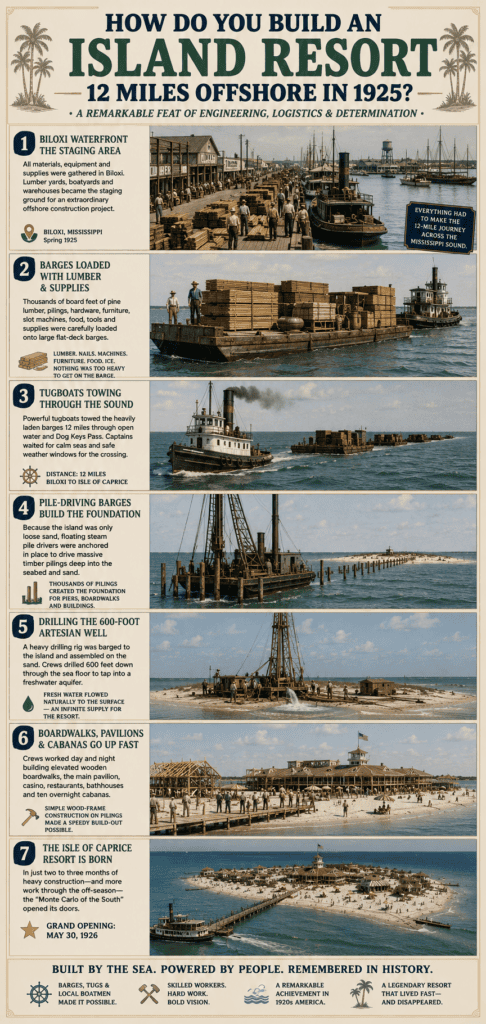
Building an Island Resort in Record Time
Standing on the Biloxi waterfront today, it is difficult to imagine the enormous undertaking required to build a luxury resort twelve miles offshore during the 1920s. There were no bridges, no helicopters, no offshore construction cranes, and no modern supply vessels.
Everything—from every board and nail to every piece of furniture—had to be transported across the Mississippi Sound by boat.
Even more remarkable, the developers completed the initial resort in just a matter of months.
Racing Against the Calendar
The developers understood that timing was everything.
The Roaring Twenties were in full swing, Prohibition had created a unique opportunity for an offshore entertainment destination, and the lucrative summer tourist season was rapidly approaching. Every week construction was delayed represented lost revenue.
Instead of building gradually over several years, they launched one of the most ambitious fast-track construction projects ever attempted on the Mississippi Gulf Coast.
A Remarkably Fast Construction Schedule
Late Spring 1925
Developers Walter Henry “Skeet” Hunt, Arbeau Caillavet, and Colonel Jack Apperson acquired the island and immediately assembled a construction team led by Biloxi architect Carl Matthes and contractor Eric Johansen.
Within days, barges loaded with lumber, pilings, tools, and construction crews began making the twelve-mile journey from Biloxi.
The first priorities were constructing the deep-water pier and drilling the island’s remarkable artesian well.
July 5, 1925
Only weeks after construction began, the Isle of Caprice welcomed its first visitors during a soft opening.
Although much of the resort was still being expanded, excursion boats were already bringing guests to enjoy dancing, dining, and entertainment while additional construction continued around them.
Winter 1925–1926
Rather than closing down, crews continued improving the island throughout the off-season.
They expanded the main pavilion, completed the casino, added overnight cabanas, bathhouses, elevated boardwalks, restaurants, and additional resort facilities in preparation for the following summer.
May 30, 1926
The Isle of Caprice celebrated its first full season with a grand opening promoted throughout Mississippi, Louisiana, Alabama, and beyond as the “Monte Carlo of the South.”
An Amphibious Construction Project
Every stage of construction depended on the Gulf itself.
The entire project functioned like a carefully coordinated marine construction operation, with Biloxi serving as the staging area for workers, equipment, and supplies.
Barges Carried an Entire Resort Across the Mississippi Sound
Thousands of board feet of southern pine lumber, heavy timber pilings, roofing materials, hardware, furniture, kitchen equipment, and construction supplies were loaded onto large flat-deck barges along the Biloxi waterfront.
Powerful tugboats slowly towed these floating construction yards twelve miles through the Mississippi Sound.
Timing was critical. Captains waited for calm weather before crossing open water, where rough seas could easily shift cargo or wash valuable materials overboard.
Building on Sand
The Isle of Caprice offered one major engineering challenge: there was no solid ground.
Instead of pouring concrete foundations, crews relied on massive timber pilings driven deep into the sand below the island.
Floating pile-driving barges positioned themselves alongside the growing resort while steam-powered equipment hammered the pilings into place. These became the structural foundation for the long dock, elevated boardwalks, casino, dance pavilion, restaurants, and other buildings.
Everything literally stood on wood driven into sand.
Drilling for Fresh Water
Perhaps the most remarkable achievement was drilling the island’s 600-foot artesian well.
Heavy drilling equipment was transported to the island aboard barges before being assembled on the sand itself.
The drilling crews bored through hundreds of feet of sand, clay, and underlying sediments until they reached a pressurized freshwater aquifer hidden deep beneath the Mississippi Sound.
When fresh water began flowing naturally to the surface, the impossible suddenly became possible.
The well supplied drinking water for guests, kitchens, restaurants, bathhouses, employees, and resort operations, eliminating the need to transport thousands of gallons of water from Biloxi each week.
It remains one of the most impressive engineering accomplishments ever completed on a Mississippi barrier island.
Biloxi’s Maritime Workforce
The project succeeded because Biloxi was already one of the Gulf Coast’s premier maritime communities.
Local shipbuilders, tug operators, barge captains, commercial fishermen, pile-driving crews, carpenters, and marine contractors possessed the skills needed to work on the water.
Many of the same diesel-powered Biloxi luggers that hauled seafood, freight, and supplies throughout the Mississippi Sound were pressed into service carrying everything from casino furniture and kitchen equipment to building materials and food supplies for the growing resort.
Without Biloxi’s thriving maritime industry, the Isle of Caprice might never have been built.
RetireCoast Insight: The Isle of Caprice wasn’t simply a resort—it was one of Mississippi’s earliest offshore construction projects. Long before modern offshore oil platforms or coastal engineering projects, local boat captains, shipbuilders, and contractors demonstrated that an entire luxury destination could be built on a remote barrier island using little more than barges, tugboats, timber pilings, and remarkable determination.
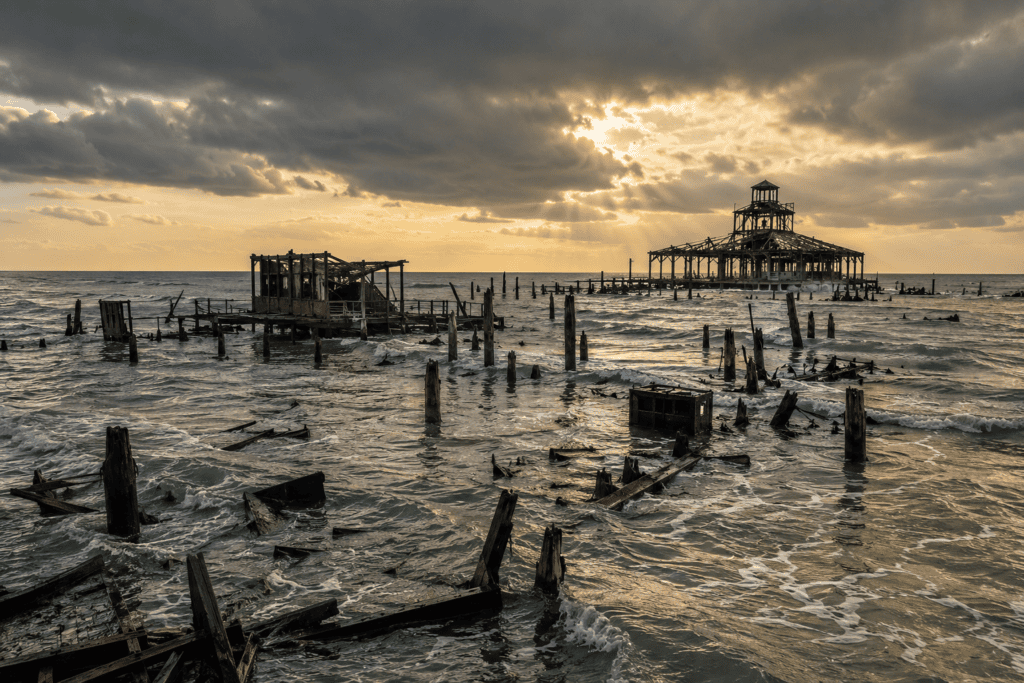
The Death of the Isle of Caprice
The disappearance of the Isle of Caprice has inspired stories for nearly a century. Some are firmly rooted in history, while others have become part of Gulf Coast folklore.
What is certain is that the island did not disappear overnight. Instead, it slowly lost its battle against the same natural forces that had created it in the first place.
Legend and Reality
Perhaps no Mississippi barrier island has generated more legends than the Isle of Caprice.
One popular story tells of a powerful hurricane striking without warning while gamblers and partygoers refused to leave the island. According to local folklore, rescuers returned after the storm to find only wreckage, floating furniture, plaster tigers from the resort, and the remains of those who had stayed behind.
It is a compelling story—but there is little historical evidence to support it.
No official records document a single catastrophic event that claimed dozens of lives on the island.
Like other Gulf Coast resorts of the era, the Isle of Caprice depended on weather forecasts and regularly suspended ferry operations when storms threatened. While individual accidents undoubtedly occurred over the years, historians have found no evidence of a mass casualty event matching the popular legend.
The legend lives on, but history tells a different story.
A Perfect Storm of Problems
The downfall of the Isle of Caprice resulted from several factors occurring in rapid succession.
The Great Depression
The stock market crash of 1929 dramatically reduced tourism throughout the country.
Luxury vacations became difficult to justify as families struggled through the economic hardships of the Great Depression. Like many resorts across America, the Isle of Caprice experienced declining attendance and shrinking revenues just as expensive repairs became necessary.
Storms Reshape the Island
Throughout 1929, 1930, and 1931, a series of tropical storms, hurricanes, and strong winter gales repeatedly battered the fragile barrier island.
Storm surge and powerful waves cut through the narrow sandbar, breaching portions of the island and allowing tidal currents to wash even more sand into the surrounding waters. Areas that had once supported buildings and boardwalks gradually disappeared beneath the Gulf.
Unlike larger barrier islands such as Horn or Ship Island, Caprice had very little elevation to withstand repeated storm damage.
Fire Strikes the Resort
As if erosion and economic hardship were not enough, a devastating fire swept through much of the wooden resort complex in 1931.
The blaze destroyed many of the island’s principal buildings, including portions of the casino and pavilion, leaving only pilings and scattered structural remains. Rebuilding would have required an enormous investment at a time when the resort was already struggling financially.
The owners never fully recovered.
Nature Reclaims the Island
Human activity also altered the island’s natural defenses.
Thousands of visitors walked across fragile dunes, while many collected sea oats as souvenirs without realizing those plants were essential to stabilizing the sand.
Although scientists believe storms, shifting currents, and the island’s naturally unstable foundation were the primary reasons for its disappearance, the loss of protective vegetation almost certainly reduced the island’s ability to recover after repeated storms.
The Gulf slowly reclaimed what it had once created.
The Island Slips Beneath the Gulf
By 1932, little remained above the water.
The casino, hotel, dance pavilion, cabanas, and boardwalks had vanished. Waves continued carrying sand away from the former island until only submerged shoals marked the location where thousands of visitors had once danced, gambled, and vacationed.
For years afterward, local boaters recalled one final reminder of the island’s existence.
The steel casing from the island’s remarkable 600-foot artesian well reportedly remained protruding above the water’s surface. Commercial fishermen and passing boaters often stopped there to fill water jugs with fresh drinking water before continuing their journeys across the Mississippi Sound.
According to local accounts, that final landmark eventually disappeared after being struck by a vessel, leaving no visible trace of the Isle of Caprice above the surface.
A Barrier Island That Returned to the Sea
Unlike many lost places that leave behind crumbling ruins, the Isle of Caprice simply became part of the Gulf once again.
Today, only shallow underwater shoals remain where the famous resort once stood. Boaters crossing the Mississippi Sound rarely realize they are passing over what was once one of the Gulf Coast’s most glamorous destinations.
Yet the island’s story endures—not only because of its casino and colorful history, but because it reminds us that Mississippi’s barrier islands are living landscapes, continually reshaped by wind, waves, tides, and time.
RetireCoast Insight: The Isle of Caprice didn’t disappear because of one single disaster. It was the cumulative result of economic hardship, repeated storms, fire, shifting currents, and the relentless natural forces that have shaped Mississippi’s barrier islands for thousands of years. In the end, nature reclaimed the island exactly as it had reclaimed it many times before.
Could the Isle of Caprice Return?
Although the Isle of Caprice disappeared beneath the Mississippi Sound nearly a century ago, its story may not be over.
Unlike a mountain or rocky island, the Isle of Caprice was a living barrier island—a landform created entirely by moving sand. Throughout history it appeared, disappeared, and reappeared as storms, tides, and longshore currents continually reshaped the Mississippi coast.
Whether it will ever emerge again remains one of the Gulf Coast’s most intriguing questions.
Who Owns the Isle of Caprice Today?
Today there is no privately owned island because there is no dry land.
The former site of the Isle of Caprice is now part of Mississippi’s submerged public trust lands, managed under state law for the benefit of all citizens.
The shallow shoals and underwater bottom fall under the jurisdiction of the Mississippi Department of Marine Resources and the Mississippi Secretary of State’s Public Lands Division, which oversee the management and protection of Mississippi’s coastal waters.
Although descendants of one of the original developers reportedly continued paying property taxes for many years in the hope that the island might someday reappear, the former resort itself no longer exists as taxable upland property.
Why the Resort Will Almost Certainly Never Be Rebuilt
Even if the Isle of Caprice were to emerge naturally above the water again, recreating the famous resort would be extraordinarily difficult.
Today’s environmental regulations protect Mississippi’s barrier islands and coastal habitats far more aggressively than they did during the 1920s. Dog Keys Pass is an environmentally sensitive area supporting important marine life, migratory birds, fisheries, and coastal ecosystems.
a large commercial development would require extensive federal and state permits that would be extremely unlikely to be approved.
The island also sits in one of the highest-energy environments along the Mississippi coast. Strong tidal currents continually move sand through Dog Keys Pass, meaning any artificially created island would require constant maintenance and enormous financial investment simply to remain above water.
In addition, modern building standards, hurricane-resistant construction requirements, flood regulations, and insurance costs would make such a project economically impractical.
A Different Kind of Restoration
While no one is proposing to rebuild the Isle of Caprice, Mississippi has embraced a different strategy for protecting its coast.
Over the past two decades, the U.S. Army Corps of Engineers and the Mississippi Department of Marine Resourceshave invested hundreds of millions of dollars restoring nearby barrier islands.
Projects such as reconnecting East and West Ship Island after Hurricane Katrina and restoring shorelines on Cat Island demonstrate the vital role barrier islands play in reducing storm surge, protecting coastal communities, and preserving wildlife habitat.
Today, restoration efforts focus on strengthening the natural barrier island system rather than developing it.
The lessons learned from places like the Isle of Caprice have helped shape modern coastal engineering and conservation practices.
The Legacy of the Isle of Caprice
Today there are no casinos, hotels, boardwalks, or dance pavilions rising above the Gulf.
Instead, fishermen navigate the shallow shoals, boaters pass over the former island without realizing what once stood beneath them, and historians continue piecing together the remarkable story of a resort that briefly became one of the Gulf Coast’s premier destinations.
The Isle of Caprice reminds us that Mississippi’s barrier islands are never truly permanent. They are constantly changing—built by nature, reshaped by storms, and slowly transformed by the sea.
Although the famous resort is gone, its legacy lives on through historic photographs, postcards, newspaper stories, and the memories of a generation that experienced what many called the “Monte Carlo of the South.”
RetireCoast Final Thought: Every barrier island in this series tells a different story. Horn Island celebrates wilderness. Ship Island preserves military history. Deer Island showcases recreation close to the mainland. Cat Island remains one of Mississippi’s most unique privately owned islands.
But the Isle of Caprice tells perhaps the most remarkable story of all—a story of an island that appeared, flourished, disappeared, and continues to fascinate nearly a century later. It serves as a powerful reminder that the Mississippi Gulf Coast is not a fixed landscape but a living coastline, forever changing with the tides, storms, and seasons.

A Ferry Captain’s Memories of the Isle of Caprice
One of the most fascinating firsthand windows into the Isle of Caprice comes from Captain Pete Skrmetta, the Croatian immigrant who founded what would become the Ship Island Excursions ferry service.
Through interviews, family recollections, and local maritime histories, Captain Pete’s stories provide a rare glimpse into what visitors experienced during the island’s brief but remarkable heyday.
The Journey Was Part of the Adventure
By 1926, Captain Pete was operating the 56-foot diesel schooner Pan American between Biloxi and the Isle of Caprice.
Round-trip tickets reportedly cost $1.00, making the resort accessible to visitors from across the Mississippi Gulf Coast. The Pan American made multiple trips each day, stopping at Biloxi hotel piers—including the Buena Vista Hotel—to pick up passengers heading offshore for a day of swimming, dining, dancing, and gambling.
Unlike today’s ferry rides, the voyage itself became part of the entertainment.
According to Skrmetta family accounts, the evening cruises often carried more than 150 passengers, with a live jazz orchestra playing on the upper deck while guests socialized during the hour-long trip across the Mississippi Sound.
RetireCoast Note: Some later family recollections describe gambling and cocktails being available aboard the Pan American during Prohibition. While these colorful stories have become part of local Gulf Coast folklore, details of onboard gaming have not been independently verified in surviving contemporary records.
Captain Pete’s Larger-Than-Life Reputation
Captain Pete became one of the Mississippi Gulf Coast’s legendary maritime personalities.
His family remembered him as a man who could “speak seven languages and curse in ten,” a description that perfectly captures the colorful personality for which he became known along the waterfront.
Another enduring family story tells how Captain Pete supposedly lost the Pan American during a late-night dice game at the Isle of Caprice casino, only to gamble throughout the night and win his boat back before sunrise—just in time to ferry his passengers home the next morning.
Whether embellished over the years or remembered exactly as it happened, the tale has become one of the most enduring legends associated with both Captain Pete and the Isle of Caprice.
From a Lost Island to Ship Island
When fire, storms, and erosion finally doomed the Isle of Caprice in the early 1930s, Captain Pete helped preserve part of its legacy.
Historical accounts indicate that lumber salvaged from the abandoned resort was transported aboard the Pan American to nearby Ship Island, where it was used in constructing an early dock and beach pavilion.
Those efforts laid part of the foundation for what would eventually become the modern Ship Island Excursions operation, which continues carrying visitors to Ship Island nearly a century later.
In a remarkable twist of history, while the Isle of Caprice disappeared beneath the Gulf, the ferry service that once carried visitors there survived—and still introduces new generations to Mississippi’s barrier islands today.
the people who brought visitors to them—continue to shape the Mississippi Gulf Coast.
🎣 Love Fishing? Explore Mississippi's Barrier Islands
If visiting the former Isle of Caprice has sparked your interest in offshore fishing, you've only scratched the surface. The waters surrounding Mississippi's barrier islands—including Horn Island, Ship Island, Cat Island, and Deer Island—offer some of the finest inshore and nearshore fishing on the northern Gulf Coast.
Whether you're targeting speckled trout, redfish, flounder, cobia, Spanish mackerel, tripletail, or even red snapper, the barrier islands provide countless opportunities for anglers of every skill level.
To help you get started, we've created several comprehensive guides covering everything from choosing tackle and understanding tides to launching your boat and finding productive fishing locations.
- 🎣 Saltwater Fishing for Beginners – Learn the basics of saltwater fishing, essential equipment, common Gulf Coast species, and techniques that will help you catch more fish.
- 🐟 Fishing on the Mississippi Gulf Coast – Discover some of the best places to fish, seasonal patterns, local species, public access points, and helpful tips from experienced Gulf Coast anglers.
- 🚤 Outdoor Activities on the Mississippi Gulf Coast – Explore boating, kayaking, barrier island adventures, wildlife viewing, beaches, and many more ways to enjoy the beautiful Mississippi Gulf Coast.
RetireCoast Tip: Many experienced local anglers combine a day of fishing around the barrier islands with beaching on Horn Island, exploring Ship Island, or cruising past the former site of the Isle of Caprice. It's one of the best ways to experience the history, beauty, and incredible fishing opportunities that make Mississippi's Gulf Coast so unique.
Ready to Visit the Resting Place of the Isle of Caprice?
Although the Isle of Caprice disappeared beneath the waters of the Mississippi Sound nearly a century ago, you can still visit the location where one of the Gulf Coast’s most famous resorts once stood.
Today, there are no casinos, no boardwalks, and no towering dance pavilion waiting to greet visitors. Instead, you’ll find a shallow underwater shoal where thousands of people once arrived aboard excursion ferries to experience what newspapers proudly called the “Monte Carlo of the South.”
Standing over the site by boat is a unique experience. Beneath the water lies the former location of the island’s hotel, casino, restaurants, cabanas, and the remarkable artesian well that made life on the island possible.
GPS Coordinates
Approximate Location
📍 30.2415° N, 88.8529° W
Degrees, Minutes, Seconds (DMS)
📍 30°14’29.4″N 88°51’10.4″W
Entering these coordinates into a marine GPS or navigation app will take you to Dog Keys Pass, the open-water passage between Horn Island and East Ship Island, approximately 12 miles south-southeast of Biloxi.
Today, you’ll find only shallow water covering the former island, generally 3 to 5 feet deep depending on tides, winds, and shifting sand.
A Great Consolation Prize: Outstanding Fishing
While you won’t find the Isle of Caprice rising above the water anymore, you’ll discover something many local anglers already know—the fishing around the former island is outstanding.
Passes between Mississippi’s barrier islands are natural highways for marine life. Every incoming and outgoing tide funnels baitfish, shrimp, crabs, and nutrients through Dog Keys Pass, creating one of the most productive fishing areas along the Mississippi Gulf Coast.
Fishing the Sunken Island
The shallow shoals that once formed the Isle of Caprice now provide excellent habitat for a variety of popular game fish.
Speckled Trout and Redfish patrol the shallow sandbars, especially during the early morning and evening hours. Live shrimp, soft plastics, topwater plugs, and gold spoons are all productive choices when working the edges of the old island.
The sandy bottom also provides ideal habitat for Southern Flounder, which often lie buried along the drop-offs waiting to ambush baitfish swept across the shoals by the tide.
Working the Deep Pass
Just beyond the former island, the bottom drops rapidly into the deeper waters of Dog Keys Pass.
These current-swept channels attract large schools of baitfish, making them prime feeding areas for larger predators.
During the spring and fall, anglers frequently encounter Bull Redfish staging in the deeper water. Summer often brings fast-moving schools of Jack Crevalle and Spanish Mackerel, while Blacktip, Spinner, and occasionally Hammerhead Sharks patrol the pass following the bait.
Bottom Fishing Opportunities
The deeper edges of the pass and nearby underwater structure also hold excellent bottom fishing.
Anglers regularly catch Black Drum and Sheepshead using shrimp or fiddler crabs around submerged structure and drop-offs.
Just outside Dog Keys Pass, nearby artificial reefs and wrecks provide opportunities for Cobia, Tripletail, and during the appropriate seasons and regulations, Red Snapper.
Local Fishing Tips
Before heading offshore, keep a few local conditions in mind:
- Fish moving tides. The strongest incoming and outgoing tides concentrate baitfish along the shoal edges and often produce the best action.
- Watch the weather. Dog Keys Pass is open water. A strong south wind against an outgoing tide can quickly create steep, uncomfortable waves.
- Pay attention to your depth finder. Although deep water borders both sides of the pass, the former island itself remains a very shallow shoal. Running across it at speed during low tide can easily leave you aground.
More Than a Fishing Trip
Visiting the former Isle of Caprice is unlike visiting any other destination on the Mississippi Gulf Coast.
As your boat drifts over the shoal, you’re floating above what was once one of the South’s most glamorous resorts. Nearly a century ago, excursion ferries tied up at a long wooden pier while visitors walked elevated boardwalks toward elegant restaurants, lively gaming rooms, beach cabanas, and dance halls filled with the music of the Roaring Twenties.
Today, nature has reclaimed the island, but it has left behind something equally valuable—a productive marine habitat that supports fish, birds, and countless other coastal species.
RetireCoast Invitation
If you’re already planning a trip to Horn Island, Ship Island, or Cat Island, consider making one more stop at the coordinates of the former Isle of Caprice. You won’t find a casino or a boardwalk, but you’ll discover one of the Mississippi Gulf Coast’s best fishing spots while floating above one of its most fascinating lost landmarks. It’s a fitting reminder that although the island is gone, the waters that once surrounded it continue to thrive.
People Often Ask About the Isle of Caprice
How many overnight rooms did the Isle of Caprice have?
Unlike many coastal resorts of its era, the Isle of Caprice did not feature one large hotel building. Instead, overnight guests stayed in 10 individual wood-frame cabanas (or cottages) nestled among the island’s sand dunes.
These private accommodations allowed visitors to spend several days enjoying the island’s beaches, dining, dancing, and casino entertainment while taking advantage of the cooler Gulf breezes.
How many passengers could the Pan American ferry carry?
When Captain Pete Skrmetta first placed the Pan American into service, it was a 56-foot diesel schooner. After the vessel was lengthened to 76 feet, it could carry up to 150 passengers per trip, making it one of the busiest excursion boats operating on the Mississippi Gulf Coast during the late 1920s.
How many people visited the Isle of Caprice each day?
During the resort’s busiest years, the Pan American often made three round trips per day between Biloxi and the Isle of Caprice. Combined, those trips could transport approximately 400 to 500 visitors daily, a remarkable number considering the island sat more than 12 miles offshore and was accessible only by boat.
What is the wildest story ever told about the Isle of Caprice?
One of the most famous stories passed down through the Skrmetta family involves Captain Pete himself. According to local Gulf Coast lore, he supposedly lost the Pan American in a high-stakes dice game inside the Isle of Caprice casino late one night.
Facing the possibility of losing both his livelihood and the boat needed to ferry passengers home, he reportedly spent the rest of the night gambling on credit—and somehow won the vessel back before sunrise, allowing the morning ferry runs to depart on schedule.
Whether the story happened exactly as told or has grown over the years through retelling, it remains one of the Mississippi Gulf Coast’s best-known maritime legends and reflects the colorful reputation that surrounded both Captain Pete and the Isle of Caprice.
FAQ
Frequently Asked Questions About the Isle of Caprice
1. Where was the Isle of Caprice located?
The Isle of Caprice was located approximately 12 miles south of Biloxi, Mississippi, between present-day Ship Island and Horn Island in the Mississippi Sound. Today the former island lies beneath shallow Gulf waters in the vicinity of Dog Keys Pass.
2. Does the Isle of Caprice still exist?
No. The island gradually disappeared beneath the Mississippi Sound by about 1932 after years of erosion, storms, and changing coastal currents. Only submerged shoals remain today.
3. Why was it called the Isle of Caprice?
The developers chose the name "Caprice" because it reflected the island's unpredictable nature. Before becoming known as the Isle of Caprice, the area was commonly referred to as Dog Key, Dog Island, or the Dog Keys Shoals.
4. Why was a casino built offshore?
During the 1920s, the island's location beyond Mississippi's territorial waters allowed gambling to operate legally while attracting visitors looking for entertainment unavailable on the mainland.
5. Was alcohol available during Prohibition?
The island developed a reputation as a place where visitors could enjoy cocktails and nightlife during Prohibition. Its offshore location made it a popular destination during an era when alcohol was heavily restricted on the mainland.
6. Who built the Isle of Caprice resort?
The resort was developed by Biloxi businessmen Walter Henry "Skeet" Hunt, Colonel Jack Apperson, and Arbeau Caillavet. Architect Carl Matthes designed the facilities, and contractor Eric Johansen supervised construction.
7. Was the resort owned by organized crime?
No credible historical evidence indicates that organized crime or the later Dixie Mafia owned or controlled the Isle of Caprice. It was developed and operated by local Mississippi businessmen.
8. How did visitors reach the island?
Most guests traveled aboard excursion boats departing from Biloxi. The famous Pan-American and Non Pareil ferries carried thousands of visitors across the Mississippi Sound during the resort's peak years.
9. How long did the ferry ride take?
The trip generally took between one hour and one and one-half hours, depending on weather conditions and the vessel being used.
10. How large was the Isle of Caprice?
At its largest, the island measured approximately 2 to 3½ miles long and up to one-quarter mile wide. The highest dunes reached only about 3 to 6 feet above sea level.
11. Did people actually stay overnight?
Yes. The resort included overnight cabanas and accommodations, allowing guests to extend their stay and enjoy multiple days on the island.
12. Where did the island get fresh drinking water?
Developers drilled a remarkable 600-foot artesian well through the sand into a freshwater aquifer beneath the Mississippi Sound. The well supplied fresh water to the entire resort.
13. What happened to the famous artesian well?
Local accounts say the well casing remained above the water for years after the island disappeared, allowing passing boaters to fill containers with fresh water until the pipe was eventually damaged and disappeared beneath the surface.
14. Why did the Isle of Caprice disappear?
The island disappeared because of repeated hurricanes, tropical storms, shifting currents, erosion, economic hardship during the Great Depression, fire damage to the resort, and the naturally unstable nature of the barrier island itself.
15. Did removing sea oats contribute to the island's erosion?
Sea oats are essential for stabilizing coastal dunes. While storms and natural coastal processes were the primary causes of the island's disappearance, the loss of native vegetation likely reduced the island's ability to recover after repeated storm damage.
16. Could the Isle of Caprice return?
Because barrier islands naturally migrate and change shape, it is theoretically possible for sand to accumulate again in the area. However, there is no scientific prediction that the Isle of Caprice will re-emerge as a permanent island.
17. Can you visit the Isle of Caprice today?
There is no island to visit. Boaters may pass over the shallow shoals where the island once stood, but nothing remains above the water.
18. Who owns the former island today?
Since the island no longer exists above the waterline, the submerged area is managed as Mississippi public trust submerged lands under state law.
19. Are there any remains of the resort underwater?
Most of the wooden structures were destroyed by storms, fire, and decades of wave action. While scattered remnants may remain buried beneath sand or underwater, no visible ruins exist above the surface today.
20. Why is the Isle of Caprice still important today?
The Isle of Caprice represents one of the most fascinating chapters in Mississippi Gulf Coast history. Its story illustrates both the ambition of the Roaring Twenties and the constantly changing nature of Mississippi's barrier islands, providing valuable lessons about coastal engineering, conservation, and the power of nature.
Continue Exploring Mississippi's Barrier Islands
The Isle of Caprice may have disappeared beneath the waves, but its story is just one chapter in the fascinating history of Mississippi's Barrier Islands. Explore the rest of the series and discover islands filled with wildlife, Civil War history, pristine beaches, boating adventures, and unforgettable scenery.
Want to Explore Even More?
RetireCoast members receive access to an expanding library of premium planning tools, interactive calculators, downloadable guides, educational courses, exclusive videos, and printable resources designed to help you make smarter financial, retirement, estate planning, and Gulf Coast lifestyle decisions.
Thank you for supporting original Mississippi Gulf Coast history, photography, maps, and educational resources created by RetireCoast.com.
Image Attributions
The following historical photographs, maps, and reference images were consulted or used with attribution where applicable in the preparation of this article.
- Sun Herald — Historical photograph of Captain Pete Skrmetta at the helm of the Pan American ferry.
https://www.sunherald.com/ - Google Earth — Satellite imagery and geographic reference used to identify the historic location of the Isle of Caprice and surrounding barrier islands.
https://earth.google.com/ - Google Maps — Geographic reference and coordinate verification.
https://maps.google.com/ - RetireCoast — Original illustrations, historical reconstructions, maps, diagrams, infographics, and artist renderings created specifically for this article.
https://retirecoast.com/
Historical Research & References
The following organizations, archives, publications, and government agencies were consulted during the research and preparation of this guide.
- Mississippi Department of Archives and History
https://www.mdah.ms.gov/ - Mississippi Department of Marine Resources
https://dmr.ms.gov/ - National Park Service — Gulf Islands National Seashore
https://www.nps.gov/guis/ - NOAA Office for Coastal Management
https://coast.noaa.gov/ - NOAA Historical Hurricane Tracks
https://coast.noaa.gov/hurricanes/ - U.S. Geological Survey (USGS)
https://www.usgs.gov/ - Library of Congress Digital Collections
https://www.loc.gov/ - Chronicling America (Library of Congress Historic Newspapers)
https://chroniclingamerica.loc.gov/ - Mississippi Digital Library
https://www.msdiglib.org/ - University of Southern Mississippi Special Collections
https://www.lib.usm.edu/spcol/ - Biloxi Historical Society
https://biloxihistoricalsociety.org/ - Harrison County Historical Society
https://harrisoncountyms.gov/
Additional Reading
Readers interested in learning more about Mississippi’s barrier islands may also enjoy:
- RetireCoast — Horn Island Guide
https://retirecoast.com/horn-island/ - RetireCoast — Ship Island Guide
https://retirecoast.com/ship-island/ - RetireCoast — Cat Island Guide
https://retirecoast.com/cat-island/ - RetireCoast — Deer Island Guide
https://retirecoast.com/best-free-vacation-trip-deer-island-beach-biloxi/ - RetireCoast — Mississippi Gulf Coast
https://retirecoast.com/mississippi-gulf-coast/
Editorial Note: Historical information about the Isle of Caprice comes from a variety of archival sources, newspaper accounts, historical records, family recollections, and government publications. Where firsthand documentation is limited, historical reconstructions and artist renderings are clearly identified as such and are based on the best available evidence at the time of publication.
Discover more from RetireCoast.com
Subscribe to get the latest posts sent to your email.