Last updated on July 17th, 2026 at 03:53 am
Introduction
Saltwater Fishing for Beginners: Catch Your First Saltwater Fish
Standing on a beach, fishing pier, or dock for the first time can feel overwhelming. The ocean stretches to the horizon, dozens of anglers seem to know exactly what they’re doing, and the local tackle shop is filled with enough rods, reels, lures, and fishing tackle to confuse almost anyone.
The good news is that saltwater fishing is much easier to learn than most beginners think.
You do not need an expensive boat, advanced electronics, or years of experience to catch fish in coastal waters. Every year, thousands of beginner anglers catch their first saltwater fish from public piers, beaches, bridges, jetties, and shorelines using simple saltwater fishing gear, basic techniques, and inexpensive live bait such as live shrimp.
Whether your goal is to catch a croaker from a public pier, a redfish in shallow waters, a speckled trout over grass flats, or eventually pursue larger fish through offshore fishing and deep-sea fishing, the first step is understanding the fundamentals.
- Introduction
- The learning curve gets shorter
- Saltwater Fishing vs. Freshwater Fishing: What’s the Difference?
- Choose Your Type of Saltwater Fishing
- Try our free Saltwater Fishing Starter Advisor below
- The Best Saltwater Fishing Gear for Beginners
- People Often Ask
- Where to Buy Saltwater Fishing Gear, Bait, and Local Knowledge
- This section is one of the biggest opportunities to outperform the competition.
- Where to Fish: Finding Saltwater Fish Near You
- People Often Ask
- When to Fish: Understanding Tides, Weather, and Timing
- People Often Ask
- The Best Saltwater Fish for Beginners
- How to Catch Your First Saltwater Fish: A Step-by-Step Guide
- Step 1: Purchase Your Fishing License
- Step 2: Visit a Local Tackle Shop
- Step 3: Buy Live Shrimp
- Step 4: Choose a Productive Location
- Step 5: Rig Your Rod
- Step 6: Make Your First Cast
- Step 7: Be Patient
- Step 8: Recognize the Bite
- Step 9: Fight the Fish
- Step 10: Land Your First Fish
- Step 11: Identify Your Catch
- Step 12: Celebrate the Moment
- People Often Ask
- Common Beginner Mistakes That Cost Fish
- Saltwater Fishing Safety: Protecting Yourself on the Water
- Your First Year of Saltwater Fishing: A Beginner’s Roadmap
- 🎣 Saltwater Fishing Quick Quiz
- Saltwater Fishing Apprentice Certificate
- Saltwater Fishing Apprentice Certificate
The learning curve gets shorter
Once you learn where fish live, how tides affect feeding behavior, and what equipment you actually need, the learning curve becomes much shorter.
If you are specifically interested in fishing along the Gulf Coast, be sure to visit our comprehensive guide, The Ultimate Mississippi Gulf Coast Fishing Guide, which covers inshore fishing, offshore fishing, public boat launches, seasonal fishing patterns, regulations, species identification, and interactive fishing tools.
It serves as an excellent companion resource for anglers planning fishing trips to the Gulf of Mexico.
One of the biggest misconceptions among new anglers is that successful fishing is about buying more gear. In reality, successful fishing is usually about putting a bait where fish are already feeding.
A simple spinning rod, spinning reel, fishing line, circle hooks, and live bait often outperform far more expensive setups when used in the right location and at the right time.
This guide will walk you through everything you need to know to catch your first saltwater fish, including:
- choosing the right type of fishing,
- selecting beginner-friendly gear,
- understanding tides,
- finding productive fishing locations,
- following local regulations,
- staying safe on the water, and
- avoiding the common mistakes that prevent many beginners from having success.
By the time you finish reading, you will have a step-by-step roadmap that can take you from your first cast to your first fish and set the foundation for a lifetime of enjoyable saltwater fishing adventures.
📝 A Note From the Author
I’ve fished in many places over the years—rivers, lakes, bayous, beaches, and even offshore waters—but I would not consider myself a fishing expert.
Unlike many of the other topics covered on RetireCoast, where I have decades of direct business experience, fishing is something I enjoy rather than something I’ve spent a lifetime mastering. What I do have is an appreciation for the sport, a curiosity about how successful anglers consistently catch fish, and the opportunity to learn from many people who are far more experienced than I am.
To create this article, I spent time talking with several avid fishermen about their experiences, favorite techniques, common beginner mistakes, and what they wish someone had told them when they first started fishing. Interestingly, most—but not all—preferred saltwater fishing over freshwater fishing for many of the reasons discussed throughout this guide.
Much of the research for this article grew out of my work on The Ultimate Mississippi Gulf Coast Fishing Guide, a comprehensive resource that eventually exceeded 17,000 words and became one of the most detailed articles on fishing I’ve written. Along the way, I discovered something unexpected: I genuinely enjoy learning about fishing, the species involved, the equipment, the techniques, and the stories that come with the sport.
Of course, it probably helps that I live on a Mississippi Gulf Coast bayou, have a dock behind my home, and keep a boat just a few steps away. Being surrounded by fishermen and fishing opportunities every day has given me a deeper appreciation for the sport and the people who love it.
My goal with this article is simple: to provide a practical, beginner-friendly guide based on research, conversations with experienced anglers, and real-world observations so you can enjoy your first saltwater fishing adventure with confidence.
Saltwater Fishing vs. Freshwater Fishing: What’s the Difference?
Many beginner anglers start by asking a simple question:
Why choose saltwater fishing instead of freshwater fishing?
The answer goes far beyond simply catching different fish species.
While both types of fishing can provide years of enjoyment, the environments, equipment, challenges, and opportunities are often very different. Understanding those differences can help you decide which type of fishing is best for you—or why many anglers eventually enjoy both.
Bigger Water, Bigger Possibilities
One of the first differences most anglers notice is the size of the fishing environment.
Freshwater fishing typically takes place in lakes, ponds, rivers, and reservoirs. Saltwater fishing occurs in bays, estuaries, marshes, beaches, coastal waters, offshore waters, and the open ocean.
The sheer size of marine environments creates countless opportunities for exploration and often allows anglers to target dozens of different species without traveling very far.
More Species to Pursue
Freshwater anglers may focus on a handful of popular species such as bass, crappie, catfish, trout, and bluegill.
Saltwater anglers can pursue an enormous variety of fish species including:
- Speckled trout
- Redfish
- Flounder
- Sheepshead
- Spanish mackerel
- King mackerel
- Cobia
- Snapper
- Grouper
- Tuna
- Sharks
Depending on where you live, a single fishing trip may present opportunities to catch several different species of fish.
Saltwater Fish Often Fight Harder
This may spark debate among fishing enthusiasts, but many anglers believe saltwater fish generally fight harder than freshwater species of comparable size.
Saltwater fish often live in areas with strong currents, tides, and open water. These conditions help create powerful fish capable of long runs and aggressive fights.
Even a modest-sized redfish or speckled trout can provide an exciting fishing experience for a beginner.
Tides Matter
One of the biggest differences between freshwater fishing and saltwater fishing is the influence of tides.
In freshwater lakes and ponds, water levels often change slowly.
In saltwater environments, water constantly moves in and out with the tides. These movements affect baitfish, feeding patterns, fish locations, and overall fishing success.
Learning to understand tides is one of the most important saltwater fishing basics.
More Access Than Many People Realize
Many people assume saltwater fishing requires an expensive boat.
In reality, millions of anglers successfully fish from:
- Public piers
- Beaches
- Jetties
- Bridges
- Docks
- Shorelines
Many beginner anglers catch their first saltwater fish without ever stepping onto a boat.
Different Equipment Requirements
Saltwater environments are harder on equipment because salt accelerates corrosion.
While many freshwater fishing rods and reels can be used in saltwater occasionally, saltwater fishing gear is typically designed with corrosion-resistant materials.
Most beginners start with:
- A spinning rod
- A spinning reel
- Monofilament line or braided fishing line
- Fluorocarbon leader
- Circle hooks
Fortunately, quality beginner equipment is available at reasonable prices.
Greater Opportunities for Growth
Many anglers begin with simple pier fishing and later expand into:
- Inshore fishing
- Kayak fishing
- Surf fishing
- Nearshore fishing
- Offshore fishing
- Deep-sea fishing
Saltwater fishing offers a natural progression that can continue for decades as your skills and interests grow.
Which Is Better?
There is no right answer.
Freshwater fishing often provides easier access, lower costs, and excellent fishing close to home.
Saltwater fishing offers tremendous species diversity, larger fish, exciting coastal environments, and nearly endless opportunities for adventure.
For many anglers, the best answer is simple:
Enjoy both.
Each offers unique challenges, different fishing experiences, and countless opportunities to spend time outdoors with friends and family.
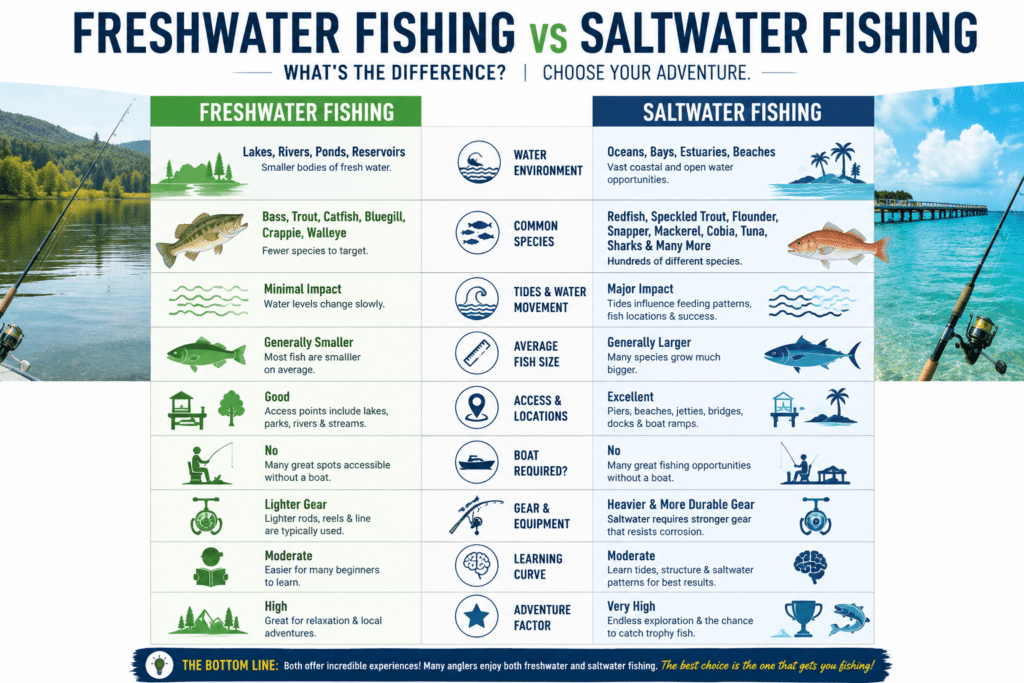
| Feature | Freshwater Fishing | Saltwater Fishing |
|---|---|---|
| Water Type | Lakes, Rivers, Ponds | Bays, Beaches, Ocean |
| Common Species | Bass, Trout, Catfish | Redfish, Trout, Snapper |
| Tides | Minimal Impact | Major Impact |
| Average Fish Size | Smaller | Larger |
| Public Access | Good | Excellent |
| Boat Required | No | No |
| Learning Curve | Moderate | Moderate |
| Adventure Factor | High | Very High |
Choose Your Type of Saltwater Fishing
One of the biggest mistakes beginner anglers make is assuming all saltwater fishing is the same.
In reality, there are several different types of saltwater fishing, each with its own techniques, equipment requirements, costs, and learning curves. The good news is that most beginners can get started with little more than a spinning rod, a spinning reel, some live bait, and access to public fishing areas.
The key is choosing the type of fishing that matches your experience level, budget, and goals.
Pier Fishing: The Best Place for Most Beginners
If your goal is to catch your first saltwater fish as quickly as possible, pier fishing is often the best choice.
Public fishing piers provide easy access to deeper water without requiring a boat. They also attract baitfish and predator fish because the pilings create structure beneath the water.
Advantages of pier fishing include:
- Easy public access
- No boat required
- Access to deeper water
- Often family-friendly
- Opportunities to catch multiple fish species
Many anglers catch their first saltwater fish from a public pier using live shrimp suspended beneath a popping cork or fished directly on the bottom.
Inshore Fishing: Exploring Bays, Marshes, and Bayous
Inshore fishing takes place in protected coastal waters, including:
- Bays
- Bayous
- Estuaries
- Marshes
- Grass flats
These areas are often home to some of the most popular saltwater game fish in America, including redfish, speckled trout, flounder, and sheepshead.
Unlike offshore fishing, inshore fishing usually occurs in relatively shallow waters ranging from a few feet deep to several dozen feet deep.
For many anglers, inshore fishing provides the perfect balance of action, accessibility, and affordability.
Surf Fishing: Fishing Directly From the Beach
Surf fishing allows anglers to fish directly from the shoreline.
Many beginners are surprised to learn that fish frequently swim much closer to shore than they realize. In many cases, fish may be feeding just beyond the breaking waves.
Surf anglers commonly target:
- Whiting
- Pompano
- Redfish
- Black drum
- Sharks
One of the biggest advantages of surf fishing is that it requires very little equipment and provides access to miles of fishable coastline.
Jetty and Bridge Fishing
Jetties and bridges create some of the most productive fishing environments in coastal waters.
Moving currents push baitfish through these areas, attracting predator species looking for an easy meal.
These locations often hold:
- Speckled trout
- Redfish
- Sheepshead
- Spanish mackerel
- Flounder
Because rocks and pilings can damage fishing line, many anglers use heavier lines and fluorocarbon leaders when fishing around structure.
Offshore Fishing and Deep Sea Fishing
When most people picture saltwater fishing, they often imagine offshore fishing in the open Gulf of Mexico or the Atlantic Ocean.
Offshore fishing typically targets larger fish such as:
- Red snapper
- Grouper
- Amberjack
- Mahi-mahi
- Tuna
- Wahoo
While offshore fishing can be incredibly exciting, it is usually not the best starting point for beginner anglers due to the additional cost, specialized equipment, and boating knowledge required.
Many experienced offshore anglers actually began their fishing journeys from public piers and shorelines before moving into deeper water.
Which Type of Saltwater Fishing Should You Choose?
For most beginners, the progression looks something like this:
- Pier Fishing
- Inshore Fishing
- Surf Fishing
- Jetty Fishing
- Offshore Fishing
Starting simple allows you to develop casting skills, learn fish behavior, understand tides, and gain confidence before investing in more advanced equipment.
The important thing to remember is that there is no wrong place to start. Whether you’re fishing from a public pier, a beach, a bridge, or a private dock, every cast teaches you something new and brings you one step closer to landing your first saltwater fish.
| Fishing Type | Cost | Difficulty | Boat Needed | Beginner Friendly |
|---|---|---|---|---|
| Pier Fishing | $ | Easy | No | ⭐⭐⭐⭐⭐ |
| Inshore Fishing | $$ | Easy-Moderate | Optional | ⭐⭐⭐⭐⭐ |
| Surf Fishing | $ | Moderate | No | ⭐⭐⭐⭐ |
| Jetty Fishing | $ | Moderate | No | ⭐⭐⭐ |
| Offshore Fishing | $$$$ | Advanced | Yes | ⭐⭐ |
People Often Ask
Is saltwater fishing harder than freshwater fishing?
Many beginners assume saltwater fishing is more difficult because the ocean is larger and fish species are unfamiliar. In reality, many anglers find saltwater fishing easier because fish populations can be dense, public access is often excellent, and common baits such as live shrimp attract a wide variety of species. The biggest adjustment is learning how tides influence fish behavior.
Can I use freshwater fishing equipment in saltwater?
Yes, many freshwater rods and reels can be used occasionally in saltwater. However, salt is highly corrosive and can damage equipment if it is not rinsed thoroughly with fresh water after each trip. Anglers who fish saltwater regularly should consider equipment specifically designed for marine environments.
Why do some anglers prefer saltwater fishing?
Many anglers enjoy the variety of fish species, larger average fish size, coastal scenery, and the opportunity to fish from beaches, piers, marshes, bays, and offshore waters. Others simply enjoy the challenge of learning how tides, currents, and weather conditions affect fishing success.
Try our free Saltwater Fishing Starter Advisor below
Answer a few quick questions and get a beginner-friendly saltwater fishing setup.
The Best Saltwater Fishing Gear for Beginners
Walk into a local tackle shop, and you’ll quickly discover there are hundreds of fishing rods, reels, lines, hooks, lures, and accessories available. For many beginners, the number of choices can feel overwhelming.
The good news is that catching your first saltwater fish does not require expensive equipment.
In fact, many experienced anglers would agree that a simple setup used correctly will often outperform a garage full of gear used incorrectly.
If you’re just getting started, focus on a basic setup that allows you to fish from a public pier, shoreline, dock, or small boat.
Start with a Spinning Rod and Reel
For most beginners, a spinning rod and spinning reel combination is an excellent choice.
Spinning reels are easy to use, relatively inexpensive, and work well for many different types of saltwater fishing.
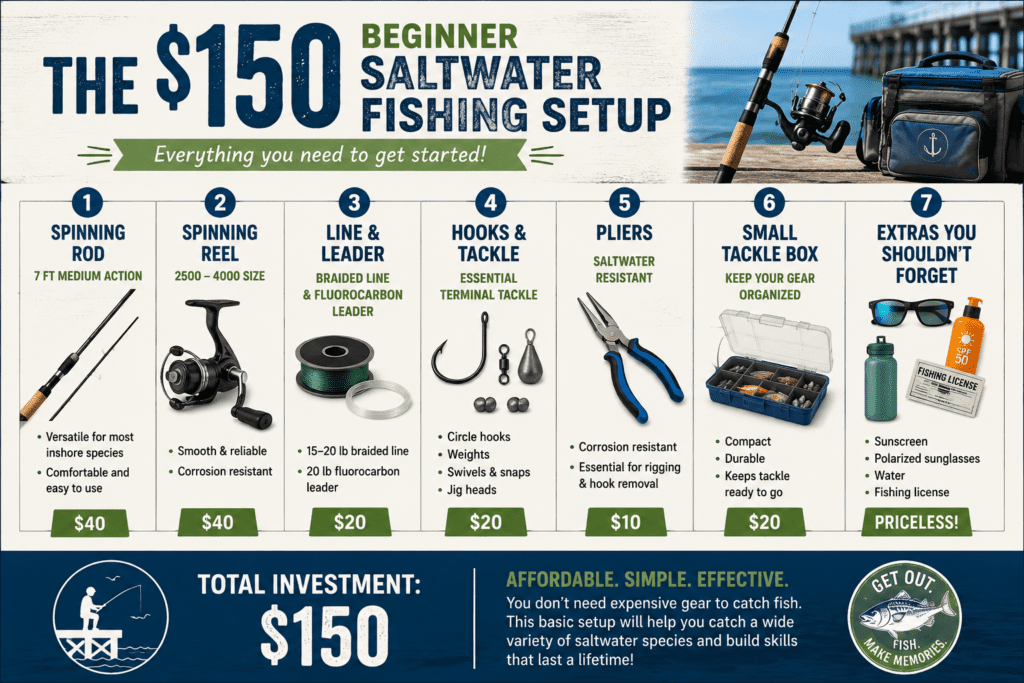
A good beginner setup includes:
- 7-foot medium-action spinning rod
- 2500 to 4000 size spinning reel
- Corrosion-resistant components
This combination provides enough power to catch a wide variety of fish species while remaining comfortable for all-day fishing.
Choosing the Right Fishing Line
Fishing line is your connection to the fish.
Most beginner anglers choose one of three options:
Monofilament Line
Advantages:
- Easy to use
- Inexpensive
- Forgiving for beginners
Disadvantages:
- More stretch
- Less sensitivity
Braided Line
Advantages:
- Stronger for its diameter
- Longer casting distance
- Better bite detection
Disadvantages:
- More expensive
- Requires a leader
Fluorocarbon Leader
Many saltwater anglers attach a fluorocarbon leader to their main line.
Advantages include:
- Less visible underwater
- Better abrasion resistance
- Excellent around the structure and oyster beds
For beginners, a 15-20 pound braided main line paired with a 20-pound fluorocarbon leader is a great starting point.
Circle Hooks: A Beginner’s Best Friend
One of the easiest ways to improve your success is to use circle hooks.
Unlike traditional hooks, circle hooks are designed to rotate into the corner of a fish’s mouth as you begin reeling.
Benefits include:
- Fewer missed fish
- Reduced gut-hooking
- Easier catch-and-release fishing
If you’re using live shrimp or other natural baits, circle hooks are often an excellent choice.
The Only Tackle Most Beginners Need
Many anglers spend hundreds of dollars on tackle before catching their first fish.
Keep it simple.
Start with:
- Circle hooks
- Split-shot weights
- Egg sinkers
- Barrel swivels
- Jig heads
- Popping corks
This small collection of tackle can catch dozens of different species in coastal waters.
Live Bait vs. Artificial Lures
If your goal is to catch your first fish as quickly as possible, live bait is usually the better option.
Popular beginner baits include:
- Live shrimp
- Finger mullet
- Cut bait
- Squid
Live shrimp may be the most versatile saltwater bait available. They catch everything from speckled trout and redfish to flounder, croaker, sheepshead, and many other species.
Artificial lures become more important as your skills develop.
Don’t Forget the Small Stuff
Successful fishing trips often depend on simple items people forget.
Bring:
- Needle-nose pliers
- Small tackle box
- Sunscreen
- Polarized sunglasses
- Drinking water
- Measuring device
- Fishing license
- Small cooler
A cooler may not seem important on your first trip, but it’s amazing how often beginners regret not bringing one after they finally catch a keeper fish.
A Beginner Setup Doesn’t Have to Be Expensive
One of the biggest myths in fishing is that expensive equipment catches more fish.
The reality is that location, timing, tides, and presentation matter far more than price.
A beginner can often assemble a complete saltwater fishing outfit—including rod, reel, line, hooks, and basic tackle—for less than the cost of a single offshore fishing charter.
The best fishing gear is the gear that gets used regularly. Start simple, learn the fundamentals, and upgrade your equipment as your skills and interests grow.
| Item | Estimated Cost |
|---|---|
| Spinning Rod | $40 |
| Spinning Reel | $40 |
| Line & Leader | $20 |
| Hooks & Tackle | $20 |
| Pliers | $10 |
| Small Tackle Box | $20 |
| Total | $150 |
People Often Ask
How much does it cost to start saltwater fishing?
Many beginners are surprised to learn that saltwater fishing can be relatively affordable. A basic setup that includes a spinning rod, spinning reel, fishing line, hooks, weights, and other essential tackle can often be assembled for $150 to $200. If you’re fishing from public piers, beaches, or shorelines, there may be little or no additional cost beyond transportation and bait.
Do I need a fishing license, and how much does it cost?
In most states, yes. Saltwater fishing licenses are typically required for anglers above a certain age, although exemptions sometimes apply for children, seniors, military personnel, or fishing from specific public piers.
License costs vary by state and residency status. Resident licenses are often relatively inexpensive, while non-resident licenses generally cost more. Before your first trip, visit your state’s wildlife or fisheries agency website to review current license requirements, local regulations, catch limits, and minimum size limits.
Should beginners use live bait or artificial lures?
Live bait usually gives beginner anglers the best chance of catching their first fish. Live shrimp, cut bait, and other natural baits are already recognized as food by many saltwater species. As your skills improve, artificial lures can become an effective and enjoyable way to target specific fish.
What is the most important piece of fishing equipment?
Many experienced anglers will tell you it isn’t the rod or reel. The most important factors are fishing where fish are located and fishing during productive conditions. Understanding tides, bait movement, structure, and weather conditions will usually improve your success more than purchasing expensive equipment.
Where to Buy Saltwater Fishing Gear, Bait, and Local Knowledge
Once you’ve decided to try saltwater fishing, the next question becomes simple:
Where should you buy your equipment?
There are generally three options available to most anglers:
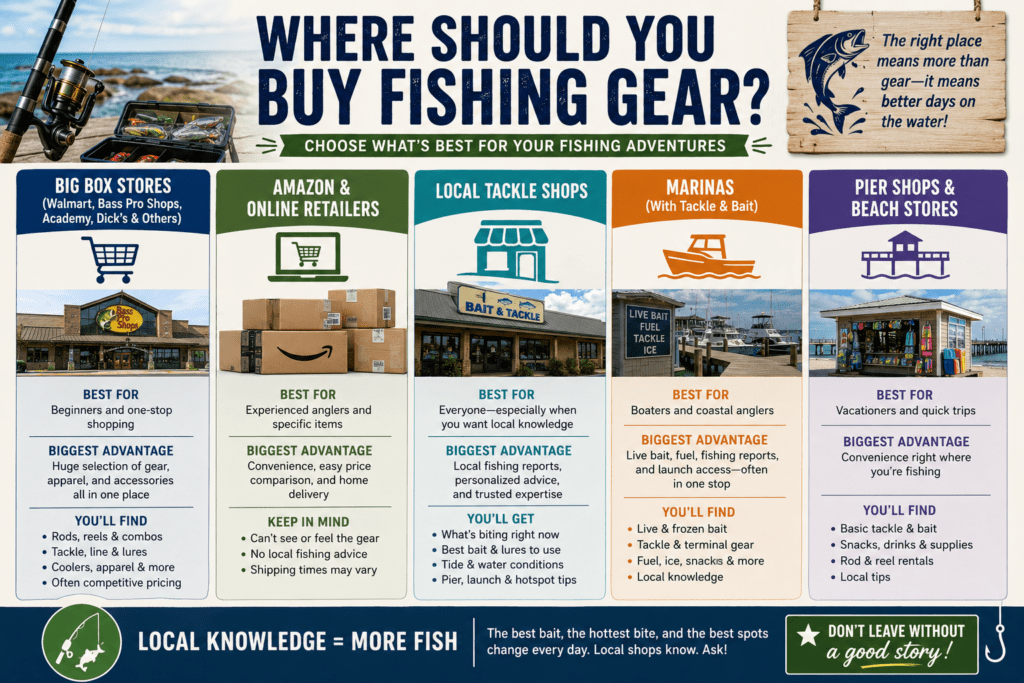
- Big box sporting goods stores
- Online retailers
- Local bait and tackle shops
Each has advantages, and many experienced fishermen use all three depending on what they need.
Big Box Stores: The One-Stop Shopping Experience
Large retailers such as:
- Walmart
- Bass Pro Shops
- Academy Sports + Outdoors
- Dick’s Sporting Goods
Offer tremendous convenience for beginner anglers.
These stores typically carry:
- Rod and reel combinations
- Fishing line
- Hooks and tackle
- Coolers
- Fishing apparel
- Sunglasses
- Life jackets
- Bait and tackle storage
One advantage of big box stores is selection. If you already know what you want, it’s hard to beat having hundreds of options in one place.
Many beginners can purchase everything needed for their first fishing trip during a single visit.
Online Retailers: Convenient but Missing Something Important
Online retailers such as Amazon make it easy to compare prices and have equipment delivered directly to your door.
However, fishing is one hobby where buying locally still offers significant advantages.
When you’re new to fishing, product reviews can only tell you so much. They can’t tell you:
- What bait is working this week
- What fish are biting locally
- Which pier has been productive
- What lure color has been successful
- Whether the water is muddy or clear
Those answers often come from local knowledge rather than product descriptions.
Local Bait and Tackle Shops: More Than Just Equipment
If you’re planning to fish in a specific area, few resources are more valuable than a good local bait shop.
Local tackle stores provide:
- Live bait
- Local fishing reports
- Tide information
- Current fishing conditions
- Tackle recommendations
- Advice tailored to local waters
Many anglers consider the conversation behind the counter just as valuable as the equipment they purchase.
In many cases, the staff members fish the same waters you’re about to fish.
Their advice can dramatically shorten the learning curve.
Mississippi Gulf Coast Favorites
If you’re planning to fish along the Mississippi Gulf Coast, several locally owned businesses have earned strong reputations among area anglers.
Gorenflo’s Tackle and Marina
Located in Biloxi, Gorenflo’s is one of the Gulf Coast’s best-known fishing destinations. The store carries a tremendous selection of saltwater tackle, rods, reels, bait, boating supplies, and fishing accessories.
Website:
https://www.gorenflostackle.com
Mary Walker Marina
Located in Gautier, Mary Walker Marina is a longtime favorite among local fishermen. The marina offers live bait, frozen bait, tackle, fuel, and fishing supplies.
Many anglers stop here before heading into the marshes, bays, and estuaries of eastern Mississippi.
Website:
Sea 2 Swamp Outfitters
Located in Gulfport, Sea 2 Swamp Outfitters has developed a loyal following among coastal anglers. The shop specializes in quality rods, reels, tackle, apparel, and local fishing expertise.
Consider Renting Before You Buy
One tip many beginners overlook is equipment rental.
Some tackle shops, marinas, fishing piers, and charter operators offer rod and reel rentals. This allows you to experience saltwater fishing without immediately investing in equipment.
If you’re unsure whether fishing will become a long-term hobby, renting can be an excellent way to get started.
The Real Value of Local Knowledge
Personally, I enjoy visiting larger stores like Bass Pro Shops because of the enormous selection available. When I know exactly what I want, those stores are hard to beat.
However, when I want advice about what bait is working, what fish are biting, or what lure color has been successful recently, I head to a local bait and tackle shop.
Local fishermen often know more about current fishing conditions than any website, app, or fishing report.
And if you stop by a local bait shop, don’t leave without hearing a story.
If you’re lucky, you’ll hear about a trophy fish that was landed last week.
If you’re really lucky, you’ll hear about the one that got away.
Some of those stories get a little bigger every time they’re told, but that’s been part of fishing culture for generations.
| Option | Best For | Biggest Advantage |
|---|---|---|
| Big Box Stores | Beginners | One-stop shopping |
| Amazon & Online Retailers | Experienced anglers | Convenience |
| Local Tackle Shops | Everyone | Local fishing knowledge |
| Marinas | Coastal anglers | Bait + local reports |
| Pier Shops | Vacation fishermen | Convenience and rentals |
This section is one of the biggest opportunities to outperform the competition.
Where to Fish: Finding Saltwater Fish Near You
One of the biggest misconceptions among beginner anglers is that catching fish is mostly about having the right rod, reel, or lure.
In reality, successful fishing often comes down to one thing:
Fishing where fish are already located.
You can have the most expensive equipment available, but if you’re fishing empty water, your chances of success drop dramatically.
The good news is that saltwater fish are often easier to locate than many beginners realize.
Fish Need the Same Things People Do
Most saltwater fish spend their time looking for three basic things:
- Food
- Protection
- Comfortable water conditions
If you can find those three things, you will usually find fish.
Start With Structure
Fish are rarely scattered randomly across large areas of water.
Instead, they gather around a structure.
Common examples include:
- Docks
- Pier pilings
- Bridges
- Jetties
- Oyster reefs
- Rock piles
- Grass beds
- Fallen trees
- Channel edges
Structure provides protection from predators and creates feeding opportunities as currents push baitfish through the area.
When in doubt, fish near structure.
Public Piers Are Beginner Gold Mines
One reason pier fishing is so popular is that piers combine several important fish-holding features:
- Deep water access
- Shade
- Structure
- Current breaks
- Concentrated baitfish
Many beginners catch their first saltwater fish simply by fishing near the pilings of a public pier.
The fish may be much closer than you think.
Look for Baitfish
Experienced anglers often spend more time looking for bait than looking for game fish.
Why?
Because where the bait goes, the predators usually follow.
Watch for:
- Schools of small fish
- Shrimp skipping across the surface
- Nervous water
- Birds diving into the water
- Pelicans actively feeding
These are often signs that larger fish are nearby.
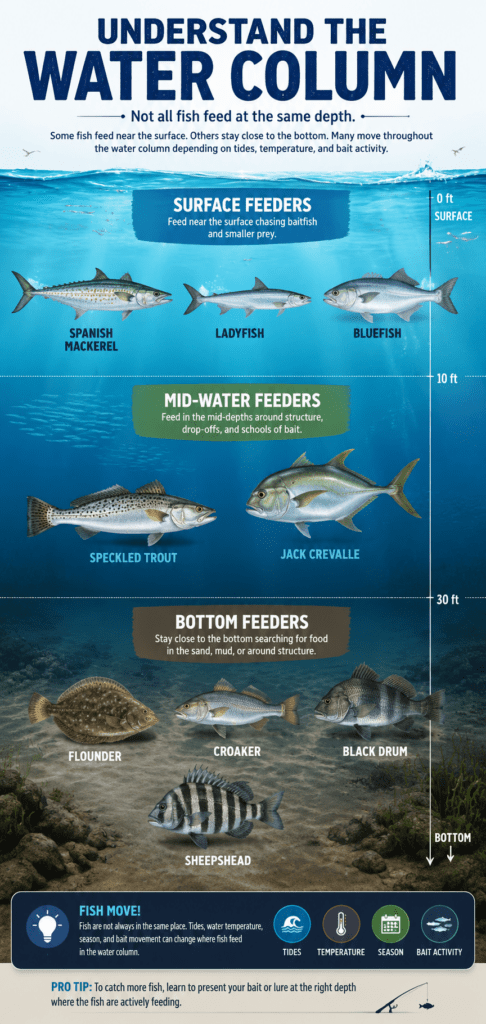
Understand the Water Column
Not all fish feed at the same depth.
Some fish feed near the surface.
Others stay close to the bottom.
Many move throughout the water column depending on tides, temperature, and bait activity.
Common examples include:
Surface Feeders
- Spanish mackerel
- Ladyfish
- Bluefish
Mid-Water Feeders
- Speckled trout
- Jack crevalle
Bottom Feeders
- Flounder
- Croaker
- Black drum
- Sheepshead
Understanding where your target species typically feeds can dramatically improve your success.
Moving Water Is Usually Better Than Still Water
One of the simplest rules in saltwater fishing is:
Moving water often produces more fish than still water.
Current moves:
- Baitfish
- Shrimp
- Crabs
- Nutrients
Predator fish learn to wait where food naturally comes to them.
This is one reason why many experienced anglers pay close attention to tide charts before every trip.
Don’t Ignore Small Areas
Beginners often think they need to cast as far as possible.
That’s not always true.
Many fish are caught:
- Along seawalls
- Under docks
- Beside pilings
- Along grass edges
- Near marsh drains
Sometimes the best fish are surprisingly close to shore.
Technology Can Help
Modern anglers have access to resources that didn’t exist a generation ago.
Helpful tools include:
- Tide apps
- Fishing reports
- Navigation apps
- Weather forecasts
- Satellite imagery
These resources can help identify productive areas before you ever arrive at the water.
Ask Local Anglers
Perhaps the most valuable resource is still the oldest one.
Talk to local fishermen.
Visit local bait shops.
Ask questions.
Most anglers are happy to point beginners in the right direction, especially if you’re respectful and willing to learn.
A five-minute conversation at a local tackle shop can often save hours of frustration on the water.
The Beginner’s Secret
If you’re not sure where to start, remember this simple formula:
Structure + Bait + Moving Water = Fish
It won’t work every time, but it will put you ahead of many beginners who simply pick a random spot and hope for the best.
Infographic Opportunity
Immediately after this section:
How to Find Fish in 5 Minutes
- Find Structure
- Look for Baitfish
- Check the Tide
- Watch the Birds
- Fish the Moving Water
People Often Ask
How do I know if fish are in the area?
Look for baitfish, diving birds, surface activity, current movement, and structure. These signs often indicate that predator fish are nearby.
Should I cast as far as possible?
Not necessarily. Many fish are caught surprisingly close to docks, piers, marsh edges, and shoreline structure.
What is the easiest place to find fish as a beginner?
Public piers are often the best starting point because they provide structure, deep water access, and concentrated fish populations in a relatively small area.
When to Fish: Understanding Tides, Weather, and Timing
One of the biggest differences between successful anglers and frustrated beginners often comes down to timing.
You can have the right gear, the right bait, and the right location, but if the fish aren’t actively feeding, your chances of success decline significantly.
Fortunately, you don’t need to become a marine biologist to improve your odds. Understanding a few basic principles can dramatically increase your chances of catching fish.
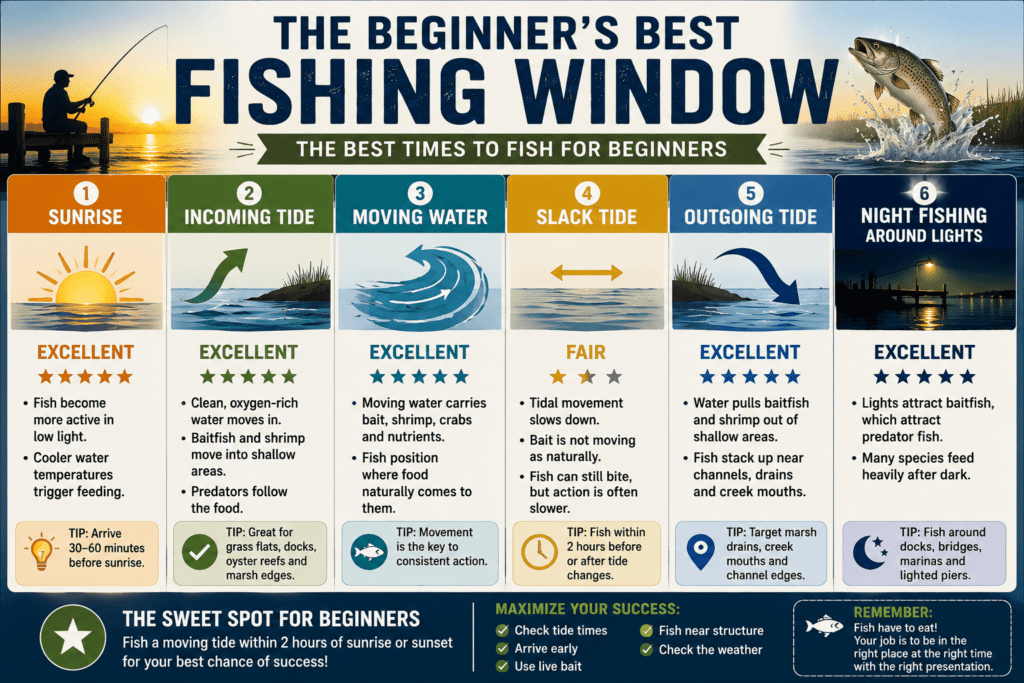
The Best Time to Fish Is Often During a Moving Tide
If there is one lesson that experienced saltwater anglers learn quickly, it is this:
Moving water is usually good fishing water.
Tides move:
- Baitfish
- Shrimp
- Crabs
- Nutrients
As food moves, predator fish follow.
This creates feeding opportunities throughout bays, marshes, bayous, beaches, and coastal waters.
Incoming Tides
An incoming tide occurs when water moves from the ocean toward shore.
Many anglers like incoming tides because:
- Cleaner water often enters bays and estuaries.
- Baitfish move into shallow feeding areas.
- Predator fish frequently follow the bait.
Incoming tides can be especially productive around:
- Grass flats
- Marsh edges
- Oyster reefs
- Docks
Outgoing Tides
Outgoing tides can be equally productive.
As water leaves marshes and shallow areas, it carries baitfish and shrimp through narrow channels and drains.
Many fish position themselves near these natural funnels and wait for food to come to them.
This is one reason experienced anglers often target:
- Marsh drains
- Creek mouths
- Channel edges
during falling tides.
What About Slack Tide?
Slack tide occurs when tidal movement temporarily slows between incoming and outgoing tides.
Fish can still be caught during slack tide, but many anglers notice slower feeding activity because bait is not moving as naturally through the water.
For beginners, fishing within two hours before or after a tide change often provides the best opportunity for success.
Early Morning and Late Evening
Fish don’t own watches, but they do respond to light levels.
Many species become more active during:
- Sunrise
- Early morning
- Sunset
- Evening hours
Cooler temperatures and reduced sunlight often encourage fish to feed more aggressively.
This is one reason why many experienced anglers launch before sunrise.
Night Fishing Can Be Outstanding
Some of the best fishing occurs after dark.
Lights around:
- Docks
- Piers
- Bridges
- Marinas
Often attract baitfish, which in turn attract larger predator fish.
Night fishing can be especially productive for:
- Speckled trout
- Redfish
- Flounder
- Snook (in some regions)
As discussed earlier, some of my favorite fishing memories involve spending evenings on the bayou with family, enjoying the peaceful atmosphere and waiting for the next strike.
Weather Matters More Than Most Beginners Realize
Fish live in the water and experience changing weather conditions long before we do.
Pay attention to:
- Approaching storms
- Sudden cold fronts
- Strong winds
- Heavy rainfall
These conditions can dramatically influence fish behavior.
Safety Comes First
Always check weather forecasts before heading out.
If thunderstorms or lightning are expected, postpone your trip.
No fish is worth risking your safety.
The Beginner’s Best Fishing Schedule
If you’re planning your first saltwater fishing trip, consider this simple formula:
✓ Fish during a moving tide
✓ Arrive near sunrise or sunset
✓ Use live shrimp or natural bait
✓ Fish near structure
✓ Check the weather forecast
Following these five steps won’t guarantee success, but they will put the odds firmly in your favor.
Remember: Fish Have to Eat
Many beginners overcomplicate fishing.
At its core, fishing is about presenting food to a fish when it is ready to eat.
The better you understand when fish are most likely to feed, the more successful your fishing trips will become.
People Often Ask
What is the single best time to go saltwater fishing?
Many anglers would choose a moving tide near sunrise or sunset because both tidal movement and changing light conditions often trigger feeding activity.
Is high tide always the best time to fish?
Not necessarily. Both incoming and outgoing tides can be productive. The key factor is often water movement rather than the exact tide stage.
Can beginners catch fish at night?
Absolutely. Fishing around docks, bridges, marinas, and lighted piers can be one of the easiest and most enjoyable ways for beginners to catch saltwater fish.
The Best Saltwater Fish for Beginners
One of the most exciting parts of saltwater fishing is that you never know exactly what might take your bait.
Unlike some forms of freshwater fishing where anglers may target only one or two species, saltwater anglers often catch a variety of fish during the same trip.
The species available will depend on your location, the season, water temperature, and the type of fishing you’re doing. Fortunately, several species are particularly beginner-friendly because they are relatively common, willing to bite, and often found around public access areas.
Croaker
If there were an award for “Best First Saltwater Fish,” croaker would be a strong contender.
Why beginners like them:
- Abundant in many coastal areas
- Readily eat live shrimp and natural bait
- Often found near piers and shorelines
- Good table fare
Croaker may not be the largest fish in the water, but they help beginners learn how to recognize bites and land fish consistently.
Whiting
Whiting are often caught from beaches and piers.
Advantages include:
- Easy to catch
- Common in many coastal waters
- Excellent eating quality
- Readily take shrimp and cut bait
Many anglers catch their first saltwater fish while surf fishing for whiting.
Speckled Trout
Speckled trout are among the most popular inshore game fish in the Gulf of Mexico and along much of the southeastern coast.
Why anglers love them:
- Aggressive strikes
- Strong fights
- Excellent table fare
- Available from shore, piers, docks, and boats
Speckled trout are often caught using live shrimp under popping corks, making them an excellent target species for beginners.
Redfish
Redfish are one of the most sought-after saltwater fish in North America.
They are known for:
- Powerful runs
- Hard fights
- Accessibility in shallow water
- Distinctive appearance
Many beginner anglers become lifelong redfish fans after landing their first one.
Flounder
Flounders are unique because they spend much of their time on the bottom waiting to ambush prey.
They are commonly found:
- Near docks
- Around the bridge pilings
- Along channel edges
- Near structure
Their unusual appearance and excellent eating quality make them a favorite among many coastal anglers.
Sheepshead
Sheepshead are easy to recognize because of their human-like teeth.
They often gather around:
- Pilings
- Docks
- Oyster reefs
- Jetties
Although they can be challenging to hook, they are frequently found near areas where beginners fish.
You Never Know What Will Show Up
One of the most enjoyable aspects of saltwater fishing is the variety.
Even when targeting a specific species, anglers frequently catch:
- Ladyfish
- Black drum
- Catfish
- Pinfish
- Spanish mackerel
- Jack crevalle
- Small sharks
- Stingrays
That’s part of the fun.
Every cast carries the possibility of a surprise.
Focus on Catching Fish, Not Trophy Fish
Many beginners make the mistake of focusing on catching the biggest fish in the water.
A better goal is simply to catch fish.
Each fish teaches valuable lessons about:
- Bait presentation
- Detecting bites
- Fighting fish
- Landing fish
- Understanding fish behavior
The anglers who become successful over time are usually the ones who enjoy the learning process rather than chasing trophies from day one.
The Beginner’s Target List
If you’re planning your first saltwater fishing trip, focus on:
- Croaker
- Whiting
- Speckled Trout
- Redfish
- Flounder
These species provide excellent opportunities to learn saltwater fishing fundamentals while also offering the possibility of bringing home a fish dinner.
| Species | Difficulty | Fight | Eating Quality | Best Bait |
|---|---|---|---|---|
| Croaker | Easy | Fair | Good | Live Shrimp |
| Whiting | Easy | Fair | Excellent | Shrimp |
| Speckled Trout | Moderate | Good | Excellent | Live Shrimp |
| Redfish | Moderate | Excellent | Excellent | Shrimp, Cut Bait |
| Flounder | Moderate | Good | Excellent | Live Bait |
How to Catch Your First Saltwater Fish: A Step-by-Step Guide
Many beginner anglers spend weeks researching equipment, bait, tides, and locations before ever making their first cast.
The truth is that your first successful fishing trip can be surprisingly simple.
Let’s walk through a realistic beginner fishing trip from start to finish.
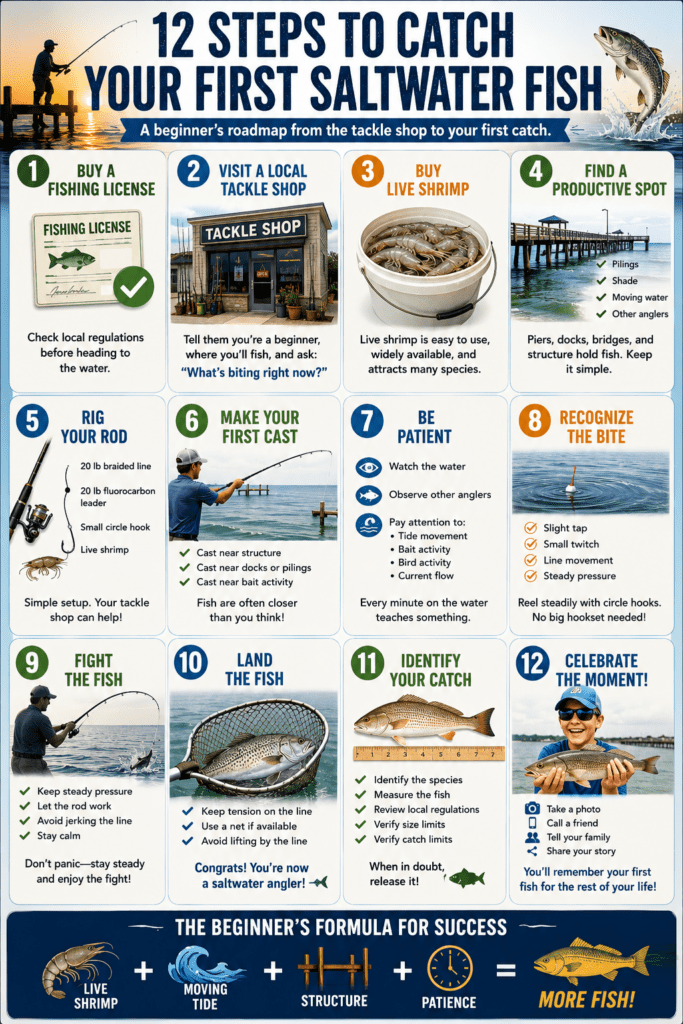
Step 1: Purchase Your Fishing License
Before heading to the water, check your state’s fishing license requirements.
Many states offer:
- Annual licenses
- Short-term licenses
- Non-resident licenses
- Senior discounts
- Youth exemptions
Always review current regulations before fishing.
Step 2: Visit a Local Tackle Shop
This may be the most important stop of the day.
Tell them:
- You’re a beginner
- Where do you plan to fish
- Whether you’ll be fishing from a pier, beach, or shoreline
Then ask:
“What’s biting right now?”
That simple question often produces more useful information than hours of online research.
Step 3: Buy Live Shrimp
If your goal is to catch your first saltwater fish, live shrimp is often the easiest and most versatile bait available.
Why live shrimp works:
- Most coastal fish already eat shrimp
- Easy to fish
- Available almost everywhere
- Effective for multiple species
Many experienced anglers recommend starting with live bait before experimenting with artificial lures.
Step 4: Choose a Productive Location
For most beginners, a public fishing pier is the best option.
Look for:
- Pilings
- Shade
- Moving water
- Other anglers are catching fish
Don’t overthink it.
Fish gather around a structure for a reason.
Step 5: Rig Your Rod
Keep it simple.
Basic beginner setup:
- 20-pound braided line
- 20-pound fluorocarbon leader
- Small circle hook
- Live shrimp
Your local tackle shop can help you tie everything together if needed.
Step 6: Make Your First Cast
One of the biggest mistakes beginners make is casting as far as possible.
Instead:
- Cast near pilings
- Cast near docks
- Cast near the structure
- Cast near visible bait activity
Many fish are much closer than you think.
Step 7: Be Patient
Fishing is not a video game.
Sometimes fish bite immediately.
Sometimes they don’t.
Watch the water.
Observe other anglers.
Pay attention to:
- Tide movement
- Bait activity
- Bird activity
- Current flow
Every minute on the water teaches something.
Step 8: Recognize the Bite
Many beginners expect fish to nearly pull the rod from their hands.
Most bites are much more subtle.
You may notice:
- A slight tap
- A small twitch
- Line movement
- Steady pressure
When using circle hooks, resist the urge to make a dramatic hookset.
Simply begin reeling steadily.
The hook is designed to rotate into the corner of the fish’s mouth.
Step 9: Fight the Fish
Once hooked:
- Keep steady pressure
- Let the rod work
- Avoid jerking the line
- Stay calm
Many beginners lose fish because they panic when the fish starts pulling.
Remember:
The fish doesn’t know it’s your first day.
Step 10: Land Your First Fish
As the fish approaches:
- Keep tension on the line
- Avoid lifting heavy fish by the line
- Use a net if available
Congratulations.
You’re now officially a saltwater angler.
Step 11: Identify Your Catch
Before keeping any fish:
- Identify the species
- Measure the fish
- Review local regulations
- Verify size limits
- Verify catch limits
When in doubt, release the fish.
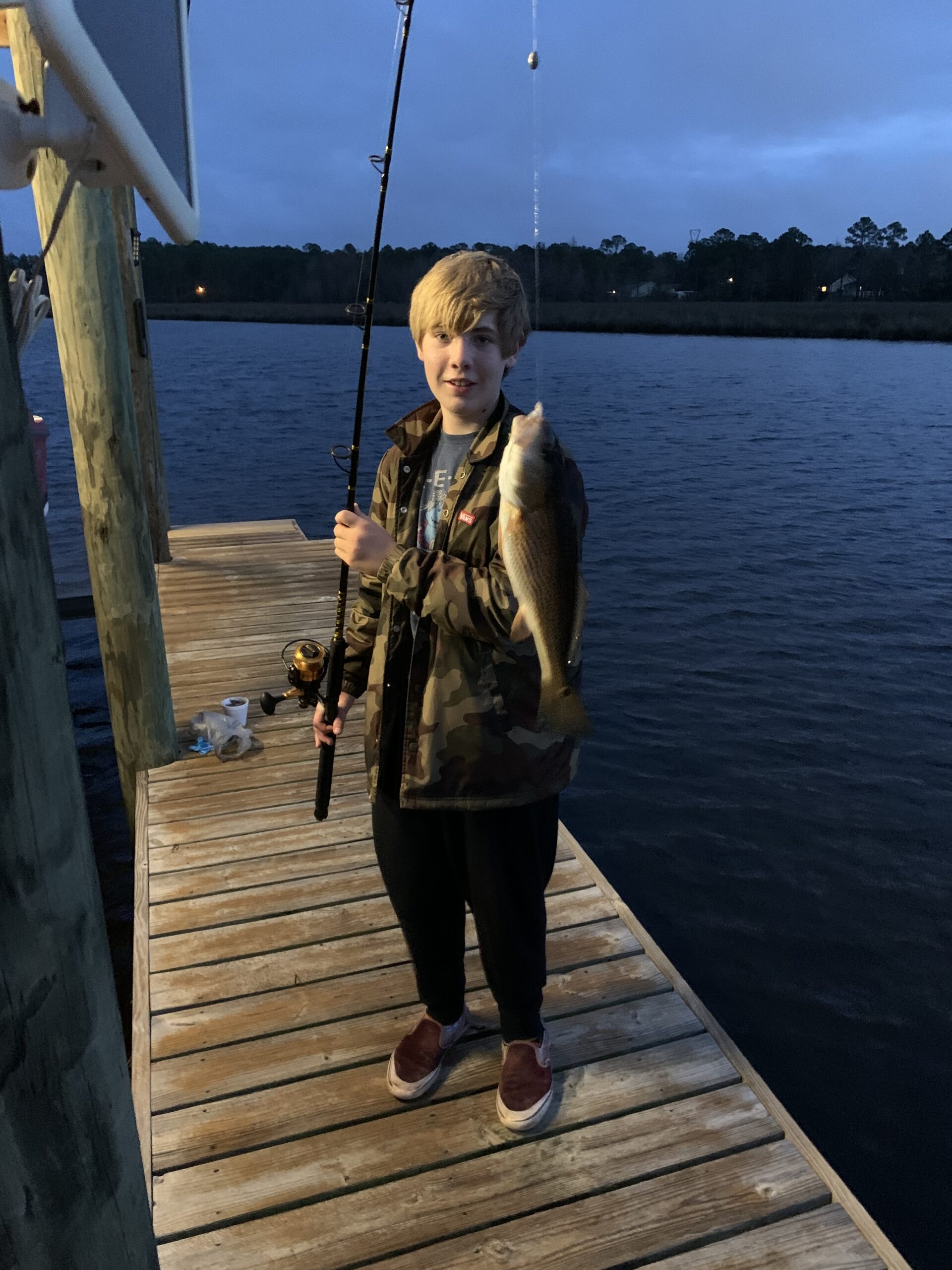
Step 12: Celebrate the Moment
Take a picture.
Call a friend.
Tell your family.
Share the story.
You’ll remember your first saltwater fish for the rest of your life.
Many experienced fishermen can describe their first catch decades later.
The fish may not be the largest you’ll ever catch, but it will always be one of the most important.
People Often Ask
How long does it take to catch your first saltwater fish?
Some beginners catch a fish within minutes, while others may need several trips. Success often depends on location, tides, bait, and patience.
What bait gives me the best chance of catching a fish?
Live shrimp is one of the most effective beginner baits because it attracts a wide variety of saltwater species.
What if I don’t catch anything?
Every fishing trip teaches valuable lessons. Even experienced anglers occasionally have slow days. Focus on learning about the water, observing fish behavior, and enjoying the experience. Your first fish will come.
Common Beginner Mistakes That Cost Fish
Every experienced angler has made mistakes.
In fact, many of the lessons fishermen learn come from losing fish, choosing the wrong location, fishing at the wrong time, or discovering that what worked yesterday doesn’t always work today.
The good news is that many beginner mistakes are easy to avoid once you know what to look for.
Fishing Empty Water
This is probably the most common mistake in fishing.
Many beginners simply pick a location that looks nice and start casting.
Fish usually gather around:
- Structure
- Baitfish
- Moving water
If you don’t see any signs of life, don’t be afraid to move.
Remember:
Fish can’t bite if they aren’t there.
Ignoring the Tide
Many new anglers focus on weather forecasts but never check tide charts.
In saltwater fishing, tides often influence fish activity more than any lure or rod.
A productive spot during a moving tide can become nearly lifeless during slack water.
Before every trip:
- Check tide times
- Identify incoming and outgoing tides
- Plan around water movement
Using Too Much Tackle
Walk through a tackle shop, and it’s easy to believe you need hundreds of dollars in equipment.
You don’t.
Many beginners catch more fish with:
- A simple spinning rod
- Live shrimp
- Circle hooks
than anglers carrying tackle boxes full of gear they don’t know how to use.
Casting Too Far
Many beginners believe fish are always far from shore.
That’s often not true.
Some of the best fishing occurs:
- Around docks
- Near pilings
- Along the grass lines
- Near marsh edges
- Besides the bridge structure
Before trying to reach the horizon, fish the water that’s right in front of you.
Setting the Hook Too Hard
Television fishing shows have convinced many anglers that every bite requires a dramatic hookset.
When using circle hooks, you can actually lose fish.
Instead:
- Let the fish take the bait
- Begin reeling steadily
- Allow the hook to rotate naturally
Circle hooks do much of the work for you.
Fishing Only One Spot
Fish move.
Conditions change.
Bait moves.
If a location isn’t producing, don’t be afraid to explore.
Many successful anglers spend more time searching than fishing.
Ignoring Local Advice
One of the fastest ways to shorten the learning curve is to listen to people who fish the area regularly.
Ask:
- Local tackle shops
- Pier regulars
- Charter captains
- Experienced anglers
Most are happy to help beginners.
A five-minute conversation can save hours of frustration.
Not Checking Regulations
Every year, anglers receive citations because they fail to verify:
- Fishing licenses
- Size limits
- Catch limits
- Seasonal closures
Regulations exist to protect fish populations and ensure future fishing opportunities.
Always check local regulations before keeping fish.
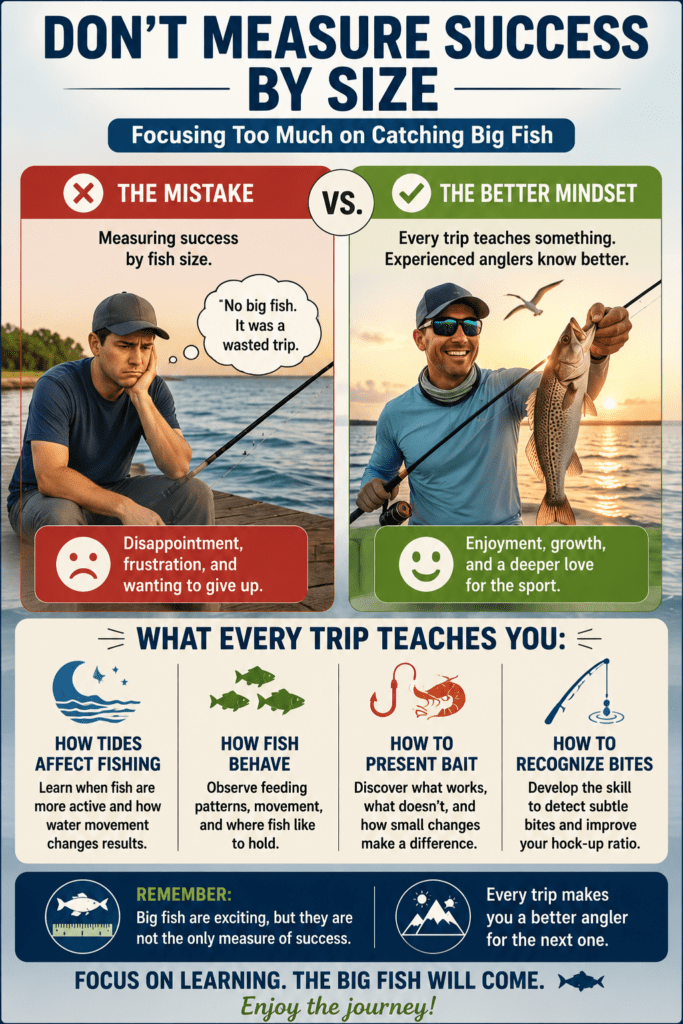
Focusing Too Much on Catching Big Fish
One of the biggest mental mistakes beginners make is measuring success by fish size.
Experienced anglers know better.
Every trip teaches something:
- How tides affect fishing
- How fish behave
- How to present bait
- How to recognize bites
The goal isn’t to become an expert overnight.
The goal is to keep learning.
Forgetting to Enjoy the Experience
Fishing is one of the few activities where success isn’t measured solely by results.
Some days you’ll catch fish.
Some days you’ll simply enjoy:
- A sunrise over the water
- Time with family
- Watching wildlife
- Learning something new
Ironically, many anglers discover that the trips they remember most aren’t always the ones where they caught the biggest fish.
They’re the ones who enjoyed the journey.
Saltwater Fishing Safety: Protecting Yourself on the Water
One of the best things about saltwater fishing is that it gets people outdoors and away from screens, traffic, and everyday stress.
However, saltwater environments deserve respect.
The ocean, bays, rivers, marshes, and coastal waters can change quickly, and even experienced anglers pay close attention to safety.
Fortunately, most fishing accidents can be prevented with a little planning and common sense.
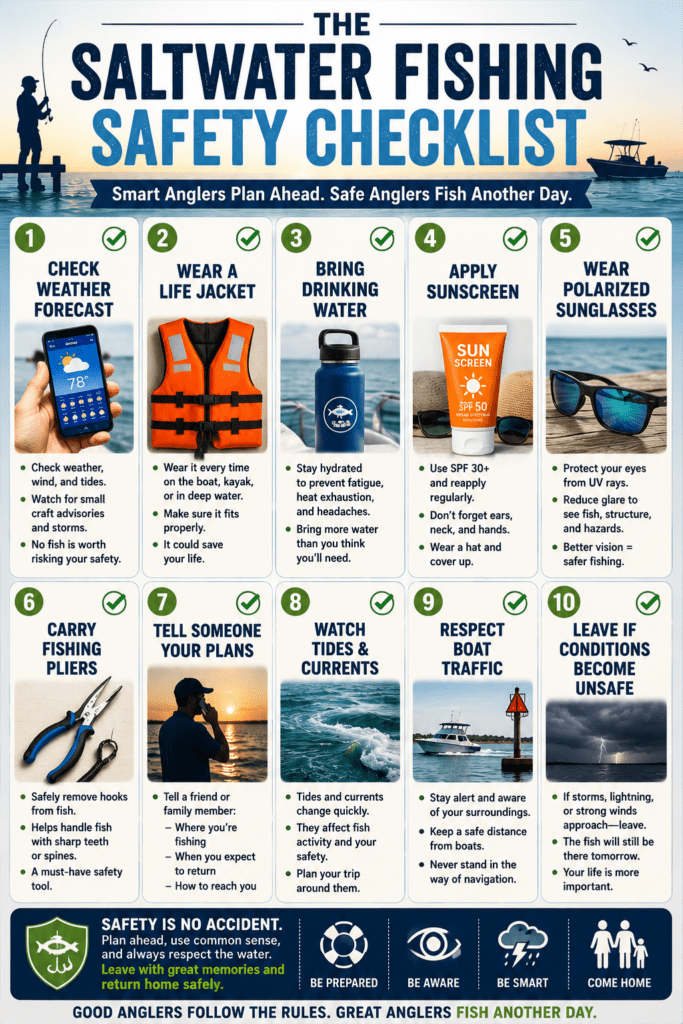
Always Check the Weather Forecast
Before leaving home, review:
- Weather forecasts
- Wind forecasts
- Thunderstorm predictions
- Small craft advisories
Weather conditions on the water can change faster than they do on land.
If thunderstorms are expected, consider postponing your trip.
Remember:
No fish is worth risking your safety.
Wear a Life Jacket When Fishing From a Boat
Many experienced boaters wear life jackets every time they leave the dock.
Modern life jackets are lightweight, comfortable, and far less restrictive than older models.
If you are:
- Fishing from a boat
- Kayak fishing
- Offshore fishing
- Fishing in deep water
a properly fitted life jacket is one of the most important pieces of equipment you can own.
Protect Yourself From the Sun
Many beginner anglers focus on fish but underestimate the sun.
Hours on the water can quickly lead to:
- Sunburn
- Dehydration
- Heat exhaustion
Bring:
- Sunscreen
- Sunglasses
- Drinking water
- Lightweight long-sleeve clothing
- A hat
Experienced coastal anglers often cover more skin, not less.
Be Careful Around Piers and Docks
Public piers and docks are excellent places for beginners to fish, but they can also become slippery.
Watch for:
- Wet surfaces
- Loose boards
- Fishing lines underfoot
- Hooks left behind by careless anglers
Good footwear can prevent many accidents.
Respect the Water
One mistake beginners make is assuming calm water means safe water.
Tides, currents, and changing weather can create hazardous conditions.
Pay attention to:
- Current strength
- Wave conditions
- Water depth
- Boat traffic
When in doubt, move to a safer location.
Learn Basic Fish Handling
Some fish are harmless.
Others are not.
Certain species have:
- Sharp teeth
- Sharp gill plates
- Strong spines
- Venomous fins
If you don’t recognize a fish, ask an experienced angler before handling it.
A pair of fishing pliers can be one of the safest tools in your tackle box.
Stay Hydrated
Many anglers become dehydrated without realizing it.
The combination of:
- Sunlight
- Heat
- Wind
- Physical activity
can cause dehydration even on mild days.
Bring more water than you think you’ll need.
Tell Someone Where You’re Going
This is especially important if:
- Fishing alone
- Fishing at night
- Fishing from a boat
- Exploring unfamiliar areas
Let a family member or friend know:
- Where you’ll be fishing
- When you expect to return
It only takes a minute and can make a big difference during an emergency.
The Safest Anglers Fish Another Day
One trait that experienced fishermen share is knowing when to leave.
If:
- Lightning appears
- Storms approach
- Conditions deteriorate
- Equipment fails
Head for safety.
The fish will still be there tomorrow.
Safety Is Part of Being a Good Angler
The goal of every fishing trip is simple:
Leave with great memories and return home safely.
The fish you catch are important.
The people waiting for you at home are even more important.
Your First Year of Saltwater Fishing: A Beginner’s Roadmap
One of the biggest misconceptions about fishing is that successful anglers are born with special knowledge.
They aren’t.
Every experienced fisherman started exactly where you are now—learning how to tie knots, choosing bait, figuring out tides, and trying to understand why fish seem to bite one day and disappear the next.
The difference is that they kept learning.
If you’re new to saltwater fishing, don’t worry about becoming an expert. Focus on making steady progress and enjoying the process.
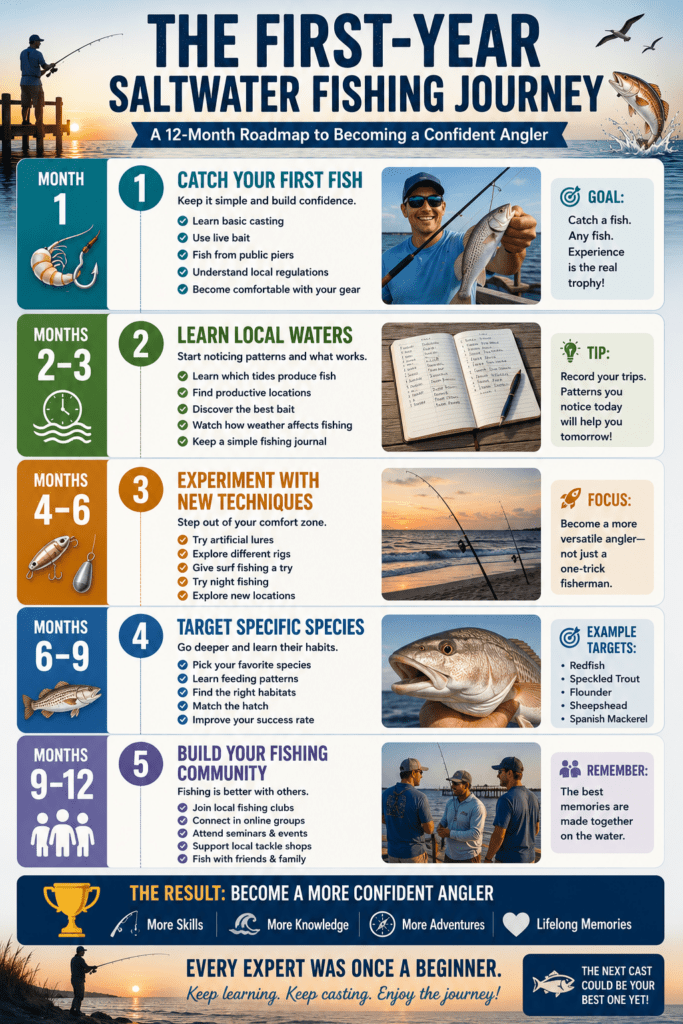
Month 1: Catch Your First Fish
Your first goal should be simple.
Catch a fish.
Not a trophy fish.
Not a fish worthy of social media fame.
Just a fish.
Focus on:
- Learning basic casting
- Using live bait
- Fishing from public piers
- Understanding local regulations
- Becoming comfortable with your equipment
Success during the first month is measured by experience, not fish size.
Months 2–3: Learn Local Waters
Once you’ve caught a few fish, begin paying attention to patterns.
Notice:
- Which tides produce fish
- Which locations are productive
- Which bait works best
- Which weather conditions improve fishing
Many anglers keep a simple fishing journal.
Record:
- Date
- Tide
- Weather
- Bait used
- Fish caught
You’ll be surprised how quickly patterns emerge.
Months 4–6: Experiment With New Techniques
As confidence grows, begin expanding your skills.
Try:
- Artificial lures
- Different rigs
- Surf fishing
- Night fishing
- New fishing locations
The goal isn’t necessarily to catch more fish.
The goal is to become a more versatile angler.
Months 6–9: Target Specific Species
By now, you’ll likely have a favorite fish.
Perhaps it’s:
- Redfish
- Speckled trout
- Flounder
- Sheepshead
- Spanish mackerel
Begin learning the habits and feeding patterns of those species.
Many anglers discover that targeting a specific fish adds a new level of challenge and excitement to the sport.
Months 9–12: Expand Your Fishing Community
One of the best parts of fishing is the people.
Consider:
- Joining local fishing clubs
- Participating in online fishing groups
- Attending seminars
- Visiting local tackle shops regularly
- Fishing with friends and family
Most anglers are eager to share stories, advice, and techniques with newcomers.
The Secret Most Experienced Anglers Know
Eventually, you’ll discover something interesting.
The fishing trip itself often becomes more important than the fish.
You’ll remember:
- Sunrises over the water
- Conversations on the pier
- Time spent with children and grandchildren
- The fish that got away
- The unexpected catches
Those memories often outlast the fish.
Every Expert Was Once a Beginner
Every tournament angler, charter captain, and fishing guide started somewhere.
Most began with:
- A simple rod and reel
- A little patience
- A willingness to learn
Your first year of saltwater fishing isn’t about becoming an expert.
It’s about building a foundation that can provide enjoyment for decades.
The next cast could be your first fish.
The cast after that could be the fish you’ll be talking about for years.
🎣 Saltwater Fishing Quick Quiz
Question 1
What is often considered the best bait for beginner saltwater anglers?
- Artificial worms
- Live shrimp ✅
- Corn
- Bread
Explanation: Live shrimp are one of the most versatile saltwater baits available and can attract many different species of fish.
Question 2
Which condition often improves saltwater fishing success?
- Completely still water
- Fishing only at noon
- A moving tide ✅
- Fishing during lightning storms
Explanation: Moving tides carry baitfish, shrimp, and other food sources, often triggering feeding activity.
Question 3
🎣 Every Fisherman Has a Story
What’s your favorite fishing memory or the story of “the one that got away?”
Examples:
- My first fish…
- The biggest fish I ever caught…
- A fishing trip with my child or grandchild…
- The fish that broke my line…
- The one that still gets longer every time I tell the story…
Your Story:
Saltwater Fishing Apprentice Certificate
Enter your name, choose your title, generate your certificate, and print.

Saltwater Fishing Apprentice Certificate
This proudly certifies that
has used the RetireCoast Saltwater Fishing for Beginners guide to learn the basic skills, safety principles, gear selection, bait choices, fishing locations, species awareness, and beginner techniques needed to advance from Beginner to
I pledge to respect the water, obey fishing regulations, protect wildlife, help new anglers learn, and always tell the story of the one that got away.
Apprentice
Angler
Thanks for Participating!
Whether you’re a beginner or a lifelong angler, every fishing trip teaches something new. The fish may not always cooperate, but the stories and memories often last a lifetime.
Do I need a boat to start saltwater fishing?
No. Many anglers catch their first saltwater fish from public piers, beaches, docks, bridges, and shorelines. A boat can expand your options, but it is not necessary for beginners.
What is the easiest saltwater fish for beginners to catch?
Species such as croaker, whiting, pinfish, and speckled trout are often good beginner targets because they are common, willing to bite, and frequently found near public access areas.
What is the best bait for beginner saltwater anglers?
Live shrimp is often considered one of the most effective beginner baits because many saltwater fish naturally feed on shrimp. It works well from piers, shorelines, docks, and boats.
Is saltwater fishing harder than freshwater fishing?
Not necessarily. Saltwater fishing introduces factors such as tides and currents, but many anglers find the variety of fish species and abundance of public access opportunities make it very beginner friendly.
How much does it cost to start saltwater fishing?
A basic rod, reel, fishing line, hooks, tackle, and bait can often be purchased for $150 to $200. Many beginners start with less, especially if they already own some equipment.
Do I need a fishing license?
In most states, yes. Fishing license requirements vary by state, age, residency status, and fishing location. Always check your state’s wildlife or fisheries agency before fishing.
What is the best time of day to go saltwater fishing?
Many anglers prefer fishing around sunrise or sunset, especially when combined with a moving tide. These conditions often increase fish feeding activity.
What is a moving tide and why is it important?
A moving tide occurs when water is actively flowing in or out. Moving water carries baitfish, shrimp, and nutrients, which often attracts predator fish and improves fishing success.
Can I use freshwater fishing equipment in saltwater?
Yes, but saltwater is highly corrosive. If you use freshwater equipment in saltwater, rinse it thoroughly with fresh water after every trip to help prevent damage.
What should I do if I don’t catch anything?
Don’t get discouraged. Even experienced anglers have slow days. Focus on learning about tides, fish behavior, bait presentation, and local fishing conditions. Every trip improves your skills.
How can I find good fishing spots near me?
Start with public piers, docks, jetties, beaches, and local bait shops. Look for structure, baitfish activity, moving water, and recommendations from local anglers.
Is saltwater fishing safe for children?
Absolutely. Many people develop a lifelong love of fishing as children. Adult supervision, properly sized equipment, life jackets around boats and deep water, and attention to weather conditions help ensure a safe experience.
What is the biggest mistake beginner anglers make?
Many beginners focus too much on catching large fish. Experienced anglers know that learning how tides work, finding productive water, and understanding fish behavior are far more important during the early stages.
Can I keep every fish I catch?
No. Most states have regulations that include size limits, bag limits, and seasonal restrictions. Always identify your catch and verify local regulations before keeping fish.
What makes saltwater fishing so addictive?
Ask ten anglers and you’ll probably get ten different answers. For some it’s the excitement of the strike, for others it’s the challenge, the scenery, the time with family, or simply the anticipation that the next cast could produce a fish you’ll be talking about for years.
Conclusion: Your First Saltwater Fish Is Closer Than You Think
Saltwater fishing can seem intimidating when you’re first getting started. There are rods, reels, lines, tides, regulations, bait choices, and dozens of fish species to learn about. It is easy to believe that successful anglers possess some secret knowledge that beginners simply don’t have.
The truth is much simpler.
Most successful anglers started exactly where you are today. They bought a basic rod and reel, asked questions, made mistakes, learned from experience, and kept fishing.
You do not need an expensive boat.
You do not need thousands of dollars in equipment.
You do not need years of experience.
What you need is a willingness to learn, a little patience, and the confidence to make that first cast.
Start simple. Visit a local tackle shop. Ask what is biting. Buy some live shrimp. Find a public pier, dock, or shoreline. Fish during a moving tide. Pay attention to the water around you. Learn from every trip.
Some days you will catch fish.
Some days you won’t.
Both types of days have value.
Along the way, you’ll learn how tides influence fish behavior, how bait attracts predators, how to identify different species, and why experienced anglers continue returning to the water year after year.
Eventually, you’ll discover something that many fishermen already know:
Fishing isn’t always about the fish.
It’s about the sunrise over the water before anyone else is awake.
It’s about sharing a fishing trip with friends, children, or grandchildren.
It’s about the stories told at the bait shop and the memories made on the water.
It’s about the fish that got away, the one that didn’t, and the anticipation that the next cast could be the best one of the day.
If you’re ready to continue your fishing journey, be sure to explore our comprehensive guide:
Whether you’re planning a vacation, relocating to the Gulf Coast, or simply looking for your next fishing adventure, you’ll find detailed information on fish species, fishing seasons, public access points, regulations, and local fishing opportunities.
Most importantly, don’t wait for the perfect day, the perfect boat, or the perfect equipment.
Grab a rod, head for the water, and make that first cast.
Your first saltwater fish may be closer than you think.
“And if you’re lucky, years from now you’ll be the one telling stories about the fish you caught, the fish that got away, and the memories that made it all worthwhile.” 🎣
🌊 Ready to Take Your Fishing Skills to the Next Level?
This beginner’s guide is just the start. If you’re planning a fishing trip to the Gulf Coast, want to learn about specific fish species, discover public fishing locations, understand regulations, or explore inshore and offshore fishing opportunities, our most comprehensive fishing resource is waiting for you.
The Ultimate Mississippi Gulf Coast Fishing Guide covers redfish, speckled trout, flounder, offshore fishing, public boat launches, seasonal fishing patterns, licensing information, local tips, and interactive resources for anglers of all experience levels.
🎣 Explore The Ultimate Mississippi Gulf Coast Fishing Guide
Whether you’re chasing your first fish or your next trophy catch, this guide can help you spend less time searching and more time fishing.
PODCAST
🎣 Turn Your Passion for Fishing Into a Business
For some people, fishing becomes more than a hobby—it becomes an opportunity.
Many successful small businesses have been built around a love of fishing and the outdoors. Opportunities range from operating a local bait and tackle shop to launching a charter fishing service, opening a specialty store that repairs rods and reels, servicing fishing boats, creating fishing-related content, guiding anglers, or selling custom lures and equipment.
One advantage of fishing-related businesses is that they are often built by people who genuinely enjoy the industry. Customers appreciate working with business owners who understand the sport, know the local waters, and share their enthusiasm for fishing.
Of course, turning a passion into a successful business requires more than simply loving what you do. You’ll need a business plan, marketing strategy, pricing structure, risk management plan, and a clear understanding of your local market.
If you’ve ever thought about turning your fishing knowledge, skills, or passion into a retirement business or side hustle, the RetireCoast Business Builder Membership provides tools, guides, templates, calculators, and resources designed to help entrepreneurs evaluate opportunities and build profitable businesses.
🚀 Explore the RetireCoast Business Builder Membership
The fish you catch may provide memories. The business you build around your passion could provide income for years to come.
Discover more from RetireCoast.com
Subscribe to get the latest posts sent to your email.