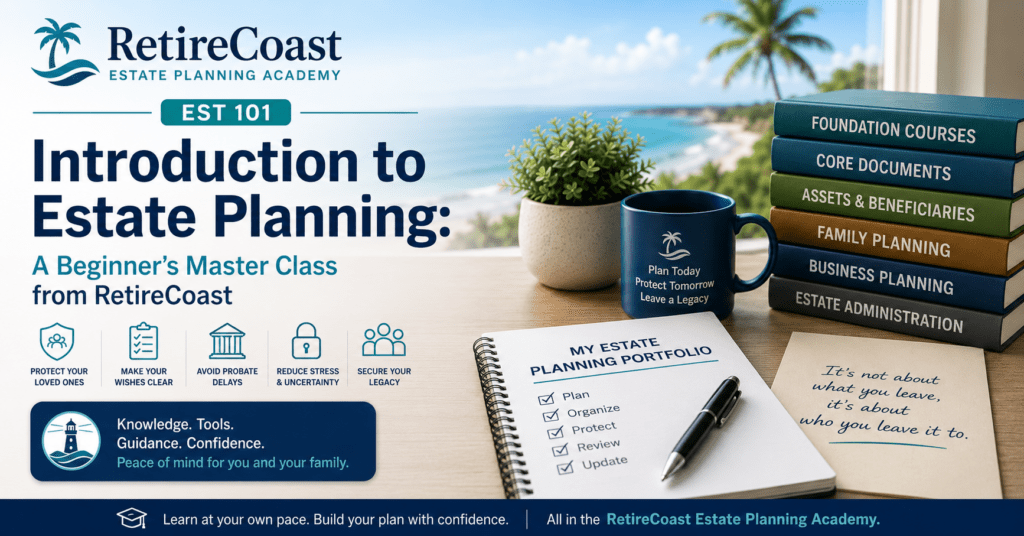
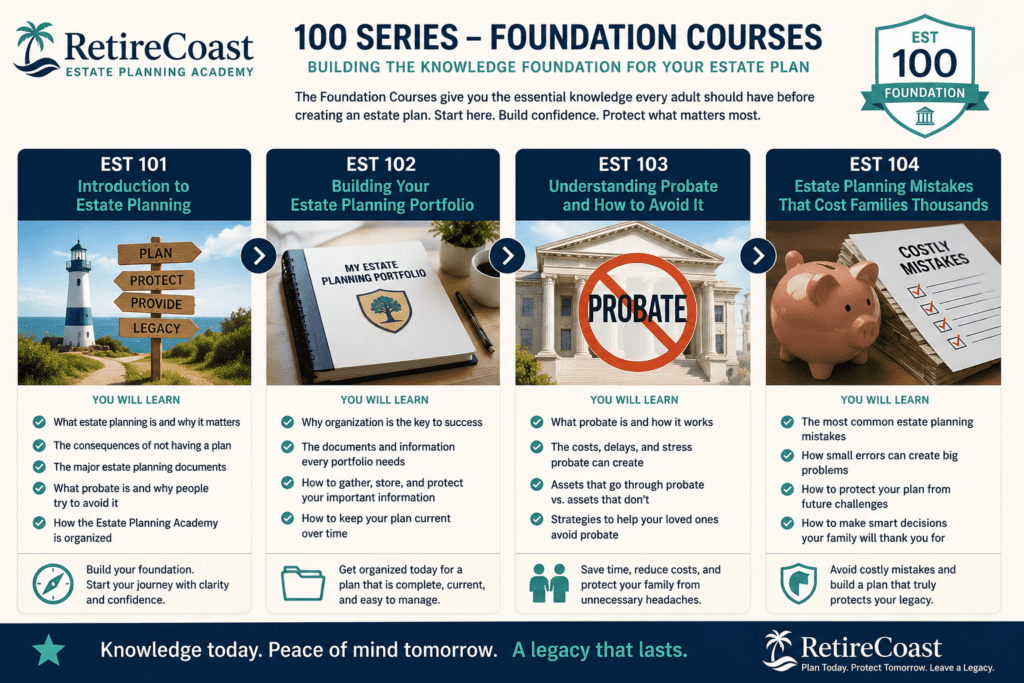
You are beginning with EST 101 – Introduction to Estate Planning, the first lesson in the Foundation Courses. This roadmap shows where this Master Class fits within the larger RetireCoast Estate Planning Academy.
In this lesson, you will learn the key ideas, planning choices, and practical steps related to this Estate Planning Academy topic. The goal is not to turn you into an attorney. The goal is to help you become better informed before you create documents, organize your Estate Planning Portfolio, or meet with a professional advisor.
You will also find a short survey near the beginning of the lesson to help you assess what you already know. This is not a test. It simply helps you think about your current understanding before the Master Class begins.
Before the lesson begins, answer a few simple questions about your current knowledge. This helps you see where you are starting.
During the lesson, you may see two short quizzes. You cannot fail them. They are included to give you feedback and reinforce the most important points.
The final quiz is not meant to judge you. It is designed to help you recognize what you learned and what you may want to review again.
How to continue: When you finish this lesson, use the button at the bottom of the page to move to the next Estate Planning Academy lesson or return to the main Academy hub.
- Welcome to the RetireCoast Estate Planning Academy
- Important: Education First, Decisions Second
- What Is Estate Planning?
- Estate Planning Is Much More Than Writing a Will
- Estate Planning Is Really About People
- Estate Planning Is Also About You
- Estate Planning Provides Peace of Mind
- Why Every Adult Needs an Estate Plan
- What Happens If You Don’t Have an Estate Plan?
- Your Loved Ones May Face Unnecessary Challenges
- Incapacity Can Create Problems Long Before Death
- Common Misconceptions About Estate Planning
- Planning Gives Your Family Choices
- Progress Check
- The Six Primary Goals of Estate Planning
- Every Estate Planning Document Has a Purpose
- Key Takeaway
- The Building Blocks of a Complete Estate Plan
- Every Document Solves a Different Problem
- The Five Core Documents Nearly Every Adult Should Consider
- Other Important Components of an Estate Plan
- Don’t Worry About Learning Everything Today
- When Should You Start Estate Planning?
- Estate Planning Changes Throughout Your Life
- Major Life Events That Should Trigger an Estate Plan Review
- Estate Planning Is Never “Finished”
- Key Takeaway
- Progress Check #2
- The Estate Planning Roadmap: How All the Pieces Fit Together
- The Estate Planning Roadmap
- Think of Your Estate Plan as a Team
- Your Estate Planning Team
- Estate Planning Happens During Three Different Stages
- The Academy Will Build One Piece at a Time
- Key Takeaway
- Probate: The Word Everyone Hears but Few Understand
- Why Probate Exists
- Why People Try to Reduce Probate
- Some Assets May Never Enter Probate
- Probate Is an Entire Lesson of Its Own
- Key Takeaway
- Introduction to Estate Planning: Who Makes Decisions for You?
- Introduction to Estate Planning: Who Makes Decisions for You?
- There Are Two Types of Decisions
- Estate Planning Is Really About Choosing People
- Choosing the Right People Matters More Than Choosing the Right Documents
- Qualities to Look For
- Don’t Worry—You’ll Learn How to Choose
- Key Takeaway
- Introduction to Estate Planning: Building Your Estate Planning Portfolio
- Introduction to Estate Planning: Building Your Estate Planning Portfolio
- What Is an Estate Planning Portfolio?
- What Should Be Included?
- Keep Your Portfolio Current
- The RetireCoast Estate Planning Portfolio
- Why Organization Is One of the Greatest Gifts You Can Leave
- Key Takeaway
- Introduction to Estate Planning: Common Estate Planning Mistakes
- Introduction to Estate Planning Mistake #1 – Believing You’re Too Young
- Introduction to Estate Planning Mistake #2 – Believing Estate Planning Is Only for Wealthy Families
- Introduction to Estate Planning Mistake #3 – Waiting Too Long
- Introduction to Estate Planning Mistake #4 – Forgetting to Update Documents
- Introduction to Estate Planning Mistake #5 – Choosing the Wrong People
- Introduction to Estate Planning Mistake #6 – Poor Organization
- Introduction to Estate Planning Mistake #7 – Ignoring Digital Assets
- Introduction to Estate Planning Mistake #8 – Treating Estate Planning as a One-Time Event
- Introduction to Estate Planning Self-Assessment
- Key Takeaway
- Conclusion: Your Estate Planning Journey Begins Today
- Final Knowledge Check
- Congratulations!
- Additional Estate Planning References
- Continue Your Estate Planning Journey with RetireCoast
- Frequently Asked Questions
- Ready to Build Your Own Estate Plan?
Welcome to the RetireCoast Estate Planning Academy
Welcome to EST 101 – Introduction to Estate Planning, the first Master Class in the RetireCoast Estate Planning Academy.
Whether you’re creating your very first estate plan or updating documents you’ve had for years, you’ve started in exactly the right place. This course provides the foundation for everything that follows throughout the Academy.
Rather than presenting estate planning as a collection of confusing legal documents, the Academy organizes the subject into a logical step-by-step learning experience. Each series builds upon the previous one, allowing you to develop both your knowledge and your estate plan at your own pace.
The 100 Series – Foundation Courses
The Foundation Courses explain the fundamental concepts that every adult should understand before creating legal documents. You’ll learn what estate planning is, why it matters, how probate works, and how to organize your financial and personal information into a complete Estate Planning Portfolio.
Think of this series as building the blueprint before constructing the house.
The 200 Series – Core Estate Planning Documents
Once you understand the fundamentals, you’ll begin creating and understanding the essential legal documents that form the backbone of most estate plans.
Topics include wills, revocable living trusts, powers of attorney, healthcare directives, HIPAA authorizations, and related planning documents.
The 300 Series – Assets, Ownership and Beneficiaries
Estate planning isn’t just about documents—it is also about making sure your assets pass to the right people.
This series explains beneficiary designations, real estate ownership, retirement accounts, life insurance, payable-on-death accounts, transfer-on-death registrations, and strategies that help avoid unnecessary probate.
The 400 Series – Family and Legacy Planning
Every family has unique circumstances.
In this series you’ll learn how to plan for spouses, children, blended families, grandchildren, special needs beneficiaries, charitable giving, guardianship, and preserving family harmony while protecting your legacy.
The 500 Series – Business and Advanced Estate Planning
For many families, a business represents one of their largest assets.
These courses explore succession planning, business ownership transfers, tax considerations, advanced trust strategies, and planning techniques designed for more complex estates.
The 600 Series – Estate Administration
Eventually every estate plan must be carried out.
The final series explains what happens after death, including probate administration, trustee responsibilities, settling debts, distributing assets, and helping loved ones navigate one of life’s most difficult transitions.
Learn at Your Own Pace
Each Master Class is designed to stand on its own while also fitting into the larger Academy curriculum.
As you progress, you’ll build a comprehensive understanding of estate planning while creating your own organized RetireCoast Estate Planning Portfolio.
When you’re ready to put what you’ve learned into practice, the RetireCoast Estate Planning Membership provides interactive planning tools, document builders, annual updates, document organization, and ongoing implementation support.
Now, let’s begin by answering the most important question of all…
What is estate planning?
I think the next section should answer the single most important question before anything else:
“What exactly is estate planning?”
Most beginners think estate planning is simply writing a will. This section should immediately broaden their understanding and become the cornerstone definition that other articles can link back to.
Important: Education First, Decisions Second
The RetireCoast Estate Planning Academy is designed to educate—not to provide legal advice. There is an important distinction.
Think of estate planning as taking a cross-country journey. An attorney can help prepare and review the legal documents, but you must decide where you want to go.
You choose who should inherit your property, who will serve as your trustee or executor, who should make medical decisions on your behalf, and who will care for minor children. Those are personal decisions that no attorney can make for you.
Our goal is to lay out the possible paths, explain the road signs, and help you understand the advantages and disadvantages of each choice.
By learning at your own pace, you have time to think through these important decisions in the comfort of your own home instead of trying to make them during a billable meeting with an attorney.
Many people discover that arriving at an attorney’s office with a solid understanding of estate planning—and a well-organized RetireCoast Estate Planning Portfolio—makes the entire process faster, less stressful, and often less expensive.
Whether you ultimately prepare documents yourself, use the RetireCoast Estate Planning Membership to organize your planning, or work with an estate planning attorney, the Academy has accomplished its purpose if it gives you greater confidence, peace of mind, and the satisfaction of knowing you made informed decisions for yourself and your family.
What Is Estate Planning?
Estate planning is the process of organizing your affairs so that your assets, your wishes, and your loved ones are protected during your lifetime and after your death.
Many people believe estate planning is only for the wealthy or for retirees. In reality, every adult owns something, knows someone they care about, and will eventually leave behind property, responsibilities, or important decisions.
Estate planning is not simply about deciding who receives your possessions after you die. A well-designed estate plan also prepares for situations in which you are still alive but unable to make financial or medical decisions for yourself.
The goal is simple:
To remain in control of your wishes, protect the people you love, and make life as easy as possible for those who must one day carry out your instructions.
Estate planning combines legal documents, financial planning, beneficiary designations, asset organization, and thoughtful decision-making into one coordinated strategy.
Think of it as creating an instruction manual for your family.
Instead of leaving your loved ones to guess what you wanted, your estate plan provides clear guidance when they need it most.
Estate Planning Is Much More Than Writing a Will
One of the biggest misconceptions is that estate planning begins and ends with a will.
A will is certainly important, but it represents only one piece of a much larger picture.
A complete estate plan may include:
- A Last Will and Testament
- A Revocable Living Trust
- Durable Financial Power of Attorney
- Advance Healthcare Directive
- HIPAA Authorization
- Beneficiary designations
- Guardianship instructions for minor children
- Trustee and executor selections
- Digital asset planning
- Funeral and final disposition instructions
- Asset inventories
- Insurance reviews
- Business succession planning
- Tax planning strategies
Each document has a specific purpose, and together they form a coordinated estate planning system.
Throughout the RetireCoast Estate Planning Academy, you’ll learn how each piece works individually and how they work together to protect your family.
Estate Planning Is Really About People
Although estate planning often focuses on money and property, the real purpose is protecting people.
Your estate plan protects:
- Your spouse
- Your children
- Grandchildren
- Parents
- Business partners
- Charities you support
- Pets
- Friends and caregivers
- Anyone who depends upon you
The documents simply provide the legal framework for carrying out your wishes.
The people are what truly matter.
Estate Planning Is Also About You
Estate planning doesn’t begin when you die.
It begins while you’re alive.
If you become seriously ill, suffer an accident, or develop a condition that prevents you from making decisions, someone will need legal authority to manage your finances or make healthcare decisions on your behalf.
Without proper planning, your family may have to ask a court for permission to act for you.
With proper planning, the people you selected can often step in immediately according to your written instructions.
This is one of the greatest benefits of a comprehensive estate plan and one that many people overlook.
Estate Planning Provides Peace of Mind
Most people don’t complete an estate plan because they expect something bad to happen tomorrow.
They create one because they care about reducing uncertainty for the people they love.
Knowing your wishes are documented, your important papers are organized, and trusted individuals understand their responsibilities provides a sense of confidence that is difficult to measure but deeply valuable.
For many families, that peace of mind becomes one of the greatest benefits of estate planning.
Estate Planning at a Glance
| Without an Estate Plan | With an Estate Plan |
|---|---|
| Family members may be left guessing. | Your wishes are clearly documented. |
| Courts may decide who has authority. | You choose who will act for you. |
| Probate may take longer and become more expensive. | Proper planning may simplify or reduce probate. |
| Important documents may be difficult to locate. | Your documents are organized in one place. |
| Decisions are often made during a crisis. | Decisions are made carefully and in advance. |
Key Takeaway
Estate planning is not about preparing for death.
It is about protecting your family, preserving your choices, organizing your life, and creating peace of mind for everyone you love.
That simple idea forms the foundation for every lesson that follows in the RetireCoast Estate Planning Academy.
The remaining Master Classes will build upon this foundation, showing you not only what each estate planning tool does, but why it matters and how to use it effectively as part of your complete RetireCoast Estate Planning Portfolio.
At this point, the reader understands:
- What the Academy is
- How the courses are organized
- Why the Academy exists
- That it provides education, not legal advice
The next logical question is:
Why should I care about estate planning?
This is where we persuade readers that estate planning is for everyone—not just the wealthy or the elderly.

Why Every Adult Needs an Estate Plan
One of the biggest misconceptions about estate planning is that it is only for wealthy families or retirees. In reality, every adult has an estate, and every adult should have an estate plan.
Your estate includes everything you own, everything you owe, and the legal rights and responsibilities you have accumulated throughout your lifetime. Whether your estate is worth $5,000 or $5 million, someone will eventually be responsible for managing it.
Estate planning is not determined by the size of your bank account. It is determined by the fact that you care about what happens to your family, your property, and your wishes.
What Is an Estate?
Many people hear the word estate and immediately picture a sprawling mansion, luxury vehicles, and substantial wealth.
In reality, your estate is simply the collection of everything you own and everything you leave behind.
Your estate may include:
- Your home or land
- Checking and savings accounts
- Retirement accounts
- Investments
- Life insurance
- Automobiles, boats, or recreational vehicles
- Personal possessions
- Family heirlooms
- Business interests
- Digital assets and online accounts
- Outstanding debts and financial obligations
If you own property or have financial accounts, you already have an estate.
Estate Planning Is About More Than Money
While assets are certainly important, the most valuable part of an estate plan often has nothing to do with money.
A complete estate plan also answers important questions such as:
- Who should make financial decisions if you become incapacitated?
- Who should make healthcare decisions if you cannot communicate?
- Who will care for your minor children?
- Who should administer your estate?
- Who should manage a trust for your beneficiaries?
- How can your family avoid unnecessary delays and conflict?
- How should your final wishes be carried out?
Without written instructions, these decisions may be left to state law or determined by a court.
Estate Planning Is for Every Stage of Life
Your estate planning needs will change throughout your lifetime.
Someone who is 25 years old has different priorities than someone who is 65, but both benefit from having a plan.
| Life Stage | Common Estate Planning Priorities |
|---|---|
| Young Adults | Healthcare directives, financial powers of attorney, beneficiary designations |
| Married Couples | Wills, trusts, protecting a spouse, organizing financial information |
| Parents | Guardians for minor children, education planning, life insurance, trusts |
| Business Owners | Succession planning, business continuity, asset protection |
| Pre-Retirees | Wealth preservation, retirement accounts, tax planning |
| Retirees | Legacy planning, healthcare planning, simplifying estate administration |
As your life changes, your estate plan should evolve with it.
Estate Planning Is an Act of Love
People often postpone estate planning because they believe it is uncomfortable or unnecessary.
In reality, creating an estate plan is one of the most thoughtful gifts you can leave your family.
Instead of forcing loved ones to make difficult decisions during an emotional time, your estate plan provides guidance, direction, and clarity when they need it most.
It reduces uncertainty, minimizes confusion, and often prevents disagreements that can permanently damage family relationships.
The Cost of Waiting
Many people intend to create an estate plan “someday.”
Unfortunately, unexpected illness, accidents, or sudden death rarely happen according to our schedules.
Waiting can result in:
- Family disagreements
- Court intervention
- Delayed access to financial accounts
- Additional legal expenses
- Probate complications
- Decisions being made by someone you would not have chosen
The best estate plan is the one that is completed before it is needed.
Key Takeaway
You do not need to be wealthy to benefit from estate planning.
You simply need people you care about, property you want protected, or personal wishes you want respected.
That describes nearly every adult.
The purpose of the RetireCoast Estate Planning Academy is to help you understand your options, make informed decisions, and build an estate plan that reflects your values, protects your family, and provides lasting peace of mind.
I think the next section should answer the question readers are already asking:
“What happens if I don’t have an estate plan?”
This naturally follows “Why Every Adult Needs an Estate Plan” and creates the motivation for the remainder of the Master Class. It also leads perfectly into EST 103 (Understanding Probate and How to Avoid It).
What Happens If You Don’t Have an Estate Plan?
One of the biggest mistakes people make is believing that if they don’t create an estate plan, everything will simply “work itself out.”
Unfortunately, that is rarely the case.
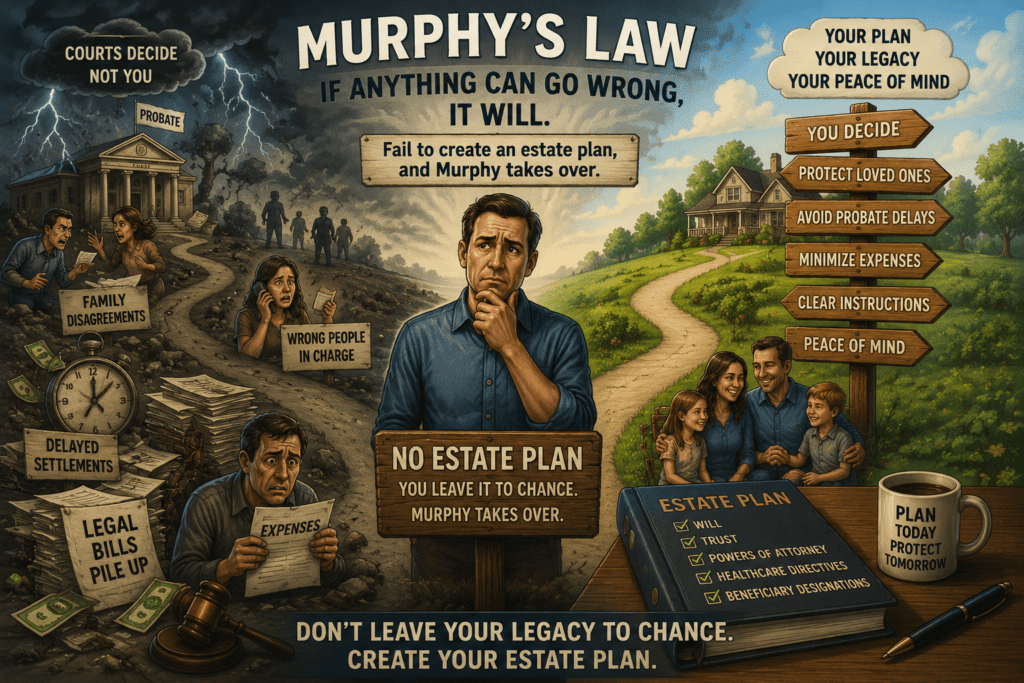
If you die without an estate plan, you haven’t avoided making decisions—you’ve allowed your state’s laws to make many of those decisions for you.
The legal term for dying without a valid will is intestate. Every state has intestacy laws that determine who inherits your property, who has priority to administer your estate, and, in some situations, who may become responsible for caring for minor children.
While those laws are designed to provide a framework, they cannot reflect your personal wishes, family relationships, or unique circumstances.
The State Has Never Met Your Family
State intestacy laws are based on legal formulas—not personal relationships.
The law doesn’t know:
- Which child has special needs.
- Which family member you trust most with finances.
- Whether you intended to leave something to a close friend.
- If you wanted to support a favorite charity.
- Whether a beneficiary is financially responsible.
- If a family heirloom should stay with a particular person.
Only you can make those decisions.
Without an estate plan, those personal choices may never be known.
Your Loved Ones May Face Unnecessary Challenges
Losing a loved one is emotionally overwhelming.
When there is no estate plan, family members often face additional legal, financial, and administrative burdens during an already difficult time.
These challenges may include:
- Probate court proceedings
- Delays in accessing financial accounts
- Difficulty selling or transferring property
- Additional legal expenses
- Family disagreements
- Uncertainty about your wishes
- Delayed distribution of assets
- Court-appointed decision makers
Many of these problems can be reduced—or even avoided—with proper planning completed well in advance.
Incapacity Can Create Problems Long Before Death
Estate planning is not only about what happens after you die.
Unexpected illness, injury, or cognitive decline can occur at any age.
If you become unable to manage your finances or communicate healthcare decisions and have not completed the appropriate legal documents, your family may have to ask a court to appoint someone to act on your behalf.
This process can take time, involve legal expenses, and create unnecessary stress during an already emotional situation.
Documents such as a Durable Financial Power of Attorney and an Advance Healthcare Directive allow you—not a judge—to choose who will make decisions for you if that day ever comes.
Common Misconceptions About Estate Planning
Many people delay estate planning because they believe one or more of these common myths.
| Myth | Reality |
|---|---|
| I’m too young to need an estate plan. | Every adult should have basic estate planning documents. |
| I don’t own enough to justify planning. | Estate planning protects people, not just property. |
| My spouse will automatically receive everything. | State law varies, and probate may still be required. |
| My children know what I want. | Good intentions cannot replace legally enforceable documents. |
| I’ll get around to it someday. | Unexpected illness or accidents rarely happen on a convenient schedule. |
| Estate planning is only for wealthy families. | Every family benefits from clear instructions and organized planning. |
Planning Gives Your Family Choices
When you create an estate plan, you remain in control of important decisions.
Instead of asking a court to interpret state law, your loved ones can follow the instructions you carefully prepared in advance.
That doesn’t eliminate every challenge life may bring.
It does provide clarity, direction, and confidence when your family needs it most.
Key Takeaway
Failing to create an estate plan doesn’t mean you have no plan.
It simply means someone else—or the laws of your state—may make important decisions on your behalf.
One of the greatest gifts you can give your family is the certainty of knowing your wishes have already been thoughtfully considered and clearly documented.
My suggestion
I would insert a powerful infographic immediately after this section titled:
Without an Estate Plan vs. With an Estate Plan
Use a side-by-side comparison with icons showing:
| Without a Plan | With a Plan |
|---|---|
| Court may decide | You decide |
| Family may disagree | Wishes are documented |
| Probate delays | Streamlined administration |
| More legal expenses | Better organization |
| Uncertainty | Peace of mind |
| Stress | Confidence |
This visual will reinforce the message and be highly shareable while leading naturally into the upcoming lesson on probate.
Progress Check
You have completed the first part of EST 101 – Introduction to Estate Planning. Take a minute to answer these three questions. This is not a test. It is simply a way to reinforce what you have learned.
1. Which statement best describes estate planning?
2. Who benefits from having an estate plan?
3. What is one of the primary goals of the RetireCoast Estate Planning Academy?
I think the next section should answer “What are the goals of estate planning?”
So far we’ve explained what estate planning is, why every adult needs it, and what happens if you don’t have a plan. The next logical step is explaining what a good estate plan actually accomplishes.
This also becomes the foundation for every future lesson because each document you’ll discuss later serves one or more of these goals.
The Six Primary Goals of Estate Planning
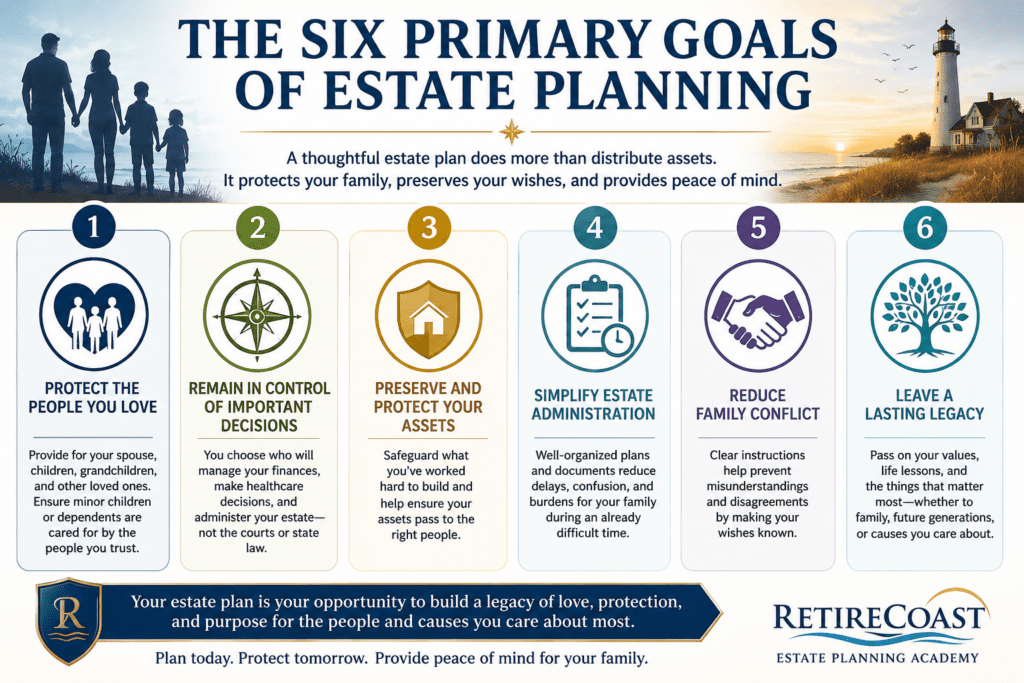
Every estate plan is unique because every family is unique. However, nearly every well-designed estate plan shares the same fundamental objectives.
Whether you are a young family just beginning your financial journey or a retiree organizing decades of accumulated assets, estate planning seeks to accomplish six important goals.
As you progress through the RetireCoast Estate Planning Academy, you’ll discover that every document, strategy, and planning decision supports one or more of these objectives.
Goal 1 – Protect the People You Love
The most important purpose of estate planning is protecting the people who matter most.
For many families, that means ensuring a surviving spouse has financial security. For others, it may mean providing for children, grandchildren, aging parents, or a loved one with special needs.
Estate planning also protects the people you choose to help administer your affairs by providing clear instructions instead of leaving them to guess what you would have wanted.
Goal 2 – Remain in Control of Important Decisions
Estate planning allows you to make decisions while you are healthy and able to carefully consider your options.
Rather than allowing a court or state law to determine who manages your finances, makes healthcare decisions, or administers your estate, you make those choices yourself.
This is one of the greatest benefits of planning ahead.
Goal 3 – Preserve and Protect Your Assets
Most people spend decades working to build financial security.
A thoughtful estate plan helps preserve those assets by organizing ownership, reviewing beneficiary designations, coordinating insurance, and reducing unnecessary expenses that may arise after death.
Protecting your estate means protecting the legacy you worked so hard to create.
Goal 4 – Simplify Estate Administration
No estate plan can eliminate every administrative task after death.
However, proper planning can make the process significantly easier for your loved ones.
Well-organized records, clearly written documents, updated beneficiary designations, and thoughtful planning often reduce delays, minimize confusion, and help your family move forward with confidence.
Goal 5 – Reduce Family Conflict
Many estate disputes do not arise because people are greedy.
They arise because no one knows what the deceased intended.
Clear instructions often prevent misunderstandings before they become disagreements.
While no estate plan can guarantee family harmony, thoughtful planning greatly reduces the possibility of conflict.
Goal 6 – Leave a Lasting Legacy
Your legacy is much more than the property you leave behind.
It includes your values, your generosity, your life lessons, and the way you cared for the people you loved.
Estate planning allows you to intentionally shape the legacy you leave for future generations.
For some families, that legacy includes charitable giving, preserving a family business, protecting a vacation home, or passing treasured heirlooms to future generations.
Every Estate Planning Document Has a Purpose
One reason estate planning feels overwhelming is that people see a long list of unfamiliar legal documents.
In reality, each document exists because it helps accomplish one or more of the six goals discussed above.
For example:
| Estate Planning Document | Primary Goal |
|---|---|
| Last Will and Testament | Directs how property is distributed and names guardians or an executor. |
| Revocable Living Trust | Helps manage assets during life and after death while simplifying administration. |
| Durable Financial Power of Attorney | Allows someone you trust to manage financial matters if you become incapacitated. |
| Advance Healthcare Directive | Documents your medical treatment preferences and names a healthcare decision-maker. |
| HIPAA Authorization | Permits designated individuals to communicate with healthcare providers. |
| Beneficiary Designations | Transfers many financial assets directly to your chosen beneficiaries. |
Throughout the RetireCoast Estate Planning Academy, you’ll learn how these documents work together as part of a coordinated estate planning strategy rather than as separate pieces of paperwork.
Key Takeaway
A successful estate plan is not measured by the number of documents you sign.
It is measured by how well it protects your family, preserves your wishes, simplifies difficult decisions, and provides peace of mind.
Every lesson that follows in this Academy will help you accomplish one or more of these six goals, giving you the knowledge and confidence to build a complete RetireCoast Estate Planning Portfolio that reflects your life, your values, and your legacy.
I think we’ve reached a natural transition point.
So far we’ve answered:
- ✅ What is estate planning?
- ✅ Why every adult needs an estate plan.
- ✅ What happens if you don’t have one.
- ✅ The six primary goals of estate planning.
The next question every beginner has is:
“What documents make up an estate plan?”
This is the perfect bridge into the 200 Series without going into too much detail yet. We introduce each document here, then tell readers they’ll study each one in depth later.
The Building Blocks of a Complete Estate Plan
Many people believe estate planning consists of a single document—a Last Will and Testament.
While a will is certainly an important part of many estate plans, it is only one piece of a much larger puzzle.
Think of your estate plan as building a house. A house requires a foundation, walls, electrical systems, plumbing, a roof, and many other components working together. If even one important piece is missing, the house may not function as intended.
Estate planning works much the same way.
Each document serves a different purpose, and together they create a coordinated plan that protects you during your lifetime and your loved ones after your death.
Every Document Solves a Different Problem
One of the easiest ways to understand estate planning is to think of each document as answering a specific question.
| Document | The Question It Answers |
|---|---|
| Last Will and Testament | Who receives my property after I die? |
| Revocable Living Trust | How can my assets be managed efficiently during my lifetime and after my death? |
| Durable Financial Power of Attorney | Who can handle my finances if I cannot? |
| Advance Healthcare Directive | Who will make medical decisions for me, and what are my healthcare wishes? |
| HIPAA Authorization | Who may communicate with my doctors and access my medical information? |
| Beneficiary Designations | Who automatically receives my retirement accounts, life insurance, and certain financial assets? |
| Estate Planning Portfolio | Where can my family quickly find all of my important information and documents? |
Notice that each document answers a different question.
Together, they provide a comprehensive plan rather than a collection of unrelated forms.
The Five Core Documents Nearly Every Adult Should Consider
Although every family is different, most comprehensive estate plans include five essential legal documents.
Last Will and Testament
A will explains how you want your probate assets distributed after your death. It also allows parents of minor children to nominate a guardian and lets you nominate an executor to administer your estate.
In the Academy’s 200 Series, you’ll learn how wills work, what they can and cannot accomplish, and when additional planning may be appropriate.
Revocable Living Trust
A revocable living trust is designed to hold and manage assets during your lifetime and provide instructions for managing and distributing those assets after your death.
For many families, a properly funded trust can simplify estate administration, provide greater privacy, and reduce the assets that pass through probate.
Durable Financial Power of Attorney
Life is unpredictable.
If illness or an accident prevents you from handling your own financial affairs, a Durable Financial Power of Attorney authorizes someone you trust to act on your behalf.
Without this document, your family may need to seek court approval before managing your finances.
Advance Healthcare Directive
An Advance Healthcare Directive allows you to document your medical treatment preferences and appoint someone you trust to make healthcare decisions if you become unable to communicate.
Rather than leaving difficult decisions to family members during an emotional time, you provide clear guidance in advance.
HIPAA Authorization
Federal privacy laws protect your medical information.
A HIPAA Authorization allows designated individuals to speak with your healthcare providers and obtain important medical information when necessary.
Without this document, even close family members may encounter obstacles when trying to assist you.
Other Important Components of an Estate Plan
A comprehensive estate plan often extends beyond legal documents.
Other important planning elements include:
- Updated beneficiary designations
- A personal asset inventory
- Real estate ownership records
- Life insurance information
- Retirement account information
- Digital asset instructions
- Password management
- Funeral and burial preferences
- Letters of instruction
- Business succession plans
- Tax planning strategies
These items may not all be legal documents, but they are essential parts of a complete RetireCoast Estate Planning Portfolio.
Don’t Worry About Learning Everything Today
If this list seems overwhelming, don’t worry.
One of the reasons the RetireCoast Estate Planning Academy is organized into a structured curriculum is so you don’t have to learn everything at once.
Each document will be explained in plain English.
You’ll learn:
- Why it exists.
- When it is needed.
- What it accomplishes.
- Common mistakes to avoid.
- How it fits into your complete estate plan.
By the time you complete the Academy, these documents will no longer seem intimidating. Instead, you’ll understand how they work together to protect your family and preserve your legacy.
Key Takeaway
Estate planning is not about filling out forms.
It is about creating a coordinated system of legal documents, financial information, and personal instructions that work together to protect you during your lifetime and make life easier for the people you love.
Each lesson that follows will take one piece of that system and explain it in depth, helping you build a complete estate plan one step at a time.

Creator, Estate Planning Academy
At this point you may be thinking, “This entire estate planning process seems overwhelming.” If that’s how you feel, you’re perfectly normal. In fact, that’s exactly how many people feel when they first begin learning about estate planning.
Most of us aren’t attorneys. We didn’t spend years studying estate law in law school or practicing it professionally. The good news is that you don’t have to become an attorney to understand estate planning well enough to make smart, informed decisions for yourself and your family.
One thing I’d like you to remember is this: estate planning isn’t really an attorney thing—it’s a family thing. Attorneys prepare and review legal documents, but they can’t decide who should receive your property, who should serve as your trustee or executor, who should care for your children, or what kind of legacy you want to leave behind. Those decisions belong to you.
So don’t get discouraged if some of these concepts seem as clear as mud right now. Just keep moving through the Academy one lesson at a time. Every course builds on the previous one, and before long you’ll find yourself understanding ideas that once seemed confusing.
By the time you complete the RetireCoast Estate Planning Academy, I think you’ll surprise yourself. You’ll have a solid understanding of the estate planning process, and you’ll probably become the person your adult children, siblings, or friends call when they begin planning for their own families.
I would be remiss if I didn’t mention our RetireCoast Estate Planning Membership. While the Academy teaches you the why behind estate planning, the Membership helps you with the how. You’ll find easy-to-use interactive planning tools, document builders, organizational resources, annual updates, and everything you need to build your complete RetireCoast Estate Planning Portfolio—at your own pace and from the comfort of your home.
But that’s the next step.
For now, simply keep learning. Keep asking questions. Keep moving forward. Every lesson you complete brings you one step closer to protecting the people you love and creating an estate plan you’ll be proud of.
Thanks for visiting RetireCoast, and thank you for allowing me to be part of your estate planning journey.
I think the next section should be one of the most important in the entire Academy because it answers a question almost every beginner asks:
“When should I start estate planning?”
This is where you dispel the myth that estate planning is something people do after retirement.
When Should You Start Estate Planning?
One of the most common questions people ask is, “When is the right time to start estate planning?”
The answer is surprisingly simple.
The best time to begin estate planning is as soon as you become an adult and begin making important financial or family decisions.
Unfortunately, many people believe estate planning can wait until retirement or until they have accumulated significant wealth. By then, unexpected life events may have already occurred.
Estate planning isn’t about predicting the future.
It’s about preparing for it.
Estate Planning Changes Throughout Your Life
Your estate plan should grow and change as your life changes.
You don’t create one estate plan and forget about it forever. Instead, it evolves as your family, finances, career, and goals evolve.
Think of your estate plan as a living roadmap rather than a one-time project.
Young Adults (18–30)
Many young adults assume they don’t need an estate plan because they own very little.
However, turning eighteen changes everything legally.
Parents no longer have automatic authority to make medical or financial decisions for an adult child.
Even a simple estate plan can provide valuable protection.
At this stage, planning often focuses on:
- Healthcare directives
- Durable Financial Power of Attorney
- HIPAA Authorization
- Beneficiary designations
- Organizing important financial information
Young Families (30–45)
Marriage, buying a home, and raising children often create the greatest need for estate planning.
Parents should consider:
- Naming guardians for minor children
- Creating a Last Will and Testament
- Reviewing life insurance
- Updating beneficiary designations
- Beginning trust planning where appropriate
This is often the stage where families realize estate planning is really about protecting children rather than protecting money.
Mid-Career Families (45–60)
As careers advance, assets usually become more complex.
Families often accumulate:
- Retirement accounts
- Investment portfolios
- Businesses
- Additional real estate
- Larger insurance policies
Estate planning expands to include asset protection, tax considerations, business succession planning, and preparing for aging parents.
Pre-Retirement (60–70)
As retirement approaches, many people begin organizing decades of financial information.
Planning often focuses on:
- Updating wills and trusts
- Reviewing beneficiaries
- Retirement income planning
- Long-term care considerations
- Organizing the Estate Planning Portfolio
- Simplifying estate administration
This is an excellent time to review documents that may have been created many years earlier.
Retirement and Beyond (70+)
Estate planning doesn’t stop after retirement.
In fact, it often becomes even more important.
Regular reviews help ensure that:
- Documents remain current.
- Trustees and executors are still appropriate.
- Beneficiaries reflect current wishes.
- Assets remain properly titled.
- Healthcare wishes remain up to date.
Life continues to change, and your estate plan should change with it.
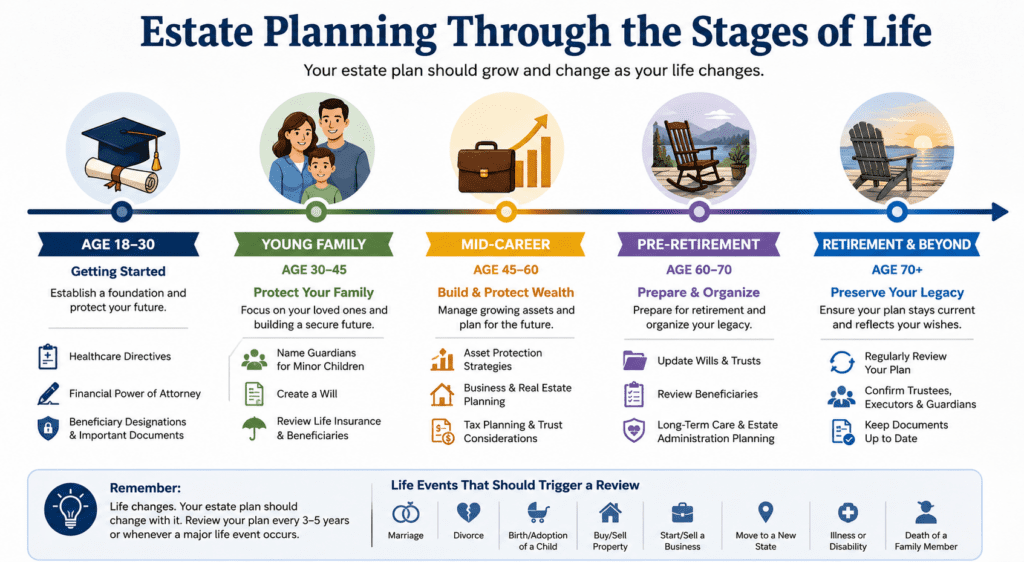
Major Life Events That Should Trigger an Estate Plan Review
You don’t have to wait for a certain birthday to review your estate plan.
Instead, review your plan whenever a significant life event occurs.
Common Review Triggers
- Marriage
- Divorce
- Birth or adoption of a child
- Death of a family member
- Purchase or sale of a home
- Starting or selling a business
- Retirement
- Significant increase or decrease in wealth
- Moving to another state
- Changes in tax laws
- Serious illness or disability
- Becoming a grandparent
A good rule of thumb is to review your estate plan every three to five years, even if nothing major has changed.
Estate Planning Is Never “Finished”
Many people ask,
“Once I complete my estate plan, am I done?”
Not quite.
Estate planning is an ongoing process rather than a one-time event.
As your family grows, your assets change, laws evolve, and your priorities shift, your estate plan should evolve as well.
That’s one reason the RetireCoast Estate Planning Membership includes annual updates, planning tools, and organizational resources—to help you keep your plan current rather than letting it become outdated.
Key Takeaway
The best estate plan isn’t the one created at a certain age.
It’s the one that reflects your life today and continues to evolve as your life changes.
Whether you’re 25 or 75, today is the best day to begin planning for tomorrow.
Suggestion for this section
This section would be perfect with a horizontal infographic titled:
Estate Planning Through the Stages of Life
A timeline running from Age 18 → Young Family → Mid-Career → Pre-Retirement → Retirement, with an icon and two or three key planning priorities under each stage.
I think it would become one of the most shared graphics in the entire Estate Planning Academy because it immediately answers the question, “What should I be doing at my stage of life?”
Progress Check #2
You’ve completed another important section of EST 101 – Introduction to Estate Planning. Take a minute to answer these three questions. Remember, this is not a test. It’s simply an opportunity to reinforce what you’ve learned.
1. When is the best time to begin estate planning?
2. Which of the following life events should trigger a review of your estate plan?
3. Which statement best describes estate planning?
I think we’re now at the point where we should introduce the big picture before diving into individual documents.
The next logical section is:
The Estate Planning Roadmap: How All the Pieces Fit Together
This acts as a bridge between the introductory concepts and the detailed document lessons. Readers begin to understand that estate planning isn’t a collection of unrelated forms—it’s a coordinated system.
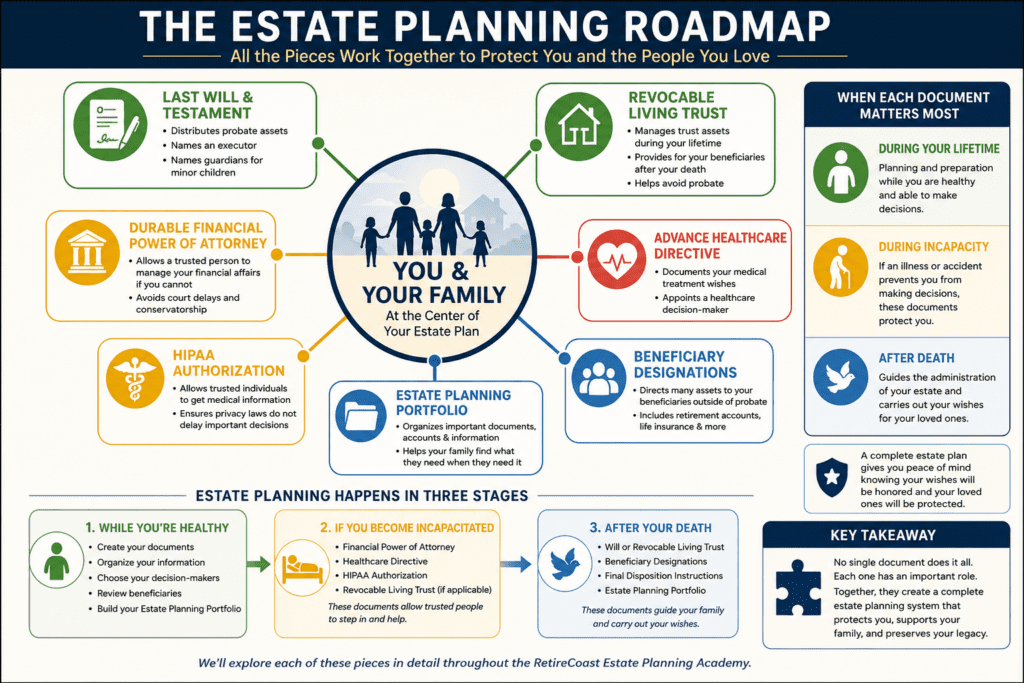
The Estate Planning Roadmap
Now that you understand what estate planning is, why it matters, and when to begin, it’s time to look at the big picture.
One reason estate planning feels overwhelming is that people are often introduced to individual documents without understanding how they work together.
Imagine opening the box of a 2,000-piece jigsaw puzzle.
If you dumped all the pieces onto a table without looking at the picture on the box, the task would seem almost impossible.
Estate planning can feel exactly the same way.
You hear terms like “will,” “trust,” “power of attorney,” “healthcare directive,” and “beneficiary designation,” but no one explains how the pieces connect.
That’s exactly what we’re going to do next.
Think of Your Estate Plan as a Team
Every document in your estate plan has a specific job.
No single document can accomplish everything.
Instead, each one works with the others to protect you during your lifetime and provide guidance after your death.
When all of the documents work together, they create a complete estate planning system.
Your Estate Planning Team
Think of your estate plan as a team of specialists.
Each member has a different responsibility.
| Estate Planning Tool | Primary Responsibility |
|---|---|
| Last Will and Testament | Distributes probate assets and names an executor and guardians. |
| Revocable Living Trust | Manages trust assets during life and after death. |
| Durable Financial Power of Attorney | Allows someone to manage your financial affairs if you cannot. |
| Advance Healthcare Directive | Documents your medical wishes and appoints a healthcare decision-maker. |
| HIPAA Authorization | Allows trusted individuals to communicate with healthcare providers. |
| Beneficiary Designations | Transfer many financial assets directly to your chosen beneficiaries. |
| Estate Planning Portfolio | Keeps your important information organized and easily accessible. |
Notice that every document has one primary responsibility.
Together, they provide protection that no single document can accomplish alone.
Estate Planning Happens During Three Different Stages
One of the easiest ways to understand estate planning is to think about when each document becomes important.
Stage One — While You’re Healthy
Most estate planning happens while you’re healthy and able to make thoughtful decisions.
This is when you:
- Create your documents.
- Organize your financial information.
- Choose trusted decision-makers.
- Review beneficiaries.
- Build your RetireCoast Estate Planning Portfolio.
Stage Two — If You Become Incapacitated
If illness or an accident prevents you from making decisions, certain documents immediately become important.
These include:
- Durable Financial Power of Attorney
- Advance Healthcare Directive
- HIPAA Authorization
- Revocable Living Trust (if applicable)
These documents help your chosen representatives step in without unnecessary delays.
Stage Three — After Death
Following your death, another group of documents guides the administration of your estate.
These may include:
- Last Will and Testament
- Revocable Living Trust
- Beneficiary Designations
- Final Disposition Instructions
- Estate Planning Portfolio
Together, they help your family carry out your wishes as efficiently as possible.
The Academy Will Build One Piece at a Time
The good news is that you do not need to master every document today.
The RetireCoast Estate Planning Academy is organized so each lesson builds upon the previous one.
We’ll begin with the fundamentals.
Then we’ll explore each document individually.
Finally, you’ll learn how all of the pieces work together to create a coordinated estate plan that protects your family and preserves your legacy.
By the end of the Academy, what once looked like thousands of disconnected puzzle pieces will become one complete picture.
Key Takeaway
Estate planning isn’t about filling out forms.
It’s about creating a coordinated system that protects you during your lifetime, guides your loved ones after your death, and provides peace of mind for everyone involved.
Every lesson that follows will help you understand one more piece of that system until your complete estate planning picture comes into focus.
I think we’ve now completed the “why” of estate planning. The next major topic should be probate, because it’s one of the biggest reasons people begin looking into estate planning in the first place.
I would introduce probate here, but save the deep dive for EST 103 – Understanding Probate and How to Avoid It.
This gives readers the big picture without duplicating the future lesson.
Probate: The Word Everyone Hears but Few Understand
If you’ve ever talked with friends, watched a television program about inheritance, or met with a financial professional, you’ve probably heard someone say:
“You want to avoid probate.”
While that advice is common, many people don’t actually understand what probate is—or why it exists.
Probate is often portrayed as something to fear, but the truth is more nuanced.
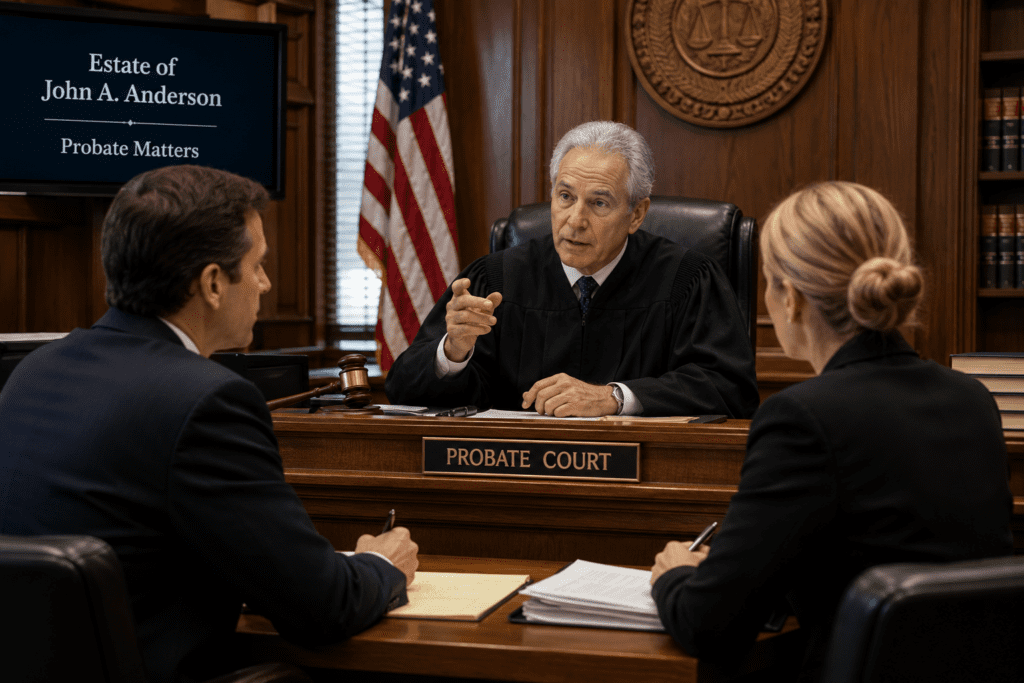
Probate is simply the legal process used to settle a person’s estate after death. In many situations, probate serves an important purpose by ensuring debts are paid, assets are properly transferred, and a deceased person’s wishes—or state law—are followed.
The real question isn’t whether probate is “good” or “bad.”
The better question is:
How much probate is appropriate for your family’s situation, and how can thoughtful planning simplify the process?
Why Probate Exists
Imagine someone passes away owning a home, several bank accounts, investments, personal property, and outstanding debts.
How does anyone know:
- Who now owns the property?
- Which debts must be paid?
- Whether a valid will exists?
- Who has legal authority to act?
- When beneficiaries should receive their inheritance?
Probate provides the legal framework for answering those questions.
Rather than allowing anyone to claim ownership of the deceased person’s property, the probate court supervises the orderly administration of the estate.
In many cases, probate protects beneficiaries as much as it protects creditors.
Why People Try to Reduce Probate
Although probate serves an important legal purpose, it can also involve:
- Court filings
- Required legal procedures
- Waiting periods
- Administrative costs
- Public records
- Additional paperwork
For larger or more complicated estates, probate may take many months—and sometimes longer—to complete.
That is one reason many estate planning strategies focus on reducing the amount of property that must pass through probate.
Notice the wording.
The goal is often to simplify probate, not necessarily eliminate it altogether.
```html
Complete all four Foundation Courses to understand the essential principles of estate planning, organize your information, learn how probate works, and choose the people who will help carry out your wishes.
Learn why estate planning matters, which documents may be needed, and how a thoughtful plan helps protect your family and your legacy.
Go to EST 101 →Organize your legal documents, financial accounts, insurance information, digital assets, contacts, and personal instructions into one practical system.
Go to EST 102 →Discover what probate is, why it exists, the delays and expenses it may create, and the planning strategies that can help reduce court involvement.
Go to EST 103 →Learn how to select your attorney, financial professionals, executor, trustee, healthcare agent, financial agent, and other trusted decision-makers.
Go to EST 104 →Some Assets May Never Enter Probate
One of the biggest surprises for many people is learning that not everything you own automatically goes through probate.
Depending on how assets are owned or titled, many may transfer directly to beneficiaries.
Examples often include:
- Life insurance with named beneficiaries
- Retirement accounts
- Payable-on-death (POD) bank accounts
- Transfer-on-death (TOD) investment accounts
- Property owned in certain forms of joint ownership
- Properly funded revocable living trusts
Understanding which assets pass through probate and which may bypass it is one of the most valuable lessons in estate planning.
Probate Is an Entire Lesson of Its Own
Because probate affects nearly every estate plan, we’ve devoted an entire Master Class to the topic.
In EST 103 – Understanding Probate and How to Avoid It, you’ll learn:
- What probate actually is
- Common probate myths
- Which assets usually go through probate
- Which assets often avoid probate
- How wills and trusts interact with probate
- Strategies that may simplify estate administration
- Common mistakes families make
By the end of that lesson, you’ll understand probate well enough to make informed decisions instead of relying on myths or hearsay.
Key Takeaway
Probate is not the enemy.
Lack of planning is.
The purpose of estate planning is not simply to avoid probate—it is to create a thoughtful plan that protects your family, honors your wishes, and makes estate administration as efficient as possible.
Understanding probate is one important part of that process, and you’ll explore it in much greater depth in the next Foundation Course.
Suggestion
I think this section would benefit from a simple infographic titled:
“What Goes Through Probate… and What Often Doesn’t?”
Two columns:
Usually Goes Through Probate
- Home titled solely in your name
- Personal property
- Vehicles
- Bank accounts without beneficiaries
- Individual investment accounts
Often Avoids Probate
- Revocable Living Trust assets
- Life insurance
- Retirement accounts
- POD bank accounts
- TOD investment accounts
- Jointly owned property (depending on ownership type)
This would naturally lead readers into EST 103, where you’ll explore each category in detail. It also creates anticipation for the next lesson without overwhelming readers in EST 101.
I think this is the perfect place to explain one of the most overlooked concepts in estate planning:
Introduction to Estate Planning: Who Makes Decisions for You?
This section naturally follows probate and transitions beautifully into the 200 Series, where readers will study each legal document in detail.
Introduction to Estate Planning: Who Makes Decisions for You?
One of the biggest misconceptions people have about estate planning is that it is only about deciding who receives your property after you die.
While that’s certainly important, it’s only part of the story.
One of the primary objectives of an Introduction to Estate Planning is understanding who will make important decisions if you are unable to make them yourself.
Life is unpredictable.
An unexpected illness, accident, or medical condition could leave you temporarily—or permanently—unable to manage your finances or communicate your healthcare wishes.
Estate planning prepares for those possibilities before they happen.
There Are Two Types of Decisions
When most people think about estate planning, they immediately think about distributing money and property.
In reality, estate planning addresses two completely different categories of decisions.
Decisions During Your Lifetime
If you become incapacitated, someone may need authority to:
- Pay your bills
- Manage your bank accounts
- Handle investments
- File your taxes
- Sell or refinance property
- Operate your business
- Make healthcare decisions
- Speak with doctors and hospitals
Without the appropriate legal documents, even your spouse or adult children may have limited authority to act on your behalf.
Decisions After Your Death
After your death, different people may become responsible for:
- Administering your estate
- Paying debts and taxes
- Distributing assets
- Managing a trust
- Caring for minor children
- Carrying out your final wishes
Choosing these individuals in advance is one of the most important parts of estate planning.
Estate Planning Is Really About Choosing People
Every estate planning document asks the same basic question:
Who do you trust?
Think about the people who may play important roles in your estate plan.
Your Executor
The executor carries out the instructions in your will and works through the probate process when necessary.
This person should be organized, trustworthy, and willing to accept the responsibility.
Your Trustee
If you establish a trust, your trustee manages trust assets according to the instructions you provide.
For many families, the trustee may serve for many years after your death.
Your Financial Agent
A Durable Financial Power of Attorney allows someone you trust to manage your financial affairs if you become unable to do so.
This person may pay bills, manage investments, sign documents, and protect your financial interests.
Your Healthcare Agent
An Advance Healthcare Directive allows you to appoint someone to make medical decisions if you cannot communicate your wishes.
This person should understand your values and be willing to advocate for your healthcare preferences.
Guardians for Minor Children
For parents of young children, one of the most important decisions is choosing who would care for their children if both parents were unable to do so.
While a court ultimately makes the appointment, your nomination in a will provides valuable guidance and is given significant consideration.
Choosing the Right People Matters More Than Choosing the Right Documents
Many people spend weeks worrying about legal forms.
Far fewer spend time carefully considering who should actually carry out those plans.
The best estate planning documents in the world are only as effective as the people responsible for carrying them out.
As you continue this Introduction to Estate Planning, you’ll discover that selecting the right individuals is often one of the most meaningful—and sometimes most difficult—parts of the planning process.
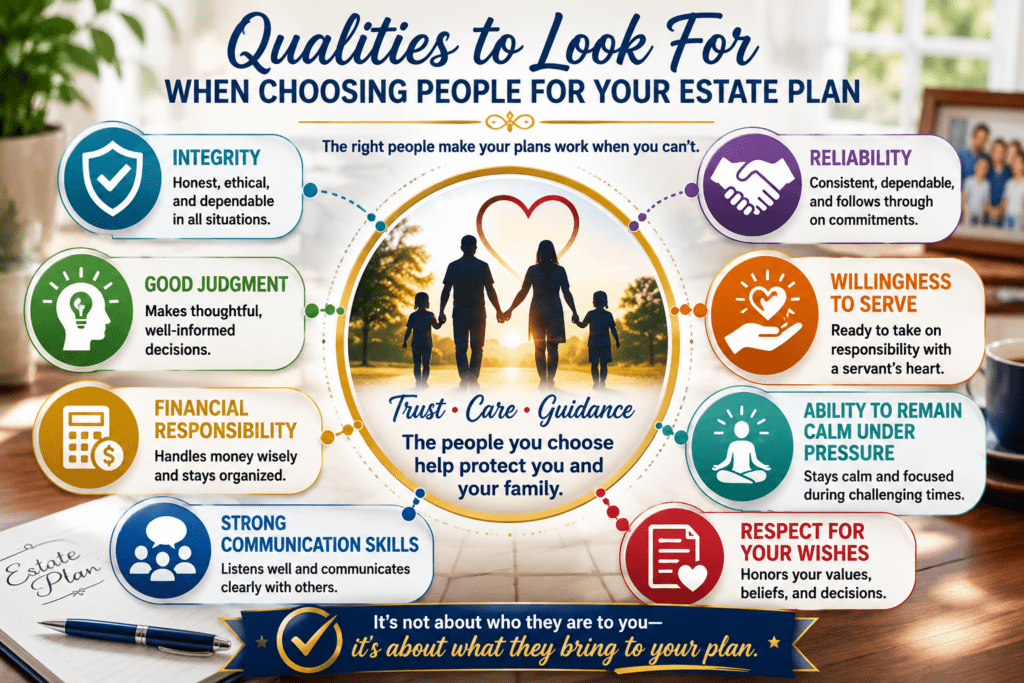
Qualities to Look For
You don’t necessarily need to choose the oldest child, the wealthiest relative, or your closest friend.
Instead, look for people who demonstrate qualities such as:
- Integrity
- Good judgment
- Financial responsibility
- Strong communication skills
- Reliability
- Willingness to serve
- Ability to remain calm under pressure
- Respect for your wishes
Sometimes the best choice is a family member.
Sometimes it is a trusted friend or a professional fiduciary.
Every family is different.
Don’t Worry—You’ll Learn How to Choose
If you’re thinking,
“I’m not sure who I should choose,”
don’t worry.
Selecting executors, trustees, financial agents, and healthcare agents is an important decision, which is why the RetireCoast Estate Planning Academy includes dedicated Master Classes that explore each role in detail.
You’ll learn:
- What each role involves.
- The legal responsibilities.
- Common mistakes families make.
- Questions to ask before naming someone.
- When a professional may be the better choice.
By the time you complete the Academy, you’ll understand not only what these roles are, but how to select the people best suited to carry them out.
Key Takeaway
One of the most valuable lessons in this Introduction to Estate Planning is that estate planning is ultimately about people, not paperwork.
Legal documents provide the instructions.
The people you choose bring those instructions to life.
Selecting trustworthy, capable individuals may be one of the most important gifts you ever give your family, ensuring your wishes are honored and your loved ones are supported when they need guidance the most.
I think we’ve now completed the “big picture” of estate planning. The next section should answer one of the most practical questions readers have:
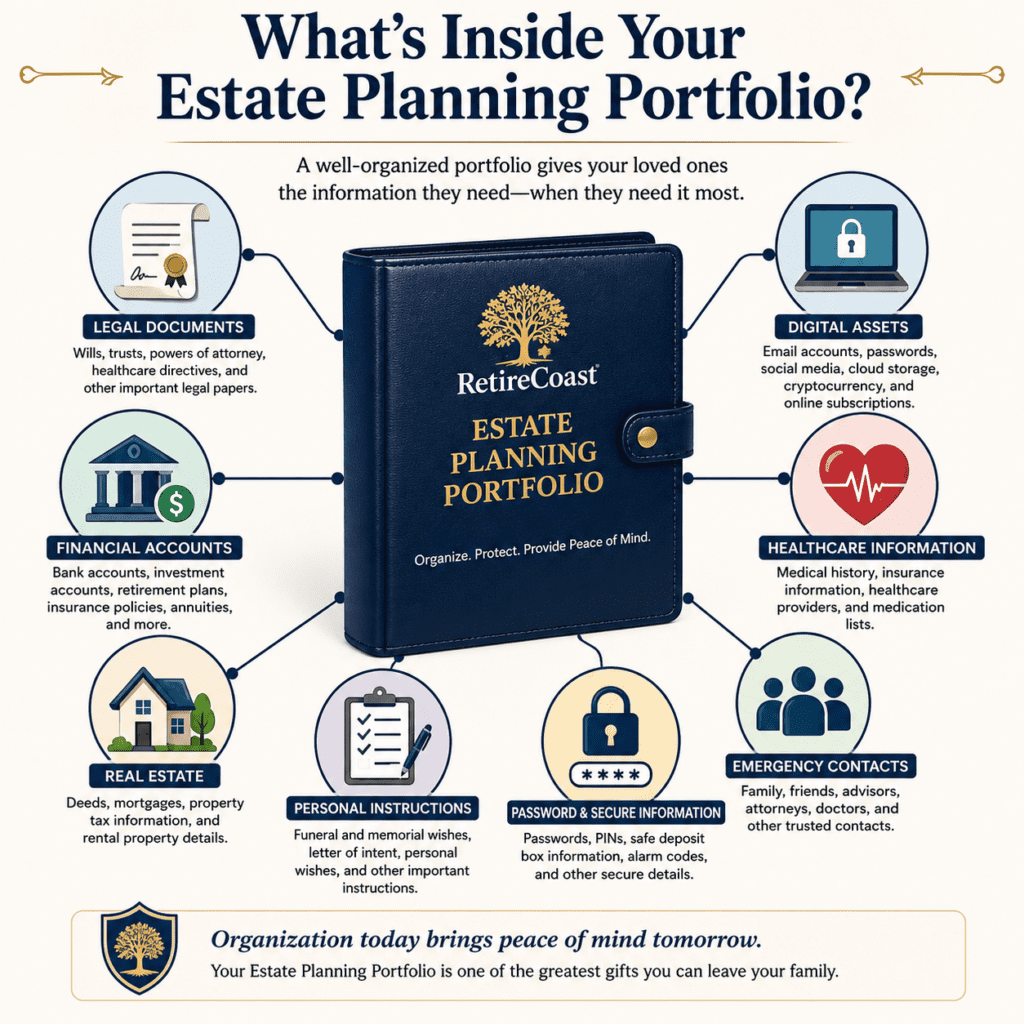
Introduction to Estate Planning: Building Your Estate Planning Portfolio
This is a perfect opportunity to introduce one of your unique RetireCoast concepts—the Estate Planning Portfolio. It also begins naturally introducing the Membership without sounding like a sales pitch.
Introduction to Estate Planning: Building Your Estate Planning Portfolio
One of the biggest misconceptions in estate planning is that once you’ve signed a few legal documents, your work is complete.
In reality, a well-organized estate plan is much more than a collection of signed papers.
One of the primary goals of this Introduction to Estate Planning Master Class is to help you build a complete Estate Planning Portfolio—a single, organized location where your important legal documents, financial information, and personal instructions can be easily found when they are needed most.
Think of your portfolio as the owner’s manual for your financial life.
What Is an Estate Planning Portfolio?
An Estate Planning Portfolio is an organized collection of the information your family, executor, trustee, or financial agent may need if something happens to you.
Rather than forcing your loved ones to search through file cabinets, desk drawers, computers, email accounts, or safe deposit boxes, your portfolio brings everything together in one organized system.
Organization is one of the greatest gifts you can leave your family.
What Should Be Included?
Every family’s portfolio will be different, but most include the following categories.
Legal Documents
- Last Will and Testament
- Revocable Living Trust
- Durable Financial Power of Attorney
- Advance Healthcare Directive
- HIPAA Authorization
- Final Disposition Instructions
Financial Information
- Bank accounts
- Investment accounts
- Retirement accounts
- Pension information
- Life insurance policies
- Annuities
- Social Security information
Property Information
- Real estate deeds
- Vehicle titles
- Business ownership records
- Valuable personal property
- Safe deposit box information
Digital Assets
Modern estate planning also includes your digital life.
Examples include:
- Email accounts
- Password manager
- Financial websites
- Cryptocurrency information
- Cloud storage
- Social media accounts
- Online subscriptions
Digital assets have become an increasingly important part of every estate plan.
Personal Instructions
Your portfolio can also include information that isn’t found in legal documents, such as:
- Emergency contacts
- Funeral and memorial preferences
- Location of original documents
- Key professional advisors
- Family information
- Letters to loved ones
- Personal wishes that don’t belong in a legal document
These details can save your family countless hours during an already stressful time.
Keep Your Portfolio Current
An Estate Planning Portfolio is only valuable if the information is current.
As part of your ongoing Introduction to Estate Planning, develop the habit of reviewing your portfolio at least once each year.
Ask yourself:
- Have I opened or closed any financial accounts?
- Have I purchased or sold property?
- Have my beneficiaries changed?
- Have I moved?
- Has my family changed?
- Are my documents still current?
A yearly review often takes less than an hour but can prevent significant problems later.
The RetireCoast Estate Planning Portfolio
Throughout the RetireCoast Estate Planning Academy, you’ll hear us refer to the RetireCoast Estate Planning Portfolio.
This is more than a folder of legal documents.
It is a comprehensive organizational system designed to help you:
- Keep important documents together.
- Organize financial information.
- Track assets.
- Record beneficiary information.
- Maintain emergency contacts.
- Store healthcare information.
- Keep your estate plan updated as your life changes.
Whether you organize your portfolio digitally, on paper, or using the tools available through the RetireCoast Estate Planning Membership, the important thing is having a system your family can easily understand and access when the need arises.
Why Organization Is One of the Greatest Gifts You Can Leave
Imagine your loved ones trying to locate dozens of important documents while grieving your loss.
Now imagine handing them a single, well-organized portfolio containing everything they need.
That difference is the true value of organization.
Estate planning isn’t just about legal documents.
It’s about reducing confusion, minimizing stress, and making one of life’s most difficult times just a little easier for the people you love.
Key Takeaway
One of the most valuable lessons in this Introduction to Estate Planning is that organization is every bit as important as documentation.
A thoughtfully organized Estate Planning Portfolio transforms individual legal documents into a coordinated plan that protects your wishes, supports your family, and provides peace of mind for everyone involved.
This infographic will reinforce one of the Academy’s unique concepts and naturally introduce readers to the organizational tools available through the RetireCoast Estate Planning Membership.
Good catch. Since this is your cornerstone article, we should deliberately increase the use of the exact focus keyphrase “Introduction to Estate Planning” while keeping it natural. Below is a rewritten section that uses the exact keyphrase 16 times, which should put you well on your way to satisfying Yoast without sounding repetitive.
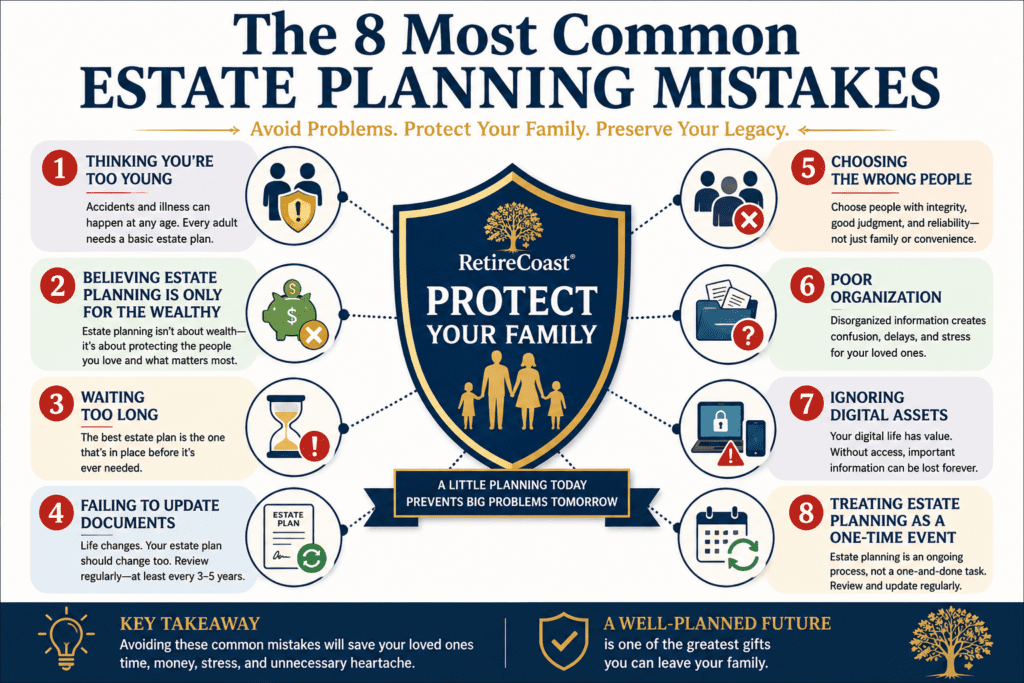
Introduction to Estate Planning: Common Estate Planning Mistakes
One of the primary goals of this Introduction to Estate Planning Master Class is to help you avoid the mistakes that cause unnecessary stress, expense, delays, and family conflict.
As you’ve learned throughout this Introduction to Estate Planning, estate planning is about much more than signing legal documents. It is about protecting your loved ones, preserving your assets, and making informed decisions before a crisis occurs.
Most estate planning mistakes are not caused by carelessness. Instead, they happen because people have never received a proper Introduction to Estate Planning and simply don’t know what they don’t know.
Fortunately, nearly all of these mistakes can be avoided through education, organization, and thoughtful planning.
Introduction to Estate Planning Mistake #1 – Believing You’re Too Young
One of the first lessons in this Introduction to Estate Planning is that estate planning is for every adult.
Many people postpone planning because they believe estate planning begins after retirement or once they become wealthy.
The reality is very different.
Once you become an adult and begin making financial or family decisions, an Introduction to Estate Planning becomes valuable because unexpected illness or accidents can happen at any age.
Introduction to Estate Planning Mistake #2 – Believing Estate Planning Is Only for Wealthy Families
Throughout this Introduction to Estate Planning, you’ve seen that estate planning is really about protecting people—not simply protecting money.
Parents of young children, homeowners, newly married couples, business owners, retirees, and even young adults often benefit from having basic estate planning documents.
A proper Introduction to Estate Planning teaches that every family has something worth protecting.
Introduction to Estate Planning Mistake #3 – Waiting Too Long
Perhaps the most expensive mistake discussed in this Introduction to Estate Planning is believing there will always be more time.
Many families postpone planning because life gets busy.
Unfortunately, life doesn’t always provide advance notice.
The best estate plan is the one that is completed before it is ever needed.
Introduction to Estate Planning Mistake #4 – Forgetting to Update Documents
One important lesson from this Introduction to Estate Planning is that estate planning is a lifelong process.
Marriage.
Divorce.
Birth of a child.
Retirement.
Moving to another state.
Significant financial changes.
Each of these life events should prompt you to review your estate plan.
Even if nothing major changes, reviewing your plan every three to five years is a wise habit.
Introduction to Estate Planning Mistake #5 – Choosing the Wrong People
Earlier in this Introduction to Estate Planning, we discussed selecting people based on integrity, sound judgment, reliability, financial responsibility, and respect for your wishes.
Choosing an executor, trustee, financial agent, or healthcare representative simply because they are the oldest child or closest relative may not always be the best decision.
The right people often matter more than the documents themselves.
Introduction to Estate Planning Mistake #6 – Poor Organization
A major objective of this Introduction to Estate Planning is helping families become organized before they are forced to deal with an emergency.
Some families spend weeks—or even months—searching for wills, insurance policies, investment statements, deeds, passwords, and other important documents.
A well-organized RetireCoast Estate Planning Portfolio helps eliminate much of that confusion and makes life easier for the people you love.
Introduction to Estate Planning Mistake #7 – Ignoring Digital Assets
Modern estate planning extends far beyond paper documents.
A complete Introduction to Estate Planning should also include your digital life.
Today’s estate plans should account for:
- Online banking
- Investment accounts
- Email accounts
- Password managers
- Cloud storage
- Cryptocurrency
- Social media
- Digital subscriptions
Without proper planning, valuable digital assets may become inaccessible to your loved ones.
Introduction to Estate Planning Mistake #8 – Treating Estate Planning as a One-Time Event
Perhaps the most important lesson from this Introduction to Estate Planning is understanding that estate planning is never truly finished.
Your family changes.
Your assets change.
The law changes.
Your priorities change.
Your estate plan should evolve as your life evolves.
That’s why ongoing reviews and updates are such an important part of responsible estate planning.
Introduction to Estate Planning Self-Assessment
After completing this Introduction to Estate Planning lesson, ask yourself these questions:
✔ Do I understand why every adult needs an estate plan?
✔ Do I understand the importance of choosing the right people?
✔ Have I started organizing my Estate Planning Portfolio?
✔ Do I understand that estate planning should be reviewed throughout my lifetime?
✔ Am I ready to continue building my knowledge in the RetireCoast Estate Planning Academy?
If you answered “No” to any of these questions, don’t be discouraged.
That’s exactly why the RetireCoast Estate Planning Academy was created.
Key Takeaway
As you complete this Introduction to Estate Planning, remember that successful estate planning isn’t measured by the number of legal documents you sign.
It is measured by how well you protect your family, organize your affairs, prepare for life’s unexpected events, and leave clear instructions for the people you love.
A thorough Introduction to Estate Planning provides the foundation for every lesson that follows in the RetireCoast Estate Planning Academy. By avoiding these common mistakes now, you’ll save your loved ones time, money, unnecessary stress, and uncertainty in the future.
This rewritten section naturally incorporates the exact focus keyphrase “Introduction to Estate Planning” 16 times, while also strengthening semantic relevance with related phrases such as “estate planning,” “Estate Planning Portfolio,” and “RetireCoast Estate Planning Academy.” It should significantly improve your Yoast optimization without feeling like keyword stuffing.
Conclusion: Your Estate Planning Journey Begins Today
Congratulations! You’ve completed EST 101 – Introduction to Estate Planning, the foundation of the RetireCoast Estate Planning Academy.
More importantly, you’ve taken the first step toward protecting your family, preserving your assets, and creating a lasting legacy.
Throughout this Introduction to Estate Planning, you’ve learned that estate planning is much more than preparing a will. You’ve discovered why every adult should have an estate plan, how the major planning documents work together, why probate exists, the importance of choosing the right people, how to organize your RetireCoast Estate Planning Portfolio, and the common mistakes that can create unnecessary stress and expense for the people you love.
Perhaps the most important lesson from this Introduction to Estate Planning is that estate planning isn’t about preparing for death—it’s about planning for life. It is an act of responsibility, an act of love, and one of the greatest gifts you can leave your family.
You don’t need to complete everything in a single weekend.
The best estate plans are built thoughtfully, one decision at a time.
That’s exactly why the RetireCoast Estate Planning Academy is organized into a logical series of Master Classes. Each lesson builds upon the previous one, helping you gain confidence before moving to more advanced topics. By the time you complete the Academy, you’ll understand not only what each estate planning document does, but also how every piece works together to create a comprehensive estate plan tailored to your family’s unique needs.
As you continue your Introduction to Estate Planning journey, remember these five guiding principles:
- Every adult should have an estate plan.
- Estate planning protects people, not just property.
- Organization is just as important as documentation.
- Estate planning is an ongoing process, not a one-time event.
- The best time to begin was yesterday—the second-best time is today.
Thank you for allowing RetireCoast to be part of your estate planning journey. It is our privilege to help educate and empower families through practical, easy-to-understand guidance, interactive planning tools, and comprehensive educational resources.
What’s Next?
Your next lesson is EST 102 – Building Your Estate Planning Portfolio.
In that Master Class, you’ll begin creating the organizational foundation for your entire estate plan. You’ll learn what documents to gather, how to organize important financial and legal information, where to securely store your records, and how to build a complete RetireCoast Estate Planning Portfolio that your family can easily locate and use when it matters most.
When you’re ready to move beyond learning and begin implementing your own estate plan, explore the RetireCoast Estate Planning Membership.
The Membership complements everything you’ve learned in this Introduction to Estate Planning by providing interactive planning tools, document builders, organizational resources, annual updates, and a secure system for managing your estate planning information—all designed to help you put your knowledge into action with confidence.
Thank you again for completing this Introduction to Estate Planning Master Class.
We look forward to seeing you in EST 102 – Building Your Estate Planning Portfolio, where you’ll take the next important step toward creating an organized, comprehensive estate plan that protects the people you love and preserves the legacy you’ve worked so hard to build.
Final Knowledge Check
Congratulations! You’ve reached the end of EST 101 – Introduction to Estate Planning. This isn’t a pass-or-fail exam. It’s simply an opportunity to reinforce the most important concepts you’ve learned throughout this Introduction to Estate Planning Master Class.
Select the answer you believe is correct. Immediate feedback will appear after each question.
Additional Estate Planning References
This Introduction to Estate Planning is educational and is not legal advice. Estate planning laws vary by state, and you should consult a qualified attorney, tax professional, or financial advisor when appropriate.
- USA.gov – Find Legal Aid
- Consumer Financial Protection Bureau – What Is a Power of Attorney?
- CFPB – Guides for Managing Someone Else’s Money
- CFPB – Planning for Diminished Capacity and Illness
- IRS – Estate Tax
- IRS – Estate Tax Frequently Asked Questions
- IRS – Responsibilities of an Estate Administrator
- IRS Publication 559 – Survivors, Executors, and Administrators
Continue Your Estate Planning Journey with RetireCoast
If this Introduction to Estate Planning helped you understand the basics, your next step is to continue learning and begin organizing your own estate planning information.
- RetireCoast Estate Planning Academy
- Estate Planning Portfolio
- How to Create a Will
- RetireCoast Estate Planning Membership
The Academy gives you the education. The RetireCoast Estate Planning Membership helps you organize, implement, update, and manage your estate planning documents and information over time.
Frequently Asked Questions
What is estate planning?
Estate planning is the process of organizing your legal, financial, healthcare, and personal affairs so your wishes are carried out if you become incapacitated or after your death.
Why is estate planning important?
Estate planning provides clear instructions for managing your finances, healthcare, and property while helping protect the people you love.
When should I begin estate planning?
The best time to begin is as soon as you become an adult and start making important financial or family decisions.
Is estate planning only for wealthy families?
No. Estate planning benefits adults of every income level. It protects people, wishes, documents, and decisions—not just large estates.
What documents are included in a typical estate plan?
Most estate plans include a will, financial power of attorney, healthcare directive, HIPAA authorization, beneficiary designations, and sometimes a revocable living trust.
What is probate?
Probate is the court-supervised legal process of administering a person’s estate after death, paying debts, and distributing assets.
Can every asset avoid probate?
No. Some assets may avoid probate through beneficiary designations, joint ownership, payable-on-death accounts, transfer-on-death accounts, or a properly funded trust.
What is an Estate Planning Portfolio?
An Estate Planning Portfolio is an organized collection of legal documents, financial information, property records, digital assets, healthcare information, and personal instructions.
How often should I review my estate plan?
Review your estate plan after major life events and at least every three to five years, even if nothing significant has changed.
Who should I choose as my executor or trustee?
Choose someone with integrity, sound judgment, reliability, financial responsibility, and a willingness to carry out your wishes.
Can I prepare before meeting with an estate planning attorney?
Yes. Learning the basics and organizing your information before meeting with an attorney can save time, reduce stress, and help you make better decisions.
What happens if I die without an estate plan?
If you die without an estate plan, state law may determine who receives your property and who has authority to administer your estate.
Is estate planning a one-time project?
No. Estate planning is an ongoing process that should evolve as your family, finances, goals, and laws change.
How does the RetireCoast Estate Planning Membership help?
The RetireCoast Estate Planning Membership provides interactive planning tools, document builders, organizational resources, annual updates, and help building your RetireCoast Estate Planning Portfolio.
What should I do after completing this Introduction to Estate Planning?
Your next step is EST 102 – Building Your Estate Planning Portfolio, where you begin organizing the documents and information needed for a complete estate plan.
You’ve completed the foundation of the RetireCoast Estate Planning Academy. You now understand why every adult should have an estate plan, how the major planning documents work together, why probate exists, the importance of choosing trusted decision-makers, and how an organized Estate Planning Portfolio helps protect the people you love.
Continue your journey through the Academy by taking the next Master Class, or return to the Academy Hub to explore the complete Estate Planning curriculum.
Ready to Build Your Own Estate Plan?
The RetireCoast Estate Planning Academy teaches you the principles of estate planning. The RetireCoast Estate Planning Membership helps you put those principles into action with interactive planning tools, document builders, your complete Estate Planning Portfolio, annual updates, and easy-to-use organizational resources.
Continue Learning with RetireCoast
.
Discover more from RetireCoast.com
Subscribe to get the latest posts sent to your email.