
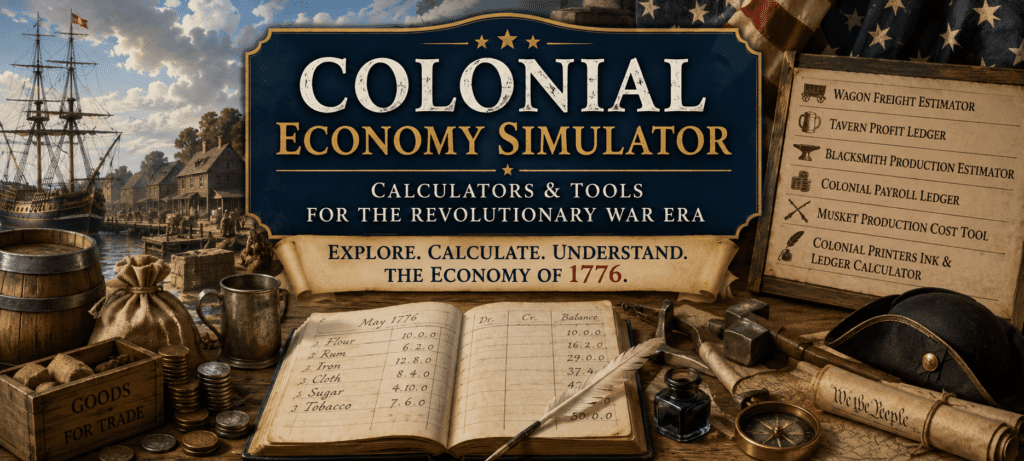
Step Into the Economy of 1776
The American colonies were not only fighting a revolution — they were operating an entire wartime economy with limited resources, dangerous transportation routes, inconsistent currency, and shortages of critical goods. Merchants, blacksmiths, tavern owners, printers, farmers, ship captains, and military suppliers all played a role in sustaining daily life and the war effort during the Revolutionary era.
The Colonial Economy Simulator recreates many of the financial and operational challenges faced by Americans in the late 18th century. These interactive calculators and ledgers are designed to help readers better understand how business, transportation, manufacturing, trade, and labor functioned during the years surrounding 1776.
Some tools focus on transportation costs and freight logistics. Others estimate payroll, tavern profits, blacksmith output, or the cost of manufacturing muskets and military supplies. Together, they form a growing ecosystem of immersive historical tools connected to the broader story of the American Revolution.
Whether you are a student, history enthusiast, teacher, reenactor, or simply curious about how colonial America functioned economically, these tools offer a unique hands-on way to explore the business side of the Revolutionary era.
For additional historical content, visit the America’s 250th Anniversary Hub and our highly detailed article on Weapons Used in 1776.
The American Revolution was not fought only on battlefields. It was also fought in taverns, shipyards, blacksmith forges, print shops, warehouses, docks, and merchant trading houses throughout colonial America. Behind every musket fired and every supply wagon stood a complex economic system struggling with shortages, transportation challenges, labor costs, inflation, and wartime uncertainty.
The Colonial Economy Simulator is a growing collection of immersive calculators and educational tools designed to recreate the economic realities of 1776. Explore transportation costs, tavern operations, blacksmith production, colonial payroll systems, musket manufacturing, printing expenses, and Revolutionary-era currency equivalents through these interactive historical tools.
Transportation in 1776 was slow, expensive, and dangerous. Colonial merchants and military suppliers depended heavily on freight wagons to move flour, iron, textiles, barrels, tools, and military supplies across rough colonial roads and muddy terrain.
Open Wagon Freight EstimatorColonial taverns operated as inns, restaurants, recruiting centers, political meeting halls, and business hubs. Estimate profits from meals, ale sales, lodging, traveler traffic, staffing, taxes, and supply shortages.
Open Tavern Profit LedgerBlacksmiths formed the industrial backbone of colonial America. Explore forge production, iron usage, fuel requirements, labor needs, and manufacturing output during the Revolutionary era.
Open Blacksmith Production EstimatorColonial businesses and military suppliers relied heavily on handwritten payroll systems to track wages, apprenticeships, craftsmen, printers, dock labor, and tavern employees.
Open Colonial Payroll LedgerManufacturing firearms during the Revolutionary War required iron, wood, charcoal, labor, transportation, and skilled gunsmithing. Explore the economic realities behind supplying an army in 1776.
Open Musket Production Cost ToolPrinters played a critical role in spreading revolutionary ideas through newspapers, military notices, pamphlets, legal forms, and broadsides. Estimate paper, ink, labor, and production costs.
Open Printer’s Ink CalculatorColonial America used Continental currency, British pounds, Spanish silver coins, barter systems, and commodity-based trade. Explore Revolutionary-era purchasing power and currency equivalents.
Open 1776 Currency CalculatorExplore our growing collection of financial calculators, business tools, estate planning systems, and educational resources designed to help individuals, families, retirees, and business owners make informed decisions.