
Fuel prices affect far more than the amount shown on the gas pump. That is why RetireCoast created the Fuel Price Intelligence Center ™.
They influence household budgets, vacation plans, commuting costs, business expenses, delivery charges, food prices, construction costs, and nearly every product that must be transported from one place to another.
Yet most fuel price websites provide only one piece of information: the current average price.
That number may tell you what gasoline costs today, but it does not necessarily help you understand what the price means for your own financial situation.
The Fuel Price Intelligence Center is a growing collection of calculators, lookup tools, and educational resources designed to help households, retirees, travelers, drivers, and business owners better understand how fuel prices affect their financial decisions.
The objective is not merely to report fuel prices.
It is to turn fuel price information into practical financial knowledge.
Fuel prices are constantly changing, but the questions they create are often the same. How will this affect my household budget? What will it cost my business? Why are prices different from one state to another? The Fuel Price Intelligence Center brings practical tools and plain-language explanations together in one growing resource.
Why RetireCoast Created the Fuel Price Intelligence Center
Fuel prices are among the most visible prices in the economy.
Drivers see them displayed on large signs along nearly every major highway. A change of ten or twenty cents per gallon can quickly attract attention, particularly when prices rise over a short period.
But the financial effect of a fuel price change depends on the person or business paying it.
A retired couple who drives only a few hundred miles each month may experience a relatively modest increase in expenses.
A commuter traveling fifty miles each day may feel the increase much more quickly.
A family with multiple vehicles may see fuel costs rise across several drivers at the same time.
A small business operating service vans, landscaping trucks, construction vehicles, or delivery vehicles may face hundreds or thousands of dollars in additional monthly costs.

The price shown at the pump is the same for everyone at that station, but the financial impact is not.
That difference is the foundation of the Fuel Price Intelligence Center.
Our goal is to help readers move beyond the national average and answer more personal questions:
How much are we spending on fuel each month?
How much would our budget change if gasoline increased by fifty cents per gallon?
How much fuel does our business use across all vehicles?
How do gasoline prices in one state compare with another?
How does the price of crude oil influence the price motorists ultimately pay?
These are practical questions. They deserve practical tools.

Understanding Fuel Prices Starts with Understanding the Bigger Picture
Many people check gasoline prices every week, but relatively few understand why prices change.
Gasoline prices are influenced by crude oil markets, refining capacity, seasonal fuel blends, transportation costs, taxes, weather events, regional supply and demand, and even geopolitical events taking place thousands of miles away.
For someone simply trying to decide whether now is a good time for a road trip—or why prices suddenly increased twenty cents overnight—the headlines often don’t provide enough context.
That is why one of the first educational resources published in the Fuel Price Intelligence Center is our cornerstone guide:
Rather than focusing on today’s price alone, this comprehensive guide explains how fuel moves from crude oil to the neighborhood service station, why prices vary from state to state, why diesel and gasoline often move differently, and how changing fuel costs affect households, retirees, travelers, and businesses.
If you’re new to the Fuel Price Intelligence Center, this article is the best place to begin. It provides the background knowledge that makes the calculators and tools throughout the center even more valuable.
Whether you’re interested in saving money, planning a move, managing a business fleet, or simply becoming a more informed consumer, this guide lays the foundation for understanding one of the most important everyday expenses most Americans face.
New to fuel price planning? Our flagship guide explains how gasoline and diesel prices are determined, why they change, how crude oil affects what you pay at the pump, and what every household and business owner should understand before using the Fuel Price Intelligence Center tools.
Read the Complete Guide →Fuel Prices Affect More Than Driving
It is easy to think of fuel prices as a concern only when filling a vehicle.
In reality, transportation energy costs move throughout the economy.
Farm equipment uses fuel.
Construction equipment uses fuel.
Delivery trucks use fuel.
Airlines, shipping companies, contractors, landscapers, service companies, and public agencies all purchase energy to transport people, equipment, and products.
When those costs increase, businesses may absorb part of the expense, reduce profits, add fuel surcharges, or increase the prices charged to customers.
This means a person who drives very little can still be affected by rising fuel prices.
Groceries must be delivered to stores. Building materials must be transported to construction sites. Online purchases must reach homes. Hotels, restaurants, and vacation destinations depend on employees and customers being able to travel.
Fuel prices are therefore both a household expense and a broader economic issue.
Understanding them can help people make better decisions about budgeting, travel, business pricing, vehicle use, and long-term planning.
Many drivers are paying more for fuel than they need to. In our next Fuel Price Intelligence Center article, How to Save Money on Gas: 25 Proven Ways to Lower Your Fuel Costs, I’ll share practical strategies that can reduce your fuel costs without driving less. One example is using warehouse club credit cards that currently offer up to 5% cash back on eligible fuel purchases. We’ll also cover loyalty programs, fuel rewards, trip planning, vehicle maintenance, and other simple ways to lower your overall transportation costs.
What the Fuel Price Intelligence Center Is
The RetireCoast Fuel Price Intelligence Center™ is an educational and financial planning resource.
It brings together tools that help readers estimate, compare, and understand fuel-related costs.
Some tools focus on individuals and families.
Others are designed for business owners.
Additional resources explain the relationship between crude oil, gasoline, diesel, taxes, refining, transportation, and regional price differences.
The center is intended to grow over time.
As new tools are developed, they will be added to the main hub so readers can find them in one organized location.
The center will also include supporting articles that explain how fuel markets work in plain language.
The purpose is not to overwhelm readers with industry terminology.
It is to make fuel prices easier to understand and easier to include in real-world financial planning.
What the Fuel Price Intelligence Center Is Not
The Fuel Price Intelligence Center does not predict the future price of gasoline or diesel.
No calculator can know with certainty what crude oil prices, refinery conditions, geopolitical events, taxes, weather disruptions, or consumer demand will look like months from now.
The center is also not a commodities trading service.
It does not recommend oil, energy, or transportation investments.
It is not affiliated with a gasoline retailer, fuel distributor, oil producer, or vehicle manufacturer.
It does not tell readers which fuel brand to purchase or where to buy gasoline.
Instead, the center provides educational estimates and planning tools based on the information entered by the user.
The results should be viewed as starting points for budgeting and comparison—not guaranteed future costs.
A collection of educational calculators, comparison tools, and articles designed to help households and businesses understand fuel costs and make better financial decisions.
It is not a fuel price prediction service, investment advisory platform, commodities trading site, or recommendation about where to purchase gasoline or diesel.
Fuel Price Tools Available Now
The Fuel Price Intelligence Center is launching with several practical resources.
Each tool addresses a different part of the fuel cost question.
Readers may use one tool or combine several of them to develop a broader understanding of their transportation expenses.
State Fuel Price Lookup
Fuel prices can vary significantly from one state to another.
State and local taxes, environmental requirements, transportation distances, refinery access, and regional market conditions can all contribute to those differences.
The State Fuel Price Lookup helps readers compare fuel price information across the United States.
This can be useful for people planning a move, comparing retirement destinations, budgeting for a road trip, or simply trying to understand why gasoline costs more in one region than another.
A national average is useful, but it may not reflect what drivers actually pay in Mississippi, California, Texas, Florida, or another state.
The state lookup helps bring the information closer to the reader’s actual location.
Household Fuel Budget Calculator
Many households know approximately how much gasoline costs per gallon, but they do not always know how much fuel they consume each month.
The Household Fuel Budget Calculator helps convert driving habits into a monthly and annual expense estimate.
Users can enter information such as:
- Miles driven
- Vehicle fuel economy
- Fuel price
- Number of vehicles
- Expected changes in driving or gasoline costs
The result can help households create a more realistic transportation budget.
It can also show how fuel-efficient vehicles, shorter commutes, combined trips, remote work, or changing fuel prices may affect total spending.
For retirees, this can be particularly useful when comparing the cost of living in different communities or estimating transportation costs after leaving the workforce.
Small Business Fuel Calculator
Fuel expenses can be difficult for a small business to track when several vehicles, employees, or pieces of equipment are involved.
The Small Business Fuel Calculator helps business owners estimate fleet and operating fuel costs.
A contractor may operate pickup trucks and trailers.
A landscaping company may use trucks, mowers, and other gasoline-powered equipment.
A property management company may have employees traveling between buildings.
A delivery business may operate several vehicles with different fuel economy ratings.
The calculator helps bring those costs together.
This can support business budgeting, job pricing, cash-flow planning, and decisions about replacing vehicles or adjusting service areas.
It can also help a business owner understand how a relatively small increase in the price per gallon may affect annual operating expenses.
Crude Oil Impact Calculator
Crude oil is one of the largest components influencing gasoline prices, but the connection is not always direct or immediate.
The price of gasoline also includes refining costs, transportation, distribution, retail expenses, taxes, seasonal fuel requirements, and local market conditions.
The Crude Oil Impact Calculator helps readers explore how changes in crude oil prices may influence gasoline prices.
It is not a prediction tool.
Instead, it illustrates the relationship between two important parts of the fuel market.
This helps readers understand why gasoline prices may rise when crude oil prices increase—and why the change at the pump may not always happen at the same time or by the same percentage.
Who Can Benefit From the Center
The Fuel Price Intelligence Center was created for a broad audience.
Households can use it to improve monthly budgeting.
Retirees can use it when comparing communities, travel plans, and cost-of-living differences.
Commuters can estimate how distance and vehicle fuel economy affect the true cost of getting to work.
Families can compare the combined expense of multiple vehicles.
Vacation travelers can estimate how fuel costs may affect a trip.
Small businesses can evaluate fleet expenses and operating costs.
Property owners and managers can consider the cost of travel, maintenance visits, landscaping, and contractor transportation.
People considering a move can compare fuel prices between states.
Readers who simply want to better understand gasoline and diesel markets can use the center’s educational resources.
The common thread is financial planning.
Fuel prices may be outside an individual’s control, but understanding their impact makes it easier to prepare for them.
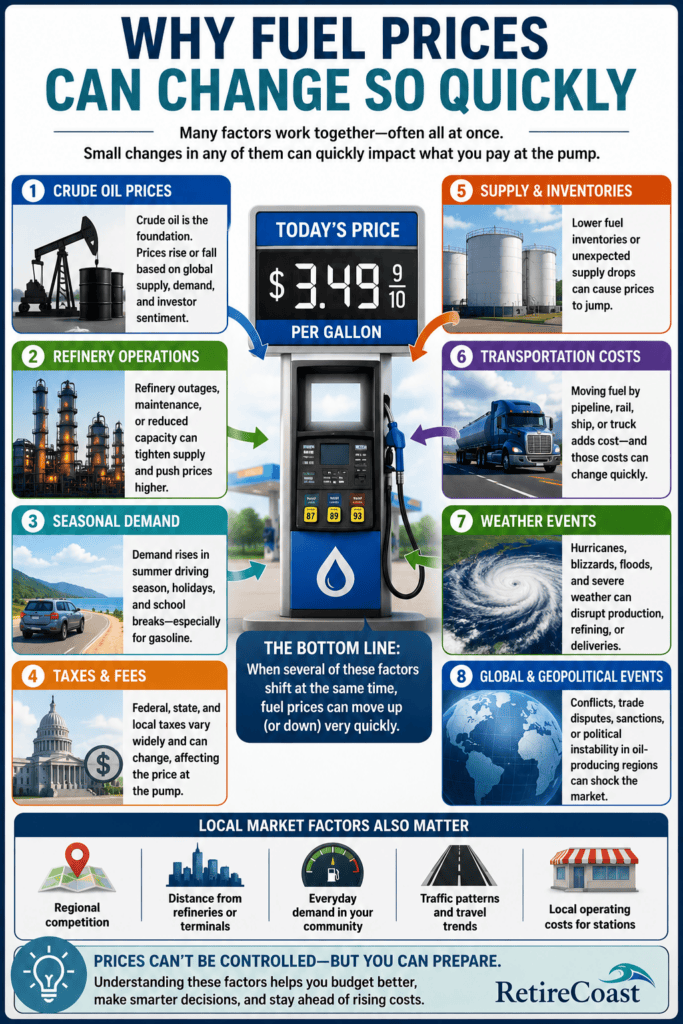
Why Fuel Prices Can Change So Quickly
Fuel prices are influenced by several interconnected factors.
Crude oil prices are important, but they are not the only factor.
Refinery maintenance or outages can reduce the available fuel supply.
Hurricanes and severe weather can interrupt production, refining, pipelines, ports, and fuel deliveries.
Seasonal gasoline requirements can change refining costs.
Demand often rises during holiday periods and the summer travel season.
State and local taxes vary.
Transportation costs differ by region.
Global events can affect crude oil production and shipping.
Local competition can influence the prices charged by individual stations.
This combination explains why gasoline prices may move differently in different parts of the country.
It also explains why a single headline does not always provide enough information to understand what is happening at the local pump.
Future articles within the Fuel Price Intelligence Center will examine these factors in more detail.
A Growing RetireCoast Resource
The current tools are only the beginning.
The Fuel Price Intelligence Center is being developed as a long-term RetireCoast resource.
Future additions may include:
- Diesel fuel planning tools
- Trucking and fleet cost estimators
- Road trip fuel calculators
- Gasoline and diesel tax comparisons
- Electric vehicle and gasoline operating cost comparisons
- Historical fuel price information
- Seasonal fuel price guides
- Fuel-saving planning resources
- Transportation cost articles
- State and regional comparisons
Not every proposed tool will appear immediately, and some may change as the center develops.
The purpose of sharing the roadmap is to show readers where the project is heading.
RetireCoast will continue expanding the center based on usefulness, reader questions, and the availability of reliable information.
Better Information Supports Better Decisions
No household or business can control the world oil market.
Most drivers cannot control refinery production, fuel taxes, weather disruptions, or international events.
But people can control how they prepare.
They can estimate their fuel use.
They can compare vehicles.
They can include realistic transportation costs in a household budget.
They can evaluate the impact of longer commutes.
They can adjust business pricing when operating expenses change.
They can plan road trips with a better understanding of the likely fuel expense.
They can compare the cost of living between states.
The Fuel Price Intelligence Center is designed to support those decisions.
It does not remove uncertainty, but it can make the financial impact easier to understand.
Bookmark the Fuel Price Intelligence Center
The Fuel Price Intelligence Center will continue to change as additional calculators, articles, and resources are added.
Bookmarking the main hub provides one place to return whenever you need to estimate fuel costs, compare prices, or learn more about the forces affecting gasoline and diesel.
RetireCoast subscribers will also receive updates as important new tools and educational resources are released.
The center is intended to become a practical reference for households, retirees, travelers, and business owners—not just during periods of high fuel prices, but whenever transportation costs become part of an important financial decision.
Fuel prices will continue to change.
The value of understanding them will remain.
Visit the RetireCoast Fuel Price Intelligence Center™ to use the latest calculators, compare fuel costs, and explore new resources as they are added. Bookmark the center and return whenever fuel prices become part of an important household, travel, or business decision.
Visit the Fuel Price Intelligence Center →Frequently Asked Questions
Does the Fuel Price Intelligence Center predict gasoline prices?
No. The center provides educational information, calculators, and planning estimates. It does not predict future gasoline, diesel, or crude oil prices.
Are the calculators free to use?
The currently available public Fuel Price Intelligence Center calculators are designed as free educational resources for RetireCoast readers.
Can businesses use the calculators?
Yes. The Small Business Fuel Calculator is specifically designed to help business owners estimate fleet and operating fuel expenses.
Are the calculator results guaranteed?
No. Results are estimates based on the information entered by the user and the assumptions used by each calculator. Actual expenses may differ.
Will additional tools be added?
Yes. RetireCoast plans to continue expanding the center with additional fuel, transportation, diesel, travel, business, and budgeting resources.
Absolutely. Every strong pillar or announcement article should include a handful of high-authority outbound links. They improve credibility, provide readers with authoritative sources, and reinforce that RetireCoast is interpreting trusted data rather than creating it.
For this launch article, I would keep it to 5–8 carefully selected references. They should be organizations your audience recognizes and that you will reference repeatedly throughout the Fuel Price Intelligence Center.
Recommended References
1. AAA Fuel Prices ⭐⭐⭐⭐⭐
Why: The most recognized source for current U.S. retail gasoline prices.
Use when discussing:
- National averages
- State averages
- Daily fuel prices
2. U.S. Energy Information Administration (EIA) ⭐⭐⭐⭐⭐
Why: The authoritative U.S. government source for energy statistics.
Use when discussing:
- Crude oil
- Gasoline
- Diesel
- Refining
- Inventories
- Weekly petroleum reports
3. U.S. Energy Information Administration – Petroleum Explained ⭐⭐⭐⭐⭐
Excellent educational material.
Use when explaining:
- How gasoline is produced
- Refineries
- Crude oil
- Distribution
URL
https://www.eia.gov/energyexplained/oil-and-petroleum-products/
4. U.S. Environmental Protection Agency (EPA)
Useful when discussing:
- Seasonal gasoline blends
- Environmental fuel requirements
- Cleaner-burning fuels
5. U.S. Bureau of Labor Statistics (BLS)
Useful for articles about:
- Inflation
- Transportation costs
- CPI
- Consumer spending
6. Federal Highway Administration (FHWA)
Good source for:
- Highway travel
- Vehicle miles traveled
- Transportation trends
7. Internal Revenue Service (IRS)
Useful for future business fuel articles.
Discuss:
- Standard mileage rates
- Business deductions
- Vehicle expense rules
8. Department of Energy
Useful consumer information.
Alternative fuels.
Vehicle efficiency.
Energy Saver articles.
Suggested “References” Section
References
The Fuel Price Intelligence Center™ relies on information from authoritative government agencies and nationally recognized organizations. The following resources provide additional information about gasoline prices, petroleum markets, transportation, and consumer energy trends.
- American Automobile Association (AAA). National and State Fuel Prices. https://gasprices.aaa.com/
- U.S. Energy Information Administration (EIA). Energy Information. https://www.eia.gov/
- U.S. Energy Information Administration. Oil and Petroleum Products Explained.https://www.eia.gov/energyexplained/oil-and-petroleum-products/
- U.S. Environmental Protection Agency. Fuel and Vehicle Programs. https://www.epa.gov/
- U.S. Bureau of Labor Statistics. Consumer Price Index. https://www.bls.gov/
- Federal Highway Administration. Transportation Statistics. https://highways.dot.gov/
- Internal Revenue Service. Standard Mileage Rates. https://www.irs.gov/
- U.S. Department of Energy. Energy Saver Resources. https://www.energy.gov/
Why these?
These organizations align well with the mission of the Fuel Price Intelligence Center:
- AAA → current fuel prices
- EIA → energy market fundamentals
- EPA → fuel formulations and environmental regulations
- BLS → inflation and transportation costs
- FHWA → driving and transportation data
- IRS → business mileage and vehicle expense rules
- DOE → consumer energy education
As the Fuel Price Intelligence Center grows, these same sources can be cited consistently across articles and tools, helping establish RetireCoast as a trusted educational resource built on authoritative public data rather than opinion.
Fuel prices don't change by chance. They are influenced by crude oil markets, refining capacity, transportation costs, fuel taxes, seasonal demand, weather events, and global economic conditions. If you want to understand why prices differ from state to state and how to interpret the results of this tool, our comprehensive guide is an excellent next step.
You'll also discover how one barrel of crude oil becomes gasoline and diesel, why diesel often costs more than gasoline, the factors that influence prices at the pump, and test your knowledge with an interactive quiz.
You've compared fuel prices across the United States. The next question is why those prices change. One of the biggest influences is the price of crude oil. Our Crude Oil to Gasoline Price Calculator demonstrates how changes in crude oil prices can ripple through the fuel supply chain and eventually affect the price you pay at the pump.
Knowing your state's average gasoline and diesel prices is only the beginning. Explore additional fuel-price resources, use our collection of financial calculators, or connect transportation costs with your household budget through the RetireCoast Millennial Financial Lab.
Explore fuel-price tools, crude oil resources, gasoline and diesel explanations, and additional cost-comparison tools.
Explore Fuel ToolsFind calculators for retirement, taxes, housing, transportation, business planning, and everyday financial decisions.
View All CalculatorsConnect fuel and transportation costs with your monthly budget, savings goals, net worth, and long-term financial plan.
Explore Budgeting ToolsFuel is one of the largest operating expenses for many businesses. Learn how to estimate transportation costs, build fuel expenses into pricing, improve profitability, and access planning tools designed specifically for entrepreneurs and small business owners.
Explore Business BuilderDiscover more from RetireCoast.com
Subscribe to get the latest posts sent to your email.