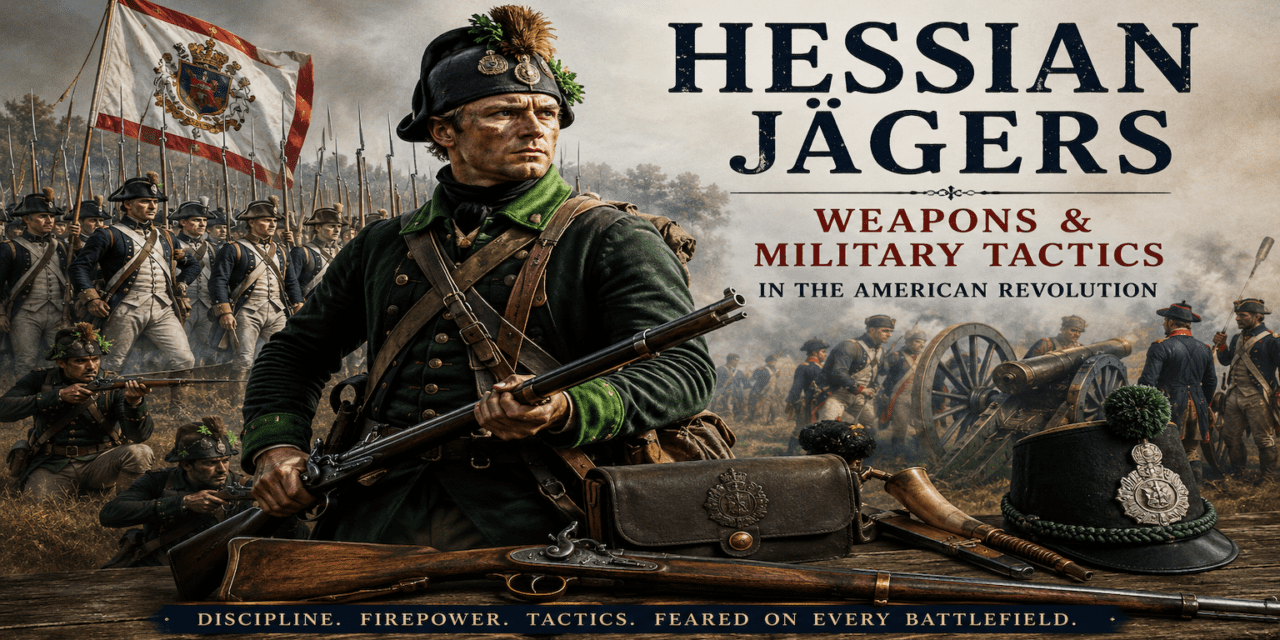

In this third article in the Hessians in the American Revolution series, the author explores the feared Hessian Jägers, their rifles, battlefield tactics, artillery support, woodland warfare methods, and the specialized military skills that made these elite German troops some of the most dangerous soldiers of the Revolutionary War.
This audio introduction also explains how the Hessian Jägers differed from ordinary infantry, why their green uniforms became feared across the colonies, and how their military legacy still fascinates historians nearly 250 years later.
Author audio introduction to Hessian Jagers, Weapons and Military Tactics in the American Revolution
- Hessian Jägers, Weapons and Military Tactics
- Why Hessian Jägers Were Completely Different from Ordinary Soldiers
- How the Hessian Jägers Changed Life Back in Germany
- How the Hessian Jägers Adapted to the American Wilderness
- The Clash Between the Jägers and American Riflemen
- The American View of the Hessian Jägers
- Hessian/Jager Weapons of 1776
- The Green-Coated Hessian Jägers
- Letters Home from the Hessian Jägers
- What the Hessian Jägers Thought About America
- Letters from the Skirmish Line
- Where You Can Read the Hessian Letters Today
- What the Hessian Jägers Thought About America
- The Great Jäger Journals
- Where You Can Read the Hessian Letters Today
- Continue Exploring the Complete Hessian Series
Hessian Jägers, Weapons and Military Tactics
The Hessian Jägers became some of the most feared soldiers of the American Revolution because they fought very differently from traditional European infantry.
This third article in the series, Hessians in the American Revolution: The German Soldiers Who Helped Shape America, explores the Hessian Jagers weapons and military tactics that made these elite German troops so dangerous on American battlefields.
From woodland warfare and scouting missions to sharpshooting and disciplined battlefield maneuvers, the Hessian Jägers earned a reputation for professionalism that even their enemies respected.
The Rise of the Hessian Jägers
As the Revolutionary War evolved, British commanders quickly realized that traditional European battlefield tactics did not always work well in the forests, farms, swamps, and rough terrain of North America.
Large formations of infantry marching shoulder to shoulder in bright uniforms became vulnerable targets in wooded environments and surprise attacks.
The British increasingly relied upon specialized German troops better suited for irregular combat conditions.
Among the most respected of these soldiers were the Hessian Jägers.
Why the Hessian Jägers Were Feared
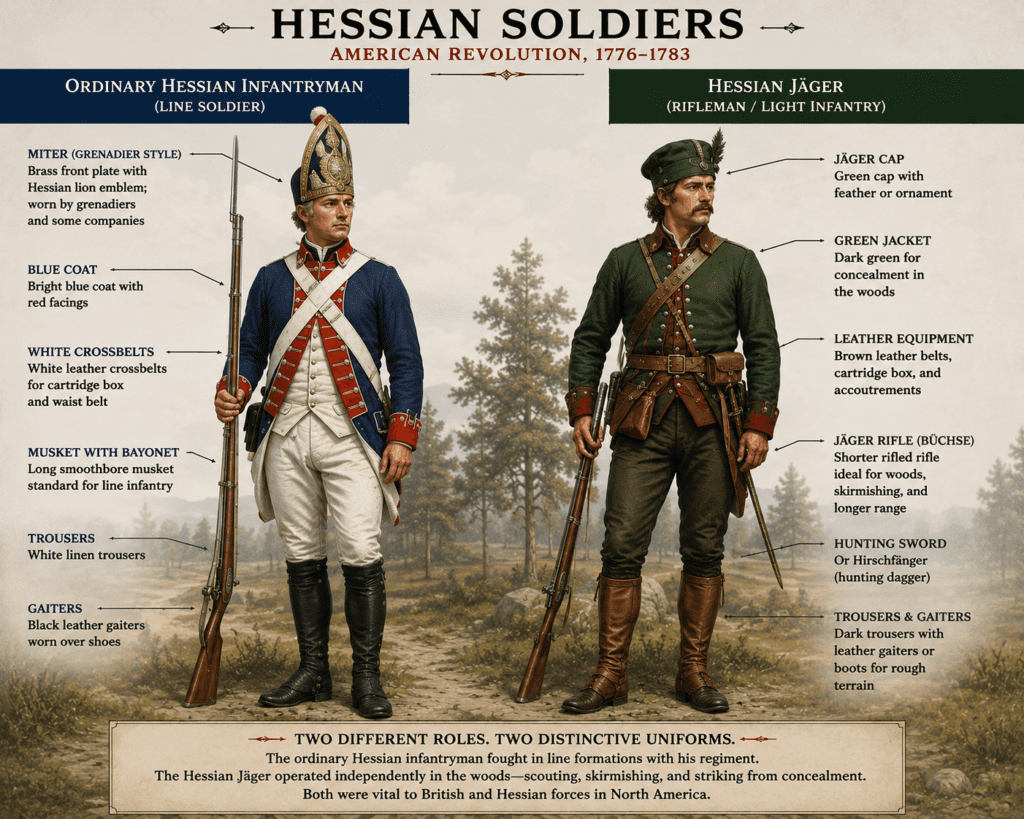
Unlike ordinary infantry carrying smoothbore muskets, the Hessian Jägers often used rifled weapons capable of far greater accuracy at longer distances.
These elite troops specialized in reconnaissance, scouting, skirmishing, sharpshooting, and woodland combat.
Their darker green uniforms also differed from the bright blue coats commonly associated with traditional Hessian infantry.
Jägers Were Trained Hunters Before Becoming Soldiers
Many Jägers came from German hunting traditions where marksmanship and fieldcraft were already highly developed skills.
British commanders valued them because they could move quickly through forests, operate independently, and engage enemy officers or artillery crews at distances difficult for smoothbore muskets to reach.
In many ways, the Hessian Jägers adapted to American conditions more successfully than many conventional European soldiers.
Hessian Discipline and Battlefield Reputation
Even as the war shifted southward, Hessian troops continued fighting with considerable effectiveness.
German units participated in major campaigns including the Siege of Charleston and the Battle of Guilford Courthouse.
Reports from Yorktown in 1781 noted that Hessian regiments maintained strict discipline and composure even during the final British surrender.
Respected by Allies and Enemies
American and French observers frequently commented on the order, professionalism, and discipline displayed by Hessian troops.
Their battlefield conduct helped create the enduring reputation surrounding Hessian Jagers weapons and military tactics that still fascinates historians today.
At the end of this article, you will find links to the complete Hessian series hub and the related articles that are part of the larger 250th Anniversary Series on RetireCoast.
Why Hessian Jägers Were Completely Different from Ordinary Soldiers
The Hessian Jägers were not simply regular infantry carrying different weapons.
They represented an entirely different military concept built around skilled hunters, foresters, and professional woodsmen whose civilian experience made them uniquely suited for warfare in difficult terrain.
Understanding this distinction is essential to understanding why Hessian Jagers military tactics and weapons became so feared during the American Revolution.
The Meaning of “Jäger”
The word Jäger means “hunter” in German.
During the 18th and early 19th centuries, Jägers served as elite light infantry specialists rather than traditional line soldiers.
Most European armies relied heavily on massed formations of infantry trained to march shoulder to shoulder and fire coordinated volleys.
The Jägers operated very differently.
Traditional Infantry vs. Jägers
Standard infantry soldiers were often conscripted peasants or impoverished laborers trained through repetitive drill.
Jägers were selected because they already possessed highly specialized civilian skills before entering military service.
This gave them a major advantage in scouting, skirmishing, reconnaissance, and woodland combat.
The Civilian Forester Class
Most Hessian Jägers came from a respected professional class tied directly to German noble estates.
These men were not inexperienced recruits learning survival skills for the first time.
Professional Foresters and Gamekeepers
The majority served as professional foresters (Förster) or gamekeepers (Berufsjäger).
Their daily work involved tracking animals, navigating forests, observing terrain, and moving silently through wilderness areas.
They already understood camouflage, concealment, and independent movement long before joining military units.
Lifelong Marksmanship Experience
Unlike ordinary infantrymen, Jägers regularly used firearms as part of their profession.
Many line infantry soldiers fired very few live rounds during their military training.
A professional forester, however, depended upon shooting accuracy as part of his livelihood and survival.
This pre-existing experience created riflemen far more effective than standard musket infantry.
The “Bring Your Own Rifle” System
Another major difference involved weapons.
Standard infantry received state-issued smoothbore muskets designed for rapid mass volley fire rather than precision shooting.
The Famous Jäger Rifle
Jägers carried specialized rifled firearms known as Büchsen.
These shorter, heavy-barreled rifles contained spiral grooves inside the barrel that spun the bullet for dramatically improved accuracy.
Unlike smoothbore muskets, a skilled Jäger could accurately strike targets at much longer distances.
Personal Ownership of Weapons
During conflicts such as the Seven Years’ War and the American Revolution, many Jägers were expected to bring their own hunting rifles or prove extensive familiarity with using one.
These were often expensive personal weapons associated with skilled hunting professions rather than military mass production.
Because the rifles usually could not mount standard bayonets, Jägers carried a heavy hunting dagger called a Hirschfänger, or “deer-catcher,” for close combat.
Physical and Mental Screening for Jägers
The demands placed upon Hessian Jägers required far more than simple obedience.
These troops needed to think independently while operating far ahead of the main army.
Independent Thinking and Terrain Awareness
Traditional line infantry fought in tightly controlled formations where soldiers followed commands mechanically.
Jägers operated in small groups or individually across skirmish lines.
They needed to read terrain, locate enemy movements, and make rapid tactical decisions without direct supervision.
Exceptional Physical Endurance
Jägers often marched long distances ahead of the main force while scouting roads, forests, and river crossings.
They needed the stamina to move quickly through rough terrain, launch ambushes, and retreat before larger enemy forces could respond.
This style of warfare demanded physical conditioning beyond that expected of most ordinary soldiers.
Literacy and Higher Social Status
Many professional foresters were literate and held a higher social position than ordinary peasants drafted into infantry service.
German states frequently treated Jägers more like trusted professionals than expendable military manpower.
This distinction contributed heavily to their discipline, professionalism, and battlefield reputation.
Why German States Invested in Jägers
Recruiting highly skilled foresters away from comfortable civilian employment required major incentives.
German rulers understood that these elite troops possessed valuable expertise difficult to replace.
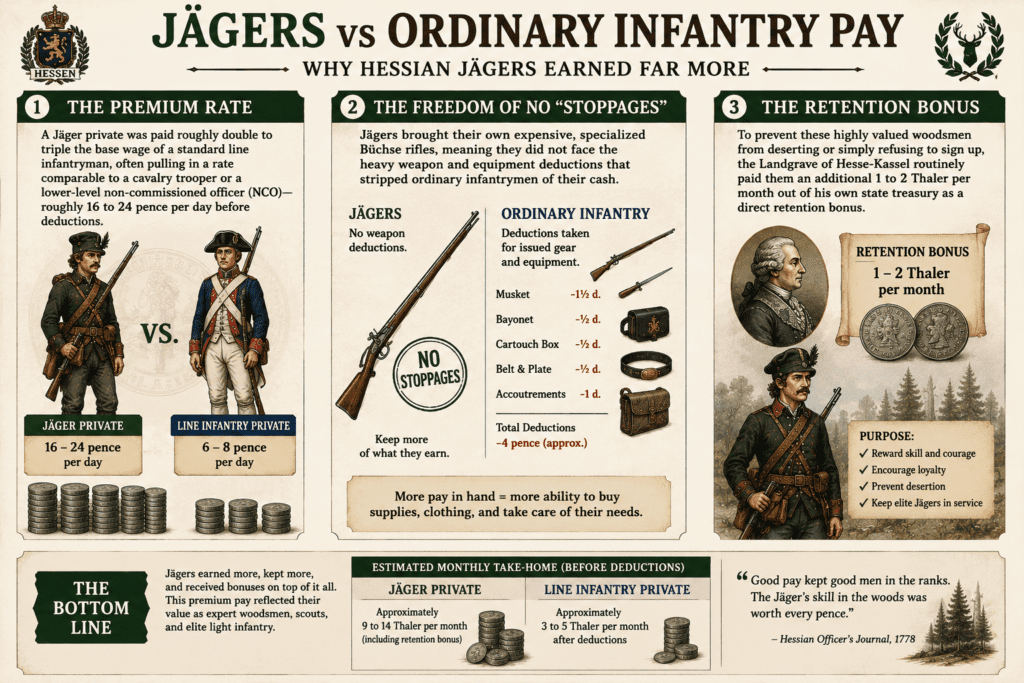
Better Pay and Special Privileges
Jägers generally received higher pay than ordinary infantry soldiers.
They were frequently exempt from exhausting camp labor and other menial duties assigned to regular troops.
Some were also promised permanent government forestry positions after honorable military service.
Elite Troops for a Changing Battlefield
As warfare increasingly involved skirmishing, reconnaissance, and combat in rough terrain, Jägers became some of the most valuable troops available to European armies.
Their specialized training and battlefield flexibility made them particularly effective in North America.
The wilderness conditions of the American Revolution allowed Hessian Jagers weapons and military tactics to demonstrate their full effectiveness against both Continental forces and militia units.
How the Hessian Jägers Changed Life Back in Germany
When Landgrave Friedrich II of Hesse-Kassel signed the 1776 treaty with King George III and sent thousands of troops to North America, the deployment of the elite Hessian Jägers created major consequences far beyond the battlefields of the American Revolution.
These were not ordinary conscripted soldiers easily replaced by the state.
The Hessian Jägers were highly trained foresters, gamekeepers, and wilderness professionals whose absence deeply disrupted the economy, forests, estates, and social structure of Hesse-Kassel itself.
Understanding this hidden impact helps explain why Hessian Jagers weapons and military tactics were tied directly to the professional forestry system of Germany.
The Forestry Crisis in Hesse-Kassel
In 18th-century Germany, forests were not simply wilderness areas.
Wood served as the primary source of fuel, heating, construction material, and industrial energy for industries such as metallurgy and glassmaking.
The Loss of the Professional Foresters
Most Jägers came directly from the state forestry system.
When thousands of these trained men departed for America, forests across Hesse-Kassel suddenly lost many of the professionals responsible for managing timber resources, protecting hunting reserves, and enforcing strict land regulations.
The consequences appeared almost immediately.
Illegal Logging and Poaching Expanded Rapidly
With professional foresters and gamekeepers gone, illegal logging increased dramatically.
Poachers also targeted deer, boar, and other protected game animals previously guarded by the forestry system serving the German nobility.
Large areas of woodland became difficult to monitor and control.
The Breakdown of Scientific Forest Management
Hesse-Kassel had become an early practitioner of Kameralismus, a highly organized bureaucratic system that treated forests as long-term renewable assets.
Officials mapped timber growth decades in advance to maintain sustainable production.
The sudden removal of so many experienced Jägers disrupted this carefully planned system and contributed to local timber shortages and ecological damage that lasted for years after the war.
Economic Problems on the Noble Estates
The absence of the Hessian Jägers also created serious financial problems for aristocratic landowners.
Many of the missing men had served as estate managers, gamekeepers, and wilderness supervisors on large private lands.
Noble Estates Lost Their Skilled Managers
German nobles depended heavily upon trained foresters to oversee tenant farmers, maintain hunting grounds, patrol estate boundaries, and control predators such as wolves.
When these experienced men left for America, many estates suffered direct economic losses from poor management and declining productivity.
Older Workers and Inexperienced Replacements
The Landgrave struggled to replace the missing specialists.
Older retired foresters and inexperienced younger workers often lacked the advanced knowledge necessary to manage the estates properly.
This created long-term disruptions throughout rural communities dependent upon forestry and hunting industries.
The Human Cost Within the Jäger Communities
The social impact of the war hit the Jäger communities particularly hard because these units were closely connected through family and professional relationships.
Unlike ordinary infantry units composed of strangers from multiple districts, Jäger companies often came from the same forestry networks.
A Tight-Knit Professional Brotherhood
Many Jägers trained together under the same master foresters and frequently belonged to interconnected families.
Some positions within the forestry system were hereditary, passing from father to son over generations.
The loss of a single Jäger could therefore affect an entire family lineage and disrupt long-established management of specific lands.
Heavy Combat Losses Shocked the Communities
Because Jägers operated as scouts, skirmishers, and advance troops, they faced constant danger.
These soldiers frequently fought ahead of the main army where ambushes and sudden attacks were common.
Losses suffered during campaigns around Trenton, Philadelphia, and other major operations devastated entire forestry communities back in Hesse-Kassel.
How the Hessian Government Responded
Landgrave Friedrich II used the enormous financial payments received from Britain to reduce some of the damage caused by the war.
The British subsidies generated massive state revenue that exceeded normal taxation levels.
Tax Relief for Families
Families with fathers or sons serving in America often received major tax exemptions.
These reductions helped offset the economic hardships created when skilled workers left home for years of military service overseas.
Guaranteed Government Employment
The state also reserved future forestry, customs, and postal positions for returning Jägers and surviving family members of those killed during the war.
This policy attempted to stabilize the professional forestry class after years of disruption.
Expansion of Social Programs
The Landgrave invested heavily in roads, schools, hospitals, and social welfare programs.
Some of these programs specifically assisted widows, wounded veterans, and struggling rural communities affected by the war.
Many Hessian Jägers Never Returned Home
When the American Revolution finally ended in 1783, the effects on Hesse-Kassel became permanent.
An estimated 30% to 40% of the German soldiers who served in America never returned to Germany.
The American Frontier Offered New Opportunities
Many former Hessian soldiers, including skilled Jägers, disappeared into the American frontier.
Their experience with forests, hunting, tracking, and wilderness survival made them well suited for life in North America.
Some settled permanently in the very forests they had originally been sent to scout and fight within during the Revolutionary War.
Their decision permanently altered both the Hessian homeland and the developing American frontier.
How the Hessian Jägers Adapted to the American Wilderness
When the Hessian Jägers arrived in North America in 1776, they expected forests similar to the dense woodlands of central Germany.
Instead, they encountered enormous stretches of rugged wilderness filled with swamps, thick underbrush, rocky terrain, and vast frontier landscapes unlike anything they had previously experienced.
This new environment forced the Jägers to adapt their battlefield methods while facing a dangerous new opponent: the American frontier rifleman.
The German Forest vs. the American Frontier
The civilian skills that made the Hessian Jägers elite troops in Europe translated remarkably well to the operational demands of the American Revolution.
However, the enormous scale and harsh terrain of North America created a steep learning curve even for these highly trained professionals.
Tracking and Navigation Skills
In Germany, Jägers spent years learning how to track animals, navigate forests, and detect subtle disturbances in the wilderness.
These same skills became critical in America where roads were often little more than dirt paths or narrow trails through dense forests.
British officers relied heavily upon the Hessian Jägers to scout dangerous terrain and detect potential ambushes.
The Jägers effectively became the eyes and ears of the British army during campaigns in New Jersey, Pennsylvania, and New York.
The Advantage of the Green Uniform
Unlike British regulars wearing bright red coats, the Hessian Jägers wore darker green jackets with red facings designed for concealment during hunting operations.
This camouflage proved extremely effective in the forests of North America.
The Jägers frequently fought using what Europeans sometimes called Indianer-Manier, or “Indian-style” combat, using trees, fences, rocks, and terrain for individual cover instead of standing in open formations.
Discipline While Fighting Independently
Traditional European infantry depended heavily on tight formations and constant officer supervision.
The Hessian Jägers, however, excelled while operating alone or in small two-man teams known as Rotten.
Their background as solitary foresters and gamekeepers allowed them to remain calm under fire while scouting far ahead of the main army.
This independent operational style became one of the defining elements of Hessian Jagers weapons and military tactics during the Revolutionary War.
The Clash Between the Jägers and American Riflemen
The Hessian Jägers soon discovered they no longer held a monopoly on long-range marksmanship.
American frontier riflemen, including famous units such as Morgan’s Riflemen, presented a serious challenge to the German sharpshooters.
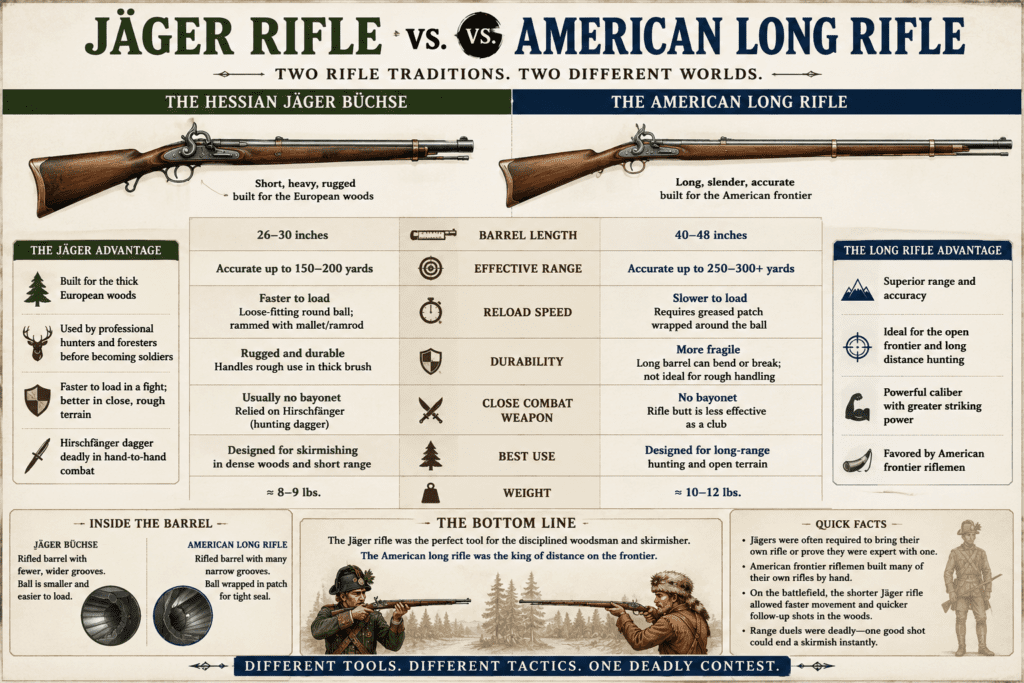
The Jäger Rifle vs. the American Long Rifle
The conflict created a fascinating contest between two different rifle traditions and two very different styles of wilderness warfare.
The Hessian Jäger Büchse
The Jägers carried shorter, heavier rifles designed for durability and maneuverability in dense forests.
These weapons could be loaded somewhat faster and handled rough terrain better than many frontier rifles.
The shorter design also worked well during rapid movement through woods and swamps.
The American Long Rifle
American frontier riflemen used much longer and more slender rifles capable of remarkable long-range accuracy.
In some engagements, American riflemen successfully targeted Jägers from distances the Germans had previously considered relatively safe.
This forced the Hessian Jägers to rethink their combat methods and adapt rapidly to frontier warfare.
How the Hessian Jägers Changed Their Tactics
Rather than relying solely on European battlefield doctrine, the Jägers evolved their methods in response to American conditions and rifle warfare.
The “Charge and Fire” Counterattack
The American long rifle possessed excellent range but suffered from slow reload times and usually lacked a bayonet.
Jäger commander Johann Ewald recognized this weakness and developed an aggressive counter-tactic.
The Jägers would often draw American rifle fire while using tree cover and terrain for protection.
The moment the Americans fired, the Jägers launched a rapid charge with daggers or close-range weapons before the riflemen could reload.
The Development of Mounted Jägers
The immense distances of North America also encouraged tactical innovation.
By 1777, the Hessian forces created Mounted Jäger units known as Jäger zu Pferd.
These mounted troops acted as highly mobile scouts and skirmishers.
They rode rapidly into position, dismounted to fire accurate rifle shots, and then remounted before enemy forces could close the distance.
The Use of the Hirschfänger
Because the traditional Jäger rifle could not easily mount a standard bayonet, the Hessian Jägers relied heavily upon the Hirschfänger, a heavy hunting dagger originally designed for dispatching wounded deer.
Some versions were adapted for combat attachment near the rifle barrel, while others served as devastating short swords during close fighting inside forests and swamps.
In dense terrain where long muskets became awkward, the Hirschfänger gave the Jägers an important advantage in hand-to-hand combat.
The American View of the Hessian Jägers
By the later years of the war, British commanders considered the Hessian Jägers among the most valuable light infantry troops available in North America.
Their discipline, adaptability, and specialized wilderness skills made them exceptionally effective in reconnaissance, skirmishing, and frontier warfare.
George Washington Recognized Their Importance
Even General George Washington understood how dangerous the Hessian Jägers had become.
American efforts reportedly offered special incentives and land grants encouraging Jägers to defect from British service because trained Hessian marksmen represented such an important military asset.
Interested in the weapons used in 1776? Our complete article in the RetireCoast 250th Anniversary Series explores the weapons carried by both American and British forces during the Revolutionary War.
The feature includes detailed historical explanations, battlefield context, high-quality images, infographics, and audio commentary covering muskets, rifles, artillery, bayonets, naval weapons, powder systems, and the technology that shaped the war for independence.
Hessian/Jager Weapons of 1776
The Hessians did not arrive in America carrying only muskets and bayonets.
They also brought highly trained artillery units equipped with cannon that were considered among the best-served field guns in the Revolutionary War.
In eighteenth-century warfare, artillery represented one of the most important and technically demanding branches of any professional army. Cannon could:
- break infantry formations,
- destroy fortifications,
- dominate roads and bridges,
- support bayonet assaults,
- and terrorize enemy troops psychologically.
The German states took artillery extremely seriously.
THE ELITE HESSIAN ARTILLERYMEN
Unlike ordinary infantry soldiers, Hessian artillery crews were highly specialized military professionals.
Operating cannon required knowledge of:
- mathematics,
- geometry,
- metallurgy,
- powder charges,
- trajectory calculations,
- and battlefield positioning.
German artillerymen underwent extensive training to master these skills.
In many ways, artillery units represented the technological elite of eighteenth-century armies.
The Hessians brought dedicated artillery companies from states such as Hesse-Kassel and Hanau, and British commanders valued them highly for their professionalism and reliability under combat conditions.
The Ultimate Disgrace: Losing the Guns
In the military culture of the 18th century, losing a regiment’s cannon to the enemy was considered one of the greatest humiliations imaginable. Cannon symbolized discipline, battlefield honor, technical skill, and the reputation of the entire regiment.
When the Hessian artillery pieces were captured at Trenton in 1776—and later during the surrender at Yorktown in 1781—the surviving German officers were reportedly mortified. The loss of artillery was viewed not simply as a battlefield setback, but as a lasting stain on military honor.
George Washington understood the symbolic importance of these captured weapons. He was so proud of the artillery seized at Trenton that the captured brass Hessian cannon were marked and incorporated directly into the Continental Army, where they continued serving against the British for the remainder of the Revolutionary War.
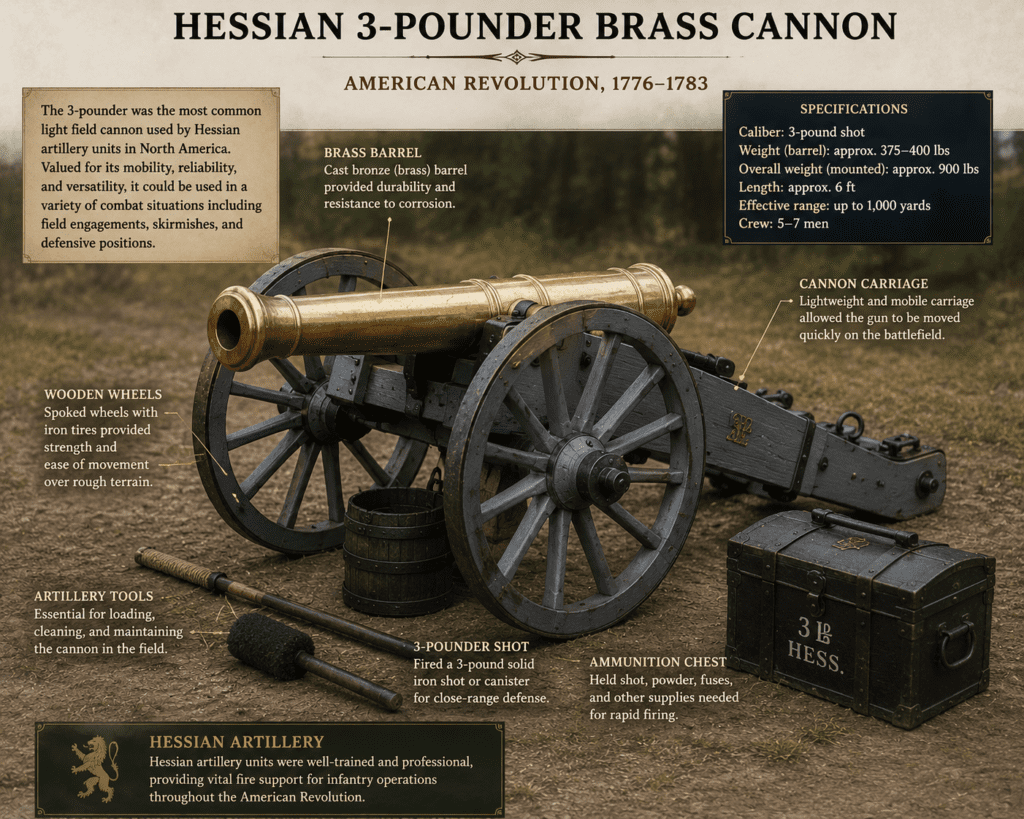
THE FAMOUS 3-POUNDER FIELD GUNS
The most common Hessian artillery piece in America was the light 3-pounder field cannon.
The term “3-pounder” referred to the weight of the solid iron cannonball fired by the gun.
Unlike the massive siege cannons used to batter fortresses, these field pieces were designed for mobility. Hessian artillery doctrine emphasized moving cannon rapidly alongside infantry formations rather than leaving them far behind the lines.
These became known as “battalion guns.”
Typically, two light cannon accompanied each infantry regiment directly into battle.
Because many Hessian field guns used brass barrels rather than heavier cast iron, they could move more quickly through:
- mud,
- forests,
- swamps,
- narrow roads,
- and rough American terrain.
Gun crews and horses often dragged the cannon forward using ropes and harnesses while infantry advanced nearby.
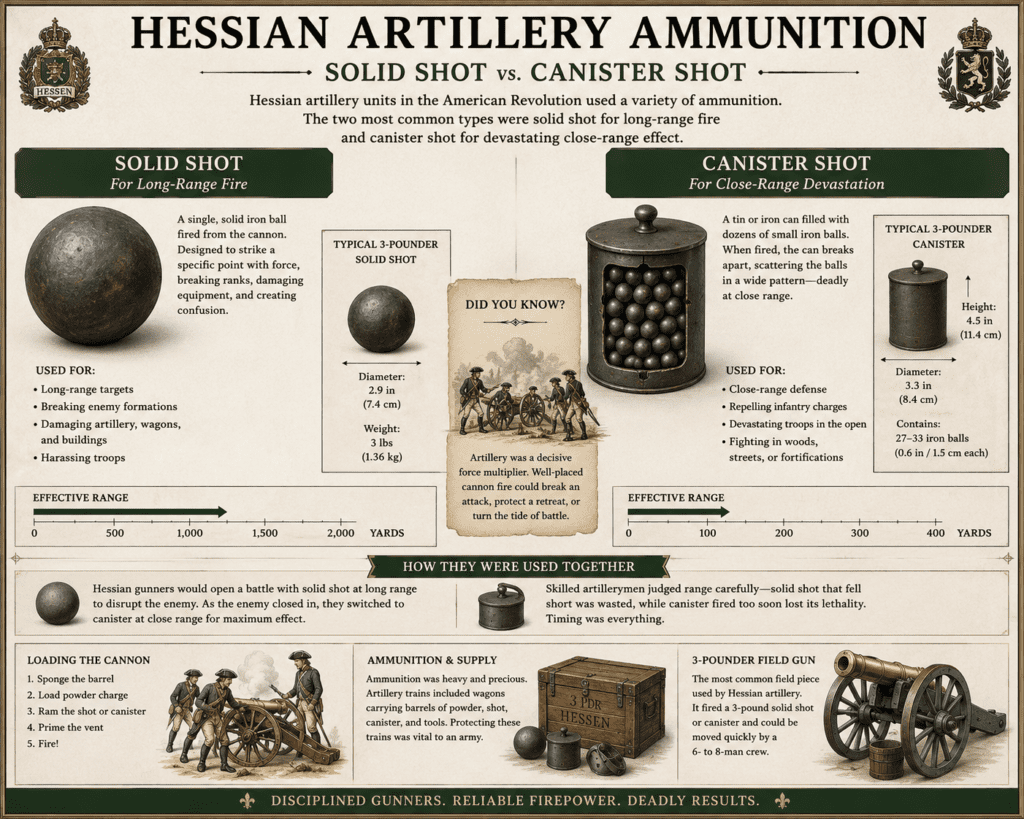
HESSIAN ARTILLERY AMMUNITION
German artillery crews used several different types of ammunition depending on battlefield conditions.
SOLID SHOT
At longer ranges, Hessian cannon fired solid iron cannonballs.
These heavy projectiles could:
- smash through defensive walls,
- destroy artillery positions,
- shatter wagons,
- or bounce through infantry formations with devastating effect.
On open ground, cannonballs sometimes skipped repeatedly across the battlefield, tearing through tightly packed lines of soldiers.
CANISTER SHOT
At close range, Hessian gunners often switched to canister shot, one of the most terrifying weapons of the eighteenth century.
Canister consisted of a metal container filled with dozens of small iron balls packed tightly together. When fired, the container exploded apart at the muzzle, transforming the cannon into something resembling a gigantic shotgun.
Against charging infantry at close distances, canister fire could devastate entire formations within seconds.
HESSIAN CANNON IN MAJOR BATTLES
German artillery played major roles throughout the Revolutionary War.
At the Battle of White Plains in 1776, Hessian cannon bombarded American positions on Chatterton’s Hill, helping pin down Continental forces long enough for German infantry to storm the position successfully.
At Fort Washington later that same year, Hessian artillery supported the assaults that captured thousands of American prisoners and large stores of military supplies.
But perhaps the most famous Hessian artillery story occurred during the Battle of Trenton.
When Washington launched his surprise attack on December 26, 1776, the Hessians stationed in Trenton possessed six prized 3-pounder brass field guns positioned throughout the town.
The problem was speed.
Washington’s attack unfolded so quickly that the Hessian crews struggled to organize effective artillery fire. Some German cannon were rolled hurriedly into the streets to resist the American advance, but Continental artillery under the command of the young Alexander Hamilton had already seized key positions overlooking the town.
Hamilton’s guns opened fire on the Hessian artillery crews before they could properly deploy.
The result became one of the great symbolic moments of the Revolution:
the Americans captured all six Hessian cannon.
In eighteenth-century military culture, losing a regiment’s artillery represented enormous humiliation. Cannon symbolized honor, discipline, and battlefield prestige. Captured guns were often displayed proudly by victorious armies as trophies of war.
Washington himself understood the importance of the captured Hessian artillery. The Continental Army reused several of the captured brass field guns during later campaigns, turning British and Hessian weapons back against the Crown itself.
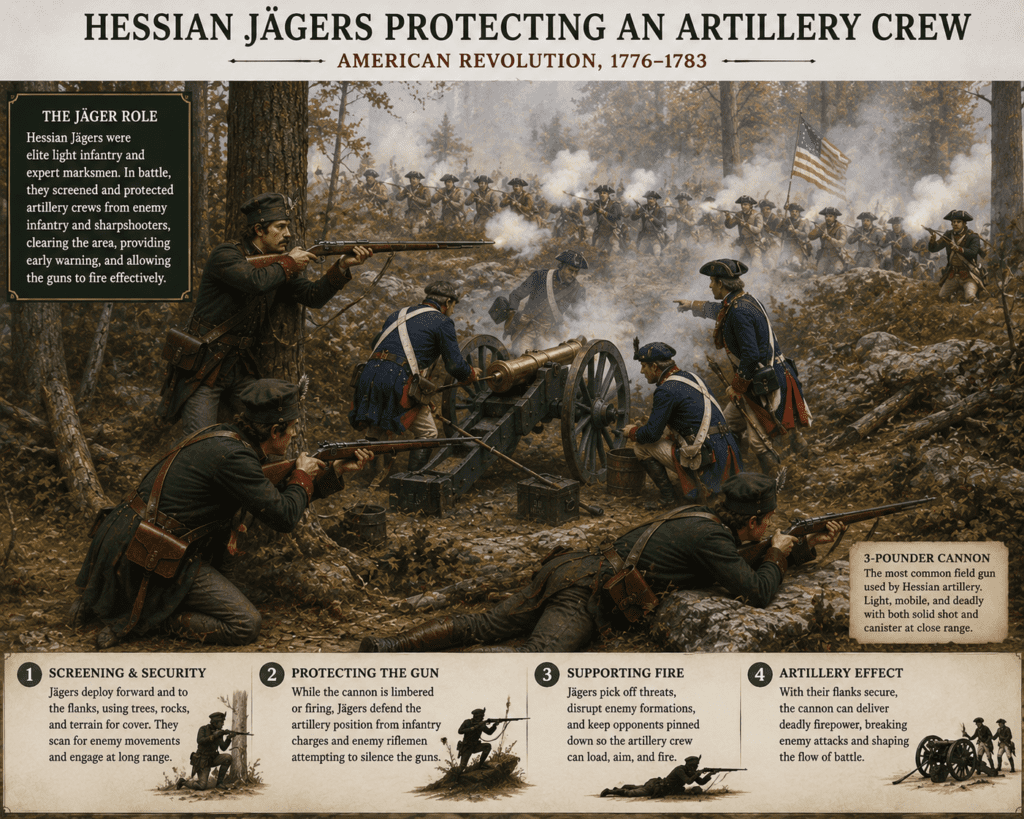
THE JÄGERS AND ARTILLERY COORDINATION
The elite Hessian Jägers often worked closely with artillery units.
Jägers screened advancing cannon positions, protected gun crews from ambush, scouted terrain, and targeted enemy officers or artillerymen during battles. This coordination between light infantry and mobile artillery reflected the advanced professionalism of the German military system.
DISCIPLINE UNTIL THE END
Even late in the war, Hessian artillery units maintained strong reputations for battlefield discipline.
At Yorktown in 1781, German artillery crews continued serving their guns with remarkable composure despite relentless American and French bombardment. Observers noted that Hessian regiments and artillerymen maintained strict military order even during the final surrender of the British army.
In many ways, the Hessian cannon represented the larger German military system itself:
technically advanced,
highly disciplined,
organized,
and extremely effective—
yet ultimately unable to overcome the enormous geographic, political, and social forces unleashed by the American Revolution.
The Green-Coated Hessian Jägers
The Hessian Jägers immediately stood apart from nearly every other soldier fighting during the American Revolution.
While most European armies marched into battle wearing bright, highly visible uniforms, the Hessian Jägers wore dark green coats specifically suited for concealment and woodland warfare.
Their appearance reflected the very origins of the Hessian Jagers weapons and military tactics that made these troops so feared across the colonies.
Why the Hessian Jägers Wore Green Uniforms
The dark green uniforms of the Jägers were not designed for parade grounds or battlefield spectacle.
They were practical hunting uniforms inspired directly by the forests and wilderness regions where many Jägers had worked before becoming soldiers.
Designed for Woodland Concealment
Bright uniforms such as the famous British red coats or the blue uniforms of regular Hessian infantry stood out sharply in forests.
The Jägers’ green jackets blended naturally into wooded terrain, brush, and shadowed landscapes.
This camouflage allowed them to move quietly through forests while scouting enemy positions or preparing ambushes.
Inspired by Professional Hunters and Foresters
Many Jägers came directly from German forestry professions where stealth and concealment were already essential skills.
Their uniforms reflected the traditions of hunters and gamekeepers rather than ordinary line infantry.
In many respects, they resembled highly trained wilderness specialists more than conventional soldiers.
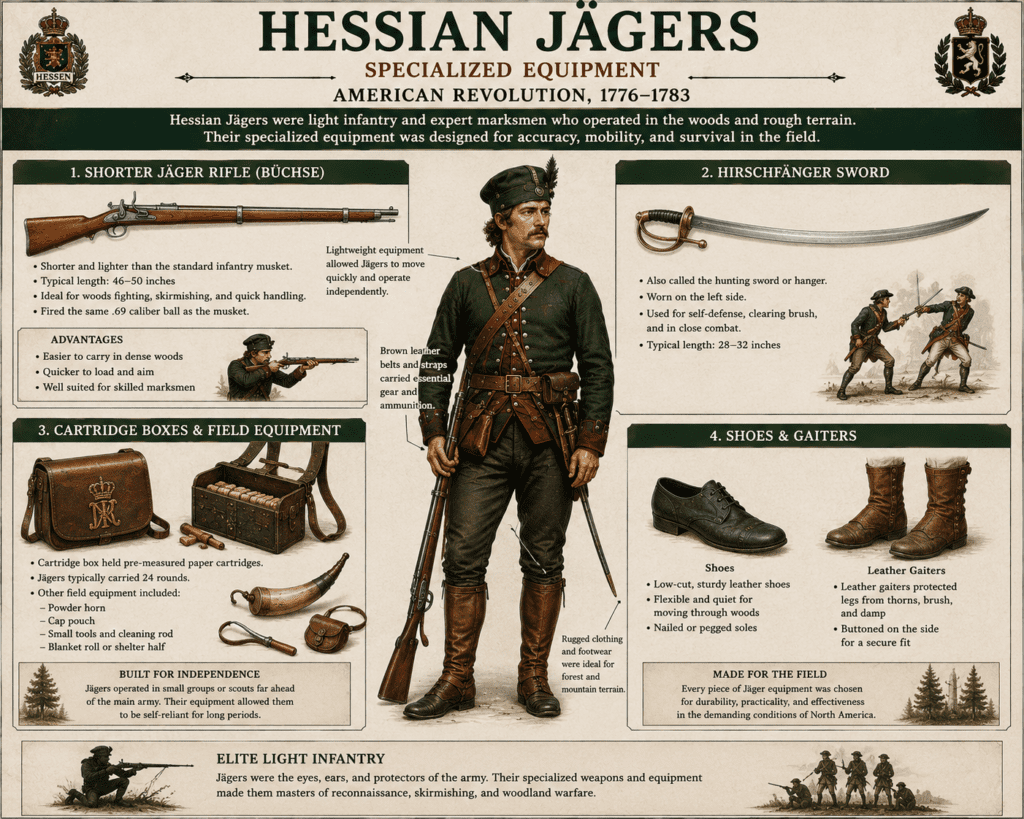
The Specialized Equipment of the Hessian Jägers
The equipment carried by the Hessian Jägers also differed significantly from standard infantry gear.
Their weapons and field equipment were chosen specifically for mobility, independent operations, and combat in rough terrain.
The Shorter Jäger Rifle
Unlike the long smoothbore muskets carried by ordinary infantry, Jägers often used shorter rifled weapons better suited for movement through forests and dense brush.
These rifles provided improved accuracy and allowed the Jägers to engage targets at greater distances.
Their reputation for deadly marksmanship quickly spread among American troops.
Hunting Swords and the Hirschfänger
Because many Jäger rifles could not easily mount standard bayonets, the soldiers often carried heavy hunting blades known as Hirschfängers.
These weapons served both as tools and close-combat weapons during fighting inside forests or swamps.
At close range, the heavy hunting dagger could become extremely deadly.
Cartridge Boxes and Field Equipment
Jägers also carried specialized cartridge boxes, powder equipment, and lightweight field gear designed for mobility.
Unlike heavily burdened line infantry, the Jägers needed to move quickly while scouting ahead of the main army.
Their equipment reflected their role as independent light infantry rather than massed battlefield troops.
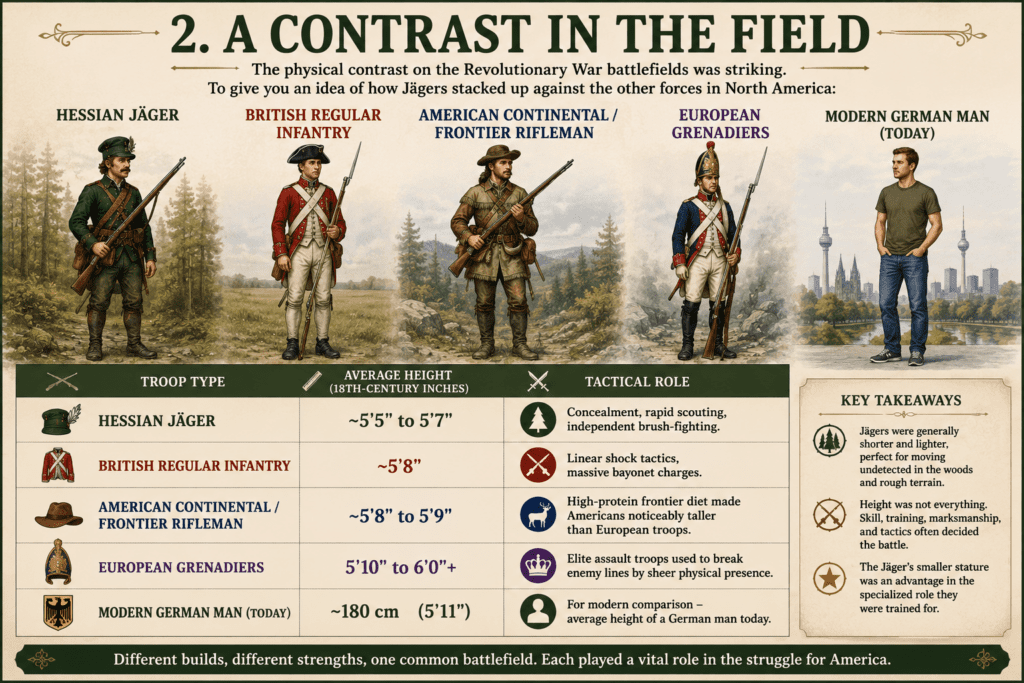
How the Hessian Jägers Fought
The battlefield role of the Jägers differed dramatically from traditional European infantry formations.
Instead of standing shoulder to shoulder in open fields, the Jägers specialized in flexible and aggressive woodland combat.
Scouting and Reconnaissance
The Jägers frequently operated ahead of the main British and Hessian forces.
They scouted roads, monitored enemy movements, and searched forests for ambushes or hidden militia forces.
British commanders often relied heavily upon the Jägers for battlefield intelligence.
Ambush and Skirmish Warfare
The Hessian Jägers excelled at ambush tactics and skirmishing.
Rather than firing massive coordinated volleys, they often fought from behind trees, fences, rocks, and natural cover.
This style of fighting shocked many traditional European officers but proved highly effective in North America.
Fighting in Rough Terrain
The forests, swamps, hills, and broken countryside of the colonies created ideal conditions for Jäger tactics.
Their ability to fight independently in difficult terrain made them some of the most adaptable troops serving the British cause during the Revolutionary War.
Elite Soldiers Ahead of Their Time
In many ways, the Hessian Jägers resembled elite light infantry or special operations troops decades before such concepts became common in modern warfare.
Their combination of camouflage, independent operations, precision shooting, and wilderness combat skills made them uniquely dangerous opponents.
The reputation built by the Hessian Jagers weapons and military tactics became one of the lasting military legacies of the American Revolution.
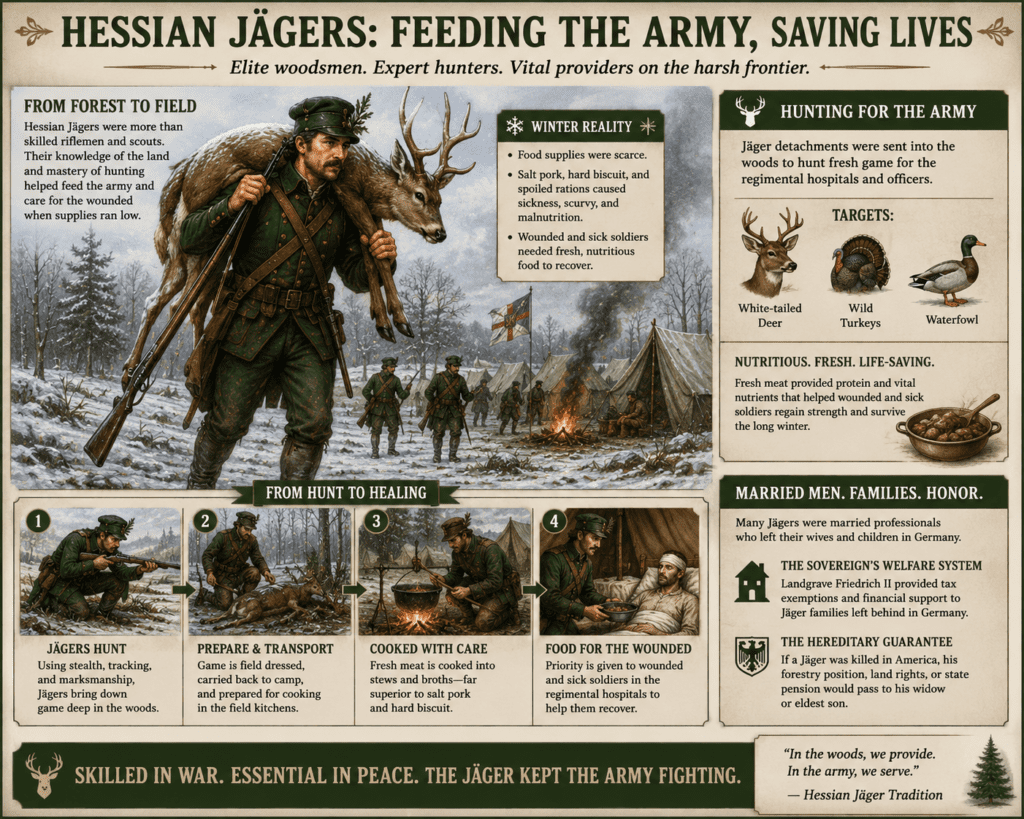
The Hessian Jägers were not simply elite riflemen and scouts. Their professional wilderness skills also made them valuable providers of food during the harsh campaigns of the American Revolution.
Because many Jägers had worked as foresters and gamekeepers before the war, they possessed advanced hunting and tracking skills that ordinary infantry soldiers simply did not have.
When Hessian and British forces entered winter quarters, food quality often deteriorated badly. Salt pork, hard biscuit, and spoiled supplies caused widespread sickness, malnutrition, and scurvy throughout the camps.
Jäger officers frequently sent small detachments into the forests specifically to hunt fresh game for wounded and sick soldiers recovering in regimental hospitals.
Targeting Venison and Fowl: Hessian Jägers hunted white-tailed deer, wild turkeys, ducks, and other game animals to provide fresh meat for weakened troops suffering from disease and poor nutrition during the winter campaigns.
Unlike many ordinary infantry soldiers, a large number of Hessian Jägers were older married men who had already established careers and families before the war.
These elite woodsmen often came from respected forestry and gamekeeping professions where hunting, land management, and wilderness survival were part of daily life.
The Sovereign’s Welfare System: When married Jägers left wives and children behind in Germany, the government of Hesse-Kassel often provided tax relief and financial support to help sustain the family during the soldier’s absence overseas.
The Hereditary Guarantee: If a Jäger died during the American Revolution, his forestry position, land rights, or pension benefits could legally transfer to his widow or eldest son, preserving the family’s place within the German forestry system.
The same wilderness skills that made the Hessian Jägers feared riflemen and scouts also helped keep parts of the British and Hessian armies alive during some of the harshest conditions of the Revolutionary War.
THE BRITISH DEPEND ON THE JÄGERS
British commanders in America quickly realized how valuable the Jägers truly were.
The British Army itself was not fully prepared for the enormous forests and frontier conditions of North America. American militia fighters and frontiersmen frequently used ambush tactics, long-range rifle fire, and irregular warfare methods unfamiliar to many European officers.
The Jägers became Britain’s ideal counter-force.
British generals constantly requested Jäger detachments for:
- reconnaissance,
- scouting,
- protecting columns,
- screening advances,
- and hunting American riflemen.
In many campaigns, the Jägers served as:
- The vanguard moving ahead of the main army,
- or the rearguard protecting retreats.
Because they could operate effectively in rough terrain while maintaining professional discipline, they became some of the most respected soldiers fighting for the British cause.
During the American Revolution, Great Britain paid enormous sums of money to the German princes who supplied troops for military service in North America.
In total, Britain distributed more than £1.77 million sterling in subsidies and levy payments directly to the German rulers who provided soldiers, including the powerful state of Hesse-Kassel.
Modern US Dollar Equivalent
~$380 million to $430 million
For Landgrave Friedrich II of Hesse-Kassel, the financial impact was staggering. The payments from Britain equaled roughly 13 years of normal national tax revenue collected almost all at once.
The massive wartime income transformed Friedrich II into one of the wealthiest rulers in Europe and allowed him to reduce domestic taxes for many civilian citizens in Hesse-Kassel by approximately one-third.
Historical Impact: The financial system behind the Hessian troop agreements reveals that the American Revolution was not only a military struggle but also a major international business and political enterprise involving European monarchies, subsidies, military contracts, and state-controlled war economies.
THEIR LEGACY
The Jägers left a permanent mark on military history.
In many ways, they represented an early transition away from rigid eighteenth-century battlefield systems toward more modern light infantry tactics emphasizing:
- mobility,
- marksmanship,
- concealment,
- initiative,
- and irregular warfare.
Ironically, many of the qualities that made the Jägers effective against the American rebels would later become standard military doctrine throughout the nineteenth century.
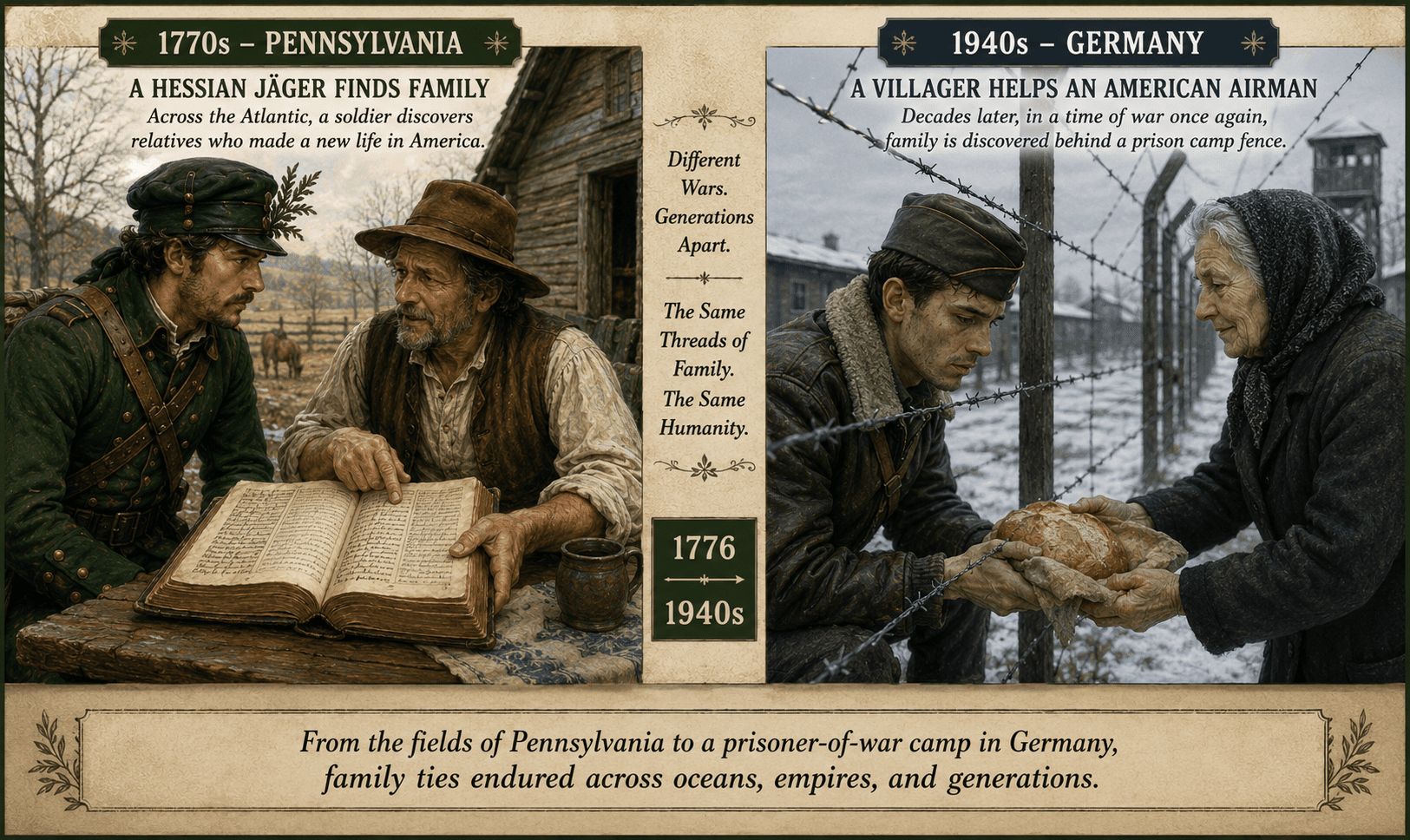
And like so many other Hessians, some Jägers eventually remained in America after the war ended.
The hunters who originally crossed the Atlantic as elite soldiers of German princes sometimes became frontiersmen, farmers, craftsmen, and settlers within the growing United States itself.
Many Hessian Jägers were not young conscripts but older, highly skilled professionals who already had established families before being sent to North America during the American Revolution.
Because the Jägers often served as foresters, gamekeepers, and estate professionals before the war, a significant number were already married with children when Landgrave Friedrich II rented the Hessian forces to Great Britain.
The dangerous Atlantic voyage and uncertainty of the war caused many married Jägers to leave their wives and children behind in the German states while they fought in America.
Landgrave Friedrich II understood that protecting the families of his elite woodsmen was essential for maintaining morale and loyalty during a conflict taking place thousands of miles away.
The Sovereign’s Welfare System: Families of deployed Jägers frequently received tax exemptions, financial assistance, and state support while their husbands served overseas in the American colonies.
The Hereditary Guarantee: If a married Jäger died in America, his forestry position, land rights, or pension benefits could legally transfer to his widow or eldest son, helping preserve the family’s long-standing connection to the German forestry system.
Some Hessian Jägers also brought wives across the Atlantic as official camp followers, while others eventually married women they met during the war in North America, permanently tying portions of the Hessian military community to the emerging United States.
Letters Home from the Hessian Jägers
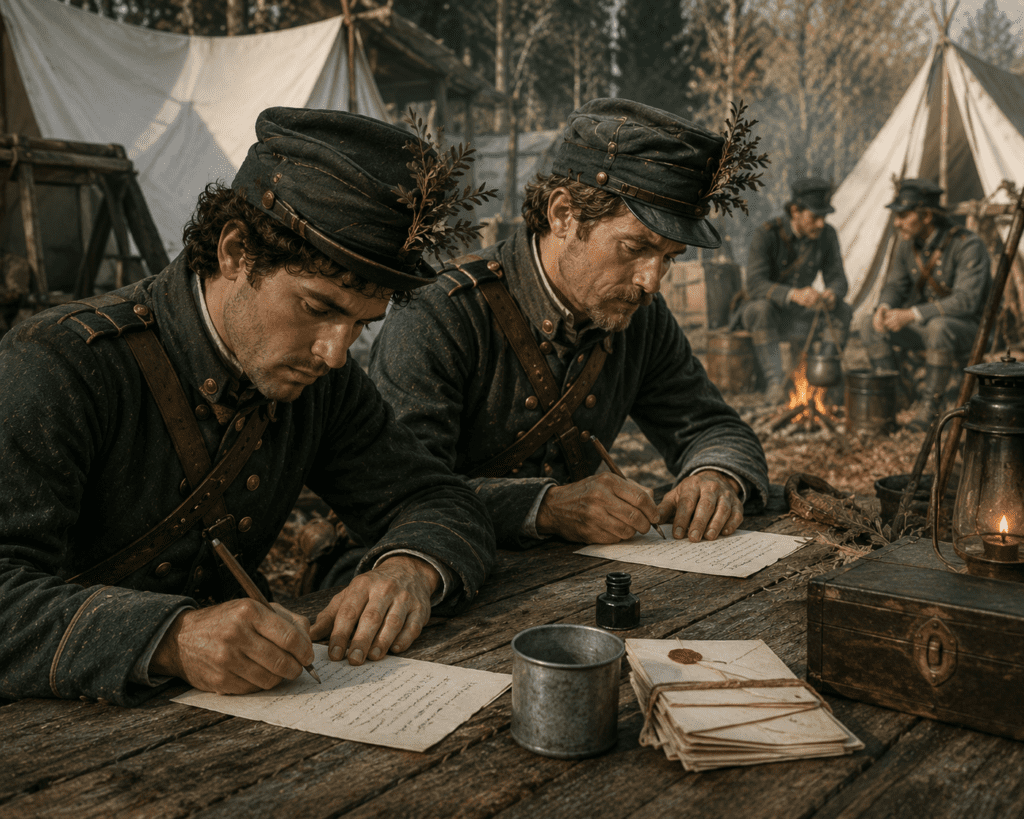
One of the most fascinating parts of the Hessian story comes directly from the surviving letters, journals, and diaries written by the Jägers themselves.
Because many Hessian Jägers came from educated forestry and professional classes, they wrote far more frequently than many ordinary 18th-century soldiers.
These writings now provide historians with some of the most vivid firsthand accounts of the American Revolution and the realities behind Hessian Jagers weapons and military tactics.
Why So Many Jäger Letters Survived
The Hessian Jägers were unusually literate for soldiers of the period.
Many had worked as foresters, gamekeepers, estate managers, or other skilled professionals before entering military service.
Published in Germany During the War
German academics and intellectuals recognized the public fascination surrounding America and the Revolutionary War.
Professor August Ludwig von Schlözer collected many of the letters and published them in German magazines during the conflict itself.
These publications allowed citizens back in Germany to follow the experiences of Hessian troops fighting across the Atlantic.
More Than Military Reports
Unlike dry official reports, the letters often contained detailed personal observations about American society, wilderness conditions, politics, food, farming, and combat.
The Jägers wrote openly about fear, exhaustion, confusion, admiration, and frustration.
Today, these writings offer an unusually human view of the Revolutionary War.
What the Hessian Jägers Thought About America
To many Hessian soldiers, America appeared both wealthy and chaotic.
The letters frequently describe amazement at the prosperity of ordinary American farmers while also expressing disbelief over the rebellion itself.
Lieutenant Johann von Hinrichs
One of the best-known Jäger officers was Lieutenant Johann von Hinrichs.
During the New York campaigns of 1776, he wrote detailed descriptions of Staten Island and Long Island that revealed both admiration and confusion.
Confusion About the Revolution
Despite admiring the land itself, many Jägers struggled to understand why Americans were rebelling against Britain.
Some compared revolutionary enthusiasm to dangerous fanaticism sweeping through society.
The contrast between prosperity and rebellion deeply puzzled many German soldiers.
The “Excess of Liberty”
Other letters focused heavily on American social customs and daily life.
Jägers commented repeatedly on the unusual freedoms and material prosperity they observed compared to Europe.
Surprised by Everyday American Life
Some Jägers remarked with astonishment that even poorer Americans often owned horses, wore clean clothing, and regularly consumed meat.
These conditions contrasted sharply with the hardships experienced by many European peasants.
Several writers also commented on seeing Black individuals moving with greater freedom in northern communities than they expected based on European social structures.
Letters from the Skirmish Line
The writings of the Hessian Jägers also provide vivid descriptions of combat in the American wilderness.
Rather than formal battlefield reports, many letters read like survival accounts from an exhausting partisan war.
Fighting in the Woods
The Jägers described the terrifying realities of woodland combat where unseen riflemen could strike from hidden positions.
They frequently wrote about crawling through dense brush, cornfields, and swamps while attempting to avoid ambushes.
Adapting “Indian-Style” Tactics
The letters repeatedly mention the adoption of what Europeans called Indian-style fighting.
Instead of rigid formations, the Jägers learned to fight from behind trees, fences, rocks, and natural cover.
This adaptation became one of the defining elements of Hessian Jagers weapons and military tactics during the American Revolution.
Growing Respect for American Soldiers
Early Hessian letters sometimes mocked American militia forces as disorganized or poorly trained.
However, by 1777 and 1778, the tone changed dramatically.
Respect for Washington’s Army
The Jägers increasingly expressed professional respect for the resilience of Continental forces under George Washington.
They also acknowledged the deadly skill of American frontier riflemen whose marksmanship created serious dangers during skirmishes.
The letters reveal how quickly the war changed German perceptions of the American fighters.
Where You Can Read the Hessian Letters Today
Several major collections now preserve these remarkable writings for modern readers and historians.
Recommended Hessian Sources
Diary of the American War: A Hessian Journal by Johann Ewald
Translated by Joseph P. Tustin, this work is considered one of the finest firsthand military accounts of the Revolutionary War.
Letters from America, 1776–1779
Often called the Schlözer Letters, this collection contains many of the original letters published in Germany during the war itself.
The Lidgerwood Collection
Housed at Morristown National Historical Park, this archive preserves translated Hessian journals, correspondence, and campaign records describing daily life during the Revolutionary War.
What the Hessian Jägers Thought About America
To many Hessian soldiers, America appeared both wealthy and chaotic.
The letters frequently describe amazement at the prosperity of ordinary American farmers while also expressing disbelief over the rebellion itself.
Lieutenant Johann von Hinrichs
One of the best-known Jäger officers was Lieutenant Johann von Hinrichs.
During the New York campaigns of 1776, he wrote detailed descriptions of Staten Island and Long Island that revealed both admiration and confusion.
Admiration for American Farms and Wealth
Hinrichs described rich farmland, orchards, grain fields, and barns overflowing with produce.
He openly admitted envy toward the prosperity enjoyed by many American colonists.
“The more I regard this land… the fine grass, the luxuriant grain and hemp, and the beautiful orchards, the more I envy the formerly happy inhabitants of this excellent land…”
Confusion About the Revolution
Despite admiring the land itself, many Jägers struggled to understand why Americans were rebelling against Britain.
Some compared revolutionary enthusiasm to dangerous fanaticism sweeping through society.
The contrast between prosperity and rebellion deeply puzzled many German soldiers.
The “Excess of Liberty”
Other letters focused heavily on American social customs and daily life.
Jägers commented repeatedly on the unusual freedoms and material prosperity they observed compared to Europe.
Surprised by Everyday American Life
Some Jägers remarked with astonishment that even poorer Americans often owned horses, wore clean clothing, and regularly consumed meat.
These conditions contrasted sharply with the hardships experienced by many European peasants.
Several writers also commented on seeing Black individuals moving with greater freedom in northern communities than they expected based on European social structures.
The Great Jäger Journals
In addition to letters, several Hessian officers kept extensive personal journals documenting the war in remarkable detail.
These diaries became some of the most valuable firsthand historical sources from the Revolutionary War.
Captain Johann Ewald
The most famous of these writers was Captain Johann Ewald of the Hessian Field Jäger Corps.
His work, Diary of the American War: A Hessian Journal, remains one of the most important primary accounts of the entire conflict.
From Arrogance to Respect
Ewald’s writings trace his personal transformation throughout the war.
At first, he viewed the conflict through the perspective of a highly confident European professional officer.
Over time, his journal reveals growing admiration for American persistence, patriotism, and military adaptability.
Understanding Why Britain Could Not Win
Ewald also wrote openly about the impossible nature of counter-insurgency warfare in America.
He explained that whenever British troops marched away from an area, local resistance quickly returned.
“Each step cost human blood.”
Personal Relationships in America
Ewald’s surviving papers even include love letters written to an American woman named Jeannette Van Horne.
These personal writings demonstrate how deeply some Hessian soldiers became connected to American society during the war.
Where You Can Read the Hessian Letters Today
Several major collections now preserve these remarkable writings for modern readers and historians.
Recommended Hessian Sources
Diary of the American War: A Hessian Journal by Johann Ewald
Translated by Joseph P. Tustin, this work is considered one of the finest firsthand military accounts of the Revolutionary War.
Letters from America, 1776–1779
Often called the Schlözer Letters, this collection contains many of the original letters published in Germany during the war itself.
The Lidgerwood Collection
Housed at Morristown National Historical Park, this archive preserves translated Hessian journals, correspondence, and campaign records describing daily life during the Revolutionary War.
Continue Exploring the Complete Hessian Series
The Hessian Jägers were only one part of the much larger story surrounding the German soldiers who fought during the American Revolution.
This article is the third installment in the 10-part series, Hessians in the American Revolution: The German Soldiers Who Helped Shape America, examining the battlefield role, rifles, uniforms, scouting methods, and wilderness combat skills that made the Jägers some of the most feared troops in North America.
Throughout this article, we explored the evolution of Hessian Jagers weapons and military tactics, including their deadly rifle warfare, skirmishing methods, psychological impact, personal letters home, and their long-term legacy after the war ended.
Explore the Entire Hessian Series
At the bottom of this article, you will find the complete directory listing for all 10 Hessian articles along with links to related Revolutionary War features included in the larger RetireCoast 250th Anniversary Series.
The full series explores:
- who the Hessians were,
- the battles of Trenton and Saratoga,
- camp followers,
- weapons and uniforms,
- battlefield tactics,
- daily military life,
- and the lasting impact the Hessians had on both America and Germany.
Continue to the full listing below to explore the rest of the Hessian series and the broader 250th Anniversary historical collection on RetireCoast.
- A) Soldier
- B) Hunter
- C) Scout
- D) Grenadier
Answer
B) Hunter
- A) They were mostly sailors
- B) They specialized in artillery only
- C) They were trained woodsmen, foresters, and expert marksmen
- D) They fought only in cities
Answer
C) They were trained woodsmen, foresters, and expert marksmen
- A) Bright red
- B) White
- C) Blue
- D) Dark green
Answer
D) Dark green
- A) It fired explosive ammunition
- B) It was highly accurate at longer distances
- C) It could fire faster than muskets
- D) It mounted two bayonets
Answer
B) It was highly accurate at longer distances
- A) Cutlass
- B) Saber
- C) Hirschfänger
- D) Claymore
Answer
C) Hirschfänger
- A) Naval gunners
- B) Siege engineers
- C) Woodland scouts and skirmishers
- D) Cavalry lancers
Answer
C) Woodland scouts and skirmishers
- A) Merchants
- B) Blacksmiths
- C) Farmers
- D) Foresters and gamekeepers
Answer
D) Foresters and gamekeepers
- A) Solid shot
- B) Chain shot
- C) Canister shot
- D) Heated shot
Answer
C) Canister shot
- A) 5%
- B) 10%
- C) 30% to 40%
- D) 75%
Answer
C) 30% to 40%
- A) Johann Ewald
- B) Friedrich von Steuben
- C) Johann Rall
- D) Wilhelm Knyphausen
Answer
A) Johann Ewald
9–10 Correct: You would have made an excellent scout for the Hessian Jägers.
7–8 Correct: Strong battlefield knowledge of Hessian military history.
5–6 Correct: You understand the basics of Hessian Jägers and their tactics.
0–4 Correct: Time to return to the forests and study the Jägers again!
What were Hessian Jägers?
Hessian Jägers were elite German light infantry soldiers who served with British forces during the American Revolution. Many were experienced foresters, gamekeepers, and hunters before becoming soldiers.
Why were Hessian Jägers feared?
They were feared because they were skilled marksmen, scouts, and woodland fighters. Their rifles, green uniforms, and ability to fight independently made them dangerous in forests, swamps, and rough terrain.
What weapons did Hessian Jägers use?
Hessian Jägers often carried shorter rifled weapons called Büchsen, along with cartridge boxes, field equipment, and a heavy hunting sword or dagger known as a Hirschfänger.
How were Jägers different from ordinary Hessian infantry?
Ordinary Hessian infantry fought in traditional line formations with smoothbore muskets and bayonets. Jägers operated as light infantry, using rifles, concealment, scouting, skirmishing, and independent woodland tactics.
Why did Hessian Jägers wear green uniforms?
Their dark green uniforms helped them blend into wooded terrain. This reflected their origins as hunters and foresters and made them better suited for reconnaissance and ambush tactics.
Did Hessian Jägers fight American riflemen?
Yes. Hessian Jägers often faced American frontier riflemen, including units known for long-range shooting. This created a deadly contest between German rifle traditions and the American long rifle.
Did Hessian Jägers help feed the army?
Yes. Because many Jägers were skilled hunters, they sometimes hunted deer, wild turkeys, and waterfowl to provide fresh meat for sick and wounded soldiers during harsh winter conditions.
Did any Hessian Jägers stay in America after the war?
Yes. Many German soldiers chose not to return home after the Revolutionary War. Some former Jägers used their wilderness skills to settle, farm, hunt, and build new lives in North America.
The RetireCoast Hessians in the American Revolution series draws from battlefield organizations, museum resources, genealogy collections, military archives, and historical research focused on German soldiers, prisoners, settlers, and families connected to the Revolutionary War.
- FamilySearch — Hessian Soldiers
- Franklin & Marshall College Archives — Johannes Schwalm Historical Association Collection
- FamilySearch Catalog — Journal of the Johannes Schwalm Historical Association
- Journal of the American Revolution — The Hessians: Journal of the Johannes Schwalm Historical Association
The Complete RetireCoast Historical Series
This series about the Hessians in the American Revolution is just one part of the much larger RetireCoast 250th Anniversary historical project celebrating the birth of the United States.
We invite you to continue exploring our growing collection of Revolutionary War articles covering battles, weapons, ships, camp followers, frontier life, hidden history, and the people who shaped the American story.
Discover more from RetireCoast.com
Subscribe to get the latest posts sent to your email.