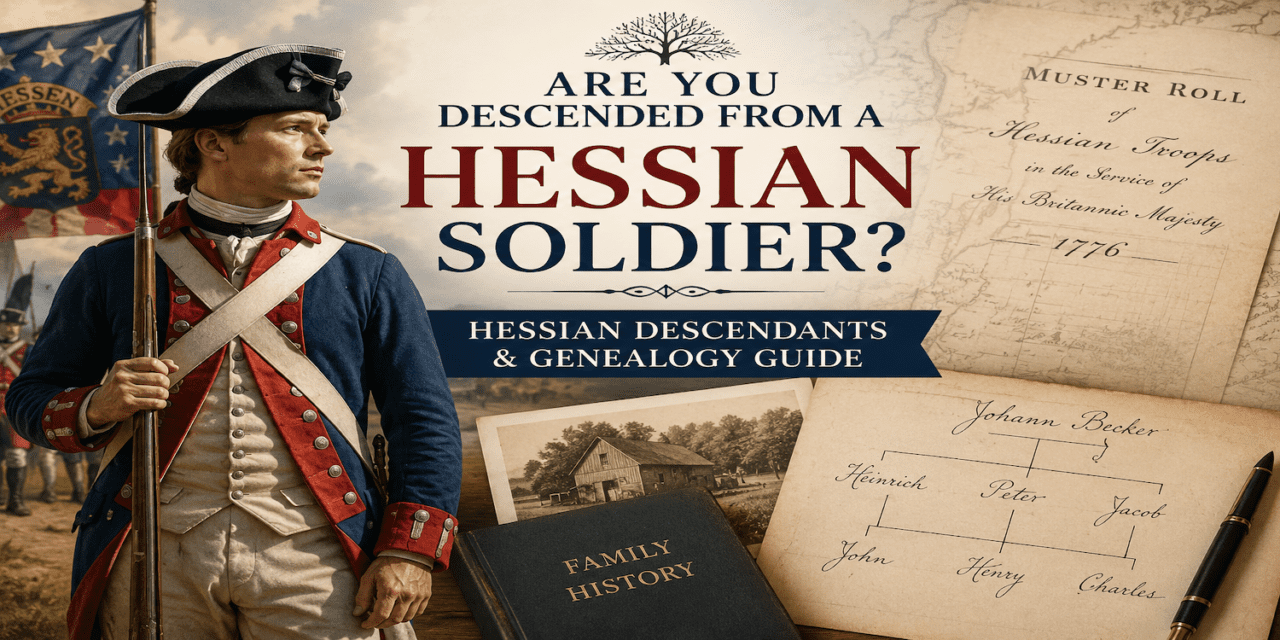
Are You Descended From a Hessian Soldier?
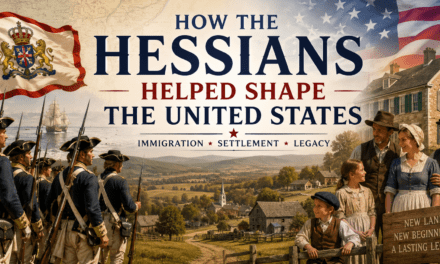
More than 30,000 Hessian soldiers and other German soldiers arrived in North America during the American Revolution. Hired by Great Britain to help suppress the rebellion, these troops fought in some of the most important campaigns of the war.
While many Hessian soldiers returned to Germany after the conflict ended, thousands remained behind. Some settled as farmers, craftsmen, laborers, and merchants, becoming part of the growing American population.
Today, many Americans may be descended from Hessian soldiers without even realizing it. In fact, the subject of Hessian descendants genealogy has become increasingly popular as more people explore their family histories.
The Hessians Who Never Went Home
The American Revolution changed countless lives, including those of the German soldiers sent across the Atlantic. What began as a military assignment often became a permanent relocation.
Some Hessians were captured and held as prisoners of war. Others deserted the British Army and disappeared into German-speaking communities throughout Pennsylvania, New York, Maryland, Virginia, and beyond.
Many discovered that America offered opportunities unavailable in the small German states from which they came.
[hessian_quiz-8]
- Are You Descended From a Hessian Soldier?
- Tracing Hessian Ancestry Today
- What This Article Will Explore
- Part of the Hessian Series and America 250
- Why Many Hessian Soldiers Arrived With Valuable Trade Skills
- The German Apprenticeship System
- Family Names Often Reflected Occupations
- Why These Skills Helped Hessians Stay in America
- From Soldiers to Settlers
- How Many Americans Are Descended From Hessian Soldiers?
- Could You Be Descended From a Hessian Soldier?
- Understanding the Math of Genealogy
- Why the Numbers Grow So Quickly
- What One Hessian Soldier Could Become
- One Soldier, Thousands of Descendants
- Extending the Calculation to All Hessian Settlers
- The Reality of Family Overlap
- The Adjusted Estimate
- The Verdict
- Where Did the Hessians and Their Descendants Settle?
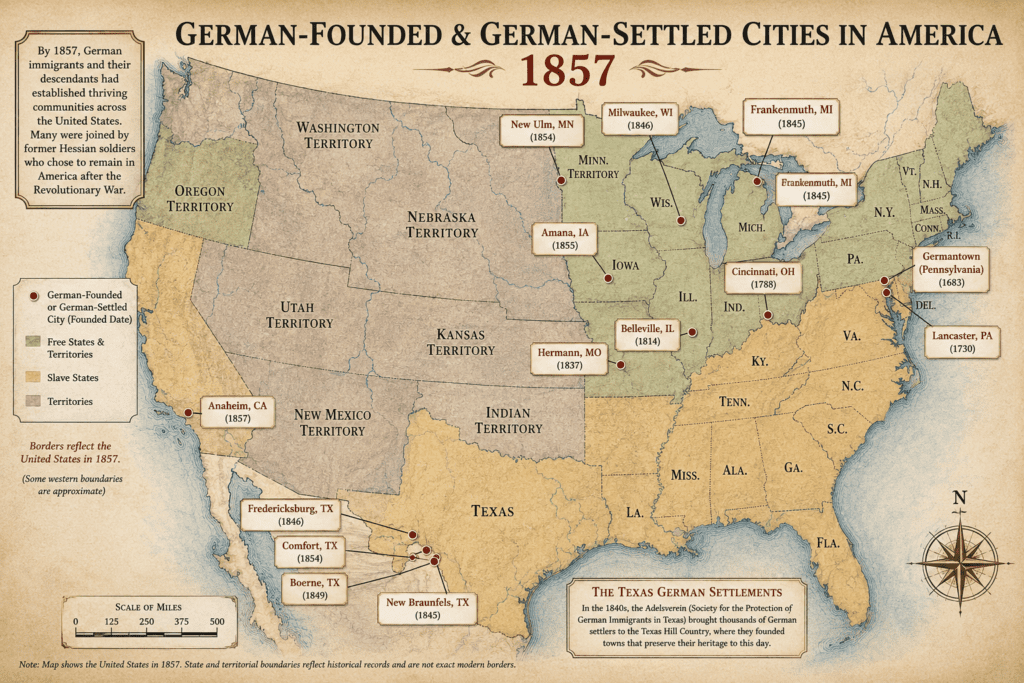
- Entire Towns Reflected German Heritage
- A Clue for Genealogy Researchers
- How Hessian Descendants Became Americans
- Preserving German Traditions
- Why Hessian Ancestry Was Often Forgotten
- Rediscovering Hessian Roots
- Major American Cities and Towns Built by German Settlers
- The German Communities of Texas
- Why These Communities Matter to Hessian Descendants
- How to Determine If You Are Descended From a Hessian Soldier
- Search for German-Speaking Communities
- Examine Family Surnames Carefully
- Church Records Are Often the Key
- Military Records May Reveal the Answer
- DNA Testing Can Provide Additional Clues
- A Surprising Discovery Awaits Many Families
- Using DNA and Online Genealogy Tools to Find Hessian Ancestors
- Ancestry.com
- FamilySearch and the Mormon Church
- DNA Testing Options
- What DNA Can and Cannot Tell You
- A Practical Research Strategy
- The Reward of Discovery
- Famous Americans Who May Have Hessian Ancestry
- President Dwight D. Eisenhower
- The Reality for Most Descendants
- Your Family Story May Be More Interesting Than Any Famous Name
- German-Americans Who Helped Build Modern America
- Babe Ruth: The Sultan of Swat
- William Boeing: Building the Aerospace Industry
- Walter Chrysler: Revolutionizing Transportation
- John D. Rockefeller: The Wealthiest American?
- The Astor Family: Builders of New York
- Henry Villard: Railroad and Industrial Titan
- German-Americans and the Gilded Age
- A Legacy Far Beyond the Battlefield
- The Legacy of the Hessians in America
- The Growth of German America
- The Communities They Built
- The Hessians and the American Melting Pot
- Why Hessian History Matters Today
- The Final Verdict
- Conclusion: Could a Hessian Soldier Be in Your Family Tree?
- More Than a Military Story
- Your Family May Hold the Answer
Why Hessian Soldiers Chose America
For many Hessian soldiers, returning home meant returning to crowded villages, limited economic opportunity, and rigid social systems. America offered something different.
Land Ownership
One of the greatest attractions was land. In many parts of the United States, a former Hessian soldier could eventually own property that would have been beyond his reach in Europe.
Economic Opportunity
German soldiers also found work as craftsmen, blacksmiths, carpenters, millers, and farmers. Their military service often provided skills that translated well into civilian life.
Marriage and Family
Many Hessians married local women and started families. Within a generation, these former German soldiers had become American citizens in everything but name.
Tracing Hessian Ancestry Today
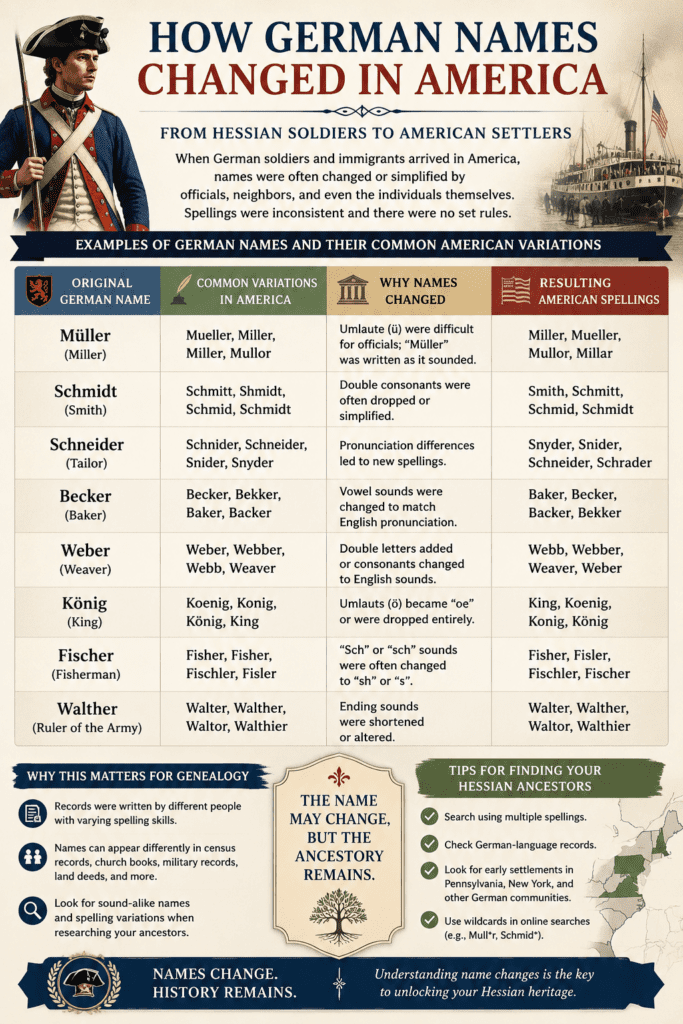
One challenge for descendants is that many German names changed over time. Family names were frequently anglicized, shortened, or altered by local officials and census takers.
As a result, a family that began with a Hessian soldier may not appear obviously German today. This is one reason why Hessian descendants genealogy often requires patience, historical records, and careful research.
Common Clues
Researchers often find clues in:
- Family stories about a German ancestor
- Early settlements in Pennsylvania or New York
- Revolutionary War-era immigration records
- Church records written in German
- Unusual surname spellings
Many Hessian descendants discover their connection only after extensive genealogy research.
What This Article Will Explore
In this chapter, we examine what happened to Hessian soldiers after the American Revolution. We will follow their journey from prisoners and deserters to settlers, business owners, community leaders, and ancestors of modern Americans.
You will learn where Hessians settled, how they integrated into American society, and how to determine whether your own family tree may contain a Hessian ancestor.
Readers interested in Hessian descendants genealogy will also discover practical research methods, historical records, and DNA resources that can help uncover possible Hessian connections.
Part of the Hessian Series and America 250
This article is Chapter 8 of our 10-part series on the Hessians and their role in the American Revolution. Throughout the series, we explore the recruitment of Hessian soldiers, their battles, camp life, military tactics, relationships with Native Americans, and their eventual assimilation into American society.
The Hessian series is also part of RetireCoast.com’s larger America 250 project commemorating the 250th anniversary of the Declaration of Independence. At the end of this article, you will find links to both the complete Hessian series and the broader America 250 collection.
Whether you are researching your own family tree or simply interested in Revolutionary War history, this guide to Hessian descendants genealogy will help you understand how a few thousand former Hessian soldiers left a legacy that may still be present in millions of American families today.
This is part of the 250th project commemorating the 250th anniversary of the Declaration of Independence. At the end of this article, you will find links to both the complete Hessian series and the broader America 250 collection, allowing you to continue exploring the people and events that shaped the United States.
Why Many Hessian Soldiers Arrived With Valuable Trade Skills
One reason so many former Hessian soldiers successfully integrated into American society was that they arrived with practical skills that were in high demand. Unlike many modern armies, the Hessian regiments contained men who had already spent years learning a trade before entering military service.
In the German states of the 1700s, children often began preparing for a profession at an early age. A young boy might work alongside his father, uncle, or a local craftsman, learning skills that would eventually support him and his family.
For researchers involved in Hessian descendants genealogy, these trades and occupations often provide important clues about family origins and migration patterns.
The German Apprenticeship System
What we call an internship today was far more formal in eighteenth-century Germany. Young men commonly entered an apprenticeship under a master craftsman and spent years learning a specific trade.
A future blacksmith learned to forge iron. A future carpenter learned how to build homes, barns, wagons, and furniture.
Bakers, millers, shoemakers, weavers, and masons all followed similar paths. The system produced highly skilled workers who could often perform their trade anywhere they found work.
Family Names Often Reflected Occupations
Many German surnames originated from occupations that had been practiced by a family for generations. These names frequently provide clues for modern genealogy researchers attempting to trace Hessian ancestry.
Understanding these occupational surnames is often an important part of Hessian descendants genealogy, especially when family records are incomplete.
Common Occupational Names Found Among Hessian Soldiers
Becker
The name Becker generally referred to a baker. A Becker family likely had ancestors who operated a bakery or produced bread for their local community.
Müller
The name Müller referred to a miller, someone who operated a grain mill. Because flour was essential to everyday life, millers often held important positions within their villages.
Schmidt
The name Schmidt meant blacksmith. These craftsmen manufactured and repaired tools, horseshoes, wagon parts, and farming equipment.
Schneider
The name Schneider meant tailor. Tailors produced and repaired clothing, uniforms, and other fabric goods.
Weber
The name Weber referred to a weaver, a skilled craftsman who produced cloth and textiles.
Fischer
The name Fischer identified a fisherman. While less common inland, fishing families were often well known in river and coastal communities.
Why These Skills Helped Hessians Stay in America
When the American Revolution ended, a former Hessian soldier did not necessarily need military work to survive. Many already possessed valuable civilian skills.
A carpenter could help build homes on the frontier. A blacksmith could establish a shop in a growing town.
A miller, baker, tailor, or wagon maker could often find customers almost immediately.
In many areas of colonial America and the early United States, skilled craftsmen were in short supply. Communities welcomed men who could build, repair, manufacture, and teach others.
From Soldiers to Settlers
This helps explain why so many Hessian soldiers chose to remain in America. They arrived not only as trained military professionals but also as trained craftsmen, laborers, and tradesmen.
Many former Hessians became respected members of their communities. Their workshops, farms, businesses, and families helped lay the foundation for future generations of Hessian descendants throughout the United States.
For modern genealogy researchers, understanding these occupational surnames can provide an important clue when tracing Hessian family history. A family name such as Becker, Müller, Schmidt, Schneider, Weber, or Fischer may represent more than a surname—it may preserve the story of the trade that sustained a Hessian ancestor centuries ago.
Researchers studying Hessian descendants genealogy often discover that occupational surnames provide some of the strongest evidence connecting modern families to their German roots.
How Many Americans Are Descended From Hessian Soldiers?
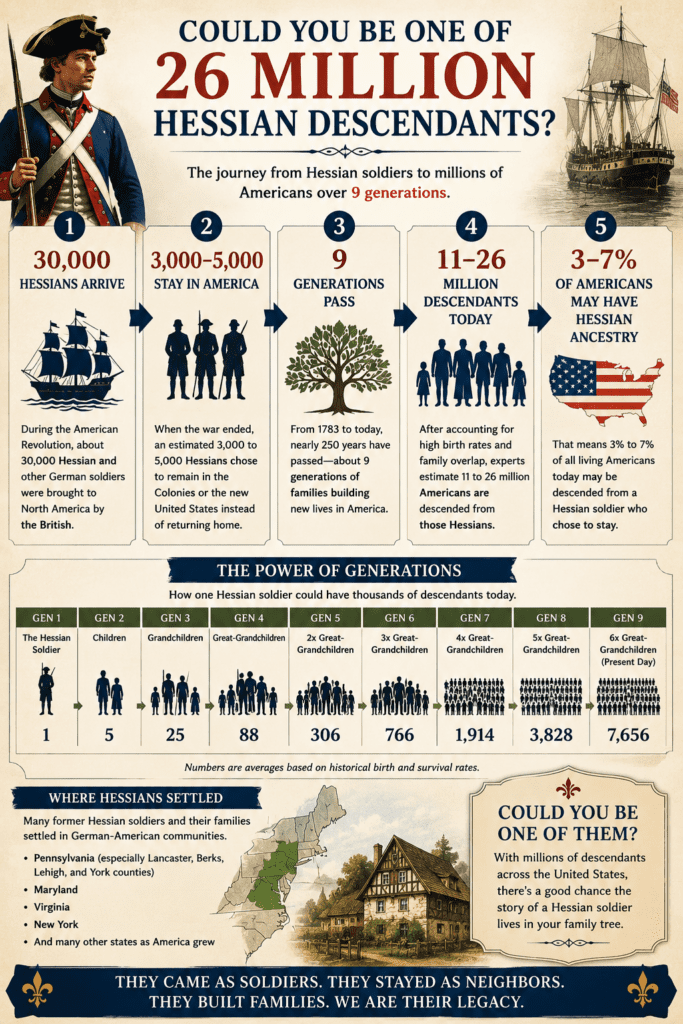
Historians estimate that between 3,000 and 5,000 Hessian soldiers chose to remain in America after the Revolutionary War rather than return to the German-speaking principalities of Europe.
Some married local women. Others settled within existing German-American communities in Pennsylvania, Maryland, Virginia, and New York.
Over the next 243 years, those decisions would ripple across generations.
Could You Be Descended From a Hessian Soldier?
Many Americans assume that if they have Hessian ancestry, they would know it. In reality, family stories are often lost, surnames change, and records disappear.
The sheer number of descendants produced by a relatively small group of Hessian soldiers may surprise you. This reality is one reason Hessian descendants genealogy has become such a popular area of research among family historians.
Understanding the Math of Genealogy
Genealogists generally estimate a generation to span about 25 to 30 years. From the end of the Revolutionary War in 1783 until today, roughly nine generations have passed.
The Generational Timeline
Generation 1 – The Hessian Soldiers
Born approximately 1750–1760 and settled in America after the war.
Generation 2 – Children
Born approximately 1785–1810.
Generation 3 – Grandchildren
Born approximately 1815–1840.
Generation 4 – Great-Grandchildren
Born approximately 1845–1870.
Generation 5
Born approximately 1875–1900.
Generation 6
Born approximately 1905–1930.
Generation 7
Born approximately 1935–1960.
Generation 8
Born approximately 1965–1990.
Generation 9 – Modern Descendants
Born approximately 1995–2025.
Why the Numbers Grow So Quickly
Early American families were much larger than modern families. In rural farming communities, large families were often considered an economic necessity.
While child mortality rates were higher than today, surviving children frequently raised large families of their own.
Average Surviving Children Per Family
Late 1700s to Early 1800s
The average family often produced seven or eight children. After accounting for infant mortality and childhood disease, approximately five children survived to adulthood and had families of their own.
Mid-1800s
As towns and cities grew, family sizes gradually became smaller. The average number of surviving children dropped to roughly 3.5 per family.
Early to Mid-1900s
Despite the Great Depression and two world wars, families continued to grow. Average surviving family size remained near 2.5 children.
Late 1900s to Today
Modern family sizes approached replacement levels, averaging approximately two children per family.
What One Hessian Soldier Could Become
If a single Hessian soldier settled in America in 1783 and his descendants followed typical American family patterns, the growth becomes remarkable.
By the second generation, he could have five children.
By the third generation, roughly twenty-five grandchildren.
By the fifth generation, the family tree could exceed 300 descendants.
By the seventh generation, more than 1,900 descendants.
By the ninth generation, the total could approach 7,600 living descendants.
One Soldier, Thousands of Descendants
The key point is not the exact number. The key point is that family trees expand exponentially.
A single Hessian soldier who remained in America could realistically have thousands of living descendants today. This extraordinary growth is one of the reasons Hessian descendants genealogy continues to attract researchers across the United States.
Extending the Calculation to All Hessian Settlers
Now consider the broader picture.
If between 3,000 and 5,000 Hessian soldiers remained in America, and each ultimately produced thousands of descendants, the numbers become enormous.
A simple mathematical projection produces a range of approximately 23 million to 38 million descendants.
The Reality of Family Overlap
Genealogy is never that simple.
Many Hessian soldiers settled within concentrated German communities. Their children, grandchildren, and great-grandchildren frequently married descendants of other Hessian soldiers.
This phenomenon is known as pedigree collapse.
When two descendants of Hessian soldiers marry, their children inherit both family lines, reducing the total number of unique descendants.
Understanding these overlapping family trees is an important aspect of modern Hessian descendants genealogy research.
The Adjusted Estimate
Demographers and genetic genealogists often apply a reduction factor to account for overlapping family trees.
After adjusting for intermarriage and overlapping ancestry, a more realistic estimate emerges.
Conservative Estimate
If 3,000 Hessian soldiers remained and family overlap was significant, the number of living descendants today could exceed 11 million people.
Upper Estimate
If 5,000 soldiers remained and their descendants spread more broadly across America, the number could exceed 26 million people.
The Verdict
The evidence suggests that somewhere between 11 million and 26 million Americans may be descended from Hessian soldiers who remained in America after the Revolutionary War.
That represents approximately 3% to 7% of the current United States population.
The next time you encounter a German surname in your family tree—or discover ancestors living in eighteenth-century Pennsylvania, Maryland, Virginia, or New York—it may be worth looking a little deeper.
There is a surprisingly good chance that one of those former Hessian soldiers, standing on American soil more than two centuries ago, became part of your family’s story. For many readers, the journey into Hessian descendants genealogymay reveal that the history of the Hessians is also the history of their own family.
Where Did the Hessians and Their Descendants Settle?
The Hessian soldiers who remained in America did not simply disappear into the population. Instead, many settled in growing German-speaking communities where they could find familiar customs, language, religion, and opportunities.
Over time, Hessian descendants spread across the continent. They helped build farms, businesses, churches, schools, and entire towns that reflected their German heritage.
The Birth of German America
German-speaking immigrants had already established communities in North America long before the American Revolution. The arrival of former Hessian soldiers added thousands of new settlers to these growing populations.
For many Hessians, settling among fellow German speakers made practical sense. They could communicate easily, attend German-language churches, and continue many of the traditions they had brought from Europe.
German Was Often the Dominant Language
In many communities during the late eighteenth and early nineteenth centuries, German was heard more often than English. Church services, business transactions, newspapers, and community meetings were frequently conducted entirely in German.
Children often learned German at home and English only when necessary. In some areas, visitors could travel for days through German settlements without hearing much English spoken.
German Newspapers and Publishing
The growth of these communities created demand for German-language newspapers. Publishers printed local news, political commentary, business advertisements, and announcements entirely in German.
For many immigrant families and former Hessian soldiers, these newspapers served as an important connection to both their heritage and their new homeland.
German Churches and Schools
German-language churches became the center of community life. Lutheran, Reformed, Moravian, Mennonite, and other congregations helped preserve traditions for generations.
Many communities also established schools where children learned to read and write in German before English became dominant.
Entire Towns Reflected German Heritage
As German-speaking populations expanded, entire towns developed a distinctly German character. Streets, businesses, churches, and neighborhoods often carried German names.
Even today, many American communities preserve visible reminders of their German roots.
Pennsylvania: The Heart of German America
Pennsylvania became one of the most important centers of German settlement in North America. Communities around Lancaster, Berks, York, Lehigh, and surrounding counties became home to large populations of German-speaking settlers.
Many former Hessian soldiers and their descendants eventually settled within these communities, blending into a population that shared their language and customs.
Moving Westward
As America expanded, German families—including Hessian descendants—followed the frontier west.
Large German populations eventually helped shape communities in Ohio, Illinois, Missouri, Wisconsin, Iowa, Minnesota, Michigan, and Texas.
Some towns were intentionally founded as German settlements where language, architecture, farming methods, and traditions could be preserved for future generations.
Familiar Names Across America
Today, communities such as Germantown, Hermann, New Ulm, Frankenmuth, Fredericksburg, New Braunfels, and countless others still reflect their German origins.
Many retain German festivals, historic buildings, family names, churches, and cultural traditions that connect directly to the immigrants who settled there generations ago.
A Clue for Genealogy Researchers
If your ancestors lived in one of these historic German communities, it does not prove Hessian ancestry. However, it may provide an important clue.
Former Hessian soldiers often settled where German was spoken, where German churches existed, and where fellow German immigrants had already established thriving communities.
For that reason, discovering ancestors in Pennsylvania Dutch country, the Ohio River Valley, the Missouri River settlements, the Texas Hill Country, or other historic German enclaves can be an important step in researching Hessian genealogy.
The Legacy Lives On
By the middle of the nineteenth century, German-Americans had become one of the largest ethnic groups in the United States. Their influence could be seen in farming, industry, education, religion, architecture, politics, and business.
Many Hessian descendants became so thoroughly integrated into American society that their military origins were forgotten. Yet the towns they helped build, the churches they attended, the newspapers they read, and the families they created remain part of the American landscape today.
author reflection hessians 8
How Hessian Descendants Became Americans
The descendants of Hessian soldiers did not remain isolated from the rest of the population. Over time, they became farmers, merchants, craftsmen, soldiers, teachers, politicians, and business owners who helped build the United States.
Yet for many decades, they remained unmistakably German.
Living in Two Worlds
The first generations born after the Revolutionary War often lived in communities where German was the primary language. They attended German churches, read German newspapers, and conducted business with other German-speaking families.
At the same time, they were becoming Americans.
Their children were born under the American flag. They voted in American elections, served in American militias, and participated in the growth of the young republic.
German Was the Language of Home
In many German-American communities, English was a second language for several generations.
Family records, church books, marriage certificates, and gravestones were frequently written in German. Parents taught German to their children, and many communities operated German-language schools.
Some immigrants who arrived in America during the early nineteenth century could spend most of their lives speaking very little English.
German Newspapers Flourished
German-language newspapers appeared throughout Pennsylvania, Ohio, Illinois, Missouri, Wisconsin, Texas, and other states.
These publications carried local news, political debates, advertisements, and announcements that connected German-American communities across the growing nation.
By the late nineteenth century, hundreds of German-language newspapers were being published throughout the United States.
Preserving German Traditions
Former Hessian families often retained customs that had been passed down for generations.
Traditional foods, holiday celebrations, music, craftsmanship, and religious practices continued long after the Revolutionary War ended.
Many descendants may not realize that family recipes, Christmas traditions, and even certain sayings have roots that stretch back to eighteenth-century Germany.
German Churches Became Community Centers
The church often served as the center of German-American life.
Lutheran, Reformed, Moravian, Mennonite, and Catholic congregations provided more than religious services. They hosted schools, community events, social gatherings, and mutual aid programs.
Church records remain among the most valuable resources for tracing Hessian genealogy today.
The Civil War Accelerated Assimilation
One of the major turning points for many German-American families came during the Civil War.
Thousands of German-Americans fought for the Union. Military service brought families into closer contact with English-speaking Americans and accelerated assimilation into mainstream society.
By the end of the nineteenth century, many descendants of Hessian soldiers identified themselves first as Americans and second as Germans.
Why Hessian Ancestry Was Often Forgotten
As generations passed, memories faded.
A Hessian soldier who arrived in America in 1776 became a grandfather, then a great-grandfather, and eventually a distant ancestor whose story was rarely discussed.
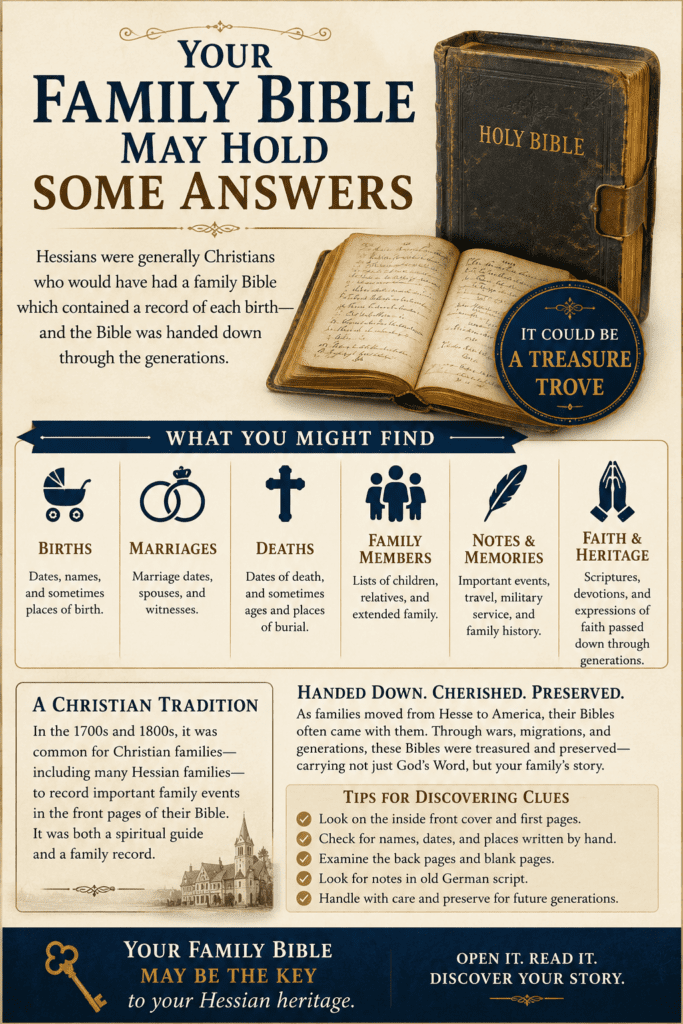
Family Bibles disappeared. Oral histories were lost. Names changed spellings. German-language documents became unreadable to descendants who no longer spoke German.
The Great Name Transformation
Many families gradually altered their surnames.
A Müller family became Miller.
A Schneider family became Snyder.
A Schmidt family became Smith or Schmitt.
A Becker family sometimes became Baker.
After several generations, descendants often had no obvious clue that their ancestors had once come from the German principalities that supplied Hessian soldiers to Britain.
Rediscovering Hessian Roots
Modern genealogy has changed everything.
Digitized church records, military records, immigration documents, census records, and DNA testing now allow researchers to uncover connections that were hidden for generations.
Many Americans are discovering that an ancestor they assumed was simply “German” was actually a former Hessian soldier who chose to remain in America after the Revolutionary War.
For some families, that discovery reveals an entirely new chapter of their history—one that began with a young German soldier crossing the Atlantic nearly 250 years ago.
Major American Cities and Towns Built by German Settlers
As former Hessian soldiers and later waves of German immigrants spread across the United States, they helped create some of America’s most successful communities.
Many of these settlements began as distinctly German towns. Residents spoke German, attended German churches, read German-language newspapers, and maintained traditions brought from Europe.
Some of these communities still celebrate their German heritage today.
Germantown, Pennsylvania
Founded in 1683, Germantown became the first permanent German settlement in colonial America.
Long before the Revolutionary War, German-speaking families had established businesses, churches, schools, and farms in the area. Former Hessian soldiers who remained in America often found familiar language and customs within communities such as Germantown.
Lancaster, Pennsylvania
Lancaster became one of the most important centers of German-American life.
By the Revolutionary War era, German-speaking farmers, craftsmen, and merchants dominated much of the surrounding region. Today, many genealogy researchers begin their search for Hessian descendants in Lancaster County.
Cincinnati, Ohio
German immigrants transformed Cincinnati into one of the largest German cities in America.
The famous Over-the-Rhine district was named after Germany’s Rhine River and became a center of German culture, brewing, manufacturing, and commerce.
Belleville, Illinois
Belleville became a major destination for educated German immigrants during the nineteenth century.
German-speaking settlers helped establish schools, cultural organizations, businesses, and civic institutions that shaped the city for generations.
Hermann, Missouri
Founded in 1837 by the German Settlement Society of Philadelphia, Hermann was intentionally created as a German community.
Settlers selected the area because its rolling hills reminded them of the Rhine Valley. German architecture, wineries, and cultural traditions remain visible today.
Milwaukee, Wisconsin
By the late nineteenth century, Milwaukee was often called the “German Athens of America.”
German immigrants shaped the city’s government, economy, newspapers, schools, and brewing industry. German was commonly spoken throughout the city for decades.
New Ulm, Minnesota
Founded in 1854, New Ulm was specifically planned as a German settlement.
The community preserved German customs, language, music, architecture, and festivals while helping open the American frontier.
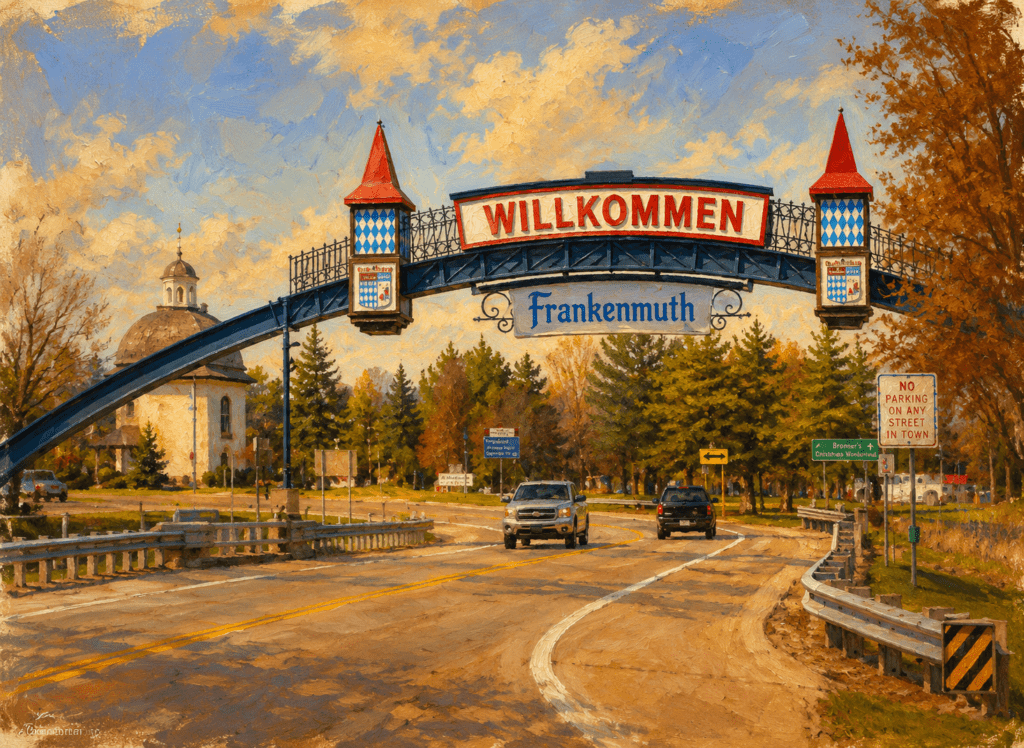
Frankenmuth, Michigan
Known today for its Bavarian architecture and German heritage, Frankenmuth was founded by Lutheran immigrants from Bavaria.
The community was established to preserve German language, culture, and faith in the United States.
The German Communities of Texas
One of the most remarkable German settlement regions emerged in Texas.
Beginning in the 1840s, thousands of German immigrants arrived through a colonization effort organized by the Adelsverein, a society established to promote German settlement in Texas.
New Braunfels
Founded in 1845, New Braunfels became the primary gateway for German immigrants entering central Texas.
German traditions remain visible throughout the city today.
Fredericksburg
Founded in 1846, Fredericksburg became one of the most successful German settlements in Texas.
The city remains famous for its German architecture, heritage festivals, and the historic treaty negotiated with the Comanche people.
Boerne and Comfort
These communities were established by German settlers seeking new opportunities on the Texas frontier.
Both communities preserved strong German cultural identities well into the twentieth century.
Why These Communities Matter to Hessian Descendants
Not every German-American family descends from a Hessian soldier.
However, many former Hessians settled in or near these growing German-speaking communities because they offered familiar language, religion, customs, and economic opportunities.
If your ancestors lived in one of these historic German settlements during the late eighteenth or nineteenth century, it may provide an important clue when researching Hessian ancestry.
The story of Hessian descendants is not limited to a few isolated families. It is woven into the history of entire cities, counties, and regions that helped shape the United States.
Of all the articles in this Hessian series, this may have been my favorite to research and write. As I traced the paths of Hessian soldiers and their descendants across America, I could not help but think about my own family history and how it intersected with the same places and people.
My father's family arrived from Ireland in the early 1700s and settled in the Philadelphia area. One of those early ancestors married a German woman, and the family remained there throughout the Revolutionary War.
There is little doubt in my mind that they encountered Hessians at some point. Whether on a battlefield, in a nearby town, at a marketplace, or perhaps while working side-by-side on a farm, the odds are remarkably high that their lives crossed paths with the thousands of German soldiers stationed throughout Pennsylvania and the surrounding colonies.
As this article demonstrates, many Hessians and their families eventually migrated westward, leaving the eastern seaboard in search of land and opportunity. That migration mirrors another chapter of my own family's story.
My mother's family emigrated from Germany in the 1830s and settled in Illinois—the same region where many descendants of Hessian soldiers and other German immigrants established farms, businesses, churches, and communities. While I have never discovered a direct Hessian ancestor in my family tree, the geographic overlap is impossible to ignore.
Researching Hessian genealogy has reminded me that American history is rarely a story of separate groups. Instead, it is a story of families, cultures, and communities constantly intersecting. Irish settlers married German immigrants. Former Hessian soldiers became American farmers. Their children moved west together, built towns together, and ultimately became part of the same American story.
The history of the Hessians is not simply the story of German soldiers who fought in the American Revolution. It is also the story of how millions of Americans today may carry a small piece of that history within their own family trees.
How to Determine If You Are Descended From a Hessian Soldier
By now you may be wondering whether a Hessian soldier appears somewhere in your own family tree.
The good news is that modern genealogy tools make this easier than ever before. For researchers interested in Hessian descendants genealogy, the challenge is that many former Hessians eventually blended into German-American communities, making them difficult to distinguish from later German immigrants.
Start With What You Already Know
Most successful Hessian descendants genealogy research begins at home.
Start by gathering family records, photographs, letters, family Bibles, obituaries, military records, and any written family histories. Even a brief reference to a German ancestor can provide valuable clues.
Do not overlook stories passed down through generations.
Sometimes a statement such as “Grandfather came from Pennsylvania Dutch country” or “Our family was German before moving west” can point researchers in the right direction.
Look for Revolutionary War Era Ancestors
A Hessian ancestor would likely have been born between approximately 1740 and 1765.
If you discover a German-speaking ancestor living in America shortly after the Revolutionary War, that individual becomes a strong candidate for further investigation. Identifying these individuals is often one of the most important steps in Hessian descendants genealogy.
Important Time Periods
Arrived Before 1776
Most likely a colonial German immigrant rather than a Hessian soldier.
Arrived Between 1776 and 1783
Potentially a Hessian soldier, camp follower, prisoner of war, or civilian connected to the conflict.
Arrived After 1783
More likely part of the larger German immigration waves that followed the Revolution.
Search for German-Speaking Communities
Many former Hessians settled in areas where German was already widely spoken.
Understanding settlement patterns is a key component of Hessian descendants genealogy because many former Hessians remained near established German-speaking populations.
If your ancestors lived in these regions during the late eighteenth or early nineteenth centuries, additional research may be worthwhile.
Pennsylvania
- Lancaster County
- Berks County
- York County
- Lehigh Valley
- Germantown
New York
- Hudson Valley
- Mohawk Valley
- Former military encampment regions
Maryland and Virginia
Areas where Hessian prisoners of war were held or assigned to work.
The Ohio River Valley
A major destination for German-American migration during the early nineteenth century.
Illinois, Missouri, Wisconsin, and Texas
Many descendants of Hessians eventually migrated westward into these growing frontier regions.
Examine Family Surnames Carefully
Many Hessian descendants retained German surnames for generations.
However, spelling changes were common.
Common Examples
- Müller became Miller.
- Schmidt became Smith, Schmitt, or Schmidt.
- Schneider became Snyder or Sneider.
- Becker occasionally became Baker.
- Weber sometimes became Weaver.
Do not assume a family lost its German heritage simply because the spelling changed.
Surname changes are among the most common challenges encountered in Hessian descendants genealogy research.
Church Records Are Often the Key
Church records are among the most valuable genealogy resources available.
German-speaking congregations frequently maintained detailed records of baptisms, marriages, confirmations, and deaths.
Many of these records survive today. Church records remain one of the most valuable resources available for Hessian descendants genealogy research.
Churches to Research
- Lutheran Churches
- German Reformed Churches
- Moravian Churches
- Mennonite Churches
- Catholic Parishes Serving German Communities
These records often contain information unavailable elsewhere.
Military Records May Reveal the Answer
Some former Hessian soldiers eventually applied for land, pensions, or legal status.
Others appear in prisoner-of-war records, parole records, military rolls, and settlement documents.
Researchers who discover an ancestor connected to one of these records may find direct evidence of Hessian service.
Helpful Record Sources
- Military muster rolls
- Prisoner-of-war records
- Church archives
- State archives
- County historical societies
- Genealogical societies
- National Archives collections
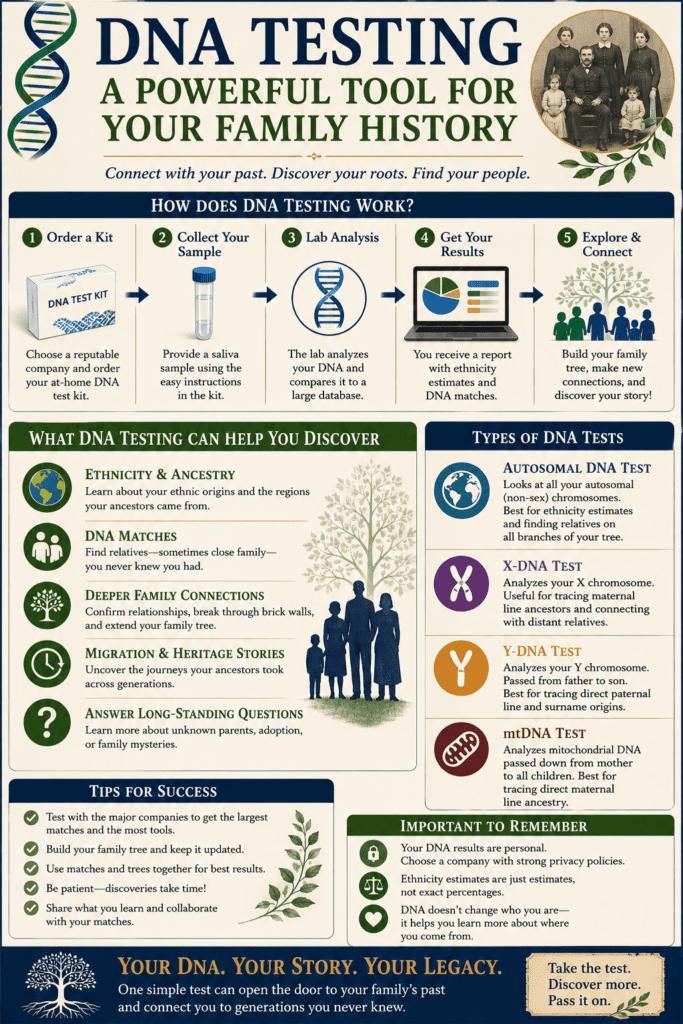
DNA Testing Can Provide Additional Clues
DNA testing cannot identify a specific Hessian soldier.
However, it can reveal connections to German populations and help researchers identify relatives who share common ancestors.
Many genealogists have used DNA matches to uncover previously unknown Hessian connections. DNA testing has become an increasingly important tool in Hessian descendants genealogy, especially when combined with traditional historical records.
DNA Works Best With Documentation
DNA should be viewed as supporting evidence rather than proof.
The strongest Hessian descendants genealogy research combines DNA results with church records, census records, military records, and family documentation.
A Surprising Discovery Awaits Many Families
One of the most rewarding aspects of genealogy is discovering stories that have been hidden for generations.
Many Americans begin searching for a German immigrant ancestor and eventually uncover something much more specific—a Hessian soldier who crossed the Atlantic during the American Revolution and chose to make America his permanent home.
If your family lived in German-speaking communities, carried German surnames, or migrated westward through the same routes followed by former Hessians, the possibility is worth exploring.
The answer may already be waiting somewhere in your family tree.
Using DNA and Online Genealogy Tools to Find Hessian Ancestors
Researching Hessian ancestry has become dramatically easier during the past two decades. Modern databases, DNA testing, and online archives have transformed Hessian descendants genealogy into a research project that can often be conducted from home.
The combination of DNA testing, online family trees, church records, military records, and historical databases has helped millions of Americans discover previously unknown ancestors.
Start With Your Family Tree First
Before purchasing a DNA test, build your family tree as far back as possible.
Collect birth certificates, marriage records, death certificates, obituaries, family Bibles, photographs, and any written family histories. The more information you gather before testing, the easier it will be to interpret DNA results later.
Remember that DNA is most valuable when combined with documented genealogy research.
Ancestry.com
One of the most popular genealogy resources is:
Ancestry maintains one of the largest collections of historical records in the world, including:
- Census records
- Immigration records
- Military records
- Marriage records
- Birth and death records
- Family trees created by other researchers
- Newspapers and obituaries
For Hessian genealogy, Ancestry’s search tools can help identify German ancestors living in America shortly after the Revolutionary War.
```html
One reason I encourage readers to research their family history is that I have personally experienced how rewarding the journey can be. My own research began with a few documents that had been preserved inside a family Bible.
Those records linked one of my earliest German ancestors to a specific town in Germany. Wanting to learn more, I wrote directly to the Bürgermeister (mayor) of the town.
To my surprise, his office responded and suggested that I contact the local Catholic Church. That recommendation changed everything.
The church sent me a treasure trove of historical documents, including baptismal records, marriage records, and a family tree that traced my German ancestors back to approximately 1680.
Once we had that foundation, my son used Ancestry.com to fill in the gaps between those early records and the present day. Piece by piece, the family story began to emerge.
Military records proved especially valuable. Civil War service records and other military documents helped connect generations and confirm family relationships.
Census records were equally important. Federal census documents provided a detailed roadmap from the late 1800s through the twentieth century, helping us track where family members lived, whom they married, and how their families grew.
Today, I have a remarkably clear picture of both my Irish and German family lines stretching back to at least the early 1700s. What began with a few pages from a family Bible ultimately became a journey through church archives, military records, census reports, and modern genealogy tools.
If there is one lesson I learned from the experience, it is this: never underestimate the value of a single family document. Sometimes one clue is all it takes to unlock centuries of family history.
Use Ancestry DNA
AncestryDNA can help identify genetic relatives who may have already researched portions of your family tree.
Many researchers discover connections to distant cousins who possess family records, photographs, or documentation that had previously been unknown.
While DNA cannot identify a specific Hessian soldier, it can help connect you with descendants who share the same ancestral lines.
FamilySearch and the Mormon Church
Many genealogy researchers consider FamilySearch one of the most valuable resources available for Hessian descendants genealogy.
The service is provided by:
FamilySearch is operated by The Church of Jesus Christ of Latter-day Saints, often referred to as the Mormon Church.
Why the Mormon Church Collects Genealogy Records
For more than a century, the Church has collected and preserved historical records from around the world.
Their efforts have resulted in billions of digitized records covering births, marriages, deaths, church records, military records, immigration documents, and census information.
Many records available through FamilySearch are completely free to access.
FamilySearch Centers
The Church also operates genealogy centers throughout the United States and many other countries.
Researchers can often access additional records, receive research assistance, and use specialized genealogy tools at these facilities.
For someone researching Hessian ancestry, FamilySearch is often one of the best starting points available.
DNA Testing Options
Several companies offer DNA testing that can assist with genealogy research.
AncestryDNA
Best for finding relatives and building family trees.
FamilyTreeDNA
Useful for advanced surname and paternal-line research.
23andMe
Provides both ancestry information and health-related genetic reports.
MyHeritage
Particularly useful for European genealogy research.
What DNA Can and Cannot Tell You
DNA testing can reveal that you have German ancestry.
DNA testing can identify relatives who share common ancestors.
DNA testing can sometimes help confirm connections suggested by historical records.
However, DNA testing cannot determine that a specific ancestor was a Hessian soldier.
To make that determination, researchers must combine DNA evidence with documentary evidence such as military records, church records, land records, census records, and family histories.
A Practical Research Strategy
If you believe you may be descended from a Hessian soldier, consider the following approach:
Step 1
Build your family tree backward as far as possible using family records.
Step 2
Create free accounts on FamilySearch and begin searching historical records.
Step 3
Search Ancestry records and public family trees for German-speaking ancestors.
Step 4
Take a DNA test and review your matches.
Step 5
Focus on ancestors living in Pennsylvania, New York, Maryland, Virginia, or other German-speaking communities shortly after the Revolutionary War.
Step 6
Look for evidence connecting those ancestors to military service, prisoner-of-war records, or known Hessian settlements.
People Also Ask
How likely is it that I am descended from a Hessian soldier?
More likely than many people realize. Historians estimate that between 3,000 and 5,000 Hessian soldiers remained in America after the Revolutionary War. Over nearly 250 years, those families may have produced between 11 million and 26 million living descendants, meaning millions of Americans could have Hessian ancestry without knowing it.
What states have the highest number of Hessian descendants?
Pennsylvania likely has the highest concentration because many Hessian soldiers settled in German-speaking communities around Lancaster, Berks County, York County, and Germantown. Their descendants later migrated westward into Ohio, Illinois, Missouri, Wisconsin, Texas, Michigan, and other growing frontier states.
Can a DNA test prove that I am descended from a Hessian soldier?
No. DNA testing can confirm German ancestry and help identify relatives, but it cannot identify a specific Hessian ancestor. To prove a connection to a Hessian soldier, researchers typically combine DNA results with family trees, church records, military records, census records, and other historical documents.
The Reward of Discovery
Many people begin genealogy research expecting to find names and dates.
Instead, they discover stories.
For descendants of Hessian soldiers, those stories often begin with a young German man crossing the Atlantic during the American Revolution and end with generations of Americans who may never have realized how their family’s journey truly began.
Famous Americans Who May Have Hessian Ancestry
One challenge when researching Hessian descendants is that very few families preserved records identifying an ancestor specifically as a Hessian soldier.
Over time, former Hessians blended into the broader German-American population. Their children and grandchildren married into other German families, moved westward, and eventually became part of mainstream American society. Hesssian decendants genealogy is about much more than names and dates.
As a result, it is often impossible to determine with certainty whether a modern American descends from a Hessian soldier or from later German immigrants.
The German-American Legacy
What we can say with certainty is that German-Americans have had an enormous influence on the United States.
German immigrants and their descendants helped build cities, establish industries, develop farms, create universities, and serve in every major American conflict.
Many families living in historic German-American communities today may unknowingly share ancestry with former Hessian soldiers.
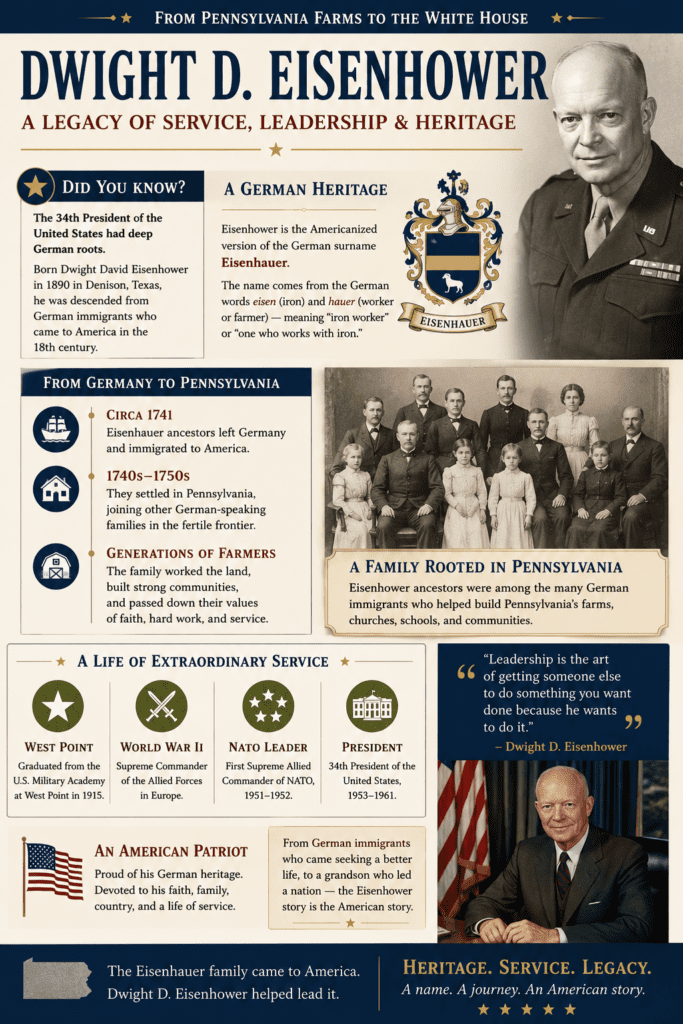
President Dwight D. Eisenhower
The Eisenhower family traces its roots to German immigrants who settled in Pennsylvania.
The original family surname was Eisenhauer, meaning “iron cutter” or “iron worker.”
Like countless German-American families, the name gradually evolved as generations became more integrated into American society.
President Herbert Hoover
Although best known for his Quaker upbringing, Hoover’s ancestry included German family lines that became part of the broader German-American migration into the colonies and early United States.
His family history reflects the complex blending of cultures that occurred throughout early America.
General John J. Pershing
Pershing’s ancestry included German-American roots that stretched back generations.
Like many families of German descent, his ancestors became fully integrated into American life while preserving elements of their heritage.
The Reality for Most Descendants
The truth is that most Hessian descendants are not famous.
They were farmers in Pennsylvania.
Blacksmiths in Ohio.
Merchants in Missouri.
Teachers in Illinois.
Ranchers in Texas.
Factory workers in Wisconsin.
Their contributions rarely appeared in history books, yet they helped build the communities and institutions that shaped the United States. Its amazing what Hessian descendents geneology teaches us.
Millions of Untold Stories
For every famous German-American, there were thousands of ordinary families whose stories remain largely unknown.
Many of those stories began with a young German soldier who arrived during the American Revolution and chose to remain in America.
Their descendants eventually spread across every region of the country.
Your Family Story May Be More Interesting Than Any Famous Name
One of the lessons of genealogy research is that fame is not what makes a family story valuable.
Discovering a Hessian soldier, a Revolutionary War-era immigrant, a Civil War veteran, or a frontier settler in your own family tree can be every bit as fascinating as tracing a connection to a famous historical figure.
For many readers, the most important discovery will not be finding a famous ancestor.
It will be discovering the ordinary men and women whose decisions created the family they know today.
German-Americans Who Helped Build Modern America
While it is often impossible to prove that a famous American descends directly from a Hessian soldier, there is no question that German-Americans became one of the most influential groups in the nation’s history.
The same German-speaking communities that absorbed former Hessian soldiers eventually produced business leaders, inventors, industrialists, athletes, and entrepreneurs who helped transform the United States into a global power.
From Hessian Settlements to American Success
The descendants of German immigrants spread across Pennsylvania, Ohio, Illinois, Missouri, Wisconsin, Texas, and countless other states.
Over the next two centuries, German-American families became deeply involved in agriculture, manufacturing, transportation, finance, brewing, engineering, and professional sports.
Their impact can still be seen throughout American society today.
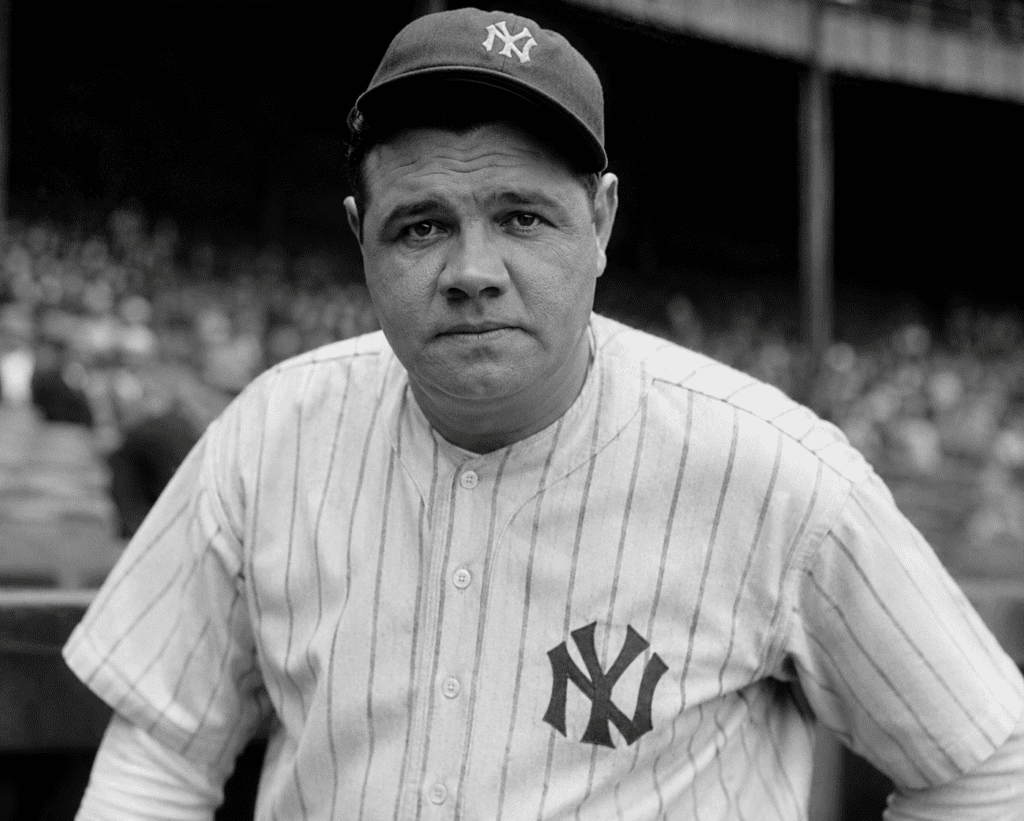
Babe Ruth: The Sultan of Swat
Few athletes are more recognizable than Babe Ruth.
Born George Herman Ruth Jr. in Baltimore, Maryland, all four of his grandparents were of German ancestry.
A German-American Baseball Legend
Ruth grew up in a working-class German-American neighborhood where German was commonly spoken. Family members maintained many of the traditions brought to America by earlier generations of German immigrants.
His extraordinary baseball career transformed the sport during the 1920s. By turning home runs into baseball’s most exciting attraction, he helped create America’s modern national pastime.
William Boeing: Building the Aerospace Industry
William Boeing’s family roots traced directly to Germany.
His father, Wilhelm Böing, emigrated from Germany before building a successful timber business in the United States.
Changing the World Through Flight
William Boeing later founded the company that bears his name.
What began as a small aircraft manufacturer eventually became one of the world’s most important aerospace companies and a major contributor to American aviation and space exploration.
Walter Chrysler: Revolutionizing Transportation
Walter Chrysler was another German-American whose influence can still be seen today.
His family ancestry reflected the wave of German immigrants who helped fuel America’s industrial expansion.
The Chrysler Legacy
As founder of the Chrysler Corporation, he became one of the most important figures in the automotive industry.
His innovations helped make automobiles accessible to millions of Americans and contributed significantly to the nation’s economic growth.
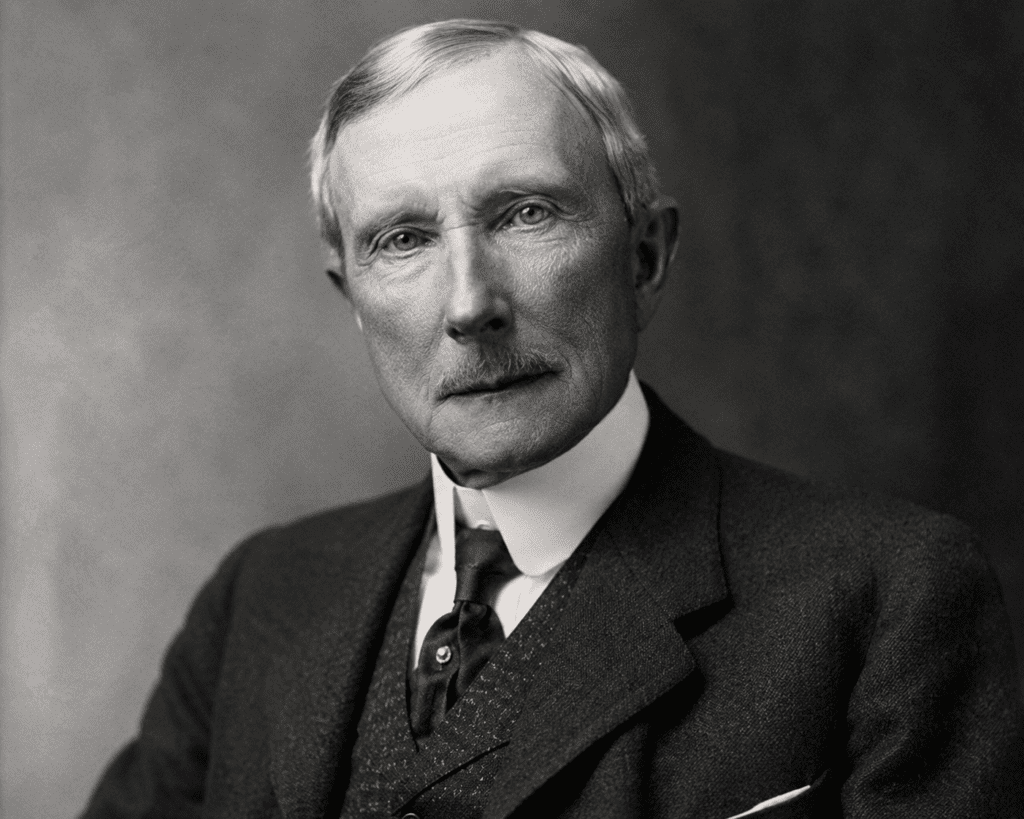
John D. Rockefeller: The Wealthiest American?
The Rockefeller family traces its roots to Johann Peter Rockefeller, who immigrated from the Rhineland region of Germany in 1723.
The family’s original surname was Rockenfeller.
Building Standard Oil
John D. Rockefeller transformed the petroleum industry through Standard Oil.
At its peak, Standard Oil controlled much of America’s oil refining capacity and made Rockefeller one of the wealthiest individuals in modern history.
Many historians estimate that, adjusted for inflation and economic impact, Rockefeller’s fortune would exceed that of nearly every billionaire alive today.
```htmlWhen discussing successful German-American families, no example is more remarkable than that of John D. Rockefeller. Historians widely regard Rockefeller as the wealthiest American who ever lived, and many consider him the wealthiest individual in modern world history.
If Rockefeller's fortune were measured as a share of the modern American economy, some economists estimate that his wealth would exceed that of many of today's billionaires combined.
Yet the most important figure in this story may not be John D. Rockefeller at all.
It was Johann Peter Rockenfeller, a German immigrant from the Rhineland, who arrived in the American colonies in 1723. Like thousands of other German immigrants, he crossed the Atlantic seeking greater opportunity, religious freedom, and a better future than was available in his homeland.
When Johann Peter stepped onto American soil, he could not have imagined that one of his descendants would someday build the world's largest oil company and become one of the richest people in history.
His story illustrates a recurring theme found throughout this article. The real story is not simply about famous descendants. It is about the immigrants who took enormous risks, left everything behind, and chose America as the place where their families would build a future.
Johann Peter Rockenfeller never became a billionaire. But by choosing America in 1723, he laid the foundation for one of the most successful family stories in American history.
The Astor Family: Builders of New York
The Astor fortune began with Johann Jakob Astor, who arrived from Germany in 1784.
After anglicizing his name to John Jacob Astor, he built one of the greatest fortunes in American history.
The Landlords of Manhattan
The Astor family accumulated vast real estate holdings throughout New York City.
Their investments helped shape the physical development of Manhattan and led to landmarks such as the famous Waldorf-Astoria Hotel.
Henry Villard: Railroad and Industrial Titan
Born Ferdinand Heinrich Gustav Hilgard in Germany, Henry Villard immigrated to the United States in 1853.
He would become one of the most influential railroad magnates of the Gilded Age.
Financing America’s Expansion
Villard played a major role in developing the Northern Pacific Railway and helping complete transcontinental transportation networks.
He also became an important investor in Thomas Edison’s early electrical ventures, helping lay the foundation for what would eventually become General Electric.
German-Americans and the Gilded Age
Many of the wealthiest industrialists of the nineteenth century came from German immigrant backgrounds.
Brewing Empires
Frederick Pabst and Joseph Schlitz transformed Milwaukee into America’s brewing capital.
Their companies pioneered large-scale beer production and helped create nationally recognized brands.
The Sugar King
Claus Spreckels, born in Germany, built a sugar empire stretching from California to Hawaii.
His business ventures dominated much of the American sugar industry during the late nineteenth century.
Luxury Hospitality
George Boldt arrived in America as a poor immigrant and eventually became one of the most successful hotel operators in the nation.
His name remains associated with the famous Boldt Castle in New York’s Thousand Islands region.

A Legacy Far Beyond the Battlefield
When the first Hessian soldiers arrived in America in 1776, few could have imagined the influence that German-speaking immigrants and their descendants would eventually have on the nation.
From baseball stadiums and automobile factories to railroads, oil fields, hotels, breweries, and aerospace companies, German-Americans helped shape virtually every aspect of modern American life.
For readers researching Hessian ancestry, these stories serve as a reminder that the descendants of those early German settlers became an important part of the American success story.
The Legacy of the Hessians in America
When most Americans think about the Hessians, they picture German soldiers marching under British command during the American Revolution. They remember the Battle of Trenton, the surprise attack by George Washington, and the role the Hessians played in the struggle for independence.
Yet the true legacy of the Hessians extends far beyond the battlefield.
From Foreign Soldiers to American Citizens
Thousands of Hessian soldiers returned to the German principalities after the war ended.
Thousands more did not.
Former Hessians became farmers, craftsmen, merchants, laborers, teachers, and community leaders. They married, raised families, purchased land, and helped build the young United States.
Within a generation, many had become Americans in every practical sense.
The Growth of German America
The Hessians arrived at a time when German-speaking communities already existed throughout the colonies.
Those communities expanded rapidly during the nineteenth century as new waves of immigrants arrived from Germany.
Former Hessian soldiers blended into these settlements, helping create one of the largest and most influential ethnic groups in American history.
A Lasting Cultural Influence
German-Americans left their mark on nearly every aspect of American life.
Their influence can still be seen in:
- Farming and agriculture
- Brewing and food traditions
- Education
- Manufacturing
- Engineering
- Music and festivals
- Architecture
- Religious institutions
- Community organizations
Many customs Americans enjoy today have roots in German traditions brought to North America by immigrants and their descendants.
The Communities They Built
The Hessians themselves did not found every German-American town.
However, their descendants often became part of the communities that transformed cities such as Lancaster, Cincinnati, Milwaukee, New Braunfels, Fredericksburg, Hermann, Belleville, and Frankenmuth into centers of German-American culture.
Many of these communities still celebrate their heritage through festivals, museums, architecture, food, and cultural events.
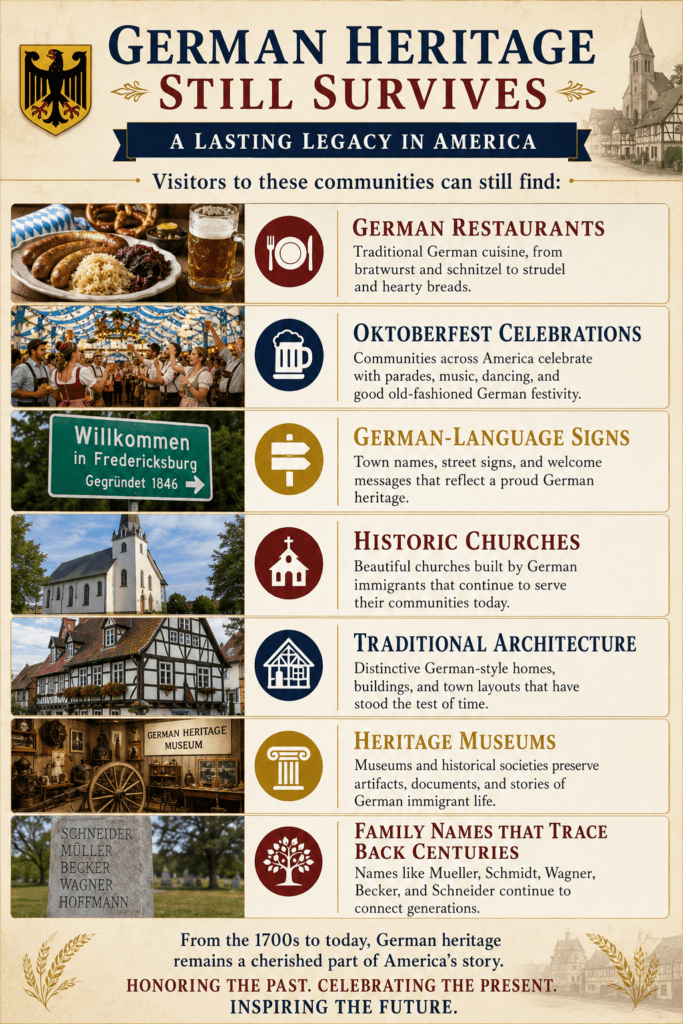
German Heritage Still Survives
Visitors to these communities can still find:
- German restaurants
- Oktoberfest celebrations
- German-language signs
- Historic churches
- Traditional architecture
- Heritage museums
- Family names that trace back centuries
Although English eventually became dominant, the cultural fingerprints of those early settlers remain visible today.
```html id="hessian-reflection-callout"As you read this article, it may seem that the focus is entirely on German heritage and the descendants of Hessian soldiers. In reality, the story is much bigger than that.
The Hessian series is not simply about a group of German soldiers who arrived in America during the Revolutionary War and eventually prospered. It is also a story about immigration, opportunity, adaptation, and the hopes people carry when they leave one place to build a better life somewhere else.
Over the past 250 years, millions of people have come to the United States from every corner of the world. My own family history includes both Irish and German immigrants, each arriving at different times and under different circumstances.
Some families arrived before the American Revolution. Others came during the great immigration waves of the nineteenth century. Still others arrived within the past century.
What connects these families is not their nationality. It is their purpose.
People came to America to raise families. They came seeking economic opportunity. They came hoping their children and grandchildren would enjoy a better future than they had known themselves.
The Hessians who remained in America shared many of the same dreams that motivated later generations of immigrants. They wanted stability, opportunity, land, work, and a chance to build something lasting for future generations.
In many ways, this may be your story as well. Whether your ancestors came from Germany, Ireland, Italy, Poland, Scandinavia, Asia, Africa, Latin America, or somewhere else entirely, the desire to create a better future is a thread that runs through nearly every American family story.
The Hessians happened to arrive as soldiers. Millions of others arrived as farmers, laborers, craftsmen, merchants, refugees, entrepreneurs, and dreamers. Their backgrounds were different, but their hopes were often remarkably similar.
The Hessians and the American Melting Pot
One of the most remarkable aspects of Hessian history is how completely they became part of the American story.
Irish families married German families.
English settlers married German settlers.
Former soldiers became neighbors, business partners, and community leaders.
Over time, distinctions that once seemed important gradually disappeared. What Hessian descendants geneology teaches us is that their offspring integrated into the nation early.
The Original Enemies Became Countrymen
The irony is striking.
Men who arrived in America as foreign soldiers fighting against the Revolution eventually became part of the nation that emerged from it.
Their children and grandchildren fought in American wars, voted in American elections, and helped build American communities.
The descendants of Hessians would go on to serve in the War of 1812, the Civil War, World War I, World War II, and every major conflict that followed.
Why Hessian History Matters Today
The story of the Hessians is about much more than military history.
It is a story about immigration.
It is a story about assimilation.
It is a story about opportunity.
Most importantly, it is a story about how people from different cultures came together to create a new nation.
A Legacy Measured in Millions
The greatest legacy of the Hessians may not be found in a battlefield monument or a military record.
It may be found in the millions of Americans who unknowingly carry their DNA today.
If the estimates presented in this article are correct, between 11 million and 26 million living Americans may descend from the few thousand Hessian soldiers who chose to remain in America after the Revolutionary War.
That means the legacy of the Hessians is not confined to history books.
It is alive in families across the United States.
The Final Verdict
The Hessians arrived in America as hired soldiers of the British Crown.
Some returned home.
Others stayed.
Those who remained became farmers, craftsmen, business owners, community leaders, and ancestors.
Nearly 250 years later, their descendants continue to shape the nation they once entered as strangers. That enduring transformation—from foreign soldier to American ancestor—may be the most important legacy the Hessians left behind.
Conclusion: Could a Hessian Soldier Be in Your Family Tree?
When the first Hessian soldiers stepped onto American soil in 1776, they could not have imagined the lives that awaited them.
Many expected to serve their contracts, return home, and resume their lives in the German principalities. Instead, thousands found themselves caught up in a new nation that was still being born.
Some were captured.
Some deserted.
Some married local women.
Some purchased farms and started businesses.
Others joined German-speaking communities that stretched from Pennsylvania to the western frontier.
A Decision That Changed Generations
The choice made by an estimated 3,000 to 5,000 Hessian soldiers to remain in America after the Revolutionary War affected far more than their own lives.
Those decisions shaped the lives of children, grandchildren, and great-grandchildren who would eventually spread across every region of the United States.
Today, millions of Americans may unknowingly carry a connection to those former German soldiers.
More Than a Military Story
The history of the Hessians is often told through battles such as Long Island, White Plains, Trenton, Bennington, Saratoga, and Yorktown.
Those events are important.
However, the larger story is what happened after the war ended.
The Hessians became immigrants.
Their descendants became Americans.
Their communities helped build towns, industries, churches, schools, and businesses that still exist today.
The Search Begins With a Single Clue
Perhaps your family has a German surname.
Perhaps an ancestor lived in Pennsylvania Dutch country.
Perhaps family records point to Ohio, Illinois, Missouri, Texas, Wisconsin, or another historic German-American settlement.
Or perhaps an old photograph, family Bible, church record, or DNA match provides the first hint.
Many genealogy journeys begin with something small.
Your Family May Hold the Answer
One of the most fascinating aspects of genealogy is that every family contains stories waiting to be discovered.
Some stories involve presidents.
Some involve industrialists.
Most involve ordinary people whose lives never appeared in history books.
Yet those ordinary people often lived extraordinary lives.
For millions of Americans, one of those stories may begin with a young Hessian soldier crossing the Atlantic during the American Revolution and deciding that America would become his new home.
Continue Exploring the Hessian Story
This article is part of our 10-part Hessian series exploring the German soldiers who fought in the American Revolution, their families, their military service, their settlements, and their descendants.
Be sure to explore the remaining articles in the series and visit our broader America 250 collection, where we examine the people, events, and forgotten stories that shaped the United States during its first 250 years.
The story of the Hessians did not end when the war ended.
In many ways, it was only beginning.
The RetireCoast Hessians in the American Revolution series draws from battlefield organizations, museum resources, genealogy collections, military archives, and historical research focused on German soldiers, prisoners, settlers, and families connected to the Revolutionary War.
- FamilySearch — Hessian Soldiers
- Franklin & Marshall College Archives — Johannes Schwalm Historical Association Collection
- FamilySearch Catalog — Journal of the Johannes Schwalm Historical Association
- Journal of the American Revolution — The Hessians: Journal of the Johannes Schwalm Historical Association
The Complete RetireCoast Historical Series
Were all Hessians from Hesse, Germany?
No. While many came from Hesse-Kassel and Hesse-Hanau, the term "Hessian" was commonly used by Americans to describe all German auxiliary troops hired by Britain. Other soldiers came from Brunswick, Waldeck, Ansbach-Bayreuth, and several other German-speaking principalities.
How many Hessian soldiers remained in America after the Revolutionary War?
Historians generally estimate that between 3,000 and 5,000 Hessian soldiers chose to remain in America rather than return to Europe. Many became farmers, craftsmen, merchants, and settlers throughout the new United States.
How many Americans may be descended from Hessian soldiers today?
Based on genealogical estimates and population growth, between 11 million and 26 million Americans may carry the DNA of Hessian soldiers who settled in America after the Revolutionary War.
What states have the largest number of Hessian descendants?
Pennsylvania likely has the highest concentration due to its large German-speaking population during and after the Revolutionary War. Descendants later migrated into Ohio, Illinois, Missouri, Wisconsin, Texas, Michigan, Minnesota, and many other states.
Can a DNA test prove that I am descended from a Hessian soldier?
No. DNA testing can confirm German ancestry and identify relatives, but it cannot identify a specific Hessian ancestor. Researchers must combine DNA results with church records, census records, military records, and family histories.
What are common Hessian surnames?
Common German surnames found among Hessian soldiers and their descendants include Becker, Müller, Schmidt, Schneider, Weber, Fischer, Wagner, Bauer, Klein, and Hoffman. Many names were later anglicized after families settled in America.
Why did so many Hessian soldiers stay in America?
Many Hessians found greater economic opportunity in America than in the small German principalities from which they came. Land ownership, employment opportunities, marriage, and established German-speaking communities encouraged many to remain permanently.
Where can I research a possible Hessian ancestor?
Excellent resources include FamilySearch.org, Ancestry.com, church records, county historical societies, state archives, military records, census records, and local genealogy societies in historic German-American communities.
Did Hessian descendants continue speaking German?
Yes. In many German-American communities, German remained the dominant language for generations. German-language newspapers, churches, schools, and businesses were common throughout the nineteenth century.
What is the lasting legacy of the Hessians in America?
The Hessians' greatest legacy may not be their military service but the millions of descendants they left behind. Their families helped build farms, businesses, towns, churches, schools, and communities that became part of the American story.
This series about the Hessians in the American Revolution is just one part of the much larger RetireCoast 250th Anniversary historical project celebrating the birth of the United States.
We invite you to continue exploring our growing collection of Revolutionary War articles covering battles, weapons, ships, camp followers, frontier life, hidden history, and the people who shaped the American story.



Discover more from RetireCoast.com
Subscribe to get the latest posts sent to your email.