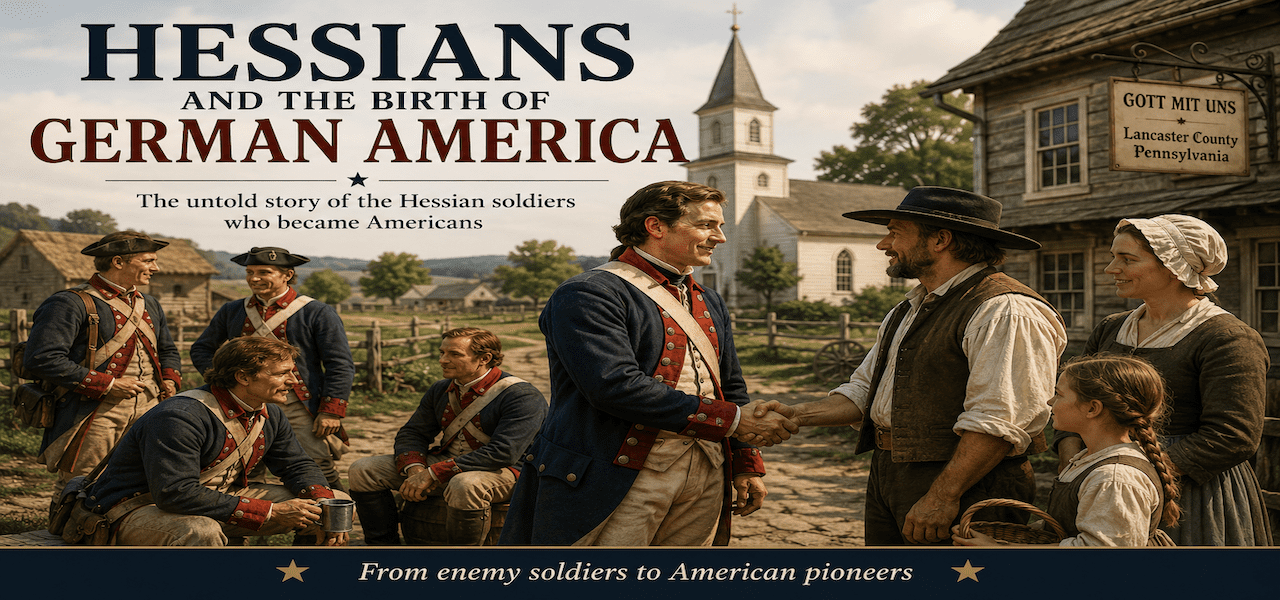
Why Thousands of Hessian Soldiers Never Returned Home After the American Revolution
The story of the Hessians in the American Revolution does not end at the Battle of Trenton, Saratoga, or Yorktown. For thousands of German-speaking soldiers who crossed the Atlantic to fight for the British Crown, the war became something far more personal: a pathway to a completely new life in America.
- Why Thousands of Hessian Soldiers Never Returned Home After the American Revolution
- QUIZ
- Penalties for desertion (if caught)
- PEOPLE OFTEN ASK ABOUT THE HESSIANS
- Were there formal documents to permit Hessian prisoners to work
- Hessians and the Birth of German America After the Revolutionary War
- The End of the Revolutionary War for the Hessians
- Why Hessians Chose to Stay in America
- Hessians and the Birth of German America in Colonial Communities
- The Cultural Impact of Hessians and the Birth of German America
- People Often Ask About Hessians and the Birth of German America
- The Hidden Legacy of Hessian Descendants
- The Final Legacy of Hessians and the Birth of German America
- What Happened to the Hessians After the Revolutionary War?
- German Communities Changed the Prisoner Experience
- Hessian Prisoners Worked Inside Civilian Communities
- Desertion Became Increasingly Common
- Hessian Officers Experienced Captivity Differently
- Hessians and the Birth of German America After 1783
- Why Many Hessians Chose to Stay in America
- Hessians and the Birth of German America in the Expanding Frontier
- The Hidden Legacy of Hessian Descendants
- The Final Legacy of Hessians and the Birth of German America
- References
- FAQ
The term “German” is used throughout this series as a modern convenience when referring to the Germanic or German-speaking peoples who served Britain during the American Revolution.
In the eighteenth century, modern Germany did not yet exist as a unified nation. Instead, the soldiers commonly called “Hessians” were actually citizens or subjects of numerous independent German principalities and states.
Many came from Hesse-Kassel, while others served from Brunswick, Waldeck, Ansbach-Bayreuth, and several additional German-speaking territories within the Holy Roman Empire.
QUIZ
- A. Britain ordered them to stay
- B. America offered land and opportunity
- C. Germany no longer existed
- D. They planned to continue fighting
Answer
- A. 500
- B. 2,000
- C. 5,000 to 6,000
- D. 20,000
Answer
- A. Georgia
- B. Pennsylvania
- C. Rhode Island
- D. South Carolina
Answer
- A. Only military service
- B. Farming and skilled trades
- C. Government positions only
- D. Shipbuilding exclusively
Answer
- A. British law required it
- B. German traditions became illegal
- C. Anti-German sentiment during World Wars I and II
- D. Most families returned to Europe
Answer
- A. Battle of Yorktown
- B. Battle of Bunker Hill
- C. Saratoga Campaign
- D. Boston Massacre
Answer
- A. They later served France
- B. They became leaders in Britain
- C. Many eventually became Americans
- D. They returned to fight in the Civil War
Answer
- A. Existing German-speaking communities
- B. British military assistance
- C. Spanish land grants only
- D. French military protection
Answer
Many Hessians never returned to Europe.
Some deserted during the war. Others remained after the peace treaty was signed. Many married local women purchased farms, joined frontier communities, or settled in growing towns across Pennsylvania, New York, Maryland, Virginia, and Canada. Over time, these former soldiers helped shape what would eventually become part of German-American culture in North America.
This article is Chapter 5 in RetireCoast’s 10-part Hessian series, created as part of America’s 250th Anniversary Project. Throughout this series, we explore not only the battles of the Revolutionary War but also the lives of the soldiers, camp followers, civilians, and immigrants whose experiences helped shape the future United States.
At the end of this article, you will find a complete directory of all ten chapters in the series with links to each article. Please also take a few minutes to complete the quiz and test your knowledge of the Hessians and the German soldiers who remained in America after the war.
DESERTION INCREASED STEADILY AS THE WAR PROGRESSED.
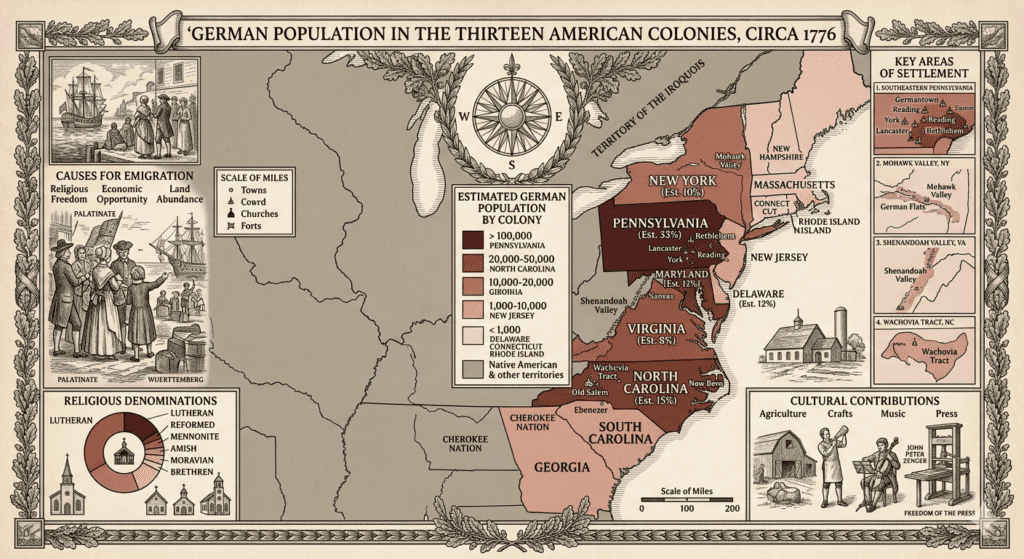
After Washington’s victories at Trenton and Princeton during the winter of 1776–1777, hundreds of captured Hessians entered German-speaking communities in Pennsylvania, where many quietly disappeared into civilian life.
Following the British defeat at Saratoga in 1777, thousands of Brunswick and Hessian soldiers belonging to the so-called “Convention Army” were marched through New England and eventually south toward Virginia. During these long prisoner marches, numerous German troops simply slipped away into forests or nearby towns and never returned.
When the Revolutionary War finally ended in 1783, British transport ships waited to carry the surviving German troops home across the Atlantic. Yet thousands of Hessians chose not to board those vessels. Some hid in the countryside until the ships departed.
Others openly settled into German-American communities where they married, farmed, worked trades, and raised families.
Today, many Americans with colonial-era German ancestry may actually descend from Hessian soldiers who arrived in North America as part of the British Army but ultimately decided that the opportunities offered by the American experiment were worth far more than returning to the rigid military states of Europe.
Penalties for desertion (if caught)
For a Hessian soldier in the American Revolution, desertion was a high-stakes gamble. The Continental Congress actively incentivized it—offering German-language broadsides promising 50 acres of land, religious freedom, and full citizenship to those who walked away.
However, if a deserter was caught by his own forces or British allies, the consequences were severe and governed by ironclad German military justice. The punishment depended heavily on the circumstances of the capture, the regiment, and whether the soldier was a ringleader.
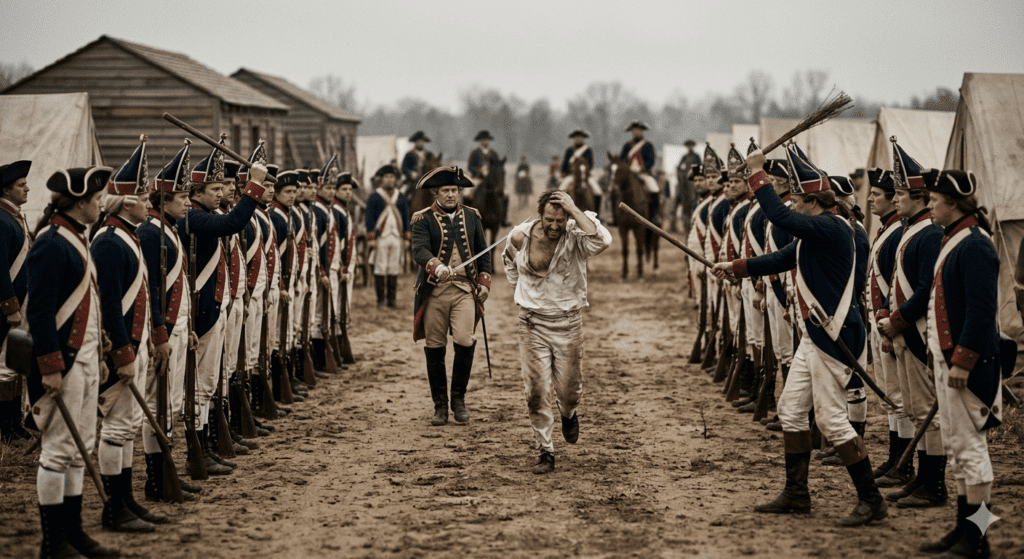
1. Running the Gauntlet (Spießrutenlaufen)
For a first-time or non-ringleader deserter, the most frequent sentence was corporal punishment rather than immediate execution. The standard method was forcing the convicted soldier to run the gauntlet.
- The Setup: The deserter was stripped to the waist and forced to walk or run multiple times down a narrow lane formed by two long rows of his fellow soldiers (often up to 200 men).
- The Punishment: Each soldier in the line was armed with a switch, rod, or cudgel and was required to strike the deserter as he passed. To prevent the prisoner from running too fast, an officer would walk backward in front of him with a lowered sword, pointing at his chest.
- The Scale: A severe sentence could dictate running the gauntlet up to 24 or even 36 times, spread out over consecutive days, to allow the skin to partially heal so the punishment could continue.
2. Execution by Firing Squad or Hanging
Capital punishment was strictly reserved for aggravated cases. If a Hessian deserter was caught actively trying to join the Continental Army to fight against his sovereign, if he resisted arrest with a weapon, or if he was the ringleader of a mass desertion plot, he faced death.
- Firing Squad: The standard military execution for soldiers was being shot by a firing squad composed of men from their own regiment.
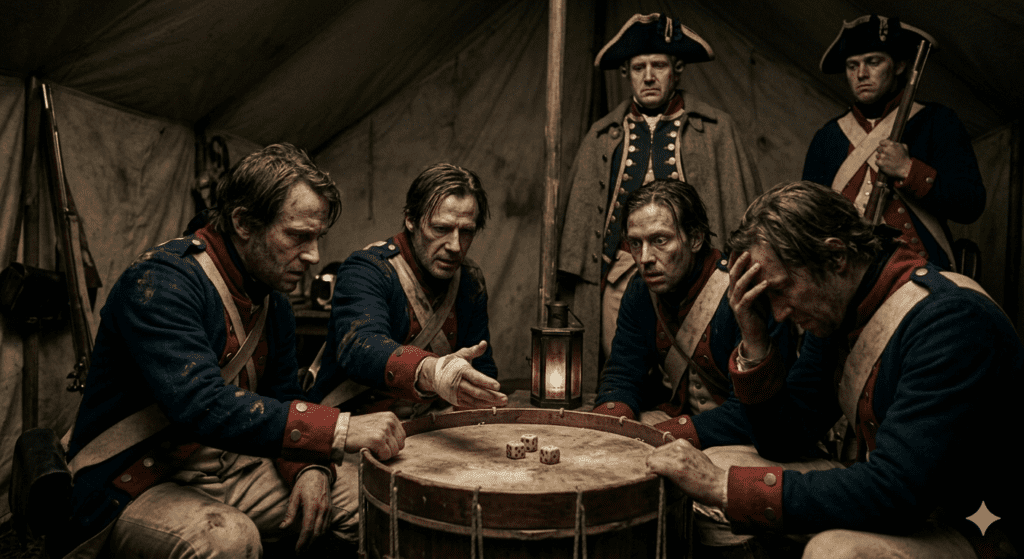
- Deciding by Dice: In instances of mass desertion where executing an entire group would severely deplete a company’s numbers, the military sometimes employed a grim psychological lottery. The captured men were forced to throw dice on a drumhead; the ones who rolled the lowest numbers were executed to serve as an example, while the rest were subjected to the gauntlet or hard labor.
3. Flogging and Physical Restraints
In lieu of the gauntlet, regimental courts-martial frequently ordered severe public floggings using a heavy whip or cane. If a soldier was deemed a chronic flight risk but too valuable to execute, he could be demoted to the lowest rank, stripped of pay, and sentenced to prolonged periods of hard labor while confined in heavy iron shackles.
The American Factor: Because the British and Hessian command knew how aggressively the Americans were recruiting deserters, they occasionally declared temporary amnesties. They promised that any soldier who returned to the fold within a specific timeframe would be pardoned or face lesser non-lethal discipline, realizing that pure brutality sometimes drove even more men to run away.
Ultimately, the risk-versus-reward calculation varied throughout the war. By 1783, between 5,000 and 6,000 of the roughly 30,000 German troops deployed had successfully deserted or chosen to stay behind, blending into the existing German-American communities across Pennsylvania, Maryland, and Virginia.
PEOPLE OFTEN ASK ABOUT THE HESSIANS
WHEN DID THE HESSIANS ARRIVE IN AMERICA?
The first major Hessian contingents arrived on August 15, 1776. Their ships anchored off Sandy Hook, New Jersey, before the troops disembarked on Staten Island to join the British campaign against New York City.
DID HESSIAN SOLDIERS BRING THEIR FAMILIES TO AMERICA?
Yes. Hundreds of women and children crossed the Atlantic alongside the German troops. These camp followers worked as cooks, laundresses, nurses, and seamstresses while traveling with the army. Some children even spent much of the Revolutionary War moving with military camps throughout North America.
WHAT BATTLES DID THE HESSIANS FIGHT IN?
Hessian soldiers participated in many major battles of the American Revolution, including:
- Long Island
- White Plains
- Fort Washington
- Trenton
- Brandywine
- Saratoga
They became an essential part of the British war effort throughout much of the conflict.
Were there formal documents to permit Hessian prisoners to work
There were formal legal and bureaucratic frameworks used during the American Revolutionary War to allow prisoners of war (including British soldiers and Hessian/German auxiliaries) to leave captivity to work. However, the exact type of document depended entirely on the soldier’s rank.
General George Washington and the Continental Congress split prisoners into two distinct categories, utilizing different legal instruments for each:
1. For Enlisted Men: The “Pass” or “Permit” System
Common soldiers and enlisted men could not technically give a “Parole of Honor”—that was a privilege strictly legally reserved for officers who were considered “gentlemen”. Instead, when Washington and local authorities allowed thousands of captured Hessians and British troops out of camps (like Camp Security in Pennsylvania or Albemarle Barracks in Virginia) to work for local farmers, blacksmiths, and shoemakers, they used a Pass System.
- The Document: This was a printed or handwritten certificate/pass issued by the local Commissary of Prisoners or the camp’s commanding militia officer.
- What it stated: The document explicitly named the prisoner, described their physical appearance, identified the local American employer who was taking financial and physical responsibility for them, and outlined strict geographical boundaries (e.g., allowing them to travel into a nearby town to sell goods or work a specific farm).
- The “Indentured” Labor Contract: In many jurisdictions, a secondary formal contract was signed between the local government and the American citizen hiring the prisoner. The employer had to post a monetary bond and sign a document guaranteeing they would provide food, clothing, housing, and a set wage, while ensuring the prisoner did not escape.
2. For Officers: The “Parole of Honor” (Parole)
If an officer wanted to live outside of a prison camp, secure private lodgings, or engage in non-military work/socializing, they had to sign a formal, legally binding Parole of Honor.
![A detailed, close-up photograph set within a Revolutionary War-era canvas military tent, showing a man's weathered hand holding an antique paper document. The text is printed in archaic font and explicitly details the formal conditions of a "Parole of Honor," stating the prisoner must remain within prescribed bounds and not correspond with enemies of the United States. It includes signature lines for the "[NAME OF OFFICER]" and "John R. Agent," along with a red wax seal. The man is wearing a rough wool coat with brass buttons. The background shows blurred details of stacked muskets and a wooden table.](https://retirecoast.com/wp-content/uploads/2026/05/parole-document-allowing-work-1024x559.png)
- The Document: This was a highly formalized paper template. Washington’s commissaries utilized standardized language that both the prisoner and the issuing agent had to sign.
- The Text of the Form: A standard Revolutionary War parole document typically followed this layout:
“Whereas [The Agent for the Care and Custody of Prisoners] has been pleased to grant leave to the undersigned Prisoner of War… to reside in [Location/Town] upon condition that I give my Parole of Honor not to withdraw from the bounds prescribed… That I will behave decently and with due respect to the laws of this country, and also that I will not, during my continuance, either directly or indirectly carry on a correspondence with any of the enemies of the United States… I do hereby declare I have given my Parole of Honor accordingly, and that I will keep it inviolably.”
- The Certificate: Once the officer signed this pledge, the American agent would issue a matching Certificate of Parole. This certificate acted as a passport or “safe conduct” paper. If the officer was stopped by Continental troops or local militia, showing this document proved they were legally permitted to be unsupervised in the area.
Washington’s Hidden Motive
Washington was highly strategic about issuing these passes, particularly to the Hessians. While it solved a massive logistical nightmare (feeding and housing thousands of captives), Washington also knew that giving German soldiers a taste of civilian life, high American wages, and geographic freedom would drastically increase desertion rates.
The plan worked perfectly: by handing out these passes and allowing the prisoners to integrate into local communities, thousands of German soldiers simply pocketed their wages, tore up their passes when the war ended, and chose never to return to Europe.
Hessians and the Birth of German America After the Revolutionary War
When the American Revolutionary War finally ended in 1783, surviving Hessian soldiers faced one of the most important decisions of their lives:
Would they return home to the German states, or remain in America permanently?
For many, the answer was far from simple.
The men who had sailed into New York Harbor in 1776 were no longer the same soldiers by the war’s end. Years of campaigning, captivity, hardship, interaction with colonists, and exposure to American society had fundamentally changed how many Hessians viewed the world around them.
Their decisions after the war became a major part of the larger story of Hessians and the Birth of German America.
The End of the Revolutionary War for the Hessians
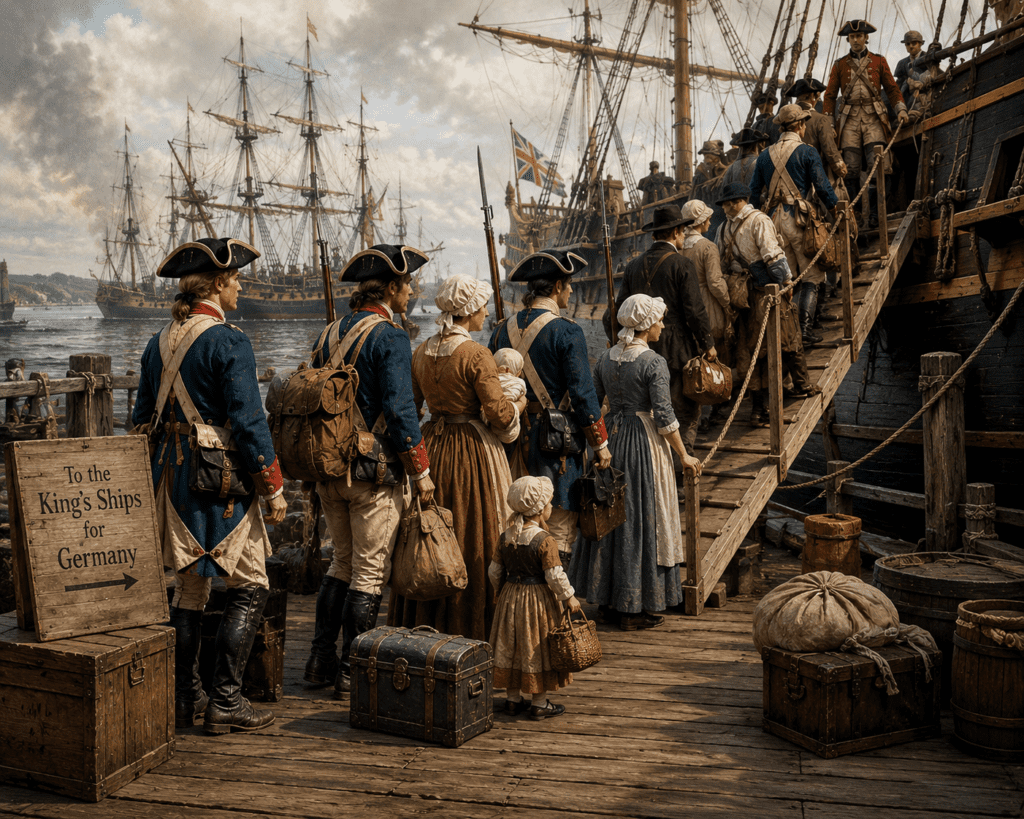
British Transport Ships Returned to New York Harbor
After the Treaty of Paris officially ended the Revolutionary War, British transport ships gathered in New York Harbor to carry German troops back across the Atlantic.
Thousands of Hessians boarded the vessels and returned to:
- Hesse-Kassel
- Brunswick
- Waldeck
- Ansbach-Bayreuth
- Other German principalities that had originally supplied soldiers to Britain
For many German troops, however, returning home no longer seemed attractive.
Thousands of Hessians Never Returned to Europe
While British authorities organized embarkation, thousands of German soldiers quietly disappeared.
Some slipped away into the countryside before departure.
Others openly remained behind with:
- Wives and children
- German-American communities
- Farming families
- Religious settlements
- Employers they had worked for during captivity
Historians estimate that between 5,000 and 6,000 German soldiers never returned to Europe at all.
Their choices became one of the defining chapters in the story of Hessians and the Birth of German America.
Why Hessians Chose to Stay in America
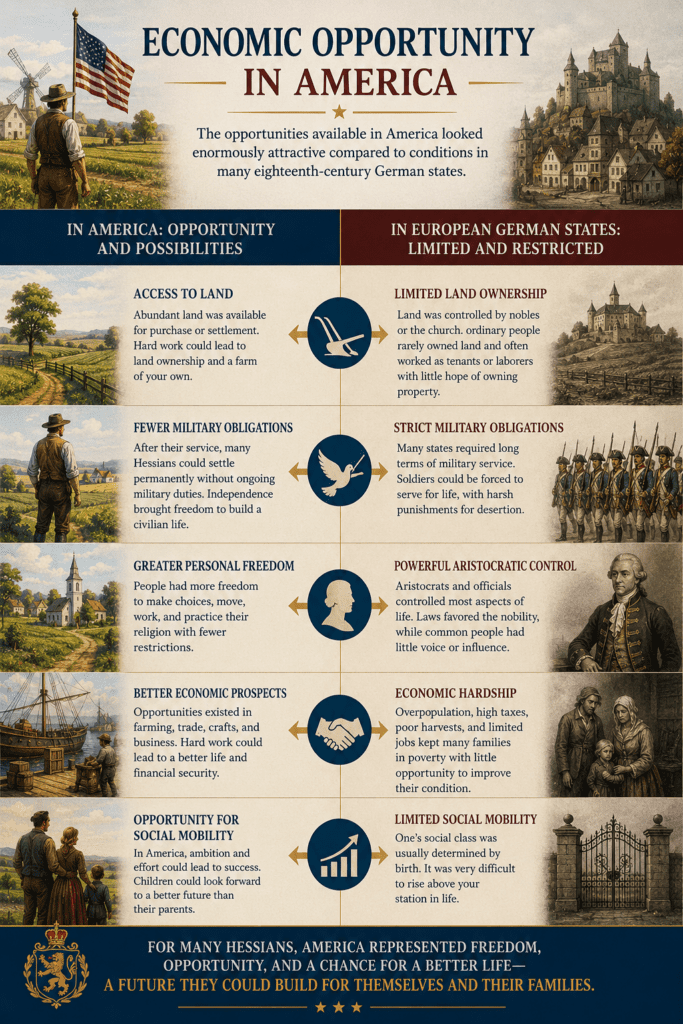
Economic Opportunity in America
The opportunities available in America looked enormously attractive compared to conditions in many eighteenth-century German states.
In Europe, many ordinary soldiers faced:
- Limited land ownership
- Strict military obligations
- Powerful aristocratic control
- Economic hardship
- Limited social mobility
In America, former Hessians discovered something very different.
What Former Hessians Found in America
Many former German soldiers found:
- Affordable farmland
- Skilled trades
- Religious freedom
- Higher wages
- Frontier opportunities
- The possibility of building independent lives
For men raised in rigid European systems, America often represented freedom and opportunity on a scale they had never experienced before.
Many Hessians who had originally arrived as subjects of European princes eventually became American farmers, craftsmen, merchants, laborers, and landowners.
Hessians and the Birth of German America in Colonial Communities
German-Speaking Communities Already Existed
Many former Hessians settled in regions where large German-speaking populations already existed.
These included:
- Pennsylvania
- Maryland
- New York
- Virginia
German churches, farms, businesses, and settlements made it easier for former soldiers to integrate into colonial life.
Some Hessians later moved farther west into frontier territories that would eventually become:
- Ohio
- Indiana
- Illinois
- Wisconsin
- Missouri
In many cases, former Hessians blended so completely into American life that their descendants eventually lost all memory of their Revolutionary War origins.
The Cultural Impact of Hessians and the Birth of German America
German Influence Spread Across the United States
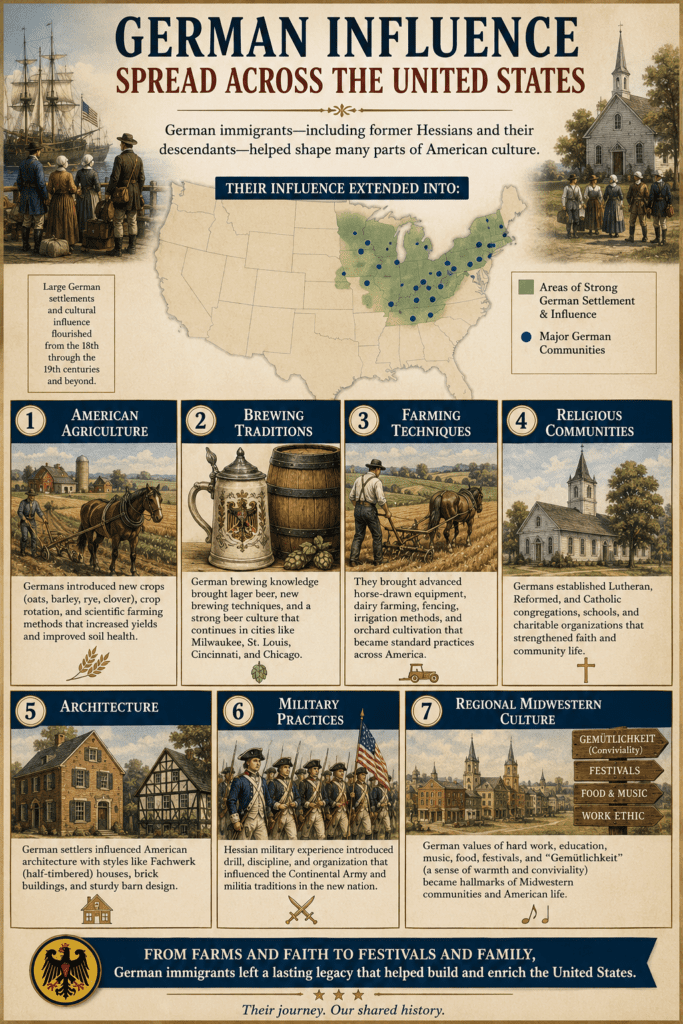
German immigrants—including former Hessians and their descendants—helped shape many parts of American culture.
Their influence extended into:
- American agriculture
- Brewing traditions
- Farming techniques
- Religious communities
- Architecture
- Military practices
- Regional Midwestern culture
By the nineteenth century, German-Americans had become one of the largest ethnic populations in the United States.
The long-term legacy of Hessians and the Birth of German America had become deeply woven into American society itself.
People Often Ask About Hessians and the Birth of German America
Did Hessian soldiers voluntarily come to America during the Revolutionary War?
Most Hessian soldiers did not individually volunteer to fight for Britain. They were members of organized German state armies leased by rulers such as the Landgrave of Hesse-Kassel to the British Crown. Many ordinary soldiers had little personal choice in the matter and served as part of formal military agreements between governments.
Why did so many Hessians stay in America after the Revolutionary War?
Many Hessians remained in America because they found greater economic opportunity, farmland, religious freedom, and social mobility than they had known in parts of eighteenth-century Germany. Some married local women joined German-speaking communities in Pennsylvania and other colonies, or simply chose not to return to rigid European military systems and aristocratic rule.
Do modern Americans descend from Hessian soldiers?
Yes. Historians estimate that between 5,000 and 6,000 German troops remained in North America after the Revolutionary War. Many settled permanently, raised families, and became part of the growing German-American population. Today, millions of Americans may unknowingly carry ancestry connected to Hessian soldiers, prisoners of war, deserters, or camp followers from the Revolutionary era.
The Hidden Legacy of Hessian Descendants
German Identity Faded During Later Wars
Ironically, anti-German sentiment during World War I and World War II later caused many families to quietly abandon visible German identity.
Across America:
- German-language newspapers disappeared
- Schools stopped teaching German dialects
- Families Anglicized surnames
- Communities reduced public German traditions
Yet the German influence never fully vanished.
Millions of Americans today unknowingly carry ancestry connected not only to later German immigration waves, but also to Hessian soldiers who first arrived during the Revolutionary War.
Modern Americans May Descend From Hessians
Some descendants today may trace their family roots to:
Hessian Prisoners Captured at Trenton
Former prisoners often remained in America after captivity ended.
Brunswick Soldiers After Saratoga
Some German troops marched south with prisoner columns and later settled permanently.
German Camp Followers
Women and families connected to Hessian regiments sometimes married local colonists and remained in America.
Hessian Deserters in Pennsylvania Communities
Some deserters vanished into Pennsylvania Dutch settlements and never returned to Europe.
The Final Legacy of Hessians and the Birth of German America
In one of history’s greatest ironies, many of the men sent by European monarchies to suppress the American Revolution ultimately became part of the nation created by that revolution.
The Hessians began the war as foreign soldiers fighting for King George III.
Many ended it as future Americans.
Their story is not only military history.
It is also the story of immigration, settlement, opportunity, and the lasting creation of German America in the United States.
What Happened to the Hessians After the Revolutionary War?
By 1783, the American Revolutionary War had finally come to an end.
For the surviving Hessian soldiers, however, an entirely different battle was beginning: the decision of whether to return home to the German states or remain permanently in America.
For many, the answer was far from simple.
The men who had first sailed into New York Harbor in 1776 were no longer the same soldiers by the war’s end. Years of campaigning, captivity, disease, hardship, and daily interaction with American colonists had profoundly changed how many Hessians viewed both Europe and the colonies.
This transformation would eventually help shape what historians now recognize as part of the story of Hessians and the Birth of German America.
German Communities Changed the Prisoner Experience
Hessians Encountered Familiar Language and Customs
In towns such as:
- Lancaster
- Reading
- Bethlehem
- Frederick
- Other Pennsylvania German communities
Hessian prisoners suddenly encountered people speaking familiar German dialects and practicing customs that reminded them of home.
This profoundly altered the experience of captivity.
Many Hessians discovered:
- Lutheran churches
- German bakeries
- Familiar foods
- German-language conversations
- Communities that felt culturally connected to their homeland
Some German-American families sympathized strongly with the prisoners and quietly assisted them during their captivity.
For many Hessians, these encounters helped lay the foundation for what would later become part of the larger story of Hessians and the Birth of German America.
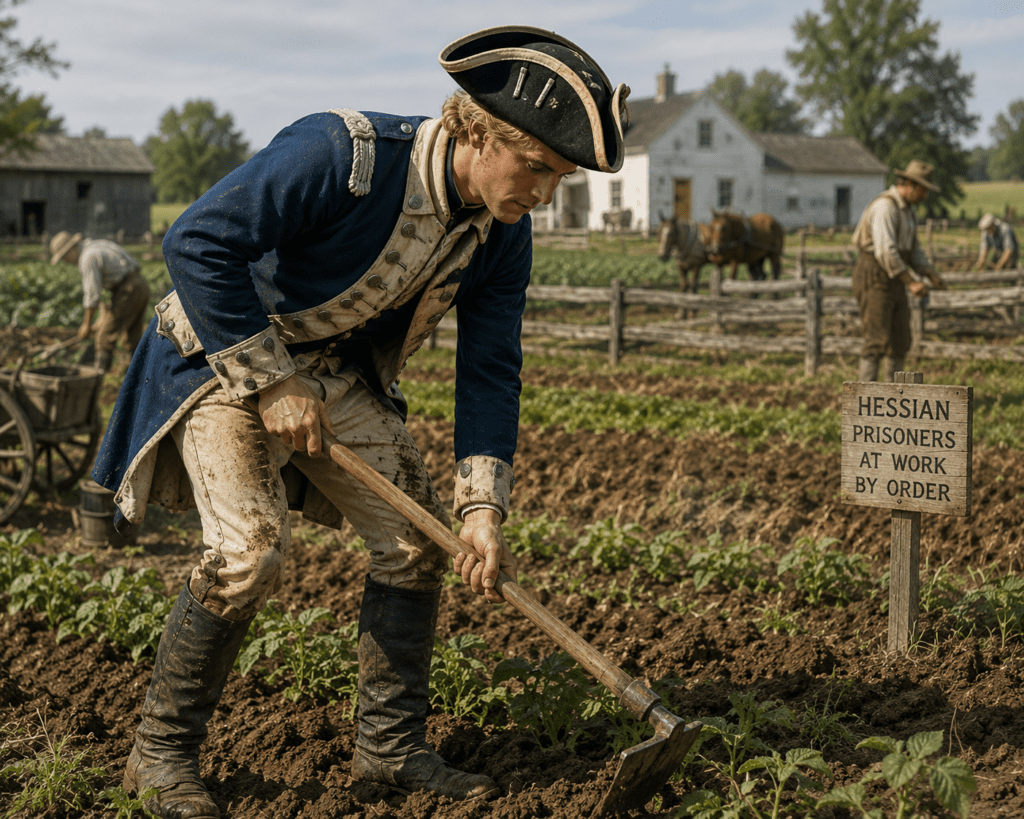
Hessian Prisoners Worked Inside Civilian Communities
Revolutionary War Captivity Often Involved Labor
Unlike later prison systems, Revolutionary War captivity frequently included labor arrangements rather than permanent confinement.
Because so many American men were away serving in the Continental Army, severe labor shortages developed across farming communities and small towns.
Captured Hessians quickly became economically valuable.
Former Hessians Worked in Skilled Trades and Farming
Farmers and tradesmen often petitioned local authorities for permission to hire Hessian prisoners as:
- Farm laborers
- Blacksmith assistants
- Carpenters
- Wagon builders
- Weavers
- General laborers
For many prisoners, these arrangements dramatically improved living conditions.
Instead of remaining inside overcrowded prison camps suffering from:
- Disease
- Poor food
- Harsh weather exposure
- Unsanitary conditions
Many Hessians worked directly within civilian communities.
Some Hessians Began Integrating Into American Life
As prisoners worked among local families and communities, many slowly began adapting to American society.
Some Hessians:
- Earned money
- Improved their English
- Attended local churches
- Formed personal relationships
- Learned trades
- Built friendships with colonists
In many cases, former prisoners effectively began integrating into American life long before the Revolutionary War officially ended.
This process became one of the defining elements of Hessians and the Birth of German America.
Desertion Became Increasingly Common
Many Hessians No Longer Wanted to Return to Europe
Not surprisingly, desertion rates among Hessian prisoners eventually became extremely high.
Once many prisoners realized that America contained:
- Abundant farmland
- German-speaking communities
- Economic opportunity
- Greater personal freedom
returning to Europe seemed far less attractive.
Hessian Prisoners Quietly Disappeared Into America
Some Hessians simply:
- Walked away from work assignments
- Disappeared into rural communities
- Changed their names
- Married local women
- Moved westward into frontier settlements
American authorities often struggled to prevent these disappearances, especially in heavily German regions where local residents sympathized with the prisoners.
Many of these deserters ultimately became part of the growing German-American population.
Hessian Officers Experienced Captivity Differently
Officers Were Often Paroled Instead of Imprisoned
Hessian officers typically experienced captivity very differently from ordinary soldiers.
Under eighteenth-century military customs, captured officers were often:
- Paroled
- Housed privately
- Allowed relative freedom of movement
- Treated according to aristocratic standards
Many officers rented homes or stayed with prominent local families while technically remaining prisoners on parole.
Hessian Officers Left Important Historical Records
Some officers used captivity as an opportunity to:
- Travel
- Write journals
- Study American society
- Correspond with Europe
These detailed writings now provide historians with some of the most valuable firsthand descriptions of Revolutionary America.
Today, many of those journals remain essential historical sources for understanding not only the Revolutionary War itself, but also the larger story of Hessians and the Birth of German America.
Hessians and the Birth of German America After 1783
The Return Ships Gathered in New York Harbor
After the Treaty of Paris formally ended the Revolutionary War, British transport ships assembled in New York Harbor to carry German troops back across the Atlantic.
Thousands of Hessian soldiers boarded those vessels and returned to:
- Hesse-Kassel
- Brunswick
- Waldeck
- Ansbach-Bayreuth
- Other German principalities that had leased troops to Britain
For many soldiers, the voyage home represented a return to military obligations, rigid social structures, and limited economic opportunity.
Others never boarded the ships at all.
Thousands of Hessians Disappeared Into America
As embarkation preparations began, thousands of German soldiers quietly vanished.
Some slipped away into the countryside before departure.
Others openly remained behind with:
- Wives and children
- German-American communities
- Former employers
- Farming families
- Religious settlements
Historians estimate that between 5,000 and 6,000 German troops never returned to Europe.
Their decision became one of the most important chapters in the larger story of Hessians and the Birth of German America.
Why Many Hessians Chose to Stay in America
America Offered Opportunity Many Had Never Known
The opportunities available in America remained enormously attractive compared to conditions in many eighteenth-century German states.
In Europe, many ordinary soldiers faced:
- Limited land ownership
- Strict military obligations
- Powerful aristocratic systems
- Restricted economic mobility
- Heavy taxation
- Few opportunities for advancement
America appeared radically different.
Former Hessians discovered:
- Affordable farmland
- Higher wages
- Skilled trades
- Religious freedom
- Expanding frontier settlements
- Greater social mobility
For many soldiers, America represented something almost revolutionary in itself: the possibility of controlling their own future.
German Communities Already Existed in America
Large German-speaking communities already existed throughout parts of the colonies before the Revolutionary War.
Many former Hessians settled in:
- Pennsylvania
- Maryland
- New York
- Virginia
These areas already contained strong German cultural and religious communities that made integration easier.
Some former soldiers later migrated westward into frontier regions that would eventually become:
- Ohio
- Indiana
- Illinois
- Wisconsin
- Missouri
In many cases, former Hessians blended so completely into American society that later generations lost all memory of their Revolutionary War origins.
Hessians and the Birth of German America in the Expanding Frontier
Former Soldiers Became Farmers, Craftsmen, and Merchants
Many Hessians who originally arrived as soldiers of European princes eventually became American citizens and settlers.
Former German troops established lives as:
- Farmers
- Blacksmiths
- Laborers
- Merchants
- Craftsmen
- Wagon makers
- Frontier settlers
Some even participated in later American conflicts or helped expand settlements farther west into the growing frontier.
Over time, their descendants became fully woven into the developing American population.
German Influence Spread Across America
The cultural impact of German immigrants—including former Hessians—became enormous.
German-Americans helped shape:
- American agriculture
- Brewing traditions
- Farming methods
- Architecture
- Religious communities
- Military traditions
- Regional culture throughout Pennsylvania and the Midwest
By the nineteenth century, German-Americans had become one of the largest ethnic populations in the United States.
The legacy of Hessians and the Birth of German America had become deeply embedded in the nation itself.
The Hidden Legacy of Hessian Descendants
Many Families Lost Their German Identity Over Time
Ironically, anti-German sentiment during World War I and World War II later caused many families to quietly distance themselves from visible German identity.
Across the United States:
- German-language newspapers disappeared
- Schools stopped teaching German dialects
- Communities abandoned German customs
- Families anglicized their surnames
Yet the German influence never truly vanished.
Today, millions of Americans unknowingly carry ancestry connected not only to later waves of German immigration but also to Hessian soldiers who first arrived during the Revolutionary War.
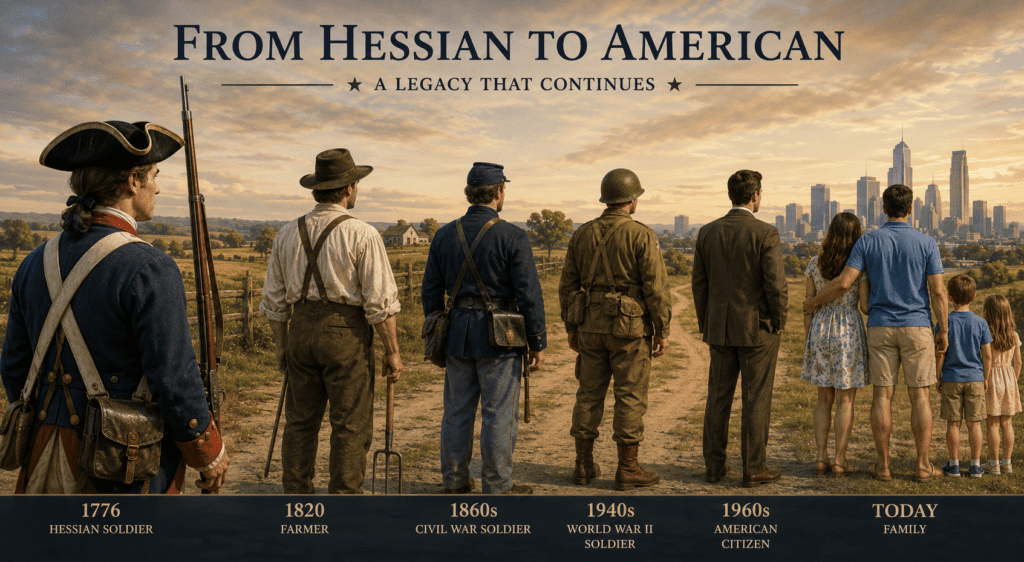
Some Americans Today Descend From Hessians
Modern descendants may trace their roots to:
- Hessian prisoners captured at Trenton
- Brunswick troops marched south after Saratoga
- German camp followers who married colonists
- Hessian deserters who disappeared into Pennsylvania Dutch communities
In one of history’s greatest ironies, many of the men sent by European monarchies to suppress the American Revolution ultimately became part of the very nation created by that revolution.
The Final Legacy of Hessians and the Birth of German America
The Hessians began the Revolutionary War as foreign soldiers fighting for King George III and the British Empire.
Many ended the war as future Americans.
Their story is not simply one of military history.
It is also an immigration story, a frontier story, and a deeply human story about opportunity, survival, and transformation in Revolutionary America.
References
The RetireCoast Hessians in the American Revolution series draws from battlefield organizations, museum resources, genealogy collections, military archives, and historical research focused on German soldiers, prisoners, settlers, and families connected to the Revolutionary War.
- FamilySearch — Hessian Soldiers
- Franklin & Marshall College Archives — Johannes Schwalm Historical Association Collection
- FamilySearch Catalog — Journal of the Johannes Schwalm Historical Association
- Journal of the American Revolution — The Hessians: Journal of the Johannes Schwalm Historical Association
The Complete RetireCoast Historical Series
FAQ
[faq _5]
This series about the Hessians in the American Revolution is just one part of the much larger RetireCoast 250th Anniversary historical project celebrating the birth of the United States.
We invite you to continue exploring our growing collection of Revolutionary War articles covering battles, weapons, ships, camp followers, frontier life, hidden history, and the people who shaped the American story.
Discover more from RetireCoast.com
Subscribe to get the latest posts sent to your email.