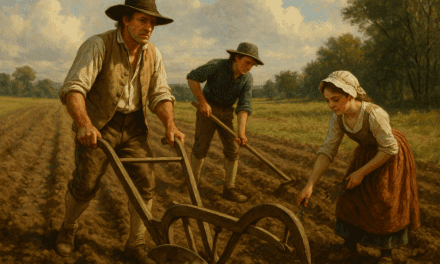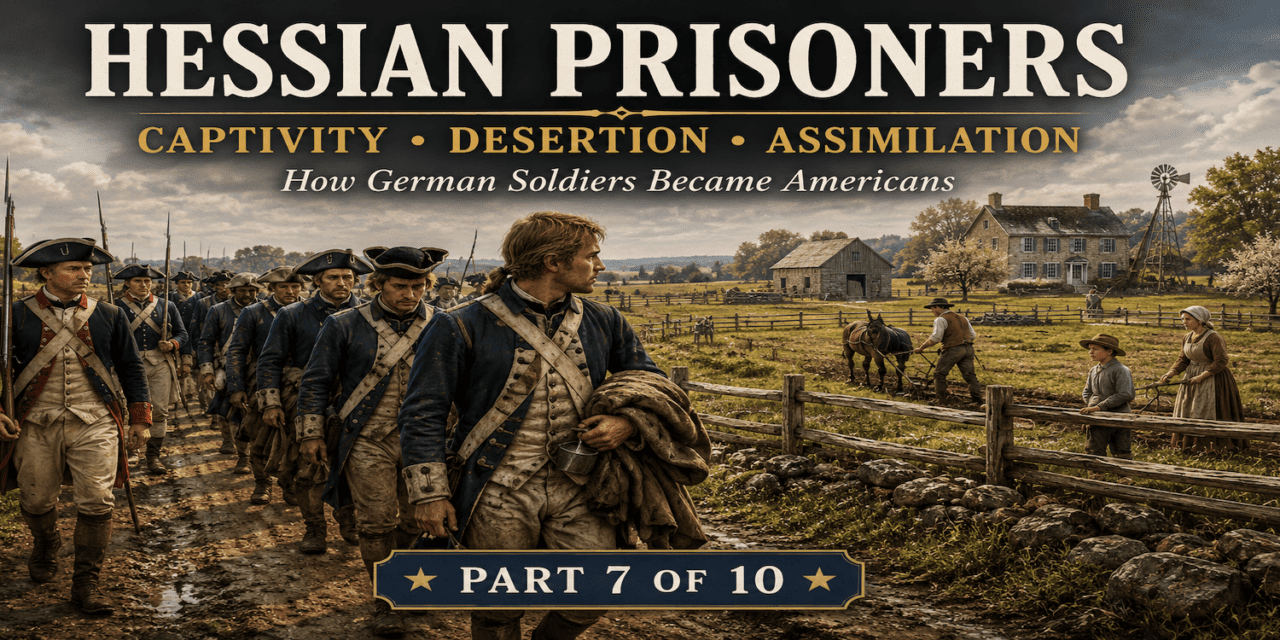
The story of Hessian prisoners is one of the most remarkable and unexpected chapters of the American Revolution. Thousands of German soldiers who arrived in America under British command never returned home. Instead, many eventually became part of the new nation they had been sent to defeat.
From Battlefield Captives to Prisoners of War
The capture of large numbers of Hessian prisoners at Trenton, Saratoga, and other battles created a challenge for the Continental Congress and the individual states. These men had to be guarded, housed, fed, and transported across hundreds of miles of American territory.
Their experiences would be very different from what they expected when they first crossed the Atlantic.
- From Battlefield Captives to Prisoners of War
- Life as Hessian Prisoners in America
- How German Soldiers Became Americans
- Where Were Hessian Prisoners Held During the American Revolution?
- Major Hessian Prison Camps and Depots
- Understanding the Convention Army
- Life and Conditions for Hessian Prisoners
- Why So Few Hessian Prisoners Died in American Captivity
- The Dangers of Long Prisoner Marches
- The Labor System That Saved Lives
- The Influence of German-American Communities
- Death, Desertion, and Disappearing Prisoners
- Were British Soldiers and Hessian Prisoners Kept Separate?
- The Convention Army and the First Major Separation
- Geographic Separation Across the Colonies
- Tensions Between British and Hessian Prisoners
- The American Strategy to Encourage Hessian Desertion
- Different Treatment for Officers
- The Long-Term Result
- Did Wives and Children Accompany Hessian Prisoners?
- When Hessian Prisoners Entered Captivity
- The Difficult Marches Into the Interior
- Creating Homes Inside the Prison Camps
- The Different Experience of Officers’ Families
- Why Families Encouraged Hessian Assimilation
- Could the Wives of Hessian Prisoners Leave the Camps and Find Work?
- Freedom of Movement Beyond the Barracks
- Employment Opportunities in Local Communities
- Laundresses, Seamstresses, and Skilled Workers
- Nursing and Medical Knowledge
- Economic Independence and Assimilation
- Assimilation: When Hessian Prisoners Became Americans
- The Blacksmith’s Apprentice: John Peter Shindel
- The Baker of York: John Conrad Diel
- Why Assimilation Happened So Easily
- Congress Encouraged Hessian Assimilation to Secure the American Frontier
- Why Hessian Prisoners Appealed to Congress
- Land as a Tool of Assimilation
- Why Hessians Were Ideal Frontier Settlers
- The Role of German-American Communities
- The Long-Term Impact on America
- Did Hessian Prisoners Keep Their German Last Names After Assimilation?
- Keeping German Names Intact
- The Problem of English Record Keepers
- Anglicizing German Surnames
- Translating Names Into English
- Hiding a Foreign Identity
- First Names Changed Even Faster
- Tracing Hessian Descendants Today
- How Long Did Hessian Families Continue Speaking German in America?
- The First Generation: German-Speaking Hessian Veterans
- The Second Generation: Growing Up Bilingual
- The Third Generation: Where German Often Faded
- Why German Faded Faster on the Frontier
- The Pennsylvania Dutch Exception
- How Many Hessians Actually Stayed in America?
- Where Did Former Hessians Settle?
- Places Where Hessian History Can Still Be Seen Today
Life as Hessian Prisoners in America
Many Hessian prisoners spent months or even years in captivity. Some lived in prison camps, while others were assigned to work details or temporarily placed with local farmers. During this time, they gained a firsthand view of American life, society, and economic opportunity.
Discovering a Different World
For many German soldiers, captivity provided their first close contact with ordinary American families. They observed prosperous farms, abundant land, and a level of personal freedom that often exceeded what they had known in parts of Europe. These experiences would influence thousands of decisions made after the war ended.
Desertion, Freedom, and New Beginnings
Not every Hessian waited for formal release before seeking a new life. Some deserted during captivity, while others remained after their military obligations ended. The growing number of former Hessian prisoners who chose to stay would help shape the future population of the United States.
How German Soldiers Became Americans
By the end of the Revolution, thousands of former Hessian prisoners had settled permanently in North America. They became farmers, craftsmen, laborers, merchants, and community leaders. Their descendants would contribute to the growth of the young republic for generations to come.
What This Chapter Covers
This chapter follows the journey of Hessian prisoners from capture on the battlefield to life in prison camps and settlements across America. It explores captivity, desertion, parole, prisoner exchanges, and assimilation into American society.
Most importantly, it reveals how a wartime experience ultimately transformed many German soldiers into American citizens.
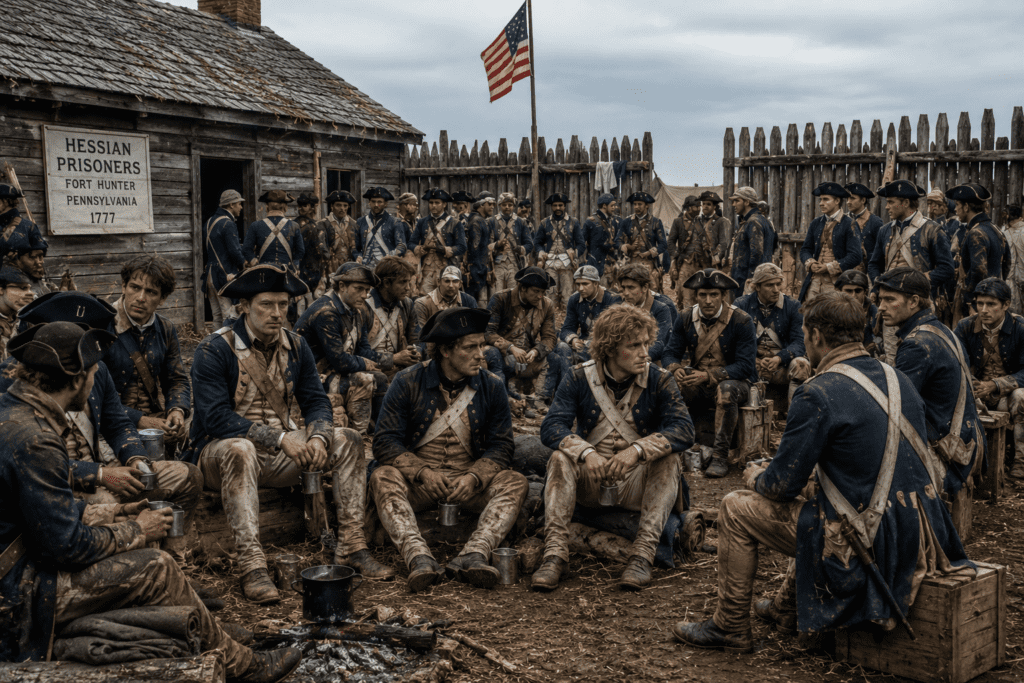
Where Were Hessian Prisoners Held During the American Revolution?
The capture of thousands of Hessian prisoners created a major logistical challenge for the Continental Congress. Because the United States had no centralized prison system, captured German soldiers were dispersed throughout the interior colonies.
The goal was to keep them far from British forces while placing them in communities capable of housing, feeding, and supervising them.
The Strategy Behind Distributing Hessian Prisoners
American leaders understood that concentrating large numbers of Hessian prisoners near the front lines increased the risk of escape or rescue.
As a result, prisoners were marched hundreds of miles inland to secure locations in Pennsylvania, Maryland, and Virginia. Many of these areas already had large German-speaking populations, making communication and supervision easier.
📝 Test Your Knowledge: Hessian Prisoners, Captivity, and Assimilation
Answer Key
- To keep them far from British rescue attempts and spread the burden of supporting them
- Lancaster
- Many were allowed to work on farms and live outside overcrowded camps
- The Americans wanted to reduce conflicts and encourage Hessian desertion
- They performed essential tasks such as cooking, laundry, sewing, and nursing
- Johannes Schwalm
- To provide settlers for the western frontier and strengthen American claims to the land
- Some remained unchanged while others were anglicized or translated into English
- Third generation
- 3,000–5,000
Major Hessian Prison Camps and Depots
Lancaster, Pennsylvania: The Primary Prisoner Hub
Lancaster became the most important center for Hessian prisoners during the war. Following the American victories at Trenton and Saratoga, thousands of captured German soldiers were marched into the town. Lancaster’s size, resources, and distance from the fighting made it an ideal location for prisoner management.
The Lancaster Barracks
Many prisoners were initially housed in the Lancaster Barracks, a large military complex originally built during the French and Indian War. The barracks provided organized housing for soldiers and officers. As prisoner numbers increased, however, the facilities quickly became overcrowded.
Camp Security
To accommodate the overflow, authorities constructed Camp Security in nearby York County. This stockaded prison camp became one of the largest prisoner-of-war facilities in North America during the Revolution. Thousands of Hessian prisoners passed through its gates over the course of the war.
Reading, Pennsylvania: The Hessian Camp
Reading housed a substantial population of Hessian prisoners, especially those captured with General John Burgoyne’s army after Saratoga. Prisoners were quartered in log huts constructed on the slopes of Mount Penn. The location became so closely associated with the Germans that it is still remembered locally as “The Hessian Camp.”
Living Among German Americans
Berks County contained one of the largest German-speaking populations in colonial America. Many prisoners found that local residents spoke dialects similar to their own. This familiarity helped some Hessians secure work on farms, in iron furnaces, and in local trades.
Frederick, Maryland: The Hessian Barracks
In 1777, Maryland authorized the construction of a permanent stone barracks complex in Frederick specifically for prisoners of war. Hundreds of Hessian prisoners captured at Trenton and later transfers from the Saratoga Convention Army were held there.
The substantial stone structures offered greater security and comfort than many temporary prison camps.
A More Permanent Facility
Unlike wooden stockades found elsewhere, the Frederick barracks were designed as long-term military housing. Local militia units guarded the prisoners while overseeing daily operations. The site became one of the most important prisoner centers in the Mid-Atlantic colonies.
Charlottesville, Virginia: The Albemarle Barracks
By 1779, Congress faced mounting costs associated with maintaining thousands of captured soldiers in the North. To reduce military risks and spread the burden of feeding prisoners, the Convention Army was marched south to Virginia. There, British and Hessian prisoners occupied a vast cantonment known as the Albemarle Barracks.
A Massive Prison Community
The settlement consisted largely of hastily constructed log cabins spread across the Virginia countryside. Thousands of prisoners lived there between 1779 and 1781. Fears of a British rescue operation eventually prompted authorities to relocate many of them back toward Maryland and Pennsylvania.
Winchester, Virginia: The Mount Hebron Barracks
Another important holding site for Hessian prisoners was located near Winchester in Virginia’s Shenandoah Valley. Prisoners lived in log barracks and were frequently hired out to local landowners.
Their labor contributed to farms, roads, and stone structures throughout the region.
Working in the Valley
Many Hessians became skilled laborers while in captivity. Farmers and craftsmen benefited from the additional workforce during a period of wartime shortages. Some structures associated with this labor still survive in the Shenandoah Valley today.
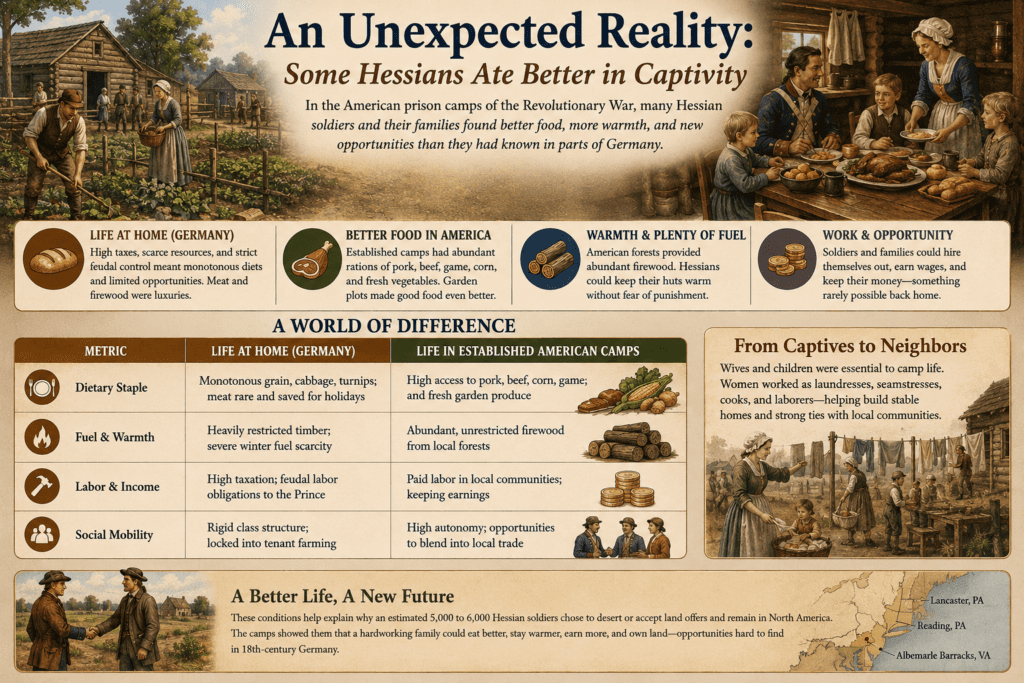
To modern readers, it may seem impossible that a prisoner-of-war camp could offer advantages over life at home. Yet for many Hessian soldiers and their families, the established prison camps of Pennsylvania, Maryland, and Virginia eventually provided more reliable food, fuel, and economic opportunity than they had known in parts of Germany.
Back in Hesse-Cassel and other German states, many ordinary people lived under a rigid feudal system marked by high taxes, limited access to land, scarce firewood, and diets dominated by rye bread, cabbage, and turnips. Meat was often reserved for special occasions, and gathering wood from the prince's forests could result in severe punishment.
By contrast, once the American camps became established, many Hessian prisoners were allowed to cultivate gardens, work for local farmers and craftsmen, and supplement their rations with abundant agricultural products. Pork, beef, game, corn, and fresh vegetables were often far more available than they had been in their homeland.
The difference extended beyond food. America’s forests provided plentiful firewood, local employers paid wages that families could keep, and wives often found work outside the camps. For soldiers accustomed to feudal obligations and limited social mobility, the American countryside sometimes appeared less like imprisonment and more like an opportunity.
This surprising contrast helps explain why thousands of Hessian soldiers ultimately chose to remain in North America after the war. The prison camps unintentionally introduced them to a society where a hardworking family could often eat better, stay warmer, earn more, and own land—possibilities that were difficult to imagine in much of eighteenth-century Germany.
Understanding the Convention Army
Not all Hessian prisoners were treated in exactly the same way. Soldiers captured at Trenton were considered traditional prisoners of war. Those captured with Burgoyne’s army at Saratoga became part of a special category known as the Convention Army.
Why the Convention Army Remained in Captivity
The Saratoga surrender agreement originally called for the captured troops to return to Europe under certain conditions. British authorities ultimately failed to satisfy Congress that these soldiers would not reenter the war. As a result, thousands of British and German prisoners remained in America for years.
A Long Journey Across the Colonies
Members of the Convention Army were repeatedly moved as military conditions changed. Their travels carried them through Connecticut, New York, Pennsylvania, Maryland, and Virginia. Few prisoners experienced more of colonial America than these captured German soldiers.
Life and Conditions for Hessian Prisoners
Compared with the horrific conditions endured by Americans aboard British prison ships such as the Jersey, many Hessian prisoners experienced relatively humane treatment.
Food shortages existed, but prisoners often enjoyed opportunities unavailable in many European military prisons. These policies reflected both practical necessity and American political strategy.
The Labor and Parole System
The Continental Congress struggled financially throughout the war. Allowing prisoners to work reduced the government’s costs while providing needed labor to local communities. This arrangement became one of the defining features of Hessian captivity.
Working for Farmers and Craftsmen
Officers frequently arranged employment for enlisted men on farms, in workshops, and at industrial sites. Prisoners earned wages while helping local businesses and landowners. The system also gave many Germans firsthand exposure to American economic opportunities.
Social Integration and Community Life
In communities such as Lancaster and Reading, Hessian prisoners often interacted regularly with German-American settlers. Many attended Lutheran and Reformed church services alongside local residents. These shared cultural and linguistic ties made assimilation far easier than American leaders had anticipated.
The Path to Becoming Americans
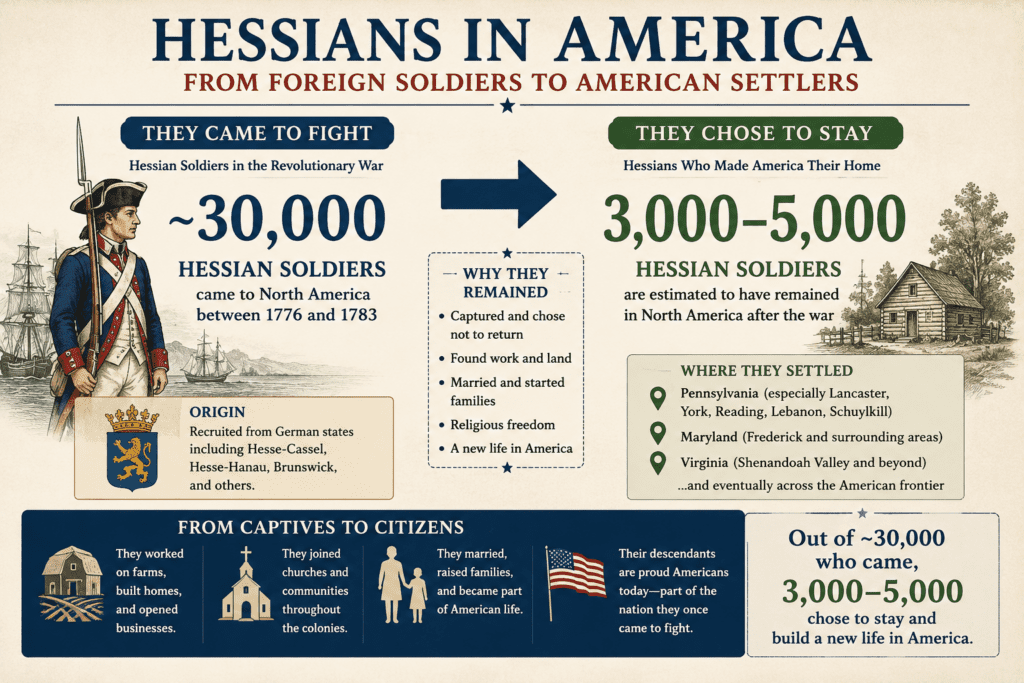
Congress actively encouraged desertion through German-language propaganda promising land and opportunity. Thousands of Hessians eventually chose not to return to Europe after the war.
Historians estimate that between 3,000 and 5,000 former German soldiers remained permanently in North America, blending into the communities where they had once been held as prisoners.
Why So Few Hessian Prisoners Died in American Captivity
Compared to the devastating mortality rates suffered by American prisoners held by the British, relatively few Hessian prisoners died while in American captivity.
Their experience was dramatically different from that of Americans confined aboard British prison ships such as the infamous HMS Jersey, where disease, starvation, and overcrowding claimed thousands of lives.
Although complete records do not exist for every prisoner, historians generally agree that the survival rate among captured Hessians was remarkably high.
George Washington’s Policy of Humane Treatment
The relatively low mortality rate among Hessian prisoners was not an accident. George Washington and the Continental Congress recognized that humane treatment could encourage desertion and weaken British military strength.
By treating German prisoners fairly, American leaders hoped to persuade some of them that their future might be better in America than in service to the British Crown.
Common Causes of Death
When deaths did occur among Hessian prisoners, they were usually caused by the same diseases that plagued all eighteenth-century armies. Smallpox, dysentery, typhus, and other infectious illnesses remained constant threats throughout the war.
Systematic starvation and deliberate mistreatment, however, were far less common than in many contemporary prisoner systems.
The Dangers of Long Prisoner Marches
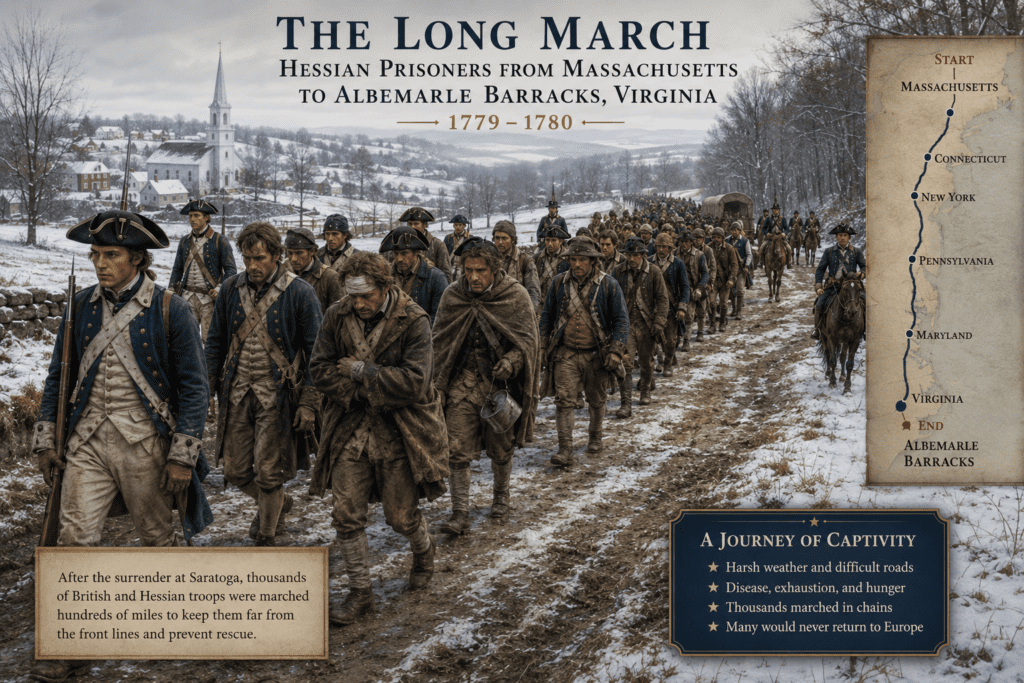
The most difficult periods for many Hessian prisoners occurred during long transfers between prison camps. Thousands of German soldiers were marched hundreds of miles through harsh weather and difficult terrain as military conditions changed.
Exposure, exhaustion, and inadequate supplies occasionally took a heavy toll, especially on older, wounded, or already sick prisoners.
The Convention Army’s Journey South
One of the most challenging movements involved the Convention Army captured at Saratoga. Thousands of British and German prisoners were marched from New England to the Albemarle Barracks near Charlottesville, Virginia. The lengthy journey exposed many prisoners to severe winter conditions and significant physical hardship.
Conditions Improved in Permanent Camps
Once Hessian prisoners reached established facilities such as Lancaster, Reading, or Frederick, conditions generally improved.
Access to farmland, fresh water, and more permanent housing reduced many of the health risks associated with military campaigning. Mortality rates often declined significantly after prisoners settled into these long-term locations.
The Labor System That Saved Lives
One reason so many Hessian prisoners survived captivity was the American labor-release system. Rather than keeping thousands of men confined in overcrowded camps, authorities frequently allowed prisoners to work for local farmers, craftsmen, and industrial employers.
This arrangement benefited both the prisoners and the struggling wartime economy.
Better Food and Better Living Conditions
Prisoners assigned to farms often ate the same food as the families they worked for. Fresh vegetables, meat, dairy products, and locally grown crops provided far better nutrition than standard military rations. Many also enjoyed cleaner and less crowded living conditions than those found in traditional prison compounds.
Life Beyond the Barracks
Some Hessian prisoners lived in barns, farmhouses, workshops, or private quarters rather than crowded stockades. This reduced the spread of disease and improved overall health. The system effectively dispersed thousands of prisoners throughout local communities instead of concentrating them in large camps.
The Influence of German-American Communities
Many Hessian prisoners found themselves living among German-speaking settlers in Pennsylvania and Maryland. These communities shared similar languages, religious traditions, and cultural customs. As a result, prisoners often experienced a level of acceptance uncommon in wartime captivity.
The Pennsylvania Dutch Connection
The so-called Pennsylvania Dutch were actually descendants of German-speaking immigrants whose word “Deutsch” was misunderstood as “Dutch.” Many prisoners could communicate easily with local residents and attend familiar Lutheran or Reformed church services.
These cultural connections helped transform captivity into something closer to temporary relocation.
Assistance from Local Families
German-American communities frequently provided clothing, blankets, food, and other necessities to Hessian prisoners. Local residents often viewed the captured Germans as fellow countrymen rather than dangerous enemies. These relationships contributed significantly to the prisoners’ overall survival and eventual assimilation.
Death, Desertion, and Disappearing Prisoners
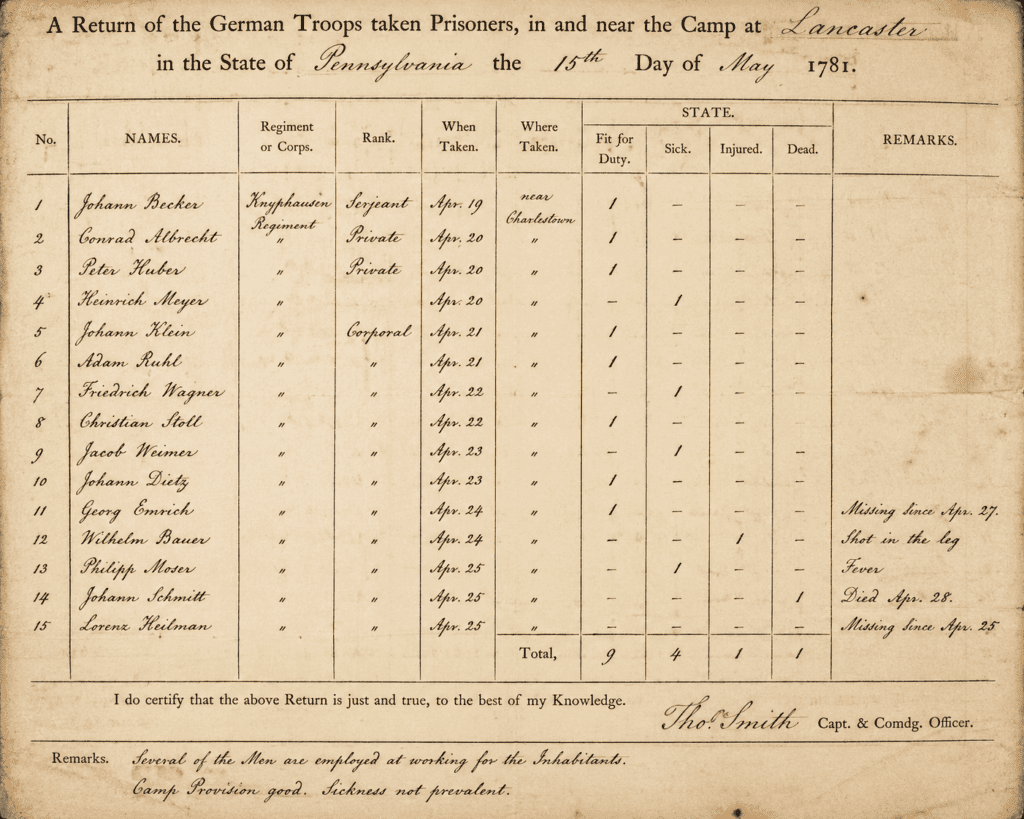
One challenge historians face when studying Hessian prisoners is distinguishing between actual deaths and successful desertions. Camp records sometimes listed prisoners as missing without clearly indicating whether they had died, escaped, or simply disappeared into the local population. This makes exact mortality figures difficult to calculate.
Congress Encouraged Desertion
The Continental Congress actively distributed German-language propaganda designed to persuade prisoners to abandon British service. Flyers promised land, opportunity, and freedom to those willing to remain in America. Security at many camps was relatively light, making escape a realistic option for motivated prisoners.
Choosing America Over Germany
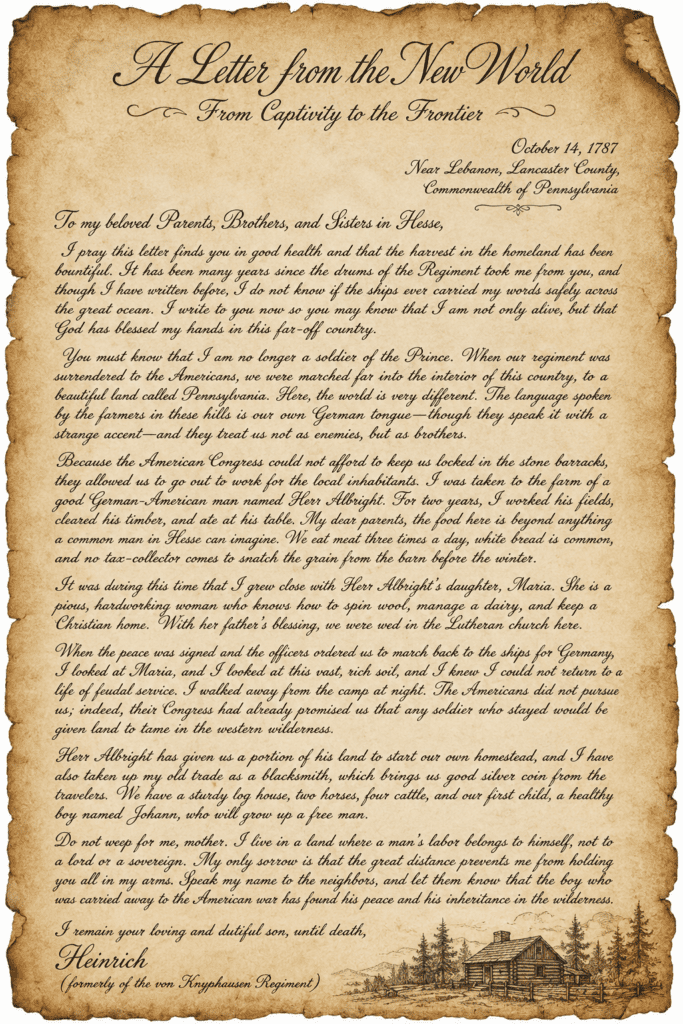
By the end of the war, between 3,000 and 5,000 German soldiers chose not to return to Europe. Many former Hessian prisoners married local women, purchased farms, learned trades, or joined established German-American communities. In countless cases, a prisoner listed as “missing” had not died at all—he had simply begun a new life in America.
Were British Soldiers and Hessian Prisoners Kept Separate?
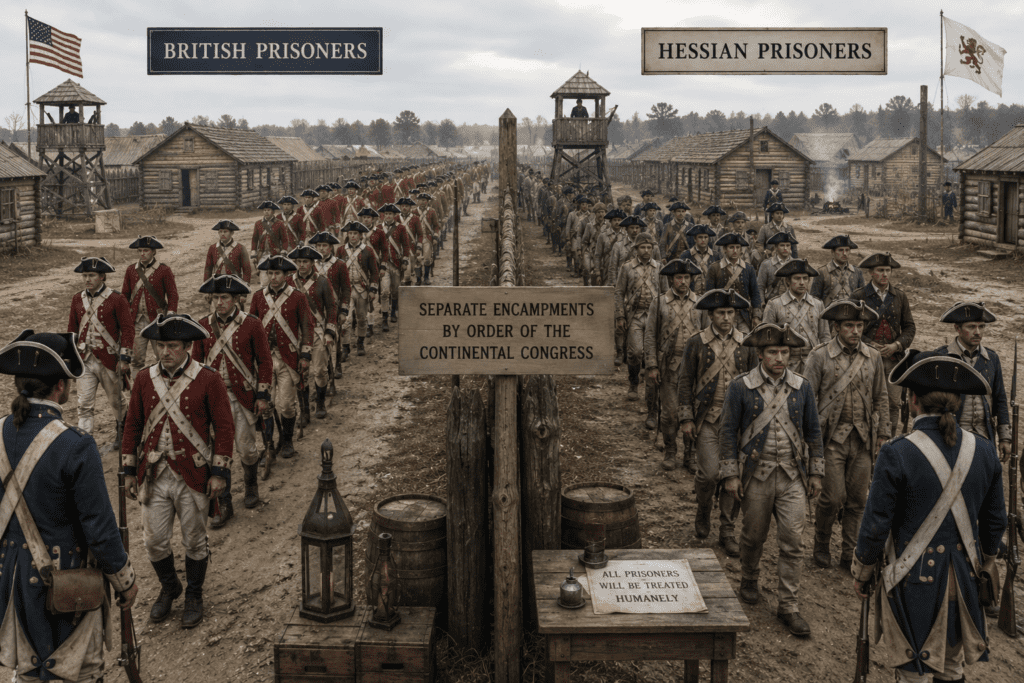
Yes. American military authorities made a deliberate effort to separate Hessian prisoners from captured British regulars whenever possible. Although they were often captured together at battles such as Trenton and Saratoga, the Continental Congress quickly concluded that keeping the two groups together created unnecessary problems.
As a result, separation became standard prisoner-management policy throughout much of the war.
Why the Americans Separated the Prisoners
American leaders viewed British soldiers and Hessian prisoners very differently. British regulars represented the primary enemy force, while many Hessians were seen as potential deserters and future settlers. Separating the two groups increased security while supporting broader American political goals.
The Convention Army and the First Major Separation
The largest test of this policy involved the Convention Army captured at Saratoga in 1777. Thousands of British and German prisoners were marched together through the colonies and eventually housed at the Albemarle Barracks near Charlottesville, Virginia. Even there, however, the Americans established strict divisions between the two national groups.
Separate Sections Within the Same Camp
The Albemarle Barracks functioned as one large prisoner cantonment, but British troops occupied one section while the Germans occupied another. Each side maintained separate administrative systems and internal organization. This arrangement reduced conflict while making supervision easier for American authorities.
Dividing the Captured Armies
American officials understood that national rivalries often intensified during captivity. Maintaining physical separation helped prevent disorder and reduced tensions between the prisoners. The policy would later expand into complete geographic separation across multiple colonies.
Geographic Separation Across the Colonies
As the war continued, the Americans increasingly distributed British soldiers and Hessian prisoners to entirely different locations. This strategy reduced the possibility of coordinated escapes and weakened the cohesion of the captured armies. By the final years of the war, many prisoners rarely had contact with members of the other nationality.
British Prisoners Sent South
Large numbers of British regulars were eventually concentrated in locations such as Frederick, Maryland, and Winchester, Virginia. These sites became major holding areas for British prisoners from the Convention Army. American authorities believed these locations provided effective supervision while keeping the soldiers away from active military operations.
Hessian Prisoners Sent to German Communities
Meanwhile, many Hessian prisoners were transferred to Lancaster, Reading, and other regions of Pennsylvania with significant German-speaking populations. These communities provided familiar language, culture, and religious traditions. The placement would have long-term consequences for Hessian assimilation into American society.
Tensions Between British and Hessian Prisoners
One reason for the separation was the strained relationship between British regulars and their German allies. Although they fought on the same side during the war, the two groups frequently viewed one another with suspicion and resentment. Captivity often made those tensions even worse.
Mutual Distrust and Blame
British soldiers sometimes blamed the Hessians for military setbacks, particularly the embarrassing defeat at Trenton. Many Hessians, in turn, believed British commanders treated them as expendable frontline troops. These grievances frequently led to arguments, fights, and disciplinary problems within mixed camps.
Easier for American Guards
Keeping British soldiers and Hessian prisoners apart reduced the burden on American guards. Fewer conflicts meant fewer resources were needed to maintain order. The policy also prevented national rivalries from disrupting camp operations.
The American Strategy to Encourage Hessian Desertion
The most important reason for separation involved desertion and assimilation. American leaders believed many Hessian prisoners could be persuaded to abandon British service permanently. That goal became much easier when the Germans were isolated from British officers and loyalist influences.
Removing British Influence
British officers actively discouraged desertion and tried to maintain loyalty among the German troops. By separating the prisoners, the Americans removed much of that pressure. Hessians living among German-American communities could more easily imagine a future outside military service.
A Path Toward Assimilation
In places such as Lancaster and Reading, Hessian prisoners attended local churches, worked on farms, and interacted daily with German-speaking settlers. Many eventually married local women or established trades within the community. The separation policy transformed captivity from a temporary military status into a pathway toward permanent settlement.
Different Treatment for Officers
The separation policy also extended to the officer corps. British officers were frequently granted parole and sometimes exchanged or returned to British-controlled territory. Hessian officers, however, were generally kept near their German troops to help maintain discipline and order.
Respect for Hessian Officers
American authorities often regarded Hessian officers as educated professionals and treated them with considerable respect. Even so, they remained separate from British command structures throughout captivity. This further weakened the connection between the captured German soldiers and the British military establishment.
The Long-Term Result
By separating British regulars from Hessian prisoners, the Americans successfully weakened the unity of the captured armies. Many British soldiers spent their captivity waiting for exchange or release and remained committed to returning home.
Thousands of Hessian prisoners, however, gradually became part of the communities where they lived, worked, worshipped, and ultimately settled after the war.
People Also Ask About Hessian Prisoners
Were Hessian prisoners allowed to work while in captivity?
Yes. Many Hessian prisoners were hired out to local farmers, blacksmiths, ironmasters, and craftsmen while in American custody. This labor system helped reduce the cost of maintaining prisoners while giving many Germans exposure to American life and economic opportunities.
Why did so many Hessian prisoners stay in America after the war?
Thousands of Hessian prisoners discovered that America offered opportunities that were difficult to find in many German states. Access to land, higher wages, religious freedom, and the presence of German-speaking communities encouraged between 3,000 and 5,000 former Hessians to remain in North America after the Revolutionary War.
Did British soldiers and Hessian prisoners get along in captivity?
Often they did not. Many British soldiers viewed the Hessians as foreign mercenaries, while many Hessian prisonersbelieved British commanders treated them unfairly during the war. To reduce conflicts and encourage desertion from British service, American authorities frequently housed British and German prisoners in separate camps and communities.
Did Wives and Children Accompany Hessian Prisoners?
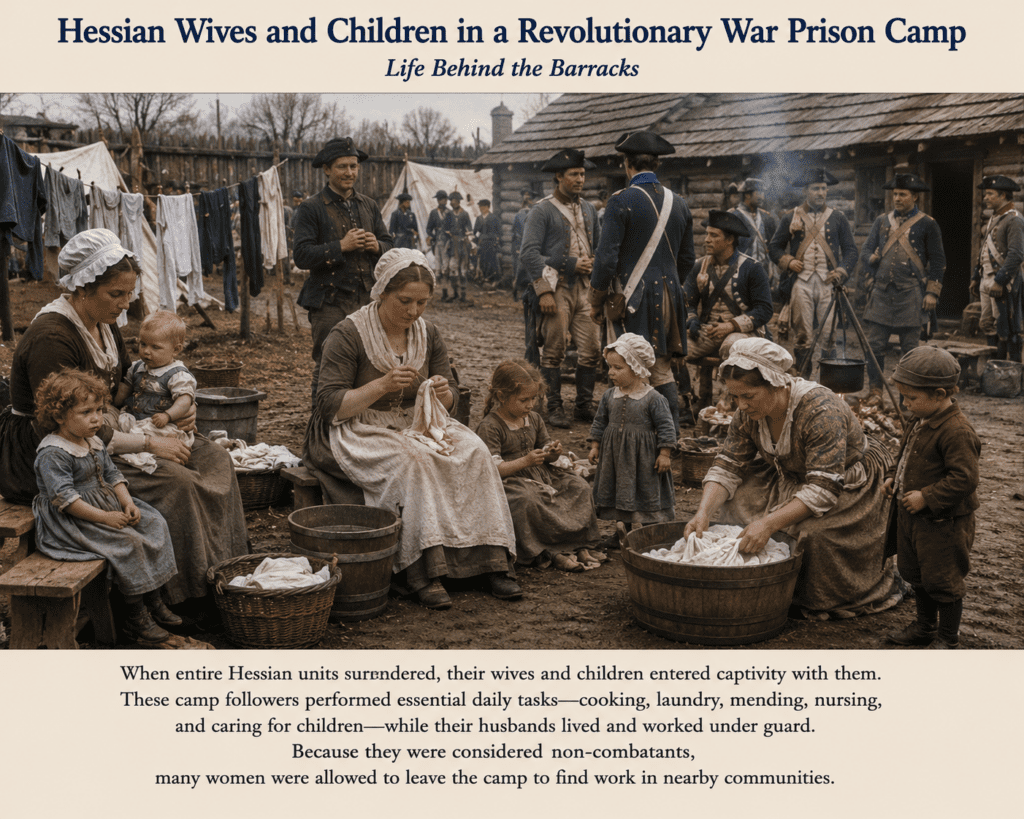
Yes. Thousands of women and children accompanied the German armies to North America during the American Revolution. When large numbers of Hessian prisoners were captured, many of these families entered captivity alongside their husbands, fathers, and relatives.
The Military Role of Camp Followers
In the eighteenth century, European armies depended heavily on civilians known as camp followers. These women performed essential services that modern armies would assign to medical, supply, and support units. Without them, many military operations would have struggled to function effectively.
Official Members of the Military Community
Most camp followers were legally recognized by their governments and military commanders. They received rations, small allowances, and permission to travel with the regiments. Their duties included cooking, washing uniforms, mending clothing, and caring for the sick and wounded.
Families on Campaign
Many camp followers were the wives of soldiers, while others were daughters, widows, or long-term companions. Children frequently traveled with the army as well. Some were even born during the transatlantic voyage or while their regiments were on campaign in North America.
When Hessian Prisoners Entered Captivity
The capture of entire German units often meant that families entered captivity alongside the soldiers. This was particularly true after General John Burgoyne’s surrender at Saratoga in 1777. Hundreds of German women and children became part of the captured Convention Army.
Families Shared the Same Fate
American authorities generally treated the accompanying civilians as part of the captured military community. As a result, wives and children often followed the same routes as the Hessian prisoners themselves. Their experiences became intertwined with the broader story of captivity and assimilation.
The Difficult Marches Into the Interior
The journey into captivity was often just as challenging for women and children as it was for the soldiers. Families marched hundreds of miles through difficult terrain and harsh weather. Many endured cold, hunger, exhaustion, and uncertainty about their future.
Baroness Frederika von Riedesel’s Account
One of the most valuable firsthand accounts comes from Baroness Frederika von Riedesel, the wife of Brunswick commander General Friedrich Adolf von Riedesel.
Traveling with her young daughters, she documented the hardships of captivity in remarkable detail. Her journals describe bitter weather, food shortages, and the daily struggles faced by military families during the long marches.
A Rare Female Perspective
The Baroness’s writings provide historians with a unique view of captivity. While military reports focus on troop movements and logistics, her observations reveal the emotional and human side of the experience. Few sources capture daily life among German prisoners and their families as vividly.
Creating Homes Inside the Prison Camps
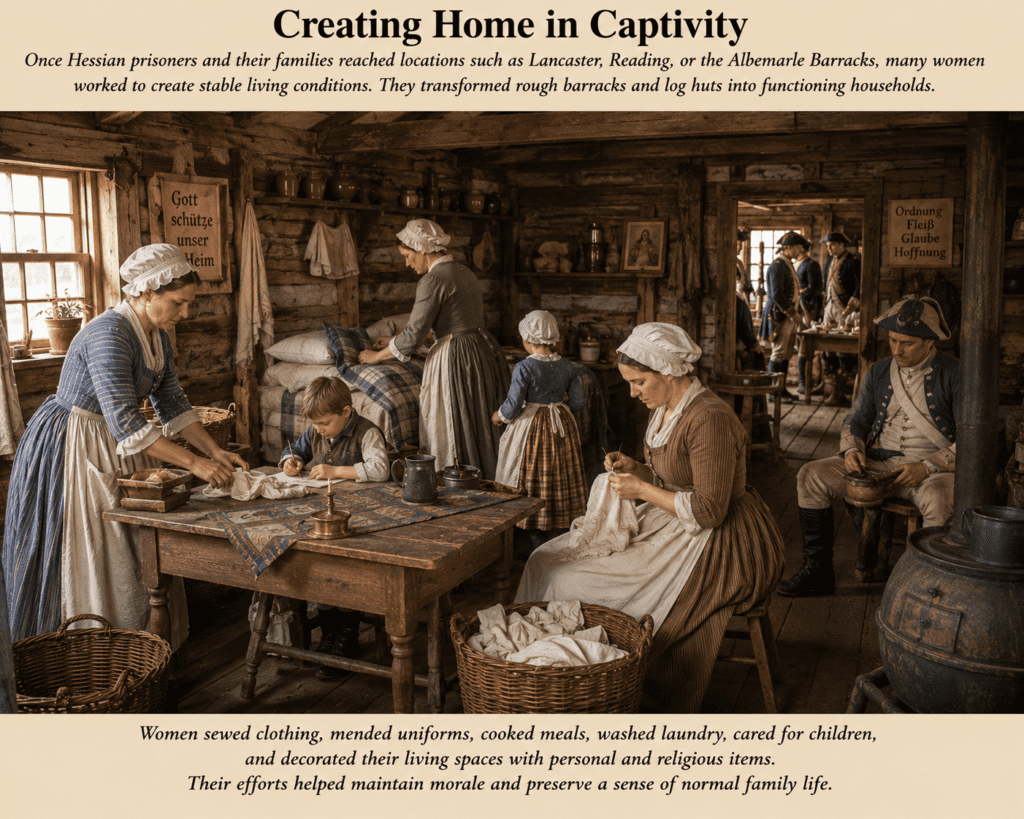
Once Hessian prisoners and their families reached locations such as Lancaster, Reading, or the Albemarle Barracks, many women worked to create stable living conditions. They transformed rough barracks and log huts into functioning households. Their efforts helped maintain morale and preserve a sense of normal family life.
The Cost to the Continental Congress
Because these women and children also required food and supplies, they created additional financial burdens for the Americans. Congress frequently struggled to provide adequate rations even for soldiers. Supporting non-combatants added another layer of expense during an already difficult war.
More Than Extra Mouths to Feed
Despite the costs, camp followers provided valuable services within the prisoner communities. They cooked meals, cared for children, repaired clothing, and helped maintain sanitation. Their labor reduced some of the challenges associated with managing large prisoner populations.
The Different Experience of Officers’ Families
The wives of senior officers often experienced captivity very differently from enlisted families. Under the customs of eighteenth-century warfare, many officers were granted parole and allowed to live outside the prison camps. This created opportunities unavailable to most ordinary prisoners.
Baroness von Riedesel in Virginia
While many enlisted families lived in barracks, Baroness von Riedesel rented a comfortable residence near Charlottesville. She interacted with American officials and local residents while maintaining her family life. Her experiences demonstrate how rank and social status continued to influence daily life even in captivity.
A Connection to Thomas Jefferson
During her stay in Virginia, the Baroness became acquainted with several prominent Americans, including Thomas Jefferson. The two reportedly shared interests in music, literature, and gardening. Jefferson even assisted her in obtaining seeds for the gardens surrounding her temporary home.
Why Families Encouraged Hessian Assimilation
The presence of wives and children may have been the single most important factor influencing the long-term decisions of many Hessian prisoners. A soldier traveling alone often dreamed of returning home. A soldier with an established family in America frequently saw a different future.
Building a New Life
Many German families recognized the opportunities available in Pennsylvania, Maryland, and Virginia. Fertile farmland, growing communities, and abundant economic opportunities contrasted sharply with conditions in parts of Europe. America offered the chance to begin again.
Connections With German-American Communities
Women often found work among German-speaking settlers while their husbands labored on farms or in local industries. These relationships strengthened ties between the prisoners and local communities. Over time, many families became integrated into the social and economic life of the colonies.
Choosing America Over Europe
When the war officially ended in 1783, surviving German units were ordered to return home. Yet hundreds of families quietly disappeared into the American countryside rather than board ships for Europe.
Having survived battles, captivity, and years of hardship together, many Hessian prisoners and their families chose to remain and become part of the new nation they had once been sent to fight.
Could the Wives of Hessian Prisoners Leave the Camps and Find Work?
Yes. The wives of Hessian prisoners often enjoyed far greater freedom than the soldiers themselves. Because they were considered non-combatants rather than prisoners of war, American authorities generally allowed them to travel outside the camps and seek employment in nearby communities.
A Different Legal Status
American officials viewed the wives and children accompanying Hessian prisoners differently from captured soldiers. Guards focused their attention on preventing military escapes rather than monitoring women engaged in domestic work. As a result, many camp followers moved relatively freely between the camps and surrounding towns.
Reducing the Burden on Congress
The Continental Congress constantly struggled to provide food and supplies for thousands of prisoners. Every woman who earned her own wages or food reduced the financial burden on American authorities. In many cases, local officials welcomed opportunities for camp followers to support themselves.
Freedom of Movement Beyond the Barracks
Unlike captive soldiers, who usually required passes or escorts to leave prison compounds, many women could simply walk beyond the camp boundaries. Their movements were often only loosely monitored. This freedom created opportunities that were unavailable to the men held in captivity.
Not Viewed as Security Risks
American authorities generally did not consider the wives of Hessian prisoners to be military threats. Most were seen as workers, mothers, and caregivers rather than enemy combatants. Their ability to move through local communities reflected this perception.
An Unusual Form of Liberty
Compared to the restrictions placed on soldiers, camp followers often lived in a gray area between captivity and freedom. They remained connected to the prisoner communities while participating in local economic life. This unique status played a major role in future assimilation.
Employment Opportunities in Local Communities
The wives of Hessian prisoners possessed valuable skills that were in high demand throughout colonial America. Many prison camps were located near German-speaking settlements, making it easy for women to communicate with potential employers. Familiar language and cultural traditions opened doors that might otherwise have remained closed.
Working on Farms
Agricultural labor provided some of the most common employment opportunities. Women helped with planting, harvesting, dairying, food preparation, and household management. Their labor became especially valuable during wartime labor shortages.
Keeping Families Together
In some cases, a woman would secure employment with a local farmer and then help arrange work for her captive husband. This allowed families to spend more time together while contributing to the local economy. Such arrangements often made captivity feel less restrictive and more like temporary relocation.
Laundresses, Seamstresses, and Skilled Workers
Many women brought practical skills developed during years of military life. Laundry services, clothing repair, sewing, and textile production were always needed in colonial communities. These skills allowed camp followers to earn money, food, and goodwill from local residents.
Supporting Both Sides
Some women even performed laundry and repair work for American militia units assigned to guard the camps. This unusual situation placed the wives of Hessian prisoners in regular contact with the very people responsible for overseeing their families. Such interactions often reduced tensions and built personal relationships.
Nursing and Medical Knowledge
Camp followers frequently possessed practical medical experience gained from years spent accompanying armies. They had treated illnesses, cared for wounded soldiers, and assisted with childbirth under difficult conditions. These abilities made them valuable members of local communities.
Helping Civilian Families
Many rural areas lacked trained physicians, creating opportunities for experienced camp followers to assist local residents. Women often helped care for the sick and served as informal midwives. Their knowledge earned respect and strengthened community ties.
Building Trust
As local families came to rely on their services, the wives of Hessian prisoners became increasingly integrated into American society. Relationships that began through work often expanded into friendships and community connections. These bonds would later influence decisions about whether to remain in America.
Economic Independence and Assimilation
Employment gave many women a level of economic independence that was difficult to achieve in Europe. They earned wages, received food and clothing, and established relationships with employers and neighbors. Over time, these opportunities transformed captivity into a pathway toward permanent settlement.
Establishing New Lives
By the final years of the war, many wives of Hessian prisoners had spent years working and living within American communities. They attended local churches, built friendships, and became familiar faces in nearby towns. Their lives increasingly resembled those of local residents rather than temporary wartime refugees.
Convincing Their Husbands to Stay
When peace finally arrived in 1783, many German families faced a difficult choice. Return to Europe and start over, or remain in communities where they already had jobs, friends, and opportunities. For countless former Hessian prisoners, the decision to stay in America was influenced heavily by wives who had already built successful lives beyond the prison camps.
One of the lesser-known aspects of Hessian captivity was the effort many wives made to keep their families together. Because camp followers were often allowed to leave the prison compounds to seek employment, some women found work on nearby farms and estates throughout Pennsylvania, Maryland, and Virginia.
After establishing a relationship with a local farmer, a wife could sometimes persuade the landowner to hire her captive husband as a laborer. This arrangement allowed families to spend more time together while providing much-needed workers to the local economy.
For many Hessian prisoners, captivity gradually became less like imprisonment and more like a temporary relocation. These family-centered work arrangements helped lay the foundation for the remarkable assimilation of thousands of German soldiers who eventually chose to remain in America after the Revolutionary War.
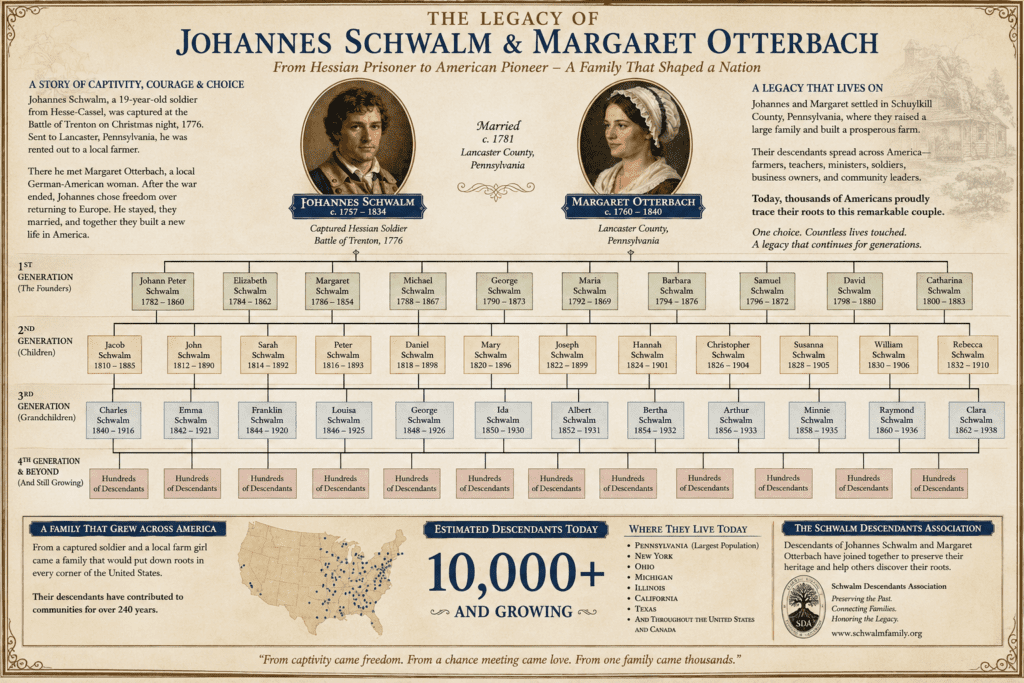
One of the best-known examples of a Hessian prisoner who became an American settler is the story of Johannes Schwalm. He was a young German soldier from Hesse-Cassel who came to America in British service during the Revolutionary War. Captured at Trenton, his life changed not on a battlefield, but in the farm country of Pennsylvania.
After Washington’s victory at Trenton, many captured German soldiers were marched inland to prison depots such as Lancaster, Pennsylvania. Because Congress struggled to feed thousands of prisoners, some Hessians were hired out to local farmers under a labor-release system. Schwalm reportedly worked among German-speaking Pennsylvania settlers, where language, religion, and culture made integration much easier.
While living and working in Pennsylvania, Schwalm met a local German-American woman, often identified in family histories as Margaret Otterbach. Instead of returning to Hesse-Cassel after the war, he chose the possibility of land, family, and freedom in America. Their story became one example of how Hessian prisoners moved from captivity into permanent settlement.
Schwalm’s journey illustrates a larger pattern. Many Hessian prisoners were not isolated forever behind prison walls. They worked on farms, entered local communities, met American women, married, raised families, and became part of the population of the new United States.
Other family traditions tell similar stories of former Hessians who became blacksmiths, bakers, farmers, craftsmen, and church members in Pennsylvania and surrounding states. To many German-American families, these men were not distant foreign enemies. They were young, hardworking German-speaking men who shared familiar customs and wanted the chance to build a better life.
The story of Hessian assimilation is therefore more than a prisoner-of-war story. It is also an immigration story, a family story, and an early American settlement story. For thousands of former Hessian prisoners, the American Revolution did not end with a return voyage to Europe — it became the beginning of a new American identity.

More than 250 years after Johannes Schwalm was captured at Trenton and settled in Pennsylvania, his descendants remain actively connected to the same region where he built his new life. What began as the story of a single Hessian prisoner has evolved into a remarkable multi-generational American legacy.
The Johannes Schwalm Historical Association (JSHA) is a non-profit organization dedicated to researching the thousands of Hessian soldiers who remained in North America after the Revolutionary War. The association helps descendants trace their family histories while preserving the stories of the German soldiers who became American settlers.
Each year, descendants and historians gather in Schuylkill County, Pennsylvania—the same region where Johannes and Margaret established their homestead after the war. The association also publishes historical journals and genealogical research that connect families across the United States to their Hessian ancestors.
Assimilation: When Hessian Prisoners Became Americans
The assimilation of Hessian prisoners into American society was one of the most remarkable outcomes of the Revolutionary War. Thousands of German soldiers arrived in North America as foreign auxiliaries serving the British Crown. Yet many ultimately became farmers, craftsmen, merchants, husbands, and fathers in the new United States.
More Than Temporary Residents
The integration of Hessian prisoners happened surprisingly quickly in many communities. Shared language, religion, and cultural traditions helped German soldiers connect with the large German-American populations already living in Pennsylvania, Maryland, and Virginia. What began as captivity often evolved into friendship, employment, marriage, and permanent settlement.
The Blacksmith’s Apprentice: John Peter Shindel
One of the best-known examples of Hessian assimilation is the story of John Peter Shindel. Captured during the Revolutionary War and sent to Lebanon, Pennsylvania, he possessed valuable metalworking skills that quickly made him useful to the local community. His craftsmanship opened doors that many prisoners could only hope to find.
A Skilled Craftsman Finds Opportunity
While working in a local blacksmith shop, Shindel became part of the daily life of the community. He earned the respect of local residents through hard work and professional skill. Over time, his status shifted from prisoner to valued tradesman.
Marriage and a New American Life
Shindel eventually fell in love with Mary Elizabeth Menges, a local Pennsylvania woman. The couple married and established a family that would become prominent throughout the region. Their descendants included numerous Lutheran ministers and community leaders who helped shape Pennsylvania’s German-American heritage.
The Baker of York: John Conrad Diel
Another example of successful assimilation involved Hessian prisoner John Conrad Diel. After being paroled to work in a bakery in York, Pennsylvania, Diel demonstrated both skill and determination. His experience highlights how employment often became the first step toward permanent settlement.
From Prisoner to Business Owner
While living and working in York, Diel met and married an American woman named Elisabeth. Following the war, he chose to remain in America rather than return to Germany. He later adopted the surname “Teel” and established his own successful bakery business.
Building a Legacy
Diel’s story reflects a pattern repeated across the colonies. Many former Hessian prisoners used the skills they had learned before the war to create successful businesses in America. Their economic success encouraged others to view the new nation as a place of opportunity.
Why Assimilation Happened So Easily
The success of these marriages and settlements was not simply a matter of chance. Most Hessian prisoners were young men in their twenties and thirties with valuable skills, strong work ethics, and familiar cultural backgrounds. In many communities, they blended naturally into existing German-American populations.
Shared Language and Religion
Many local women and families spoke the same German dialects as the prisoners. They attended the same Lutheran and Reformed churches and shared many of the same customs and traditions. These similarities removed barriers that often existed between immigrants and local populations.
A Common Desire for a Better Future
To many American families, the Hessians were not viewed as ideological enemies after the fighting ended. They were hardworking young men seeking stability, land, family, and opportunity. The same qualities that made them dependable soldiers often made them desirable husbands and respected members of their communities.
From Captives to Citizens
The stories of Johannes Schwalm, John Peter Shindel, John Conrad Diel, and thousands of others demonstrate how completely many Hessian prisoners assimilated into American society. Their descendants still live throughout the United States today, serving as a lasting reminder that some of the soldiers sent to suppress the American Revolution ultimately became part of the nation it created.
Congress Encouraged Hessian Assimilation to Secure the American Frontier
The assimilation of Hessian prisoners was not simply an act of generosity by the Continental Congress. It was also a calculated strategy designed to strengthen the young United States and secure its vast frontier lands.
To American leaders struggling with limited resources and enormous territorial ambitions, captured German soldiers represented both a challenge and an opportunity.
A Nation With More Land Than Settlers
At the time of the American Revolution, enormous tracts of land lay beyond the Appalachian Mountains. Regions that would later become western Pennsylvania, Kentucky, West Virginia, and Ohio remained sparsely settled by European Americans. Congress understood that controlling this territory required people willing to live there, farm it, and defend it.
The Frontier Security Problem
American settlements along the frontier faced constant threats from warfare, raids, and political uncertainty. British forces continued to support Native American allies in many western regions throughout the war. Congress believed that permanent settlements were the best way to secure these contested lands for the future United States.
Why Hessian Prisoners Appealed to Congress
Many American leaders viewed Hessian prisoners as ideal candidates for frontier settlement. Unlike British soldiers, the Germans generally had no personal loyalty to King George III. Most had been recruited or conscripted by German princes and sent overseas to serve British interests.
Franklin and Jefferson’s Strategy
Benjamin Franklin and Thomas Jefferson recognized that many German soldiers might be persuaded to abandon British service. They understood that land ownership represented a powerful incentive for men who came from societies where land was often controlled by aristocrats and hereditary elites.
America could offer opportunities that many Hessians could never realistically obtain in Europe.
Promises of Land and Opportunity
Congress authorized German-language propaganda designed to encourage desertion and assimilation. These pamphlets highlighted the availability of land and economic opportunity in America. The message was simple: a Hessian soldier could exchange military service for the chance to become an independent landowner.
Land as a Tool of Assimilation
The promises made to Hessian prisoners were often tied directly to western lands. Congress did not possess unlimited resources in the established eastern colonies. The land being discussed was largely located on the expanding frontier beyond the Appalachian Mountains.
Creating a Human Buffer
American leaders saw frontier settlers as more than farmers. They would also serve as a defensive population capable of protecting the nation’s western borders. Settlements established by former Hessians could strengthen American claims to territory while discouraging British influence in the region.
A Strategic Population Policy
Rather than viewing captured Germans solely as prisoners, some American leaders viewed them as potential future citizens. Every Hessian who chose to remain in America represented another productive farmer, craftsman, taxpayer, and militia member. Assimilation served both military and economic objectives.
Why Hessians Were Ideal Frontier Settlers
Many Hessian prisoners possessed exactly the skills needed for frontier life. They were accustomed to hard physical labor, military discipline, and difficult living conditions. These qualities made them attractive candidates for settlement in undeveloped regions.
Experienced Woodsmen and Farmers
Many German soldiers came from rural backgrounds and had experience working the land. Some, particularly members of Jäger units, were skilled hunters and woodsmen familiar with forest environments. Their abilities translated naturally to frontier settlement and land development.
Strong Work Ethic and Discipline
American leaders frequently praised German settlers for their productivity and determination. Former Hessian prisonerswere often viewed as dependable workers capable of building homes, clearing forests, and establishing successful farms. These characteristics aligned perfectly with the needs of the expanding nation.
Learning American Farming Methods
Before moving west, many Hessians spent years working on farms in Pennsylvania, Maryland, and Virginia. During this period, they learned American agricultural practices and became familiar with local customs. These experiences eased their transition from prisoners to settlers.
The Role of German-American Communities
The presence of large German-speaking populations in Pennsylvania played a major role in the assimilation process. Communities often known as the Pennsylvania Dutch provided cultural and linguistic support for former Hessian prisoners. These settlements acted as a bridge between European military life and American citizenship.
A Natural Transition
German soldiers could attend familiar churches, speak their native language, and interact with people who shared similar traditions. This environment reduced the cultural shock of remaining in America. Many prisoners quickly became comfortable within these established communities.
The Long-Term Impact on America
The strategy proved remarkably successful. Thousands of Hessian prisoners chose not to return to Europe after the war ended. Many settled in Pennsylvania before gradually moving westward into newly opened frontier territories.
Building the Expanding United States
Former Hessians helped clear forests, establish farms, build towns, and support local economies throughout the expanding republic. Their labor contributed directly to the growth of western settlements. In many cases, they became respected members of the very communities they had once entered as prisoners.
From Enemy Soldiers to Frontier Citizens
What began as a wartime effort to weaken the British military evolved into a powerful settlement program. The assimilation of Hessian prisoners helped populate the frontier, strengthen American territorial claims, and contribute to westward expansion.
In that sense, some of the soldiers sent to suppress the American Revolution ultimately helped build the nation that emerged from it.
historial feature letter from new world
Did Hessian Prisoners Keep Their German Last Names After Assimilation?
The answer is both yes and no. The fate of a former Hessian prisoner’s surname often depended on where he settled, who his neighbors were, and how much interaction he had with English-speaking communities. In many cases, the process happened gradually over decades rather than through any formal legal action.
No Formal Name Change Process Existed
Modern Americans are accustomed to driver’s licenses, birth certificates, and court-approved name changes. In the late eighteenth century, however, identity was much more flexible.
Names were recorded by ministers, tax collectors, census takers, and county clerks, many of whom spelled names based on what they heard rather than how the individual wrote them.
Keeping German Names Intact
Many Hessian prisoners settled in areas already populated by German-speaking immigrants. In communities such as Lancaster, Reading, York, and parts of the Shenandoah Valley, German remained the primary language of daily life. As a result, many former soldiers kept their original surnames unchanged.
Life in the Pennsylvania Dutch Communities
German churches maintained records in German. Local newspapers often published German-language editions. Families could live for generations without feeling pressure to alter their names.
Names That Survived Intact
Many descendants of Hessian prisoners still carry surnames that closely resemble their original German forms. Names such as Schwalm, Huber, Albrecht, and Schweitzer survived largely unchanged because they remained within strong German-speaking communities.
The Problem of English Record Keepers
Even when families kept their German names, English-speaking officials sometimes altered them in government records. Clerks often struggled with German spelling and pronunciation. These inconsistencies created multiple variations of the same surname.
Phonetic Recording
County officials frequently wrote names the way they sounded rather than according to German spelling rules. A family might use one spelling at home while appearing under a different spelling in tax records or land deeds. This process gradually created new American versions of old German names.
Examples of Phonetic Drift
A surname such as Jaeger might become Yager in official records. Likewise, Fuchs could appear as Fox when recorded by English-speaking officials. Over time, some families adopted these altered spellings permanently.
Anglicizing German Surnames
When former Hessian prisoners moved into predominantly English-speaking areas, name changes became much more common. A German surname could be difficult for neighbors, customers, and government officials to pronounce. Simplifying the name often made life easier.
Spelling Names the English Way
Some names were altered to preserve pronunciation while making them easier for English speakers to read.
Common Examples
| Original German Name | Americanized Version |
|---|---|
| Schumacher | Shoemaker |
| Weber | Weaver |
| Schneider | Snyder or Snider |
| Eberhardt | Everhart |
| Bär | Baer, Bare, or Barr |
Translating Names Into English
Some former Hessian prisoners took a more dramatic approach and translated their surnames directly into English. This allowed them to blend seamlessly into Anglo-American communities while preserving the original meaning of the family name.
Trade Names Became English Occupations
Many German surnames originated from occupations. Translating them created instantly recognizable English names.
Examples of Direct Translation
| German Name | Meaning | American Name |
|---|---|---|
| Zimmermann | Carpenter | Carpenter |
| Müller | Miller | Miller |
| Schmidt | Smith | Smith |
| Becker | Baker | Baker |
| Klein | Small | Little |
Hiding a Foreign Identity
Not every name change was motivated by convenience. Some former Hessian prisoners deliberately concealed their German origins. Although many communities welcomed them, anti-Hessian sentiment existed in certain areas, especially shortly after the war.
Escaping the Past
Desertion from British service remained a sensitive issue for some former soldiers. Adopting a simpler or shorter surname helped them blend into American society. In many cases, descendants eventually forgot the family’s original German name entirely.
Radical Name Changes
A soldier named Rosenberger might become Rose. A family named Steigerwald might eventually appear in records as Stayer or Stage. These changes sometimes occurred within a single generation.
First Names Changed Even Faster
While surnames often evolved slowly, first names were usually Americanized almost immediately. This was especially true when a direct English equivalent already existed. Many former Hessian prisoners adapted their first names as soon as they entered American communities.
From Johann to John
German first names frequently had obvious English counterparts. Using the English version made communication easier and helped immigrants fit into their new surroundings.
Common First-Name Conversions
- Johann became John
- Heinrich became Henry
- Wilhelm became William
- Friedrich became Frederick
- Ludwig became Louis
Tracing Hessian Descendants Today
For genealogists, these name changes create both challenges and opportunities. Many descendants of Hessian prisonersmay not even realize they have German military ancestors because the original surnames evolved over time. Understanding these naming patterns is often the key to connecting modern American families with their Hessian roots.
How Long Did Hessian Families Continue Speaking German in America?
For many descendants of Hessian prisoners, German remained the language of home and church long after the Revolutionary War ended. How quickly it disappeared depended largely on where the family settled.
In frontier regions, German often faded by the third generation, while in Pennsylvania’s German-speaking communities it survived for many decades and, in some places, continues to be spoken today.
Geography Determined the Fate of the Language
The descendants of Hessian prisoners who settled in heavily German areas experienced a very different linguistic future than those who moved into the frontier wilderness. Communities surrounded by German-speaking neighbors preserved their language much longer. Families isolated among English-speaking settlers often shifted to English within a few generations.
The First Generation: German-Speaking Hessian Veterans
The original Hessian prisoners who chose to remain in America spoke German as their primary language. They may have learned enough English to conduct business, purchase land, or interact with local officials. However, German remained the language they used at home, in church, and within their communities.
German Was the Language of Daily Life
Many Hessian families owned German-language Bibles, hymnals, and newspapers. Church services were frequently conducted in German. Family conversations, letters, and social gatherings were overwhelmingly German-speaking.
A Familiar Culture in a New Land
Large German settlements in Pennsylvania made it possible for former soldiers to live comfortably without mastering English. In many communities, a Hessian veteran could spend decades surrounded by people who shared his language and traditions. This slowed the process of assimilation considerably.
The Second Generation: Growing Up Bilingual
The children of Hessian prisoners represented the transition generation. Born in America but raised by German-speaking parents, they learned both languages from an early age. Their lives bridged the gap between the Old World and the new American society emerging around them.
German at Home, English in Public
Many second-generation descendants spoke German with their parents and attended German-speaking churches. At the same time, they used English in business, government, and interactions with non-German neighbors. Bilingualism became common throughout many German-American communities.
The Choice That Determined the Future
Families that remained in German-speaking regions often continued using German as their primary language. Those who moved westward into English-speaking frontier areas gradually relied more heavily on English. This decision frequently determined whether the language survived another generation.
The Third Generation: Where German Often Faded
For many descendants of Hessian prisoners, the third generation marked the turning point. Grandchildren could often understand German but increasingly preferred English in daily life. By the mid-nineteenth century, English dominated much of the American frontier.
English Became the Common Language
Third-generation descendants usually attended schools, conducted business, and socialized primarily in English. They often married outside the original German-speaking communities. As a result, German became less useful and less frequently spoken.
Losing the Ability to Read German
Many grandchildren of Hessian veterans could still recognize spoken German words and phrases. However, fewer could read or write the old German script used in family Bibles and letters. By the Civil War era, many frontier descendants were effectively English-speaking Americans.
Why German Faded Faster on the Frontier
The speed of language loss depended largely on social and educational influences. Communities on the frontier were more culturally mixed than the German settlements of eastern Pennsylvania. This diversity encouraged English as a common language.
The Impact of Public Schools
During the nineteenth century, states increasingly developed public education systems that taught exclusively in English. Children spent much of their day learning and interacting in English. This gradually pushed German into a secondary role within many households.
The Influence of the Civil War
The Civil War accelerated assimilation for many descendants of Hessian prisoners. Young men served alongside Americans of English, Irish, Scottish, and other backgrounds. Military service exposed them to broader American culture and strengthened the dominance of English.
Returning Home as English Speakers
Many veterans returned from military service speaking English almost exclusively. They raised their own children in English and participated more fully in mainstream American society. This often marked the final stage of language transition for frontier families.
The Pennsylvania Dutch Exception
Not all descendants of Hessian prisoners abandoned German by the third generation. In the agricultural regions of southeastern and central Pennsylvania, German remained deeply rooted. There, the language evolved into what became known as Pennsylvania Dutch.
A Language That Endured
Pennsylvania Dutch developed from various German dialects mixed with English influences. It remained the everyday language of many farming communities well into the twentieth century. Some Amish and Mennonite communities continue to speak it today.
A Living Legacy of Hessian Assimilation
For families that remained in counties such as Lancaster, Berks, and Schuylkill, German survived for five or six generations and sometimes longer. Their experience demonstrates that assimilation did not always mean abandoning cultural heritage.
Instead, many descendants of Hessian prisoners successfully balanced American identity with German traditions for centuries.
How Many Hessians Actually Stayed in America?
Not every captured German soldier returned home when the Revolutionary War ended. Historians estimate that between 3,000 and 5,000 former Hessian prisoners ultimately remained in North America.
Considering that approximately 30,000 German auxiliary troops served during the war, this represented a significant migration that helped shape the early republic.
Some Deserted During the War
Many Hessian prisoners chose to leave military service long before peace was declared in 1783. Some slipped away while working on farms, while others disappeared from prison camps and labor assignments. The combination of land opportunities, higher wages, and family connections often proved more attractive than returning to Europe.
Others Simply Never Boarded the Ships Home
When German regiments were ordered to return to Europe after the war, not everyone obeyed. Many former prisoners had already established homes, businesses, and families in America. For these men, remaining in the United States was often an easy decision.
A Remarkable Transformation
Few military forces in history experienced such a dramatic shift. Thousands of soldiers who arrived as foreign auxiliaries fighting for the British Crown ultimately became American settlers. Their stories represent one of the largest and most successful examples of wartime assimilation in American history.
Where Did Former Hessians Settle?
Most former Hessian prisoners initially remained close to the regions where they had been held during captivity. Over time, however, many pushed westward into newly opened frontier territories. Their migration patterns mirrored the broader westward expansion of the young United States.
Pennsylvania Became the Primary Destination
Pennsylvania attracted the largest concentration of former Hessian soldiers. Communities in Lancaster, York, Reading, Lebanon, and Schuylkill counties offered German-speaking neighbors, familiar churches, and abundant farmland. These regions became the heartland of Hessian assimilation.
Settlement in Maryland and Virginia
Other former Hessian prisoners remained near Frederick, Maryland, or in Virginia’s Shenandoah Valley. These areas offered rich agricultural land and growing communities. Many veterans established farms, businesses, and families that remained in the region for generations.
Moving Beyond the Appalachians
As frontier lands opened after the Revolution, Hessian descendants joined other Americans moving west. Former soldiers and their children settled in western Pennsylvania, Kentucky, Ohio, and beyond. Their labor helped transform forests and wilderness into productive farms and thriving communities.
Following the Frontier
The story of Hessian settlement did not end in Pennsylvania. Like many Americans of the era, they followed opportunity wherever it led. In doing so, they became part of the broader story of American expansion.
Places Where Hessian History Can Still Be Seen Today
Although more than two centuries have passed, visitors can still find reminders of the Hessian prisoners who remained in America. Historical markers, preserved sites, and genealogical organizations continue to tell their stories. These locations offer a direct connection to one of the most fascinating chapters of the Revolutionary War.
Surviving Historical Sites
Several locations associated with Hessian captivity still exist today. Visitors can explore sites connected to Camp Security, the Frederick Hessian Barracks, and historical markers commemorating the Hessian Camp at Reading, Pennsylvania. These landmarks help preserve the memory of the German soldiers who once occupied them.
The Legacy of the Johannes Schwalm Historical Association
The Johannes Schwalm Historical Association continues to research and document the descendants of former Hessian soldiers. Through publications, meetings, and genealogical projects, the organization helps preserve the history of German soldiers who chose America over a return to Europe.
Their work demonstrates that the story of Hessian assimilation remains very much alive.
Walking in the Footsteps of History
Many of the towns where former Hessian prisoners settled remain thriving communities today. Visitors to Lancaster, Lebanon, Reading, York, and Schuylkill County can still see landscapes that would have been familiar to the first generation of Hessian settlers.
In many ways, the story of their captivity and assimilation remains visible across the American countryside.
Few groups in the American Revolution experienced a more dramatic transformation than the Hessian prisoners. They arrived in North America as foreign soldiers fighting for the British Crown and expected to return home once their military service ended.
Instead, thousands found themselves living among American farmers, craftsmen, merchants, and church communities. Through work, marriage, faith, and opportunity, many gradually became part of the society they had originally been sent to fight.
By the end of the Revolutionary War, thousands of former Hessian prisoners had chosen America over Europe. Their journey from battlefield enemy to frontier citizen remains one of the most remarkable stories of assimilation in early American history—and one whose descendants can still be found across the United States today.
The story of the Hessian prisoners does not end with captivity. Thousands of former German soldiers chose to remain in America, married into local families, settled the frontier, and left descendants who are still discovering their remarkable Revolutionary War heritage today.
Chapter 8 explores how to determine whether you may be descended from one of the thousands of Hessian soldiers who remained in America after the Revolutionary War. Learn about common surnames, settlement patterns, genealogical records, military rosters, and the clues that may connect your family tree to a former Hessian soldier.
Read Chapter 8 here:
Are You Descended from a Hessian Soldier?
Interested in the complete story? Be sure to explore the other articles in our 10-part Hessians in the American Revolution series. A complete directory with links to every chapter can be found at the end of this article.
Final Recommendation: If you enjoy Revolutionary War history, continue your journey by exploring our growing America's 250th Anniversary Series. These articles examine the soldiers, families, weapons, ships, economies, and ordinary people whose actions helped create the United States. Together they provide a deeper understanding of the events that shaped America's founding and its first generation of citizens.
[references-hessians]
Where were Hessian prisoners held during the American Revolution?
Hessian prisoners were held in several inland locations, especially Lancaster and Reading, Pennsylvania; Frederick, Maryland; Charlottesville, Virginia; and Winchester, Virginia. These locations kept prisoners far from British rescue attempts while placing them near communities that could support or employ them.
Why did so many Hessian prisoners survive captivity?
Many Hessian prisoners survived because American authorities often allowed them to work outside crowded camps. Farm labor, better food, cleaner housing, and support from German-American communities helped reduce disease and starvation.
Were British soldiers and Hessian prisoners kept separate?
Yes. American authorities often separated British regulars from Hessian prisoners to reduce conflict, prevent organized escapes, and encourage German soldiers to desert or assimilate into American communities.
Did Hessian wives and children enter captivity too?
Yes. Many German soldiers were accompanied by wives and children known as camp followers. When entire units were captured, these families often entered captivity alongside the soldiers and played an important role in daily camp life.
Could Hessian wives work outside the prison camps?
Yes. Because they were considered non-combatants, many wives could leave the camps to find work. They often earned wages as farm laborers, laundresses, seamstresses, nurses, and domestic workers.
Did Hessian prisoners marry American women?
Yes. Some Hessian prisoners married women from German-American communities in Pennsylvania, Maryland, and Virginia. These marriages helped many former soldiers assimilate and remain in America after the war.
Did Hessian prisoners keep their German surnames?
Some did, especially in German-speaking areas such as Lancaster, Reading, and York. Others anglicized, translated, or shortened their surnames when they moved into English-speaking communities.
How long did Hessian families continue speaking German?
In frontier areas, German often faded by the third generation. In Pennsylvania Dutch communities, however, German dialects survived much longer and continued for many generations.
Why did Congress encourage Hessian assimilation?
Congress saw Hessian prisoners as potential settlers who could help populate and secure frontier lands. Encouraging desertion and settlement weakened the British war effort while adding farmers, workers, and future citizens to the new nation.
How many Hessian soldiers stayed in America?
Historians generally estimate that between 3,000 and 5,000 German soldiers remained in North America after the Revolutionary War. Many became farmers, craftsmen, husbands, fathers, and permanent American settlers.
The Complete RetireCoast Historical Series
Reducing your tax burden is only one piece of a successful financial strategy. Building wealth, protecting assets, planning your estate, and creating additional income streams often require a deeper level of education and planning than a single article can provide.
To help our readers take the next step, RetireCoast now offers three premium membership programs designed to provide advanced tools, calculators, guides, and planning resources.
Choose the Membership That Fits Your Goals:
-
💼 Business Builder Membership
Designed for entrepreneurs, retirees starting businesses, real estate investors, and small business owners seeking strategies to increase income, improve operations, and legally reduce taxes. -
🛡️ Estate Planning Membership
Focused on wealth preservation, trusts, asset protection, estate planning, inheritance strategies, and protecting assets for future generations. -
📈 Millennial Financial Lab
Built specifically for Millennials and younger professionals seeking practical guidance on investing, retirement planning, debt reduction, major purchases, and long-term wealth building.
Many members find that more than one program fits their needs. For those who want access to every tool, calculator, guide, and membership resource across the RetireCoast platform, we offer an All-Access Membership that provides a substantial discount compared to purchasing all three memberships separately.
Whether your goal is reducing taxes, protecting assets, starting a business, preparing for retirement, or creating a lasting legacy, RetireCoast memberships provide the tools and guidance to help you move forward with confidence.
Discover more from RetireCoast.com
Subscribe to get the latest posts sent to your email.