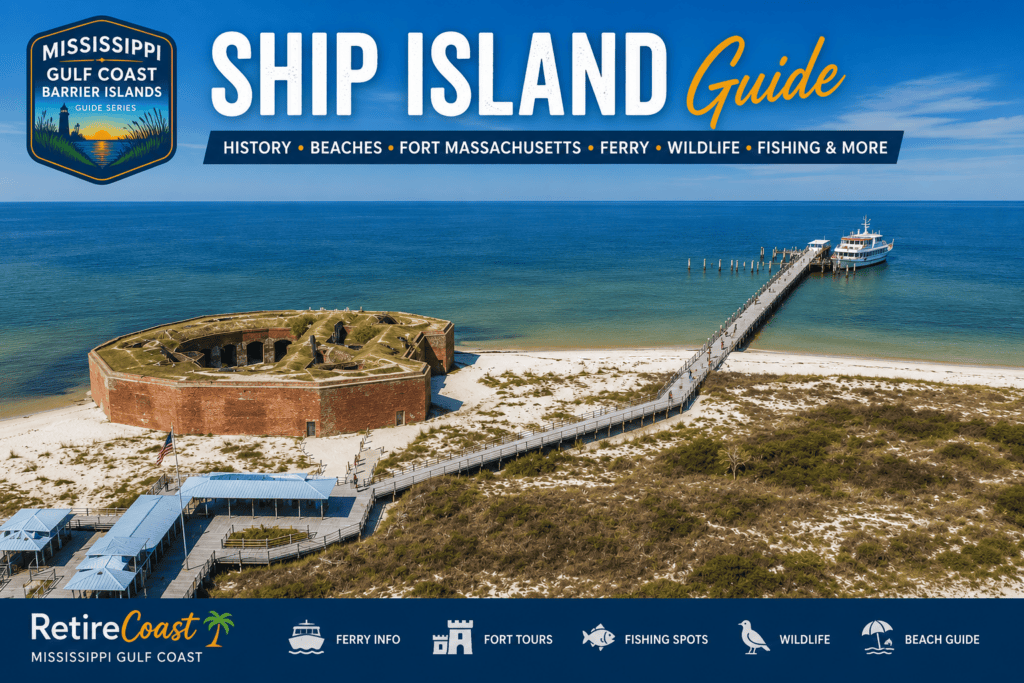
Welcome to the Ship Island Guide
Welcome to the Ship Island Guide, RetireCoast’s most comprehensive resource for exploring Mississippi’s best-known barrier island.
Whether you’re planning to ride the ferry from Gulfport, tour historic Fort Massachusetts, spend a relaxing day on the beach, photograph wildlife, or enjoy some outstanding Gulf Coast fishing, this guide will help you make the most of your visit.
Ship Island is one of five remarkable barrier islands that stretch across the Mississippi Gulf Coast, protecting the mainland from storms while creating one of the richest coastal ecosystems in the northern Gulf of Mexico.
Its combination of pristine beaches, fascinating military history, abundant wildlife, and easy public access has made it the most visited of Mississippi’s barrier islands.
This Ship Island Guide is part of RetireCoast’s Mississippi Gulf Coast Barrier Islands Guide Series. While Ship Island is famous for Fort Massachusetts and its convenient passenger ferry, every island in the chain has its own story to tell.
We invite you to explore our companion guides to Horn Island, Cat Island, Deer Island, and the vanished Isle of Caprice, each offering a completely different coastal experience.
Beaches, history, wildlife
Throughout this guide, you’ll also discover links to many of our related articles covering Gulf Coast fishing, boating, wildlife, history, beaches, nearby attractions, and coastal communities.
Together, these resources provide a deeper understanding of why Mississippi’s barrier islands are among the Gulf Coast’s greatest natural and historical treasures.
Unlike many websites that offer only a brief overview, this Ship Island Guide takes you well beyond ferry schedules and visitor information.
Fort Massachusetts
We’ll explore how the island was formed, its role in defending the Gulf Coast, the history of Fort Massachusetts, the island’s wildlife and marine life, what to expect during your visit, the best fishing opportunities, seasonal activities, and answers to the questions visitors ask most often.
Whether you’re a first-time visitor, a history enthusiast, a fisherman, a photographer, or a lifelong Gulf Coast resident, this Ship Island Guide is designed to become your trusted companion before, during, and after your visit. We hope it inspires you to experience not only Ship Island, but the entire chain of Mississippi’s extraordinary barrier islands.

Bill Anderson
Founder, RetireCoast
A Note from Bill Anderson
I absolutely love writing about Mississippi’s barrier islands because they are unlike anywhere else I’ve visited. While many coastal states have barrier islands, very few offer the remarkable combination of history, wildlife, recreation, and natural beauty found just offshore of the Mississippi Gulf Coast.
Ship Island naturally receives the most attention thanks to historic Fort Massachusetts and the convenient passenger ferry. It’s a fantastic destination and well deserving of its popularity. But I encourage you not to stop there. Take a few minutes to explore our guides to Horn Island, Cat Island, Deer Island, and the fascinating story of the vanished Isle of Caprice. Each island has its own personality, history, and unforgettable experiences.
As both a boater and someone who enjoys exploring the Gulf Coast, I’ve found that many visitors launch their boats without really knowing where to go. Mississippi’s barrier islands solve that problem beautifully. They’re close enough for enjoyable day trips, yet once you arrive you’ll feel like you’ve traveled to another world of white sand beaches, wildlife, clear Gulf waters, and centuries of history.
Whether you arrive by ferry or by your own boat, I hope this Ship Island Guide inspires you to discover not only Ship Island but the entire chain of Mississippi’s incredible barrier islands. Have fun, take plenty of photos, spend some time fishing, and enjoy one of the Gulf Coast’s greatest natural treasures.
Where Is Ship Island?
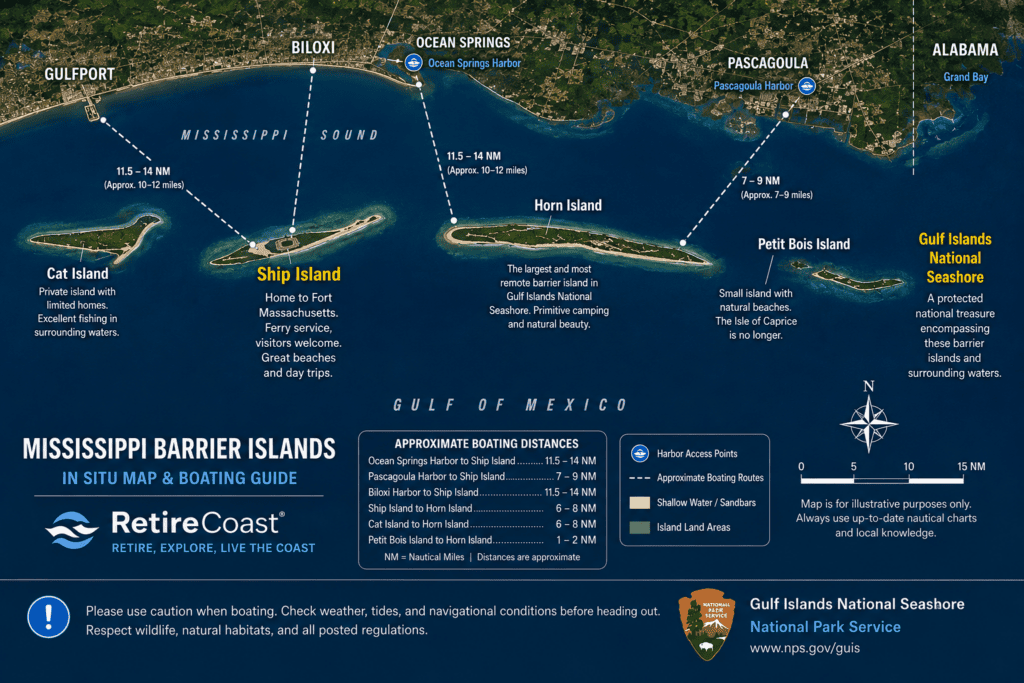
Ship Island is located approximately 10 to 12 miles south of Gulfport on Mississippi’s Gulf Coast. It lies within the Gulf Islands National Seashore, a protected collection of barrier islands managed by the National Park Service that stretches across portions of Mississippi and Florida.
The island sits between Cat Island to the west and Horn Island to the east, forming part of the natural barrier that separates the open Gulf of Mexico from the calmer waters of the Mississippi Sound. Together, these islands absorb wave energy during storms, reduce coastal erosion, and provide critical habitat for hundreds of species of birds, fish, sea turtles, and other wildlife.
Today, Ship Island is best known as the only Mississippi barrier island with regularly scheduled public ferry service, making it the easiest island in the chain for visitors to experience without owning a boat. Thousands of visitors arrive each year to explore Fort Massachusetts, enjoy the beaches, swim in the Gulf, and experience one of Mississippi’s most unique natural landscapes.
East Ship Island and West Ship Island
Although most visitors simply refer to “Ship Island,” it is actually made up of two separate islands: East Ship Island and West Ship Island.
For centuries, Ship Island existed as one continuous barrier island. In 1969, however, Hurricane Camille cut a channel through the island, permanently dividing it into two sections. Additional storms, including Hurricane Katrina in 2005, widened the pass and further reshaped the island into the form visitors see today.
West Ship Island is the destination for the public ferry and is home to Fort Massachusetts, the visitor facilities, beaches, picnic areas, restrooms, and the island’s famous fishing and swimming areas. East Ship Island remains undeveloped and provides important habitat for nesting shorebirds, sea turtles, and other coastal wildlife.
How to Reach Ship Island
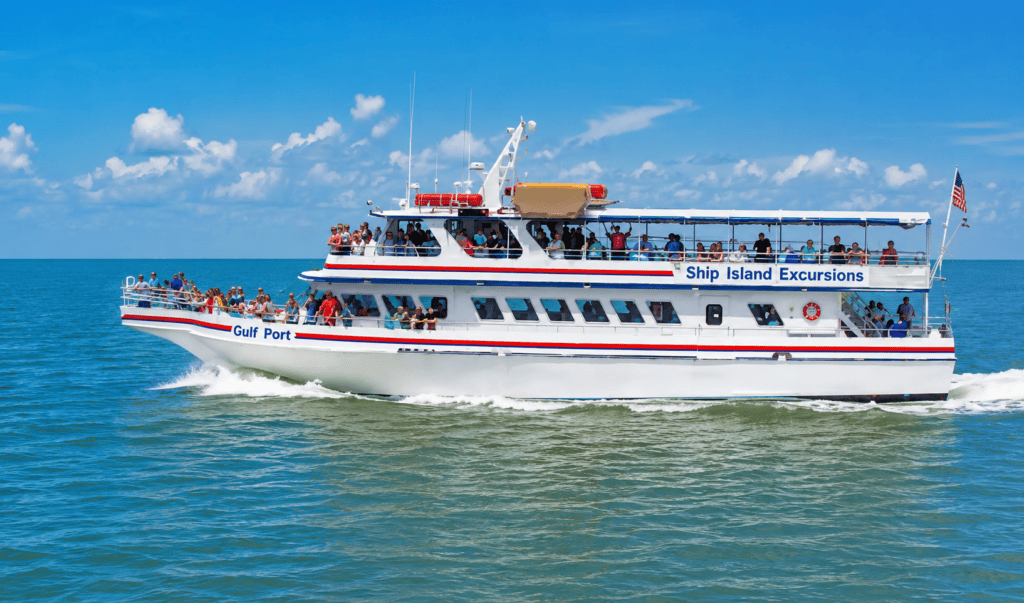
Most visitors reach Ship Island aboard the Ship Island Excursions ferry, which departs from Gulfport during the visitor season. The ferry provides a comfortable ride across the Mississippi Sound and offers spectacular views of the Gulf Coast skyline before arriving at the island’s long pier.
Private boaters also frequently visit Ship Island. The island is a popular destination for fishing boats, sailboats, cruisers, and center consoles launching from Gulfport, Biloxi, Pass Christian, Long Beach, and nearby marinas. Because of its protected waters, beautiful beaches, and excellent fishing opportunities, Ship Island has become one of the Gulf Coast’s favorite boating destinations.
Why Ship Island Is So Popular
Unlike Horn Island, Cat Island, and several of the other Mississippi barrier islands that require a private boat and a greater sense of adventure, Ship Island welcomes visitors of all ages. Families can spend the day on the beach, history enthusiasts can tour Fort Massachusetts, anglers can fish from the shoreline or nearby waters, and nature lovers can observe coastal birds and marine life—all without needing specialized equipment or boating experience.
Its combination of accessibility, history, natural beauty, and recreational opportunities makes Ship Island the most visited and perhaps the most recognizable of Mississippi’s barrier islands, serving as an ideal introduction to the remarkable island chain that protects the Mississippi Gulf Coast.
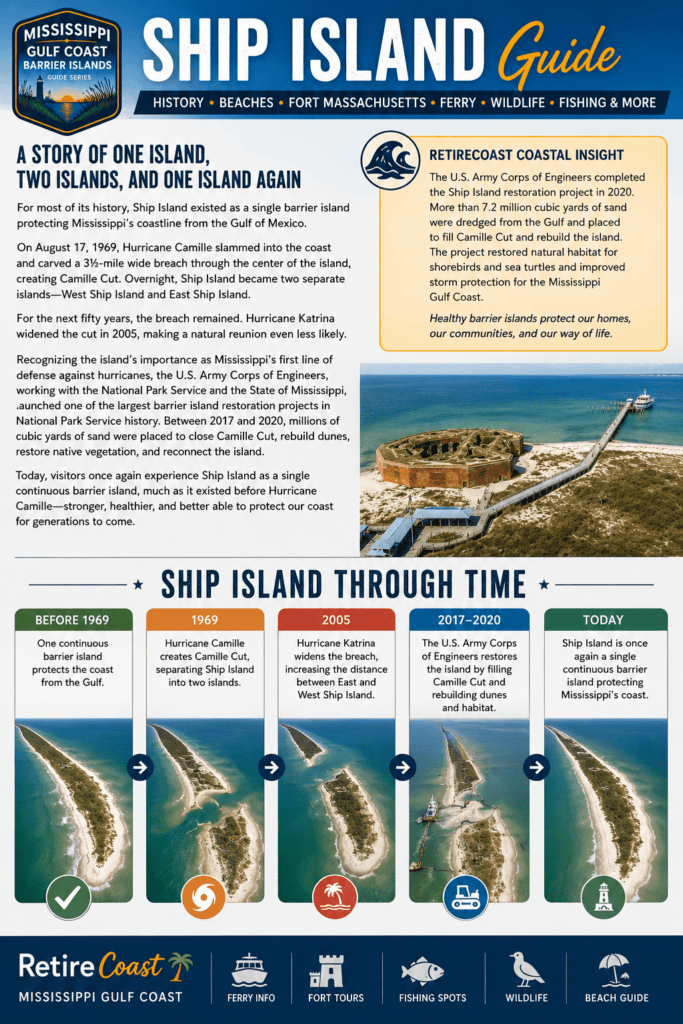
A Story of One Island, Two Islands, and One Island Again
One of the most fascinating chapters in the Ship Island Guide is the island’s ever-changing shape. For most of its recorded history, Ship Island existed as a single barrier island protecting Mississippi’s coastline from the Gulf of Mexico.
Everything changed on August 17, 1969, when Hurricane Camille slammed into the Mississippi Gulf Coast. The storm carved a 3½-mile-wide breach through the center of the island, creating what became known as Camille Cut. Overnight, Ship Island became two separate islands—West Ship Island and East Ship Island.
For the next fifty years, maps, guidebooks, and even National Park Service publications referred to East Ship Island and West Ship Island. Hurricane Katrina widened the breach in 2005, making a natural reunion even less likely.
Recognizing the island’s importance as Mississippi’s first line of defense against hurricanes, the U.S. Army Corps of Engineers, working with the National Park Service and the State of Mississippi, launched one of the largest barrier island restoration projects in National Park Service history. Between 2017 and 2020, engineers placed millions of cubic yards of sand, restored dunes, planted native vegetation, and permanently closed Camille Cut.
Today, visitors once again experience Ship Island as a single continuous barrier island, much as it existed before Hurricane Camille. While longtime Gulf Coast residents still occasionally refer to “East Ship” and “West Ship,” the restored island has regained its historic form, creating a stronger natural barrier against storms while expanding habitat for shorebirds, sea turtles, and other coastal wildlife.
Yes. I would rewrite this entire passage rather than mechanically inserting the phrase. We can get “Ship Island Guide”into the copy 10+ times while keeping it reasonably natural for Yoast and readers.
Why Does Ship Island Exist?
Understanding how the island formed adds another dimension to any Ship Island Guide. Ship Island did not appear by accident; it developed over thousands of years through the combined forces of sediment, waves, tides, storms, wind, and Gulf currents.
Although Ship Island may appear permanent, it is actually a constantly changing landform. Every major storm, cold front, and hurricane can move sand, reshape dunes, and alter the shoreline.
The Mississippi River Helped Build the Foundation
The geological story behind our Ship Island Guide begins with sediment carried toward the Gulf Coast by major river systems, including the Mississippi River.
Over thousands of years, enormous quantities of sand, silt, and clay reached the northern Gulf. Waves and coastal currents redistributed sediments along the coast, helping create offshore shoals that eventually contributed to the development of Mississippi’s barrier islands.
As sandy shoals accumulated and emerged above sea level, wind pushed dry sand inland. Dunes developed, and vegetation such as sea oats helped trap additional blowing sand and stabilize portions of the new landscape.
The result was not a permanently fixed island but a barrier island capable of moving and changing.
Nature Never Stops Remodeling Ship Island
One of the most important lessons in this Ship Island Guide is that barrier islands are naturally dynamic.
Strong winter fronts and storms can remove sand from beaches and move it offshore. During calmer periods, waves and currents may return some of that sediment to the shoreline.
Hurricanes can accomplish in several hours what ordinary waves might take decades to achieve.
Hurricane Camille demonstrated that power in 1969 when it breached Ship Island and helped create the separation between what became known as East and West Ship Island. Subsequent storms, particularly Hurricane Katrina, further enlarged the gap.
The U.S. Army Corps of Engineers later undertook an enormous restoration project that filled the breach and reconnected the island.
That means visitors using this Ship Island Guide today are visiting an island that was once one island, became two islands, and has now been restored as one continuous barrier island again.
Why Mississippi’s Barrier Islands Are So Important
A complete Ship Island Guide should explain that these islands are much more than recreational destinations.
Mississippi’s barrier islands stand between the open Gulf of Mexico and the mainland. They interact with waves and storm surge and are an important component of the coastal system protecting the Mississippi Sound.


Ship Island, Horn Island, Cat Island, and Petit Bois Island form part of this remarkable offshore chain. The now-submerged Isle of Caprice also demonstrates just how dramatically Gulf currents and storms can reshape these sandy environments.
The islands also help separate the relatively protected Mississippi Sound from the open Gulf.
Those calmer waters provide important habitat for shrimp, blue crabs, oysters, juvenile fish, dolphins, and many other marine species.
A Haven for Wildlife
Wildlife is another reason our Ship Island Guide goes well beyond beaches and ferry schedules.
The island’s beaches, dunes, grasslands, tidal areas, and surrounding waters create several different habitats within a relatively small area. Each supports different plants and animals.
Sea oats and other vegetation capture blowing sand and help stabilize dunes. Shorebirds use the beaches for feeding and nesting, while migrating birds depend upon Gulf barrier islands as places to rest during their remarkable spring and fall journeys.
The surrounding waters support dolphins, rays, sharks, sea turtles, shrimp, crabs, and an extraordinary variety of fish.
Because Ship Island is protected within Gulf Islands National Seashore, preserving these habitats remains an important part of managing the island.
Ship Island Will Continue to Change
Perhaps the most fascinating geological lesson in this Ship Island Guide is simple: no map of Ship Island will remain completely accurate forever.
Sand continues to move.
Storms continue to reshape the shoreline, dunes continue to migrate, and waves and currents continually redistribute sediment around the island.
Coastal restoration can influence that process, but it cannot turn a barrier island into a permanently fixed piece of land.
Visitors fifty years from now may see a shoreline noticeably different from the one we see today. Today’s visitors are already seeing a Ship Island substantially different from the island that existed before Hurricane Camille.
That constant evolution is part of what makes Ship Island extraordinary.
It isn’t simply an island sitting in the Gulf of Mexico. Ship Island is a living landscape.
The History of Ship Island
History is a major part of this Ship Island Guide because few places along the Mississippi Gulf Coast have played so many different roles over such a long period.
Long before today’s visitors boarded ferries or walked through Fort Massachusetts, Ship Island was known to Indigenous peoples, European explorers, soldiers, sailors, merchants, immigrants, fishermen, and coastal residents.
The island’s location and anchorage repeatedly placed it at the center of events occurring far beyond Mississippi.
Native Americans Knew the Islands First
Long before Europeans arrived on the northern Gulf Coast, Indigenous peoples traveled the Mississippi Sound by canoe.
The productive coastal environment supplied fish, oysters, shrimp, crabs, and other resources. Barrier islands also provided landmarks and temporary stopping places for people who understood these waters generations before European maps existed.
Ship Island’s lack of a dependable source of fresh water discouraged permanent settlement. However, its location would have made it useful to people traveling and fishing throughout the Mississippi Sound.
This human history begins long before the European chapters emphasized in most accounts of the island.
French Explorers Changed Gulf Coast History
No historical Ship Island Guide would be complete without the remarkable events of 1699.
French explorers Pierre Le Moyne d’Iberville and Jean-Baptiste Le Moyne de Bienville arrived along the northern Gulf during France’s effort to establish a permanent presence near the Mississippi River.
Ship Island provided an important offshore anchorage as the French explored the surrounding coastline.
Their expedition ultimately led to the establishment of a settlement at present-day Ocean Springs before the colonial center shifted, helping begin the French colonial era along the Mississippi Gulf Coast.
Ship Island therefore witnessed the opening chapters of European colonization in this region.
Related RetireCoast Reading
This is where I would link your articles about d’Iberville, Bienville, Ocean Springs, Biloxi, French Louisiana, and the early history of the Mississippi Gulf Coast.
Rather than forcing all of that history into this Ship Island Guide, those internal links let interested readers follow individual stories in much greater depth.
Why Is It Called Ship Island?
Even the island’s name tells us something important about its history.
Ship Island became associated with vessels because its location and offshore anchorage made it an important stopping place during the age of sail.
Large sailing ships could not simply sail anywhere they wanted within Mississippi Sound. Shallow water, shoals, and the drafts of large vessels limited where captains could safely navigate.
Ships could anchor in deeper water near the barrier islands and transfer passengers, supplies, and cargo to smaller vessels capable of navigating the shallower coastal waters.
This geographical advantage helps explain something that appears repeatedly throughout this Ship Island Guide:
Ship Island was important because of where it was located.
Its position between the deeper Gulf of Mexico and the protected but shallower Mississippi Sound made the island a natural gateway to the Mississippi Gulf Coast.
Geography Created Ship Island’s History
The geology and history described in this Ship Island Guide are really two parts of the same story.
The same forces that created Ship Island also placed it in a strategic location for exploration, immigration, commerce, warfare, fishing, coastal defense, and eventually tourism.
French explorers stopped here.
Spanish supply networks operated throughout these waters during the American Revolution.
British forces used the area during the War of 1812.
American forces later constructed Fort Massachusetts.
Immigrants passed through the island’s maritime gateway.
Fishermen worked its surrounding waters.
Tourists eventually began arriving aboard excursion boats.
Today, families step from a modern ferry onto the same remarkable barrier island.
That is what makes a Ship Island Guide different from an ordinary beach guide. Ship Island isn’t merely a place to spend a day at the beach—it is a place where geology, American history, wildlife, fishing, recreation, and the story of the Mississippi Gulf Coast all meet.
Why It Was Named “Ship Island”
The island earned its name because of its naturally protected harbor.
Large sailing vessels crossing the Gulf of Mexico often anchored near Ship Island while waiting for favorable winds, transferring cargo, or preparing to sail into nearby ports. During the age of sail, safe anchorages were extremely valuable, and Ship Island quickly became one of the most important maritime landmarks on the northern Gulf Coast.
Its strategic location also made it valuable for military operations, customs enforcement, and international commerce.
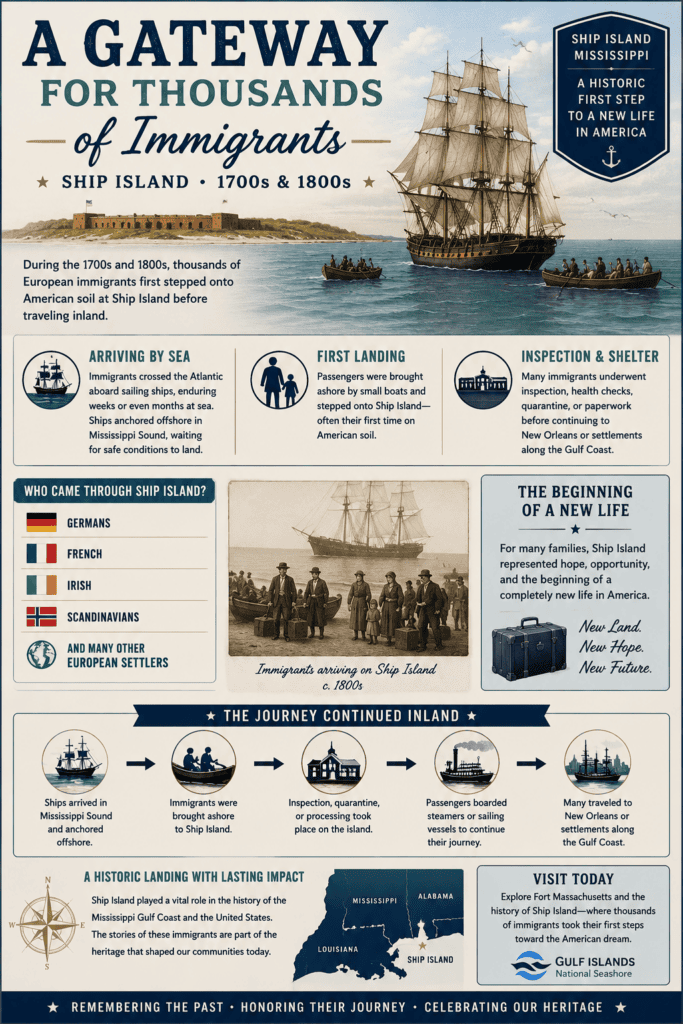
A Gateway for Thousands of Immigrants
During the 1700s and 1800s, thousands of European immigrants first stepped onto American soil at Ship Island before traveling inland.
Many German, French, Irish, and other European settlers arrived aboard sailing ships that anchored offshore. Before continuing to New Orleans or settlements along the Gulf Coast, passengers often disembarked on Ship Island for inspection, quarantine, or temporary shelter.
For many families, Ship Island represented the beginning of a completely new life in America.
Fort Massachusetts Defended the Gulf Coast
Following the War of 1812, the United States recognized the need for stronger coastal defenses.
Construction of Fort Massachusetts began in 1859 as part of a nationwide system of masonry forts designed to protect major ports from naval attack. Although construction was interrupted by the Civil War and never fully completed, the massive brick fort remains one of the finest preserved coastal forts in the United States.
Today, it is the island’s most recognizable landmark and one of the primary reasons visitors travel to Ship Island.
The Civil War Comes to Ship Island
Ship Island became strategically important during the Civil War because it offered the Union Navy a secure base of operations in the northern Gulf of Mexico.
Union forces occupied the island early in the war, using it as a staging area for the capture of New Orleans and later military operations against Confederate positions along the Gulf Coast.
The island also served as a prison camp for Confederate soldiers and civilians, adding another chapter to its complex military history.
A National Treasure Today
Today, Ship Island is protected as part of Gulf Islands National Seashore, preserving both its natural beauty and extraordinary history.
Visitors can walk through the same fort where Union soldiers once stood guard, travel the same waters explored by French navigators more than 325 years ago, and experience one of the Gulf Coast’s most historically significant barrier islands.
Ship Island is more than a beautiful beach destination—it is a place where geology, military history, exploration, immigration, and conservation all come together in one unforgettable location.
Author’s Coastal Insight
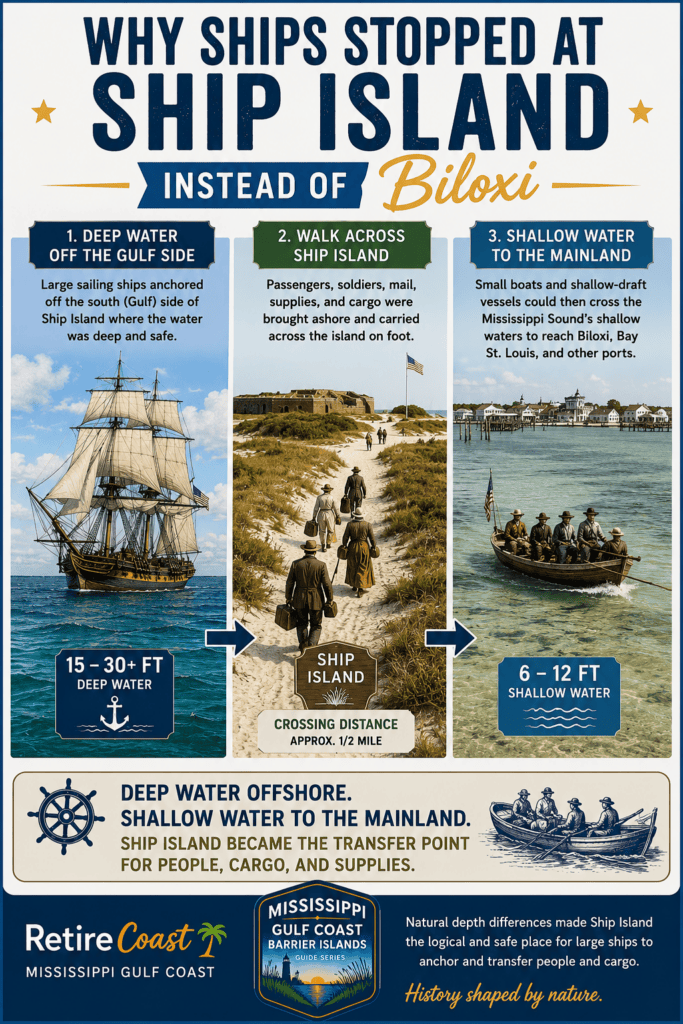
One of the most fascinating questions I hear is: “If Biloxi and Bay St. Louis already existed, why didn’t the large sailing ships simply sail directly into those harbors?”
The answer lies beneath the water. The Mississippi Sound on the north side of Ship Island was simply too shallow for most ocean-going sailing vessels. Much of the water between the mainland and the barrier islands averaged only 6 to 12 feet deep, with constantly shifting sandbars that made navigation difficult and sometimes dangerous for deep-draft ships.
By contrast, the Gulf side of Ship Island offered much deeper water—generally 15 to more than 30 feet deep just offshore beyond the surf zone. Large sailing ships could safely anchor there without risking running aground.
Passengers, soldiers, supplies, and cargo were often brought ashore on Ship Island, where they crossed the island on foot before boarding much smaller boats capable of navigating the shallow waters of the Mississippi Sound. Those smaller craft then carried them to Biloxi, Bay St. Louis, Pass Christian, and other coastal settlements.
This natural deep-water anchorage is one of the primary reasons Ship Island became such an important military base, immigration station, commercial harbor, and gateway to the Mississippi Gulf Coast. In many ways, the island functioned as the Gulf Coast’s first “port transfer terminal” centuries before modern ports and shipping channels existed.
— Bill Anderson, Founder, RetireCoast
Ship Island and the American Revolution
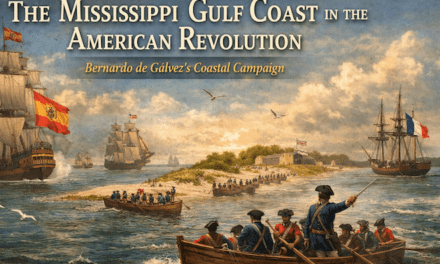
Most visitors associate Ship Island with Fort Massachusetts and the Civil War. However, the island played an important role decades earlier during the American Revolutionary War, when control of the Mississippi Gulf Coast became part of the international struggle between Great Britain, Spain, France, and the American colonies.
Although the thirteen colonies fought for independence from Britain, they did not fight alone. Spain entered the war in 1779 and launched a military campaign to drive the British from the Gulf Coast and lower Mississippi Valley. Spanish victories would prove critical to the American cause.
Spanish-Controlled Ship Island
During the Revolutionary War, Ship Island was part of Spanish West Florida. Spain controlled much of today’s Mississippi Gulf Coast, including the barrier islands that stretched across the Mississippi Sound.
These islands provided protected anchorages where Spanish vessels could safely unload supplies beyond the reach of British naval patrols operating in the Gulf of Mexico.
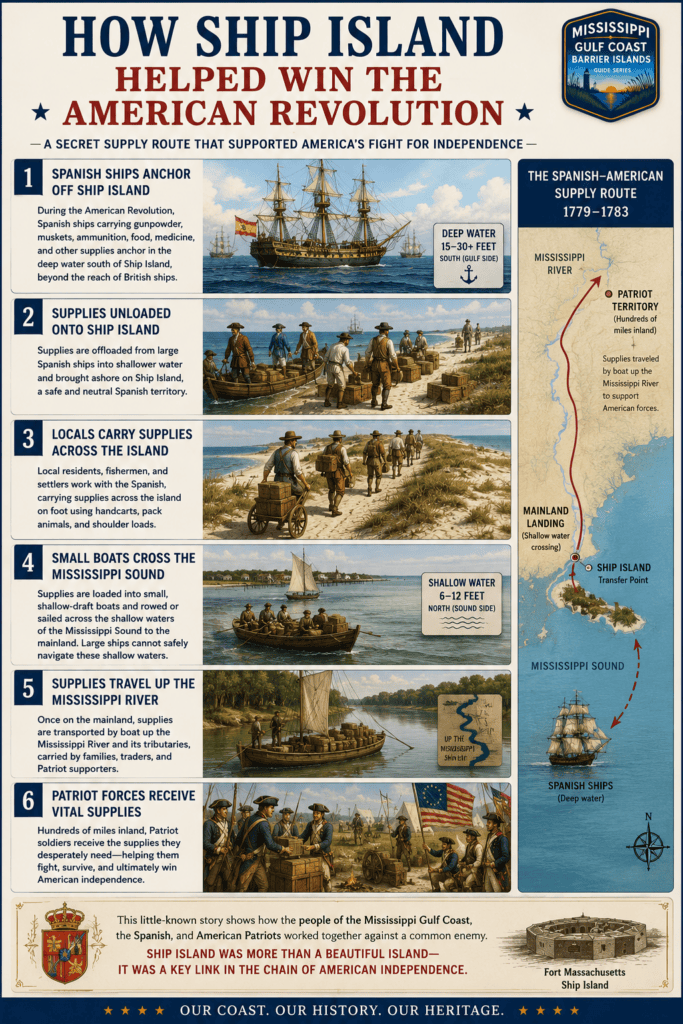
A Secret Supply Route
One of the lesser-known stories of the American Revolution involves the movement of supplies through the Mississippi Gulf Coast.
Spanish ships carrying gunpowder, muskets, ammunition, uniforms, medicine, food, and other military suppliesanchored in the deep water south of Ship Island and neighboring barrier islands. Because the shallow waters of the Mississippi Sound were unsuitable for large sailing vessels, cargo was transferred to local residents and smaller boats.
Working together, Gulf Coast settlers, fishermen, traders, and boatmen transported these supplies across the shallow sound and then northward through the Mississippi River system. From there, the supplies continued upriver to support American Patriot forces fighting hundreds of miles away.
This Gulf Coast supply network became one of the important logistical routes that helped sustain the fight for American independence.
Bernardo de Gálvez Changed the Course of the War
The campaign was led by Bernardo de Gálvez, the Spanish governor of Louisiana, whose victories against the British at Baton Rouge, Mobile, and Pensacola dramatically weakened British control of the Gulf Coast.
By securing the Mississippi River and keeping vital supply routes open, Spain prevented Britain from controlling the western frontier and helped ensure that American forces continued receiving desperately needed military supplies.
Today, historians recognize Gálvez as one of the most important foreign allies of the American Revolution, although his contributions are often overlooked in traditional history books.
Ship Island’s Forgotten Legacy
When visitors stand on Ship Island today, they often admire its beaches and historic fort without realizing they are standing on ground that helped shape the birth of the United States.
Long before Fort Massachusetts was constructed, the island served as a natural harbor and transfer point where Spanish ships, local Gulf Coast residents, and Patriot supporters helped move supplies that contributed to the American victory.
Continue the Story: Learn more in our America’s 250th Anniversary Series, including our articles on ,Spain’s Unsung Ally: Bernardo de Gálvez and the Hispanic Lifeline to American Independence” and “Mississippi Gulf Coast and the American Revolution.” These articles explore how Mississippi’s barrier islands—including Ship Island and Horn Island—played an unexpected but significant role in America’s fight for independence.
Ship Island and the War of 1812
Long before Fort Massachusetts stood watch over the Mississippi Sound, Ship Island became the launching point for one of the largest British military expeditions ever assembled in North America.
During the closing months of the War of 1812, the island served as the staging area for Britain’s attempt to capture New Orleans and control the lower Mississippi River.
Ironically, the events that unfolded on Ship Island would eventually convince the United States that the island needed a permanent fortress—leading directly to the construction of Fort Massachusetts a generation later.
Why the British Chose Ship Island
Ship Island offered something almost no other location along the northern Gulf Coast could provide—a deep-water natural harbor.
While much of the Mississippi Sound averages only 6 to 12 feet deep, the Gulf side of Ship Island provides 15 to more than 30 feet of water, allowing large ocean-going warships to anchor safely.
The protected anchorage also offered fresh beaches for landing troops, storing supplies, and organizing one of the largest amphibious operations in American history.
For the Royal Navy, there was simply no better staging area between Pensacola and New Orleans.
A Floating City of Warships
In December 1814, Vice Admiral Sir Alexander Cochrane and Major General Sir Edward Pakenham assembled an enormous invasion force at Ship Island.
More than 60 British warships and transport vessels anchored offshore, carrying an estimated 10,000 to 14,000 soldiers, sailors, Royal Marines, engineers, artillerymen, and support personnel.
The quiet barrier island suddenly became a massive military encampment, with tents, supplies, ammunition, horses, and equipment covering portions of its beaches.
For several weeks, Ship Island functioned as Britain’s headquarters for the planned invasion of Louisiana.
The Battle of Lake Borgne
Although the British possessed one of the world’s most powerful navies, their largest warships could not navigate the shallow waters of the Mississippi Sound.
Instead, nearly 1,200 British sailors and Royal Marines launched from Ship Island aboard approximately 45 open rowing barges on December 14, 1814. Their mission was to eliminate a small American flotilla commanded by Lieutenant Thomas ap Catesby Jones, which guarded the entrance to Lake Borgne.
After a fierce battle fought almost entirely with cannon fire, muskets, and hand-to-hand combat, the British captured the American gunboats.
Although it was a British victory, the determined American defense delayed the invasion long enough for Major General Andrew Jackson to strengthen the defenses of New Orleans—a delay that would prove decisive only weeks later.
The Road to New Orleans
With Lake Borgne secured, British troops began moving from Ship Island through the shallow bays and bayous leading toward New Orleans.
Thousands of soldiers were ferried ashore in small boats before marching toward the city. Their objective was ambitious: capture New Orleans, seize control of the Mississippi River, and cripple American commerce throughout the western frontier.
On January 8, 1815, Andrew Jackson’s forces decisively defeated the British during the Battle of New Orleans, inflicting devastating casualties and ending Britain’s Gulf Coast campaign.
The surviving British troops withdrew through the Louisiana marshes and eventually returned to their waiting fleet anchored off Ship Island before sailing back across the Atlantic.
The Battle That Built Fort Massachusetts
Although the United States won the Battle of New Orleans, military leaders recognized a troubling reality.
The British had been able to anchor an enormous fleet at Ship Island without opposition and use the island as a launching point for an invasion of the Gulf Coast. If another foreign power attempted the same strategy in the future, the United States needed a permanent defensive installation to protect the entrance to the Mississippi Sound.
That lesson ultimately led Congress to authorize construction of Fort Massachusetts, part of the nation’s Third System of Coastal Fortifications. Construction began in 1859, and while the fort was never fully completed, it remains one of the best-preserved masonry coastal forts in America.
RetireCoast Coastal Insight
Ship Island has influenced the outcome of three major wars in American history. During the American Revolution, it served as a Spanish-controlled transfer point for supplies destined for Patriot forces. During the War of 1812, it became the British staging area for the invasion of New Orleans. During the Civil War, it was occupied by Union forces and used as a base for operations throughout the Gulf Coast. Few places in Mississippi—and few barrier islands anywhere in the United States—can claim such a remarkable military history.
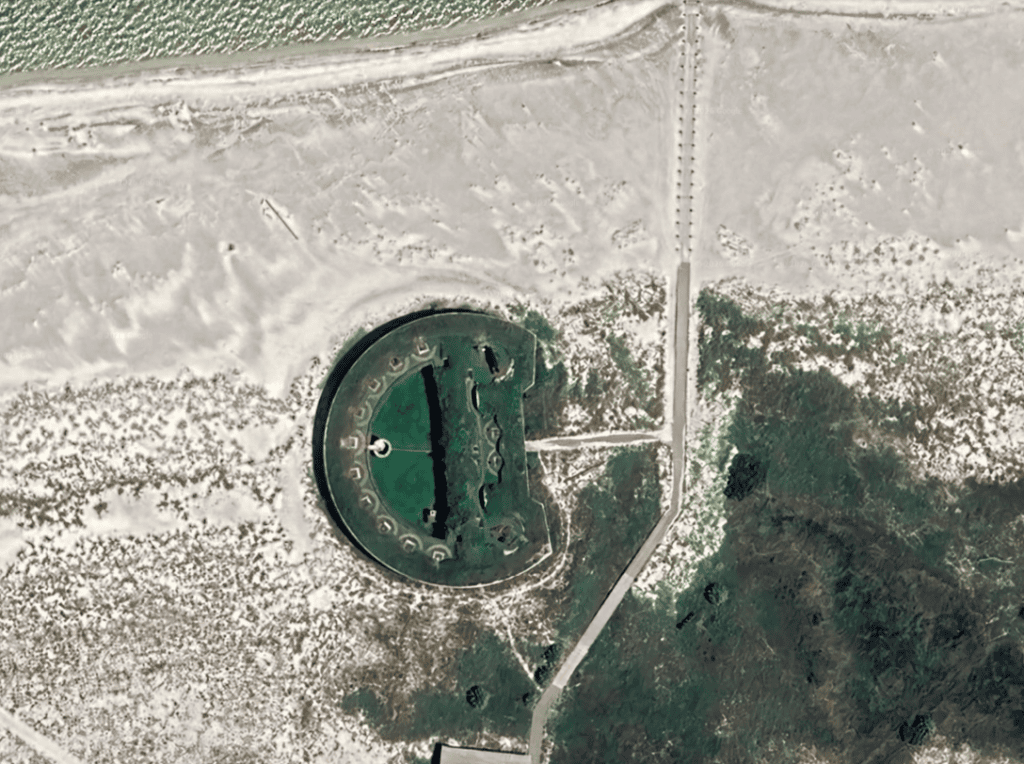
Fort Massachusetts: The Guardian of the Mississippi Gulf Coast
If Ship Island is the heart of Mississippi’s barrier islands, Fort Massachusetts is its crown jewel.
Rising above the white sand dunes on the western end of Ship Island, the massive brick fortress has guarded the entrance to the Mississippi Sound for more than 160 years. Today it stands as one of the best-preserved coastal forts in the United States and is the centerpiece of every visit to Ship Island.
Although the fort never fired its massive guns in battle against a foreign navy, its very existence helped protect one of America’s most important waterways.
Why Was Fort Massachusetts Built?
The story of Fort Massachusetts begins with an American defeat—not on the battlefield, but in military planning.
During the War of 1812, the British demonstrated just how vulnerable the northern Gulf Coast was when they anchored a massive invasion fleet off Ship Island before launching their attack on New Orleans. Military planners realized that any future enemy could use the island exactly the same way.
The United States responded by creating the Third System of Coastal Fortifications, an ambitious network of masonry forts designed to defend America’s harbors and major shipping routes.
Because of its strategic location, Ship Island became one of the most important sites selected for a permanent fortress.
Construction Begins
Construction of Fort Massachusetts began in 1859 under the supervision of the U.S. Army Corps of Engineers.
Thousands of bricks, granite blocks, iron beams, timber, and other building materials had to be transported by ship to the isolated barrier island. Workers then assembled one of the largest masonry structures ever built on the Mississippi Gulf Coast.
When completed as originally designed, the fort would have mounted more than 260 cannons on multiple levels, giving American forces complete control over the shipping channels entering the Mississippi Sound.
It would have been one of the most powerful coastal fortifications in the nation.
The Civil War Changed Everything
Construction came to an abrupt halt in 1861 when the Civil War erupted.
Confederate troops briefly occupied the unfinished fort before Union forces captured Ship Island later that same year. Recognizing its strategic importance, Union engineers repaired portions of the structure and transformed it into an operational military base.
From Ship Island, Union forces controlled much of the Mississippi Gulf Coast while supporting naval operations throughout the Gulf of Mexico.
The fort also served as a military prison and staging area for campaigns along the coast.
Why the Fort Was Never Finished
After the Civil War ended, military technology advanced rapidly.
New steel warships, rifled artillery, and explosive shells could destroy brick forts that had once been considered nearly impregnable. As warfare evolved, the era of large masonry coastal forts came to an end.
Construction of Fort Massachusetts quietly ceased before the original plans were completed.
Ironically, the unfinished fort became one of its greatest strengths. Because it was never heavily modernized or substantially altered, visitors today see a remarkably authentic example of nineteenth-century military engineering.
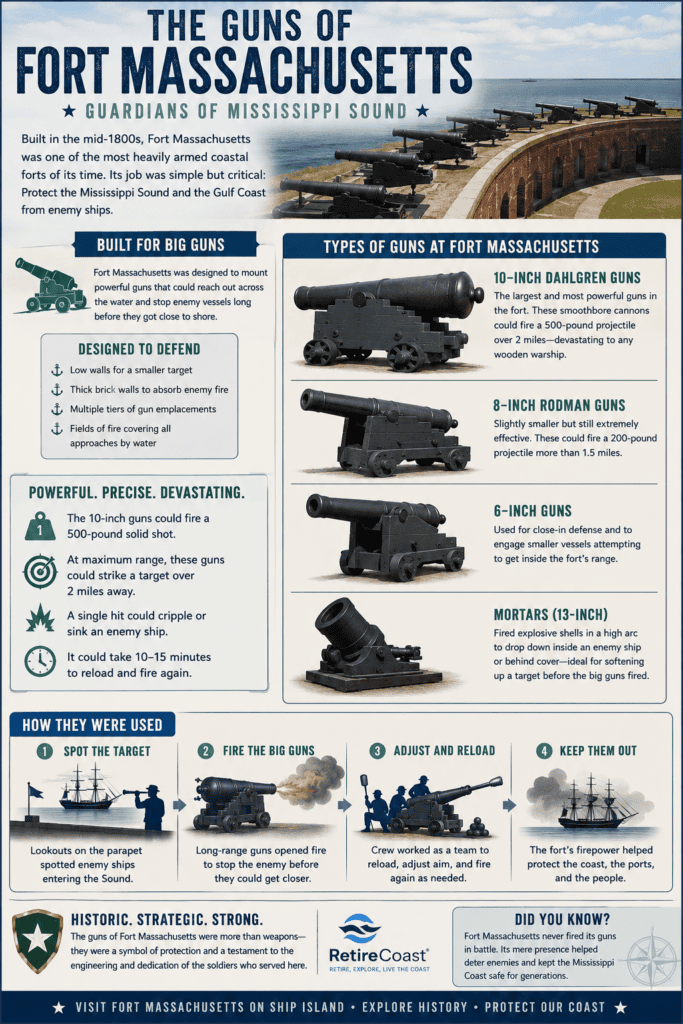
A Masterpiece of Military Engineering
Walking through Fort Massachusetts today reveals just how impressive nineteenth-century engineering could be.
The fort features:
- Massive brick walls several feet thick.
- Arched gun casemates designed to withstand enemy fire.
- Powder magazines protected behind reinforced masonry.
- Elevated gun positions overlooking the Gulf of Mexico.
- Interior courtyards that provided light, ventilation, and troop movement.
- Multiple defensive layers that made direct assault extremely difficult.
Every arch, tunnel, and firing position was carefully designed to maximize defensive strength while protecting the soldiers stationed inside.
Exploring Fort Massachusetts Today
Fort Massachusetts is one of the highlights of every Ship Island visit.
Visitors can walk through the historic casemates, climb to the upper gun deck, explore the parade ground, and enjoy panoramic views of the Gulf of Mexico and Mississippi Sound.
National Park Service rangers frequently offer guided tours explaining the fort’s architecture, military history, and role in defending the Gulf Coast. Even visitors who are not history enthusiasts are often impressed by the sheer size and craftsmanship of the structure.
For photographers, the fort provides some of the most dramatic views on the Mississippi Gulf Coast, especially during the early morning and late afternoon when the brick walls glow in the warm coastal sunlight.
A Lasting Symbol of America’s Coastal Defense
Fort Massachusetts was built because military leaders learned an important lesson during the War of 1812: controlling Ship Island meant controlling access to the northern Gulf of Mexico.
Although the fort never faced the foreign invasion it was designed to repel, it successfully fulfilled another mission. For more than a century and a half, it has stood as a symbol of America’s determination to protect its coastline and preserve its maritime heritage.
Today, visitors come not to witness a battlefield, but to experience one of Mississippi’s greatest historical landmarks—a fortress that connects the Revolutionary War, the War of 1812, the Civil War, and the ongoing story of the Mississippi Gulf Coast.
Ship Island After the Civil War: From Fortress to National Treasure
When the Civil War ended in 1865, Ship Island entered an entirely new chapter in its remarkable history. The days of massive military campaigns and naval blockades were over, but the island would continue serving the nation in ways few people realize.
Over the next 160 years, Ship Island would evolve from a military fortress into America’s first line of defense against deadly epidemics, then into a recreational destination, and finally into one of the Gulf Coast’s most important protected natural areas.
The Final Years of Fort Massachusetts
Following the Civil War, the U.S. Army continued work on Fort Massachusetts in hopes of completing one of the nation’s largest coastal fortifications.
Although construction continued for several years, military technology was advancing at an astonishing pace. During the Civil War, rifled artillery and explosive shells had proven capable of destroying traditional brick forts that had once been considered nearly invincible.
By the early 1870s, Fort Massachusetts was already becoming obsolete before it was ever fully completed.
The Army maintained a small garrison for several years, but in 1875 the fort was officially abandoned as an active military installation.
The Buffalo Soldiers Connection
One of the lesser-known stories of Ship Island involves the African American soldiers who protected the island during Reconstruction.
Companies of the 2nd Regiment of the Louisiana Native Guards, among the first Black regiments to serve in the Union Army, were stationed at Ship Island following the Civil War. These soldiers guarded Fort Massachusetts, protected government property, and helped maintain order during Reconstruction.
When federal military forces were reorganized in 1870, many of these veterans became members of the newly created 25th U.S. Infantry Regiment, one of the famous Buffalo Soldier regiments that would serve throughout the American West.
Ship Island therefore represents an important chapter in the history of the Buffalo Soldiers and the integration of African American troops into the post-war United States Army.
What People Often Ask About the Ship Island Ferry
1. If I take the early ferry, do I have to return on the first boat back?
Not during the summer.
One of the nicest features of the summer ferry schedule is its flexibility. If you take the 9:00 a.m. ferry from Gulfport, you can choose to return on either the 2:30 p.m. ferry or the 5:00 p.m. ferry. You’re not locked into returning on the first boat back. (Ship Island Excursions)
During the spring and fall, however, schedules are more limited on certain weekdays. If only one outbound and one return trip are operating that day, you’ll need to return on the scheduled afternoon ferry. Always check the current schedule before your trip. (Ship Island Excursions)
2. How often do the ferries run during the summer?
During the peak summer season, Ship Island Excursions generally operates two departures each day from Gulfport.
Typical summer departures are:
- 9:00 a.m.
- 12:00 p.m.
Return ferries typically leave Ship Island at:
- 2:30 p.m.
- 5:00 p.m.
This schedule gives visitors the option of spending either a half-day or nearly a full day enjoying the island. Schedules may change because of weather, maintenance, or seasonal operations, so it’s always a good idea to verify departure times before your visit. (Ship Island Excursions)
3. Should I buy ferry tickets in advance?
Yes—especially during the summer.
Weekends, holidays, and the period between Memorial Day and Labor Day are the busiest times of the year. Ferries frequently sell out, particularly the popular morning departures.
Purchasing tickets online in advance helps guarantee your seat and allows you to plan your day with confidence. Even with advance tickets, plan to arrive at least 30 minutes before departure, as boarding usually begins well before the scheduled sailing time. (Ship Island Excursions)
4. What happens if bad weather is forecast?
Passenger safety always comes first.
High winds, rough seas, dense fog, thunderstorms, or other hazardous conditions may delay or cancel ferry service. Keep in mind that weather on the mainland and weather 11 miles offshore can be very different, so conditions are evaluated across the entire route.
Before leaving for Gulfport, check the ferry operator’s website or call for the latest service updates if questionable weather is expected. (Ship Island Excursions)
5. Can I bring my own cooler on the ferry?
Yes.
Visitors are welcome to bring coolers containing food and non-glass beverages for a day on the island. Many families pack picnic lunches, snacks, and extra bottled water, particularly during the hot summer months.
Even though Ship Island has a snack bar and concession stand, bringing your own refreshments is a great way to save money and ensure you have everything you need for a relaxing day at the beach. Remember that glass containers are prohibited, and be sure to pack out everything you bring to help protect this beautiful National Park Service site. (Ship Island Excursions)
America’s First National Quarantine Station
As military activity declined, Ship Island found an entirely different mission—protecting public health.
During the late nineteenth century, outbreaks of yellow fever, cholera, and smallpox regularly devastated Gulf Coast cities. Maritime trade connected the Gulf of Mexico with the Caribbean, Central America, and South America, where many of these diseases were endemic.
Recognizing Ship Island’s isolated location, the federal government established the nation’s first National Quarantine Station on the island in 1879, operated by the United States Marine Hospital Service, the predecessor of today’s U.S. Public Health Service.
Protecting America’s Gulf Coast
Every arriving vessel destined for ports such as New Orleans, Mobile, Biloxi, Gulfport, and Pascagoula could be stopped and inspected before reaching the mainland.
Medical officers boarded ships to examine crews for signs of infectious disease. If illness was suspected, sailors were quarantined in isolation hospitals while the vessels underwent fumigation and disinfection using methods considered advanced for their time.
Although inconvenient for shipping companies, these procedures helped prevent devastating epidemics from spreading throughout the Gulf Coast.
The quarantine station remained in operation until 1916, when improvements in medicine, sanitation, and newer facilities gradually made Ship Island’s role unnecessary.
From Military Outpost to Tourist Destination
Following the closure of the quarantine station, Ship Island entered a quieter period.
During World War I, the island saw limited use by naval patrol vessels monitoring Gulf Coast shipping.
In the 1930s, however, local leaders recognized that Ship Island’s beautiful beaches and historic fort could become an important tourist attraction. Gulfport acquired West Ship Island, and Captain Joe Graham established one of the first regular ferry services, allowing families to visit Fort Massachusetts and enjoy the island’s pristine beaches.
For the first time, Ship Island became known not only for war and public health, but also for recreation and tourism.
World War II Returns the Military
History briefly repeated itself during World War II.
Following reports of German submarines operating in the Gulf of Mexico, the United States Coast Guard reoccupied Ship Island as part of the nation’s coastal defense system.
Personnel stationed on the island conducted coastal patrols, monitored shipping traffic, and watched for enemy submarines that occasionally ventured into Gulf waters during the war.
Although Ship Island never came under attack, it once again served as an important military observation post protecting America’s coastline.
Hurricane Camille Changes Everything
On August 17, 1969, one of the strongest hurricanes ever to strike the United States forever changed the appearance of Ship Island.
Hurricane Camille, a catastrophic Category 5 storm, generated enormous storm surge and wave action that carved a massive channel through the center of the island.
Within hours, the once-continuous barrier island had been split into East Ship Island and West Ship Island, separated by what became known as Camille Cut.
For the next fifty years, maps of Mississippi showed two separate Ship Islands.
A National Park and a Historic Restoration
Only two years after Hurricane Camille, Congress designated Ship Island as part of the newly created Gulf Islands National Seashore in 1971.
Under National Park Service protection, Fort Massachusetts was preserved, natural habitats were protected, and visitors gained greater access to one of Mississippi’s greatest historical and ecological treasures.
When Hurricane Katrina struck in 2005, Camille Cut widened even further, increasing concerns about storm protection, wildlife habitat, and the long-term stability of the island.
Those concerns led to one of the largest coastal restoration projects ever undertaken in the United States.
Working through the Mississippi Coastal Improvements Program (MsCIP), the U.S. Army Corps of Engineerspumped millions of cubic yards of sand into the breach, rebuilt dunes, restored native habitat, and reconnected East and West Ship Island into a single continuous barrier island.
Today, visitors once again experience Ship Island much as earlier generations did—one long barrier island protecting Mississippi’s coast from the Gulf of Mexico.
Ship Island Today
Ship Island has served many different purposes during its remarkable history.
It has been a Spanish supply depot during the American Revolution, the British staging area for the War of 1812, a Union military base during the Civil War, a quarantine station protecting public health, a Coast Guard outpost during World War II, and today one of the most visited destinations within the Gulf Islands National Seashore.
Few places in America have experienced such a diverse and influential history. From defending a young nation to protecting communities from disease and hurricanes, Ship Island continues to play an important role in the story of the Mississippi Gulf Coast.
🇺🇸 RetireCoast WWII Coastal Insight: German U-Boats Reached Mississippi’s Doorstep
Most visitors think of Ship Island as a peaceful beach destination, but during World War II it once again became part of America’s front line.
In 1942, German submarines launched Operation Drumbeat, a campaign that brought the war to the Gulf of Mexico. U-boats sank dozens of merchant ships and oil tankers carrying vital fuel and supplies from Gulf Coast ports, creating real concern that enemy submarines could threaten shipping lanes off Mississippi.
Because of its commanding position at the entrance to the Ship Island Pass and the Gulfport shipping channel, the U.S. Coast Guard reoccupied Ship Island to conduct coastal surveillance and anti-submarine patrols.
Coast Guardsmen watched for suspicious vessels, protected nearby shipping routes, and stood ready to respond if enemy activity approached the Mississippi coastline.
Ship Island also served a very different mission. The former federal quarantine station was converted into a U.S. Army Air Forces recreation and Rest & Relaxation (R&R) center, where airmen from nearby Keesler Field—today’s Keesler Air Force Base—could briefly escape the pressures of wartime training.
Soldiers enjoyed the island’s beaches, fresh Gulf air, and recreational facilities before returning to duty.
By the end of the war, Ship Island had once again proven its strategic value.
Over the previous 170 years, it had served as a Spanish supply depot during the American Revolution, a British invasion base during the War of 1812, a Union stronghold during the Civil War, a national quarantine station protecting Americans from deadly epidemics, and finally a coastal defense outpost during World War II.
Few places on the Mississippi Gulf Coast can claim such an extraordinary military legacy. For more than three centuries, Ship Island has quietly stood watch over the northern Gulf of Mexico, protecting America’s coast in times of war, safeguarding public health in times of crisis, and welcoming visitors in times of peace.
Planning Your Visit to Ship Island
Every year, tens of thousands of visitors make the journey across the Mississippi Sound to experience Ship Island’s history, beaches, wildlife, and crystal-clear Gulf waters. Whether you’re planning a relaxing beach day, a guided tour of Fort Massachusetts, or a full day of fishing and exploring, a little preparation will help you get the most from your visit.
Unlike most Mississippi barrier islands, Ship Island is remarkably accessible. You don’t need to own a boat to enjoy it. Regular passenger ferry service from Gulfport makes Ship Island the easiest barrier island for families, photographers, history enthusiasts, and first-time visitors to experience.
How Most Visitors Reach Ship Island
The overwhelming majority of visitors arrive aboard the Ship Island Excursions ferry.
The ferry departs from Gulfport Small Craft Harbor, carrying passengers approximately 11 miles across the Mississippi Sound to the island’s long pier. The crossing typically takes about an hour and often becomes part of the adventure itself.
During the trip, passengers frequently spot:
- Brown pelicans diving for fish
- Bottlenose dolphins swimming alongside the ferry
- Brown and white pelicans soaring over the Sound
- Royal terns, gulls, and other seabirds
- Commercial shrimp boats and recreational fishing vessels
- The Gulfport skyline gradually disappearing behind the boat
For many visitors, the ferry ride offers their first opportunity to appreciate just how extensive Mississippi’s barrier island chain really is.
Arriving at Ship Island
As the ferry approaches, the island gradually comes into view.
One of the first landmarks you’ll notice is the long pier extending into the Mississippi Sound. After disembarking, visitors walk along the pier toward the island before choosing where to spend their day.
Within a short walk you’ll find:
- Historic Fort Massachusetts
- The National Park Service Visitor Center
- Restrooms
- Picnic pavilions
- Beautiful white-sand beaches
- Nature trails
- Fishing areas
- The boardwalk leading to the Gulf beach
Everything is within easy walking distance, making Ship Island an excellent destination for families and visitors of all ages.
Can You Visit by Private Boat?
Absolutely.
While the ferry brings most visitors, thousands of recreational boaters visit Ship Island every year.
Center consoles, bay boats, pontoons, sailboats, cabin cruisers, and offshore fishing boats regularly anchor along the island. On busy summer weekends, especially holidays, portions of the beach become lively gathering places where boaters spend the day swimming, grilling, paddleboarding, and enjoying the clear Gulf waters.
One advantage of arriving by private boat is the flexibility to explore areas of the island beyond the ferry landing while also fishing the surrounding waters before or after spending time onshore.
How Much Time Should You Plan?
Most visitors spend four to six hours on Ship Island.
That provides enough time to:
- Tour Fort Massachusetts
- Walk both the Mississippi Sound and Gulf beaches
- Swim in the Gulf of Mexico
- Enjoy lunch or a picnic
- Photograph wildlife and historic structures
- Relax on the beach
- Watch dolphins and passing boats
History enthusiasts and photographers often wish they had even longer, while anglers arriving by private boat frequently spend the entire day around the island.
What Makes Ship Island Different?
Every Mississippi barrier island offers a different experience.
Ship Island is ideal for visitors who want to combine history, beaches, and easy access in a single day. Unlike Horn Island, which offers a more remote wilderness experience, or Cat Island, which is best explored by private boat, Ship Island provides amenities that make it accessible without sacrificing its natural beauty.
It is this unique combination of history, recreation, wildlife, and convenience that has made Ship Island the most visited barrier island on the Mississippi Gulf Coast.
Ship Island Ferry Guide
For most visitors, the journey to Ship Island begins long before they step onto the island itself. It begins aboard the Ship Island Excursions ferry, a family-owned business that has been introducing generations of visitors to Mississippi’s barrier islands for nearly a century.
The ferry ride is much more than transportation—it’s part of the Ship Island experience. During the hour-long crossing of the Mississippi Sound, passengers often spot dolphins, pelicans, shrimp boats, and spectacular views of the Mississippi Gulf Coast before arriving at one of the state’s most historic destinations.
The Legacy of Ship Island Excursions
The history of Ship Island Excursions reaches back to one of Mississippi’s most fascinating lost landmarks—the legendary Isle of Caprice.
During the 1920s, thousands of visitors traveled to the Isle of Caprice, a man-made island resort located several miles offshore between Gulfport and Ship Island. The resort featured hotels, restaurants, dancing, gambling casinos, and entertainment that attracted visitors from throughout the South.
One of the men responsible for transporting those visitors was Captain Joe Graham.
Captain Graham operated excursion boats that carried passengers across the Mississippi Sound to the Isle of Caprice during its golden years. When hurricanes and shifting sands eventually destroyed the island resort, he recognized that another nearby barrier island offered tremendous potential for tourism.
That island was Ship Island.
Instead of ending his excursion business with the loss of the Isle of Caprice, Captain Graham redirected his efforts toward introducing visitors to Ship Island’s beaches and the historic Fort Massachusetts. His vision helped transform Ship Island from a little-known military outpost into one of Mississippi’s premier tourist destinations.
Today’s Ship Island Excursions continues that tradition, carrying hundreds of thousands of visitors across the Mississippi Sound while preserving one of the Gulf Coast’s longest-running family tourism businesses.
RetireCoast Historical Connection
There is an interesting connection between two of Mississippi’s most famous islands. The same entrepreneurial spirit that brought thousands of visitors to the glamorous Isle of Caprice during the Roaring Twenties ultimately helped create modern tourism on Ship Island. When Caprice disappeared beneath the Gulf, Captain Joe Graham didn’t give up—he simply shifted his attention to another remarkable barrier island. Nearly a century later, visitors are still making that same journey across the Mississippi Sound aboard Ship Island Excursions.
Related Reading: The Isle of Caprice: The Rise and Fall of Mississippi’s Lost Island Paradise.
Today’s Ferry Experience
Modern ferries depart from Gulfport Small Craft Harbor, carrying visitors approximately eleven miles across the Mississippi Sound to Ship Island.
The trip normally takes about one hour and offers outstanding opportunities to observe:
- Bottlenose dolphins swimming alongside the ferry
- Brown pelicans diving for fish
- Royal terns, laughing gulls, and other coastal birds
- Commercial shrimp boats returning with their catch
- Recreational fishing vessels heading offshore
- The Mississippi Gulf Coast skyline slowly fading into the distance
Many visitors consider the ferry ride to be one of the highlights of their day.
Arriving at Ship Island
As the ferry approaches the island, you’ll immediately notice the long fishing pier extending into the Mississippi Sound and, beyond it, the massive brick walls of Fort Massachusetts rising above the dunes.
After disembarking, visitors enjoy a pleasant walk down the pier before reaching the island’s visitor facilities, beaches, and historic fort. From there, everything is within easy walking distance, allowing guests to spend the day exploring at their own pace.
I would tighten and refine the history slightly while emphasizing that Ship Island Excursions is one of the oldest continuously operating tourism businesses on the Mississippi Gulf Coast. Since your readers will already have read the Isle of Caprice article (or you’ll link to it), we can tell the story without overwhelming this section.
The Story Behind Ship Island Excursions
Long before Ship Island became Mississippi’s most popular barrier island destination, local boat captains were already carrying passengers across the Mississippi Sound to another famous island—the legendary Isle of Caprice.
That connection makes Ship Island Excursions much more than a ferry company. It is part of a nearly century-long story of Gulf Coast tourism that spans Prohibition, World War II, hurricanes, and generations of family ownership.
The Joe Graham Post and Ship Island
In 1933, Congress transferred ownership of Fort Massachusetts and much of West Ship Island to Joe Graham Post No. 119 of the American Legion in Gulfport.
The post was named in honor of Joe Graham, a Gulfport soldier who was killed during World War I. Congress required that the property be preserved for public recreation and historical purposes, giving the American Legion responsibility for maintaining the fort and developing Ship Island as a destination for veterans, families, and visitors.
The Legion built picnic areas, dance pavilions, dormitories, concessions, and other facilities that transformed the former military outpost into one of Mississippi’s first organized beach recreation areas.
Captain Pete Skrmetta Builds a Ferry Service
The success of Ship Island depended on one important thing—getting visitors there.
That responsibility fell to Captain Peter “Pete” Skrmetta, a Croatian immigrant who had settled on the Mississippi Gulf Coast and developed a reputation as one of the area’s most respected boat captains.
In 1926, Captain Skrmetta established what would become Ship Island Excursions, providing passenger transportation across the Mississippi Sound. After the Joe Graham Post assumed responsibility for Ship Island, the American Legion partnered with Captain Skrmetta to operate ferry service and manage visitor transportation.
The partnership proved enormously successful, bringing thousands of visitors to Ship Island throughout the 1930s, 1940s, and 1950s.
Nearly one hundred years later, Ship Island Excursions remains family-owned by the Skrmetta family, making it one of the oldest continuously operating tourism businesses on the Mississippi Gulf Coast.
The Connection to the Isle of Caprice
The history of Ship Island Excursions cannot be told without mentioning the Isle of Caprice.
During the Roaring Twenties, the Isle of Caprice became one of the Gulf Coast’s most famous entertainment destinations. Located about twelve miles offshore, the resort flourished during Prohibition by offering visitors gambling, dancing, restaurants, entertainment, and legal alcohol beyond Mississippi’s jurisdiction.
Boats operated by Captain Pete Skrmetta and other local captains carried thousands of passengers from Gulfport and Biloxi to the island for what many called the “Las Vegas of the Gulf.”
When the Isle of Caprice disappeared beneath the Gulf after storms and erosion in the early 1930s, the demand for offshore excursions did not disappear with it.
Instead, Ship Island became the Coast’s premier offshore destination. Captain Skrmetta shifted his attention from the vanished resort to the historic barrier island, helping establish a tourism tradition that continues today.
RetireCoast Historical Insight
One of my favorite Mississippi Gulf Coast stories is how two very different islands are connected by the same family business. During the 1920s, boats operated by the Skrmetta family carried visitors to the glamorous Isle of Caprice, where people came to dance, gamble, and escape Prohibition. After Caprice disappeared beneath the Gulf, those same maritime traditions helped build tourism on Ship Island. Today, nearly a century later, Ship Island Excursions continues to introduce new generations to Mississippi’s barrier islands. It’s a remarkable example of how Gulf Coast families adapted to changing times while preserving a maritime legacy that still thrives today.
Related Reading: The Isle of Caprice: The Rise and Fall of Mississippi’s Lost Island Paradise.
Continuing a Century of Tradition
Today, riding the ferry is about much more than reaching Ship Island.
Every crossing continues a tradition that began nearly 100 years ago when local captains first introduced visitors to Mississippi’s offshore islands. As the ferry leaves Gulfport and heads toward the horizon, passengers are following in the wake of countless veterans, fishermen, vacationers, history enthusiasts, and families who have made the same journey for generations.
For many visitors, the voyage across the Mississippi Sound is where the Ship Island adventure truly begins.
What to See and Do on Ship Island
Whether you visit for history, beaches, wildlife, or simply a relaxing day on the Gulf, Ship Island offers far more than most first-time visitors expect. While many people come specifically to tour Fort Massachusetts, they often discover that the island itself is the attraction.
From swimming in crystal-clear Gulf waters to watching dolphins from the beach, exploring military history, or simply enjoying one of Mississippi’s most beautiful stretches of sand, there’s enough to fill an entire day.
Tour Historic Fort Massachusetts
No visit to Ship Island is complete without exploring Fort Massachusetts.
The massive brick fortress dominates the western end of the island and is one of the finest surviving examples of nineteenth-century coastal military architecture in America. Visitors can walk through vaulted brick casemates, climb to the upper gun deck, and enjoy panoramic views of both the Mississippi Sound and the Gulf of Mexico.
National Park Service rangers frequently offer guided tours that explain the fort’s construction, Civil War history, military engineering, and its role in protecting one of America’s most important waterways.
Relax on Some of Mississippi’s Best Beaches
Ship Island is famous for its remarkably white sand beaches and clear Gulf waters.
Unlike many mainland beaches, the island has no hotels, highways, condominiums, or commercial development. The result is a peaceful beach experience where the sounds of waves, seabirds, and the breeze replace traffic and city noise.
Visitors can spread out along miles of shoreline, making it easy to find a quiet place to relax even during the busy summer season.
Swim in the Gulf of Mexico
The Gulf-side beach is the island’s most popular destination for swimming.
During calm weather, the water is often clear enough to see fish swimming near shore. Gentle slopes and wide sandy beaches make swimming enjoyable for families, although visitors should always pay attention to changing weather, currents, and National Park Service safety advisories.
Many people are surprised by just how blue and inviting the water can be compared to the mainland beaches.
Walk Between Two Worlds
One of Ship Island’s unique features is how quickly the scenery changes.
Within just a few minutes, visitors can walk from the calm waters of the Mississippi Sound to the surf of the Gulf of Mexico.
The north side of the island typically offers protected waters with little wave action, while the Gulf side features rolling waves, shell collecting, and expansive views of the open Gulf.
Few places on the Mississippi Gulf Coast allow visitors to experience two distinctly different coastal environments with such a short walk.
Watch Dolphins and Coastal Birds
Wildlife is everywhere on Ship Island.
Bottlenose dolphins are frequently seen near the ferry route and occasionally just offshore from the beaches. Brown pelicans, laughing gulls, royal terns, herons, egrets, and osprey are common sights throughout the year.
During spring and fall migrations, birdwatchers may encounter dozens of additional species using the island as a temporary stopover during journeys that span entire continents.
Enjoy a Picnic by the Gulf
Many visitors choose to bring a picnic lunch and spend the day on the island.
Picnic areas near the ferry landing provide convenient places to eat before or after exploring the fort. Others prefer carrying their lunch to the Gulf beach, where they can enjoy spectacular waterfront views while listening to the surf.
Because there are no restaurants or stores on the island, bringing food, drinks, and plenty of water is highly recommended.
Explore at Your Own Pace
One of the greatest pleasures of Ship Island is that there is no schedule once you arrive.
Some visitors spend hours touring Fort Massachusetts. Others never leave the beach. Photographers wander the shoreline looking for wildlife, while families search for seashells, build sandcastles, or simply enjoy a relaxing day away from the mainland.
Whether your interests are history, nature, photography, fishing, or simply enjoying one of Mississippi’s most beautiful barrier islands, Ship Island offers a memorable experience for visitors of every age.
Ship Island Beaches: What Makes Them So Special?
For many visitors, the beaches are the real reason to visit Ship Island.
Unlike many mainland beaches along the Mississippi Gulf Coast, Ship Island offers an undeveloped shoreline with no hotels, condominiums, highways, or commercial buildings. The result is a beach experience that feels surprisingly natural and secluded, despite being only about an hour from Gulfport.
Miles of soft white sand, gentle dunes, clear Gulf waters, and abundant wildlife make Ship Island one of Mississippi’s premier beach destinations.
The Gulf Side: White Sand and Rolling Waves
Most visitors head directly to the Gulf side after arriving on the island.
A short boardwalk crosses the dunes and opens onto a wide stretch of brilliant white sand facing the Gulf of Mexico. Here you’ll find the largest beach area, where visitors swim, sunbathe, walk the shoreline, or simply relax while listening to the surf.
Unlike the protected waters of the Mississippi Sound, the Gulf side typically has gentle waves that make it feel much more like the beaches found along Florida’s Emerald Coast.
During calm weather, the water often takes on beautiful shades of emerald green and turquoise, surprising first-time visitors who never expected to find such clear water along the Mississippi coast.
The Mississippi Sound Side
The north side of Ship Island presents an entirely different environment.
Protected by the barrier islands themselves, the Mississippi Sound usually has calmer water with very little wave action. The ferry docks on this side, making it the first shoreline visitors experience.
Many families appreciate the calmer conditions, while photographers enjoy the panoramic views toward Gulfport, Biloxi, and the mainland.
The Sound side is also an excellent place to watch shrimp boats, sailboats, and recreational vessels traveling through Ship Island Pass.
Soft White Quartz Sand
One of the first things visitors notice is the remarkable quality of the sand.
Ship Island’s beaches are composed primarily of fine white quartz that has been transported south by the Mississippi River and redistributed over thousands of years by waves and coastal currents.
The sand is soft underfoot, reflects sunlight beautifully, and creates the bright, clean appearance that has made Mississippi’s barrier islands famous among Gulf Coast visitors.
Crystal Clear Water—Sometimes Surprisingly Clear
Water clarity varies throughout the year depending on winds, tides, rainfall, and river discharge.
During periods of light winds and calm seas—especially in late spring and early summer—visibility can be excellent. It’s often possible to see fish, crabs, and shells several feet below the surface.
After strong winds or storms, suspended sand and sediment may temporarily reduce water clarity, particularly on the Mississippi Sound side.
Excellent Swimming Conditions
Ship Island offers some of the safest swimming beaches on the Mississippi Gulf Coast when weather conditions are favorable.
The gradual sandy bottom makes entering the water easy for swimmers of all ages. Most visitors stay within the designated swimming areas near the ferry landing, where National Park Service staff can provide current beach conditions and safety information.
As with any Gulf beach, swimmers should remain aware of changing weather, waves, and currents, and always follow posted advisories.
Shelling and Beachcombing
Walking the shoreline is one of Ship Island’s simplest pleasures.
Depending on recent tides and weather, visitors may discover:
- Olive shells
- Moon snails
- Coquinas
- Lightning whelks
- Scallop shells
- Sand dollars (occasionally)
- Colorful sea glass
- Interesting driftwood
Early morning, particularly after a storm or strong tide, is often the best time for shell collecting.
Remember that live shells should always remain in their natural habitat.
🏖️ RetireCoast Beach Tip
Want the best beach experience? Walk a little farther than most visitors. Many people stay close to the ferry landing, but just a 10- to 15-minute walk along the Gulf shoreline often rewards you with quieter beaches, fewer people, and outstanding opportunities to photograph birds, seashells, and the natural beauty of Ship Island. One of the greatest luxuries on a barrier island is finding a stretch of beach that feels like it’s yours alone.
Watching the Sunset
Although most ferry schedules return before sunset, private boaters often remain into the evening.
Watching the sun sink toward the western horizon while Fort Massachusetts glows in the warm evening light is one of the most spectacular scenes on the Mississippi Gulf Coast.
The combination of historic brick walls, white sand, and the open Gulf creates unforgettable photography opportunities throughout the year.
A Beach Worth Protecting
Ship Island’s beaches are more than just a beautiful destination—they are part of a living barrier island system that protects the Mississippi mainland from hurricanes, storm surge, and coastal erosion.
Every dune, sea oat, and stretch of sand plays an important role in preserving this fragile ecosystem. By staying on designated walkways, avoiding the dunes, and packing out everything you bring, visitors help ensure that future generations can enjoy the same natural beauty that has drawn people to Ship Island for centuries.
Ship Island Facilities and Visitor Amenities
Although Ship Island feels wonderfully remote, visitors are often surprised by the number of amenities available for a comfortable day trip.
Facilities on West Ship Island are jointly operated by the National Park Service and Ship Island Excursions. Because the island is part of the Gulf Islands National Seashore, development is intentionally limited to protect the fragile barrier island ecosystem while still providing the services needed for thousands of visitors each year.
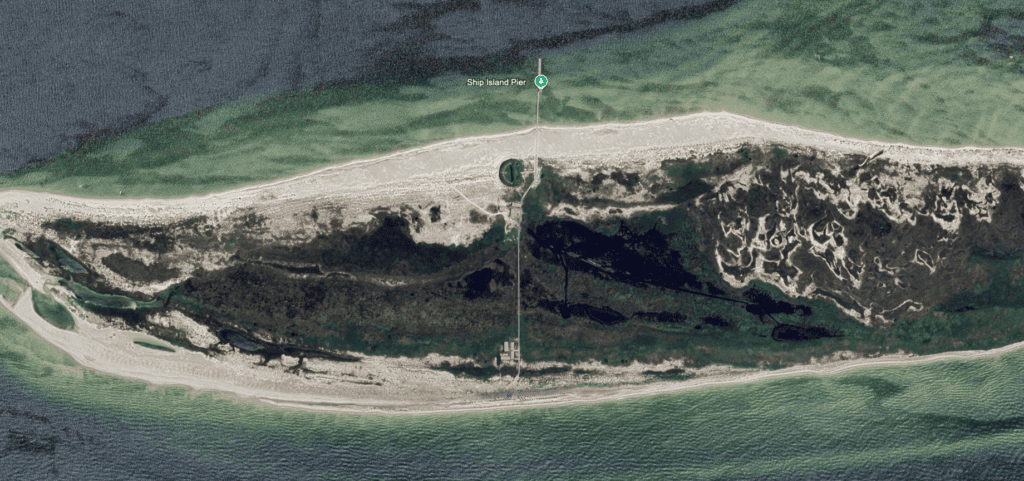
Nearly all public facilities are conveniently located along a one-third-mile boardwalk that connects the passenger pier on the Mississippi Sound to the swimming beach on the Gulf of Mexico.
Passenger Dock and Ferry Landing
Your visit begins at the long passenger pier extending into the Mississippi Sound.
The ferry docks here several times each day, and private boaters may also use designated docking areas when space is available. As you walk toward shore, you’ll enjoy your first views of Fort Massachusetts and the island’s natural beauty.
Please note that fishing is not permitted from the passenger pier. Anglers may fish from the island’s beaches with a valid Mississippi saltwater fishing license and must follow National Park Service regulations.
The Boardwalk
One of the island’s most recognizable features is the raised wooden boardwalk that stretches across the dunes.
The boardwalk protects fragile sea oats, native vegetation, and wildlife habitat while providing visitors with an easy walk between the ferry landing and the Gulf beach.
Along the way, you’ll enjoy excellent views of the marshes, dunes, and coastal landscape that make Ship Island such an important part of Mississippi’s natural defenses against hurricanes.
Fort Massachusetts
Located only a short walk from the ferry landing, Fort Massachusetts is one of the island’s premier attractions.
The National Park Service offers seasonal ranger-led tours, while visitors may also explore many portions of the fort on their own. The massive brick casemates remain surprisingly cool, providing welcome shade during Mississippi’s warm summer months.
National Park Service Ranger Station
Near Fort Massachusetts, visitors will find the National Park Service ranger station.
Friendly park rangers are available to answer questions, provide maps, explain the island’s history and wildlife, offer Junior Ranger information for children, and assist with emergency situations when needed.
It’s also a great place to obtain the official Gulf Islands National Seashore passport stamp if you collect National Park cancellation stamps.
Covered Picnic Pavilions
Two large covered picnic pavilions provide welcome relief from the Mississippi sun.
One pavilion is located near the ferry landing and Fort Massachusetts, while the second sits closer to the Gulf beach. Both offer shaded picnic tables where families can enjoy lunch or simply take a break from the beach.
During the hottest summer afternoons, these pavilions are among the most popular gathering places on the island.
Restrooms, Changing Areas, and Showers
Modern restroom facilities are available at both the north and south ends of the developed area.
Visitors will find:
- Air-conditioned restrooms
- Flush toilets
- Changing rooms
- Fresh drinking water fountains
- Outdoor rinse-off showers for removing sand before boarding the ferry
These facilities make it easy to spend an entire day on the island without sacrificing comfort.
Snack Bar and Beach Concessions
If you forget lunch or simply work up an appetite after exploring the island, the snack bar near the Gulf beach offers a variety of refreshments.
Depending on the season, visitors can typically purchase:
- Hamburgers and hot dogs
- Snacks and chips
- Soft drinks
- Bottled water
- Ice cream and frozen treats
- Beer (for adults of legal drinking age)
- Sunscreen and other beach essentials
- Souvenir items
Availability may vary depending on the season and weather, so bringing extra water is always a good idea.
Beach Chair and Umbrella Rentals
For visitors who prefer to travel light, beach equipment rentals are available near the Gulf beach.
Rental packages typically include:
- Two wooden beach chairs
- One large beach umbrella
This convenient option allows visitors to enjoy a comfortable day at the beach without carrying bulky equipment onto the ferry.
Things You Won’t Find on Ship Island
Part of Ship Island’s charm is its natural setting. Because it is a protected national seashore, commercial development is intentionally limited.
Before your visit, keep these important points in mind:
- Very little natural shade: Other than the picnic pavilions, snack bar, and Fort Massachusetts, there are few places to escape the sun. A hat, sunscreen, sunglasses, and plenty of water are essential.
- No transportation on the island: Once you leave the ferry, everything is explored on foot. Lightweight backpacks and soft-sided coolers are much easier to manage than oversized carts or wagons.
- No overnight camping: Unlike some other Mississippi barrier islands, overnight public camping is not permitted on Ship Island.
- Limited cell phone coverage: Cellular service generally works but can become unreliable depending on your carrier and weather conditions. While concessions normally accept credit cards, carrying a small amount of cash is always a smart backup.
☀️ RetireCoast Visitor Tip
One mistake first-time visitors often make is assuming Ship Island has plenty of shade. It doesn’t. The combination of bright white sand and open Gulf sunshine can make the island feel much hotter than the mainland. Bring sunscreen, wear a wide-brimmed hat, stay hydrated, and take advantage of the shaded pavilions or the cool interior of Fort Massachusetts during the hottest part of the afternoon. A little preparation will make your visit far more enjoyable.
What People Often Ask About Ship Island
1. Is Ship Island worth visiting?
Absolutely. Ship Island is one of Mississippi’s premier coastal attractions because it combines history, beautiful beaches, and easy accessibility in one destination.
Visitors can tour historic Fort Massachusetts, swim in the Gulf of Mexico, relax on miles of white sand beaches, watch dolphins and seabirds, and enjoy a scenic ferry ride across the Mississippi Sound—all in a single day.
Whether you’re a history enthusiast, beach lover, photographer, or family looking for a memorable outing, Ship Island offers something for everyone.
2. Can you spend the night on Ship Island?
No. Unlike Horn Island and several other Mississippi barrier islands where primitive camping is permitted, overnight camping is not allowed on Ship Island. Most visitors arrive on the ferry in the morning and return to Gulfport later that afternoon, while private boaters generally leave before sunset.
The National Park Service manages Ship Island primarily as a historic site and day-use recreation area.
3. Are there alligators on Ship Island?
Unlike Horn Island, which has freshwater ponds that support a small population of American alligators, alligators are not considered a resident species on Ship Island. The island lacks the large freshwater wetlands needed to support permanent populations.
Visitors are far more likely to see bottlenose dolphins, pelicans, shorebirds, sea turtles, ghost crabs, and a wide variety of coastal wildlife than alligators.
4. Do you need to bring food and water?
While Ship Island has a seasonal snack bar that offers food, drinks, snacks, and beach essentials, it’s always wise to bring your own bottled water, especially during the summer months.
The Mississippi sun can be intense, and spending several hours on the beach can quickly lead to dehydration. Many visitors also bring picnic lunches to enjoy at one of the covered pavilions or on the beach.
5. Why is Fort Massachusetts on Ship Island instead of the mainland?
Fort Massachusetts was built on Ship Island because the island controlled one of the deepest natural entrances into the Mississippi Sound. Before modern dredging, large sailing ships could not easily reach ports such as Biloxi or Gulfport because of shallow water.
By placing a fort on Ship Island, the United States could protect the primary shipping channel, defend Gulf Coast commerce, and prevent enemy fleets from entering the Sound. The island’s strategic location made it one of the most important military positions on the northern Gulf of Mexico during the nineteenth century.
Wildlife on Ship Island: A Nature Lover’s Paradise
Ship Island is much more than a beautiful beach destination—it’s one of the most important wildlife habitats along the northern Gulf of Mexico.
Protected as part of the Gulf Islands National Seashore, the island provides nesting areas, feeding grounds, and resting habitat for hundreds of species of birds, marine mammals, reptiles, fish, and countless smaller creatures.
Every visit offers the opportunity to see wildlife in its natural environment, making Ship Island a favorite destination for photographers, birdwatchers, and nature enthusiasts.
Whether you’re walking the beach, riding the ferry, or relaxing near the dunes, keep your eyes open—you never know what might appear.
Bottlenose Dolphins
One of the highlights of almost every ferry trip is the chance to see Atlantic bottlenose dolphins.
These intelligent marine mammals frequently swim alongside the ferry, riding the boat’s wake and delighting passengers of all ages. Dolphins can also be spotted from the beach, especially during the early morning and late afternoon when they are actively feeding.
Although dolphins often appear playful, they are wild animals. Visitors should admire them from a distance and never attempt to feed or approach them.
Sea Birds Everywhere You Look
Ship Island is one of Mississippi’s premier birdwatching destinations.
Because the barrier islands sit directly beneath the Mississippi Flyway, hundreds of thousands of migratory birds use the islands as resting and feeding areas each year.
Common species include:
- Brown Pelicans
- Royal Terns
- Sandwich Terns
- Laughing Gulls
- Ring-billed Gulls
- Great Blue Herons
- Great Egrets
- Snowy Egrets
- Ospreys
- Double-crested Cormorants
Spring and fall migration often bring dozens of additional species, making Ship Island a favorite stop for serious birders.
Sea Turtles
Several species of sea turtles inhabit the waters surrounding Ship Island.
Although sightings are uncommon, visitors occasionally spot:
- Kemp’s Ridley Sea Turtle
- Loggerhead Sea Turtle
- Green Sea Turtle
These threatened and endangered species sometimes nest on Mississippi’s barrier islands. If you encounter a nesting turtle or hatchlings, keep your distance and immediately notify a National Park Service ranger.
Ghost Crabs
One of the island’s most entertaining residents is the ghost crab.
These pale-colored crabs race across the beach with astonishing speed and spend most of the day inside deep burrows dug into the sand above the high tide line.
Children especially enjoy watching them emerge around sunrise, sunset, and after dark.
Fish Along the Shoreline
The waters surrounding Ship Island support an incredible variety of marine life.
Depending on the season, visitors may see:
- Mullet
- Speckled trout
- Redfish
- Flounder
- Ladyfish
- Stingrays
- Small sharks
- Blue crabs
Schools of baitfish are often visible from the beach, attracting pelicans, dolphins, and larger predatory fish.
Shells and Other Beach Treasures
Even a leisurely walk along the shoreline can reveal fascinating discoveries.
Visitors commonly find:
- Lightning whelks
- Olive shells
- Moon snails
- Scallop shells
- Coquinas
- Sand dollars (occasionally)
- Sea beans
- Colorful sea glass
- Driftwood sculpted by the Gulf
Please remember that shells containing live animals should always be left where they are found.
Butterflies, Dragonflies, and Pollinators
Although most people focus on the beach, Ship Island’s dunes support an impressive community of insects and pollinators.
Native wildflowers attract butterflies, bees, dragonflies, and other beneficial insects throughout much of the year.
These small creatures play an essential role in maintaining the island’s delicate ecosystem.
Are There Alligators on Ship Island?
One question visitors often ask is whether Ship Island has alligators.
The answer is no resident population exists.
Unlike nearby Horn Island, which contains numerous freshwater ponds that support American alligators, Ship Island lacks the freshwater wetlands needed for permanent populations.
Although an alligator could theoretically reach the island following major floods or hurricanes, sightings are extraordinarily rare. Visitors should instead expect to encounter dolphins, shorebirds, sea turtles, and other coastal wildlife.
🦩 RetireCoast Wildlife Tip
The best wildlife viewing usually happens early in the morning or late in the afternoon, when temperatures are cooler and animals are most active. Bring a pair of binoculars if you have them—you’ll greatly increase your chances of spotting dolphins offshore, ospreys diving for fish, pelicans soaring overhead, and migratory birds resting among the dunes. A camera with a zoom lens is also well worth bringing, especially during spring and fall migration.
Help Protect Ship Island’s Wildlife
Every visitor plays an important role in preserving Ship Island’s fragile ecosystem.
You can help by:
- Staying on designated boardwalks and trails.
- Never feeding wildlife.
- Keeping a respectful distance from birds and marine animals.
- Leaving shells with living animals where you found them.
- Properly disposing of all trash.
- Avoiding dunes and sea oat vegetation.
- Reporting injured wildlife to a National Park Service ranger.
By following these simple guidelines, you’ll help ensure that Ship Island remains one of the Gulf Coast’s premier wildlife refuges for generations to come.
At this point you’ve covered:
- History
- Ferry
- Beaches
- Facilities
- Wildlife
The next major section that visitors always search for is Fishing. Ship Island is one of the premier fishing destinations on the Mississippi Gulf Coast, and it deserves its own comprehensive section.
Fishing Around Ship Island
For generations, anglers have considered Ship Island one of the finest fishing destinations on the Mississippi Gulf Coast. The combination of the Mississippi Sound, the Gulf of Mexico, tidal passes, sandy beaches, and nearby artificial reefs creates an incredibly diverse fishery that attracts everyone from first-time anglers to experienced offshore fishermen.
Whether you’re casting from the beach, wading in the surf, or arriving by boat, Ship Island offers outstanding opportunities throughout the year.
Why Is the Fishing So Good?
Ship Island sits where several marine environments come together.
The calm, nutrient-rich waters of the Mississippi Sound meet the deeper, saltier waters of the Gulf of Mexico. Strong tidal currents moving through Ship Island Pass constantly bring baitfish, shrimp, and crabs into the area, attracting larger game fish.
The island’s beaches, sandbars, channels, and nearby reefs create ideal habitat for dozens of popular sport fish.
Popular Fish Species
Depending on the season, anglers commonly catch:
- Speckled Trout
- Red Drum (Redfish)
- Flounder
- Black Drum
- Sheepshead
- Spanish Mackerel
- King Mackerel (offshore)
- Tripletail
- Cobia (seasonal)
- Jack Crevalle
- Whiting
- Croaker
- Pompano
- Bluefish
Offshore anglers venturing beyond the barrier islands may also target snapper, grouper, amberjack, tuna, and other deep-water species.
Fishing From the Beach
Many visitors are surprised to learn that excellent fishing is available right from the shoreline.
Surf anglers regularly catch:
- Whiting
- Pompano
- Redfish
- Speckled trout
- Black drum
- Bluefish
Early morning and late evening are often the most productive times, particularly during warmer months.
Please remember that fishing is not permitted from the passenger ferry pier.
Fishing by Boat
Private boats have access to some of the best fishing on the Mississippi Coast.
Popular areas include:
- Ship Island Pass
- The Gulf side sandbars
- Nearshore artificial reefs
- The Mississippi Sound
- Offshore wrecks
- Oil platform structures farther into the Gulf
The island is frequently used as a launching point for offshore fishing adventures because it provides quick access to deeper Gulf waters.
Seasonal Fishing
Fishing changes throughout the year.
Spring
- Speckled trout begin moving into shallow water.
- Cobia migrate along the beaches.
- Spanish mackerel become more common.
Summer
- Excellent trout and redfish fishing.
- Offshore action peaks.
- King mackerel and snapper season attract many anglers.
Fall
- One of the best times for redfish.
- Flounder begin migrating.
- Cooling water improves overall fishing.
Winter
- Black drum and sheepshead become more active.
- Speckled trout remain available during mild weather.
Do You Need a Fishing License?
Yes.
Anyone fishing around Ship Island generally needs a valid Mississippi Saltwater Recreational Fishing License, unless exempt under Mississippi law.
Current regulations, size limits, bag limits, and seasonal closures are established by the Mississippi Department of Marine Resources (MDMR) and should always be reviewed before your trip.
Respect the National Seashore
Because Ship Island is part of the Gulf Islands National Seashore, anglers are encouraged to practice responsible fishing.
Please remember to:
- Dispose of fishing line properly.
- Never leave hooks or tackle on the beach.
- Observe all size and bag limits.
- Respect wildlife and nesting bird areas.
- Leave the beach cleaner than you found it.
🎣 RetireCoast Fishing Tip
Ship Island offers two completely different fishing experiences. The Mississippi Sound side generally provides calmer water that’s excellent for families and light tackle fishing, while the Gulf side often produces larger game fish, especially during bait migrations. If you’re arriving by private boat, fishing both sides of the island during changing tides can dramatically improve your chances of success.
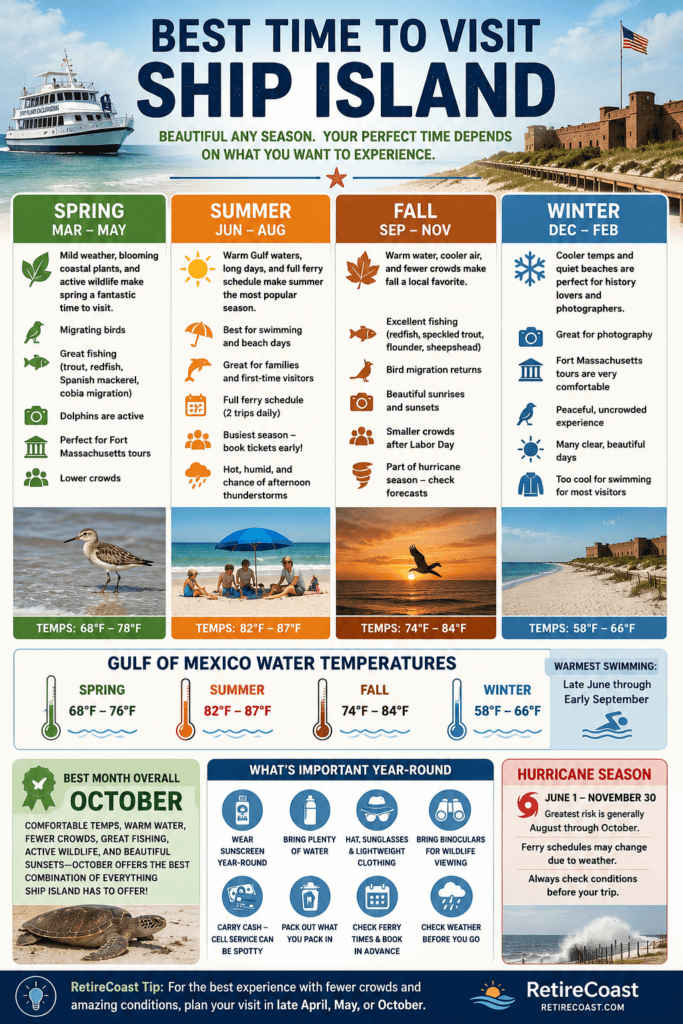
Best Time to Visit Ship Island
One of the best things about Ship Island is that every season offers a different experience.
Some visitors come for warm Gulf waters and long summer beach days, while others prefer the cooler temperatures, migrating birds, or outstanding fishing found during spring and fall. Even winter has its appeal, especially for photographers and history enthusiasts who enjoy exploring Fort Massachusetts without the summer crowds.
The “best” time to visit really depends on what you hope to experience.
Spring (March through May)
Spring is one of the finest times to visit Ship Island.
Comfortable temperatures, lower humidity, blooming coastal vegetation, and active wildlife make this season ideal for sightseeing. Migratory birds stop on the island during their long journeys, while dolphins become increasingly active around the ferry route.
Average temperatures range from the upper 60s to the upper 70s, making it comfortable to explore Fort Massachusetts, walk the beaches, or spend hours photographing wildlife.
Spring is also one of the best seasons for anglers targeting speckled trout, redfish, Spanish mackerel, and the annual cobia migration.
Best For:
- Wildlife photography
- Birdwatching
- Fort Massachusetts tours
- Fishing
- Comfortable hiking
- Families avoiding peak crowds
Summer (June through August)
Summer is Ship Island’s busiest season.
Warm Gulf waters, long daylight hours, and daily ferry service attract thousands of visitors from across the Southeast. Families flock to the island to swim, relax on the beach, and enjoy one of Mississippi’s favorite summer traditions.
Water temperatures often reach the low to mid-80s, making swimming especially enjoyable.
However, summer also brings higher humidity, stronger sunshine, and afternoon thunderstorms. Sunscreen, lightweight clothing, hats, and plenty of drinking water become essential.
Because this is the busiest time of year, purchasing ferry tickets in advance is strongly recommended.
Best For:
- Swimming
- Family vacations
- Beach days
- Dolphin watching
- Full ferry schedule
- Warm Gulf water
Fall (September through November)
Many locals consider fall to be the best season of the year.
The Gulf remains pleasantly warm from the summer heat, while air temperatures become much more comfortable. Humidity decreases, crowds thin out after Labor Day, and fishing reaches its annual peak.
Bird migration resumes during the fall, creating excellent opportunities for photographers and birdwatchers.
Keep in mind that September and October remain within the Atlantic hurricane season, so visitors should monitor tropical weather forecasts before traveling.
Best For:
- Fishing
- Beach walks
- Photography
- Smaller crowds
- Comfortable temperatures
- Wildlife viewing
Winter (December through February)
Winter offers a completely different Ship Island experience.
Although swimming is generally too cold for most visitors, mild Gulf Coast winters make the island an excellent destination for history lovers, photographers, and anyone looking for peaceful beaches.
Fort Massachusetts is especially enjoyable during cooler weather, allowing visitors to spend more time exploring without the heat of summer.
Many winter days feature crystal-clear skies and exceptional visibility across the Mississippi Sound.
Best For:
- Touring Fort Massachusetts
- Photography
- Quiet beaches
- Birdwatching
- Scenic ferry rides
- Avoiding crowds
Water Temperatures Throughout the Year
The Gulf of Mexico changes gradually with the seasons.
Approximate water temperatures include:
| Season | Average Water Temperature |
|---|---|
| Spring | 68–76°F |
| Summer | 82–87°F |
| Fall | 74–84°F |
| Winter | 58–66°F |
The warmest swimming conditions typically occur from late June through early September, while many visitors still comfortably swim into October during mild years.
Hurricane Season
Ship Island lies within the Gulf of Mexico, making it vulnerable to tropical storms and hurricanes.
The Atlantic hurricane season officially runs from June 1 through November 30, with the greatest risk generally occurring between August and October.
Modern weather forecasting provides excellent advance warning, and ferry operators closely monitor conditions. If tropical weather threatens the Mississippi Gulf Coast, ferry schedules may be delayed or canceled for passenger safety.
The Best Month Overall
If choosing just one month, many experienced Gulf Coast visitors recommend October.
October offers an outstanding combination of:
- Comfortable temperatures
- Warm Gulf water
- Smaller crowds
- Excellent fishing
- Active wildlife
- Beautiful sunsets
- Pleasant ferry rides
- Lower humidity
It’s an ideal time to enjoy everything Ship Island has to offer without the peak summer crowds.
🍂 RetireCoast Recommendation
If your schedule is flexible, plan your visit for late April, May, or October. These months offer what many locals consider the “sweet spot” for Ship Island—pleasant temperatures, fewer visitors, excellent wildlife viewing, and comfortable conditions for exploring Fort Massachusetts, relaxing on the beach, or simply enjoying the scenic ferry ride across the Mississippi Sound. You’ll often experience the island at its very best while avoiding the hottest summer days.
This deserves its own section because fishing is one of the biggest reasons many people visit Ship Island. I’d organize it by habitat, which helps both readers and SEO.
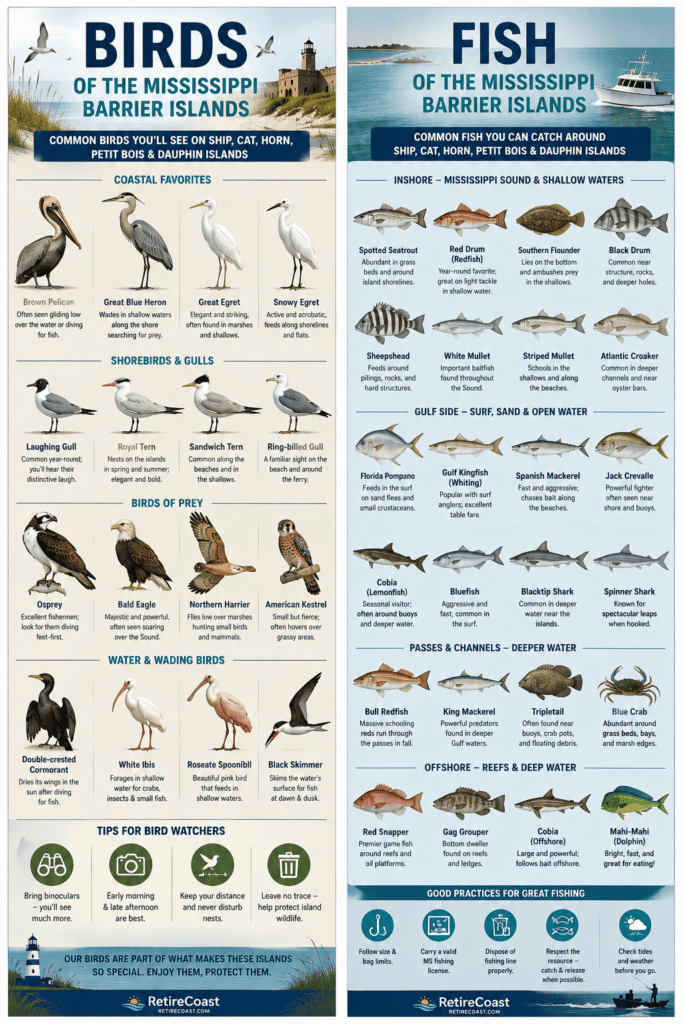
Fish Species Around Ship Island
One of the reasons Ship Island is considered one of the premier fishing destinations on the Mississippi Gulf Coast is the incredible diversity of fish found in its surrounding waters.
The island sits at the meeting point of two very different marine environments. On the north side, the protected waters of the Mississippi Sound contain grass flats, shallow bays, and nutrient-rich estuaries that serve as nurseries for countless marine species.
On the south side, the open Gulf of Mexico features sandy beaches, deeper water, tidal passes, and offshore reefs that attract larger game fish.
This unique combination creates outstanding fishing opportunities throughout the year.
North Side: Mississippi Sound Grass Flats and Shallow Water
The north side of Ship Island is protected from the open Gulf by the barrier island chain, creating calmer waters with extensive seagrass beds, sandy bottoms, and shallow marsh-like habitat.
These areas support enormous populations of shrimp, crabs, mullet, and other baitfish, making them ideal feeding grounds for many of Mississippi’s favorite sport fish.
Common catches include:
- Spotted Seatrout (Speckled Trout) – Often considered the signature fish of the Mississippi Sound, speckled trout are abundant around grass beds, oyster reefs, and deeper potholes.
- Red Drum (Redfish) – Found cruising shallow flats and sandy shorelines year-round. Both slot-sized fish and trophy bull reds are common.
- Southern Flounder – Masters of camouflage that lie buried along sandy bottoms waiting to ambush passing baitfish.
- Black Drum – Frequently caught near structure and deeper channels, especially during cooler months.
- Sheepshead – Recognized by their distinctive black stripes and human-like teeth, these fish gather around pilings, rocks, and other hard structures.
- Striped and White Mullet – Although often used as bait, these schooling fish are among the most important forage species in the Mississippi Sound.
South Side: Gulf Beaches and Surf Zone
The Gulf side of Ship Island offers a completely different fishing experience.
Rolling waves, clean sandy beaches, troughs, and offshore sandbars create excellent habitat for fish that prefer higher salinity and stronger wave action.
Popular species include:
- Florida Pompano – One of the Gulf Coast’s most prized table fish, often caught in the surf feeding on sand fleas and small crabs.
- Gulf Kingfish (Whiting) – A favorite among beach anglers because they bite readily and provide excellent table fare.
- Spanish Mackerel – Fast-moving predators that chase schools of baitfish close to shore during spring and summer.
- Jack Crevalle – Powerful fighters known for explosive surface strikes and blistering runs.
- Cobia (Lemonfish) – Seasonal visitors often spotted cruising along beaches, buoys, and channel markers.
- Bluefish – Aggressive feeders that frequently attack schools of baitfish near the surf.
Deep Passes and Island Channels
Some of the best fishing occurs in the deeper water surrounding Ship Island Pass and nearby channels.
Strong tidal currents funnel baitfish through these natural openings, attracting larger predators throughout much of the year.
Species commonly targeted include:
- Bull Redfish – Massive spawning redfish migrate through the passes each fall, with fish often exceeding 30 pounds.
- King Mackerel – Frequently caught by anglers trolling just outside the barrier islands during the warmer months.
- Tripletail – One of the Gulf’s most unusual fish, often found floating beside crab trap buoys, channel markers, or drifting debris.
- Blacktip Sharks – Common during summer and fall, especially around deeper channels.
- Spinner Sharks – Known for spectacular leaps when hooked.
- Bull Sharks – Powerful predators that occasionally patrol the deeper waters around the island.
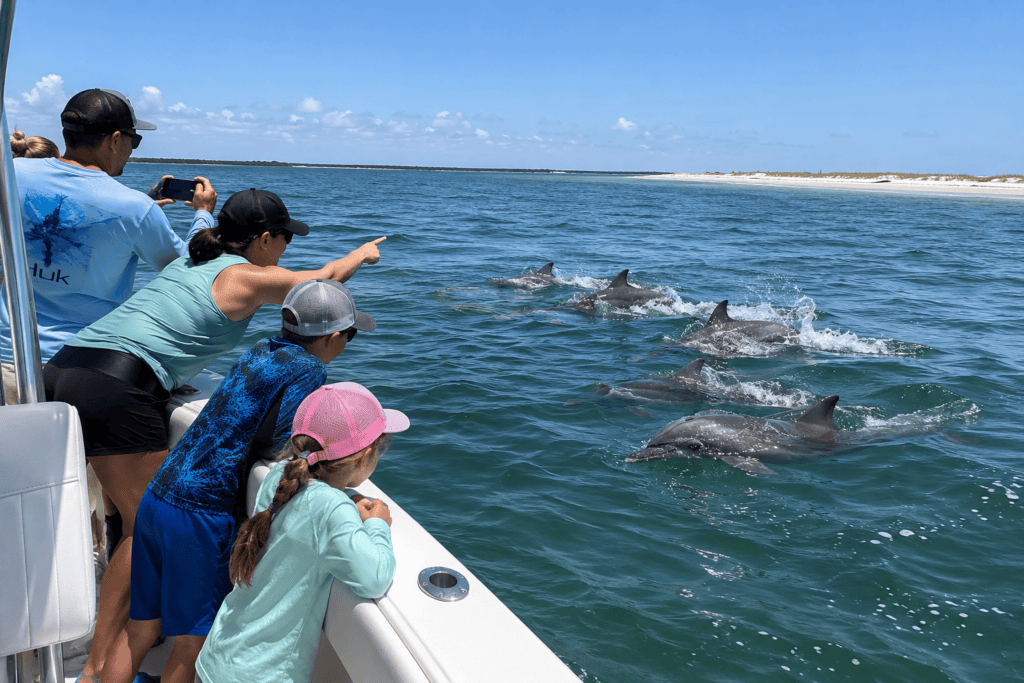
Offshore Opportunities
Just beyond Ship Island, the Gulf of Mexico opens into productive offshore fishing grounds.
Artificial reefs, natural bottom structure, and oil platforms support some of the Gulf’s most sought-after game fish.
Depending on the season, offshore anglers pursue:
- Red Snapper
- Mangrove Snapper
- Vermilion Snapper
- Gag Grouper
- Red Grouper
- Greater Amberjack
- Cobia
- King Mackerel
- Mahi-Mahi (occasionally)
- Blackfin Tuna (farther offshore)
Many charter boats departing from Gulfport, Biloxi, and Long Beach pass Ship Island on their way to these productive fishing grounds.
Why Ship Island Is Such a Productive Fishery
Barrier islands are nature’s fish factories.
The combination of shallow estuaries, seagrass beds, sandy beaches, tidal passes, marsh habitat, and open Gulf waters provides food, shelter, and spawning areas for hundreds of marine species.
Shrimp, blue crabs, mullet, menhaden, and other baitfish thrive here, creating a food chain that supports everything from speckled trout to sharks.
This rich ecosystem is one of the primary reasons Mississippi’s barrier islands have earned a reputation as some of the finest fishing destinations anywhere on the northern Gulf Coast.
🎣 RetireCoast Fishing Insight
Experienced local anglers often say Ship Island offers three fisheries in one. Fish the north side for speckled trout and redfish in the protected waters of the Mississippi Sound, work the Gulf beaches for pompano and Spanish mackerel in the surf, or head to Ship Island Pass and nearby offshore waters for king mackerel, tripletail, bull reds, snapper, and other larger game fish. Few places on the Gulf Coast provide so much variety within such a short distance.
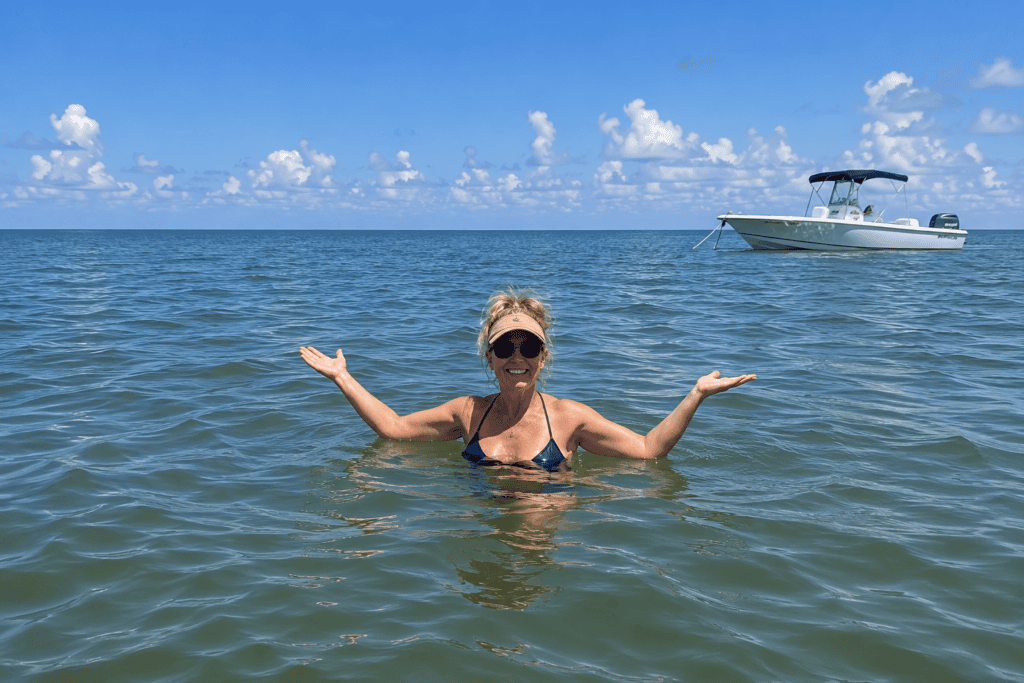
🧭 RetireCoast Adventure Tip: Visit the Sunken Isle of Caprice
Looking for one of the Mississippi Gulf Coast’s best-kept secrets?
If you’re visiting Ship Island by private boat, continue approximately 7 miles east along the island. As you approach the area between Ship Island and Horn Island, keep an eye on your depth finder. You’ll notice the water suddenly rises from roughly 12–30 feet deep to only 3–5 feet.
Congratulations—you’ve just arrived at the site of the legendary Isle of Caprice.
During the Roaring Twenties, this now-submerged sandbar was home to one of the Gulf Coast’s most famous offshore resorts, featuring casinos, dancing, restaurants, and legal alcohol during Prohibition. Today, the island lies beneath just a few feet of water, forming a broad sandy shoal surrounded by the Gulf.
On calm days and especially around low tide, many boaters carefully anchor nearby and wade onto the shallow sandbar. One of the most popular photo opportunities is having a friend take your picture as you appear to be walking in the middle of the Gulf of Mexico—all while standing on what was once one of Mississippi’s most glamorous resort islands.
GPS Coordinates (Former Isle of Caprice)
Decimal Degrees (DD)
30.2415° N, 88.8529° WDegrees, Minutes, Seconds (DMS)
30° 14′ 29.4″ N, 88° 51′ 10.4″ WDegrees, Decimal Minutes (DMM)
30° 14.490′ N, 88° 51.174′ W⚠️ Boater Safety: Conditions around the shoal change with tides, winds, and shifting sand. Navigate slowly, watch your depth finder, and be alert for other anchored boats. The surrounding waters can become very shallow much faster than many first-time visitors expect.
Don’t miss the story behind this remarkable place. Read our companion article, “The Isle of Caprice: The Rise and Fall of Mississippi’s Lost Island Paradise,” and discover how a luxurious offshore resort became one of the Gulf Coast’s most fascinating lost landmarks.
I think an itinerary is an excellent addition. It answers one of the biggest questions visitors have: “How do I spend my day?” It also naturally incorporates many of the sections you’ve already written.
One-Day Ship Island Itinerary
Whether you’re visiting for the first time or returning to explore more of Mississippi’s beautiful barrier islands, a little planning can help you make the most of your day. The following itinerary is based on taking the 9:00 a.m. ferry from Gulfport during the summer season and returning on the 5:00 p.m. ferry, giving you nearly a full day to enjoy everything Ship Island has to offer.
8:00–8:30 a.m. — Arrive at Gulfport Small Craft Harbor
Plan to arrive at least 30 to 45 minutes before departure.
This gives you time to:
- Check in if needed.
- Find parking.
- Purchase snacks or drinks for the ferry.
- Take photos of the harbor.
- Watch shrimp boats and recreational vessels preparing to leave.
If you haven’t already purchased ferry tickets, this is when you’ll want to do so.
9:00–10:00 a.m. — Ferry Ride to Ship Island
The hour-long ferry ride is part of the adventure.
During the crossing, keep your camera ready for:
- Bottlenose dolphins
- Brown pelicans diving for fish
- Shrimp boats working the Mississippi Sound
- Views of Deer Island and the Mississippi coastline
- The first glimpse of Fort Massachusetts rising above the dunes
Many visitors spend the entire ride outside enjoying the scenery.
10:00–11:00 a.m. — Explore Fort Massachusetts
Once you arrive, head first to Fort Massachusetts before the summer temperatures climb.
Allow time to:
- Walk through the historic brick casemates.
- Climb to the upper level.
- Join a ranger-led tour if available.
- Photograph the fort from several angles.
- Enjoy panoramic views of both the Mississippi Sound and the Gulf of Mexico.
This is one of the most fascinating historic sites on the entire Gulf Coast.
11:00 a.m.–12:30 p.m. — Walk the Boardwalk and Visit the Gulf Beach
Next, stroll along the boardwalk to the Gulf side of the island.
Spend time:
- Swimming in the Gulf.
- Walking the shoreline.
- Looking for seashells.
- Photographing birds.
- Relaxing in the soft white sand.
If you’re visiting in spring or fall, you’ll often find the beaches surprisingly uncrowded.
12:30–1:30 p.m. — Lunch
Enjoy lunch at one of the covered picnic pavilions or visit the concession stand.
Many visitors choose to:
- Bring a picnic.
- Purchase burgers, hot dogs, snacks, or cold drinks.
- Relax in the shade before heading back to the beach.
Don’t forget to drink plenty of water.
1:30–3:30 p.m. — Relax or Explore
The afternoon is yours.
Popular activities include:
- More swimming.
- Beachcombing.
- Wildlife photography.
- Watching dolphins offshore.
- Fishing from the beach (with a Mississippi saltwater license).
- Simply relaxing under an umbrella.
This is also a great time to walk farther down the beach where you’ll often find fewer people.
3:30–4:30 p.m. — Final Walk Around the Island
Before leaving, take one last stroll around the developed area.
Many visitors like to:
- Visit the gift shop.
- Photograph Fort Massachusetts in the afternoon light.
- Watch boats entering Ship Island Pass.
- Sit quietly and enjoy the peaceful atmosphere before boarding the ferry.
It’s amazing how quickly the day passes.
5:00–6:00 p.m. — Ferry Ride Back to Gulfport
The return trip offers one final opportunity to enjoy the Mississippi Sound.
As the sun begins dropping toward the western sky, keep watching for dolphins, seabirds, and spectacular views of the Mississippi coastline.
Many visitors say the ride home is one of the most relaxing parts of the entire experience.
🌴 RetireCoast Insider Itinerary
If you’re traveling by private boat, your day can be even more memorable. Spend the morning exploring Ship Island and Fort Massachusetts, enjoy lunch on the beach, then continue about 7 miles east to the shallow shoals of the sunken Isle of Caprice. On calm days, many boaters anchor over the historic sandbar, wade into the shallow water, and experience one of the Mississippi Gulf Coast’s most fascinating hidden landmarks. It’s two unforgettable destinations in one incredible day.
Sample Packing Checklist
Before leaving home, make sure you have:
- ✅ Ferry tickets
- ✅ Sunscreen
- ✅ Hat and sunglasses
- ✅ Swimsuit and towel
- ✅ Comfortable walking shoes or sandals
- ✅ Bottled water
- ✅ Snacks or picnic lunch
- ✅ Camera or binoculars
- ✅ Cash or credit card
- ✅ Lightweight backpack or beach bag
Make It a Barrier Islands Adventure
Ship Island is just one stop in the RetireCoast Mississippi Barrier Islands Guide Series. If today’s visit leaves you wanting more—and it probably will—consider exploring the other islands on future trips.
Each has its own personality:
- Horn Island – Wilderness, camping, kayaking, and the legacy of Walter Anderson.
- Cat Island – Excellent fishing, unique T-shaped geography, and quiet anchorages.
- Deer Island – The easiest island to reach by kayak or paddleboard from Biloxi.
- The Isle of Caprice – A fascinating underwater destination where a glamorous Prohibition-era resort once stood.
One day on Ship Island often inspires a lifetime of exploring Mississippi’s remarkable barrier islands.
Looking at what we’ve built, the article is now very comprehensive. The next section should answer another question almost every visitor asks before leaving home:
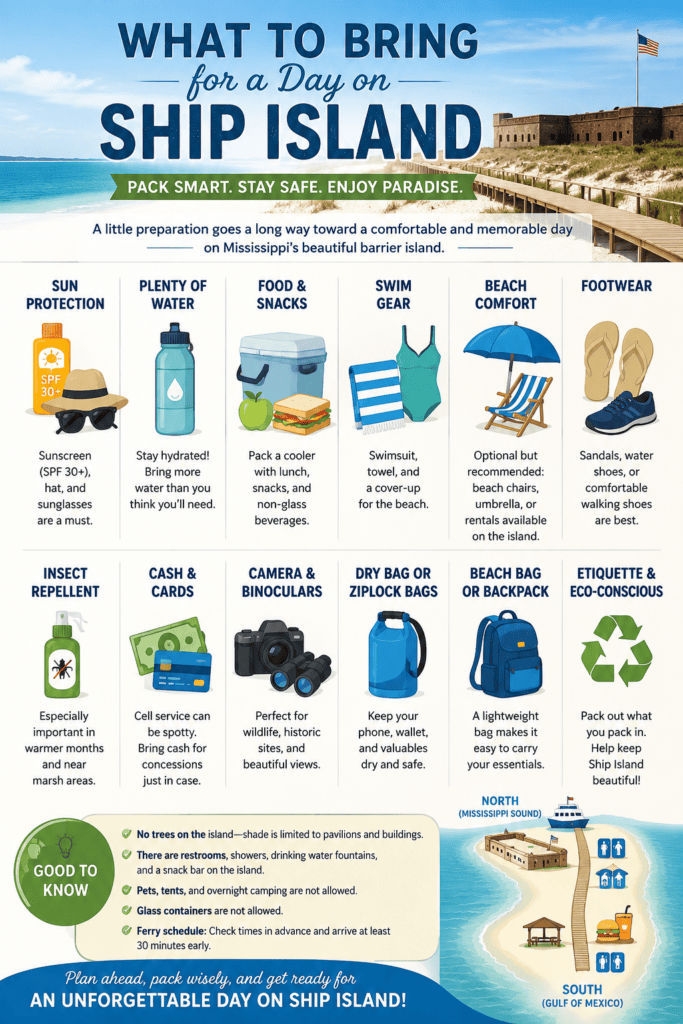
What Should You Bring to Ship Island?
Ship Island is one of Mississippi’s most beautiful destinations, but it is also a barrier island located approximately eleven miles offshore. While modern visitor facilities make spending the day comfortable, you’ll enjoy your visit much more if you arrive prepared.
Unlike a typical beach along the mainland, there are no convenience stores, pharmacies, or shopping centers just down the street. Bringing a few essential items can make the difference between a good day and a great one.
Plenty of Drinking Water
The number one item every visitor should bring is water.
Mississippi’s summer temperatures often climb into the 90s, and the combination of bright white sand, Gulf sunshine, and sea breezes can cause dehydration before you realize it.
Although drinking fountains are available near the visitor facilities, carrying extra bottled water is highly recommended.
Sunscreen
The Gulf sun is powerful.
Because there are very few trees on Ship Island, visitors spend much of the day in direct sunlight. Apply sunscreen before boarding the ferry and reapply it throughout the day, especially after swimming.
A broad-spectrum sunscreen with an SPF of 30 or higher is recommended.
Hat and Sunglasses
A wide-brimmed hat and polarized sunglasses make a tremendous difference.
Besides protecting you from harmful UV rays, polarized lenses reduce glare from the water, making it easier to spot dolphins, fish, birds, and other marine life.
Comfortable Footwear
You’ll spend much of the day walking.
Comfortable sandals, water shoes, or lightweight athletic shoes work well depending on your plans. If you intend to explore Fort Massachusetts, shoes with good traction are recommended.
Swimsuit and Towel
Even visitors planning to tour the fort often find themselves tempted by the beautiful Gulf waters.
Packing a swimsuit and towel gives you the flexibility to enjoy both the historical attractions and one of Mississippi’s finest beaches.
Camera or Binoculars
Ship Island offers outstanding opportunities for photography.
Common subjects include:
- Bottlenose dolphins
- Brown pelicans
- Fort Massachusetts
- White sand beaches
- Beautiful sunsets
- Shorebirds
- Ferry crossings
Binoculars are especially useful for birdwatching and spotting wildlife offshore.
Snacks or a Picnic Lunch
Although concessions are available during the operating season, many visitors prefer bringing their own lunch.
Soft-sided coolers are easier to carry than large hard-sided coolers, especially since everything must be transported by foot after leaving the ferry.
Lightweight Beach Bag or Backpack
Since vehicles are not permitted beyond the ferry landing, you’ll carry everything yourself.
A lightweight backpack or beach bag makes moving between the fort, picnic areas, and beach much easier.
Fishing Gear (If You Plan to Fish)
Anglers should remember:
- Rod and reel
- Tackle
- Bait
- Valid Mississippi saltwater fishing license
- Needle-nose pliers
- Small tackle bag
Remember that fishing is permitted from the beaches but not from the passenger ferry pier.
Don’t Forget Your Sense of Adventure
Perhaps the most important thing to bring isn’t something you can pack.
Ship Island offers a chance to experience Mississippi much as it appeared centuries ago. Whether you’re walking through Fort Massachusetts, watching dolphins alongside the ferry, or simply listening to the waves roll onto the beach, slow down and enjoy the experience.
It’s one of the few places along the Gulf Coast where history, wildlife, and natural beauty come together so perfectly.
🎒 RetireCoast Pro Tip
Travel light. Everything you bring must be carried from the ferry, across the boardwalk, and back again at the end of the day. A backpack, reusable water bottle, towel, sunscreen, hat, sunglasses, and your camera are usually all you need for an unforgettable visit. If you’re arriving by private boat, you’ll have a little more flexibility—but even then, keeping your gear simple lets you spend more time enjoying the island and less time hauling equipment.
Nearby Barrier Islands Worth Exploring
One of the best reasons to visit Ship Island is that it serves as a gateway to the rest of Mississippi’s remarkable barrier island chain.
Stretching nearly 70 miles across the northern Gulf of Mexico, these islands protect the Mississippi mainland from storms while offering visitors dramatically different experiences. Some are easily reached by ferry, while others reward adventurous boaters with secluded beaches, primitive camping, world-class fishing, and abundant wildlife.
If Ship Island leaves you wanting more—and for many visitors it does—consider exploring these neighboring islands on your next trip.
Horn Island – Mississippi’s Wilderness Island
Horn Island is the largest and wildest of Mississippi’s barrier islands.
Unlike Ship Island, there is no ferry service, no concession stand, and no developed visitor facilities. The island is known for its pristine beaches, maritime forests, freshwater ponds, and rich artistic legacy as the favorite retreat of renowned Mississippi artist Walter Anderson.
Visitors arrive by private boat, kayak, or charter to enjoy:
- Primitive camping
- Excellent fishing
- Birdwatching
- Photography
- Kayaking
- Exploring one of the Gulf Coast’s last true wilderness islands
Horn Island is ideal for visitors seeking solitude and adventure.
Cat Island – A Fisherman’s Paradise
Located west of Ship Island, Cat Island is instantly recognizable by its distinctive T-shaped shoreline.
The island offers outstanding fishing, quiet anchorages, and beautiful beaches. Because much of the island is privately owned, visitors should respect private property while enjoying the surrounding beaches and public waters.
Cat Island is especially popular with:
- Anglers
- Boaters
- Birdwatchers
- Nature photographers
- Families seeking quieter beaches
Deer Island – The Closest Barrier Island
Just offshore from Biloxi, Deer Island is the easiest Mississippi barrier island to reach without a boat.
Many visitors kayak or paddleboard across the narrow channel, while others arrive by small boat. Its close proximity to Biloxi’s casinos, restaurants, and hotels makes it a popular destination for day trips.
Activities include:
- Beachcombing
- Kayaking
- Paddleboarding
- Fishing
- Primitive camping (where permitted)
- Watching spectacular sunsets over Biloxi
Petit Bois Island – Remote Natural Beauty
Located east of Horn Island near the Alabama state line, Petit Bois Island offers one of the most secluded experiences in the Gulf Islands National Seashore.
The island is largely undeveloped and attracts experienced boaters, campers, birdwatchers, and anglers looking for a true backcountry adventure.
Visitors often encounter:
- Empty beaches
- Nesting shorebirds
- Dolphins
- Exceptional fishing
- Incredible stargazing
Because there are no visitor services, careful planning is essential.
The Sunken Isle of Caprice
Although no longer visible above the water, the Isle of Caprice remains one of the Gulf Coast’s most fascinating historical destinations.
Located approximately seven miles east of Ship Island, the former Prohibition-era resort now lies beneath just a few feet of water. On calm days, private boaters often anchor over the shallow shoal and wade in waist-deep water while imagining the casinos, dance halls, hotels, and boardwalks that once stood there.
It’s one of the Mississippi Gulf Coast’s most unusual adventures—and one few visitors ever discover.
Every Island Has Its Own Personality
While all of Mississippi’s barrier islands share beautiful beaches and abundant wildlife, each offers a completely different experience.
| Island | Best Known For |
|---|---|
| Ship Island | Ferry access, Fort Massachusetts, swimming, family-friendly beaches |
| Horn Island | Wilderness, camping, Walter Anderson, freshwater ponds |
| Cat Island | Outstanding fishing, unique T-shaped geography, quiet anchorages |
| Deer Island | Easy access from Biloxi, kayaking, paddleboarding, sunsets |
| Petit Bois Island | Remote beaches, camping, wildlife, solitude |
| Isle of Caprice | Sunken Prohibition resort, boating adventure, fascinating history |
🏝️ RetireCoast Recommendation
Don’t stop with just one island. Each Mississippi barrier island offers a completely different adventure, from touring Fort Massachusetts on Ship Island to camping beneath the stars on Horn Island, fishing the waters around Cat Island, paddling to Deer Island from Biloxi, exploring the remote beauty of Petit Bois, or standing on the submerged sands of the legendary Isle of Caprice. Together, they tell one of the most fascinating stories on the Gulf Coast—and each is well worth discovering.
Explore the complete RetireCoast Mississippi Barrier Islands Guide Series to plan your next island adventure.
Why Ship Island Should Be on Your Bucket List
Some destinations are worth visiting because they’re beautiful. Others are worth visiting because they’re historic. Ship Island is one of the rare places where you can experience both in a single day.
Just an hour by ferry from Gulfport, you’ll find yourself on an island that feels worlds away from the busy mainland. Powder-soft white sand stretches for miles, emerald Gulf waters invite you for a swim, dolphins often escort the ferry, and one of the Gulf Coast’s best-preserved historic forts overlooks it all.
Whether you’re a history enthusiast, beach lover, angler, photographer, or simply someone looking to relax, Ship Island offers an experience unlike anywhere else along the Mississippi Gulf Coast.
A Place Where History Comes Alive
Walking through Fort Massachusetts isn’t like reading about history in a textbook.
Here, you can stand inside massive brick casemates, climb historic walls, and look across the same waters once traveled by French explorers, Spanish ships, Civil War naval forces, and generations of Gulf Coast fishermen. Few destinations combine military history, maritime heritage, and natural beauty so seamlessly.
One of the Gulf Coast’s Most Beautiful Beaches
Ship Island’s beaches consistently surprise first-time visitors.
The brilliant white sand, clear Gulf waters, and wide-open shoreline rival beaches found anywhere along the northern Gulf of Mexico. Even during the busy summer season, it’s easy to find a quiet stretch of beach where you can relax, swim, or simply listen to the waves.
Wildlife Around Every Corner
The journey to Ship Island is often as memorable as the destination itself.
Bottlenose dolphins frequently swim alongside the ferry, pelicans dive for fish just offshore, and migratory birds use the island as an important stop along the Mississippi Flyway. Every season offers something new for nature lovers and photographers.
An Adventure That’s Easy to Reach
Unlike many barrier islands that require private boats or specialized equipment, Ship Island is accessible to almost everyone.
Regular ferry service from Gulfport makes it possible for families, couples, solo travelers, and visitors of all ages to enjoy a true barrier island adventure without owning a boat. It’s one of the easiest ways to experience the protected wilderness of the Gulf Islands National Seashore.
The Perfect Starting Point for Exploring Mississippi’s Barrier Islands
Many visitors discover that one trip to Ship Island sparks a desire to see the rest of Mississippi’s barrier islands.
From the wilderness of Horn Island and the exceptional fishing around Cat Island to the easy access of Deer Island, the remote beauty of Petit Bois Island, and the fascinating underwater history of the Isle of Caprice, each island offers its own unique adventure.
Ship Island is often where that journey begins.
⭐ RetireCoast Final Thought
If you’re planning a trip to the Mississippi Gulf Coast, don’t spend all of your time on the mainland. Set aside a day for Ship Island and discover why generations of visitors return year after year. Between the historic fort, pristine beaches, abundant wildlife, and peaceful Gulf scenery, you’ll experience a side of Mississippi that many travelers never see. And once you’ve explored Ship Island, chances are you’ll already be planning your next adventure to another island in the Mississippi Barrier Islands Guide Series.
Add Ship Island to Your Bucket List
Whether you’re checking off a lifelong dream of visiting a historic coastal fort, searching for one of the Gulf Coast’s most beautiful beaches, or planning your first barrier island adventure, Ship Island deserves a place on your bucket list.
Come for the history. Stay for the beaches. Return for the memories. Ship Island is more than a destination—it’s an experience that captures the very best of Mississippi’s Gulf Coast.
🏝️ Ship Island Guide Quiz
Think you’ve mastered Mississippi’s most famous barrier island? Take this short quiz to test your knowledge. Don’t worry—you can’t fail! If you miss a few questions, simply scroll back through the guide and discover something new.
References
The following references were used to verify the historical, geographical, ecological, and visitor information presented in this guide. These resources provide authoritative information about Ship Island, Fort Massachusetts, the Gulf Islands National Seashore, and Mississippi’s barrier islands.
National Park Service
National Park Service. Gulf Islands National Seashore.
https://www.nps.gov/guis/
National Park Service. Ship Island.
https://www.nps.gov/guis/planyourvisit/ship-island.htm
National Park Service. Fort Massachusetts.
https://www.nps.gov/guis/learn/historyculture/fort-massachusetts.htm
National Park Service. Camping Regulations – Gulf Islands National Seashore.
https://www.nps.gov/guis/planyourvisit/camping.htm
U.S. Army Corps of Engineers
U.S. Army Corps of Engineers. Mississippi Coastal Improvements Program (MsCIP) – Barrier Island Restoration.
https://www.mvn.usace.army.mil/
Mississippi Department of Marine Resources
Mississippi Department of Marine Resources. Coastal Resources and Barrier Islands.
https://dmr.ms.gov/
Mississippi Department of Wildlife, Fisheries, and Parks
Mississippi Department of Wildlife, Fisheries, and Parks. Saltwater Fishing Regulations.
https://www.mdwfp.com/
NOAA
National Oceanic and Atmospheric Administration (NOAA). National Ocean Service.
https://oceanservice.noaa.gov/
NOAA National Weather Service. Hurricane History and Gulf Coast Weather.
https://www.weather.gov/
NOAA Fisheries. Marine Mammals of the Gulf of Mexico.
https://www.fisheries.noaa.gov/
U.S. Fish & Wildlife Service
U.S. Fish & Wildlife Service. Migratory Bird Program.
https://www.fws.gov/program/migratory-birds
Mississippi Secretary of State
Mississippi Secretary of State. Mississippi History and Historic Preservation Resources.
https://www.sos.ms.gov/
Mississippi Department of Archives and History
Mississippi Department of Archives and History. Fort Massachusetts and Mississippi Coastal History.
https://www.mdah.ms.gov/
Ship Island Excursions
Ship Island Excursions. Official Ferry Information, Schedules, and Visitor Services.
https://msshipisland.com/
Library of Congress
Library of Congress. Historic Maps and Gulf Coast Maritime History Collections.
https://www.loc.gov/
U.S. Geological Survey
U.S. Geological Survey. Barrier Island Geology and Coastal Change.
https://www.usgs.gov/
Additional Historical Resources
- National Park Service Historic Resource Studies
- U.S. Army Corps of Engineers historical engineering records
- Mississippi Gulf Coast historical archives
- Spanish Colonial records relating to Bernardo de Gálvez and the American Revolution
- Civil War military records documenting the defense and occupation of Ship Island
- Gulf Islands National Seashore educational publications
About This Guide
This guide combines information from federal and state agencies, historical records, scientific publications, and decades of local knowledge to provide one of the most comprehensive resources available on Ship Island.
While every effort has been made to ensure accuracy, ferry schedules, visitor services, regulations, weather conditions, and park operations may change. Visitors should always consult the National Park Service and Ship Island Excursions for the latest operating information before planning their trip.
These answers cover many of the questions first-time visitors ask when planning a ferry trip, beach day, fishing adventure, or private-boat visit to Ship Island.
Is Ship Island worth visiting?
Yes. Ship Island combines white-sand beaches, Gulf swimming, wildlife, ferry sightseeing, and a visit to historic Fort Massachusetts in one day.
It is one of the easiest Mississippi barrier islands to visit because regularly scheduled ferry service is available from Gulfport during the operating season.
How do visitors get to Ship Island?
Most visitors take the passenger ferry from Gulfport Small Craft Harbor. The trip across the Mississippi Sound generally takes about one hour.
Visitors may also arrive by private boat. There is no bridge or automobile access to the island.
How long should I spend on Ship Island?
A full-day visit provides enough time to tour Fort Massachusetts, walk to the Gulf beach, swim, eat lunch, watch wildlife, and relax before the return ferry.
A shorter visit can still be enjoyable, but ferry schedules determine how much time passengers have on the island.
Can I choose any ferry back to Gulfport?
Return procedures can vary by schedule and ticket type. Passengers should confirm their assigned or available return departure when checking in.
During busy periods, visitors should not assume that every return ferry will have space available.
Should ferry tickets be purchased in advance?
Advance reservations are strongly recommended, especially on weekends, holidays, and during the summer vacation season.
Weather, maintenance, or operating conditions may affect departures, so confirm current information with Ship Island Excursions before traveling.
Can I bring food and drinks to Ship Island?
Visitors may bring food, snacks, water, and a manageable cooler. Soft-sided coolers and backpacks are usually easier to carry from the ferry to the beach.
Bring more drinking water than you think you will need, particularly during hot and humid summer weather.
Is food available on the island?
Seasonal concessions may sell meals, snacks, and cold drinks near the developed visitor area.
Availability and hours can change, so visitors who have dietary restrictions or specific needs should bring their own food.
Are restrooms and showers available?
Restrooms, changing areas, and outdoor rinse-off showers are generally available within the developed visitor area during the operating season.
Facilities may be limited outside normal ferry operations or following storms, maintenance, or seasonal closures.
Can visitors tour Fort Massachusetts?
Yes. Fort Massachusetts is one of the primary attractions on Ship Island and can generally be explored during a visit.
Ranger programs or guided tours may be offered depending on staffing, weather, and seasonal operations.
Is the water safe for swimming?
The Gulf-side beach is a popular swimming destination, but visitors must evaluate current water, surf, weather, and marine conditions before entering.
Watch children closely, avoid swimming during thunderstorms or hazardous surf, and follow all posted National Park Service warnings.
Are there lifeguards on Ship Island?
Visitors should never assume a lifeguard is present. Staffing and supervised swimming areas may vary by season and operating conditions.
Check posted signs when you arrive and remain responsible for your own safety and the safety of children in your group.
Are alligators found on Ship Island?
Alligators are not commonly encountered in the developed beach and ferry areas of Ship Island. The island does not have the extensive freshwater pond habitat found on Horn Island.
Wild animals can occasionally appear in unexpected coastal locations, so visitors should never approach, feed, or disturb any wildlife.
What wildlife might visitors see?
Bottlenose dolphins are often seen during the ferry crossing. Visitors may also see brown pelicans, gulls, terns, herons, egrets, shorebirds, ghost crabs, rays, and numerous fish species.
Sea turtles use Gulf Coast waters and beaches, although sightings are less predictable.
Can I fish from Ship Island?
Fishing is popular from the beaches and surrounding waters. Anglers catch species such as speckled trout, redfish, flounder, pompano, whiting, Spanish mackerel, and sheepshead.
A valid Mississippi saltwater fishing license may be required. Fishing may be prohibited from the passenger dock or other designated areas.
Can visitors camp on Ship Island?
Camping rules differ among the Mississippi barrier islands and may change because of restoration work, wildlife protection, storms, or park operations.
Do not plan to camp on Ship Island without first confirming the current National Park Service regulations and permitted locations.
Are pets allowed on Ship Island?
Pets may be restricted on passenger ferries, developed visitor areas, beaches, or protected wildlife habitat.
Confirm both ferry-company and National Park Service rules before bringing an animal.
Can I bring a beach tent, umbrella, or chair?
Visitors may generally bring manageable beach equipment, provided it complies with ferry and National Park Service rules.
Remember that every item must be carried from the ferry landing to the beach and back again. Lightweight chairs and compact shade equipment are the easiest choices.
Is there natural shade on Ship Island?
Natural shade is extremely limited because the developed portion of the island has few large trees.
Covered picnic areas may provide some relief, but visitors should bring a hat, sunscreen, protective clothing, and permitted shade equipment.
Is Ship Island accessible for visitors with mobility limitations?
The ferry, dock, boardwalk, fort, sand, and changing tides can create accessibility challenges. Some developed areas may offer accessible features, but conditions vary.
Contact Ship Island Excursions and the National Park Service before traveling to discuss boarding assistance, wheelchairs, beach access, and current facility conditions.
Is cell phone service available?
Cellular service may work in some locations, but coverage can be weak or inconsistent offshore.
Download tickets and important information before departure, and do not depend entirely on your phone for navigation or emergency communication.
What should I bring for a day on Ship Island?
- Ferry tickets or reservation confirmation
- Drinking water
- Sunscreen
- Hat and sunglasses
- Swimsuit and towel
- Comfortable footwear
- Food or snacks
- Lightweight beach bag or backpack
- Camera or binoculars
- Necessary medications
What is the best time of year to visit?
Late spring through early fall offers the warmest beach and swimming conditions. Summer provides the most traditional island experience but can also bring high heat, humidity, crowds, and afternoon thunderstorms.
Spring and fall often provide pleasant temperatures, excellent birdwatching, and fewer visitors. Ferry availability may be more limited outside peak season.
What happens if the weather becomes bad?
Ferry trips may be delayed, modified, or canceled because of thunderstorms, high winds, rough seas, tropical weather, or other safety concerns.
Check the forecast and ferry status before leaving home. Follow crew and National Park Service instructions if conditions change while you are on the island.
Can private boaters visit other barrier islands during the same trip?
Experienced boaters sometimes combine Ship Island with Cat Island, Horn Island, Petit Bois Island, Deer Island, or the submerged Isle of Caprice shoal.
Distances, water depth, currents, changing sandbars, weather, fuel range, and navigation hazards must all be considered before attempting a multi-island trip.
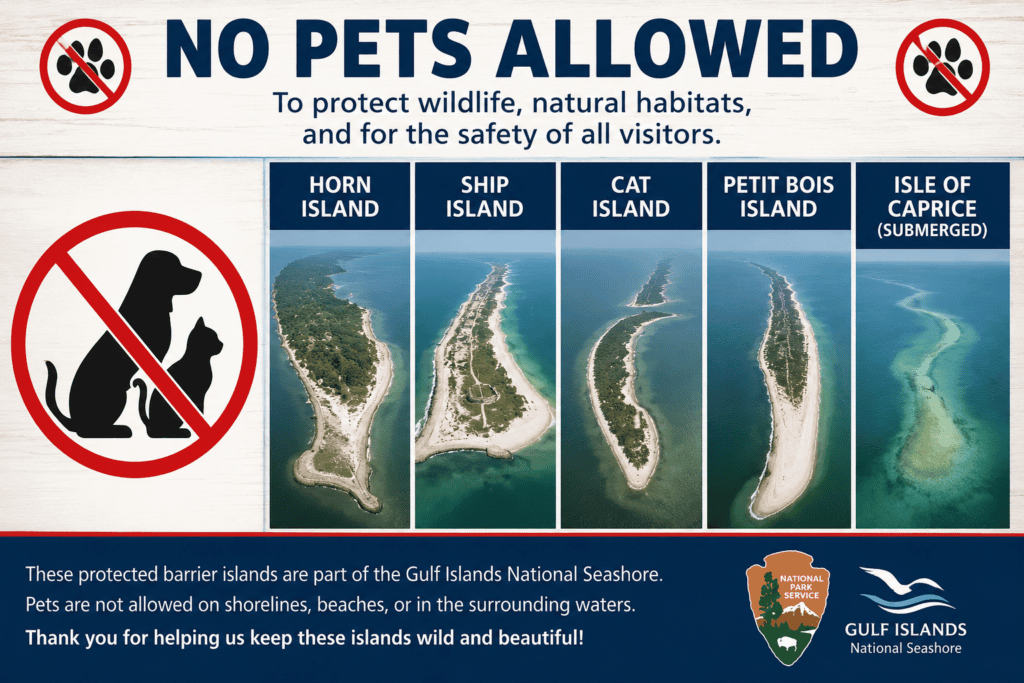
Discover more from RetireCoast.com
Subscribe to get the latest posts sent to your email.